Boundary Detection:
Hough Transform
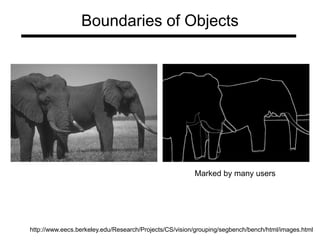
Boundaries of Objects
Marked by many users
http://www.eecs.berkeley.edu/Research/Projects/CS/vision/grouping/segbench/bench/html/images.html
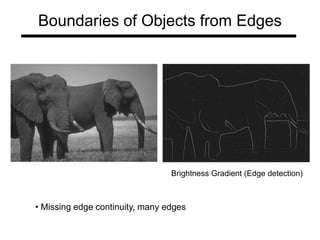
Boundaries of Objects from Edges
Brightness Gradient (Edge detection)
• Missing edge continuity, many edges
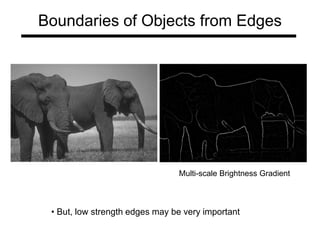
Boundaries of Objects from Edges
Multi-scale Brightness Gradient
• But, low strength edges may be very important
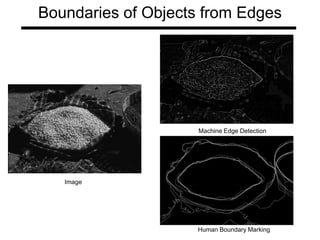
Boundaries of Objects from Edges
Image
Machine Edge Detection
Human Boundary Marking
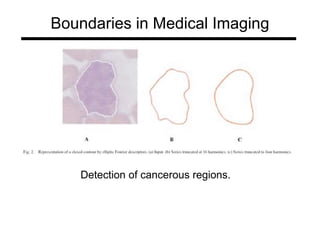
Boundaries in Medical Imaging
Detection of cancerous regions.
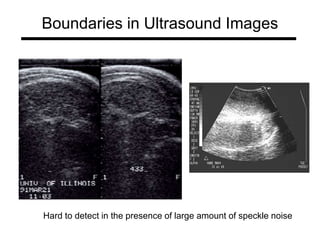
Boundaries in Ultrasound Images
Hard to detect in the presence of large amount of speckle noise
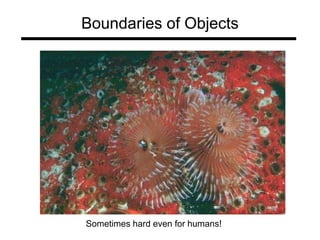
Boundaries of Objects
Sometimes hard even for humans!
Topics
• Preprocessing Edge Images
• Edge Tracking Methods
• Fitting Lines and Curves to Edges
• The Hough Transform
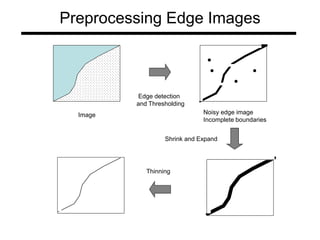
Preprocessing Edge Images
Image
Edge detection
and Thresholding
Noisy edge image
Incomplete boundaries
Shrink and Expand
Thinning
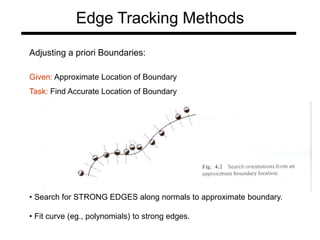
Edge Tracking Methods
Adjusting a priori Boundaries:
Given: Approximate Location of Boundary
Task: Find Accurate Location of Boundary
• Search for STRONG EDGES along normals to approximate boundary.
• Fit curve (eg., polynomials) to strong edges.
Edge Tracking Methods
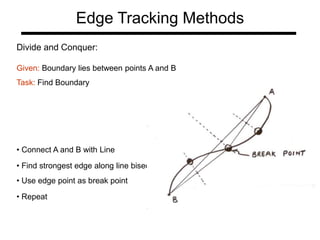
Divide and Conquer:
Given: Boundary lies between points A and B
Task: Find Boundary
• Connect A and B with Line
• Find strongest edge along line bisector
• Use edge point as break point
• Repeat
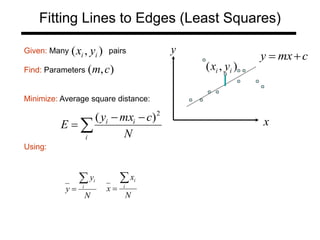
Fitting Lines to Edges (Least Squares)
c
mx
y 

)
,
( i
i y
x
y
x
Given: Many pairs
Find: Parameters
Minimize: Average square distance:
Using:
)
,
( i
i y
x
)
,
( c
m




i
i
i
N
c
mx
y
E
2
)
(
N
y
y i
i


N
x
x i
i


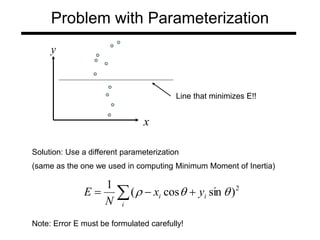
Problem with Parameterization
y
x
Line that minimizes E!!
Solution: Use a different parameterization
(same as the one we used in computing Minimum Moment of Inertia)
Note: Error E must be formulated carefully!
 


i
i
i y
x
N
E 2
)
sin
cos
(
1



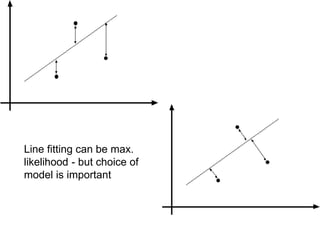
Line fitting can be max.
likelihood - but choice of
model is important
Curve Fitting
y
x
Find Polynomial:
that best fits the given points
Minimize:
Using:
Note: is LINEAR in the parameters (a, b, c, d)
)
,
( i
i y
x
d
cx
bx
ax
x
f
y 



 2
3
)
(
 



i
i
i
i
i d
cx
bx
ax
y
N
2
2
3
)]
(
[
1
0
,
0
,
0
,
0 











d
E
c
E
b
E
a
E
)
(x
f
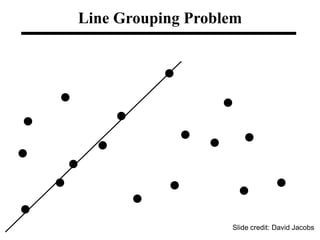
Line Grouping Problem
Slide credit: David Jacobs
This is difficult because of:
• Extraneous data: clutter or multiple models
– We do not know what is part of the model?
– Can we pull out models with a few parts from much
larger amounts of background clutter?
• Missing data: only some parts of model are present
• Noise
• Cost:
– It is not feasible to check all combinations of features
by fitting a model to each possible subset
Hough Transform
• Elegant method for direct object recognition
• Edges need not be connected
• Complete object need not be visible
• Key Idea: Edges VOTE for the possible model
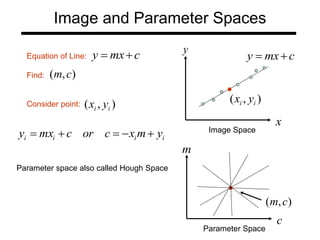
Image and Parameter Spaces
c
mx
y 

)
,
( i
i y
x
y
x
Equation of Line:
Find:
Consider point:
c
mx
y 

)
,
( c
m
)
,
( i
i y
x
i
i
i
i y
m
x
c
or
c
mx
y 




m
c
)
,
( c
m
Image Space
Parameter Space
Parameter space also called Hough Space
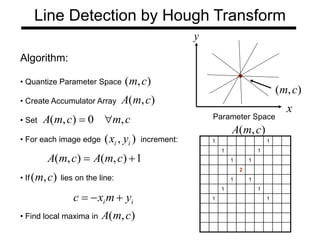
Line Detection by Hough Transform
y
x
)
,
( c
m
Parameter Space
1 1
1 1
1 1
2
1 1
1 1
1 1
)
,
( c
m
A
Algorithm:
• Quantize Parameter Space
• Create Accumulator Array
• Set
• For each image edge increment:
• If lies on the line:
• Find local maxima in
)
,
( c
m
)
,
( c
m
A
c
m
c
m
A ,
0
)
,
( 

)
,
( i
i y
x
1
)
,
(
)
,
( 
 c
m
A
c
m
A
)
,
( c
m
)
,
( c
m
A
i
i y
m
x
c 


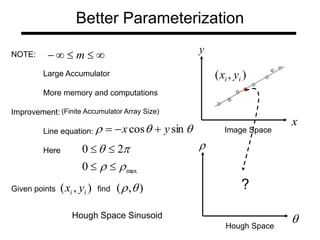
Better Parameterization
NOTE:
Large Accumulator
More memory and computations
Improvement:
Line equation:
Here
Given points find




 m


 sin
cos y
x 


max
0
2
0








(Finite Accumulator Array Size)
)
,
( i
i y
x )
,
( 

)
,
( i
i y
x
y
x
Image Space


Hough Space
?
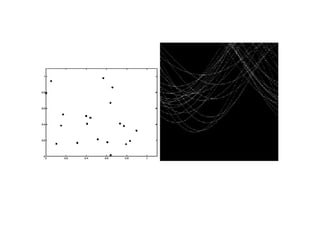
Hough Space Sinusoid
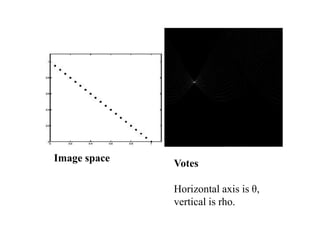
Image space
Votes
Horizontal axis is θ,
vertical is rho.
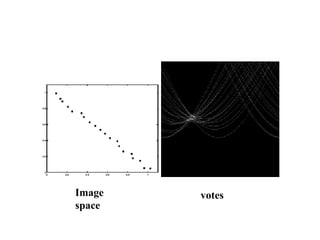
Image
space
votes
Mechanics of the Hough transform
• Difficulties
– how big should the cells
be? (too big, and we
merge quite different lines;
too small, and noise
causes lines to be missed)
• How many lines?
– Count the peaks in the
Hough array
– Treat adjacent peaks as
a single peak
• Which points belong to each
line?
– Search for points close to
the line
– Solve again for line and
iterate
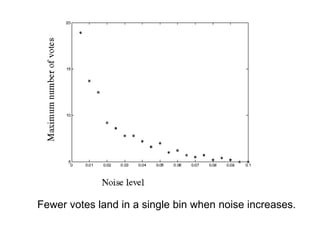
Fewer votes land in a single bin when noise increases.
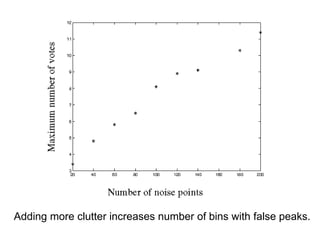
Adding more clutter increases number of bins with false peaks.
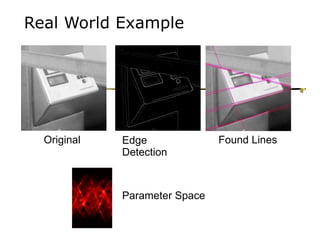
Real World Example
Original Edge
Detection
Found Lines
Parameter Space
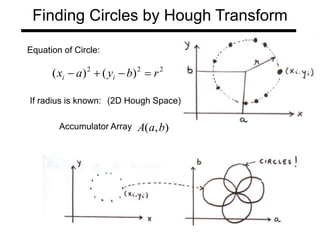
Finding Circles by Hough Transform
Equation of Circle:
2
2
2
)
(
)
( r
b
y
a
x i
i 



If radius is known:
)
,
( b
a
A
Accumulator Array
(2D Hough Space)
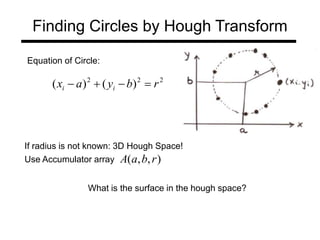
Finding Circles by Hough Transform
Equation of Circle:
2
2
2
)
(
)
( r
b
y
a
x i
i 



If radius is not known: 3D Hough Space!
Use Accumulator array )
,
,
( r
b
a
A
What is the surface in the hough space?
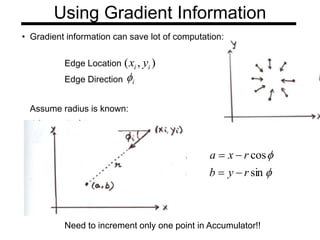
Using Gradient Information
• Gradient information can save lot of computation:
Edge Location
Edge Direction
Need to increment only one point in Accumulator!!
i

)
,
( i
i y
x
Assume radius is known:


sin
cos
r
y
b
r
x
a




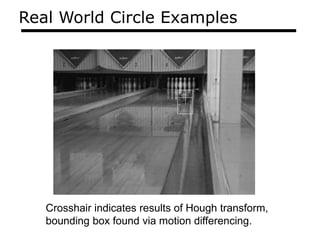
Real World Circle Examples
Crosshair indicates results of Hough transform,
bounding box found via motion differencing.
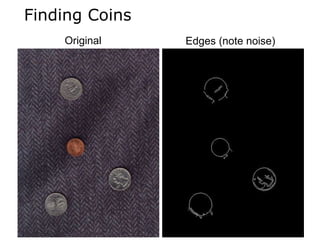
Finding Coins
Original Edges (note noise)
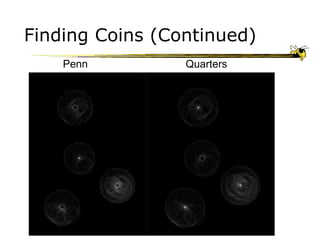
Finding Coins (Continued)
Penn
y
Quarters
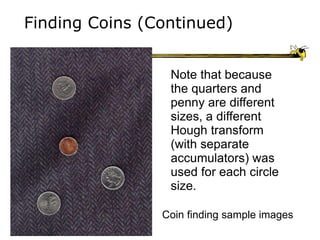
Finding Coins (Continued)
Coin finding sample images
Note that because
the quarters and
penny are different
sizes, a different
Hough transform
(with separate
accumulators) was
used for each circle
size.
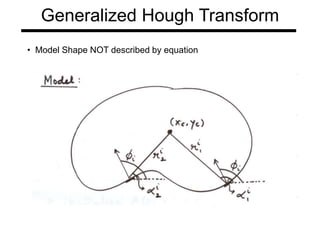
Generalized Hough Transform
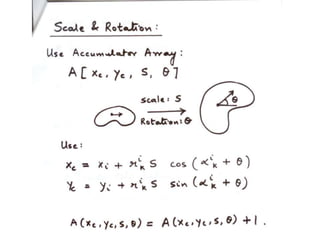
• Model Shape NOT described by equation
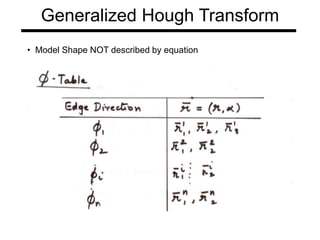
Generalized Hough Transform
• Model Shape NOT described by equation
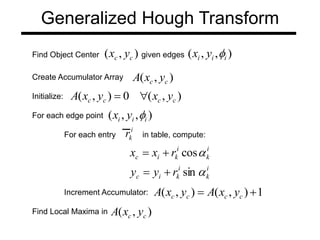
Generalized Hough Transform
Find Object Center given edges
Create Accumulator Array
Initialize:
For each edge point
For each entry in table, compute:
Increment Accumulator:
Find Local Maxima in
)
,
( c
c y
x
A
)
,
(
0
)
,
( c
c
c
c y
x
y
x
A 

)
,
,
( i
i
i y
x 
1
)
,
(
)
,
( 
 c
c
c
c y
x
A
y
x
A
)
,
( c
c y
x
A
i
k
i
k
i
c
i
k
i
k
i
c
r
y
y
r
x
x


sin
cos




i
k
r
)
,
( c
c y
x )
,
,
( i
i
i y
x 
Hough Transform: Comments
• Works on Disconnected Edges
• Relatively insensitive to occlusion
• Effective for simple shapes (lines, circles, etc)
• Trade-off between work in Image Space and Parameter Space
• Handling inaccurate edge locations:
• Increment Patch in Accumulator rather than a single point

cv1.ppt

  • 1.
  • 2.
    Boundaries of Objects Markedby many users http://www.eecs.berkeley.edu/Research/Projects/CS/vision/grouping/segbench/bench/html/images.html
  • 3.
    Boundaries of Objectsfrom Edges Brightness Gradient (Edge detection) • Missing edge continuity, many edges
  • 4.
    Boundaries of Objectsfrom Edges Multi-scale Brightness Gradient • But, low strength edges may be very important
  • 5.
    Boundaries of Objectsfrom Edges Image Machine Edge Detection Human Boundary Marking
  • 6.
    Boundaries in MedicalImaging Detection of cancerous regions.
  • 7.
    Boundaries in UltrasoundImages Hard to detect in the presence of large amount of speckle noise
  • 8.
    Boundaries of Objects Sometimeshard even for humans!
  • 9.
    Topics • Preprocessing EdgeImages • Edge Tracking Methods • Fitting Lines and Curves to Edges • The Hough Transform
  • 10.
    Preprocessing Edge Images Image Edgedetection and Thresholding Noisy edge image Incomplete boundaries Shrink and Expand Thinning
  • 11.
    Edge Tracking Methods Adjustinga priori Boundaries: Given: Approximate Location of Boundary Task: Find Accurate Location of Boundary • Search for STRONG EDGES along normals to approximate boundary. • Fit curve (eg., polynomials) to strong edges.
  • 12.
    Edge Tracking Methods Divideand Conquer: Given: Boundary lies between points A and B Task: Find Boundary • Connect A and B with Line • Find strongest edge along line bisector • Use edge point as break point • Repeat
  • 13.
    Fitting Lines toEdges (Least Squares) c mx y   ) , ( i i y x y x Given: Many pairs Find: Parameters Minimize: Average square distance: Using: ) , ( i i y x ) , ( c m     i i i N c mx y E 2 ) ( N y y i i   N x x i i  
  • 14.
    Problem with Parameterization y x Linethat minimizes E!! Solution: Use a different parameterization (same as the one we used in computing Minimum Moment of Inertia) Note: Error E must be formulated carefully!     i i i y x N E 2 ) sin cos ( 1   
  • 15.
    Line fitting canbe max. likelihood - but choice of model is important
  • 16.
    Curve Fitting y x Find Polynomial: thatbest fits the given points Minimize: Using: Note: is LINEAR in the parameters (a, b, c, d) ) , ( i i y x d cx bx ax x f y      2 3 ) (      i i i i i d cx bx ax y N 2 2 3 )] ( [ 1 0 , 0 , 0 , 0             d E c E b E a E ) (x f
  • 17.
    Line Grouping Problem Slidecredit: David Jacobs
  • 18.
    This is difficultbecause of: • Extraneous data: clutter or multiple models – We do not know what is part of the model? – Can we pull out models with a few parts from much larger amounts of background clutter? • Missing data: only some parts of model are present • Noise • Cost: – It is not feasible to check all combinations of features by fitting a model to each possible subset
  • 19.
    Hough Transform • Elegantmethod for direct object recognition • Edges need not be connected • Complete object need not be visible • Key Idea: Edges VOTE for the possible model
  • 20.
    Image and ParameterSpaces c mx y   ) , ( i i y x y x Equation of Line: Find: Consider point: c mx y   ) , ( c m ) , ( i i y x i i i i y m x c or c mx y      m c ) , ( c m Image Space Parameter Space Parameter space also called Hough Space
  • 21.
    Line Detection byHough Transform y x ) , ( c m Parameter Space 1 1 1 1 1 1 2 1 1 1 1 1 1 ) , ( c m A Algorithm: • Quantize Parameter Space • Create Accumulator Array • Set • For each image edge increment: • If lies on the line: • Find local maxima in ) , ( c m ) , ( c m A c m c m A , 0 ) , (   ) , ( i i y x 1 ) , ( ) , (   c m A c m A ) , ( c m ) , ( c m A i i y m x c   
  • 22.
    Better Parameterization NOTE: Large Accumulator Morememory and computations Improvement: Line equation: Here Given points find      m    sin cos y x    max 0 2 0         (Finite Accumulator Array Size) ) , ( i i y x ) , (   ) , ( i i y x y x Image Space   Hough Space ? Hough Space Sinusoid
  • 23.
    Image space Votes Horizontal axisis θ, vertical is rho.
  • 24.
  • 26.
    Mechanics of theHough transform • Difficulties – how big should the cells be? (too big, and we merge quite different lines; too small, and noise causes lines to be missed) • How many lines? – Count the peaks in the Hough array – Treat adjacent peaks as a single peak • Which points belong to each line? – Search for points close to the line – Solve again for line and iterate
  • 27.
    Fewer votes landin a single bin when noise increases.
  • 28.
    Adding more clutterincreases number of bins with false peaks.
  • 29.
    Real World Example OriginalEdge Detection Found Lines Parameter Space
  • 30.
    Finding Circles byHough Transform Equation of Circle: 2 2 2 ) ( ) ( r b y a x i i     If radius is known: ) , ( b a A Accumulator Array (2D Hough Space)
  • 31.
    Finding Circles byHough Transform Equation of Circle: 2 2 2 ) ( ) ( r b y a x i i     If radius is not known: 3D Hough Space! Use Accumulator array ) , , ( r b a A What is the surface in the hough space?
  • 32.
    Using Gradient Information •Gradient information can save lot of computation: Edge Location Edge Direction Need to increment only one point in Accumulator!! i  ) , ( i i y x Assume radius is known:   sin cos r y b r x a    
  • 33.
    Real World CircleExamples Crosshair indicates results of Hough transform, bounding box found via motion differencing.
  • 34.
  • 35.
  • 36.
    Finding Coins (Continued) Coinfinding sample images Note that because the quarters and penny are different sizes, a different Hough transform (with separate accumulators) was used for each circle size.
  • 37.
    Generalized Hough Transform •Model Shape NOT described by equation
  • 38.
    Generalized Hough Transform •Model Shape NOT described by equation
  • 39.
    Generalized Hough Transform FindObject Center given edges Create Accumulator Array Initialize: For each edge point For each entry in table, compute: Increment Accumulator: Find Local Maxima in ) , ( c c y x A ) , ( 0 ) , ( c c c c y x y x A   ) , , ( i i i y x  1 ) , ( ) , (   c c c c y x A y x A ) , ( c c y x A i k i k i c i k i k i c r y y r x x   sin cos     i k r ) , ( c c y x ) , , ( i i i y x 
  • 41.
    Hough Transform: Comments •Works on Disconnected Edges • Relatively insensitive to occlusion • Effective for simple shapes (lines, circles, etc) • Trade-off between work in Image Space and Parameter Space • Handling inaccurate edge locations: • Increment Patch in Accumulator rather than a single point