• define the concept of customer
value and the different ways of
creating it;
• discuss the nature of
relationship marketing and its
types; and
• explain the benefits of
delivering customer satisfaction
and the challenges to success.
Customes Value,
Satisfaction, and
Relationships
Customer Value
“the unique combination of benefits received by
targeted buyers that include quality, price,
convenience, on-time delivery, and both before-
sale and after-sale service”
The BRAND must have a value proposition,
brand’s promise to the customers to provide a
set of benefits that would satisfy their needs and
wants.
Alternative Ways for Creating Value
INCREASING THE BENEFITS
Adding something to the product that
customers would find meaningful, important,
useful, and unique.
A unique value proposition can be developed
based on either one of the following strategies:
• Best Price
• Best Product
• Best Service
Best Price
Many companies that cater to price-sensitive
markets to choose to have a best price strategy.
Example:
Cebu Pacific Air and Puregold
• These companies seek to provide added
value by emphasizing that customers get the
most vale value out of their products because
the low price they can offer.
Best Product
• It would appeal customers who are more
selective in terms of what they look for and
would have the financial resources to satisfy
their discriminating tastes.
• The quality of the product is important
Examples:
Apple
Philippine Airlines
Rustan’s Department Store
Best Service
• Used by companies that believe that their
customers would like to be well taken care of
and find value in services that cater to their
special needs.
Examples:
Singapore Airlines highlights in its advertising
the Singapore girl who epitomizes the quality of
service provided by their airline
Starbucks Coffee
• Creating value is not necessarily limited to merely
increasing the benefits.
• Creating value for the consumer could also mean
reducing the “sacrifice” the customers must experience
in order to purchase the product.
• Making it easier for the customers to enjoy the benefits
that the product would provide.
Example:
On-time delivery
Providing installment payment schemes
Pop-up stores
• Whenever a customer buys a product, there is a level of
expectation as to how that product satisfies the buyer’s
preferences
• If the product’s perceived performance is less than the
expectations, then the possibility of customer
dissatisfaction arises and it would be reasonable to
expect that the customer would no longer buy the
product
• The marketer’s job is TO SATISFY or EVEN EXCEED
expectations of customers as high satisfaction
A relationship with HAPPY,
LOYAL CUSTOMERS is
something that all companies
would want to work for.
WHAT IS RELATIONSHIP MARKETING?
• Modern marketing recognizes that
customer needs should take center stage
in the development of the marketing mix.
• Establish CLOSER LINKS with the
customer
• KEY to developing and maintaining close
relationships with targeted customers.
TWO KEY ELEMENTS OF RELATIONSHIP
MARKETING
• PROMISE AND TRUST
TYPES OF RELATIONSHIP
MARKETING
• EXPERIENTIAL MARKETING
• PERMISSION MARKETING
• ONE-TO-ONE MARKETING
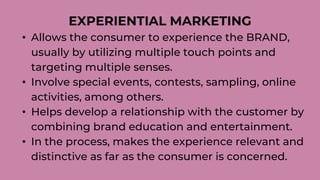
EXPERIENTIAL MARKETING
• Allows the consumer to experience the BRAND,
usually by utilizing multiple touch points and
targeting multiple senses.
• Involve special events, contests, sampling, online
activities, among others.
• Helps develop a relationship with the customer by
combining brand education and entertainment.
• In the process, makes the experience relevant and
distinctive as far as the consumer is concerned.
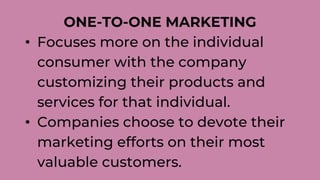
ONE-TO-ONE MARKETING
• Focuses more on the individual
consumer with the company
customizing their products and
services for that individual.
• Companies choose to devote their
marketing efforts on their most
valuable customers.
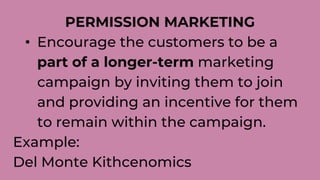
PERMISSION MARKETING
• Encourage the customers to be a
part of a longer-term marketing
campaign by inviting them to join
and providing an incentive for them
to remain within the campaign.
Example:
Del Monte Kithcenomics
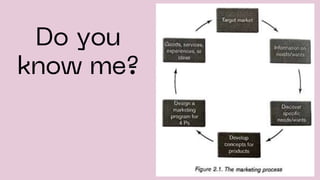
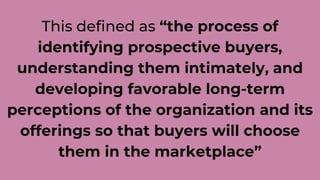
This defined as “the process of
identifying prospective buyers,
understanding them intimately, and
developing favorable long-term
perceptions of the organization and its
offerings so that buyers will choose
them in the marketplace”
Customer Relationship.pptx

Customer Relationship.pptx

  • 2.
    • define theconcept of customer value and the different ways of creating it; • discuss the nature of relationship marketing and its types; and • explain the benefits of delivering customer satisfaction and the challenges to success.
  • 6.
  • 7.
    Customer Value “the uniquecombination of benefits received by targeted buyers that include quality, price, convenience, on-time delivery, and both before- sale and after-sale service” The BRAND must have a value proposition, brand’s promise to the customers to provide a set of benefits that would satisfy their needs and wants.
  • 8.
    Alternative Ways forCreating Value INCREASING THE BENEFITS Adding something to the product that customers would find meaningful, important, useful, and unique. A unique value proposition can be developed based on either one of the following strategies: • Best Price • Best Product • Best Service
  • 9.
    Best Price Many companiesthat cater to price-sensitive markets to choose to have a best price strategy. Example: Cebu Pacific Air and Puregold • These companies seek to provide added value by emphasizing that customers get the most vale value out of their products because the low price they can offer.
  • 10.
    Best Product • Itwould appeal customers who are more selective in terms of what they look for and would have the financial resources to satisfy their discriminating tastes. • The quality of the product is important Examples: Apple Philippine Airlines Rustan’s Department Store
  • 11.
    Best Service • Usedby companies that believe that their customers would like to be well taken care of and find value in services that cater to their special needs. Examples: Singapore Airlines highlights in its advertising the Singapore girl who epitomizes the quality of service provided by their airline Starbucks Coffee
  • 12.
    • Creating valueis not necessarily limited to merely increasing the benefits. • Creating value for the consumer could also mean reducing the “sacrifice” the customers must experience in order to purchase the product. • Making it easier for the customers to enjoy the benefits that the product would provide. Example: On-time delivery Providing installment payment schemes Pop-up stores
  • 13.
    • Whenever acustomer buys a product, there is a level of expectation as to how that product satisfies the buyer’s preferences • If the product’s perceived performance is less than the expectations, then the possibility of customer dissatisfaction arises and it would be reasonable to expect that the customer would no longer buy the product • The marketer’s job is TO SATISFY or EVEN EXCEED expectations of customers as high satisfaction
  • 14.
    A relationship withHAPPY, LOYAL CUSTOMERS is something that all companies would want to work for.
  • 15.
    WHAT IS RELATIONSHIPMARKETING? • Modern marketing recognizes that customer needs should take center stage in the development of the marketing mix. • Establish CLOSER LINKS with the customer • KEY to developing and maintaining close relationships with targeted customers.
  • 16.
    TWO KEY ELEMENTSOF RELATIONSHIP MARKETING • PROMISE AND TRUST
  • 17.
    TYPES OF RELATIONSHIP MARKETING •EXPERIENTIAL MARKETING • PERMISSION MARKETING • ONE-TO-ONE MARKETING
  • 18.
    EXPERIENTIAL MARKETING • Allowsthe consumer to experience the BRAND, usually by utilizing multiple touch points and targeting multiple senses. • Involve special events, contests, sampling, online activities, among others. • Helps develop a relationship with the customer by combining brand education and entertainment. • In the process, makes the experience relevant and distinctive as far as the consumer is concerned.
  • 19.
    ONE-TO-ONE MARKETING • Focusesmore on the individual consumer with the company customizing their products and services for that individual. • Companies choose to devote their marketing efforts on their most valuable customers.
  • 20.
    PERMISSION MARKETING • Encouragethe customers to be a part of a longer-term marketing campaign by inviting them to join and providing an incentive for them to remain within the campaign. Example: Del Monte Kithcenomics
  • 24.
    This defined as“the process of identifying prospective buyers, understanding them intimately, and developing favorable long-term perceptions of the organization and its offerings so that buyers will choose them in the marketplace”