CUSTOMER RELATIONSHIP
MANAGEMENT
TOPIC
 Introduction
 Definitions
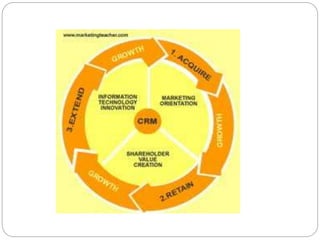
 Comprehensive Domain of CRM
 Process
 Model
 Emerging Trends in CRM
 Conclusion
INTRODUCTION
 Advance technology and globalization has lead to
competition so fierce never before.
 Due to this intense competitive environment has shown a
paradigm shift from transaction model to the
relationship model where the focus is on long term
customer satisfaction rather than short term profit
acquiring by the business.
 So, keeping your existing customer satisfied and
maximizing Customer Lifetime Value (CLV) have
significant importance than acquiring new customer.
Cont…………
 In marketing, customer lifetime value (CLV),
lifetime customer value (LCV), or lifetime value
(LTV) is the net present value of the cash flows
attributed to the relationship with a customer.
 The use of customer lifetime value as a marketing
metric tends to place greater emphasis on
customer service and long-term customer
satisfaction, rather than on maximizing short-term
sales.
 The concept of CLV helps the marketer to analyze the
cost of acquiring , servicing and retaining a certain set
of customer in the market
Cont……….
 According to Bain and Company, “ a 5% improvement in
customer retention rates will yield between 25 to 100%
increase in profit across a wide range of industries.”
 The last thing company can afford to lose any of their
customer.
 So CRM gained importance and came in existence.
 Berry (1983) formally introduced the term customer
relationship management.
 Several ideas of relationship marketing had emerged much
earlier.
 In marketing literature the term Customer Relationship
Management and Relationship Marketing used interchangeably
.
Cont…………..
 Customer Relationship Management (CRM) emerged as the
database management of existing customer to provide them
better personalized and customized services to enhance
customer satisfaction.
 Advances in IT and Information system have been a catalyst
for development of CRM system.
Definition
 CRM is to identify, establish, maintain, enhance
and when necessary also to terminate
relationship with the customers and
stakeholder, at a profit, so that objective of both
parties are met and that this is done by mutual
exchange and fulfillment of promise.
- Tapan K. Pande (2002-2003)
CRM can be defined as managerial efforts to
manage business interactions with customers by
combining business processes and
technologies that seek to understand a
company’s customers.
Definition
 The core concept of CRM is that value creation
between the firm and the customer is related in
such a way that an increase in customer value leads
to an increase in firm value.
-Mithas, Krishnan, & Fornell and Payne
and Frow(2005)
 CRM stress on cross-functional integration of
organizational assets (processes, people,
operations) with customers' interests via technology.
-Payne and Frow (2005)
Comprehensive Domain of
CRM
 The word management is synonymous to Optimization.
 The basic insight received from above is the outcome of
critical literature review is that CRM does not mere
meant for having healthy and cordial relationship but also
takes in account the terminating the relationship with non
profitable customers since it is a part of management
ultimately (cost reduction) and not mere relationship as
considered in case of Public Relations (one of the
elements Communication Mix ) .
 The objective of any company is to have profitable CRM
and for that they continuously attempt to improve on the
elements as well as the process.
PROCESS
 Consteantinous J Stfanou, in his paper classified
CRM in three categories from process point of
view:
1. I . CRM with out using IT
2. II CRM with IT
3. III CRM with Automated IT
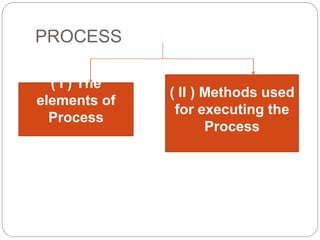
PROCESS
( I ) The
elements of
Process
( II ) Methods used
for executing the
Process
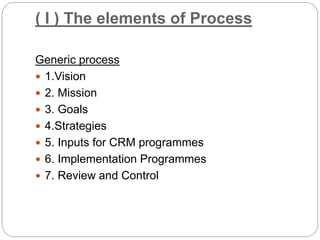
( I ) The elements of Process
Generic process
 1.Vision
 2. Mission
 3. Goals
 4.Strategies
 5. Inputs for CRM programmes
 6. Implementation Programmes
 7. Review and Control
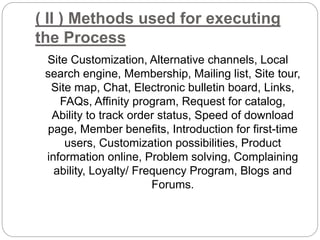
( II ) Methods used for executing
the Process
Site Customization, Alternative channels, Local
search engine, Membership, Mailing list, Site tour,
Site map, Chat, Electronic bulletin board, Links,
FAQs, Affinity program, Request for catalog,
Ability to track order status, Speed of download
page, Member benefits, Introduction for first-time
users, Customization possibilities, Product
information online, Problem solving, Complaining
ability, Loyalty/ Frequency Program, Blogs and
Forums.
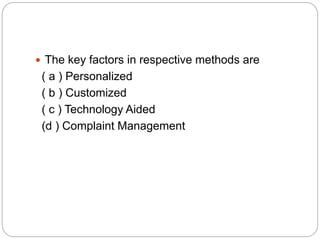
 The key factors in respective methods are
( a ) Personalized
( b ) Customized
( c ) Technology Aided
(d ) Complaint Management
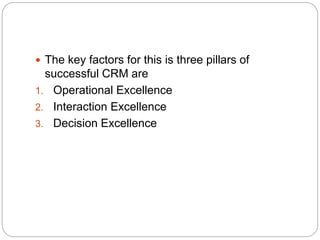
 The key factors for this is three pillars of
successful CRM are
1. Operational Excellence
2. Interaction Excellence
3. Decision Excellence
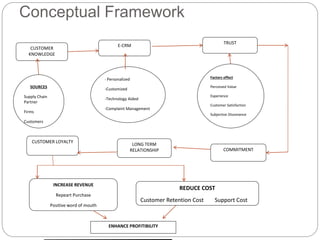
Conceptual Framework
CUSTOMER
KNOWLEDGE
SOURCES
Supply Chain
Partner
Firms
Customers
E-CRM
- Personalized
-Customized
-Technology Aided
-Complaint Management
TRUST
Factors effect
Perceived Value
Experience
Customer Satisfaction
Subjective Dissonance
COMMITMENT
LONG TERM
RELATIONSHIP
CUSTOMER LOYALTY
REDUCE COST
Customer Retention Cost Support Cost
INCREASE REVENUE
Repeart Purchase
Positive word of mouth
ENHANCE PROFITIBILITY
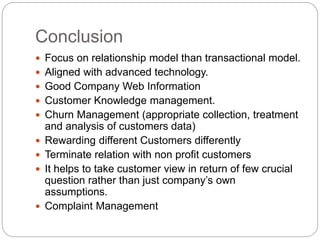
Conclusion
 Focus on relationship model than transactional model.
 Aligned with advanced technology.
 Good Company Web Information
 Customer Knowledge management.
 Churn Management (appropriate collection, treatment
and analysis of customers data)
 Rewarding different Customers differently
 Terminate relation with non profit customers
 It helps to take customer view in return of few crucial
question rather than just company’s own
assumptions.
 Complaint Management
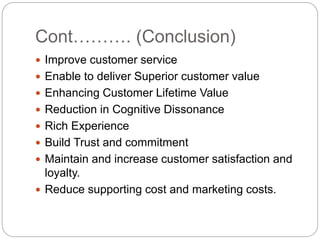
Cont………. (Conclusion)
 Improve customer service
 Enable to deliver Superior customer value
 Enhancing Customer Lifetime Value
 Reduction in Cognitive Dissonance
 Rich Experience
 Build Trust and commitment
 Maintain and increase customer satisfaction and
loyalty.
 Reduce supporting cost and marketing costs.
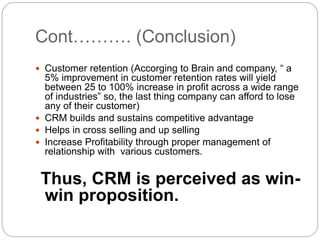
Cont………. (Conclusion)
 Customer retention (Accorging to Brain and company, “ a
5% improvement in customer retention rates will yield
between 25 to 100% increase in profit across a wide range
of industries” so, the last thing company can afford to lose
any of their customer)
 CRM builds and sustains competitive advantage
 Helps in cross selling and up selling
 Increase Profitability through proper management of
relationship with various customers.
Thus, CRM is perceived as win-
win proposition.
THANK
YOU

Customer relationship management

  • 1.
  • 2.
    TOPIC  Introduction  Definitions Comprehensive Domain of CRM  Process  Model  Emerging Trends in CRM  Conclusion
  • 3.
    INTRODUCTION  Advance technologyand globalization has lead to competition so fierce never before.  Due to this intense competitive environment has shown a paradigm shift from transaction model to the relationship model where the focus is on long term customer satisfaction rather than short term profit acquiring by the business.  So, keeping your existing customer satisfied and maximizing Customer Lifetime Value (CLV) have significant importance than acquiring new customer.
  • 4.
    Cont…………  In marketing,customer lifetime value (CLV), lifetime customer value (LCV), or lifetime value (LTV) is the net present value of the cash flows attributed to the relationship with a customer.  The use of customer lifetime value as a marketing metric tends to place greater emphasis on customer service and long-term customer satisfaction, rather than on maximizing short-term sales.  The concept of CLV helps the marketer to analyze the cost of acquiring , servicing and retaining a certain set of customer in the market
  • 6.
    Cont……….  According toBain and Company, “ a 5% improvement in customer retention rates will yield between 25 to 100% increase in profit across a wide range of industries.”  The last thing company can afford to lose any of their customer.  So CRM gained importance and came in existence.  Berry (1983) formally introduced the term customer relationship management.  Several ideas of relationship marketing had emerged much earlier.  In marketing literature the term Customer Relationship Management and Relationship Marketing used interchangeably .
  • 7.
    Cont…………..  Customer RelationshipManagement (CRM) emerged as the database management of existing customer to provide them better personalized and customized services to enhance customer satisfaction.  Advances in IT and Information system have been a catalyst for development of CRM system.
  • 8.
    Definition  CRM isto identify, establish, maintain, enhance and when necessary also to terminate relationship with the customers and stakeholder, at a profit, so that objective of both parties are met and that this is done by mutual exchange and fulfillment of promise. - Tapan K. Pande (2002-2003) CRM can be defined as managerial efforts to manage business interactions with customers by combining business processes and technologies that seek to understand a company’s customers.
  • 9.
    Definition  The coreconcept of CRM is that value creation between the firm and the customer is related in such a way that an increase in customer value leads to an increase in firm value. -Mithas, Krishnan, & Fornell and Payne and Frow(2005)  CRM stress on cross-functional integration of organizational assets (processes, people, operations) with customers' interests via technology. -Payne and Frow (2005)
  • 10.
    Comprehensive Domain of CRM The word management is synonymous to Optimization.  The basic insight received from above is the outcome of critical literature review is that CRM does not mere meant for having healthy and cordial relationship but also takes in account the terminating the relationship with non profitable customers since it is a part of management ultimately (cost reduction) and not mere relationship as considered in case of Public Relations (one of the elements Communication Mix ) .  The objective of any company is to have profitable CRM and for that they continuously attempt to improve on the elements as well as the process.
  • 11.
    PROCESS  Consteantinous JStfanou, in his paper classified CRM in three categories from process point of view: 1. I . CRM with out using IT 2. II CRM with IT 3. III CRM with Automated IT
  • 12.
    PROCESS ( I )The elements of Process ( II ) Methods used for executing the Process
  • 13.
    ( I )The elements of Process Generic process  1.Vision  2. Mission  3. Goals  4.Strategies  5. Inputs for CRM programmes  6. Implementation Programmes  7. Review and Control
  • 14.
    ( II )Methods used for executing the Process Site Customization, Alternative channels, Local search engine, Membership, Mailing list, Site tour, Site map, Chat, Electronic bulletin board, Links, FAQs, Affinity program, Request for catalog, Ability to track order status, Speed of download page, Member benefits, Introduction for first-time users, Customization possibilities, Product information online, Problem solving, Complaining ability, Loyalty/ Frequency Program, Blogs and Forums.
  • 15.
     The keyfactors in respective methods are ( a ) Personalized ( b ) Customized ( c ) Technology Aided (d ) Complaint Management
  • 16.
     The keyfactors for this is three pillars of successful CRM are 1. Operational Excellence 2. Interaction Excellence 3. Decision Excellence
  • 17.
    Conceptual Framework CUSTOMER KNOWLEDGE SOURCES Supply Chain Partner Firms Customers E-CRM -Personalized -Customized -Technology Aided -Complaint Management TRUST Factors effect Perceived Value Experience Customer Satisfaction Subjective Dissonance COMMITMENT LONG TERM RELATIONSHIP CUSTOMER LOYALTY REDUCE COST Customer Retention Cost Support Cost INCREASE REVENUE Repeart Purchase Positive word of mouth ENHANCE PROFITIBILITY
  • 18.
    Conclusion  Focus onrelationship model than transactional model.  Aligned with advanced technology.  Good Company Web Information  Customer Knowledge management.  Churn Management (appropriate collection, treatment and analysis of customers data)  Rewarding different Customers differently  Terminate relation with non profit customers  It helps to take customer view in return of few crucial question rather than just company’s own assumptions.  Complaint Management
  • 19.
    Cont………. (Conclusion)  Improvecustomer service  Enable to deliver Superior customer value  Enhancing Customer Lifetime Value  Reduction in Cognitive Dissonance  Rich Experience  Build Trust and commitment  Maintain and increase customer satisfaction and loyalty.  Reduce supporting cost and marketing costs.
  • 20.
    Cont………. (Conclusion)  Customerretention (Accorging to Brain and company, “ a 5% improvement in customer retention rates will yield between 25 to 100% increase in profit across a wide range of industries” so, the last thing company can afford to lose any of their customer)  CRM builds and sustains competitive advantage  Helps in cross selling and up selling  Increase Profitability through proper management of relationship with various customers. Thus, CRM is perceived as win- win proposition.
  • 21.