Customer Lifetime Value

(CLTV)
2019.05.07

JY (천재윤)
What is CLTV?
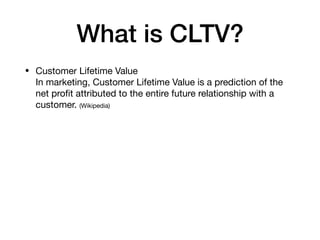
• Customer Lifetime Value

In marketing, Customer Lifetime Value is a prediction of the
net profit attributed to the entire future relationship with a
customer. (Wikipedia)
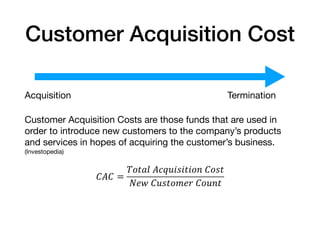
Customer Acquisition Cost
Acquisition Termination

Customer Acquisition Costs are those funds that are used in
order to introduce new customers to the company’s products
and services in hopes of acquiring the customer’s business.
(Investopedia)

!"! =
$%&'(	"*+,-.-&-%/	!%.&
012	!,.&%314	!%,/&
Components of Total
Acquisition Cost
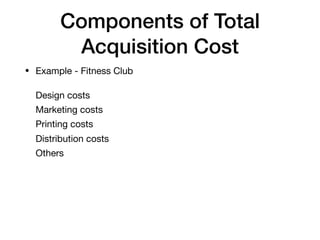
• Example - Fitness Club

Design costs

Marketing costs

Printing costs

Distribution costs

Others
Business Case
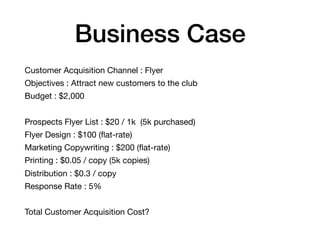
Customer Acquisition Channel : Flyer

Objectives : Attract new customers to the club

Budget : $2,000

Prospects Flyer List : $20 / 1k (5k purchased)

Flyer Design : $100 (flat-rate)

Marketing Copywriting : $200 (flat-rate)

Printing : $0.05 / copy (5k copies)

Distribution : $0.3 / copy

Response Rate : 5%

Total Customer Acquisition Cost?
Business Case
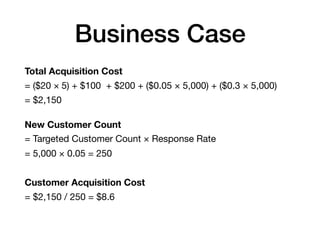
Total Acquisition Cost
= ($20 × 5) + $100 + $200 + ($0.05 × 5,000) + ($0.3 × 5,000)

= $2,150

New Customer Count
= Targeted Customer Count × Response Rate

= 5,000 × 0.05 = 250

Customer Acquisition Cost

= $2,150 / 250 = $8.6
Business Case
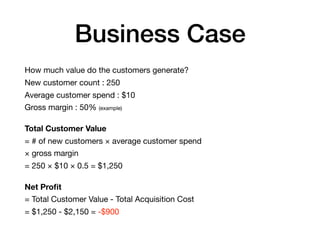
How much value do the customers generate?

New customer count : 250

Average customer spend : $10

Gross margin : 50% (example)

Total Customer Value
= # of new customers × average customer spend

× gross margin

= 250 × $10 × 0.5 = $1,250

Net Profit
= Total Customer Value - Total Acquisition Cost

= $1,250 - $2,150 = -$900
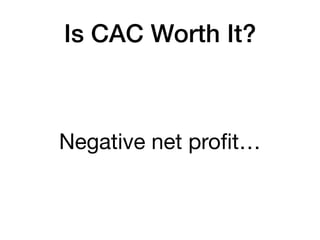
Is CAC Worth It?
Negative net profit…
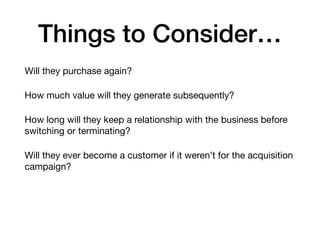
Things to Consider…
Will they purchase again?

How much value will they generate subsequently?

How long will they keep a relationship with the business before
switching or terminating?

Will they ever become a customer if it weren’t for the acquisition
campaign?
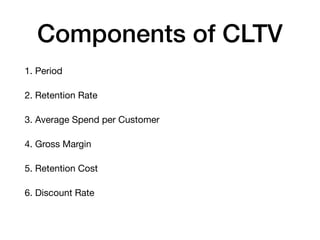
Components of CLTV
1. Period

2. Retention Rate

3. Average Spend per Customer

4. Gross Margin

5. Retention Cost

6. Discount Rate
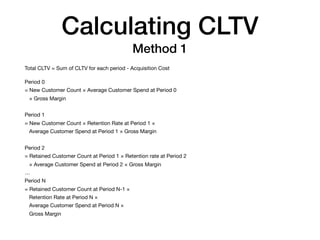
Calculating CLTV
Method 1
Total CLTV = Sum of CLTV for each period - Acquisition Cost

Period 0

= New Customer Count × Average Customer Spend at Period 0

× Gross Margin

Period 1

= New Customer Count × Retention Rate at Period 1 ×

Average Customer Spend at Period 1 × Gross Margin

Period 2 

= Retained Customer Count at Period 1 × Retention rate at Period 2

× Average Customer Spend at Period 2 × Gross Margin

…

Period N

= Retained Customer Count at Period N-1 ×

Retention Rate at Period N ×

Average Customer Spend at Period N ×

Gross Margin
Calculating CLTV
Method 1
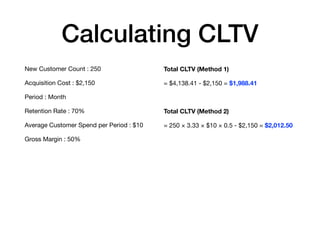
CLTV for month 0 = 250 × $10 × 0.5 = $1,250

# of retained customers for month 1
= 250 × 0.7 = 175

CLTV for month 1 = 175 × $10 × 0.5 = $875

# of retained customers for month 2
= 175 × 0.7 = 122.5

CLTV for month 2 = 122.5 × $10 × 0.5 = $612.5

…
# of retained customers for month 12
= 4.94 × 0.7 = 3.46

CLTV for month 12 = 3.46 × $10 × 0.5 = $17.30

# of retained customers for month 13
= 3.46 × 0.7 = 2.42

CLTV for month 13 = 2.42 × $10 × 0.5 = $12.11

Total CLTV

= Sum of All Periods - Acquisition Cost

= $4,138.41 - $2,150 = $1,988.41

CTLV per Customer = $1,988.41 / 250 = $7.95 (It worth it!)
New Customer Count : 250

Acquisition Cost : $2,150

Period : Month

Retention Rate : 70%

Average Customer Spend per Period : $10

Gross Margin : 50%
Calculating CLTV
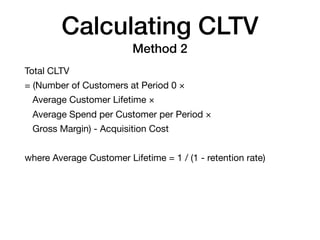
Method 2
Total CLTV

= (Number of Customers at Period 0 ×

Average Customer Lifetime ×

Average Spend per Customer per Period ×

Gross Margin) - Acquisition Cost

where Average Customer Lifetime = 1 / (1 - retention rate)
Calculating CLTV
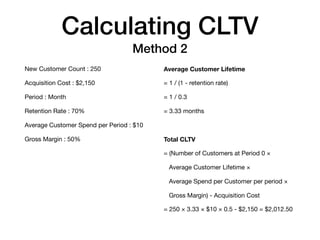
Method 2
Average Customer Lifetime

= 1 / (1 - retention rate)

= 1 / 0.3

= 3.33 months

Total CLTV
= (Number of Customers at Period 0 ×

Average Customer Lifetime ×

Average Spend per Customer per period ×

Gross Margin) - Acquisition Cost

= 250 × 3.33 × $10 × 0.5 - $2,150 = $2,012.50
New Customer Count : 250

Acquisition Cost : $2,150

Period : Month

Retention Rate : 70%

Average Customer Spend per Period : $10

Gross Margin : 50%
Calculating CLTV
Total CLTV (Method 1)

= $4,138.41 - $2,150 = $1,988.41

Total CLTV (Method 2)
= 250 × 3.33 × $10 × 0.5 - $2,150 = $2,012.50
New Customer Count : 250

Acquisition Cost : $2,150

Period : Month

Retention Rate : 70%

Average Customer Spend per Period : $10

Gross Margin : 50%
Return of Marketing
Investment
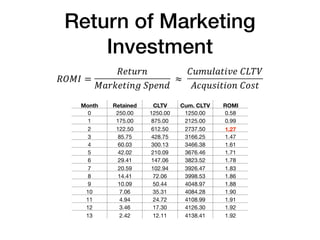
Month Retained CLTV Cum. CLTV ROMI
0 250.00 1250.00 1250.00 0.58
1 175.00 875.00 2125.00 0.99
2 122.50 612.50 2737.50 1.27
3 85.75 428.75 3166.25 1.47
4 60.03 300.13 3466.38 1.61
5 42.02 210.09 3676.46 1.71
6 29.41 147.06 3823.52 1.78
7 20.59 102.94 3926.47 1.83
8 14.41 72.06 3998.53 1.86
9 10.09 50.44 4048.97 1.88
10 7.06 35.31 4084.28 1.90
11 4.94 24.72 4108.99 1.91
12 3.46 17.30 4126.30 1.92
13 2.42 12.11 4138.41 1.92
!"#$ =
!&'()*
#+),&'-*.	01&*2
	≈	
4(5(6+'-7&	489:
;<=(>-'-?*	4?>'
Net Present Value &
Discount Rate
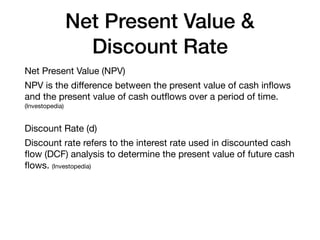
Net Present Value (NPV)

NPV is the difference between the present value of cash inflows
and the present value of cash outflows over a period of time.
(Investopedia)

Discount Rate (d)

Discount rate refers to the interest rate used in discounted cash
flow (DCF) analysis to determine the present value of future cash
flows. (Investopedia)
Net Present Value &
Discount Rate
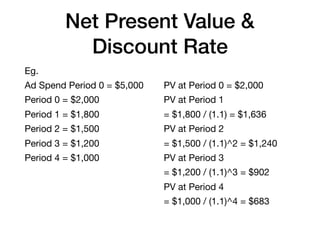
Eg.

Ad Spend Period 0 = $5,000

Period 0 = $2,000

Period 1 = $1,800

Period 2 = $1,500

Period 3 = $1,200

Period 4 = $1,000
PV at Period 0 = $2,000

PV at Period 1

= $1,800 / (1.1) = $1,636

PV at Period 2

= $1,500 / (1.1)^2 = $1,240

PV at Period 3

= $1,200 / (1.1)^3 = $902

PV at Period 4

= $1,000 / (1.1)^4 = $683
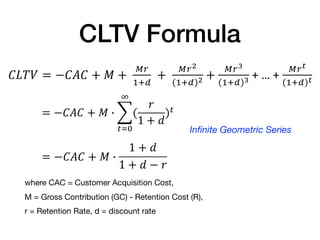
CLTV Formula
Infinite Geometric Series

where CAC = Customer Acquisition Cost,

M = Gross Contribution (GC) - Retention Cost (R),

r = Retention Rate, d = discount rate
= −#$# + & ' ((
*
1 + ,
).
/
.01
= −#$# + & '
1 + )
1 + ) − *
!"#$ = −!'! + ) +	
+,
-./
	+	
+,0
-./ 0 +
+,1
-./ 1 + … +
+,2
-./ 2
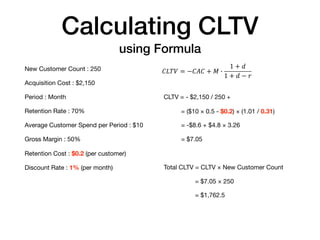
Calculating CLTV
using Formula
CLTV = - $2,150 / 250 +

= ($10 × 0.5 - $0) × (1 / 0.3)

= -$8.6 + $5 × 3.33

= $8.05

Total CLTV = CLTV × New Customer Count

= $8.05 × 250

= $2,012.5
New Customer Count : 250

Acquisition Cost : $2,150

Period : Month

Retention Rate : 70%

Average Customer Spend per Period : $10

Gross Margin : 50%

Retention Cost : $0 (per customer)

Discount Rate : 0% (per month)
!"#$ = −!'! + ) *
1 + ,
1 + , − -
Calculating CLTV
using Formula
CLTV = - $2,150 / 250 +

= ($10 × 0.5 - $0.2) × (1.01 / 0.31)

= -$8.6 + $4.8 × 3.26

= $7.05

Total CLTV = CLTV × New Customer Count

= $7.05 × 250

= $1,762.5
New Customer Count : 250

Acquisition Cost : $2,150

Period : Month

Retention Rate : 70%

Average Customer Spend per Period : $10

Gross Margin : 50%

Retention Cost : $0.2 (per customer)

Discount Rate : 1% (per month)
!"#$ = −!'! + ) *
1 + ,
1 + , − -
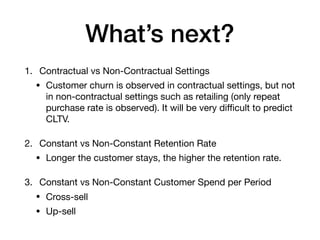
What’s next?
1. Contractual vs Non-Contractual Settings

• Customer churn is observed in contractual settings, but not
in non-contractual settings such as retailing (only repeat
purchase rate is observed). It will be very difficult to predict
CLTV.

2. Constant vs Non-Constant Retention Rate

• Longer the customer stays, the higher the retention rate.

3. Constant vs Non-Constant Customer Spend per Period

• Cross-sell

• Up-sell

Customer Lifetime Value

  • 1.
  • 2.
    What is CLTV? •Customer Lifetime Value
 In marketing, Customer Lifetime Value is a prediction of the net profit attributed to the entire future relationship with a customer. (Wikipedia)
  • 3.
    Customer Acquisition Cost AcquisitionTermination Customer Acquisition Costs are those funds that are used in order to introduce new customers to the company’s products and services in hopes of acquiring the customer’s business. (Investopedia) !"! = $%&'( "*+,-.-&-%/ !%.& 012 !,.&%314 !%,/&
  • 4.
    Components of Total AcquisitionCost • Example - Fitness Club Design costs Marketing costs Printing costs Distribution costs Others
  • 5.
    Business Case Customer AcquisitionChannel : Flyer Objectives : Attract new customers to the club Budget : $2,000 Prospects Flyer List : $20 / 1k (5k purchased) Flyer Design : $100 (flat-rate) Marketing Copywriting : $200 (flat-rate) Printing : $0.05 / copy (5k copies) Distribution : $0.3 / copy Response Rate : 5% Total Customer Acquisition Cost?
  • 6.
    Business Case Total AcquisitionCost = ($20 × 5) + $100 + $200 + ($0.05 × 5,000) + ($0.3 × 5,000) = $2,150 New Customer Count = Targeted Customer Count × Response Rate = 5,000 × 0.05 = 250 Customer Acquisition Cost = $2,150 / 250 = $8.6
  • 7.
    Business Case How muchvalue do the customers generate? New customer count : 250 Average customer spend : $10 Gross margin : 50% (example) Total Customer Value = # of new customers × average customer spend × gross margin = 250 × $10 × 0.5 = $1,250 Net Profit = Total Customer Value - Total Acquisition Cost = $1,250 - $2,150 = -$900
  • 8.
    Is CAC WorthIt? Negative net profit…
  • 9.
    Things to Consider… Willthey purchase again? How much value will they generate subsequently? How long will they keep a relationship with the business before switching or terminating? Will they ever become a customer if it weren’t for the acquisition campaign?
  • 10.
    Components of CLTV 1.Period 2. Retention Rate 3. Average Spend per Customer 4. Gross Margin 5. Retention Cost 6. Discount Rate
  • 11.
    Calculating CLTV Method 1 TotalCLTV = Sum of CLTV for each period - Acquisition Cost Period 0 = New Customer Count × Average Customer Spend at Period 0 × Gross Margin Period 1 = New Customer Count × Retention Rate at Period 1 × Average Customer Spend at Period 1 × Gross Margin Period 2 = Retained Customer Count at Period 1 × Retention rate at Period 2 × Average Customer Spend at Period 2 × Gross Margin … Period N = Retained Customer Count at Period N-1 × Retention Rate at Period N × Average Customer Spend at Period N × Gross Margin
  • 12.
    Calculating CLTV Method 1 CLTVfor month 0 = 250 × $10 × 0.5 = $1,250 # of retained customers for month 1 = 250 × 0.7 = 175 CLTV for month 1 = 175 × $10 × 0.5 = $875 # of retained customers for month 2 = 175 × 0.7 = 122.5 CLTV for month 2 = 122.5 × $10 × 0.5 = $612.5 … # of retained customers for month 12 = 4.94 × 0.7 = 3.46 CLTV for month 12 = 3.46 × $10 × 0.5 = $17.30 # of retained customers for month 13 = 3.46 × 0.7 = 2.42 CLTV for month 13 = 2.42 × $10 × 0.5 = $12.11 Total CLTV = Sum of All Periods - Acquisition Cost = $4,138.41 - $2,150 = $1,988.41 CTLV per Customer = $1,988.41 / 250 = $7.95 (It worth it!) New Customer Count : 250 Acquisition Cost : $2,150 Period : Month Retention Rate : 70% Average Customer Spend per Period : $10 Gross Margin : 50%
  • 13.
    Calculating CLTV Method 2 TotalCLTV = (Number of Customers at Period 0 × Average Customer Lifetime × Average Spend per Customer per Period × Gross Margin) - Acquisition Cost where Average Customer Lifetime = 1 / (1 - retention rate)
  • 14.
    Calculating CLTV Method 2 AverageCustomer Lifetime = 1 / (1 - retention rate) = 1 / 0.3 = 3.33 months Total CLTV = (Number of Customers at Period 0 × Average Customer Lifetime × Average Spend per Customer per period × Gross Margin) - Acquisition Cost = 250 × 3.33 × $10 × 0.5 - $2,150 = $2,012.50 New Customer Count : 250 Acquisition Cost : $2,150 Period : Month Retention Rate : 70% Average Customer Spend per Period : $10 Gross Margin : 50%
  • 15.
    Calculating CLTV Total CLTV(Method 1) = $4,138.41 - $2,150 = $1,988.41 Total CLTV (Method 2) = 250 × 3.33 × $10 × 0.5 - $2,150 = $2,012.50 New Customer Count : 250 Acquisition Cost : $2,150 Period : Month Retention Rate : 70% Average Customer Spend per Period : $10 Gross Margin : 50%
  • 16.
    Return of Marketing Investment MonthRetained CLTV Cum. CLTV ROMI 0 250.00 1250.00 1250.00 0.58 1 175.00 875.00 2125.00 0.99 2 122.50 612.50 2737.50 1.27 3 85.75 428.75 3166.25 1.47 4 60.03 300.13 3466.38 1.61 5 42.02 210.09 3676.46 1.71 6 29.41 147.06 3823.52 1.78 7 20.59 102.94 3926.47 1.83 8 14.41 72.06 3998.53 1.86 9 10.09 50.44 4048.97 1.88 10 7.06 35.31 4084.28 1.90 11 4.94 24.72 4108.99 1.91 12 3.46 17.30 4126.30 1.92 13 2.42 12.11 4138.41 1.92 !"#$ = !&'()* #+),&'-*. 01&*2 ≈ 4(5(6+'-7& 489: ;<=(>-'-?* 4?>'
  • 17.
    Net Present Value& Discount Rate Net Present Value (NPV) NPV is the difference between the present value of cash inflows and the present value of cash outflows over a period of time. (Investopedia) Discount Rate (d) Discount rate refers to the interest rate used in discounted cash flow (DCF) analysis to determine the present value of future cash flows. (Investopedia)
  • 18.
    Net Present Value& Discount Rate Eg. Ad Spend Period 0 = $5,000 Period 0 = $2,000 Period 1 = $1,800 Period 2 = $1,500 Period 3 = $1,200 Period 4 = $1,000 PV at Period 0 = $2,000 PV at Period 1 = $1,800 / (1.1) = $1,636 PV at Period 2 = $1,500 / (1.1)^2 = $1,240 PV at Period 3 = $1,200 / (1.1)^3 = $902 PV at Period 4 = $1,000 / (1.1)^4 = $683
  • 19.
    CLTV Formula Infinite GeometricSeries where CAC = Customer Acquisition Cost, M = Gross Contribution (GC) - Retention Cost (R), r = Retention Rate, d = discount rate = −#$# + & ' (( * 1 + , ). / .01 = −#$# + & ' 1 + ) 1 + ) − * !"#$ = −!'! + ) + +, -./ + +,0 -./ 0 + +,1 -./ 1 + … + +,2 -./ 2
  • 20.
    Calculating CLTV using Formula CLTV= - $2,150 / 250 + = ($10 × 0.5 - $0) × (1 / 0.3) = -$8.6 + $5 × 3.33 = $8.05 Total CLTV = CLTV × New Customer Count = $8.05 × 250 = $2,012.5 New Customer Count : 250 Acquisition Cost : $2,150 Period : Month Retention Rate : 70% Average Customer Spend per Period : $10 Gross Margin : 50% Retention Cost : $0 (per customer) Discount Rate : 0% (per month) !"#$ = −!'! + ) * 1 + , 1 + , − -
  • 21.
    Calculating CLTV using Formula CLTV= - $2,150 / 250 + = ($10 × 0.5 - $0.2) × (1.01 / 0.31) = -$8.6 + $4.8 × 3.26 = $7.05 Total CLTV = CLTV × New Customer Count = $7.05 × 250 = $1,762.5 New Customer Count : 250 Acquisition Cost : $2,150 Period : Month Retention Rate : 70% Average Customer Spend per Period : $10 Gross Margin : 50% Retention Cost : $0.2 (per customer) Discount Rate : 1% (per month) !"#$ = −!'! + ) * 1 + , 1 + , − -
  • 22.
    What’s next? 1. Contractualvs Non-Contractual Settings • Customer churn is observed in contractual settings, but not in non-contractual settings such as retailing (only repeat purchase rate is observed). It will be very difficult to predict CLTV. 2. Constant vs Non-Constant Retention Rate • Longer the customer stays, the higher the retention rate. 3. Constant vs Non-Constant Customer Spend per Period • Cross-sell • Up-sell