June 2018
Customer Feedback
How and when
2 | Customer feedback, Expert review, June 2018
Customer feedback: what is it and
when should we use it
— Remember that feedback surveys are not, and cannot replace user
research
o User research is based on observed behaviour, and can tell us
why people behave they way they do.
o Surveys can get people to answer questions about things, but
don’t tell us why people answer they way the did.
— However, surveys can be useful to gather feedback on specific
interactions and/or experiences.
o A survey must have a specific research question.
o Only ask questions if something can be done with the insight
(asking questions and not doing anything with the insight is
pointless and will annoy people).
o Surveys must be short and concise.
Customer Feedback
3 | Customer feedback, Expert review, June 2018
Most websites take a similar approach to
gathering feedback from customers
Customer Feedback
Customer visits website Customer continues with their visit and
completes (or attempts to complete) their task
User finishes their task, then begins the survey
Visitor begins the survey,
without knowing how
long it will take
Request to complete
survey appears as pop-
up
Begin survey
4 | Customer feedback, Expert review, June 2018
Traditional customer feedback forms
offer a very poor user experience
Customer Feedback
— They’re disruptive, take a lot of time to fill out, and
are often rife with usability issues that make them
difficult to complete.
— It feels like it’s for the corporation’s benefit, not the
consumers.
— Surveys are presented after customers complete an
action or journey.
o When users complete an action, they will probably
want to carry on with their life, not complete a
customer survey.
5 | Customer feedback, Expert review, June 2018
Allowing customers to provide feedback ‘in-line’
without breaking flow is becoming more common
Customer Feedback
Customer uses website/app
as they do normally
As they are completing their task, they
are offered the opportunity to provide
feedback, without breaking their flow
Then they can continue
with their original task
6 | Customer feedback, Expert review, June 2018
The in-line approach makes it easier for customers
to provide feedback as it is ‘light-touch’
Customer Feedback
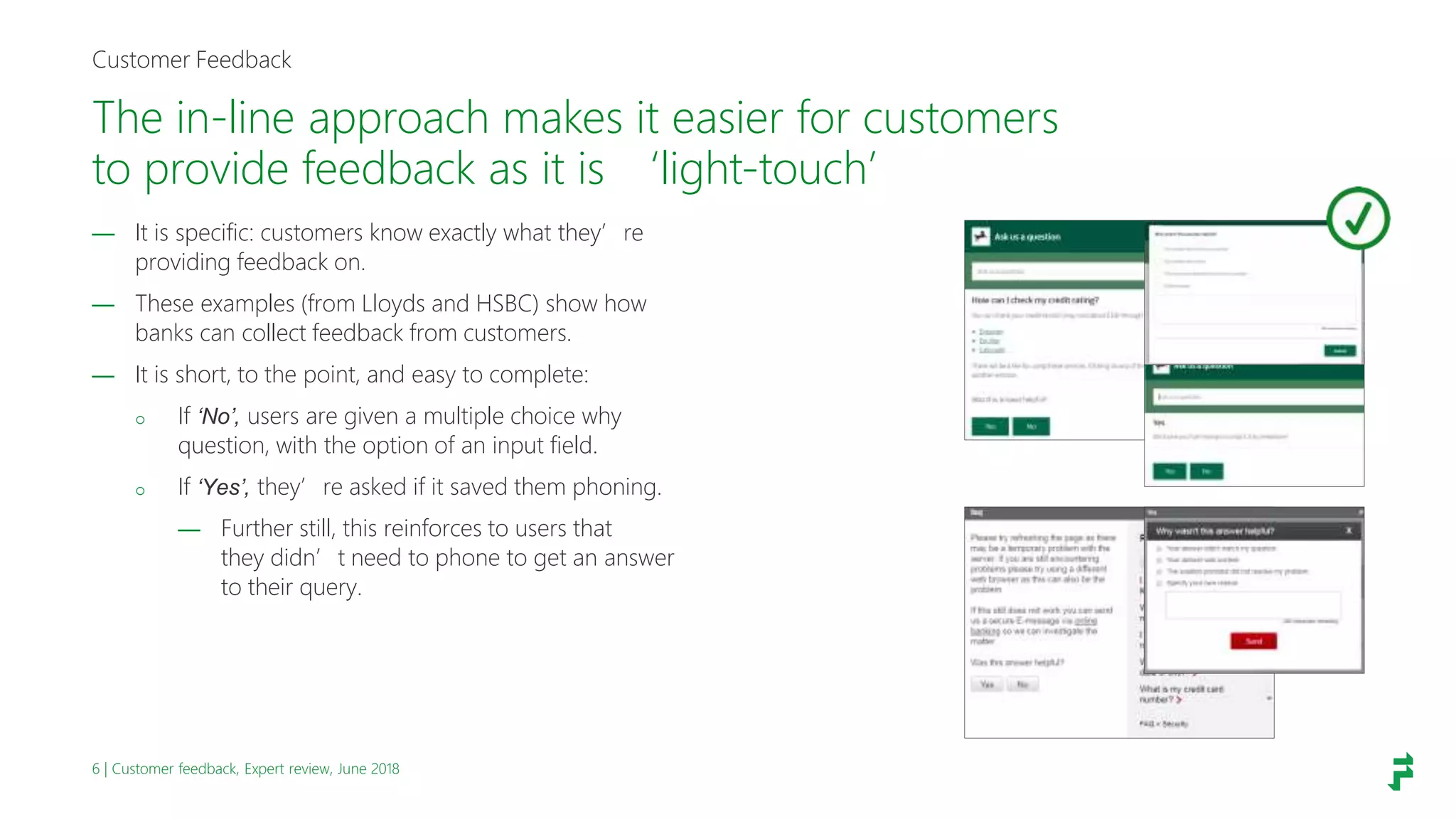
— It is specific: customers know exactly what they’re
providing feedback on.
— These examples (from Lloyds and HSBC) show how
banks can collect feedback from customers.
— It is short, to the point, and easy to complete:
o If ‘No’, users are given a multiple choice why
question, with the option of an input field.
o If ‘Yes’, they’re asked if it saved them phoning.
— Further still, this reinforces to users that
they didn’t need to phone to get an answer
to their query.
7 | Customer feedback, Expert review, June 2018
‘Coupling’ feedback surveys with the
interaction captures insight when it’s freshest
Customer Feedback
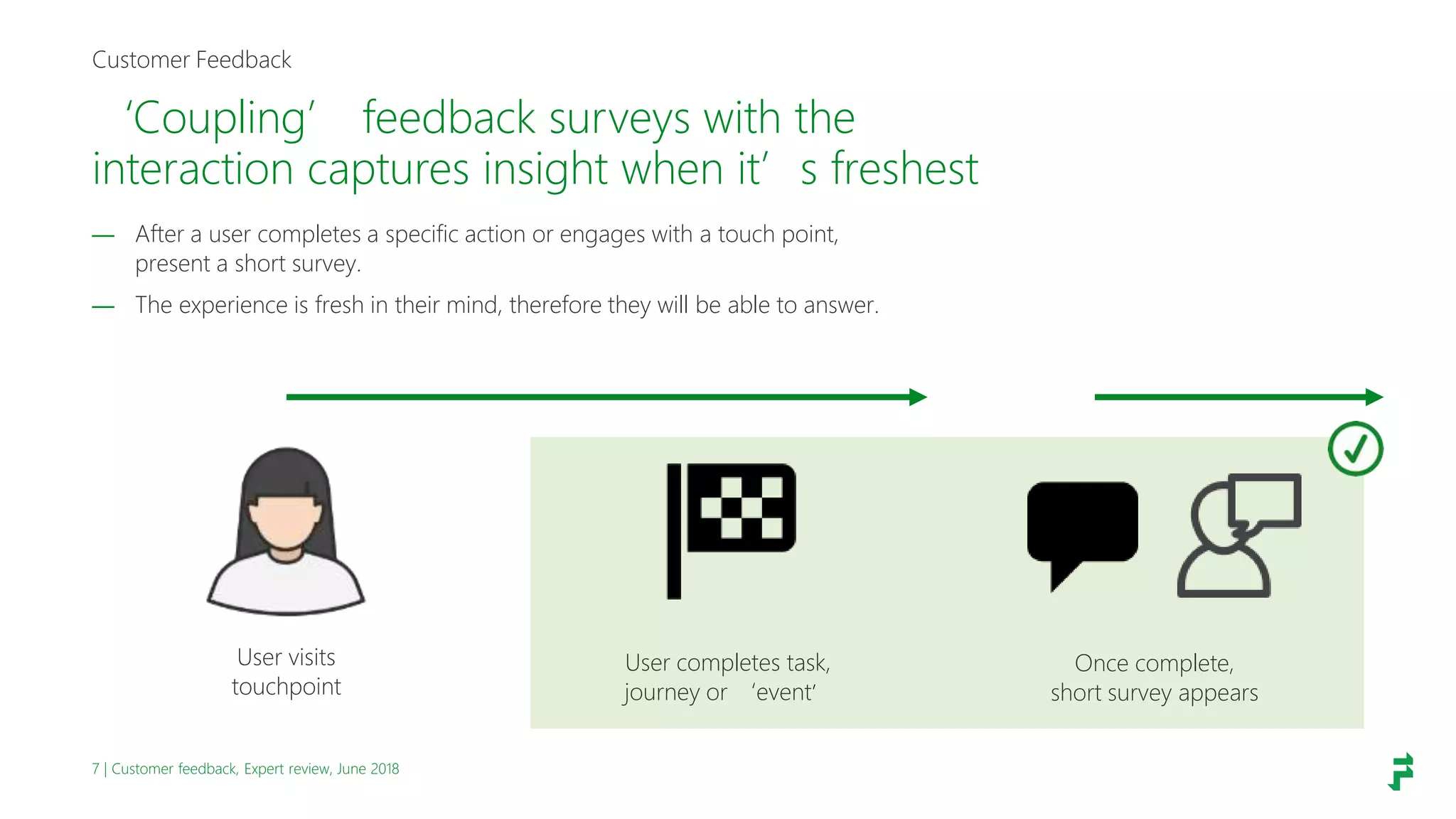
— After a user completes a specific action or engages with a touch point,
present a short survey.
— The experience is fresh in their mind, therefore they will be able to answer.
Once complete,
short survey appears
User visits
touchpoint
User completes task,
journey or ‘event’
8 | Customer feedback, Expert review, June 2018
End of experience surveys capture
feedback when it’s most pertinent
Customer Feedback
— Uber couple feedback with the interaction by asking
users to give feedback right after their experience.
o The UX is simple and easy to understand.
o The star rating and multiple-choice question is
simple to complete.
— Google ask for feedback after users have visited a
particular location. One question at a time, and include
the option to skip.
o Users can give ‘Yes/No’ or multiple-choice.
9 | Customer feedback, Expert review, June 2018
Conclusion
— Ensure the survey is designed around specific research questions.
o ‘What do you think of our website/app’ isn’t as useful as
‘What did you think of feature X’.
— Only use surveys if something can be done with the insight.
o Ensure the survey is designed and questions written in a way that
creates meaningful insight.
— Feedback surveys must be short.
o Every situation is different, but anything longer than 30 seconds is
long. If a survey is 10 minutes then a different method should
have been used to get the insight needed.
— Surveys must be easy to complete.
o Ensure there are no usability issues.
Customer Feedback

Customer feedback - How and when

  • 1.
  • 2.
    2 | Customerfeedback, Expert review, June 2018 Customer feedback: what is it and when should we use it — Remember that feedback surveys are not, and cannot replace user research o User research is based on observed behaviour, and can tell us why people behave they way they do. o Surveys can get people to answer questions about things, but don’t tell us why people answer they way the did. — However, surveys can be useful to gather feedback on specific interactions and/or experiences. o A survey must have a specific research question. o Only ask questions if something can be done with the insight (asking questions and not doing anything with the insight is pointless and will annoy people). o Surveys must be short and concise. Customer Feedback
  • 3.
    3 | Customerfeedback, Expert review, June 2018 Most websites take a similar approach to gathering feedback from customers Customer Feedback Customer visits website Customer continues with their visit and completes (or attempts to complete) their task User finishes their task, then begins the survey Visitor begins the survey, without knowing how long it will take Request to complete survey appears as pop- up Begin survey
  • 4.
    4 | Customerfeedback, Expert review, June 2018 Traditional customer feedback forms offer a very poor user experience Customer Feedback — They’re disruptive, take a lot of time to fill out, and are often rife with usability issues that make them difficult to complete. — It feels like it’s for the corporation’s benefit, not the consumers. — Surveys are presented after customers complete an action or journey. o When users complete an action, they will probably want to carry on with their life, not complete a customer survey.
  • 5.
    5 | Customerfeedback, Expert review, June 2018 Allowing customers to provide feedback ‘in-line’ without breaking flow is becoming more common Customer Feedback Customer uses website/app as they do normally As they are completing their task, they are offered the opportunity to provide feedback, without breaking their flow Then they can continue with their original task
  • 6.
    6 | Customerfeedback, Expert review, June 2018 The in-line approach makes it easier for customers to provide feedback as it is ‘light-touch’ Customer Feedback — It is specific: customers know exactly what they’re providing feedback on. — These examples (from Lloyds and HSBC) show how banks can collect feedback from customers. — It is short, to the point, and easy to complete: o If ‘No’, users are given a multiple choice why question, with the option of an input field. o If ‘Yes’, they’re asked if it saved them phoning. — Further still, this reinforces to users that they didn’t need to phone to get an answer to their query.
  • 7.
    7 | Customerfeedback, Expert review, June 2018 ‘Coupling’ feedback surveys with the interaction captures insight when it’s freshest Customer Feedback — After a user completes a specific action or engages with a touch point, present a short survey. — The experience is fresh in their mind, therefore they will be able to answer. Once complete, short survey appears User visits touchpoint User completes task, journey or ‘event’
  • 8.
    8 | Customerfeedback, Expert review, June 2018 End of experience surveys capture feedback when it’s most pertinent Customer Feedback — Uber couple feedback with the interaction by asking users to give feedback right after their experience. o The UX is simple and easy to understand. o The star rating and multiple-choice question is simple to complete. — Google ask for feedback after users have visited a particular location. One question at a time, and include the option to skip. o Users can give ‘Yes/No’ or multiple-choice.
  • 9.
    9 | Customerfeedback, Expert review, June 2018 Conclusion — Ensure the survey is designed around specific research questions. o ‘What do you think of our website/app’ isn’t as useful as ‘What did you think of feature X’. — Only use surveys if something can be done with the insight. o Ensure the survey is designed and questions written in a way that creates meaningful insight. — Feedback surveys must be short. o Every situation is different, but anything longer than 30 seconds is long. If a survey is 10 minutes then a different method should have been used to get the insight needed. — Surveys must be easy to complete. o Ensure there are no usability issues. Customer Feedback