COSTUMER
EXPERIENCE GUIDE
•
•
•
•
•
•
•
•
•
•
•
•
•
•
•
•
•
•
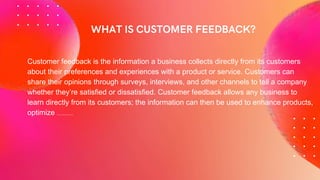
Customer feedback is the information a business collects directly from its customers
about their preferences and experiences with a product or service. Customers can
share their opinions through surveys, interviews, and other channels to tell a company
whether they’re satisfied or dissatisfied. Customer feedback allows any business to
learn directly from its customers; the information can then be used to enhance products,
optimize sales funnels, and improve the customer experience.
Nobody has better firsthand knowledge of your business than your
customers. Collecting customer feedback gives you the opportunity
to leverage that expert knowledge into better service, better sales,
and a better product in at least 11 different ways:
•
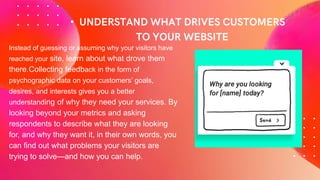
Instead of guessing or assuming why your visitors have
reached your site, learn about what drove them
there.Collecting feedback in the form of
psychographic data on your customers’ goals,
desires, and interests gives you a better
understanding of why they need your services. By
looking beyond your metrics and asking
respondents to describe what they are looking
for, and why they want it, in their own words, you
can find out what problems your visitors are
trying to solve—and how you can help.
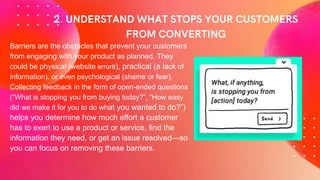
Barriers are the obstacles that prevent your customers
from engaging with your product as planned. They
could be physical (website errors), practical (a lack of
information), or even psychological (shame or fear).
Collecting feedback in the form of open-ended questions
(“What is stopping you from buying today?”, “How easy
did we make it for you to do what you wanted to do?”)
helps you determine how much effort a customer

has to exert to use a product or service, find the
information they need, or get an issue resolved—so
you can focus on removing these barriers.
In contrast to barriers, hooks are the
aspect of your website that persuade
potential customers to take action.
When you get feedback from your
customers about what convinced them,
you can discover the most effective
hooks and emphasize them on your
website to increase conversion rates.
If you don’t know how to improve your product, let your visitors tell you!
With feedback, you’ll hear directly from your users and customers where
your biggest room for growth is.
Ultimately, the most useful and intuitive products are created through a
customer-centric design process that uses customer feedback to align
products perfectly to the customer’s needs.
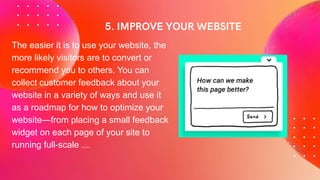
The easier it is to use your website, the
more likely visitors are to convert or
recommend you to others. You can
collect customer feedback about your
website in a variety of ways and use it
as a roadmap for how to optimize your
website—from placing a small feedback
widget on each page of your site to
running full-scale usability testing.
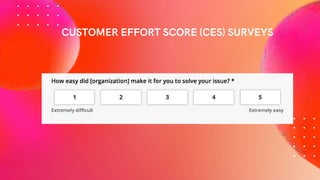
Polling customers helps you evaluate the effectiveness and helpfulness of your
sales and/or customer service representatives. In this context, a Customer
Effort Score calculation helps you determine how easy, or difficult it is for

customers to resolve any issues they encounter when doing business with

you—studies show that low effort is the strongest driver of customer
loyalty, so this is something you definitely need to be on top of.
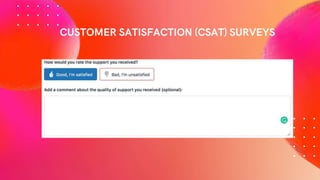
You can use customer satisfaction outside of customer support! By running
customer satisfaction surveys across your site or via email, you can find
out how happy your customers are with individual pages or functions.
With this information, you’ll constantly make improvements to their
experience.
As humans, we love it when we know we are being heard. Responding to
the concerns that your customers share with you in a proactive manner allows
you to close the feedback loop and make sure they know you take their
issues seriously. On the other hand, companies that don’t go the extra
mile to understand and address customer concerns are left with higher
churn rates and unhappy customers.
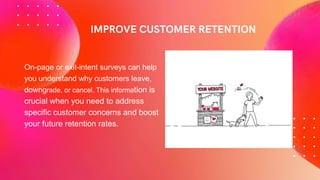
On-page or exit-intent surveys can help
you understand why customers leave,
downgrade, or cancel. This information is
crucial when you need to address
specific customer concerns and boost
your future retention rates.
If your pricing plans are confusing, or if
your prices are simply too high, that will
negatively impact sales. Asking for
customer feedback on your pricing
pages or surveying customers after
they’ve converted helps you
determine if customers think your
pricing is clear and reasonable, or
there is room for improvement.
In order to compete in your industry, you need to know how your services
measure up in terms of pricing, quality, and service. Surveying your customer base
on their past experiences might give you a clear indication of who your
major competitors are and how you stack up against them.
People in different parts of the customer lifecycle will have different perspectives
and information to share with you. Some customers have long histories with your
product, while others may be trying it out for the first time. Whom you
survey and when depends on the type of information you want to collect.
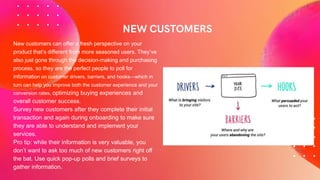
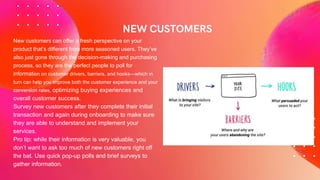
New customers can offer a fresh perspective on your
product that’s different from more seasoned users. They’ve
also just gone through the decision-making and purchasing
process, so they are the perfect people to poll for
information on customer drivers, barriers, and hooks—which in
turn can help you improve both the customer experience and your
conversion rates, optimizing buying experiences and
overall customer success.
Survey new customers after they complete their initial
transaction and again during onboarding to make sure
they are able to understand and implement your
services.
Pro tip: while their information is very valuable, you
don’t want to ask too much of new customers right off
the bat. Use quick pop-up polls and brief surveys to
gather information.
New customers can offer a fresh perspective on your
product that’s different from more seasoned users. They’ve
also just gone through the decision-making and purchasing
process, so they are the perfect people to poll for
information on customer drivers, barriers, and hooks—which in
turn can help you improve both the customer experience and your
conversion rates, optimizing buying experiences and
overall customer success.
Survey new customers after they complete their initial
transaction and again during onboarding to make sure
they are able to understand and implement your
services.
Pro tip: while their information is very valuable, you
don’t want to ask too much of new customers right off
the bat. Use quick pop-up polls and brief surveys to
gather information.
Consistent or regular customers will be more knowledgeable about the ins and outs of
your product or services and can give you informed feedback on specific features and
processes. Routinely ask regular users to rate their satisfaction using Net Promoter
Score(NPS) or Customer Effort Score (CES) polls, and send them email surveys or
onsite surveys asking their opinions on specific aspects of your product or service.
Your most loyal long-term customers are a great source for collecting more
nuanced feedback. They know your product extremely well, which makes them
best equipped to explain in-depth what they like or would improve. They can also speak
to bigger picture issues, such as changes in service or quality over time.
In addition to routine surveys or pop-up questions, identify your most
dedicated users and personally reach out and ask them for feedback via a
longer survey or phone interview.
There are many different methods for collecting feedback, from pop-up
polls to chat logs. You may want to employ a variety of customer feedback
methods to increase the likelihood of getting a response and to
evaluate different aspects of the customer experience. Here, we're
going to cover 13 different systems:
Send email surveys to your customers when you want to ask several
questions at once. Ask almost any kind of question here, like: open-ended,
multiple-choice, or rating scale questions are all fair game. The
return rate is usually low for email surveys, but it’s possible to boost
participation by promising a reward (like a discount) or prize (a
chance to win a gift card) to participants.
Reading through old customer support tickets or service emails can help you see what
time-sensitive problems or complaints your customers have dealt with recently. This is
great feedback for pinpointing pressing issues or recurring problems that can affect
customer happiness.
Practical example from my experience at Hotjar: when users reached out to your support
team looking for a feature/functionality we didn’t have, we sent them to our feature request
tool where they would submit the request themselves. After reviewing several negative
CSAT ratings, we learned that this process was incredibly frustrating for our users.
Solution: instead of sending them to another tool, we now submit the request on their
behalf.
Reading through old customer support tickets or service emails can
help you see what time-sensitive problems or complaints your
customers have dealt with recently. This is great feedback for
pinpointing pressing issues or recurring problems that can affect
customer happiness.
Practical example from my experience at Hotjar: when users reached
out to your support team looking for a feature/functionality we didn’t
have, we sent them to our feature request tool where they would
submit the request themselves. After reviewing several negative
CSAT ratings, we learned that this process was incredibly frustrating
for our users. Solution: instead of sending them to another tool, we
now submit the request on their behalf.
A live chat function on your website can help you close sales, assist with
troubleshooting, and act as a forum for user feedback. Review live chat
transcripts to collect data about customers’ experiences and issues.
Customer Feedback Guide

Customer Feedback Guide

  • 1.
  • 2.
  • 3.
  • 5.
  • 7.
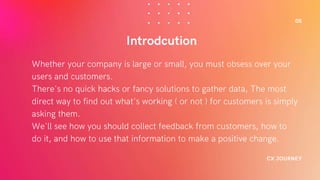
    Customer feedback isthe information a business collects directly from its customers about their preferences and experiences with a product or service. Customers can share their opinions through surveys, interviews, and other channels to tell a company whether they’re satisfied or dissatisfied. Customer feedback allows any business to learn directly from its customers; the information can then be used to enhance products, optimize sales funnels, and improve the customer experience.
  • 8.
    Nobody has betterfirsthand knowledge of your business than your customers. Collecting customer feedback gives you the opportunity to leverage that expert knowledge into better service, better sales, and a better product in at least 11 different ways:
  • 9.
    • Instead of guessingor assuming why your visitors have reached your site, learn about what drove them there.Collecting feedback in the form of psychographic data on your customers’ goals, desires, and interests gives you a better understanding of why they need your services. By looking beyond your metrics and asking respondents to describe what they are looking for, and why they want it, in their own words, you can find out what problems your visitors are trying to solve—and how you can help.
  • 10.
    Barriers are theobstacles that prevent your customers from engaging with your product as planned. They could be physical (website errors), practical (a lack of information), or even psychological (shame or fear). Collecting feedback in the form of open-ended questions (“What is stopping you from buying today?”, “How easy did we make it for you to do what you wanted to do?”) helps you determine how much effort a customer has to exert to use a product or service, find the information they need, or get an issue resolved—so you can focus on removing these barriers.
  • 11.
    In contrast tobarriers, hooks are the aspect of your website that persuade potential customers to take action. When you get feedback from your customers about what convinced them, you can discover the most effective hooks and emphasize them on your website to increase conversion rates.
  • 12.
    If you don’tknow how to improve your product, let your visitors tell you! With feedback, you’ll hear directly from your users and customers where your biggest room for growth is. Ultimately, the most useful and intuitive products are created through a customer-centric design process that uses customer feedback to align products perfectly to the customer’s needs.
  • 13.
    The easier itis to use your website, the more likely visitors are to convert or recommend you to others. You can collect customer feedback about your website in a variety of ways and use it as a roadmap for how to optimize your website—from placing a small feedback widget on each page of your site to running full-scale usability testing.
  • 14.
    Polling customers helpsyou evaluate the effectiveness and helpfulness of your sales and/or customer service representatives. In this context, a Customer Effort Score calculation helps you determine how easy, or difficult it is for customers to resolve any issues they encounter when doing business with you—studies show that low effort is the strongest driver of customer loyalty, so this is something you definitely need to be on top of.
  • 15.
    You can usecustomer satisfaction outside of customer support! By running customer satisfaction surveys across your site or via email, you can find out how happy your customers are with individual pages or functions. With this information, you’ll constantly make improvements to their experience.
  • 16.
    As humans, welove it when we know we are being heard. Responding to the concerns that your customers share with you in a proactive manner allows you to close the feedback loop and make sure they know you take their issues seriously. On the other hand, companies that don’t go the extra mile to understand and address customer concerns are left with higher churn rates and unhappy customers.
  • 17.
    On-page or exit-intentsurveys can help you understand why customers leave, downgrade, or cancel. This information is crucial when you need to address specific customer concerns and boost your future retention rates.
  • 18.
    If your pricingplans are confusing, or if your prices are simply too high, that will negatively impact sales. Asking for customer feedback on your pricing pages or surveying customers after they’ve converted helps you determine if customers think your pricing is clear and reasonable, or there is room for improvement.
  • 19.
    In order tocompete in your industry, you need to know how your services measure up in terms of pricing, quality, and service. Surveying your customer base on their past experiences might give you a clear indication of who your major competitors are and how you stack up against them.
  • 20.
    People in differentparts of the customer lifecycle will have different perspectives and information to share with you. Some customers have long histories with your product, while others may be trying it out for the first time. Whom you survey and when depends on the type of information you want to collect.
  • 21.
    New customers canoffer a fresh perspective on your product that’s different from more seasoned users. They’ve also just gone through the decision-making and purchasing process, so they are the perfect people to poll for information on customer drivers, barriers, and hooks—which in turn can help you improve both the customer experience and your conversion rates, optimizing buying experiences and overall customer success. Survey new customers after they complete their initial transaction and again during onboarding to make sure they are able to understand and implement your services. Pro tip: while their information is very valuable, you don’t want to ask too much of new customers right off the bat. Use quick pop-up polls and brief surveys to gather information.
  • 22.
    New customers canoffer a fresh perspective on your product that’s different from more seasoned users. They’ve also just gone through the decision-making and purchasing process, so they are the perfect people to poll for information on customer drivers, barriers, and hooks—which in turn can help you improve both the customer experience and your conversion rates, optimizing buying experiences and overall customer success. Survey new customers after they complete their initial transaction and again during onboarding to make sure they are able to understand and implement your services. Pro tip: while their information is very valuable, you don’t want to ask too much of new customers right off the bat. Use quick pop-up polls and brief surveys to gather information.
  • 23.
    Consistent or regularcustomers will be more knowledgeable about the ins and outs of your product or services and can give you informed feedback on specific features and processes. Routinely ask regular users to rate their satisfaction using Net Promoter Score(NPS) or Customer Effort Score (CES) polls, and send them email surveys or onsite surveys asking their opinions on specific aspects of your product or service.
  • 24.
    Your most loyallong-term customers are a great source for collecting more nuanced feedback. They know your product extremely well, which makes them best equipped to explain in-depth what they like or would improve. They can also speak to bigger picture issues, such as changes in service or quality over time. In addition to routine surveys or pop-up questions, identify your most dedicated users and personally reach out and ask them for feedback via a longer survey or phone interview.
  • 25.
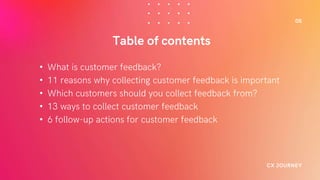
    There are manydifferent methods for collecting feedback, from pop-up polls to chat logs. You may want to employ a variety of customer feedback methods to increase the likelihood of getting a response and to evaluate different aspects of the customer experience. Here, we're going to cover 13 different systems:
  • 29.
    Send email surveysto your customers when you want to ask several questions at once. Ask almost any kind of question here, like: open-ended, multiple-choice, or rating scale questions are all fair game. The return rate is usually low for email surveys, but it’s possible to boost participation by promising a reward (like a discount) or prize (a chance to win a gift card) to participants.
  • 33.
    Reading through oldcustomer support tickets or service emails can help you see what time-sensitive problems or complaints your customers have dealt with recently. This is great feedback for pinpointing pressing issues or recurring problems that can affect customer happiness. Practical example from my experience at Hotjar: when users reached out to your support team looking for a feature/functionality we didn’t have, we sent them to our feature request tool where they would submit the request themselves. After reviewing several negative CSAT ratings, we learned that this process was incredibly frustrating for our users. Solution: instead of sending them to another tool, we now submit the request on their behalf.
  • 34.
    Reading through oldcustomer support tickets or service emails can help you see what time-sensitive problems or complaints your customers have dealt with recently. This is great feedback for pinpointing pressing issues or recurring problems that can affect customer happiness. Practical example from my experience at Hotjar: when users reached out to your support team looking for a feature/functionality we didn’t have, we sent them to our feature request tool where they would submit the request themselves. After reviewing several negative CSAT ratings, we learned that this process was incredibly frustrating for our users. Solution: instead of sending them to another tool, we now submit the request on their behalf.
  • 36.
    A live chatfunction on your website can help you close sales, assist with troubleshooting, and act as a forum for user feedback. Review live chat transcripts to collect data about customers’ experiences and issues.