
Custom Care
Management
Algorithms that
Actually Reveal Risk
© 2016 Health Catalyst
Proprietary. Feel free to share but we would appreciate a Health Catalyst citation.
Care Management Strategies
Care management is a population health
strategy tool that helps patients achieve
their healthcare goals and overcome
socioeconomic barriers to care.
These achievements are guiding
principles of value-based care.
Though organizations deploy care
management programs differently, it is
the bedrock of every successful
population health approach.
© 2016 Health Catalyst
Proprietary. Feel free to share but we would appreciate a Health Catalyst citation.
Care Management Strategies
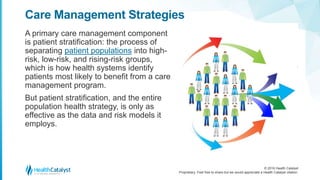
A primary care management component
is patient stratification: the process of
separating patient populations into high-
risk, low-risk, and rising-risk groups,
which is how health systems identify
patients most likely to benefit from a care
management program.
But patient stratification, and the entire
population health strategy, is only as
effective as the data and risk models it
employs.
© 2016 Health Catalyst
Proprietary. Feel free to share but we would appreciate a Health Catalyst citation.
Care Management Strategies
Accurate and effective risk scoring
depends on multiple models, multiple
data sources, and custom care
management algorithms capable of
blending them all into a comprehensive
patient stratification visualization.
© 2016 Health Catalyst
Proprietary. Feel free to share but we would appreciate a Health Catalyst citation.
Care Management Risk Modeling Under
Value-Based Care
Care management practitioners and
goals have changed as healthcare
has moved from fee-for-service
(FFS) to value-based care.
Under FFS, a payer uses care
management techniques to identify
members of the population, target
them for enrollment, and plan
appropriate care services.
The payer uses claims and clinical
data, which are run through a
black box risk model, to assign
static risk scores.
© 2016 Health Catalyst
Proprietary. Feel free to share but we would appreciate a Health Catalyst citation.
Care Management Risk Modeling Under
Value-Based Care
Under value-based care, healthcare
organizations (HCOs) have more
complex risk modeling needs because
their goals center on the health of
multiple patient populations.
These organizations’ goals involve
multiple payers and multiple risk
models, which tend to complicate
care management.
© 2016 Health Catalyst
Proprietary. Feel free to share but we would appreciate a Health Catalyst citation.
Care Management Risk Modeling Under
Value-Based Care
Because most organizations have
limited care management resources,
identifying those patients who will
respond best to care management
tactics is important.
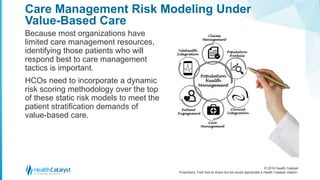
HCOs need to incorporate a dynamic
risk scoring methodology over the top
of these static risk models to meet the
patient stratification demands of
value-based care.
© 2016 Health Catalyst
Proprietary. Feel free to share but we would appreciate a Health Catalyst citation.
The Problem with Static Risk Model Scores
Different risk models produce unique risk scores.
For example, Conifer and Milliman Advanced Risk
Adjuster (MARA) are two popular models used by
payers to produce static scores.
A patient with a Conifer risk score greater than 30
is considered high-risk, as is a patient with a
MARA risk score greater than 3.5.
But comparing these scores is like comparing
apples to oranges. Though they have similar
meaning, they are on completely different scales.
Also, these models were originally developed
without access to EMR data.
© 2016 Health Catalyst
Proprietary. Feel free to share but we would appreciate a Health Catalyst citation.
The Problem with Static Risk Model Scores
Typical clinical risk models also produce unique
scores, such as predictive risk, admissions risk,
Charlson/Deyo, and HHS-HCC. These models
were built with limited access to clinical datasets.
In managing population health, care managers
need to effectively compare patient risk levels,
then target and coordinate care appropriately.
But static, incongruent scores make it nearly
impossible to compare risk levels to stratify
patients and create precise lists of patients for
assigning to care management programs.
Normalizing risk scores is necessary for
precise stratification.
© 2016 Health Catalyst
Proprietary. Feel free to share but we would appreciate a Health Catalyst citation.
How to Normalize Static Risk Model Scores
with Custom Care Management Algorithms
HCOs need an analytics solution that
can ingest the vast amounts of data that
come from their patient populations.
The solution must also work with
disparate data sources, including
claims, EMRs, and clinical applications.
A solution that can nimbly handle large
datasets from a broad representation of
data sources establishes the process
for normalizing risk scores.
© 2016 Health Catalyst
Proprietary. Feel free to share but we would appreciate a Health Catalyst citation.
How to Normalize Static Risk Model Scores
with Custom Care Management Algorithms
To normalize scores (i.e., standardize them
for comparison in a risk stratification process),
care management teams must be able to
build custom care management algorithms
from all datasets, so they can accurately
stratify patients into risk categories.
Comprehensive stratification algorithms
consider chronic conditions, risk, utilization,
medication, and social determinant variables,
each of which must be weight-adjustable.
© 2016 Health Catalyst
Proprietary. Feel free to share but we would appreciate a Health Catalyst citation.
How to Normalize Static Risk Model Scores
with Custom Care Management Algorithms
For example, the utilization variable could be
weighted by any combination of ED visits,
hospital admissions, skilled nursing facility
stays, specialist visits, or ICU stays.
The risk variable could be weighted by
predicted risk, rising risk, readmission risk,
HHS-HCC risk, and Charlson-Deyo risk.
A custom algorithm must play on the
strengths of multiple risk models and data
sources, while removing the fragmentation
imposed by individual, mismatched scores
and disparate data sources.
© 2016 Health Catalyst
Proprietary. Feel free to share but we would appreciate a Health Catalyst citation.
Effective Patient Stratification Accounts
for Patient Complexity
Typical risk models don’t take into account the
complexity of patients. Instead, they rely on
static datasets.
A clinical or claims-based patient stratification
algorithm only looks at a portion of the patient
profile, which limits the care management
team to only a partial view of the risk
variables impacting each patient.
Custom care management algorithms
reveal patient populations with complex
care needs that otherwise would be missed
using traditional risk scoring models.
© 2016 Health Catalyst
Proprietary. Feel free to share but we would appreciate a Health Catalyst citation.
Effective Patient Stratification Accounts
for Patient Complexity
Though robust geographic-based socioeconomic
datasets still need to be collected, the value of
being able to ingest this data cannot be overstated.
Clinical and claims data alone cannot tell the care
management team if a patient can afford to pay for
medication or understand discharge instructions.
Patient stratification care management software
should include modules for consuming all these
data sources, especially socioeconomic data, to
generate a list of patients that can then be reviewed
and assigned to a care management program.
© 2016 Health Catalyst
Proprietary. Feel free to share but we would appreciate a Health Catalyst citation.
Effective Patient Stratification Accounts
for Patient Complexity
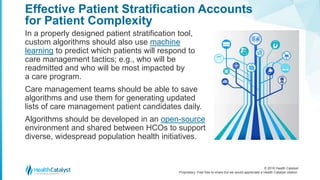
In a properly designed patient stratification tool,
custom algorithms should also use machine
learning to predict which patients will respond to
care management tactics; e.g., who will be
readmitted and who will be most impacted by
a care program.
Care management teams should be able to save
algorithms and use them for generating updated
lists of care management patient candidates daily.
Algorithms should be developed in an open-source
environment and shared between HCOs to support
diverse, widespread population health initiatives.
© 2016 Health Catalyst
Proprietary. Feel free to share but we would appreciate a Health Catalyst citation.
Population Health Demands Next-Level
Patient Stratification
Population health initiatives require knowing as
much about patient populations as possible.
More robust data enables this understanding,
shows the care gaps, stratifies the sickest patients,
and reveals how they are utilizing resources.
Using multiple risk models, multiple data sources,
and dynamic patient stratification algorithms, care
management teams can confidently target
populations for care management resources:
a critical process for meeting the financial and
clinical challenges of value-based care.
© 2016 Health Catalyst
Proprietary. Feel free to share but we would appreciate a Health Catalyst citation.
For more information:
“This book is a fantastic piece of work”
– Robert Lindeman MD, FAAP, Chief Physician Quality Officer
© 2016 Health Catalyst
Proprietary. Feel free to share but we would appreciate a Health Catalyst citation.
More about this topic
Link to original article for a more in-depth discussion.
Custom Care Management Algorithms that Actually Reveal Risk
Patient Stratification
Health Catalyst Product – Care Management Suite
In Pursuit of the Patient Stratification Gold Standard: Getting There with Healthcare Analytics
Maggie O'Keefe, Product Line Director, Operations and Performance Management
Defining Patient Populations Using Analytical Tools
Kathleen Merkley, Senior VP of Professional Services
A Guide to Care Management: Five Competencies Every Health System Must Have
Russ Staheli, Analytics, VP
How to Define Population Health Management
Health Catalyst Population Health Solutions
© 2016 Health Catalyst
Proprietary. Feel free to share but we would appreciate a Health Catalyst citation.
Kathleen Clary joined Health Catalyst in May 2017 as VP of Care Management & Patient
Engagement. Prior to coming to Catalyst, Kathleen worked for MultiCare Health System as
the Administrator of Patient Navigation & Care Coordination. Kathleen has a degree in
Bachelors of Nursing from Mount Marty College, a Masters of Nursing from University of
Washington, Tacoma, a Doctorate of Nursing Practice in Systems Leadership from Rush University,
Chicago and currently enrolled (graduate 2018) at the Army War College to earn a Master’s in
Strategic Studies.
Other Clinical Quality Improvement Resources
Click to read additional information at www.healthcatalyst.com
Kathleen Clary, BSN, MSN, DNP

Custom Care Management Algorithms that Actually Reveal Risk

  • 1.
  • 2.
    © 2016 HealthCatalyst Proprietary. Feel free to share but we would appreciate a Health Catalyst citation. Care Management Strategies Care management is a population health strategy tool that helps patients achieve their healthcare goals and overcome socioeconomic barriers to care. These achievements are guiding principles of value-based care. Though organizations deploy care management programs differently, it is the bedrock of every successful population health approach.
  • 3.
    © 2016 HealthCatalyst Proprietary. Feel free to share but we would appreciate a Health Catalyst citation. Care Management Strategies A primary care management component is patient stratification: the process of separating patient populations into high- risk, low-risk, and rising-risk groups, which is how health systems identify patients most likely to benefit from a care management program. But patient stratification, and the entire population health strategy, is only as effective as the data and risk models it employs.
  • 4.
    © 2016 HealthCatalyst Proprietary. Feel free to share but we would appreciate a Health Catalyst citation. Care Management Strategies Accurate and effective risk scoring depends on multiple models, multiple data sources, and custom care management algorithms capable of blending them all into a comprehensive patient stratification visualization.
  • 5.
    © 2016 HealthCatalyst Proprietary. Feel free to share but we would appreciate a Health Catalyst citation. Care Management Risk Modeling Under Value-Based Care Care management practitioners and goals have changed as healthcare has moved from fee-for-service (FFS) to value-based care. Under FFS, a payer uses care management techniques to identify members of the population, target them for enrollment, and plan appropriate care services. The payer uses claims and clinical data, which are run through a black box risk model, to assign static risk scores.
  • 6.
    © 2016 HealthCatalyst Proprietary. Feel free to share but we would appreciate a Health Catalyst citation. Care Management Risk Modeling Under Value-Based Care Under value-based care, healthcare organizations (HCOs) have more complex risk modeling needs because their goals center on the health of multiple patient populations. These organizations’ goals involve multiple payers and multiple risk models, which tend to complicate care management.
  • 7.
    © 2016 HealthCatalyst Proprietary. Feel free to share but we would appreciate a Health Catalyst citation. Care Management Risk Modeling Under Value-Based Care Because most organizations have limited care management resources, identifying those patients who will respond best to care management tactics is important. HCOs need to incorporate a dynamic risk scoring methodology over the top of these static risk models to meet the patient stratification demands of value-based care.
  • 8.
    © 2016 HealthCatalyst Proprietary. Feel free to share but we would appreciate a Health Catalyst citation. The Problem with Static Risk Model Scores Different risk models produce unique risk scores. For example, Conifer and Milliman Advanced Risk Adjuster (MARA) are two popular models used by payers to produce static scores. A patient with a Conifer risk score greater than 30 is considered high-risk, as is a patient with a MARA risk score greater than 3.5. But comparing these scores is like comparing apples to oranges. Though they have similar meaning, they are on completely different scales. Also, these models were originally developed without access to EMR data.
  • 9.
    © 2016 HealthCatalyst Proprietary. Feel free to share but we would appreciate a Health Catalyst citation. The Problem with Static Risk Model Scores Typical clinical risk models also produce unique scores, such as predictive risk, admissions risk, Charlson/Deyo, and HHS-HCC. These models were built with limited access to clinical datasets. In managing population health, care managers need to effectively compare patient risk levels, then target and coordinate care appropriately. But static, incongruent scores make it nearly impossible to compare risk levels to stratify patients and create precise lists of patients for assigning to care management programs. Normalizing risk scores is necessary for precise stratification.
  • 10.
    © 2016 HealthCatalyst Proprietary. Feel free to share but we would appreciate a Health Catalyst citation. How to Normalize Static Risk Model Scores with Custom Care Management Algorithms HCOs need an analytics solution that can ingest the vast amounts of data that come from their patient populations. The solution must also work with disparate data sources, including claims, EMRs, and clinical applications. A solution that can nimbly handle large datasets from a broad representation of data sources establishes the process for normalizing risk scores.
  • 11.
    © 2016 HealthCatalyst Proprietary. Feel free to share but we would appreciate a Health Catalyst citation. How to Normalize Static Risk Model Scores with Custom Care Management Algorithms To normalize scores (i.e., standardize them for comparison in a risk stratification process), care management teams must be able to build custom care management algorithms from all datasets, so they can accurately stratify patients into risk categories. Comprehensive stratification algorithms consider chronic conditions, risk, utilization, medication, and social determinant variables, each of which must be weight-adjustable.
  • 12.
    © 2016 HealthCatalyst Proprietary. Feel free to share but we would appreciate a Health Catalyst citation. How to Normalize Static Risk Model Scores with Custom Care Management Algorithms For example, the utilization variable could be weighted by any combination of ED visits, hospital admissions, skilled nursing facility stays, specialist visits, or ICU stays. The risk variable could be weighted by predicted risk, rising risk, readmission risk, HHS-HCC risk, and Charlson-Deyo risk. A custom algorithm must play on the strengths of multiple risk models and data sources, while removing the fragmentation imposed by individual, mismatched scores and disparate data sources.
  • 13.
    © 2016 HealthCatalyst Proprietary. Feel free to share but we would appreciate a Health Catalyst citation. Effective Patient Stratification Accounts for Patient Complexity Typical risk models don’t take into account the complexity of patients. Instead, they rely on static datasets. A clinical or claims-based patient stratification algorithm only looks at a portion of the patient profile, which limits the care management team to only a partial view of the risk variables impacting each patient. Custom care management algorithms reveal patient populations with complex care needs that otherwise would be missed using traditional risk scoring models.
  • 14.
    © 2016 HealthCatalyst Proprietary. Feel free to share but we would appreciate a Health Catalyst citation. Effective Patient Stratification Accounts for Patient Complexity Though robust geographic-based socioeconomic datasets still need to be collected, the value of being able to ingest this data cannot be overstated. Clinical and claims data alone cannot tell the care management team if a patient can afford to pay for medication or understand discharge instructions. Patient stratification care management software should include modules for consuming all these data sources, especially socioeconomic data, to generate a list of patients that can then be reviewed and assigned to a care management program.
  • 15.
    © 2016 HealthCatalyst Proprietary. Feel free to share but we would appreciate a Health Catalyst citation. Effective Patient Stratification Accounts for Patient Complexity In a properly designed patient stratification tool, custom algorithms should also use machine learning to predict which patients will respond to care management tactics; e.g., who will be readmitted and who will be most impacted by a care program. Care management teams should be able to save algorithms and use them for generating updated lists of care management patient candidates daily. Algorithms should be developed in an open-source environment and shared between HCOs to support diverse, widespread population health initiatives.
  • 16.
    © 2016 HealthCatalyst Proprietary. Feel free to share but we would appreciate a Health Catalyst citation. Population Health Demands Next-Level Patient Stratification Population health initiatives require knowing as much about patient populations as possible. More robust data enables this understanding, shows the care gaps, stratifies the sickest patients, and reveals how they are utilizing resources. Using multiple risk models, multiple data sources, and dynamic patient stratification algorithms, care management teams can confidently target populations for care management resources: a critical process for meeting the financial and clinical challenges of value-based care.
  • 17.
    © 2016 HealthCatalyst Proprietary. Feel free to share but we would appreciate a Health Catalyst citation. For more information: “This book is a fantastic piece of work” – Robert Lindeman MD, FAAP, Chief Physician Quality Officer
  • 18.
    © 2016 HealthCatalyst Proprietary. Feel free to share but we would appreciate a Health Catalyst citation. More about this topic Link to original article for a more in-depth discussion. Custom Care Management Algorithms that Actually Reveal Risk Patient Stratification Health Catalyst Product – Care Management Suite In Pursuit of the Patient Stratification Gold Standard: Getting There with Healthcare Analytics Maggie O'Keefe, Product Line Director, Operations and Performance Management Defining Patient Populations Using Analytical Tools Kathleen Merkley, Senior VP of Professional Services A Guide to Care Management: Five Competencies Every Health System Must Have Russ Staheli, Analytics, VP How to Define Population Health Management Health Catalyst Population Health Solutions
  • 19.
    © 2016 HealthCatalyst Proprietary. Feel free to share but we would appreciate a Health Catalyst citation. Kathleen Clary joined Health Catalyst in May 2017 as VP of Care Management & Patient Engagement. Prior to coming to Catalyst, Kathleen worked for MultiCare Health System as the Administrator of Patient Navigation & Care Coordination. Kathleen has a degree in Bachelors of Nursing from Mount Marty College, a Masters of Nursing from University of Washington, Tacoma, a Doctorate of Nursing Practice in Systems Leadership from Rush University, Chicago and currently enrolled (graduate 2018) at the Army War College to earn a Master’s in Strategic Studies. Other Clinical Quality Improvement Resources Click to read additional information at www.healthcatalyst.com Kathleen Clary, BSN, MSN, DNP