Custody Transfer Temperature Measurement
API MPMS Chapter 7 – Temperature Measurement Standards
Overview
Presented at 2012 API Asia Conference and Expo
March 6-8, 2012
Dr. William J. Schmidt, II
Director Commercial – Measurement & Loss Control
ConocoPhillips Company
2
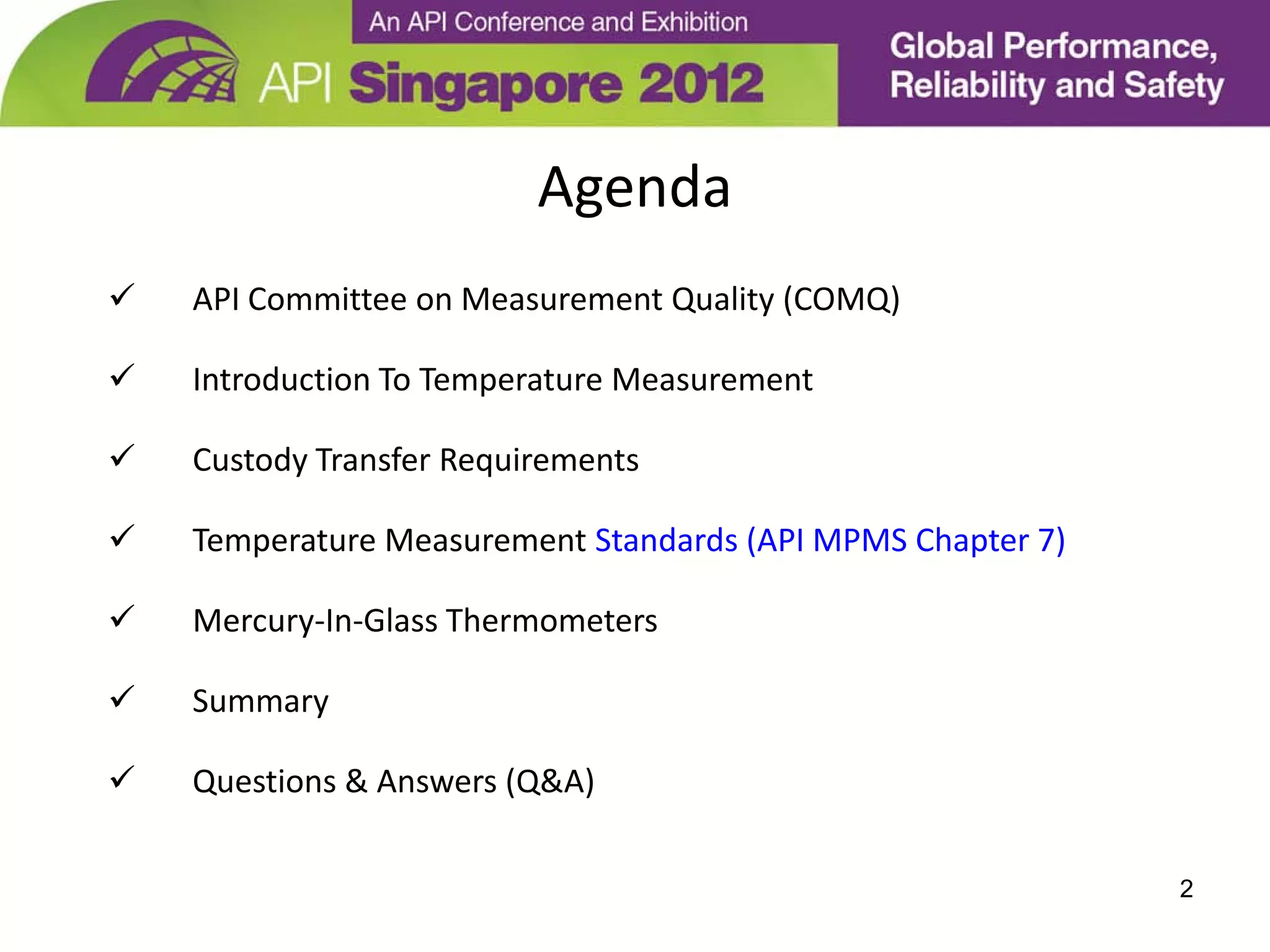
Agenda
 API Committee on Measurement Quality (COMQ)
 Introduction To Temperature Measurement
 Custody Transfer Requirements
 Temperature Measurement Standards (API MPMS Chapter 7)
 Mercury-In-Glass Thermometers
 Summary
 Questions & Answers (Q&A)
3
API Committee on Measurement Quality
4
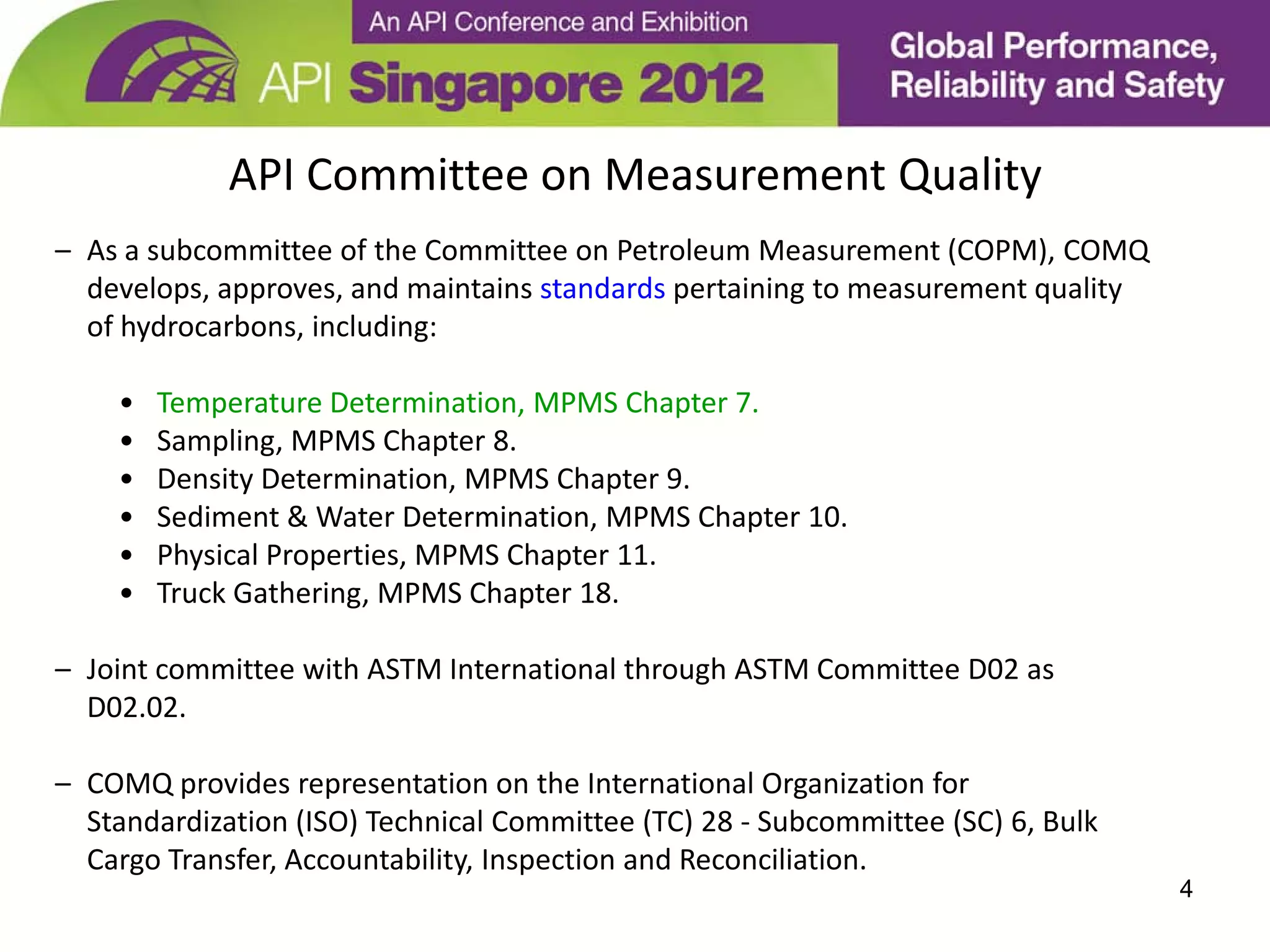
API Committee on Measurement Quality
– As a subcommittee of the Committee on Petroleum Measurement (COPM), COMQ
develops, approves, and maintains standards pertaining to measurement quality
of hydrocarbons, including:
• Temperature Determination, MPMS Chapter 7.
• Sampling, MPMS Chapter 8.
• Density Determination, MPMS Chapter 9.
• Sediment & Water Determination, MPMS Chapter 10.
• Physical Properties, MPMS Chapter 11.
• Truck Gathering, MPMS Chapter 18.
– Joint committee with ASTM International through ASTM Committee D02 as
D02.02.
– COMQ provides representation on the International Organization for
Standardization (ISO) Technical Committee (TC) 28 - Subcommittee (SC) 6, Bulk
Cargo Transfer, Accountability, Inspection and Reconciliation.
5
Introduction To Temperature Measurement
– Crude oil and petroleum products are typically sold based
on fluid properties at Standard (“Reference”) Temperature
and Pressure conditions.
– Temperature has the most significant effect on the accurate
determination of liquid quantities when correcting to
Standard Conditions (Volumetric Correction Factor).
– Therefore: The most accurate means for temperature
measurement should be used for these custody transfer
applications.
Introduction to Temperature Measurement
– Contracts reference standards to be used in custody
transfer, which specify temperature measurement
equipment, location, and required accuracy.
– Regulatory agencies also reference the same standards for
use in determining royalties, taxes, and regulatory
compliance.
– Buyers and Sellers negotiate the appropriate standards to
be used in the development of contracts for custody
transfer.
Introduction to Temperature Measurement
– Temperature measurement standards are written for:
• Fluids under “static” conditions.
• Fluids under “dynamic” conditions.
– Standards cover temperature measurement for:
• Selection of equipment types and equipment usage.
• Volumetric custody temperature measurement.
• Calibration of volumetric measurement devices.
• Calibration of other temperature measurement devices.
• Use in quality analysis (QA).
Introduction to Temperature Measurement
9
Custody Transfer Requirements
– Static liquid hydrocarbon temperature measurement
• Static vessels:
– Storage tanks, gathering tanks.
– Ships, tankers, and barges.
– Tank cars and rail cars
– Can provers.
– Dynamic liquid hydrocarbon temperature measurement
• Dynamic vessels:
– Pipes.
– Pipe Provers.
Custody Transfer Requirements
– Static and dynamic temperature measurement
• Objective: find average temperature – representative of “bulk”.
– Manual method:
» Mercury-In-Glass Thermometers (MIGTs).
» Portable Electronic Thermometers (PETs).
– Automatic method:
» Fixed electronic sensors
» Automatic Tank Thermometer elements (ATTs)
Custody Transfer Requirements
– Performance of temperature measurement (Accuracy)
determined by a variety of standards:
• Calculation standard (API MPMS Chapter 12).
• Density determination standards (API MPMS Chapter 9).
• Sediment and Water determination standards (API MPMS Chapter 10).
• Proving standards (API MPMS Chapter 5).
• Tank gauging standard (API MPMS Chapter 3).
• Tank calibration standard (API MPMS Chapter 2).
• Metering standards (API MPMS Chapter 5).
• Gathering standard (API MPMS Chapter 18).
13
Temperature Measurement Standards
14
Temperature Measurement Standards
• Currently, MPMS Chapter 7 contains all temperature measurement
information organized as sections in one document.
– Equipment and apparatus.
– Static Temperature Measurement.
– Dynamic Temperature Measurement.
– Calibration, Verification, and Inspection.
• Ongoing effort to reorganize current document into stand-alone standards:
– Section 1 – Liquid-In-Glass Thermometers.
– Section 2 – Portable Electronic Thermometers (PETs).
– Section 3 – Fixed Automatic Tank Systems (PUBLISHED 9/2011).
– Section 4 – Dynamic Temperature Measurement.
Temperature Measurement Standards
• Equipment and apparatus section.
– Fixed automatic tank thermometers.
– Portable electronic thermometers (PETs).
– Glass thermometers.
– Electronic temperature devices.
– Thermowells.
– Data Collection, transmission, receiving equipment.
Temperature Measurement Standards
ASTM Thermometers
Name
ASTM
Thermometer Range Length (inches) Graduation Accuracy
ASTM tank 58F-80 -–30°F to +120°F 12 1°F ± 0.5°F
ASTM tank 97F-80 0°F to 120°F 12 1°F ± 0.5°F
ASTM tank 59F-80 0°F to180°F 12 1°F ± 0.5°F
ASTM tank 98F-80 60°F to180°F 12 1°F ± 0.5°F
ASTM tank 60F-80 170°F to 500°F 12 2°F ± 1.0°F
Angle-stem — Suitable range 12a
1°F ± 1.0°F
Tank thermometerb
— 20°F to 220°F 12 1°F ± 0.5°F
Note: Except for the angle-stem thermometer, all thermometers listed in this table are the total-immersion type.
Portable Electronic Thermometer Specifications
Minimum Graduation Accuracy Range of Required Accuracy
0.1°F ± 0.2°F 0 – 200°F
± 0.5°F > 200°F
0.1°C ± 0.1°C 0 – 100°C
± 0.3°C > 100°C
Note 1: The specifications in this table represent minimum acceptable accuracy for portable electronic thermometers used for custody transfer.
Thermometers with better accuracy are available and may be specified by mutual agreement.
Note 2: PETs shall be provided with displays that provide a resolution of 0.1°C or 0.1°F or better.
Temperature Measurement Standards
• Static temperature determination section.
– Ambient temperature.
– Timing of temperature measurement.
– Fixed automatic tank thermometers.
– Portable electronic thermometers.
– Mercury-in-glass thermometers.
Temperature Measurement Standards
Comparison of Recommended Immersion Times for PETs and Woodback Cup-Case Assemblies
-------------------------------------- Recommended Immersion Times (minutes) ----------------------------------------------
Electronic
Thermometer ------------------------------ Woodback Cup-Case Assembly ---------------------------------------
When Temperature Differential <2.5°C (< 5°F)
API Gravity At 60°F In-Motion (see note 1) In-Motion Stationary In-Motion Stationary
> 50 30 seconds 5 minutes 10 minutes 5 minutes 10 minutes
40 to 49 30 seconds 5 minutes 15 minutes 5 minutes 15 minutes
30 to 39 45 seconds 12 minutes 25 minutes 12 minutes 20 minutes
20 to 29 45 seconds 20 minutes 45 minutes 20 minutes 35 minutes
< 20 75 seconds 45 minutes 80 minutes 35 minutes 60 minutes
.
Temperature Measurement Standards
Thermometer Assemblies and Temperature Levels for Tanks and Cargo Carriers
Tanks
Typical Temperature
Measurement Facilities
Thermometer
Assemblies Measurement Levels
Stationary Tanks
Fixed-roof Roof hatch Cup-case See note
Floating-roof Gauge hatch Cup-case See note
Variable vapor space Gauge hatch Cup-case See note
Vertical thermowells Armored See note
Pressure lock Cup-case See note
Horizontal separable wells Angle Stem Three for tank heights less than
10 meters (30 feet); four for tank heights
greater than 10 meters (30 feet)
Horizontal-cylindrical
Nonpressure Gauge hatch Cup-case See note
Pressure Vertical thermowells Armored See note
Horizontal separable wells Angle-stem Two, one at middle of tank and one
0.3 meter (1 foot), above bottom
Tank Cars and Tank Trucks
Nonpressure Dome hatch Cup-case Middle of liquida
Pressure Vertical thermowells Armored Middle of liquida
Ships and Barges
Nonpressure Deck hatch Cup-case See note
Pressure Vertical thermowells Armored Middle of liquida
Note: See Table 5 for the minimum number of measurement levels.
a
In special cases, it may be desirable to obtain temperatures at more than one level and calculate a weighted average temperature.
See Table 5, Note 2, for the correct method of averaging multiple temperatures.
Temperature Measurement Standards
• Dynamic temperature determination section.
– Temperature sensor placement.
– Temperature discrimination.
• Calibration verification and Inspection section.
– Fixed automatic tank thermometers (ATTs).
– Portable electronic thermometers (PETs)
– Glass and Mercury-in-glass thermometer verification
– Dynamic verification and calibration.
Temperature Measurement Standards
Maximum Deviation Limits: Temperature Device
Versus Reference Thermometer
Service °C °F
Meter Prover Calibration 0.05 0.1
Meter Proving 0.10 0.2
22
Mercury-In-Glass Thermometers
– World-wide movement to ban mercury in 2000’s.
– Discussed as part of UN activities.
– Commitment by most countries to ban mercury within 2
years.
– MIGT most commonly used
temperature measurement
device in Petrochemical
Industry.
– NIST discontinued calibration
of mercury devices as of
November 2011.
Mercury-In-Glass Thermometers
– Replacement technology:
• Static and dynamic fluid measurements
» Portable Electronic Thermometers (PETs)
» Automatic Tank Thermometer elements (ATT)
• Calibration devices
» ???
• Under study by API MIGT replacement adhoc group
(results in 2012).
• Revise standards to exclude MIGT devices.
25
Summary
Summary
– The most accurate means for temperature measurement
should be used for these custody transfer applications.
– API MPMS Chapter 7 describes the equipment types, usage,
calibration of the various temperature measurements made
in custody transfer.
– Mercury-In-Glass Thermometers will be phased out of the
petrochemical business; standards are being revised to
reflect replacement technologies.
27
Questions ?

custody-transfer-temperature-measurement-api-mpms.pdf

  • 1.
    Custody Transfer TemperatureMeasurement API MPMS Chapter 7 – Temperature Measurement Standards Overview Presented at 2012 API Asia Conference and Expo March 6-8, 2012 Dr. William J. Schmidt, II Director Commercial – Measurement & Loss Control ConocoPhillips Company
  • 2.
    2 Agenda  API Committeeon Measurement Quality (COMQ)  Introduction To Temperature Measurement  Custody Transfer Requirements  Temperature Measurement Standards (API MPMS Chapter 7)  Mercury-In-Glass Thermometers  Summary  Questions & Answers (Q&A)
  • 3.
    3 API Committee onMeasurement Quality
  • 4.
    4 API Committee onMeasurement Quality – As a subcommittee of the Committee on Petroleum Measurement (COPM), COMQ develops, approves, and maintains standards pertaining to measurement quality of hydrocarbons, including: • Temperature Determination, MPMS Chapter 7. • Sampling, MPMS Chapter 8. • Density Determination, MPMS Chapter 9. • Sediment & Water Determination, MPMS Chapter 10. • Physical Properties, MPMS Chapter 11. • Truck Gathering, MPMS Chapter 18. – Joint committee with ASTM International through ASTM Committee D02 as D02.02. – COMQ provides representation on the International Organization for Standardization (ISO) Technical Committee (TC) 28 - Subcommittee (SC) 6, Bulk Cargo Transfer, Accountability, Inspection and Reconciliation.
  • 5.
  • 6.
    – Crude oiland petroleum products are typically sold based on fluid properties at Standard (“Reference”) Temperature and Pressure conditions. – Temperature has the most significant effect on the accurate determination of liquid quantities when correcting to Standard Conditions (Volumetric Correction Factor). – Therefore: The most accurate means for temperature measurement should be used for these custody transfer applications. Introduction to Temperature Measurement
  • 7.
    – Contracts referencestandards to be used in custody transfer, which specify temperature measurement equipment, location, and required accuracy. – Regulatory agencies also reference the same standards for use in determining royalties, taxes, and regulatory compliance. – Buyers and Sellers negotiate the appropriate standards to be used in the development of contracts for custody transfer. Introduction to Temperature Measurement
  • 8.
    – Temperature measurementstandards are written for: • Fluids under “static” conditions. • Fluids under “dynamic” conditions. – Standards cover temperature measurement for: • Selection of equipment types and equipment usage. • Volumetric custody temperature measurement. • Calibration of volumetric measurement devices. • Calibration of other temperature measurement devices. • Use in quality analysis (QA). Introduction to Temperature Measurement
  • 9.
  • 10.
    Custody Transfer Requirements –Static liquid hydrocarbon temperature measurement • Static vessels: – Storage tanks, gathering tanks. – Ships, tankers, and barges. – Tank cars and rail cars – Can provers. – Dynamic liquid hydrocarbon temperature measurement • Dynamic vessels: – Pipes. – Pipe Provers.
  • 11.
    Custody Transfer Requirements –Static and dynamic temperature measurement • Objective: find average temperature – representative of “bulk”. – Manual method: » Mercury-In-Glass Thermometers (MIGTs). » Portable Electronic Thermometers (PETs). – Automatic method: » Fixed electronic sensors » Automatic Tank Thermometer elements (ATTs)
  • 12.
    Custody Transfer Requirements –Performance of temperature measurement (Accuracy) determined by a variety of standards: • Calculation standard (API MPMS Chapter 12). • Density determination standards (API MPMS Chapter 9). • Sediment and Water determination standards (API MPMS Chapter 10). • Proving standards (API MPMS Chapter 5). • Tank gauging standard (API MPMS Chapter 3). • Tank calibration standard (API MPMS Chapter 2). • Metering standards (API MPMS Chapter 5). • Gathering standard (API MPMS Chapter 18).
  • 13.
  • 14.
    14 Temperature Measurement Standards •Currently, MPMS Chapter 7 contains all temperature measurement information organized as sections in one document. – Equipment and apparatus. – Static Temperature Measurement. – Dynamic Temperature Measurement. – Calibration, Verification, and Inspection. • Ongoing effort to reorganize current document into stand-alone standards: – Section 1 – Liquid-In-Glass Thermometers. – Section 2 – Portable Electronic Thermometers (PETs). – Section 3 – Fixed Automatic Tank Systems (PUBLISHED 9/2011). – Section 4 – Dynamic Temperature Measurement.
  • 15.
    Temperature Measurement Standards •Equipment and apparatus section. – Fixed automatic tank thermometers. – Portable electronic thermometers (PETs). – Glass thermometers. – Electronic temperature devices. – Thermowells. – Data Collection, transmission, receiving equipment.
  • 16.
    Temperature Measurement Standards ASTMThermometers Name ASTM Thermometer Range Length (inches) Graduation Accuracy ASTM tank 58F-80 -–30°F to +120°F 12 1°F ± 0.5°F ASTM tank 97F-80 0°F to 120°F 12 1°F ± 0.5°F ASTM tank 59F-80 0°F to180°F 12 1°F ± 0.5°F ASTM tank 98F-80 60°F to180°F 12 1°F ± 0.5°F ASTM tank 60F-80 170°F to 500°F 12 2°F ± 1.0°F Angle-stem — Suitable range 12a 1°F ± 1.0°F Tank thermometerb — 20°F to 220°F 12 1°F ± 0.5°F Note: Except for the angle-stem thermometer, all thermometers listed in this table are the total-immersion type. Portable Electronic Thermometer Specifications Minimum Graduation Accuracy Range of Required Accuracy 0.1°F ± 0.2°F 0 – 200°F ± 0.5°F > 200°F 0.1°C ± 0.1°C 0 – 100°C ± 0.3°C > 100°C Note 1: The specifications in this table represent minimum acceptable accuracy for portable electronic thermometers used for custody transfer. Thermometers with better accuracy are available and may be specified by mutual agreement. Note 2: PETs shall be provided with displays that provide a resolution of 0.1°C or 0.1°F or better.
  • 17.
    Temperature Measurement Standards •Static temperature determination section. – Ambient temperature. – Timing of temperature measurement. – Fixed automatic tank thermometers. – Portable electronic thermometers. – Mercury-in-glass thermometers.
  • 18.
    Temperature Measurement Standards Comparisonof Recommended Immersion Times for PETs and Woodback Cup-Case Assemblies -------------------------------------- Recommended Immersion Times (minutes) ---------------------------------------------- Electronic Thermometer ------------------------------ Woodback Cup-Case Assembly --------------------------------------- When Temperature Differential <2.5°C (< 5°F) API Gravity At 60°F In-Motion (see note 1) In-Motion Stationary In-Motion Stationary > 50 30 seconds 5 minutes 10 minutes 5 minutes 10 minutes 40 to 49 30 seconds 5 minutes 15 minutes 5 minutes 15 minutes 30 to 39 45 seconds 12 minutes 25 minutes 12 minutes 20 minutes 20 to 29 45 seconds 20 minutes 45 minutes 20 minutes 35 minutes < 20 75 seconds 45 minutes 80 minutes 35 minutes 60 minutes .
  • 19.
    Temperature Measurement Standards ThermometerAssemblies and Temperature Levels for Tanks and Cargo Carriers Tanks Typical Temperature Measurement Facilities Thermometer Assemblies Measurement Levels Stationary Tanks Fixed-roof Roof hatch Cup-case See note Floating-roof Gauge hatch Cup-case See note Variable vapor space Gauge hatch Cup-case See note Vertical thermowells Armored See note Pressure lock Cup-case See note Horizontal separable wells Angle Stem Three for tank heights less than 10 meters (30 feet); four for tank heights greater than 10 meters (30 feet) Horizontal-cylindrical Nonpressure Gauge hatch Cup-case See note Pressure Vertical thermowells Armored See note Horizontal separable wells Angle-stem Two, one at middle of tank and one 0.3 meter (1 foot), above bottom Tank Cars and Tank Trucks Nonpressure Dome hatch Cup-case Middle of liquida Pressure Vertical thermowells Armored Middle of liquida Ships and Barges Nonpressure Deck hatch Cup-case See note Pressure Vertical thermowells Armored Middle of liquida Note: See Table 5 for the minimum number of measurement levels. a In special cases, it may be desirable to obtain temperatures at more than one level and calculate a weighted average temperature. See Table 5, Note 2, for the correct method of averaging multiple temperatures.
  • 20.
    Temperature Measurement Standards •Dynamic temperature determination section. – Temperature sensor placement. – Temperature discrimination. • Calibration verification and Inspection section. – Fixed automatic tank thermometers (ATTs). – Portable electronic thermometers (PETs) – Glass and Mercury-in-glass thermometer verification – Dynamic verification and calibration.
  • 21.
    Temperature Measurement Standards MaximumDeviation Limits: Temperature Device Versus Reference Thermometer Service °C °F Meter Prover Calibration 0.05 0.1 Meter Proving 0.10 0.2
  • 22.
  • 23.
    Mercury-In-Glass Thermometers – World-widemovement to ban mercury in 2000’s. – Discussed as part of UN activities. – Commitment by most countries to ban mercury within 2 years. – MIGT most commonly used temperature measurement device in Petrochemical Industry. – NIST discontinued calibration of mercury devices as of November 2011.
  • 24.
    Mercury-In-Glass Thermometers – Replacementtechnology: • Static and dynamic fluid measurements » Portable Electronic Thermometers (PETs) » Automatic Tank Thermometer elements (ATT) • Calibration devices » ??? • Under study by API MIGT replacement adhoc group (results in 2012). • Revise standards to exclude MIGT devices.
  • 25.
  • 26.
    Summary – The mostaccurate means for temperature measurement should be used for these custody transfer applications. – API MPMS Chapter 7 describes the equipment types, usage, calibration of the various temperature measurements made in custody transfer. – Mercury-In-Glass Thermometers will be phased out of the petrochemical business; standards are being revised to reflect replacement technologies.
  • 27.