An estimate of the cost of being a child in Barcelona (Spain) through
the Reference Budgets approach
Work in progress - forms part of a thesis project by
Irene Cussó Parcerisas, PhD candidate
Dr. Elena Carrillo Álvarez
Dr. Jordi Riera i Romaní
with the support of FPU programme by the MECD (Spain) at
PSITIC Research Group. Universitat Ramon Llull (Barcelona).
Facultat de Psicologia, Ciències de l’Educació i de l’Esport Blanquerna.
in collaboration with CSB-UA (Antwerp) within the ImPRovE project
The impact of Poverty on Education – New Evidence of an Old Problem
Newcastle University, 12th July 2016
Outline
2
 Introduction: What are ‘Reference Budgets’ (RBs)?
 The ImPRovE project: common Framework & Methodology
 Results: overview Total Budget & Children Costs
 Discussion & Conclusions
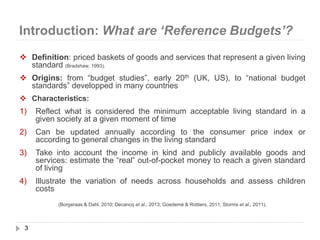
Introduction: What are ‘Reference Budgets’?
3
 Definition: priced baskets of goods and services that represent a given living
standard (Bradshaw, 1993).
 Origins: from “budget studies”, early 20th (UK, US), to “national budget
standards” developped in many countries
 Characteristics:
1) Reflect what is considered the minimum acceptable living standard in a
given society at a given moment of time
2) Can be updated annually according to the consumer price index or
according to general changes in the living standard
3) Take into account the income in kind and publicly available goods and
services: estimate the “real” out-of-pocket money to reach a given standard
of living
4) Illustrate the variation of needs across households and assess children
costs
(Borgeraas & Dahl, 2010; Decancq et al., 2013; Goedemé & Rottiers, 2011; Storms et al., 2011).
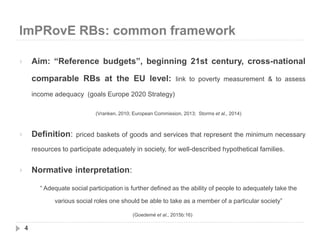
ImPRovE RBs: common framework
4
 Aim: “Reference budgets”, beginning 21st century, cross-national
comparable RBs at the EU level: link to poverty measurement & to assess
income adequacy (goals Europe 2020 Strategy)
(Vranken, 2010; European Commission, 2013; Storms et al., 2014)
 Definition: priced baskets of goods and services that represent the minimum necessary
resources to participate adequately in society, for well-described hypothetical families.
 Normative interpretation:
“ Adequate social participation is further defined as the ability of people to adequately take the
various social roles one should be able to take as a member of a particular society”
(Goedemé et al., 2015b:16)
ImPRovE RBs: common methodology (I)
5
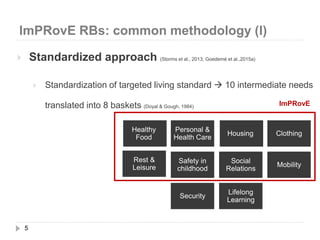
 Standardized approach (Storms et al., 2013; Goedemé et al.,2015a)
 Standardization of targeted living standard  10 intermediate needs
translated into 8 baskets (Doyal & Gough, 1984)
Healthy
Food
Personal &
Health Care
Housing Clothing
Rest &
Leisure
Safety in
childhood
Social
Relations
Mobility
Security
Lifelong
Learning
ImPRovE
6
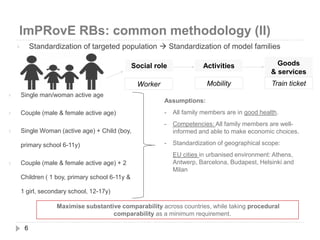
Social role Activities Goods
& services
Worker Mobility Train ticket
ImPRovE RBs: common methodology (II)
 Standardization of targeted population  Standardization of model families
 Single man/woman active age
 Couple (male & female active age)
 Single Woman (active age) + Child (boy,
primary school 6-11y)
 Couple (male & female active age) + 2
Children ( 1 boy, primary school 6-11y &
1 girl, secondary school, 12-17y)
Assumptions:
- All family members are in good health.
- Competencies: All family members are well-
informed and able to make economic choices.
- Standardization of geographical scope:
EU cities in urbanised environment: Athens,
Antwerp, Barcelona, Budapest, Helsinki and
Milan
Maximise substantive comparability across countries, while taking procedural
comparability as a minimum requirement.
ImPRovE RBs: common methodology (III)
7
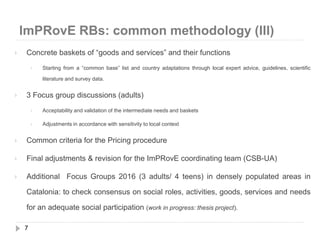
 Concrete baskets of “goods and services” and their functions
 Starting from a “common base” list and country adaptations through local expert advice, guidelines, scientific
literature and survey data.
 3 Focus group discussions (adults)
 Acceptability and validation of the intermediate needs and baskets
 Adjustments in accordance with sensitivity to local context
 Common criteria for the Pricing procedure
 Final adjustments & revision for the ImPRovE coordinating team (CSB-UA)
 Additional Focus Groups 2016 (3 adults/ 4 teens) in densely populated areas in
Catalonia: to check consensus on social roles, activities, goods, services and needs
for an adequate social participation (work in progress: thesis project).
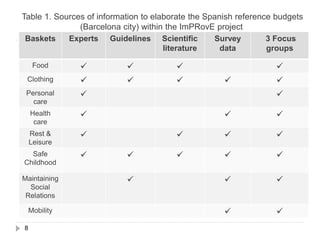
Table 1. Sources of information to elaborate the Spanish reference budgets
(Barcelona city) within the ImPRovE project
8
Baskets Experts Guidelines Scientific
literature
Survey
data
3 Focus
groups
Food    
Clothing     
Personal
care
 
Health
care
  
Rest &
Leisure
   
Safe
Childhood
    
Maintaining
Social
Relations
  
Mobility  
9
Preliminary Results
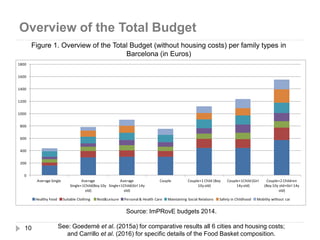
Overview of the Total Budget
10
Source: ImPRovE budgets 2014.
See: Goedemé et al. (2015a) for comparative results all 6 cities and housing costs;
and Carrillo et al. (2016) for specific details of the Food Basket composition.
Figure 1. Overview of the Total Budget (without housing costs) per family types in
Barcelona (in Euros)
0
200
400
600
800
1000
1200
1400
1600
1800
Average Single Average
Single+1Child(Boy 10y
old)
Average
Single+1Child(Girl 14y
old)
Couple Couple+1 Child (Boy
10y old)
Couple+1Child (Girl
14y old)
Couple+2 Children
(Boy 10y old+Girl 14y
old)
Healthy Food Suitable Clothing Rest&Leisure Personal & Health Care Maintaining Social Relations Safety in Childhood Mobility without car
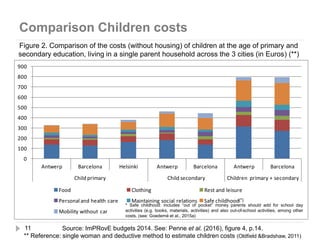
Comparison Children costs
11
0
100
200
300
400
500
600
700
800
900
Antwerp Barcelona Helsinki Antwerp Barcelona Antwerp Barcelona
Child primary Child secondary Children primary + secondary
Food Clothing Rest and leisure
Personal and health care Maintaining social relations Safe childhood
Mobility without car
Source: ImPRovE budgets 2014. See: Penne et al. (2016), figure 4, p.14.
** Reference: single woman and deductive method to estimate children costs (Oldfield &Bradshaw, 2011)
Figure 2. Comparison of the costs (without housing) of children at the age of primary and
secondary education, living in a single parent household across the 3 cities (in Euros) (**)
* Safe childhood: includes “out of pocket” money parents should add for school day
activities (e.g. books, materials, activities) and also out-of-school activities, among other
costs. (see: Goedemé et al., 2015a)
(*)
12
Pre-defined list
Children
Added by Adults Added by Teens (*)
Family
(sibling, cousin, daughter, son)
-Grandchild
-Nephew
-Grandchild
-Nephew
-Half-sister/brother
-Partner (only teens 14y)
School
(Student)
-Classmates
-Class Delegate
-Classmates
Community
(Neighbour, Member of
association, Member of society)
-Friends
-Sports-boy/sports-girl, member of
an sport club
-Consumers
-Viewers
-Digital user
-Users of public services
-Helpers in domestic tasks
-Citizens
-Volunteers
-Friends
-Sports-boy/sports-girl, member of
an sport club
-Consumers
-Fans
-Clients
-Patients
-Caregivers
-Inhabitants
-Referent person
-Being “children”
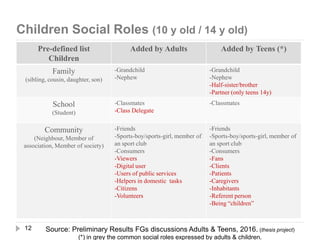
Source: Preliminary Results FGs discussions Adults & Teens, 2016. (thesis project)
(*) in grey the common social roles expressed by adults & children.
Children Social Roles (10 y old / 14 y old)
13
Suitable Clothing
“It is true that people might look at you disapprovingly when you don’t dress properly but sometimes
it’s because you cannot afford to dress better.” (FGT1, boy, 17y, low SES).
After-school activities / Mobile Phone Teenagers – Safety in Childhood; Mobility
“If you do an after-school activity very near from home, you don’t need to have a mobile phone. But, if
you are half an hour away from home and you have to come back by car, then maybe if your dad cannot
come or if he arrives late, he will call you.”(FGT4, girl, 16y middle SES).
Computer and Internet – Maintaining Social Relations
“Without a computer children could feel excluded at school. M: What do you mean?
“They wouldn’t have access to some games, videos, social networks…and it is also necessary for
school work”
(FGT3, boy, 17y, middle SES).
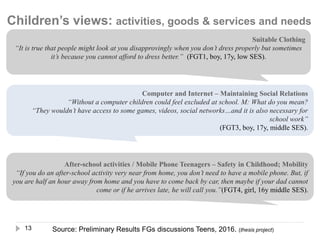
Source: Preliminary Results FGs discussions Teens, 2016. (thesis project)
Children’s views: activities, goods & services and needs
14
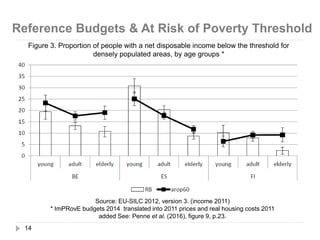
Reference Budgets & At Risk of Poverty Threshold
Figure 3. Proportion of people with a net disposable income below the threshold for
densely populated areas, by age groups *
Source: EU-SILC 2012, version 3. (income 2011)
* ImPRovE budgets 2014 translated into 2011 prices and real housing costs 2011
added See: Penne et al. (2016), figure 9, p.23.
Discussion & Conclusions
15
 Limitations on the Methodology to develop RBs
 Normative approach (needs and rights): illustrate a threshold below an adequate social participation is not possible (social roles)
 Many assumptions have to be done: people in good health, living in urban areas, with information and competences to develop
their daily life.
 RBs could assess the needs of children and their added costs in a specific household type: could orient
social and educative policies to reduce children poverty.
 Reflect the role of subsidised goods and services provided by the State (universalism of health care, added costs education
systems (e.g. books, school material and activities), mobility polices (e.g. discounts children)), nevertheless in a context of
austerity measures in Spain…:
 In 2013 the investment in child policies was 7,6% less than in 2007; Particularly, investment in education. (González Cago, 2015;
Assiego & Ubrich, 2015)
 Universal cash benefit for each born child only implemented: 2007-10. (González-Bueno, 2014; Cantó, 2014)
 Minimum Income allowance in Catalonia: 423,70 euros (single person); 538,28 euros (single parent with 2 children) (Malgesini, 2014)
 Could be used to assess directly family and children needs, educative instrument for financial counselling, health advice and
improve people ‘empowerment’ (e.g. healthy eating, leisure time, ..etc).
Thank you for your attention
16
Irene Cussó Parcerisas
irenecp2@blanquerna.url.edu
PhD candidate with the support of FPU programme by the MECD (Spain)
at PSITIC Research Group. Universitat Ramon Llull (Barcelona).
Facultat de Psicologia, Ciències de l’Educació i de l’Esport Blanquerna.
http://recerca.blanquerna.edu/psitic/
in collaboration with CSB-UA (Antwerp) within the ImPRovE project
The impact of Poverty on Education – New Evidence of an Old Problem
Newcastle University, 12th July 2016
http://improve-research.eu/
References
17
 Assiego, V. & Ubrich, T. (2015). Iluminando el futuro. Invertir en educación es luchar contra la pobreza infantil. Madrid: Save The Children España.
 Borgeraas, E. & Dahl, E. (2010). Low income and ‘poverty lines’ in Norway: a comparison of three concepts. International Journal of Social Welfare, 19(1), 73-83. doi:
10.1111/j.1468-2397.2008.00622.x
 Bradshaw, J. (1993). Budget standards for the United Kingdom. Alderschot: Avebury.
 Carrillo, E., Cussó-Parcerisas, I. & Riera, J. (2016). Development of the Spanish Healthy Food Reference Budget for an adequate social participation at the minimum, Public
Health Nutrition (PHN). doi: http://dx.doi.org/10.1017/S1368980016001026
 Decancq, K., Goedemé, T., Van den Bosch, K., & Vanhille, J. (2013). The Evolution of Poverty in the European Union: Concepts, Measurement and Data. ImPRovE
Methodological Paper No13/01, pp. 1-42. Antwerp. Retrieved from http://improve-research.eu
 Doyle, L. & Gough, I. (1984). A theory of human needs, Crit Soc Policy, 10, 6-38.
 European Commission. (2013). Social investment: Commission urges Member States to focus on growth and social cohesion – frequently asked questions, MEMO 13/117,
20th Februrary 2013. Brussels: European Commission. Retrieved 30-09-2015 from http://europa.eu/rapid/press-release_MEMO-13-117_en.htm
 Goedemé, T. & Rottiers, Stijn. (2011). Poverty in the Enlarged European Union. A Discussion about Definitions and Reference Groups, Sociology Compass, 5(1), 77–91. doi:
10.1111/j.1751-9020.2010.00350.x
 Goedemé, T., Storms, B., Stockman, S., Penne, T. & Van den Bosch, K. (2015a). Towards cross-country comparable reference budgets in Europe: first results of a concerted
effort, European Journal of Social Security, 17(1), 3-30.
 Goedemé, T., Storms, B. & Van den Bosch, K. (2015b). Pilot project for the development of a common methodology on reference budgets in Europe. Proposal for a method
for comparable reference budgets in Europe . Brussels: Directorate-General for Employment, Social Affairs and Inclusion .Retrieved 04-02-2016 from:
http://ec.europa.eu/social/main.jsp?catId=1092&intPageId=2312&langId=en
 González Gago, E. (dir.). (2015). La infancia en los presupuestos. Estimación de la inversión en políticas relacionadas con la infancia en España y su evolución entre 2007 y
2013. Madrid: UNICEF Comité Español.
 Oldfield, N. & Bradshaw, J. (2011). The costs of a child in a low-income household, Journal of Poverty and Social Justice, 19(2), 131-143. doi: 10.1332/175982711X574003
 Penne, T., Cussó Parcerisas, I., Mäkinen, L., Storms, B. & Goedemé, T. (2016). Can Reference Budgets Be Used as a Poverty Line. ImPRovE Working Paper No. 16/05,
pp.1-35. Antwerp: Herman Deleeck Centre for Social Policy – University of Antwerp. http://improve-research.eu/?page_id=37
 Storms,B., Goedemé,T., & Van den Bosch, K. (2011). Reference budgets. Are they an alternative to the current poverty line?. Conference "Growth, Social Protection and
Inequality". Sigtuna: FISS, pp.37. Retrieved 05-02-2015 from: http://onderzoek.khk.be/domein_SociaalEconomischBeleid/documents/Storms_Goedeme_VandenBosch.pdf
 Storms, B., Goedemé, T., Van den Bosch, K. & Devuyst, K. (2013). Towards a common framework for developing cross-nationally comparable reference budgets in Europe.
ImPRovE Methodological Paper, No. 13/02. Antwerp, pp. 1-27. Retrieved 16-08-2013 from: http://www.improve-research.eu
 Storms, B., Goedemé, T., Van den Bosch, K., Penne, T., Schuerman, N. & Stockman, S. (2014). Pilot project for a development of a common methodology on reference
budgets in Europe. Review of current state of play on reference budget practices at national, regional and local level, pp.1-146. Retrieved 25/07/2014 from:
http://www.referencebudgets.eu/
 Vranken, J. (2010). Using Reference Budgets for Drawing up the requirements of a Minimum Income Scheme and Assessing Adequacy. Synthesis Report. Brussels:
European Commission. Employment, Social Affairs and Inclusion.

The cost of being a child

  • 1.
    An estimate ofthe cost of being a child in Barcelona (Spain) through the Reference Budgets approach Work in progress - forms part of a thesis project by Irene Cussó Parcerisas, PhD candidate Dr. Elena Carrillo Álvarez Dr. Jordi Riera i Romaní with the support of FPU programme by the MECD (Spain) at PSITIC Research Group. Universitat Ramon Llull (Barcelona). Facultat de Psicologia, Ciències de l’Educació i de l’Esport Blanquerna. in collaboration with CSB-UA (Antwerp) within the ImPRovE project The impact of Poverty on Education – New Evidence of an Old Problem Newcastle University, 12th July 2016
  • 2.
    Outline 2  Introduction: Whatare ‘Reference Budgets’ (RBs)?  The ImPRovE project: common Framework & Methodology  Results: overview Total Budget & Children Costs  Discussion & Conclusions
  • 3.
    Introduction: What are‘Reference Budgets’? 3  Definition: priced baskets of goods and services that represent a given living standard (Bradshaw, 1993).  Origins: from “budget studies”, early 20th (UK, US), to “national budget standards” developped in many countries  Characteristics: 1) Reflect what is considered the minimum acceptable living standard in a given society at a given moment of time 2) Can be updated annually according to the consumer price index or according to general changes in the living standard 3) Take into account the income in kind and publicly available goods and services: estimate the “real” out-of-pocket money to reach a given standard of living 4) Illustrate the variation of needs across households and assess children costs (Borgeraas & Dahl, 2010; Decancq et al., 2013; Goedemé & Rottiers, 2011; Storms et al., 2011).
  • 4.
    ImPRovE RBs: commonframework 4  Aim: “Reference budgets”, beginning 21st century, cross-national comparable RBs at the EU level: link to poverty measurement & to assess income adequacy (goals Europe 2020 Strategy) (Vranken, 2010; European Commission, 2013; Storms et al., 2014)  Definition: priced baskets of goods and services that represent the minimum necessary resources to participate adequately in society, for well-described hypothetical families.  Normative interpretation: “ Adequate social participation is further defined as the ability of people to adequately take the various social roles one should be able to take as a member of a particular society” (Goedemé et al., 2015b:16)
  • 5.
    ImPRovE RBs: commonmethodology (I) 5  Standardized approach (Storms et al., 2013; Goedemé et al.,2015a)  Standardization of targeted living standard  10 intermediate needs translated into 8 baskets (Doyal & Gough, 1984) Healthy Food Personal & Health Care Housing Clothing Rest & Leisure Safety in childhood Social Relations Mobility Security Lifelong Learning ImPRovE
  • 6.
    6 Social role ActivitiesGoods & services Worker Mobility Train ticket ImPRovE RBs: common methodology (II)  Standardization of targeted population  Standardization of model families  Single man/woman active age  Couple (male & female active age)  Single Woman (active age) + Child (boy, primary school 6-11y)  Couple (male & female active age) + 2 Children ( 1 boy, primary school 6-11y & 1 girl, secondary school, 12-17y) Assumptions: - All family members are in good health. - Competencies: All family members are well- informed and able to make economic choices. - Standardization of geographical scope: EU cities in urbanised environment: Athens, Antwerp, Barcelona, Budapest, Helsinki and Milan Maximise substantive comparability across countries, while taking procedural comparability as a minimum requirement.
  • 7.
    ImPRovE RBs: commonmethodology (III) 7  Concrete baskets of “goods and services” and their functions  Starting from a “common base” list and country adaptations through local expert advice, guidelines, scientific literature and survey data.  3 Focus group discussions (adults)  Acceptability and validation of the intermediate needs and baskets  Adjustments in accordance with sensitivity to local context  Common criteria for the Pricing procedure  Final adjustments & revision for the ImPRovE coordinating team (CSB-UA)  Additional Focus Groups 2016 (3 adults/ 4 teens) in densely populated areas in Catalonia: to check consensus on social roles, activities, goods, services and needs for an adequate social participation (work in progress: thesis project).
  • 8.
    Table 1. Sourcesof information to elaborate the Spanish reference budgets (Barcelona city) within the ImPRovE project 8 Baskets Experts Guidelines Scientific literature Survey data 3 Focus groups Food     Clothing      Personal care   Health care    Rest & Leisure     Safe Childhood      Maintaining Social Relations    Mobility  
  • 9.
  • 10.
    Overview of theTotal Budget 10 Source: ImPRovE budgets 2014. See: Goedemé et al. (2015a) for comparative results all 6 cities and housing costs; and Carrillo et al. (2016) for specific details of the Food Basket composition. Figure 1. Overview of the Total Budget (without housing costs) per family types in Barcelona (in Euros) 0 200 400 600 800 1000 1200 1400 1600 1800 Average Single Average Single+1Child(Boy 10y old) Average Single+1Child(Girl 14y old) Couple Couple+1 Child (Boy 10y old) Couple+1Child (Girl 14y old) Couple+2 Children (Boy 10y old+Girl 14y old) Healthy Food Suitable Clothing Rest&Leisure Personal & Health Care Maintaining Social Relations Safety in Childhood Mobility without car
  • 11.
    Comparison Children costs 11 0 100 200 300 400 500 600 700 800 900 AntwerpBarcelona Helsinki Antwerp Barcelona Antwerp Barcelona Child primary Child secondary Children primary + secondary Food Clothing Rest and leisure Personal and health care Maintaining social relations Safe childhood Mobility without car Source: ImPRovE budgets 2014. See: Penne et al. (2016), figure 4, p.14. ** Reference: single woman and deductive method to estimate children costs (Oldfield &Bradshaw, 2011) Figure 2. Comparison of the costs (without housing) of children at the age of primary and secondary education, living in a single parent household across the 3 cities (in Euros) (**) * Safe childhood: includes “out of pocket” money parents should add for school day activities (e.g. books, materials, activities) and also out-of-school activities, among other costs. (see: Goedemé et al., 2015a) (*)
  • 12.
    12 Pre-defined list Children Added byAdults Added by Teens (*) Family (sibling, cousin, daughter, son) -Grandchild -Nephew -Grandchild -Nephew -Half-sister/brother -Partner (only teens 14y) School (Student) -Classmates -Class Delegate -Classmates Community (Neighbour, Member of association, Member of society) -Friends -Sports-boy/sports-girl, member of an sport club -Consumers -Viewers -Digital user -Users of public services -Helpers in domestic tasks -Citizens -Volunteers -Friends -Sports-boy/sports-girl, member of an sport club -Consumers -Fans -Clients -Patients -Caregivers -Inhabitants -Referent person -Being “children” Source: Preliminary Results FGs discussions Adults & Teens, 2016. (thesis project) (*) in grey the common social roles expressed by adults & children. Children Social Roles (10 y old / 14 y old)
  • 13.
    13 Suitable Clothing “It istrue that people might look at you disapprovingly when you don’t dress properly but sometimes it’s because you cannot afford to dress better.” (FGT1, boy, 17y, low SES). After-school activities / Mobile Phone Teenagers – Safety in Childhood; Mobility “If you do an after-school activity very near from home, you don’t need to have a mobile phone. But, if you are half an hour away from home and you have to come back by car, then maybe if your dad cannot come or if he arrives late, he will call you.”(FGT4, girl, 16y middle SES). Computer and Internet – Maintaining Social Relations “Without a computer children could feel excluded at school. M: What do you mean? “They wouldn’t have access to some games, videos, social networks…and it is also necessary for school work” (FGT3, boy, 17y, middle SES). Source: Preliminary Results FGs discussions Teens, 2016. (thesis project) Children’s views: activities, goods & services and needs
  • 14.
    14 Reference Budgets &At Risk of Poverty Threshold Figure 3. Proportion of people with a net disposable income below the threshold for densely populated areas, by age groups * Source: EU-SILC 2012, version 3. (income 2011) * ImPRovE budgets 2014 translated into 2011 prices and real housing costs 2011 added See: Penne et al. (2016), figure 9, p.23.
  • 15.
    Discussion & Conclusions 15 Limitations on the Methodology to develop RBs  Normative approach (needs and rights): illustrate a threshold below an adequate social participation is not possible (social roles)  Many assumptions have to be done: people in good health, living in urban areas, with information and competences to develop their daily life.  RBs could assess the needs of children and their added costs in a specific household type: could orient social and educative policies to reduce children poverty.  Reflect the role of subsidised goods and services provided by the State (universalism of health care, added costs education systems (e.g. books, school material and activities), mobility polices (e.g. discounts children)), nevertheless in a context of austerity measures in Spain…:  In 2013 the investment in child policies was 7,6% less than in 2007; Particularly, investment in education. (González Cago, 2015; Assiego & Ubrich, 2015)  Universal cash benefit for each born child only implemented: 2007-10. (González-Bueno, 2014; Cantó, 2014)  Minimum Income allowance in Catalonia: 423,70 euros (single person); 538,28 euros (single parent with 2 children) (Malgesini, 2014)  Could be used to assess directly family and children needs, educative instrument for financial counselling, health advice and improve people ‘empowerment’ (e.g. healthy eating, leisure time, ..etc).
  • 16.
    Thank you foryour attention 16 Irene Cussó Parcerisas irenecp2@blanquerna.url.edu PhD candidate with the support of FPU programme by the MECD (Spain) at PSITIC Research Group. Universitat Ramon Llull (Barcelona). Facultat de Psicologia, Ciències de l’Educació i de l’Esport Blanquerna. http://recerca.blanquerna.edu/psitic/ in collaboration with CSB-UA (Antwerp) within the ImPRovE project The impact of Poverty on Education – New Evidence of an Old Problem Newcastle University, 12th July 2016 http://improve-research.eu/
  • 17.
    References 17  Assiego, V.& Ubrich, T. (2015). Iluminando el futuro. Invertir en educación es luchar contra la pobreza infantil. Madrid: Save The Children España.  Borgeraas, E. & Dahl, E. (2010). Low income and ‘poverty lines’ in Norway: a comparison of three concepts. International Journal of Social Welfare, 19(1), 73-83. doi: 10.1111/j.1468-2397.2008.00622.x  Bradshaw, J. (1993). Budget standards for the United Kingdom. Alderschot: Avebury.  Carrillo, E., Cussó-Parcerisas, I. & Riera, J. (2016). Development of the Spanish Healthy Food Reference Budget for an adequate social participation at the minimum, Public Health Nutrition (PHN). doi: http://dx.doi.org/10.1017/S1368980016001026  Decancq, K., Goedemé, T., Van den Bosch, K., & Vanhille, J. (2013). The Evolution of Poverty in the European Union: Concepts, Measurement and Data. ImPRovE Methodological Paper No13/01, pp. 1-42. Antwerp. Retrieved from http://improve-research.eu  Doyle, L. & Gough, I. (1984). A theory of human needs, Crit Soc Policy, 10, 6-38.  European Commission. (2013). Social investment: Commission urges Member States to focus on growth and social cohesion – frequently asked questions, MEMO 13/117, 20th Februrary 2013. Brussels: European Commission. Retrieved 30-09-2015 from http://europa.eu/rapid/press-release_MEMO-13-117_en.htm  Goedemé, T. & Rottiers, Stijn. (2011). Poverty in the Enlarged European Union. A Discussion about Definitions and Reference Groups, Sociology Compass, 5(1), 77–91. doi: 10.1111/j.1751-9020.2010.00350.x  Goedemé, T., Storms, B., Stockman, S., Penne, T. & Van den Bosch, K. (2015a). Towards cross-country comparable reference budgets in Europe: first results of a concerted effort, European Journal of Social Security, 17(1), 3-30.  Goedemé, T., Storms, B. & Van den Bosch, K. (2015b). Pilot project for the development of a common methodology on reference budgets in Europe. Proposal for a method for comparable reference budgets in Europe . Brussels: Directorate-General for Employment, Social Affairs and Inclusion .Retrieved 04-02-2016 from: http://ec.europa.eu/social/main.jsp?catId=1092&intPageId=2312&langId=en  González Gago, E. (dir.). (2015). La infancia en los presupuestos. Estimación de la inversión en políticas relacionadas con la infancia en España y su evolución entre 2007 y 2013. Madrid: UNICEF Comité Español.  Oldfield, N. & Bradshaw, J. (2011). The costs of a child in a low-income household, Journal of Poverty and Social Justice, 19(2), 131-143. doi: 10.1332/175982711X574003  Penne, T., Cussó Parcerisas, I., Mäkinen, L., Storms, B. & Goedemé, T. (2016). Can Reference Budgets Be Used as a Poverty Line. ImPRovE Working Paper No. 16/05, pp.1-35. Antwerp: Herman Deleeck Centre for Social Policy – University of Antwerp. http://improve-research.eu/?page_id=37  Storms,B., Goedemé,T., & Van den Bosch, K. (2011). Reference budgets. Are they an alternative to the current poverty line?. Conference "Growth, Social Protection and Inequality". Sigtuna: FISS, pp.37. Retrieved 05-02-2015 from: http://onderzoek.khk.be/domein_SociaalEconomischBeleid/documents/Storms_Goedeme_VandenBosch.pdf  Storms, B., Goedemé, T., Van den Bosch, K. & Devuyst, K. (2013). Towards a common framework for developing cross-nationally comparable reference budgets in Europe. ImPRovE Methodological Paper, No. 13/02. Antwerp, pp. 1-27. Retrieved 16-08-2013 from: http://www.improve-research.eu  Storms, B., Goedemé, T., Van den Bosch, K., Penne, T., Schuerman, N. & Stockman, S. (2014). Pilot project for a development of a common methodology on reference budgets in Europe. Review of current state of play on reference budget practices at national, regional and local level, pp.1-146. Retrieved 25/07/2014 from: http://www.referencebudgets.eu/  Vranken, J. (2010). Using Reference Budgets for Drawing up the requirements of a Minimum Income Scheme and Assessing Adequacy. Synthesis Report. Brussels: European Commission. Employment, Social Affairs and Inclusion.