Famil
y &
FamilyLifecycle
SocialClass
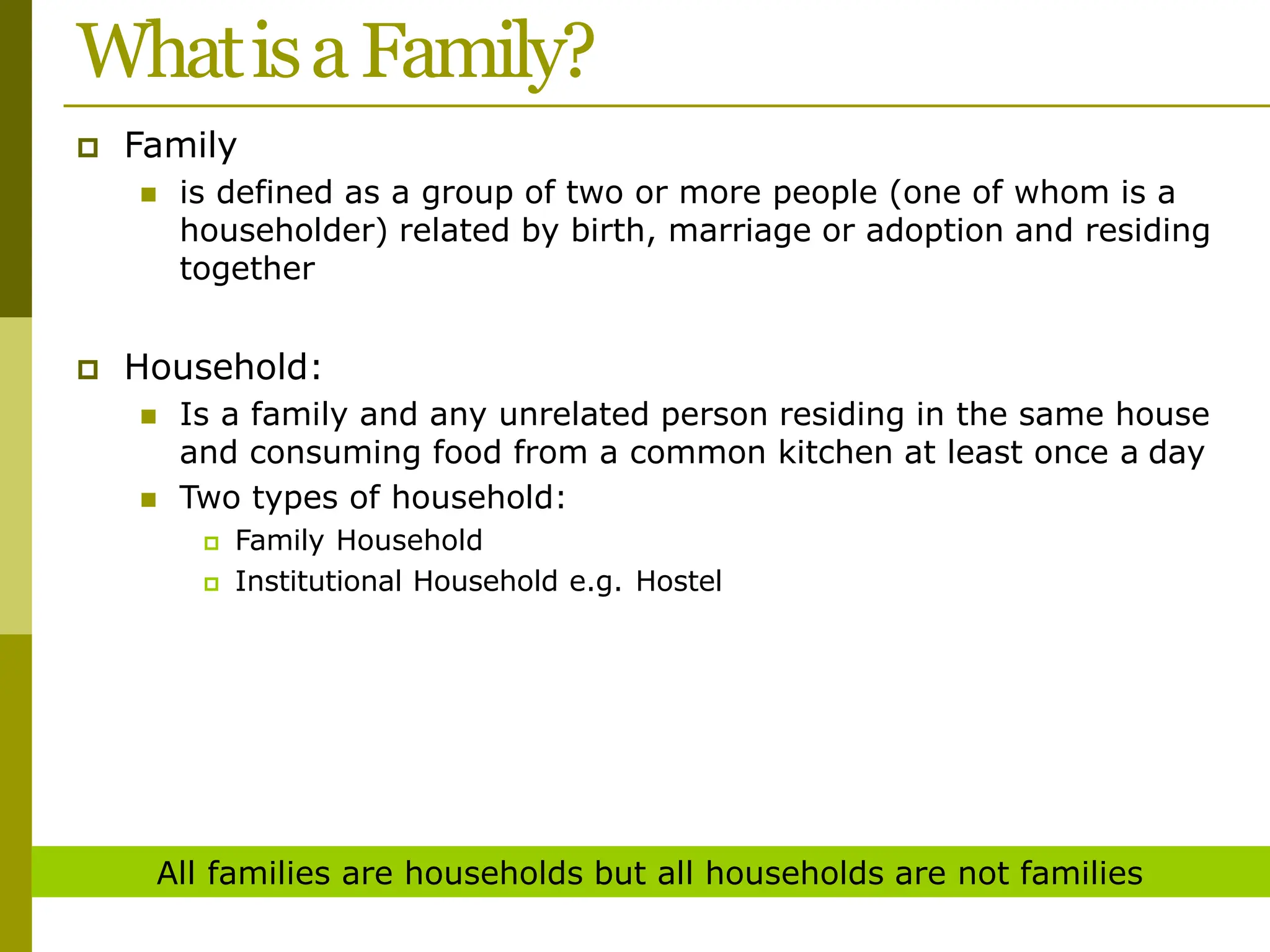
WhatisaFamily?
 Family
 is defined as a group of two or more people (one of whom is a
householder) related by birth, marriage or adoption and residing
together
 Household:
 Is a family and any unrelated person residing in the same house
and consuming food from a common kitchen at least once a day
 Two types of household:
 Family Household
 Institutional Household e.g. Hostel
All families are households but all households are not families
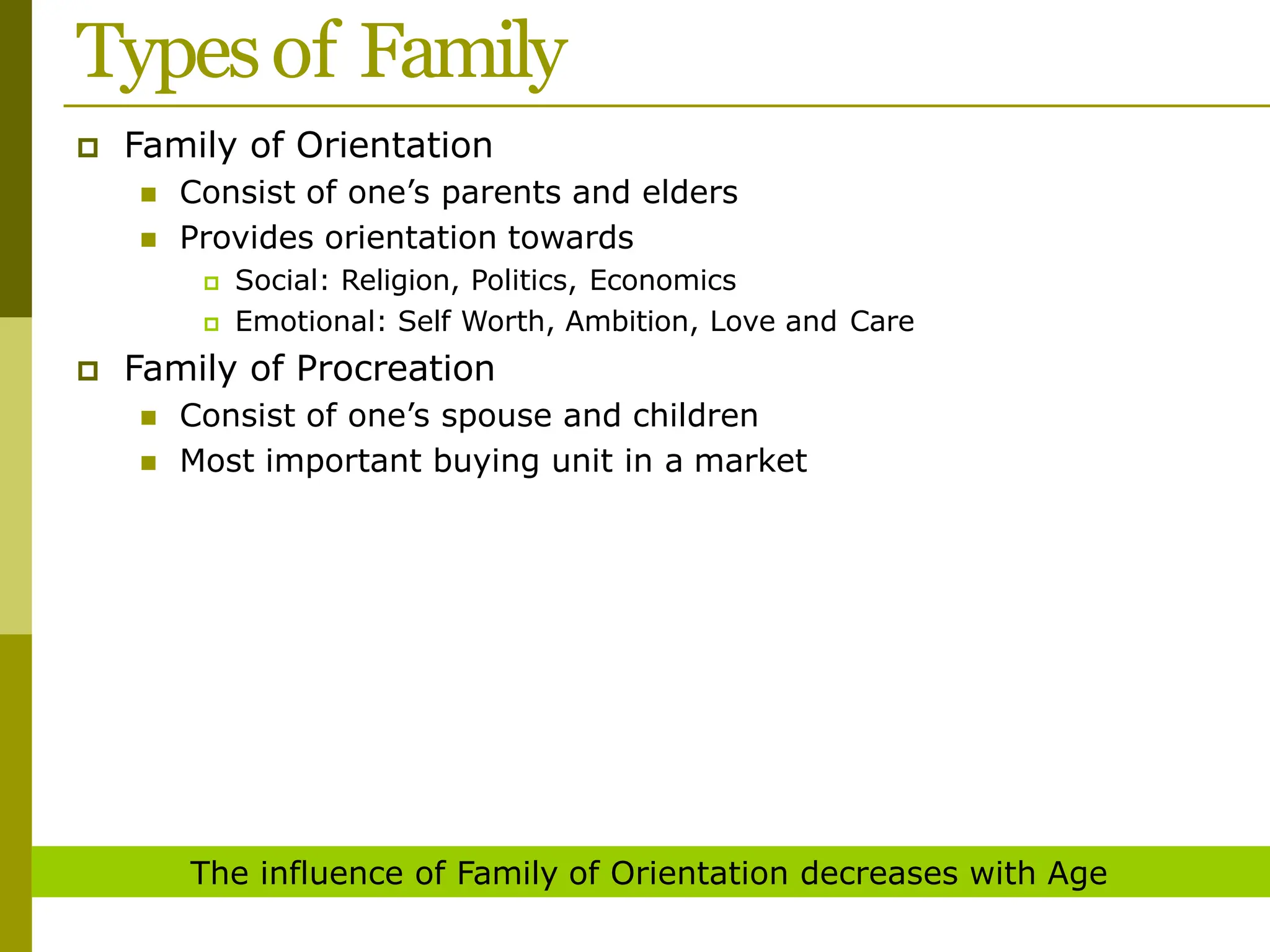
Typesof Family
 Family of Orientation
 Consist of one’s parents and elders
 Provides orientation towards
 Social: Religion, Politics, Economics
 Emotional: Self Worth, Ambition, Love and Care
 Family of Procreation
 Consist of one’s spouse and children
 Most important buying unit in a market
The influence of Family of Orientation decreases with Age
Typesof Family
 Traditional Family Types:
 Married Couple:
 Simplest type of family consisting of husband and wife
 Nuclear Family:
 Consist of Husband Wife and at least one child
 Extended Family:
 Consist of a nuclear family with at least one grand parent
 Joint Family:
 Blood relatives and their spouses with kids staying together
 New Modes of Family
 Blended Family:
 A family in which either or both partner were previously married
 Single Parent Family:
 A family in which only one of the parent is present
 Unmarried Family:
 Parents, unmarried, but living together
 Communal Family:
 A group of families living together and sharing responsibility
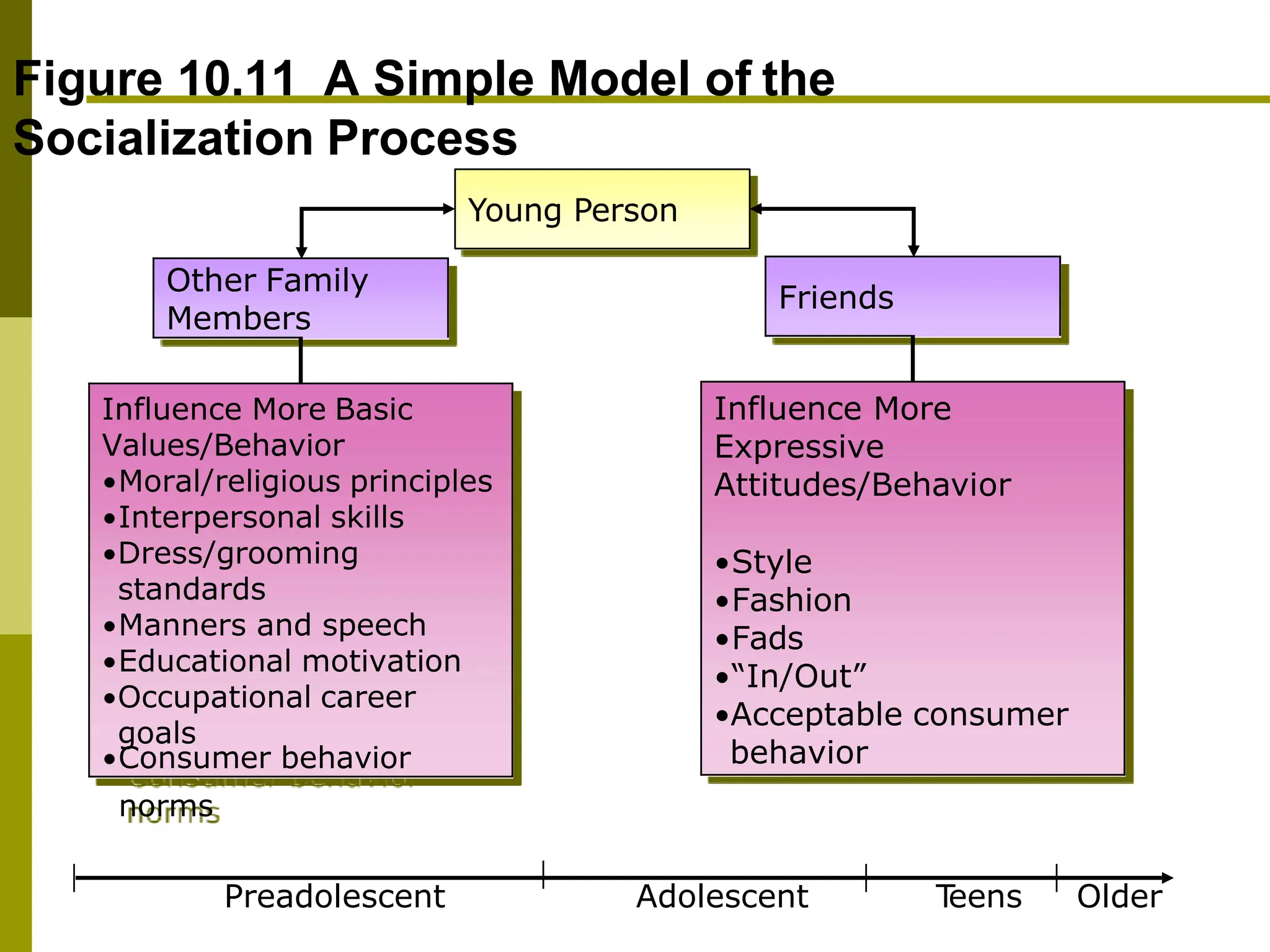
Figure 10.11 A Simple Model of the
Socialization Process
norms
Other Family
Members
Influence More Basic
Values/Behavior
•Moral/religious principles
•Interpersonal skills
•Dress/grooming
standards
•Manners and speech
•Educational motivation
•Occupational career
goals
•Consumer behavior
Friends
Influence More
Expressive
Attitudes/Behavior
•Style
•Fashion
•Fads
•“In/Out”
•Acceptable consumer
behavior
Young Person
Preadolescent Adolescent T
eens Older
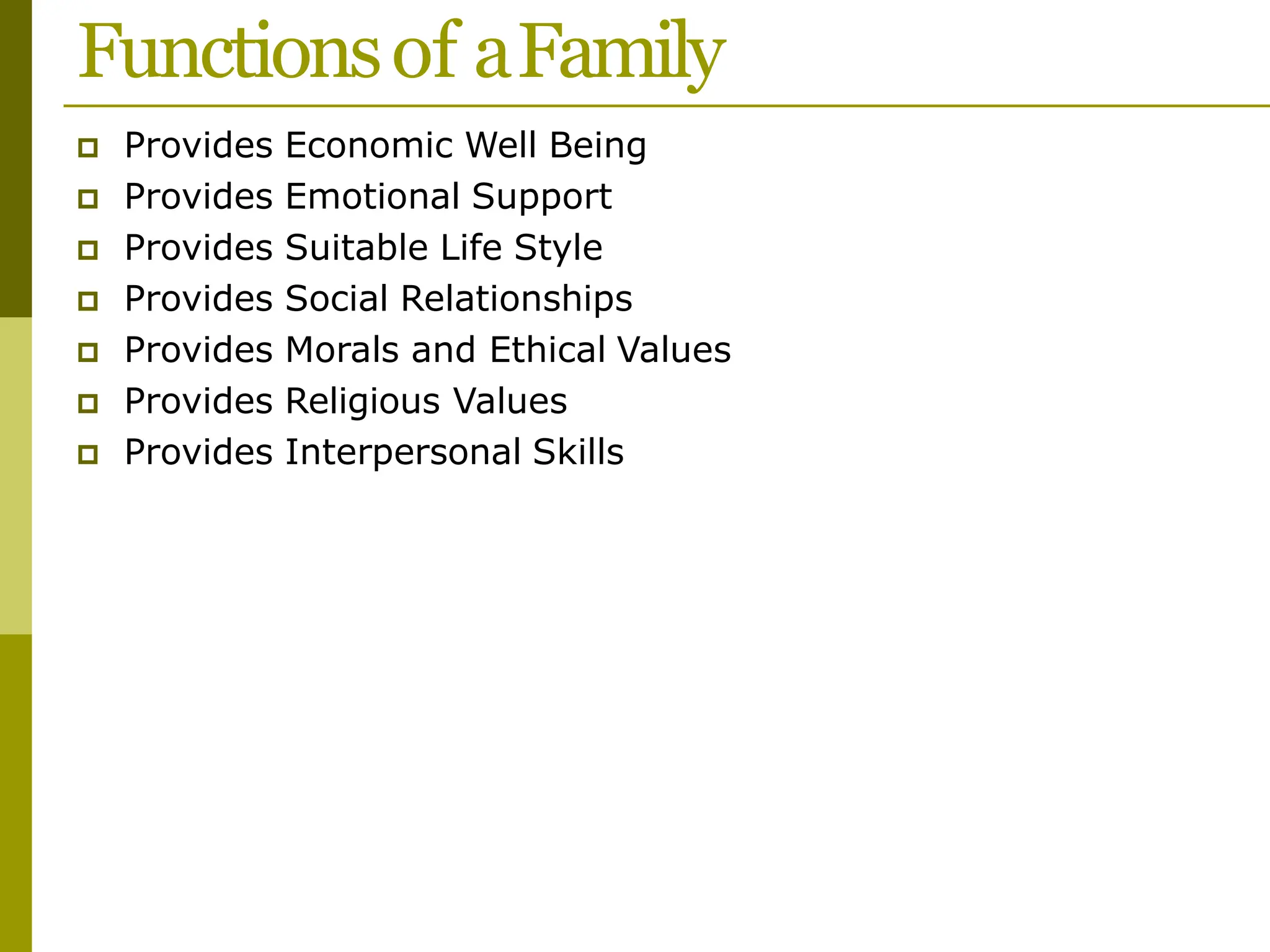
Functionsof aFamily
 Provides Economic Well Being
 Provides Emotional Support
 Provides Suitable Life Style
 Provides Social Relationships
 Provides Morals and Ethical Values
 Provides Religious Values
 Provides Interpersonal Skills
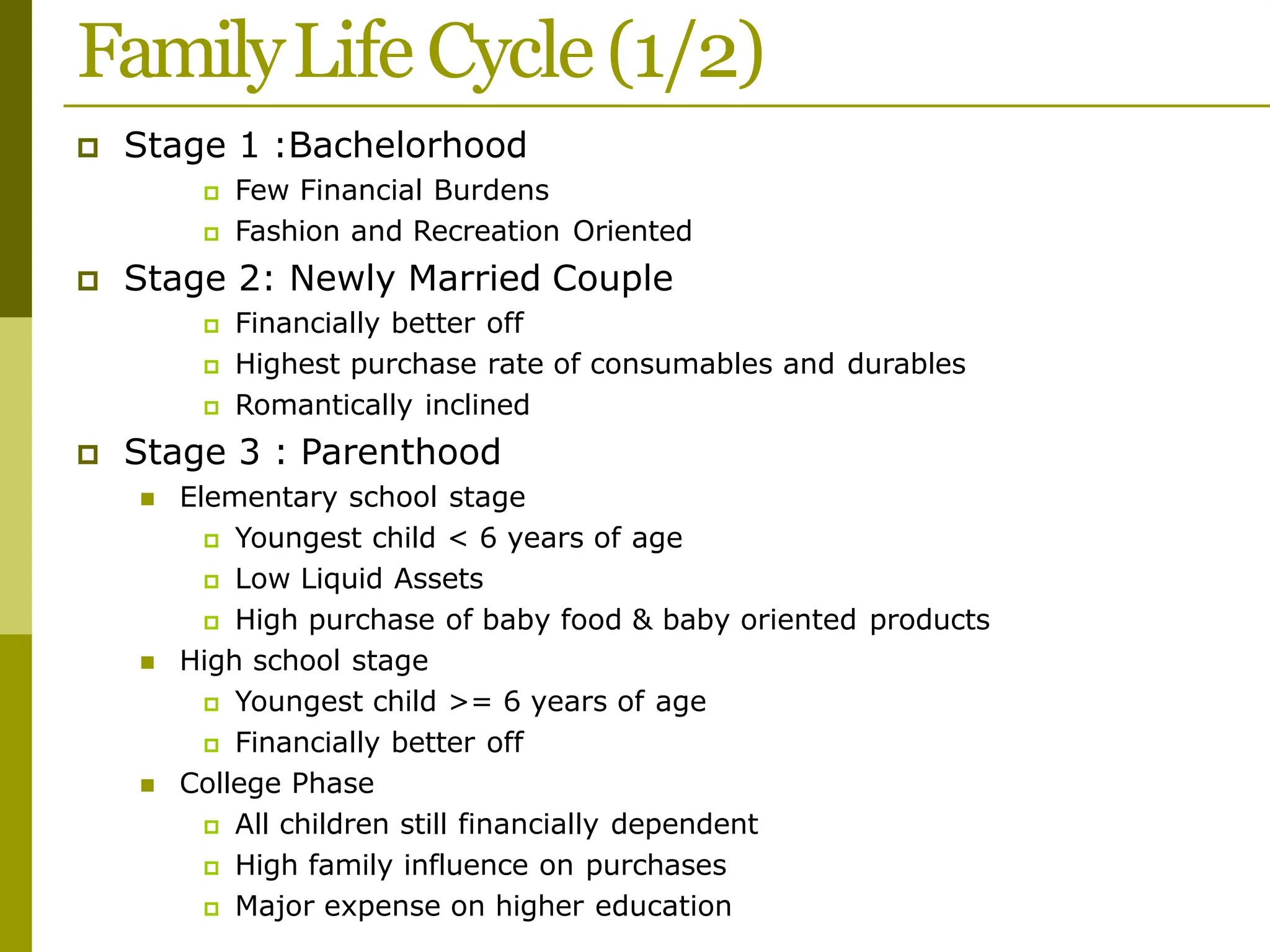
FamilyLife Cycle(1/2)
 Stage 1 :Bachelorhood
 Few Financial Burdens
 Fashion and Recreation Oriented
 Stage 2: Newly Married Couple
 Financially better off
 Highest purchase rate of consumables and durables
 Romantically inclined
 Stage 3 : Parenthood
 Elementary school stage
 Youngest child < 6 years of age
 Low Liquid Assets
 High purchase of baby food & baby oriented products
 High school stage
 Youngest child >= 6 years of age
 Financially better off
 College Phase
 All children still financially dependent
 High family influence on purchases
 Major expense on higher education
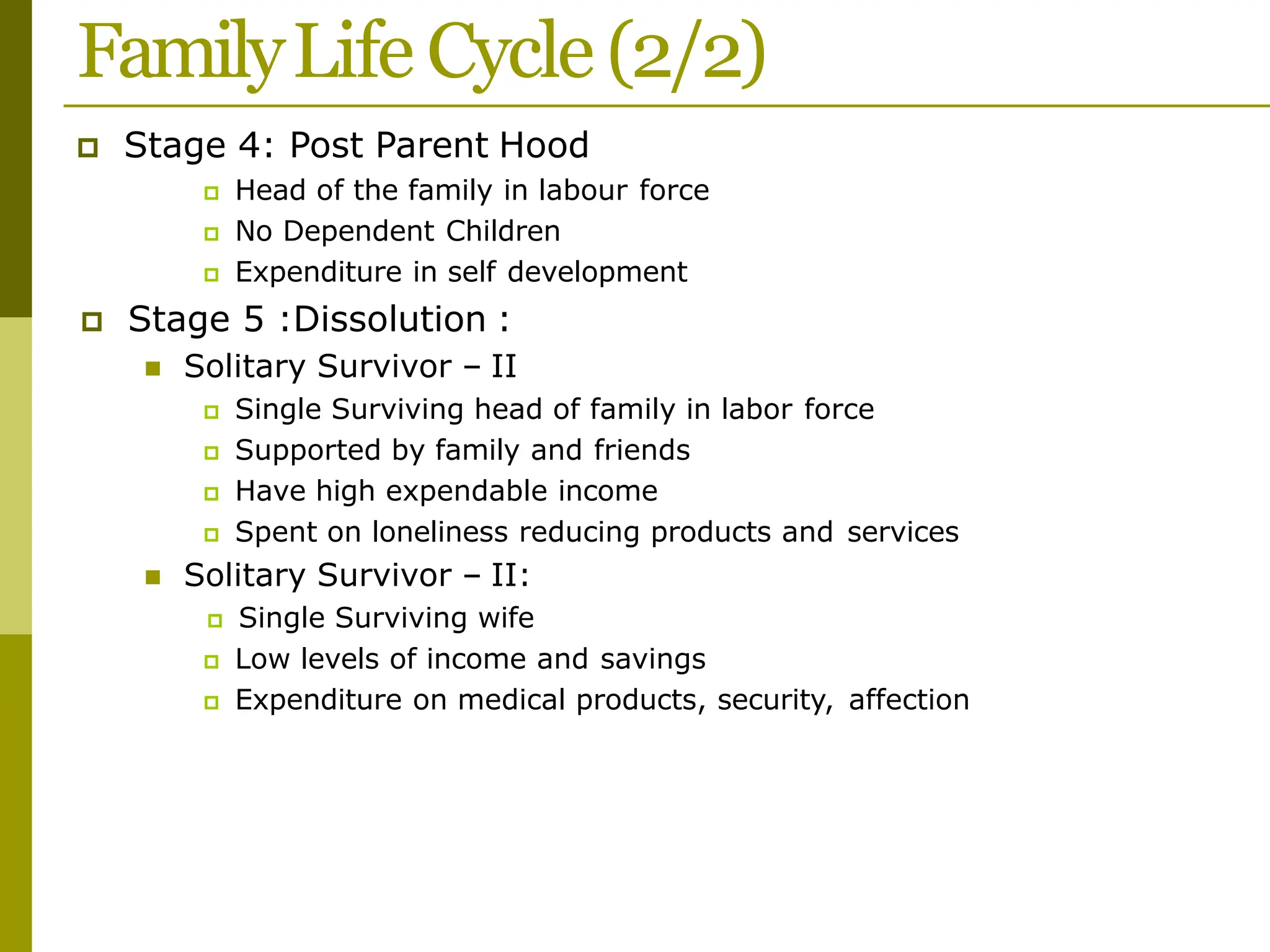
FamilyLife Cycle(2/2)
 Stage 4: Post Parent Hood
 Head of the family in labour force
 No Dependent Children
 Expenditure in self development
 Stage 5 :Dissolution :
 Solitary Survivor – II
 Single Surviving head of family in labor force
 Supported by family and friends
 Have high expendable income
 Spent on loneliness reducing products and services
 Solitary Survivor – II:
 Single Surviving wife
 Low levels of income and savings
 Expenditure on medical products, security, affection
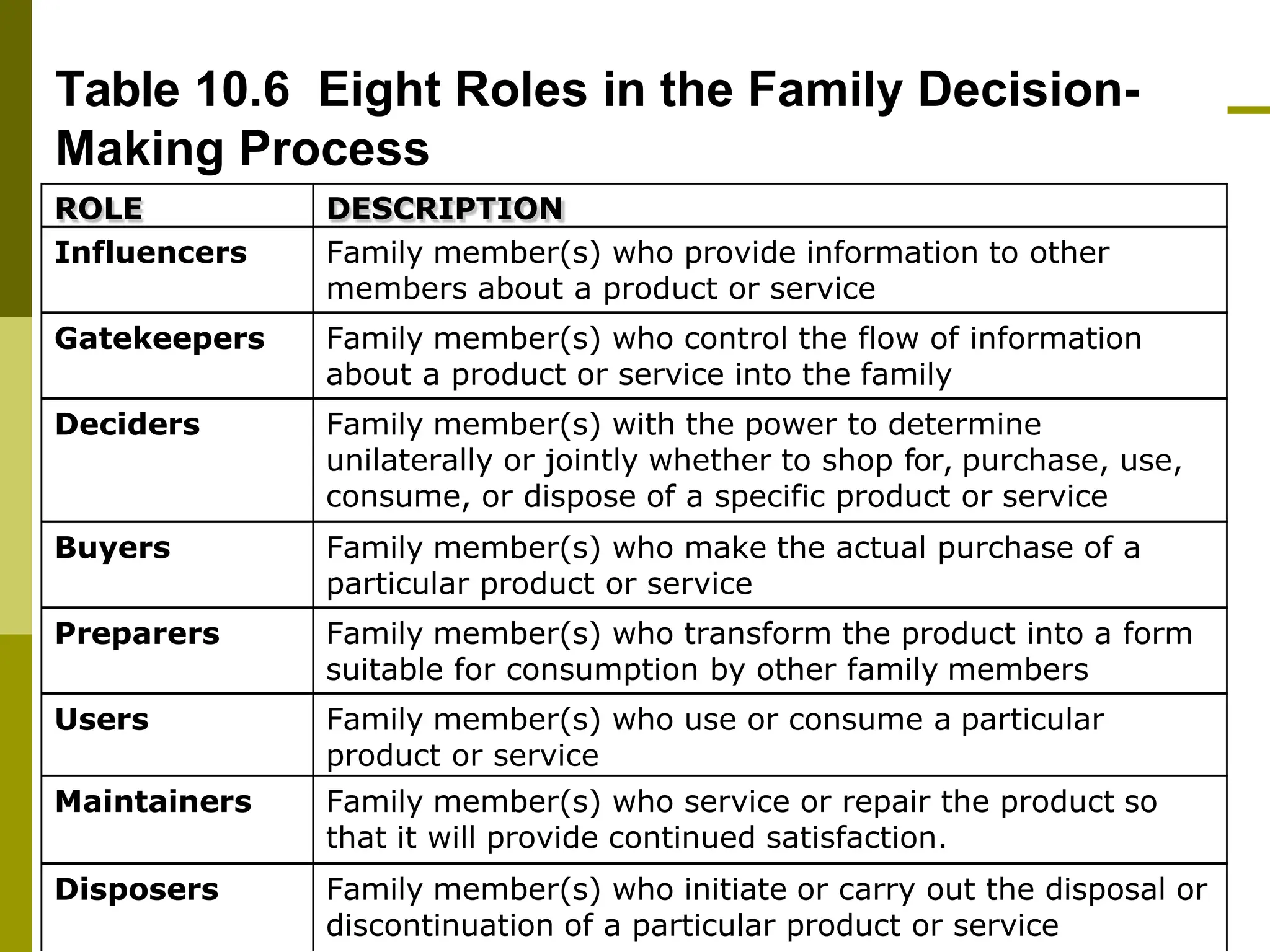
Table 10.6 Eight Roles in the Family Decision-
Making Process
ROLE DESCRIPTION
Influencers Family member(s) who provide information to other
members about a product or service
Gatekeepers Family member(s) who control the flow of information
about a product or service into the family
Deciders Family member(s) with the power to determine
unilaterally or jointly whether to shop for, purchase, use,
consume, or dispose of a specific product or service
Buyers Family member(s) who make the actual purchase of a
particular product or service
Preparers Family member(s) who transform the product into a form
suitable for consumption by other family members
Users Family member(s) who use or consume a particular
product or service
Maintainers Family member(s) who service or repair the product so
that it will provide continued satisfaction.
Disposers Family member(s) who initiate or carry out the disposal or
discontinuation of a particular product or service
HouseholdDecisionMakingProcess
Communication
targeted at
Children
Communication
targeted at
Parents
Influencer
(Children)
Initiator
(Parents,
Children)
Information
Gathering
Decision
Maker
(Parents,
Children)
Purchaser
(Parents)
User
(Parents,
Children)
Typesof Family Decisions
 Husband Dominated Decisions
 Husband takes the purchase decisions
 Traditionally in products like Automobiles, Alcohol, Insurance
 Wife Dominated Decisions
 Wife takes the purchase decisions
 Traditionally in products like household maintenance items, food
and kitchen appliances
 Joint Decision Making
 Both husband and wife make the decision
 Traditionally in School choice, living room furniture, vacations
 Child Dominated Decision Making
 Child makes the “final product” decision
 Traditionally on children related items
 Unilateral Decision Making
 Taken by any member of the family
 Traditionally on Personal Care items, low priced goods
These Traditional Roles are Changing
Conflict Resolution
 Family Decisions are bound to create conflict
 Conflicts are resolved by:
 Bargaining:
 Reaching a compromise on which product to buy
 Impression Management:
 Misrepresentation of facts in order to create favorable impressions
 Use of Authority:
 Claiming superior authority to resolve the conflict
 Reasoning:
 Using logical arguments to resolve the conflict
 Playing on Emotions:
 Using emotions to resolve the conflict
 Additional Information:
 Getting additional Data or Third Party Information
Consumer Socialization
ConsumerSocialization
 Consumer Socialization is the process by which people acquire
skills, knowledge and attitudes relevant to their functioning as
consumers in the marketplace
 Contents of Consumer Socialization:
 Consumer Skills:
 Skills necessary for purchase and understand
money, budgeting, product evaluation
 Consumption Preferences:
 Are knowledge, attitudes and values that cause people to attach
differential evaluation to products, brands and retail outlets
 Consumption Attitudes:
 Are cognitive orientation towards market place stimulus such as
advertising, sales persons, warranties etc.
Social Class
The division of
members of a society
into a hierarchy of
distinct status classes,
so that members of
each class have either
higher or lower status
than members of other
classes.
SocialClassIs Hierarchal
 Status is frequently thought of as the relative
rankings of members of each social class
Table 11.2 Percent Distribution of
Five-Category Social-Class
Measure
SOCIAL CLASSES PERCENTAGE
Upper 4.3
Upper-middle 13.8
Middle 32.8
Working 32.3
Lower 16.8
Total percentage 100.0
SocialClassMeasurement
 Subjective Measures
 individuals are asked to estimate their own
social-class positions
 Reputational Measures
 informants make judgments concerning the
social-class membership of others within the
community
 Objective Measures
 individuals answer specific socioeconomic
questions and then are categorized according to
answers
Objective Measures
 Single-variable
indexes
 Occupation
 Education
 Income
 Other Variables
 Composite-
variable indexes
 Index of Status
Characteristics
 Socioeconomic
Status Score
Geo demographic clustering
 “Birds of a feather flock together”
 Families of similar socioeconomic backgrounds tend
to reside in the same neighborhoods or
communities. “They cluster together”
 Dispersed communities with similar geographic
profiles
 Located by PINCODES
A composite
measure of social
class that combines
occupation, source
Index of Status of income (not
Characteristics amount), house
(ISC) type/dwelling area
into a single
weighted index of
social class
standing.
A multivariable social
class measure used by
the United States
Socioeconomic
Status Score
(SES)
Bureau of the Census
that combines
occupational status,
family income, and
educational attainment
into a single measure of
social class standing.
A composite
segmentation
strategy that uses
both geographic
Geodemographic
Clusters
variables (zip codes,
neighborhoods) and
demographic
variables (e.g.,
income, occupation)
to identify target
markets.
PRIZM
(Potential
Rating Index
by Zip
Market)
A composite index of
geographic and
socioeconomic factors
expressed in
residential zip code
neighborhoods from
which
geodemographic
consumer segments
are formed.
TheAffluent Consumer
 Especially attractive target to marketers
 Growing number of households can be classified as
“mass affluent” with incomes of at least $75,000
 Some researchers are defining affluent to include
lifestyle and psychographic factors in addition to
income
 Have different medial habits than the general
population
WhatIstheMiddleClass?
 The “middle” 50 percent of household incomes -
households earning between $22,500 and
$80,000
 Households made up of college-educated adults
who use computers, and are involved in
children’s education
 Lower-middle to middle-middle based on
income, education, and occupation (this view
does NOT include upper-middle, which is
considered affluent)
TheTechno Class
 Having competency with technology
 Those without are referred to as “technologically
underclassed”
 Parents are seeking computer exposure for their
children
 Geeks now viewed as friendly and fun
Social Class
 Clothing, Fashion, and Shopping
 The Pursuit of Leisure
 Saving, Spending, and Credit
 Social Class and Communication
ClassSituations,Self-Perceptions, andFinancial Orientations

family social class life cycle-.pptx

  • 1.
  • 2.
    WhatisaFamily?  Family  isdefined as a group of two or more people (one of whom is a householder) related by birth, marriage or adoption and residing together  Household:  Is a family and any unrelated person residing in the same house and consuming food from a common kitchen at least once a day  Two types of household:  Family Household  Institutional Household e.g. Hostel All families are households but all households are not families
  • 3.
    Typesof Family  Familyof Orientation  Consist of one’s parents and elders  Provides orientation towards  Social: Religion, Politics, Economics  Emotional: Self Worth, Ambition, Love and Care  Family of Procreation  Consist of one’s spouse and children  Most important buying unit in a market The influence of Family of Orientation decreases with Age
  • 4.
    Typesof Family  TraditionalFamily Types:  Married Couple:  Simplest type of family consisting of husband and wife  Nuclear Family:  Consist of Husband Wife and at least one child  Extended Family:  Consist of a nuclear family with at least one grand parent  Joint Family:  Blood relatives and their spouses with kids staying together  New Modes of Family  Blended Family:  A family in which either or both partner were previously married  Single Parent Family:  A family in which only one of the parent is present  Unmarried Family:  Parents, unmarried, but living together  Communal Family:  A group of families living together and sharing responsibility
  • 5.
    Figure 10.11 ASimple Model of the Socialization Process norms Other Family Members Influence More Basic Values/Behavior •Moral/religious principles •Interpersonal skills •Dress/grooming standards •Manners and speech •Educational motivation •Occupational career goals •Consumer behavior Friends Influence More Expressive Attitudes/Behavior •Style •Fashion •Fads •“In/Out” •Acceptable consumer behavior Young Person Preadolescent Adolescent T eens Older
  • 6.
    Functionsof aFamily  ProvidesEconomic Well Being  Provides Emotional Support  Provides Suitable Life Style  Provides Social Relationships  Provides Morals and Ethical Values  Provides Religious Values  Provides Interpersonal Skills
  • 7.
    FamilyLife Cycle(1/2)  Stage1 :Bachelorhood  Few Financial Burdens  Fashion and Recreation Oriented  Stage 2: Newly Married Couple  Financially better off  Highest purchase rate of consumables and durables  Romantically inclined  Stage 3 : Parenthood  Elementary school stage  Youngest child < 6 years of age  Low Liquid Assets  High purchase of baby food & baby oriented products  High school stage  Youngest child >= 6 years of age  Financially better off  College Phase  All children still financially dependent  High family influence on purchases  Major expense on higher education
  • 8.
    FamilyLife Cycle(2/2)  Stage4: Post Parent Hood  Head of the family in labour force  No Dependent Children  Expenditure in self development  Stage 5 :Dissolution :  Solitary Survivor – II  Single Surviving head of family in labor force  Supported by family and friends  Have high expendable income  Spent on loneliness reducing products and services  Solitary Survivor – II:  Single Surviving wife  Low levels of income and savings  Expenditure on medical products, security, affection
  • 9.
    Table 10.6 EightRoles in the Family Decision- Making Process ROLE DESCRIPTION Influencers Family member(s) who provide information to other members about a product or service Gatekeepers Family member(s) who control the flow of information about a product or service into the family Deciders Family member(s) with the power to determine unilaterally or jointly whether to shop for, purchase, use, consume, or dispose of a specific product or service Buyers Family member(s) who make the actual purchase of a particular product or service Preparers Family member(s) who transform the product into a form suitable for consumption by other family members Users Family member(s) who use or consume a particular product or service Maintainers Family member(s) who service or repair the product so that it will provide continued satisfaction. Disposers Family member(s) who initiate or carry out the disposal or discontinuation of a particular product or service
  • 10.
  • 11.
    Typesof Family Decisions Husband Dominated Decisions  Husband takes the purchase decisions  Traditionally in products like Automobiles, Alcohol, Insurance  Wife Dominated Decisions  Wife takes the purchase decisions  Traditionally in products like household maintenance items, food and kitchen appliances  Joint Decision Making  Both husband and wife make the decision  Traditionally in School choice, living room furniture, vacations  Child Dominated Decision Making  Child makes the “final product” decision  Traditionally on children related items  Unilateral Decision Making  Taken by any member of the family  Traditionally on Personal Care items, low priced goods These Traditional Roles are Changing
  • 12.
    Conflict Resolution  FamilyDecisions are bound to create conflict  Conflicts are resolved by:  Bargaining:  Reaching a compromise on which product to buy  Impression Management:  Misrepresentation of facts in order to create favorable impressions  Use of Authority:  Claiming superior authority to resolve the conflict  Reasoning:  Using logical arguments to resolve the conflict  Playing on Emotions:  Using emotions to resolve the conflict  Additional Information:  Getting additional Data or Third Party Information
  • 13.
  • 14.
    ConsumerSocialization  Consumer Socializationis the process by which people acquire skills, knowledge and attitudes relevant to their functioning as consumers in the marketplace  Contents of Consumer Socialization:  Consumer Skills:  Skills necessary for purchase and understand money, budgeting, product evaluation  Consumption Preferences:  Are knowledge, attitudes and values that cause people to attach differential evaluation to products, brands and retail outlets  Consumption Attitudes:  Are cognitive orientation towards market place stimulus such as advertising, sales persons, warranties etc.
  • 15.
    Social Class The divisionof members of a society into a hierarchy of distinct status classes, so that members of each class have either higher or lower status than members of other classes.
  • 16.
    SocialClassIs Hierarchal  Statusis frequently thought of as the relative rankings of members of each social class
  • 17.
    Table 11.2 PercentDistribution of Five-Category Social-Class Measure SOCIAL CLASSES PERCENTAGE Upper 4.3 Upper-middle 13.8 Middle 32.8 Working 32.3 Lower 16.8 Total percentage 100.0
  • 18.
    SocialClassMeasurement  Subjective Measures individuals are asked to estimate their own social-class positions  Reputational Measures  informants make judgments concerning the social-class membership of others within the community  Objective Measures  individuals answer specific socioeconomic questions and then are categorized according to answers
  • 19.
    Objective Measures  Single-variable indexes Occupation  Education  Income  Other Variables  Composite- variable indexes  Index of Status Characteristics  Socioeconomic Status Score
  • 20.
    Geo demographic clustering “Birds of a feather flock together”  Families of similar socioeconomic backgrounds tend to reside in the same neighborhoods or communities. “They cluster together”  Dispersed communities with similar geographic profiles  Located by PINCODES
  • 21.
    A composite measure ofsocial class that combines occupation, source Index of Status of income (not Characteristics amount), house (ISC) type/dwelling area into a single weighted index of social class standing.
  • 22.
    A multivariable social classmeasure used by the United States Socioeconomic Status Score (SES) Bureau of the Census that combines occupational status, family income, and educational attainment into a single measure of social class standing.
  • 23.
    A composite segmentation strategy thatuses both geographic Geodemographic Clusters variables (zip codes, neighborhoods) and demographic variables (e.g., income, occupation) to identify target markets.
  • 24.
    PRIZM (Potential Rating Index by Zip Market) Acomposite index of geographic and socioeconomic factors expressed in residential zip code neighborhoods from which geodemographic consumer segments are formed.
  • 25.
    TheAffluent Consumer  Especiallyattractive target to marketers  Growing number of households can be classified as “mass affluent” with incomes of at least $75,000  Some researchers are defining affluent to include lifestyle and psychographic factors in addition to income  Have different medial habits than the general population
  • 26.
    WhatIstheMiddleClass?  The “middle”50 percent of household incomes - households earning between $22,500 and $80,000  Households made up of college-educated adults who use computers, and are involved in children’s education  Lower-middle to middle-middle based on income, education, and occupation (this view does NOT include upper-middle, which is considered affluent)
  • 27.
    TheTechno Class  Havingcompetency with technology  Those without are referred to as “technologically underclassed”  Parents are seeking computer exposure for their children  Geeks now viewed as friendly and fun
  • 28.
    Social Class  Clothing,Fashion, and Shopping  The Pursuit of Leisure  Saving, Spending, and Credit  Social Class and Communication
  • 29.