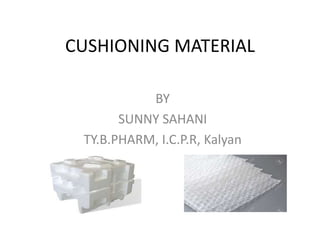
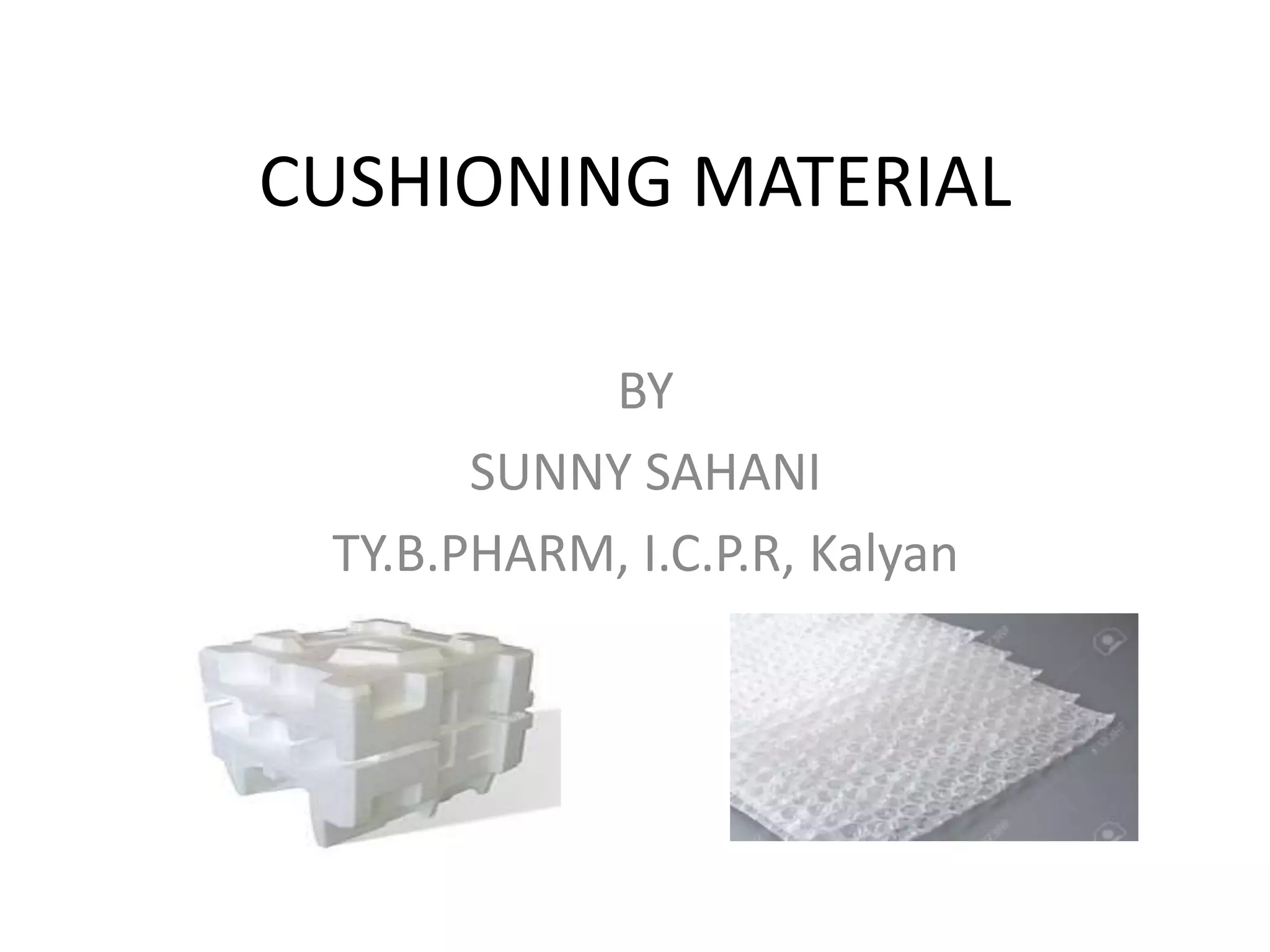
CUSHIONING MATERIAL
BY
SUNNY SAHANI
TY.B.PHARM, I.C.P.R, Kalyan
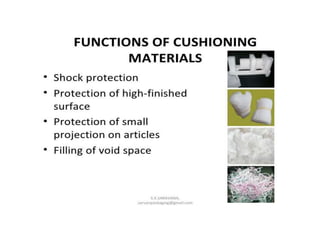
• TYPES OF CUSHIONING
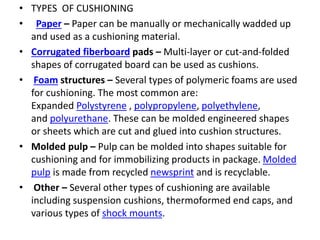
• Paper – Paper can be manually or mechanically wadded up
and used as a cushioning material.
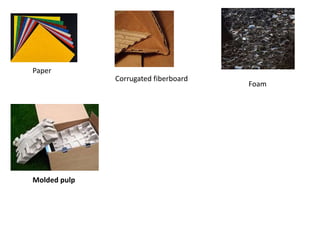
• Corrugated fiberboard pads – Multi-layer or cut-and-folded
shapes of corrugated board can be used as cushions.
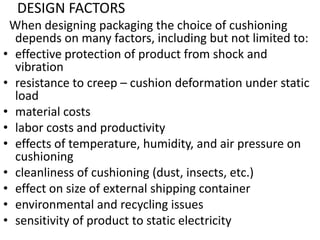
• Foam structures – Several types of polymeric foams are used
for cushioning. The most common are:
Expanded Polystyrene , polypropylene, polyethylene,
and polyurethane. These can be molded engineered shapes
or sheets which are cut and glued into cushion structures.
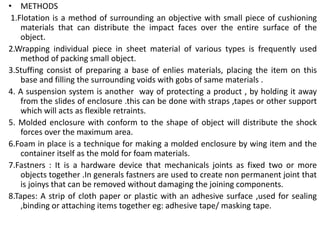
• Molded pulp – Pulp can be molded into shapes suitable for
cushioning and for immobilizing products in package. Molded
pulp is made from recycled newsprint and is recyclable.
• Other – Several other types of cushioning are available
including suspension cushions, thermoformed end caps, and
various types of shock mounts.
Paper
Corrugated fiberboard
Foam
Molded pulp
DESIGN FACTORS
When designing packaging the choice of cushioning
depends on many factors, including but not limited to:
• effective protection of product from shock and
vibration
• resistance to creep – cushion deformation under static
load
• material costs
• labor costs and productivity
• effects of temperature, humidity, and air pressure on
cushioning
• cleanliness of cushioning (dust, insects, etc.)
• effect on size of external shipping container
• environmental and recycling issues
• sensitivity of product to static electricity
• METHODS
1.Flotation is a method of surrounding an objective with small piece of cushioning
materials that can distribute the impact faces over the entire surface of the
object.
2.Wrapping individual piece in sheet material of various types is frequently used
method of packing small object.
3.Stuffing consist of preparing a base of enlies materials, placing the item on this
base and filling the surrounding voids with gobs of same materials .
4. A suspension system is another way of protecting a product , by holding it away
from the slides of enclosure .this can be done with straps ,tapes or other support
which will acts as flexible retraints.
5. Molded enclosure with conform to the shape of object will distribute the shock
forces over the maximum area.
6.Foam in place is a technique for making a molded enclosure by wing item and the
container itself as the mold for foam materials.
7.Fastners : It is a hardware device that mechanicals joints as fixed two or more
objects together .In generals fastners are used to create non permanent joint that
is joinys that can be removed without damaging the joining components.
8.Tapes: A strip of cloth paper or plastic with an adhesive surface ,used for sealing
,binding or attaching items together eg: adhesive tape/ masking tape.
ADVANTAGE OF CUSHIONING
It include flexibility as bubble wrap sheets are
dispensed and placed as needed, light weight, and
low cost.
DISADVANTAGE OF CUSHIONING
It include manually intensive, cushioning quality
depends operator, and high loads can result in air
leaking out of the bubbles reducing effectiveness.
APPLICATION OF CUSHIONING
1. Cushioning packaging, to protect against shocks,
impacts and vibrations
2.Optimal cushioning protection to avoid transport
damage
Cushioning material

Cushioning material

  • 1.
  • 4.
    • TYPES OFCUSHIONING • Paper – Paper can be manually or mechanically wadded up and used as a cushioning material. • Corrugated fiberboard pads – Multi-layer or cut-and-folded shapes of corrugated board can be used as cushions. • Foam structures – Several types of polymeric foams are used for cushioning. The most common are: Expanded Polystyrene , polypropylene, polyethylene, and polyurethane. These can be molded engineered shapes or sheets which are cut and glued into cushion structures. • Molded pulp – Pulp can be molded into shapes suitable for cushioning and for immobilizing products in package. Molded pulp is made from recycled newsprint and is recyclable. • Other – Several other types of cushioning are available including suspension cushions, thermoformed end caps, and various types of shock mounts.
  • 5.
  • 6.
    DESIGN FACTORS When designingpackaging the choice of cushioning depends on many factors, including but not limited to: • effective protection of product from shock and vibration • resistance to creep – cushion deformation under static load • material costs • labor costs and productivity • effects of temperature, humidity, and air pressure on cushioning • cleanliness of cushioning (dust, insects, etc.) • effect on size of external shipping container • environmental and recycling issues • sensitivity of product to static electricity
  • 7.
    • METHODS 1.Flotation isa method of surrounding an objective with small piece of cushioning materials that can distribute the impact faces over the entire surface of the object. 2.Wrapping individual piece in sheet material of various types is frequently used method of packing small object. 3.Stuffing consist of preparing a base of enlies materials, placing the item on this base and filling the surrounding voids with gobs of same materials . 4. A suspension system is another way of protecting a product , by holding it away from the slides of enclosure .this can be done with straps ,tapes or other support which will acts as flexible retraints. 5. Molded enclosure with conform to the shape of object will distribute the shock forces over the maximum area. 6.Foam in place is a technique for making a molded enclosure by wing item and the container itself as the mold for foam materials. 7.Fastners : It is a hardware device that mechanicals joints as fixed two or more objects together .In generals fastners are used to create non permanent joint that is joinys that can be removed without damaging the joining components. 8.Tapes: A strip of cloth paper or plastic with an adhesive surface ,used for sealing ,binding or attaching items together eg: adhesive tape/ masking tape.
  • 8.
    ADVANTAGE OF CUSHIONING Itinclude flexibility as bubble wrap sheets are dispensed and placed as needed, light weight, and low cost. DISADVANTAGE OF CUSHIONING It include manually intensive, cushioning quality depends operator, and high loads can result in air leaking out of the bubbles reducing effectiveness. APPLICATION OF CUSHIONING 1. Cushioning packaging, to protect against shocks, impacts and vibrations 2.Optimal cushioning protection to avoid transport damage