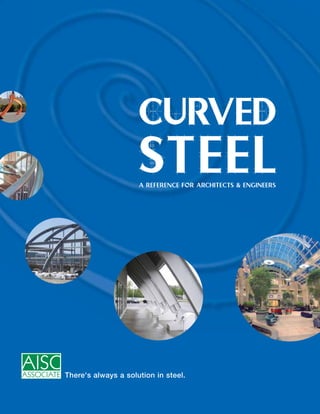
There's always a solution in steel.
2
How did they do that?
As curved steel has been increasing in popularity, so have the questions about
it:
 Who curves steel?
 Where can you use curved steel?
 How do you curve it?
 Is it easy?
 Where can I find additional information?
This brochure will answer these questions and many more. Multiple
steel projects are highlighted to show how any project—from the largest
monumental project to that building down your street—can benefit from the
use of curved steel. In addition, this reference contains a pictorial description
of how steel is bent as well as a technical article about curving steel.
The best way to answer all your curving questions is to contact AISC
Associate Member Bender-Rollers listed at www.aisc.org/benders. In
addition to contact information, the site is a great resource for curved steel,
featuring technical articles, current industry developments, and the latest
curved steel projects.
So keep reading—and learn how you can use curved steel in your next
project.
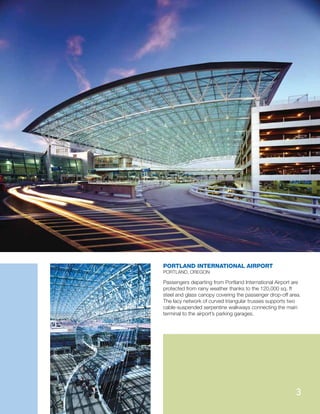
Passengers departing from Portland International Airport are
protected from rainy weather thanks to the 120,000 sq. ft
steel and glass canopy covering the passenger drop-off area.
The lacy network of curved triangular trusses supports two
cable-suspended serpentine walkways connecting the main
terminal to the airport’s parking garages.
PORTLAND INTERNATIONAL AIRPORT
PORTLAND, OREGON
3
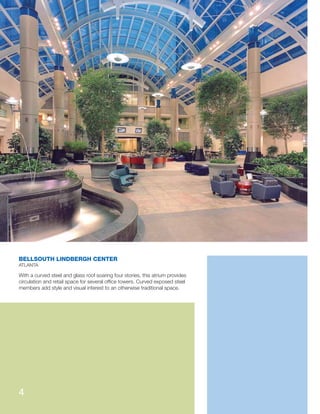
With a curved steel and glass roof soaring four stories, this atrium provides
circulation and retail space for several office towers. Curved exposed steel
members add style and visual interest to an otherwise traditional space.
BELLSOUTH LINDBERGH CENTER
ATLANTA
4
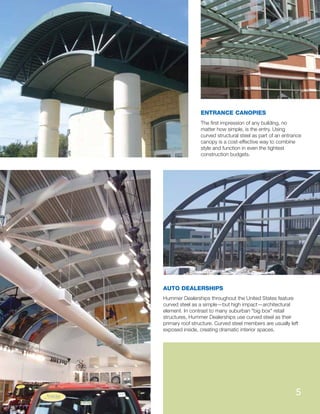
The first impression of any building, no
matter how simple, is the entry. Using
curved structural steel as part of an entrance
canopy is a cost-effective way to combine
style and function in even the tightest
construction budgets.
ENTRANCE CANOPIES
Hummer Dealerships throughout the United States feature
curved steel as a simple—but high impact—architectural
element. In contrast to many suburban big box retail
structures, Hummer Dealerships use curved steel as their
primary roof structure. Curved steel members are usually left
exposed inside, creating dramatic interior spaces.
AUTO DEALERSHIPS
5
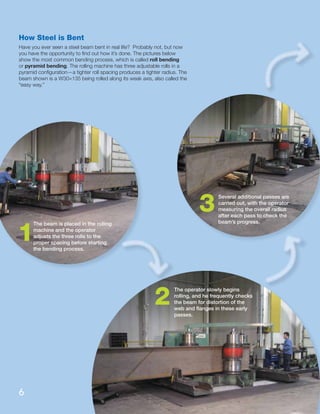
How Steel is Bent
Have you ever seen a steel beam bent in real life? Probably not, but now
you have the opportunity to find out how it’s done. The pictures below
show the most common bending process, which is called roll bending
or pyramid bending. The rolling machine has three adjustable rolls in a
pyramid configuration—a tighter roll spacing produces a tighter radius. The
beam shown is a W30×135 being rolled along its weak axis, also called the
“easy way.”
The beam is placed in the rolling
machine and the operator
adjusts the three rolls to the
proper spacing before starting
the bending process.
The operator slowly begins
rolling, and he frequently checks
the beam for distortion of the
web and flanges in these early
passes.
Several additional passes are
carried out, with the operator
measuring the overall radius
after each pass to check the
beam’s progress.
1
3
2
6
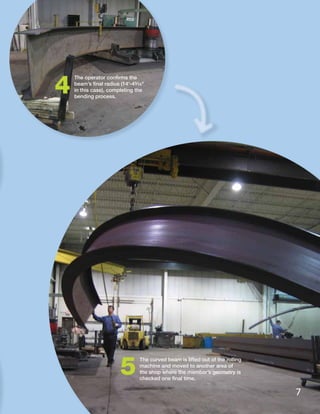
The operator confirms the
beam’s final radius (14'-43⁄16
in this case), completing the
bending process.
5
The curved beam is lifted out of the rolling
machine and moved to another area of
the shop where the member’s geometry is
checked one final time.
4
7
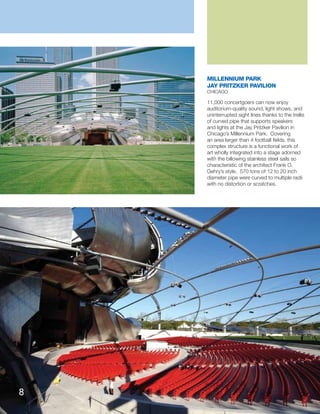
11,000 concertgoers can now enjoy
auditorium-quality sound, light shows, and
uninterrupted sight lines thanks to the trellis
of curved pipe that supports speakers
and lights at the Jay Pritzker Pavilion in
Chicago’s Millennium Park. Covering
an area larger than 4 football fields, this
complex structure is a functional work of
art wholly integrated into a stage adorned
with the billowing stainless steel sails so
characteristic of the architect Frank O.
Gehry’s style. 570 tons of 12 to 20 inch
diameter pipe were curved to multiple radii
with no distortion or scratches.
MILLENNIUM PARK
JAY PRITZKER PAVILION
CHICAGO
8
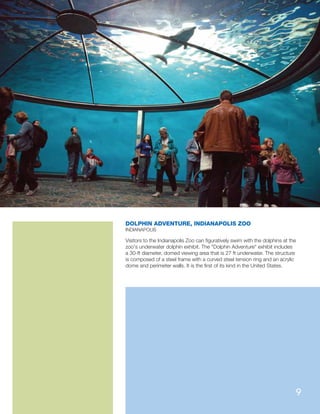
DOLPHIN ADVENTURE, INDIANAPOLIS ZOO
INDIANAPOLIS
Visitors to the Indianapolis Zoo can figuratively swim with the dolphins at the
zoo's underwater dolphin exhibit. The Dolphin Adventure exhibit includes
a 30-ft diameter, domed viewing area that is 27 ft underwater. The structure
is composed of a steel frame with a curved steel tension ring and an acrylic
dome and perimeter walls. It is the first of its kind in the United States.
9
H
ow much do you know about bending structural steel?
Do you know what you need to show on construction
drawings to transfer the idea of what the result should
actually look like? Do you know how tight of a radius
you can roll a W12×19, and what to expect it to
look like? If you have bending questions, who do you ask? AISC’s
bender-roller committee is taking steps to address these questions,
which are coming up more and more within the structural steel
industry.
Bender = Fabricator?
Not so! The bender is typically a specialty subcontractor of
the fabricator. Benders receive the steel from the fabricator (or
sometimes furnish it themselves), and then ship the curved steel
back to the fabricator. Benders usually have limited fabrication
capabilities, such as hole drilling and plate welding, but they are
generally used for smaller jobs that usually are not structural in
nature. Typical fabrication is still carried out through the main project
fabricator who organizes the steel package from procurement
through delivery to the site for erection.
There’s only one type of bending, right?
Nope! There are five typical methods of bending in the industry:
rolling, incremental bending, hot bending, rotary-draw bending,
and induction bending. Each method has its advantages. Some
methods are more commonly used in the steel construction industry,
while others are more common in the automobile or manufacturing
industries:
š Rolling or cold bending is the typical method of curving steel for
construction and is usually the most economical for rolling members
with tighter radii. A steel member is placed in a machine and curved
between three rolls. Cold bending may also be called “pyramid
rolling” because of the three rolls’ pyramid arrangement. Bending
occurs when the distance between these rolls is manipulated before
each successive pass.
š Point bending or gag pressing is usually used for cambering
and curving to very large radii. Bending is achieved by applying
a minimal number of point loads with a hydraulic ram or press at
selected points.
š Hot bending is where a structural member is heated directly
and then bent. The heat source could be a direct flame or
furnace. This application is used extensively in repair.
š Rotary-draw bending is where the structural member is bent
by rotating it around a die. The member is clamped into a
form and then is drawn through the machine until the bend is
formed. This method produces tight radii and is mainly used for
complicated bends in the machine and parts industry.
š Induction bending uses an electric coil to heat a short section
of a structural member, and then that member is drawn through
a process similar to rotary-draw and cooled with water directly
after. In some cases, this process can produce a smaller, tighter
radius.
š Synchronized incremental cold bending is performed by
applying pressure in a highly synchronized fashion at several
locations on the section. This can result in tight radii with minimal
distortion.
š Other methods have been developed by AISC members to
enhance rolling and bending results.
What about construction drawings?
Have you worked on a building project that included bent
steel and then had to answer RFIs because you were not exactly
sure what the detailer or bender needed to produce that curved
member? Here are several very important but very simple items that
should be included on construction drawings when dealing with
curved steel.
š What are you trying to bend—what is the member shape
and size? This is simple and straightforward, but the benders
often see requests for an estimate without a member size, and
there is a big difference between bending a W8×10 and a
W40×215. Plus, don’t forget to list the grade of steel for the
member, and if it must be domestically produced.
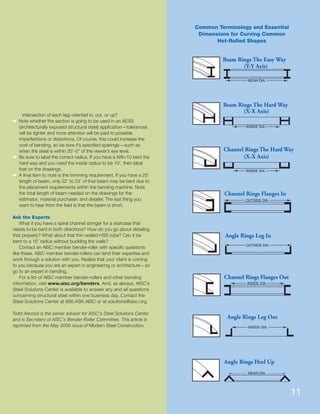
š How about the orientation of the member? The table at
right shows several different member shapes with common
terminologies:
s“Easy way” is bending a member around its weak axis, and
“hard way” is bending around the strong axis;
s“Flanges in” or “flanges out” refers to the direction of the
flanges on channels, angles, and tees;
sWhen an angle is curved on its diagonal, is the heel (the
What Engineers and Architects
Should Know About Bending Steel
With these tips under your belt, you’ll be ahead of the curve on your next bending or rolling project.
BY TODD A. ALWOOD
10
intersection of each leg) oriented in, out, or up?
š Note whether the section is going to be used in an AESS
(architecturally exposed structural steel) application—tolerances
will be tighter and more attention will be paid to possible
imperfections or distortions. Of course, this could increase the
cost of bending, so be sure it’s specified sparingly—such as
when the steel is within 20’-0” of the viewer’s eye level.
š Be sure to label the correct radius. If you have a W8×10 bent the
hard way and you need the inside radius to be 10’, then label
that on the drawings.
š A final item to note is the trimming requirement. If you have a 25’
length of beam, only 22’ to 23’ of that beam may be bent due to
the placement requirements within the bending machine. Note
the total length of beam needed on the drawings for the
estimator, material purchaser, and detailer. The last thing you
want to hear from the field is that the beam is short.
Ask the Experts
What if you have a spiral channel stringer for a staircase that
needs to be bent in both directions? How do you go about detailing
that properly? What about that thin-walled HSS tube? Can it be
bent to a 16’ radius without buckling the walls?
Contact an AISC member bender-roller with specific questions
like these. AISC member bender-rollers can lend their expertise and
work through a solution with you. Realize that your client is coming
to you because you are an expert in engineering or architecture—so
go to an expert in bending.
For a list of AISC member bender-rollers and other bending
information, visit www.aisc.org/benders. And, as always, AISC’s
Steel Solutions Center is available to answer any and all questions
concerning structural steel within one business day. Contact the
Steel Solutions Center at 866.ASK.AISC or at solutions@aisc.org.
Todd Alwood is the senior advisor for AISC’s Steel Solutions Center
and is Secretary of AISC’s Bender-Roller Committee. This article is
reprinted from the May 2006 issue of Modern Steel Construction.
Common Terminology and Essential
Dimensions for Curving Common
Hot-Rolled Shapes
11
There's always a solution in steel.
American Institute of Steel Construction
One East Wacker Drive, Suite 700
Chicago, IL 60601-1802
866.ASK.AISC www.aisc.org
To contact an AISC Associate Member Bender-Roller,
please visit www.aisc.org/benders.
Contact the AISC Steel Solutions Center at 866.ASK.
AISC or solutions@aisc.org to discuss how structural
steel can benefit your next project.
A special thanks to Kottler Metal Products for providing and bending the beam shown on pp.
6–7.
Item F045-06
(06/06:2M:ADV)

Curved steel-a-reference-for-architects-and-engineers

  • 1.
    There's always asolution in steel.
  • 2.
    2 How did theydo that? As curved steel has been increasing in popularity, so have the questions about it: Who curves steel? Where can you use curved steel? How do you curve it? Is it easy? Where can I find additional information? This brochure will answer these questions and many more. Multiple steel projects are highlighted to show how any project—from the largest monumental project to that building down your street—can benefit from the use of curved steel. In addition, this reference contains a pictorial description of how steel is bent as well as a technical article about curving steel. The best way to answer all your curving questions is to contact AISC Associate Member Bender-Rollers listed at www.aisc.org/benders. In addition to contact information, the site is a great resource for curved steel, featuring technical articles, current industry developments, and the latest curved steel projects. So keep reading—and learn how you can use curved steel in your next project.
  • 3.
    Passengers departing fromPortland International Airport are protected from rainy weather thanks to the 120,000 sq. ft steel and glass canopy covering the passenger drop-off area. The lacy network of curved triangular trusses supports two cable-suspended serpentine walkways connecting the main terminal to the airport’s parking garages. PORTLAND INTERNATIONAL AIRPORT PORTLAND, OREGON 3
  • 4.
    With a curvedsteel and glass roof soaring four stories, this atrium provides circulation and retail space for several office towers. Curved exposed steel members add style and visual interest to an otherwise traditional space. BELLSOUTH LINDBERGH CENTER ATLANTA 4
  • 5.
    The first impressionof any building, no matter how simple, is the entry. Using curved structural steel as part of an entrance canopy is a cost-effective way to combine style and function in even the tightest construction budgets. ENTRANCE CANOPIES Hummer Dealerships throughout the United States feature curved steel as a simple—but high impact—architectural element. In contrast to many suburban big box retail structures, Hummer Dealerships use curved steel as their primary roof structure. Curved steel members are usually left exposed inside, creating dramatic interior spaces. AUTO DEALERSHIPS 5
  • 6.
    How Steel isBent Have you ever seen a steel beam bent in real life? Probably not, but now you have the opportunity to find out how it’s done. The pictures below show the most common bending process, which is called roll bending or pyramid bending. The rolling machine has three adjustable rolls in a pyramid configuration—a tighter roll spacing produces a tighter radius. The beam shown is a W30×135 being rolled along its weak axis, also called the “easy way.” The beam is placed in the rolling machine and the operator adjusts the three rolls to the proper spacing before starting the bending process. The operator slowly begins rolling, and he frequently checks the beam for distortion of the web and flanges in these early passes. Several additional passes are carried out, with the operator measuring the overall radius after each pass to check the beam’s progress. 1 3 2 6
  • 7.
    The operator confirmsthe beam’s final radius (14'-43⁄16 in this case), completing the bending process. 5 The curved beam is lifted out of the rolling machine and moved to another area of the shop where the member’s geometry is checked one final time. 4 7
  • 8.
    11,000 concertgoers cannow enjoy auditorium-quality sound, light shows, and uninterrupted sight lines thanks to the trellis of curved pipe that supports speakers and lights at the Jay Pritzker Pavilion in Chicago’s Millennium Park. Covering an area larger than 4 football fields, this complex structure is a functional work of art wholly integrated into a stage adorned with the billowing stainless steel sails so characteristic of the architect Frank O. Gehry’s style. 570 tons of 12 to 20 inch diameter pipe were curved to multiple radii with no distortion or scratches. MILLENNIUM PARK JAY PRITZKER PAVILION CHICAGO 8
  • 9.
    DOLPHIN ADVENTURE, INDIANAPOLISZOO INDIANAPOLIS Visitors to the Indianapolis Zoo can figuratively swim with the dolphins at the zoo's underwater dolphin exhibit. The Dolphin Adventure exhibit includes a 30-ft diameter, domed viewing area that is 27 ft underwater. The structure is composed of a steel frame with a curved steel tension ring and an acrylic dome and perimeter walls. It is the first of its kind in the United States. 9
  • 10.
    H ow much doyou know about bending structural steel? Do you know what you need to show on construction drawings to transfer the idea of what the result should actually look like? Do you know how tight of a radius you can roll a W12×19, and what to expect it to look like? If you have bending questions, who do you ask? AISC’s bender-roller committee is taking steps to address these questions, which are coming up more and more within the structural steel industry. Bender = Fabricator? Not so! The bender is typically a specialty subcontractor of the fabricator. Benders receive the steel from the fabricator (or sometimes furnish it themselves), and then ship the curved steel back to the fabricator. Benders usually have limited fabrication capabilities, such as hole drilling and plate welding, but they are generally used for smaller jobs that usually are not structural in nature. Typical fabrication is still carried out through the main project fabricator who organizes the steel package from procurement through delivery to the site for erection. There’s only one type of bending, right? Nope! There are five typical methods of bending in the industry: rolling, incremental bending, hot bending, rotary-draw bending, and induction bending. Each method has its advantages. Some methods are more commonly used in the steel construction industry, while others are more common in the automobile or manufacturing industries: š Rolling or cold bending is the typical method of curving steel for construction and is usually the most economical for rolling members with tighter radii. A steel member is placed in a machine and curved between three rolls. Cold bending may also be called “pyramid rolling” because of the three rolls’ pyramid arrangement. Bending occurs when the distance between these rolls is manipulated before each successive pass. š Point bending or gag pressing is usually used for cambering and curving to very large radii. Bending is achieved by applying a minimal number of point loads with a hydraulic ram or press at selected points. š Hot bending is where a structural member is heated directly and then bent. The heat source could be a direct flame or furnace. This application is used extensively in repair. š Rotary-draw bending is where the structural member is bent by rotating it around a die. The member is clamped into a form and then is drawn through the machine until the bend is formed. This method produces tight radii and is mainly used for complicated bends in the machine and parts industry. š Induction bending uses an electric coil to heat a short section of a structural member, and then that member is drawn through a process similar to rotary-draw and cooled with water directly after. In some cases, this process can produce a smaller, tighter radius. š Synchronized incremental cold bending is performed by applying pressure in a highly synchronized fashion at several locations on the section. This can result in tight radii with minimal distortion. š Other methods have been developed by AISC members to enhance rolling and bending results. What about construction drawings? Have you worked on a building project that included bent steel and then had to answer RFIs because you were not exactly sure what the detailer or bender needed to produce that curved member? Here are several very important but very simple items that should be included on construction drawings when dealing with curved steel. š What are you trying to bend—what is the member shape and size? This is simple and straightforward, but the benders often see requests for an estimate without a member size, and there is a big difference between bending a W8×10 and a W40×215. Plus, don’t forget to list the grade of steel for the member, and if it must be domestically produced. š How about the orientation of the member? The table at right shows several different member shapes with common terminologies: s“Easy way” is bending a member around its weak axis, and “hard way” is bending around the strong axis; s“Flanges in” or “flanges out” refers to the direction of the flanges on channels, angles, and tees; sWhen an angle is curved on its diagonal, is the heel (the What Engineers and Architects Should Know About Bending Steel With these tips under your belt, you’ll be ahead of the curve on your next bending or rolling project. BY TODD A. ALWOOD 10
  • 11.
    intersection of eachleg) oriented in, out, or up? š Note whether the section is going to be used in an AESS (architecturally exposed structural steel) application—tolerances will be tighter and more attention will be paid to possible imperfections or distortions. Of course, this could increase the cost of bending, so be sure it’s specified sparingly—such as when the steel is within 20’-0” of the viewer’s eye level. š Be sure to label the correct radius. If you have a W8×10 bent the hard way and you need the inside radius to be 10’, then label that on the drawings. š A final item to note is the trimming requirement. If you have a 25’ length of beam, only 22’ to 23’ of that beam may be bent due to the placement requirements within the bending machine. Note the total length of beam needed on the drawings for the estimator, material purchaser, and detailer. The last thing you want to hear from the field is that the beam is short. Ask the Experts What if you have a spiral channel stringer for a staircase that needs to be bent in both directions? How do you go about detailing that properly? What about that thin-walled HSS tube? Can it be bent to a 16’ radius without buckling the walls? Contact an AISC member bender-roller with specific questions like these. AISC member bender-rollers can lend their expertise and work through a solution with you. Realize that your client is coming to you because you are an expert in engineering or architecture—so go to an expert in bending. For a list of AISC member bender-rollers and other bending information, visit www.aisc.org/benders. And, as always, AISC’s Steel Solutions Center is available to answer any and all questions concerning structural steel within one business day. Contact the Steel Solutions Center at 866.ASK.AISC or at solutions@aisc.org. Todd Alwood is the senior advisor for AISC’s Steel Solutions Center and is Secretary of AISC’s Bender-Roller Committee. This article is reprinted from the May 2006 issue of Modern Steel Construction. Common Terminology and Essential Dimensions for Curving Common Hot-Rolled Shapes 11
  • 12.
    There's always asolution in steel. American Institute of Steel Construction One East Wacker Drive, Suite 700 Chicago, IL 60601-1802 866.ASK.AISC www.aisc.org To contact an AISC Associate Member Bender-Roller, please visit www.aisc.org/benders. Contact the AISC Steel Solutions Center at 866.ASK. AISC or solutions@aisc.org to discuss how structural steel can benefit your next project. A special thanks to Kottler Metal Products for providing and bending the beam shown on pp. 6–7. Item F045-06 (06/06:2M:ADV)