Running Head: DISCUSSION QUESTIONS 1
Discussion Questions
Name:
Institution:
DISCUSSION QUESTIONS 2
Question 1:
The proper or ethical use of technology in terms of both ensuring public safety as well
as protecting individual liberties
The need for governments to infringe on individuals private lives in their endeavour
to enhance the safety of the public while boosting individuals’ freedom has been emphasized
for a very long time. For this reason, the government provides a level of transparency in the
utilization of new technologies (Pure, 2013). Additionally, individuals using new
technologies are subjected to legislative and judicial oversight. The utilization of
investigative and new technologies has provided the justice system with an opportunity to
analyze technology advances and review their impact on individual’s privacy as per the
public and constitutional policy foundation. Therefore, whenever privacy risks emerge or
whenever government authority goes beyond the outlined limits through a process that is
democratic, corrective action is mandatory (Pure, 2013). For this reason, to enhance
individual’s privacy, the investigative process must be transparent and those who infringe on
individuals privacy should be held accountable.
How might the use of such an indicator mirror current trends in criminal justice system
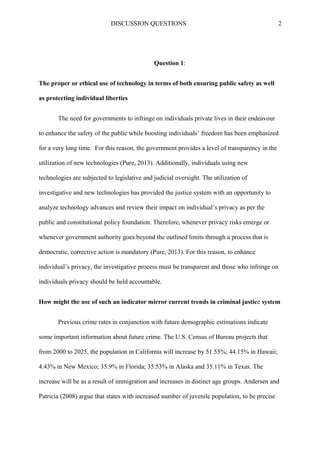
Previous crime rates in conjunction with future demographic estimations indicate
some important information about future crime. The U.S. Census of Bureau projects that
from 2000 to 2025, the population in California will increase by 51.55%; 44.15% in Hawaii;
4.43% in New Mexico; 35.9% in Florida; 35.53% in Alaska and 35.11% in Texas. The
increase will be as a result of immigration and increases in distinct age groups. Andersen and
Patricia (2008) argue that states with increased number of juvenile population, to be precise
DISCUSSION QUESTIONS 3
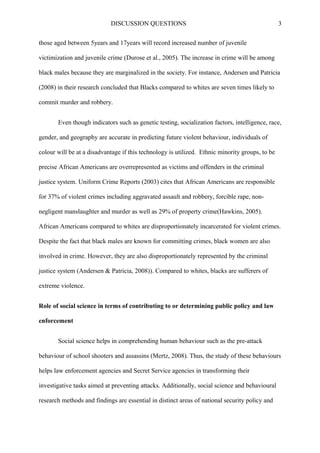
those aged between 5years and 17years will record increased number of juvenile
victimization and juvenile crime (Durose et al., 2005). The increase in crime will be among
black males because they are marginalized in the society. For instance, Andersen and Patricia
(2008) in their research concluded that Blacks compared to whites are seven times likely to
commit murder and robbery.
Even though indicators such as genetic testing, socialization factors, intelligence, race,
gender, and geography are accurate in predicting future violent behaviour, individuals of
colour will be at a disadvantage if this technology is utilized. Ethnic minority groups, to be
precise African Americans are overrepresented as victims and offenders in the criminal
justice system. Uniform Crime Reports (2003) cites that African Americans are responsible
for 37% of violent crimes including aggravated assault and robbery, forcible rape, non-
negligent manslaughter and murder as well as 29% of property crime(Hawkins, 2005).
African Americans compared to whites are disproportionately incarcerated for violent crimes.
Despite the fact that black males are known for committing crimes, black women are also
involved in crime. However, they are also disproportionately represented by the criminal
justice system (Andersen & Patricia, 2008)). Compared to whites, blacks are sufferers of
extreme violence.
Role of social science in terms of contributing to or determining public policy and law
enforcement
Social science helps in comprehending human behaviour such as the pre-attack
behaviour of school shooters and assassins (Mertz, 2008). Thus, the study of these behaviours
helps law enforcement agencies and Secret Service agencies in transforming their
investigative tasks aimed at preventing attacks. Additionally, social science and behavioural
research methods and findings are essential in distinct areas of national security policy and
DISCUSSION QUESTIONS 4
justice system. Equally, social research methods and findings could enhance effective
utilization and the quality of national intelligence analysis (Mertz, 2008). However, it is
extremely challenging to identify scientist in this current century who exhibit confidence in
the prevention of crime because most of them are biased in their judgements (Mertz, 2008).
Regardless, psychology and sociology remains the foundation of all contemporary justice
policies.
Question3
There exists a controversy between trait theorists and social structure theorists
regarding genetics and hereditary influence on the overall attributes of human beings. The
debate has triggered the general public to ask themselves about the determinants that shape
their personal character and behaviours (Barak, 2004). Scholars argue that the model for
developing the behaviour of human beings is complex and affected by distinct factors.
However, the factors are not only limited to environmental factors and genes, but an
interaction between genes and the environment. However, some theories such as trait theory
and social structure theory fail to advocate environmental factors or hereditary over one
another. However, the theories highlight the significance of their interaction in influencing
the behaviour of human beings.
According to social structure theorists, socialization as an environmental factor is
crucial in determining the manner in which an individual behaves. Children are socialized to
obey societal rules. For instance, children fail to comprehend that stealing is not acceptable.
For this reason, the society is force d to teach them that stealing is a crime by using negative
consequences such as punishment. As a result, they internalize the fact that stealing is wrong
and the society uses this opportunity to instil in a child socially and morally acceptable
behaviour. As a result, social structure theorists contend that social environments appear to
DISCUSSION QUESTIONS 5
behave in a predictable and similar fashion. Thus, they make an assumption that if human
behaviour is not influenced by the environment, then the rate of crime would be equally
distributed across structure, which is not the case. However, trait theorists contend that
psychological and biological factor rather than the social environment determines human
behaviour, especially those related to anti-social, violent or aggressive behaviour (Hiriyappa,
2002).
Trait theorists assert that traits are dimensions or variables that are dynamic. As such,
people exhibit certain attributes that partly define their behaviours. Example of such trait is
introversion and extraversion. The latter manifest itself in energetic, outgoing, and talkative
behaviour whereas the former manifests itself in more solitary and reserved behaviour
(Matthews, Deary & Whiteman, 2009). Therefore, the manner in which an individual
behaves falls along the two continuum and determines the manner in which individuals react
in distinct contexts.
Personality traits are categorized into three distinct levels: central traits, cardinal
traits, and secondary trait. Central trait shapes human behaviours such as being honest.
Secondary traits are triggered by certain stimuli. For this reason, they illustrate why some
people exhibit attributes that are incongruent with other people’s behaviour in the society.
Cardinal traits are those that shape and dominate a person’s behaviour. Therefore, the
environment does not influence an individual behaviour (Barak, Jeanne & Paul, 2004). On
the contrary, individuals through free will can make a choice on how they act. For this
reason, individuals are able to choose either to be aggressive, violent or conform to the
society norms (Wiggins, 2006). For instance, people are free to make a choice to commit or
not to commit crime. However, trait theories face numerous criticisms. Some critics argue
that traits do not accurately predict an individual behaviour. Even though a person might
DISCUSSION QUESTIONS 6
score high in trait assessment, the person might not often conduct himself/herself the same
way in every circumstance.
References
Andersen, M. L., & Patricia, H.C. (2008). Race, Class and Gender: An Anthology, 3rd
edition. Belmont, CA: Wadsworth Publishing.
Barak, G. (2004). (ed.). Media, Process, and the Social Construction of Crime: Studies in
Newsmaking Criminology. New York: Garland Publishing
Barak, G., Jeanne, F., & Paul, L. (200)1. Class, Race, Gender, and Crime: Social Realities
of Justice in America. Los Angeles: Roxbury Publishing.
Durose, M. R., Erica, L., Schmitt, S., & Patrick, A. L. (2005). Contacts Between Police and
the Public: Findings from the 2002National Survey.NCJ 207845. Washington, DC:
Bureau of Justice Statistics
Hawkins, D. F. 2005. (ed.). Ethnicity, Race, and Crime: Perspectives Across Time and Place.
Albany, NY: SUNY Press.
Hiriyappa, B. (2012). Development of personality and its theories. Bloomington, IN :
Booktango
Matthews, G., Deary, I. J., & Whiteman, M. C. (2009). Personality traits. Cambridge, UK:
Cambridge University Press.
Mertz, E. (2008). The role of social science in law. Aldershot, England: Ashgate.
Pure, R. A., &. (2013). Privacy expectations in online contexts. Santa Barbara, Calif.:
University of California, Santa Barbara.
DISCUSSION QUESTIONS 7
Wiggins, J. S. (2006). The five-factor model of personality: Theoretical perspectives. New
York, NYa.: Guilford Press.

current trends in criminal justice system

  • 1.
    Running Head: DISCUSSIONQUESTIONS 1 Discussion Questions Name: Institution:
  • 2.
    DISCUSSION QUESTIONS 2 Question1: The proper or ethical use of technology in terms of both ensuring public safety as well as protecting individual liberties The need for governments to infringe on individuals private lives in their endeavour to enhance the safety of the public while boosting individuals’ freedom has been emphasized for a very long time. For this reason, the government provides a level of transparency in the utilization of new technologies (Pure, 2013). Additionally, individuals using new technologies are subjected to legislative and judicial oversight. The utilization of investigative and new technologies has provided the justice system with an opportunity to analyze technology advances and review their impact on individual’s privacy as per the public and constitutional policy foundation. Therefore, whenever privacy risks emerge or whenever government authority goes beyond the outlined limits through a process that is democratic, corrective action is mandatory (Pure, 2013). For this reason, to enhance individual’s privacy, the investigative process must be transparent and those who infringe on individuals privacy should be held accountable. How might the use of such an indicator mirror current trends in criminal justice system Previous crime rates in conjunction with future demographic estimations indicate some important information about future crime. The U.S. Census of Bureau projects that from 2000 to 2025, the population in California will increase by 51.55%; 44.15% in Hawaii; 4.43% in New Mexico; 35.9% in Florida; 35.53% in Alaska and 35.11% in Texas. The increase will be as a result of immigration and increases in distinct age groups. Andersen and Patricia (2008) argue that states with increased number of juvenile population, to be precise
  • 3.
    DISCUSSION QUESTIONS 3 thoseaged between 5years and 17years will record increased number of juvenile victimization and juvenile crime (Durose et al., 2005). The increase in crime will be among black males because they are marginalized in the society. For instance, Andersen and Patricia (2008) in their research concluded that Blacks compared to whites are seven times likely to commit murder and robbery. Even though indicators such as genetic testing, socialization factors, intelligence, race, gender, and geography are accurate in predicting future violent behaviour, individuals of colour will be at a disadvantage if this technology is utilized. Ethnic minority groups, to be precise African Americans are overrepresented as victims and offenders in the criminal justice system. Uniform Crime Reports (2003) cites that African Americans are responsible for 37% of violent crimes including aggravated assault and robbery, forcible rape, non- negligent manslaughter and murder as well as 29% of property crime(Hawkins, 2005). African Americans compared to whites are disproportionately incarcerated for violent crimes. Despite the fact that black males are known for committing crimes, black women are also involved in crime. However, they are also disproportionately represented by the criminal justice system (Andersen & Patricia, 2008)). Compared to whites, blacks are sufferers of extreme violence. Role of social science in terms of contributing to or determining public policy and law enforcement Social science helps in comprehending human behaviour such as the pre-attack behaviour of school shooters and assassins (Mertz, 2008). Thus, the study of these behaviours helps law enforcement agencies and Secret Service agencies in transforming their investigative tasks aimed at preventing attacks. Additionally, social science and behavioural research methods and findings are essential in distinct areas of national security policy and
  • 4.
    DISCUSSION QUESTIONS 4 justicesystem. Equally, social research methods and findings could enhance effective utilization and the quality of national intelligence analysis (Mertz, 2008). However, it is extremely challenging to identify scientist in this current century who exhibit confidence in the prevention of crime because most of them are biased in their judgements (Mertz, 2008). Regardless, psychology and sociology remains the foundation of all contemporary justice policies. Question3 There exists a controversy between trait theorists and social structure theorists regarding genetics and hereditary influence on the overall attributes of human beings. The debate has triggered the general public to ask themselves about the determinants that shape their personal character and behaviours (Barak, 2004). Scholars argue that the model for developing the behaviour of human beings is complex and affected by distinct factors. However, the factors are not only limited to environmental factors and genes, but an interaction between genes and the environment. However, some theories such as trait theory and social structure theory fail to advocate environmental factors or hereditary over one another. However, the theories highlight the significance of their interaction in influencing the behaviour of human beings. According to social structure theorists, socialization as an environmental factor is crucial in determining the manner in which an individual behaves. Children are socialized to obey societal rules. For instance, children fail to comprehend that stealing is not acceptable. For this reason, the society is force d to teach them that stealing is a crime by using negative consequences such as punishment. As a result, they internalize the fact that stealing is wrong and the society uses this opportunity to instil in a child socially and morally acceptable behaviour. As a result, social structure theorists contend that social environments appear to
  • 5.
    DISCUSSION QUESTIONS 5 behavein a predictable and similar fashion. Thus, they make an assumption that if human behaviour is not influenced by the environment, then the rate of crime would be equally distributed across structure, which is not the case. However, trait theorists contend that psychological and biological factor rather than the social environment determines human behaviour, especially those related to anti-social, violent or aggressive behaviour (Hiriyappa, 2002). Trait theorists assert that traits are dimensions or variables that are dynamic. As such, people exhibit certain attributes that partly define their behaviours. Example of such trait is introversion and extraversion. The latter manifest itself in energetic, outgoing, and talkative behaviour whereas the former manifests itself in more solitary and reserved behaviour (Matthews, Deary & Whiteman, 2009). Therefore, the manner in which an individual behaves falls along the two continuum and determines the manner in which individuals react in distinct contexts. Personality traits are categorized into three distinct levels: central traits, cardinal traits, and secondary trait. Central trait shapes human behaviours such as being honest. Secondary traits are triggered by certain stimuli. For this reason, they illustrate why some people exhibit attributes that are incongruent with other people’s behaviour in the society. Cardinal traits are those that shape and dominate a person’s behaviour. Therefore, the environment does not influence an individual behaviour (Barak, Jeanne & Paul, 2004). On the contrary, individuals through free will can make a choice on how they act. For this reason, individuals are able to choose either to be aggressive, violent or conform to the society norms (Wiggins, 2006). For instance, people are free to make a choice to commit or not to commit crime. However, trait theories face numerous criticisms. Some critics argue that traits do not accurately predict an individual behaviour. Even though a person might
  • 6.
    DISCUSSION QUESTIONS 6 scorehigh in trait assessment, the person might not often conduct himself/herself the same way in every circumstance. References Andersen, M. L., & Patricia, H.C. (2008). Race, Class and Gender: An Anthology, 3rd edition. Belmont, CA: Wadsworth Publishing. Barak, G. (2004). (ed.). Media, Process, and the Social Construction of Crime: Studies in Newsmaking Criminology. New York: Garland Publishing Barak, G., Jeanne, F., & Paul, L. (200)1. Class, Race, Gender, and Crime: Social Realities of Justice in America. Los Angeles: Roxbury Publishing. Durose, M. R., Erica, L., Schmitt, S., & Patrick, A. L. (2005). Contacts Between Police and the Public: Findings from the 2002National Survey.NCJ 207845. Washington, DC: Bureau of Justice Statistics Hawkins, D. F. 2005. (ed.). Ethnicity, Race, and Crime: Perspectives Across Time and Place. Albany, NY: SUNY Press. Hiriyappa, B. (2012). Development of personality and its theories. Bloomington, IN : Booktango Matthews, G., Deary, I. J., & Whiteman, M. C. (2009). Personality traits. Cambridge, UK: Cambridge University Press. Mertz, E. (2008). The role of social science in law. Aldershot, England: Ashgate. Pure, R. A., &. (2013). Privacy expectations in online contexts. Santa Barbara, Calif.: University of California, Santa Barbara.
  • 7.
    DISCUSSION QUESTIONS 7 Wiggins,J. S. (2006). The five-factor model of personality: Theoretical perspectives. New York, NYa.: Guilford Press.