PHYSICS
CH- ELECTRICITY
NCERT EX. NUMERICALS
 Question 1
Draw a schematic diagram of a circuit consisting of a battery of three cells of 2 V
each, a 5Ω resistor, an 8 Ω resistor, and a 12 Ω resistor, and a plug key, all
connected in series.
Answer:
The required circuit diagram is shown below :
Question 2
Redraw the circuit of Questions 1, putting in an ammeter to measure the current
through the resistors and a voltmeter to measure the potential difference
across the 12 Ω resistor. What would be the readings in the ammeter and the
voltmeter ?
Solution:
The required circuit diagram is shown on the right.
Total voltage, V = 3 x 2 = 6V
Total resistance, R = 5Ω + 8Ω + 12Ω = 25Ω
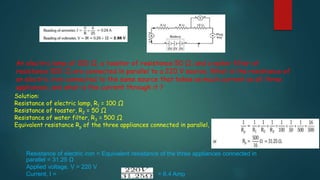
An electric lamp of 100 Ω, a toaster of resistance 50 Ω, and a water filter of
resistance 500 Ω are connected in parallel to a 220 V source. What is the resistance of
an electric iron connected to the same source that takes as much current as all three
appliances, and what is the current through it ?
Solution:
Resistance of electric lamp, R1 = 100 Ω
Resistance of toaster, R2 = 50 Ω
Resistance of water filter, R3 = 500 Ω
Equivalent resistance Rp of the three appliances connected in parallel, is
Resistance of electric iron = Equivalent resistance of the three appliances connected in
parallel = 31.25 Ω
Applied voltage, V = 220 V
Current, I = = 6.4 Amp
 Question 11
Show how you would connect three resistors, each of resistance 6 Ω, so that the
combination has a resistance of (i) 9 Ω, (ii) 4Ω
Solution:
Here, R1 = R2 = R3 = 6 Ω.
 (i) When we connect R1 in series with the parallel combination of R2 and R3 as shown in
Fig. (a).
The equivalent resistance is -
(ii) When we connect a series combination of R1 and R2 in parallel with R3, as shown in Fig. (b), the
equivalent resistance is
 Question 12
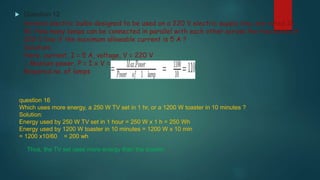
Several electric bulbs designed to be used on a 220 V electric supply line, are rated 10
W. How many lamps can be connected in parallel with each other across the two wires of
220 V line if the maximum allowable current is 5 A ?
Solution:
Here, current, I = 5 A, voltage, V = 220 V
∴ Maxium power, P = I x V = 5 x 220 = 1100W
Required no. of lamps
question 16
Which uses more energy, a 250 W TV set in 1 hr, or a 1200 W toaster in 10 minutes ?
Solution:
Energy used by 250 W TV set in 1 hour = 250 W x 1 h = 250 Wh
Energy used by 1200 W toaster in 10 minutes = 1200 W x 10 min
= 1200 x10/60 = 200 wh
Thus, the TV set uses more energy than the toaster.
Commercial unit of electric energy …( kwh)
 A copper wire has diameter 0.5 mm and resistivity of 1.6 x 10⁻⁸ Ω m. What will be the length
of this wire to make its resistance 10 Ω ? How much does the resistance change if the
diameter is doubled ?






If a wire of diameter doubled to it is taken, then
area of cross-section becomes four times.
New resistance = 10/4 =2.5 Ohm
Decrease in resistance = (10 – 2.5) Ω = 7.5 Ω
 Question 10
How many 176 Ω resistors (in parallel) are required to carry 5 A on a 220 V line? [CBSE (Delhi)
2013]
Solution:
 Suppose n resistors of 176 Ω are connected in parallel.
Thus 4 resistors are needed to be connect.
 Question 14
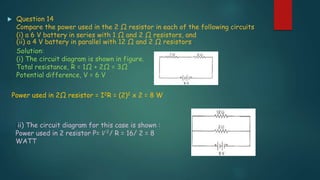
Compare the power used in the 2 Ω resistor in each of the following circuits
(i) a 6 V battery in series with 1 Ω and 2 Ω resistors, and
(ii) a 4 V battery in parallel with 12 Ω and 2 Ω resistors.
Solution:
(i) The circuit diagram is shown in figure.
Total resistance, R = 1Ω + 2Ω = 3Ω
Potential difference, V = 6 V
Power used in 2Ω resistor = I2R = (2)2 x 2 = 8 W
(ii) The circuit diagram for this case is shown :
Power used in 2 resistor P= 𝑉2/ R = 16/ 2 = 8
WATT
 Explain the following:
(i) Why is tungsten used almost exclusively for filament of electric lamps ?
(ii) Why are the conductors of electric heating devices, such as bread-toasters and electric irons,
made of an alloy rather than a pure metal ?
(in) Why is the series arrangement not used for domestic circuits ?
(iv) How does the resistance of a wire vary with its area of cross-section ?
(v) Why are copper and aluminium wires usually employed for electricity transmission?
Answer:
(i) The tungsten is used almost exclusively for filament of electric lamps because it has a very high
melting point (3300°C). On passing electricity through tungsten filament, its temperature reaches to
2700°C and it gives heat and light energy without being melted.
(ii) The conductors of electric heating devices such as bread-toasters and electric irons, are made of
an alloy rather than a pure metal because the resistivity of an alloy is much higher than that of pure
metal and an alloy does not undergo oxidation (or burn) easily even at high temperature.
(iii) The series arrangement is not used for domestic circuits because in series circuit, if one
electrical appliance stops working due to some defect, than all other appliances also stop working
because the whole circuit is broken.
(iv) The resistance of a wire is inversely proportional to its area of cross-section, i.e., Resistance R ∝
(1/πr2). If the area of cross section of a conductor of fixed length is increased, then resistance
decreases because there are more free electrons for movement in conductor.
(v) Copper and aluminium wires usually employed for electricity transmission because they have very
low resistances. So, they do not become too hot on passing electric current.
MADE BY- AVIRAL
SRIVASTAVA
CLASS – 10th A

Class x electricity numericals

  • 1.
  • 2.
    NCERT EX. NUMERICALS Question 1 Draw a schematic diagram of a circuit consisting of a battery of three cells of 2 V each, a 5Ω resistor, an 8 Ω resistor, and a 12 Ω resistor, and a plug key, all connected in series. Answer: The required circuit diagram is shown below : Question 2 Redraw the circuit of Questions 1, putting in an ammeter to measure the current through the resistors and a voltmeter to measure the potential difference across the 12 Ω resistor. What would be the readings in the ammeter and the voltmeter ? Solution: The required circuit diagram is shown on the right. Total voltage, V = 3 x 2 = 6V Total resistance, R = 5Ω + 8Ω + 12Ω = 25Ω
  • 3.
    An electric lampof 100 Ω, a toaster of resistance 50 Ω, and a water filter of resistance 500 Ω are connected in parallel to a 220 V source. What is the resistance of an electric iron connected to the same source that takes as much current as all three appliances, and what is the current through it ? Solution: Resistance of electric lamp, R1 = 100 Ω Resistance of toaster, R2 = 50 Ω Resistance of water filter, R3 = 500 Ω Equivalent resistance Rp of the three appliances connected in parallel, is Resistance of electric iron = Equivalent resistance of the three appliances connected in parallel = 31.25 Ω Applied voltage, V = 220 V Current, I = = 6.4 Amp
  • 4.
     Question 11 Showhow you would connect three resistors, each of resistance 6 Ω, so that the combination has a resistance of (i) 9 Ω, (ii) 4Ω Solution: Here, R1 = R2 = R3 = 6 Ω.  (i) When we connect R1 in series with the parallel combination of R2 and R3 as shown in Fig. (a). The equivalent resistance is - (ii) When we connect a series combination of R1 and R2 in parallel with R3, as shown in Fig. (b), the equivalent resistance is
  • 5.
     Question 12 Severalelectric bulbs designed to be used on a 220 V electric supply line, are rated 10 W. How many lamps can be connected in parallel with each other across the two wires of 220 V line if the maximum allowable current is 5 A ? Solution: Here, current, I = 5 A, voltage, V = 220 V ∴ Maxium power, P = I x V = 5 x 220 = 1100W Required no. of lamps question 16 Which uses more energy, a 250 W TV set in 1 hr, or a 1200 W toaster in 10 minutes ? Solution: Energy used by 250 W TV set in 1 hour = 250 W x 1 h = 250 Wh Energy used by 1200 W toaster in 10 minutes = 1200 W x 10 min = 1200 x10/60 = 200 wh Thus, the TV set uses more energy than the toaster.
  • 6.
    Commercial unit ofelectric energy …( kwh)
  • 7.
     A copperwire has diameter 0.5 mm and resistivity of 1.6 x 10⁻⁸ Ω m. What will be the length of this wire to make its resistance 10 Ω ? How much does the resistance change if the diameter is doubled ?       If a wire of diameter doubled to it is taken, then area of cross-section becomes four times. New resistance = 10/4 =2.5 Ohm Decrease in resistance = (10 – 2.5) Ω = 7.5 Ω
  • 8.
     Question 10 Howmany 176 Ω resistors (in parallel) are required to carry 5 A on a 220 V line? [CBSE (Delhi) 2013] Solution:  Suppose n resistors of 176 Ω are connected in parallel. Thus 4 resistors are needed to be connect.
  • 9.
     Question 14 Comparethe power used in the 2 Ω resistor in each of the following circuits (i) a 6 V battery in series with 1 Ω and 2 Ω resistors, and (ii) a 4 V battery in parallel with 12 Ω and 2 Ω resistors. Solution: (i) The circuit diagram is shown in figure. Total resistance, R = 1Ω + 2Ω = 3Ω Potential difference, V = 6 V Power used in 2Ω resistor = I2R = (2)2 x 2 = 8 W (ii) The circuit diagram for this case is shown : Power used in 2 resistor P= 𝑉2/ R = 16/ 2 = 8 WATT
  • 10.
     Explain thefollowing: (i) Why is tungsten used almost exclusively for filament of electric lamps ? (ii) Why are the conductors of electric heating devices, such as bread-toasters and electric irons, made of an alloy rather than a pure metal ? (in) Why is the series arrangement not used for domestic circuits ? (iv) How does the resistance of a wire vary with its area of cross-section ? (v) Why are copper and aluminium wires usually employed for electricity transmission? Answer: (i) The tungsten is used almost exclusively for filament of electric lamps because it has a very high melting point (3300°C). On passing electricity through tungsten filament, its temperature reaches to 2700°C and it gives heat and light energy without being melted. (ii) The conductors of electric heating devices such as bread-toasters and electric irons, are made of an alloy rather than a pure metal because the resistivity of an alloy is much higher than that of pure metal and an alloy does not undergo oxidation (or burn) easily even at high temperature. (iii) The series arrangement is not used for domestic circuits because in series circuit, if one electrical appliance stops working due to some defect, than all other appliances also stop working because the whole circuit is broken. (iv) The resistance of a wire is inversely proportional to its area of cross-section, i.e., Resistance R ∝ (1/πr2). If the area of cross section of a conductor of fixed length is increased, then resistance decreases because there are more free electrons for movement in conductor. (v) Copper and aluminium wires usually employed for electricity transmission because they have very low resistances. So, they do not become too hot on passing electric current.
  • 11.