Current Account deficit
By
Vishnu. G
XIME Kochi
Intro...
 The Current account balance is part of the Balance of

Payments (BOP)
 BOP Measures all financial and economic transactions over

a specified period of time
 BOP = Current account + Capital account and must equal

zero
 CURRENT ACCOUNT DEFICIT = TOTAL IMPORTS –

TOTAL EXPORTS (Current CAD – 22.8b, 4.9%)


(Where Total Imports > Total Exports)
Implications of a large Deficit
 A net outflow of foreign exchange.


In India’s case, this means a dollar outgo. Such a deficit could drain the
country’s forex reserves.



In layman terms, it means that India is a net debtor to the rest of the world

 When capital flows are insufficient to meet the deficit, the country’s

currency starts to depreciate and would be difficult to meet its
international commitment or fund its current purchases.
 A current account deficit in excess of 2.5% of GDP is seen as

worrisome in case of India
Causes
 Gold imports - A sharp surge in gold imports in the

December quarter of 2012 due to the Diwali festival and
ahead of schedule gold imports on expectation of an

impending import duty hike


India is the largest importer of gold.



Gold is its second biggest import item after oil and contributes
around 10 per cent to the total import bill (345 tonnes in Q1, 20132014)



Mainly due to the rising disposable income
Causes
 A hefty oil bill – Petroleum products are the biggest

contributor to India's import bill


India's current account deficit is likely to remain elevated reflecting
the global new norm of high oil prices and weak exports

 Coal production – Shortfall in domestic coal production

has resulted in increased dependence on imports.


Hence reducing CAD through lowering oil and coal imports is not a
feasible option
Causes
 Falling exports – India's trade deficit, or the excess of
imports over exports, stood at $59.6 billion in the December
quarter

 Fall in FDI – FDI declined from $35.12b in 2011 to

$22.42b in 2012 (38%)


India would require around $1 trillion in the next five years to

overhaul its infrastructure sector such as ports, airports and
highways to boost growth
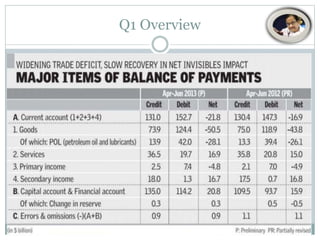
Q1 Overview
Impacts
 Loans from abroad, paid back with interest
 Continuous deficit will be looked upon harshly by the

international business and financial community – loans

from abroad would be rejected
 Downward pressure on currency
 Foreign firms ultimately fund more and more of domestic

investment, making the domestic economy vulnerable
Impacts
 Unemployment due to exit of foreign capital
 Country may be forced to raise interest rates to attract more

foreign investment and to keep a desired exchange rate
AMOUNT
(billion of dollars)

CAD 2007 & 2013
100
90
80
70
60
50
40
30
20
10
0

90

CAD

8
2007

2013
YEAR

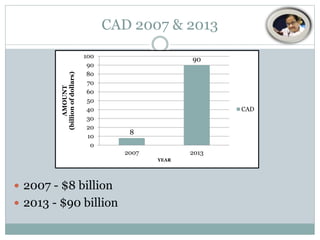
 2007 - $8 billion
 2013 - $90 billion
Steps taken by RBI
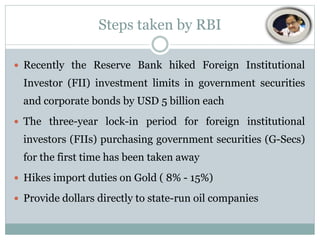
 Recently the Reserve Bank hiked Foreign Institutional

Investor (FII) investment limits in government securities
and corporate bonds by USD 5 billion each
 The three-year lock-in period for foreign institutional

investors (FIIs) purchasing government securities (G-Secs)
for the first time has been taken away
 Hikes import duties on Gold ( 8% - 15%)
 Provide dollars directly to state-run oil companies
Contd...
 Hiking repo rate to contain inflation
 The repo rate has been increased by 25 basis points

to 7.5% from 7.25%
 Cutting govt expenditures
 Restricting Indians from investing abroad
 Curb speculative trading
CAD of developing Countries
3
2
1
0
-1
-2
-3
-4
-5
-6
-7
-8

2.3

2.3

Russia
CAD

China

Mexico
brazil

-1.8

Indinesia
India
-4.1

South Africa

-4.1

Turkey

-5
-5.8
-6.6
What’s the SCENE???

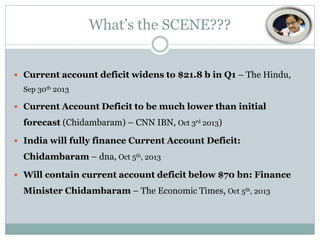
 Current account deficit widens to $21.8 b in Q1 – The Hindu,
Sep 30th 2013
 Current Account Deficit to be much lower than initial

forecast (Chidambaram) – CNN IBN, Oct 3rd 2013)
 India will fully finance Current Account Deficit:

Chidambaram – dna, Oct 5th, 2013
 Will contain current account deficit below $70 bn: Finance

Minister Chidambaram – The Economic Times, Oct 5th, 2013
Thank you

Current Account Deficit

  • 1.
  • 2.
    Intro...  The Currentaccount balance is part of the Balance of Payments (BOP)  BOP Measures all financial and economic transactions over a specified period of time  BOP = Current account + Capital account and must equal zero  CURRENT ACCOUNT DEFICIT = TOTAL IMPORTS – TOTAL EXPORTS (Current CAD – 22.8b, 4.9%)  (Where Total Imports > Total Exports)
  • 3.
    Implications of alarge Deficit  A net outflow of foreign exchange.  In India’s case, this means a dollar outgo. Such a deficit could drain the country’s forex reserves.  In layman terms, it means that India is a net debtor to the rest of the world  When capital flows are insufficient to meet the deficit, the country’s currency starts to depreciate and would be difficult to meet its international commitment or fund its current purchases.  A current account deficit in excess of 2.5% of GDP is seen as worrisome in case of India
  • 4.
    Causes  Gold imports- A sharp surge in gold imports in the December quarter of 2012 due to the Diwali festival and ahead of schedule gold imports on expectation of an impending import duty hike  India is the largest importer of gold.  Gold is its second biggest import item after oil and contributes around 10 per cent to the total import bill (345 tonnes in Q1, 20132014)  Mainly due to the rising disposable income
  • 5.
    Causes  A heftyoil bill – Petroleum products are the biggest contributor to India's import bill  India's current account deficit is likely to remain elevated reflecting the global new norm of high oil prices and weak exports  Coal production – Shortfall in domestic coal production has resulted in increased dependence on imports.  Hence reducing CAD through lowering oil and coal imports is not a feasible option
  • 6.
    Causes  Falling exports– India's trade deficit, or the excess of imports over exports, stood at $59.6 billion in the December quarter  Fall in FDI – FDI declined from $35.12b in 2011 to $22.42b in 2012 (38%)  India would require around $1 trillion in the next five years to overhaul its infrastructure sector such as ports, airports and highways to boost growth
  • 7.
  • 8.
    Impacts  Loans fromabroad, paid back with interest  Continuous deficit will be looked upon harshly by the international business and financial community – loans from abroad would be rejected  Downward pressure on currency  Foreign firms ultimately fund more and more of domestic investment, making the domestic economy vulnerable
  • 9.
    Impacts  Unemployment dueto exit of foreign capital  Country may be forced to raise interest rates to attract more foreign investment and to keep a desired exchange rate
  • 10.
    AMOUNT (billion of dollars) CAD2007 & 2013 100 90 80 70 60 50 40 30 20 10 0 90 CAD 8 2007 2013 YEAR  2007 - $8 billion  2013 - $90 billion
  • 11.
    Steps taken byRBI  Recently the Reserve Bank hiked Foreign Institutional Investor (FII) investment limits in government securities and corporate bonds by USD 5 billion each  The three-year lock-in period for foreign institutional investors (FIIs) purchasing government securities (G-Secs) for the first time has been taken away  Hikes import duties on Gold ( 8% - 15%)  Provide dollars directly to state-run oil companies
  • 12.
    Contd...  Hiking reporate to contain inflation  The repo rate has been increased by 25 basis points to 7.5% from 7.25%  Cutting govt expenditures  Restricting Indians from investing abroad  Curb speculative trading
  • 13.
    CAD of developingCountries 3 2 1 0 -1 -2 -3 -4 -5 -6 -7 -8 2.3 2.3 Russia CAD China Mexico brazil -1.8 Indinesia India -4.1 South Africa -4.1 Turkey -5 -5.8 -6.6
  • 14.
    What’s the SCENE??? Current account deficit widens to $21.8 b in Q1 – The Hindu, Sep 30th 2013  Current Account Deficit to be much lower than initial forecast (Chidambaram) – CNN IBN, Oct 3rd 2013)  India will fully finance Current Account Deficit: Chidambaram – dna, Oct 5th, 2013  Will contain current account deficit below $70 bn: Finance Minister Chidambaram – The Economic Times, Oct 5th, 2013
  • 15.