Summer school 2018
COMPASSIONATE USE
François Houÿez
128/06/2018
2 2
3
Compassionate use is a response for patients with the
most urgent need for a new option
New drug being
developed
New drug
authorised
But whenever a
compassionate use
programme starts,
there will always be
patients for whom it
will be too late.
Compassionate
use
4
Batten disease
NCL2 = neuronal ceroid lipofuscinosis type 2
NCL 2 is a debilitating and life-threatening disease that usually leads to death
between the ages of 8 and 12
28/06/2018 4
5
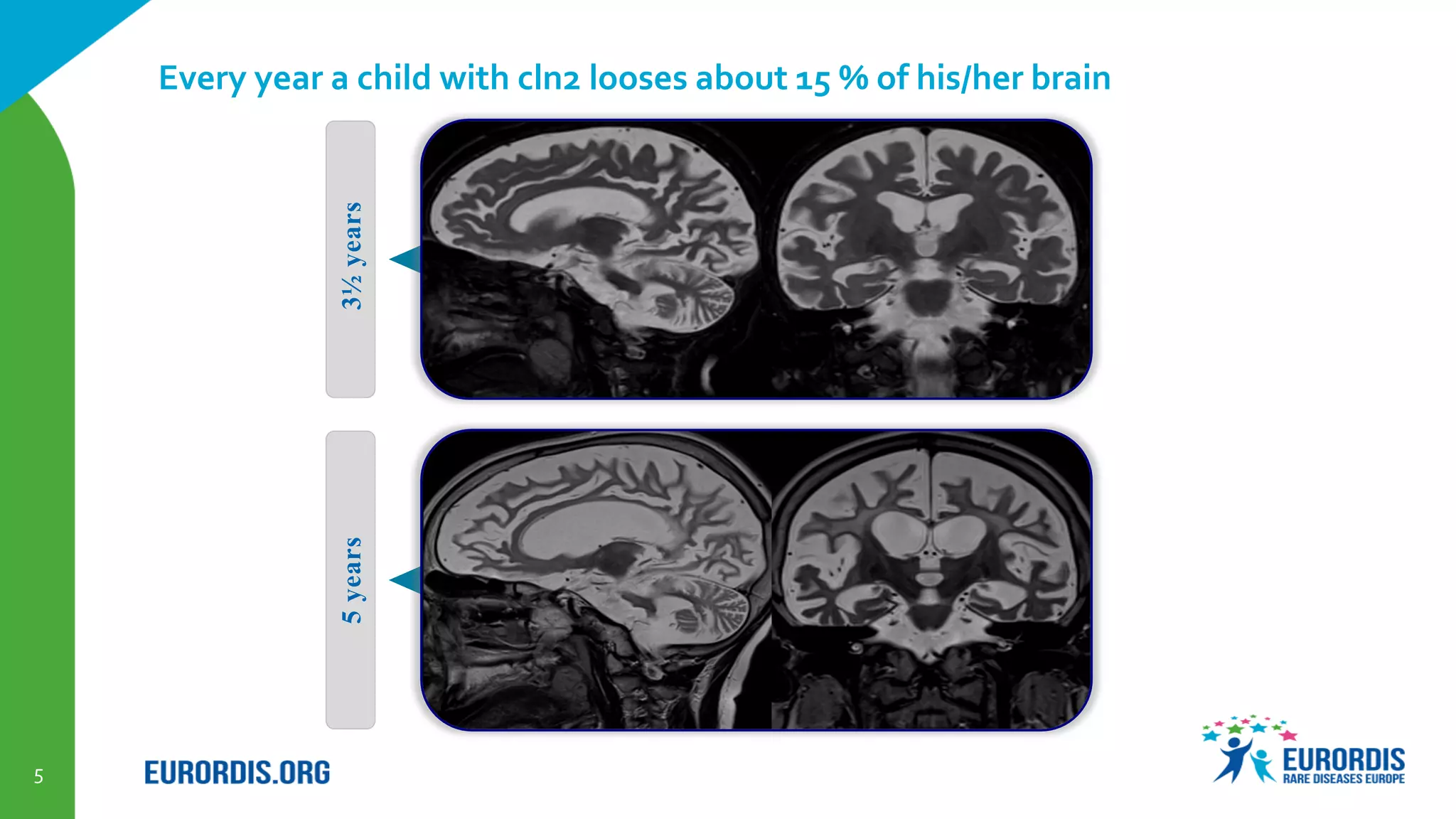
Every year a child with cln2 looses about 15 % of his/her brain
3½years5years
Natural History of CLN2 Disease
Rapidly evolving: a child can walk, 6 months later he can’t. Same for speech, and
all other functions. Symptoms usually begin between 2 and 4 years of age
Rate of decline
2.1 units/year (SD±1.0)
Nr. 6
7
Prevalence (SOP, EMA) (12/03/2013): 15,000
On its web site, BioMarin estimated the number of children ranging from 1,200
to 1,600 in their “commercial territories” (Biomarin, 2016)
28/06/2018 7
• But in its annual report year 2014, BioMarin
estimated that 400-600 cases exist worldwide
“BioMarin is expecting 500 Mio$
revenues per year with BMN 190”
Cost per patient
300 k$ to 1 Mio$/year/pt
If 15,000: 33,000 $/pt/y
8
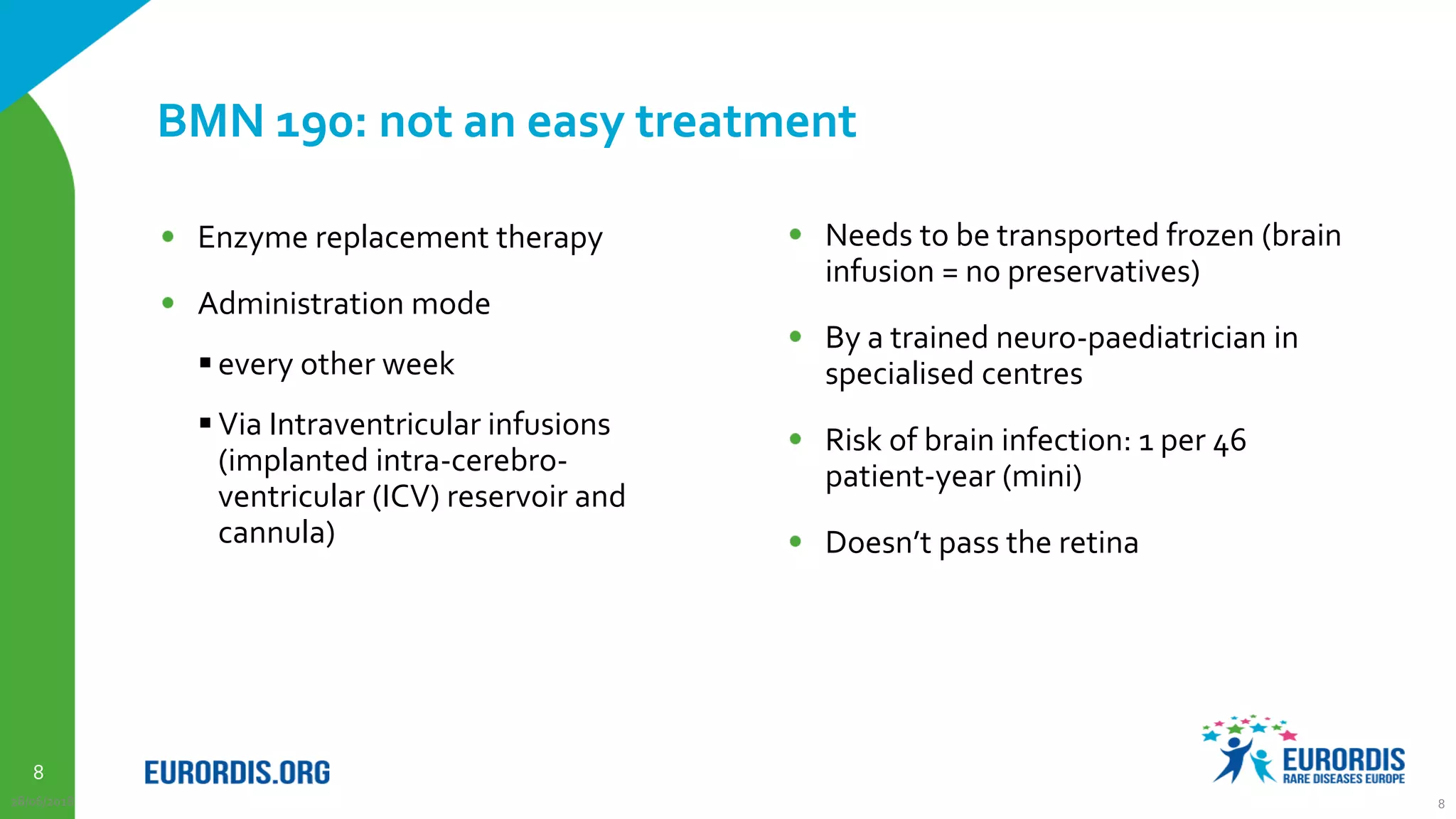
BMN 190: not an easy treatment
Enzyme replacement therapy
Administration mode
 every other week
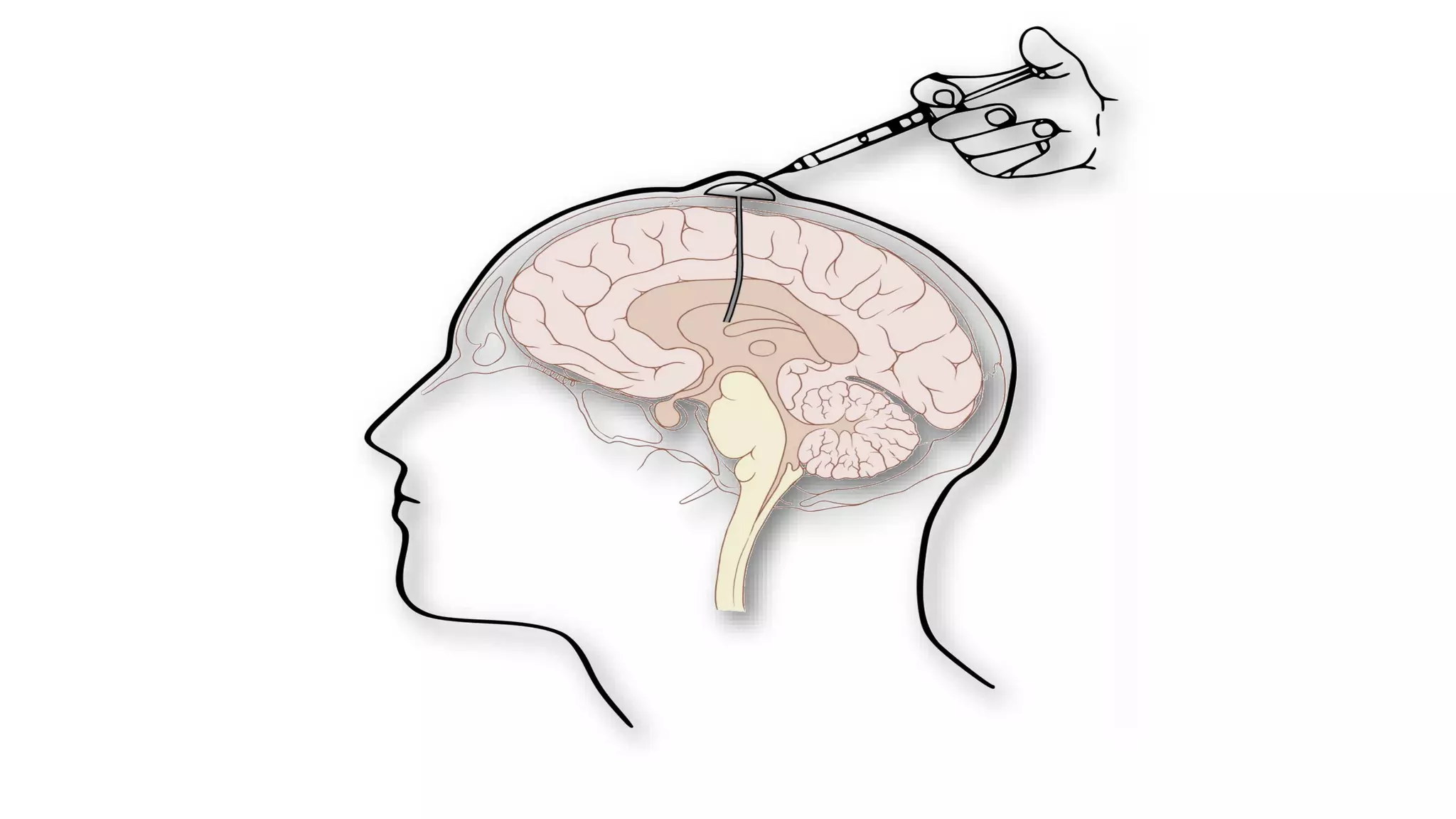
 Via Intraventricular infusions
(implanted intra-cerebro-
ventricular (ICV) reservoir and
cannula)
28/06/2018 8
Needs to be transported frozen (brain
infusion = no preservatives)
By a trained neuro-paediatrician in
specialised centres
Risk of brain infection: 1 per 46
patient-year (mini)
Doesn’t pass the retina
10 10
11
An active company in RD
28/06/2018 11
(1) Morquio disease or Mucopolysaccharidosis type IV ORPHA582
(2) Maroteaux-Lamy disease or Mucopolysaccharidosis typeVI ORPHA583
(3) Phenylalanine hydroxylase deficiency ORPHA716
(4) Mercks-Serono markets Kuvan in the EU. Court case in progress against generic manufacturer
(5) Agreement with Genzyme Corporation
(6) Hurler syndrome Mucopolysaccharidosis type I ORPHA579
(7) Lambert-Eaton myasthenic syndrome ORPHA43393
12
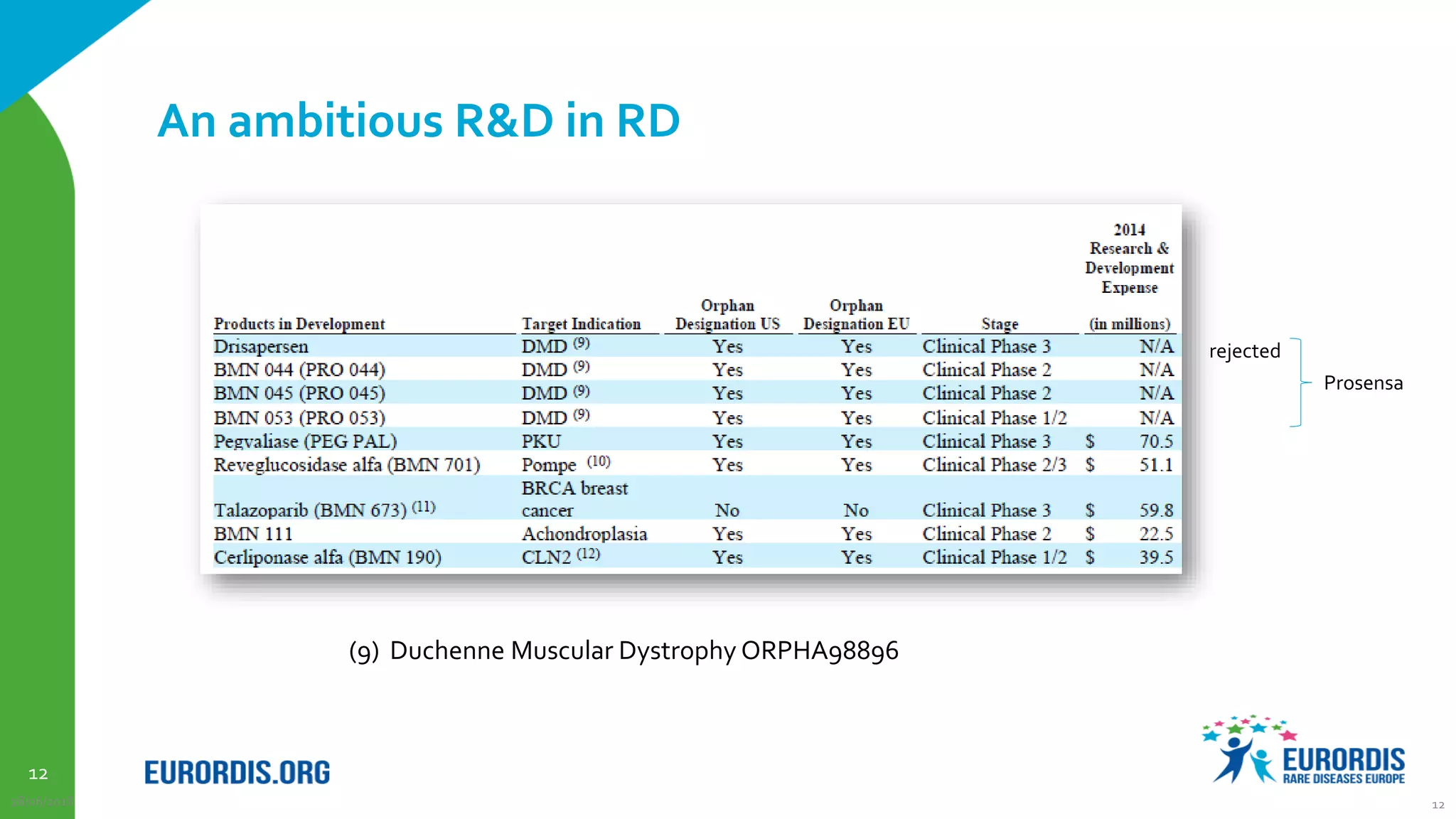
An ambitious R&D in RD
28/06/2018 12
(9) Duchenne Muscular Dystrophy ORPHA98896
rejected
Prosensa
13
28/06/2018 13
Figure 1: BioMarin's Pipeline as of January 2016
14 14
15
Timelines
28/06/2018 15
08/2013
Phase 1/2 n=24
> 2 years
Extension n=23
> 4 years
Phase 2 n=5
12 January 2015: Press release based on first 9
patients, 6/9 stabilised
Dose escalating
Open label trial
Historical controls
2015: Parents campaign
for CUP
Meeting @
Eurordis 02/2016
Final results
public
MAA submission
2Q-3Q2016?
If positive feedback at day 80: BMN 190
shipped for CUP
16
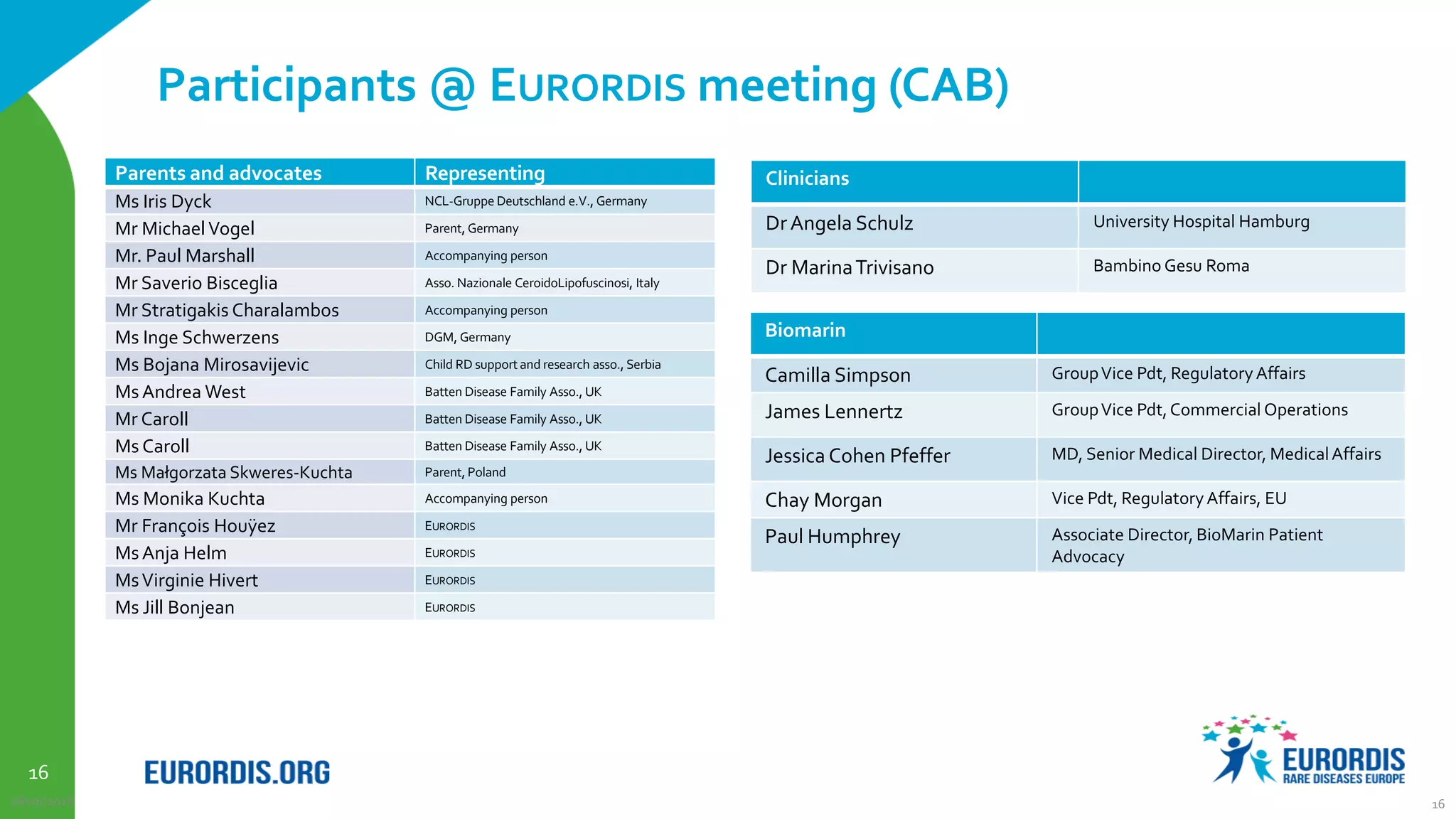
Participants @ EURORDIS meeting (CAB)
Parents and advocates Representing
Ms Iris Dyck NCL-Gruppe Deutschland e.V., Germany
Mr MichaelVogel Parent, Germany
Mr. Paul Marshall Accompanying person
Mr Saverio Bisceglia Asso. Nazionale CeroidoLipofuscinosi, Italy
Mr Stratigakis Charalambos Accompanying person
Ms Inge Schwerzens DGM, Germany
Ms Bojana Mirosavijevic Child RD support and research asso., Serbia
Ms Andrea West Batten Disease Family Asso., UK
Mr Caroll Batten Disease Family Asso., UK
Ms Caroll Batten Disease Family Asso., UK
Ms Małgorzata Skweres-Kuchta Parent, Poland
Ms Monika Kuchta Accompanying person
Mr François Houÿez EURORDIS
Ms Anja Helm EURORDIS
MsVirginie Hivert EURORDIS
Ms Jill Bonjean EURORDIS
28/06/2018 16
Biomarin
Camilla Simpson GroupVice Pdt, RegulatoryAffairs
James Lennertz GroupVice Pdt,Commercial Operations
Jessica Cohen Pfeffer MD, Senior Medical Director, MedicalAffairs
Chay Morgan Vice Pdt, RegulatoryAffairs, EU
Paul Humphrey Associate Director, BioMarin Patient
Advocacy
Clinicians
DrAngela Schulz University Hospital Hamburg
Dr MarinaTrivisano Bambino Gesu Roma
17
BioMarin regulatory approach
Submission of a marketing authorisation application to EMA
 2Q or 3Q 2016 (between May-September 2016)
 With results from the 201 trial (23 patients only)
 With accelerated review (150 not 210 days)
 For a full approval
In parallel: start arrangements for CUPs in Ger, Ita, UK and USA
 But will ship product only if positive feedback from regulators (day 80, August-
December 2016)
 In theory they could ship it at anytime, independently from regulators’ feedback
28/06/2018 17
18
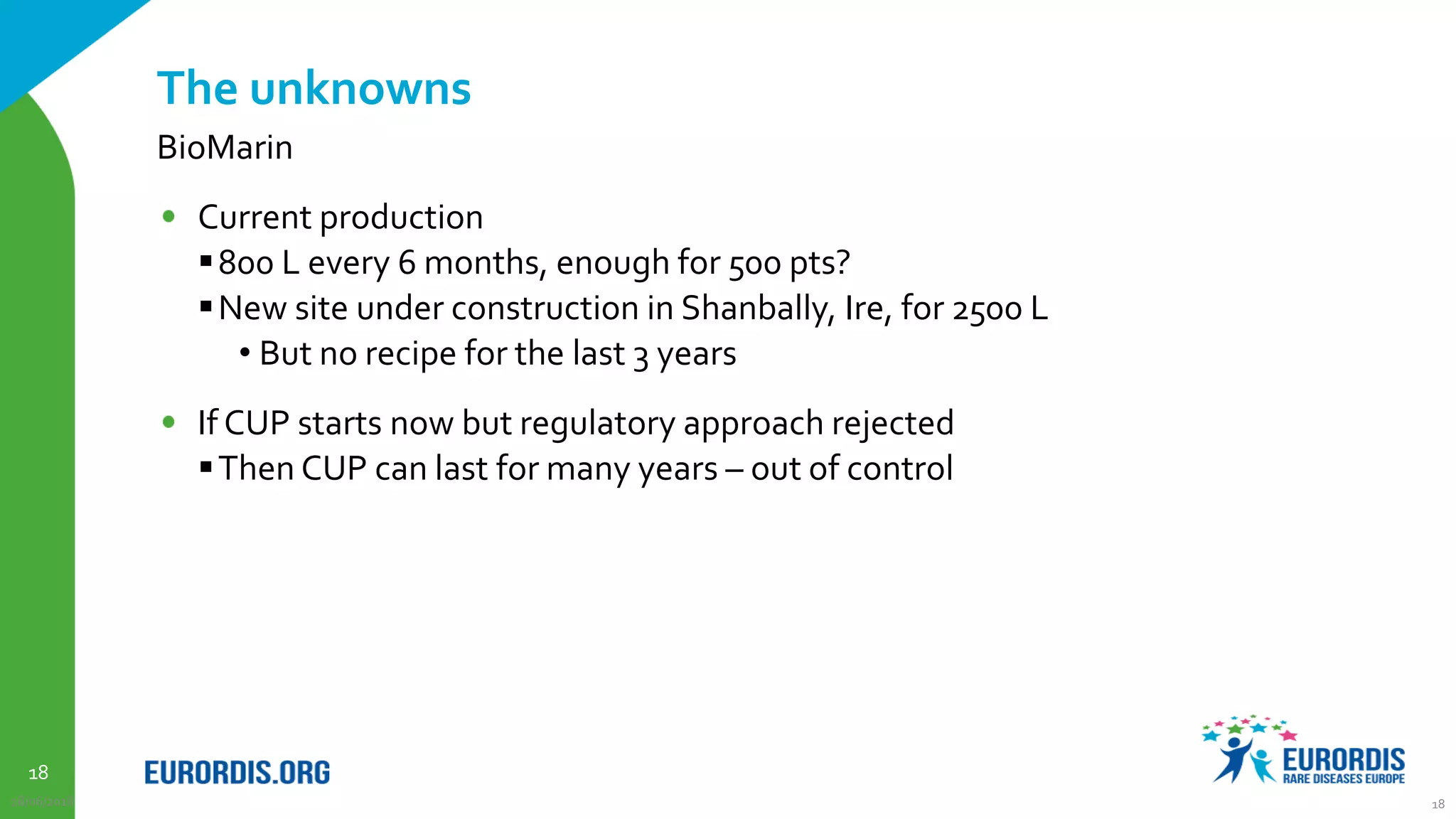
The unknowns
BioMarin
Current production
800 L every 6 months, enough for 500 pts?
New site under construction in Shanbally, Ire, for 2500 L
• But no recipe for the last 3 years
If CUP starts now but regulatory approach rejected
Then CUP can last for many years – out of control
28/06/2018 18
19
What happened next?
Submission of application, official EMA evaluation for Brineura started 05/2016
08/2016 CU started in Germany and the first child was treated in 9/2016
nearly same strict inclusion criteria than in the first study
-> still no chance for more progressed children,
these had to wait – at least – one more year until approval
only 5 children in CU at each study site in Europe
30/05/2017 Approval in EU
19
20 20
21
REGULATION (EC) Nº 726/2004 art. 83.2
Running a CompassionateUse Programme (CUP) consists in
making a medicinal product available for compassionate reasons
to a group of patients with a chronically or seriously debilitating
disease or whose disease is considered to be life-threatening, and
who cannot be treated satisfactorily by an authorised medicinal
product.
The medicinal product concerned must either be the subject of an
application for a marketing authorisation or must be undergoing
clinical trials.
22
characteristics
Efficacy only presumed
Risks/toxicity profile not yet determined
Named basis programme
Or cohort programme
Protocol (run by developer)
Data collection
Data can be submitted in the file for marketing authorisation
Free of charge or paid for
23
28/06/2018 23
0 6 12 18 24 30 36 42 48 54 60 66 72 78 84 90 96 102 108 114 120 126 132 140 148 156 164 172
Time (months)
CUP initiation is a matter of manufacturing capacity, proof of concept and willingness
pilot production Validated Commercial batches Distance to market
Lab research
Animal testing
FIM studies
Proof of concept trials
Confirmatory
trials
Go / No go
CUP?
24
Hell is in the details
Germany
CUP to be initiated by the
company, not by clinicians
CUP must be for free
CUP must use commercial
batches of highest quality
Unclear who pays for other
expenses (surgery…)
28/06/2018 24
France
CUP can be on doctor’s request
CUP can be free of charge or paid
for
CUP can use pilot batches
Healthcare system pays for all
related expenses
25
A.T.U and orphan drugs
Afssaps, annual report 2009
72% of authorised orphan drugs receivedATU*
status
In average 34 months before authorisation
*Temporary Use Authorisation
25
26
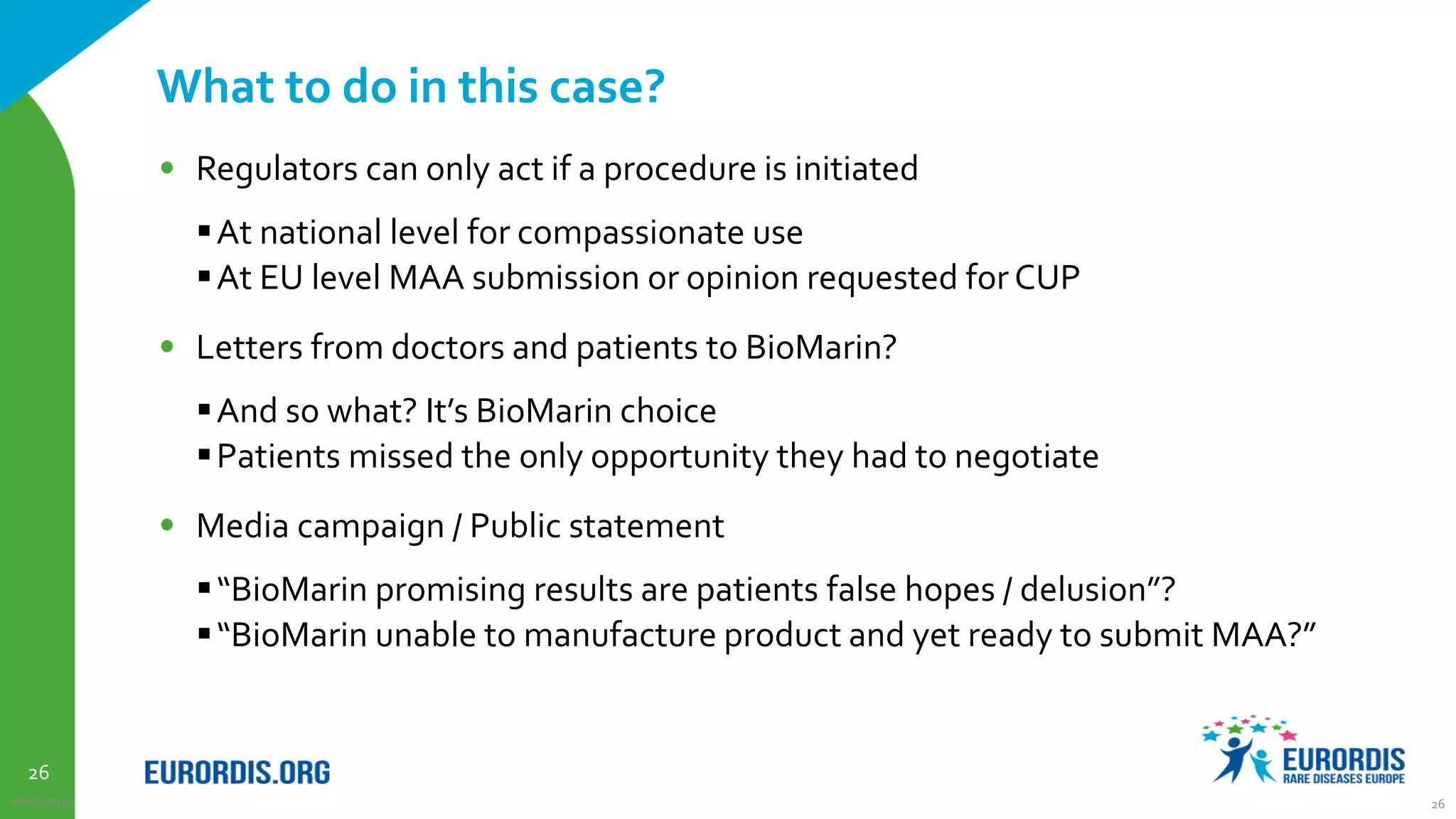
What to do in this case?
Regulators can only act if a procedure is initiated
At national level for compassionate use
At EU level MAA submission or opinion requested for CUP
Letters from doctors and patients to BioMarin?
And so what? It’s BioMarin choice
Patients missed the only opportunity they had to negotiate
Media campaign / Public statement
“BioMarin promising results are patients false hopes / delusion”?
“BioMarin unable to manufacture product and yet ready to submit MAA?”
28/06/2018 26
27
What can EURORDIS do in general?
Explain members what they can do and when
EURORDIS Position on CUP
Adopted by MB March 2017
Sent to all national competent authorities in the EU
Presented at STAMP on 27 / 06
EURORDIS resources: http://www.eurordis.org/content/links-national-
authorities-websites
And also: Eurordis webinar about the A.T.U and why it is the best regulatory
scheme for compassionate use
• Recorded, ask for it
28/06/2018 27
28
What EURORDIS recommends to industry
Discuss relevance and timing of CUP with patients’ advocates and doctors
early in the development of a medicine
Define inclusion criteria for the compassionate use with patients and
doctors
Explain the plans for the initiation of a CUP country by country
Accept information on CUPs cannot be confidential
Collect information from the CUP, in particular toxicity data and special
populations;
28/06/2018 28
29
And avoid
Interrupting the programme in an abrupt manner in the eventuality of a
negative CHMP opinion on MA
 rather discuss the programme-end modalities with patients, doctors and regulators
Stop providing the product to patients until the price and reimbursement
decision
 new inclusions can be closed during that phase
Presenting the programme to clinicians as a gift to high inclusion rates in
clinical trials
Mixing CUPs with humanitarian or financial support programmes
28/06/2018 29
Thank you!

Cup case study

  • 1.
    Summer school 2018 COMPASSIONATEUSE François Houÿez 128/06/2018
  • 2.
  • 3.
    3 Compassionate use isa response for patients with the most urgent need for a new option New drug being developed New drug authorised But whenever a compassionate use programme starts, there will always be patients for whom it will be too late. Compassionate use
  • 4.
    4 Batten disease NCL2 =neuronal ceroid lipofuscinosis type 2 NCL 2 is a debilitating and life-threatening disease that usually leads to death between the ages of 8 and 12 28/06/2018 4
  • 5.
    5 Every year achild with cln2 looses about 15 % of his/her brain 3½years5years
  • 6.
    Natural History ofCLN2 Disease Rapidly evolving: a child can walk, 6 months later he can’t. Same for speech, and all other functions. Symptoms usually begin between 2 and 4 years of age Rate of decline 2.1 units/year (SD±1.0) Nr. 6
  • 7.
    7 Prevalence (SOP, EMA)(12/03/2013): 15,000 On its web site, BioMarin estimated the number of children ranging from 1,200 to 1,600 in their “commercial territories” (Biomarin, 2016) 28/06/2018 7 • But in its annual report year 2014, BioMarin estimated that 400-600 cases exist worldwide “BioMarin is expecting 500 Mio$ revenues per year with BMN 190” Cost per patient 300 k$ to 1 Mio$/year/pt If 15,000: 33,000 $/pt/y
  • 8.
    8 BMN 190: notan easy treatment Enzyme replacement therapy Administration mode  every other week  Via Intraventricular infusions (implanted intra-cerebro- ventricular (ICV) reservoir and cannula) 28/06/2018 8 Needs to be transported frozen (brain infusion = no preservatives) By a trained neuro-paediatrician in specialised centres Risk of brain infection: 1 per 46 patient-year (mini) Doesn’t pass the retina
  • 10.
  • 11.
    11 An active companyin RD 28/06/2018 11 (1) Morquio disease or Mucopolysaccharidosis type IV ORPHA582 (2) Maroteaux-Lamy disease or Mucopolysaccharidosis typeVI ORPHA583 (3) Phenylalanine hydroxylase deficiency ORPHA716 (4) Mercks-Serono markets Kuvan in the EU. Court case in progress against generic manufacturer (5) Agreement with Genzyme Corporation (6) Hurler syndrome Mucopolysaccharidosis type I ORPHA579 (7) Lambert-Eaton myasthenic syndrome ORPHA43393
  • 12.
    12 An ambitious R&Din RD 28/06/2018 12 (9) Duchenne Muscular Dystrophy ORPHA98896 rejected Prosensa
  • 13.
    13 28/06/2018 13 Figure 1:BioMarin's Pipeline as of January 2016
  • 14.
  • 15.
    15 Timelines 28/06/2018 15 08/2013 Phase 1/2n=24 > 2 years Extension n=23 > 4 years Phase 2 n=5 12 January 2015: Press release based on first 9 patients, 6/9 stabilised Dose escalating Open label trial Historical controls 2015: Parents campaign for CUP Meeting @ Eurordis 02/2016 Final results public MAA submission 2Q-3Q2016? If positive feedback at day 80: BMN 190 shipped for CUP
  • 16.
    16 Participants @ EURORDISmeeting (CAB) Parents and advocates Representing Ms Iris Dyck NCL-Gruppe Deutschland e.V., Germany Mr MichaelVogel Parent, Germany Mr. Paul Marshall Accompanying person Mr Saverio Bisceglia Asso. Nazionale CeroidoLipofuscinosi, Italy Mr Stratigakis Charalambos Accompanying person Ms Inge Schwerzens DGM, Germany Ms Bojana Mirosavijevic Child RD support and research asso., Serbia Ms Andrea West Batten Disease Family Asso., UK Mr Caroll Batten Disease Family Asso., UK Ms Caroll Batten Disease Family Asso., UK Ms Małgorzata Skweres-Kuchta Parent, Poland Ms Monika Kuchta Accompanying person Mr François Houÿez EURORDIS Ms Anja Helm EURORDIS MsVirginie Hivert EURORDIS Ms Jill Bonjean EURORDIS 28/06/2018 16 Biomarin Camilla Simpson GroupVice Pdt, RegulatoryAffairs James Lennertz GroupVice Pdt,Commercial Operations Jessica Cohen Pfeffer MD, Senior Medical Director, MedicalAffairs Chay Morgan Vice Pdt, RegulatoryAffairs, EU Paul Humphrey Associate Director, BioMarin Patient Advocacy Clinicians DrAngela Schulz University Hospital Hamburg Dr MarinaTrivisano Bambino Gesu Roma
  • 17.
    17 BioMarin regulatory approach Submissionof a marketing authorisation application to EMA  2Q or 3Q 2016 (between May-September 2016)  With results from the 201 trial (23 patients only)  With accelerated review (150 not 210 days)  For a full approval In parallel: start arrangements for CUPs in Ger, Ita, UK and USA  But will ship product only if positive feedback from regulators (day 80, August- December 2016)  In theory they could ship it at anytime, independently from regulators’ feedback 28/06/2018 17
  • 18.
    18 The unknowns BioMarin Current production 800L every 6 months, enough for 500 pts? New site under construction in Shanbally, Ire, for 2500 L • But no recipe for the last 3 years If CUP starts now but regulatory approach rejected Then CUP can last for many years – out of control 28/06/2018 18
  • 19.
    19 What happened next? Submissionof application, official EMA evaluation for Brineura started 05/2016 08/2016 CU started in Germany and the first child was treated in 9/2016 nearly same strict inclusion criteria than in the first study -> still no chance for more progressed children, these had to wait – at least – one more year until approval only 5 children in CU at each study site in Europe 30/05/2017 Approval in EU 19
  • 20.
  • 21.
    21 REGULATION (EC) Nº726/2004 art. 83.2 Running a CompassionateUse Programme (CUP) consists in making a medicinal product available for compassionate reasons to a group of patients with a chronically or seriously debilitating disease or whose disease is considered to be life-threatening, and who cannot be treated satisfactorily by an authorised medicinal product. The medicinal product concerned must either be the subject of an application for a marketing authorisation or must be undergoing clinical trials.
  • 22.
    22 characteristics Efficacy only presumed Risks/toxicityprofile not yet determined Named basis programme Or cohort programme Protocol (run by developer) Data collection Data can be submitted in the file for marketing authorisation Free of charge or paid for
  • 23.
    23 28/06/2018 23 0 612 18 24 30 36 42 48 54 60 66 72 78 84 90 96 102 108 114 120 126 132 140 148 156 164 172 Time (months) CUP initiation is a matter of manufacturing capacity, proof of concept and willingness pilot production Validated Commercial batches Distance to market Lab research Animal testing FIM studies Proof of concept trials Confirmatory trials Go / No go CUP?
  • 24.
    24 Hell is inthe details Germany CUP to be initiated by the company, not by clinicians CUP must be for free CUP must use commercial batches of highest quality Unclear who pays for other expenses (surgery…) 28/06/2018 24 France CUP can be on doctor’s request CUP can be free of charge or paid for CUP can use pilot batches Healthcare system pays for all related expenses
  • 25.
    25 A.T.U and orphandrugs Afssaps, annual report 2009 72% of authorised orphan drugs receivedATU* status In average 34 months before authorisation *Temporary Use Authorisation 25
  • 26.
    26 What to doin this case? Regulators can only act if a procedure is initiated At national level for compassionate use At EU level MAA submission or opinion requested for CUP Letters from doctors and patients to BioMarin? And so what? It’s BioMarin choice Patients missed the only opportunity they had to negotiate Media campaign / Public statement “BioMarin promising results are patients false hopes / delusion”? “BioMarin unable to manufacture product and yet ready to submit MAA?” 28/06/2018 26
  • 27.
    27 What can EURORDISdo in general? Explain members what they can do and when EURORDIS Position on CUP Adopted by MB March 2017 Sent to all national competent authorities in the EU Presented at STAMP on 27 / 06 EURORDIS resources: http://www.eurordis.org/content/links-national- authorities-websites And also: Eurordis webinar about the A.T.U and why it is the best regulatory scheme for compassionate use • Recorded, ask for it 28/06/2018 27
  • 28.
    28 What EURORDIS recommendsto industry Discuss relevance and timing of CUP with patients’ advocates and doctors early in the development of a medicine Define inclusion criteria for the compassionate use with patients and doctors Explain the plans for the initiation of a CUP country by country Accept information on CUPs cannot be confidential Collect information from the CUP, in particular toxicity data and special populations; 28/06/2018 28
  • 29.
    29 And avoid Interrupting theprogramme in an abrupt manner in the eventuality of a negative CHMP opinion on MA  rather discuss the programme-end modalities with patients, doctors and regulators Stop providing the product to patients until the price and reimbursement decision  new inclusions can be closed during that phase Presenting the programme to clinicians as a gift to high inclusion rates in clinical trials Mixing CUPs with humanitarian or financial support programmes 28/06/2018 29
  • 30.