A Brief Introduction
• Sindh is one of the five provinces of Pakistan
• Though Muslims form the largest religious group in
Sindh, large numbers of Christians, Zoroastrians and
Hindus can also be found
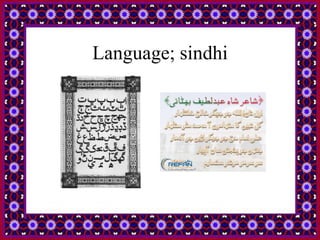
• The main language of Sindh is Sindhi
• The province is associated with the Indus civilization
• The name is derived from the Indus River; the ancient
Iranians in Sanskrit as Sarasvati, to Assyrians as Sinda,
and to the Pashtuns as "Abasind".
• Most Sindhi are engaged in irrigation agriculture
• Sindh's principal crops are wheat, rice, cotton, oilseeds,
sugarcane, and fruits
• The attributes associate with people living in Sindh,
Sindhi people, are peaceful, hardworking, hospitable,
open-minded community.
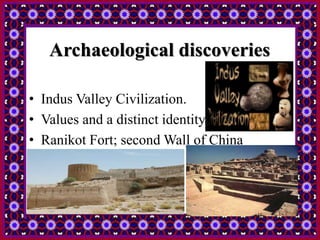
Archaeological discoveries
• Indus Valley Civilization.
• Values and a distinct identity
• Ranikot Fort; second Wall of China
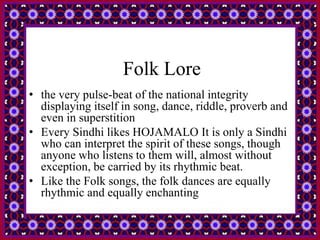
Folk Lore
• the very pulse-beat of the national integrity
displaying itself in song, dance, riddle, proverb and
even in superstition
• Every Sindhi likes HOJAMALO It is only a Sindhi
who can interpret the spirit of these songs, though
anyone who listens to them will, almost without
exception, be carried by its rhythmic beat.
• Like the Folk songs, the folk dances are equally
rhythmic and equally enchanting
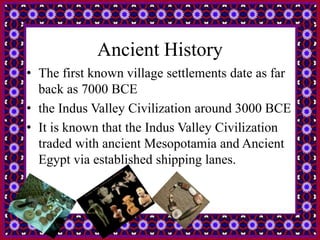
Ancient History
• The first known village settlements date as far
back as 7000 BCE
• the Indus Valley Civilization around 3000 BCE
• It is known that the Indus Valley Civilization
traded with ancient Mesopotamia and Ancient
Egypt via established shipping lanes.
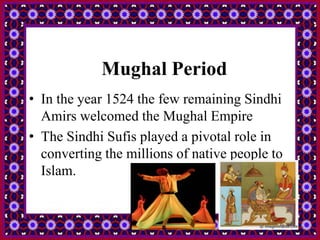
Mughal Period
• In the year 1524 the few remaining Sindhi
Amirs welcomed the Mughal Empire
• The Sindhi Sufis played a pivotal role in
converting the millions of native people to
Islam.
Modern History after
independence of Pakistan
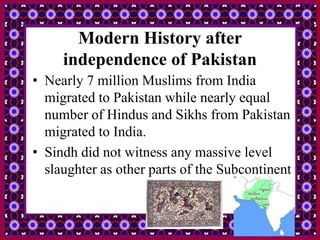
• Nearly 7 million Muslims from India
migrated to Pakistan while nearly equal
number of Hindus and Sikhs from Pakistan
migrated to India.
• Sindh did not witness any massive level
slaughter as other parts of the Subcontinent
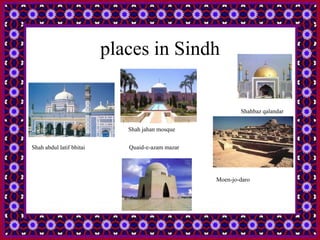
places in Sindh
Shah abdul latif bhitai
Shahbaz qalandar
Shah jahan mosque
Moen-jo-daro
Quaid-e-azam mazar
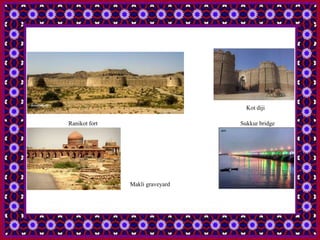
Ranikot fort Sukkur bridge
Makli graveyard
Kot diji
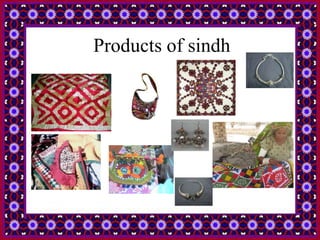
Products of sindh
Language; sindhi
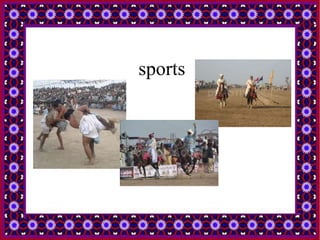
sports
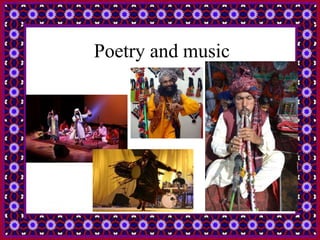
Poetry and music
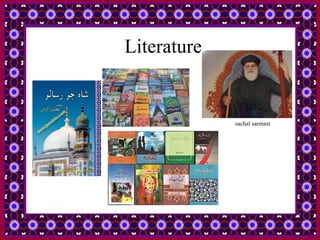
Literature
sachal sarmast
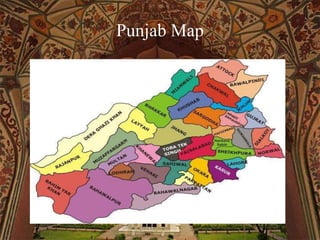
Punjab Map
Introduction
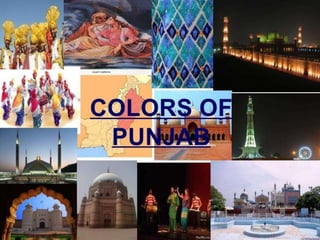
• Punjab (the land of five rivers) is the biggest land area of
Pakistan and is popularly known for its culture.According to
population, 56% of the total population of the country is situated
in Punjab Province. It has a total of 36 districts and contributes
approximately 50-60 % of the economy.
• Punjabi Culture is one of the oldest in world history, dating
from ancient antiquity to the modern era. The scope, history,
complexity and density of the culture are vast. Some of the main
areas of the Punjabi culture include: Languages, Cuisine,
Dresses, Sports, Dance & Music, Festivals, Arts & Craft,
Punjabi Weddings, Fields and Rivers.
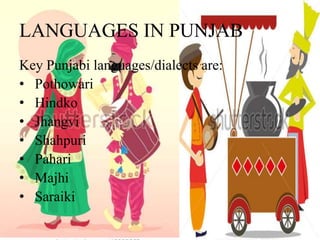
LANGUAGES IN PUNJAB
Key Punjabi languages/dialects are:
• Pothowari
• Hindko
• Jhangvi
• Shahpuri
• Pahari
• Majhi
• Saraiki
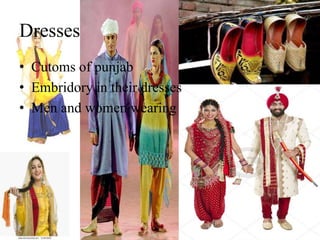
Dresses
• Cutoms of punjab
• Embridory in their dresses
• Men and women wearing
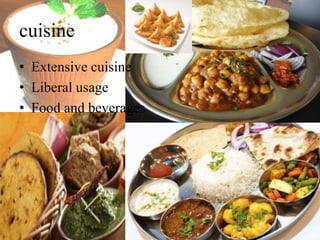
cuisine
• Extensive cuisine
• Liberal usage
• Food and beverages
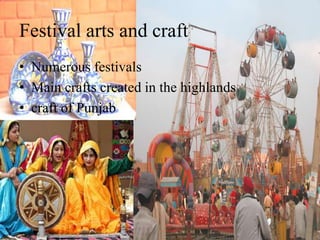
Festival arts and craft
• Numerous festivals
• Main crafts created in the highlands
• craft of Punjab
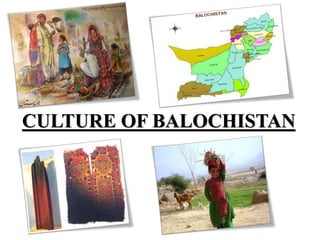
CULTURE OF BALOCHISTAN
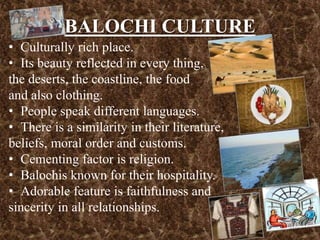
BALOCHI CULTURE
• Culturally rich place.
• Its beauty reflected in every thing,
the deserts, the coastline, the food
and also clothing.
• People speak different languages.
• There is a similarity in their literature,
beliefs, moral order and customs.
• Cementing factor is religion.
• Balochis known for their hospitality.
• Adorable feature is faithfulness and
sincerity in all relationships.
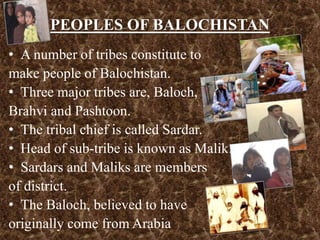
PEOPLES OF BALOCHISTAN
• A number of tribes constitute to
make people of Balochistan.
• Three major tribes are, Baloch,
Brahvi and Pashtoon.
• The tribal chief is called Sardar.
• Head of sub-tribe is known as Malik.
• Sardars and Maliks are members
of district.
• The Baloch, believed to have
originally come from Arabia
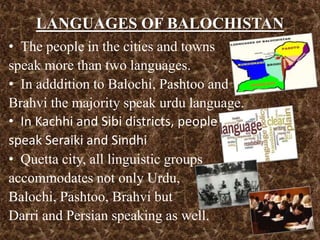
LANGUAGES OF BALOCHISTAN
• The people in the cities and towns
speak more than two languages.
• In adddition to Balochi, Pashtoo and
Brahvi the majority speak urdu language.
• In Kachhi and Sibi districts, people
speak Seraiki and Sindhi
• Quetta city, all linguistic groups
accommodates not only Urdu,
Balochi, Pashtoo, Brahvi but
Darri and Persian speaking as well.
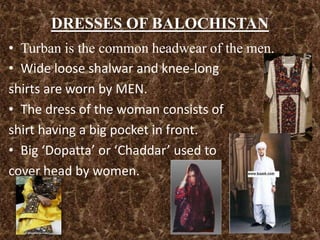
DRESSES OF BALOCHISTAN
• Turban is the common headwear of the men.
• Wide loose shalwar and knee-long
shirts are worn by MEN.
• The dress of the woman consists of
shirt having a big pocket in front.
• Big ‘Dopatta’ or ‘Chaddar’ used to
cover head by women.
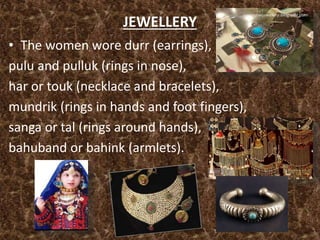
JEWELLERY
• The women wore durr (earrings),
pulu and pulluk (rings in nose),
har or touk (necklace and bracelets),
mundrik (rings in hands and foot fingers),
sanga or tal (rings around hands),
bahuband or bahink (armlets).
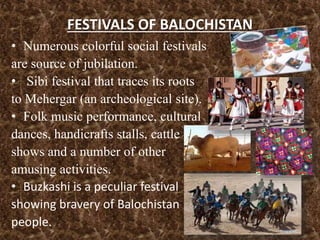
FESTIVALS OF BALOCHISTAN
• Numerous colorful social festivals
are source of jubilation.
• Sibi festival that traces its roots
to Mehergar (an archeological site).
• Folk music performance, cultural
dances, handicrafts stalls, cattle
shows and a number of other
amusing activities.
• Buzkashi is a peculiar festival
showing bravery of Balochistan
people.
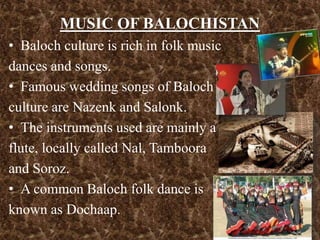
MUSIC OF BALOCHISTAN
• Baloch culture is rich in folk music
dances and songs.
• Famous wedding songs of Baloch
culture are Nazenk and Salonk.
• The instruments used are mainly a
flute, locally called Nal, Tamboora
and Soroz.
• A common Baloch folk dance is
known as Dochaap.
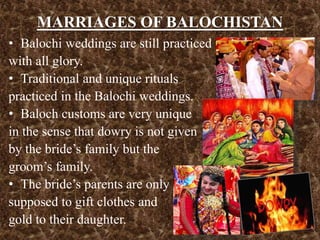
MARRIAGES OF BALOCHISTAN
• Balochi weddings are still practiced
with all glory.
• Traditional and unique rituals
practiced in the Balochi weddings.
• Baloch customs are very unique
in the sense that dowry is not given
by the bride’s family but the
groom’s family.
• The bride’s parents are only
supposed to gift clothes and
gold to their daughter.
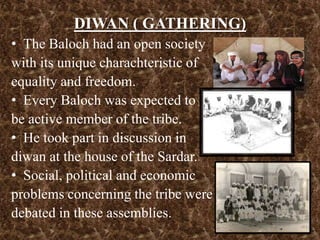
DIWAN ( GATHERING)
• The Baloch had an open society
with its unique charachteristic of
equality and freedom.
• Every Baloch was expected to
be active member of the tribe.
• He took part in discussion in
diwan at the house of the Sardar.
• Social, political and economic
problems concerning the tribe were
debated in these assemblies.

CulturePakistan

  • 3.
    A Brief Introduction •Sindh is one of the five provinces of Pakistan • Though Muslims form the largest religious group in Sindh, large numbers of Christians, Zoroastrians and Hindus can also be found • The main language of Sindh is Sindhi • The province is associated with the Indus civilization
  • 4.
    • The nameis derived from the Indus River; the ancient Iranians in Sanskrit as Sarasvati, to Assyrians as Sinda, and to the Pashtuns as "Abasind". • Most Sindhi are engaged in irrigation agriculture • Sindh's principal crops are wheat, rice, cotton, oilseeds, sugarcane, and fruits • The attributes associate with people living in Sindh, Sindhi people, are peaceful, hardworking, hospitable, open-minded community.
  • 5.
    Archaeological discoveries • IndusValley Civilization. • Values and a distinct identity • Ranikot Fort; second Wall of China
  • 6.
    Folk Lore • thevery pulse-beat of the national integrity displaying itself in song, dance, riddle, proverb and even in superstition • Every Sindhi likes HOJAMALO It is only a Sindhi who can interpret the spirit of these songs, though anyone who listens to them will, almost without exception, be carried by its rhythmic beat. • Like the Folk songs, the folk dances are equally rhythmic and equally enchanting
  • 7.
    Ancient History • Thefirst known village settlements date as far back as 7000 BCE • the Indus Valley Civilization around 3000 BCE • It is known that the Indus Valley Civilization traded with ancient Mesopotamia and Ancient Egypt via established shipping lanes.
  • 8.
    Mughal Period • Inthe year 1524 the few remaining Sindhi Amirs welcomed the Mughal Empire • The Sindhi Sufis played a pivotal role in converting the millions of native people to Islam.
  • 9.
    Modern History after independenceof Pakistan • Nearly 7 million Muslims from India migrated to Pakistan while nearly equal number of Hindus and Sikhs from Pakistan migrated to India. • Sindh did not witness any massive level slaughter as other parts of the Subcontinent
  • 10.
    places in Sindh Shahabdul latif bhitai Shahbaz qalandar Shah jahan mosque Moen-jo-daro Quaid-e-azam mazar
  • 11.
    Ranikot fort Sukkurbridge Makli graveyard Kot diji
  • 12.
  • 13.
  • 14.
  • 15.
  • 16.
  • 18.
  • 19.
    Introduction • Punjab (theland of five rivers) is the biggest land area of Pakistan and is popularly known for its culture.According to population, 56% of the total population of the country is situated in Punjab Province. It has a total of 36 districts and contributes approximately 50-60 % of the economy. • Punjabi Culture is one of the oldest in world history, dating from ancient antiquity to the modern era. The scope, history, complexity and density of the culture are vast. Some of the main areas of the Punjabi culture include: Languages, Cuisine, Dresses, Sports, Dance & Music, Festivals, Arts & Craft, Punjabi Weddings, Fields and Rivers.
  • 20.
    LANGUAGES IN PUNJAB KeyPunjabi languages/dialects are: • Pothowari • Hindko • Jhangvi • Shahpuri • Pahari • Majhi • Saraiki
  • 21.
    Dresses • Cutoms ofpunjab • Embridory in their dresses • Men and women wearing
  • 22.
    cuisine • Extensive cuisine •Liberal usage • Food and beverages
  • 23.
    Festival arts andcraft • Numerous festivals • Main crafts created in the highlands • craft of Punjab
  • 24.
  • 25.
    BALOCHI CULTURE • Culturallyrich place. • Its beauty reflected in every thing, the deserts, the coastline, the food and also clothing. • People speak different languages. • There is a similarity in their literature, beliefs, moral order and customs. • Cementing factor is religion. • Balochis known for their hospitality. • Adorable feature is faithfulness and sincerity in all relationships.
  • 26.
    PEOPLES OF BALOCHISTAN •A number of tribes constitute to make people of Balochistan. • Three major tribes are, Baloch, Brahvi and Pashtoon. • The tribal chief is called Sardar. • Head of sub-tribe is known as Malik. • Sardars and Maliks are members of district. • The Baloch, believed to have originally come from Arabia
  • 27.
    LANGUAGES OF BALOCHISTAN •The people in the cities and towns speak more than two languages. • In adddition to Balochi, Pashtoo and Brahvi the majority speak urdu language. • In Kachhi and Sibi districts, people speak Seraiki and Sindhi • Quetta city, all linguistic groups accommodates not only Urdu, Balochi, Pashtoo, Brahvi but Darri and Persian speaking as well.
  • 28.
    DRESSES OF BALOCHISTAN •Turban is the common headwear of the men. • Wide loose shalwar and knee-long shirts are worn by MEN. • The dress of the woman consists of shirt having a big pocket in front. • Big ‘Dopatta’ or ‘Chaddar’ used to cover head by women.
  • 29.
    JEWELLERY • The womenwore durr (earrings), pulu and pulluk (rings in nose), har or touk (necklace and bracelets), mundrik (rings in hands and foot fingers), sanga or tal (rings around hands), bahuband or bahink (armlets).
  • 30.
    FESTIVALS OF BALOCHISTAN •Numerous colorful social festivals are source of jubilation. • Sibi festival that traces its roots to Mehergar (an archeological site). • Folk music performance, cultural dances, handicrafts stalls, cattle shows and a number of other amusing activities. • Buzkashi is a peculiar festival showing bravery of Balochistan people.
  • 31.
    MUSIC OF BALOCHISTAN •Baloch culture is rich in folk music dances and songs. • Famous wedding songs of Baloch culture are Nazenk and Salonk. • The instruments used are mainly a flute, locally called Nal, Tamboora and Soroz. • A common Baloch folk dance is known as Dochaap.
  • 32.
    MARRIAGES OF BALOCHISTAN •Balochi weddings are still practiced with all glory. • Traditional and unique rituals practiced in the Balochi weddings. • Baloch customs are very unique in the sense that dowry is not given by the bride’s family but the groom’s family. • The bride’s parents are only supposed to gift clothes and gold to their daughter.
  • 33.
    DIWAN ( GATHERING) •The Baloch had an open society with its unique charachteristic of equality and freedom. • Every Baloch was expected to be active member of the tribe. • He took part in discussion in diwan at the house of the Sardar. • Social, political and economic problems concerning the tribe were debated in these assemblies.