Culture Shock
Press the right arrow button to continue reading.
A Brief Background
Culture Shock
First Usage
Cora DuBois (1951):
[Culture shock is] “a disorienting feeling” felt when going to new cultures
Culture Shock
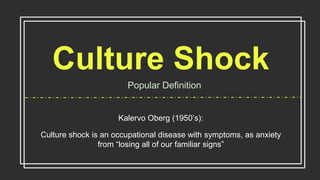
Popular Definition
Kalervo Oberg (1950’s):
Culture shock is an occupational disease with symptoms, as anxiety
from “losing all of our familiar signs”
Culture Shock
Recent Decades
David Hoopes and Gary Althen (1971):
Culture shock is “the way in which the individual reconfirms his or her
own identity in the face of new […] learning.”
Culture Shock
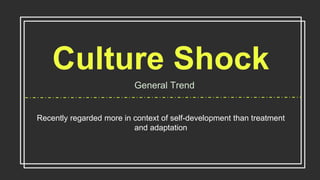
General Trend
Recently regarded more in context of self-development than treatment
and adaptation
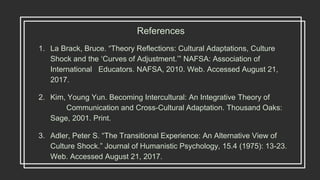
1. La Brack, Bruce. “Theory Reflections: Cultural Adaptations, Culture
Shock and the ‘Curves of Adjustment.’” NAFSA: Association of
International Educators. NAFSA, 2010. Web. Accessed August 21,
2017.
2. Kim, Young Yun. Becoming Intercultural: An Integrative Theory of
Communication and Cross-Cultural Adaptation. Thousand Oaks:
Sage, 2001. Print.
3. Adler, Peter S. “The Transitional Experience: An Alternative View of
Culture Shock.” Journal of Humanistic Psychology, 15.4 (1975): 13-23.
Web. Accessed August 21, 2017.
References

Culture Shock

  • 1.
    Culture Shock Press theright arrow button to continue reading. A Brief Background
  • 2.
    Culture Shock First Usage CoraDuBois (1951): [Culture shock is] “a disorienting feeling” felt when going to new cultures
  • 3.
    Culture Shock Popular Definition KalervoOberg (1950’s): Culture shock is an occupational disease with symptoms, as anxiety from “losing all of our familiar signs”
  • 4.
    Culture Shock Recent Decades DavidHoopes and Gary Althen (1971): Culture shock is “the way in which the individual reconfirms his or her own identity in the face of new […] learning.”
  • 5.
    Culture Shock General Trend Recentlyregarded more in context of self-development than treatment and adaptation
  • 6.
    1. La Brack,Bruce. “Theory Reflections: Cultural Adaptations, Culture Shock and the ‘Curves of Adjustment.’” NAFSA: Association of International Educators. NAFSA, 2010. Web. Accessed August 21, 2017. 2. Kim, Young Yun. Becoming Intercultural: An Integrative Theory of Communication and Cross-Cultural Adaptation. Thousand Oaks: Sage, 2001. Print. 3. Adler, Peter S. “The Transitional Experience: An Alternative View of Culture Shock.” Journal of Humanistic Psychology, 15.4 (1975): 13-23. Web. Accessed August 21, 2017. References