At the end of the lesson the students
are expected to:
1. explain concepts of culture and society and
relate it to a real-life situation;
2. show deep appreciation on the collaboration
between our culture and society by means of
stating personal pledge;
3. trace terms that are related to the study of
culture and the society, and give examples of
such concepts
CULTURE and
SOCIETY as a
COMPLEX
WHOLE
EDWARD TYLOR- one of
the founders of modern
anthropology, characterize
culture as a “complex
whole” which
encompasses beliefs,
practices, traits, values,
attitudes, laws, norms,
artifacts, symbols,
knowledge and everything
that a person learns and
shares as a member of the
society.
SOCIETY
-refers to group of people that follows or
shares same cultures.
PEOPLE
-refer to group of people that follows or shares
same cultures as members of the society,
possess, produce and also transmit culture but
they cannot consider themselves as culture.
1. Culture is social
because it is the
product of behavior.
-Culture does not exist
in isolation. It develops
through social
interaction.
CHARACTERISTICS of
CULTURE
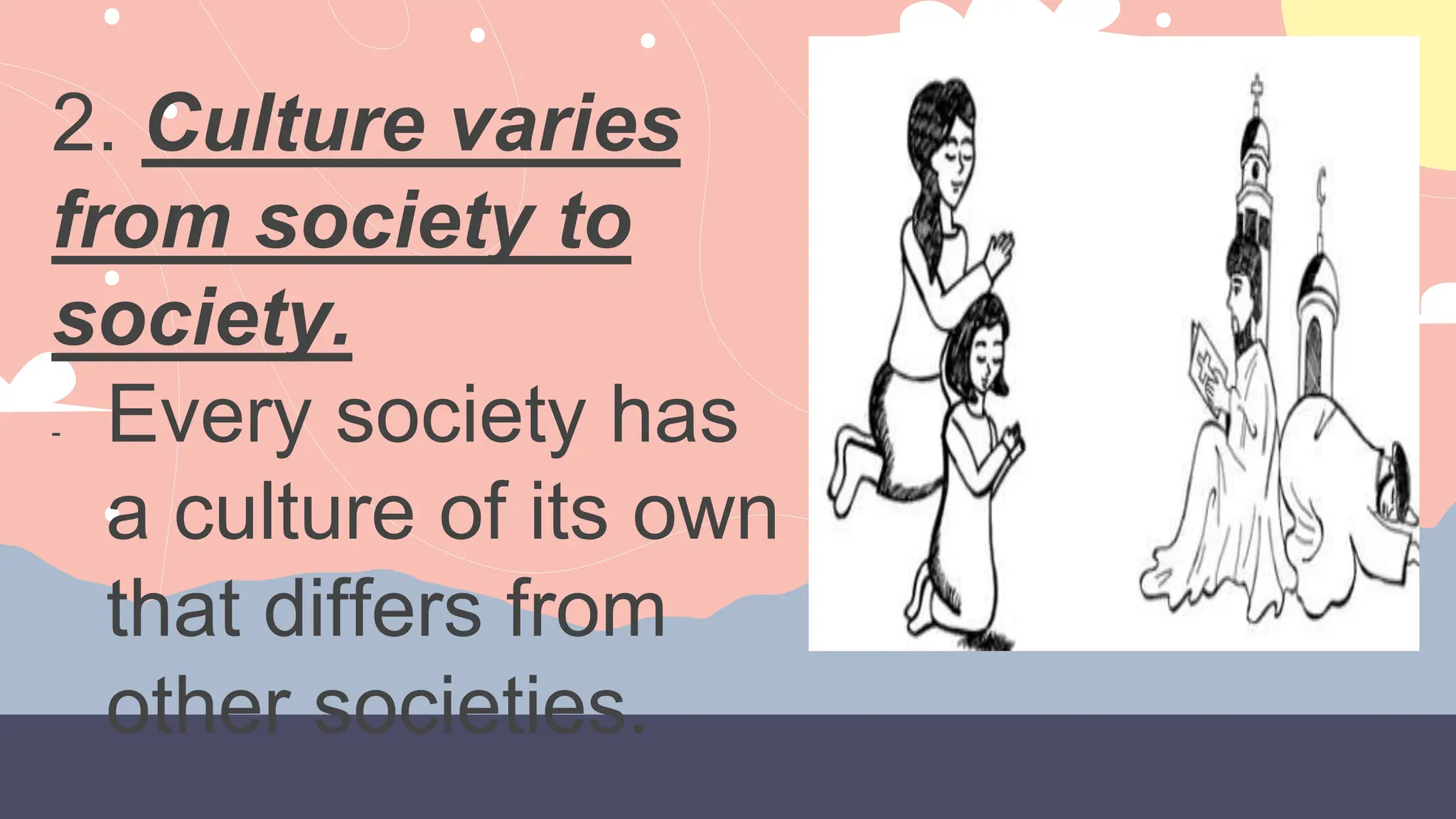
2. Culture varies
from society to
society.
- Every society has
a culture of its own
that differs from
other societies.
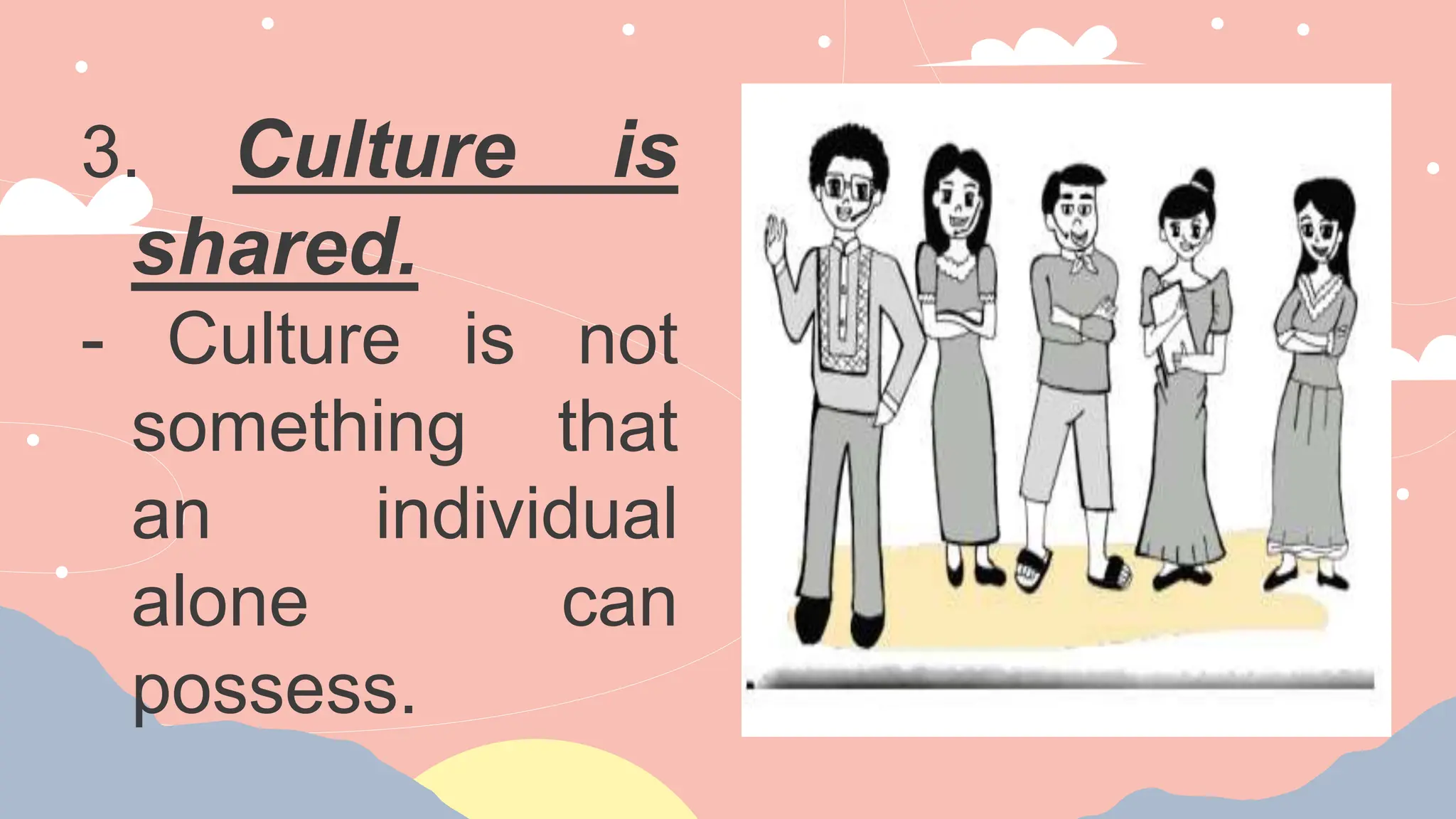
3. Culture is
shared.
- Culture is not
something that
an individual
alone can
possess.
4. Culture is
learned.
-Culture is not
inborn. It is
learned.
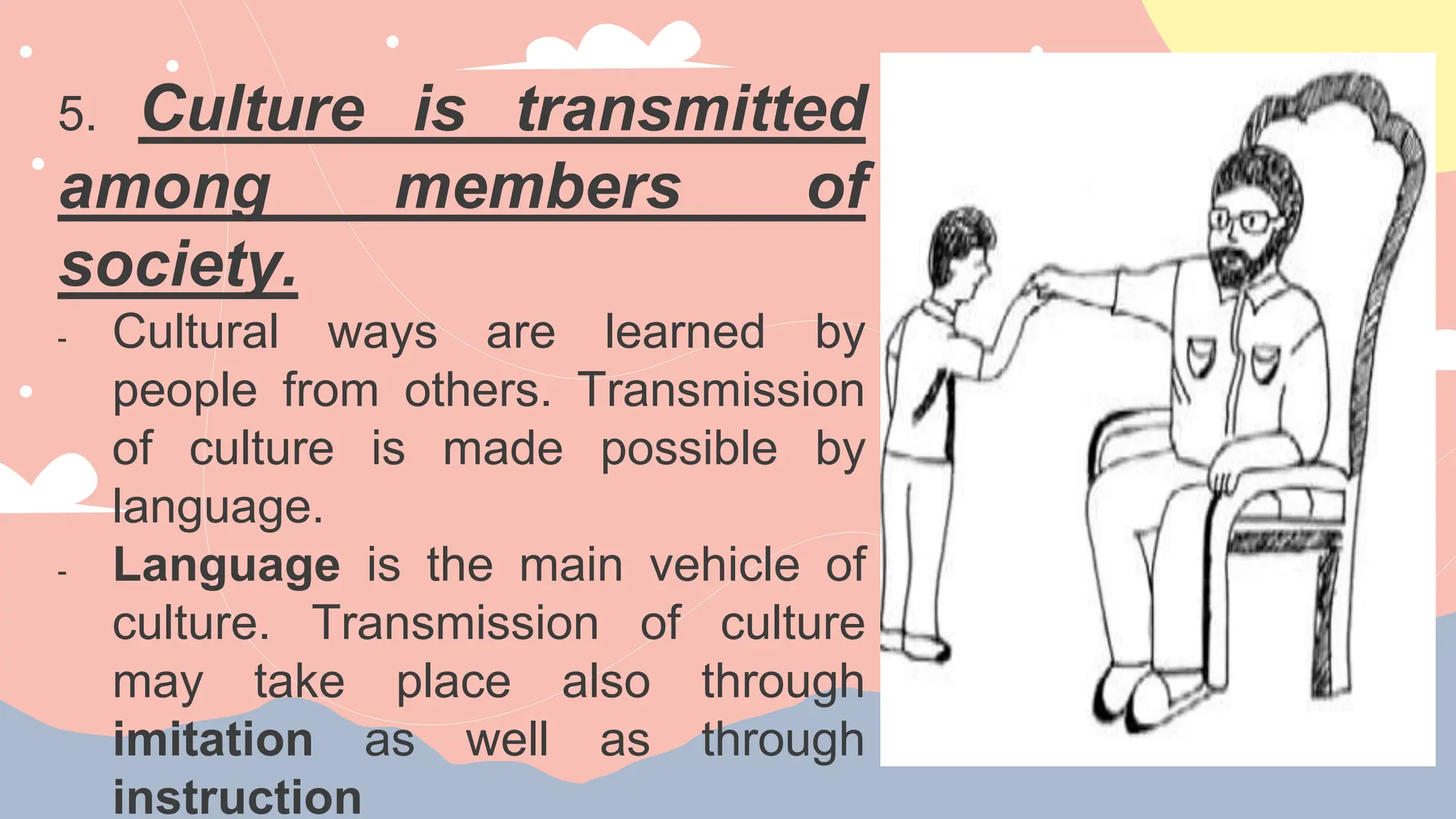
5. Culture is transmitted
among members of
society.
- Cultural ways are learned by
people from others. Transmission
of culture is made possible by
language.
- Language is the main vehicle of
culture. Transmission of culture
may take place also through
imitation as well as through
instruction
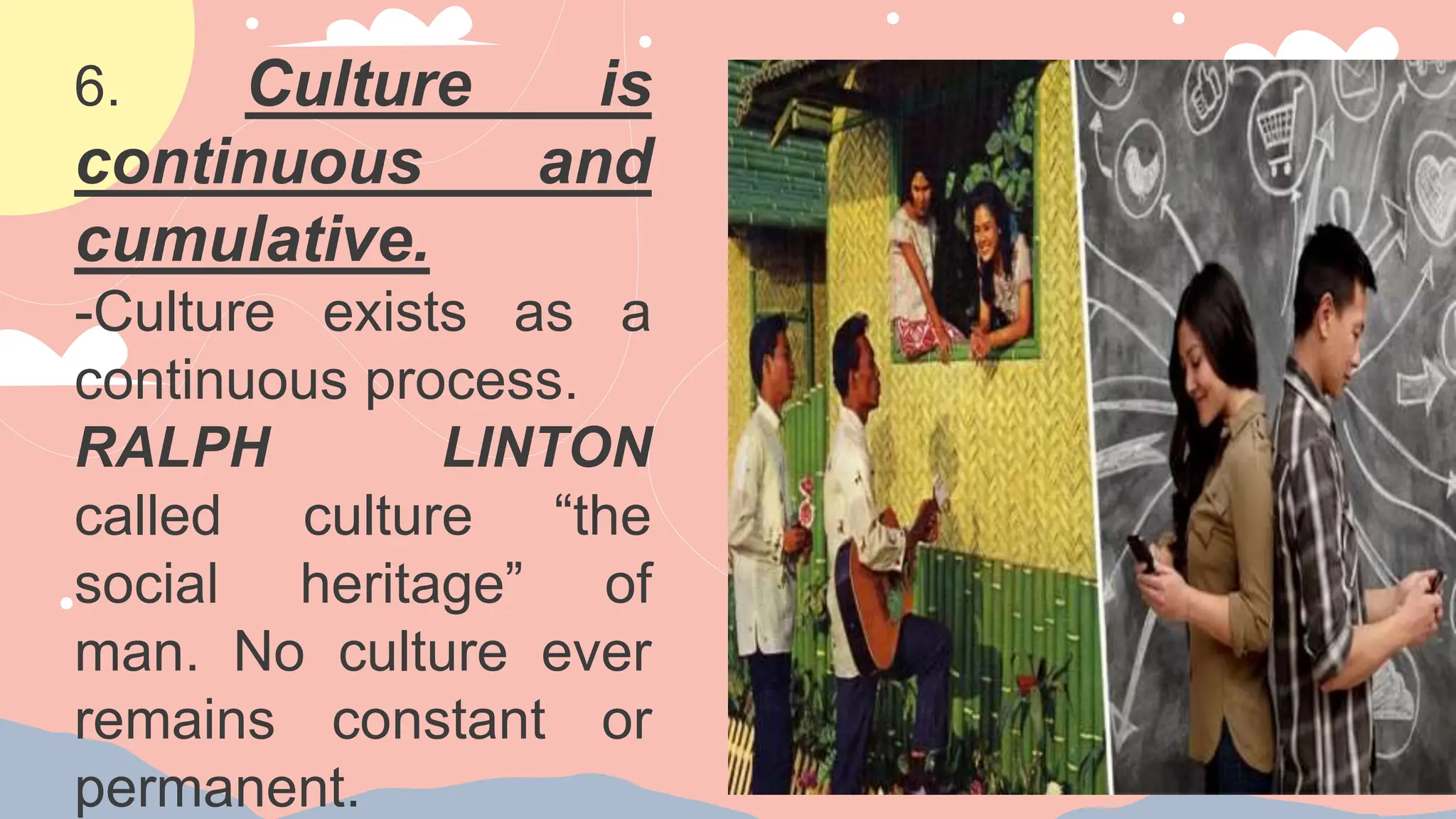
6. Culture is
continuous and
cumulative.
-Culture exists as a
continuous process.
RALPH LINTON
called culture “the
social heritage” of
man. No culture ever
remains constant or
permanent.
7. Culture is
gratifying and
idealistic.
- Culture provides
proper opportunities
for the satisfaction
of our needs and
desires.
1. How do you define the terms “culture” and
“society”? You can cite some instances?
2. Can a society function without culture, or can
a culture exist without society?
Why?
3. What are the different characteristics of
culture?
4. How can these characteristics of culture help
us in appreciating our culture
& society?
LEARNED
SOCIAL
VARIETY
SHARED
GRATIFYING
CONTINUOUS
TRANSMITTED
, “A nation’s culture resides
in the heart and in the
soul of its people”
MAHATMA GANDHI once
said,
Activity 6 #comicstrips (p.13)
Directions: Read the
following items
carefully. Write the letter
that corresponds to your
answer on a separate
sheet of paper.
1. 2. Maharlika is a young woman of Agta tribe. She is excellent
in performing their ethnic dance. According to her, the elders in
their tribe transferred the steps of the dance to her. What
characteristic or aspect of culture is being referred to by this
experience?
a. Culture is learned. c. Culture is continuous.
b. Culture is shared. d. Culture is transmitted.
2. Mang Isko and Aling Perla used to have a family devotion
(prayer) every Saturday. They demonstrate and explain to their
children the reason for having deep faith to God. What aspect of
culture is best suitable for this situation?
a. Culture is shared. c. Culture is transmitted.
b. Culture is social. d. Culture is learned.
3. The following are all considered as means of transmitting
culture among members of the society. Which one is the main
vehicle of passing culture from one generation to another
generation?
a. Instruction c. Language
b. Imitation d. Symbols
4. Pinoys are fond of singing and listening to music. Before,
people used to do sing-a-long with a jukebox, then it was
changed to karaoke, and now, most people sing their favorite
songs in videoke. Their ways of enjoying music has gone through
changes but still lives up until today. Therefore, culture is ______.
a. learned c. continuous
b. shared d. transmitted
5. It refers to group of people that
follows or shares same cultures.
6. -refer to group of people that follows
or shares same cultures as members
of the society, possess, produce and
also transmit culture but they cannot
consider themselves as culture.
8. EDWARD TYLOR- one of
the founders of modern
anthropology, characterize
culture as
a_____________________
9-10. Characteristics of
Culture
REFLECTION
MY PLEDGE
Make your own pledge by
stating your deep
appreciation of the
collaboration between our
culture and society as
means of developing
harmonious relationship
among people in the
society.

CULTURE and SOCIETY as a COMPLEX WHOLE (W4).pptx

  • 1.
    At the endof the lesson the students are expected to: 1. explain concepts of culture and society and relate it to a real-life situation; 2. show deep appreciation on the collaboration between our culture and society by means of stating personal pledge; 3. trace terms that are related to the study of culture and the society, and give examples of such concepts
  • 3.
    CULTURE and SOCIETY asa COMPLEX WHOLE
  • 4.
    EDWARD TYLOR- oneof the founders of modern anthropology, characterize culture as a “complex whole” which encompasses beliefs, practices, traits, values, attitudes, laws, norms, artifacts, symbols, knowledge and everything that a person learns and shares as a member of the society.
  • 5.
    SOCIETY -refers to groupof people that follows or shares same cultures. PEOPLE -refer to group of people that follows or shares same cultures as members of the society, possess, produce and also transmit culture but they cannot consider themselves as culture.
  • 6.
    1. Culture issocial because it is the product of behavior. -Culture does not exist in isolation. It develops through social interaction. CHARACTERISTICS of CULTURE
  • 7.
    2. Culture varies fromsociety to society. - Every society has a culture of its own that differs from other societies.
  • 8.
    3. Culture is shared. -Culture is not something that an individual alone can possess.
  • 9.
    4. Culture is learned. -Cultureis not inborn. It is learned.
  • 10.
    5. Culture istransmitted among members of society. - Cultural ways are learned by people from others. Transmission of culture is made possible by language. - Language is the main vehicle of culture. Transmission of culture may take place also through imitation as well as through instruction
  • 11.
    6. Culture is continuousand cumulative. -Culture exists as a continuous process. RALPH LINTON called culture “the social heritage” of man. No culture ever remains constant or permanent.
  • 12.
    7. Culture is gratifyingand idealistic. - Culture provides proper opportunities for the satisfaction of our needs and desires.
  • 13.
    1. How doyou define the terms “culture” and “society”? You can cite some instances? 2. Can a society function without culture, or can a culture exist without society? Why? 3. What are the different characteristics of culture? 4. How can these characteristics of culture help us in appreciating our culture & society?
  • 14.
  • 15.
  • 16.
  • 17.
  • 18.
  • 19.
  • 20.
  • 22.
    , “A nation’sculture resides in the heart and in the soul of its people” MAHATMA GANDHI once said,
  • 23.
  • 24.
    Directions: Read the followingitems carefully. Write the letter that corresponds to your answer on a separate sheet of paper.
  • 25.
    1. 2. Maharlikais a young woman of Agta tribe. She is excellent in performing their ethnic dance. According to her, the elders in their tribe transferred the steps of the dance to her. What characteristic or aspect of culture is being referred to by this experience? a. Culture is learned. c. Culture is continuous. b. Culture is shared. d. Culture is transmitted. 2. Mang Isko and Aling Perla used to have a family devotion (prayer) every Saturday. They demonstrate and explain to their children the reason for having deep faith to God. What aspect of culture is best suitable for this situation? a. Culture is shared. c. Culture is transmitted. b. Culture is social. d. Culture is learned.
  • 26.
    3. The followingare all considered as means of transmitting culture among members of the society. Which one is the main vehicle of passing culture from one generation to another generation? a. Instruction c. Language b. Imitation d. Symbols 4. Pinoys are fond of singing and listening to music. Before, people used to do sing-a-long with a jukebox, then it was changed to karaoke, and now, most people sing their favorite songs in videoke. Their ways of enjoying music has gone through changes but still lives up until today. Therefore, culture is ______. a. learned c. continuous b. shared d. transmitted
  • 27.
    5. It refersto group of people that follows or shares same cultures. 6. -refer to group of people that follows or shares same cultures as members of the society, possess, produce and also transmit culture but they cannot consider themselves as culture.
  • 28.
    8. EDWARD TYLOR-one of the founders of modern anthropology, characterize culture as a_____________________ 9-10. Characteristics of Culture
  • 29.
    REFLECTION MY PLEDGE Make yourown pledge by stating your deep appreciation of the collaboration between our culture and society as means of developing harmonious relationship among people in the society.