Culturally responsive
training: Why and how?
Anne Fox
Anne Fox ApS
Map
 Explore meaning of culturally
responsive teaching (CRT)
 Present a couple of the main tools used
in CRT
 Suggest some benefits of CRT for
intercultural trainers
annefox.eu
Culturally Responsive
Teaching
Making a diverse group of
people feel comfortable,
welcome and valued
Culturally Responsive
Teaching
Not about intercultural
training
Culturally Responsive
Teaching
Focus on instructor
Culturally Responsive
Teaching
Could we refer to culturally
responsive training?
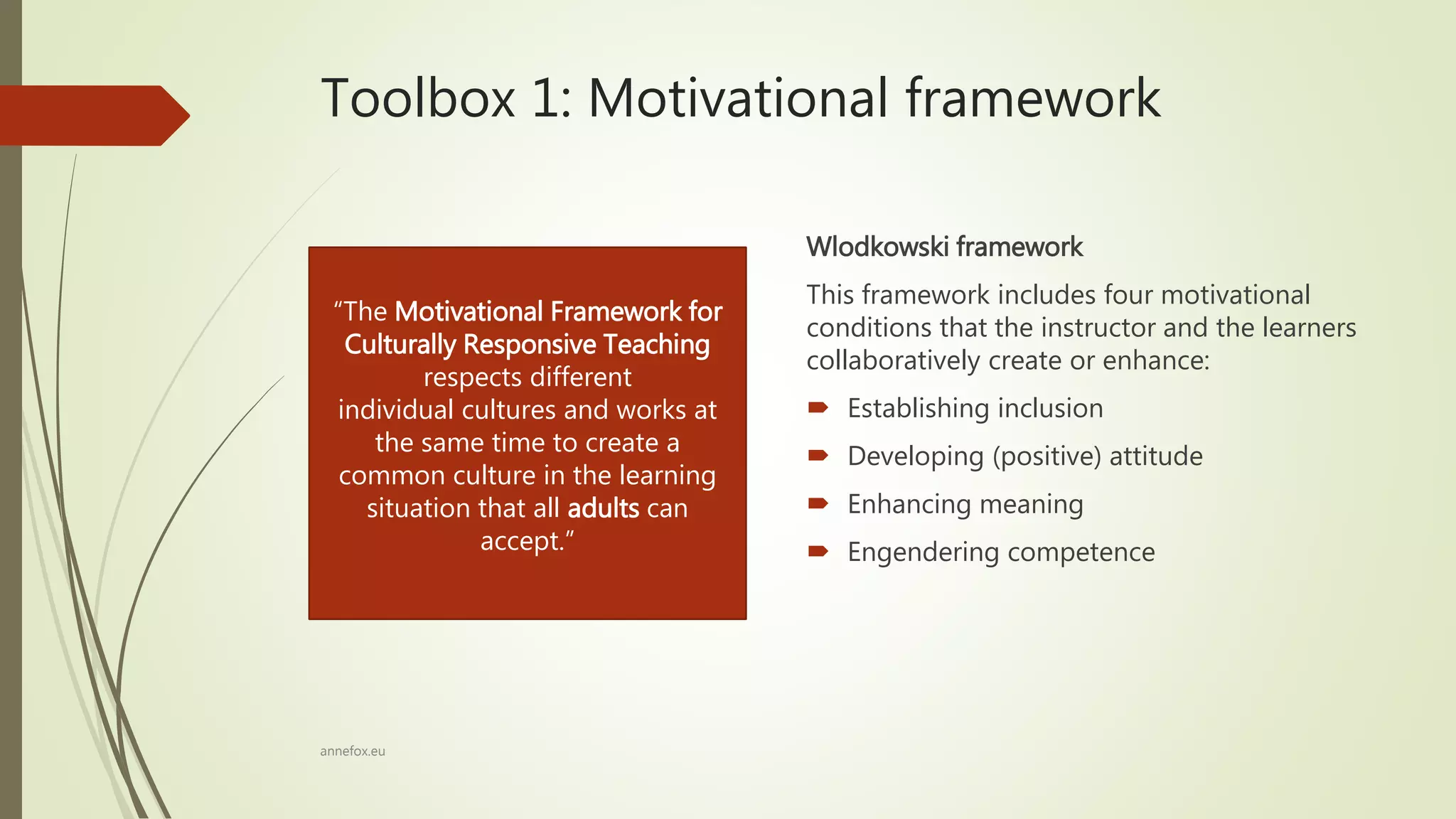
Toolbox 1: Motivational framework
Wlodkowski framework
This framework includes four motivational
conditions that the instructor and the learners
collaboratively create or enhance:
 Establishing inclusion
 Developing (positive) attitude
 Enhancing meaning
 Engendering competence
annefox.eu
“The Motivational Framework for
Culturally Responsive Teaching
respects different
individual cultures and works at
the same time to create a
common culture in the learning
situation that all adults can
accept.”
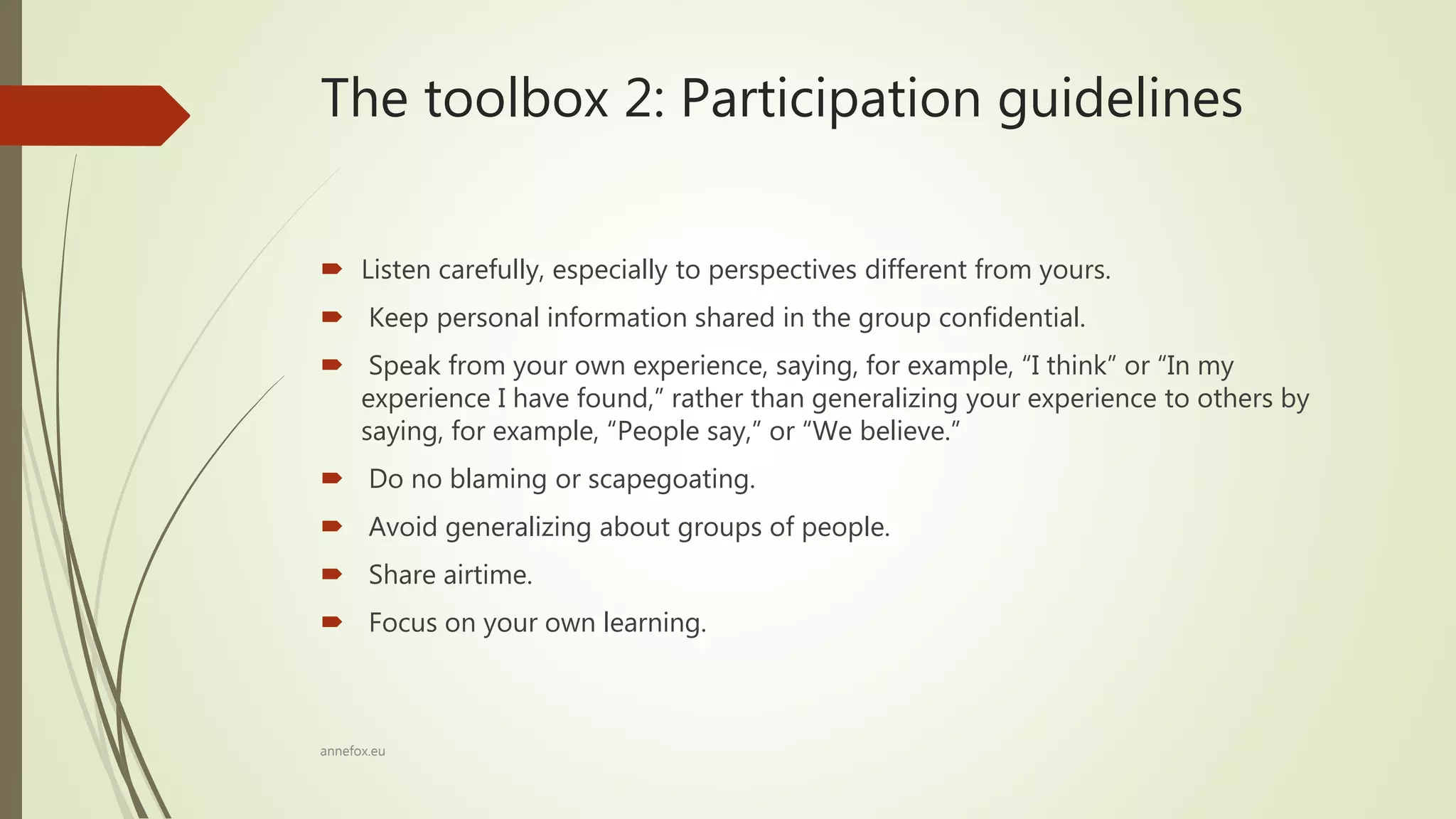
The toolbox 2: Participation guidelines
 Listen carefully, especially to perspectives different from yours.
 Keep personal information shared in the group confidential.
 Speak from your own experience, saying, for example, “I think” or “In my
experience I have found,” rather than generalizing your experience to others by
saying, for example, “People say,” or “We believe.”
 Do no blaming or scapegoating.
 Avoid generalizing about groups of people.
 Share airtime.
 Focus on your own learning.
annefox.eu
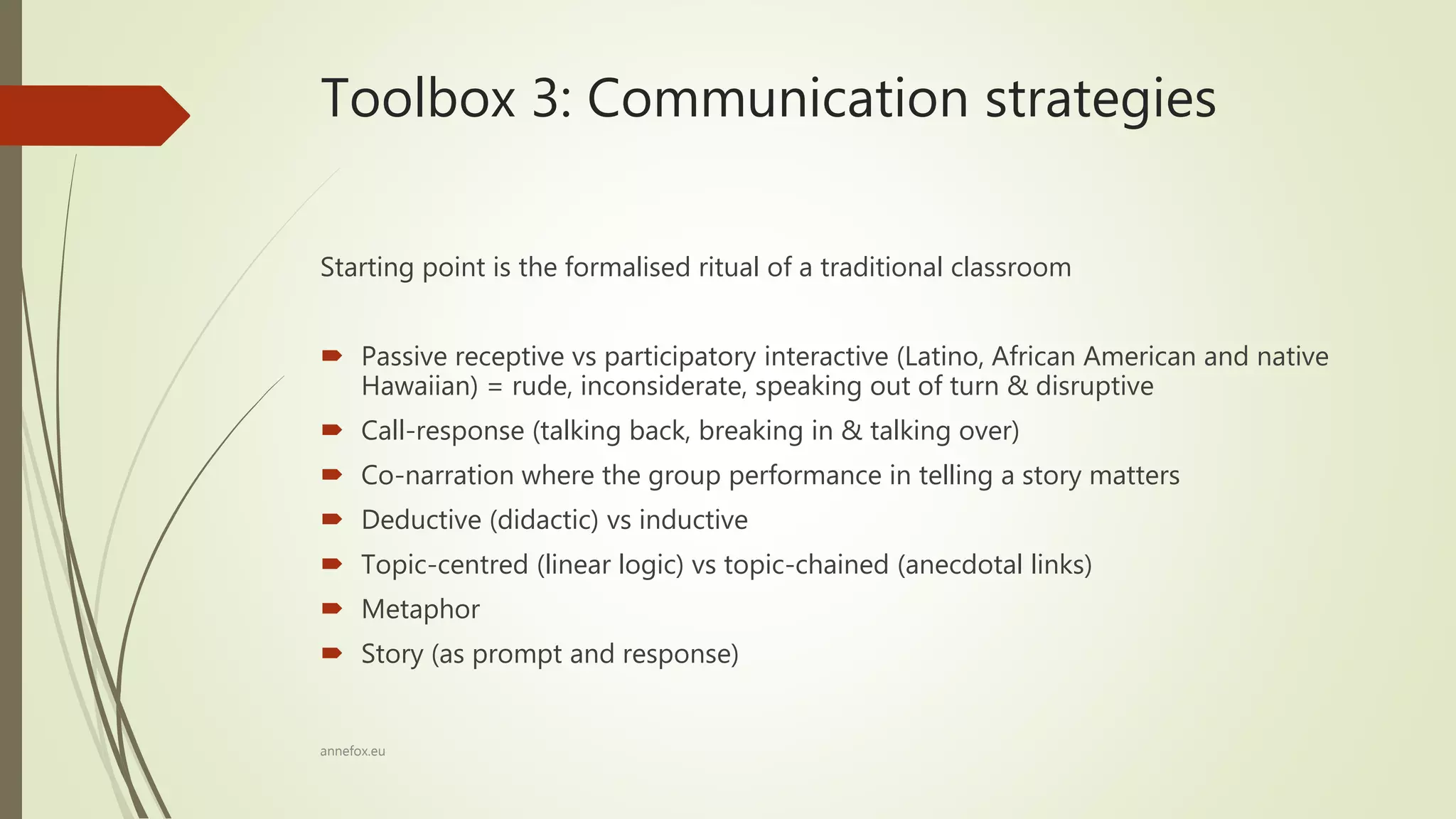
Toolbox 3: Communication strategies
Starting point is the formalised ritual of a traditional classroom
 Passive receptive vs participatory interactive (Latino, African American and native
Hawaiian) = rude, inconsiderate, speaking out of turn & disruptive
 Call-response (talking back, breaking in & talking over)
 Co-narration where the group performance in telling a story matters
 Deductive (didactic) vs inductive
 Topic-centred (linear logic) vs topic-chained (anecdotal links)
 Metaphor
 Story (as prompt and response)
annefox.eu
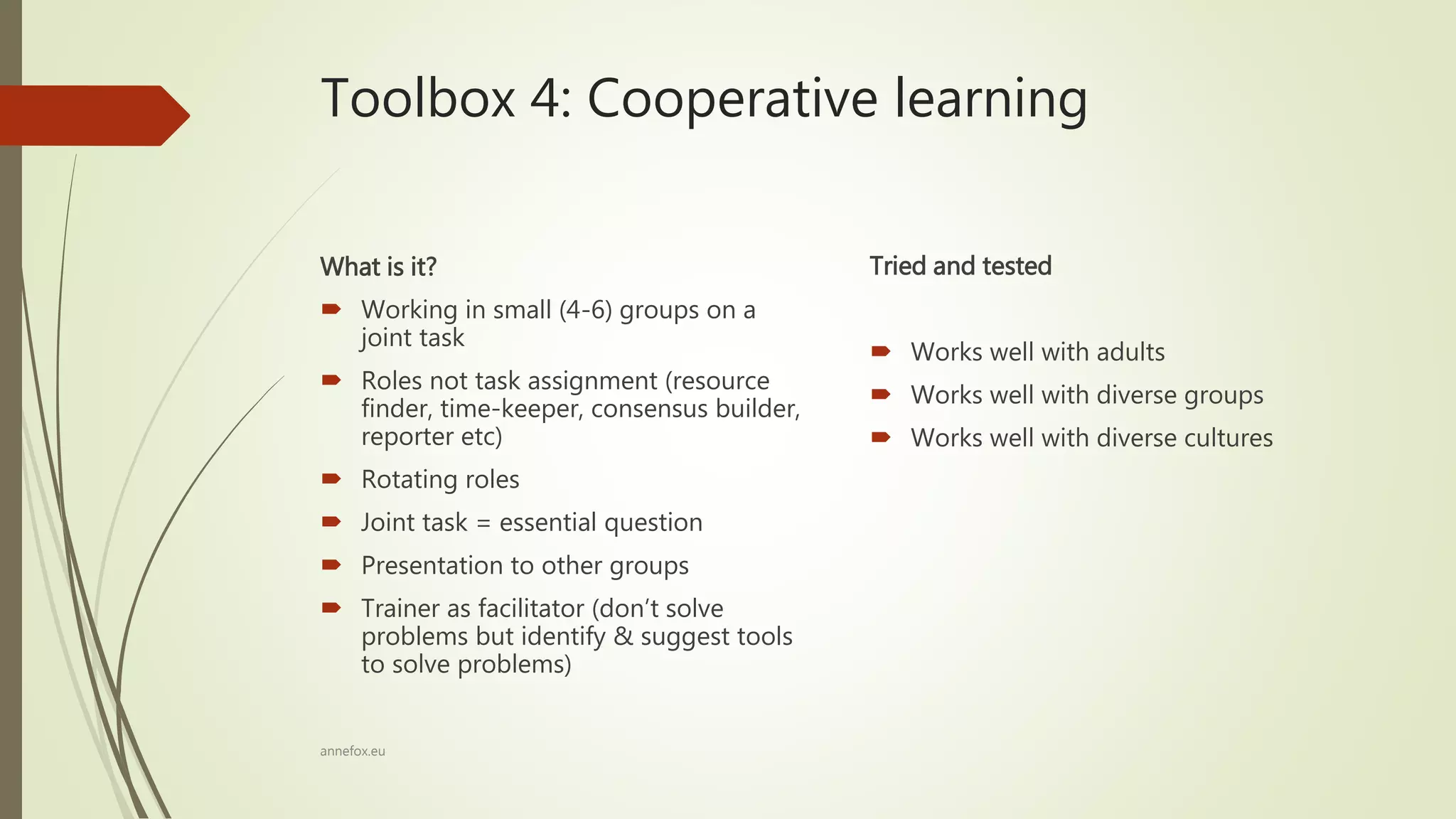
Toolbox 4: Cooperative learning
What is it?
 Working in small (4-6) groups on a
joint task
 Roles not task assignment (resource
finder, time-keeper, consensus builder,
reporter etc)
 Rotating roles
 Joint task = essential question
 Presentation to other groups
 Trainer as facilitator (don’t solve
problems but identify & suggest tools
to solve problems)
Tried and tested
 Works well with adults
 Works well with diverse groups
 Works well with diverse cultures
annefox.eu
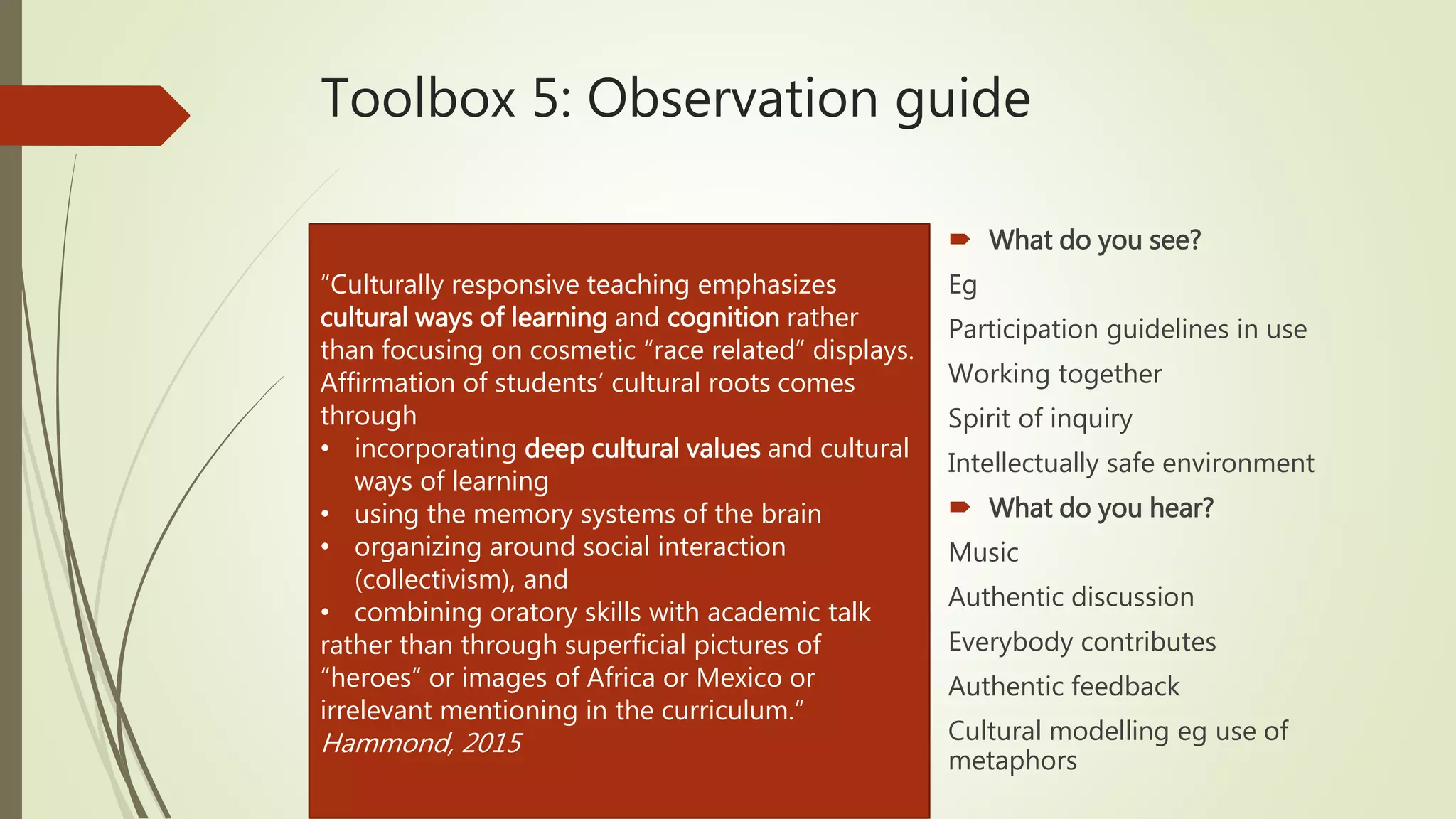
Toolbox 5: Observation guide
 What do you see?
Eg
Participation guidelines in use
Working together
Spirit of inquiry
Intellectually safe environment
 What do you hear?
Music
Authentic discussion
Everybody contributes
Authentic feedback
Cultural modelling eg use of
metaphors
annefox.eu
“Culturally responsive teaching emphasizes
cultural ways of learning and cognition rather
than focusing on cosmetic “race related” displays.
Affirmation of students’ cultural roots comes
through
• incorporating deep cultural values and cultural
ways of learning
• using the memory systems of the brain
• organizing around social interaction
(collectivism), and
• combining oratory skills with academic talk
rather than through superficial pictures of
“heroes” or images of Africa or Mexico or
irrelevant mentioning in the curriculum.”
Hammond, 2015
What now?
 Apply the Wlodkowski framework (inclusion, positive, meaning, competence)
 Avoiding stereotype threat and micro aggressions
 Use of Cooperative Learning approach
 Accommodation of different communication styles
annefox.eu
Sources
 Gay, G Culturally Responsive Teaching: Theory, research and practice, 2010,
Teachers College Press
 Hammond, Z. Culturally Responsive Teaching & the Brain: Promoting authentic
engagement and rigor among culturally and linguistically diverse students 2015
Corwin Press
 Wlodkowski, R. J. The Motivational Framework for Culturally Responsive Teaching is
presented as a guide to foster participation, learning, and transfer throughout a
professional development program for all participants. Source: New Directions for
Adult and Continuing Education, no. 98, Summer 2003, Wiley.
annefox.eu
Links
 Absolutely Intercultural www.absolutely-intercultural.com
 Teaching Culture newsletter
 Anne Fox www.annefox.eu
 I am on Linked In, Twitter and Facebook (search on foxdenuk)
annefox.eu

Culturally responsive training

  • 1.
    Culturally responsive training: Whyand how? Anne Fox Anne Fox ApS
  • 2.
    Map  Explore meaningof culturally responsive teaching (CRT)  Present a couple of the main tools used in CRT  Suggest some benefits of CRT for intercultural trainers annefox.eu
  • 3.
    Culturally Responsive Teaching Making adiverse group of people feel comfortable, welcome and valued
  • 4.
  • 5.
  • 6.
    Culturally Responsive Teaching Could werefer to culturally responsive training?
  • 7.
    Toolbox 1: Motivationalframework Wlodkowski framework This framework includes four motivational conditions that the instructor and the learners collaboratively create or enhance:  Establishing inclusion  Developing (positive) attitude  Enhancing meaning  Engendering competence annefox.eu “The Motivational Framework for Culturally Responsive Teaching respects different individual cultures and works at the same time to create a common culture in the learning situation that all adults can accept.”
  • 8.
    The toolbox 2:Participation guidelines  Listen carefully, especially to perspectives different from yours.  Keep personal information shared in the group confidential.  Speak from your own experience, saying, for example, “I think” or “In my experience I have found,” rather than generalizing your experience to others by saying, for example, “People say,” or “We believe.”  Do no blaming or scapegoating.  Avoid generalizing about groups of people.  Share airtime.  Focus on your own learning. annefox.eu
  • 9.
    Toolbox 3: Communicationstrategies Starting point is the formalised ritual of a traditional classroom  Passive receptive vs participatory interactive (Latino, African American and native Hawaiian) = rude, inconsiderate, speaking out of turn & disruptive  Call-response (talking back, breaking in & talking over)  Co-narration where the group performance in telling a story matters  Deductive (didactic) vs inductive  Topic-centred (linear logic) vs topic-chained (anecdotal links)  Metaphor  Story (as prompt and response) annefox.eu
  • 10.
    Toolbox 4: Cooperativelearning What is it?  Working in small (4-6) groups on a joint task  Roles not task assignment (resource finder, time-keeper, consensus builder, reporter etc)  Rotating roles  Joint task = essential question  Presentation to other groups  Trainer as facilitator (don’t solve problems but identify & suggest tools to solve problems) Tried and tested  Works well with adults  Works well with diverse groups  Works well with diverse cultures annefox.eu
  • 11.
    Toolbox 5: Observationguide  What do you see? Eg Participation guidelines in use Working together Spirit of inquiry Intellectually safe environment  What do you hear? Music Authentic discussion Everybody contributes Authentic feedback Cultural modelling eg use of metaphors annefox.eu “Culturally responsive teaching emphasizes cultural ways of learning and cognition rather than focusing on cosmetic “race related” displays. Affirmation of students’ cultural roots comes through • incorporating deep cultural values and cultural ways of learning • using the memory systems of the brain • organizing around social interaction (collectivism), and • combining oratory skills with academic talk rather than through superficial pictures of “heroes” or images of Africa or Mexico or irrelevant mentioning in the curriculum.” Hammond, 2015
  • 12.
    What now?  Applythe Wlodkowski framework (inclusion, positive, meaning, competence)  Avoiding stereotype threat and micro aggressions  Use of Cooperative Learning approach  Accommodation of different communication styles annefox.eu
  • 13.
    Sources  Gay, GCulturally Responsive Teaching: Theory, research and practice, 2010, Teachers College Press  Hammond, Z. Culturally Responsive Teaching & the Brain: Promoting authentic engagement and rigor among culturally and linguistically diverse students 2015 Corwin Press  Wlodkowski, R. J. The Motivational Framework for Culturally Responsive Teaching is presented as a guide to foster participation, learning, and transfer throughout a professional development program for all participants. Source: New Directions for Adult and Continuing Education, no. 98, Summer 2003, Wiley. annefox.eu
  • 14.
    Links  Absolutely Interculturalwww.absolutely-intercultural.com  Teaching Culture newsletter  Anne Fox www.annefox.eu  I am on Linked In, Twitter and Facebook (search on foxdenuk) annefox.eu

Editor's Notes

  • #2 Exploring the potential of culturally responsive teaching to intercultural training What I do: podcast, Teaching Culture course (ERASMUS+ ) online courses
  • #3 So next, what is meant by culturally responsive teaching? It is not about including Black History Month and other symbolic references to culture in the curriculum
  • #4 What CRT means. Comes from the US and is mainly about K12 education. Mainly about race. Eg lots of discussion about the place and value of ebonics.
  • #5 What CRT means. Comes from the US and is mainly about K12 education. Focus on the teacher, not the participants
  • #6 Focus on the teacher, not the participants. About self-awareness first which IC trainers should already have. What can the instructor do to give participants tasks which are authentic to their context? May be a particular challenge in diverse teams/groups
  • #7 Wondering if there is potential for crossover, for learning from the CRT literature and practice in the US?
  • #8 http://raymondwlodkowski.com/Materials/Fostering%20Motivation%20in%20Professional%20Development%20Programs.pdf Note this is addressed to *adults* so there is crossover in the field already eg embarrassment at self-disclosure varies across cultures (a staple of intercultural training) Establishing inclusion: Creating a learning atmosphere in which learners and instructors feel respected by and connected to one another • Developing attitude: Creating a favorable disposition toward the learning experience through personal relevance and choice (For example, two participants may both believe their company has to do something to diminish sexual harassment, the program’s focus. However, what constitutes sexual harassment may be quite different for each participant. A relevant workshop will have to address both points of view respectfully. ) • Enhancing meaning: Creating challenging, thoughtful learning experiences that include learners’ perspectives and values • Engendering competence: Creating an understanding that learners are effective in learning something they value These conditions are essential for developing intrinsic motivation among all participants in a professional development program.
  • #9  Do you have participation guidelines? Share airtime might be the most difficult across cultures Griffin 1997 Griffin, P. “Facilitating Social Justice Education Courses.” In M. Adams, L. A. Bell, and P. Griffin (eds.), Teaching for Diversity and Social Justice: A Sourcebook. New York: Routledge, 1997.
  • #10 Geneva Gay Topic chained narratives can be difficult for instructors to understand and follow. Call-response style may contradict the share airtime participation guideline
  • #11 Works in Denmark with migrant language learners
  • #13 Areas of potential overlap and application for intercultural trainers