Culturally Responsive
Practices

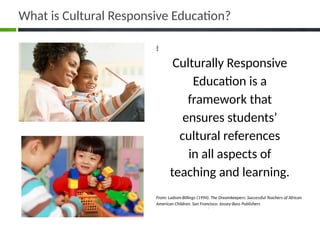
Culturally Responsive
Education is a
framework that
ensures students’
cultural references
in all aspects of
teaching and learning.
From: Ladson-Billings (1994). The Dreamkeepers: Successful Teachers of African
American Children. San Francisco: Jossey-Bass Publishers
What is Cultural Responsive Education?
From: Irvine & Armento (2001). Culturally Responsive Teaching: Lesson Planning for Elementary and Middle Grades. New York, New York: The McGraw Hill Companies,
Inc.
This is a self-reflective process. “Because
there are no quick and simple solutions, no
single program or packaged intervention to
train teachers to teach culturally diverse
students, the issue of reflection becomes
critically important. Any attempt to generate
“tricks of the trade” must be avoided
because of the complexity of the issue and
because of the individual needs, motivations,
experiences, and abilities of children of
color.”
Culturally
Responsive
Practices
• Communication of High Expectations
• Active Learning and Teaching Methods
• Student strengths are Identified and Nurtured
• Inclusion of Culturally and Linguistically Diverse teaching
strategies
• Cultural Sensitivity
• Supportive Learning Environment Reflecting the Cultures of all
Children
• Small Group Instruction
Adapted From: Ladson-Billings (1994). The Dreamkeepers: Successful Teachers of African American Children. San
Francisco: Jossey-Bass Publishers
7 Principles of Culturally
Responsive Practices
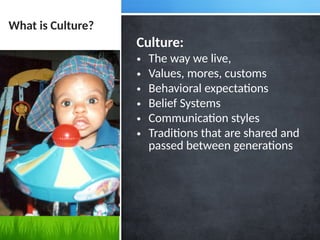
What is Culture?
Culture:
• The way we live,
• Values, mores, customs
• Behavioral expectations
• Belief Systems
• Communication styles
• Traditions that are shared and
passed between generations
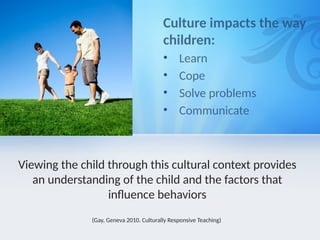
Culture impacts the way
children:
• Learn
• Cope
• Solve problems
• Communicate
Viewing the child through this cultural context provides
an understanding of the child and the factors that
influence behaviors
(Gay, Geneva 2010. Culturally Responsive Teaching)
“You Must Study The Student!”
Gloria Ladson-Billings
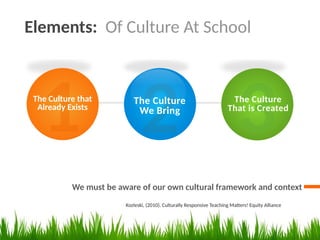
Elements: Of Culture At School
We must be aware of our own cultural framework and context
1
The Culture that
Already Exists
2
The Culture
We Bring
3
The Culture
That is Created
Kozleski, (2010). Culturally Responsive Teaching Matters! Equity Alliance
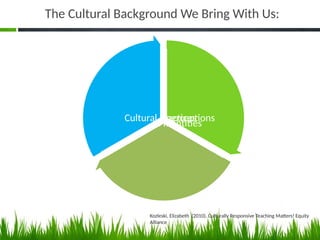
The Cultural Background We Bring With Us:
Beliefs and perceptions
Personal Identities
Cultural Practices
Kozleski, Elizabeth (2010). Culturally Responsive Teaching Matters! Equity
Alliance
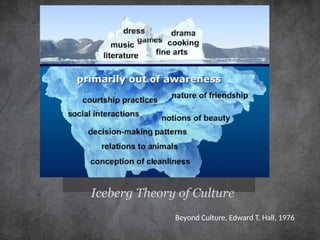
Iceberg Theory of Culture
Beyond Culture, Edward T. Hall, 1976
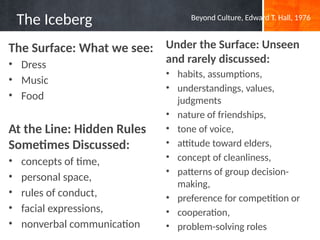
The Iceberg
The Surface: What we see:
• Dress
• Music
• Food
At the Line: Hidden Rules
Sometimes Discussed:
• concepts of time,
• personal space,
• rules of conduct,
• facial expressions,
• nonverbal communication
Under the Surface: Unseen
and rarely discussed:
• habits, assumptions,
• understandings, values,
judgments
• nature of friendships,
• tone of voice,
• attitude toward elders,
• concept of cleanliness,
• patterns of group decision-
making,
• preference for competition or
• cooperation,
• problem-solving roles
Beyond Culture, Edward T. Hall, 1976
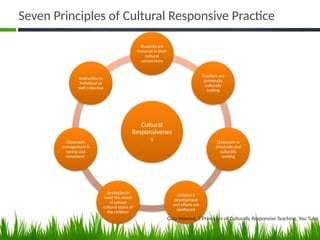
Seven Principles of Cultural Responsive Practice
Cultural
Responsivenes
s
Students are
honored in their
cultural
connections
Teachers are
personally
culturally
inviting
Classroom is
physically and
culturally
inviting
Children’s
development
and efforts are
reinforced
Strategies to
meet the needs
of unique
cultural styles of
the children
Classroom
management is
caring and
consistent
Instruction is
individual as
well collective
Gary Howard, 7 Principles of Culturally Responsive Teaching. You Tube
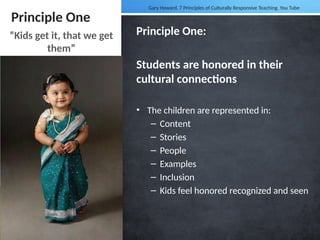
Principle One
Principle One:
Students are honored in their
cultural connections
• The children are represented in:
– Content
– Stories
– People
– Examples
– Inclusion
– Kids feel honored recognized and seen
“Kids get it, that we get
them”
Gary Howard, 7 Principles of Culturally Responsive Teaching. You Tube
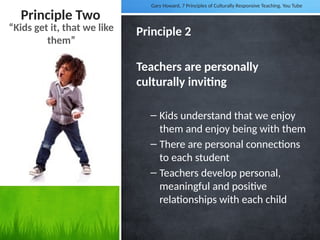
Principle Two
Principle 2
Teachers are personally
culturally inviting
– Kids understand that we enjoy
them and enjoy being with them
– There are personal connections
to each student
– Teachers develop personal,
meaningful and positive
relationships with each child
“Kids get it, that we like
them”
Gary Howard, 7 Principles of Culturally Responsive Teaching. You Tube
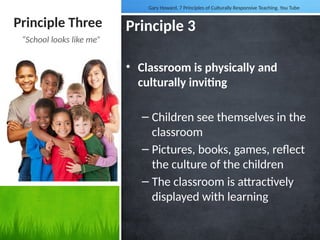
Principle Three Principle 3
• Classroom is physically and
culturally inviting
– Children see themselves in the
classroom
– Pictures, books, games, reflect
the culture of the children
– The classroom is attractively
displayed with learning
“School looks like me”
Gary Howard, 7 Principles of Culturally Responsive Teaching. You Tube
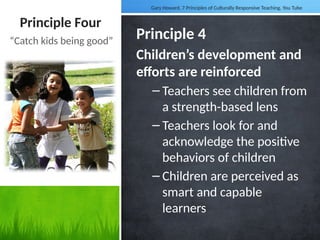
Principle Four
Principle 4
Children’s development and
efforts are reinforced
– Teachers see children from
a strength-based lens
– Teachers look for and
acknowledge the positive
behaviors of children
– Children are perceived as
smart and capable
learners
“Catch kids being good”
Gary Howard, 7 Principles of Culturally Responsive Teaching. You Tube
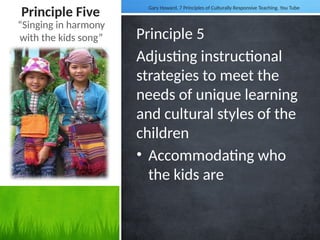
Principle Five
Principle 5
Adjusting instructional
strategies to meet the
needs of unique learning
and cultural styles of the
children
• Accommodating who
the kids are
“Singing in harmony
with the kids song”
Gary Howard, 7 Principles of Culturally Responsive Teaching. You Tube
Principle Six
Principle 6
Classroom management is caring
and consistent
– Children are intentionally taught
culturally appropriate prosocial
skills
– Children are taught classroom
expectations
– Rules are clear, implemented
consistently, and reinforced
regularly
– Guidance is instructive, not punitive
“Respect begins with
the teacher”
Gary Howard, 7 Principles of Culturally Responsive Teaching. You Tube
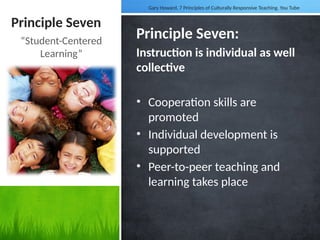
Principle Seven
Principle Seven:
Instruction is individual as well
collective
• Cooperation skills are
promoted
• Individual development is
supported
• Peer-to-peer teaching and
learning takes place
“Student-Centered
Learning”
Gary Howard, 7 Principles of Culturally Responsive Teaching. You Tube
20
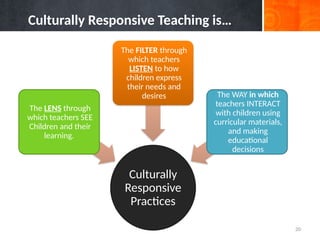
Culturally Responsive Teaching is…
Culturally
Responsive
Practices
The LENS through
which teachers SEE
Children and their
learning.
The FILTER through
which teachers
LISTEN to how
children express
their needs and
desires The WAY in which
teachers INTERACT
with children using
curricular materials,
and making
educational
decisions
Where Are You in your
journey to becoming
culturally responsive?

Culturally_Responsive_Practices_ (1).pptx

  • 1.
  • 2.
     Culturally Responsive Education isa framework that ensures students’ cultural references in all aspects of teaching and learning. From: Ladson-Billings (1994). The Dreamkeepers: Successful Teachers of African American Children. San Francisco: Jossey-Bass Publishers What is Cultural Responsive Education?
  • 3.
    From: Irvine &Armento (2001). Culturally Responsive Teaching: Lesson Planning for Elementary and Middle Grades. New York, New York: The McGraw Hill Companies, Inc. This is a self-reflective process. “Because there are no quick and simple solutions, no single program or packaged intervention to train teachers to teach culturally diverse students, the issue of reflection becomes critically important. Any attempt to generate “tricks of the trade” must be avoided because of the complexity of the issue and because of the individual needs, motivations, experiences, and abilities of children of color.”
  • 4.
    Culturally Responsive Practices • Communication ofHigh Expectations • Active Learning and Teaching Methods • Student strengths are Identified and Nurtured • Inclusion of Culturally and Linguistically Diverse teaching strategies • Cultural Sensitivity • Supportive Learning Environment Reflecting the Cultures of all Children • Small Group Instruction Adapted From: Ladson-Billings (1994). The Dreamkeepers: Successful Teachers of African American Children. San Francisco: Jossey-Bass Publishers 7 Principles of Culturally Responsive Practices
  • 5.
    What is Culture? Culture: •The way we live, • Values, mores, customs • Behavioral expectations • Belief Systems • Communication styles • Traditions that are shared and passed between generations
  • 6.
    Culture impacts theway children: • Learn • Cope • Solve problems • Communicate Viewing the child through this cultural context provides an understanding of the child and the factors that influence behaviors (Gay, Geneva 2010. Culturally Responsive Teaching)
  • 7.
    “You Must StudyThe Student!” Gloria Ladson-Billings
  • 8.
    Elements: Of CultureAt School We must be aware of our own cultural framework and context 1 The Culture that Already Exists 2 The Culture We Bring 3 The Culture That is Created Kozleski, (2010). Culturally Responsive Teaching Matters! Equity Alliance
  • 9.
    The Cultural BackgroundWe Bring With Us: Beliefs and perceptions Personal Identities Cultural Practices Kozleski, Elizabeth (2010). Culturally Responsive Teaching Matters! Equity Alliance
  • 10.
    Iceberg Theory ofCulture Beyond Culture, Edward T. Hall, 1976
  • 11.
    The Iceberg The Surface:What we see: • Dress • Music • Food At the Line: Hidden Rules Sometimes Discussed: • concepts of time, • personal space, • rules of conduct, • facial expressions, • nonverbal communication Under the Surface: Unseen and rarely discussed: • habits, assumptions, • understandings, values, judgments • nature of friendships, • tone of voice, • attitude toward elders, • concept of cleanliness, • patterns of group decision- making, • preference for competition or • cooperation, • problem-solving roles Beyond Culture, Edward T. Hall, 1976
  • 12.
    Seven Principles ofCultural Responsive Practice Cultural Responsivenes s Students are honored in their cultural connections Teachers are personally culturally inviting Classroom is physically and culturally inviting Children’s development and efforts are reinforced Strategies to meet the needs of unique cultural styles of the children Classroom management is caring and consistent Instruction is individual as well collective Gary Howard, 7 Principles of Culturally Responsive Teaching. You Tube
  • 13.
    Principle One Principle One: Studentsare honored in their cultural connections • The children are represented in: – Content – Stories – People – Examples – Inclusion – Kids feel honored recognized and seen “Kids get it, that we get them” Gary Howard, 7 Principles of Culturally Responsive Teaching. You Tube
  • 14.
    Principle Two Principle 2 Teachersare personally culturally inviting – Kids understand that we enjoy them and enjoy being with them – There are personal connections to each student – Teachers develop personal, meaningful and positive relationships with each child “Kids get it, that we like them” Gary Howard, 7 Principles of Culturally Responsive Teaching. You Tube
  • 15.
    Principle Three Principle3 • Classroom is physically and culturally inviting – Children see themselves in the classroom – Pictures, books, games, reflect the culture of the children – The classroom is attractively displayed with learning “School looks like me” Gary Howard, 7 Principles of Culturally Responsive Teaching. You Tube
  • 16.
    Principle Four Principle 4 Children’sdevelopment and efforts are reinforced – Teachers see children from a strength-based lens – Teachers look for and acknowledge the positive behaviors of children – Children are perceived as smart and capable learners “Catch kids being good” Gary Howard, 7 Principles of Culturally Responsive Teaching. You Tube
  • 17.
    Principle Five Principle 5 Adjustinginstructional strategies to meet the needs of unique learning and cultural styles of the children • Accommodating who the kids are “Singing in harmony with the kids song” Gary Howard, 7 Principles of Culturally Responsive Teaching. You Tube
  • 18.
    Principle Six Principle 6 Classroommanagement is caring and consistent – Children are intentionally taught culturally appropriate prosocial skills – Children are taught classroom expectations – Rules are clear, implemented consistently, and reinforced regularly – Guidance is instructive, not punitive “Respect begins with the teacher” Gary Howard, 7 Principles of Culturally Responsive Teaching. You Tube
  • 19.
    Principle Seven Principle Seven: Instructionis individual as well collective • Cooperation skills are promoted • Individual development is supported • Peer-to-peer teaching and learning takes place “Student-Centered Learning” Gary Howard, 7 Principles of Culturally Responsive Teaching. You Tube
  • 20.
    20 Culturally Responsive Teachingis… Culturally Responsive Practices The LENS through which teachers SEE Children and their learning. The FILTER through which teachers LISTEN to how children express their needs and desires The WAY in which teachers INTERACT with children using curricular materials, and making educational decisions
  • 21.
    Where Are Youin your journey to becoming culturally responsive?

Editor's Notes

  • #1 This presentation demonstrates the new capabilities of PowerPoint and it is best viewed in Slide Show. These slides are designed to give you great ideas for the presentations you’ll create in PowerPoint 2011! For more sample templates, click the File menu, and then click New From Template. Under Templates, click Presentations.