A Quick and Easy School Visit Observation Guide
© Zaretta Hammond www.ready4rigor.com


Culturally responsive teaching emphasizes cultural ways of learning and cognition rather than
focusing on cosmetic “race related” displays. Affirmation of students’ cultural roots comes
through incorporating deep cultural values and cultural ways of learning (using the memory
systems of the brain, organizing around social interaction (collectivism), and combining oratory
skills with academic talk) rather than through superficial pictures of “heroes” or images of Africa
or Mexico or irrelevant mentioning in the curriculum.


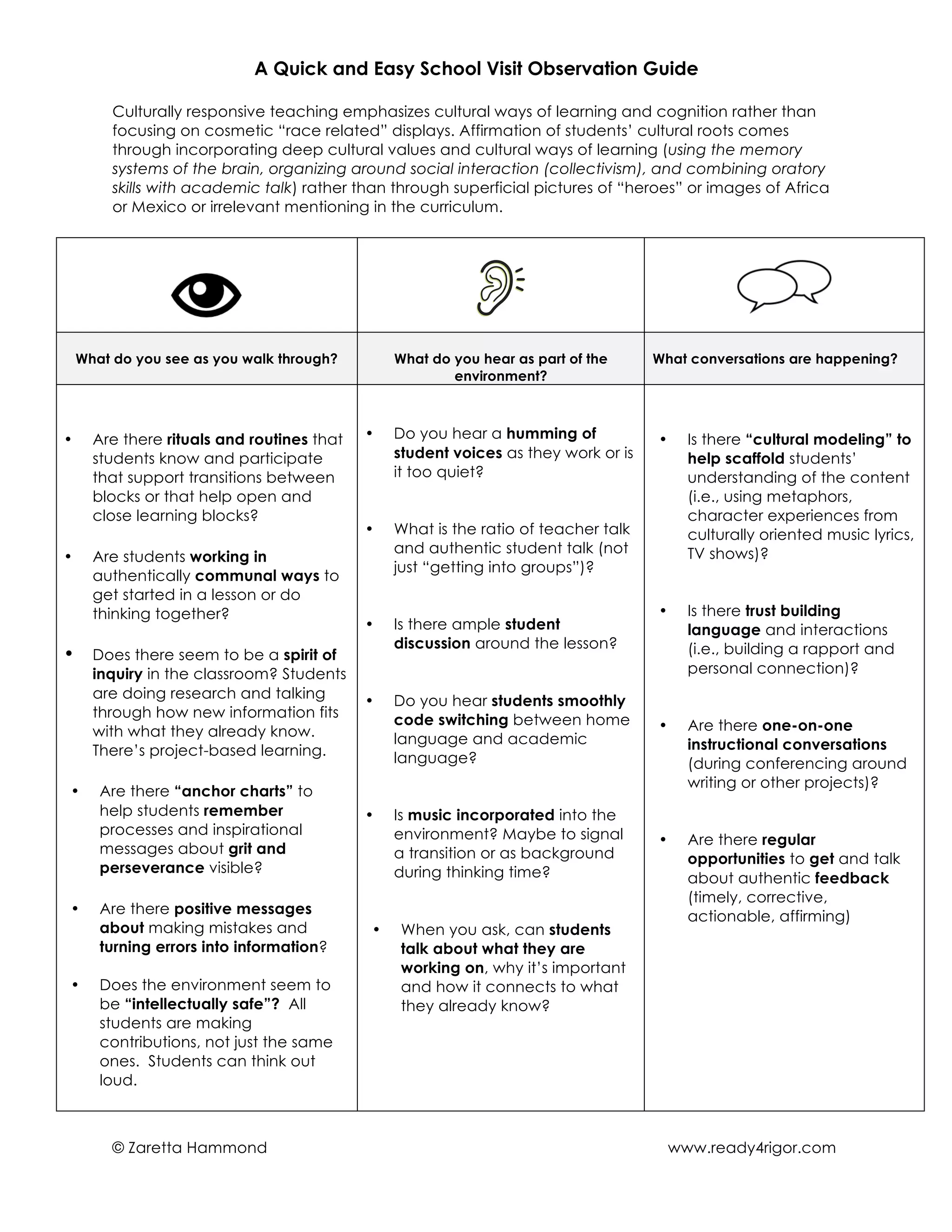
What do you see as you walk through? What do you hear as part of the
environment?
What conversations are happening?


• Are there rituals and routines that
students know and participate
that support transitions between
blocks or that help open and
close learning blocks?
	
  
• Are students working in
authentically communal ways to
get started in a lesson or do
thinking together?
• Does there seem to be a spirit of
inquiry in the classroom? Students
are doing research and talking
through how new information fits
with what they already know.
There’s project-based learning.	


• Are there “anchor charts” to
help students remember
processes and inspirational
messages about grit and
perseverance visible?
	
  
• Are there positive messages
about making mistakes and
turning errors into information?
• Does the environment seem to
be “intellectually safe”? All
students are making
contributions, not just the same
ones. Students can think out
loud.
	
  
• Do you hear a humming of
student voices as they work or is
it too quiet?
• What is the ratio of teacher talk
and authentic student talk (not
just “getting into groups”)?
• Is there ample student
discussion around the lesson?
• Do you hear students smoothly
code switching between home
language and academic
language?
• Is music incorporated into the
environment? Maybe to signal
a transition or as background
during thinking time?
• When you ask, can students
talk about what they are
working on, why it’s important
and how it connects to what
they already know?


• Is there “cultural modeling” to
help scaffold students’
understanding of the content
(i.e., using metaphors,
character experiences from
culturally oriented music lyrics,
TV shows)?
• Is there trust building
language and interactions
(i.e., building a rapport and
personal connection)?
• Are there one-on-one
instructional conversations
(during conferencing around
writing or other projects)?
• Are there regular
opportunities to get and talk
about authentic feedback
(timely, corrective,
actionable, affirming)


Crt walk-through-observation-guide

  • 1.
    A Quick andEasy School Visit Observation Guide © Zaretta Hammond www.ready4rigor.com     Culturally responsive teaching emphasizes cultural ways of learning and cognition rather than focusing on cosmetic “race related” displays. Affirmation of students’ cultural roots comes through incorporating deep cultural values and cultural ways of learning (using the memory systems of the brain, organizing around social interaction (collectivism), and combining oratory skills with academic talk) rather than through superficial pictures of “heroes” or images of Africa or Mexico or irrelevant mentioning in the curriculum.                                                                                                         What do you see as you walk through? What do you hear as part of the environment? What conversations are happening?       • Are there rituals and routines that students know and participate that support transitions between blocks or that help open and close learning blocks?   • Are students working in authentically communal ways to get started in a lesson or do thinking together? • Does there seem to be a spirit of inquiry in the classroom? Students are doing research and talking through how new information fits with what they already know. There’s project-based learning.     • Are there “anchor charts” to help students remember processes and inspirational messages about grit and perseverance visible?   • Are there positive messages about making mistakes and turning errors into information? • Does the environment seem to be “intellectually safe”? All students are making contributions, not just the same ones. Students can think out loud.   • Do you hear a humming of student voices as they work or is it too quiet? • What is the ratio of teacher talk and authentic student talk (not just “getting into groups”)? • Is there ample student discussion around the lesson? • Do you hear students smoothly code switching between home language and academic language? • Is music incorporated into the environment? Maybe to signal a transition or as background during thinking time? • When you ask, can students talk about what they are working on, why it’s important and how it connects to what they already know?     • Is there “cultural modeling” to help scaffold students’ understanding of the content (i.e., using metaphors, character experiences from culturally oriented music lyrics, TV shows)? • Is there trust building language and interactions (i.e., building a rapport and personal connection)? • Are there one-on-one instructional conversations (during conferencing around writing or other projects)? • Are there regular opportunities to get and talk about authentic feedback (timely, corrective, actionable, affirming)