Page 1
The University of Sydney
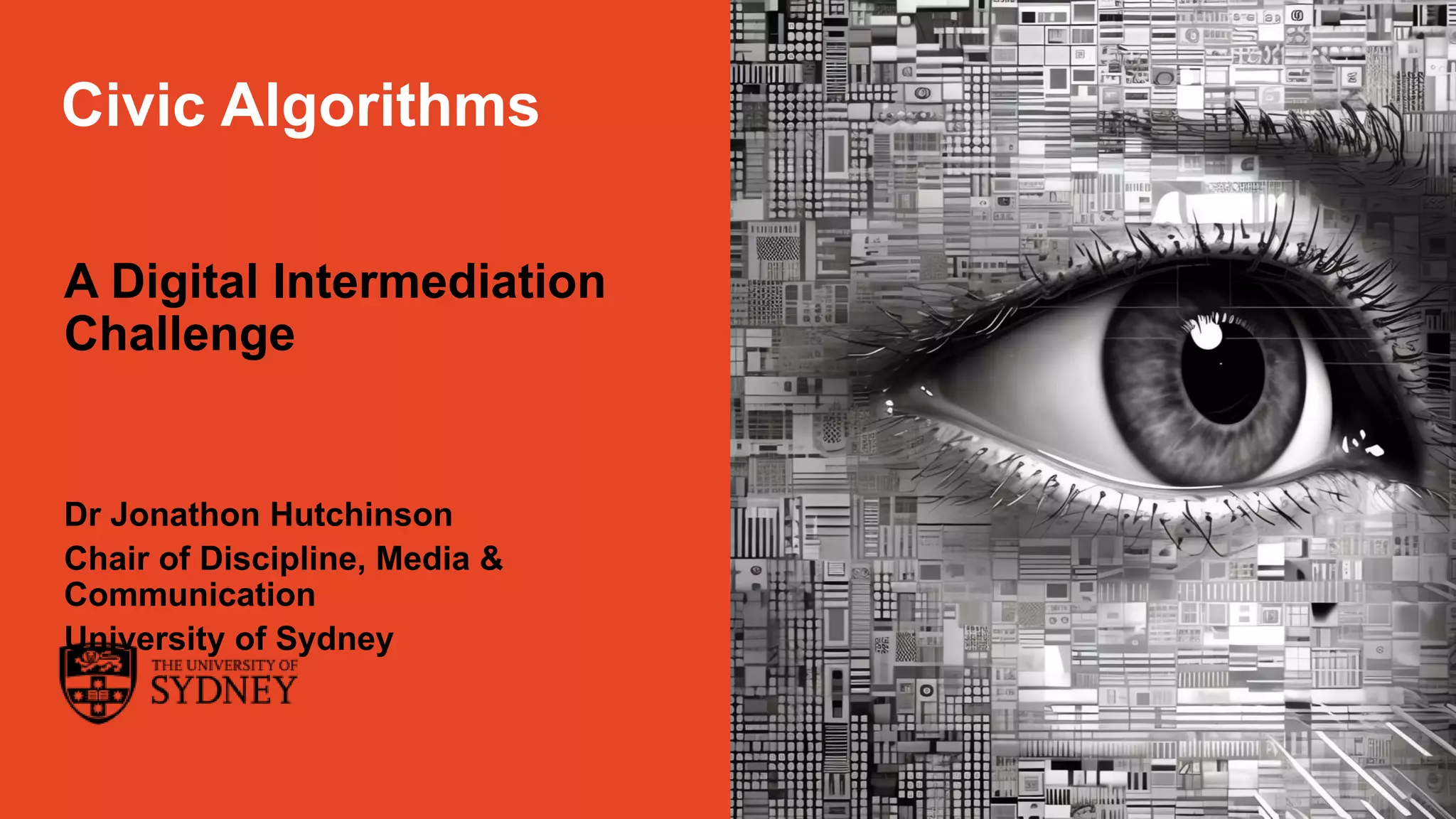
Civic Algorithms
A Digital Intermediation
Challenge
Dr Jonathon Hutchinson
Chair of Discipline, Media &
Communication
University of Sydney
The University of Sydney
I would like to acknowledge the Ngunnawal
people as the Traditional Custodians of the
land upon which the University of Canberra’s
main campus sits. I pay respect to all Elders
past and present.
The University of Sydney
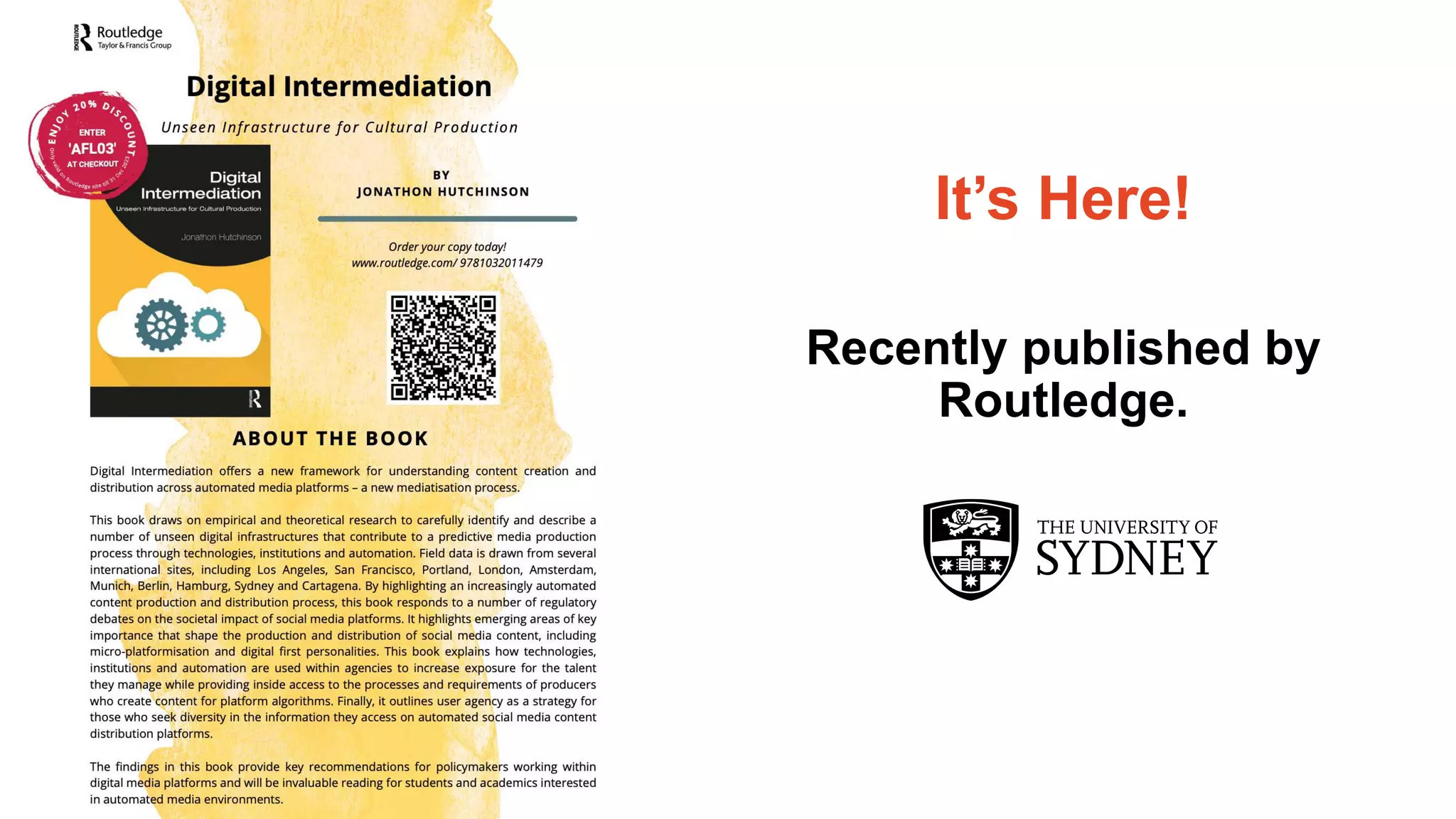
It’s Here!
Recently published by
Routledge.
The University of Sydney
Vince Neilstein
‘Earache’s Metalizer app automatically generates custom metal playlists that
draw from all the metal available on Spotify, not just Earache releases. Users
can adjust four sliders — “Metal,” “Death,” “Thrash” and “Grind,” —
depending on how much of each sub-genre they want in their playlist, and
then a fifth slider determining the number of tracks in the playlist. Press the
“Metalize” button and a playlist materializes before your very eyes.’
The University of Sydney
Page 7
The University of Sydney
How might generative artificial intelligence (AI) and automation be
undertaken to produce social good?
Algorithmically designed decision making processes function for users to
assist them in making sense of these environments as a means of
assisting them to seek out content that is relevant, of interest and
entertaining.
Recommendations, particularly across social media, have caused
anything but social cohesion and unity amongst users, and have instead
spread misinformation, vitriol and hurtful media.
Would our society be different had we designed systems that focused on,
the wellbeing of humans instead of content that is, for the most part,
popular?
How can algorithms contribute to civic good/is any of this new?
Today…
The University of Sydney
Digital intermediation (problem?)
Page 9
The University of Sydney
Digital Intermediation - Unseen infrastructures
– YouTube - 450 hours of content/minute
– Twitter - 500 million Tweets/day
– WeChat - 1.09 billion monthly users
– TikTok – Arguably the most successful?
– Digital Intermediation is a process:
platforms >
regulation >
commercial imperatives >
content creators >
automated calculations
The University of Sydney
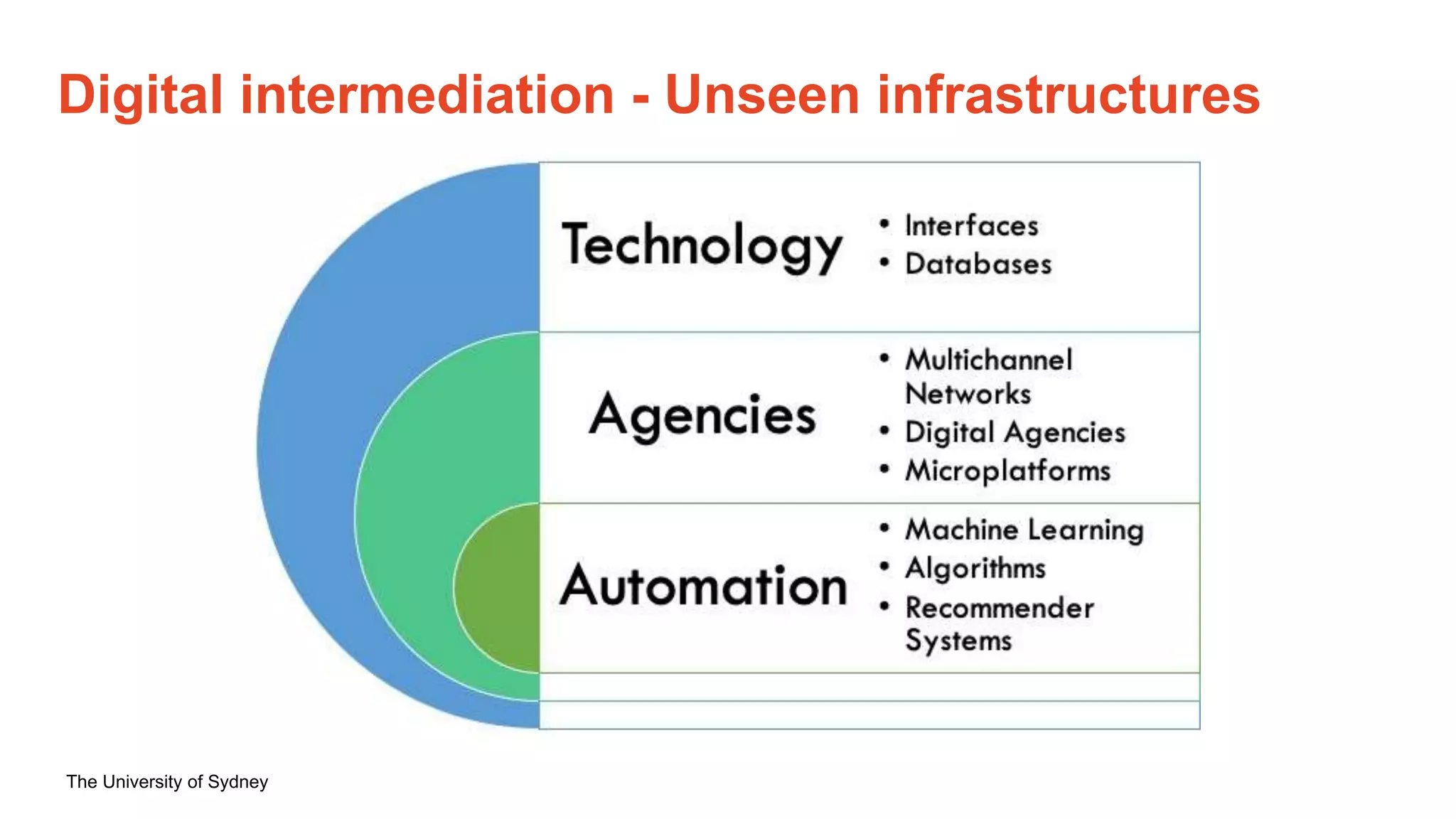
Digital intermediation - Unseen infrastructures
Page 11
The University of Sydney
Digital intermediation - Technologies
– Platforms, personal tracking
devices, drones, sensors, smart
devices
– Interoperability: ‘interoperability
is needed to support seamless
and heterogeneous
communications in the IoT
[Internet of Things]. Achieving
interoperability is vital for
interconnecting multiple things
together across different
communication networks’
(Elkhodr, 2016, 86)
– Interfaces, databases
Page 12
The University of Sydney
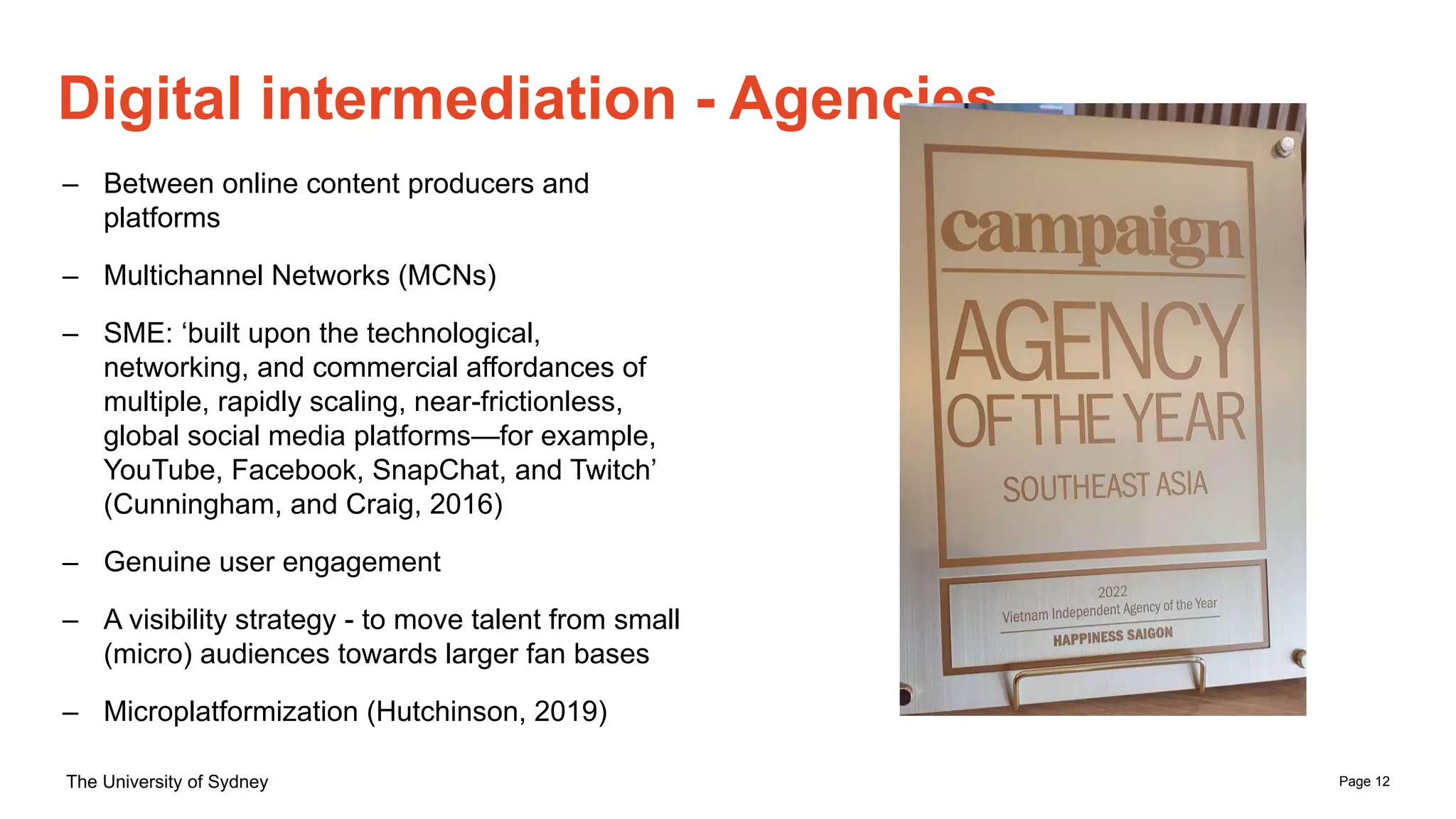
Digital intermediation - Agencies
– Between online content producers and
platforms
– Multichannel Networks (MCNs)
– SME: ‘built upon the technological,
networking, and commercial affordances of
multiple, rapidly scaling, near-frictionless,
global social media platforms—for example,
YouTube, Facebook, SnapChat, and Twitch’
(Cunningham, and Craig, 2016)
– Genuine user engagement
– A visibility strategy - to move talent from small
(micro) audiences towards larger fan bases
– Microplatformization (Hutchinson, 2019)
Page 13
The University of Sydney
Digital Intermediation -
Automation
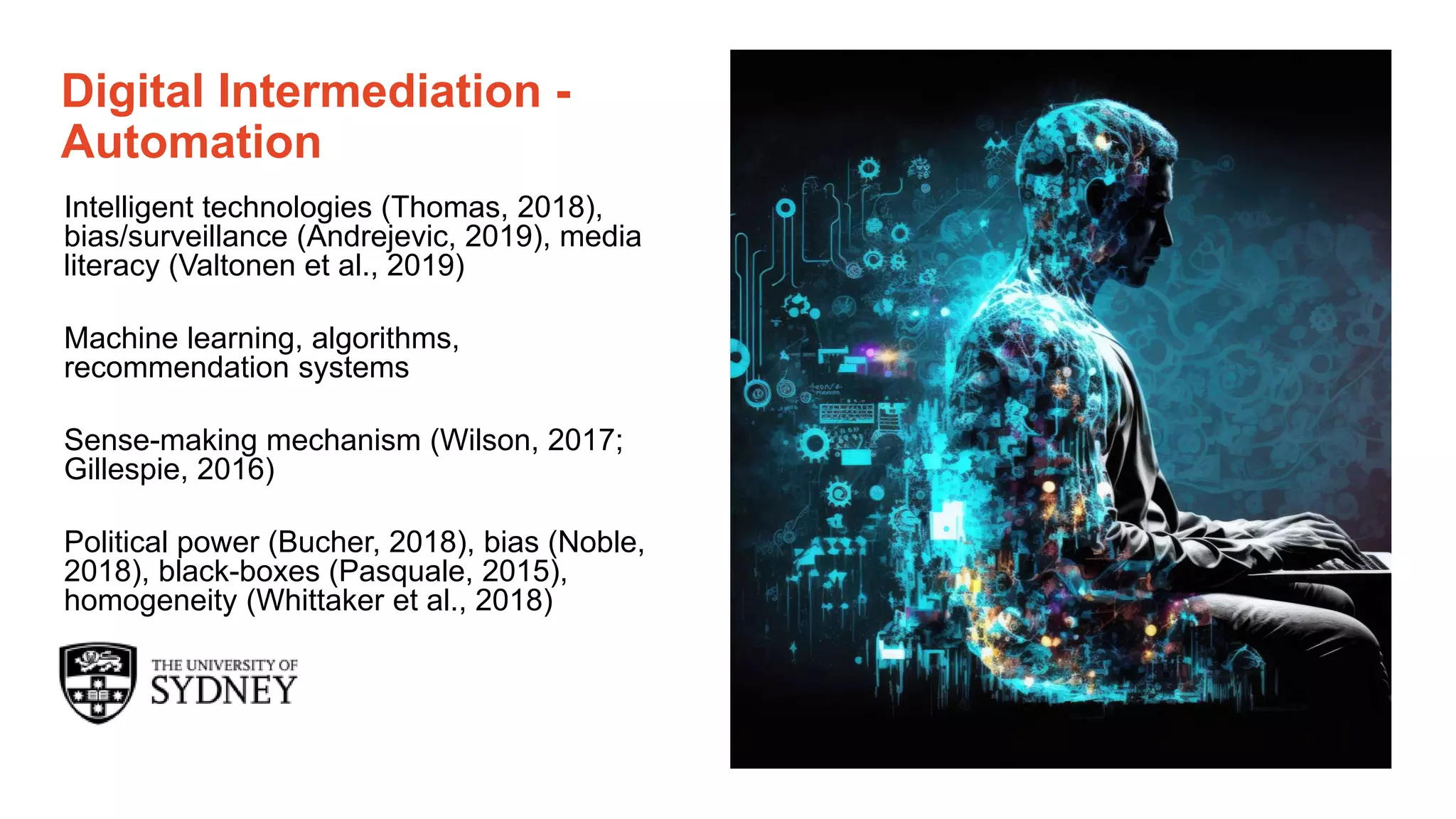
Intelligent technologies (Thomas, 2018),
bias/surveillance (Andrejevic, 2019), media
literacy (Valtonen et al., 2019)
Machine learning, algorithms,
recommendation systems
Sense-making mechanism (Wilson, 2017;
Gillespie, 2016)
Political power (Bucher, 2018), bias (Noble,
2018), black-boxes (Pasquale, 2015),
homogeneity (Whittaker et al., 2018)
The University of Sydney
Content
Page 15
The University of Sydney
Content visibility - For cultural production
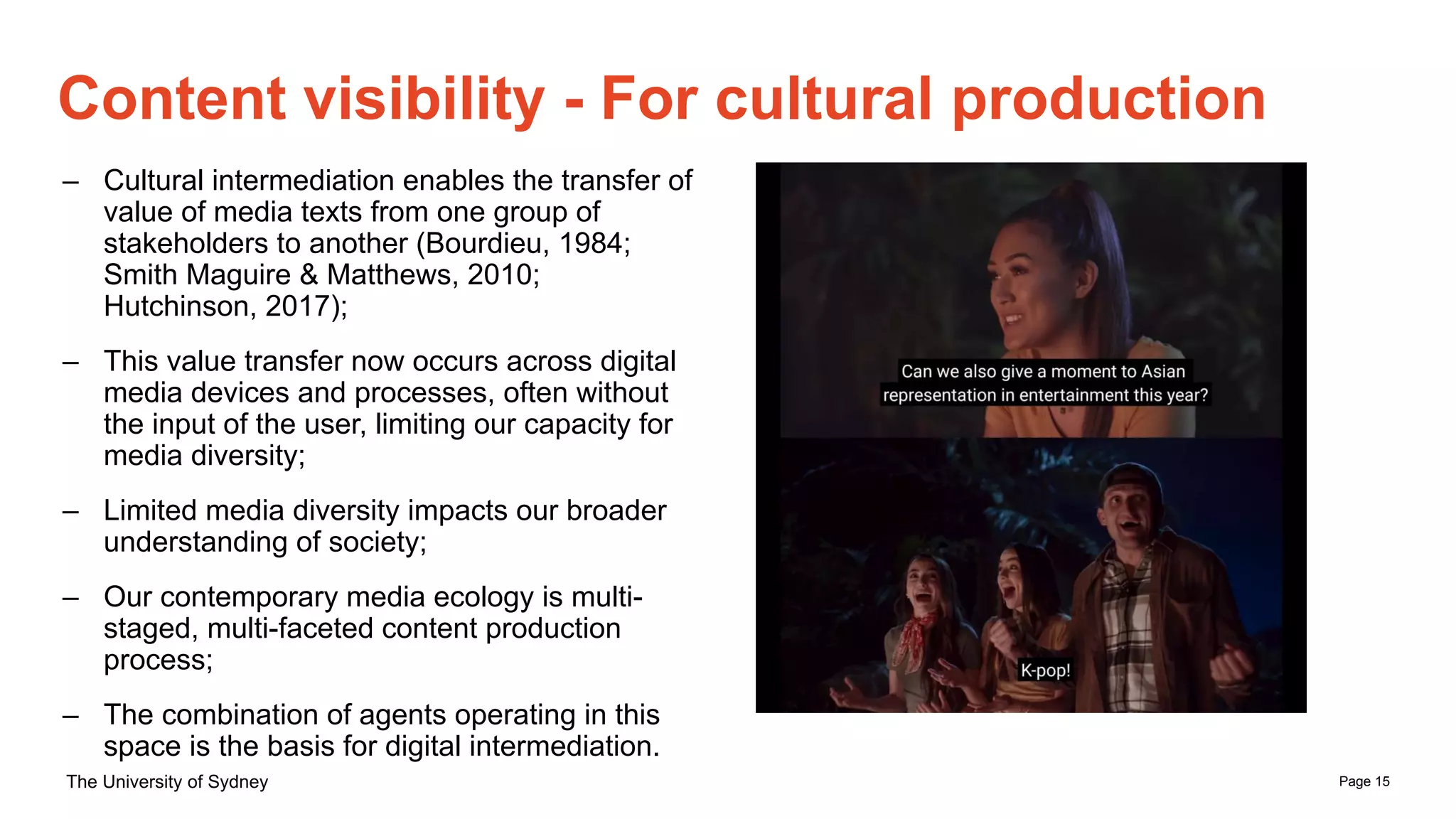
– Cultural intermediation enables the transfer of
value of media texts from one group of
stakeholders to another (Bourdieu, 1984;
Smith Maguire & Matthews, 2010;
Hutchinson, 2017);
– This value transfer now occurs across digital
media devices and processes, often without
the input of the user, limiting our capacity for
media diversity;
– Limited media diversity impacts our broader
understanding of society;
– Our contemporary media ecology is multi-
staged, multi-faceted content production
process;
– The combination of agents operating in this
space is the basis for digital intermediation.
Page 16
The University of Sydney
Media Diversity - Digital Ability
– We simply do not understand the
vastly varying digital ability of users
– Australian Digital Inclusion Index
(ADII): Digital Ability
– ‘understood through the attitudes,
skills and activities of individuals, and
serve as important measures that
either include or exclude users within a
digital society’ (Thomas et al., 2018)
– Public service media is well positioned
to build digital ability and guide citizens
through the digital intermediation
ecology
The University of Sydney
Generative AI
Page 18
The University of Sydney
Generative AI
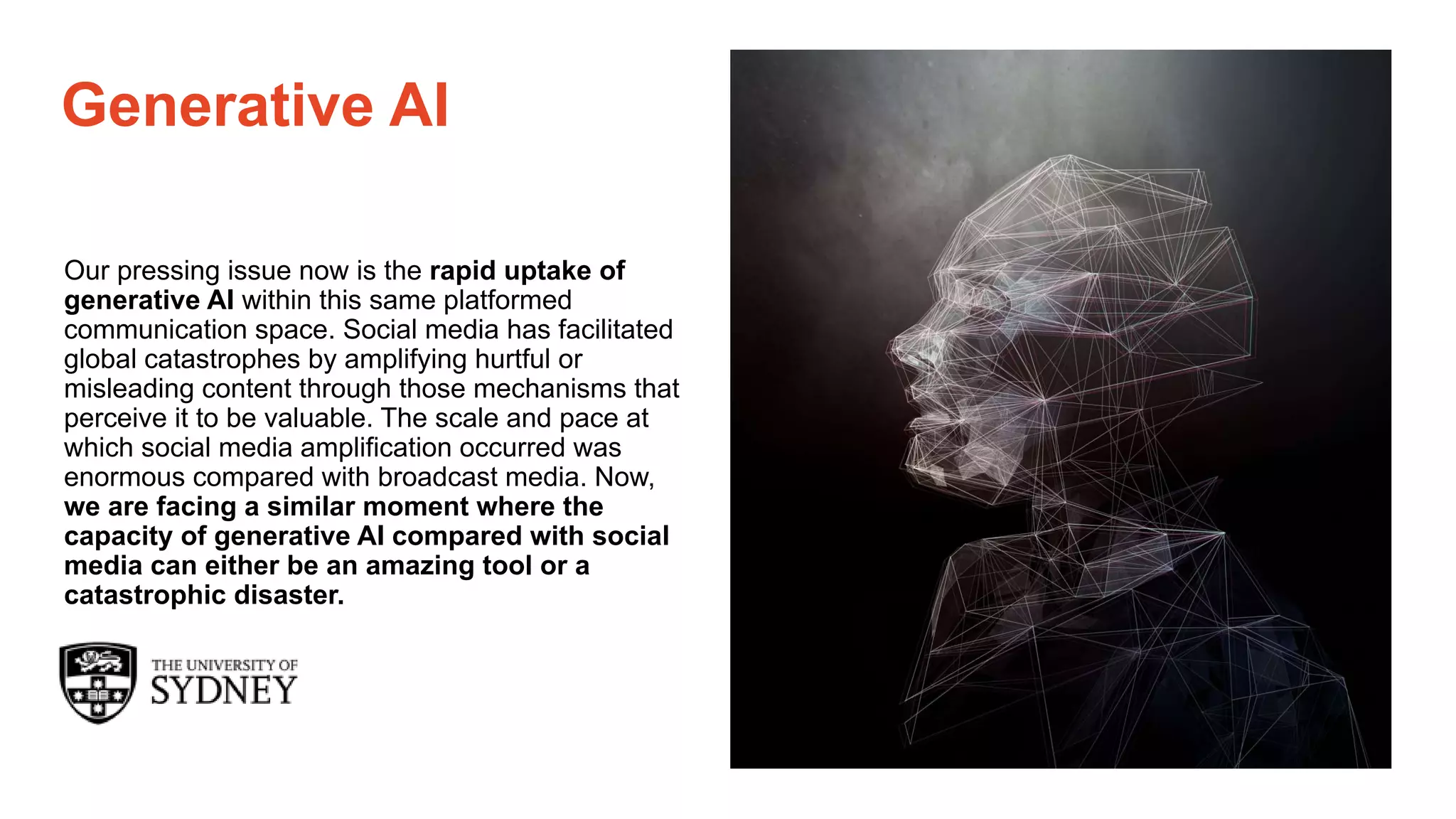
Our pressing issue now is the rapid uptake of
generative AI within this same platformed
communication space. Social media has facilitated
global catastrophes by amplifying hurtful or
misleading content through those mechanisms that
perceive it to be valuable. The scale and pace at
which social media amplification occurred was
enormous compared with broadcast media. Now,
we are facing a similar moment where the
capacity of generative AI compared with social
media can either be an amazing tool or a
catastrophic disaster.
Page 19
The University of Sydney
Generative AI
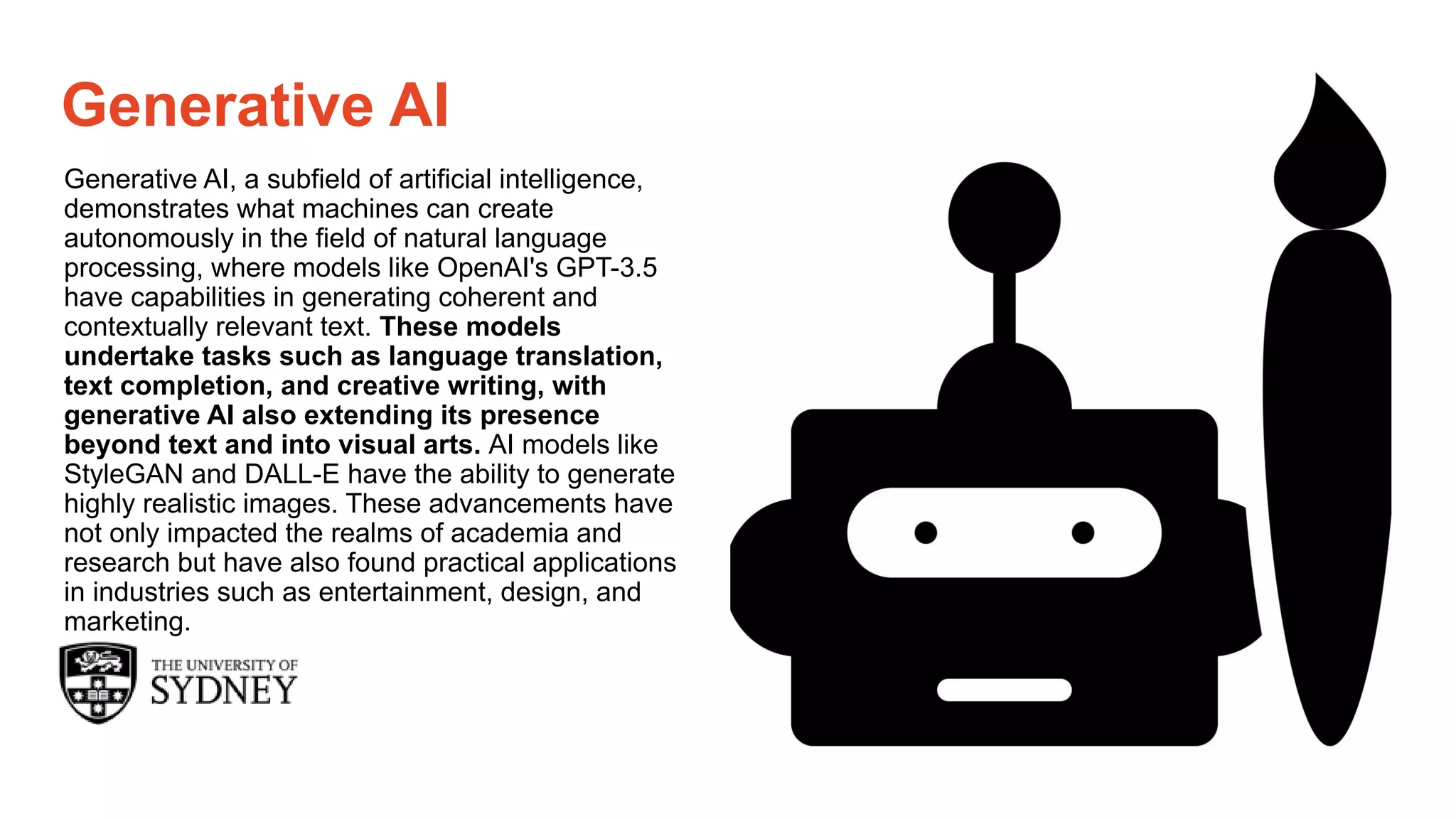
Generative AI, a subfield of artificial intelligence,
demonstrates what machines can create
autonomously in the field of natural language
processing, where models like OpenAI's GPT-3.5
have capabilities in generating coherent and
contextually relevant text. These models
undertake tasks such as language translation,
text completion, and creative writing, with
generative AI also extending its presence
beyond text and into visual arts. AI models like
StyleGAN and DALL-E have the ability to generate
highly realistic images. These advancements have
not only impacted the realms of academia and
research but have also found practical applications
in industries such as entertainment, design, and
marketing.
Page 20
The University of Sydney
Wild West (again) in Media Technology
“You consent to Zoom’s access, use,
collection, creation, modification,
distribution, processing, sharing,
maintenance, and storage of Service
Generated Data for any purpose, to the
extent and in the manner permitted under
applicable Law, including for the purpose
of product and service development,
marketing, analytics, quality assurance,
machine learning or artificial intelligence
(including for the purposes of training
and tuning of algorithms and models),
training, testing, improvement of the
Services, Software, or Zoom’s other
products, services, and software, or any
combination thereof, and as otherwise
provided in this Agreement.”
Zoom, Terms of Service, Section 10.2
Page 21
The University of Sydney
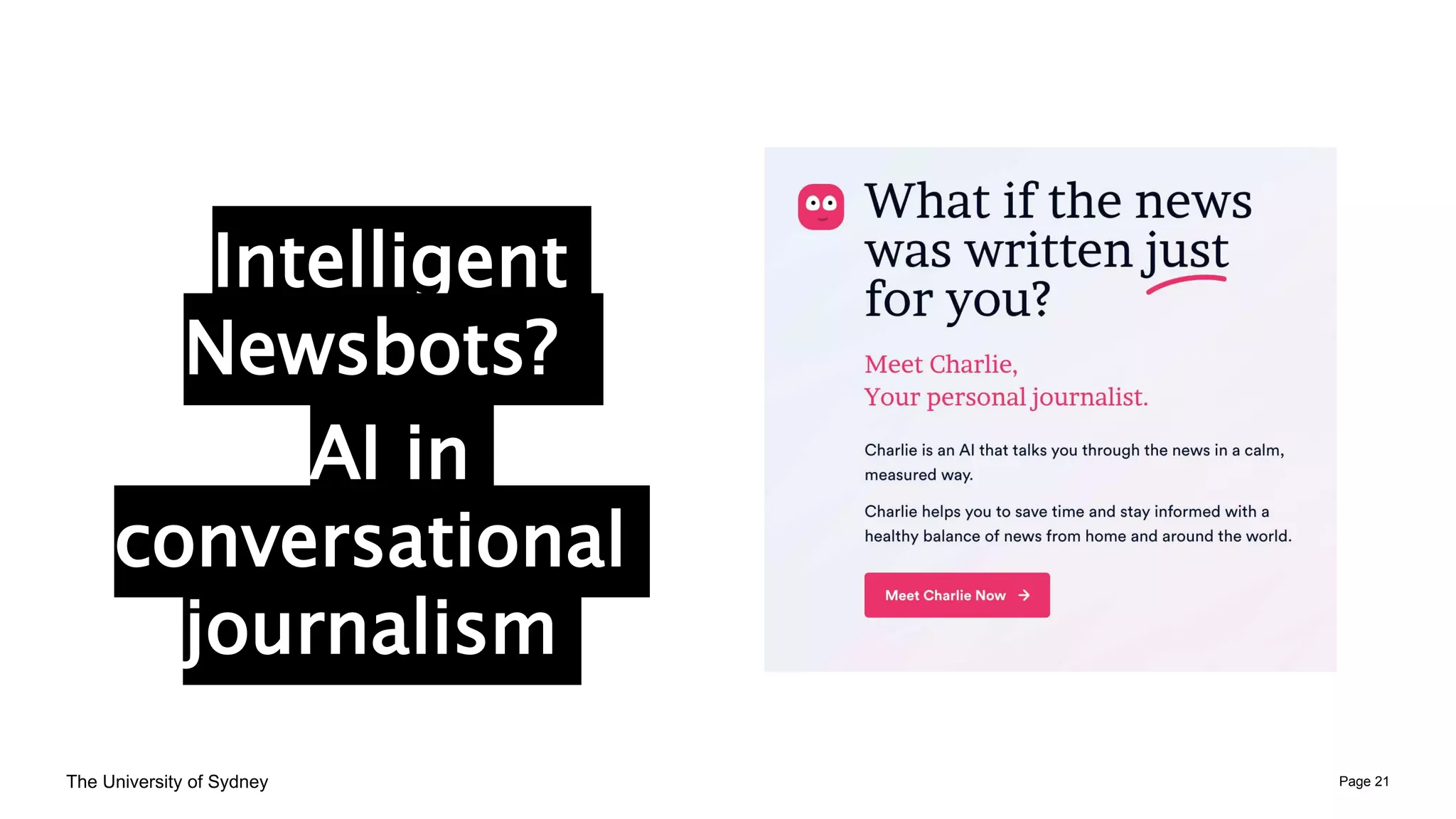
–Intelligent
Newsbots?
–AI in
conversational
journalism
Page 22
The University of Sydney
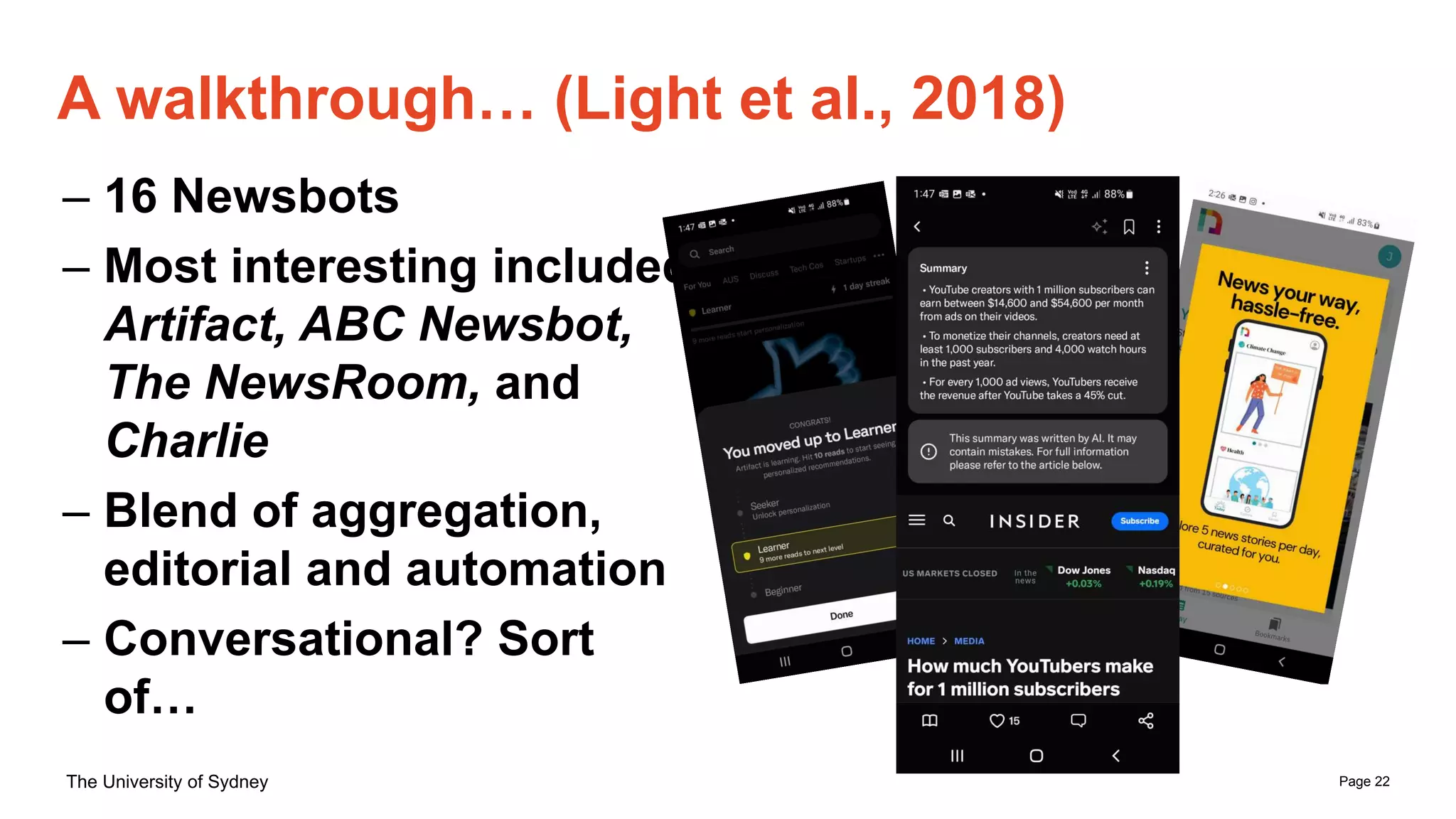
A walkthrough… (Light et al., 2018)
– 16 Newsbots
– Most interesting included
Artifact, ABC Newsbot,
The NewsRoom, and
Charlie
– Blend of aggregation,
editorial and automation
– Conversational? Sort
of…
Page 23
The University of Sydney
There remains a gap in ‘conversational’
journalism
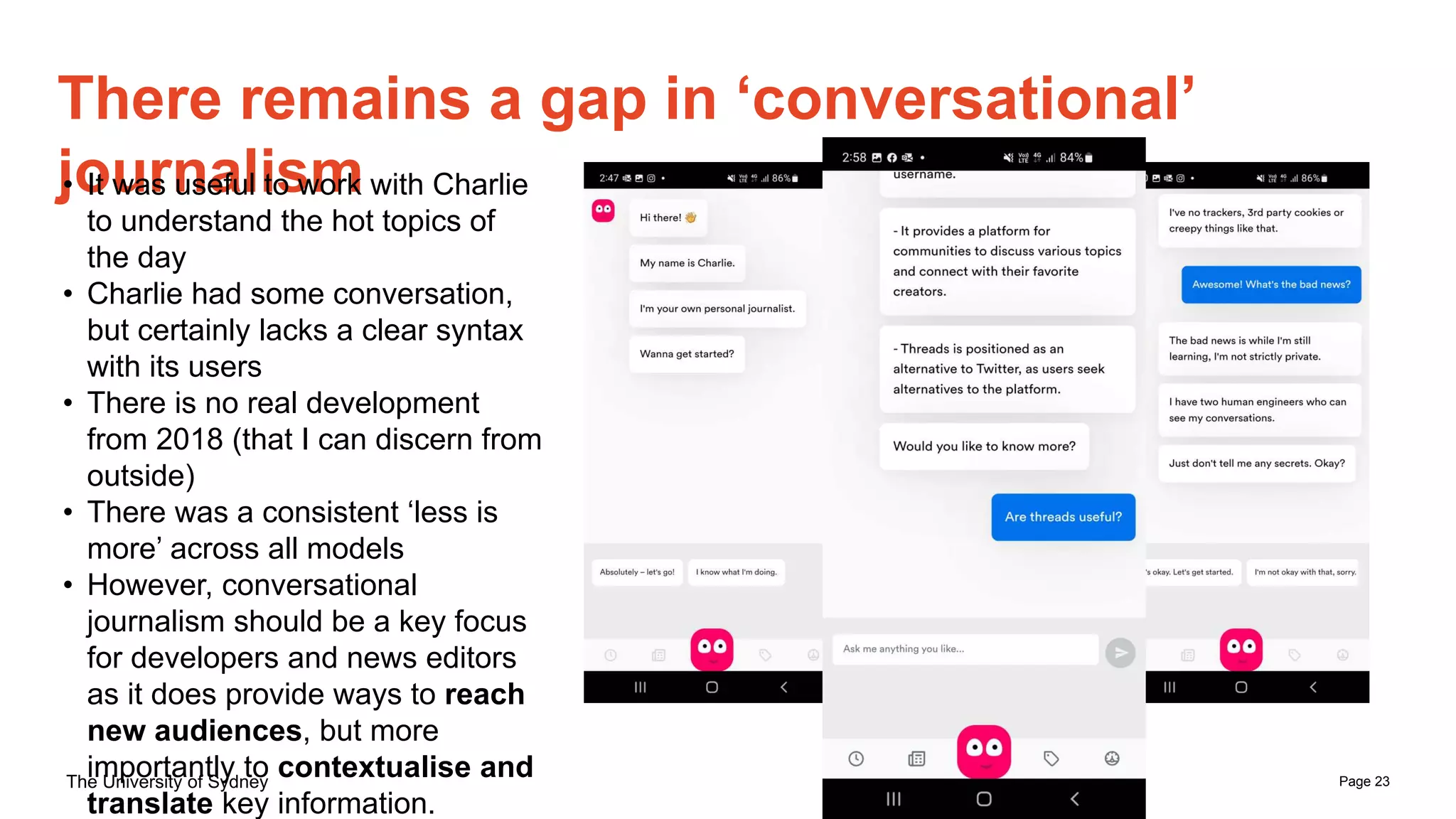
• It was useful to work with Charlie
to understand the hot topics of
the day
• Charlie had some conversation,
but certainly lacks a clear syntax
with its users
• There is no real development
from 2018 (that I can discern from
outside)
• There was a consistent ‘less is
more’ across all models
• However, conversational
journalism should be a key focus
for developers and news editors
as it does provide ways to reach
new audiences, but more
importantly to contextualise and
translate key information.
Page 24
The University of Sydney
– Lack of transparency
– Built on models that are ‘black boxed’
– Ethic and moral rights are current focus
– New business models
– ‘Tech Bros’ securing their patch
– These problems are broadly the same across most
media technologies of now – (internet/social
media/platformization)
– Policy design rarely keeps step with technology
advances
Generative AI (problems?)
Page 25
The University of Sydney
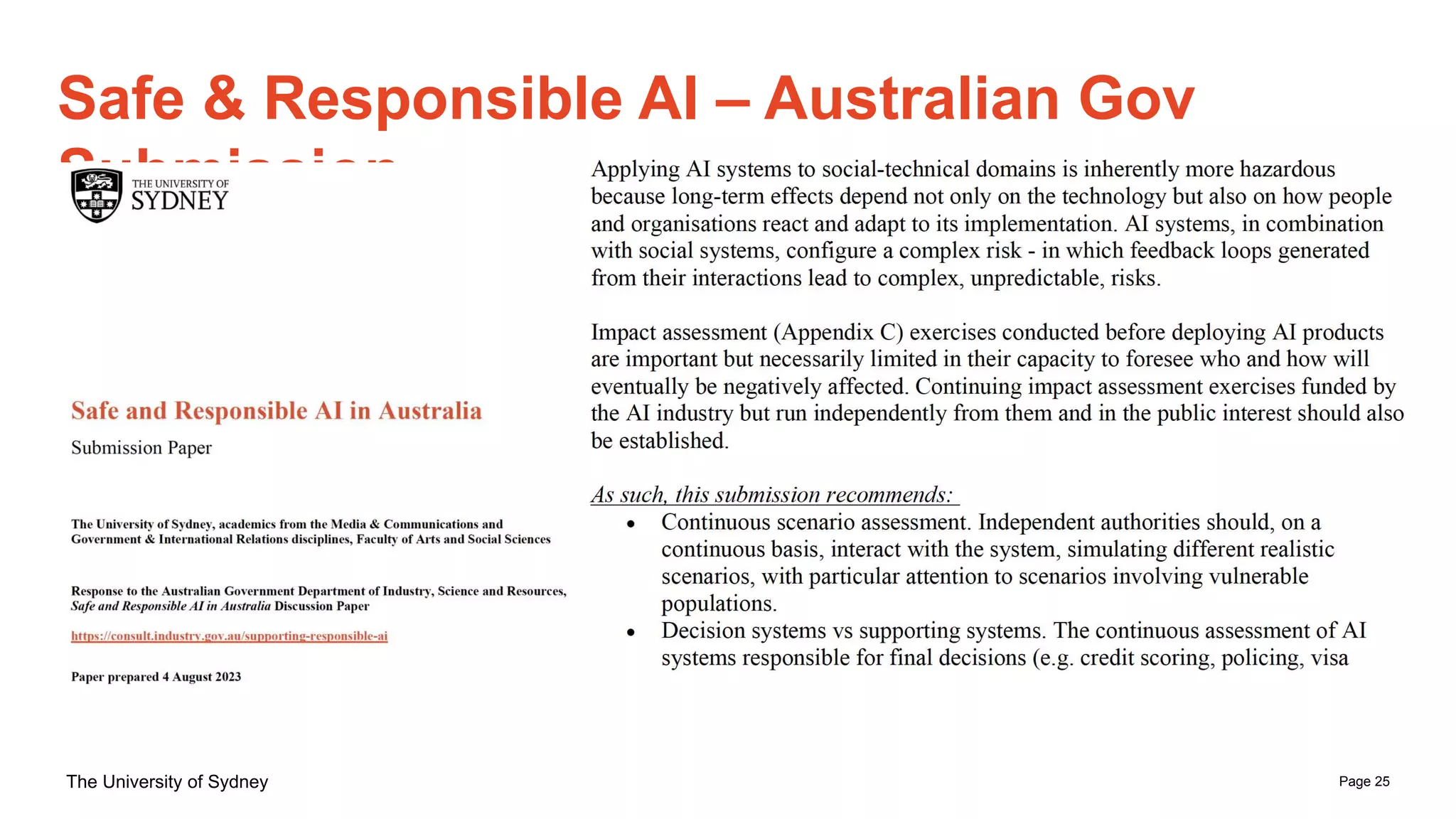
Safe & Responsible AI – Australian Gov
Submission
Page 26
The University of Sydney
What do we know? How to prevent (un)social
cohesion?
Page 27
The University of Sydney
– We have learnt the problems from the internet, Web 2.0,
social media, and platformisation. How is generative AI
any different?
– Moral rights are the start, but it is much more deeper than
this (policy and regulation that understands
technology)
– Digital intermediation sits at the heart of this dilemma
– Answers may be present in not only greater transparency,
but increased user agency in these spaces
– Increased user agency is critical for civic algorithms and
its development
– This work may also be at the heart of cultural
institutions
Conclusions
The University of Sydney
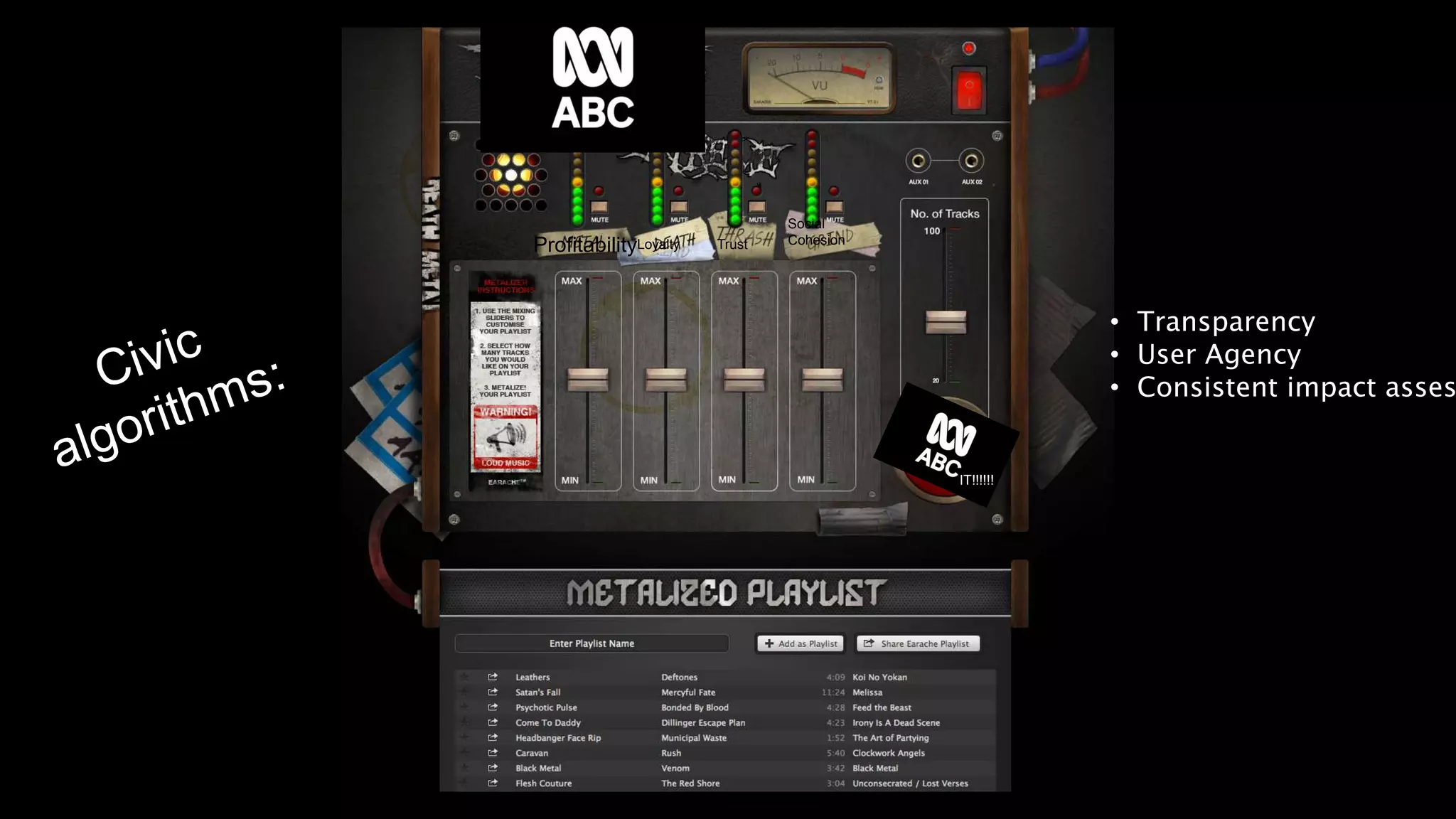
Public service media have charters that oblige them to educate, inform, and sustain
social cohesion, and an ongoing challenge for public service media is interpreting their
mission in the light of contemporary societal and technological context. The
performance metrics by which these organisations measure the success of their
algorithmic recommendations will reflect these particular goals, name profitability,
loyalty, trust, or social cohesion
Bodó, B., Helberger, N., Eskens, S., & Möller, J. (2019, p.218).
The University of Sydney
ProfitabilityLoyalty Trust
Social
Cohesion
IT!!!!!!
• Transparency
• User Agency
• Consistent impact asses
The University of Sydney
Dr Jonathon Hutchinson
jonathon.hutchinson@sydney.edu.au
@dhutchman
Thank You

Civic Algorithms: A digital intermediation challenge

  • 1.
    Page 1 The Universityof Sydney Civic Algorithms A Digital Intermediation Challenge Dr Jonathon Hutchinson Chair of Discipline, Media & Communication University of Sydney
  • 2.
    The University ofSydney I would like to acknowledge the Ngunnawal people as the Traditional Custodians of the land upon which the University of Canberra’s main campus sits. I pay respect to all Elders past and present.
  • 3.
    The University ofSydney It’s Here! Recently published by Routledge.
  • 4.
  • 5.
    The University ofSydney Vince Neilstein ‘Earache’s Metalizer app automatically generates custom metal playlists that draw from all the metal available on Spotify, not just Earache releases. Users can adjust four sliders — “Metal,” “Death,” “Thrash” and “Grind,” — depending on how much of each sub-genre they want in their playlist, and then a fifth slider determining the number of tracks in the playlist. Press the “Metalize” button and a playlist materializes before your very eyes.’
  • 6.
  • 7.
    Page 7 The Universityof Sydney How might generative artificial intelligence (AI) and automation be undertaken to produce social good? Algorithmically designed decision making processes function for users to assist them in making sense of these environments as a means of assisting them to seek out content that is relevant, of interest and entertaining. Recommendations, particularly across social media, have caused anything but social cohesion and unity amongst users, and have instead spread misinformation, vitriol and hurtful media. Would our society be different had we designed systems that focused on, the wellbeing of humans instead of content that is, for the most part, popular? How can algorithms contribute to civic good/is any of this new? Today…
  • 8.
    The University ofSydney Digital intermediation (problem?)
  • 9.
    Page 9 The Universityof Sydney Digital Intermediation - Unseen infrastructures – YouTube - 450 hours of content/minute – Twitter - 500 million Tweets/day – WeChat - 1.09 billion monthly users – TikTok – Arguably the most successful? – Digital Intermediation is a process: platforms > regulation > commercial imperatives > content creators > automated calculations
  • 10.
    The University ofSydney Digital intermediation - Unseen infrastructures
  • 11.
    Page 11 The Universityof Sydney Digital intermediation - Technologies – Platforms, personal tracking devices, drones, sensors, smart devices – Interoperability: ‘interoperability is needed to support seamless and heterogeneous communications in the IoT [Internet of Things]. Achieving interoperability is vital for interconnecting multiple things together across different communication networks’ (Elkhodr, 2016, 86) – Interfaces, databases
  • 12.
    Page 12 The Universityof Sydney Digital intermediation - Agencies – Between online content producers and platforms – Multichannel Networks (MCNs) – SME: ‘built upon the technological, networking, and commercial affordances of multiple, rapidly scaling, near-frictionless, global social media platforms—for example, YouTube, Facebook, SnapChat, and Twitch’ (Cunningham, and Craig, 2016) – Genuine user engagement – A visibility strategy - to move talent from small (micro) audiences towards larger fan bases – Microplatformization (Hutchinson, 2019)
  • 13.
    Page 13 The Universityof Sydney Digital Intermediation - Automation Intelligent technologies (Thomas, 2018), bias/surveillance (Andrejevic, 2019), media literacy (Valtonen et al., 2019) Machine learning, algorithms, recommendation systems Sense-making mechanism (Wilson, 2017; Gillespie, 2016) Political power (Bucher, 2018), bias (Noble, 2018), black-boxes (Pasquale, 2015), homogeneity (Whittaker et al., 2018)
  • 14.
    The University ofSydney Content
  • 15.
    Page 15 The Universityof Sydney Content visibility - For cultural production – Cultural intermediation enables the transfer of value of media texts from one group of stakeholders to another (Bourdieu, 1984; Smith Maguire & Matthews, 2010; Hutchinson, 2017); – This value transfer now occurs across digital media devices and processes, often without the input of the user, limiting our capacity for media diversity; – Limited media diversity impacts our broader understanding of society; – Our contemporary media ecology is multi- staged, multi-faceted content production process; – The combination of agents operating in this space is the basis for digital intermediation.
  • 16.
    Page 16 The Universityof Sydney Media Diversity - Digital Ability – We simply do not understand the vastly varying digital ability of users – Australian Digital Inclusion Index (ADII): Digital Ability – ‘understood through the attitudes, skills and activities of individuals, and serve as important measures that either include or exclude users within a digital society’ (Thomas et al., 2018) – Public service media is well positioned to build digital ability and guide citizens through the digital intermediation ecology
  • 17.
    The University ofSydney Generative AI
  • 18.
    Page 18 The Universityof Sydney Generative AI Our pressing issue now is the rapid uptake of generative AI within this same platformed communication space. Social media has facilitated global catastrophes by amplifying hurtful or misleading content through those mechanisms that perceive it to be valuable. The scale and pace at which social media amplification occurred was enormous compared with broadcast media. Now, we are facing a similar moment where the capacity of generative AI compared with social media can either be an amazing tool or a catastrophic disaster.
  • 19.
    Page 19 The Universityof Sydney Generative AI Generative AI, a subfield of artificial intelligence, demonstrates what machines can create autonomously in the field of natural language processing, where models like OpenAI's GPT-3.5 have capabilities in generating coherent and contextually relevant text. These models undertake tasks such as language translation, text completion, and creative writing, with generative AI also extending its presence beyond text and into visual arts. AI models like StyleGAN and DALL-E have the ability to generate highly realistic images. These advancements have not only impacted the realms of academia and research but have also found practical applications in industries such as entertainment, design, and marketing.
  • 20.
    Page 20 The Universityof Sydney Wild West (again) in Media Technology “You consent to Zoom’s access, use, collection, creation, modification, distribution, processing, sharing, maintenance, and storage of Service Generated Data for any purpose, to the extent and in the manner permitted under applicable Law, including for the purpose of product and service development, marketing, analytics, quality assurance, machine learning or artificial intelligence (including for the purposes of training and tuning of algorithms and models), training, testing, improvement of the Services, Software, or Zoom’s other products, services, and software, or any combination thereof, and as otherwise provided in this Agreement.” Zoom, Terms of Service, Section 10.2
  • 21.
    Page 21 The Universityof Sydney –Intelligent Newsbots? –AI in conversational journalism
  • 22.
    Page 22 The Universityof Sydney A walkthrough… (Light et al., 2018) – 16 Newsbots – Most interesting included Artifact, ABC Newsbot, The NewsRoom, and Charlie – Blend of aggregation, editorial and automation – Conversational? Sort of…
  • 23.
    Page 23 The Universityof Sydney There remains a gap in ‘conversational’ journalism • It was useful to work with Charlie to understand the hot topics of the day • Charlie had some conversation, but certainly lacks a clear syntax with its users • There is no real development from 2018 (that I can discern from outside) • There was a consistent ‘less is more’ across all models • However, conversational journalism should be a key focus for developers and news editors as it does provide ways to reach new audiences, but more importantly to contextualise and translate key information.
  • 24.
    Page 24 The Universityof Sydney – Lack of transparency – Built on models that are ‘black boxed’ – Ethic and moral rights are current focus – New business models – ‘Tech Bros’ securing their patch – These problems are broadly the same across most media technologies of now – (internet/social media/platformization) – Policy design rarely keeps step with technology advances Generative AI (problems?)
  • 25.
    Page 25 The Universityof Sydney Safe & Responsible AI – Australian Gov Submission
  • 26.
    Page 26 The Universityof Sydney What do we know? How to prevent (un)social cohesion?
  • 27.
    Page 27 The Universityof Sydney – We have learnt the problems from the internet, Web 2.0, social media, and platformisation. How is generative AI any different? – Moral rights are the start, but it is much more deeper than this (policy and regulation that understands technology) – Digital intermediation sits at the heart of this dilemma – Answers may be present in not only greater transparency, but increased user agency in these spaces – Increased user agency is critical for civic algorithms and its development – This work may also be at the heart of cultural institutions Conclusions
  • 28.
    The University ofSydney Public service media have charters that oblige them to educate, inform, and sustain social cohesion, and an ongoing challenge for public service media is interpreting their mission in the light of contemporary societal and technological context. The performance metrics by which these organisations measure the success of their algorithmic recommendations will reflect these particular goals, name profitability, loyalty, trust, or social cohesion Bodó, B., Helberger, N., Eskens, S., & Möller, J. (2019, p.218).
  • 29.
    The University ofSydney ProfitabilityLoyalty Trust Social Cohesion IT!!!!!! • Transparency • User Agency • Consistent impact asses
  • 30.
    The University ofSydney Dr Jonathon Hutchinson jonathon.hutchinson@sydney.edu.au @dhutchman Thank You