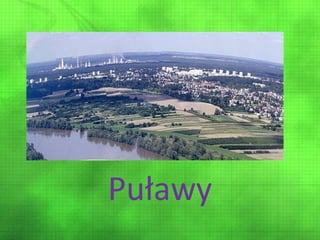
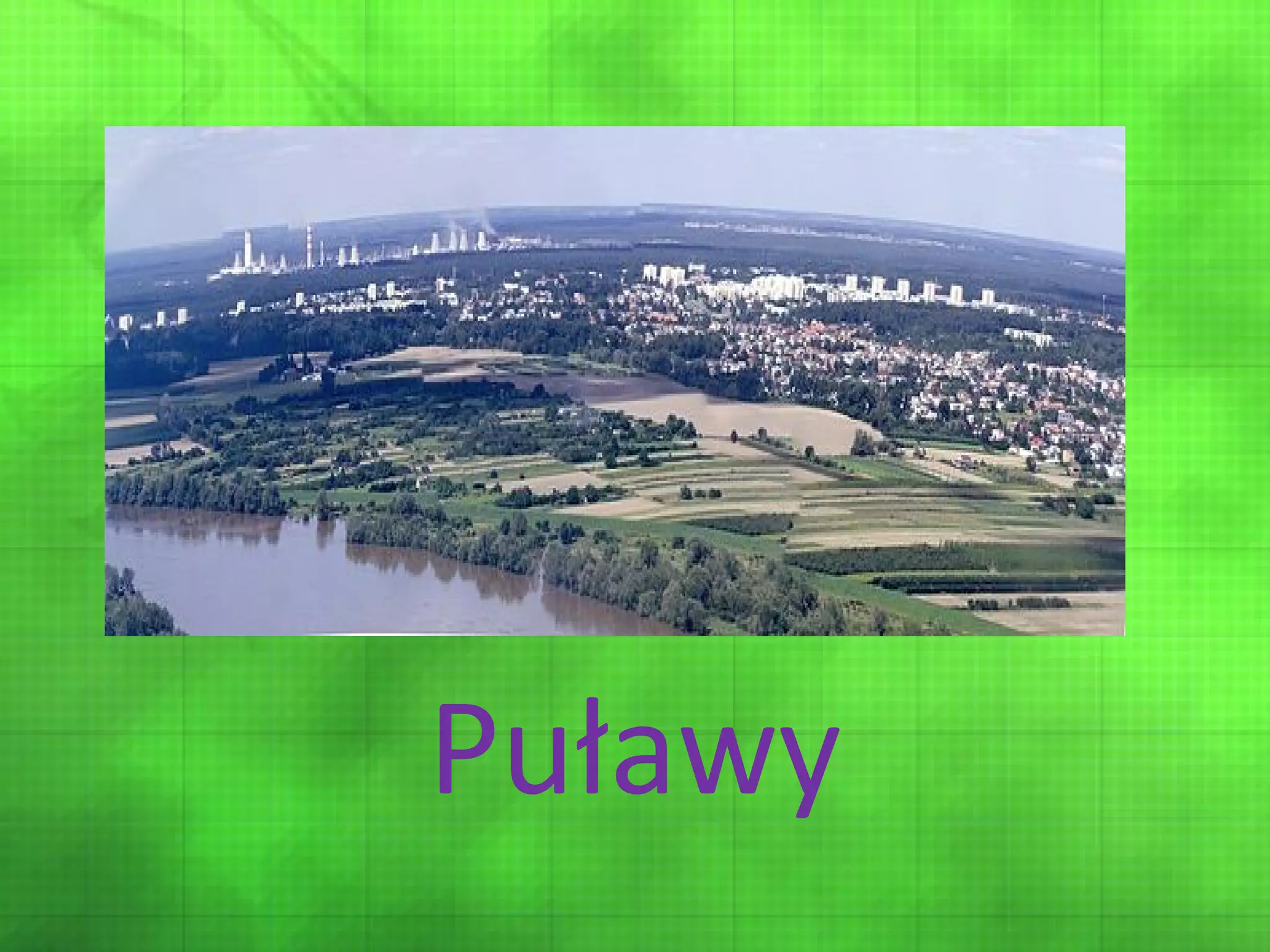
Puławy
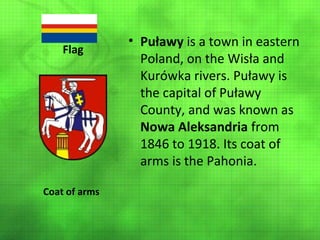
Flag

Coat of arms

• Puławy is a town in eastern
Poland, on the Wisła and
Kurówka rivers. Puławy is
the capital of Puławy
County, and was known as
Nowa Aleksandria from
1846 to 1918. Its coat of
arms is the Pahonia.
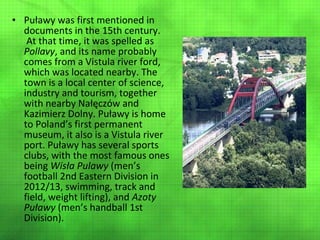
• Puławy was first mentioned in
documents in the 15th century.
At that time, it was spelled as
Pollavy, and its name probably
comes from a Vistula river ford,
which was located nearby. The
town is a local center of science,
industry and tourism, together
with nearby Nałęczów and
Kazimierz Dolny. Puławy is home
to Poland’s first permanent
museum, it also is a Vistula river
port. Puławy has several sports
clubs, with the most famous ones
being Wisła Pulawy (men’s
football 2nd Eastern Division in
2012/13, swimming, track and
field, weight lifting), and Azoty
Puławy (men’s handball 1st
Division).
History

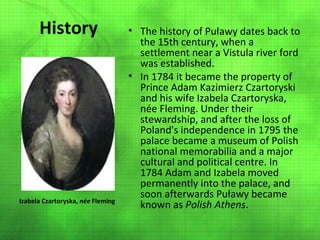
Izabela Czartoryska, née Fleming

• The history of Puławy dates back to
the 15th century, when a
settlement near a Vistula river ford
was established.
• In 1784 it became the property of
Prince Adam Kazimierz Czartoryski
and his wife Izabela Czartoryska,
née Fleming. Under their
stewardship, and after the loss of
Poland's independence in 1795 the
palace became a museum of Polish
national memorabilia and a major
cultural and political centre. In
1784 Adam and Izabela moved
permanently into the palace, and
soon afterwards Puławy became
known as Polish Athens.
Zakłady Azotowe PUŁAWY PLC
•

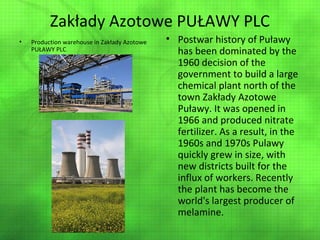
Production warehouse in Zakłady Azotowe
PUŁAWY PLC

• Postwar history of Puławy
has been dominated by the
1960 decision of the
government to build a large
chemical plant north of the
town Zakłady Azotowe
Puławy. It was opened in
1966 and produced nitrate
fertilizer. As a result, in the
1960s and 1970s Pulawy
quickly grew in size, with
new districts built for the
influx of workers. Recently
the plant has become the
world's largest producer of
melamine.
Points of
interest

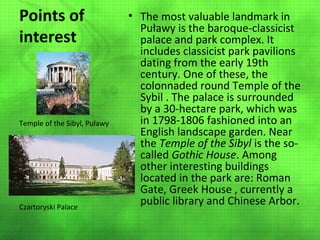
Temple of the Sibyl, Puławy

Czartoryski Palace

• The most valuable landmark in
Puławy is the baroque-classicist
palace and park complex. It
includes classicist park pavilions
dating from the early 19th
century. One of these, the
colonnaded round Temple of the
Sybil . The palace is surrounded
by a 30-hectare park, which was
in 1798-1806 fashioned into an
English landscape garden. Near
the Temple of the Sibyl is the socalled Gothic House. Among
other interesting buildings
located in the park are: Roman
Gate, Greek House , currently a
public library and Chinese Arbor.
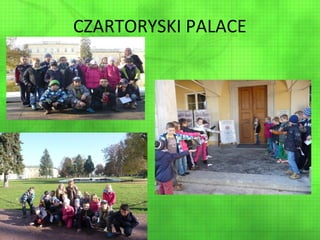
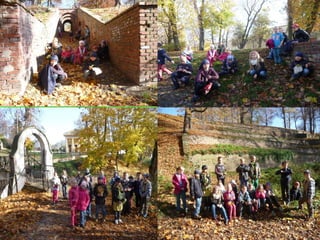
SOME PHOTOS FROM OUR
AUTUMN WALK
OCTOBER 2013
CZARTORYSKI PALACE
Park
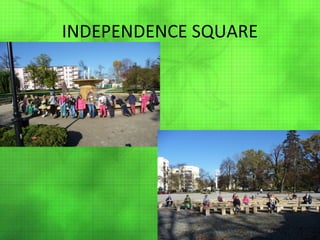
INDEPENDENCE SQUARE
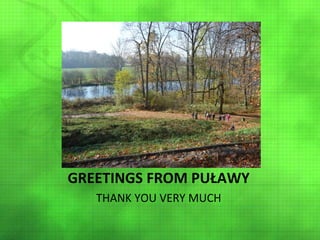
GREETINGS FROM PUŁAWY
THANK YOU VERY MUCH

Our+town

  • 1.
  • 2.
    Flag Coat of arms •Puławy is a town in eastern Poland, on the Wisła and Kurówka rivers. Puławy is the capital of Puławy County, and was known as Nowa Aleksandria from 1846 to 1918. Its coat of arms is the Pahonia.
  • 3.
    • Puławy wasfirst mentioned in documents in the 15th century. At that time, it was spelled as Pollavy, and its name probably comes from a Vistula river ford, which was located nearby. The town is a local center of science, industry and tourism, together with nearby Nałęczów and Kazimierz Dolny. Puławy is home to Poland’s first permanent museum, it also is a Vistula river port. Puławy has several sports clubs, with the most famous ones being Wisła Pulawy (men’s football 2nd Eastern Division in 2012/13, swimming, track and field, weight lifting), and Azoty Puławy (men’s handball 1st Division).
  • 4.
    History Izabela Czartoryska, néeFleming • The history of Puławy dates back to the 15th century, when a settlement near a Vistula river ford was established. • In 1784 it became the property of Prince Adam Kazimierz Czartoryski and his wife Izabela Czartoryska, née Fleming. Under their stewardship, and after the loss of Poland's independence in 1795 the palace became a museum of Polish national memorabilia and a major cultural and political centre. In 1784 Adam and Izabela moved permanently into the palace, and soon afterwards Puławy became known as Polish Athens.
  • 5.
    Zakłady Azotowe PUŁAWYPLC • Production warehouse in Zakłady Azotowe PUŁAWY PLC • Postwar history of Puławy has been dominated by the 1960 decision of the government to build a large chemical plant north of the town Zakłady Azotowe Puławy. It was opened in 1966 and produced nitrate fertilizer. As a result, in the 1960s and 1970s Pulawy quickly grew in size, with new districts built for the influx of workers. Recently the plant has become the world's largest producer of melamine.
  • 6.
    Points of interest Temple ofthe Sibyl, Puławy Czartoryski Palace • The most valuable landmark in Puławy is the baroque-classicist palace and park complex. It includes classicist park pavilions dating from the early 19th century. One of these, the colonnaded round Temple of the Sybil . The palace is surrounded by a 30-hectare park, which was in 1798-1806 fashioned into an English landscape garden. Near the Temple of the Sibyl is the socalled Gothic House. Among other interesting buildings located in the park are: Roman Gate, Greek House , currently a public library and Chinese Arbor.
  • 7.
    SOME PHOTOS FROMOUR AUTUMN WALK OCTOBER 2013
  • 8.
  • 9.
  • 11.
  • 13.