SUMMER
SCHOOL
CURIOSITIES
SUMMER SCHOOL OF CREATIVITY IN PIRAN SLOVENIA
http://sporocilovsteklenici.blogspot.com/2014/01/su
mmer-school-of-creativity.html
ONCE UPON A TIME...
The earliest reliable records of the area are in the 7th
century work Cosmographia by an anonymous cleric of
Ravenna. The name of the town most probably originates
from the Greek "pyrranos", which means "red", because of
the reddish flysch stones commonly found in the town's
area.
In the pre-Roman era, the hills in the Piran area were
inhabited by Illyrian Histri tribes who were farmers,
hunters and fishermen. They were also pirates who
disrupted Roman trade in the north Adriatic Sea. By 952,
Piran had become a part of the Holy Roman Empire. By the
7th century, under Byzantine rule, Piran had become
heavily fortified.
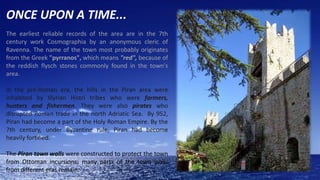
The Piran town walls were constructed to protect the town
from Ottoman incursions; many parts of the town walls
from different eras remain.
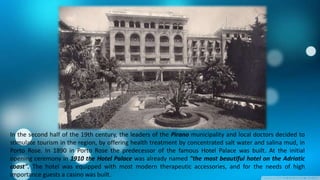
In the second half of the 19th century, the leaders of the Pirano municipality and local doctors decided to
stimulate tourism in the region, by offering health treatment by concentrated salt water and salina mud, in
Porto Rose. In 1890 in Porto Rose the predecessor of the famous Hotel Palace was built. At the initial
opening ceremony in 1910 the Hotel Palace was already named "the most beautiful hotel on the Adriatic
coast". The hotel was equipped with most modern therapeutic accessories, and for the needs of high
importance guests a casino was built.
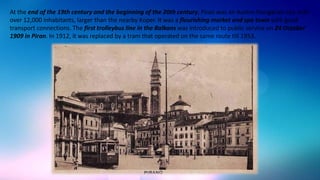
At the end of the 19th century and the beginning of the 20th century, Piran was an Austro-Hungarian city with
over 12,000 inhabitants, larger than the nearby Koper. It was a flourishing market and spa town with good
transport connections. The first trolleybus line in the Balkans was introduced to public service on 24 October
1909 in Piran. In 1912, it was replaced by a tram that operated on the same route till 1953.
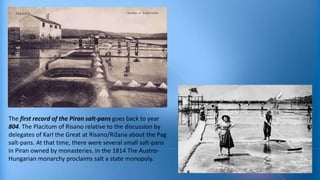
The first record of the Piran salt-pans goes back to year
804. The Placitum of Risano relative to the discussion by
delegates of Karl the Great at Risano/Rižana about the Pag
salt-pans. At that time, there were several small salt-pans
in Piran owned by monasteries. In the 1814 The AustroHungarian monarchy proclaims salt a state monopoly.
TODAY...
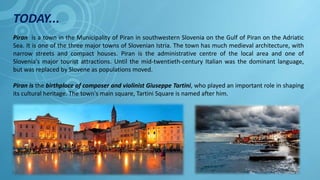
Piran is a town in the Municipality of Piran in southwestern Slovenia on the Gulf of Piran on the Adriatic
Sea. It is one of the three major towns of Slovenian Istria. The town has much medieval architecture, with
narrow streets and compact houses. Piran is the administrative centre of the local area and one of
Slovenia's major tourist attractions. Until the mid-twentieth-century Italian was the dominant language,
but was replaced by Slovene as populations moved.
Piran is the birthplace of composer and violinist Giuseppe Tartini, who played an important role in shaping
its cultural heritage. The town's main square, Tartini Square is named after him.
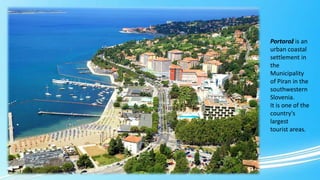
Portorož is an
urban coastal
settlement in
the
Municipality
of Piran in the
southwestern
Slovenia.
It is one of the
country's
largest
tourist areas.
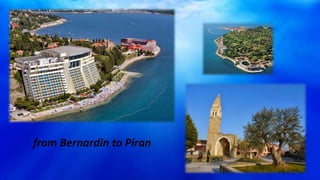
from Bernardin to Piran
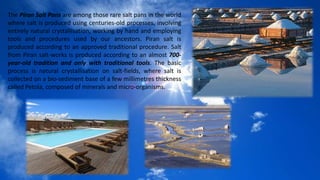
The Piran Salt Pans are among those rare salt pans in the world
where salt is produced using centuries-old processes, involving
entirely natural crystallisation, working by hand and employing
tools and procedures used by our ancestors. Piran salt is
produced according to an approved traditional procedure. Salt
from Piran salt-works is produced according to an almost 700year-old tradition and only with traditional tools. The basic
process is natural crystallisation on salt-fields, where salt is
collected on a bio-sediment base of a few millimetres thickness
called Petola, composed of minerals and micro-organisms.
JOIN US THIS SUMMER!
http://sporocilovsteklenici.blogspot.c
om/2014/01/summer-school-ofcreativity.html

Summer school curiosities

  • 1.
    SUMMER SCHOOL CURIOSITIES SUMMER SCHOOL OFCREATIVITY IN PIRAN SLOVENIA http://sporocilovsteklenici.blogspot.com/2014/01/su mmer-school-of-creativity.html
  • 2.
    ONCE UPON ATIME... The earliest reliable records of the area are in the 7th century work Cosmographia by an anonymous cleric of Ravenna. The name of the town most probably originates from the Greek "pyrranos", which means "red", because of the reddish flysch stones commonly found in the town's area. In the pre-Roman era, the hills in the Piran area were inhabited by Illyrian Histri tribes who were farmers, hunters and fishermen. They were also pirates who disrupted Roman trade in the north Adriatic Sea. By 952, Piran had become a part of the Holy Roman Empire. By the 7th century, under Byzantine rule, Piran had become heavily fortified. The Piran town walls were constructed to protect the town from Ottoman incursions; many parts of the town walls from different eras remain.
  • 3.
    In the secondhalf of the 19th century, the leaders of the Pirano municipality and local doctors decided to stimulate tourism in the region, by offering health treatment by concentrated salt water and salina mud, in Porto Rose. In 1890 in Porto Rose the predecessor of the famous Hotel Palace was built. At the initial opening ceremony in 1910 the Hotel Palace was already named "the most beautiful hotel on the Adriatic coast". The hotel was equipped with most modern therapeutic accessories, and for the needs of high importance guests a casino was built.
  • 4.
    At the endof the 19th century and the beginning of the 20th century, Piran was an Austro-Hungarian city with over 12,000 inhabitants, larger than the nearby Koper. It was a flourishing market and spa town with good transport connections. The first trolleybus line in the Balkans was introduced to public service on 24 October 1909 in Piran. In 1912, it was replaced by a tram that operated on the same route till 1953.
  • 5.
    The first recordof the Piran salt-pans goes back to year 804. The Placitum of Risano relative to the discussion by delegates of Karl the Great at Risano/Rižana about the Pag salt-pans. At that time, there were several small salt-pans in Piran owned by monasteries. In the 1814 The AustroHungarian monarchy proclaims salt a state monopoly.
  • 6.
    TODAY... Piran is atown in the Municipality of Piran in southwestern Slovenia on the Gulf of Piran on the Adriatic Sea. It is one of the three major towns of Slovenian Istria. The town has much medieval architecture, with narrow streets and compact houses. Piran is the administrative centre of the local area and one of Slovenia's major tourist attractions. Until the mid-twentieth-century Italian was the dominant language, but was replaced by Slovene as populations moved. Piran is the birthplace of composer and violinist Giuseppe Tartini, who played an important role in shaping its cultural heritage. The town's main square, Tartini Square is named after him.
  • 7.
    Portorož is an urbancoastal settlement in the Municipality of Piran in the southwestern Slovenia. It is one of the country's largest tourist areas.
  • 8.
  • 9.
    The Piran SaltPans are among those rare salt pans in the world where salt is produced using centuries-old processes, involving entirely natural crystallisation, working by hand and employing tools and procedures used by our ancestors. Piran salt is produced according to an approved traditional procedure. Salt from Piran salt-works is produced according to an almost 700year-old tradition and only with traditional tools. The basic process is natural crystallisation on salt-fields, where salt is collected on a bio-sediment base of a few millimetres thickness called Petola, composed of minerals and micro-organisms.
  • 10.
    JOIN US THISSUMMER! http://sporocilovsteklenici.blogspot.c om/2014/01/summer-school-ofcreativity.html