Crimean Federal University
Medical Academy Named after S.I Georgegivsky
Culdocentesis
NAME : PAVAN BAROT
GROUP:509
IN GUIDANCE OF : IRINA PAPOVA MA’AM
What is Culdocentesis
•Culdocentesis is a procedure in which
peritoneal fluid is obtained from the cul
de sac of a female patient.
•Cul de sac literally translated in French
“ bottom of sac “
•In medical term it is called “ Retrouterus
peritoneal pouch” or “ Douglas pouch”
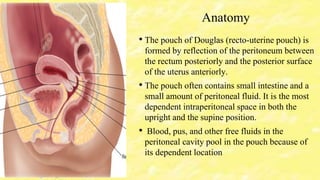
Anatomy
• The pouch of Douglas (recto-uterine pouch) is
formed by reflection of the peritoneum between
the rectum posteriorly and the posterior surface
of the uterus anteriorly.
• The pouch often contains small intestine and a
small amount of peritoneal fluid. It is the most
dependent intraperitoneal space in both the
upright and the supine position.
• Blood, pus, and other free fluids in the
peritoneal cavity pool in the pouch because of
its dependent location
Indications
•In the current practice with easy access to
ultrasonography, culdocentesis is rarely
performed for most of the indications below.
•suspected ruptured ectopic pregnancy in
the following clinical situations:
•Hemodynamically unstable patients when
ultrasonography is not immediately
available
•When ultrasonography or laparoscopy is
not available
•In place of diagnostic peritoneal lavage to
detect hemoperitoneum
•To diagnose ruptured ovarian cysts in
patients with sudden onset of pelvic pain.
•To obtain fluid for culture to aid in the
diagnosis and treatment of pelvic
inflammatory disease (PID).
•For diagnosis and treatment of ascites
Indications
Contraindications
• Pelvic mass : ovarian tumors, tubo-ovarian abscesses,
appendiceal abscesses, and pelvic kidney
• Fixed retroverted uterus.
• Coagulopathy
• Prepubescence: procedure would be difficult to perform
through a small prepubertal vagina.
• Noncooperative patient
Anesthesia
•Lidocaine (1-2%) with epinephrine is injected
into the vaginal mucosa of the posterior fornix in
the midline about 1 cm inferior to the point at
which the posterior vaginal wall joins the cervix.
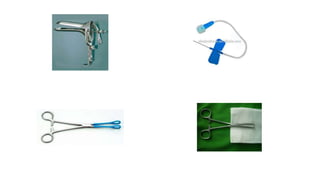
Equipments
• Bivalve vaginal speculum (Graves or Pederson)
• Tenaculum or Allis clamp
• Ring forceps
• Spinal needle, 18 gauge (ga)
• Monsel solution (ferric subsulfate) for hemostasis
• Butterfly needle, 19 ga
• Needle, 25 ga, 1 inch
• Antiseptic (eg, povidone-iodine solution [Betadine])
• Lidocaine (1-2%) with epinephrine
• Specimen container
• Light source
Positioning
• Allow the patient to walk or sit up for a short
time prior to the procedure to allow gravity to
help bring the peritoneal fluid to the cul de sac.
• Place the patient in dorsal lithotomy position
with the feet in stirrups. Elevating the head of
the bed helps the intraperitoneal fluid gravitate
to the retroperitoneal pouch for easier
aspiration.
Procedure
1. Obtain informed consent prior to the procedure.
2. Premedicate with narcotics or sedatives as needed.
3. Radiographs, when indicated in stable patients, are taken prior to culdocentesis
to avoid possible confusion if a pneumoperitoneum is detected following the
procedure.
4. Perform bimanual pelvic examination to rule out a fixed pelvic mass and to
assess the position of the uterus prior to culdocentesis.
5. A bulging of the cul de sac into the posterior fornix suggests pooling of
intraperitoneal fluid.
Prepare the vagina with povidone-iodine solution.
Place the patient in dorsal lithotomy position with the feet in stirrups. Elevate the
head of the bed.
Insert a bivalve vaginal speculum into the vagina
 grasp the posterior lip of cervix with a tenaculum or ring forceps. In patients with
retroverted uterus, anterior tenaculum placement is preferred, as it helps straighten the
uterus.
The patient should be forewarned that grasping the cervix with the tenaculum will be
painful. Some practitioners inject the tenaculum site with local anesthetic.
Open the speculum as wide as the patient can tolerate to expose the posterior fornix
and stretch the vaginal mucosa taut, making the procedure easier.
• Attach an 18-ga spinal needle to a 20-mL syringe with 2-3 mL normal saline and
injecting 0.5-1 mL of saline through the point of lidocaine infiltration between the
uterosacral ligaments in the posterior fornix.
• If the puncture site is too high, the needle hits the substance of the cervix or uterus. If
it is placed too low, the needle may enter the rectum or tunnel beneath the posterior
peritoneum of the cul de sac.
• The spinal needle is inserted parallel to the lower blade of the speculum.
• Free flow of saline confirms the correct placement of the needle in the cul de sac. It
may otherwise be within the wall of the uterus or intestine.
• In that case, withdraw and redirect the tip of the needle until saline flows freely upon
injection.
• Apply negative pressure (pull back the syringe plunger) while slowly
withdrawing the needle.
• Avoid aspirating any blood that has accumulated in the vagina from
previous needle punctures or from cervical bleeding because this may
give the false impression of a positive culdocentesis.
• If no fluid is withdrawn, withdraw the needle and reintroduce it, directing
slightly to the left or right of the midline.
• Avoid directing the needle too far laterally, which can result in the puncture
of a mesenteric or pelvic vessel.
Assessment
• normal culdocentesis result
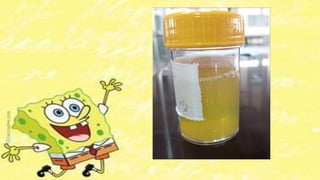
• A normal culdocentesis result in the absence of pathology should yield only
2-4 mL of clear to straw-colored peritoneal fluid.
• Nondiagnostic result
• A dry tap (return of no fluid) has no diagnostic value; the needle may
simply not have found the pool of fluid.
• Aspiration of less than 2 mL of clotted blood is nondiagnostic; this
blood might have come from the vessel at the puncture site of the vaginal
wall.
Positive result
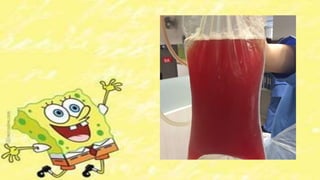
• A positive tap is one in which more than 2 mL of nonclotting blood is obtained.
Absolute volume may be related to the needle position or the rate of bleeding, so larger
amounts of blood have no particular significance.
• A positive culdocentesis result in the presence of ectopic pregnancy does not necessary
indicate tubal rupture.
• Intraperitoneal blood from a source other than ectopic pregnancy (eg, ovarian cyst,
ruptured spleen) may remain unclotted after aspiration for days in the syringe as a
result of the defibrination activity of the peritoneum.
• Hemoperitoneum has been noted to occur in unruptured ectopic pregnancy proved at
surgery.
• A positive culdocentesis result can also occur in nonpregnant women (eg, retrograde
menstruation).
Negative result
• A culdocentesis is considered negative when the aspirated fluid is pus, cystic, or
straw-colored.
• Purulent fluid indicates infection. Pelvic inflammatory disease is the most common
gynecological cause, but nongynecological causes such
as diverticulitis and appendicitis should also be considered in the differential
diagnosis.
• Rarely, greasy or fatty fluid is obtained during culdocentesis. Such fluid is from a
ruptured teratoma.
• A false-negative result is produced in 15% of ectopic pregnancies; these pregnancies
are generally unruptured.
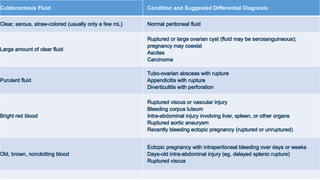
Culdocentesis Fluid Condition and Suggested Differential Diagnosis
Clear, serous, straw-colored (usually only a few mL) Normal peritoneal fluid
Large amount of clear fluid
Ruptured or large ovarian cyst (fluid may be serosanguineous);
pregnancy may coexist
Ascites
Carcinoma
Purulent fluid
Tubo-ovarian abscess with rupture
Appendicitis with rupture
Diverticulitis with perforation
Bright red blood
Ruptured viscus or vascular injury
Bleeding corpus luteum
Intra-abdominal injury involving liver, spleen, or other organs
Ruptured aortic aneurysm
Recently bleeding ectopic pregnancy (ruptured or unruptured)
Old, brown, nonclotting blood
Ectopic pregnancy with intraperitoneal bleeding over days or weeks
Days-old intra-abdominal injury (eg, delayed splenic rupture)
Ruptured viscus
Thank You ! ;)

Culdocentesis

  • 1.
    Crimean Federal University MedicalAcademy Named after S.I Georgegivsky Culdocentesis NAME : PAVAN BAROT GROUP:509 IN GUIDANCE OF : IRINA PAPOVA MA’AM
  • 2.
    What is Culdocentesis •Culdocentesisis a procedure in which peritoneal fluid is obtained from the cul de sac of a female patient. •Cul de sac literally translated in French “ bottom of sac “ •In medical term it is called “ Retrouterus peritoneal pouch” or “ Douglas pouch”
  • 3.
    Anatomy • The pouchof Douglas (recto-uterine pouch) is formed by reflection of the peritoneum between the rectum posteriorly and the posterior surface of the uterus anteriorly. • The pouch often contains small intestine and a small amount of peritoneal fluid. It is the most dependent intraperitoneal space in both the upright and the supine position. • Blood, pus, and other free fluids in the peritoneal cavity pool in the pouch because of its dependent location
  • 4.
    Indications •In the currentpractice with easy access to ultrasonography, culdocentesis is rarely performed for most of the indications below. •suspected ruptured ectopic pregnancy in the following clinical situations: •Hemodynamically unstable patients when ultrasonography is not immediately available •When ultrasonography or laparoscopy is not available
  • 5.
    •In place ofdiagnostic peritoneal lavage to detect hemoperitoneum •To diagnose ruptured ovarian cysts in patients with sudden onset of pelvic pain. •To obtain fluid for culture to aid in the diagnosis and treatment of pelvic inflammatory disease (PID). •For diagnosis and treatment of ascites Indications
  • 6.
    Contraindications • Pelvic mass: ovarian tumors, tubo-ovarian abscesses, appendiceal abscesses, and pelvic kidney • Fixed retroverted uterus. • Coagulopathy • Prepubescence: procedure would be difficult to perform through a small prepubertal vagina. • Noncooperative patient
  • 7.
    Anesthesia •Lidocaine (1-2%) withepinephrine is injected into the vaginal mucosa of the posterior fornix in the midline about 1 cm inferior to the point at which the posterior vaginal wall joins the cervix.
  • 8.
    Equipments • Bivalve vaginalspeculum (Graves or Pederson) • Tenaculum or Allis clamp • Ring forceps • Spinal needle, 18 gauge (ga) • Monsel solution (ferric subsulfate) for hemostasis • Butterfly needle, 19 ga • Needle, 25 ga, 1 inch • Antiseptic (eg, povidone-iodine solution [Betadine]) • Lidocaine (1-2%) with epinephrine • Specimen container • Light source
  • 10.
    Positioning • Allow thepatient to walk or sit up for a short time prior to the procedure to allow gravity to help bring the peritoneal fluid to the cul de sac. • Place the patient in dorsal lithotomy position with the feet in stirrups. Elevating the head of the bed helps the intraperitoneal fluid gravitate to the retroperitoneal pouch for easier aspiration.
  • 11.
    Procedure 1. Obtain informedconsent prior to the procedure. 2. Premedicate with narcotics or sedatives as needed. 3. Radiographs, when indicated in stable patients, are taken prior to culdocentesis to avoid possible confusion if a pneumoperitoneum is detected following the procedure. 4. Perform bimanual pelvic examination to rule out a fixed pelvic mass and to assess the position of the uterus prior to culdocentesis. 5. A bulging of the cul de sac into the posterior fornix suggests pooling of intraperitoneal fluid.
  • 14.
    Prepare the vaginawith povidone-iodine solution. Place the patient in dorsal lithotomy position with the feet in stirrups. Elevate the head of the bed. Insert a bivalve vaginal speculum into the vagina  grasp the posterior lip of cervix with a tenaculum or ring forceps. In patients with retroverted uterus, anterior tenaculum placement is preferred, as it helps straighten the uterus. The patient should be forewarned that grasping the cervix with the tenaculum will be painful. Some practitioners inject the tenaculum site with local anesthetic. Open the speculum as wide as the patient can tolerate to expose the posterior fornix and stretch the vaginal mucosa taut, making the procedure easier.
  • 16.
    • Attach an18-ga spinal needle to a 20-mL syringe with 2-3 mL normal saline and injecting 0.5-1 mL of saline through the point of lidocaine infiltration between the uterosacral ligaments in the posterior fornix. • If the puncture site is too high, the needle hits the substance of the cervix or uterus. If it is placed too low, the needle may enter the rectum or tunnel beneath the posterior peritoneum of the cul de sac. • The spinal needle is inserted parallel to the lower blade of the speculum. • Free flow of saline confirms the correct placement of the needle in the cul de sac. It may otherwise be within the wall of the uterus or intestine. • In that case, withdraw and redirect the tip of the needle until saline flows freely upon injection.
  • 18.
    • Apply negativepressure (pull back the syringe plunger) while slowly withdrawing the needle. • Avoid aspirating any blood that has accumulated in the vagina from previous needle punctures or from cervical bleeding because this may give the false impression of a positive culdocentesis. • If no fluid is withdrawn, withdraw the needle and reintroduce it, directing slightly to the left or right of the midline. • Avoid directing the needle too far laterally, which can result in the puncture of a mesenteric or pelvic vessel.
  • 21.
    Assessment • normal culdocentesisresult • A normal culdocentesis result in the absence of pathology should yield only 2-4 mL of clear to straw-colored peritoneal fluid. • Nondiagnostic result • A dry tap (return of no fluid) has no diagnostic value; the needle may simply not have found the pool of fluid. • Aspiration of less than 2 mL of clotted blood is nondiagnostic; this blood might have come from the vessel at the puncture site of the vaginal wall.
  • 23.
    Positive result • Apositive tap is one in which more than 2 mL of nonclotting blood is obtained. Absolute volume may be related to the needle position or the rate of bleeding, so larger amounts of blood have no particular significance. • A positive culdocentesis result in the presence of ectopic pregnancy does not necessary indicate tubal rupture. • Intraperitoneal blood from a source other than ectopic pregnancy (eg, ovarian cyst, ruptured spleen) may remain unclotted after aspiration for days in the syringe as a result of the defibrination activity of the peritoneum. • Hemoperitoneum has been noted to occur in unruptured ectopic pregnancy proved at surgery. • A positive culdocentesis result can also occur in nonpregnant women (eg, retrograde menstruation).
  • 25.
    Negative result • Aculdocentesis is considered negative when the aspirated fluid is pus, cystic, or straw-colored. • Purulent fluid indicates infection. Pelvic inflammatory disease is the most common gynecological cause, but nongynecological causes such as diverticulitis and appendicitis should also be considered in the differential diagnosis. • Rarely, greasy or fatty fluid is obtained during culdocentesis. Such fluid is from a ruptured teratoma. • A false-negative result is produced in 15% of ectopic pregnancies; these pregnancies are generally unruptured.
  • 26.
    Culdocentesis Fluid Conditionand Suggested Differential Diagnosis Clear, serous, straw-colored (usually only a few mL) Normal peritoneal fluid Large amount of clear fluid Ruptured or large ovarian cyst (fluid may be serosanguineous); pregnancy may coexist Ascites Carcinoma Purulent fluid Tubo-ovarian abscess with rupture Appendicitis with rupture Diverticulitis with perforation Bright red blood Ruptured viscus or vascular injury Bleeding corpus luteum Intra-abdominal injury involving liver, spleen, or other organs Ruptured aortic aneurysm Recently bleeding ectopic pregnancy (ruptured or unruptured) Old, brown, nonclotting blood Ectopic pregnancy with intraperitoneal bleeding over days or weeks Days-old intra-abdominal injury (eg, delayed splenic rupture) Ruptured viscus
  • 28.