A growing need among companies to
establish closer relationship with customers,
suppliers and other business partners is fast
fuelling the demand for ESB technologies
across the world.
With information delivery becoming one of
the key result areas for an enterprise,
furnishing company details such as product,
financial, and other key information to
customers, partners or shareholders
becomes highly crucial. This therefore
necessitates those companies to source
information from different set of applications.
Information exchange is dependent on
network connectivity and access to different
systems running in an enterprise.
A flexible connectivity infrastructure with an
ideal combination of lightweight, standards
based and robust technology, implemented
in service-oriented architecture (SOA) that
reduces the complexity of integrating
applications and services. Cuecent ESB
enables you to get more value for money
with simple, code-less, configuration based
service integration.
ENTERPRISE
SERVICE BUS
About Bahwan CyberTek
Bahwan CyberTek (BCT), established in 1999, is a global provider of innovative software products and services. A CMMi Level-5 Ver 1.3
organization, with 550+ customers and 2000+ professionals, BCT excels in Product Development, Middleware and Integration, Business
Process Management, Systems Integration, Business Intelligence, BPO, SAP Consulting Services, Independent Testing, Training, Consulting
and Infrastructure Management. BCT’s technology product - the Cuecent Suite - comprises leading edge BPM/SOA/ESB and enterprise
business solutions National Payment Systems, Business Licensing, Utility Bill Payments etc. Our focus verticals include Banking, Government,
Energy & Utilities, SCM & Logistics. BCT enjoys the highest level of partnership with Oracle, SAP, Microsoft, IBM, and FRS Global etc. BCT
has delivered solutions in twenty countries across North America, Middle East, Far East, Africa and Asia.
ESB
CUECENT ESB
Business Benefits
Supports Multiple Data Standards
ISO8583, SWIFT, OFXML, NEFT, RTGS,
Proprietary XML and CCB to enable
organizations to perform easy message
communication
Maintains High Quality Service
Provides visibility to the running systems and
automatic timely notification of exceptional
conditions
Lowers Operating Costs
Increased reusability thereby reducing
development and maintenance costs
Eliminates Manual Process Errors
Automated message communication process
More flexible to construct own message
formats
The Custom Message Format (CMF) Designer
describes the format of the message as per the
need
www.cuecent.com | www.bahwancybertek.com © 2015 Bahwan CyberTek. All rights reserved.
For more information on Cuecent ESB, please mail to info@bahwancybertek.com
Right Platform for Service Orchestration
and SOA
Service orchestration and SOA, however, can
be difficult to achieve without the right set of
tools. Otherwise, it may result in a high
financial costs as well as major time
investments as the developers have to
orchestrate services programmatically (i.e.
write new code), defeating the ultimate
purpose of adopting SOA.
What is needed is a simpler and more flexible
way to perform service orchestrations and
implement SOA. Cuecent enterprise service
bus (ESB) emerged as the go-to mechanism
for service orchestration and SOA making the
process much simpler and eliminate the need
for custom coding.
Cuecent ESB offers unparalleled
interoperability and flexibility by making it
possible to reuse service components of any
type and exchange messages of any format
both within the enterprise and outside.
Linear scalability and optimized load-
balancing
Cuecent ESB is highly scalable due to its
uniquely designed architecture. Most of the
Cuecent ESB components expose themselves
as web services. Web Services today are
widely used in large-scale enterprise
applications as it renders interoperability but
also improves scalability to a great extent.
These ESB services can be distributed across
different physical servers. In case you need to
scale up, a service can easily be deployed onto
another server. This gives optimal flexibility in
load-balancing.
Accelerated Time to Market
Cuecent ESB enables to extract greater value
from legacy assets by exposing them as
services – and add new functionality without
costly system migration and redesign efforts.
The ability to synthesize applications from
multiple, distributed assets without any
programming is extremely vital for achieving
flexibility in a dynamic environment leading to
an automation of common development tasks
and accelerated time to market.
USA
OMAN
SINGAPORE
UAE
INDIA
MA : 209, West Central Street, Natick, Massachusetts 01760 | Tel : (1) 508 652- 0001 / 652-0015
VA : 11710, Plaza America Drive, Suite 2000, Reston, VA 20190 USA | Tel : (703) 707-0094
CA : 2041 Misson College Blvd, Suite 175, Santa Clara CA 95054 | Tel : (408) 432-7217
GA : 11330 Lakefield Dr. Bldg 2 Ste 200, Johns Creek, GA 30097
P.O.Box 97, Postal code 117, Wadi Kabir, Sultanate of Oman | Tel : (968) 24567154
1 Robinson Road, AIA Towers #22-02, Singapore 048542. Tel: +65- 6532 1120 Fax : +65-6532 1124
Office No. 206, Building No.1, Ist Floor, Dubai Internet City, P.O. Box 500061, Dubai, UAE | Tel : (9714) 3911850
Chennai : 148, Rajiv Gandhi Salai (OMR), Okkiyam Thoraipakkam, Chennai - 600 097 | Tel : (91) 44 43449000 / 39209000
Bangalore : Prestige Meridian II, 12th Floor, Unit 1202, #30, M. G. Road, Bangalore - 560 001 | Tel : (91) 80 40745454 / 25590996 / 97
Mumbai : 405, Matharu Arcade, 4th Floor, Subhash Road, Vile Parle East, Mumbai - 400 057 | Tel : (91) 22 4006 0111 ®
Technical challenges
l
l
l
l
l
l
Business challenges
l
l
l
l
Defining common data objects and
transformation rules in information
sharing
Appropriate interface mechanisms to
integrate the Various Applications
Common integration services for
handling Exception, Notification, and
Resolving data conflicts
Integration that complement existing
systems
Adopting services based architecture
that can evolve and adapt to new
systems and processes
High Availability and load balancing
Seamlessly connect the heterogeneous
applications and systems across highly
distributed environments
Deploy incrementally, one integration
project at a time, eliminating the need
for major up-front investments
Achieve continuous high performance
and scalability, especially during peak
periods
Realize low cost of ownership, helping
to reduce operational and IT costs
Challenges faced by
organizations in the area of
integration
Key Highlights
Presenting
Cuecent Enterprise Service Bus
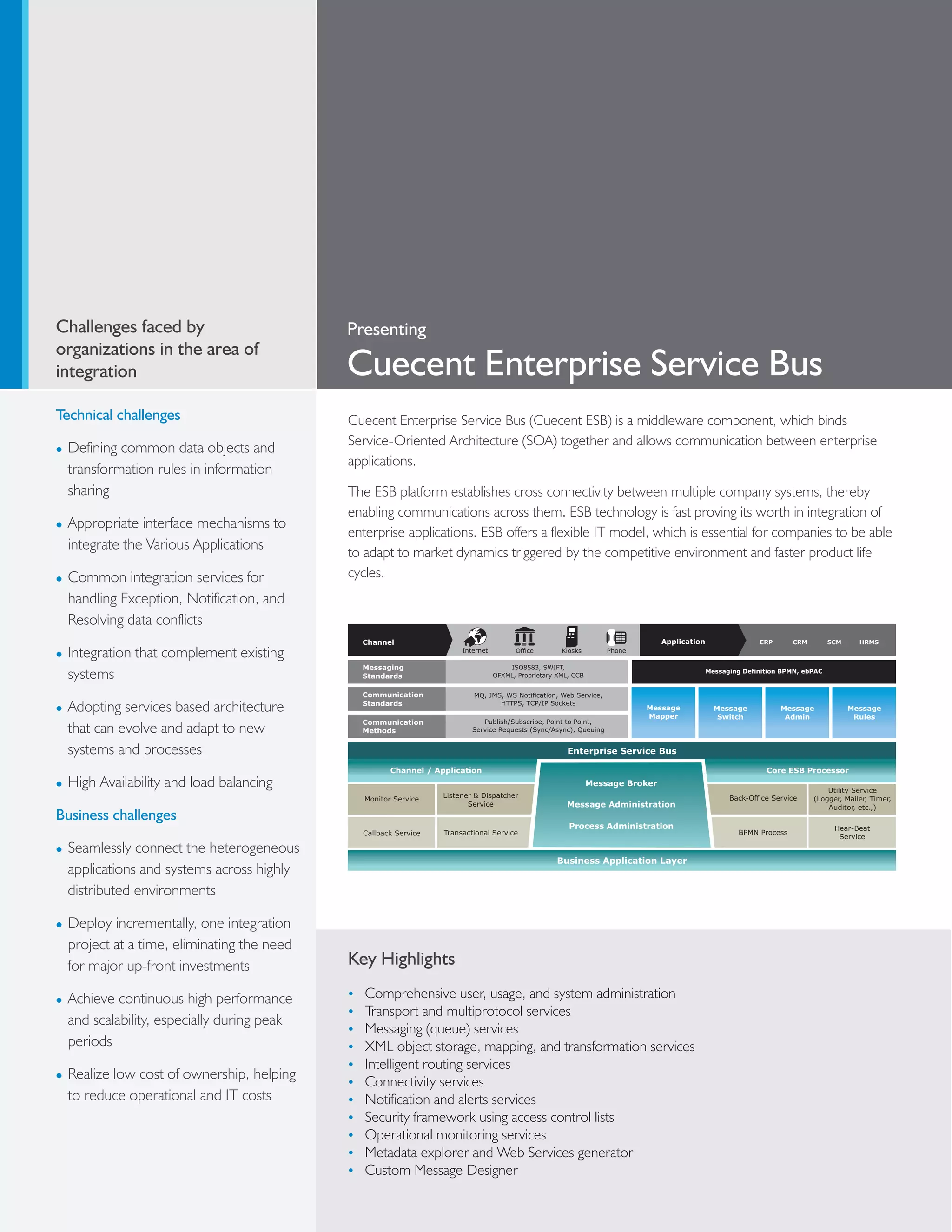
Cuecent Enterprise Service Bus (Cuecent ESB) is a middleware component, which binds
Service-Oriented Architecture (SOA) together and allows communication between enterprise
applications.
The ESB platform establishes cross connectivity between multiple company systems, thereby
enabling communications across them. ESB technology is fast proving its worth in integration of
enterprise applications. ESB offers a flexible IT model, which is essential for companies to be able
to adapt to market dynamics triggered by the competitive environment and faster product life
cycles.
Key Features
A standards-based
intelligent ESB which is
scalable, flexible,
configurable and
extensible
Value Proposition of
Cuecent ESB
Channel
Enterprise Service Bus
Messaging
Standards
ISO8583, SWIFT,
OFXML, Proprietary XML, CCB
MQ, JMS, WS Notification, Web Service,
HTTPS, TCP/IP Sockets
Communication
Standards
Communication
Methods
Message Broker
Message Administration
Process Administration
Publish/Subscribe, Point to Point,
Service Requests (Sync/Async), Queuing
Business Application Layer
Messaging Definition BPMN, ebPAC
Message
Mapper
Message
Switch
Message
Admin
Message
Rules
Channel / Application
Monitor Service Listener & Dispatcher
Service
Transactional ServiceCallback Service
Core ESB Processor
Utility Service
(Logger, Mailer, Timer,
Auditor, etc.,)
Hear-Beat
Service
BPMN Process
Back-Office Service
ERP CRM SCM HRMSApplication
Internet Office PhoneKiosks
Supported Protocols Adapters
Routing
Application Server Suppot
Message Transformation
Operation System Support
Database API Support
Service Orchestration
Messaging
lShould be able to map existing
l l services with any other service lHTTP/HTTPS Framework for Custom Adapters End-to-end tracking of messages
availablel l lRMI T24 Channel Health Monitoring
lSupport for process orchestrationl lFTP Threads, TCP Socket
through XPDLl l Configuration and timeoutTCP/IP Dynamic content based routing
ll l ESB Exception / Log monitoringJMS Header based Routing
lException Handling ll l Ability to manage the individualWebservices (SOAP) Identity-based routing
lLogging Start/Stop of interfacel lREST Forking and Aggregating
lException Reporting services/channels/back-officesl lWeb Sphere MQ Filter
l connected to ESBTracking and Debugging Flowsl lXMLRPC Based on Rules (thru BPMN)
ll Scheduling and TimingActivity LoglBPM Integration for long running
lAuditingl services as part of routing logicJboss
ll SOAP 1.1 and 1.2Business Process CachinglWeblogic
lSOAP Messages with Attachmentsll Schema ValidationWebsphere
ll HTTP 1.1Integrated Developmentll Built-in transformation functionsApache Tomcat
lEnvironment WSDL 1.1(for example, sum, average,
l lEase of integration with current WS-Addressing (new SOAPconcatenation)lWindows 7 and XP
and future applications domain only)lMetadata that enables an ESB tolLinux
l lService Component Versioning WS-Security (new SOAP domainfind, bind to and invoke thelUNIX
l only)execution of a service Distributed operationslSolaris limplementation management Compliance with Web Services
lHP-UX l l Security: SAML Token ProfileEnrichment and Semantic Support for heterogeneous
lAIX lInterpretation environment Compliance with Web Services
l l Security: X.509 Certificate TokenData Validation Capability for distributed scenario
lODBC Profile 1.1l testing and debuggingData Format - COBOL
lJDBC ll Compliance with Web ServicesCopybook, OFXML and XML Capability for local unit and
lDatabase Support Security:l scenario-level test and debugTransformation support for XML ,
lDb2 Username Token Profile 1.1lISO 8583 and ASCII(RAW Visibility into performance
l lOracle Signature signed partsSTRING) attributes
l lMS SQL Server l SAML AssertionAbility to federate with other ESBs
lMySQL l lBusiness Rules Custom Node to create
ll customized drag and drop controls XMLRule Reuse Across Processes
l l lAsynchronous Messaging (BPMN) Hot deployment RAW String
l l lSynchronous Messaging Dynamic Reconfiguration ISO 8583 - 1993
l l l lRequest/Response Long Running Transactions Rule Authoring/Definitions SWIFT
l l l lMulti part Atomic transactions (Transaction Versioning COBOL COPY BOOK(CCB)
l begin and END) lMessage Queuing NGRTGS
ll Web Service Generation (SOAP l lWS-Policy Scenario-level security RTGS
over HTTP)l (Authentication & Authorization) lWS-Security Custom Message Format Designer
lSupport for standard ll SSL/TokenMessage Types (XML , Raw string,
representation using BPMNISO 8583)
Monitoring
Operations & Management
WebService
Application Management
Message Types
Business Rules
Security
?
?
?
?
?
?
Service and business agility
Assures business continuity
Highly reliable and available
Lowers inventory costs
Improves return on assets
Access to real time business
information
?
?
?
?
?
?
?
?
?
?
?
Comprehensive user, usage, and system administration
Transport and multiprotocol services
Messaging (queue) services
XML object storage, mapping, and transformation services
Intelligent routing services
Connectivity services
Notification and alerts services
Security framework using access control lists
Operational monitoring services
Metadata explorer and Web Services generator
Custom Message Designer
Technical challenges
l
l
l
l
l
l
Business challenges
l
l
l
l
Defining common data objects and
transformation rules in information
sharing
Appropriate interface mechanisms to
integrate the Various Applications
Common integration services for
handling Exception, Notification, and
Resolving data conflicts
Integration that complement existing
systems
Adopting services based architecture
that can evolve and adapt to new
systems and processes
High Availability and load balancing
Seamlessly connect the heterogeneous
applications and systems across highly
distributed environments
Deploy incrementally, one integration
project at a time, eliminating the need
for major up-front investments
Achieve continuous high performance
and scalability, especially during peak
periods
Realize low cost of ownership, helping
to reduce operational and IT costs
Challenges faced by
organizations in the area of
integration
Key Highlights
Presenting
Cuecent Enterprise Service Bus
Cuecent Enterprise Service Bus (Cuecent ESB) is a middleware component, which binds
Service-Oriented Architecture (SOA) together and allows communication between enterprise
applications.
The ESB platform establishes cross connectivity between multiple company systems, thereby
enabling communications across them. ESB technology is fast proving its worth in integration of
enterprise applications. ESB offers a flexible IT model, which is essential for companies to be able
to adapt to market dynamics triggered by the competitive environment and faster product life
cycles.
Key Features
A standards-based
intelligent ESB which is
scalable, flexible,
configurable and
extensible
Value Proposition of
Cuecent ESB
Channel
Enterprise Service Bus
Messaging
Standards
ISO8583, SWIFT,
OFXML, Proprietary XML, CCB
MQ, JMS, WS Notification, Web Service,
HTTPS, TCP/IP Sockets
Communication
Standards
Communication
Methods
Message Broker
Message Administration
Process Administration
Publish/Subscribe, Point to Point,
Service Requests (Sync/Async), Queuing
Business Application Layer
Messaging Definition BPMN, ebPAC
Message
Mapper
Message
Switch
Message
Admin
Message
Rules
Channel / Application
Monitor Service Listener & Dispatcher
Service
Transactional ServiceCallback Service
Core ESB Processor
Utility Service
(Logger, Mailer, Timer,
Auditor, etc.,)
Hear-Beat
Service
BPMN Process
Back-Office Service
ERP CRM SCM HRMSApplication
Internet Office PhoneKiosks
Supported Protocols Adapters
Routing
Application Server Suppot
Message Transformation
Operation System Support
Database API Support
Service Orchestration
Messaging
lShould be able to map existing
l l services with any other service lHTTP/HTTPS Framework for Custom Adapters End-to-end tracking of messages
availablel l lRMI T24 Channel Health Monitoring
lSupport for process orchestrationl lFTP Threads, TCP Socket
through XPDLl l Configuration and timeoutTCP/IP Dynamic content based routing
ll l ESB Exception / Log monitoringJMS Header based Routing
lException Handling ll l Ability to manage the individualWebservices (SOAP) Identity-based routing
lLogging Start/Stop of interfacel lREST Forking and Aggregating
lException Reporting services/channels/back-officesl lWeb Sphere MQ Filter
l connected to ESBTracking and Debugging Flowsl lXMLRPC Based on Rules (thru BPMN)
ll Scheduling and TimingActivity LoglBPM Integration for long running
lAuditingl services as part of routing logicJboss
ll SOAP 1.1 and 1.2Business Process CachinglWeblogic
lSOAP Messages with Attachmentsll Schema ValidationWebsphere
ll HTTP 1.1Integrated Developmentll Built-in transformation functionsApache Tomcat
lEnvironment WSDL 1.1(for example, sum, average,
l lEase of integration with current WS-Addressing (new SOAPconcatenation)lWindows 7 and XP
and future applications domain only)lMetadata that enables an ESB tolLinux
l lService Component Versioning WS-Security (new SOAP domainfind, bind to and invoke thelUNIX
l only)execution of a service Distributed operationslSolaris limplementation management Compliance with Web Services
lHP-UX l l Security: SAML Token ProfileEnrichment and Semantic Support for heterogeneous
lAIX lInterpretation environment Compliance with Web Services
l l Security: X.509 Certificate TokenData Validation Capability for distributed scenario
lODBC Profile 1.1l testing and debuggingData Format - COBOL
lJDBC ll Compliance with Web ServicesCopybook, OFXML and XML Capability for local unit and
lDatabase Support Security:l scenario-level test and debugTransformation support for XML ,
lDb2 Username Token Profile 1.1lISO 8583 and ASCII(RAW Visibility into performance
l lOracle Signature signed partsSTRING) attributes
l lMS SQL Server l SAML AssertionAbility to federate with other ESBs
lMySQL l lBusiness Rules Custom Node to create
ll customized drag and drop controls XMLRule Reuse Across Processes
l l lAsynchronous Messaging (BPMN) Hot deployment RAW String
l l lSynchronous Messaging Dynamic Reconfiguration ISO 8583 - 1993
l l l lRequest/Response Long Running Transactions Rule Authoring/Definitions SWIFT
l l l lMulti part Atomic transactions (Transaction Versioning COBOL COPY BOOK(CCB)
l begin and END) lMessage Queuing NGRTGS
ll Web Service Generation (SOAP l lWS-Policy Scenario-level security RTGS
over HTTP)l (Authentication & Authorization) lWS-Security Custom Message Format Designer
lSupport for standard ll SSL/TokenMessage Types (XML , Raw string,
representation using BPMNISO 8583)
Monitoring
Operations & Management
WebService
Application Management
Message Types
Business Rules
Security
?
?
?
?
?
?
Service and business agility
Assures business continuity
Highly reliable and available
Lowers inventory costs
Improves return on assets
Access to real time business
information
?
?
?
?
?
?
?
?
?
?
?
Comprehensive user, usage, and system administration
Transport and multiprotocol services
Messaging (queue) services
XML object storage, mapping, and transformation services
Intelligent routing services
Connectivity services
Notification and alerts services
Security framework using access control lists
Operational monitoring services
Metadata explorer and Web Services generator
Custom Message Designer
A growing need among companies to
establish closer relationship with customers,
suppliers and other business partners is fast
fuelling the demand for ESB technologies
across the world.
With information delivery becoming one of
the key result areas for an enterprise,
furnishing company details such as product,
financial, and other key information to
customers, partners or shareholders
becomes highly crucial. This therefore
necessitates those companies to source
information from different set of applications.
Information exchange is dependent on
network connectivity and access to different
systems running in an enterprise.
A flexible connectivity infrastructure with an
ideal combination of lightweight, standards
based and robust technology, implemented
in service-oriented architecture (SOA) that
reduces the complexity of integrating
applications and services. Cuecent ESB
enables you to get more value for money
with simple, code-less, configuration based
service integration.
ENTERPRISE
SERVICE BUS
About Bahwan CyberTek
Bahwan CyberTek (BCT), established in 1999, is a global provider of innovative software products and services. A CMMi Level-5 Ver 1.3
organization, with 550+ customers and 2000+ professionals, BCT excels in Product Development, Middleware and Integration, Business
Process Management, Systems Integration, Business Intelligence, BPO, SAP Consulting Services, Independent Testing, Training, Consulting
and Infrastructure Management. BCT’s technology product - the Cuecent Suite - comprises leading edge BPM/SOA/ESB and enterprise
business solutions National Payment Systems, Business Licensing, Utility Bill Payments etc. Our focus verticals include Banking, Government,
Energy & Utilities, SCM & Logistics. BCT enjoys the highest level of partnership with Oracle, SAP, Microsoft, IBM, and FRS Global etc. BCT
has delivered solutions in twenty countries across North America, Middle East, Far East, Africa and Asia.
ESB
CUECENT ESB
Business Benefits
Supports Multiple Data Standards
ISO8583, SWIFT, OFXML, NEFT, RTGS,
Proprietary XML and CCB to enable
organizations to perform easy message
communication
Maintains High Quality Service
Provides visibility to the running systems and
automatic timely notification of exceptional
conditions
Lowers Operating Costs
Increased reusability thereby reducing
development and maintenance costs
Eliminates Manual Process Errors
Automated message communication process
More flexible to construct own message
formats
The Custom Message Format (CMF) Designer
describes the format of the message as per the
need
www.cuecent.com | www.bahwancybertek.com © 2015 Bahwan CyberTek. All rights reserved.
For more information on Cuecent ESB, please mail to info@bahwancybertek.com
Right Platform for Service Orchestration
and SOA
Service orchestration and SOA, however, can
be difficult to achieve without the right set of
tools. Otherwise, it may result in a high
financial costs as well as major time
investments as the developers have to
orchestrate services programmatically (i.e.
write new code), defeating the ultimate
purpose of adopting SOA.
What is needed is a simpler and more flexible
way to perform service orchestrations and
implement SOA. Cuecent enterprise service
bus (ESB) emerged as the go-to mechanism
for service orchestration and SOA making the
process much simpler and eliminate the need
for custom coding.
Cuecent ESB offers unparalleled
interoperability and flexibility by making it
possible to reuse service components of any
type and exchange messages of any format
both within the enterprise and outside.
Linear scalability and optimized load-
balancing
Cuecent ESB is highly scalable due to its
uniquely designed architecture. Most of the
Cuecent ESB components expose themselves
as web services. Web Services today are
widely used in large-scale enterprise
applications as it renders interoperability but
also improves scalability to a great extent.
These ESB services can be distributed across
different physical servers. In case you need to
scale up, a service can easily be deployed onto
another server. This gives optimal flexibility in
load-balancing.
Accelerated Time to Market
Cuecent ESB enables to extract greater value
from legacy assets by exposing them as
services – and add new functionality without
costly system migration and redesign efforts.
The ability to synthesize applications from
multiple, distributed assets without any
programming is extremely vital for achieving
flexibility in a dynamic environment leading to
an automation of common development tasks
and accelerated time to market.
USA
OMAN
SINGAPORE
UAE
INDIA
MA : 209, West Central Street, Natick, Massachusetts 01760 | Tel : (1) 508 652- 0001 / 652-0015
VA : 11710, Plaza America Drive, Suite 2000, Reston, VA 20190 USA | Tel : (703) 707-0094
CA : 2041 Misson College Blvd, Suite 175, Santa Clara CA 95054 | Tel : (408) 432-7217
GA : 11330 Lakefield Dr. Bldg 2 Ste 200, Johns Creek, GA 30097
P.O.Box 97, Postal code 117, Wadi Kabir, Sultanate of Oman | Tel : (968) 24567154
1 Robinson Road, AIA Towers #22-02, Singapore 048542. Tel: +65- 6532 1120 Fax : +65-6532 1124
Office No. 206, Building No.1, Ist Floor, Dubai Internet City, P.O. Box 500061, Dubai, UAE | Tel : (9714) 3911850
Chennai : 148, Rajiv Gandhi Salai (OMR), Okkiyam Thoraipakkam, Chennai - 600 097 | Tel : (91) 44 43449000 / 39209000
Bangalore : Prestige Meridian II, 12th Floor, Unit 1202, #30, M. G. Road, Bangalore - 560 001 | Tel : (91) 80 40745454 / 25590996 / 97
Mumbai : 405, Matharu Arcade, 4th Floor, Subhash Road, Vile Parle East, Mumbai - 400 057 | Tel : (91) 22 4006 0111 ®

Cuecent Enterprise Service Bus (ESB)

  • 1.
    A growing needamong companies to establish closer relationship with customers, suppliers and other business partners is fast fuelling the demand for ESB technologies across the world. With information delivery becoming one of the key result areas for an enterprise, furnishing company details such as product, financial, and other key information to customers, partners or shareholders becomes highly crucial. This therefore necessitates those companies to source information from different set of applications. Information exchange is dependent on network connectivity and access to different systems running in an enterprise. A flexible connectivity infrastructure with an ideal combination of lightweight, standards based and robust technology, implemented in service-oriented architecture (SOA) that reduces the complexity of integrating applications and services. Cuecent ESB enables you to get more value for money with simple, code-less, configuration based service integration. ENTERPRISE SERVICE BUS About Bahwan CyberTek Bahwan CyberTek (BCT), established in 1999, is a global provider of innovative software products and services. A CMMi Level-5 Ver 1.3 organization, with 550+ customers and 2000+ professionals, BCT excels in Product Development, Middleware and Integration, Business Process Management, Systems Integration, Business Intelligence, BPO, SAP Consulting Services, Independent Testing, Training, Consulting and Infrastructure Management. BCT’s technology product - the Cuecent Suite - comprises leading edge BPM/SOA/ESB and enterprise business solutions National Payment Systems, Business Licensing, Utility Bill Payments etc. Our focus verticals include Banking, Government, Energy & Utilities, SCM & Logistics. BCT enjoys the highest level of partnership with Oracle, SAP, Microsoft, IBM, and FRS Global etc. BCT has delivered solutions in twenty countries across North America, Middle East, Far East, Africa and Asia. ESB CUECENT ESB Business Benefits Supports Multiple Data Standards ISO8583, SWIFT, OFXML, NEFT, RTGS, Proprietary XML and CCB to enable organizations to perform easy message communication Maintains High Quality Service Provides visibility to the running systems and automatic timely notification of exceptional conditions Lowers Operating Costs Increased reusability thereby reducing development and maintenance costs Eliminates Manual Process Errors Automated message communication process More flexible to construct own message formats The Custom Message Format (CMF) Designer describes the format of the message as per the need www.cuecent.com | www.bahwancybertek.com © 2015 Bahwan CyberTek. All rights reserved. For more information on Cuecent ESB, please mail to info@bahwancybertek.com Right Platform for Service Orchestration and SOA Service orchestration and SOA, however, can be difficult to achieve without the right set of tools. Otherwise, it may result in a high financial costs as well as major time investments as the developers have to orchestrate services programmatically (i.e. write new code), defeating the ultimate purpose of adopting SOA. What is needed is a simpler and more flexible way to perform service orchestrations and implement SOA. Cuecent enterprise service bus (ESB) emerged as the go-to mechanism for service orchestration and SOA making the process much simpler and eliminate the need for custom coding. Cuecent ESB offers unparalleled interoperability and flexibility by making it possible to reuse service components of any type and exchange messages of any format both within the enterprise and outside. Linear scalability and optimized load- balancing Cuecent ESB is highly scalable due to its uniquely designed architecture. Most of the Cuecent ESB components expose themselves as web services. Web Services today are widely used in large-scale enterprise applications as it renders interoperability but also improves scalability to a great extent. These ESB services can be distributed across different physical servers. In case you need to scale up, a service can easily be deployed onto another server. This gives optimal flexibility in load-balancing. Accelerated Time to Market Cuecent ESB enables to extract greater value from legacy assets by exposing them as services – and add new functionality without costly system migration and redesign efforts. The ability to synthesize applications from multiple, distributed assets without any programming is extremely vital for achieving flexibility in a dynamic environment leading to an automation of common development tasks and accelerated time to market. USA OMAN SINGAPORE UAE INDIA MA : 209, West Central Street, Natick, Massachusetts 01760 | Tel : (1) 508 652- 0001 / 652-0015 VA : 11710, Plaza America Drive, Suite 2000, Reston, VA 20190 USA | Tel : (703) 707-0094 CA : 2041 Misson College Blvd, Suite 175, Santa Clara CA 95054 | Tel : (408) 432-7217 GA : 11330 Lakefield Dr. Bldg 2 Ste 200, Johns Creek, GA 30097 P.O.Box 97, Postal code 117, Wadi Kabir, Sultanate of Oman | Tel : (968) 24567154 1 Robinson Road, AIA Towers #22-02, Singapore 048542. Tel: +65- 6532 1120 Fax : +65-6532 1124 Office No. 206, Building No.1, Ist Floor, Dubai Internet City, P.O. Box 500061, Dubai, UAE | Tel : (9714) 3911850 Chennai : 148, Rajiv Gandhi Salai (OMR), Okkiyam Thoraipakkam, Chennai - 600 097 | Tel : (91) 44 43449000 / 39209000 Bangalore : Prestige Meridian II, 12th Floor, Unit 1202, #30, M. G. Road, Bangalore - 560 001 | Tel : (91) 80 40745454 / 25590996 / 97 Mumbai : 405, Matharu Arcade, 4th Floor, Subhash Road, Vile Parle East, Mumbai - 400 057 | Tel : (91) 22 4006 0111 ®
  • 2.
    Technical challenges l l l l l l Business challenges l l l l Definingcommon data objects and transformation rules in information sharing Appropriate interface mechanisms to integrate the Various Applications Common integration services for handling Exception, Notification, and Resolving data conflicts Integration that complement existing systems Adopting services based architecture that can evolve and adapt to new systems and processes High Availability and load balancing Seamlessly connect the heterogeneous applications and systems across highly distributed environments Deploy incrementally, one integration project at a time, eliminating the need for major up-front investments Achieve continuous high performance and scalability, especially during peak periods Realize low cost of ownership, helping to reduce operational and IT costs Challenges faced by organizations in the area of integration Key Highlights Presenting Cuecent Enterprise Service Bus Cuecent Enterprise Service Bus (Cuecent ESB) is a middleware component, which binds Service-Oriented Architecture (SOA) together and allows communication between enterprise applications. The ESB platform establishes cross connectivity between multiple company systems, thereby enabling communications across them. ESB technology is fast proving its worth in integration of enterprise applications. ESB offers a flexible IT model, which is essential for companies to be able to adapt to market dynamics triggered by the competitive environment and faster product life cycles. Key Features A standards-based intelligent ESB which is scalable, flexible, configurable and extensible Value Proposition of Cuecent ESB Channel Enterprise Service Bus Messaging Standards ISO8583, SWIFT, OFXML, Proprietary XML, CCB MQ, JMS, WS Notification, Web Service, HTTPS, TCP/IP Sockets Communication Standards Communication Methods Message Broker Message Administration Process Administration Publish/Subscribe, Point to Point, Service Requests (Sync/Async), Queuing Business Application Layer Messaging Definition BPMN, ebPAC Message Mapper Message Switch Message Admin Message Rules Channel / Application Monitor Service Listener & Dispatcher Service Transactional ServiceCallback Service Core ESB Processor Utility Service (Logger, Mailer, Timer, Auditor, etc.,) Hear-Beat Service BPMN Process Back-Office Service ERP CRM SCM HRMSApplication Internet Office PhoneKiosks Supported Protocols Adapters Routing Application Server Suppot Message Transformation Operation System Support Database API Support Service Orchestration Messaging lShould be able to map existing l l services with any other service lHTTP/HTTPS Framework for Custom Adapters End-to-end tracking of messages availablel l lRMI T24 Channel Health Monitoring lSupport for process orchestrationl lFTP Threads, TCP Socket through XPDLl l Configuration and timeoutTCP/IP Dynamic content based routing ll l ESB Exception / Log monitoringJMS Header based Routing lException Handling ll l Ability to manage the individualWebservices (SOAP) Identity-based routing lLogging Start/Stop of interfacel lREST Forking and Aggregating lException Reporting services/channels/back-officesl lWeb Sphere MQ Filter l connected to ESBTracking and Debugging Flowsl lXMLRPC Based on Rules (thru BPMN) ll Scheduling and TimingActivity LoglBPM Integration for long running lAuditingl services as part of routing logicJboss ll SOAP 1.1 and 1.2Business Process CachinglWeblogic lSOAP Messages with Attachmentsll Schema ValidationWebsphere ll HTTP 1.1Integrated Developmentll Built-in transformation functionsApache Tomcat lEnvironment WSDL 1.1(for example, sum, average, l lEase of integration with current WS-Addressing (new SOAPconcatenation)lWindows 7 and XP and future applications domain only)lMetadata that enables an ESB tolLinux l lService Component Versioning WS-Security (new SOAP domainfind, bind to and invoke thelUNIX l only)execution of a service Distributed operationslSolaris limplementation management Compliance with Web Services lHP-UX l l Security: SAML Token ProfileEnrichment and Semantic Support for heterogeneous lAIX lInterpretation environment Compliance with Web Services l l Security: X.509 Certificate TokenData Validation Capability for distributed scenario lODBC Profile 1.1l testing and debuggingData Format - COBOL lJDBC ll Compliance with Web ServicesCopybook, OFXML and XML Capability for local unit and lDatabase Support Security:l scenario-level test and debugTransformation support for XML , lDb2 Username Token Profile 1.1lISO 8583 and ASCII(RAW Visibility into performance l lOracle Signature signed partsSTRING) attributes l lMS SQL Server l SAML AssertionAbility to federate with other ESBs lMySQL l lBusiness Rules Custom Node to create ll customized drag and drop controls XMLRule Reuse Across Processes l l lAsynchronous Messaging (BPMN) Hot deployment RAW String l l lSynchronous Messaging Dynamic Reconfiguration ISO 8583 - 1993 l l l lRequest/Response Long Running Transactions Rule Authoring/Definitions SWIFT l l l lMulti part Atomic transactions (Transaction Versioning COBOL COPY BOOK(CCB) l begin and END) lMessage Queuing NGRTGS ll Web Service Generation (SOAP l lWS-Policy Scenario-level security RTGS over HTTP)l (Authentication & Authorization) lWS-Security Custom Message Format Designer lSupport for standard ll SSL/TokenMessage Types (XML , Raw string, representation using BPMNISO 8583) Monitoring Operations & Management WebService Application Management Message Types Business Rules Security ? ? ? ? ? ? Service and business agility Assures business continuity Highly reliable and available Lowers inventory costs Improves return on assets Access to real time business information ? ? ? ? ? ? ? ? ? ? ? Comprehensive user, usage, and system administration Transport and multiprotocol services Messaging (queue) services XML object storage, mapping, and transformation services Intelligent routing services Connectivity services Notification and alerts services Security framework using access control lists Operational monitoring services Metadata explorer and Web Services generator Custom Message Designer
  • 3.
    Technical challenges l l l l l l Business challenges l l l l Definingcommon data objects and transformation rules in information sharing Appropriate interface mechanisms to integrate the Various Applications Common integration services for handling Exception, Notification, and Resolving data conflicts Integration that complement existing systems Adopting services based architecture that can evolve and adapt to new systems and processes High Availability and load balancing Seamlessly connect the heterogeneous applications and systems across highly distributed environments Deploy incrementally, one integration project at a time, eliminating the need for major up-front investments Achieve continuous high performance and scalability, especially during peak periods Realize low cost of ownership, helping to reduce operational and IT costs Challenges faced by organizations in the area of integration Key Highlights Presenting Cuecent Enterprise Service Bus Cuecent Enterprise Service Bus (Cuecent ESB) is a middleware component, which binds Service-Oriented Architecture (SOA) together and allows communication between enterprise applications. The ESB platform establishes cross connectivity between multiple company systems, thereby enabling communications across them. ESB technology is fast proving its worth in integration of enterprise applications. ESB offers a flexible IT model, which is essential for companies to be able to adapt to market dynamics triggered by the competitive environment and faster product life cycles. Key Features A standards-based intelligent ESB which is scalable, flexible, configurable and extensible Value Proposition of Cuecent ESB Channel Enterprise Service Bus Messaging Standards ISO8583, SWIFT, OFXML, Proprietary XML, CCB MQ, JMS, WS Notification, Web Service, HTTPS, TCP/IP Sockets Communication Standards Communication Methods Message Broker Message Administration Process Administration Publish/Subscribe, Point to Point, Service Requests (Sync/Async), Queuing Business Application Layer Messaging Definition BPMN, ebPAC Message Mapper Message Switch Message Admin Message Rules Channel / Application Monitor Service Listener & Dispatcher Service Transactional ServiceCallback Service Core ESB Processor Utility Service (Logger, Mailer, Timer, Auditor, etc.,) Hear-Beat Service BPMN Process Back-Office Service ERP CRM SCM HRMSApplication Internet Office PhoneKiosks Supported Protocols Adapters Routing Application Server Suppot Message Transformation Operation System Support Database API Support Service Orchestration Messaging lShould be able to map existing l l services with any other service lHTTP/HTTPS Framework for Custom Adapters End-to-end tracking of messages availablel l lRMI T24 Channel Health Monitoring lSupport for process orchestrationl lFTP Threads, TCP Socket through XPDLl l Configuration and timeoutTCP/IP Dynamic content based routing ll l ESB Exception / Log monitoringJMS Header based Routing lException Handling ll l Ability to manage the individualWebservices (SOAP) Identity-based routing lLogging Start/Stop of interfacel lREST Forking and Aggregating lException Reporting services/channels/back-officesl lWeb Sphere MQ Filter l connected to ESBTracking and Debugging Flowsl lXMLRPC Based on Rules (thru BPMN) ll Scheduling and TimingActivity LoglBPM Integration for long running lAuditingl services as part of routing logicJboss ll SOAP 1.1 and 1.2Business Process CachinglWeblogic lSOAP Messages with Attachmentsll Schema ValidationWebsphere ll HTTP 1.1Integrated Developmentll Built-in transformation functionsApache Tomcat lEnvironment WSDL 1.1(for example, sum, average, l lEase of integration with current WS-Addressing (new SOAPconcatenation)lWindows 7 and XP and future applications domain only)lMetadata that enables an ESB tolLinux l lService Component Versioning WS-Security (new SOAP domainfind, bind to and invoke thelUNIX l only)execution of a service Distributed operationslSolaris limplementation management Compliance with Web Services lHP-UX l l Security: SAML Token ProfileEnrichment and Semantic Support for heterogeneous lAIX lInterpretation environment Compliance with Web Services l l Security: X.509 Certificate TokenData Validation Capability for distributed scenario lODBC Profile 1.1l testing and debuggingData Format - COBOL lJDBC ll Compliance with Web ServicesCopybook, OFXML and XML Capability for local unit and lDatabase Support Security:l scenario-level test and debugTransformation support for XML , lDb2 Username Token Profile 1.1lISO 8583 and ASCII(RAW Visibility into performance l lOracle Signature signed partsSTRING) attributes l lMS SQL Server l SAML AssertionAbility to federate with other ESBs lMySQL l lBusiness Rules Custom Node to create ll customized drag and drop controls XMLRule Reuse Across Processes l l lAsynchronous Messaging (BPMN) Hot deployment RAW String l l lSynchronous Messaging Dynamic Reconfiguration ISO 8583 - 1993 l l l lRequest/Response Long Running Transactions Rule Authoring/Definitions SWIFT l l l lMulti part Atomic transactions (Transaction Versioning COBOL COPY BOOK(CCB) l begin and END) lMessage Queuing NGRTGS ll Web Service Generation (SOAP l lWS-Policy Scenario-level security RTGS over HTTP)l (Authentication & Authorization) lWS-Security Custom Message Format Designer lSupport for standard ll SSL/TokenMessage Types (XML , Raw string, representation using BPMNISO 8583) Monitoring Operations & Management WebService Application Management Message Types Business Rules Security ? ? ? ? ? ? Service and business agility Assures business continuity Highly reliable and available Lowers inventory costs Improves return on assets Access to real time business information ? ? ? ? ? ? ? ? ? ? ? Comprehensive user, usage, and system administration Transport and multiprotocol services Messaging (queue) services XML object storage, mapping, and transformation services Intelligent routing services Connectivity services Notification and alerts services Security framework using access control lists Operational monitoring services Metadata explorer and Web Services generator Custom Message Designer
  • 4.
    A growing needamong companies to establish closer relationship with customers, suppliers and other business partners is fast fuelling the demand for ESB technologies across the world. With information delivery becoming one of the key result areas for an enterprise, furnishing company details such as product, financial, and other key information to customers, partners or shareholders becomes highly crucial. This therefore necessitates those companies to source information from different set of applications. Information exchange is dependent on network connectivity and access to different systems running in an enterprise. A flexible connectivity infrastructure with an ideal combination of lightweight, standards based and robust technology, implemented in service-oriented architecture (SOA) that reduces the complexity of integrating applications and services. Cuecent ESB enables you to get more value for money with simple, code-less, configuration based service integration. ENTERPRISE SERVICE BUS About Bahwan CyberTek Bahwan CyberTek (BCT), established in 1999, is a global provider of innovative software products and services. A CMMi Level-5 Ver 1.3 organization, with 550+ customers and 2000+ professionals, BCT excels in Product Development, Middleware and Integration, Business Process Management, Systems Integration, Business Intelligence, BPO, SAP Consulting Services, Independent Testing, Training, Consulting and Infrastructure Management. BCT’s technology product - the Cuecent Suite - comprises leading edge BPM/SOA/ESB and enterprise business solutions National Payment Systems, Business Licensing, Utility Bill Payments etc. Our focus verticals include Banking, Government, Energy & Utilities, SCM & Logistics. BCT enjoys the highest level of partnership with Oracle, SAP, Microsoft, IBM, and FRS Global etc. BCT has delivered solutions in twenty countries across North America, Middle East, Far East, Africa and Asia. ESB CUECENT ESB Business Benefits Supports Multiple Data Standards ISO8583, SWIFT, OFXML, NEFT, RTGS, Proprietary XML and CCB to enable organizations to perform easy message communication Maintains High Quality Service Provides visibility to the running systems and automatic timely notification of exceptional conditions Lowers Operating Costs Increased reusability thereby reducing development and maintenance costs Eliminates Manual Process Errors Automated message communication process More flexible to construct own message formats The Custom Message Format (CMF) Designer describes the format of the message as per the need www.cuecent.com | www.bahwancybertek.com © 2015 Bahwan CyberTek. All rights reserved. For more information on Cuecent ESB, please mail to info@bahwancybertek.com Right Platform for Service Orchestration and SOA Service orchestration and SOA, however, can be difficult to achieve without the right set of tools. Otherwise, it may result in a high financial costs as well as major time investments as the developers have to orchestrate services programmatically (i.e. write new code), defeating the ultimate purpose of adopting SOA. What is needed is a simpler and more flexible way to perform service orchestrations and implement SOA. Cuecent enterprise service bus (ESB) emerged as the go-to mechanism for service orchestration and SOA making the process much simpler and eliminate the need for custom coding. Cuecent ESB offers unparalleled interoperability and flexibility by making it possible to reuse service components of any type and exchange messages of any format both within the enterprise and outside. Linear scalability and optimized load- balancing Cuecent ESB is highly scalable due to its uniquely designed architecture. Most of the Cuecent ESB components expose themselves as web services. Web Services today are widely used in large-scale enterprise applications as it renders interoperability but also improves scalability to a great extent. These ESB services can be distributed across different physical servers. In case you need to scale up, a service can easily be deployed onto another server. This gives optimal flexibility in load-balancing. Accelerated Time to Market Cuecent ESB enables to extract greater value from legacy assets by exposing them as services – and add new functionality without costly system migration and redesign efforts. The ability to synthesize applications from multiple, distributed assets without any programming is extremely vital for achieving flexibility in a dynamic environment leading to an automation of common development tasks and accelerated time to market. USA OMAN SINGAPORE UAE INDIA MA : 209, West Central Street, Natick, Massachusetts 01760 | Tel : (1) 508 652- 0001 / 652-0015 VA : 11710, Plaza America Drive, Suite 2000, Reston, VA 20190 USA | Tel : (703) 707-0094 CA : 2041 Misson College Blvd, Suite 175, Santa Clara CA 95054 | Tel : (408) 432-7217 GA : 11330 Lakefield Dr. Bldg 2 Ste 200, Johns Creek, GA 30097 P.O.Box 97, Postal code 117, Wadi Kabir, Sultanate of Oman | Tel : (968) 24567154 1 Robinson Road, AIA Towers #22-02, Singapore 048542. Tel: +65- 6532 1120 Fax : +65-6532 1124 Office No. 206, Building No.1, Ist Floor, Dubai Internet City, P.O. Box 500061, Dubai, UAE | Tel : (9714) 3911850 Chennai : 148, Rajiv Gandhi Salai (OMR), Okkiyam Thoraipakkam, Chennai - 600 097 | Tel : (91) 44 43449000 / 39209000 Bangalore : Prestige Meridian II, 12th Floor, Unit 1202, #30, M. G. Road, Bangalore - 560 001 | Tel : (91) 80 40745454 / 25590996 / 97 Mumbai : 405, Matharu Arcade, 4th Floor, Subhash Road, Vile Parle East, Mumbai - 400 057 | Tel : (91) 22 4006 0111 ®