HGA-00434
70° to 75°F. The seed will often come with the specific
germination temperature printed on the pack. Cover the
seeded flats with glass or plastic to reduce heat loss and
to prevent drying out. Remove the cover as soon as the
seeds have germinated and emerged. Maintain daytime
soil temperatures between 70° to 75°F and night tem-
perature at 65°F. Keep seedlings moist.
When the cotyledons (seed leaves) have expanded,
transplant to individual 4-inch pots containing a potting
mixture with good water holding capacity and adequate
drainage. Peat, vermiculite and coconut fiber are popular
amendments added to improve water-holding capacity.
Perlite and horticulture-grade sand are commonly used
to improve drainage.
Begin fertilizing three days after transplanting or when
true leaves have emerged. Plants should be watered
frequently with a fertilizer solution. A minimum of 14
hours of direct light is required for developing seedlings.
Planting in the Greenhouse
In two to three weeks after seeding the plants will be
ready to transplant into their permanent location in the
greenhouse. Prior to planting, moisten the media with
warm water. Plant one seedless cucumber plant per 10
square feet. Allows 5 square feet of bed space for each
seeded cucumber plant. This will insure good air circula-
tion and adequate light for fruit production.
Varieties
There are two major types of cucumbers that can be
grown in the greenhouse for both home and commer-
cial production. The most popular are the long, seed-
less varieties often referred to as European, Japanese or
English. The older, traditional varieties have seeds and
white spines.
Seedless varieties have parthenocarpic fruit, or fruit that
do not develop seed. A major benefit of these varieties
is they do not require pollination. The skin is smooth
and often has longitudinal ridges. Fruit are long, ranging
from 12 to 24 inches when ready for harvest.
Seeded varieties require pollination to form fruit. They
produce both male and female flowers; pollen from the
male flowers must be transferred to female flowers. Out-
doors under good weather conditions, insects typically
do an adequate job of pollinating. In the greenhouse,
however, it is the grower’s responsibility to transfer pol-
len. When cucumbers are not properly pollinated, the
fruit will be misshapen and poorly developed, especially
on the blossom end of the fruit.
Cucumbers are very sensitive to imbalances or changes
in growing conditions. Growers should carefully moni-
tor fertilizer salts, light, air temperature, humidity, car-
bon dioxide and moisture. Inattention to these details
can result in decreased production and poor-quality
fruit, such as bitter-tasting cucumbers.
Seeding
Sow seeds in sterile media. Members of the Cucurbita-
ceae (squash) family, such as cucumbers, are sensitive to
root disturbance. If planting only a few plants, sow seeds
directly in the garden or in individual pots to reduce
root disturbance during transplanting. For large-scale
production, sow in flats and use care not to damage
roots when transplanting.
The optimum germination temperature for seedless
varieties is 80° to 82°F. Germinate seeded varieties at
Cucumber Production
in Greenhouses
2
Basic Feeding Formula
	 Concentration	 oz/100 gal
	 Formulas 	 (ppm)
A.	 potassium chloride (0-0-62)	 200 K	 4.3
	 magnesium sulphate	 25 Mg	 1.6
	 diammonium	 36 P	 0.9
	 phosphate (21-53-0) 	 33 N
	 calcium nitrate (15.5-0-0)	 135 N	 11.6
			 148 Ca
	or
B.	 potassium chloride (0-0-62)	 80 K	 1.72
	 potassium nitrate (13-0-44)	 30 N	 3.0
			 84 K
	 magnesium sulfate	 25 Mg	 1.6
	 monopotassium 	 36 P	 0.9
	 phosphate (0-53-34)	 44K
	 calcium nitrate (15.5-0-0)	 140 N	 12.0
Minor elements for	 Concentration	 gms/100 gal
both formulas 	 (ppm)
iron chelate (10% Fe)	 Fe	 1.0	 3.78 g
manganese sulphate
	 (28% Mn)	 Mn 	 0.3	 0.4 g
boron (20.5% B)	 B	 0.7	 1.3 g
zinc sulphate (36% Zn)	 Zn	 0.1	 105.0 mg
copper sulphate (25% Cu)	 Cu	 .03	 45.0 mg
molybdenum (54% Mo)	 Mo	 .05	 35.0 mg
Basicfertilizerformulas:FormulaAmayrequiretheaddition
of sulfuric or phosphoric acid to lower pH of the fertilizer
solution. A milky precipitate after tank mixing indicates the
need for pH adjustment.
Fertilizing
As the plants grow and have more tissue to support, their
fertilizer requirements will increase. When plants are
small, start with 1 quart of fertilizer solution per plant
per day. As plants mature and increase in size, adjust
feeding volumes upward. A mature plant will require 1
to 2 gallons of solution per day. Warm the fertilizer solu-
tion to room temperature before using. Nitrogen is the
most important element during the growing season. Be
sure to apply continually through the irrigation water.
It is often more convenient to purchase a premixed
complete fertilizer with micronutrients. If you choose a
commercial fertilizer mix, start with a weak strength and
increase the concentration as the plant grows.
Most commercial producers will want to mix their own
fertilizer tailored to specific crop requirements and
water analysis. Water can vary in pH, calcium, sodium
and micronutrient levels and should be tested to de-
termine fertilizer formulations. If the water is alkaline
(high pH level), phosphoric acid may added as a source
of phosphorous and to adjust the pH down.
Pruning, Thinning and Training
Branches, leaves, flowers and fruit should be pruned to
maintain a proper balance between the vegetative and
reproductive growth to maximize production. Proper
training increases the plant’s ability to access the sun-
light needed for growth. Too dense a canopy of leaves
will shade fruits from sunlight, causing them to be pale.
Flower production depends on the amount of branch
growth and the number of leaf axils. Removing fruit
stimulates vegetative growth.
When too many fruits set at any one time, a large
proportion may abort ­— or experience what is of-
ten called fruit drop — due to insufficient nutrients.
Likewise, when a heavy load of fruit sets, many will be
malformed or poorly colored. Fruit loads should be
thinned to one fruit per leaf axil.
Cucumbers are often trained on a string or wire system.
The umbrella system, which is best used for seedless vari-
eties, is straightforward and not too demanding in labor.
Seeded cucumber varieties perform best with the tree
trellis system (see diagrams and instructions on page 3).
Pollination
Pollination is the process of transferring pollen from
male to female flowers. Seeded cucumbers are mone-
cious, meaning that they have both male and female
flowers on the same plant. While both sexes of flower
have the same size yellow petals, they are physically dif-
ferent. Male flowers are attached to the stem by a thin
stalk and contain the stamen. Female flowers are identi-
fied by the small, spiny, immature cucumber between the
yellow flower petals and the flower stem, and they also
contain the pistil. In greenhouse production, because
of the elimination of natural pollinators, it becomes the
grower's responsibility to "play pollinator" by transfer-
ring pollen from the male to female flowers. This is best
done by removing the male flower petals, exposing the
anthers, which are covered in pollen, and touching them
to the center of the female stigma (center of the flower).
This can also be done with a small, soft bristled brush.
3
A
B
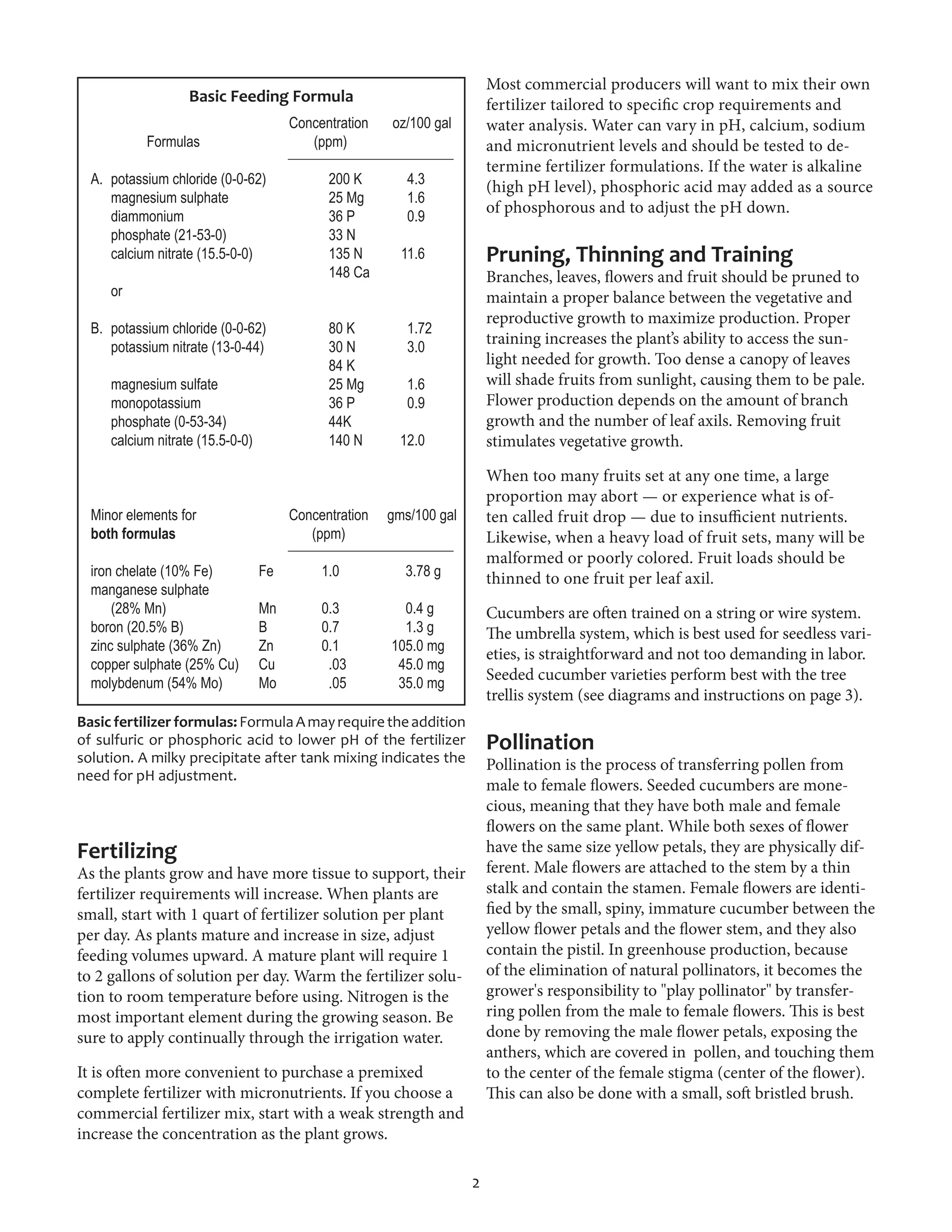
Umbrella System
A—Top wire. B—Support. C,D,E—Lateral fruiting stems.
wire
E D C
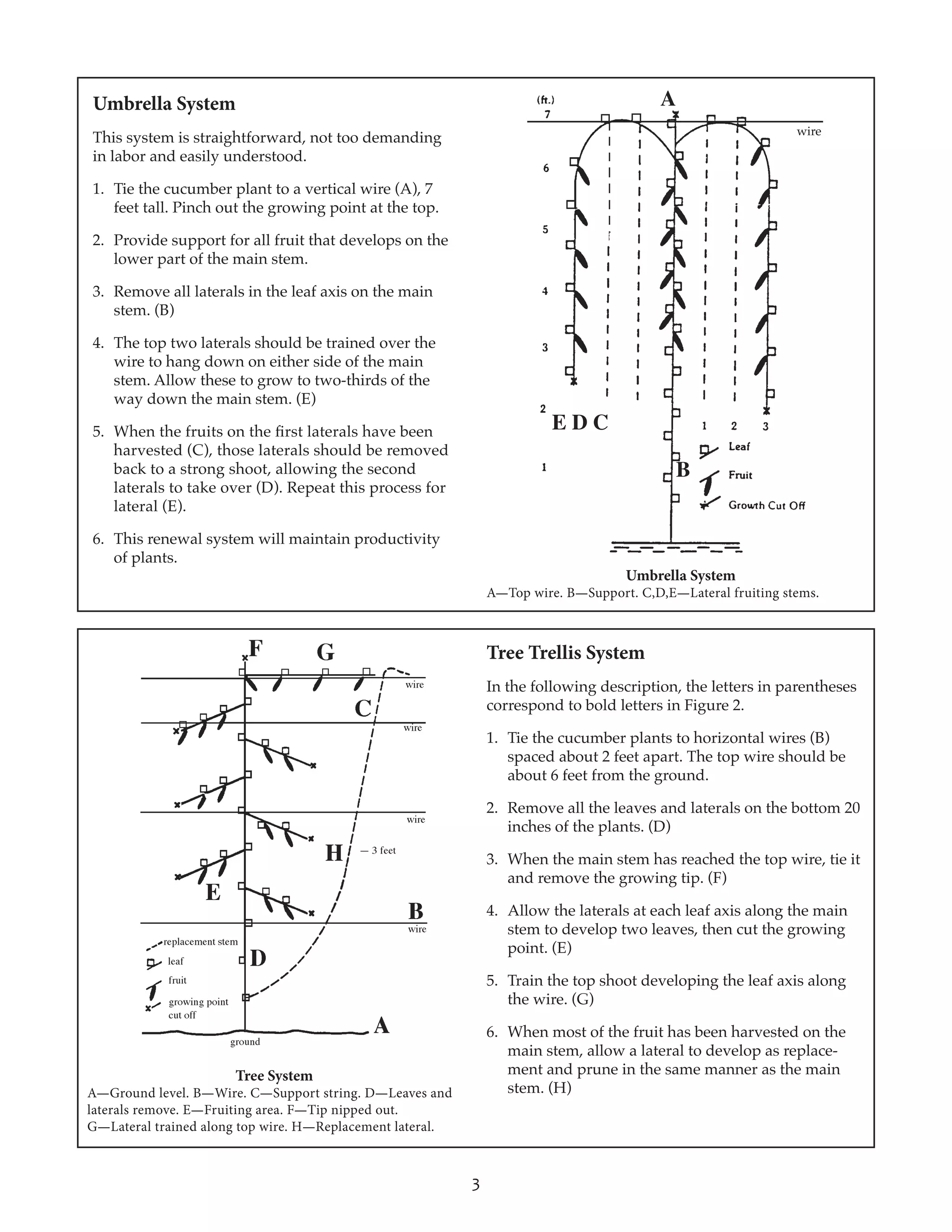
Tree System
A—Ground level. B—Wire. C—Support string. D—Leaves and
laterals remove. E—Fruiting area. F—Tip nipped out.
G—Lateral trained along top wire. H—Replacement lateral.
Umbrella System
This system is straightforward, not too demanding
in labor and easily understood.
1.	 Tie the cucumber plant to a vertical wire (A), 7
feet tall. Pinch out the growing point at the top.
2.	 Provide support for all fruit that develops on the
lower part of the main stem.
3.	 Remove all laterals in the leaf axis on the main
stem. (B)
4.	 The top two laterals should be trained over the
wire to hang down on either side of the main
stem. Allow these to grow to two-thirds of the
way down the main stem. (E)
5.	 When the fruits on the first laterals have been
harvested (C), those laterals should be removed
back to a strong shoot, allowing the second
laterals to take over (D). Repeat this process for
lateral (E).
6.	 This renewal system will maintain productivity
of plants.
Tree Trellis System
In the following description, the letters in parentheses
correspond to bold letters in Figure 2.
1.	 Tie the cucumber plants to horizontal wires (B)
spaced about 2 feet apart. The top wire should be
about 6 feet from the ground.
2.	 Remove all the leaves and laterals on the bottom 20
inches of the plants. (D)
3.	 When the main stem has reached the top wire, tie it
and remove the growing tip. (F)
4.	 Allow the laterals at each leaf axis along the main
stem to develop two leaves, then cut the growing
point. (E)
5.	 Train the top shoot developing the leaf axis along
the wire. (G)
6.	 When most of the fruit has been harvested on the
main stem, allow a lateral to develop as replace-
ment and prune in the same manner as the main
stem. (H)
Published by the University of Alaska Fairbanks Cooperative Extension Service in cooperation with the United States Department of
Agriculture. The University of Alaska Fairbanks is an affirmative action/equal opportunity employer and educational institution.
©2014 University of Alaska Fairbanks.
11-90/WV/7-14	 Revised October 2013
www.uaf.edu/ces or 1-877-520-5211
Originally prepared by Wayne Vandre, former Extension Horticulturist.
Female flower
Male flower
Pest and Disease Control
Integrated pest management (IPM) is a commonsense
approach to long-term management of pest problems
with minimal impact on human health, the environment
and non-target organisms. This approach focuses on the
biology of pests and their relationship to the environ-
ment. The first step in an IPM program is to identify any
organism in question and then completely investigate
the situation. IPM is not a single pest control method,
but a series of pest management evaluations, decisions
and controls. Strategies for IPM may include the appli-
cation of physical, cultural, mechanical, biological and
chemical controls. For more information about IPM,
visit www.uaf.edu/ces/ipm/.
Diseases commonly encountered in greenhouse produc-
tion include Botrytis, or gray mold, powdery mildew
and mosaic viruses. Inadequate ventilation, particularly
during periods of high humidity, increases damage from
Botrytis. Powdery mildew is encouraged by high humid-
ity and the excessive use of nitrogen fertilizers. Removal
of a plant’s lower leaves to increase air flow around the
plant, controlling greenhouse humidity and avoiding
over application of nitrogen fertilizers can help reduce
the damage caused by these plant diseases.
Many viruses are transmitted to crops from other hosts
or plants by insect pests. Aphids, commonly encoun-
tered in greenhouse growing situations, are able to
transmit a number of viruses that affect cucumbers.
Developing and following IPM practices is the most
effective method for dealing with pests. Examples of
IPM management strategies for greenhouse cucumber
production include using sticky traps to monitor for
pest presence, controlling unwanted vegetation in and
around the greenhouse to help exclude aphids from the
area and positively identifying insects as pests to deter-
mine the most appropriate control methods.
Harvesting
The picking size of cucumbers varies according to the
type and desired use, but they should always be harvest-
ed before the seeds fully enlarge and harden. A cucum-
ber is of the highest quality when the fruit is firm, bright
and green in color with no dullness or yellowing to the
skin. If mature fruit are left on the plant, they decrease
future production. When harvesting, cut fruit from the
plant with a sharp, clean knife to reduce damage and
disease. Cucumbers have thin skin and lose moisture
quickly, often softening in storage. To avoid losses from
spoilage, store harvested fruits in cool, moist conditions
at 45°F to 50°F and 80 to 90 percent humidity.

Cucumber Production in Greenhouses in Fairbanks, Alaska, Gardening Guidebook

  • 1.
    HGA-00434 70° to 75°F.The seed will often come with the specific germination temperature printed on the pack. Cover the seeded flats with glass or plastic to reduce heat loss and to prevent drying out. Remove the cover as soon as the seeds have germinated and emerged. Maintain daytime soil temperatures between 70° to 75°F and night tem- perature at 65°F. Keep seedlings moist. When the cotyledons (seed leaves) have expanded, transplant to individual 4-inch pots containing a potting mixture with good water holding capacity and adequate drainage. Peat, vermiculite and coconut fiber are popular amendments added to improve water-holding capacity. Perlite and horticulture-grade sand are commonly used to improve drainage. Begin fertilizing three days after transplanting or when true leaves have emerged. Plants should be watered frequently with a fertilizer solution. A minimum of 14 hours of direct light is required for developing seedlings. Planting in the Greenhouse In two to three weeks after seeding the plants will be ready to transplant into their permanent location in the greenhouse. Prior to planting, moisten the media with warm water. Plant one seedless cucumber plant per 10 square feet. Allows 5 square feet of bed space for each seeded cucumber plant. This will insure good air circula- tion and adequate light for fruit production. Varieties There are two major types of cucumbers that can be grown in the greenhouse for both home and commer- cial production. The most popular are the long, seed- less varieties often referred to as European, Japanese or English. The older, traditional varieties have seeds and white spines. Seedless varieties have parthenocarpic fruit, or fruit that do not develop seed. A major benefit of these varieties is they do not require pollination. The skin is smooth and often has longitudinal ridges. Fruit are long, ranging from 12 to 24 inches when ready for harvest. Seeded varieties require pollination to form fruit. They produce both male and female flowers; pollen from the male flowers must be transferred to female flowers. Out- doors under good weather conditions, insects typically do an adequate job of pollinating. In the greenhouse, however, it is the grower’s responsibility to transfer pol- len. When cucumbers are not properly pollinated, the fruit will be misshapen and poorly developed, especially on the blossom end of the fruit. Cucumbers are very sensitive to imbalances or changes in growing conditions. Growers should carefully moni- tor fertilizer salts, light, air temperature, humidity, car- bon dioxide and moisture. Inattention to these details can result in decreased production and poor-quality fruit, such as bitter-tasting cucumbers. Seeding Sow seeds in sterile media. Members of the Cucurbita- ceae (squash) family, such as cucumbers, are sensitive to root disturbance. If planting only a few plants, sow seeds directly in the garden or in individual pots to reduce root disturbance during transplanting. For large-scale production, sow in flats and use care not to damage roots when transplanting. The optimum germination temperature for seedless varieties is 80° to 82°F. Germinate seeded varieties at Cucumber Production in Greenhouses
  • 2.
    2 Basic Feeding Formula Concentration oz/100 gal Formulas (ppm) A. potassium chloride (0-0-62) 200 K 4.3 magnesium sulphate 25 Mg 1.6 diammonium 36 P 0.9 phosphate (21-53-0) 33 N calcium nitrate (15.5-0-0) 135 N 11.6 148 Ca or B. potassium chloride (0-0-62) 80 K 1.72 potassium nitrate (13-0-44) 30 N 3.0 84 K magnesium sulfate 25 Mg 1.6 monopotassium 36 P 0.9 phosphate (0-53-34) 44K calcium nitrate (15.5-0-0) 140 N 12.0 Minor elements for Concentration gms/100 gal both formulas (ppm) iron chelate (10% Fe) Fe 1.0 3.78 g manganese sulphate (28% Mn) Mn 0.3 0.4 g boron (20.5% B) B 0.7 1.3 g zinc sulphate (36% Zn) Zn 0.1 105.0 mg copper sulphate (25% Cu) Cu .03 45.0 mg molybdenum (54% Mo) Mo .05 35.0 mg Basicfertilizerformulas:FormulaAmayrequiretheaddition of sulfuric or phosphoric acid to lower pH of the fertilizer solution. A milky precipitate after tank mixing indicates the need for pH adjustment. Fertilizing As the plants grow and have more tissue to support, their fertilizer requirements will increase. When plants are small, start with 1 quart of fertilizer solution per plant per day. As plants mature and increase in size, adjust feeding volumes upward. A mature plant will require 1 to 2 gallons of solution per day. Warm the fertilizer solu- tion to room temperature before using. Nitrogen is the most important element during the growing season. Be sure to apply continually through the irrigation water. It is often more convenient to purchase a premixed complete fertilizer with micronutrients. If you choose a commercial fertilizer mix, start with a weak strength and increase the concentration as the plant grows. Most commercial producers will want to mix their own fertilizer tailored to specific crop requirements and water analysis. Water can vary in pH, calcium, sodium and micronutrient levels and should be tested to de- termine fertilizer formulations. If the water is alkaline (high pH level), phosphoric acid may added as a source of phosphorous and to adjust the pH down. Pruning, Thinning and Training Branches, leaves, flowers and fruit should be pruned to maintain a proper balance between the vegetative and reproductive growth to maximize production. Proper training increases the plant’s ability to access the sun- light needed for growth. Too dense a canopy of leaves will shade fruits from sunlight, causing them to be pale. Flower production depends on the amount of branch growth and the number of leaf axils. Removing fruit stimulates vegetative growth. When too many fruits set at any one time, a large proportion may abort ­— or experience what is of- ten called fruit drop — due to insufficient nutrients. Likewise, when a heavy load of fruit sets, many will be malformed or poorly colored. Fruit loads should be thinned to one fruit per leaf axil. Cucumbers are often trained on a string or wire system. The umbrella system, which is best used for seedless vari- eties, is straightforward and not too demanding in labor. Seeded cucumber varieties perform best with the tree trellis system (see diagrams and instructions on page 3). Pollination Pollination is the process of transferring pollen from male to female flowers. Seeded cucumbers are mone- cious, meaning that they have both male and female flowers on the same plant. While both sexes of flower have the same size yellow petals, they are physically dif- ferent. Male flowers are attached to the stem by a thin stalk and contain the stamen. Female flowers are identi- fied by the small, spiny, immature cucumber between the yellow flower petals and the flower stem, and they also contain the pistil. In greenhouse production, because of the elimination of natural pollinators, it becomes the grower's responsibility to "play pollinator" by transfer- ring pollen from the male to female flowers. This is best done by removing the male flower petals, exposing the anthers, which are covered in pollen, and touching them to the center of the female stigma (center of the flower). This can also be done with a small, soft bristled brush.
  • 3.
    3 A B Umbrella System A—Top wire.B—Support. C,D,E—Lateral fruiting stems. wire E D C Tree System A—Ground level. B—Wire. C—Support string. D—Leaves and laterals remove. E—Fruiting area. F—Tip nipped out. G—Lateral trained along top wire. H—Replacement lateral. Umbrella System This system is straightforward, not too demanding in labor and easily understood. 1. Tie the cucumber plant to a vertical wire (A), 7 feet tall. Pinch out the growing point at the top. 2. Provide support for all fruit that develops on the lower part of the main stem. 3. Remove all laterals in the leaf axis on the main stem. (B) 4. The top two laterals should be trained over the wire to hang down on either side of the main stem. Allow these to grow to two-thirds of the way down the main stem. (E) 5. When the fruits on the first laterals have been harvested (C), those laterals should be removed back to a strong shoot, allowing the second laterals to take over (D). Repeat this process for lateral (E). 6. This renewal system will maintain productivity of plants. Tree Trellis System In the following description, the letters in parentheses correspond to bold letters in Figure 2. 1. Tie the cucumber plants to horizontal wires (B) spaced about 2 feet apart. The top wire should be about 6 feet from the ground. 2. Remove all the leaves and laterals on the bottom 20 inches of the plants. (D) 3. When the main stem has reached the top wire, tie it and remove the growing tip. (F) 4. Allow the laterals at each leaf axis along the main stem to develop two leaves, then cut the growing point. (E) 5. Train the top shoot developing the leaf axis along the wire. (G) 6. When most of the fruit has been harvested on the main stem, allow a lateral to develop as replace- ment and prune in the same manner as the main stem. (H)
  • 4.
    Published by theUniversity of Alaska Fairbanks Cooperative Extension Service in cooperation with the United States Department of Agriculture. The University of Alaska Fairbanks is an affirmative action/equal opportunity employer and educational institution. ©2014 University of Alaska Fairbanks. 11-90/WV/7-14 Revised October 2013 www.uaf.edu/ces or 1-877-520-5211 Originally prepared by Wayne Vandre, former Extension Horticulturist. Female flower Male flower Pest and Disease Control Integrated pest management (IPM) is a commonsense approach to long-term management of pest problems with minimal impact on human health, the environment and non-target organisms. This approach focuses on the biology of pests and their relationship to the environ- ment. The first step in an IPM program is to identify any organism in question and then completely investigate the situation. IPM is not a single pest control method, but a series of pest management evaluations, decisions and controls. Strategies for IPM may include the appli- cation of physical, cultural, mechanical, biological and chemical controls. For more information about IPM, visit www.uaf.edu/ces/ipm/. Diseases commonly encountered in greenhouse produc- tion include Botrytis, or gray mold, powdery mildew and mosaic viruses. Inadequate ventilation, particularly during periods of high humidity, increases damage from Botrytis. Powdery mildew is encouraged by high humid- ity and the excessive use of nitrogen fertilizers. Removal of a plant’s lower leaves to increase air flow around the plant, controlling greenhouse humidity and avoiding over application of nitrogen fertilizers can help reduce the damage caused by these plant diseases. Many viruses are transmitted to crops from other hosts or plants by insect pests. Aphids, commonly encoun- tered in greenhouse growing situations, are able to transmit a number of viruses that affect cucumbers. Developing and following IPM practices is the most effective method for dealing with pests. Examples of IPM management strategies for greenhouse cucumber production include using sticky traps to monitor for pest presence, controlling unwanted vegetation in and around the greenhouse to help exclude aphids from the area and positively identifying insects as pests to deter- mine the most appropriate control methods. Harvesting The picking size of cucumbers varies according to the type and desired use, but they should always be harvest- ed before the seeds fully enlarge and harden. A cucum- ber is of the highest quality when the fruit is firm, bright and green in color with no dullness or yellowing to the skin. If mature fruit are left on the plant, they decrease future production. When harvesting, cut fruit from the plant with a sharp, clean knife to reduce damage and disease. Cucumbers have thin skin and lose moisture quickly, often softening in storage. To avoid losses from spoilage, store harvested fruits in cool, moist conditions at 45°F to 50°F and 80 to 90 percent humidity.