Scaling Microblogging Services
with Divergent Traffic Demands

      Presented by Tianyin Xu

        Tianyin Xu, Yang Chen, Lei Jiao,
        Ben Zhao, Pan Hui, Xiaoming Fu

       University of Goettingen, UC San Diego
       UC Santa Barbara, Deutsche Telekom
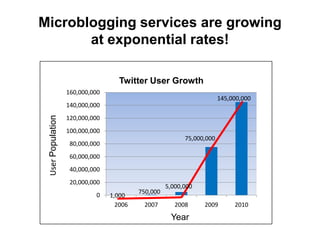
Microblogging services are growing
       at exponential rates!

                                    Twitter User Growth
                   160,000,000
                                                                       145,000,000
                   140,000,000
 User Population


                   120,000,000
                   100,000,000
                                                          75,000,000
                    80,000,000
                    60,000,000
                    40,000,000
                    20,000,000
                                                    5,000,000
                                          750,000
                            0    1,000
                                   2006    2007        2008     2009        2010
                                                     Year
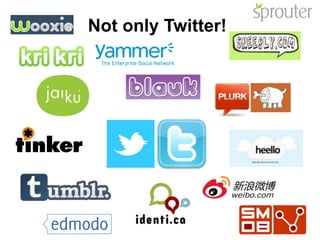
Not only Twitter!
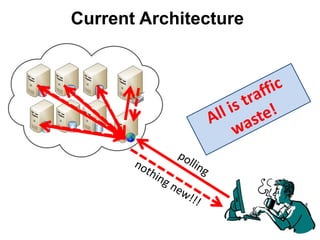
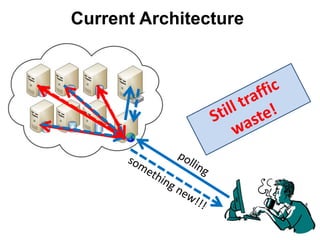
Current Architecture
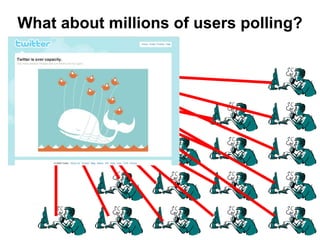
What about millions of users polling?
How is the availability and performance
  of these microblogging services?
        (Measurement Study on Twitter)
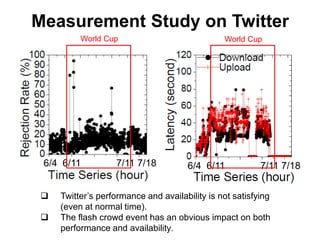
   Measurement period: Jun. 4 – Jul. 18, 2010
     - Including a flash crowd event:
        FIFA World Cup 2010
Measurement Study on Twitter
          World Cup                             World Cup


 6/4 6/11          7/11 7/18          6/4 6/11            7/11 7/18


    Twitter’s performance and availability is not satisfying
     (even at normal time).
    The flash crowd event has an obvious impact on both
     performance and availability.
Twitter’s Short-Term Solutions
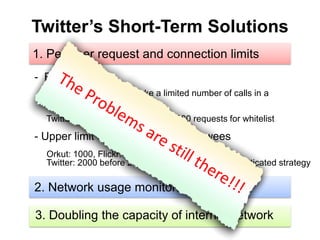
1. Per-user request and connection limits
- Rate limit
    Only allows clients to make a limited number of calls in a
    given period
   Twitter: 150 requests per hour, 2,000 requests for whitelist

- Upper limit on the number of followees
      Orkut: 1000, Flickr: 3000, Facebook: 5000,
      Twitter: 2000 before 2009, now using a more sophisticated strategy
identi.ca         jaiku           emote.in       Chinese Sina microblogging


2. Network usage monitoring

3. Doubling the capacity of internal network
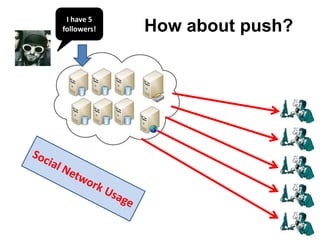
I have 5
followers!   How about push?
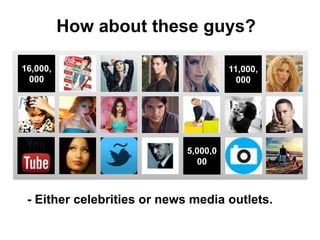
How about these guys?

16,000,                                11,000,
 000                                     000


                             5,000,0
                                00


 - Either celebrities or news media outlets.
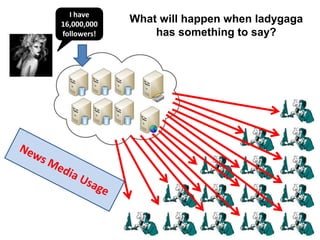
I have
16,000,000
             What will happen when ladygaga
followers!       has something to say?
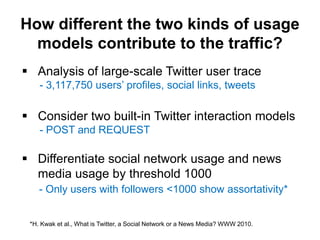
How different the two kinds of usage
  models contribute to the traffic?
 Analysis of large-scale Twitter user trace
    - 3,117,750 users’ profiles, social links, tweets

 Consider two built-in Twitter interaction models
    - POST and REQUEST

 Differentiate social network usage and news
  media usage by threshold 1000
    - Only users with followers <1000 show assortativity*


 *H. Kwak et al., What is Twitter, a Social Network or a News Media? WWW 2010.
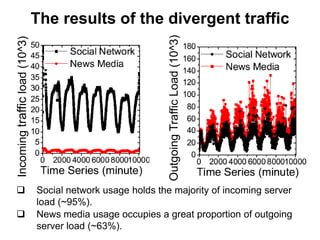
The results of the divergent traffic


                                                             Outgoing Traffic Load (10^3)
Incoming traffic load (10^3)


                              Social network usage holds the majority of incoming server
                               load (~95%).
                              News media usage occupies a great proportion of outgoing
                               server load (~63%).
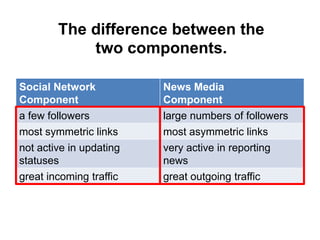
The difference between the
            two components.

Social Network           News Media
Component                Component
a few followers          large numbers of followers
most symmetric links     most asymmetric links
not active in updating   very active in reporting
statuses                 news
great incoming traffic   great outgoing traffic
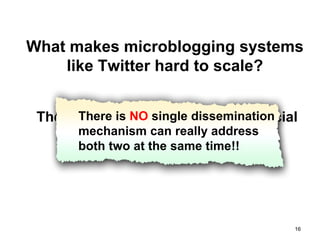
What makes microblogging systems
    like Twitter hard to scale?


 They are being used asdissemination
       There is NO single both the social
       mechanism can really address
      network and the news media
    infrastructure at same time!!time!
       both two at the the same


                                        16
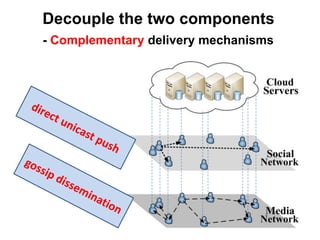
Decouple the two components
- Complementary delivery mechanisms
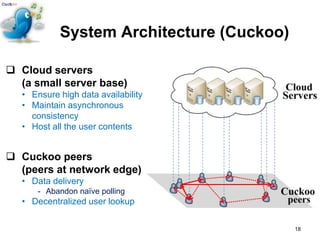
System Architecture (Cuckoo)

 Cloud servers
  (a small server base)
   • Ensure high data availability
   • Maintain asynchronous
     consistency
   • Host all the user contents


 Cuckoo peers
  (peers at network edge)
   • Data delivery
       - Abandon naïve polling
   • Decentralized user lookup

                                           18
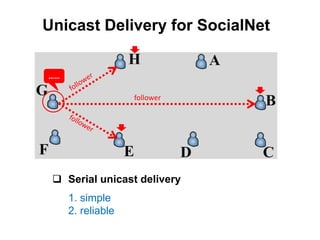
Unicast Delivery for SocialNet


……

                   follower


  Serial unicast delivery
     1. simple
     2. reliable
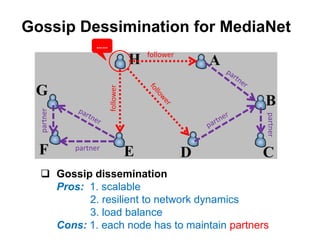
Gossip Dessimination for MediaNet
                  ……
                                  follower


                       follower
  partner


                                              partner
            partner


   Gossip dissemination
    Pros: 1. scalable
          2. resilient to network dynamics
          3. load balance
    Cons: 1. each node has to maintain partners
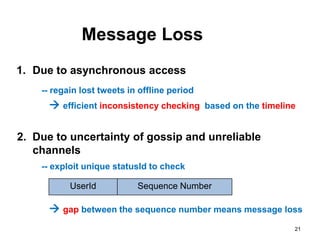
Message Loss
1. Due to asynchronous access
    -- regain lost tweets in offline period
       efficient inconsistency checking based on the timeline

2. Due to uncertainty of gossip and unreliable
   channels
    -- exploit unique statusId to check

           UserId           Sequence Number

       gap between the sequence number means message loss
                                                             21
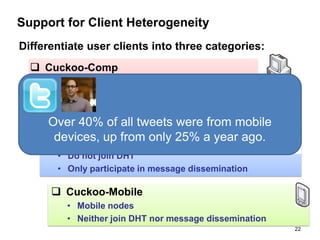
Support for Client Heterogeneity
Differentiate user clients into three categories:
   Cuckoo-Comp
     • Stable nodes
     • Construct DHT and provide DHT-based user lookup
     • Participate in message dissemination
     Over 40% of all tweets were from mobile
     Cuckoo-Lite
      devices, up clients onlylaptops)a year ago.
       • Lightweight
                     from (i.e., 25%
       • Do not join DHT
       • Only participate in message dissemination

       Cuckoo-Mobile
         • Mobile nodes
         • Neither join DHT nor message dissemination
                                                         22
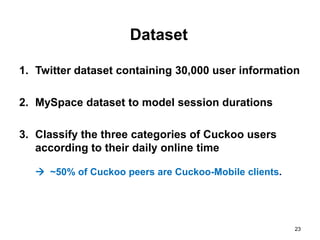
Dataset

1. Twitter dataset containing 30,000 user information

2. MySpace dataset to model session durations

3. Classify the three categories of Cuckoo users
   according to their daily online time

    ~50% of Cuckoo peers are Cuckoo-Mobile clients.


                                                       23
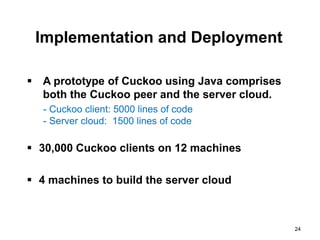
Implementation and Deployment

 A prototype of Cuckoo using Java comprises
  both the Cuckoo peer and the server cloud.
   - Cuckoo client: 5000 lines of code
   - Server cloud: 1500 lines of code

 30,000 Cuckoo clients on 12 machines

 4 machines to build the server cloud


                                               24
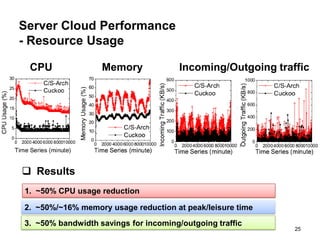
Server Cloud Performance
- Resource Usage

 CPU               Memory              Incoming/Outgoing traffic


 Results
1. ~50% CPU usage reduction

2. ~50%/~16% memory usage reduction at peak/leisure time
3. ~50% bandwidth savings for incoming/outgoing traffic
                                                             25
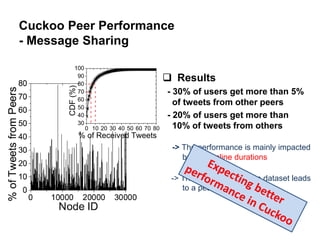
Cuckoo Peer Performance
- Message Sharing

           100
            90
            80
                                               Results
       CDF (%)

            70                                 - 30% of users get more than 5%
            60
            50
                                                 of tweets from other peers
            40                                 - 20% of users get more than
            30
                  0 10 20 30 40 50 60 70 80      10% of tweets from others
                 % of Received Tweets
                                                 -> The performance is mainly impacted
                                                    by user online durations

                                                -> The MySpace duration dataset leads
                                                   to a pessimistic deviation
                                                       jaiku               emote.in
                                              Chinese Sina microblogging
Cuckoo Peer Performance
- Micronews Dissemination


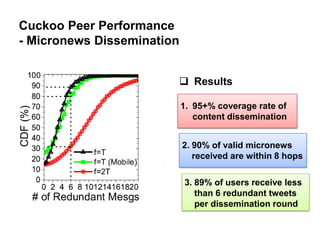
                         Results

                            1. 95+% coverage rate of
                               content dissemination


                            2. 90% of valid micronews
                               received are within 8 hops

                            3. 89% of users receive less
                               than 6 redundant tweets
                               per dissemination round
Related Work
• Microblogging and Pub-Sub Systems
  – [Rama_NSDI2006], [Sandler_IPTPS2005],

• Measurement Study on Microblogging
  – [Ghosh_WOSN2010], [Krish_WOSN2007], [Kw
    ak_WWW2009], [Cha_ICWSM2010],

• Decentralized Microblogging
  – [Sandler_IPTPS2009], [Buchegger_SNS2009],
    [Shakimov_WOSN2009]
Conclusion
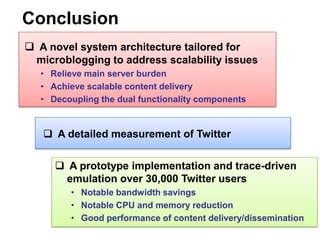
 A novel system architecture tailored for
 microblogging to address scalability issues
   • Relieve main server burden
   • Achieve scalable content delivery
   • Decoupling the dual functionality components


    A detailed measurement of Twitter

       A prototype implementation and trace-driven
       emulation over 30,000 Twitter users
         • Notable bandwidth savings
         • Notable CPU and memory reduction
         • Good performance of content delivery/dissemination
Acknowledgement

   Opera Group
   U.C. San Diego, USA


   Middleware
   Conference
Thank you very much!!

  http://mycuckoo.org

Scaling Microblogging Services with Divergent Traffic Demands

  • 1.
    Scaling Microblogging Services withDivergent Traffic Demands Presented by Tianyin Xu Tianyin Xu, Yang Chen, Lei Jiao, Ben Zhao, Pan Hui, Xiaoming Fu University of Goettingen, UC San Diego UC Santa Barbara, Deutsche Telekom
  • 2.
    Microblogging services aregrowing at exponential rates! Twitter User Growth 160,000,000 145,000,000 140,000,000 User Population 120,000,000 100,000,000 75,000,000 80,000,000 60,000,000 40,000,000 20,000,000 5,000,000 750,000 0 1,000 2006 2007 2008 2009 2010 Year
  • 3.
  • 4.
  • 5.
  • 6.
    What about millionsof users polling?
  • 7.
    How is theavailability and performance of these microblogging services? (Measurement Study on Twitter)  Measurement period: Jun. 4 – Jul. 18, 2010 - Including a flash crowd event:  FIFA World Cup 2010
  • 8.
    Measurement Study onTwitter World Cup World Cup 6/4 6/11 7/11 7/18 6/4 6/11 7/11 7/18  Twitter’s performance and availability is not satisfying (even at normal time).  The flash crowd event has an obvious impact on both performance and availability.
  • 9.
    Twitter’s Short-Term Solutions 1.Per-user request and connection limits - Rate limit Only allows clients to make a limited number of calls in a given period Twitter: 150 requests per hour, 2,000 requests for whitelist - Upper limit on the number of followees Orkut: 1000, Flickr: 3000, Facebook: 5000, Twitter: 2000 before 2009, now using a more sophisticated strategy identi.ca jaiku emote.in Chinese Sina microblogging 2. Network usage monitoring 3. Doubling the capacity of internal network
  • 10.
    I have 5 followers! How about push?
  • 11.
    How about theseguys? 16,000, 11,000, 000 000 5,000,0 00 - Either celebrities or news media outlets.
  • 12.
    I have 16,000,000 What will happen when ladygaga followers! has something to say?
  • 13.
    How different thetwo kinds of usage models contribute to the traffic?  Analysis of large-scale Twitter user trace - 3,117,750 users’ profiles, social links, tweets  Consider two built-in Twitter interaction models - POST and REQUEST  Differentiate social network usage and news media usage by threshold 1000 - Only users with followers <1000 show assortativity* *H. Kwak et al., What is Twitter, a Social Network or a News Media? WWW 2010.
  • 14.
    The results ofthe divergent traffic Outgoing Traffic Load (10^3) Incoming traffic load (10^3)  Social network usage holds the majority of incoming server load (~95%).  News media usage occupies a great proportion of outgoing server load (~63%).
  • 15.
    The difference betweenthe two components. Social Network News Media Component Component a few followers large numbers of followers most symmetric links most asymmetric links not active in updating very active in reporting statuses news great incoming traffic great outgoing traffic
  • 16.
    What makes microbloggingsystems like Twitter hard to scale? They are being used asdissemination There is NO single both the social mechanism can really address network and the news media infrastructure at same time!!time! both two at the the same 16
  • 17.
    Decouple the twocomponents - Complementary delivery mechanisms
  • 18.
    System Architecture (Cuckoo) Cloud servers (a small server base) • Ensure high data availability • Maintain asynchronous consistency • Host all the user contents  Cuckoo peers (peers at network edge) • Data delivery - Abandon naïve polling • Decentralized user lookup 18
  • 19.
    Unicast Delivery forSocialNet …… follower  Serial unicast delivery 1. simple 2. reliable
  • 20.
    Gossip Dessimination forMediaNet …… follower follower partner partner partner  Gossip dissemination Pros: 1. scalable 2. resilient to network dynamics 3. load balance Cons: 1. each node has to maintain partners
  • 21.
    Message Loss 1. Dueto asynchronous access -- regain lost tweets in offline period  efficient inconsistency checking based on the timeline 2. Due to uncertainty of gossip and unreliable channels -- exploit unique statusId to check UserId Sequence Number  gap between the sequence number means message loss 21
  • 22.
    Support for ClientHeterogeneity Differentiate user clients into three categories:  Cuckoo-Comp • Stable nodes • Construct DHT and provide DHT-based user lookup • Participate in message dissemination Over 40% of all tweets were from mobile  Cuckoo-Lite devices, up clients onlylaptops)a year ago. • Lightweight from (i.e., 25% • Do not join DHT • Only participate in message dissemination  Cuckoo-Mobile • Mobile nodes • Neither join DHT nor message dissemination 22
  • 23.
    Dataset 1. Twitter datasetcontaining 30,000 user information 2. MySpace dataset to model session durations 3. Classify the three categories of Cuckoo users according to their daily online time  ~50% of Cuckoo peers are Cuckoo-Mobile clients. 23
  • 24.
    Implementation and Deployment A prototype of Cuckoo using Java comprises both the Cuckoo peer and the server cloud. - Cuckoo client: 5000 lines of code - Server cloud: 1500 lines of code  30,000 Cuckoo clients on 12 machines  4 machines to build the server cloud 24
  • 25.
    Server Cloud Performance -Resource Usage CPU Memory Incoming/Outgoing traffic  Results 1. ~50% CPU usage reduction 2. ~50%/~16% memory usage reduction at peak/leisure time 3. ~50% bandwidth savings for incoming/outgoing traffic 25
  • 26.
    Cuckoo Peer Performance -Message Sharing 100 90 80  Results CDF (%) 70 - 30% of users get more than 5% 60 50 of tweets from other peers 40 - 20% of users get more than 30 0 10 20 30 40 50 60 70 80 10% of tweets from others % of Received Tweets -> The performance is mainly impacted by user online durations -> The MySpace duration dataset leads to a pessimistic deviation jaiku emote.in Chinese Sina microblogging
  • 27.
    Cuckoo Peer Performance -Micronews Dissemination  Results 1. 95+% coverage rate of content dissemination 2. 90% of valid micronews received are within 8 hops 3. 89% of users receive less than 6 redundant tweets per dissemination round
  • 28.
    Related Work • Microbloggingand Pub-Sub Systems – [Rama_NSDI2006], [Sandler_IPTPS2005], • Measurement Study on Microblogging – [Ghosh_WOSN2010], [Krish_WOSN2007], [Kw ak_WWW2009], [Cha_ICWSM2010], • Decentralized Microblogging – [Sandler_IPTPS2009], [Buchegger_SNS2009], [Shakimov_WOSN2009]
  • 29.
    Conclusion  A novelsystem architecture tailored for microblogging to address scalability issues • Relieve main server burden • Achieve scalable content delivery • Decoupling the dual functionality components  A detailed measurement of Twitter  A prototype implementation and trace-driven emulation over 30,000 Twitter users • Notable bandwidth savings • Notable CPU and memory reduction • Good performance of content delivery/dissemination
  • 30.
    Acknowledgement Opera Group U.C. San Diego, USA Middleware Conference
  • 31.
    Thank you verymuch!! http://mycuckoo.org