Phoenix: A Weight-Based
Network Coordinate System
 Using Matrix Factorization

           Yang Chen
 Department of Computer Science
         Duke University
       ychen@cs.duke.edu
Outline
•   Background
•   System Design
•   Evaluation
•   Perspective Future Work


                              2
BACKGROUND


             3
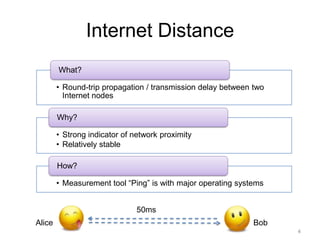
Internet Distance
        What?

        • Round-trip propagation / transmission delay between two
          Internet nodes

        Why?

        • Strong indicator of network proximity
        • Relatively stable

        How?

        • Measurement tool “Ping” is with major operating systems


                               50ms
Alice                                                         Bob
                                                                    4
Use Cases
• Knowledge of Internet distance is useful
  for…
  – P2P content delivery (file sharing/streaming)
  – Online/mobile games
  – Overlay routing
  – Server selection in P2P/Cloud
  – Network monitoring


                                                    5
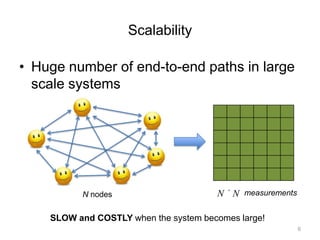
Scalability

• Huge number of end-to-end paths in large
  scale systems


          N nodes                      N ´ N measurements

    SLOW and COSTLY when the system becomes large!
                                                            6
Network Coordinate (NC) Systems
  (5, 10, 2)                                (-3, 4, -2)
Alice
                                                    Bob


                   Distance Function


                         22ms


  • Scalable measurement: N2  NK (K << N)
  • Every node is assigned with coordinates
  • Distance function: compute the distance between
    two nodes without explicit measurement
                                                          7
               [Ng et al, INFOCOM’02]
Deployments


     They are all using
Network Coordinate Systems!
                              8
Basic models
• Euclidean Distance-based NC (ENC)
  – Modeling the Internet as a Euclidean space
  – Systems: Vivaldi [Dabek et al., SIGCOMM’04], GNP [Ng et al,
    INFOCOM’02], NPS [Ng et al., USENIX ATC’04], PIC [Costa et al.,

    ICDCS’04]…

• Matrix Factorization-based NC (MFNC)
  – Factorizing an Internet distance matrix as the
    product of two smaller matrices
  – Systems: IDES [Mao et al., JSAC’06], Phoenix, …
                                                                      9
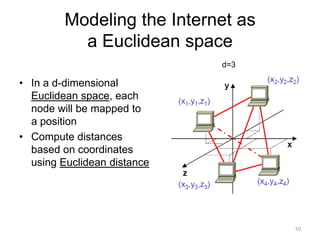
Modeling the Internet as
           a Euclidean space
                             d=3

• In a d-dimensional
  Euclidean space, each
  node will be mapped to
  a position
• Compute distances
  based on coordinates
  using Euclidean distance


                                    10
Triangle Inequality Violation
                                         29.9 > 5.6+3.6
                                                                Czech
                                                               Republic
                                             5.6 ms

                                                                       29.9 ms
                                        Slovakia
                                                   3.6 ms
                                                               Hungary

                                       A Triangle Inequality Violation (TIV)
Predicted distances in                 example in GEANT network
Euclidean space must
   satisfy triangle
      inequality                             Lots of TIVs in the Internet
                                              due sub-optimal routing!!


                                                                            11
                         [Zheng et al, PAM’05]
Correlation in Internet Distance Matrices
                    Distance measurement using PlanetLab nodes


             Duke       UNC     Yale    Aachen   Oxford   Toronto   THU    NUS


Duke          -          3       24      107      122       37      219    252


UNC           3          -       24      106      109       38      219    253


                       Internet paths with nearby
                      end nodes are often overlap!!

  Rows in different Internet distance matrices are large correlated (low
  effective rank)
  [Tang et al, IMC’03], [Lim et al, ToN’05], [Liao et al, CoNEXT’11]
                                                                             12
Factorization of an Internet Distance Matrix

             
             N columns


         {
                                 d columns
                                  


                           »
    N rows


                                             ´


          M                         X                Y   T

          
                                          
                                                
                             X7 = [ 1 0 3 ],Y2 = [ 2 0 5 ]
  M ij » Xi ×Yj                       
                                          
                              M 72 » X7 ×Y2 =1´ 2 + 0 + 3´ 5 =17

                     [Mao et al., JSAC’06]                         13
Matrix Factorization-Based NC
                 N columns
                                                        
                                                        X2


          {
                                          d columns
                                                               
                                                                 
                                                                Y2

                                   »
     N rows


                                                    ´


                    M                        X                  Y   T

• Each node i has an outgoing vector Xi and an
  incoming vector Yi
• Distance function is the dot product.
                                                                        14
              No triangle inequality constrain in this model!
SYSTEM DESIGN


                15
Goals
• Substantial improvement in prediction
  accuracy
• Decentralized and scalable
• Robust to dynamic Internet


                                          16
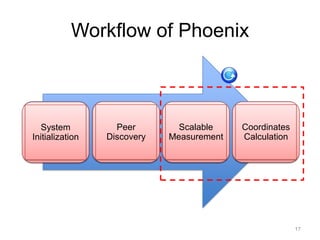
Workflow of Phoenix


   System          Peer        Scalable    Coordinates
Initialization   Discovery   Measurement   Calculation


                                                         17
System Initialization
              Measured Distance
              Predicted Distance
                                                   (X1,Y1)
                                                                                   (X2,Y2)
 H1                                            H1
                                        H2                                            H2


                                H4                                            H4
H3                                            H3
                                                                         (X4,Y4)
                                                 (X3,Y3)
 •   Early nodes (N<K): Full-mesh measurement
 •   Compute coordinates of early nodes by minimizing the overall discrepancy
     between predicted distances and measured distances

Nonnegative matrix factorization: [D. D. Lee and H. S. Seung, Nature, 401(6755):788–791,
                                                                                       18
1999.]
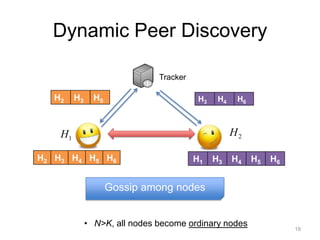
Dynamic Peer Discovery

                               Tracker

  H2     H3     H5                        H3    H4    H6


    H1                                               H2

H2 H3 H4 H5 H6                           H1    H3    H4    H5   H6


                     Gossip among nodes


              • N>K, all nodes become ordinary nodes
                                                                     19
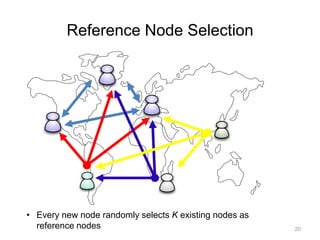
Reference Node Selection


• Every new node randomly selects K existing nodes as
  reference nodes                                       20
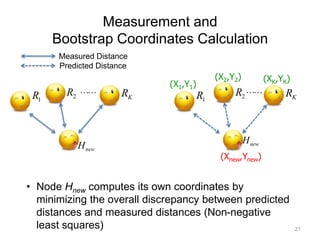
Measurement and
      Bootstrap Coordinates Calculation
       Measured Distance
       Predicted Distance
                                            (X2,Y2)           (XK,YK)
                             (X1,Y1)
 R1      R2          RK              R1        R2              RK


                                                      H new
           H new
                                             (Xnew,Ynew)


• Node Hnew computes its own coordinates by
  minimizing the overall discrepancy between predicted
  distances and measured distances (Non-negative
  least squares)                                                        21
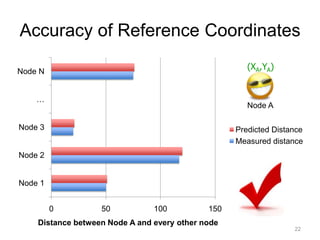
Accuracy of Reference Coordinates

Node N
                                                      (XA,YA)


    …
                                                      Node A

Node 3                                             Predicted Distance
                                                   Measured distance
Node 2


Node 1


         0         50           100          150
    Distance between Node A and every other node
                                                                  22
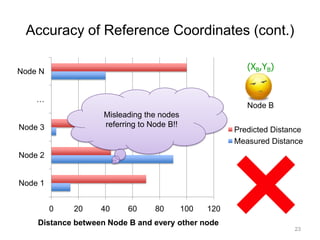
Accuracy of Reference Coordinates (cont.)

Node N
                                                           (XB,YB)


    …
                                                           Node B
                    Misleading the nodes
Node 3              referring to Node B!!
                                                        Predicted Distance
                                                        Measured Distance
Node 2


Node 1


         0   20    40     60      80        100   120
    Distance between Node B and every other node
                                                                       23
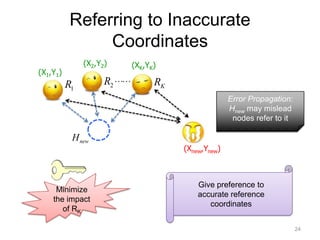
Referring to Inaccurate
                Coordinates
               (X2,Y2)       (XK,YK)
(X1,Y1)
          R1         R2          RK
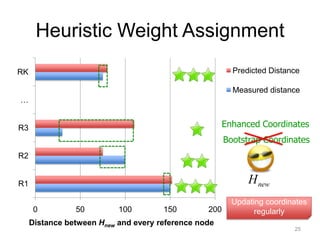
                                                      Error Propagation:
                                                      Hnew may mislead
                                                       nodes refer to it

           H new
                                        (Xnew,Ynew)


                                            Give preference to
     Minimize
                                            accurate reference
    the impact
                                               coordinates
       of RK

                                                                           24
Heuristic Weight Assignment
RK                                                       Predicted Distance

                                                         Measured distance
…


R3                                                    Enhanced Coordinates
                                                       Bootstrap Coordinates
R2


R1                                                           H new
                                                         Updating coordinates
      0         50         100        150        200           regularly
     Distance between Hnew and every reference node
                                                                         25
EVALUATION


             26
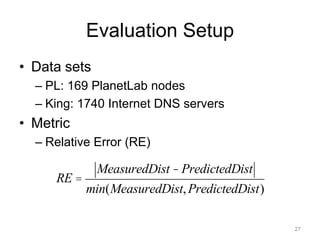
Evaluation Setup
• Data sets
  – PL: 169 PlanetLab nodes
  – King: 1740 Internet DNS servers
• Metric
  – Relative Error (RE)

           MeasuredDist - PredictedDist
     RE =
          min(MeasuredDist, PredictedDist)

                                             27
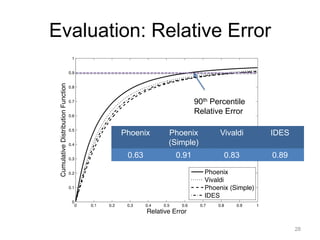
Evaluation: Relative Error


                          90th Percentile
                          Relative Error

        Phoenix   Phoenix        Vivaldi    IDES
                  (Simple)
         0.63      0.91           0.83      0.89


                                                   28
Evaluation (cont.)
• Other findings through evaluation
  – Robust to node churn
  – Fast convergence
  – Robust to measurement anomalies
  – Robust to distance variation


                                      29
FUTURE WORK


              30
Perspective Topics
• NC systems in mobile-centric environment
  – Access latency, host mobility, host churn
• Scalable Prediction of other important
  network parameters
  – Available bandwidth, shortest-path distance in
    social graph


                                                 31
Software
• NCSim
  – Simulator of Decentralized Network
    Coordinate Algorithms
  – http://code.google.com/p/ncsim/
• Phoenix
  – Original Phoenix simulator in IEEE TNSM
    paper
  – http://www.cs.duke.edu/~ychen/Phoenix_TNS
    M_2011.zip
                                            32

Phoenix: A Weight-based Network Coordinate System Using Matrix Factorization

  • 1.
    Phoenix: A Weight-Based NetworkCoordinate System Using Matrix Factorization Yang Chen Department of Computer Science Duke University ychen@cs.duke.edu
  • 2.
    Outline • Background • System Design • Evaluation • Perspective Future Work 2
  • 3.
  • 4.
    Internet Distance What? • Round-trip propagation / transmission delay between two Internet nodes Why? • Strong indicator of network proximity • Relatively stable How? • Measurement tool “Ping” is with major operating systems 50ms Alice Bob 4
  • 5.
    Use Cases • Knowledgeof Internet distance is useful for… – P2P content delivery (file sharing/streaming) – Online/mobile games – Overlay routing – Server selection in P2P/Cloud – Network monitoring 5
  • 6.
    Scalability • Huge numberof end-to-end paths in large scale systems N nodes N ´ N measurements SLOW and COSTLY when the system becomes large! 6
  • 7.
    Network Coordinate (NC)Systems (5, 10, 2) (-3, 4, -2) Alice Bob Distance Function 22ms • Scalable measurement: N2  NK (K << N) • Every node is assigned with coordinates • Distance function: compute the distance between two nodes without explicit measurement 7 [Ng et al, INFOCOM’02]
  • 8.
    Deployments They are all using Network Coordinate Systems! 8
  • 9.
    Basic models • EuclideanDistance-based NC (ENC) – Modeling the Internet as a Euclidean space – Systems: Vivaldi [Dabek et al., SIGCOMM’04], GNP [Ng et al, INFOCOM’02], NPS [Ng et al., USENIX ATC’04], PIC [Costa et al., ICDCS’04]… • Matrix Factorization-based NC (MFNC) – Factorizing an Internet distance matrix as the product of two smaller matrices – Systems: IDES [Mao et al., JSAC’06], Phoenix, … 9
  • 10.
    Modeling the Internetas a Euclidean space d=3 • In a d-dimensional Euclidean space, each node will be mapped to a position • Compute distances based on coordinates using Euclidean distance 10
  • 11.
    Triangle Inequality Violation 29.9 > 5.6+3.6 Czech Republic 5.6 ms 29.9 ms Slovakia 3.6 ms Hungary A Triangle Inequality Violation (TIV) Predicted distances in example in GEANT network Euclidean space must satisfy triangle inequality Lots of TIVs in the Internet due sub-optimal routing!! 11 [Zheng et al, PAM’05]
  • 12.
    Correlation in InternetDistance Matrices Distance measurement using PlanetLab nodes Duke UNC Yale Aachen Oxford Toronto THU NUS Duke - 3 24 107 122 37 219 252 UNC 3 - 24 106 109 38 219 253 Internet paths with nearby end nodes are often overlap!! Rows in different Internet distance matrices are large correlated (low effective rank) [Tang et al, IMC’03], [Lim et al, ToN’05], [Liao et al, CoNEXT’11] 12
  • 13.
    Factorization of anInternet Distance Matrix  N columns { d columns  » N rows ´ M X Y T        X7 = [ 1 0 3 ],Y2 = [ 2 0 5 ] M ij » Xi ×Yj    M 72 » X7 ×Y2 =1´ 2 + 0 + 3´ 5 =17 [Mao et al., JSAC’06] 13
  • 14.
    Matrix Factorization-Based NC  N columns  X2 { d columns    Y2 » N rows ´ M X Y T • Each node i has an outgoing vector Xi and an incoming vector Yi • Distance function is the dot product. 14 No triangle inequality constrain in this model!
  • 15.
  • 16.
    Goals • Substantial improvementin prediction accuracy • Decentralized and scalable • Robust to dynamic Internet 16
  • 17.
    Workflow of Phoenix System Peer Scalable Coordinates Initialization Discovery Measurement Calculation 17
  • 18.
    System Initialization Measured Distance Predicted Distance (X1,Y1) (X2,Y2) H1 H1 H2 H2 H4 H4 H3 H3 (X4,Y4) (X3,Y3) • Early nodes (N<K): Full-mesh measurement • Compute coordinates of early nodes by minimizing the overall discrepancy between predicted distances and measured distances Nonnegative matrix factorization: [D. D. Lee and H. S. Seung, Nature, 401(6755):788–791, 18 1999.]
  • 19.
    Dynamic Peer Discovery Tracker H2 H3 H5 H3 H4 H6 H1 H2 H2 H3 H4 H5 H6 H1 H3 H4 H5 H6 Gossip among nodes • N>K, all nodes become ordinary nodes 19
  • 20.
    Reference Node Selection •Every new node randomly selects K existing nodes as reference nodes 20
  • 21.
    Measurement and Bootstrap Coordinates Calculation Measured Distance Predicted Distance (X2,Y2) (XK,YK) (X1,Y1) R1 R2  RK R1 R2  RK H new H new (Xnew,Ynew) • Node Hnew computes its own coordinates by minimizing the overall discrepancy between predicted distances and measured distances (Non-negative least squares) 21
  • 22.
    Accuracy of ReferenceCoordinates Node N (XA,YA) … Node A Node 3 Predicted Distance Measured distance Node 2 Node 1 0 50 100 150 Distance between Node A and every other node 22
  • 23.
    Accuracy of ReferenceCoordinates (cont.) Node N (XB,YB) … Node B Misleading the nodes Node 3 referring to Node B!! Predicted Distance Measured Distance Node 2 Node 1 0 20 40 60 80 100 120 Distance between Node B and every other node 23
  • 24.
    Referring to Inaccurate Coordinates (X2,Y2) (XK,YK) (X1,Y1) R1 R2  RK Error Propagation: Hnew may mislead nodes refer to it H new (Xnew,Ynew) Give preference to Minimize accurate reference the impact coordinates of RK 24
  • 25.
    Heuristic Weight Assignment RK Predicted Distance Measured distance … R3 Enhanced Coordinates Bootstrap Coordinates R2 R1 H new Updating coordinates 0 50 100 150 200 regularly Distance between Hnew and every reference node 25
  • 26.
  • 27.
    Evaluation Setup • Datasets – PL: 169 PlanetLab nodes – King: 1740 Internet DNS servers • Metric – Relative Error (RE) MeasuredDist - PredictedDist RE = min(MeasuredDist, PredictedDist) 27
  • 28.
    Evaluation: Relative Error 90th Percentile Relative Error Phoenix Phoenix Vivaldi IDES (Simple) 0.63 0.91 0.83 0.89 28
  • 29.
    Evaluation (cont.) • Otherfindings through evaluation – Robust to node churn – Fast convergence – Robust to measurement anomalies – Robust to distance variation 29
  • 30.
  • 31.
    Perspective Topics • NCsystems in mobile-centric environment – Access latency, host mobility, host churn • Scalable Prediction of other important network parameters – Available bandwidth, shortest-path distance in social graph 31
  • 32.
    Software • NCSim – Simulator of Decentralized Network Coordinate Algorithms – http://code.google.com/p/ncsim/ • Phoenix – Original Phoenix simulator in IEEE TNSM paper – http://www.cs.duke.edu/~ychen/Phoenix_TNS M_2011.zip 32

Editor's Notes