Cuban Tourism: 2016 and
Beyond
Presentation to the "Cuba as a Tourism Destination for Americans” expert panel organized by the Association of North America Higher Education International (ANAHEI) as part of the
“International Education Week” celebrations, 15 November, 2016.
Babu P George, PhD, DBA
Associate Professor of Management
Fort Hays State University, USA
My Fascination with the Cuban Tourism
• Change management under economic transitions has been an area of
research interest for me, since early 2000’s.
• Since 2005, I began taking keen interest in the Caribbean tourism in
transition.
• In particular, me and my co-researchers assessed the strategic positioning of
Cuba in the largely homogenous Caribbean tourism product mix.
• Peer reviewed published research, doctoral dissertations, consulting projects, among
others.
• I am fascinated by the Cuban tourism – because it is still an enigma.
The Industry Structure
• In the early 1950’s, International tourism from the US was thriving in
Cuba
• Gambling and sex tourism
• Late 1950’s and beyond saw complete shut down of the US tourist arrivals
• Deterioration of quality accommodation, accessibilities, and tourist amenities.
• In the 1980s, international tourism was reopened
• 1990’s saw fresh developments (public-private partnership models)
• In 1994, the Ministry of Tourism (MINTUR) was formed.
• Provide political directions for tourism development
• Monitor tourism development plans
• Oversee the activities of sub-agencies
• Publicitur: PR agency for tourism; Fintur Banking agency for tourism
“Legal Excuses” for US Nationals to Travel to
Cuba
Family visits
Official business of the U.S. government, foreign governments, and certain intergovernmental organizations
Journalistic activity
Professional research and professional meetings
Educational activities; including “people – to- people travel”
Religious activities
Public performances, clinics, workshops, athletic and other competitions, and exhibitions
Support for the Cuban people
Humanitarian projects
Activities of private foundations or research or educational institutes
Exportation, importation, or transmission of information or informational materials
Certain export transactions that may be considered for authorization under existing Department of Commerce
regulations and guidelines with respect to Cuba or engaged in by U.S.-owned or -controlled foreign firms
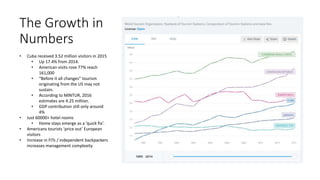
The Growth in
Numbers
• Cuba received 3.52 million visitors in 2015
• Up 17.4% from 2014.
• American visits rose 77% reach
161,000
• “Before it all changes” tourism
originating from the US may not
sustain.
• According to MINTUR, 2016
estimates are 4.25 million.
• GDP contribution still only around
4%
• Just 60000+ hotel rooms
• Home stays emerge as a ‘quick fix’.
• Americans tourists ‘price out’ European
visitors
• Increase in FITs / independent backpackers
increases management complexity
Tourism Education
• Formatur School for Tourism Education provides professional training
• Planned educational offerings, according to local priorities
• Two years of intense training, irrespective of prior education
• One-year training period for housekeeping positions
• Increasing partnership with foreign schools (E.g.: Institut de tourisme et
d'hôtellerie du Québec (ITHQ), Canada, partnership).
• Brain drain from other industries
• Graduates join the unionized labor force
• Unions approved by the Confederación de Trabajadores de Cuba (CTC)
• CTC head is a Cuban Communist Party political bureau member
• Foreign investors must hire them via the State employment agency
Observation about Food Culture
• Fusion of native American, African, Spanish, and Caribbean cuisines
• Issues in differentiation
• Customer expectations for any ‘exotic differences’ are often unmet
• Recent initiatives in creating an inventory of national and local
cuisines
Some practical tips!
• Even today, it is easier to fly to Cuba from a third country.
• Flying from the US means you need to sign an affidavit
• The airliners may not give the signed affidavits to a US agency. Still, an unwanted step.
• Some airlines may ask for the affidavit, if you are a US citizen / resident (Eg: AeroMexico).
• US Dollar is widely accepted. But, there is an administrative fee (10-13%).
• Might be better to carry Euro or even Canadian dollar
• Technically, travel to Cuba for US citizens is legal only if it falls under one of the following
twelve categories listed in https://www.treasury.gov/resource-
center/sanctions/Programs/Documents/cuba_faqs_new.pdf
• Good news is, most people can (fairly easily) interpret their travel needs to belong to one of these
categories.
• Visit a provider like www.asistur.cu/indexi.php
• Travel insurance, emergency financial needs, etc.
• Americans can now import unlimited cigars and rum, for personal use!
• Provided, the maximum declared value is $400 (likely to change)

Cuban tourism: 2016 and Beyond

  • 1.
    Cuban Tourism: 2016and Beyond Presentation to the "Cuba as a Tourism Destination for Americans” expert panel organized by the Association of North America Higher Education International (ANAHEI) as part of the “International Education Week” celebrations, 15 November, 2016. Babu P George, PhD, DBA Associate Professor of Management Fort Hays State University, USA
  • 2.
    My Fascination withthe Cuban Tourism • Change management under economic transitions has been an area of research interest for me, since early 2000’s. • Since 2005, I began taking keen interest in the Caribbean tourism in transition. • In particular, me and my co-researchers assessed the strategic positioning of Cuba in the largely homogenous Caribbean tourism product mix. • Peer reviewed published research, doctoral dissertations, consulting projects, among others. • I am fascinated by the Cuban tourism – because it is still an enigma.
  • 3.
    The Industry Structure •In the early 1950’s, International tourism from the US was thriving in Cuba • Gambling and sex tourism • Late 1950’s and beyond saw complete shut down of the US tourist arrivals • Deterioration of quality accommodation, accessibilities, and tourist amenities. • In the 1980s, international tourism was reopened • 1990’s saw fresh developments (public-private partnership models) • In 1994, the Ministry of Tourism (MINTUR) was formed. • Provide political directions for tourism development • Monitor tourism development plans • Oversee the activities of sub-agencies • Publicitur: PR agency for tourism; Fintur Banking agency for tourism
  • 4.
    “Legal Excuses” forUS Nationals to Travel to Cuba Family visits Official business of the U.S. government, foreign governments, and certain intergovernmental organizations Journalistic activity Professional research and professional meetings Educational activities; including “people – to- people travel” Religious activities Public performances, clinics, workshops, athletic and other competitions, and exhibitions Support for the Cuban people Humanitarian projects Activities of private foundations or research or educational institutes Exportation, importation, or transmission of information or informational materials Certain export transactions that may be considered for authorization under existing Department of Commerce regulations and guidelines with respect to Cuba or engaged in by U.S.-owned or -controlled foreign firms
  • 5.
    The Growth in Numbers •Cuba received 3.52 million visitors in 2015 • Up 17.4% from 2014. • American visits rose 77% reach 161,000 • “Before it all changes” tourism originating from the US may not sustain. • According to MINTUR, 2016 estimates are 4.25 million. • GDP contribution still only around 4% • Just 60000+ hotel rooms • Home stays emerge as a ‘quick fix’. • Americans tourists ‘price out’ European visitors • Increase in FITs / independent backpackers increases management complexity
  • 6.
    Tourism Education • FormaturSchool for Tourism Education provides professional training • Planned educational offerings, according to local priorities • Two years of intense training, irrespective of prior education • One-year training period for housekeeping positions • Increasing partnership with foreign schools (E.g.: Institut de tourisme et d'hôtellerie du Québec (ITHQ), Canada, partnership). • Brain drain from other industries • Graduates join the unionized labor force • Unions approved by the Confederación de Trabajadores de Cuba (CTC) • CTC head is a Cuban Communist Party political bureau member • Foreign investors must hire them via the State employment agency
  • 7.
    Observation about FoodCulture • Fusion of native American, African, Spanish, and Caribbean cuisines • Issues in differentiation • Customer expectations for any ‘exotic differences’ are often unmet • Recent initiatives in creating an inventory of national and local cuisines
  • 8.
    Some practical tips! •Even today, it is easier to fly to Cuba from a third country. • Flying from the US means you need to sign an affidavit • The airliners may not give the signed affidavits to a US agency. Still, an unwanted step. • Some airlines may ask for the affidavit, if you are a US citizen / resident (Eg: AeroMexico). • US Dollar is widely accepted. But, there is an administrative fee (10-13%). • Might be better to carry Euro or even Canadian dollar • Technically, travel to Cuba for US citizens is legal only if it falls under one of the following twelve categories listed in https://www.treasury.gov/resource- center/sanctions/Programs/Documents/cuba_faqs_new.pdf • Good news is, most people can (fairly easily) interpret their travel needs to belong to one of these categories. • Visit a provider like www.asistur.cu/indexi.php • Travel insurance, emergency financial needs, etc. • Americans can now import unlimited cigars and rum, for personal use! • Provided, the maximum declared value is $400 (likely to change)