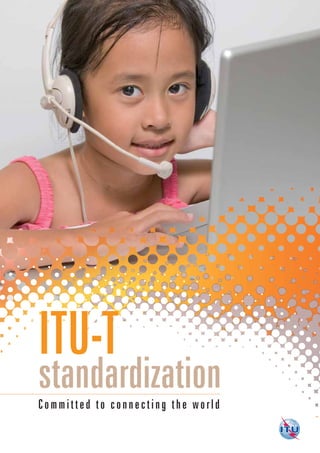
Committed to connecting the world
ITU-T
standardization
2
2
2 www.itu.int
www.itu.int 3
ITU-T Recommendations help the world communicate…
Without ITU-T standards:
• You couldn’t make a telephone call from one side
of the world to the other
• The Internet wouldn’t work
• Modern communications, as we know them,
just wouldn’t exist
The work of ITU
has helped the smoother,
more economical introduction
of new technologies
4
4
4 www.itu.int
Standards are a proven tool for economic
development. The World Trade Organization’s
(WTO) 2005 World Trade Report underlines
the important benefits that standards can
deliver. Various national standards bodies have
undertaken studies that underline the positive
contribution that standardization can make to
a country’s GDP. Standards may also have a
significant effect on limiting the undesirable
outcomes of market failure.
ITU’s work, in the development of global
standards for information and communication
technologies (ICTs) and telecoms, has facilitated
the smoother and more economical introduction
of new technologies around the world.
As the United Nations specialized agency for
ICT – and the world’s preeminent ICT standards
body – ITU’s standards work underpins much of
this amazing technological achievement and plays
a strong role in the Union’s mission to Connect
the World.
The standards, topologies, protocols and
interfaces developed by ITU engender a smoothly
functioning global ICT network – one that powers
commerce, politics, democracy, health, education,
entertainment, literacy and financial markets. In
short, this is a network that is now fundamental
to our modern lives. Standardization has and
will continue to play a key role in measuring,
preventing and mitigating the effects of climate
change.
Many governments around the world have
recognized that ICTs are now the key engine
for economic growth. With the right mix of
infrastructure and services, these under-
developed markets will take off quickly. That’s not
just a boon for under-resourced communities; it’s
a huge opportunity for many in the private sector.
And that makes it a win-win situation. Booming
markets will create more jobs and more wealth.
A world where every child will get access to the
information and communications they need to
realize their potential. We can, and will,
make this happen.
Connecting the World
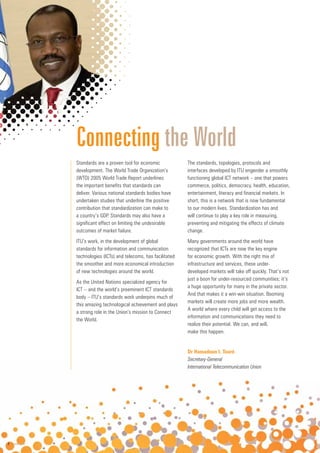
Dr Hamadoun I. Touré
Secretary General
Secretary-General
International Telecommunication Union
www.itu.int 5
Standardization is a key building block in
constructing a globally connected society.
Standards play a strategic role in fostering
innovation and competitive markets. ITU-T
standards (Recommendations) help bring products
and services to market rapidly, build order in the
marketplace, generate trust and enhance safety.
Manufacturers, network operators and consumers
benefit in terms of lower prices and increased
availability by reducing technical barriers and
promoting compatibility between systems.
Thousands of dedicated individuals – from
governments, the private sector, academia and
civil society – come together at ITU-T meetings to
develop these standards that facilitate access to
global markets, allowing for economies of scale in
production and distribution.
This unique global public/private partnership
develops standards in a unique contribution-
driven, and consensus-based, environment.
Conformance to ITU-T standards will increase the
probability of interoperability between equipment
from different vendors and ITU-T is fully involved
in a programme to assist developing countries on
conformance and interoperability testing.
Participation in the ITU standards process gives
you direct influence over the technological
forces that are shaping the ICT industry. It allows
early access to many technical resources and
standards in development. Taking part will help
ensure that your products are safe, reliable and
compatible on a global scale.
Membership allows for unparalleled networking
opportunities with the industry’s top talent
and representatives of over 700 private sector
entities, in addition to 192 governments and their
regulators.
ITU-T’s approach to making standards offers large,
medium and small businesses in both mature and
fledging markets equal opportunity to address
their requirements. And to ensure maximum
visibility the vast majority of ITU-T standards are
now available for free download.
ITU-T’s secretariat will be happy to answer any of
your questions on how we can meet your needs.
We look forward to hearing from you.
Welcome to ITU-T
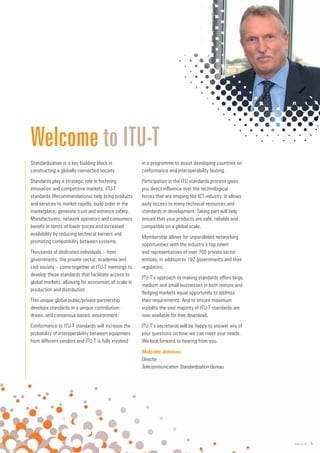
Malcolm Johnson
Director
Director
Telecommunication Standardization Bureau
6 www.itu.int
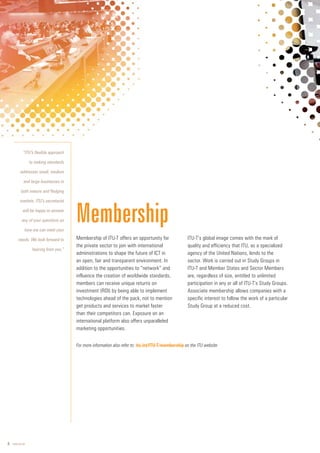
Membership of ITU-T offers an opportunity for
the private sector to join with international
administrations to shape the future of ICT in
an open, fair and transparent environment. In
addition to the opportunities to “network” and
influence the creation of worldwide standards,
members can receive unique returns on
investment (ROI) by being able to implement
technologies ahead of the pack, not to mention
get products and services to market faster
than their competitors can. Exposure on an
international platform also offers unparalleled
marketing opportunities.
ITU-T’s global image comes with the mark of
quality and efficiency that ITU, as a specialized
agency of the United Nations, lends to the
sector. Work is carried out in Study Groups in
ITU-T and Member States and Sector Members
are, regardless of size, entitled to unlimited
participation in any or all of ITU-T’s Study Groups.
Associate membership allows companies with a
specific interest to follow the work of a particular
Study Group at a reduced cost.
Membership
“ITU’s flexible approach
to making standards
addresses small, medium
and large businesses in
both mature and fledging
markets. ITU’s secretariat
will be happy to answer
any of your questions on
how we can meet your
needs. We look forward to
hearing from you.”
For more information also refer to: itu.int/ITU-T/membership on the ITU website
www.itu.int 7
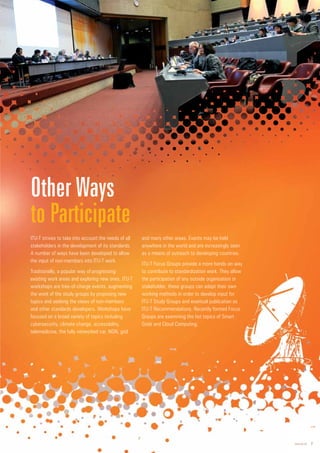
ITU-T strives to take into account the needs of all
stakeholders in the development of its standards.
A number of ways have been developed to allow
the input of non-members into ITU-T work.
Traditionally, a popular way of progressing
existing work areas and exploring new ones, ITU-T
workshops are free-of-charge events, augmenting
the work of the study groups by proposing new
topics and seeking the views of non-members
and other standards developers. Workshops have
focused on a broad variety of topics including
cybersecurity, climate change, accessibility,
telemedicine, the fully networked car, NGN, grid
and many other areas. Events may be held
anywhere in the world and are increasingly seen
as a means of outreach to developing countries.
ITU-T Focus Groups provide a more hands-on way
to contribute to standardization work. They allow
the participation of any outside organization or
stakeholder; these groups can adopt their own
working methods in order to develop input for
ITU-T Study Groups and eventual publication as
ITU-T Recommendations. Recently formed Focus
Groups are examining the hot topics of Smart
Grids and Cloud Computing.
Other Ways
to Participate
8 www.itu.int
Standards are an essential tool in bridging
the digital divide. Bringing vital assistance to
developing countries, standards help build
communications infrastructure and encourage
economic development.
The standardization gap can be defined as
disparities in the ability of developing countries
– relative to those in the developed world – to
access, implement, contribute to and influence
international information and communication
technologies (ICT) standards, and specifically
ITU-T Recommendations.
Participation in the standardization process
allows developing countries to accelerate the
deployment of new networks and services.
ITU’s activities to eliminate the standardization
disparity include implementing remote
participation tools, establishing regional groups,
and holding more meetings and forums in
developing areas.
Bridging
the Digital Divide
For more information, also refer to itu.int/ITU-T/gap/ on the ITU website.
/
“The standards,
topologies, protocols and
interfaces developed by
ITU engender a smoothly
functioning global ICT
network. A network
that powers commerce,
politics, democracy,
health, education,
entertainment, literacy
and financial markets. In
short, a network that has
become fundamental to
our modern lives.”
www.itu.int 9
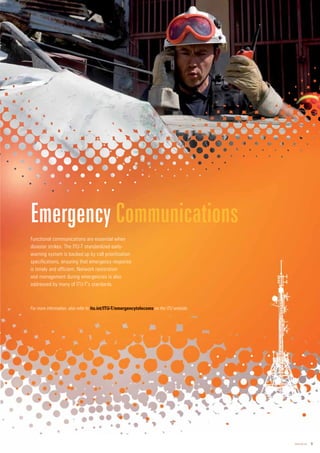
Functional communications are essential when
disaster strikes. The ITU-T standardized early-
warning system is backed up by call prioritization
specifications, ensuring that emergency response
is timely and efficient. Network restoration
and management during emergencies is also
addressed by many of ITU-T’s standards.
Emergency Communications
For more information, also refer to itu.int/ITU-T/emergenc
cyt
ytel
elec
ecom
o s on the ITU website.
10 www.itu.int
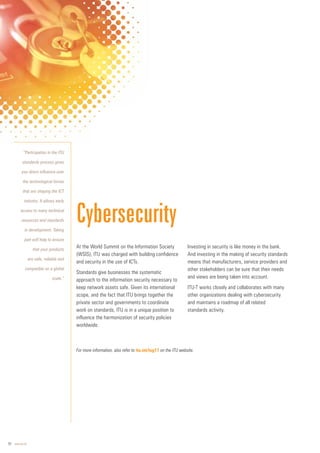
At the World Summit on the Information Society
(WSIS), ITU was charged with building confidence
and security in the use of ICTs.
Standards give businesses the systematic
approach to the information security necessary to
keep network assets safe. Given its international
scope, and the fact that ITU brings together the
private sector and governments to coordinate
work on standards, ITU is in a unique position to
influence the harmonization of security policies
worldwide.
Investing in security is like money in the bank.
And investing in the making of security standards
means that manufacturers, service providers and
other stakeholders can be sure that their needs
and views are being taken into account.
ITU-T works closely and collaborates with many
other organizations dealing with cybersecurity
and maintains a roadmap of all related
standards activity.
Cybersecurity
For more information, also refer to itu.int/tsg17 on the ITU website.
“Participation in the ITU
standards process gives
you direct influence over
the technological forces
that are shaping the ICT
industry. It allows early
access to many technical
resources and standards
in development. Taking
part will help to ensure
that your products
are safe, reliable and
compatible on a global
scale.”
www.itu.int 11
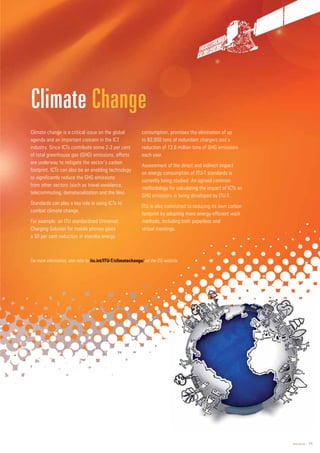
Climate change is a critical issue on the global
agenda and an important concern in the ICT
industry. Since ICTs contribute some 2-3 per cent
of total greenhouse gas (GHG) emissions, efforts
are underway to mitigate the sector’s carbon
footprint. ICTs can also be an enabling technology
to significantly reduce the GHG emissions
from other sectors (such as travel avoidance,
telecommuting, dematerialization and the like).
Standards can play a key role in using ICTs to
combat climate change.
For example, an ITU standardized Universal
Charging Solution for mobile phones gives
a 50 per cent reduction in standby energy
consumption, promises the elimination of up
to 82,000 tons of redundant chargers and a
reduction of 13.6 million tons of GHG emissions
each year.
Assessment of the direct and indirect impact
on energy consumption of ITU-T standards is
currently being studied. An agreed common
methodology for calculating the impact of ICTs on
GHG emissions is being developed by ITU-T.
ITU is also committed to reducing its own carbon
footprint by adopting more energy-efficient work
methods, including both paperless and
virtual meetings.
Climate Change
For more information, also refer to it
itu.int/ITU-T/climatec
ch
hange/ on the ITU website.
12 www.itu.int
Next-Generation Networks
(NGN) and beyond
The shift from the traditional, circuit-switched
networks to a fundamentally different, Internet
protocol (IP)-based, infrastructure presents a
massive challenge for the telecoms industry –
it’s one of the most complex transitions ever
to occur in the industry’s history.
As in the past, when seismic shifts transformed
the simple world of the telegraph to create
wireline telephony, followed by satellite systems,
digitalization, fibre-optic networks, broadband
and cellular mobile, ITU-T will play a central and
critical role in ushering in this new converged
environment.
Always forward-thinking, ITU is leading new
work on future networks – including clean-slate
approaches to future Internet architecture, open
to researchers from around the world. Global
connectivity – and therefore the harmonization
and interoperability between devices, networks,
services and applications – is not only extremely
important but is absolutely necessary in order to
build up globally interoperable ICT infrastructures,
now and in the future.
For more information, also refer to itu.int/ITU-T/ngn/ on the ITU website.
“Standards play
a strategic role in
fostering innovation and
competitive markets.
ITU-T standards
(Recommendations)
help to bring products
and services to market
rapidly, build order in the
marketplace, generate
trust and enhance safety.
Manufacturers, network
operators and consumers
benefit in terms of lower
prices and increased
availability by reducing
technical barriers and
promoting compatibility
between systems.”
www.itu.int 13
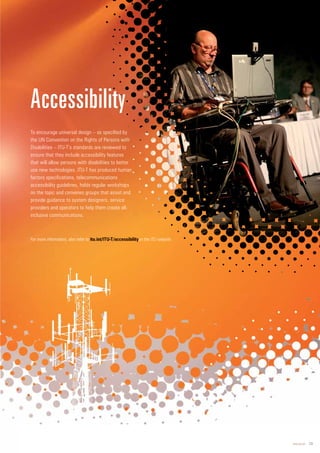
To encourage universal design – as specified by
the UN Convention on the Rights of Persons with
Disabilities – ITU-T’s standards are reviewed to
ensure that they include accessibility features
that will allow persons with disabilities to better
use new technologies. ITU-T has produced human
factors specifications, telecommunications
accessibility guidelines, holds regular workshops
on the topic and convenes groups that assist and
provide guidance to system designers, service
providers and operators to help them create all-
inclusive communications.
Accessibility
For more information, also refer to on the ITU website.
14 www.itu.int
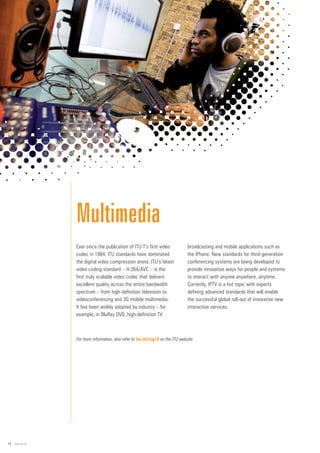
Ever since the publication of ITU-T’s first video
codec in 1984, ITU standards have dominated
the digital video compression arena. ITU’s latest
video coding standard – H.264/AVC – is the
first truly scalable video codec that delivers
excellent quality across the entire bandwidth
spectrum – from high-definition television to
videoconferencing and 3G mobile multimedia.
It has been widely adopted by industry – for
example, in BluRay DVD, high-definition TV
broadcasting and mobile applications such as
the iPhone. New standards for third-generation
conferencing systems are being developed to
provide innovative ways for people and systems
to interact with anyone anywhere, anytime.
Currently, IPTV is a hot topic with experts
defining advanced standards that will enable
the successful global roll-out of innovative new
interactive services.
Multimedia
For more information, also refer to itu.int/tsg16 on the ITU website.
www.itu.int 15
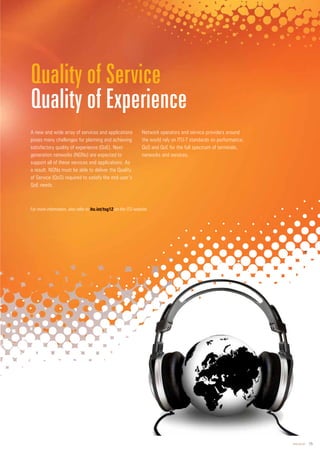
A new and wide array of services and applications
poses many challenges for planning and achieving
satisfactory quality of experience (QoE). Next-
generation networks (NGNs) are expected to
support all of these services and applications. As
a result, NGNs must be able to deliver the Quality
of Service (QoS) required to satisfy the end user’s
QoE needs.
Network operators and service providers around
the world rely on ITU-T standards on performance,
QoS and QoE for the full spectrum of terminals,
networks and services.
Quality of Service
Quality of Experience
For more information, also refer to on the ITU website.
16 www.itu.int
ITU’s work in the field of electromagnetic
compatibility (EMC) has led to standards that
protect telecommunication installations against
damage and malfunction from electromagnetic
disturbances, such as lightning. ITU-T has also
produced standards that ensure the safety
of telecommunication personnel and users of
telecommunication networks.
Work also focuses on limiting human exposure
to electromagnetic fields (EMF) by producing
guidance on measurement methods and
mitigation techniques, in order to reduce the EMF
produced by telecommunication equipment and
planned installations.
Electromagnetic
Compatibility
“Standards are a proven
tool in terms of economic
development. The WTO

trade report of 2005
underlines the important
benefits that standards
can deliver. Various
national standards bodies
have undertaken studies
that have shown the
positive contribution
that standardization can
make to a country’s GDP.
Standards may also have
a significant effect on
limiting the undesirable
outcomes of market
failure.”
For more information, also refer to itu.int/tsg05 on the ITU website.
www.itu.int 17
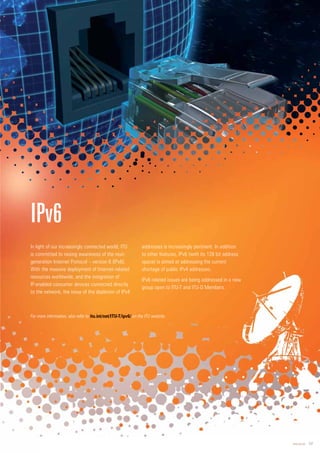
In light of our increasingly connected world, ITU
is committed to raising awareness of the next-
generation Internet Protocol – version 6 (IPv6).
With the massive deployment of Internet-related
resources worldwide, and the integration of
IP-enabled consumer devices connected directly
to the network, the issue of the depletion of IPv4
addresses is increasingly pertinent. In addition
to other features, IPv6 (with its 128 bit address
space) is aimed at addressing the current
shortage of public IPv4 addresses.
IPv6 related issues are being addressed in a new
group open to ITU-T and ITU-D Members.
IPv6
For more information, also refer to it
tu.int/net/ITU-T/ipv6/ on the ITU website.
18 www.itu.int
Without ITU-T’s access standards, the Internet
would not enjoy its current state of ubiquity. In the
past, if proprietary standards had been adopted,
the Internet’s development could well have been
significantly hampered. ADSL has given people around
the globe their first taste of broadband, and VDSL 2
(which takes legacy copper networks to new limits) is
now being deployed by operators worldwide.
ISDN (integrated services digital network), SDH
(synchronous digital hierarchy), DSL (digital
subscriber line), as well as PON (Passive Optical
Network) and WDM (wave division multiplexing)
are all familiar abbreviations to ICT professionals
and approved as international standards by ITU.
Ongoing work focuses on the continuing
development of standards for optical transport
networks and access network infrastructures
to enable the evolution toward intelligent
transport networks.
Access
and Transport
“ITU membership
allows for unparalleled
networking opportunities
with the best talent
in the industry and
representatives of over
700 private sector
entities, as well as
192 governments and
their regulators.”
For more information, also refer to itu.int/tsg15 on the ITU website.
www.itu.int 19
ITU-T numbering standards have played a key
role in shaping today’s telecom networks.
They provide the structure and functionality for
telephone numbers – without them we would not
be able to communicate internationally. As well
as assigning international dialing codes, ITU-T
standards allow a roaming mobile terminal to be
identified in another network and, subsequently,
the querying of the home network for subscription
and billing information.
ITU-T is also tasked with the complicated job of
recommending principles for the harmonization of
international interconnection rates. ITU-T’s aim is not
only to keep rates fair but also as low as possible,
without compromising service. Interconnection rates
are a key concern for our members and, in particular,
for the developing world.
Numbering
and Interconnection
For more information, also refer to itu.in
nt/tsg02 and it
itu.
u.in
int/
t/ts
t g03 on the ITU website.
20 www.itu.int
Academic and research institutions are invited
to participate in ITU-T’s work. ITU is looking to
increase the participation of universities and
other academic institutions around the world in
its standardization process. There are myriad
examples of this policy bearing fruit with many
standards having been heavily influenced by
academic involvement.
A series of academic conferences, called
The Kaleidoscope, was launched in 2008.
By viewing technologies through a
“Kaleidoscope”, participants of these forward-
looking events will also seek to identify new
topics for standardization.
Each year papers are invited on a forward-looking
topic and are peer reviewed with a selection
of the best papers pulled out for presentation.
Winning papers receive a share of a prize fund
and are published in the IEEE Xplore system.
Academic
Opportunities
For more information, also refer to itu-kaleidoscope.org
www.itu.int 21
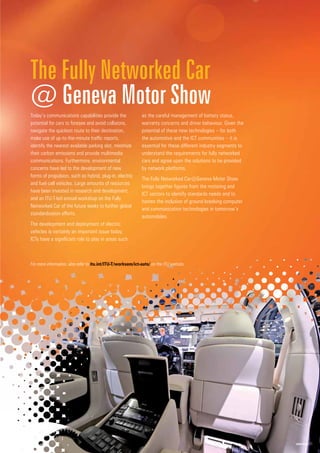
Today’s communications capabilities provide the
potential for cars to foresee and avoid collisions,
navigate the quickest route to their destination,
make use of up-to-the-minute traffic reports,
identify the nearest available parking slot, minimize
their carbon emissions and provide multimedia
communications. Furthermore, environmental
concerns have led to the development of new
forms of propulsion, such as hybrid, plug-in, electric
and fuel-cell vehicles. Large amounts of resources
have been invested in research and development,
and an ITU-T-led annual workshop on the Fully
Networked Car of the future seeks to further global
standardization efforts.
The development and deployment of electric
vehicles is certainly an important issue today.
ICTs have a significant role to play in areas such
as the careful management of battery status,
warranty concerns and driver behaviour. Given the
potential of these new technologies – for both
the automotive and the ICT communities – it is
essential for these different industry segments to
understand the requirements for fully networked
cars and agree upon the solutions to be provided
by network platforms.
The Fully Networked Car@Geneva Motor Show
brings together figures from the motoring and
ICT sectors to identify standards needs and to
hasten the inclusion of ground-breaking computer
and communication technologies in tomorrow’s
automobiles.
The Fully Networked Car
@ Geneva Motor Show
For more information, also refer to itu.
u.in
int/
t/IT
ITU
U-T/worksem/ict-auto
t
to
t
t
t
t
t
t
t
t
t
t
t
t
t
t
t
t / on the ITU website.
22 www.itu.int
ITU’s Technology Watch function surveys the
ICT environment, identifying new and emerging
technologies, as well as assessing their likely
impact on future standardization work and on
developing countries.
Technology Watch Reports provide an up-to-date
assessment of promising new technologies in
language that is accessible to non-specialists.
Important topics covered in previous reports have
included cloud computing, intelligent transport
systems, energy efficiency of NGNs, and the
future of the Internet.
Technology
Watch
“Conformance to ITU-T
Recommendations will
increase the probability of
interoperability between
equipment from different
vendors. ITU-T is fully
involved in a programme
to assist developing
countries on conformance
assessment and testing.”
All reports are available free-of-charge at itu.int/ITU-T/techwatch on on the ITU website.
www.itu.int 23
2
23
The lack of conformity and interoperability of ICT
equipment has been a major concern, especially in
developing countries. Addressing interoperability is
one of the founding principles of the ITU and a new
activity seeks to significantly reduce the problems
facing service providers, and others, as well as
bring renewed confidence to the market.
ITU-T has implemented measures that will give
purchasers of ICT equipment a much clearer
picture of its interoperability. A key component of
this new initiative will be a database that will log
products declaring conformity to ITU standards
(ITU-T Recommendations).
The database will allow end users to make much
better informed purchasing decisions. It also
has the potential to widen markets, increase
competition and even decrease costs. For
example, a telecoms service provider may consult
the database to check that a product, under
purchase consideration, will work with other
network elements.
In addition, ITU-T will stage events to test
products for interoperability, host capacity and
building workshops, and help to establish test
centres around the world.
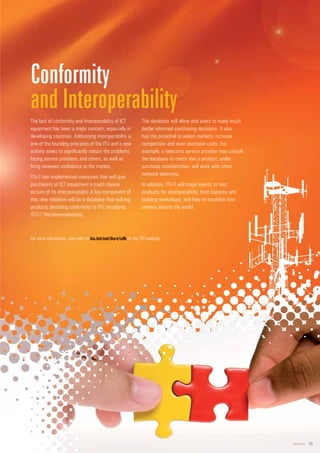
Conformity
and Interoperability
For more information, also refer to itu.int/net/itu-
u-t/
t/c
cdb on the ITU website.
Related website addresses
Homepage: itu.int/ITU-T/
About ITU-T: itu.int/net/ITU-T/info/
Video: bit.ly/cm1d37
Membership: itu.int/ITU-T/membership/
Tel.: +41 22 730 5852
e-mail: tsbmail@itu.int

T0 b060000033301pdfe

  • 1.
    Committed to connectingthe world ITU-T standardization
  • 2.
  • 3.
    www.itu.int 3 ITU-T Recommendationshelp the world communicate… Without ITU-T standards: • You couldn’t make a telephone call from one side of the world to the other • The Internet wouldn’t work • Modern communications, as we know them, just wouldn’t exist The work of ITU has helped the smoother, more economical introduction of new technologies
  • 4.
    4 4 4 www.itu.int Standards area proven tool for economic development. The World Trade Organization’s (WTO) 2005 World Trade Report underlines the important benefits that standards can deliver. Various national standards bodies have undertaken studies that underline the positive contribution that standardization can make to a country’s GDP. Standards may also have a significant effect on limiting the undesirable outcomes of market failure. ITU’s work, in the development of global standards for information and communication technologies (ICTs) and telecoms, has facilitated the smoother and more economical introduction of new technologies around the world. As the United Nations specialized agency for ICT – and the world’s preeminent ICT standards body – ITU’s standards work underpins much of this amazing technological achievement and plays a strong role in the Union’s mission to Connect the World. The standards, topologies, protocols and interfaces developed by ITU engender a smoothly functioning global ICT network – one that powers commerce, politics, democracy, health, education, entertainment, literacy and financial markets. In short, this is a network that is now fundamental to our modern lives. Standardization has and will continue to play a key role in measuring, preventing and mitigating the effects of climate change. Many governments around the world have recognized that ICTs are now the key engine for economic growth. With the right mix of infrastructure and services, these under- developed markets will take off quickly. That’s not just a boon for under-resourced communities; it’s a huge opportunity for many in the private sector. And that makes it a win-win situation. Booming markets will create more jobs and more wealth. A world where every child will get access to the information and communications they need to realize their potential. We can, and will, make this happen. Connecting the World Dr Hamadoun I. Touré Secretary General Secretary-General International Telecommunication Union
  • 5.
    www.itu.int 5 Standardization isa key building block in constructing a globally connected society. Standards play a strategic role in fostering innovation and competitive markets. ITU-T standards (Recommendations) help bring products and services to market rapidly, build order in the marketplace, generate trust and enhance safety. Manufacturers, network operators and consumers benefit in terms of lower prices and increased availability by reducing technical barriers and promoting compatibility between systems. Thousands of dedicated individuals – from governments, the private sector, academia and civil society – come together at ITU-T meetings to develop these standards that facilitate access to global markets, allowing for economies of scale in production and distribution. This unique global public/private partnership develops standards in a unique contribution- driven, and consensus-based, environment. Conformance to ITU-T standards will increase the probability of interoperability between equipment from different vendors and ITU-T is fully involved in a programme to assist developing countries on conformance and interoperability testing. Participation in the ITU standards process gives you direct influence over the technological forces that are shaping the ICT industry. It allows early access to many technical resources and standards in development. Taking part will help ensure that your products are safe, reliable and compatible on a global scale. Membership allows for unparalleled networking opportunities with the industry’s top talent and representatives of over 700 private sector entities, in addition to 192 governments and their regulators. ITU-T’s approach to making standards offers large, medium and small businesses in both mature and fledging markets equal opportunity to address their requirements. And to ensure maximum visibility the vast majority of ITU-T standards are now available for free download. ITU-T’s secretariat will be happy to answer any of your questions on how we can meet your needs. We look forward to hearing from you. Welcome to ITU-T Malcolm Johnson Director Director Telecommunication Standardization Bureau
  • 6.
    6 www.itu.int Membership ofITU-T offers an opportunity for the private sector to join with international administrations to shape the future of ICT in an open, fair and transparent environment. In addition to the opportunities to “network” and influence the creation of worldwide standards, members can receive unique returns on investment (ROI) by being able to implement technologies ahead of the pack, not to mention get products and services to market faster than their competitors can. Exposure on an international platform also offers unparalleled marketing opportunities. ITU-T’s global image comes with the mark of quality and efficiency that ITU, as a specialized agency of the United Nations, lends to the sector. Work is carried out in Study Groups in ITU-T and Member States and Sector Members are, regardless of size, entitled to unlimited participation in any or all of ITU-T’s Study Groups. Associate membership allows companies with a specific interest to follow the work of a particular Study Group at a reduced cost. Membership “ITU’s flexible approach to making standards addresses small, medium and large businesses in both mature and fledging markets. ITU’s secretariat will be happy to answer any of your questions on how we can meet your needs. We look forward to hearing from you.” For more information also refer to: itu.int/ITU-T/membership on the ITU website
  • 7.
    www.itu.int 7 ITU-T strivesto take into account the needs of all stakeholders in the development of its standards. A number of ways have been developed to allow the input of non-members into ITU-T work. Traditionally, a popular way of progressing existing work areas and exploring new ones, ITU-T workshops are free-of-charge events, augmenting the work of the study groups by proposing new topics and seeking the views of non-members and other standards developers. Workshops have focused on a broad variety of topics including cybersecurity, climate change, accessibility, telemedicine, the fully networked car, NGN, grid and many other areas. Events may be held anywhere in the world and are increasingly seen as a means of outreach to developing countries. ITU-T Focus Groups provide a more hands-on way to contribute to standardization work. They allow the participation of any outside organization or stakeholder; these groups can adopt their own working methods in order to develop input for ITU-T Study Groups and eventual publication as ITU-T Recommendations. Recently formed Focus Groups are examining the hot topics of Smart Grids and Cloud Computing. Other Ways to Participate
  • 8.
    8 www.itu.int Standards arean essential tool in bridging the digital divide. Bringing vital assistance to developing countries, standards help build communications infrastructure and encourage economic development. The standardization gap can be defined as disparities in the ability of developing countries – relative to those in the developed world – to access, implement, contribute to and influence international information and communication technologies (ICT) standards, and specifically ITU-T Recommendations. Participation in the standardization process allows developing countries to accelerate the deployment of new networks and services. ITU’s activities to eliminate the standardization disparity include implementing remote participation tools, establishing regional groups, and holding more meetings and forums in developing areas. Bridging the Digital Divide For more information, also refer to itu.int/ITU-T/gap/ on the ITU website. / “The standards, topologies, protocols and interfaces developed by ITU engender a smoothly functioning global ICT network. A network that powers commerce, politics, democracy, health, education, entertainment, literacy and financial markets. In short, a network that has become fundamental to our modern lives.”
  • 9.
    www.itu.int 9 Functional communicationsare essential when disaster strikes. The ITU-T standardized early- warning system is backed up by call prioritization specifications, ensuring that emergency response is timely and efficient. Network restoration and management during emergencies is also addressed by many of ITU-T’s standards. Emergency Communications For more information, also refer to itu.int/ITU-T/emergenc cyt ytel elec ecom o s on the ITU website.
  • 10.
    10 www.itu.int At theWorld Summit on the Information Society (WSIS), ITU was charged with building confidence and security in the use of ICTs. Standards give businesses the systematic approach to the information security necessary to keep network assets safe. Given its international scope, and the fact that ITU brings together the private sector and governments to coordinate work on standards, ITU is in a unique position to influence the harmonization of security policies worldwide. Investing in security is like money in the bank. And investing in the making of security standards means that manufacturers, service providers and other stakeholders can be sure that their needs and views are being taken into account. ITU-T works closely and collaborates with many other organizations dealing with cybersecurity and maintains a roadmap of all related standards activity. Cybersecurity For more information, also refer to itu.int/tsg17 on the ITU website. “Participation in the ITU standards process gives you direct influence over the technological forces that are shaping the ICT industry. It allows early access to many technical resources and standards in development. Taking part will help to ensure that your products are safe, reliable and compatible on a global scale.”
  • 11.
    www.itu.int 11 Climate changeis a critical issue on the global agenda and an important concern in the ICT industry. Since ICTs contribute some 2-3 per cent of total greenhouse gas (GHG) emissions, efforts are underway to mitigate the sector’s carbon footprint. ICTs can also be an enabling technology to significantly reduce the GHG emissions from other sectors (such as travel avoidance, telecommuting, dematerialization and the like). Standards can play a key role in using ICTs to combat climate change. For example, an ITU standardized Universal Charging Solution for mobile phones gives a 50 per cent reduction in standby energy consumption, promises the elimination of up to 82,000 tons of redundant chargers and a reduction of 13.6 million tons of GHG emissions each year. Assessment of the direct and indirect impact on energy consumption of ITU-T standards is currently being studied. An agreed common methodology for calculating the impact of ICTs on GHG emissions is being developed by ITU-T. ITU is also committed to reducing its own carbon footprint by adopting more energy-efficient work methods, including both paperless and virtual meetings. Climate Change For more information, also refer to it itu.int/ITU-T/climatec ch hange/ on the ITU website.
  • 12.
    12 www.itu.int Next-Generation Networks (NGN)and beyond The shift from the traditional, circuit-switched networks to a fundamentally different, Internet protocol (IP)-based, infrastructure presents a massive challenge for the telecoms industry – it’s one of the most complex transitions ever to occur in the industry’s history. As in the past, when seismic shifts transformed the simple world of the telegraph to create wireline telephony, followed by satellite systems, digitalization, fibre-optic networks, broadband and cellular mobile, ITU-T will play a central and critical role in ushering in this new converged environment. Always forward-thinking, ITU is leading new work on future networks – including clean-slate approaches to future Internet architecture, open to researchers from around the world. Global connectivity – and therefore the harmonization and interoperability between devices, networks, services and applications – is not only extremely important but is absolutely necessary in order to build up globally interoperable ICT infrastructures, now and in the future. For more information, also refer to itu.int/ITU-T/ngn/ on the ITU website. “Standards play a strategic role in fostering innovation and competitive markets. ITU-T standards (Recommendations) help to bring products and services to market rapidly, build order in the marketplace, generate trust and enhance safety. Manufacturers, network operators and consumers benefit in terms of lower prices and increased availability by reducing technical barriers and promoting compatibility between systems.”
  • 13.
    www.itu.int 13 To encourageuniversal design – as specified by the UN Convention on the Rights of Persons with Disabilities – ITU-T’s standards are reviewed to ensure that they include accessibility features that will allow persons with disabilities to better use new technologies. ITU-T has produced human factors specifications, telecommunications accessibility guidelines, holds regular workshops on the topic and convenes groups that assist and provide guidance to system designers, service providers and operators to help them create all- inclusive communications. Accessibility For more information, also refer to on the ITU website.
  • 14.
    14 www.itu.int Ever sincethe publication of ITU-T’s first video codec in 1984, ITU standards have dominated the digital video compression arena. ITU’s latest video coding standard – H.264/AVC – is the first truly scalable video codec that delivers excellent quality across the entire bandwidth spectrum – from high-definition television to videoconferencing and 3G mobile multimedia. It has been widely adopted by industry – for example, in BluRay DVD, high-definition TV broadcasting and mobile applications such as the iPhone. New standards for third-generation conferencing systems are being developed to provide innovative ways for people and systems to interact with anyone anywhere, anytime. Currently, IPTV is a hot topic with experts defining advanced standards that will enable the successful global roll-out of innovative new interactive services. Multimedia For more information, also refer to itu.int/tsg16 on the ITU website.
  • 15.
    www.itu.int 15 A newand wide array of services and applications poses many challenges for planning and achieving satisfactory quality of experience (QoE). Next- generation networks (NGNs) are expected to support all of these services and applications. As a result, NGNs must be able to deliver the Quality of Service (QoS) required to satisfy the end user’s QoE needs. Network operators and service providers around the world rely on ITU-T standards on performance, QoS and QoE for the full spectrum of terminals, networks and services. Quality of Service Quality of Experience For more information, also refer to on the ITU website.
  • 16.
    16 www.itu.int ITU’s workin the field of electromagnetic compatibility (EMC) has led to standards that protect telecommunication installations against damage and malfunction from electromagnetic disturbances, such as lightning. ITU-T has also produced standards that ensure the safety of telecommunication personnel and users of telecommunication networks. Work also focuses on limiting human exposure to electromagnetic fields (EMF) by producing guidance on measurement methods and mitigation techniques, in order to reduce the EMF produced by telecommunication equipment and planned installations. Electromagnetic Compatibility “Standards are a proven tool in terms of economic development. The WTO trade report of 2005 underlines the important benefits that standards can deliver. Various national standards bodies have undertaken studies that have shown the positive contribution that standardization can make to a country’s GDP. Standards may also have a significant effect on limiting the undesirable outcomes of market failure.” For more information, also refer to itu.int/tsg05 on the ITU website.
  • 17.
    www.itu.int 17 In lightof our increasingly connected world, ITU is committed to raising awareness of the next- generation Internet Protocol – version 6 (IPv6). With the massive deployment of Internet-related resources worldwide, and the integration of IP-enabled consumer devices connected directly to the network, the issue of the depletion of IPv4 addresses is increasingly pertinent. In addition to other features, IPv6 (with its 128 bit address space) is aimed at addressing the current shortage of public IPv4 addresses. IPv6 related issues are being addressed in a new group open to ITU-T and ITU-D Members. IPv6 For more information, also refer to it tu.int/net/ITU-T/ipv6/ on the ITU website.
  • 18.
    18 www.itu.int Without ITU-T’saccess standards, the Internet would not enjoy its current state of ubiquity. In the past, if proprietary standards had been adopted, the Internet’s development could well have been significantly hampered. ADSL has given people around the globe their first taste of broadband, and VDSL 2 (which takes legacy copper networks to new limits) is now being deployed by operators worldwide. ISDN (integrated services digital network), SDH (synchronous digital hierarchy), DSL (digital subscriber line), as well as PON (Passive Optical Network) and WDM (wave division multiplexing) are all familiar abbreviations to ICT professionals and approved as international standards by ITU. Ongoing work focuses on the continuing development of standards for optical transport networks and access network infrastructures to enable the evolution toward intelligent transport networks. Access and Transport “ITU membership allows for unparalleled networking opportunities with the best talent in the industry and representatives of over 700 private sector entities, as well as 192 governments and their regulators.” For more information, also refer to itu.int/tsg15 on the ITU website.
  • 19.
    www.itu.int 19 ITU-T numberingstandards have played a key role in shaping today’s telecom networks. They provide the structure and functionality for telephone numbers – without them we would not be able to communicate internationally. As well as assigning international dialing codes, ITU-T standards allow a roaming mobile terminal to be identified in another network and, subsequently, the querying of the home network for subscription and billing information. ITU-T is also tasked with the complicated job of recommending principles for the harmonization of international interconnection rates. ITU-T’s aim is not only to keep rates fair but also as low as possible, without compromising service. Interconnection rates are a key concern for our members and, in particular, for the developing world. Numbering and Interconnection For more information, also refer to itu.in nt/tsg02 and it itu. u.in int/ t/ts t g03 on the ITU website.
  • 20.
    20 www.itu.int Academic andresearch institutions are invited to participate in ITU-T’s work. ITU is looking to increase the participation of universities and other academic institutions around the world in its standardization process. There are myriad examples of this policy bearing fruit with many standards having been heavily influenced by academic involvement. A series of academic conferences, called The Kaleidoscope, was launched in 2008. By viewing technologies through a “Kaleidoscope”, participants of these forward- looking events will also seek to identify new topics for standardization. Each year papers are invited on a forward-looking topic and are peer reviewed with a selection of the best papers pulled out for presentation. Winning papers receive a share of a prize fund and are published in the IEEE Xplore system. Academic Opportunities For more information, also refer to itu-kaleidoscope.org
  • 21.
    www.itu.int 21 Today’s communicationscapabilities provide the potential for cars to foresee and avoid collisions, navigate the quickest route to their destination, make use of up-to-the-minute traffic reports, identify the nearest available parking slot, minimize their carbon emissions and provide multimedia communications. Furthermore, environmental concerns have led to the development of new forms of propulsion, such as hybrid, plug-in, electric and fuel-cell vehicles. Large amounts of resources have been invested in research and development, and an ITU-T-led annual workshop on the Fully Networked Car of the future seeks to further global standardization efforts. The development and deployment of electric vehicles is certainly an important issue today. ICTs have a significant role to play in areas such as the careful management of battery status, warranty concerns and driver behaviour. Given the potential of these new technologies – for both the automotive and the ICT communities – it is essential for these different industry segments to understand the requirements for fully networked cars and agree upon the solutions to be provided by network platforms. The Fully Networked Car@Geneva Motor Show brings together figures from the motoring and ICT sectors to identify standards needs and to hasten the inclusion of ground-breaking computer and communication technologies in tomorrow’s automobiles. The Fully Networked Car @ Geneva Motor Show For more information, also refer to itu. u.in int/ t/IT ITU U-T/worksem/ict-auto t to t t t t t t t t t t t t t t t t / on the ITU website.
  • 22.
    22 www.itu.int ITU’s TechnologyWatch function surveys the ICT environment, identifying new and emerging technologies, as well as assessing their likely impact on future standardization work and on developing countries. Technology Watch Reports provide an up-to-date assessment of promising new technologies in language that is accessible to non-specialists. Important topics covered in previous reports have included cloud computing, intelligent transport systems, energy efficiency of NGNs, and the future of the Internet. Technology Watch “Conformance to ITU-T Recommendations will increase the probability of interoperability between equipment from different vendors. ITU-T is fully involved in a programme to assist developing countries on conformance assessment and testing.” All reports are available free-of-charge at itu.int/ITU-T/techwatch on on the ITU website.
  • 23.
    www.itu.int 23 2 23 The lackof conformity and interoperability of ICT equipment has been a major concern, especially in developing countries. Addressing interoperability is one of the founding principles of the ITU and a new activity seeks to significantly reduce the problems facing service providers, and others, as well as bring renewed confidence to the market. ITU-T has implemented measures that will give purchasers of ICT equipment a much clearer picture of its interoperability. A key component of this new initiative will be a database that will log products declaring conformity to ITU standards (ITU-T Recommendations). The database will allow end users to make much better informed purchasing decisions. It also has the potential to widen markets, increase competition and even decrease costs. For example, a telecoms service provider may consult the database to check that a product, under purchase consideration, will work with other network elements. In addition, ITU-T will stage events to test products for interoperability, host capacity and building workshops, and help to establish test centres around the world. Conformity and Interoperability For more information, also refer to itu.int/net/itu- u-t/ t/c cdb on the ITU website.
  • 24.
    Related website addresses Homepage:itu.int/ITU-T/ About ITU-T: itu.int/net/ITU-T/info/ Video: bit.ly/cm1d37 Membership: itu.int/ITU-T/membership/ Tel.: +41 22 730 5852 e-mail: tsbmail@itu.int