Maz Moshiri DMD, MS, FICD
www.smilesaintlouis.com
Invisalign’s Evolution
2014
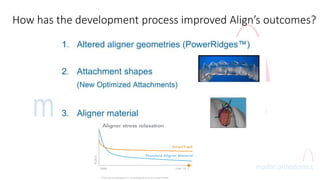
How has the development process improved Align’s outcomes?
Clincheck Pro
Invisalign’s advantages over braces:
• Have a diagnostic set-up on every patient
• Only move the teeth you want to move
• Interocclusal plastic ideal for crossbite correction
• Posterior intrusive effect ideal for anterior open bite
• Not dependent of bracket placement- human error
• Less unwanted side effects when using elastics
• No round tripping of teeth
• Interocclusal plastic aids in AP correction
• Less emergencies to slow treatment
The Biggest Advantage!!
•The reason that fixed appliances generally take
about 24 months to treat is that it takes 12
months to correct the problems that we created
through the various effects of our
mechanotherapy
Invisalign, like braces, is an imperfect process
• Inaccuracy of predicted movements
• The process of IPR and software inaccuracy
• Biological variations in orthodontic movement
between patients
• Aligner manufacturing errors
• We use refinements in about 75% of patients to detail
and finish the case; otherwise, 2nd to final tray used
for one month as a finishing appliance
• MCC in about 10%
Orthodontic Movements
• Tipping?- Yes, both crown and root (**attachment
considerations)
• Rotations?- Yes (**attachment considerations)
• Extrusion?- Yes, BUT preferably combined with retraction to
increase predictability (**attachment considerations)
• Intrusion?- Yes, but slow down movements to apply less
force over-engineer (esp. deep OB and ant. intrusion)
• Torque?- Yes, but also need to over-engineer and possibly use
other aligner auxillaries
Malocclusions treated?
Which malocclusions are best treated with Invisalign… in our practice?
Class I with good OB, lower ant. relapse, mild-mod. crowding/spacing and rotations
Pseudo class III/ edge-to-edge malocclusions with mild-mod. crowding
Mild-mod anterior open bite with mild-mod. crowding and mild-mod OJ
End-on class II division I or Div. II , with mild-moderate OB/OJ, mild-mod. crowding
Class I deep OB / Class II div. II severe deep OB patients with minimal crowding or spacing
Variables for Invisalign Clinical Predictability
• 1) Diagnosis-
• i.e. etiology of the malocclusion , cephalometric analysis,
TSD, growth and development, etc
• 2) Set-up of the ClinCheck-
• THOROUGH evaluation of the ClinCheck and understanding
the plausibility and/or limitations of the movements
occurring… being a constant student
• 3) Proper clinical technique- i.e. IPR, anchorage, etc
• 4) Patient selection and Psychology ~ compliance
• 5) Proper team training and systems
Take your time…up front!
Treatment Success?
Reviewing the ClinCheck
Initial Bite Set
Understanding any Tooth Size Discrepancy
Assess Predictability of Movements
Add/Change Attachments
Anchorage Consideration/Anticipation of Elastics
Address TSD via Interproximal Space/IPR
Interincisal Angle Evaluation
Records
• Great composite photos, perpendicular buccal shots,
***articulation markings (Align does not use bite
records unless requested for CR registrations)
Assuming PVS impressions…
Possible consequences from an
inaccurate bite set:
• 1) Midline shift
• 2) Arch asymmetry and lack of coordination
• 3) Unnecessary IPR
Panoramic x-ray
Records continued…
• A traced cephalometric x-ray
– Evaluation of skeletal relationships
– ***Evaluation of incisor angulations
– ***Evaluation of mandibular plane angles
Reviewing the ClinCheck
Initial Bite Set
Understanding any Tooth Size Discrepancy
Assess Predictability of Movements
Add/Change Attachments
Anchorage Consideration/Anticipation of Elastics
Address TSD via Interproximal Space/IPR
Interincisal Angle Evaluation
Predicting the Future?
Bolton discrepancy- aka tooth size discrepancy
A proper balance should exist between the mesio-distal
tooth size of the maxillary and mandibular arches to
ensure proper interdigitation, overjet, and overbite at the
completion of orthodontic treatment.
TSD continued…
• This is an often underappreciated and overlooked aspect
of orthodontic diagnosis. Lack of attention to a TSD may:
• 1) less than ideal occlusion instability and relapse
• 2) compromised esthetics
• 3) lead to a posterior open bite
91.3%
77.2%
• Bolton’s OR = 91.3%
If the value obtained is <91.3%, the discrepancy (excess) is in maxillary teeth.
• Bolton’s AR= 77.2 %
If the value obtained is <77.2%, the discrepancy (excess) is in maxillary teeth.
• i.e. if the sum of mandibular 6 anterior=41.5mm, sum of maxillary 6
anterior=48mm
41.5/48*100=86.45% mandibular excess (or maxillary deficiency)
x/48*100=77.2% x=37.05, ideal mandibular anterior total width
41.5-37.05= 4.45mm, amount of mandibular excess
41.5/x * 100= 77.2% x-=53.5, ideal max. ant. total width
53.5- 48= 5.5mm, amount of maxillary deficiency
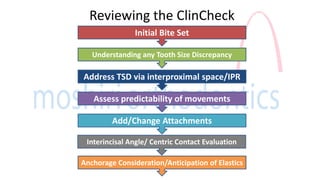
Reviewing the ClinCheck
Initial Bite Set
Understanding any Tooth Size Discrepancy
Assess predictability of movements
Add/Change Attachments
Anchorage Consideration/Anticipation of Elastics
Address TSD via interproximal space/IPR
Interincisal Angle/ Centric Contact Evaluation
How do you address the TSD,
+ , - or both?
• Depth of Bite
• Periodontal status
• Anterior guidance
• Esthetics- golden proportions
• Lip support
• To aid in detailing of a particular malocclusion
IPR
-It is always good practice to check crowded
interproximal contacts with floss at every patient
appointment and lighten any tight contacts with
diamond strips, even if IPR is not indicated for
that area
-This is because even the slightest 1/100th mm of
binding can impede a tooth’s movement towards
the desired goal
.1 .1
.1.1.1
Mild-Moderate Class II Patients
Progress
Progress
Class II elastics
•TSD- the most common cause of
malocclusion ***
•Start elastics early and often
Tip: How to address TSD for Class II malocclusions
• Mandibular excess, maxillary deficiency:
–Distalize buccal segment to full class I, build up upper
laterals
–Use ipr lower to mesialize lower buccal segment and
eliminate heavy anterior interferences
• Maxillary excess:
–Establish class I molar, then use IPR to distalize/detail
remaining buccal occlusion and reduce overjet as
needed
**Pay attention to lingual root torque anterior 2-2**
To Download the full presentation please visit:
www.smilesaintlouis.com

Clear Techniques II

  • 1.
  • 2.
  • 3.
  • 4.
    How has thedevelopment process improved Align’s outcomes?
  • 6.
  • 7.
    Invisalign’s advantages overbraces: • Have a diagnostic set-up on every patient • Only move the teeth you want to move • Interocclusal plastic ideal for crossbite correction • Posterior intrusive effect ideal for anterior open bite • Not dependent of bracket placement- human error • Less unwanted side effects when using elastics • No round tripping of teeth • Interocclusal plastic aids in AP correction • Less emergencies to slow treatment
  • 11.
    The Biggest Advantage!! •Thereason that fixed appliances generally take about 24 months to treat is that it takes 12 months to correct the problems that we created through the various effects of our mechanotherapy
  • 12.
    Invisalign, like braces,is an imperfect process • Inaccuracy of predicted movements • The process of IPR and software inaccuracy • Biological variations in orthodontic movement between patients • Aligner manufacturing errors • We use refinements in about 75% of patients to detail and finish the case; otherwise, 2nd to final tray used for one month as a finishing appliance • MCC in about 10%
  • 13.
    Orthodontic Movements • Tipping?-Yes, both crown and root (**attachment considerations) • Rotations?- Yes (**attachment considerations) • Extrusion?- Yes, BUT preferably combined with retraction to increase predictability (**attachment considerations) • Intrusion?- Yes, but slow down movements to apply less force over-engineer (esp. deep OB and ant. intrusion) • Torque?- Yes, but also need to over-engineer and possibly use other aligner auxillaries
  • 14.
    Malocclusions treated? Which malocclusionsare best treated with Invisalign… in our practice? Class I with good OB, lower ant. relapse, mild-mod. crowding/spacing and rotations Pseudo class III/ edge-to-edge malocclusions with mild-mod. crowding Mild-mod anterior open bite with mild-mod. crowding and mild-mod OJ End-on class II division I or Div. II , with mild-moderate OB/OJ, mild-mod. crowding Class I deep OB / Class II div. II severe deep OB patients with minimal crowding or spacing
  • 15.
    Variables for InvisalignClinical Predictability • 1) Diagnosis- • i.e. etiology of the malocclusion , cephalometric analysis, TSD, growth and development, etc • 2) Set-up of the ClinCheck- • THOROUGH evaluation of the ClinCheck and understanding the plausibility and/or limitations of the movements occurring… being a constant student • 3) Proper clinical technique- i.e. IPR, anchorage, etc • 4) Patient selection and Psychology ~ compliance • 5) Proper team training and systems
  • 16.
  • 17.
  • 18.
    Reviewing the ClinCheck InitialBite Set Understanding any Tooth Size Discrepancy Assess Predictability of Movements Add/Change Attachments Anchorage Consideration/Anticipation of Elastics Address TSD via Interproximal Space/IPR Interincisal Angle Evaluation
  • 19.
    Records • Great compositephotos, perpendicular buccal shots, ***articulation markings (Align does not use bite records unless requested for CR registrations)
  • 20.
  • 23.
    Possible consequences froman inaccurate bite set: • 1) Midline shift • 2) Arch asymmetry and lack of coordination • 3) Unnecessary IPR
  • 24.
  • 25.
    Records continued… • Atraced cephalometric x-ray – Evaluation of skeletal relationships – ***Evaluation of incisor angulations – ***Evaluation of mandibular plane angles
  • 26.
    Reviewing the ClinCheck InitialBite Set Understanding any Tooth Size Discrepancy Assess Predictability of Movements Add/Change Attachments Anchorage Consideration/Anticipation of Elastics Address TSD via Interproximal Space/IPR Interincisal Angle Evaluation
  • 28.
  • 29.
    Bolton discrepancy- akatooth size discrepancy A proper balance should exist between the mesio-distal tooth size of the maxillary and mandibular arches to ensure proper interdigitation, overjet, and overbite at the completion of orthodontic treatment.
  • 30.
    TSD continued… • Thisis an often underappreciated and overlooked aspect of orthodontic diagnosis. Lack of attention to a TSD may: • 1) less than ideal occlusion instability and relapse • 2) compromised esthetics • 3) lead to a posterior open bite
  • 31.
    91.3% 77.2% • Bolton’s OR= 91.3% If the value obtained is <91.3%, the discrepancy (excess) is in maxillary teeth. • Bolton’s AR= 77.2 % If the value obtained is <77.2%, the discrepancy (excess) is in maxillary teeth. • i.e. if the sum of mandibular 6 anterior=41.5mm, sum of maxillary 6 anterior=48mm 41.5/48*100=86.45% mandibular excess (or maxillary deficiency) x/48*100=77.2% x=37.05, ideal mandibular anterior total width 41.5-37.05= 4.45mm, amount of mandibular excess 41.5/x * 100= 77.2% x-=53.5, ideal max. ant. total width 53.5- 48= 5.5mm, amount of maxillary deficiency
  • 32.
    Reviewing the ClinCheck InitialBite Set Understanding any Tooth Size Discrepancy Assess predictability of movements Add/Change Attachments Anchorage Consideration/Anticipation of Elastics Address TSD via interproximal space/IPR Interincisal Angle/ Centric Contact Evaluation
  • 33.
    How do youaddress the TSD, + , - or both? • Depth of Bite • Periodontal status • Anterior guidance • Esthetics- golden proportions • Lip support • To aid in detailing of a particular malocclusion
  • 34.
    IPR -It is alwaysgood practice to check crowded interproximal contacts with floss at every patient appointment and lighten any tight contacts with diamond strips, even if IPR is not indicated for that area -This is because even the slightest 1/100th mm of binding can impede a tooth’s movement towards the desired goal
  • 35.
  • 40.
  • 41.
  • 42.
  • 43.
  • 46.
    •TSD- the mostcommon cause of malocclusion *** •Start elastics early and often
  • 47.
    Tip: How toaddress TSD for Class II malocclusions • Mandibular excess, maxillary deficiency: –Distalize buccal segment to full class I, build up upper laterals –Use ipr lower to mesialize lower buccal segment and eliminate heavy anterior interferences • Maxillary excess: –Establish class I molar, then use IPR to distalize/detail remaining buccal occlusion and reduce overjet as needed **Pay attention to lingual root torque anterior 2-2**
  • 48.
    To Download thefull presentation please visit: www.smilesaintlouis.com