1
10/02/2012 Slide 1
CT Burden Testing
Notes from the Field
Prepared by Tom Lawton,TESCO
for the 2015 SEMA Conference
2
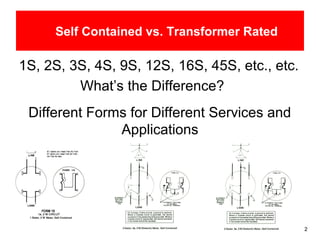
Self Contained vs. Transformer Rated
1S, 2S, 3S, 4S, 9S, 12S, 16S, 45S, etc., etc.
What’s the Difference?
Different Forms for Different Services and
Applications
3
Self Contained vs. Transformer Rated
Self Contained
(direct)
Transformer Rated
(indirect)
4
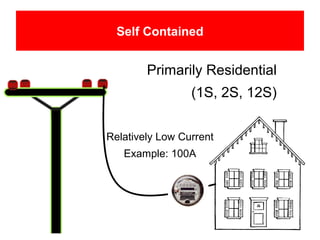
Self Contained
Primarily Residential
(1S, 2S, 12S)
Relatively Low Current
Example: 100A
5
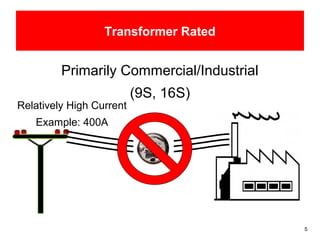
Transformer Rated
Primarily Commercial/Industrial
(9S, 16S)
Relatively High Current
Example: 400A
6
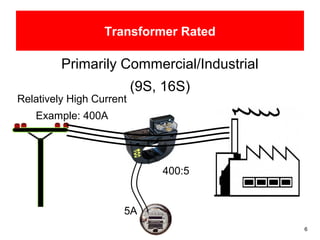
Transformer Rated
Primarily Commercial/Industrial
(9S, 16S)
Relatively High Current
Example: 400A
400:5
5A
7
CT’s – Functions and Terminology
Ratio
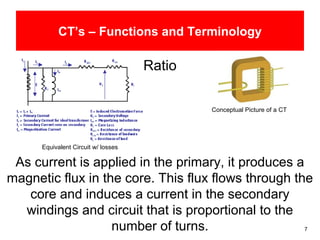
Equivalent Circuit w/ losses
Conceptual Picture of a CT
As current is applied in the primary, it produces a
magnetic flux in the core. This flux flows through the
core and induces a current in the secondary
windings and circuit that is proportional to the
number of turns.
8
CT’s – Functions and Terminology
Ratio
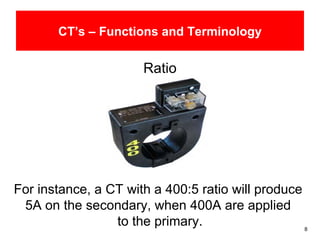
For instance, a CT with a 400:5 ratio will produce
5A on the secondary, when 400A are applied
to the primary.
9
CT’s – Functions and Terminology
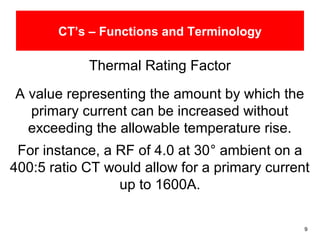
Thermal Rating Factor
A value representing the amount by which the
primary current can be increased without
exceeding the allowable temperature rise.
For instance, a RF of 4.0 at 30° ambient on a
400:5 ratio CT would allow for a primary current
up to 1600A.
10
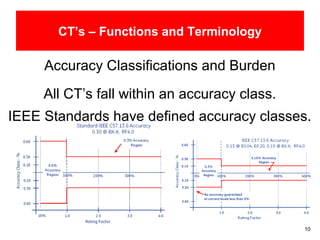
CT’s – Functions and Terminology
Accuracy Classifications and Burden
All CT’s fall within an accuracy class.
IEEE Standards have defined accuracy classes.
11
CT’s – Functions and Terminology
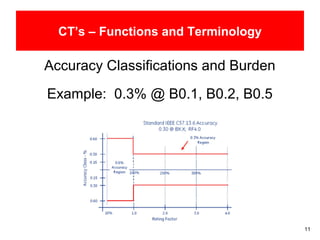
Accuracy Classifications and Burden
Example: 0.3% @ B0.1, B0.2, B0.5
12
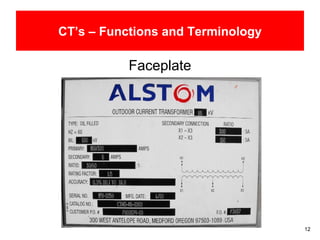
CT’s – Functions and Terminology
Faceplate
13
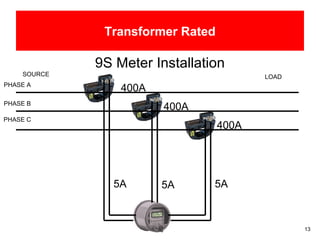
Transformer Rated
9S Meter Installation
5A
PHASE A
SOURCE
PHASE C
PHASE B
LOAD
400A
400A
400A
5A5A
14
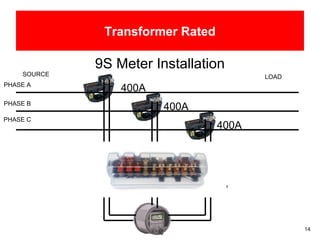
Transformer Rated
9S Meter Installation
5A
PHASE A
SOURCE
PHASE C
PHASE B
LOAD
400A
400A
400A
5A5A
15
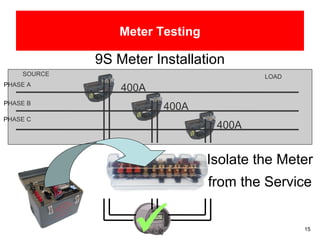
Meter Testing
9S Meter Installation
5A
PHASE A
SOURCE
PHASE C
PHASE B
LOAD
400A
400A
400A
5A5A
Isolate the Meter
from the Service

16
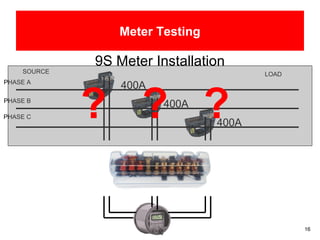
Meter Testing
9S Meter Installation
5A
PHASE A
SOURCE
PHASE C
PHASE B
LOAD
400A
400A
400A
5A5A
? ? ?
17
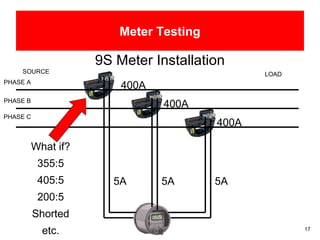
Meter Testing
9S Meter Installation
5A
PHASE A
SOURCE
PHASE C
PHASE B
LOAD
400A
400A
400A
5A5A
What if?
355:5
405:5
200:5
Shorted
etc.
18
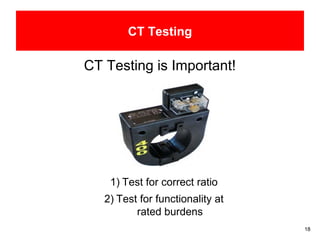
CT Testing
CT Testing is Important!
1) Test for correct ratio
2) Test for functionality at
rated burdens
19
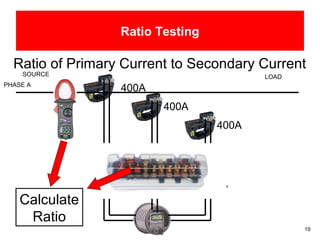
Ratio Testing
Ratio of Primary Current to Secondary Current
5A
PHASE A
SOURCE LOAD
400A
400A
400A
5A5A
Calculate
Ratio
20
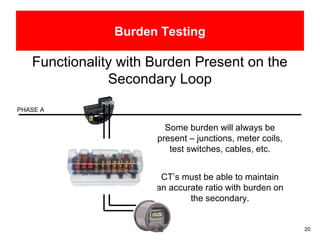
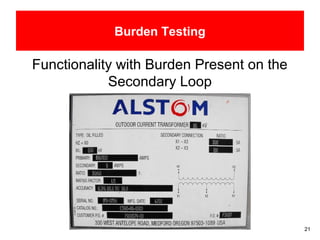
Burden Testing
Functionality with Burden Present on the
Secondary Loop
PHASE A
Some burden will always be
present – junctions, meter coils,
test switches, cables, etc.
CT’s must be able to maintain
an accurate ratio with burden on
the secondary.
21
Burden Testing
Functionality with Burden Present on the
Secondary Loop
22
Burden Testing
Functionality with Burden Present on the
Secondary Loop
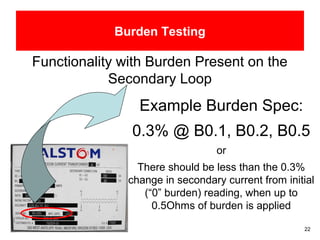
Example Burden Spec:
0.3% @ B0.1, B0.2, B0.5
or
There should be less than the 0.3%
change in secondary current from initial
(“0” burden) reading, when up to
0.5Ohms of burden is applied
23
Burden Testing
Functionality with Burden Present on the
Secondary Loop
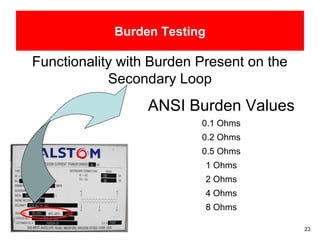
ANSI Burden Values
0.1 Ohms
0.2 Ohms
0.5 Ohms
1 Ohms
2 Ohms
4 Ohms
8 Ohms
24
Burden Testing
0.0000
1.0000
2.0000
3.0000
4.0000
5.0000
6.0000
0 2 4 6 8
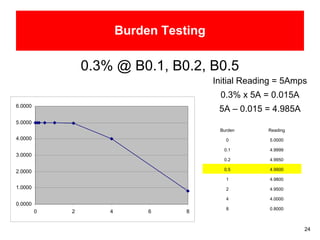
0.3% @ B0.1, B0.2, B0.5
Initial Reading = 5Amps
0.3% x 5A = 0.015A
5A – 0.015 = 4.985A
Burden Reading
0 5.0000
0.1 4.9999
0.2 4.9950
0.5 4.9900
1 4.9800
2 4.9500
4 4.0000
8 0.8000
25
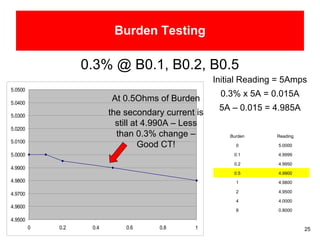
Burden Testing
4.9500
4.9600
4.9700
4.9800
4.9900
5.0000
5.0100
5.0200
5.0300
5.0400
5.0500
0 0.2 0.4 0.6 0.8 1
0.3% @ B0.1, B0.2, B0.5
Initial Reading = 5Amps
0.3% x 5A = 0.015A
5A – 0.015 = 4.985A
At 0.5Ohms of Burden
the secondary current is
still at 4.990A – Less
than 0.3% change –
Good CT!
Burden Reading
0 5.0000
0.1 4.9999
0.2 4.9950
0.5 4.9900
1 4.9800
2 4.9500
4 4.0000
8 0.8000
26
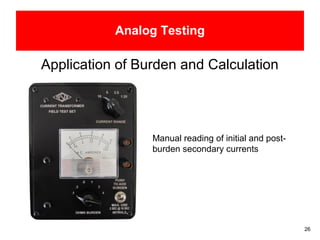
Analog Testing
Application of Burden and Calculation
Manual reading of initial and post-
burden secondary currents
27
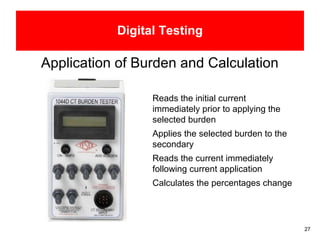
Digital Testing
Application of Burden and Calculation
Reads the initial current
immediately prior to applying the
selected burden
Applies the selected burden to the
secondary
Reads the current immediately
following current application
Calculates the percentages change
28
Questions and Discussion
Tom Lawton
TESCO – The Eastern Specialty Company
Bristol, PA
1-800-762-8211
This presentation can also be found under Meter Conferences and
Schools on the TESCO web site: www.tesco-advent.com

CT Burden Testing