Understanding & Supporting
Dyslexia in Business:
Trainers, Coaches and Mentors
Sample slides and information from our
online dyslexia course
for workplace learning development staff
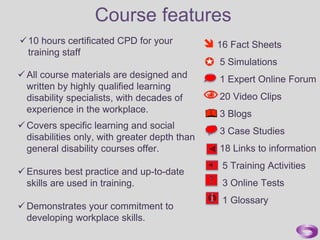
16 Fact Sheets
5 Simulations
1 Expert Online Forum
20 Video Clips
3 Blogs
3 Case Studies
18 Links to information
5 Training Activities
3 Online Tests
1 Glossary
 All course materials are designed and
written by highly qualified learning
disability specialists, with decades of
experience in the workplace.
10 hours certificated CPD for your
training staff
 Covers specific learning and social
disabilities only, with greater depth than
general disability courses offer.
 Ensures best practice and up-to-date
skills are used in training.
 Demonstrates your commitment to
developing workplace skills.
Course features
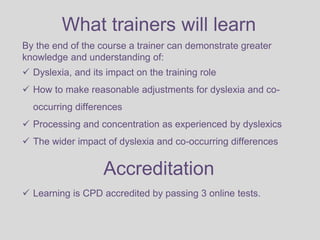
What trainers will learn
By the end of the course a trainer can demonstrate greater
knowledge and understanding of:
 Dyslexia, and its impact on the training role
 How to make reasonable adjustments for dyslexia and co-
occurring differences
 Processing and concentration as experienced by dyslexics
 The wider impact of dyslexia and co-occurring differences
Accreditation
 Learning is CPD accredited by passing 3 online tests.
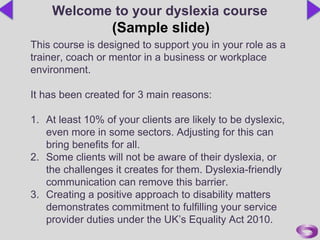
This course is designed to support you in your role as a
trainer, coach or mentor in a business or workplace
environment.
It has been created for 3 main reasons:
1. At least 10% of your clients are likely to be dyslexic,
even more in some sectors. Adjusting for this can
bring benefits for all.
2. Some clients will not be aware of their dyslexia, or
the challenges it creates for them. Dyslexia-friendly
communication can remove this barrier.
3. Creating a positive approach to disability matters
demonstrates commitment to fulfilling your service
provider duties under the UK’s Equality Act 2010.
Welcome to your dyslexia course
(Sample slide)
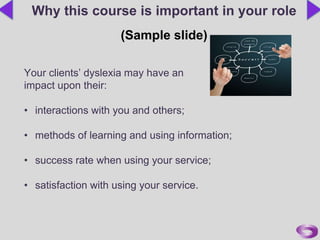
Your clients’ dyslexia may have an
impact upon their:
• interactions with you and others;
• methods of learning and using information;
• success rate when using your service;
• satisfaction with using your service.
Why this course is important in your role
(Sample slide)
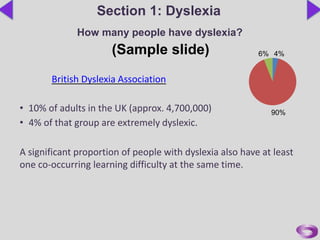
British Dyslexia Association
• 10% of adults in the UK (approx. 4,700,000)
• 4% of that group are extremely dyslexic.
A significant proportion of people with dyslexia also have at least
one co-occurring learning difficulty at the same time.
Section 1: Dyslexia
How many people have dyslexia?
(Sample slide)
90%
4%6%
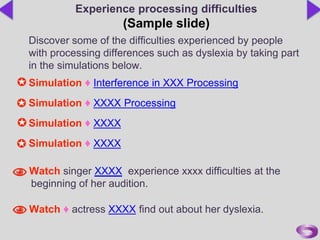
Discover some of the difficulties experienced by people
with processing differences such as dyslexia by taking part
in the simulations below.
Simulation ♦ Interference in XXX Processing
Simulation ♦ XXXX Processing
Simulation ♦ XXXX
Simulation ♦ XXXX
Watch singer XXXX experience xxxx difficulties at the
beginning of her audition.
Watch ♦ actress XXXX find out about her dyslexia.
Experience processing difficulties
(Sample slide)
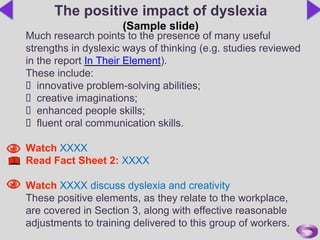
Much research points to the presence of many useful
strengths in dyslexic ways of thinking (e.g. studies reviewed
in the report In Their Element).
These include:
 innovative problem-solving abilities;
 creative imaginations;
 enhanced people skills;
 fluent oral communication skills.
Watch XXXX
Read Fact Sheet 2: XXXX
Watch XXXX discuss dyslexia and creativity
These positive elements, as they relate to the workplace,
are covered in Section 3, along with effective reasonable
adjustments to training delivered to this group of workers.
The positive impact of dyslexia
(Sample slide)
• In medical references to dyslexia, co-occurrence may
often be termed 'co-morbidity'.
• Both terms describe the incidence of two or more
factors being present in an individual at the same time.
Section 2: Co-occurrence and Dyslexia
(Sample slide)
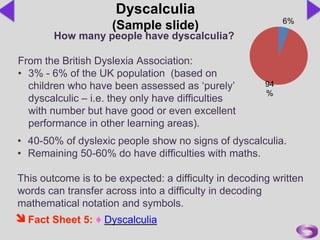
• 40-50% of dyslexic people show no signs of dyscalculia.
• Remaining 50-60% do have difficulties with maths.
This outcome is to be expected: a difficulty in decoding written
words can transfer across into a difficulty in decoding
mathematical notation and symbols.
6%
94
%
Dyscalculia
(Sample slide)
How many people have dyscalculia?
From the British Dyslexia Association:
• 3% - 6% of the UK population (based on
children who have been assessed as ‘purely’
dyscalculic – i.e. they only have difficulties
with number but have good or even excellent
performance in other learning areas).
Fact Sheet 5: ♦ Dyscalculia
Fact Sheet 8: ♦ Auditory Processing Disorder
Simulation ♦ Auditory Processing Difficulties
Watch this video on the symptoms of APD
Watch this explanation of APD by XXXX.
Auditory Processing Disorder
Resources
(Sample slide)
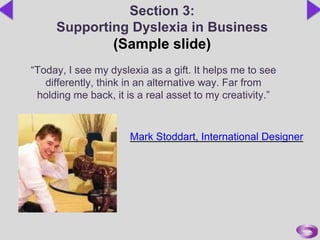
Section 3:
Supporting Dyslexia in Business
(Sample slide)
“Today, I see my dyslexia as a gift. It helps me to see
differently, think in an alternative way. Far from
holding me back, it is a real asset to my creativity.”
Mark Stoddart, International Designer
In your role as a trainer, mentor or coach you will meet these two
groups of learners:
• learners who know they are dyslexic;
• learners with dyslexia who have never been identified as such.
We aim to equip you with essential knowledge and skills to help
you provide valuable support to adults from both groups.
This Section covers:
(i) Impacts and incidence of dyslexia in the workplace;
(ii) Components of support – legislation and adjustments.
Watch XXXX
Introduction
(Sample slide)
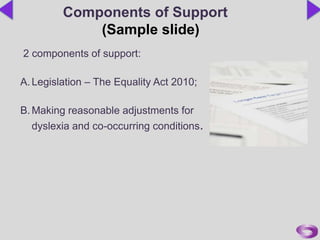
2 components of support:
A.Legislation – The Equality Act 2010;
B.Making reasonable adjustments for
dyslexia and co-occurring conditions.
Components of Support
(Sample slide)
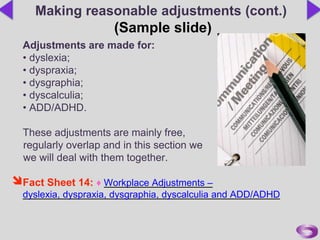
Adjustments are made for:
• dyslexia;
• dyspraxia;
• dysgraphia;
• dyscalculia;
• ADD/ADHD.
These adjustments are mainly free,
regularly overlap and in this section we
we will deal with them together.
Fact Sheet 14: ♦ Workplace Adjustments –
dyslexia, dyspraxia, dysgraphia, dyscalculia and ADD/ADHD
Making reasonable adjustments (cont.)
(Sample slide)
Order your copies of
Understanding & Supporting Dyslexia in Business:
Trainers, Coaches and Mentors
or contact us for more information:
info@halfpennydevelopment.co.uk
See our Face Book page
Tel. 01659 742140
halfpennydevelopment.co.uk
Order

Understanding & Supporting Dyslexia in Business: Trainers, Coaches and Mentors

  • 1.
    Understanding & Supporting Dyslexiain Business: Trainers, Coaches and Mentors Sample slides and information from our online dyslexia course for workplace learning development staff
  • 2.
    16 Fact Sheets 5Simulations 1 Expert Online Forum 20 Video Clips 3 Blogs 3 Case Studies 18 Links to information 5 Training Activities 3 Online Tests 1 Glossary  All course materials are designed and written by highly qualified learning disability specialists, with decades of experience in the workplace. 10 hours certificated CPD for your training staff  Covers specific learning and social disabilities only, with greater depth than general disability courses offer.  Ensures best practice and up-to-date skills are used in training.  Demonstrates your commitment to developing workplace skills. Course features
  • 3.
    What trainers willlearn By the end of the course a trainer can demonstrate greater knowledge and understanding of:  Dyslexia, and its impact on the training role  How to make reasonable adjustments for dyslexia and co- occurring differences  Processing and concentration as experienced by dyslexics  The wider impact of dyslexia and co-occurring differences Accreditation  Learning is CPD accredited by passing 3 online tests.
  • 4.
    This course isdesigned to support you in your role as a trainer, coach or mentor in a business or workplace environment. It has been created for 3 main reasons: 1. At least 10% of your clients are likely to be dyslexic, even more in some sectors. Adjusting for this can bring benefits for all. 2. Some clients will not be aware of their dyslexia, or the challenges it creates for them. Dyslexia-friendly communication can remove this barrier. 3. Creating a positive approach to disability matters demonstrates commitment to fulfilling your service provider duties under the UK’s Equality Act 2010. Welcome to your dyslexia course (Sample slide)
  • 5.
    Your clients’ dyslexiamay have an impact upon their: • interactions with you and others; • methods of learning and using information; • success rate when using your service; • satisfaction with using your service. Why this course is important in your role (Sample slide)
  • 6.
    British Dyslexia Association •10% of adults in the UK (approx. 4,700,000) • 4% of that group are extremely dyslexic. A significant proportion of people with dyslexia also have at least one co-occurring learning difficulty at the same time. Section 1: Dyslexia How many people have dyslexia? (Sample slide) 90% 4%6%
  • 7.
    Discover some ofthe difficulties experienced by people with processing differences such as dyslexia by taking part in the simulations below. Simulation ♦ Interference in XXX Processing Simulation ♦ XXXX Processing Simulation ♦ XXXX Simulation ♦ XXXX Watch singer XXXX experience xxxx difficulties at the beginning of her audition. Watch ♦ actress XXXX find out about her dyslexia. Experience processing difficulties (Sample slide)
  • 8.
    Much research pointsto the presence of many useful strengths in dyslexic ways of thinking (e.g. studies reviewed in the report In Their Element). These include:  innovative problem-solving abilities;  creative imaginations;  enhanced people skills;  fluent oral communication skills. Watch XXXX Read Fact Sheet 2: XXXX Watch XXXX discuss dyslexia and creativity These positive elements, as they relate to the workplace, are covered in Section 3, along with effective reasonable adjustments to training delivered to this group of workers. The positive impact of dyslexia (Sample slide)
  • 9.
    • In medicalreferences to dyslexia, co-occurrence may often be termed 'co-morbidity'. • Both terms describe the incidence of two or more factors being present in an individual at the same time. Section 2: Co-occurrence and Dyslexia (Sample slide)
  • 10.
    • 40-50% ofdyslexic people show no signs of dyscalculia. • Remaining 50-60% do have difficulties with maths. This outcome is to be expected: a difficulty in decoding written words can transfer across into a difficulty in decoding mathematical notation and symbols. 6% 94 % Dyscalculia (Sample slide) How many people have dyscalculia? From the British Dyslexia Association: • 3% - 6% of the UK population (based on children who have been assessed as ‘purely’ dyscalculic – i.e. they only have difficulties with number but have good or even excellent performance in other learning areas). Fact Sheet 5: ♦ Dyscalculia
  • 11.
    Fact Sheet 8:♦ Auditory Processing Disorder Simulation ♦ Auditory Processing Difficulties Watch this video on the symptoms of APD Watch this explanation of APD by XXXX. Auditory Processing Disorder Resources (Sample slide)
  • 12.
    Section 3: Supporting Dyslexiain Business (Sample slide) “Today, I see my dyslexia as a gift. It helps me to see differently, think in an alternative way. Far from holding me back, it is a real asset to my creativity.” Mark Stoddart, International Designer
  • 13.
    In your roleas a trainer, mentor or coach you will meet these two groups of learners: • learners who know they are dyslexic; • learners with dyslexia who have never been identified as such. We aim to equip you with essential knowledge and skills to help you provide valuable support to adults from both groups. This Section covers: (i) Impacts and incidence of dyslexia in the workplace; (ii) Components of support – legislation and adjustments. Watch XXXX Introduction (Sample slide)
  • 14.
    2 components ofsupport: A.Legislation – The Equality Act 2010; B.Making reasonable adjustments for dyslexia and co-occurring conditions. Components of Support (Sample slide)
  • 15.
    Adjustments are madefor: • dyslexia; • dyspraxia; • dysgraphia; • dyscalculia; • ADD/ADHD. These adjustments are mainly free, regularly overlap and in this section we we will deal with them together. Fact Sheet 14: ♦ Workplace Adjustments – dyslexia, dyspraxia, dysgraphia, dyscalculia and ADD/ADHD Making reasonable adjustments (cont.) (Sample slide)
  • 16.
    Order your copiesof Understanding & Supporting Dyslexia in Business: Trainers, Coaches and Mentors or contact us for more information: info@halfpennydevelopment.co.uk See our Face Book page Tel. 01659 742140 halfpennydevelopment.co.uk Order

Editor's Notes