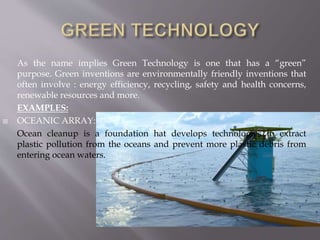
As the name implies Green Technology is one that has a “green”
purpose. Green inventions are environmentally friendly inventions that
often involve : energy efficiency, recycling, safety and health concerns,
renewable resources and more.
EXAMPLES:
 OCEANIC ARRAY:
Ocean cleanup is a foundation hat develops technologies to extract
plastic pollution from the oceans and prevent more plastic debris from
entering ocean waters.
 SOLAR CELLS:
Solar cell, also called photovoltaic cell, any device that directly
converts the energy of light into electrical energy through the
photovoltaic effect.
 SUSTAINABILITY EXPERTS:
Focus of Industry experts on sustainability continues to partner
with leading companies and organizations to arrive at solutions
that embed sustainability into business models and governance
processes across industries and functions.
CSR requires companies to acknowledge that they should be publicly
accountable not only for their financial performance but also for their
social and environmental record.
Definitions:
 As per World Business Council, Corporate Social Responsibility is “The
commitment of business to contribute to sustainable economic
development, working with employees, their families, the local
community and society at large to improve their quality of life.”
 CSR encompasses the extent to which company should promote human
rights, democracy, community improvement and sustainable development
objectives throughout the world.
-(Confederation of Business Industry, 2001).
CSR is the procedure of assessing an organization’s impact on society
and evaluating their responsibilities. It begins with an assessment of the
following aspects of each business:
 Customers
 Suppliers
 Environment
 Communities
 Employees
The most effective CSR plans ensure that while organizations comply
with legislation, their investments also respect the growth and
development of marginalized communities and the environment. CSR
should also be sustainable – involving activities that an organization can
uphold without negatively affecting their business goals.
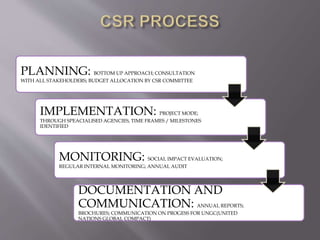
PLANNING: BOTTOM UP APPROACH; CONSULTATION
WITH ALL STAKEHOLDERS; BUDGET ALLOCATION BY CSR COMMITTEE
IMPLEMENTATION: PROJECT MODE;
THROUGH SPEACIALISED AGENCIES, TIME FRAMES / MILESTONES
IDENTIFIED
MONITORING: SOCIAL IMPACT EVALUATION;
REGULAR INTERNAL MONITORING; ANNUAL AUDIT
DOCUMENTATION AND
COMMUNICATION: ANNUAL REPORTS;
BROCHURES; COMMUNICATION ON PROGESS FOR UNGC(UNITED
NATIONS GLOBAL COMPACT)
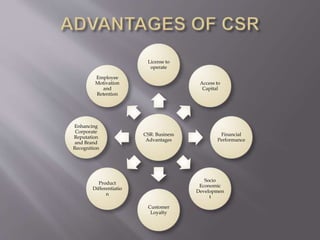
CSR: Business
Advantages
License to
operate
Access to
Capital
Financial
Performance
Socio
Economic
Developmen
t
Customer
Loyalty
Product
Differentiatio
n
Enhancing
Corporate
Reputation
and Brand
Recognition
Employee
Motivation
and
Retention
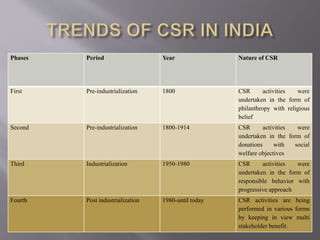
Phases Period Year Nature of CSR
First Pre-industrialization 1800 CSR activities were
undertaken in the form of
philanthropy with religious
belief
Second Pre-industrialization 1800-1914 CSR activities were
undertaken in the form of
donations with social
welfare objectives
Third Industrialization 1950-1980 CSR activities were
undertaken in the form of
responsible behavior with
progressive approach
Fourth Post industrialization 1980-until today CSR activities are being
performed in various forms
by keeping in view multi
stakeholder benefit.
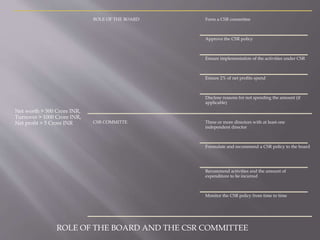
Net worth > 500 Crore INR,
Turnover > 1000 Crore INR,
Net profit > 5 Crore INR
ROLE OF THE BOARD Form a CSR committee
Approve the CSR policy
Ensure implementation of the activities under CSR
Ensure 2% of net profits spend
Disclose reasons for not spending the amount (if
applicable)
CSR COMMITTE Three or more directors with at least one
independent director
Formulate and recommend a CSR policy to the board
Recommend activities and the amount of
expenditure to be incurred
Monitor the CSR policy from time to time
ROLE OF THE BOARD AND THE CSR COMMITTEE
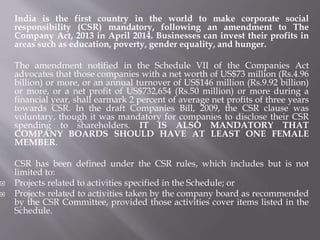
India is the first country in the world to make corporate social
responsibility (CSR) mandatory, following an amendment to The
Company Act, 2013 in April 2014. Businesses can invest their profits in
areas such as education, poverty, gender equality, and hunger.
The amendment notified in the Schedule VII of the Companies Act
advocates that those companies with a net worth of US$73 million (Rs.4.96
billion) or more, or an annual turnover of US$146 million (Rs.9.92 billion)
or more, or a net profit of US$732,654 (Rs.50 million) or more during a
financial year, shall earmark 2 percent of average net profits of three years
towards CSR. In the draft Companies Bill, 2009, the CSR clause was
voluntary, though it was mandatory for companies to disclose their CSR
spending to shareholders. IT IS ALSO MANDATORY THAT
COMPANY BOARDS SHOULD HAVE AT LEAST ONE FEMALE
MEMBER.
CSR has been defined under the CSR rules, which includes but is not
limited to:
 Projects related to activities specified in the Schedule; or
 Projects related to activities taken by the company board as recommended
by the CSR Committee, provided those activities cover items listed in the
Schedule.
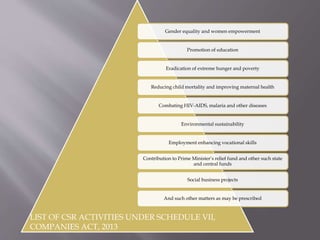
Gender equality and women empowerment
Promotion of education
Eradication of extreme hunger and poverty
Reducing child mortality and improving maternal health
Combating HIV-AIDS, malaria and other diseases
Environmental sustainability
Employment enhancing vocational skills
Contribution to Prime Minister’s relief fund and other such state
and central funds
Social business projects
And such other matters as may be prescribed
LIST OF CSR ACTIVITIES UNDER SCHEDULE VII,
COMPANIES ACT, 2013
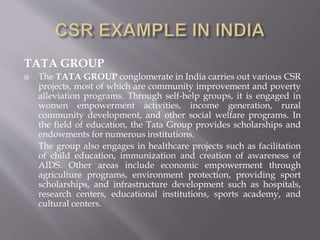
TATA GROUP
 The TATA GROUP conglomerate in India carries out various CSR
projects, most of which are community improvement and poverty
alleviation programs. Through self-help groups, it is engaged in
women empowerment activities, income generation, rural
community development, and other social welfare programs. In
the field of education, the Tata Group provides scholarships and
endowments for numerous institutions.
The group also engages in healthcare projects such as facilitation
of child education, immunization and creation of awareness of
AIDS. Other areas include economic empowerment through
agriculture programs, environment protection, providing sport
scholarships, and infrastructure development such as hospitals,
research centers, educational institutions, sports academy, and
cultural centers.
CSR is an indispensible mechanism for both increased corporate
accountability, profitability and environment sustainability.
Csr

Csr

  • 3.
    As the nameimplies Green Technology is one that has a “green” purpose. Green inventions are environmentally friendly inventions that often involve : energy efficiency, recycling, safety and health concerns, renewable resources and more. EXAMPLES:  OCEANIC ARRAY: Ocean cleanup is a foundation hat develops technologies to extract plastic pollution from the oceans and prevent more plastic debris from entering ocean waters.
  • 4.
     SOLAR CELLS: Solarcell, also called photovoltaic cell, any device that directly converts the energy of light into electrical energy through the photovoltaic effect.  SUSTAINABILITY EXPERTS: Focus of Industry experts on sustainability continues to partner with leading companies and organizations to arrive at solutions that embed sustainability into business models and governance processes across industries and functions.
  • 5.
    CSR requires companiesto acknowledge that they should be publicly accountable not only for their financial performance but also for their social and environmental record. Definitions:  As per World Business Council, Corporate Social Responsibility is “The commitment of business to contribute to sustainable economic development, working with employees, their families, the local community and society at large to improve their quality of life.”  CSR encompasses the extent to which company should promote human rights, democracy, community improvement and sustainable development objectives throughout the world. -(Confederation of Business Industry, 2001).
  • 6.
    CSR is theprocedure of assessing an organization’s impact on society and evaluating their responsibilities. It begins with an assessment of the following aspects of each business:  Customers  Suppliers  Environment  Communities  Employees The most effective CSR plans ensure that while organizations comply with legislation, their investments also respect the growth and development of marginalized communities and the environment. CSR should also be sustainable – involving activities that an organization can uphold without negatively affecting their business goals.
  • 7.
    PLANNING: BOTTOM UPAPPROACH; CONSULTATION WITH ALL STAKEHOLDERS; BUDGET ALLOCATION BY CSR COMMITTEE IMPLEMENTATION: PROJECT MODE; THROUGH SPEACIALISED AGENCIES, TIME FRAMES / MILESTONES IDENTIFIED MONITORING: SOCIAL IMPACT EVALUATION; REGULAR INTERNAL MONITORING; ANNUAL AUDIT DOCUMENTATION AND COMMUNICATION: ANNUAL REPORTS; BROCHURES; COMMUNICATION ON PROGESS FOR UNGC(UNITED NATIONS GLOBAL COMPACT)
  • 8.
    CSR: Business Advantages License to operate Accessto Capital Financial Performance Socio Economic Developmen t Customer Loyalty Product Differentiatio n Enhancing Corporate Reputation and Brand Recognition Employee Motivation and Retention
  • 9.
    Phases Period YearNature of CSR First Pre-industrialization 1800 CSR activities were undertaken in the form of philanthropy with religious belief Second Pre-industrialization 1800-1914 CSR activities were undertaken in the form of donations with social welfare objectives Third Industrialization 1950-1980 CSR activities were undertaken in the form of responsible behavior with progressive approach Fourth Post industrialization 1980-until today CSR activities are being performed in various forms by keeping in view multi stakeholder benefit.
  • 10.
    Net worth >500 Crore INR, Turnover > 1000 Crore INR, Net profit > 5 Crore INR ROLE OF THE BOARD Form a CSR committee Approve the CSR policy Ensure implementation of the activities under CSR Ensure 2% of net profits spend Disclose reasons for not spending the amount (if applicable) CSR COMMITTE Three or more directors with at least one independent director Formulate and recommend a CSR policy to the board Recommend activities and the amount of expenditure to be incurred Monitor the CSR policy from time to time ROLE OF THE BOARD AND THE CSR COMMITTEE
  • 11.
    India is thefirst country in the world to make corporate social responsibility (CSR) mandatory, following an amendment to The Company Act, 2013 in April 2014. Businesses can invest their profits in areas such as education, poverty, gender equality, and hunger. The amendment notified in the Schedule VII of the Companies Act advocates that those companies with a net worth of US$73 million (Rs.4.96 billion) or more, or an annual turnover of US$146 million (Rs.9.92 billion) or more, or a net profit of US$732,654 (Rs.50 million) or more during a financial year, shall earmark 2 percent of average net profits of three years towards CSR. In the draft Companies Bill, 2009, the CSR clause was voluntary, though it was mandatory for companies to disclose their CSR spending to shareholders. IT IS ALSO MANDATORY THAT COMPANY BOARDS SHOULD HAVE AT LEAST ONE FEMALE MEMBER. CSR has been defined under the CSR rules, which includes but is not limited to:  Projects related to activities specified in the Schedule; or  Projects related to activities taken by the company board as recommended by the CSR Committee, provided those activities cover items listed in the Schedule.
  • 12.
    Gender equality andwomen empowerment Promotion of education Eradication of extreme hunger and poverty Reducing child mortality and improving maternal health Combating HIV-AIDS, malaria and other diseases Environmental sustainability Employment enhancing vocational skills Contribution to Prime Minister’s relief fund and other such state and central funds Social business projects And such other matters as may be prescribed LIST OF CSR ACTIVITIES UNDER SCHEDULE VII, COMPANIES ACT, 2013
  • 13.
    TATA GROUP  TheTATA GROUP conglomerate in India carries out various CSR projects, most of which are community improvement and poverty alleviation programs. Through self-help groups, it is engaged in women empowerment activities, income generation, rural community development, and other social welfare programs. In the field of education, the Tata Group provides scholarships and endowments for numerous institutions. The group also engages in healthcare projects such as facilitation of child education, immunization and creation of awareness of AIDS. Other areas include economic empowerment through agriculture programs, environment protection, providing sport scholarships, and infrastructure development such as hospitals, research centers, educational institutions, sports academy, and cultural centers.
  • 14.
    CSR is anindispensible mechanism for both increased corporate accountability, profitability and environment sustainability.