
•Ganesh Padhi (B047)
•Richansh Kumar(B038)
•Ritesh Kamal(B032)
•Sushant Kumar(B039)
•Mayank Shukla(B055)
•B Kushal Kumar(B036)
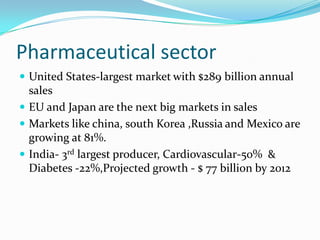
Pharmaceutical sector
ď‚— United States-largest market with $289 billion annual
  sales
ď‚— EU and Japan are the next big markets in sales
ď‚— Markets like china, south Korea ,Russia and Mexico are
  growing at 81%.
ď‚— India- 3rd largest producer, Cardiovascular-50% &
  Diabetes -22%,Projected growth - $ 77 billion by 2012
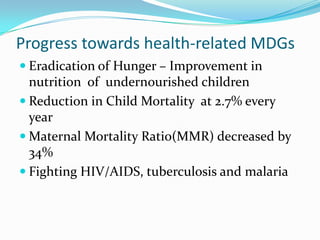
Progress towards health-related MDGs
 Eradication of Hunger – Improvement in
  nutrition of undernourished children
ď‚— Reduction in Child Mortality at 2.7% every
  year
ď‚— Maternal Mortality Ratio(MMR) decreased by
  34%
ď‚— Fighting HIV/AIDS, tuberculosis and malaria
Contd…
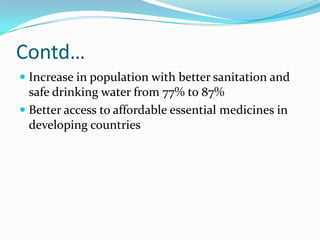
ď‚— Increase in population with better sanitation and
  safe drinking water from 77% to 87%
ď‚— Better access to affordable essential medicines in
  developing countries
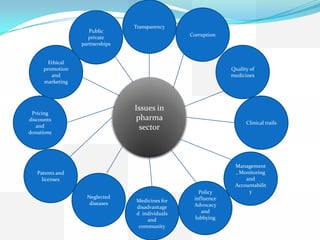
Transparency
                    Public
                                                Corruption
                   private
                 partnerships


       Ethical
     promotion                                               Quality of
        and                                                  medicines
     marketing


                                Issues in
 Pricing
discounts                        pharma
                                                                   Clinical trails
   and                            sector
donations


                                                              Management
   Patents and                                                , Monitoring
     licenses                                                     and
                                                              Accountabilit
                                                   Policy          y
                   Neglected                     influence
                                Medicines for
                    diseases                     Advocacy
                                disadvantage
                                d individuals       and
                                    and          lobbying
                                 community
About Astrazeneca
 World’s fifth largest pharmaceutical company
ď‚— Dedicated to research, development , manufacturing
  and marketing of medicines in over 100 countries.
ď‚— Committed to sustainable development of business
Astrazeneca’s CSR approach
ď‚— Stakeholder based approach
ď‚— Mainly targeted employees
ď‚— Other stakeholders were suppliers, global
 community, environment and customers.
Employees
ď‚— Workforce diversity
ď‚— Work-life balance
ď‚— Safety, health and well being
ď‚— Health screening and other health activities
Suppliers
ď‚— Continuing risk assessments of suppliers
ď‚— Rolling out a programme of onsite audits of key
  suppliers
ď‚— Implementing plans to improve standards with certain
  suppliers
ď‚— Following up and verifying that progress is being made
  with suppliers
ď‚— Training staff on their standards
Customers
ď‚— Access to medicines for vulnerable individuals
ď‚— AstraZeneca's Young Health Programme for 10-19
  years of children
ď‚— Community sponsorships and charitable donations
ď‚— Patient assistance programmes to avail medicines free
  or at reduced prices.
Others
Global community
ď‚— Disaster relief

Environment
ď‚— Reduction in Greenhouse gas footprint
ď‚— Waste reduction
ď‚— Reduction in water usage
ď‚— Product environmental improvement
ď‚— Improvement in supply chain
Critical analysis
ď‚— Stakeholder approach
ď‚— Business responsibilities
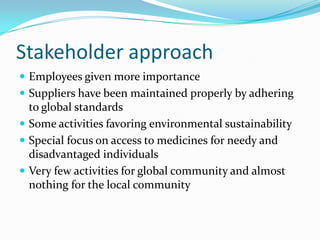
Stakeholder approach
ď‚— Employees given more importance
ď‚— Suppliers have been maintained properly by adhering
  to global standards
ď‚— Some activities favoring environmental sustainability
ď‚— Special focus on access to medicines for needy and
  disadvantaged individuals
ď‚— Very few activities for global community and almost
  nothing for the local community
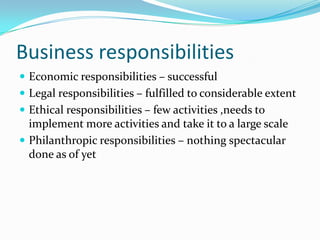
Business responsibilities
 Economic responsibilities – successful
 Legal responsibilities – fulfilled to considerable extent
 Ethical responsibilities – few activities ,needs to
  implement more activities and take it to a large scale
 Philanthropic responsibilities – nothing spectacular
  done as of yet
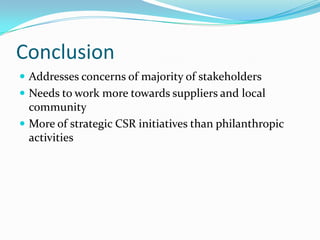
Conclusion
ď‚— Addresses concerns of majority of stakeholders
ď‚— Needs to work more towards suppliers and local
  community
ď‚— More of strategic CSR initiatives than philanthropic
  activities
Scope for future work
ď‚— Work environment improvement for employees
ď‚— Awareness programme for suppliers regarding
  environmental sustainability
ď‚— Implement environmental activities at a larger scale in
  more areas
ď‚— Invest more in R&D for innovative drugs and
  techniques for treatment
ď‚— Participate in community beneficial activities.
Csr astrazeneca

Csr astrazeneca

  • 1.
    •Ganesh Padhi (B047) •RichanshKumar(B038) •Ritesh Kamal(B032) •Sushant Kumar(B039) •Mayank Shukla(B055) •B Kushal Kumar(B036)
  • 2.
    Pharmaceutical sector ď‚— UnitedStates-largest market with $289 billion annual sales ď‚— EU and Japan are the next big markets in sales ď‚— Markets like china, south Korea ,Russia and Mexico are growing at 81%. ď‚— India- 3rd largest producer, Cardiovascular-50% & Diabetes -22%,Projected growth - $ 77 billion by 2012
  • 3.
    Progress towards health-relatedMDGs  Eradication of Hunger – Improvement in nutrition of undernourished children  Reduction in Child Mortality at 2.7% every year  Maternal Mortality Ratio(MMR) decreased by 34%  Fighting HIV/AIDS, tuberculosis and malaria
  • 4.
    Contd…  Increase inpopulation with better sanitation and safe drinking water from 77% to 87%  Better access to affordable essential medicines in developing countries
  • 5.
    Transparency Public Corruption private partnerships Ethical promotion Quality of and medicines marketing Issues in Pricing discounts pharma Clinical trails and sector donations Management Patents and , Monitoring licenses and Accountabilit Policy y Neglected influence Medicines for diseases Advocacy disadvantage d individuals and and lobbying community
  • 6.
    About Astrazeneca  World’sfifth largest pharmaceutical company  Dedicated to research, development , manufacturing and marketing of medicines in over 100 countries.  Committed to sustainable development of business
  • 7.
    Astrazeneca’s CSR approach Stakeholder based approach  Mainly targeted employees  Other stakeholders were suppliers, global community, environment and customers.
  • 8.
    Employees ď‚— Workforce diversity ď‚—Work-life balance ď‚— Safety, health and well being ď‚— Health screening and other health activities
  • 9.
    Suppliers ď‚— Continuing riskassessments of suppliers ď‚— Rolling out a programme of onsite audits of key suppliers ď‚— Implementing plans to improve standards with certain suppliers ď‚— Following up and verifying that progress is being made with suppliers ď‚— Training staff on their standards
  • 10.
    Customers ď‚— Access tomedicines for vulnerable individuals ď‚— AstraZeneca's Young Health Programme for 10-19 years of children ď‚— Community sponsorships and charitable donations ď‚— Patient assistance programmes to avail medicines free or at reduced prices.
  • 11.
    Others Global community ď‚— Disasterrelief Environment ď‚— Reduction in Greenhouse gas footprint ď‚— Waste reduction ď‚— Reduction in water usage ď‚— Product environmental improvement ď‚— Improvement in supply chain
  • 12.
    Critical analysis ď‚— Stakeholderapproach ď‚— Business responsibilities
  • 13.
    Stakeholder approach ď‚— Employeesgiven more importance ď‚— Suppliers have been maintained properly by adhering to global standards ď‚— Some activities favoring environmental sustainability ď‚— Special focus on access to medicines for needy and disadvantaged individuals ď‚— Very few activities for global community and almost nothing for the local community
  • 14.
    Business responsibilities  Economicresponsibilities – successful  Legal responsibilities – fulfilled to considerable extent  Ethical responsibilities – few activities ,needs to implement more activities and take it to a large scale  Philanthropic responsibilities – nothing spectacular done as of yet
  • 15.
    Conclusion ď‚— Addresses concernsof majority of stakeholders ď‚— Needs to work more towards suppliers and local community ď‚— More of strategic CSR initiatives than philanthropic activities
  • 16.
    Scope for futurework ď‚— Work environment improvement for employees ď‚— Awareness programme for suppliers regarding environmental sustainability ď‚— Implement environmental activities at a larger scale in more areas ď‚— Invest more in R&D for innovative drugs and techniques for treatment ď‚— Participate in community beneficial activities.