IbogainePresented by Rachel Jordan
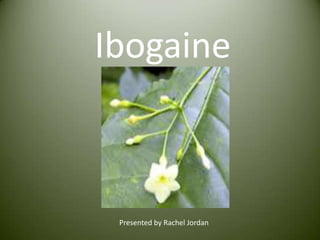
What is Ibogaine?A naturally occurring psychoactive plant alkaloidIt is sourced from the roots of the plant TabernantheIboga that grows in the forests of West AfricaTabernantheIboga plant
Ibogaine’s HistoryTraditionally used for thousands of years as a catalyst for spiritual exploration and healing by the African Bwiti culture.
Ibogaine’s HistoryHoward S. Lotsof first discovered Ibogaine’s ability to disrupt chemical dependency in 1962-63Ever since, he has been researching everything about it and advocating for it’s use in treating addictionAs of March 2007, 12 people out of 3611 died in relation to Ibogaine treatment but also in relation to other factorsHas been used to treat chemical dependence for over 40 years and has a 65% abstinence rate over 10% with conventional drug treatment programsNo potential for abuse
Ibogaine’s action     Has been shown to bind with multiple                  neurotransmitter sites within the CNS   Increases serotonin and decreases/blocks      dopamine   Has been shown to act both as an            antagonist and an agonist as well as      directly and indirectly
Ibogaine’s EffectsWorks in two ways:Reduction of withdrawal symptoms & cravings & sustained periods of abstinence or reduced useProduces a subjective experience where the person may undergo processes where their life & choices are examined & reassessed
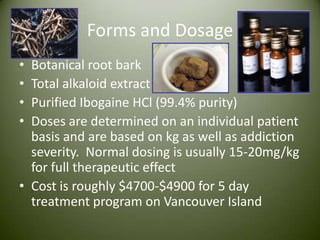
Forms and DosageBotanical root barkTotal alkaloid extractPurified Ibogaine HCl (99.4% purity)Doses are determined on an individual patient basis and are based on kg as well as addiction severity.  Normal dosing is usually 15-20mg/kg for full therapeutic effectCost is roughly $4700-$4900 for 5 day treatment program on Vancouver Island
Ibogaine AdministrationAn oral capsuleTakes approx. 45 minutes to take effect & decrease withdrawal symptomsShould be taken  in place of next narcotic dose Blood pressure & pulse should be checked every 30 min for first 4-8 hours & then if stable, every hour thereafterEffects occur in 3 stages and can last up to 36 hours
First StagePatient will usually want to lay prone & still as may experience motion related N&VSkin tends to become numbMay hear an initial buzzing or oscillating soundA period of dream-like visualization may last for 3 to 4 hours & ends abruptly should it occur at allMay experience random flashes of light that appear everywhere with eyes open & may last for hours or days.  Visualization on the other hand is most common with eyes closed.
Second stageFollows visualization & has been described as one in which the patient principally experiences cognitive evaluation or a review of issues that are important to themThey may cover every possible scenario from early childhood experiences to current health issues & may last for as few as 8 hours or for 20 hours or longer.
Third StageAlso known as Residual Stimulation stageIt tends to leave the patient exhausted & therefore is somewhat uncomfortableMay remain awake for two or more days but most patients will sleep within 24-48 hours of Ibogaine administrationUsually, there is a long term diminishment of the need for sleep over weeks or monthsSome patients may require or request sedation
Side EffectsCoordination disturbances (unstable gait and tendency to fall)Hallucination-like experiences Sleep disturbancesConcentration & speech troublesHeart rate & blood pressure changesNausea & vomitingDizziness Light sensitivityTirednessMuscles soreness
Post Ibogaine Treatment TherapyPatients are encouraged to attend NA or AA meetings for further supportMany are encouraged to have supports &/or resources in place before detox-ingOther additional treatment therapies
ContraindicationsHistory of heart attacks or cardiovascular disease/abnormalitiesConcurrent opiate/stimulant drug useActive psychological or neurological disordersBeck Depression Inventory score > 24 Active TB or pregnancyImpaired kidney, liver or GI function Concurrent drugs that may cause adverse ibogaine/drug interactions
PHN RoleKnow use/effects of Ibogaine in case a client inquires about it or presents themselves on itAdvocate for its use/funding in addictions treatment through a harm reduction, health promotion perspectiveEducate the public and patients on benefits & risks of Ibogaine compared to conventional treatments so they can make the best choice possible & can advocate for themselves & othersKnow difference b/w opioid withdrawal & Ibogaine’s effects
Q & A !!Where does Ibogaine originate from?Who qualifies for Ibogaine treatment?How long does the therapy typically last?What are the two main ways that Ibogaine works on treating chemical dependence?How many different forms are there?How is it typically taken?What should a nurse do while taking care of a person on Ibogaine?
ReferencesIbogaine Association. (2006).  Retrieved February 27, 2008 from http://www.ibogaine-therapy.net/Ibogaine Research Project. (2005). Retrieved February 27, 2008 from http://www.ibogaine-research.org/Ibogaine-Research-Project/Ibogaine.htmlIbogaine Roots of Hope: CBS.  Retrived from Veoh videos and internet television athttp://www.veoh.com/videos/v927524wxpsC5nkIbogaine Therapy House. (2008).  Retrieved February 27, 2008 from http://www.ibogatherapyhouse.net/cms/content/view/22/37/Multidisciplinary Association for Psychedelic Studies. (2007).  Ibogaine studies and research projects.  Retrieved February 27, 2008 from http://www.maps.org/ibogaine/Roslin, A. (2007, Oct. 25).  THE QUEST FOR THE ULTIMATE CURE FOR ADDICTION.The Georgia Straight.  Retrieved February 27th, 2008 from http://www.mapinc.org/drugnews/v07/n1235/a06.html.  The Ibogaine Dossier. (1999). Retrieved February 27, 2008 from http://www.ibogaine.org/index.html/

Ibogaine

  • 1.
  • 2.
    What is Ibogaine?Anaturally occurring psychoactive plant alkaloidIt is sourced from the roots of the plant TabernantheIboga that grows in the forests of West AfricaTabernantheIboga plant
  • 3.
    Ibogaine’s HistoryTraditionally usedfor thousands of years as a catalyst for spiritual exploration and healing by the African Bwiti culture.
  • 4.
    Ibogaine’s HistoryHoward S.Lotsof first discovered Ibogaine’s ability to disrupt chemical dependency in 1962-63Ever since, he has been researching everything about it and advocating for it’s use in treating addictionAs of March 2007, 12 people out of 3611 died in relation to Ibogaine treatment but also in relation to other factorsHas been used to treat chemical dependence for over 40 years and has a 65% abstinence rate over 10% with conventional drug treatment programsNo potential for abuse
  • 5.
    Ibogaine’s action Has been shown to bind with multiple neurotransmitter sites within the CNS Increases serotonin and decreases/blocks dopamine Has been shown to act both as an antagonist and an agonist as well as directly and indirectly
  • 6.
    Ibogaine’s EffectsWorks intwo ways:Reduction of withdrawal symptoms & cravings & sustained periods of abstinence or reduced useProduces a subjective experience where the person may undergo processes where their life & choices are examined & reassessed
  • 7.
    Forms and DosageBotanicalroot barkTotal alkaloid extractPurified Ibogaine HCl (99.4% purity)Doses are determined on an individual patient basis and are based on kg as well as addiction severity. Normal dosing is usually 15-20mg/kg for full therapeutic effectCost is roughly $4700-$4900 for 5 day treatment program on Vancouver Island
  • 8.
    Ibogaine AdministrationAn oralcapsuleTakes approx. 45 minutes to take effect & decrease withdrawal symptomsShould be taken in place of next narcotic dose Blood pressure & pulse should be checked every 30 min for first 4-8 hours & then if stable, every hour thereafterEffects occur in 3 stages and can last up to 36 hours
  • 9.
    First StagePatient willusually want to lay prone & still as may experience motion related N&VSkin tends to become numbMay hear an initial buzzing or oscillating soundA period of dream-like visualization may last for 3 to 4 hours & ends abruptly should it occur at allMay experience random flashes of light that appear everywhere with eyes open & may last for hours or days. Visualization on the other hand is most common with eyes closed.
  • 10.
    Second stageFollows visualization& has been described as one in which the patient principally experiences cognitive evaluation or a review of issues that are important to themThey may cover every possible scenario from early childhood experiences to current health issues & may last for as few as 8 hours or for 20 hours or longer.
  • 11.
    Third StageAlso knownas Residual Stimulation stageIt tends to leave the patient exhausted & therefore is somewhat uncomfortableMay remain awake for two or more days but most patients will sleep within 24-48 hours of Ibogaine administrationUsually, there is a long term diminishment of the need for sleep over weeks or monthsSome patients may require or request sedation
  • 12.
    Side EffectsCoordination disturbances(unstable gait and tendency to fall)Hallucination-like experiences Sleep disturbancesConcentration & speech troublesHeart rate & blood pressure changesNausea & vomitingDizziness Light sensitivityTirednessMuscles soreness
  • 13.
    Post Ibogaine TreatmentTherapyPatients are encouraged to attend NA or AA meetings for further supportMany are encouraged to have supports &/or resources in place before detox-ingOther additional treatment therapies
  • 14.
    ContraindicationsHistory of heartattacks or cardiovascular disease/abnormalitiesConcurrent opiate/stimulant drug useActive psychological or neurological disordersBeck Depression Inventory score > 24 Active TB or pregnancyImpaired kidney, liver or GI function Concurrent drugs that may cause adverse ibogaine/drug interactions
  • 15.
    PHN RoleKnow use/effectsof Ibogaine in case a client inquires about it or presents themselves on itAdvocate for its use/funding in addictions treatment through a harm reduction, health promotion perspectiveEducate the public and patients on benefits & risks of Ibogaine compared to conventional treatments so they can make the best choice possible & can advocate for themselves & othersKnow difference b/w opioid withdrawal & Ibogaine’s effects
  • 16.
    Q & A!!Where does Ibogaine originate from?Who qualifies for Ibogaine treatment?How long does the therapy typically last?What are the two main ways that Ibogaine works on treating chemical dependence?How many different forms are there?How is it typically taken?What should a nurse do while taking care of a person on Ibogaine?
  • 17.
    ReferencesIbogaine Association. (2006). Retrieved February 27, 2008 from http://www.ibogaine-therapy.net/Ibogaine Research Project. (2005). Retrieved February 27, 2008 from http://www.ibogaine-research.org/Ibogaine-Research-Project/Ibogaine.htmlIbogaine Roots of Hope: CBS. Retrived from Veoh videos and internet television athttp://www.veoh.com/videos/v927524wxpsC5nkIbogaine Therapy House. (2008). Retrieved February 27, 2008 from http://www.ibogatherapyhouse.net/cms/content/view/22/37/Multidisciplinary Association for Psychedelic Studies. (2007). Ibogaine studies and research projects. Retrieved February 27, 2008 from http://www.maps.org/ibogaine/Roslin, A. (2007, Oct. 25). THE QUEST FOR THE ULTIMATE CURE FOR ADDICTION.The Georgia Straight. Retrieved February 27th, 2008 from http://www.mapinc.org/drugnews/v07/n1235/a06.html. The Ibogaine Dossier. (1999). Retrieved February 27, 2008 from http://www.ibogaine.org/index.html/

Editor's Notes

  • #4 Also used as an initiation practice
  • #5 Such as: Having a pre-existing heart condition, sometimes one not detectable by EKG Using opiates when on ibogaine, or shortly afterwards Using the rootbark or iboga extract because Ibogaine HCl is statistically much safer orTaking ibogaine outside of a clinical facility because people taking ibogaine need constant supervision and, ideally, online heart monitoring Ibogaine has also been used for psychotherapy and pain management.
  • #6 Breaks down in the liver into a metabolite called nor-ibogaine which has been shown to prevent cravings and have anti-depressant effects that last for weeks or longerIbogaine’s effects may result from complex interactions between multiple neurotransmitter systems rather than predominant activity of a single neurotransmitter (Popik & Skolnick, 1999).
  • #8 Each form has a different onset and duration of action and the purified ibogaine has been shown to last longer than the extract.Generally, lower doses are used for psychotherapeutic therapy and higher doses are used for detox-ingThe cost of the dose has been known to be has high as $10000. Currently, there is no funding available for the treatment in Canada.
  • #9 8-12hours after the last dose of heroin, morphine, demerol, crack &/or cocaine and 24 hours after the last dose of methadoneBooster dosing is not recommended unless very experienced in administration. It is recommended to wait about a week to re-dose if withdrawal symptoms persist.
  • #11 Many patients state that it is through this cognitive evaluation that the reasons for their addiction become clear
  • #12 Sedatives that have been used include benzodiazepines, barbiturates and melatonin Some of Ibogaine’s effects are similar to opioid withdrawal and it is important for the administrator to know the difference between the two to be able to counsel the patient and assist them if in fact they are going through withdrawal.
  • #14 Addiction is a chronic debilitating disease and relapse is always a possibility. Ibogaine is not a “cure” and works best in conjunction with well-defined therapeutic goals, adequate preparation and monitoring and integration into existing treatment options for aftercare. Supports/resources such as returning to school, place to live, social assistance, etc… whatever they may be faced with when they leave therapyOther additional post treatment therapies can include massage therapy/bodywork, guided breathwork, reiki, exercise/stretching, art & music therapy, nutritional & recovery planning
  • #15 Includes hypertensionConcurrent opiate/stimulant drug use could be fatal because ibogaine has been shown to enhance the effects of these drugs.Impaired function may inhibit or decrease the ability to clear Ibogaine from the bodyDrugs such as anti-epilipetics, anti-depressants, etc…
  • #16 Show video!!!! http://www.veoh.com/videos/v927524wxpsC5nkTurn PP over and then ask Q & A!
  • #17 West AfricaAnyone without the contraindications such as impaired liver, kidney, GI function, heart disease/complications, active psycho or neurological disorders, depression, etc…24-36 hours1). Reduction of withdrawal symptoms & cravings & sustained periods of abstinence or reduced use2).Produces a subjective experience where the person may undergo processes where their life & choices are examined & reassessed3 forms: total alkaloid extract, rootbark, and purified ibogaineHClTaken orallyMonitor blood pressure and pulse every 30 minutes for first 4-8 hours or until stable and then every hour thereafter and be there to counsel the patient if needed