1
Copyright  Cirrus Logic, Inc. 1998
(All Rights Reserved)
Cirrus Logic, Inc.
Crystal Semiconductor Products Division
P.O. Box 17847, Austin, Texas 78760
(512) 445 7222 FAX: (512) 445 7581
http://www.crystal.com
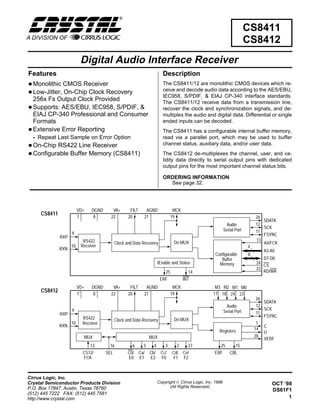
CS8411
CS8412
Digital Audio Interface Receiver
Features
l Monolithic CMOS Receiver
l Low-Jitter, On-Chip Clock Recovery
256x Fs Output Clock Provided
l Supports: AES/EBU, IEC958, S/PDIF, &
EIAJ CP-340 Professional and Consumer
Formats
l Extensive Error Reporting
- Repeat Last Sample on Error Option
l On-Chip RS422 Line Receiver
l Configurable Buffer Memory (CS8411)
Description
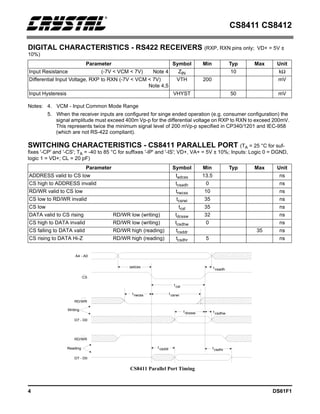
The CS8411/12 are monolithic CMOS devices which re-
ceive and decode audio data according to the AES/EBU,
IEC958, S/PDIF, & EIAJ CP-340 interface standards.
The CS8411/12 receive data from a transmission line,
recover the clock and synchronization signals, and de-
multiplex the audio and digital data. Differential or single
ended inputs can be decoded.
The CS8411 has a configurable internal buffer memory,
read via a parallel port, which may be used to buffer
channel status, auxiliary data, and/or user data.
The CS8412 de-multiplexes the channel, user, and va-
lidity data directly to serial output pins with dedicated
output pins for the most important channel status bits.
ORDERING INFORMATION
See page 32.
I
SCK
12
FSYNC
11
SDATA
26
RXP
9
RXN
10
Audio
Serial Port
CS
24
RD/WR
23
A3-A0
4
D7-D0
8
Configurable
Buffer
Memory
MCK
19
De-MUX
RS422
Receiver
CS8411
IEnable and Status
ERF INT
25 14
Clock and Data Recovery
AGND
21
FILT
20
VA+
22
DGND
8
VD+
7
SCK
12
FSYNC
11
SDATA
26
RXP
9
RXN
10
Audio
Serial Port
14
28
Registers
MCK
19
De-MUX
RS422
Receiver
CS8412
MUX
2 27
Clock and Data Recovery
AGND
21
FILT
20
VA+
22
DGND
8
VD+
7
1
C
U
VERF
M3
17
M2
18
M1
24
M0
23
MUX
ERF
25
CBL
15
4 3
6 5
Ce/
Cd/
Cc/
Cb/
Ca/
C0/
F2
F1
F0
E2
E1
E0
16
SEL
13
CS12/
FCK
13
A4/FCK
OCT ‘98
DS61F1
CS8411 CS8412
2 DS61F1
TABLE OF CONTENTS
CHARACTERISTICS/SPECIFICATIONS ............................................................ 3
ABSOLUTE MAXIMUM RATINGS .............................................................. 3
RECOMMENDED OPERATING CONDITIONS.......................................... 3
DIGITAL CHARACTERISTICS.................................................................... 3
DIGITAL CHARACTERISTICS - RS422 RECEIVERS................................ 4
SWITCHING CHARACTERISTICS - CS8411 PARALLEL PORT............... 4
SWITCHING CHARACTERISTICS - SERIAL PORTS................................ 5
GENERAL DESCRIPTION .................................................................................. 7
Line Receiver .............................................................................................. 7
Clocks and Jitter Attenuation ...................................................................... 7
CS8411 DESCRIPTION ....................................................................................... 8
Parallel Port ................................................................................................ 8
Status and IEnable Registers ..................................................................... 8
Control Registers ...................................................................................... 11
Audio Serial Port ....................................................................................... 13
Normal Modes .................................................................................... 14
Special Modes .................................................................................... 14
Buffer Memory .......................................................................................... 15
Buffer Mode 0 ..................................................................................... 15
Buffer Mode 1 ..................................................................................... 16
Buffer Mode 2 ..................................................................................... 18
Buffer Updates and Interrupt Timing ......................................................... 19
ERF Pin Timing ......................................................................................... 19
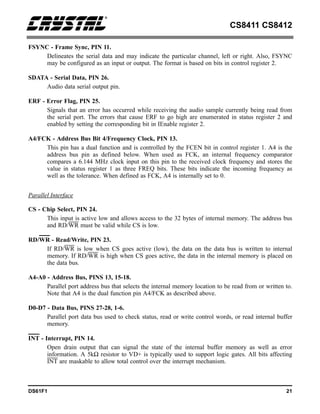
PIN DESCRIPTIONS: CS8411 .......................................................................... 20
CS8412 DESCRIPTION ..................................................................................... 23
Audio Serial Port ....................................................................................... 23
Normal Modes (M3 = 0) ..................................................................... 23
Special Modes (M3 = 1) ..................................................................... 24
C, U, VERF, ERF, and CBL Serial Outputs .............................................. 26
Multifunction Pins ...................................................................................... 26
Channel Status Reporting .................................................................. 27
Professional Channel Status (C0 = 0) ................................................ 28
Consumer Channel Status (C0 = 1) ................................................... 28
SCMS ................................................................................................. 28
PIN DESCRIPTIONS: CS8412 .......................................................................... 29
ORDERING GUIDE ............................................................................................ 32
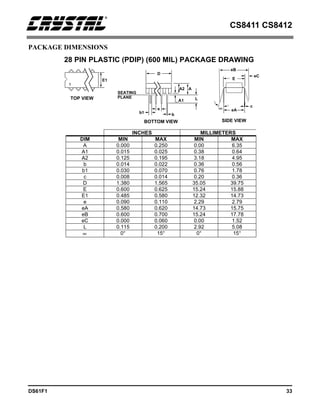
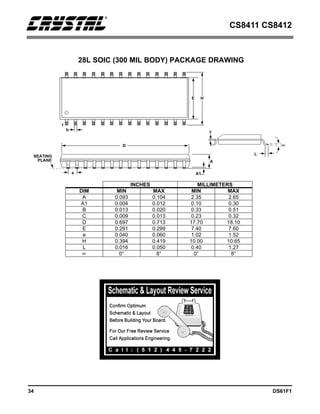
PACKAGE DIMENSIONS .................................................................................. 33
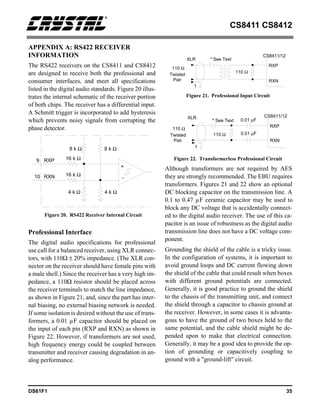
APPE2NDIX A: RS422 RECEIVER INFORMATION ........................................ 35
Professional Interface ............................................................................... 35
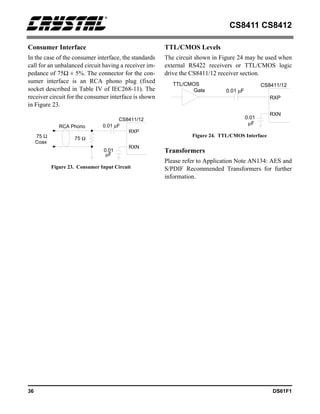
Consumer Interface .................................................................................. 36
TTL/CMOS Levels .................................................................................... 36
Transformers ............................................................................................ 36
APPENDIX B ..................................................................................................... 37
Preliminary product information describes products which are in production, but for which full characterization data is not yet available. Advance
product information describes products which are in development and subject to development changes. Cirrus Logic, Inc. has made best efforts
to ensure that the information contained in this document is accurate and reliable. However, the information is subject to change without notice
and is provided “AS IS” without warranty of any kind (express or implied). No responsibility is assumed by Cirrus Logic, Inc. for the use of this
information, nor for infringements of patents or other rights of third parties. This document is the property of Cirrus Logic, Inc. and implies no
license under patents, copyrights, trademarks, or trade secrets. No part of this publication may be copied, reproduced, stored in a retrieval sys-
tem, or transmitted, in any form or by any means (electronic, mechanical, photographic, or otherwise). Furthermore, no part of this publication
may be used as a basis for manufacture or sale of any items without the prior written consent of Cirrus Logic, Inc. The names of products of
Cirrus Logic, Inc. or other vendors and suppliers appearing in this document may be trademarks or service marks of their respective owners
which may be registered in some jurisdictions. A list of Cirrus Logic, Inc. trademarks and service marks can be found at http://www.cirrus.com.
CS8411 CS8412
DS61F1 3
CHARACTERISTICS/SPECIFICATIONS
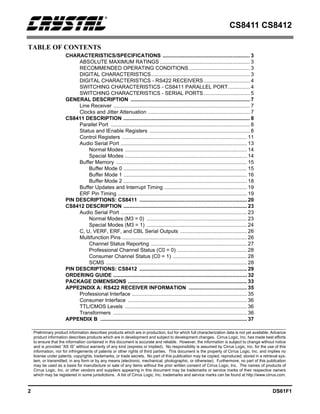
ABSOLUTE MAXIMUM RATINGS (GND = 0V, all voltages with respect to ground)
Notes: 1. Transient currents of up to 100 mA will not cause SCR latch-up.
WARNING: Operation beyond these limits may result in permanent damage to the device.
Normal operation is not guaranteed at these extremes.
RECOMMENDED OPERATING CONDITIONS (GND = 0V; all voltages with respect to ground)
Notes: 2. The '-CP' and '-CS' parts are specified to operate over 0 to 70 °C but are tested at 25 °C only.
The '-IP' and '-IS' parts are tested over the full -40 to 85 °C temperature range.
DIGITAL CHARACTERISTICS (TA = 25 °C for suffixes '-CP' & '-CS', TA = -40 to 85 °C for '-IP' & '-IS';
VD+, VA+ = 5V ± 10%)
3. FS is defined as the incoming audio sample frequency per channel.
Parameter Symbol Min Max Units
Power Supply Voltage VD+, VA+ 6.0 V
Input Current, Any Pin Except Supply Note 1 Iin ± 10 mA
Input Voltage, Any Pin except RXP, RXN VIN -0.3 VD+ + 0.3 V
Input Voltage, RXP and RXN VIN -12 12 V
Ambient Operating Temperature (power applied) TA -55 125 °C
Storage Temperature Tstg -65 150 °C
Parameter Symbol Min Typ Max Unit
Power Supply Voltage VD+, VA+ 4.5 5.0 5.5 V
Supply Current VA+
VD+
IA
ID
20
20
30
30
mA
mA
Ambient Operating Temperature: CS8411/12-CP or -CS
CS8411/12-IP or -IS
Note 2
TA 0
-40
25 70
85
°C
°C
Power Consumption PD 135 248 mW
Parameter Symbol Min Typ Max Unit
High-Level Input Voltage except RXP, RXN VIH 2.4 V
Low-Level Input Voltage except RXP, RXN VIL 0.4 V
High-Level Output Voltage (IO = 200 µA) VOH VD+ - 1.0 V
Low-Level Output Voltage (IO = -3.2 mA) VOL 0.5 V
Input Leakage Current Iin 1.0 10 µA
Input Sample Frequency CS8411/12-CP or -CS
CS8411/12-IP or -IS
Note 3
FS
FS
25
30
55
50
kHz
kHz
Master Clock Frequency Note 3 MCK 6.4 256 X FS 14.08 MHz
MCK Clock Jitter tj 200 ps RMS
MCK Duty Cycle (high time/cycle time) 50 %
CS8411 CS8412
4 DS61F1
DIGITAL CHARACTERISTICS - RS422 RECEIVERS (RXP, RXN pins only; VD+ = 5V ±
10%)
Notes: 4. VCM - Input Common Mode Range
5. When the receiver inputs are configured for singe ended operation (e.g. consumer configuration) the
signal amplitude must exceed 400m Vp-p for the differential voltage on RXP to RXN to exceed 200mV.
This represents twice the minimum signal level of 200 mVp-p specified in CP340/1201 and IEC-958
(which are not RS-422 compliant).
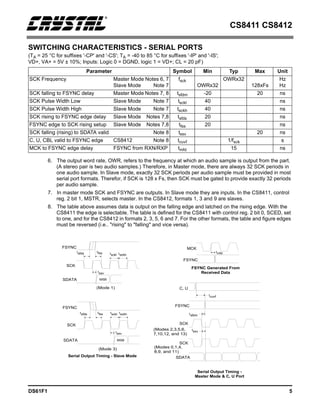
SWITCHING CHARACTERISTICS - CS8411 PARALLEL PORT (TA = 25 °C for suf-
fixes '-CP' and '-CS'; TA = -40 to 85 °C for suffixes '-IP' and '-IS'; VD+, VA+ = 5V ± 10%; Inputs: Logic 0 = DGND,
logic 1 = VD+; CL = 20 pF)
Parameter Symbol Min Typ Max Unit
Input Resistance (-7V < VCM < 7V) Note 4 ZIN 10 kΩ
Differential Input Voltage, RXP to RXN (-7V < VCM < 7V)
Note 4,5
VTH 200 mV
Input Hysteresis VHYST 50 mV
Parameter Symbol Min Typ Max Unit
ADDRESS valid to CS low tadcss 13.5 ns
CS high to ADDRESS invalid tcsadh 0 ns
RD/WR valid to CS low trwcss 10 ns
CS low to RD/WR invalid tcsrwi 35 ns
CS low tcsl 35 ns
DATA valid to CS rising RD/WR low (writing) tdcssw 32 ns
CS high to DATA invalid RD/WR low (writing) tcsdhw 0 ns
CS falling to DATA valid RD/WR high (reading) tcsddr 35 ns
CS rising to DATA Hi-Z RD/WR high (reading) tcsdhr 5 ns
A4 - A0
D7 - D0
RD/WR
Writing
Reading
adcss
t
csddr
t
csl
t
dcssw
t csdhw
t
csdhr
t
csadh
t
CS
D7 - D0
RD/WR
csrwi
t
rwcss
t
CS8411 Parallel Port Timing
CS8411 CS8412
DS61F1 5
SWITCHING CHARACTERISTICS - SERIAL PORTS
(TA = 25 °C for suffixes '-CP' and '-CS'; TA = -40 to 85 °C for suffixes '-IP' and '-IS';
VD+, VA+ = 5V ± 10%; Inputs: Logic 0 = DGND, logic 1 = VD+; CL = 20 pF)
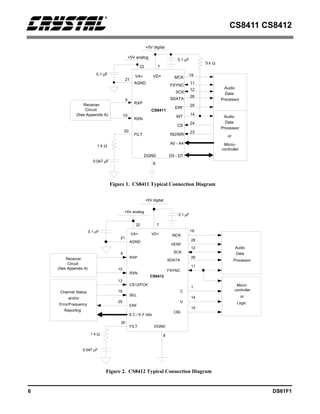
6. The output word rate, OWR, refers to the frequency at which an audio sample is output from the part.
(A stereo pair is two audio samples.) Therefore, in Master mode, there are always 32 SCK periods in
one audio sample. In Slave mode, exactly 32 SCK periods per audio sample must be provided in most
serial port formats. Therefor, if SCK is 128 x Fs, then SCK must be gated to provide exactly 32 periods
per audio sample.
7. In master mode SCK and FSYNC are outputs. In Slave mode they are inputs. In the CS8411, control
reg. 2 bit 1, MSTR, selects master. In the CS8412, formats 1, 3 and 9 are slaves.
8. The table above assumes data is output on the falling edge and latched on the rising edge. With the
CS8411 the edge is selectable. The table is defined for the CS8411 with control reg. 2 bit 0, SCED, set
to one, and for the CS8412 in formats 2, 3, 5, 6 and 7. For the other formats, the table and figure edges
must be reversed (i.e.. "rising" to "falling" and vice versa).
Parameter Symbol Min Typ Max Unit
SCK Frequency Master Mode Notes 6, 7
Slave Mode Note 7
fsck
OWRx32
OWRx32
128xFs
Hz
Hz
SCK falling to FSYNC delay Master Mode Notes 7, 8 tsfdm -20 20 ns
SCK Pulse Width Low Slave Mode Note 7 tsckl 40 ns
SCK Pulse Width High Slave Mode Note 7 tsckh 40 ns
SCK rising to FSYNC edge delay Slave Mode Notes 7,8 tsfds 20 ns
FSYNC edge to SCK rising setup Slave Mode Notes 7,8 tfss 20 ns
SCK falling (rising) to SDATA valid Note 8 tssv 20 ns
C, U, CBL valid to FSYNC edge CS8412 Note 8 tcuvf 1/fsck s
MCK to FSYNC edge delay FSYNC from RXN/RXP tmfd 15 ns
sfds
t
ssv
t
SDATA
SCK
FSYNC
fss
t
MSB
sckh
t
ssv
t
sckl
t
SDATA
SCK
FSYNC
MSB
(Mode 1)
(Mode 3)
sfdm
t
ssv
t
cuvf
t
SDATA
SCK
FSYNC
C, U
Serial Output Timing - Slave Mode
Serial Output Timing -
Master Mode & C, U Port
FSYNC Generated From
Received Data
FSYNC
mfd
t
MCK
fss
t
sfds
t
sckh
t
sckl
t
SCK
(Modes 2,3,5,6,
7,10,12, and 13)
(Modes 0,1,4,
8,9, and 11)
CS8411 CS8412
6 DS61F1
Audio
Data
Processor
or
Micro-
controller
CS8411
VD+
21
+5V digital
7
DGND
8
RXP
RXN
11
FSYNC
SCK
SDATA
12
26
0.1 µF
24
23
MCK
14
INT
A0 - A4
D0 - D7
19
CS
RD/WR
ERF
25
Audio
Data
Processor
VA+
+5V analog
22
0.1 µF
AGND
9
10
FILT
0.047 µF
20
Receiver
Circuit
(See Appendix A)
1 k Ω
5 k Ω
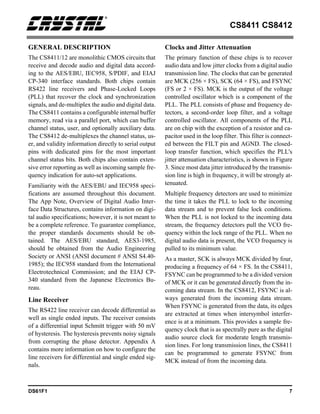
Figure 1. CS8411 Typical Connection Diagram
or
Micro-
controller
CS8412
VD+
21
+5V digital
7
DGND
8
RXP
RXN
11
FSYNC
SCK
SDATA
12
26
0.1 µF
1
14
MCK
CBL
19
C
U
VERF
28
Audio
Data
Processor
VA+
+5V analog
22
0.1 µF
AGND
9
10
FILT
20
Receiver
Circuit
(See Appendix A)
Logic
15
CS12/FCK
13
SEL
16
ERF
25
6 C / E-F bits
Channel Status
and/or
Error/Frequency
Reporting
0.047 µF
1 k Ω
Figure 2. CS8412 Typical Connection Diagram
CS8411 CS8412
DS61F1 7
GENERAL DESCRIPTION
The CS8411/12 are monolithic CMOS circuits that
receive and decode audio and digital data accord-
ing to the AES/EBU, IEC958, S/PDIF, and EIAJ
CP-340 interface standards. Both chips contain
RS422 line receivers and Phase-Locked Loops
(PLL) that recover the clock and synchronization
signals, and de-multiplex the audio and digital data.
The CS8411 contains a configurable internal buffer
memory, read via a parallel port, which can buffer
channel status, user, and optionally auxiliary data.
The CS8412 de-multiplexes the channel status, us-
er, and validity information directly to serial output
pins with dedicated pins for the most important
channel status bits. Both chips also contain exten-
sive error reporting as well as incoming sample fre-
quency indication for auto-set applications.
Familiarity with the AES/EBU and IEC958 speci-
fications are assumed throughout this document.
The App Note, Overview of Digital Audio Inter-
face Data Structures, contains information on digi-
tal audio specifications; however, it is not meant to
be a complete reference. To guarantee compliance,
the proper standards documents should be ob-
tained. The AES/EBU standard, AES3-1985,
should be obtained from the Audio Engineering
Society or ANSI (ANSI document # ANSI S4.40-
1985); the IEC958 standard from the International
Electrotechnical Commission; and the EIAJ CP-
340 standard from the Japanese Electronics Bu-
reau.
Line Receiver
The RS422 line receiver can decode differential as
well as single ended inputs. The receiver consists
of a differential input Schmitt trigger with 50 mV
of hysteresis. The hysteresis prevents noisy signals
from corrupting the phase detector. Appendix A
contains more information on how to configure the
line receivers for differential and single ended sig-
nals.
Clocks and Jitter Attenuation
The primary function of these chips is to recover
audio data and low jitter clocks from a digital audio
transmission line. The clocks that can be generated
are MCK (256 × FS), SCK (64 × FS), and FSYNC
(FS or 2 × FS). MCK is the output of the voltage
controlled oscillator which is a component of the
PLL. The PLL consists of phase and frequency de-
tectors, a second-order loop filter, and a voltage
controlled oscillator. All components of the PLL
are on chip with the exception of a resistor and ca-
pacitor used in the loop filter. This filter is connect-
ed between the FILT pin and AGND. The closed-
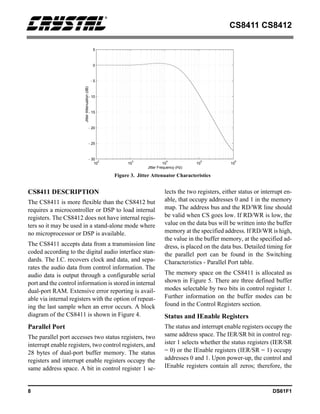
loop transfer function, which specifies the PLL's
jitter attenuation characteristics, is shown in Figure
3. Since most data jitter introduced by the transmis-
sion line is high in frequency, it will be strongly at-
tenuated.
Multiple frequency detectors are used to minimize
the time it takes the PLL to lock to the incoming
data stream and to prevent false lock conditions.
When the PLL is not locked to the incoming data
stream, the frequency detectors pull the VCO fre-
quency within the lock range of the PLL. When no
digital audio data is present, the VCO frequency is
pulled to its minimum value.
As a master, SCK is always MCK divided by four,
producing a frequency of 64 × FS. In the CS8411,
FSYNC can be programmed to be a divided version
of MCK or it can be generated directly from the in-
coming data stream. In the CS8412, FSYNC is al-
ways generated from the incoming data stream.
When FSYNC is generated from the data, its edges
are extracted at times when intersymbol interfer-
ence is at a minimum. This provides a sample fre-
quency clock that is as spectrally pure as the digital
audio source clock for moderate length transmis-
sion lines. For long transmission lines, the CS8411
can be programmed to generate FSYNC from
MCK instead of from the incoming data.
CS8411 CS8412
8 DS61F1
CS8411 DESCRIPTION
The CS8411 is more flexible than the CS8412 but
requires a microcontroller or DSP to load internal
registers. The CS8412 does not have internal regis-
ters so it may be used in a stand-alone mode where
no microprocessor or DSP is available.
The CS8411 accepts data from a transmission line
coded according to the digital audio interface stan-
dards. The I.C. recovers clock and data, and sepa-
rates the audio data from control information. The
audio data is output through a configurable serial
port and the control information is stored in internal
dual-port RAM. Extensive error reporting is avail-
able via internal registers with the option of repeat-
ing the last sample when an error occurs. A block
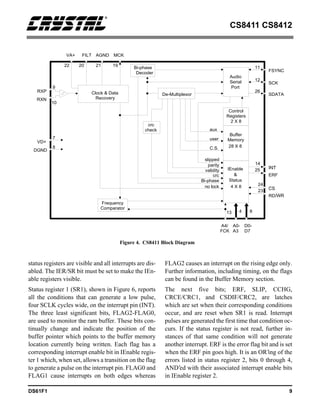
diagram of the CS8411 is shown in Figure 4.
Parallel Port
The parallel port accesses two status registers, two
interrupt enable registers, two control registers, and
28 bytes of dual-port buffer memory. The status
registers and interrupt enable registers occupy the
same address space. A bit in control register 1 se-
lects the two registers, either status or interrupt en-
able, that occupy addresses 0 and 1 in the memory
map. The address bus and the RD/WR line should
be valid when CS goes low. If RD/WR is low, the
value on the data bus will be written into the buffer
memory at the specified address. If RD/WR is high,
the value in the buffer memory, at the specified ad-
dress, is placed on the data bus. Detailed timing for
the parallel port can be found in the Switching
Characteristics - Parallel Port table.
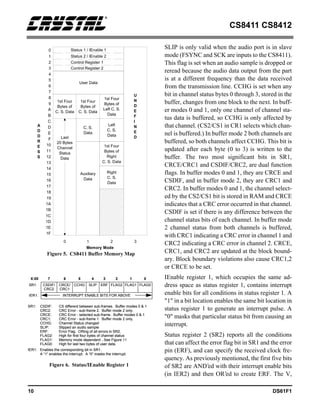
The memory space on the CS8411 is allocated as
shown in Figure 5. There are three defined buffer
modes selectable by two bits in control register 1.
Further information on the buffer modes can be
found in the Control Registers section.
Status and IEnable Registers
The status and interrupt enable registers occupy the
same address space. The IER/SR bit in control reg-
ister 1 selects whether the status registers (IER/SR
= 0) or the IEnable registers (IER/SR = 1) occupy
addresses 0 and 1. Upon power-up, the control and
IEnable registers contain all zeros; therefore, the
10
2
10
3
10
4
10
5
10
6
5
0
- 5
- 10
- 15
- 20
- 25
- 30
Jitter Frequency (Hz)
Jitter
Attenuation
(dB)
Figure 3. Jitter Attenuator Characteristics
CS8411 CS8412
DS61F1 9
status registers are visible and all interrupts are dis-
abled. The IER/SR bit must be set to make the IEn-
able registers visible.
Status register 1 (SR1), shown in Figure 6, reports
all the conditions that can generate a low pulse,
four SCLK cycles wide, on the interrupt pin (INT).
The three least significant bits, FLAG2-FLAG0,
are used to monitor the ram buffer. These bits con-
tinually change and indicate the position of the
buffer pointer which points to the buffer memory
location currently being written. Each flag has a
corresponding interrupt enable bit in IEnable regis-
ter 1 which, when set, allows a transition on the flag
to generate a pulse on the interrupt pin. FLAG0 and
FLAG1 cause interrupts on both edges whereas
FLAG2 causes an interrupt on the rising edge only.
Further information, including timing, on the flags
can be found in the Buffer Memory section.
The next five bits; ERF, SLIP, CCHG,
CRCE/CRC1, and CSDIF/CRC2, are latches
which are set when their corresponding conditions
occur, and are reset when SR1 is read. Interrupt
pulses are generated the first time that condition oc-
curs. If the status register is not read, further in-
stances of that same condition will not generate
another interrupt. ERF is the error flag bit and is set
when the ERF pin goes high. It is an OR’ing of the
errors listed in status register 2, bits 0 through 4,
AND’ed with their associated interrupt enable bits
in IEnable register 2.
A4/
13
VA+ FILT AGND MCK
19
21
22 20
9
10
SDATA
23
24
FCK
A0-
A3
D0-
D7
4 8
11
SCK
FSYNC
12
26
CS
RD/WR
4 X 8
25
ERF
14
INT
Buffer
Memory
28 X 8
Control
Registers
2 X 8
De-Multiplexor
Audio
Serial
Port
C.S.
user
aux
crc
check
no lock
Bi-phase
parity
validity
crc
slipped
RXP
RXN
7
8
VD+
DGND
Clock & Data
Recovery
Bi-phase
Decoder
Frequency
Comparator
IEnable
&
Status
Figure 4. CS8411 Block Diagram
CS8411 CS8412
10 DS61F1
SLIP is only valid when the audio port is in slave
mode (FSYNC and SCK are inputs to the CS8411).
This flag is set when an audio sample is dropped or
reread because the audio data output from the part
is at a different frequency than the data received
from the transmission line. CCHG is set when any
bit in channel status bytes 0 through 3, stored in the
buffer, changes from one block to the next. In buff-
er modes 0 and 1, only one channel of channel sta-
tus data is buffered, so CCHG is only affected by
that channel. (CS2/CS1 in CR1 selects which chan-
nel is buffered.) In buffer mode 2 both channels are
buffered, so both channels affect CCHG. This bit is
updated after each byte (0 to 3) is written to the
buffer. The two most significant bits in SR1,
CRCE/CRC1 and CSDIF/CRC2, are dual function
flags. In buffer modes 0 and 1, they are CRCE and
CSDIF, and in buffer mode 2, they are CRC1 and
CRC2. In buffer modes 0 and 1, the channel select-
ed by the CS2/CS1 bit is stored in RAM and CRCE
indicates that a CRC error occurred in that channel.
CSDIF is set if there is any difference between the
channel status bits of each channel. In buffer mode
2 channel status from both channels is buffered,
with CRC1 indicating a CRC error in channel 1 and
CRC2 indicating a CRC error in channel 2. CRCE,
CRC1, and CRC2 are updated at the block bound-
ary. Block boundary violations also cause CRC1,2
or CRCE to be set.
IEnable register 1, which occupies the same ad-
dress space as status register 1, contains interrupt
enable bits for all conditions in status register 1. A
"1" in a bit location enables the same bit location in
status register 1 to generate an interrupt pulse. A
"0" masks that particular status bit from causing an
interrupt.
Status register 2 (SR2) reports all the conditions
that can affect the error flag bit in SR1 and the error
pin (ERF), and can specify the received clock fre-
quency. As previously mentioned, the first five bits
of SR2 are AND’ed with their interrupt enable bits
(in IER2) and then OR’ed to create ERF. The V,
0 1 2 3
User Data
1st Four
Bytes of
C. S. Data
1st Four
Bytes of
C. S. Data
1st Four
Bytes of
Left C. S.
Data
Auxiliary
Data
Last
20 Bytes
Channel
Status
Data
Status 1 / IEnable 1
C. S.
Data
Left
C. S.
Data
Right
C. S.
Data
1st Four
Bytes of
Right
C. S. Data
U
N
D
E
F
I
N
E
D
A
D
D
R
E
S
S
Memory Mode
0
1
2
3
4
5
6
7
8
9
A
B
C
D
E
F
10
11
12
13
14
15
16
17
18
19
1A
1B
1C
1D
1E
1F
Control Register 1
Control Register 2
Status 2 / IEnable 2
Figure 5. CS8411 Buffer Memory Map
Figure 6. Status/IEnable Register 1
SR1: CSDIF: CS different between sub-frames. Buffer modes 0 & 1
CRC2: CRC Error - sub-frame 2. Buffer mode 2 only.
CRCE: CRC Error - selected sub-frame. Buffer modes 0 & 1
CRC1: CRC Error - sub-frame 1. Buffer mode 2 only.
CCHG: Channel Status changed
SLIP: Slipped an audio sample
ERF: Error Flag. ORing of all errors in SR2.
FLAG2: High for first four bytes of channel status
FLAG1: Memory mode dependent - See Figure .
FLAG0: High for last two bytes of user data.
IER1: Enables the corresponding bit in SR1.
A “1” enables the interrupt. A “0” masks the interrupt.
X:00 7 6 5 4 3 2 1 0
SR1. CSDIF/
CRC2
CRCE/
CRC1
CCHG SLIP ERF FLAG2 FLAG1 FLAG0
IER1. INTERRUPT ENABLE BITS FOR ABOVE
SR1: CSDIF: CS different between sub-frames. Buffer modes 0 & 1
CRC2: CRC Error - sub-frame 2. Buffer mode 2 only.
CRCE: CRC Error - selected sub-frame. Buffer modes 0 & 1
CRC1: CRC Error - sub-frame 1. Buffer mode 2 only.
CCHG: Channel Status changed
SLIP: Slipped an audio sample
ERF: Error Flag. ORing of all errors in SR2.
FLAG2: High for first four bytes of channel status
FLAG1: Memory mode dependent - See Figure 11
FLAG0: High for last two bytes of user data.
IER1: Enables the corresponding bit in SR1.
A “1” enables the interrupt. A “0” masks the interrupt.
X:00 7 6 5 4 3 2 1 0
SR1. CSDIF/
CRC2
CRCE/
CRC1
CCHG SLIP ERF FLAG2 FLAG1 FLAG0
IER1. INTERRUPT ENABLE BITS FOR ABOVE
CS8411 CS8412
DS61F1 11
PARITY, CODE and LOCK bits are latches which
are set when their corresponding conditions occur,
and are reset when SR2 is read. The ERF pin is as-
serted each time the error occurs assuming the in-
terrupt enable bit in IER2 is set for that particular
error. When the ERF pin is asserted, the ERF bit in
SR1 is set. If the ERF bit was not set prior to the
ERF pin assertion, an interrupt will be generated
(assuming bit 3 in IER1 is set). Although the ERF
pin is asserted for each occurrence of an enabled er-
ror condition, the ERF bit will only cause an inter-
rupt once if SR1 is not read.
V is the validity status bit which is set any time the
received validity bit is high. PARITY is set when a
parity error is detected. CODE is set when a bi-
phase coding error is detected. LOCK is asserted
when the receiver PLL is not locked and occurs
when there is no input on RXP/RXN, or if the re-
ceived frequency is out of the receiver lock range
(25 kHz to 55 kHz). Lock is achieved after receiv-
ing three frame preambles followed by one block
preamble, and is lost after four consecutive frame
preambles are not received.
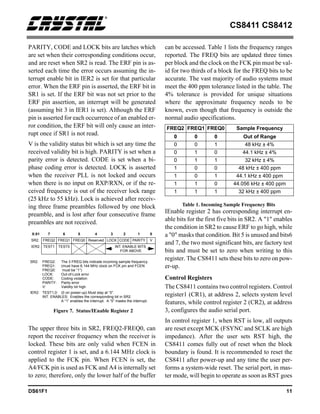
The upper three bits in SR2, FREQ2-FREQ0, can
report the receiver frequency when the receiver is
locked. These bits are only valid when FCEN in
control register 1 is set, and a 6.144 MHz clock is
applied to the FCK pin. When FCEN is set, the
A4/FCK pin is used as FCK and A4 is internally set
to zero; therefore, only the lower half of the buffer
can be accessed. Table 1 lists the frequency ranges
reported. The FREQ bits are updated three times
per block and the clock on the FCK pin must be val-
id for two thirds of a block for the FREQ bits to be
accurate. The vast majority of audio systems must
meet the 400 ppm tolerance listed in the table. The
4% tolerance is provided for unique situations
where the approximate frequency needs to be
known, even though that frequency is outside the
normal audio specifications.
Table 1. Incoming Sample Frequency Bits
IEnable register 2 has corresponding interrupt en-
able bits for the first five bits in SR2. A "1" enables
the condition in SR2 to cause ERF to go high, while
a "0" masks that condition. Bit 5 is unused and bits6
and 7, the two most significant bits, are factory test
bits and must be set to zero when writing to this
register. The CS8411 sets these bits to zero on pow-
er-up.
Control Registers
The CS8411 contains two control registers. Control
register1 (CR1), at address 2, selects system level
features, while control register 2 (CR2), at address
3, configures the audio serial port.
In control register 1, when RST is low, all outputs
are reset except MCK (FSYNC and SCLK are high
impedance). After the user sets RST high, the
CS8411 comes fully out of reset when the block
boundary is found. It is recommended to reset the
CS8411 after power-up and any time the user per-
forms a system-wide reset. The serial port, in mas-
ter mode, will begin to operate as soon as RST goes
Figure 7. Status/IEnable Register 2
SR2: FREQ2: The 3 FREQ bits indicate incoming sample frequency.
FREQ1: (must have 6.144 MHz clock on FCK pin and FCEN
FREQ0: must be “1”)
LOCK: Out-of-Lock error
CODE: Coding violation
PARITY: Parity error
V: Validity bit high
IER2: TEST1,0: (0 on power-up) Must stay at “0”.
INT. ENABLES: Enables the corresponding bit in SR2.
A “1” enables the interrupt. A “0” masks the interrupt.
X:01 7 6 5 4 3 2 1 0
SR2. FREQ2 FREQ1 FREQ0 Reserved LOCK CODE PARITY V
IER2. TEST1 TEST0 INT. ENABLE BITS
FOR ABOVE
FREQ2 FREQ1 FREQ0 Sample Frequency
0 0 0 Out of Range
0 0 1 48 kHz ± 4%
0 1 0 44.1 kHz ± 4%
0 1 1 32 kHz ± 4%
1 0 0 48 kHz ± 400 ppm
1 0 1 44.1 kHz ± 400 ppm
1 1 0 44.056 kHz ± 400 ppm
1 1 1 32 kHz ± 400 ppm
CS8411 CS8412
12 DS61F1
high. B0 and B1 select one of three buffer modes
listed in Table 2 and illustrated in Figure 5. In all
modes four bytes of user data are stored. In mode 0,
one entire block of channel status is stored. In mode
1 eight bytes of channel status and sixteen bytes of
auxiliary data are stored. In mode 2, eight bytes of
channel status from each sub-frame are stored. The
buffer modes are discussed in more detail in the
Buffer Memory section. The next bit, CS2/CS1, se-
lects the particular sub-frame of channel status to
buffer in modes 0 and 1, and has no effect in mode
2. When CS2/CS1 is low, sub-frame 1 is buffered,
and when CS2/CS1 is high, sub-frame 2 is buff-
ered. IER/SR selects which set of registers, either
IEnable or status, occupy addresses 0 and 1. When
IER/SR is low, the status registers occupy the first
two addresses, and when IER/SR is high, the IEn-
able registers occupy those addresses. FCEN en-
ables the internal frequency counter. A 6.144 MHz
clock must be connected to the FCK pin as a refer-
ence. The value of the FREQ bits in SR2 are not
valid until two thirds of a block of data is received.
Since FCK and A4, the most significant address bit,
occupy the same pin, A4 is internally set to zero
when FCEN is high. Since A4 is forced to zero, the
upper half of the buffer is not accessible while us-
ing the frequency compare feature. FPLL deter-
mines how FSYNC is derived. When FPLL is low,
FSYNC is derived from the incoming data, and
when FPLL is high, it is derived from the internal
phase-locked loop.
Control Register 2 configures the serial port which
consists of three pins: SCK, SDATA, and FSYNC.
SDATA is always an output, but SCK and FSYNC
can be configured as inputs or outputs. FSYNC and
SDATA can have a variety of relationships to each
other, and the polarity of SCK can be controlled.
The large variety of audio data formats provides an
easy interface to most DSPs and other audio pro-
cessors. SDATA is normally just audio data, but
special modes are provided that output received bi-
phase data, or received NRZ data with zeros substi-
tuted for preamble. Another special mode allows an
asynchronous SCK input to read audio data from
the serial port without slipping samples. In this
mode FSYNC and SDATA are outputs synchro-
nized to the SCK input. Since SCK is asynchronous
to the received clock, the number of SCK cycles
between FSYNC edges will vary.
ROER, when set, causes the last audio sample to be
reread if the error pin, ERF, is active. When out of
lock, the CS8411 will output zeros if ROER is set
and output random data if ROER is not set. The
conditions that activate ERF are those reported in
SR2 and enabled in IER2. Figure 10 illustrates the
modes selectable by SDF2-SDF0 and FSF1-FSF0.
MSTR, which in most applications will be set to
one, determines whether FSYNC and SCK are out-
puts (MSTR = 1) or inputs (MSTR = 0). When
FSYNC and SCK are inputs (slave mode) the audio
Figure 8. Control Register 1
CR1: FPLL: 0 - FSYNC from RXP/RXN, 1 - FSYNC from PLL
FCEN: enables freq. comparator (FCK must be 6.144 MHz).
IER/SR: [X:00,01] 0 - status, 1 - interrupt enable registers.
CS2/CS1: ch. status to buffer; 0 - sub-frame 1, 1 - sub-frame 2.
B1: with B0, selects the buffer memory mode.
B0: with B1, selects the buffer memory mode.
RST: Resets internal counters. Set to “1” for normal operation.
X:02 7 6 5 4 3 2 1 0
CR1. FPLL FCEN IER/SR CS2/CS1 B1 B0 RST
B1 B0 Mode Buffer Memory Contents
0 0 0 Channel Status
0 1 1 Auxiliary Data
1 0 2 Independent Channel Status
1 1 3 Reserved
Table 2. Buffer Memory Modes
Figure 9. Control Register 2
CR2: ROER: Repeat previous value on error (audio data)
SDF2: with SDF0 & SDF1, select serial data format.
SDF1: with SDF0 & SDF2, select serial data format.
SDF0: with SDF1 & SDF2, select serial data format.
FSF1: with FSF0, select FSYNC format.
FSF0: with FSF1, select FSYNC format.
MSTR: When set, SCK and FSYNC are output
SCED: When set, falling edge of SCK outputs data.
When clear, rising edge of SCK outputs data.
X:03 7 6 5 4 3 2 1 0
CR2. ROER SDF2 SDF1 SDF0 FSF1 FSF0 MSTR SCED
CS8411 CS8412
DS61F1 13
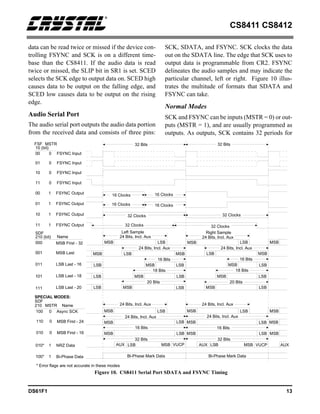
data can be read twice or missed if the device con-
trolling FSYNC and SCK is on a different time-
base than the CS8411. If the audio data is read
twice or missed, the SLIP bit in SR1 is set. SCED
selects the SCK edge to output data on. SCED high
causes data to be output on the falling edge, and
SCED low causes data to be output on the rising
edge.
Audio Serial Port
The audio serial port outputs the audio data portion
from the received data and consists of three pins:
SCK, SDATA, and FSYNC. SCK clocks the data
out on the SDATA line. The edge that SCK uses to
output data is programmable from CR2. FSYNC
delineates the audio samples and may indicate the
particular channel, left or right. Figure 10 illus-
trates the multitude of formats that SDATA and
FSYNC can take.
Normal Modes
SCK and FSYNC can be inputs (MSTR = 0) or out-
puts (MSTR = 1), and are usually programmed as
outputs. As outputs, SCK contains 32 periods for
24 Bits, Incl. Aux
16 Clocks 16 Clocks
16 Clocks 16 Clocks
32 Clocks
32 Clocks 32 Clocks
32 Clocks
00
01
10
11
1
1
1
1
FSYNC Output
FSYNC Output
FSYNC Output
FSYNC Output
FSF
00
01
10
11
MSTR
0
0
0
0
FSYNC Input
FSYNC Input
FSYNC Input
FSYNC Input
10 (bit)
000 MSB First - 32
001
011
101
111
MSB Last
LSB Last - 16
LSB Last - 18
LSB Last - 20
210 (bit) Name
SDF
20 Bits
LSB MSB LSB MSB LSB
LSB LSB
MSB LSB
MSB
LSB LSB
MSB LSB
MSB
MSB LSB MSB LSB MSB
16 Bits
18 Bits
20 Bits
18 Bits
16 Bits
MSB LSB MSB LSB MSB
Left Sample Right Sample
32 Bits 32 Bits
SPECIAL MODES:
* Error flags are not accurate in these modes
MSB LSB MSB LSB MSB
16 Bits
16 Bits
MSB MSB MSB
LSB
LSB
MSB MSB MSB
LSB
LSB
Bi-Phase Mark Data
Bi-Phase Mark Data
32 Bits 32 Bits
LSB VUCP
MSB
AUX LSB
AUX VUCP
MSB AUX
210 MSTR Name
SDF
110 0 MSB First - 24
010 0 MSB First - 16
010* 1 NRZ Data
100* 1 Bi-Phase Data
100 Async SCK
0
24 Bits, Incl. Aux 24 Bits, Incl. Aux
24 Bits, Incl. Aux
Figure 10. CS8411 Serial Port SDATA and FSYNC Timing
CS8411 CS8412
14 DS61F1
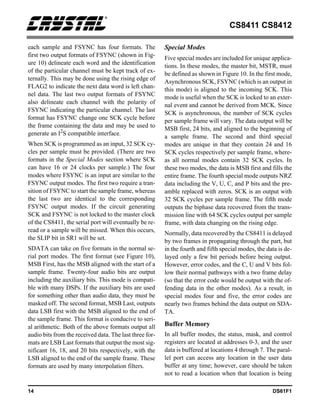
each sample and FSYNC has four formats. The
first two output formats of FSYNC (shown in Fig-
ure 10) delineate each word and the identification
of the particular channel must be kept track of ex-
ternally. This may be done using the rising edge of
FLAG2 to indicate the next data word is left chan-
nel data. The last two output formats of FSYNC
also delineate each channel with the polarity of
FSYNC indicating the particular channel. The last
format has FSYNC change one SCK cycle before
the frame containing the data and may be used to
generate an I2S compatible interface.
When SCK is programmed as an input, 32 SCK cy-
cles per sample must be provided. (There are two
formats in the Special Modes section where SCK
can have 16 or 24 clocks per sample.) The four
modes where FSYNC is an input are similar to the
FSYNC output modes. The first two require a tran-
sition of FSYNC to start the sample frame, whereas
the last two are identical to the corresponding
FSYNC output modes. If the circuit generating
SCK and FSYNC is not locked to the master clock
of the CS8411, the serial port will eventually be re-
read or a sample will be missed. When this occurs,
the SLIP bit in SR1 will be set.
SDATA can take on five formats in the normal se-
rial port modes. The first format (see Figure 10),
MSB First, has the MSB aligned with the start of a
sample frame. Twenty-four audio bits are output
including the auxiliary bits. This mode is compati-
ble with many DSPs. If the auxiliary bits are used
for something other than audio data, they must be
masked off. The second format, MSB Last, outputs
data LSB first with the MSB aligned to the end of
the sample frame. This format is conducive to seri-
al arithmetic. Both of the above formats output all
audio bits from the received data. The last three for-
mats are LSB Last formats that output the most sig-
nificant 16, 18, and 20 bits respectively, with the
LSB aligned to the end of the sample frame. These
formats are used by many interpolation filters.
Special Modes
Five special modes are included for unique applica-
tions. In these modes, the master bit, MSTR, must
be defined as shown in Figure 10. In the first mode,
Asynchronous SCK, FSYNC (which is an output in
this mode) is aligned to the incoming SCK. This
mode is useful when the SCK is locked to an exter-
nal event and cannot be derived from MCK. Since
SCK is asynchronous, the number of SCK cycles
per sample frame will vary. The data output will be
MSB first, 24 bits, and aligned to the beginning of
a sample frame. The second and third special
modes are unique in that they contain 24 and 16
SCK cycles respectively per sample frame, where-
as all normal modes contain 32 SCK cycles. In
these two modes, the data is MSB first and fills the
entire frame. The fourth special mode outputs NRZ
data including the V, U, C, and P bits and the pre-
amble replaced with zeros. SCK is an output with
32 SCK cycles per sample frame. The fifth mode
outputs the biphase data recovered from the trans-
mission line with 64 SCK cycles output per sample
frame, with data changing on the rising edge.
Normally, data recovered by the CS8411 is delayed
by two frames in propagating through the part, but
in the fourth and fifth special modes, the data is de-
layed only a few bit periods before being output.
However, error codes, and the C, U and V bits fol-
low their normal pathways with a two frame delay
(so that the error code would be output with the of-
fending data in the other modes). As a result, in
special modes four and five, the error codes are
nearly two frames behind the data output on SDA-
TA.
Buffer Memory
In all buffer modes, the status, mask, and control
registers are located at addresses 0-3, and the user
data is buffered at locations 4 through 7. The paral-
lel port can access any location in the user data
buffer at any time; however, care should be taken
not to read a location when that location is being
CS8411 CS8412
DS61F1 15
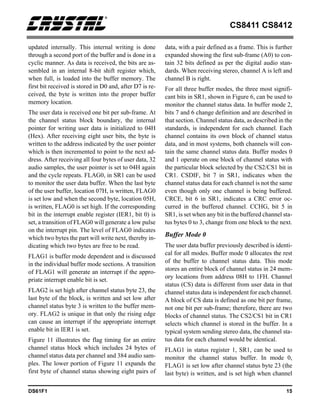
updated internally. This internal writing is done
through a second port of the buffer and is done in a
cyclic manner. As data is received, the bits are as-
sembled in an internal 8-bit shift register which,
when full, is loaded into the buffer memory. The
first bit received is stored in D0 and, after D7 is re-
ceived, the byte is written into the proper buffer
memory location.
The user data is received one bit per sub-frame. At
the channel status block boundary, the internal
pointer for writing user data is initialized to 04H
(Hex). After receiving eight user bits, the byte is
written to the address indicated by the user pointer
which is then incremented to point to the next ad-
dress. After receiving all four bytes of user data, 32
audio samples, the user pointer is set to 04H again
and the cycle repeats. FLAG0, in SR1 can be used
to monitor the user data buffer. When the last byte
of the user buffer, location 07H, is written, FLAG0
is set low and when the second byte, location 05H,
is written, FLAG0 is set high. If the corresponding
bit in the interrupt enable register (IER1, bit 0) is
set, a transition of FLAG0 will generate a low pulse
on the interrupt pin. The level of FLAG0 indicates
which two bytes the part will write next, thereby in-
dicating which two bytes are free to be read.
FLAG1 is buffer mode dependent and is discussed
in the individual buffer mode sections. A transition
of FLAG1 will generate an interrupt if the appro-
priate interrupt enable bit is set.
FLAG2 is set high after channel status byte 23, the
last byte of the block, is written and set low after
channel status byte 3 is written to the buffer mem-
ory. FLAG2 is unique in that only the rising edge
can cause an interrupt if the appropriate interrupt
enable bit in IER1 is set.
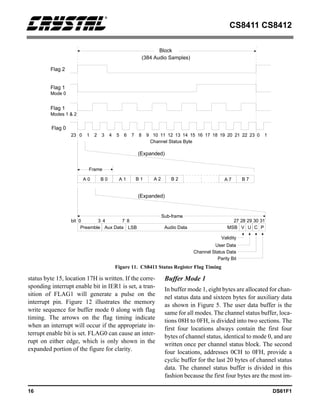
Figure 11 illustrates the flag timing for an entire
channel status block which includes 24 bytes of
channel status data per channel and 384 audio sam-
ples. The lower portion of Figure 11 expands the
first byte of channel status showing eight pairs of
data, with a pair defined as a frame. This is further
expanded showing the first sub-frame (A0) to con-
tain 32 bits defined as per the digital audio stan-
dards. When receiving stereo, channel A is left and
channel B is right.
For all three buffer modes, the three most signifi-
cant bits in SR1, shown in Figure 6, can be used to
monitor the channel status data. In buffer mode 2,
bits 7 and 6 change definition and are described in
that section. Channel status data, as described in the
standards, is independent for each channel. Each
channel contains its own block of channel status
data, and in most systems, both channels will con-
tain the same channel status data. Buffer modes 0
and 1 operate on one block of channel status with
the particular block selected by the CS2/CS1 bit in
CR1. CSDIF, bit 7 in SR1, indicates when the
channel status data for each channel is not the same
even though only one channel is being buffered.
CRCE, bit 6 in SR1, indicates a CRC error oc-
curred in the buffered channel. CCHG, bit 5 in
SR1, is set when any bit in the buffered channel sta-
tus bytes 0 to 3, change from one block to the next.
Buffer Mode 0
The user data buffer previously described is identi-
cal for all modes. Buffer mode 0 allocates the rest
of the buffer to channel status data. This mode
stores an entire block of channel status in 24 mem-
ory locations from address 08H to 1FH. Channel
status (CS) data is different from user data in that
channel status data is independent for each channel.
A block of CS data is defined as one bit per frame,
not one bit per sub-frame; therefore, there are two
blocks of channel status. The CS2/CS1 bit in CR1
selects which channel is stored in the buffer. In a
typical system sending stereo data, the channel sta-
tus data for each channel would be identical.
FLAG1 in status register 1, SR1, can be used to
monitor the channel status buffer. In mode 0,
FLAG1 is set low after channel status byte 23 (the
last byte) is written, and is set high when channel
CS8411 CS8412
16 DS61F1
status byte 15, location 17H is written. If the corre-
sponding interrupt enable bit in IER1 is set, a tran-
sition of FLAG1 will generate a pulse on the
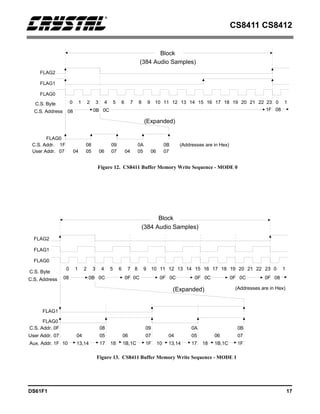
interrupt pin. Figure 12 illustrates the memory
write sequence for buffer mode 0 along with flag
timing. The arrows on the flag timing indicate
when an interrupt will occur if the appropriate in-
terrupt enable bit is set. FLAG0 can cause an inter-
rupt on either edge, which is only shown in the
expanded portion of the figure for clarity.
Buffer Mode 1
In buffer mode 1, eight bytes are allocated for chan-
nel status data and sixteen bytes for auxiliary data
as shown in Figure 5. The user data buffer is the
same for all modes. The channel status buffer, loca-
tions 08H to 0FH, is divided into two sections. The
first four locations always contain the first four
bytes of channel status, identical to mode 0, and are
written once per channel status block. The second
four locations, addresses 0CH to 0FH, provide a
cyclic buffer for the last 20 bytes of channel status
data. The channel status buffer is divided in this
fashion because the first four bytes are the most im-
Flag 0
Flag 1
Mode 0
Flag 1
Modes 1 & 2
Flag 2
B 0
A 0 B 1
A 1 B 2
A 2 B 7
A 7
Aux Data
0 3 4 7
LSB
8
Audio Data
Preamble
28 29 30 31
V U C P
MSB
27
(384 Audio Samples)
23 0 1 2 3 4 5 6 7 8 9 10 11 12 13 14 15 16 17 18 19 20 21 22 23 0 1
Channel Status Byte
(Expanded)
(Expanded)
bit
Frame
Sub-frame
Block
Validity
User Data
Channel Status Data
Parity Bit
Figure 11. CS8411 Status Register Flag Timing
CS8411 CS8412
DS61F1 17
FLAG0
FLAG1
FLAG2
(384 Audio Samples)
(Expanded)
Block
08 0B 0C 1F 08
C.S. Address
0 1 2 3 4 5 6 7 8 9 10 11 12 13 14 15 16 17 18 19 20 21 22 23 0 1
C.S. Byte
FLAG0
C.S. Addr.
User Addr.
(Addresses are in Hex)
04 05 06 07 04 05 06 07
08 09 0A 0B
1F
07
Figure 12. CS8411 Buffer Memory Write Sequence - MODE 0
FLAG0
FLAG1
FLAG2
(384 Audio Samples)
(Expanded)
Block
08 0B 0C 0F 08
C.S. Address
0 1 2 3 4 5 6 7 8 9 10 11 12 13 14 15 16 17 18 19 20 21 22 23 0 1
C.S. Byte
FLAG0
C.S. Addr.
User Addr.
(Addresses are in Hex)
0F 0C 0F 0C 0F 0C 0F 0C
FLAG1
Aux. Addr.
08 09 0A 0B
04 05 06 07 04 05 06 07
07
0F
10 13,14 17 18 1B,1C 1F 10 13,14 17 18 1B,1C 1F
1F
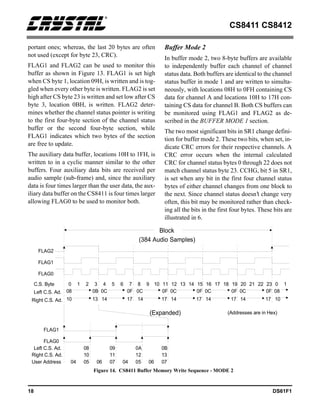
Figure 13. CS8411 Buffer Memory Write Sequence - MODE 1
CS8411 CS8412
18 DS61F1
portant ones; whereas, the last 20 bytes are often
not used (except for byte 23, CRC).
FLAG1 and FLAG2 can be used to monitor this
buffer as shown in Figure 13. FLAG1 is set high
when CS byte 1, location 09H, is written and is tog-
gled when every other byte is written. FLAG2 is set
high after CS byte 23 is written and set low after CS
byte 3, location 0BH, is written. FLAG2 deter-
mines whether the channel status pointer is writing
to the first four-byte section of the channel status
buffer or the second four-byte section, while
FLAG1 indicates which two bytes of the section
are free to update.
The auxiliary data buffer, locations 10H to 1FH, is
written to in a cyclic manner similar to the other
buffers. Four auxiliary data bits are received per
audio sample (sub-frame) and, since the auxiliary
data is four times larger than the user data, the aux-
iliary data buffer on the CS8411 is four times larger
allowing FLAG0 to be used to monitor both.
Buffer Mode 2
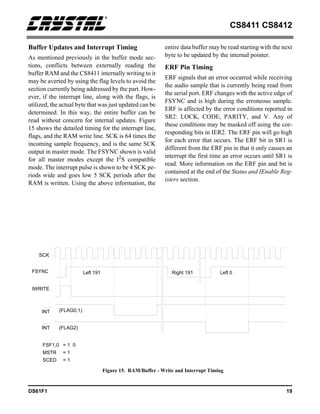
In buffer mode 2, two 8-byte buffers are available
to independently buffer each channel of channel
status data. Both buffers are identical to the channel
status buffer in mode 1 and are written to simulta-
neously, with locations 08H to 0FH containing CS
data for channel A and locations 10H to 17H con-
taining CS data for channel B. Both CS buffers can
be monitored using FLAG1 and FLAG2 as de-
scribed in the BUFFER MODE 1 section.
The two most significant bits in SR1 change defini-
tion for buffer mode 2. These two bits, when set, in-
dicate CRC errors for their respective channels. A
CRC error occurs when the internal calculated
CRC for channel status bytes 0 through 22 does not
match channel status byte 23. CCHG, bit 5 in SR1,
is set when any bit in the first four channel status
bytes of either channel changes from one block to
the next. Since channel status doesn’t change very
often, this bit may be monitored rather than check-
ing all the bits in the first four bytes. These bits are
illustrated in 6.
FLAG0
FLAG1
FLAG2
(384 Audio Samples)
Block
Left C.S. Ad.
0 1 2 3 4 5 6 7 8 9 10 11 12 13 14 15 16 17 18 19 20 21 22 23 0 1
C.S. Byte
(Addresses are in Hex)
(Expanded)
FLAG0
Left C.S. Ad.
User Address
08 0B 0C 0F 08
0F 0C 0F 0C 0F 0C 0F 0C
10 13 14 17 10
17 14 17 14 17 14 17 14
Right C.S. Ad.
Right C.S. Ad.
FLAG1
05 06 07 04 05 06 07
04
08 09 0A 0B
10 11 12 13
Figure 14. CS8411 Buffer Memory Write Sequence - MODE 2
CS8411 CS8412
DS61F1 19
Buffer Updates and Interrupt Timing
As mentioned previously in the buffer mode sec-
tions, conflicts between externally reading the
buffer RAM and the CS8411 internally writing to it
may be averted by using the flag levels to avoid the
section currently being addressed by the part. How-
ever, if the interrupt line, along with the flags, is
utilized, the actual byte that was just updated can be
determined. In this way, the entire buffer can be
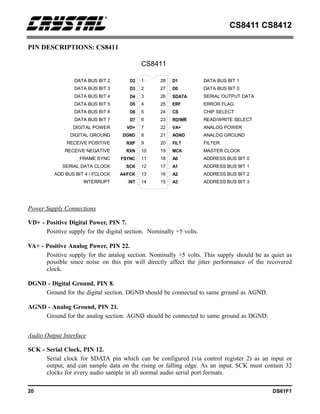
read without concern for internal updates. Figure
15 shows the detailed timing for the interrupt line,
flags, and the RAM write line. SCK is 64 times the
incoming sample frequency, and is the same SCK
output in master mode. The FSYNC shown is valid
for all master modes except the I2S compatible
mode. The interrupt pulse is shown to be 4 SCK pe-
riods wide and goes low 5 SCK periods after the
RAM is written. Using the above information, the
entire data buffer may be read starting with the next
byte to be updated by the internal pointer.
ERF Pin Timing
ERF signals that an error occurred while receiving
the audio sample that is currently being read from
the serial port. ERF changes with the active edge of
FSYNC and is high during the erroneous sample.
ERF is affected by the error conditions reported in
SR2: LOCK, CODE, PARITY, and V. Any of
these conditions may be masked off using the cor-
responding bits in IER2. The ERF pin will go high
for each error that occurs. The ERF bit in SR1 is
different from the ERF pin in that it only causes an
interrupt the first time an error occurs until SR1 is
read. More information on the ERF pin and bit is
contained at the end of the Status and IEnable Reg-
isters section.
FSYNC
(FLAG0,1)
(FLAG2)
SCK
Left 191 Right 191 Left 0
INT
IWRITE
INT
FSF1,0
MSTR
SCED = 1
= 1
= 1 0
Figure 15. RAM/Buffer - Write and Interrupt Timing
CS8411 CS8412
20 DS61F1
PIN DESCRIPTIONS: CS8411
Power Supply Connections
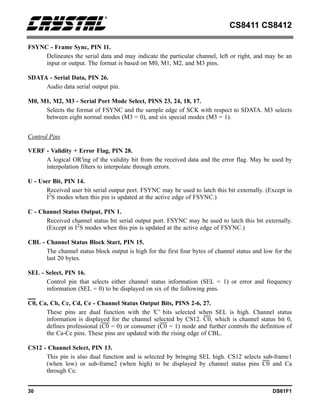
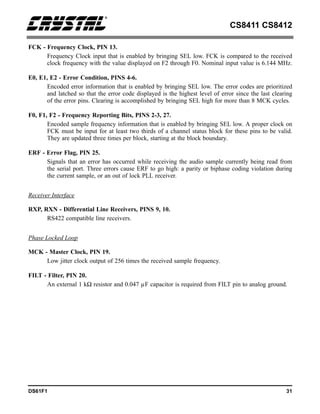
VD+ - Positive Digital Power, PIN 7.
Positive supply for the digital section. Nominally +5 volts.
VA+ - Positive Analog Power, PIN 22.
Positive supply for the analog section. Nominally +5 volts. This supply should be as quiet as
possible since noise on this pin will directly affect the jitter performance of the recovered
clock.
DGND - Digital Ground, PIN 8.
Ground for the digital section. DGND should be connected to same ground as AGND.
AGND - Analog Ground, PIN 21.
Ground for the analog section. AGND should be connected to same ground as DGND.
Audio Output Interface
SCK - Serial Clock, PIN 12.
Serial clock for SDATA pin which can be configured (via control register 2) as an input or
output, and can sample data on the rising or falling edge. As an input, SCK must contain 32
clocks for every audio sample in all normal audio serial port formats.
1
2
3
4
5
6
7
8 21
22
23
24
25
26
27
28 DATA BUS BIT 1
DATA BUS BIT 0
SERIAL OUTPUT DATA
ERROR FLAG
CHIP SELECT
READ/WRITE SELECT
ANALOG POWER
ANALOG GROUND
DGND
VD+
D7
D6
D5
D4
D3
D2
9
10
11
12 17
18
19
20 FILTER
MASTER CLOCK
ADDRESS BUS BIT 0
ADDRESS BUS BIT 1
SCK
FSYNC
RXN
RXP
13
14 15
16 ADDRESS BUS BIT 2
ADDRESS BUS BIT 3
INT
A4/FCK
D1
D0
SDATA
ERF
CS
RD/WR
VA+
AGND
FILT
MCK
A0
A1
A2
A3
DIGITAL GROUND
DIGITAL POWER
DATA BUS BIT 7
DATA BUS BIT 6
DATA BUS BIT 5
DATA BUS BIT 4
DATA BUS BIT 3
DATA BUS BIT 2
SERIAL DATA CLOCK
FRAME SYNC
RECEIVE NEGATIVE
RECEIVE POSITIVE
INTERRUPT
ADD BUS BIT 4 / FCLOCK
CS8411
CS8411 CS8412
DS61F1 21
FSYNC - Frame Sync, PIN 11.
Delineates the serial data and may indicate the particular channel, left or right. Also, FSYNC
may be configured as an input or output. The format is based on bits in control register 2.
SDATA - Serial Data, PIN 26.
Audio data serial output pin.
ERF - Error Flag, PIN 25.
Signals that an error has occurred while receiving the audio sample currently being read from
the serial port. The errors that cause ERF to go high are enumerated in status register 2 and
enabled by setting the corresponding bit in IEnable register 2.
A4/FCK - Address Bus Bit 4/Frequency Clock, PIN 13.
This pin has a dual function and is controlled by the FCEN bit in control register 1. A4 is the
address bus pin as defined below. When used as FCK, an internal frequency comparator
compares a 6.144 MHz clock input on this pin to the received clock frequency and stores the
value in status register 1 as three FREQ bits. These bits indicate the incoming frequency as
well as the tolerance. When defined as FCK, A4 is internally set to 0.
Parallel Interface
CS - Chip Select, PIN 24.
This input is active low and allows access to the 32 bytes of internal memory. The address bus
and RD/WR must be valid while CS is low.
RD/WR - Read/Write, PIN 23.
If RD/WR is low when CS goes active (low), the data on the data bus is written to internal
memory. If RD/WR is high when CS goes active, the data in the internal memory is placed on
the data bus.
A4-A0 - Address Bus, PINS 13, 15-18.
Parallel port address bus that selects the internal memory location to be read from or written to.
Note that A4 is the dual function pin A4/FCK as described above.
D0-D7 - Data Bus, PINS 27-28, 1-6.
Parallel port data bus used to check status, read or write control words, or read internal buffer
memory.
INT - Interrupt, PIN 14.
Open drain output that can signal the state of the internal buffer memory as well as error
information. A 5kΩ resistor to VD+ is typically used to support logic gates. All bits affecting
INT are maskable to allow total control over the interrupt mechanism.
CS8411 CS8412
22 DS61F1
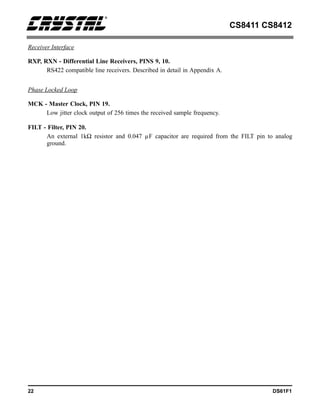
Receiver Interface
RXP, RXN - Differential Line Receivers, PINS 9, 10.
RS422 compatible line receivers. Described in detail in Appendix A.
Phase Locked Loop
MCK - Master Clock, PIN 19.
Low jitter clock output of 256 times the received sample frequency.
FILT - Filter, PIN 20.
An external 1kΩ resistor and 0.047 µF capacitor are required from the FILT pin to analog
ground.
CS8411 CS8412
DS61F1 23
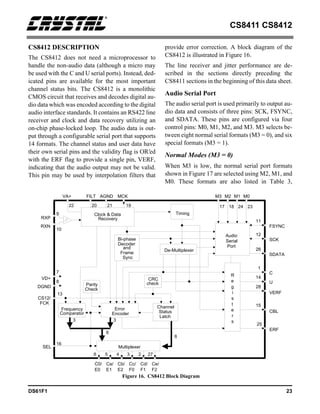
CS8412 DESCRIPTION
The CS8412 does not need a microprocessor to
handle the non-audio data (although a micro may
be used with the C and U serial ports). Instead, ded-
icated pins are available for the most important
channel status bits. The CS8412 is a monolithic
CMOS circuit that receives and decodes digital au-
dio data which was encoded according to the digital
audio interface standards. It contains an RS422 line
receiver and clock and data recovery utilizing an
on-chip phase-locked loop. The audio data is out-
put through a configurable serial port that supports
14 formats. The channel status and user data have
their own serial pins and the validity flag is OR’ed
with the ERF flag to provide a single pin, VERF,
indicating that the audio output may not be valid.
This pin may be used by interpolation filters that
provide error correction. A block diagram of the
CS8412 is illustrated in Figure 16.
The line receiver and jitter performance are de-
scribed in the sections directly preceding the
CS8411 sections in the beginning of this data sheet.
Audio Serial Port
The audio serial port is used primarily to output au-
dio data and consists of three pins: SCK, FSYNC,
and SDATA. These pins are configured via four
control pins: M0, M1, M2, and M3. M3 selects be-
tween eight normal serial formats (M3 = 0), and six
special formats (M3 = 1).
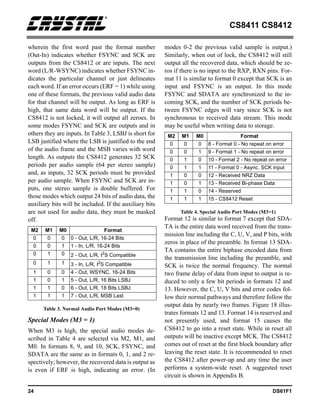
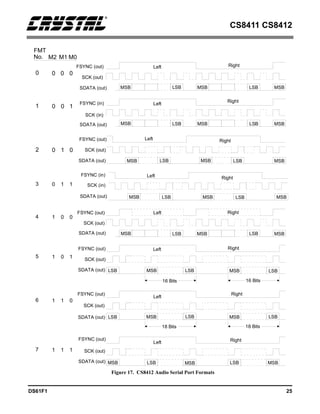
Normal Modes (M3 = 0)
When M3 is low, the normal serial port formats
shown in Figure 17 are selected using M2, M1, and
M0. These formats are also listed in Table 3,
VA+ FILT AGND MCK
SDATA
11
SCK
FSYNC
12
26
De-Multiplexer
Audio
Serial
Port
CRC
check
RXP
RXN
VD+
DGND
R
e
g
i
s
t
e
r
s
Parity
Check
Frequency
Comparator
Error
Encoder
Channel
Status
Latch
Ca/
E1
C0/
E0
Ce/
F2
Cd/
F1
Cc/
F0
Cb/
E2
Multiplexer
Bi-phase
Decoder
and
Frame
Sync
3
3
6
Timing
M0
M1
M2
M3
C
U
VERF
CBL
ERF
SEL
CS12/
FCK
22 20 21 19
9
10
7
8
13
16
6 5 4 3 2 27
25
15
28
14
1
17 18 24 23
Clock & Data
Recovery
6
Figure 16. CS8412 Block Diagram
CS8411 CS8412
24 DS61F1
wherein the first word past the format number
(Out-In) indicates whether FSYNC and SCK are
outputs from the CS8412 or are inputs. The next
word (L/R-WSYNC) indicates whether FSYNC in-
dicates the particular channel or just delineates
each word. If an error occurs (ERF = 1) while using
one of these formats, the previous valid audio data
for that channel will be output. As long as ERF is
high, that same data word will be output. If the
CS8412 is not locked, it will output all zeroes. In
some modes FSYNC and SCK are outputs and in
others they are inputs. In Table 3, LSBJ is short for
LSB justified where the LSB is justified to the end
of the audio frame and the MSB varies with word
length. As outputs the CS8412 generates 32 SCK
periods per audio sample (64 per stereo sample)
and, as inputs, 32 SCK periods must be provided
per audio sample. When FSYNC and SCK are in-
puts, one stereo sample is double buffered. For
those modes which output 24 bits of audio data, the
auxiliary bits will be included. If the auxiliary bits
are not used for audio data, they must be masked
off.
Table 3. Normal Audio Port Modes (M3=0)
Special Modes (M3 = 1)
When M3 is high, the special audio modes de-
scribed in Table 4 are selected via M2, M1, and
M0. In formats 8, 9, and 10, SCK, FSYNC, and
SDATA are the same as in formats 0, 1, and 2 re-
spectively; however, the recovered data is output as
is even if ERF is high, indicating an error. (In
modes 0-2 the previous valid sample is output.)
Similarly, when out of lock, the CS8412 will still
output all the recovered data, which should be ze-
ros if there is no input to the RXP, RXN pins. For-
mat 11 is similar to format 0 except that SCK is an
input and FSYNC is an output. In this mode
FSYNC and SDATA are synchronized to the in-
coming SCK, and the number of SCK periods be-
tween FSYNC edges will vary since SCK is not
synchronous to received data stream. This mode
may be useful when writing data to storage.
Table 4. Special Audio Port Modes (M3=1)
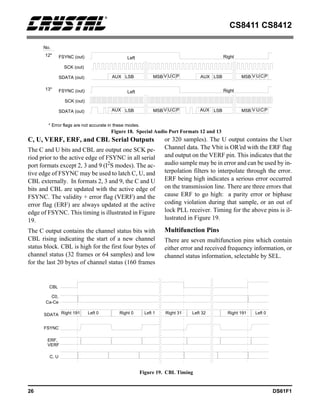
Format 12 is similar to format 7 except that SDA-
TA is the entire data word received from the trans-
mission line including the C, U, V, and P bits, with
zeros in place of the preamble. In format 13 SDA-
TA contains the entire biphase encoded data from
the transmission line including the preamble, and
SCK is twice the normal frequency. The normal
two frame delay of data from input to output is re-
duced to only a few bit periods in formats 12 and
13. However, the C, U, V bits and error codes fol-
low their normal pathways and therefore follow the
output data by nearly two frames. Figure 18 illus-
trates formats 12 and 13. Format 14 is reserved and
not presently used, and format 15 causes the
CS8412 to go into a reset state. While in reset all
outputs will be inactive except MCK. The CS8412
comes out of reset at the first block boundary after
leaving the reset state. It is recommended to reset
the CS8412 after power-up and any time the user
performs a system-wide reset. A suggested reset
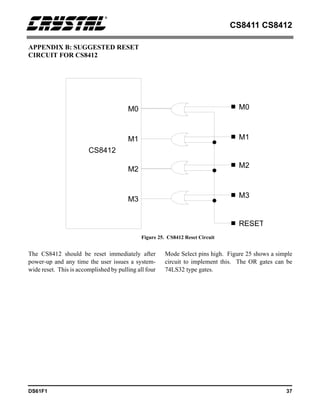
circuit is shown in Appendix B.
M2 M1 M0 Format
0 0 0 0 - Out, L/R, 16-24 Bits
0 0 1 1 - In, L/R, 16-24 Bits
0 1 0 2 - Out, L/R, I2
S Compatible
0 1 1 3 - In, L/R, I2S Compatible
1 0 0 4 - Out, WSYNC, 16-24 Bits
1 0 1 5 - Out, L/R, 16 Bits LSBJ
1 1 0 6 - Out, L/R, 18 Bits LSBJ
1 1 1 7 - Out, L/R, MSB Last
M2 M1 M0 Format
0 0 0 8 - Format 0 - No repeat on error
0 0 1 9 - Format 1 - No repeat on error
0 1 0 10 - Format 2 - No repeat on error
0 1 1 11 - Format 0 - Async. SCK input
1 0 0 12 - Received NRZ Data
1 0 1 13 - Received Bi-phase Data
1 1 0 14 - Reserved
1 1 1 15 - CS8412 Reset
CS8411 CS8412
DS61F1 25
FMT
No. M2 M1 M0
FSYNC (out)
SCK (out)
SDATA (out) LSB MSB LSB MSB
Left Right
MSB
7
FSYNC (out)
SCK (out)
SDATA (out) MSB LSB MSB LSB
Left
Right
LSB
18 Bits
18 Bits
6
FSYNC (out)
SCK (out)
SDATA (out) MSB LSB MSB LSB
Left Right
LSB
16 Bits 16 Bits
5
3
FSYNC (in)
SCK (in)
SDATA (out) MSB LSB MSB LSB
Left Right
MSB
FSYNC (out)
SCK (out)
SDATA (out) MSB LSB MSB LSB
Left Right
MSB
2
FSYNC (out)
SCK (out)
SDATA (out) MSB LSB MSB LSB MSB
Left Right
4
FSYNC (in)
SCK (in)
SDATA (out) MSB LSB MSB LSB MSB
Left
Right
1
FSYNC (out)
SCK (out)
SDATA (out) MSB LSB MSB LSB MSB
Left Right
0
1
1 1
0
1 1
1
1 0
1
0 1
0
0 1
0
1 0
1
0 0
0
0 0
Figure 17. CS8412 Audio Serial Port Formats
CS8411 CS8412
26 DS61F1
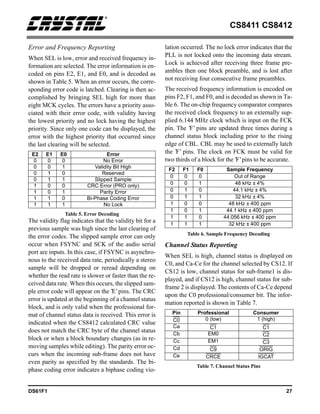
C, U, VERF, ERF, and CBL Serial Outputs
The C and U bits and CBL are output one SCK pe-
riod prior to the active edge of FSYNC in all serial
port formats except 2, 3 and 9 (I2
S modes). The ac-
tive edge of FSYNC may be used to latch C, U, and
CBL externally. In formats 2, 3 and 9, the C and U
bits and CBL are updated with the active edge of
FSYNC. The validity + error flag (VERF) and the
error flag (ERF) are always updated at the active
edge of FSYNC. This timing is illustrated in Figure
19.
The C output contains the channel status bits with
CBL rising indicating the start of a new channel
status block. CBL is high for the first four bytes of
channel status (32 frames or 64 samples) and low
for the last 20 bytes of channel status (160 frames
or 320 samples). The U output contains the User
Channel data. The Vbit is OR’ed with the ERF flag
and output on the VERF pin. This indicates that the
audio sample may be in error and can be used by in-
terpolation filters to interpolate through the error.
ERF being high indicates a serious error occurred
on the transmission line. There are three errors that
cause ERF to go high: a parity error or biphase
coding violation during that sample, or an out of
lock PLL receiver. Timing for the above pins is il-
lustrated in Figure 19.
Multifunction Pins
There are seven multifunction pins which contain
either error and received frequency information, or
channel status information, selectable by SEL.
No.
FSYNC (out)
SDATA (out)
13*
FSYNC (out)
SCK (out)
SDATA (out)
12*
MSB V U C P
LSB
AUX MSB V U C P
LSB
AUX
Left Right
Left Right
MSB V U C P
LSB
AUX MSB V U C P
LSB
AUX
SCK (out)
* Error flags are not accurate in these modes.
Figure 18. Special Audio Port Formats 12 and 13
CBL
SDATA
FSYNC
Left 0 Left 1
Right 0 Left 0
Left 32 Right 191
Right 31
Right 191
Ca-Ce
C0,
ERF,
VERF
C, U
Figure 19. CBL Timing
CS8411 CS8412
DS61F1 27
Error and Frequency Reporting
When SEL is low, error and received frequency in-
formation are selected. The error information is en-
coded on pins E2, E1, and E0, and is decoded as
shown in Table 5. When an error occurs, the corre-
sponding error code is latched. Clearing is then ac-
complished by bringing SEL high for more than
eight MCK cycles. The errors have a priority asso-
ciated with their error code, with validity having
the lowest priority and no lock having the highest
priority. Since only one code can be displayed, the
error with the highest priority that occurred since
the last clearing will be selected.
Table 5. Error Decoding
The validity flag indicates that the validity bit for a
previous sample was high since the last clearing of
the error codes. The slipped sample error can only
occur when FSYNC and SCK of the audio serial
port are inputs. In this case, if FSYNC is asynchro-
nous to the received data rate, periodically a stereo
sample will be dropped or reread depending on
whether the read rate is slower or faster than the re-
ceived data rate. When this occurs, the slipped sam-
ple error code will appear on the ’E’pins. The CRC
error is updated at the beginning of a channel status
block, and is only valid when the professional for-
mat of channel status data is received. This error is
indicated when the CS8412 calculated CRC value
does not match the CRC byte of the channel status
block or when a block boundary changes (as in re-
moving samples while editing). The parity error oc-
curs when the incoming sub-frame does not have
even parity as specified by the standards. The bi-
phase coding error indicates a biphase coding vio-
lation occurred. The no lock error indicates that the
PLL is not locked onto the incoming data stream.
Lock is achieved after receiving three frame pre-
ambles then one block preamble, and is lost after
not receiving four consecutive frame preambles.
The received frequency information is encoded on
pins F2, F1, and F0, and is decoded as shown in Ta-
ble 6. The on-chip frequency comparator compares
the received clock frequency to an externally sup-
plied 6.144 MHz clock which is input on the FCK
pin. The ’F’ pins are updated three times during a
channel status block including prior to the rising
edge of CBL. CBL may be used to externally latch
the ’F’ pins. The clock on FCK must be valid for
two thirds of a block for the ’F’pins to be accurate.
Table 6. Sample Frequency Decoding
Channel Status Reporting
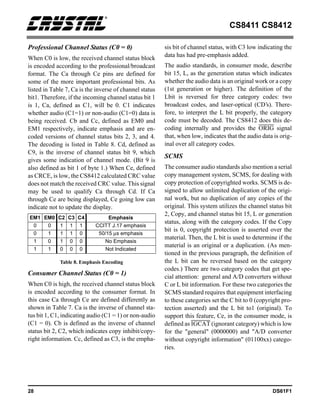
When SEL is high, channel status is displayed on
C0, and Ca-Ce for the channel selected by CS12. If
CS12 is low, channel status for sub-frame1 is dis-
played, and if CS12 is high, channel status for sub-
frame 2 is displayed. The contents of Ca-Ce depend
upon the C0 professional/consumer bit. The infor-
mation reported is shown in Table 7.
Table 7. Channel Status Pins
E2 E1 E0 Error
0 0 0 No Error
0 0 1 Validity Bit High
0 1 0 Reserved
0 1 1 Slipped Sample
1 0 0 CRC Error (PRO only)
1 0 1 Parity Error
1 1 0 Bi-Phase Coding Error
1 1 1 No Lock
F2 F1 F0 Sample Frequency
0 0 0 Out of Range
0 0 1 48 kHz ± 4%
0 1 0 44.1 kHz ± 4%
0 1 1 32 kHz ± 4%
1 0 0 48 kHz ± 400 ppm
1 0 1 44.1 kHz ± 400 ppm
1 1 0 44.056 kHz ± 400 ppm
1 1 1 32 kHz ± 400 ppm
Pin Professional Consumer
C0 0 (low) 1 (high)
Ca C1 C1
Cb EM0 C2
Cc EM1 C3
Cd C9 ORIG
Ce CRCE IGCAT
CS8411 CS8412
28 DS61F1
Professional Channel Status (C0 = 0)
When C0 is low, the received channel status block
is encoded according to the professional/broadcast
format. The Ca through Ce pins are defined for
some of the more important professional bits. As
listed in Table 7, Ca is the inverse of channel status
bit1. Therefore, if the incoming channel status bit 1
is 1, Ca, defined as C1, will be 0. C1 indicates
whether audio (C1=1) or non-audio (C1=0) data is
being received. Cb and Cc, defined as EM0 and
EM1 respectively, indicate emphasis and are en-
coded versions of channel status bits 2, 3, and 4.
The decoding is listed in Table 8. Cd, defined as
C9, is the inverse of channel status bit 9, which
gives some indication of channel mode. (Bit 9 is
also defined as bit 1 of byte 1.) When Ce, defined
as CRCE, is low, the CS8412 calculated CRC value
does not match the received CRC value. This signal
may be used to qualify Ca through Cd. If Ca
through Ce are being displayed, Ce going low can
indicate not to update the display.
Table 8. Emphasis Encoding
Consumer Channel Status (C0 = 1)
When C0 is high, the received channel status block
is encoded according to the consumer format. In
this case Ca through Ce are defined differently as
shown in Table 7. Ca is the inverse of channel sta-
tus bit 1, C1, indicating audio (C1 = 1) or non-audio
(C1 = 0). Cb is defined as the inverse of channel
status bit 2, C2, which indicates copy inhibit/copy-
right information. Cc, defined as C3, is the empha-
sis bit of channel status, with C3 low indicating the
data has had pre-emphasis added.
The audio standards, in consumer mode, describe
bit 15, L, as the generation status which indicates
whether the audio data is an original work or a copy
(1st generation or higher). The definition of the
Lbit is reversed for three category codes: two
broadcast codes, and laser-optical (CD’s). There-
fore, to interpret the L bit properly, the category
code must be decoded. The CS8412 does this de-
coding internally and provides the ORIG signal
that, when low, indicates that the audio data is orig-
inal over all category codes.
SCMS
The consumer audio standards also mention a serial
copy management system, SCMS, for dealing with
copy protection of copyrighted works. SCMS is de-
signed to allow unlimited duplication of the origi-
nal work, but no duplication of any copies of the
original. This system utilizes the channel status bit
2, Copy, and channel status bit 15, L or generation
status, along with the category codes. If the Copy
bit is 0, copyright protection is asserted over the
material. Then, the L bit is used to determine if the
material is an original or a duplication. (As men-
tioned in the previous paragraph, the definition of
the L bit can be reversed based on the category
codes.) There are two category codes that get spe-
cial attention: general and A/D converters without
C or L bit information. For these two categories the
SCMS standard requires that equipment interfacing
to these categories set the C bit to 0 (copyright pro-
tection asserted) and the L bit to1 (original). To
support this feature, Ce, in the consumer mode, is
defined as IGCAT (ignorant category) which is low
for the "general" (0000000) and "A/D converter
without copyright information" (01100xx) catego-
ries.
EM1 EM0 C2 C3 C4 Emphasis
0 0 1 1 1 CCITT J.17 emphasis
0 1 1 1 0 50/15 µs emphasis
1 0 1 0 0 No Emphasis
1 1 0 0 0 Not Indicated
CS8411 CS8412
DS61F1 29
PIN DESCRIPTIONS: CS8412
Power Supply Connections
VD+ - Positive Digital Power, PIN 7.
Positive supply for the digital section. Nominally +5 volts.
VA+ - Positive Analog Power, PIN 22.
Positive supply for the analog section. Nominally +5 volts.
DGND - Digital Ground, PIN 8.
Ground for the digital section. DGND should be connected to same ground as AGND.
AGND - Analog Ground, PIN 21.
Ground for the analog section. AGND should be connected to same ground as DGND.
Audio Output Interface
SCK - Serial Clock, PIN 12.
Serial clock for SDATA pin which can be configured (via the M0, M1, M2, and M3 pins) as an
input or output, and can sample data on the rising or falling edge. As an output, SCK will
generate 32 clocks for every audio sample. As an input, 32 SCK periods per audio sample must
be provided in all normal modes.
1
2
3
4
5
6
7
8 21
22
23
24
25
26
27
28 VALIDITY + ERROR FLAG
CS e / FREQ REPORT 2
SERIAL OUTPUT DATA
ERROR FLAG
SERIAL PORT MODE SELECT 1
SERIAL PORT MODE SELECT 2
ANALOG POWER
ANALOG GROUND
DGND
VD+
C0/E0
Ca/E1
Cb/E2
Cc/F0
Cd/F1
C
9
10
11
12 17
18
19
20 FILTER
MASTER CLOCK
SERIAL PORT MODE SELECT 2
SERIAL PORT MODE SELECT 3
SCK
FSYNC
RXN
RXP
13
14 15
16 FREQ/CS SELECT
CS BLOCK START
U
CS12/FCK
VERF
Ce/F2
SDATA
ERF
M1
M0
VA+
AGND
FILT
MCK
M2
M3
SEL
CBL
DIGITAL GROUND
DIGITAL POWER
CS 0 / ERROR CONDITION 0
CS a / ERROR CONDITION 1
CS b / ERROR CONDITION 2
CS c / FREQ REPORT 0
CS d / FREQ REPORT 1
CHANNEL STATUS OUTPUT
SERIAL DATA CLOCK
FRAME SYNC
RECEIVE NEGATIVE
RECEIVE POSITIVE
USER DATA OUTPUT
CHANNEL SELECT / FCLOCK
CS8412
CS8411 CS8412
30 DS61F1
FSYNC - Frame Sync, PIN 11.
Delineates the serial data and may indicate the particular channel, left or right, and may be an
input or output. The format is based on M0, M1, M2, and M3 pins.
SDATA - Serial Data, PIN 26.
Audio data serial output pin.
M0, M1, M2, M3 - Serial Port Mode Select, PINS 23, 24, 18, 17.
Selects the format of FSYNC and the sample edge of SCK with respect to SDATA. M3 selects
between eight normal modes (M3 = 0), and six special modes (M3 = 1).
Control Pins
VERF - Validity + Error Flag, PIN 28.
A logical OR’ing of the validity bit from the received data and the error flag. May be used by
interpolation filters to interpolate through errors.
U - User Bit, PIN 14.
Received user bit serial output port. FSYNC may be used to latch this bit externally. (Except in
I2S modes when this pin is updated at the active edge of FSYNC.)
C - Channel Status Output, PIN 1.
Received channel status bit serial output port. FSYNC may be used to latch this bit externally.
(Except in I2
S modes when this pin is updated at the active edge of FSYNC.)
CBL - Channel Status Block Start, PIN 15.
The channel status block output is high for the first four bytes of channel status and low for the
last 20 bytes.
SEL - Select, PIN 16.
Control pin that selects either channel status information (SEL = 1) or error and frequency
information (SEL = 0) to be displayed on six of the following pins.
C0, Ca, Cb, Cc, Cd, Ce - Channel Status Output Bits, PINS 2-6, 27.
These pins are dual function with the ’C’ bits selected when SEL is high. Channel status
information is displayed for the channel selected by CS12. C0, which is channel status bit 0,
defines professional (C0 = 0) or consumer (C0 = 1) mode and further controls the definition of
the Ca-Ce pins. These pins are updated with the rising edge of CBL.
CS12 - Channel Select, PIN 13.
This pin is also dual function and is selected by bringing SEL high. CS12 selects sub-frame1
(when low) or sub-frame2 (when high) to be displayed by channel status pins C0 and Ca
through Ce.
CS8411 CS8412
DS61F1 31
FCK - Frequency Clock, PIN 13.
Frequency Clock input that is enabled by bringing SEL low. FCK is compared to the received
clock frequency with the value displayed on F2 through F0. Nominal input value is 6.144 MHz.
E0, E1, E2 - Error Condition, PINS 4-6.
Encoded error information that is enabled by bringing SEL low. The error codes are prioritized
and latched so that the error code displayed is the highest level of error since the last clearing
of the error pins. Clearing is accomplished by bringing SEL high for more than 8 MCK cycles.
F0, F1, F2 - Frequency Reporting Bits, PINS 2-3, 27.
Encoded sample frequency information that is enabled by bringing SEL low. A proper clock on
FCK must be input for at least two thirds of a channel status block for these pins to be valid.
They are updated three times per block, starting at the block boundary.
ERF - Error Flag, PIN 25.
Signals that an error has occurred while receiving the audio sample currently being read from
the serial port. Three errors cause ERF to go high: a parity or biphase coding violation during
the current sample, or an out of lock PLL receiver.
Receiver Interface
RXP, RXN - Differential Line Receivers, PINS 9, 10.
RS422 compatible line receivers.
Phase Locked Loop
MCK - Master Clock, PIN 19.
Low jitter clock output of 256 times the received sample frequency.
FILT - Filter, PIN 20.
An external 1 kΩ resistor and 0.047 µF capacitor is required from FILT pin to analog ground.
CS8411 CS8412
32 DS61F1
ORDERING GUIDE
* Although the ‘-CP’ and ‘-CS’ suffixed parts are guaranteed to operate over 0 to 70 °C, they are tested at 25 °C
only. If testing over temperature is desired, the ‘-IP’ and ‘-IS’ suffixed parts are tested over their speci-
fied temperature range.
Model Temperature Range Package
CS8411 - CP 0 to 70 °C* 28-Pin Plastic .6” DIP
CS8411 - IP -40 to 85 °C 28-Pin Plastic .6” DIP
CS8411 - CS 0 to 70 °C* 28-Pin Plastic SOIC
CS8411 - IS -40 to 85 °C 28-Pin Plastic SOIC
CS8412 - CP 0 to 70 °C* 28-Pin Plastic .6” DIP
CS8412 - IP -40 to 85 °C 28-Pin Plastic .6” DIP
CS8412 - CS 0 to 70 °C* 28-Pin Plastic SOIC
CS8412 - IS -40 to 85 °C 28-Pin Plastic SOIC
CS8411 CS8412
DS61F1 33
PACKAGE DIMENSIONS
INCHES MILLIMETERS
DIM MIN MAX MIN MAX
A 0.000 0.250 0.00 6.35
A1 0.015 0.025 0.38 0.64
A2 0.125 0.195 3.18 4.95
b 0.014 0.022 0.36 0.56
b1 0.030 0.070 0.76 1.78
c 0.008 0.014 0.20 0.36
D 1.380 1.565 35.05 39.75
E 0.600 0.625 15.24 15.88
E1 0.485 0.580 12.32 14.73
e 0.090 0.110 2.29 2.79
eA 0.580 0.620 14.73 15.75
eB 0.600 0.700 15.24 17.78
eC 0.000 0.060 0.00 1.52
L 0.115 0.200 2.92 5.08
∝ 0° 15° 0° 15°
28 PIN PLASTIC (PDIP) (600 MIL) PACKAGE DRAWING
E1
D
SEATING
PLANE
b1
e
b
A
L
A1
∝
TOP VIEW
BOTTOM VIEW SIDE VIEW
1
eA
c
A2
E
eC
eB
CS8411 CS8412
34 DS61F1
INCHES MILLIMETERS
DIM MIN MAX MIN MAX
A 0.093 0.104 2.35 2.65
A1 0.004 0.012 0.10 0.30
B 0.013 0.020 0.33 0.51
C 0.009 0.013 0.23 0.32
D 0.697 0.713 17.70 18.10
E 0.291 0.299 7.40 7.60
e 0.040 0.060 1.02 1.52
H 0.394 0.419 10.00 10.65
L 0.016 0.050 0.40 1.27
∝ 0° 8° 0° 8°
28L SOIC (300 MIL BODY) PACKAGE DRAWING
D
H
E
b
A1
A
c
L
∝
SEATING
PLANE
1
e
CS8411 CS8412
DS61F1 35
APPENDIX A: RS422 RECEIVER
INFORMATION
The RS422 receivers on the CS8411 and CS8412
are designed to receive both the professional and
consumer interfaces, and meet all specifications
listed in the digital audio standards. Figure 20 illus-
trates the internal schematic of the receiver portion
of both chips. The receiver has a differential input.
A Schmitt trigger is incorporated to add hysteresis
which prevents noisy signals from corrupting the
phase detector.
Professional Interface
The digital audio specifications for professional
use call for a balanced receiver, using XLR connec-
tors, with 110Ω ± 20% impedance. (The XLR con-
nector on the receiver should have female pins with
a male shell.) Since the receiver has a very high im-
pedance, a 110Ω resistor should be placed across
the receiver terminals to match the line impedance,
as shown in Figure 21, and, since the part has inter-
nal biasing, no external biasing network is needed.
If some isolation is desired without the use of trans-
formers, a 0.01 µF capacitor should be placed on
the input of each pin (RXP and RXN) as shown in
Figure 22. However, if transformers are not used,
high frequency energy could be coupled between
transmitter and receiver causing degradation in an-
alog performance.
Although transformers are not required by AES
they are strongly recommended. The EBU requires
transformers. Figures 21 and 22 show an optional
DC blocking capacitor on the transmission line. A
0.1 to 0.47 µF ceramic capacitor may be used to
block any DC voltage that is accidentally connect-
ed to the digital audio receiver. The use of this ca-
pacitor is an issue of robustness as the digital audio
transmission line does not have a DC voltage com-
ponent.
Grounding the shield of the cable is a tricky issue.
In the configuration of systems, it is important to
avoid ground loops and DC current flowing down
the shield of the cable that could result when boxes
with different ground potentials are connected.
Generally, it is good practice to ground the shield
to the chassis of the transmitting unit, and connect
the shield through a capacitor to chassis ground at
the receiver. However, in some cases it is advanta-
gous to have the ground of two boxes held to the
same potential, and the cable shield might be de-
pended upon to make that electrical connection.
Generally, it may be a good idea to provide the op-
tion of grounding or capacitively coupling to
ground with a "ground-lift" circuit.
+
8 k Ω
4 k Ω
4 k Ω
8 k Ω
16 k Ω
16 k Ω
RXP
9
RXN
10 -
Figure 20. RS422 Receiver Internal Circuit
1
XLR
Twisted
Pair
110 Ω
110 Ω
CS8411/12
RXP
RXN
* See Text
Figure 21. Professional Input Circuit
1
XLR
Twisted
Pair
110 Ω
110 Ω
CS8411/12
RXP
RXN
0.01 µF
0.01 µF
* See Text
Figure 22. Transformerless Professional Circuit
CS8411 CS8412
36 DS61F1
Consumer Interface
In the case of the consumer interface, the standards
call for an unbalanced circuit having a receiver im-
pedance of 75Ω ± 5%. The connector for the con-
sumer interface is an RCA phono plug (fixed
socket described in Table IV of IEC268-11). The
receiver circuit for the consumer interface is shown
in Figure 23.
TTL/CMOS Levels
The circuit shown in Figure 24 may be used when
external RS422 receivers or TTL/CMOS logic
drive the CS8411/12 receiver section.
Transformers
Please refer to Application Note AN134: AES and
S/PDIF Recommended Transformers for further
information.
RCA Phono
RXP
RXN
CS8411/12
Coax
75 Ω 75 Ω
0.01
µF
0.01 µF
Figure 23. Consumer Input Circuit
RXP
RXN
CS8411/12
0.01
µF
0.01 µF
TTL/CMOS
Gate
Figure 24. TTL/CMOS Interface
CS8411 CS8412
DS61F1 37
APPENDIX B: SUGGESTED RESET
CIRCUIT FOR CS8412
The CS8412 should be reset immediately after
power-up and any time the user issues a system-
wide reset. This is accomplished by pulling all four
Mode Select pins high. Figure 25 shows a simple
circuit to implement this. The OR gates can be
74LS32 type gates.
CS8412
M0
M1
M2
M3
RESET
M0
M1
M2
M3
Figure 25. CS8412 Reset Circuit
CS8411 Data sheet for enginering and electric technology

CS8411 Data sheet for enginering and electric technology

  • 1.
    1 Copyright  CirrusLogic, Inc. 1998 (All Rights Reserved) Cirrus Logic, Inc. Crystal Semiconductor Products Division P.O. Box 17847, Austin, Texas 78760 (512) 445 7222 FAX: (512) 445 7581 http://www.crystal.com CS8411 CS8412 Digital Audio Interface Receiver Features l Monolithic CMOS Receiver l Low-Jitter, On-Chip Clock Recovery 256x Fs Output Clock Provided l Supports: AES/EBU, IEC958, S/PDIF, & EIAJ CP-340 Professional and Consumer Formats l Extensive Error Reporting - Repeat Last Sample on Error Option l On-Chip RS422 Line Receiver l Configurable Buffer Memory (CS8411) Description The CS8411/12 are monolithic CMOS devices which re- ceive and decode audio data according to the AES/EBU, IEC958, S/PDIF, & EIAJ CP-340 interface standards. The CS8411/12 receive data from a transmission line, recover the clock and synchronization signals, and de- multiplex the audio and digital data. Differential or single ended inputs can be decoded. The CS8411 has a configurable internal buffer memory, read via a parallel port, which may be used to buffer channel status, auxiliary data, and/or user data. The CS8412 de-multiplexes the channel, user, and va- lidity data directly to serial output pins with dedicated output pins for the most important channel status bits. ORDERING INFORMATION See page 32. I SCK 12 FSYNC 11 SDATA 26 RXP 9 RXN 10 Audio Serial Port CS 24 RD/WR 23 A3-A0 4 D7-D0 8 Configurable Buffer Memory MCK 19 De-MUX RS422 Receiver CS8411 IEnable and Status ERF INT 25 14 Clock and Data Recovery AGND 21 FILT 20 VA+ 22 DGND 8 VD+ 7 SCK 12 FSYNC 11 SDATA 26 RXP 9 RXN 10 Audio Serial Port 14 28 Registers MCK 19 De-MUX RS422 Receiver CS8412 MUX 2 27 Clock and Data Recovery AGND 21 FILT 20 VA+ 22 DGND 8 VD+ 7 1 C U VERF M3 17 M2 18 M1 24 M0 23 MUX ERF 25 CBL 15 4 3 6 5 Ce/ Cd/ Cc/ Cb/ Ca/ C0/ F2 F1 F0 E2 E1 E0 16 SEL 13 CS12/ FCK 13 A4/FCK OCT ‘98 DS61F1
  • 2.
    CS8411 CS8412 2 DS61F1 TABLEOF CONTENTS CHARACTERISTICS/SPECIFICATIONS ............................................................ 3 ABSOLUTE MAXIMUM RATINGS .............................................................. 3 RECOMMENDED OPERATING CONDITIONS.......................................... 3 DIGITAL CHARACTERISTICS.................................................................... 3 DIGITAL CHARACTERISTICS - RS422 RECEIVERS................................ 4 SWITCHING CHARACTERISTICS - CS8411 PARALLEL PORT............... 4 SWITCHING CHARACTERISTICS - SERIAL PORTS................................ 5 GENERAL DESCRIPTION .................................................................................. 7 Line Receiver .............................................................................................. 7 Clocks and Jitter Attenuation ...................................................................... 7 CS8411 DESCRIPTION ....................................................................................... 8 Parallel Port ................................................................................................ 8 Status and IEnable Registers ..................................................................... 8 Control Registers ...................................................................................... 11 Audio Serial Port ....................................................................................... 13 Normal Modes .................................................................................... 14 Special Modes .................................................................................... 14 Buffer Memory .......................................................................................... 15 Buffer Mode 0 ..................................................................................... 15 Buffer Mode 1 ..................................................................................... 16 Buffer Mode 2 ..................................................................................... 18 Buffer Updates and Interrupt Timing ......................................................... 19 ERF Pin Timing ......................................................................................... 19 PIN DESCRIPTIONS: CS8411 .......................................................................... 20 CS8412 DESCRIPTION ..................................................................................... 23 Audio Serial Port ....................................................................................... 23 Normal Modes (M3 = 0) ..................................................................... 23 Special Modes (M3 = 1) ..................................................................... 24 C, U, VERF, ERF, and CBL Serial Outputs .............................................. 26 Multifunction Pins ...................................................................................... 26 Channel Status Reporting .................................................................. 27 Professional Channel Status (C0 = 0) ................................................ 28 Consumer Channel Status (C0 = 1) ................................................... 28 SCMS ................................................................................................. 28 PIN DESCRIPTIONS: CS8412 .......................................................................... 29 ORDERING GUIDE ............................................................................................ 32 PACKAGE DIMENSIONS .................................................................................. 33 APPE2NDIX A: RS422 RECEIVER INFORMATION ........................................ 35 Professional Interface ............................................................................... 35 Consumer Interface .................................................................................. 36 TTL/CMOS Levels .................................................................................... 36 Transformers ............................................................................................ 36 APPENDIX B ..................................................................................................... 37 Preliminary product information describes products which are in production, but for which full characterization data is not yet available. Advance product information describes products which are in development and subject to development changes. Cirrus Logic, Inc. has made best efforts to ensure that the information contained in this document is accurate and reliable. However, the information is subject to change without notice and is provided “AS IS” without warranty of any kind (express or implied). No responsibility is assumed by Cirrus Logic, Inc. for the use of this information, nor for infringements of patents or other rights of third parties. This document is the property of Cirrus Logic, Inc. and implies no license under patents, copyrights, trademarks, or trade secrets. No part of this publication may be copied, reproduced, stored in a retrieval sys- tem, or transmitted, in any form or by any means (electronic, mechanical, photographic, or otherwise). Furthermore, no part of this publication may be used as a basis for manufacture or sale of any items without the prior written consent of Cirrus Logic, Inc. The names of products of Cirrus Logic, Inc. or other vendors and suppliers appearing in this document may be trademarks or service marks of their respective owners which may be registered in some jurisdictions. A list of Cirrus Logic, Inc. trademarks and service marks can be found at http://www.cirrus.com.
  • 3.
    CS8411 CS8412 DS61F1 3 CHARACTERISTICS/SPECIFICATIONS ABSOLUTEMAXIMUM RATINGS (GND = 0V, all voltages with respect to ground) Notes: 1. Transient currents of up to 100 mA will not cause SCR latch-up. WARNING: Operation beyond these limits may result in permanent damage to the device. Normal operation is not guaranteed at these extremes. RECOMMENDED OPERATING CONDITIONS (GND = 0V; all voltages with respect to ground) Notes: 2. The '-CP' and '-CS' parts are specified to operate over 0 to 70 °C but are tested at 25 °C only. The '-IP' and '-IS' parts are tested over the full -40 to 85 °C temperature range. DIGITAL CHARACTERISTICS (TA = 25 °C for suffixes '-CP' & '-CS', TA = -40 to 85 °C for '-IP' & '-IS'; VD+, VA+ = 5V ± 10%) 3. FS is defined as the incoming audio sample frequency per channel. Parameter Symbol Min Max Units Power Supply Voltage VD+, VA+ 6.0 V Input Current, Any Pin Except Supply Note 1 Iin ± 10 mA Input Voltage, Any Pin except RXP, RXN VIN -0.3 VD+ + 0.3 V Input Voltage, RXP and RXN VIN -12 12 V Ambient Operating Temperature (power applied) TA -55 125 °C Storage Temperature Tstg -65 150 °C Parameter Symbol Min Typ Max Unit Power Supply Voltage VD+, VA+ 4.5 5.0 5.5 V Supply Current VA+ VD+ IA ID 20 20 30 30 mA mA Ambient Operating Temperature: CS8411/12-CP or -CS CS8411/12-IP or -IS Note 2 TA 0 -40 25 70 85 °C °C Power Consumption PD 135 248 mW Parameter Symbol Min Typ Max Unit High-Level Input Voltage except RXP, RXN VIH 2.4 V Low-Level Input Voltage except RXP, RXN VIL 0.4 V High-Level Output Voltage (IO = 200 µA) VOH VD+ - 1.0 V Low-Level Output Voltage (IO = -3.2 mA) VOL 0.5 V Input Leakage Current Iin 1.0 10 µA Input Sample Frequency CS8411/12-CP or -CS CS8411/12-IP or -IS Note 3 FS FS 25 30 55 50 kHz kHz Master Clock Frequency Note 3 MCK 6.4 256 X FS 14.08 MHz MCK Clock Jitter tj 200 ps RMS MCK Duty Cycle (high time/cycle time) 50 %
  • 4.
    CS8411 CS8412 4 DS61F1 DIGITALCHARACTERISTICS - RS422 RECEIVERS (RXP, RXN pins only; VD+ = 5V ± 10%) Notes: 4. VCM - Input Common Mode Range 5. When the receiver inputs are configured for singe ended operation (e.g. consumer configuration) the signal amplitude must exceed 400m Vp-p for the differential voltage on RXP to RXN to exceed 200mV. This represents twice the minimum signal level of 200 mVp-p specified in CP340/1201 and IEC-958 (which are not RS-422 compliant). SWITCHING CHARACTERISTICS - CS8411 PARALLEL PORT (TA = 25 °C for suf- fixes '-CP' and '-CS'; TA = -40 to 85 °C for suffixes '-IP' and '-IS'; VD+, VA+ = 5V ± 10%; Inputs: Logic 0 = DGND, logic 1 = VD+; CL = 20 pF) Parameter Symbol Min Typ Max Unit Input Resistance (-7V < VCM < 7V) Note 4 ZIN 10 kΩ Differential Input Voltage, RXP to RXN (-7V < VCM < 7V) Note 4,5 VTH 200 mV Input Hysteresis VHYST 50 mV Parameter Symbol Min Typ Max Unit ADDRESS valid to CS low tadcss 13.5 ns CS high to ADDRESS invalid tcsadh 0 ns RD/WR valid to CS low trwcss 10 ns CS low to RD/WR invalid tcsrwi 35 ns CS low tcsl 35 ns DATA valid to CS rising RD/WR low (writing) tdcssw 32 ns CS high to DATA invalid RD/WR low (writing) tcsdhw 0 ns CS falling to DATA valid RD/WR high (reading) tcsddr 35 ns CS rising to DATA Hi-Z RD/WR high (reading) tcsdhr 5 ns A4 - A0 D7 - D0 RD/WR Writing Reading adcss t csddr t csl t dcssw t csdhw t csdhr t csadh t CS D7 - D0 RD/WR csrwi t rwcss t CS8411 Parallel Port Timing
  • 5.
    CS8411 CS8412 DS61F1 5 SWITCHINGCHARACTERISTICS - SERIAL PORTS (TA = 25 °C for suffixes '-CP' and '-CS'; TA = -40 to 85 °C for suffixes '-IP' and '-IS'; VD+, VA+ = 5V ± 10%; Inputs: Logic 0 = DGND, logic 1 = VD+; CL = 20 pF) 6. The output word rate, OWR, refers to the frequency at which an audio sample is output from the part. (A stereo pair is two audio samples.) Therefore, in Master mode, there are always 32 SCK periods in one audio sample. In Slave mode, exactly 32 SCK periods per audio sample must be provided in most serial port formats. Therefor, if SCK is 128 x Fs, then SCK must be gated to provide exactly 32 periods per audio sample. 7. In master mode SCK and FSYNC are outputs. In Slave mode they are inputs. In the CS8411, control reg. 2 bit 1, MSTR, selects master. In the CS8412, formats 1, 3 and 9 are slaves. 8. The table above assumes data is output on the falling edge and latched on the rising edge. With the CS8411 the edge is selectable. The table is defined for the CS8411 with control reg. 2 bit 0, SCED, set to one, and for the CS8412 in formats 2, 3, 5, 6 and 7. For the other formats, the table and figure edges must be reversed (i.e.. "rising" to "falling" and vice versa). Parameter Symbol Min Typ Max Unit SCK Frequency Master Mode Notes 6, 7 Slave Mode Note 7 fsck OWRx32 OWRx32 128xFs Hz Hz SCK falling to FSYNC delay Master Mode Notes 7, 8 tsfdm -20 20 ns SCK Pulse Width Low Slave Mode Note 7 tsckl 40 ns SCK Pulse Width High Slave Mode Note 7 tsckh 40 ns SCK rising to FSYNC edge delay Slave Mode Notes 7,8 tsfds 20 ns FSYNC edge to SCK rising setup Slave Mode Notes 7,8 tfss 20 ns SCK falling (rising) to SDATA valid Note 8 tssv 20 ns C, U, CBL valid to FSYNC edge CS8412 Note 8 tcuvf 1/fsck s MCK to FSYNC edge delay FSYNC from RXN/RXP tmfd 15 ns sfds t ssv t SDATA SCK FSYNC fss t MSB sckh t ssv t sckl t SDATA SCK FSYNC MSB (Mode 1) (Mode 3) sfdm t ssv t cuvf t SDATA SCK FSYNC C, U Serial Output Timing - Slave Mode Serial Output Timing - Master Mode & C, U Port FSYNC Generated From Received Data FSYNC mfd t MCK fss t sfds t sckh t sckl t SCK (Modes 2,3,5,6, 7,10,12, and 13) (Modes 0,1,4, 8,9, and 11)
  • 6.
    CS8411 CS8412 6 DS61F1 Audio Data Processor or Micro- controller CS8411 VD+ 21 +5Vdigital 7 DGND 8 RXP RXN 11 FSYNC SCK SDATA 12 26 0.1 µF 24 23 MCK 14 INT A0 - A4 D0 - D7 19 CS RD/WR ERF 25 Audio Data Processor VA+ +5V analog 22 0.1 µF AGND 9 10 FILT 0.047 µF 20 Receiver Circuit (See Appendix A) 1 k Ω 5 k Ω Figure 1. CS8411 Typical Connection Diagram or Micro- controller CS8412 VD+ 21 +5V digital 7 DGND 8 RXP RXN 11 FSYNC SCK SDATA 12 26 0.1 µF 1 14 MCK CBL 19 C U VERF 28 Audio Data Processor VA+ +5V analog 22 0.1 µF AGND 9 10 FILT 20 Receiver Circuit (See Appendix A) Logic 15 CS12/FCK 13 SEL 16 ERF 25 6 C / E-F bits Channel Status and/or Error/Frequency Reporting 0.047 µF 1 k Ω Figure 2. CS8412 Typical Connection Diagram
  • 7.
    CS8411 CS8412 DS61F1 7 GENERALDESCRIPTION The CS8411/12 are monolithic CMOS circuits that receive and decode audio and digital data accord- ing to the AES/EBU, IEC958, S/PDIF, and EIAJ CP-340 interface standards. Both chips contain RS422 line receivers and Phase-Locked Loops (PLL) that recover the clock and synchronization signals, and de-multiplex the audio and digital data. The CS8411 contains a configurable internal buffer memory, read via a parallel port, which can buffer channel status, user, and optionally auxiliary data. The CS8412 de-multiplexes the channel status, us- er, and validity information directly to serial output pins with dedicated pins for the most important channel status bits. Both chips also contain exten- sive error reporting as well as incoming sample fre- quency indication for auto-set applications. Familiarity with the AES/EBU and IEC958 speci- fications are assumed throughout this document. The App Note, Overview of Digital Audio Inter- face Data Structures, contains information on digi- tal audio specifications; however, it is not meant to be a complete reference. To guarantee compliance, the proper standards documents should be ob- tained. The AES/EBU standard, AES3-1985, should be obtained from the Audio Engineering Society or ANSI (ANSI document # ANSI S4.40- 1985); the IEC958 standard from the International Electrotechnical Commission; and the EIAJ CP- 340 standard from the Japanese Electronics Bu- reau. Line Receiver The RS422 line receiver can decode differential as well as single ended inputs. The receiver consists of a differential input Schmitt trigger with 50 mV of hysteresis. The hysteresis prevents noisy signals from corrupting the phase detector. Appendix A contains more information on how to configure the line receivers for differential and single ended sig- nals. Clocks and Jitter Attenuation The primary function of these chips is to recover audio data and low jitter clocks from a digital audio transmission line. The clocks that can be generated are MCK (256 × FS), SCK (64 × FS), and FSYNC (FS or 2 × FS). MCK is the output of the voltage controlled oscillator which is a component of the PLL. The PLL consists of phase and frequency de- tectors, a second-order loop filter, and a voltage controlled oscillator. All components of the PLL are on chip with the exception of a resistor and ca- pacitor used in the loop filter. This filter is connect- ed between the FILT pin and AGND. The closed- loop transfer function, which specifies the PLL's jitter attenuation characteristics, is shown in Figure 3. Since most data jitter introduced by the transmis- sion line is high in frequency, it will be strongly at- tenuated. Multiple frequency detectors are used to minimize the time it takes the PLL to lock to the incoming data stream and to prevent false lock conditions. When the PLL is not locked to the incoming data stream, the frequency detectors pull the VCO fre- quency within the lock range of the PLL. When no digital audio data is present, the VCO frequency is pulled to its minimum value. As a master, SCK is always MCK divided by four, producing a frequency of 64 × FS. In the CS8411, FSYNC can be programmed to be a divided version of MCK or it can be generated directly from the in- coming data stream. In the CS8412, FSYNC is al- ways generated from the incoming data stream. When FSYNC is generated from the data, its edges are extracted at times when intersymbol interfer- ence is at a minimum. This provides a sample fre- quency clock that is as spectrally pure as the digital audio source clock for moderate length transmis- sion lines. For long transmission lines, the CS8411 can be programmed to generate FSYNC from MCK instead of from the incoming data.
  • 8.
    CS8411 CS8412 8 DS61F1 CS8411DESCRIPTION The CS8411 is more flexible than the CS8412 but requires a microcontroller or DSP to load internal registers. The CS8412 does not have internal regis- ters so it may be used in a stand-alone mode where no microprocessor or DSP is available. The CS8411 accepts data from a transmission line coded according to the digital audio interface stan- dards. The I.C. recovers clock and data, and sepa- rates the audio data from control information. The audio data is output through a configurable serial port and the control information is stored in internal dual-port RAM. Extensive error reporting is avail- able via internal registers with the option of repeat- ing the last sample when an error occurs. A block diagram of the CS8411 is shown in Figure 4. Parallel Port The parallel port accesses two status registers, two interrupt enable registers, two control registers, and 28 bytes of dual-port buffer memory. The status registers and interrupt enable registers occupy the same address space. A bit in control register 1 se- lects the two registers, either status or interrupt en- able, that occupy addresses 0 and 1 in the memory map. The address bus and the RD/WR line should be valid when CS goes low. If RD/WR is low, the value on the data bus will be written into the buffer memory at the specified address. If RD/WR is high, the value in the buffer memory, at the specified ad- dress, is placed on the data bus. Detailed timing for the parallel port can be found in the Switching Characteristics - Parallel Port table. The memory space on the CS8411 is allocated as shown in Figure 5. There are three defined buffer modes selectable by two bits in control register 1. Further information on the buffer modes can be found in the Control Registers section. Status and IEnable Registers The status and interrupt enable registers occupy the same address space. The IER/SR bit in control reg- ister 1 selects whether the status registers (IER/SR = 0) or the IEnable registers (IER/SR = 1) occupy addresses 0 and 1. Upon power-up, the control and IEnable registers contain all zeros; therefore, the 10 2 10 3 10 4 10 5 10 6 5 0 - 5 - 10 - 15 - 20 - 25 - 30 Jitter Frequency (Hz) Jitter Attenuation (dB) Figure 3. Jitter Attenuator Characteristics
  • 9.
    CS8411 CS8412 DS61F1 9 statusregisters are visible and all interrupts are dis- abled. The IER/SR bit must be set to make the IEn- able registers visible. Status register 1 (SR1), shown in Figure 6, reports all the conditions that can generate a low pulse, four SCLK cycles wide, on the interrupt pin (INT). The three least significant bits, FLAG2-FLAG0, are used to monitor the ram buffer. These bits con- tinually change and indicate the position of the buffer pointer which points to the buffer memory location currently being written. Each flag has a corresponding interrupt enable bit in IEnable regis- ter 1 which, when set, allows a transition on the flag to generate a pulse on the interrupt pin. FLAG0 and FLAG1 cause interrupts on both edges whereas FLAG2 causes an interrupt on the rising edge only. Further information, including timing, on the flags can be found in the Buffer Memory section. The next five bits; ERF, SLIP, CCHG, CRCE/CRC1, and CSDIF/CRC2, are latches which are set when their corresponding conditions occur, and are reset when SR1 is read. Interrupt pulses are generated the first time that condition oc- curs. If the status register is not read, further in- stances of that same condition will not generate another interrupt. ERF is the error flag bit and is set when the ERF pin goes high. It is an OR’ing of the errors listed in status register 2, bits 0 through 4, AND’ed with their associated interrupt enable bits in IEnable register 2. A4/ 13 VA+ FILT AGND MCK 19 21 22 20 9 10 SDATA 23 24 FCK A0- A3 D0- D7 4 8 11 SCK FSYNC 12 26 CS RD/WR 4 X 8 25 ERF 14 INT Buffer Memory 28 X 8 Control Registers 2 X 8 De-Multiplexor Audio Serial Port C.S. user aux crc check no lock Bi-phase parity validity crc slipped RXP RXN 7 8 VD+ DGND Clock & Data Recovery Bi-phase Decoder Frequency Comparator IEnable & Status Figure 4. CS8411 Block Diagram
  • 10.
    CS8411 CS8412 10 DS61F1 SLIPis only valid when the audio port is in slave mode (FSYNC and SCK are inputs to the CS8411). This flag is set when an audio sample is dropped or reread because the audio data output from the part is at a different frequency than the data received from the transmission line. CCHG is set when any bit in channel status bytes 0 through 3, stored in the buffer, changes from one block to the next. In buff- er modes 0 and 1, only one channel of channel sta- tus data is buffered, so CCHG is only affected by that channel. (CS2/CS1 in CR1 selects which chan- nel is buffered.) In buffer mode 2 both channels are buffered, so both channels affect CCHG. This bit is updated after each byte (0 to 3) is written to the buffer. The two most significant bits in SR1, CRCE/CRC1 and CSDIF/CRC2, are dual function flags. In buffer modes 0 and 1, they are CRCE and CSDIF, and in buffer mode 2, they are CRC1 and CRC2. In buffer modes 0 and 1, the channel select- ed by the CS2/CS1 bit is stored in RAM and CRCE indicates that a CRC error occurred in that channel. CSDIF is set if there is any difference between the channel status bits of each channel. In buffer mode 2 channel status from both channels is buffered, with CRC1 indicating a CRC error in channel 1 and CRC2 indicating a CRC error in channel 2. CRCE, CRC1, and CRC2 are updated at the block bound- ary. Block boundary violations also cause CRC1,2 or CRCE to be set. IEnable register 1, which occupies the same ad- dress space as status register 1, contains interrupt enable bits for all conditions in status register 1. A "1" in a bit location enables the same bit location in status register 1 to generate an interrupt pulse. A "0" masks that particular status bit from causing an interrupt. Status register 2 (SR2) reports all the conditions that can affect the error flag bit in SR1 and the error pin (ERF), and can specify the received clock fre- quency. As previously mentioned, the first five bits of SR2 are AND’ed with their interrupt enable bits (in IER2) and then OR’ed to create ERF. The V, 0 1 2 3 User Data 1st Four Bytes of C. S. Data 1st Four Bytes of C. S. Data 1st Four Bytes of Left C. S. Data Auxiliary Data Last 20 Bytes Channel Status Data Status 1 / IEnable 1 C. S. Data Left C. S. Data Right C. S. Data 1st Four Bytes of Right C. S. Data U N D E F I N E D A D D R E S S Memory Mode 0 1 2 3 4 5 6 7 8 9 A B C D E F 10 11 12 13 14 15 16 17 18 19 1A 1B 1C 1D 1E 1F Control Register 1 Control Register 2 Status 2 / IEnable 2 Figure 5. CS8411 Buffer Memory Map Figure 6. Status/IEnable Register 1 SR1: CSDIF: CS different between sub-frames. Buffer modes 0 & 1 CRC2: CRC Error - sub-frame 2. Buffer mode 2 only. CRCE: CRC Error - selected sub-frame. Buffer modes 0 & 1 CRC1: CRC Error - sub-frame 1. Buffer mode 2 only. CCHG: Channel Status changed SLIP: Slipped an audio sample ERF: Error Flag. ORing of all errors in SR2. FLAG2: High for first four bytes of channel status FLAG1: Memory mode dependent - See Figure . FLAG0: High for last two bytes of user data. IER1: Enables the corresponding bit in SR1. A “1” enables the interrupt. A “0” masks the interrupt. X:00 7 6 5 4 3 2 1 0 SR1. CSDIF/ CRC2 CRCE/ CRC1 CCHG SLIP ERF FLAG2 FLAG1 FLAG0 IER1. INTERRUPT ENABLE BITS FOR ABOVE SR1: CSDIF: CS different between sub-frames. Buffer modes 0 & 1 CRC2: CRC Error - sub-frame 2. Buffer mode 2 only. CRCE: CRC Error - selected sub-frame. Buffer modes 0 & 1 CRC1: CRC Error - sub-frame 1. Buffer mode 2 only. CCHG: Channel Status changed SLIP: Slipped an audio sample ERF: Error Flag. ORing of all errors in SR2. FLAG2: High for first four bytes of channel status FLAG1: Memory mode dependent - See Figure 11 FLAG0: High for last two bytes of user data. IER1: Enables the corresponding bit in SR1. A “1” enables the interrupt. A “0” masks the interrupt. X:00 7 6 5 4 3 2 1 0 SR1. CSDIF/ CRC2 CRCE/ CRC1 CCHG SLIP ERF FLAG2 FLAG1 FLAG0 IER1. INTERRUPT ENABLE BITS FOR ABOVE
  • 11.
    CS8411 CS8412 DS61F1 11 PARITY,CODE and LOCK bits are latches which are set when their corresponding conditions occur, and are reset when SR2 is read. The ERF pin is as- serted each time the error occurs assuming the in- terrupt enable bit in IER2 is set for that particular error. When the ERF pin is asserted, the ERF bit in SR1 is set. If the ERF bit was not set prior to the ERF pin assertion, an interrupt will be generated (assuming bit 3 in IER1 is set). Although the ERF pin is asserted for each occurrence of an enabled er- ror condition, the ERF bit will only cause an inter- rupt once if SR1 is not read. V is the validity status bit which is set any time the received validity bit is high. PARITY is set when a parity error is detected. CODE is set when a bi- phase coding error is detected. LOCK is asserted when the receiver PLL is not locked and occurs when there is no input on RXP/RXN, or if the re- ceived frequency is out of the receiver lock range (25 kHz to 55 kHz). Lock is achieved after receiv- ing three frame preambles followed by one block preamble, and is lost after four consecutive frame preambles are not received. The upper three bits in SR2, FREQ2-FREQ0, can report the receiver frequency when the receiver is locked. These bits are only valid when FCEN in control register 1 is set, and a 6.144 MHz clock is applied to the FCK pin. When FCEN is set, the A4/FCK pin is used as FCK and A4 is internally set to zero; therefore, only the lower half of the buffer can be accessed. Table 1 lists the frequency ranges reported. The FREQ bits are updated three times per block and the clock on the FCK pin must be val- id for two thirds of a block for the FREQ bits to be accurate. The vast majority of audio systems must meet the 400 ppm tolerance listed in the table. The 4% tolerance is provided for unique situations where the approximate frequency needs to be known, even though that frequency is outside the normal audio specifications. Table 1. Incoming Sample Frequency Bits IEnable register 2 has corresponding interrupt en- able bits for the first five bits in SR2. A "1" enables the condition in SR2 to cause ERF to go high, while a "0" masks that condition. Bit 5 is unused and bits6 and 7, the two most significant bits, are factory test bits and must be set to zero when writing to this register. The CS8411 sets these bits to zero on pow- er-up. Control Registers The CS8411 contains two control registers. Control register1 (CR1), at address 2, selects system level features, while control register 2 (CR2), at address 3, configures the audio serial port. In control register 1, when RST is low, all outputs are reset except MCK (FSYNC and SCLK are high impedance). After the user sets RST high, the CS8411 comes fully out of reset when the block boundary is found. It is recommended to reset the CS8411 after power-up and any time the user per- forms a system-wide reset. The serial port, in mas- ter mode, will begin to operate as soon as RST goes Figure 7. Status/IEnable Register 2 SR2: FREQ2: The 3 FREQ bits indicate incoming sample frequency. FREQ1: (must have 6.144 MHz clock on FCK pin and FCEN FREQ0: must be “1”) LOCK: Out-of-Lock error CODE: Coding violation PARITY: Parity error V: Validity bit high IER2: TEST1,0: (0 on power-up) Must stay at “0”. INT. ENABLES: Enables the corresponding bit in SR2. A “1” enables the interrupt. A “0” masks the interrupt. X:01 7 6 5 4 3 2 1 0 SR2. FREQ2 FREQ1 FREQ0 Reserved LOCK CODE PARITY V IER2. TEST1 TEST0 INT. ENABLE BITS FOR ABOVE FREQ2 FREQ1 FREQ0 Sample Frequency 0 0 0 Out of Range 0 0 1 48 kHz ± 4% 0 1 0 44.1 kHz ± 4% 0 1 1 32 kHz ± 4% 1 0 0 48 kHz ± 400 ppm 1 0 1 44.1 kHz ± 400 ppm 1 1 0 44.056 kHz ± 400 ppm 1 1 1 32 kHz ± 400 ppm
  • 12.
    CS8411 CS8412 12 DS61F1 high.B0 and B1 select one of three buffer modes listed in Table 2 and illustrated in Figure 5. In all modes four bytes of user data are stored. In mode 0, one entire block of channel status is stored. In mode 1 eight bytes of channel status and sixteen bytes of auxiliary data are stored. In mode 2, eight bytes of channel status from each sub-frame are stored. The buffer modes are discussed in more detail in the Buffer Memory section. The next bit, CS2/CS1, se- lects the particular sub-frame of channel status to buffer in modes 0 and 1, and has no effect in mode 2. When CS2/CS1 is low, sub-frame 1 is buffered, and when CS2/CS1 is high, sub-frame 2 is buff- ered. IER/SR selects which set of registers, either IEnable or status, occupy addresses 0 and 1. When IER/SR is low, the status registers occupy the first two addresses, and when IER/SR is high, the IEn- able registers occupy those addresses. FCEN en- ables the internal frequency counter. A 6.144 MHz clock must be connected to the FCK pin as a refer- ence. The value of the FREQ bits in SR2 are not valid until two thirds of a block of data is received. Since FCK and A4, the most significant address bit, occupy the same pin, A4 is internally set to zero when FCEN is high. Since A4 is forced to zero, the upper half of the buffer is not accessible while us- ing the frequency compare feature. FPLL deter- mines how FSYNC is derived. When FPLL is low, FSYNC is derived from the incoming data, and when FPLL is high, it is derived from the internal phase-locked loop. Control Register 2 configures the serial port which consists of three pins: SCK, SDATA, and FSYNC. SDATA is always an output, but SCK and FSYNC can be configured as inputs or outputs. FSYNC and SDATA can have a variety of relationships to each other, and the polarity of SCK can be controlled. The large variety of audio data formats provides an easy interface to most DSPs and other audio pro- cessors. SDATA is normally just audio data, but special modes are provided that output received bi- phase data, or received NRZ data with zeros substi- tuted for preamble. Another special mode allows an asynchronous SCK input to read audio data from the serial port without slipping samples. In this mode FSYNC and SDATA are outputs synchro- nized to the SCK input. Since SCK is asynchronous to the received clock, the number of SCK cycles between FSYNC edges will vary. ROER, when set, causes the last audio sample to be reread if the error pin, ERF, is active. When out of lock, the CS8411 will output zeros if ROER is set and output random data if ROER is not set. The conditions that activate ERF are those reported in SR2 and enabled in IER2. Figure 10 illustrates the modes selectable by SDF2-SDF0 and FSF1-FSF0. MSTR, which in most applications will be set to one, determines whether FSYNC and SCK are out- puts (MSTR = 1) or inputs (MSTR = 0). When FSYNC and SCK are inputs (slave mode) the audio Figure 8. Control Register 1 CR1: FPLL: 0 - FSYNC from RXP/RXN, 1 - FSYNC from PLL FCEN: enables freq. comparator (FCK must be 6.144 MHz). IER/SR: [X:00,01] 0 - status, 1 - interrupt enable registers. CS2/CS1: ch. status to buffer; 0 - sub-frame 1, 1 - sub-frame 2. B1: with B0, selects the buffer memory mode. B0: with B1, selects the buffer memory mode. RST: Resets internal counters. Set to “1” for normal operation. X:02 7 6 5 4 3 2 1 0 CR1. FPLL FCEN IER/SR CS2/CS1 B1 B0 RST B1 B0 Mode Buffer Memory Contents 0 0 0 Channel Status 0 1 1 Auxiliary Data 1 0 2 Independent Channel Status 1 1 3 Reserved Table 2. Buffer Memory Modes Figure 9. Control Register 2 CR2: ROER: Repeat previous value on error (audio data) SDF2: with SDF0 & SDF1, select serial data format. SDF1: with SDF0 & SDF2, select serial data format. SDF0: with SDF1 & SDF2, select serial data format. FSF1: with FSF0, select FSYNC format. FSF0: with FSF1, select FSYNC format. MSTR: When set, SCK and FSYNC are output SCED: When set, falling edge of SCK outputs data. When clear, rising edge of SCK outputs data. X:03 7 6 5 4 3 2 1 0 CR2. ROER SDF2 SDF1 SDF0 FSF1 FSF0 MSTR SCED
  • 13.
    CS8411 CS8412 DS61F1 13 datacan be read twice or missed if the device con- trolling FSYNC and SCK is on a different time- base than the CS8411. If the audio data is read twice or missed, the SLIP bit in SR1 is set. SCED selects the SCK edge to output data on. SCED high causes data to be output on the falling edge, and SCED low causes data to be output on the rising edge. Audio Serial Port The audio serial port outputs the audio data portion from the received data and consists of three pins: SCK, SDATA, and FSYNC. SCK clocks the data out on the SDATA line. The edge that SCK uses to output data is programmable from CR2. FSYNC delineates the audio samples and may indicate the particular channel, left or right. Figure 10 illus- trates the multitude of formats that SDATA and FSYNC can take. Normal Modes SCK and FSYNC can be inputs (MSTR = 0) or out- puts (MSTR = 1), and are usually programmed as outputs. As outputs, SCK contains 32 periods for 24 Bits, Incl. Aux 16 Clocks 16 Clocks 16 Clocks 16 Clocks 32 Clocks 32 Clocks 32 Clocks 32 Clocks 00 01 10 11 1 1 1 1 FSYNC Output FSYNC Output FSYNC Output FSYNC Output FSF 00 01 10 11 MSTR 0 0 0 0 FSYNC Input FSYNC Input FSYNC Input FSYNC Input 10 (bit) 000 MSB First - 32 001 011 101 111 MSB Last LSB Last - 16 LSB Last - 18 LSB Last - 20 210 (bit) Name SDF 20 Bits LSB MSB LSB MSB LSB LSB LSB MSB LSB MSB LSB LSB MSB LSB MSB MSB LSB MSB LSB MSB 16 Bits 18 Bits 20 Bits 18 Bits 16 Bits MSB LSB MSB LSB MSB Left Sample Right Sample 32 Bits 32 Bits SPECIAL MODES: * Error flags are not accurate in these modes MSB LSB MSB LSB MSB 16 Bits 16 Bits MSB MSB MSB LSB LSB MSB MSB MSB LSB LSB Bi-Phase Mark Data Bi-Phase Mark Data 32 Bits 32 Bits LSB VUCP MSB AUX LSB AUX VUCP MSB AUX 210 MSTR Name SDF 110 0 MSB First - 24 010 0 MSB First - 16 010* 1 NRZ Data 100* 1 Bi-Phase Data 100 Async SCK 0 24 Bits, Incl. Aux 24 Bits, Incl. Aux 24 Bits, Incl. Aux 24 Bits, Incl. Aux 24 Bits, Incl. Aux 24 Bits, Incl. Aux 24 Bits, Incl. Aux Figure 10. CS8411 Serial Port SDATA and FSYNC Timing
  • 14.
    CS8411 CS8412 14 DS61F1 eachsample and FSYNC has four formats. The first two output formats of FSYNC (shown in Fig- ure 10) delineate each word and the identification of the particular channel must be kept track of ex- ternally. This may be done using the rising edge of FLAG2 to indicate the next data word is left chan- nel data. The last two output formats of FSYNC also delineate each channel with the polarity of FSYNC indicating the particular channel. The last format has FSYNC change one SCK cycle before the frame containing the data and may be used to generate an I2S compatible interface. When SCK is programmed as an input, 32 SCK cy- cles per sample must be provided. (There are two formats in the Special Modes section where SCK can have 16 or 24 clocks per sample.) The four modes where FSYNC is an input are similar to the FSYNC output modes. The first two require a tran- sition of FSYNC to start the sample frame, whereas the last two are identical to the corresponding FSYNC output modes. If the circuit generating SCK and FSYNC is not locked to the master clock of the CS8411, the serial port will eventually be re- read or a sample will be missed. When this occurs, the SLIP bit in SR1 will be set. SDATA can take on five formats in the normal se- rial port modes. The first format (see Figure 10), MSB First, has the MSB aligned with the start of a sample frame. Twenty-four audio bits are output including the auxiliary bits. This mode is compati- ble with many DSPs. If the auxiliary bits are used for something other than audio data, they must be masked off. The second format, MSB Last, outputs data LSB first with the MSB aligned to the end of the sample frame. This format is conducive to seri- al arithmetic. Both of the above formats output all audio bits from the received data. The last three for- mats are LSB Last formats that output the most sig- nificant 16, 18, and 20 bits respectively, with the LSB aligned to the end of the sample frame. These formats are used by many interpolation filters. Special Modes Five special modes are included for unique applica- tions. In these modes, the master bit, MSTR, must be defined as shown in Figure 10. In the first mode, Asynchronous SCK, FSYNC (which is an output in this mode) is aligned to the incoming SCK. This mode is useful when the SCK is locked to an exter- nal event and cannot be derived from MCK. Since SCK is asynchronous, the number of SCK cycles per sample frame will vary. The data output will be MSB first, 24 bits, and aligned to the beginning of a sample frame. The second and third special modes are unique in that they contain 24 and 16 SCK cycles respectively per sample frame, where- as all normal modes contain 32 SCK cycles. In these two modes, the data is MSB first and fills the entire frame. The fourth special mode outputs NRZ data including the V, U, C, and P bits and the pre- amble replaced with zeros. SCK is an output with 32 SCK cycles per sample frame. The fifth mode outputs the biphase data recovered from the trans- mission line with 64 SCK cycles output per sample frame, with data changing on the rising edge. Normally, data recovered by the CS8411 is delayed by two frames in propagating through the part, but in the fourth and fifth special modes, the data is de- layed only a few bit periods before being output. However, error codes, and the C, U and V bits fol- low their normal pathways with a two frame delay (so that the error code would be output with the of- fending data in the other modes). As a result, in special modes four and five, the error codes are nearly two frames behind the data output on SDA- TA. Buffer Memory In all buffer modes, the status, mask, and control registers are located at addresses 0-3, and the user data is buffered at locations 4 through 7. The paral- lel port can access any location in the user data buffer at any time; however, care should be taken not to read a location when that location is being
  • 15.
    CS8411 CS8412 DS61F1 15 updatedinternally. This internal writing is done through a second port of the buffer and is done in a cyclic manner. As data is received, the bits are as- sembled in an internal 8-bit shift register which, when full, is loaded into the buffer memory. The first bit received is stored in D0 and, after D7 is re- ceived, the byte is written into the proper buffer memory location. The user data is received one bit per sub-frame. At the channel status block boundary, the internal pointer for writing user data is initialized to 04H (Hex). After receiving eight user bits, the byte is written to the address indicated by the user pointer which is then incremented to point to the next ad- dress. After receiving all four bytes of user data, 32 audio samples, the user pointer is set to 04H again and the cycle repeats. FLAG0, in SR1 can be used to monitor the user data buffer. When the last byte of the user buffer, location 07H, is written, FLAG0 is set low and when the second byte, location 05H, is written, FLAG0 is set high. If the corresponding bit in the interrupt enable register (IER1, bit 0) is set, a transition of FLAG0 will generate a low pulse on the interrupt pin. The level of FLAG0 indicates which two bytes the part will write next, thereby in- dicating which two bytes are free to be read. FLAG1 is buffer mode dependent and is discussed in the individual buffer mode sections. A transition of FLAG1 will generate an interrupt if the appro- priate interrupt enable bit is set. FLAG2 is set high after channel status byte 23, the last byte of the block, is written and set low after channel status byte 3 is written to the buffer mem- ory. FLAG2 is unique in that only the rising edge can cause an interrupt if the appropriate interrupt enable bit in IER1 is set. Figure 11 illustrates the flag timing for an entire channel status block which includes 24 bytes of channel status data per channel and 384 audio sam- ples. The lower portion of Figure 11 expands the first byte of channel status showing eight pairs of data, with a pair defined as a frame. This is further expanded showing the first sub-frame (A0) to con- tain 32 bits defined as per the digital audio stan- dards. When receiving stereo, channel A is left and channel B is right. For all three buffer modes, the three most signifi- cant bits in SR1, shown in Figure 6, can be used to monitor the channel status data. In buffer mode 2, bits 7 and 6 change definition and are described in that section. Channel status data, as described in the standards, is independent for each channel. Each channel contains its own block of channel status data, and in most systems, both channels will con- tain the same channel status data. Buffer modes 0 and 1 operate on one block of channel status with the particular block selected by the CS2/CS1 bit in CR1. CSDIF, bit 7 in SR1, indicates when the channel status data for each channel is not the same even though only one channel is being buffered. CRCE, bit 6 in SR1, indicates a CRC error oc- curred in the buffered channel. CCHG, bit 5 in SR1, is set when any bit in the buffered channel sta- tus bytes 0 to 3, change from one block to the next. Buffer Mode 0 The user data buffer previously described is identi- cal for all modes. Buffer mode 0 allocates the rest of the buffer to channel status data. This mode stores an entire block of channel status in 24 mem- ory locations from address 08H to 1FH. Channel status (CS) data is different from user data in that channel status data is independent for each channel. A block of CS data is defined as one bit per frame, not one bit per sub-frame; therefore, there are two blocks of channel status. The CS2/CS1 bit in CR1 selects which channel is stored in the buffer. In a typical system sending stereo data, the channel sta- tus data for each channel would be identical. FLAG1 in status register 1, SR1, can be used to monitor the channel status buffer. In mode 0, FLAG1 is set low after channel status byte 23 (the last byte) is written, and is set high when channel
  • 16.
    CS8411 CS8412 16 DS61F1 statusbyte 15, location 17H is written. If the corre- sponding interrupt enable bit in IER1 is set, a tran- sition of FLAG1 will generate a pulse on the interrupt pin. Figure 12 illustrates the memory write sequence for buffer mode 0 along with flag timing. The arrows on the flag timing indicate when an interrupt will occur if the appropriate in- terrupt enable bit is set. FLAG0 can cause an inter- rupt on either edge, which is only shown in the expanded portion of the figure for clarity. Buffer Mode 1 In buffer mode 1, eight bytes are allocated for chan- nel status data and sixteen bytes for auxiliary data as shown in Figure 5. The user data buffer is the same for all modes. The channel status buffer, loca- tions 08H to 0FH, is divided into two sections. The first four locations always contain the first four bytes of channel status, identical to mode 0, and are written once per channel status block. The second four locations, addresses 0CH to 0FH, provide a cyclic buffer for the last 20 bytes of channel status data. The channel status buffer is divided in this fashion because the first four bytes are the most im- Flag 0 Flag 1 Mode 0 Flag 1 Modes 1 & 2 Flag 2 B 0 A 0 B 1 A 1 B 2 A 2 B 7 A 7 Aux Data 0 3 4 7 LSB 8 Audio Data Preamble 28 29 30 31 V U C P MSB 27 (384 Audio Samples) 23 0 1 2 3 4 5 6 7 8 9 10 11 12 13 14 15 16 17 18 19 20 21 22 23 0 1 Channel Status Byte (Expanded) (Expanded) bit Frame Sub-frame Block Validity User Data Channel Status Data Parity Bit Figure 11. CS8411 Status Register Flag Timing
  • 17.
    CS8411 CS8412 DS61F1 17 FLAG0 FLAG1 FLAG2 (384Audio Samples) (Expanded) Block 08 0B 0C 1F 08 C.S. Address 0 1 2 3 4 5 6 7 8 9 10 11 12 13 14 15 16 17 18 19 20 21 22 23 0 1 C.S. Byte FLAG0 C.S. Addr. User Addr. (Addresses are in Hex) 04 05 06 07 04 05 06 07 08 09 0A 0B 1F 07 Figure 12. CS8411 Buffer Memory Write Sequence - MODE 0 FLAG0 FLAG1 FLAG2 (384 Audio Samples) (Expanded) Block 08 0B 0C 0F 08 C.S. Address 0 1 2 3 4 5 6 7 8 9 10 11 12 13 14 15 16 17 18 19 20 21 22 23 0 1 C.S. Byte FLAG0 C.S. Addr. User Addr. (Addresses are in Hex) 0F 0C 0F 0C 0F 0C 0F 0C FLAG1 Aux. Addr. 08 09 0A 0B 04 05 06 07 04 05 06 07 07 0F 10 13,14 17 18 1B,1C 1F 10 13,14 17 18 1B,1C 1F 1F Figure 13. CS8411 Buffer Memory Write Sequence - MODE 1
  • 18.
    CS8411 CS8412 18 DS61F1 portantones; whereas, the last 20 bytes are often not used (except for byte 23, CRC). FLAG1 and FLAG2 can be used to monitor this buffer as shown in Figure 13. FLAG1 is set high when CS byte 1, location 09H, is written and is tog- gled when every other byte is written. FLAG2 is set high after CS byte 23 is written and set low after CS byte 3, location 0BH, is written. FLAG2 deter- mines whether the channel status pointer is writing to the first four-byte section of the channel status buffer or the second four-byte section, while FLAG1 indicates which two bytes of the section are free to update. The auxiliary data buffer, locations 10H to 1FH, is written to in a cyclic manner similar to the other buffers. Four auxiliary data bits are received per audio sample (sub-frame) and, since the auxiliary data is four times larger than the user data, the aux- iliary data buffer on the CS8411 is four times larger allowing FLAG0 to be used to monitor both. Buffer Mode 2 In buffer mode 2, two 8-byte buffers are available to independently buffer each channel of channel status data. Both buffers are identical to the channel status buffer in mode 1 and are written to simulta- neously, with locations 08H to 0FH containing CS data for channel A and locations 10H to 17H con- taining CS data for channel B. Both CS buffers can be monitored using FLAG1 and FLAG2 as de- scribed in the BUFFER MODE 1 section. The two most significant bits in SR1 change defini- tion for buffer mode 2. These two bits, when set, in- dicate CRC errors for their respective channels. A CRC error occurs when the internal calculated CRC for channel status bytes 0 through 22 does not match channel status byte 23. CCHG, bit 5 in SR1, is set when any bit in the first four channel status bytes of either channel changes from one block to the next. Since channel status doesn’t change very often, this bit may be monitored rather than check- ing all the bits in the first four bytes. These bits are illustrated in 6. FLAG0 FLAG1 FLAG2 (384 Audio Samples) Block Left C.S. Ad. 0 1 2 3 4 5 6 7 8 9 10 11 12 13 14 15 16 17 18 19 20 21 22 23 0 1 C.S. Byte (Addresses are in Hex) (Expanded) FLAG0 Left C.S. Ad. User Address 08 0B 0C 0F 08 0F 0C 0F 0C 0F 0C 0F 0C 10 13 14 17 10 17 14 17 14 17 14 17 14 Right C.S. Ad. Right C.S. Ad. FLAG1 05 06 07 04 05 06 07 04 08 09 0A 0B 10 11 12 13 Figure 14. CS8411 Buffer Memory Write Sequence - MODE 2
  • 19.
    CS8411 CS8412 DS61F1 19 BufferUpdates and Interrupt Timing As mentioned previously in the buffer mode sec- tions, conflicts between externally reading the buffer RAM and the CS8411 internally writing to it may be averted by using the flag levels to avoid the section currently being addressed by the part. How- ever, if the interrupt line, along with the flags, is utilized, the actual byte that was just updated can be determined. In this way, the entire buffer can be read without concern for internal updates. Figure 15 shows the detailed timing for the interrupt line, flags, and the RAM write line. SCK is 64 times the incoming sample frequency, and is the same SCK output in master mode. The FSYNC shown is valid for all master modes except the I2S compatible mode. The interrupt pulse is shown to be 4 SCK pe- riods wide and goes low 5 SCK periods after the RAM is written. Using the above information, the entire data buffer may be read starting with the next byte to be updated by the internal pointer. ERF Pin Timing ERF signals that an error occurred while receiving the audio sample that is currently being read from the serial port. ERF changes with the active edge of FSYNC and is high during the erroneous sample. ERF is affected by the error conditions reported in SR2: LOCK, CODE, PARITY, and V. Any of these conditions may be masked off using the cor- responding bits in IER2. The ERF pin will go high for each error that occurs. The ERF bit in SR1 is different from the ERF pin in that it only causes an interrupt the first time an error occurs until SR1 is read. More information on the ERF pin and bit is contained at the end of the Status and IEnable Reg- isters section. FSYNC (FLAG0,1) (FLAG2) SCK Left 191 Right 191 Left 0 INT IWRITE INT FSF1,0 MSTR SCED = 1 = 1 = 1 0 Figure 15. RAM/Buffer - Write and Interrupt Timing
  • 20.
    CS8411 CS8412 20 DS61F1 PINDESCRIPTIONS: CS8411 Power Supply Connections VD+ - Positive Digital Power, PIN 7. Positive supply for the digital section. Nominally +5 volts. VA+ - Positive Analog Power, PIN 22. Positive supply for the analog section. Nominally +5 volts. This supply should be as quiet as possible since noise on this pin will directly affect the jitter performance of the recovered clock. DGND - Digital Ground, PIN 8. Ground for the digital section. DGND should be connected to same ground as AGND. AGND - Analog Ground, PIN 21. Ground for the analog section. AGND should be connected to same ground as DGND. Audio Output Interface SCK - Serial Clock, PIN 12. Serial clock for SDATA pin which can be configured (via control register 2) as an input or output, and can sample data on the rising or falling edge. As an input, SCK must contain 32 clocks for every audio sample in all normal audio serial port formats. 1 2 3 4 5 6 7 8 21 22 23 24 25 26 27 28 DATA BUS BIT 1 DATA BUS BIT 0 SERIAL OUTPUT DATA ERROR FLAG CHIP SELECT READ/WRITE SELECT ANALOG POWER ANALOG GROUND DGND VD+ D7 D6 D5 D4 D3 D2 9 10 11 12 17 18 19 20 FILTER MASTER CLOCK ADDRESS BUS BIT 0 ADDRESS BUS BIT 1 SCK FSYNC RXN RXP 13 14 15 16 ADDRESS BUS BIT 2 ADDRESS BUS BIT 3 INT A4/FCK D1 D0 SDATA ERF CS RD/WR VA+ AGND FILT MCK A0 A1 A2 A3 DIGITAL GROUND DIGITAL POWER DATA BUS BIT 7 DATA BUS BIT 6 DATA BUS BIT 5 DATA BUS BIT 4 DATA BUS BIT 3 DATA BUS BIT 2 SERIAL DATA CLOCK FRAME SYNC RECEIVE NEGATIVE RECEIVE POSITIVE INTERRUPT ADD BUS BIT 4 / FCLOCK CS8411
  • 21.
    CS8411 CS8412 DS61F1 21 FSYNC- Frame Sync, PIN 11. Delineates the serial data and may indicate the particular channel, left or right. Also, FSYNC may be configured as an input or output. The format is based on bits in control register 2. SDATA - Serial Data, PIN 26. Audio data serial output pin. ERF - Error Flag, PIN 25. Signals that an error has occurred while receiving the audio sample currently being read from the serial port. The errors that cause ERF to go high are enumerated in status register 2 and enabled by setting the corresponding bit in IEnable register 2. A4/FCK - Address Bus Bit 4/Frequency Clock, PIN 13. This pin has a dual function and is controlled by the FCEN bit in control register 1. A4 is the address bus pin as defined below. When used as FCK, an internal frequency comparator compares a 6.144 MHz clock input on this pin to the received clock frequency and stores the value in status register 1 as three FREQ bits. These bits indicate the incoming frequency as well as the tolerance. When defined as FCK, A4 is internally set to 0. Parallel Interface CS - Chip Select, PIN 24. This input is active low and allows access to the 32 bytes of internal memory. The address bus and RD/WR must be valid while CS is low. RD/WR - Read/Write, PIN 23. If RD/WR is low when CS goes active (low), the data on the data bus is written to internal memory. If RD/WR is high when CS goes active, the data in the internal memory is placed on the data bus. A4-A0 - Address Bus, PINS 13, 15-18. Parallel port address bus that selects the internal memory location to be read from or written to. Note that A4 is the dual function pin A4/FCK as described above. D0-D7 - Data Bus, PINS 27-28, 1-6. Parallel port data bus used to check status, read or write control words, or read internal buffer memory. INT - Interrupt, PIN 14. Open drain output that can signal the state of the internal buffer memory as well as error information. A 5kΩ resistor to VD+ is typically used to support logic gates. All bits affecting INT are maskable to allow total control over the interrupt mechanism.
  • 22.
    CS8411 CS8412 22 DS61F1 ReceiverInterface RXP, RXN - Differential Line Receivers, PINS 9, 10. RS422 compatible line receivers. Described in detail in Appendix A. Phase Locked Loop MCK - Master Clock, PIN 19. Low jitter clock output of 256 times the received sample frequency. FILT - Filter, PIN 20. An external 1kΩ resistor and 0.047 µF capacitor are required from the FILT pin to analog ground.
  • 23.
    CS8411 CS8412 DS61F1 23 CS8412DESCRIPTION The CS8412 does not need a microprocessor to handle the non-audio data (although a micro may be used with the C and U serial ports). Instead, ded- icated pins are available for the most important channel status bits. The CS8412 is a monolithic CMOS circuit that receives and decodes digital au- dio data which was encoded according to the digital audio interface standards. It contains an RS422 line receiver and clock and data recovery utilizing an on-chip phase-locked loop. The audio data is out- put through a configurable serial port that supports 14 formats. The channel status and user data have their own serial pins and the validity flag is OR’ed with the ERF flag to provide a single pin, VERF, indicating that the audio output may not be valid. This pin may be used by interpolation filters that provide error correction. A block diagram of the CS8412 is illustrated in Figure 16. The line receiver and jitter performance are de- scribed in the sections directly preceding the CS8411 sections in the beginning of this data sheet. Audio Serial Port The audio serial port is used primarily to output au- dio data and consists of three pins: SCK, FSYNC, and SDATA. These pins are configured via four control pins: M0, M1, M2, and M3. M3 selects be- tween eight normal serial formats (M3 = 0), and six special formats (M3 = 1). Normal Modes (M3 = 0) When M3 is low, the normal serial port formats shown in Figure 17 are selected using M2, M1, and M0. These formats are also listed in Table 3, VA+ FILT AGND MCK SDATA 11 SCK FSYNC 12 26 De-Multiplexer Audio Serial Port CRC check RXP RXN VD+ DGND R e g i s t e r s Parity Check Frequency Comparator Error Encoder Channel Status Latch Ca/ E1 C0/ E0 Ce/ F2 Cd/ F1 Cc/ F0 Cb/ E2 Multiplexer Bi-phase Decoder and Frame Sync 3 3 6 Timing M0 M1 M2 M3 C U VERF CBL ERF SEL CS12/ FCK 22 20 21 19 9 10 7 8 13 16 6 5 4 3 2 27 25 15 28 14 1 17 18 24 23 Clock & Data Recovery 6 Figure 16. CS8412 Block Diagram
  • 24.
    CS8411 CS8412 24 DS61F1 whereinthe first word past the format number (Out-In) indicates whether FSYNC and SCK are outputs from the CS8412 or are inputs. The next word (L/R-WSYNC) indicates whether FSYNC in- dicates the particular channel or just delineates each word. If an error occurs (ERF = 1) while using one of these formats, the previous valid audio data for that channel will be output. As long as ERF is high, that same data word will be output. If the CS8412 is not locked, it will output all zeroes. In some modes FSYNC and SCK are outputs and in others they are inputs. In Table 3, LSBJ is short for LSB justified where the LSB is justified to the end of the audio frame and the MSB varies with word length. As outputs the CS8412 generates 32 SCK periods per audio sample (64 per stereo sample) and, as inputs, 32 SCK periods must be provided per audio sample. When FSYNC and SCK are in- puts, one stereo sample is double buffered. For those modes which output 24 bits of audio data, the auxiliary bits will be included. If the auxiliary bits are not used for audio data, they must be masked off. Table 3. Normal Audio Port Modes (M3=0) Special Modes (M3 = 1) When M3 is high, the special audio modes de- scribed in Table 4 are selected via M2, M1, and M0. In formats 8, 9, and 10, SCK, FSYNC, and SDATA are the same as in formats 0, 1, and 2 re- spectively; however, the recovered data is output as is even if ERF is high, indicating an error. (In modes 0-2 the previous valid sample is output.) Similarly, when out of lock, the CS8412 will still output all the recovered data, which should be ze- ros if there is no input to the RXP, RXN pins. For- mat 11 is similar to format 0 except that SCK is an input and FSYNC is an output. In this mode FSYNC and SDATA are synchronized to the in- coming SCK, and the number of SCK periods be- tween FSYNC edges will vary since SCK is not synchronous to received data stream. This mode may be useful when writing data to storage. Table 4. Special Audio Port Modes (M3=1) Format 12 is similar to format 7 except that SDA- TA is the entire data word received from the trans- mission line including the C, U, V, and P bits, with zeros in place of the preamble. In format 13 SDA- TA contains the entire biphase encoded data from the transmission line including the preamble, and SCK is twice the normal frequency. The normal two frame delay of data from input to output is re- duced to only a few bit periods in formats 12 and 13. However, the C, U, V bits and error codes fol- low their normal pathways and therefore follow the output data by nearly two frames. Figure 18 illus- trates formats 12 and 13. Format 14 is reserved and not presently used, and format 15 causes the CS8412 to go into a reset state. While in reset all outputs will be inactive except MCK. The CS8412 comes out of reset at the first block boundary after leaving the reset state. It is recommended to reset the CS8412 after power-up and any time the user performs a system-wide reset. A suggested reset circuit is shown in Appendix B. M2 M1 M0 Format 0 0 0 0 - Out, L/R, 16-24 Bits 0 0 1 1 - In, L/R, 16-24 Bits 0 1 0 2 - Out, L/R, I2 S Compatible 0 1 1 3 - In, L/R, I2S Compatible 1 0 0 4 - Out, WSYNC, 16-24 Bits 1 0 1 5 - Out, L/R, 16 Bits LSBJ 1 1 0 6 - Out, L/R, 18 Bits LSBJ 1 1 1 7 - Out, L/R, MSB Last M2 M1 M0 Format 0 0 0 8 - Format 0 - No repeat on error 0 0 1 9 - Format 1 - No repeat on error 0 1 0 10 - Format 2 - No repeat on error 0 1 1 11 - Format 0 - Async. SCK input 1 0 0 12 - Received NRZ Data 1 0 1 13 - Received Bi-phase Data 1 1 0 14 - Reserved 1 1 1 15 - CS8412 Reset
  • 25.
    CS8411 CS8412 DS61F1 25 FMT No.M2 M1 M0 FSYNC (out) SCK (out) SDATA (out) LSB MSB LSB MSB Left Right MSB 7 FSYNC (out) SCK (out) SDATA (out) MSB LSB MSB LSB Left Right LSB 18 Bits 18 Bits 6 FSYNC (out) SCK (out) SDATA (out) MSB LSB MSB LSB Left Right LSB 16 Bits 16 Bits 5 3 FSYNC (in) SCK (in) SDATA (out) MSB LSB MSB LSB Left Right MSB FSYNC (out) SCK (out) SDATA (out) MSB LSB MSB LSB Left Right MSB 2 FSYNC (out) SCK (out) SDATA (out) MSB LSB MSB LSB MSB Left Right 4 FSYNC (in) SCK (in) SDATA (out) MSB LSB MSB LSB MSB Left Right 1 FSYNC (out) SCK (out) SDATA (out) MSB LSB MSB LSB MSB Left Right 0 1 1 1 0 1 1 1 1 0 1 0 1 0 0 1 0 1 0 1 0 0 0 0 0 Figure 17. CS8412 Audio Serial Port Formats
  • 26.
    CS8411 CS8412 26 DS61F1 C,U, VERF, ERF, and CBL Serial Outputs The C and U bits and CBL are output one SCK pe- riod prior to the active edge of FSYNC in all serial port formats except 2, 3 and 9 (I2 S modes). The ac- tive edge of FSYNC may be used to latch C, U, and CBL externally. In formats 2, 3 and 9, the C and U bits and CBL are updated with the active edge of FSYNC. The validity + error flag (VERF) and the error flag (ERF) are always updated at the active edge of FSYNC. This timing is illustrated in Figure 19. The C output contains the channel status bits with CBL rising indicating the start of a new channel status block. CBL is high for the first four bytes of channel status (32 frames or 64 samples) and low for the last 20 bytes of channel status (160 frames or 320 samples). The U output contains the User Channel data. The Vbit is OR’ed with the ERF flag and output on the VERF pin. This indicates that the audio sample may be in error and can be used by in- terpolation filters to interpolate through the error. ERF being high indicates a serious error occurred on the transmission line. There are three errors that cause ERF to go high: a parity error or biphase coding violation during that sample, or an out of lock PLL receiver. Timing for the above pins is il- lustrated in Figure 19. Multifunction Pins There are seven multifunction pins which contain either error and received frequency information, or channel status information, selectable by SEL. No. FSYNC (out) SDATA (out) 13* FSYNC (out) SCK (out) SDATA (out) 12* MSB V U C P LSB AUX MSB V U C P LSB AUX Left Right Left Right MSB V U C P LSB AUX MSB V U C P LSB AUX SCK (out) * Error flags are not accurate in these modes. Figure 18. Special Audio Port Formats 12 and 13 CBL SDATA FSYNC Left 0 Left 1 Right 0 Left 0 Left 32 Right 191 Right 31 Right 191 Ca-Ce C0, ERF, VERF C, U Figure 19. CBL Timing
  • 27.
    CS8411 CS8412 DS61F1 27 Errorand Frequency Reporting When SEL is low, error and received frequency in- formation are selected. The error information is en- coded on pins E2, E1, and E0, and is decoded as shown in Table 5. When an error occurs, the corre- sponding error code is latched. Clearing is then ac- complished by bringing SEL high for more than eight MCK cycles. The errors have a priority asso- ciated with their error code, with validity having the lowest priority and no lock having the highest priority. Since only one code can be displayed, the error with the highest priority that occurred since the last clearing will be selected. Table 5. Error Decoding The validity flag indicates that the validity bit for a previous sample was high since the last clearing of the error codes. The slipped sample error can only occur when FSYNC and SCK of the audio serial port are inputs. In this case, if FSYNC is asynchro- nous to the received data rate, periodically a stereo sample will be dropped or reread depending on whether the read rate is slower or faster than the re- ceived data rate. When this occurs, the slipped sam- ple error code will appear on the ’E’pins. The CRC error is updated at the beginning of a channel status block, and is only valid when the professional for- mat of channel status data is received. This error is indicated when the CS8412 calculated CRC value does not match the CRC byte of the channel status block or when a block boundary changes (as in re- moving samples while editing). The parity error oc- curs when the incoming sub-frame does not have even parity as specified by the standards. The bi- phase coding error indicates a biphase coding vio- lation occurred. The no lock error indicates that the PLL is not locked onto the incoming data stream. Lock is achieved after receiving three frame pre- ambles then one block preamble, and is lost after not receiving four consecutive frame preambles. The received frequency information is encoded on pins F2, F1, and F0, and is decoded as shown in Ta- ble 6. The on-chip frequency comparator compares the received clock frequency to an externally sup- plied 6.144 MHz clock which is input on the FCK pin. The ’F’ pins are updated three times during a channel status block including prior to the rising edge of CBL. CBL may be used to externally latch the ’F’ pins. The clock on FCK must be valid for two thirds of a block for the ’F’pins to be accurate. Table 6. Sample Frequency Decoding Channel Status Reporting When SEL is high, channel status is displayed on C0, and Ca-Ce for the channel selected by CS12. If CS12 is low, channel status for sub-frame1 is dis- played, and if CS12 is high, channel status for sub- frame 2 is displayed. The contents of Ca-Ce depend upon the C0 professional/consumer bit. The infor- mation reported is shown in Table 7. Table 7. Channel Status Pins E2 E1 E0 Error 0 0 0 No Error 0 0 1 Validity Bit High 0 1 0 Reserved 0 1 1 Slipped Sample 1 0 0 CRC Error (PRO only) 1 0 1 Parity Error 1 1 0 Bi-Phase Coding Error 1 1 1 No Lock F2 F1 F0 Sample Frequency 0 0 0 Out of Range 0 0 1 48 kHz ± 4% 0 1 0 44.1 kHz ± 4% 0 1 1 32 kHz ± 4% 1 0 0 48 kHz ± 400 ppm 1 0 1 44.1 kHz ± 400 ppm 1 1 0 44.056 kHz ± 400 ppm 1 1 1 32 kHz ± 400 ppm Pin Professional Consumer C0 0 (low) 1 (high) Ca C1 C1 Cb EM0 C2 Cc EM1 C3 Cd C9 ORIG Ce CRCE IGCAT
  • 28.
    CS8411 CS8412 28 DS61F1 ProfessionalChannel Status (C0 = 0) When C0 is low, the received channel status block is encoded according to the professional/broadcast format. The Ca through Ce pins are defined for some of the more important professional bits. As listed in Table 7, Ca is the inverse of channel status bit1. Therefore, if the incoming channel status bit 1 is 1, Ca, defined as C1, will be 0. C1 indicates whether audio (C1=1) or non-audio (C1=0) data is being received. Cb and Cc, defined as EM0 and EM1 respectively, indicate emphasis and are en- coded versions of channel status bits 2, 3, and 4. The decoding is listed in Table 8. Cd, defined as C9, is the inverse of channel status bit 9, which gives some indication of channel mode. (Bit 9 is also defined as bit 1 of byte 1.) When Ce, defined as CRCE, is low, the CS8412 calculated CRC value does not match the received CRC value. This signal may be used to qualify Ca through Cd. If Ca through Ce are being displayed, Ce going low can indicate not to update the display. Table 8. Emphasis Encoding Consumer Channel Status (C0 = 1) When C0 is high, the received channel status block is encoded according to the consumer format. In this case Ca through Ce are defined differently as shown in Table 7. Ca is the inverse of channel sta- tus bit 1, C1, indicating audio (C1 = 1) or non-audio (C1 = 0). Cb is defined as the inverse of channel status bit 2, C2, which indicates copy inhibit/copy- right information. Cc, defined as C3, is the empha- sis bit of channel status, with C3 low indicating the data has had pre-emphasis added. The audio standards, in consumer mode, describe bit 15, L, as the generation status which indicates whether the audio data is an original work or a copy (1st generation or higher). The definition of the Lbit is reversed for three category codes: two broadcast codes, and laser-optical (CD’s). There- fore, to interpret the L bit properly, the category code must be decoded. The CS8412 does this de- coding internally and provides the ORIG signal that, when low, indicates that the audio data is orig- inal over all category codes. SCMS The consumer audio standards also mention a serial copy management system, SCMS, for dealing with copy protection of copyrighted works. SCMS is de- signed to allow unlimited duplication of the origi- nal work, but no duplication of any copies of the original. This system utilizes the channel status bit 2, Copy, and channel status bit 15, L or generation status, along with the category codes. If the Copy bit is 0, copyright protection is asserted over the material. Then, the L bit is used to determine if the material is an original or a duplication. (As men- tioned in the previous paragraph, the definition of the L bit can be reversed based on the category codes.) There are two category codes that get spe- cial attention: general and A/D converters without C or L bit information. For these two categories the SCMS standard requires that equipment interfacing to these categories set the C bit to 0 (copyright pro- tection asserted) and the L bit to1 (original). To support this feature, Ce, in the consumer mode, is defined as IGCAT (ignorant category) which is low for the "general" (0000000) and "A/D converter without copyright information" (01100xx) catego- ries. EM1 EM0 C2 C3 C4 Emphasis 0 0 1 1 1 CCITT J.17 emphasis 0 1 1 1 0 50/15 µs emphasis 1 0 1 0 0 No Emphasis 1 1 0 0 0 Not Indicated
  • 29.
    CS8411 CS8412 DS61F1 29 PINDESCRIPTIONS: CS8412 Power Supply Connections VD+ - Positive Digital Power, PIN 7. Positive supply for the digital section. Nominally +5 volts. VA+ - Positive Analog Power, PIN 22. Positive supply for the analog section. Nominally +5 volts. DGND - Digital Ground, PIN 8. Ground for the digital section. DGND should be connected to same ground as AGND. AGND - Analog Ground, PIN 21. Ground for the analog section. AGND should be connected to same ground as DGND. Audio Output Interface SCK - Serial Clock, PIN 12. Serial clock for SDATA pin which can be configured (via the M0, M1, M2, and M3 pins) as an input or output, and can sample data on the rising or falling edge. As an output, SCK will generate 32 clocks for every audio sample. As an input, 32 SCK periods per audio sample must be provided in all normal modes. 1 2 3 4 5 6 7 8 21 22 23 24 25 26 27 28 VALIDITY + ERROR FLAG CS e / FREQ REPORT 2 SERIAL OUTPUT DATA ERROR FLAG SERIAL PORT MODE SELECT 1 SERIAL PORT MODE SELECT 2 ANALOG POWER ANALOG GROUND DGND VD+ C0/E0 Ca/E1 Cb/E2 Cc/F0 Cd/F1 C 9 10 11 12 17 18 19 20 FILTER MASTER CLOCK SERIAL PORT MODE SELECT 2 SERIAL PORT MODE SELECT 3 SCK FSYNC RXN RXP 13 14 15 16 FREQ/CS SELECT CS BLOCK START U CS12/FCK VERF Ce/F2 SDATA ERF M1 M0 VA+ AGND FILT MCK M2 M3 SEL CBL DIGITAL GROUND DIGITAL POWER CS 0 / ERROR CONDITION 0 CS a / ERROR CONDITION 1 CS b / ERROR CONDITION 2 CS c / FREQ REPORT 0 CS d / FREQ REPORT 1 CHANNEL STATUS OUTPUT SERIAL DATA CLOCK FRAME SYNC RECEIVE NEGATIVE RECEIVE POSITIVE USER DATA OUTPUT CHANNEL SELECT / FCLOCK CS8412
  • 30.
    CS8411 CS8412 30 DS61F1 FSYNC- Frame Sync, PIN 11. Delineates the serial data and may indicate the particular channel, left or right, and may be an input or output. The format is based on M0, M1, M2, and M3 pins. SDATA - Serial Data, PIN 26. Audio data serial output pin. M0, M1, M2, M3 - Serial Port Mode Select, PINS 23, 24, 18, 17. Selects the format of FSYNC and the sample edge of SCK with respect to SDATA. M3 selects between eight normal modes (M3 = 0), and six special modes (M3 = 1). Control Pins VERF - Validity + Error Flag, PIN 28. A logical OR’ing of the validity bit from the received data and the error flag. May be used by interpolation filters to interpolate through errors. U - User Bit, PIN 14. Received user bit serial output port. FSYNC may be used to latch this bit externally. (Except in I2S modes when this pin is updated at the active edge of FSYNC.) C - Channel Status Output, PIN 1. Received channel status bit serial output port. FSYNC may be used to latch this bit externally. (Except in I2 S modes when this pin is updated at the active edge of FSYNC.) CBL - Channel Status Block Start, PIN 15. The channel status block output is high for the first four bytes of channel status and low for the last 20 bytes. SEL - Select, PIN 16. Control pin that selects either channel status information (SEL = 1) or error and frequency information (SEL = 0) to be displayed on six of the following pins. C0, Ca, Cb, Cc, Cd, Ce - Channel Status Output Bits, PINS 2-6, 27. These pins are dual function with the ’C’ bits selected when SEL is high. Channel status information is displayed for the channel selected by CS12. C0, which is channel status bit 0, defines professional (C0 = 0) or consumer (C0 = 1) mode and further controls the definition of the Ca-Ce pins. These pins are updated with the rising edge of CBL. CS12 - Channel Select, PIN 13. This pin is also dual function and is selected by bringing SEL high. CS12 selects sub-frame1 (when low) or sub-frame2 (when high) to be displayed by channel status pins C0 and Ca through Ce.
  • 31.
    CS8411 CS8412 DS61F1 31 FCK- Frequency Clock, PIN 13. Frequency Clock input that is enabled by bringing SEL low. FCK is compared to the received clock frequency with the value displayed on F2 through F0. Nominal input value is 6.144 MHz. E0, E1, E2 - Error Condition, PINS 4-6. Encoded error information that is enabled by bringing SEL low. The error codes are prioritized and latched so that the error code displayed is the highest level of error since the last clearing of the error pins. Clearing is accomplished by bringing SEL high for more than 8 MCK cycles. F0, F1, F2 - Frequency Reporting Bits, PINS 2-3, 27. Encoded sample frequency information that is enabled by bringing SEL low. A proper clock on FCK must be input for at least two thirds of a channel status block for these pins to be valid. They are updated three times per block, starting at the block boundary. ERF - Error Flag, PIN 25. Signals that an error has occurred while receiving the audio sample currently being read from the serial port. Three errors cause ERF to go high: a parity or biphase coding violation during the current sample, or an out of lock PLL receiver. Receiver Interface RXP, RXN - Differential Line Receivers, PINS 9, 10. RS422 compatible line receivers. Phase Locked Loop MCK - Master Clock, PIN 19. Low jitter clock output of 256 times the received sample frequency. FILT - Filter, PIN 20. An external 1 kΩ resistor and 0.047 µF capacitor is required from FILT pin to analog ground.
  • 32.
    CS8411 CS8412 32 DS61F1 ORDERINGGUIDE * Although the ‘-CP’ and ‘-CS’ suffixed parts are guaranteed to operate over 0 to 70 °C, they are tested at 25 °C only. If testing over temperature is desired, the ‘-IP’ and ‘-IS’ suffixed parts are tested over their speci- fied temperature range. Model Temperature Range Package CS8411 - CP 0 to 70 °C* 28-Pin Plastic .6” DIP CS8411 - IP -40 to 85 °C 28-Pin Plastic .6” DIP CS8411 - CS 0 to 70 °C* 28-Pin Plastic SOIC CS8411 - IS -40 to 85 °C 28-Pin Plastic SOIC CS8412 - CP 0 to 70 °C* 28-Pin Plastic .6” DIP CS8412 - IP -40 to 85 °C 28-Pin Plastic .6” DIP CS8412 - CS 0 to 70 °C* 28-Pin Plastic SOIC CS8412 - IS -40 to 85 °C 28-Pin Plastic SOIC
  • 33.
    CS8411 CS8412 DS61F1 33 PACKAGEDIMENSIONS INCHES MILLIMETERS DIM MIN MAX MIN MAX A 0.000 0.250 0.00 6.35 A1 0.015 0.025 0.38 0.64 A2 0.125 0.195 3.18 4.95 b 0.014 0.022 0.36 0.56 b1 0.030 0.070 0.76 1.78 c 0.008 0.014 0.20 0.36 D 1.380 1.565 35.05 39.75 E 0.600 0.625 15.24 15.88 E1 0.485 0.580 12.32 14.73 e 0.090 0.110 2.29 2.79 eA 0.580 0.620 14.73 15.75 eB 0.600 0.700 15.24 17.78 eC 0.000 0.060 0.00 1.52 L 0.115 0.200 2.92 5.08 ∝ 0° 15° 0° 15° 28 PIN PLASTIC (PDIP) (600 MIL) PACKAGE DRAWING E1 D SEATING PLANE b1 e b A L A1 ∝ TOP VIEW BOTTOM VIEW SIDE VIEW 1 eA c A2 E eC eB
  • 34.
    CS8411 CS8412 34 DS61F1 INCHESMILLIMETERS DIM MIN MAX MIN MAX A 0.093 0.104 2.35 2.65 A1 0.004 0.012 0.10 0.30 B 0.013 0.020 0.33 0.51 C 0.009 0.013 0.23 0.32 D 0.697 0.713 17.70 18.10 E 0.291 0.299 7.40 7.60 e 0.040 0.060 1.02 1.52 H 0.394 0.419 10.00 10.65 L 0.016 0.050 0.40 1.27 ∝ 0° 8° 0° 8° 28L SOIC (300 MIL BODY) PACKAGE DRAWING D H E b A1 A c L ∝ SEATING PLANE 1 e
  • 35.
    CS8411 CS8412 DS61F1 35 APPENDIXA: RS422 RECEIVER INFORMATION The RS422 receivers on the CS8411 and CS8412 are designed to receive both the professional and consumer interfaces, and meet all specifications listed in the digital audio standards. Figure 20 illus- trates the internal schematic of the receiver portion of both chips. The receiver has a differential input. A Schmitt trigger is incorporated to add hysteresis which prevents noisy signals from corrupting the phase detector. Professional Interface The digital audio specifications for professional use call for a balanced receiver, using XLR connec- tors, with 110Ω ± 20% impedance. (The XLR con- nector on the receiver should have female pins with a male shell.) Since the receiver has a very high im- pedance, a 110Ω resistor should be placed across the receiver terminals to match the line impedance, as shown in Figure 21, and, since the part has inter- nal biasing, no external biasing network is needed. If some isolation is desired without the use of trans- formers, a 0.01 µF capacitor should be placed on the input of each pin (RXP and RXN) as shown in Figure 22. However, if transformers are not used, high frequency energy could be coupled between transmitter and receiver causing degradation in an- alog performance. Although transformers are not required by AES they are strongly recommended. The EBU requires transformers. Figures 21 and 22 show an optional DC blocking capacitor on the transmission line. A 0.1 to 0.47 µF ceramic capacitor may be used to block any DC voltage that is accidentally connect- ed to the digital audio receiver. The use of this ca- pacitor is an issue of robustness as the digital audio transmission line does not have a DC voltage com- ponent. Grounding the shield of the cable is a tricky issue. In the configuration of systems, it is important to avoid ground loops and DC current flowing down the shield of the cable that could result when boxes with different ground potentials are connected. Generally, it is good practice to ground the shield to the chassis of the transmitting unit, and connect the shield through a capacitor to chassis ground at the receiver. However, in some cases it is advanta- gous to have the ground of two boxes held to the same potential, and the cable shield might be de- pended upon to make that electrical connection. Generally, it may be a good idea to provide the op- tion of grounding or capacitively coupling to ground with a "ground-lift" circuit. + 8 k Ω 4 k Ω 4 k Ω 8 k Ω 16 k Ω 16 k Ω RXP 9 RXN 10 - Figure 20. RS422 Receiver Internal Circuit 1 XLR Twisted Pair 110 Ω 110 Ω CS8411/12 RXP RXN * See Text Figure 21. Professional Input Circuit 1 XLR Twisted Pair 110 Ω 110 Ω CS8411/12 RXP RXN 0.01 µF 0.01 µF * See Text Figure 22. Transformerless Professional Circuit
  • 36.
    CS8411 CS8412 36 DS61F1 ConsumerInterface In the case of the consumer interface, the standards call for an unbalanced circuit having a receiver im- pedance of 75Ω ± 5%. The connector for the con- sumer interface is an RCA phono plug (fixed socket described in Table IV of IEC268-11). The receiver circuit for the consumer interface is shown in Figure 23. TTL/CMOS Levels The circuit shown in Figure 24 may be used when external RS422 receivers or TTL/CMOS logic drive the CS8411/12 receiver section. Transformers Please refer to Application Note AN134: AES and S/PDIF Recommended Transformers for further information. RCA Phono RXP RXN CS8411/12 Coax 75 Ω 75 Ω 0.01 µF 0.01 µF Figure 23. Consumer Input Circuit RXP RXN CS8411/12 0.01 µF 0.01 µF TTL/CMOS Gate Figure 24. TTL/CMOS Interface
  • 37.
    CS8411 CS8412 DS61F1 37 APPENDIXB: SUGGESTED RESET CIRCUIT FOR CS8412 The CS8412 should be reset immediately after power-up and any time the user issues a system- wide reset. This is accomplished by pulling all four Mode Select pins high. Figure 25 shows a simple circuit to implement this. The OR gates can be 74LS32 type gates. CS8412 M0 M1 M2 M3 RESET M0 M1 M2 M3 Figure 25. CS8412 Reset Circuit