PIC16F882/883/884/886/887 
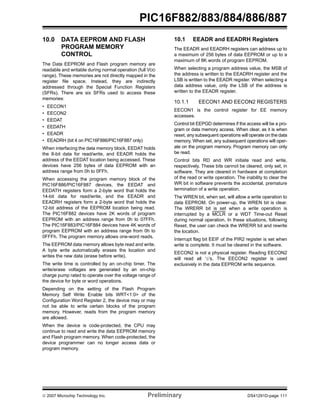
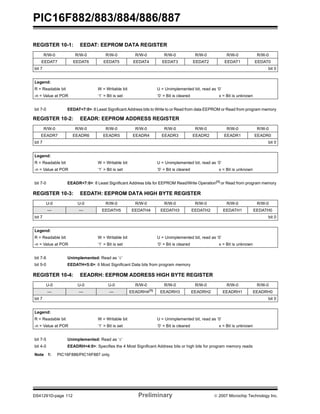
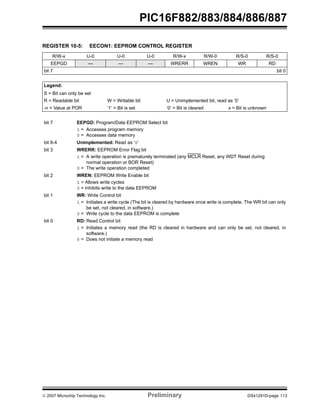
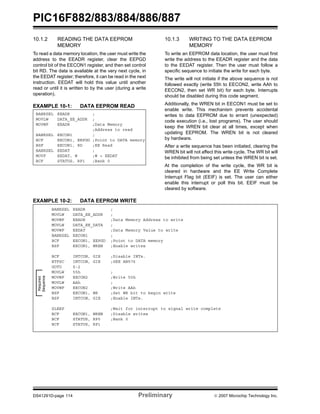
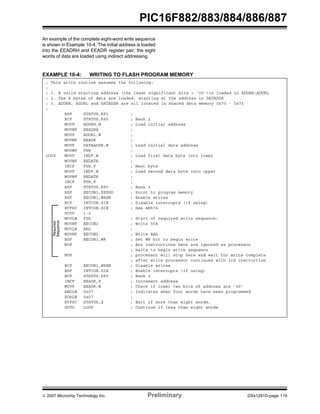
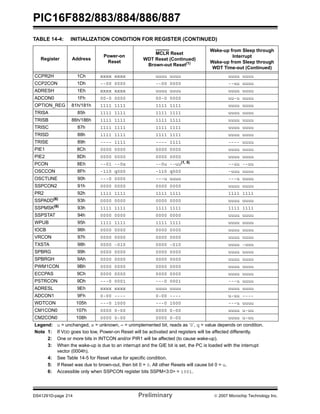
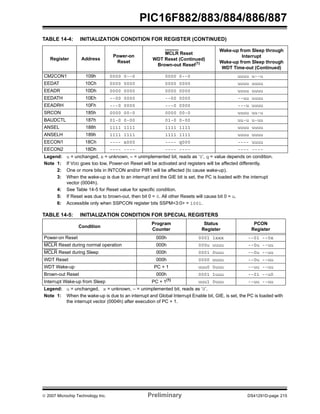
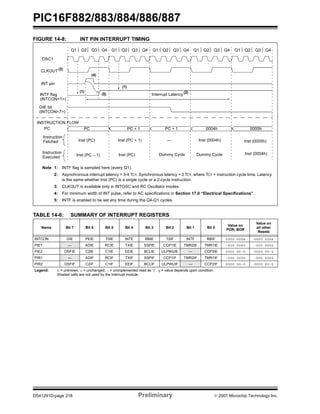
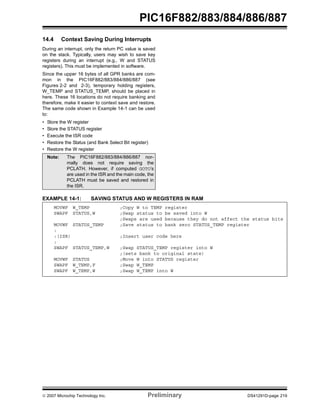
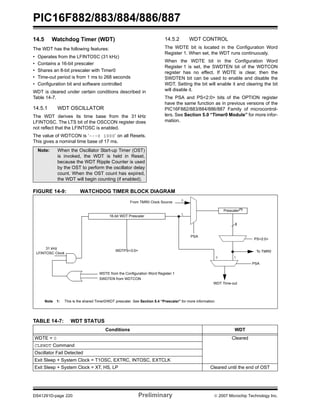
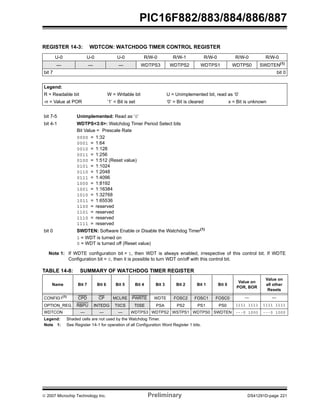
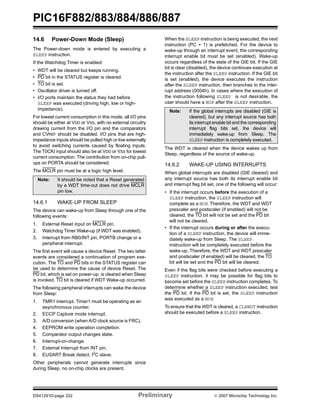
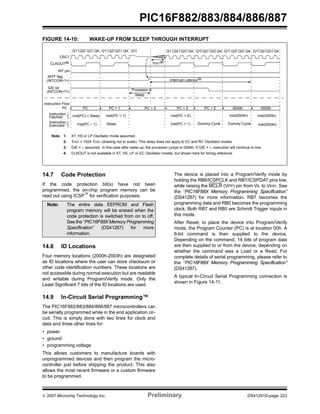
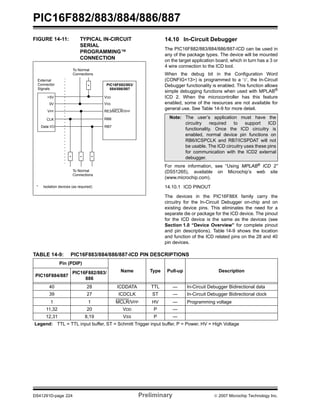
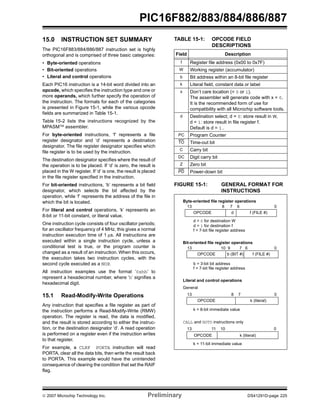
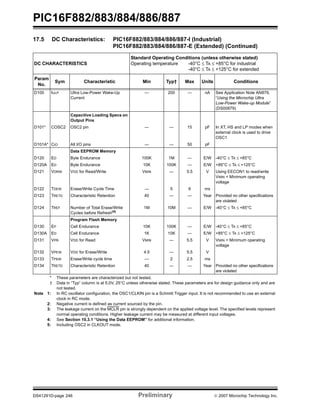
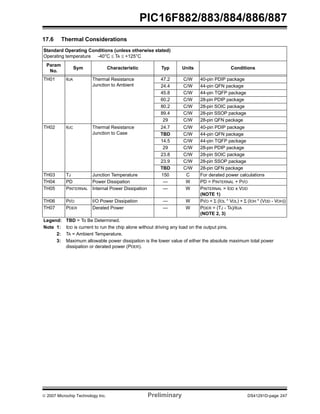
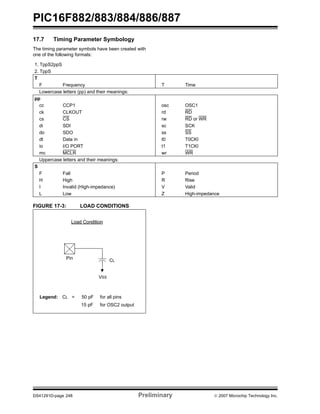
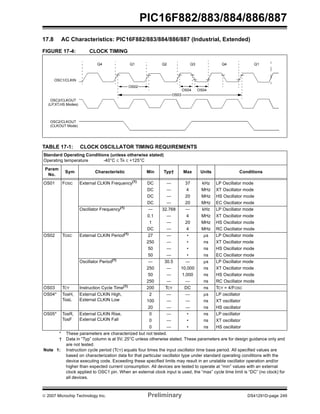
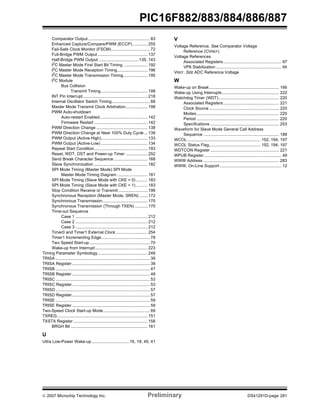
Data Sheet 
28/40/44-Pin, Enhanced Flash-Based 8-Bit 
CMOS Microcontrollers with 
nanoWatt Technology 
© 2007 Microchip Technology Inc. Preliminary DS41291D
Note the following details of the code protection feature on Microchip devices: 
• Microchip products meet the specification contained in their particular Microchip Data Sheet. 
• Microchip believes that its family of products is one of the most secure families of its kind on the market today, when used in the 
intended manner and under normal conditions. 
• There are dishonest and possibly illegal methods used to breach the code protection feature. All of these methods, to our 
knowledge, require using the Microchip products in a manner outside the operating specifications contained in Microchip’s Data 
Sheets. Most likely, the person doing so is engaged in theft of intellectual property. 
• Microchip is willing to work with the customer who is concerned about the integrity of their code. 
• Neither Microchip nor any other semiconductor manufacturer can guarantee the security of their code. Code protection does not 
mean that we are guaranteeing the product as “unbreakable.” 
Code protection is constantly evolving. We at Microchip are committed to continuously improving the code protection features of our 
products. Attempts to break Microchip’s code protection feature may be a violation of the Digital Millennium Copyright Act. If such acts 
allow unauthorized access to your software or other copyrighted work, you may have a right to sue for relief under that Act. 
Information contained in this publication regarding device 
applications and the like is provided only for your convenience 
and may be superseded by updates. It is your responsibility to 
ensure that your application meets with your specifications. 
MICROCHIP MAKES NO REPRESENTATIONS OR 
WARRANTIES OF ANY KIND WHETHER EXPRESS OR 
IMPLIED, WRITTEN OR ORAL, STATUTORY OR 
OTHERWISE, RELATED TO THE INFORMATION, 
INCLUDING BUT NOT LIMITED TO ITS CONDITION, 
QUALITY, PERFORMANCE, MERCHANTABILITY OR 
FITNESS FOR PURPOSE. Microchip disclaims all liability 
arising from this information and its use. Use of Microchip 
devices in life support and/or safety applications is entirely at 
the buyer’s risk, and the buyer agrees to defend, indemnify and 
hold harmless Microchip from any and all damages, claims, 
suits, or expenses resulting from such use. No licenses are 
conveyed, implicitly or otherwise, under any Microchip 
intellectual property rights. 
Trademarks 
The Microchip name and logo, the Microchip logo, Accuron, 
dsPIC, KEELOQ, KEELOQ logo, microID, MPLAB, PIC, 
PICmicro, PICSTART, PRO MATE, PowerSmart, rfPIC, and 
SmartShunt are registered trademarks of Microchip 
Technology Incorporated in the U.S.A. and other countries. 
AmpLab, FilterLab, Linear Active Thermistor, Migratable 
Memory, MXDEV, MXLAB, PS logo, SEEVAL, SmartSensor 
and The Embedded Control Solutions Company are 
registered trademarks of Microchip Technology Incorporated 
in the U.S.A. 
Analog-for-the-Digital Age, Application Maestro, CodeGuard, 
dsPICDEM, dsPICDEM.net, dsPICworks, ECAN, 
ECONOMONITOR, FanSense, FlexROM, fuzzyLAB, 
In-Circuit Serial Programming, ICSP, ICEPIC, Mindi, MiWi, 
MPASM, MPLAB Certified logo, MPLIB, MPLINK, PICkit, 
PICDEM, PICDEM.net, PICLAB, PICtail, PowerCal, 
PowerInfo, PowerMate, PowerTool, REAL ICE, rfLAB, 
rfPICDEM, Select Mode, Smart Serial, SmartTel, Total 
Endurance, UNI/O, WiperLock and ZENA are trademarks of 
Microchip Technology Incorporated in the U.S.A. and other 
countries. 
SQTP is a service mark of Microchip Technology Incorporated 
in the U.S.A. 
All other trademarks mentioned herein are property of their 
respective companies. 
© 2007, Microchip Technology Incorporated, Printed in the 
U.S.A., All Rights Reserved. 
Printed on recycled paper. 
Microchip received ISO/TS-16949:2002 certification for its worldwide 
headquarters, design and wafer fabrication facilities in Chandler and 
Tempe, Arizona, Gresham, Oregon and Mountain View, California. The 
Company’s quality system processes and procedures are for its PIC® 
MCUs and dsPIC® DSCs, KEELOQ® code hopping devices, Serial 
EEPROMs, microperipherals, nonvolatile memory and analog 
products. In addition, Microchip’s quality system for the design and 
manufacture of development systems is ISO 9001:2000 certified. 
DS41291D-page ii Preliminary © 2007 Microchip Technology Inc.
PIC16F882/883/884/886/887 
28/40/44-Pin Flash-Based, 8-Bit CMOS Microcontrollers with 
nanoWatt Technology 
High-Performance RISC CPU: 
• Only 35 instructions to learn: 
- All single-cycle instructions except branches 
• Operating speed: 
- DC – 20 MHz oscillator/clock input 
- DC – 200 ns instruction cycle 
• Interrupt capability 
• 8-level deep hardware stack 
• Direct, Indirect and Relative Addressing modes 
Special Microcontroller Features: 
• Precision Internal Oscillator: 
- Factory calibrated to ±1% 
- Software selectable frequency range of 
8 MHz to 31 kHz 
- Software tunable 
- Two-Speed Start-up mode 
- Crystal fail detect for critical applications 
- Clock mode switching during operation for 
power savings 
• Power-Saving Sleep mode 
• Wide operating voltage range (2.0V-5.5V) 
• Industrial and Extended Temperature range 
• Power-on Reset (POR) 
• Power-up Timer (PWRT) and Oscillator Start-up 
Timer (OST) 
• Brown-out Reset (BOR) with software control 
option 
• Enhanced low-current Watchdog Timer (WDT) 
with on-chip oscillator (software selectable 
nominal 268 seconds with full prescaler) with 
software enable 
• Multiplexed Master Clear with pull-up/input pin 
• Programmable code protection 
• High Endurance Flash/EEPROM cell: 
- 100,000 write Flash endurance 
- 1,000,000 write EEPROM endurance 
- Flash/Data EEPROM retention: > 40 years 
• Program memory Read/Write during run time 
• In-Circuit Debugger (on board) 
Low-Power Features: 
• Standby Current: 
- 50 nA @ 2.0V, typical 
• Operating Current: 
- 11μA @ 32 kHz, 2.0V, typical 
- 220μA @ 4 MHz, 2.0V, typical 
• Watchdog Timer Current: 
- 1μA @ 2.0V, typical 
Peripheral Features: 
• 24/35 I/O pins with individual direction control: 
- High current source/sink for direct LED drive 
- Interrupt-on-Change pin 
- Individually programmable weak pull-ups 
- Ultra Low-Power Wake-up (ULPWU) 
• Analog Comparator module with: 
- Two analog comparators 
- Programmable on-chip voltage reference 
(CVREF) module (% of VDD) 
- Fixed voltage reference (0.6V) 
- Comparator inputs and outputs externally 
accessible 
- SR Latch mode 
- External Timer1 Gate (count enable) 
• A/D Converter: 
- 10-bit resolution and 11/14 channels 
• Timer0: 8-bit timer/counter with 8-bit 
programmable prescaler 
• Enhanced Timer1: 
- 16-bit timer/counter with prescaler 
- External Gate Input mode 
- Dedicated low-power 32 kHz oscillator 
• Timer2: 8-bit timer/counter with 8-bit period 
register, prescaler and postscaler 
• Enhanced Capture, Compare, PWM+ module: 
- 16-bit Capture, max. resolution 12.5 ns 
- Compare, max. resolution 200 ns 
- 10-bit PWM with 1, 2 or 4 output channels, 
programmable “dead time”, max. frequency 
20 kHz 
- PWM output steering control 
• Capture, Compare, PWM module: 
- 16-bit Capture, max. resolution 12.5 ns 
- 16-bit Compare, max. resolution 200 ns 
- 10-bit PWM, max. frequency 20 kHz 
• Enhanced USART module: 
- Supports RS-485, RS-232, and LIN 2.0 
- Auto-Baud Detect 
- Auto-Wake-Up on Start bit 
• In-Circuit Serial ProgrammingTM (ICSPTM) via two 
pins 
• Master Synchronous Serial Port (MSSP) module 
supporting 3-wire SPI (all 4 modes) and I2C™ 
Master and Slave Modes with I2C address mask 
© 2007 Microchip Technology Inc. Preliminary DS41291D-page 1
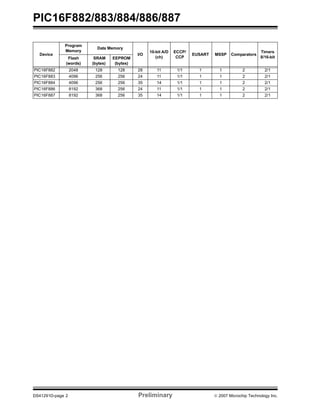
PIC16F882/883/884/886/887 
Device 
Program 
Memory 
Data Memory 
I/O 
10-bit A/D 
Flash (ch) 
8/16-bit 
(words) 
ECCP/ 
CCP 
EUSART MSSP Comparators 
Timers 
SRAM 
(bytes) 
EEPROM 
(bytes) 
PIC16F882 2048 128 128 28 11 1/1 1 1 2 2/1 
PIC16F883 4096 256 256 24 11 1/1 1 1 2 2/1 
PIC16F884 4096 256 256 35 14 1/1 1 1 2 2/1 
PIC16F886 8192 368 256 24 11 1/1 1 1 2 2/1 
PIC16F887 8192 368 256 35 14 1/1 1 1 2 2/1 
DS41291D-page 2 Preliminary © 2007 Microchip Technology Inc.
PIC16F882/883/884/886/887 
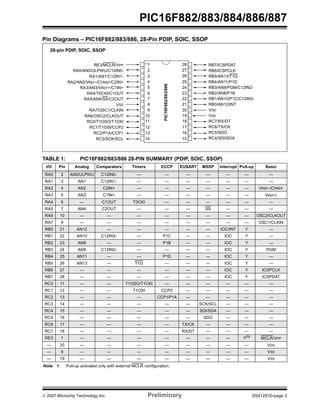
Pin Diagrams – PIC16F882/883/886, 28-Pin PDIP, SOIC, SSOP 
1 
2 
3 
4 
5 
6 
7 
8 
9 
10 
11 
28 
27 
26 
25 
24 
23 
22 
21 
20 
19 
18 
17 
PIC16F882/883/886 
12 
13 
16 
14 15 
28-pin PDIP, SOIC, SSOP 
RE3/MCLR/VPP 
RA0/AN0/ULPWU/C12IN0- 
RA1/AN1/C12IN1- 
RA2/AN2/VREF-/CVREF/C2IN+ 
RA3/AN3/VREF+/C1IN+ 
RA4/T0CKI/C1OUT 
RA5/AN4/SS/C2OUT 
VSS 
RA7/OSC1/CLKIN 
RA6/OSC2/CLKOUT 
RC0/T1OSO/T1CKI 
RC1/T1OSI/CCP2 
RC2/P1A/CCP1 
RC3/SCK/SCL 
RB7/ICSPDAT 
RB6/ICSPCLK 
RB5/AN13/T1G 
RB4/AN11/P1D 
RB3/AN9/PGM/C12IN2- 
RB2/AN8/P1B 
RB1/AN10/P1C/C12IN3- 
RB0/AN12/INT 
VDD 
VSS 
RC7/RX/DT 
RC6/TX/CK 
RC5/SDO 
RC4/SDI/SDA 
TABLE 1: PIC16F882/883/886 28-PIN SUMMARY (PDIP, SOIC, SSOP) 
I/O Pin Analog Comparators Timers ECCP EUSART MSSP Interrupt Pull-up Basic 
RA0 2 AN0/ULPWU C12IN0- — — — — — — — 
RA1 3 AN1 C12IN1- — — — — — — — 
RA2 4 AN2 C2IN+ — — — — — — VREF-/CVREF 
RA3 5 AN3 C1IN+ — — — — — — VREF+ 
RA4 6 — C1OUT T0CKI — — — — — — 
RA5 7 AN4 C2OUT — — — SS — — — 
RA6 10 — — — — — — — — OSC2/CLKOUT 
RA7 9 — — — — — — — — OSC1/CLKIN 
RB0 21 AN12 — — — — — IOC/INT Y — 
RB1 22 AN10 C12IN3- — P1C — — IOC Y — 
RB2 23 AN8 — — P1B — — IOC Y — 
RB3 24 AN9 C12IN2- — — — — IOC Y PGM 
RB4 25 AN11 — — P1D — — IOC Y — 
RB5 26 AN13 — T1G — — — IOC Y — 
RB6 27 — — — — — — IOC Y ICSPCLK 
RB7 28 — — — — — — IOC Y ICSPDAT 
RC0 11 — — T1OSO/T1CKI — — — — — — 
RC1 12 — — T1OSI CCP2 — — — — — 
RC2 13 — — — CCP1/P1A — — — — — 
RC3 14 — — — — — SCK/SCL — — — 
RC4 15 — — — — — SDI/SDA — — — 
RC5 16 — — — — — SDO — — — 
RC6 17 — — — — TX/CK — — — — 
RC7 18 — — — — RX/DT — — — — 
RE3 1 — — — — — — — Y(1) MCLR/VPP 
— 20 — — — — — — — — VDD 
— 8 — — — — — — — — VSS 
— 19 — — — — — — — — VSS 
Note 1: Pull-up activated only with external MCLR configuration. 
© 2007 Microchip Technology Inc. Preliminary DS41291D-page 3
PIC16F882/883/884/886/887 
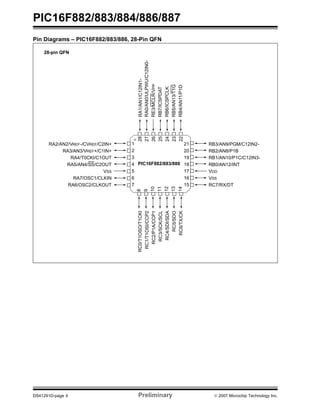
Pin Diagrams – PIC16F882/883/886, 28-Pin QFN 
21 
20 
19 
18 
17 
16 
1 
2 
3 
4 
5 
6 
7 
15 
RA1/AN1/C12IN1- 
RA0/AN0/ULPWU/C12IN0- 
RE3/MCLR/VPP 
RB7/ICSPDAT 
RB6/ICSPCLK 
RB5/AN13/T1G 
RB4/AN11/P1D 
22 
28 
26 
27 
23 
24 
25 
PIC16F882/883/886 
14 
8 
10 
9 
13 
12 
11 
RC0/T1OSO/T1CKI 
RC1/T1OSI/CCP2 
RC2/P1A/CCP1 
RC3/SCK/SCL 
RC4/SDI/SDA 
RC5/SDO 
RC6/TX/CK 
28-pin QFN 
RA2/AN2/VREF-/CVREF/C2IN+ 
RA3/AN3/VREF+/C1IN+ 
RA4/T0CKI/C1OUT 
RA5/AN4/SS/C2OUT 
VSS 
RA7/OSC1/CLKIN 
RA6/OSC2/CLKOUT 
RB3/AN9/PGM/C12IN2- 
RB2/AN8/P1B 
RB1/AN10/P1C/C12IN3- 
RB0/AN12/INT 
VDD 
VSS 
RC7/RX/DT 
DS41291D-page 4 Preliminary © 2007 Microchip Technology Inc.
PIC16F882/883/884/886/887 
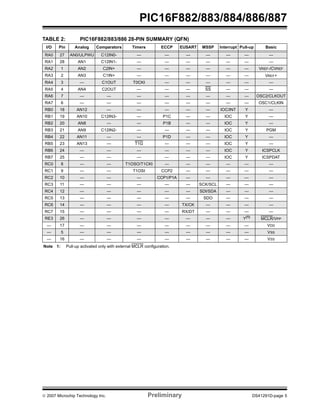
TABLE 2: PIC16F882/883/886 28-PIN SUMMARY (QFN) 
I/O Pin Analog Comparators Timers ECCP EUSART MSSP Interrupt Pull-up Basic 
RA0 27 AN0/ULPWU C12IN0- — — — — — — — 
RA1 28 AN1 C12IN1- — — — — — — — 
RA2 1 AN2 C2IN+ — — — — — — VREF-/CVREF 
RA3 2 AN3 C1IN+ — — — — — — VREF+ 
RA4 3 — C1OUT T0CKI — — — — — — 
RA5 4 AN4 C2OUT — — — SS — — — 
RA6 7 — — — — — — — — OSC2/CLKOUT 
RA7 6 — — — — — — — — OSC1/CLKIN 
RB0 18 AN12 — — — — — IOC/INT Y — 
RB1 19 AN10 C12IN3- — P1C — — IOC Y — 
RB2 20 AN8 — — P1B — — IOC Y — 
RB3 21 AN9 C12IN2- — — — — IOC Y PGM 
RB4 22 AN11 — — P1D — — IOC Y — 
RB5 23 AN13 — T1G — — — IOC Y — 
RB6 24 — — — — — — IOC Y ICSPCLK 
RB7 25 — — — — — — IOC Y ICSPDAT 
RC0 8 — — T1OSO/T1CKI — — — — — — 
RC1 9 — — T1OSI CCP2 — — — — — 
RC2 10 — — — CCP1/P1A — — — — — 
RC3 11 — — — — — SCK/SCL — — — 
RC4 12 — — — — — SDI/SDA — — — 
RC5 13 — — — — — SDO — — — 
RC6 14 — — — — TX/CK — — — — 
RC7 15 — — — — RX/DT — — — — 
RE3 26 — — — — — — — Y(1) MCLR/VPP 
— 17 — — — — — — — — VDD 
— 5 — — — — — — — — VSS 
— 16 — — — — — — — — VSS 
Note 1: Pull-up activated only with external MCLR configuration. 
© 2007 Microchip Technology Inc. Preliminary DS41291D-page 5
PIC16F882/883/884/886/887 
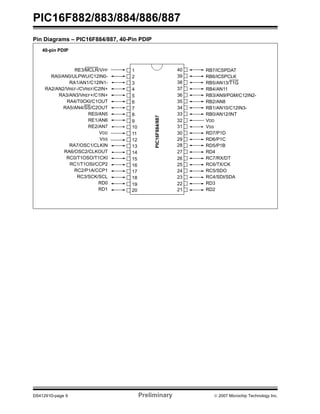
Pin Diagrams – PIC16F884/887, 40-Pin PDIP 
1 
2 
3 
4 
5 
6 
7 
8 
9 
10 
11 
12 
13 
14 
15 
16 
17 
18 
19 
20 
40 
39 
38 
37 
36 
35 
34 
33 
32 
31 
30 
29 
28 
27 
26 
25 
24 
23 
22 
21 
PIC16F884/887 
RE3/MCLR/VPP 
40-pin PDIP 
RA0/AN0/ULPWU/C12IN0- 
RA1/AN1/C12IN1- 
RA2/AN2/VREF-/CVREF/C2IN+ 
RA3/AN3/VREF+/C1IN+ 
RA4/T0CKI/C1OUT 
RA5/AN4/SS/C2OUT 
RE0/AN5 
RE1/AN6 
RE2/AN7 
VDD 
VSS 
RA7/OSC1/CLKIN 
RA6/OSC2/CLKOUT 
RC0/T1OSO/T1CKI 
RC1/T1OSI/CCP2 
RC2/P1A/CCP1 
RC3/SCK/SCL 
RD0 
RD1 
RB7/ICSPDAT 
RB6/ICSPCLK 
RB5/AN13/T1G 
RB4/AN11 
RB3/AN9/PGM/C12IN2- 
RB2/AN8 
RB1/AN10/C12IN3- 
RB0/AN12/INT 
VDD 
VSS 
RD7/P1D 
RD6/P1C 
RD5/P1B 
RD4 
RC7/RX/DT 
RC6/TX/CK 
RC5/SDO 
RC4/SDI/SDA 
RD3 
RD2 
DS41291D-page 6 Preliminary © 2007 Microchip Technology Inc.
PIC16F882/883/884/886/887 
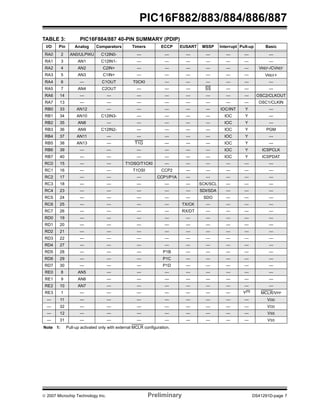
TABLE 3: PIC16F884/887 40-PIN SUMMARY (PDIP) 
I/O Pin Analog Comparators Timers ECCP EUSART MSSP Interrupt Pull-up Basic 
RA0 2 AN0/ULPWU C12IN0- — — — — — — — 
RA1 3 AN1 C12IN1- — — — — — — — 
RA2 4 AN2 C2IN+ — — — — — — VREF-/CVREF 
RA3 5 AN3 C1IN+ — — — — — — VREF+ 
RA4 6 — C1OUT T0CKI — — — — — — 
RA5 7 AN4 C2OUT — — — SS — — — 
RA6 14 — — — — — — — — OSC2/CLKOUT 
RA7 13 — — — — — — — — OSC1/CLKIN 
RB0 33 AN12 — — — — — IOC/INT Y — 
RB1 34 AN10 C12IN3- — — — — IOC Y — 
RB2 35 AN8 — — — — — IOC Y — 
RB3 36 AN9 C12IN2- — — — — IOC Y PGM 
RB4 37 AN11 — — — — — IOC Y — 
RB5 38 AN13 — T1G — — — IOC Y — 
RB6 39 — — — — — — IOC Y ICSPCLK 
RB7 40 — — — — — — IOC Y ICSPDAT 
RC0 15 — — T1OSO/T1CKI — — — — — — 
RC1 16 — — T1OSI CCP2 — — — — — 
RC2 17 — — — CCP1/P1A — — — — — 
RC3 18 — — — — — SCK/SCL — — — 
RC4 23 — — — — — SDI/SDA — — — 
RC5 24 — — — — — SDO — — — 
RC6 25 — — — — TX/CK — — — — 
RC7 26 — — — — RX/DT — — — — 
RD0 19 — — — — — — — — — 
RD1 20 — — — — — — — — — 
RD2 21 — — — — — — — — — 
RD3 22 — — — — — — — — — 
RD4 27 — — — — — — — — — 
RD5 28 — — — P1B — — — — — 
RD6 29 — — — P1C — — — — — 
RD7 30 — — — P1D — — — — — 
RE0 8 AN5 — — — — — — — — 
RE1 9 AN6 — — — — — — — — 
RE2 10 AN7 — — — — — — — — 
RE3 1 — — — — — — — Y(1) MCLR/VPP 
— 11 — — — — — — — — VDD 
— 32 — — — — — — — — VDD 
— 12 — — — — — — — — VSS 
— 31 — — — — — — — — VSS 
Note 1: Pull-up activated only with external MCLR configuration. 
© 2007 Microchip Technology Inc. Preliminary DS41291D-page 7
PIC16F882/883/884/886/887 
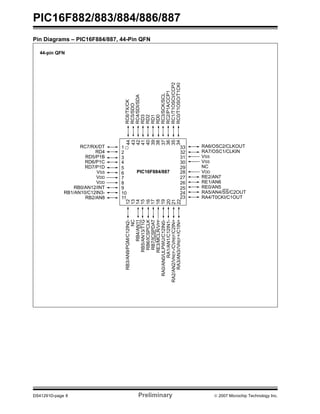
Pin Diagrams – PIC16F884/887, 44-Pin QFN 
44-pin QFN 
1 
23 
4 
5 
6 
8 7 
RC6/TX/CK 
RC5/SDO 
RC4/SDI/SDA 
RD3 
RD2 
RD1 
RD0 
RC3/SCK/SCL 
RC2/P1A/CCP1 
RC1/T1OSCI/CCP2 
RC0/T1OSO/T1CKI 
44 
43 
42 
41 
40 
39 
9 
10 
11 
38 
PIC16F884/887 
16 
17 
37 
36 
34 
33 
32 
31 
30 
29 
28 
27 
26 
25 
24 
23 
12 
13 
14 
15 
35 
18 
19 
20 
21 
22 
RA6/OSC2/CLKOUT 
RA7/OSC1/CLKIN 
VSS 
VSS 
NC 
VDD 
RE2/AN7 
RE1/AN6 
RE0/AN5 
RA5/AN4/SS/C2OUT 
RA4/T0CKI/C1OUT 
RC7/RX/DT 
RD4 
RD5/P1B 
RD6/P1C 
RD7/P1D 
VSS 
VDD 
VDD 
RB0/AN12/INT 
RB1/AN10/C12IN3- 
RB2/AN8 
RB3/AN9/PGM/C12IN2- 
NC 
RB5/AN13/T1G 
RB6/ICSPCLK 
RB7/ICSPDAT 
RE3/MCLR/VPP 
RB4/AN11 
RA1/AN1/C12IN1- 
RA0/AN0/ULPWU/C12IN0- 
RA3/AN3//VREF+/C1IN+ 
RA2/AN2/VREF-/CVREF/C2IN+ 
DS41291D-page 8 Preliminary © 2007 Microchip Technology Inc.
PIC16F882/883/884/886/887 
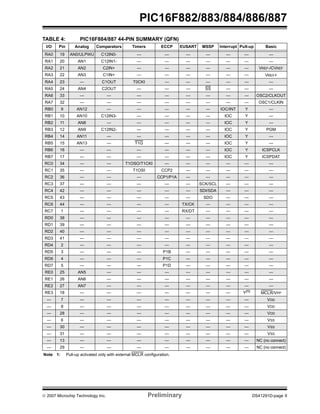
TABLE 4: PIC16F884/887 44-PIN SUMMARY (QFN) 
I/O Pin Analog Comparators Timers ECCP EUSART MSSP Interrupt Pull-up Basic 
RA0 19 AN0/ULPWU C12IN0- — — — — — — — 
RA1 20 AN1 C12IN1- — — — — — — — 
RA2 21 AN2 C2IN+ — — — — — — VREF-/CVREF 
RA3 22 AN3 C1IN+ — — — — — — VREF+ 
RA4 23 — C1OUT T0CKI — — — — — — 
RA5 24 AN4 C2OUT — — — SS — — — 
RA6 33 — — — — — — — — OSC2/CLKOUT 
RA7 32 — — — — — — — — OSC1/CLKIN 
RB0 9 AN12 — — — — — IOC/INT Y — 
RB1 10 AN10 C12IN3- — — — — IOC Y — 
RB2 11 AN8 — — — — — IOC Y — 
RB3 12 AN9 C12IN2- — — — — IOC Y PGM 
RB4 14 AN11 — — — — — IOC Y — 
RB5 15 AN13 — T1G — — — IOC Y — 
RB6 16 — — — — — — IOC Y ICSPCLK 
RB7 17 — — — — — — IOC Y ICSPDAT 
RC0 34 — — T1OSO/T1CKI — — — — — — 
RC1 35 — — T1OSI CCP2 — — — — — 
RC2 36 — — — CCP1/P1A — — — — — 
RC3 37 — — — — — SCK/SCL — — — 
RC4 42 — — — — — SDI/SDA — — — 
RC5 43 — — — — — SDO — — — 
RC6 44 — — — — TX/CK — — — — 
RC7 1 — — — — RX/DT — — — — 
RD0 38 — — — — — — — — — 
RD1 39 — — — — — — — — — 
RD2 40 — — — — — — — — — 
RD3 41 — — — — — — — — — 
RD4 2 — — — — — — — — — 
RD5 3 — — — P1B — — — — — 
RD6 4 — — — P1C — — — — — 
RD7 5 — — — P1D — — — — — 
RE0 25 AN5 — — — — — — — — 
RE1 26 AN6 — — — — — — — — 
RE2 27 AN7 — — — — — — — — 
RE3 18 — — — — — — — Y(1) MCLR/VPP 
— 7 — — — — — — — — VDD 
— 8 — — — — — — — — VDD 
— 28 — — — — — — — — VDD 
— 6 — — — — — — — — VSS 
— 30 — — — — — — — — VSS 
— 31 — — — — — — — — VSS 
— 13 — — — — — — — — NC (no connect) 
— 29 — — — — — — — — NC (no connect) 
Note 1: Pull-up activated only with external MCLR configuration. 
© 2007 Microchip Technology Inc. Preliminary DS41291D-page 9
PIC16F882/883/884/886/887 
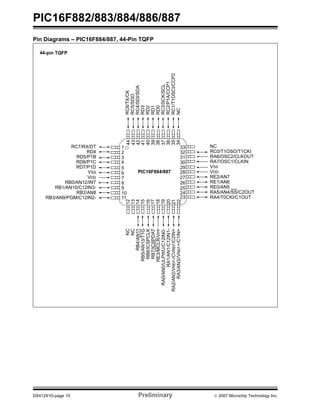
Pin Diagrams – PIC16F884/887, 44-Pin TQFP 
44-pin TQFP 
1 
23 
4 
5 
6 
8 7 
RC6/TX/CK 
RC5/SDO 
RC4/SDI/SDA 
RD3 
RD2 
RD1 
RD0 
RC3/SCK/SCL 
RC2/P1A/CCP1 
RC1/T1OSCI/CCP2 
NC 
44 
43 
42 
41 
40 
39 
9 
10 
11 
38 
PIC16F884/887 
16 
17 
37 
36 
34 
33 
32 
31 
30 
29 
28 
27 
26 
25 
24 
23 
12 
13 
14 
15 
35 
18 
19 
20 
21 
22 
NC 
RC0/T1OSO/T1CKI 
RA6/OSC2/CLKOUT 
RA7/OSC1/CLKIN 
VSS 
VDD 
RE2/AN7 
RE1/AN6 
RE0/AN5 
RA5/AN4/SS/C2OUT 
RA4/T0CKI/C1OUT 
RC7/RX/DT 
RD4 
RD5/P1B 
RD6/P1C 
RD7/P1D 
VSS 
VDD 
RB0/AN12/INT 
RB1/AN10/C12IN3- 
RB2/AN8 
RB3/AN9/PGM/C12IN2- 
NC 
NC 
RB5/AN13/T1G 
RB6/ICSPCLK 
RB7/ICSPDAT 
RE3/MCLR/VPP 
RB4/AN11 
RA1/AN1/C12IN1- 
RA0/AN0/ULPWU/C12IN0- 
RA3/AN3//VREF+/C1IN+ 
RA2/AN2/VREF-/CVREF/C2IN+ 
DS41291D-page 10 Preliminary © 2007 Microchip Technology Inc.
PIC16F882/883/884/886/887 
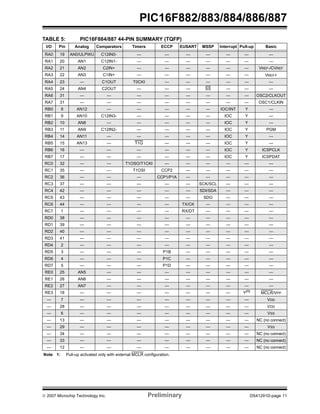
TABLE 5: PIC16F884/887 44-PIN SUMMARY (TQFP) 
I/O Pin Analog Comparators Timers ECCP EUSART MSSP Interrupt Pull-up Basic 
RA0 19 AN0/ULPWU C12IN0- — — — — — — — 
RA1 20 AN1 C12IN1- — — — — — — — 
RA2 21 AN2 C2IN+ — — — — — — VREF-/CVREF 
RA3 22 AN3 C1IN+ — — — — — — VREF+ 
RA4 23 — C1OUT T0CKI — — — — — — 
RA5 24 AN4 C2OUT — — — SS — — — 
RA6 31 — — — — — — — — OSC2/CLKOUT 
RA7 31 — — — — — — — — OSC1/CLKIN 
RB0 8 AN12 — — — — — IOC/INT Y — 
RB1 9 AN10 C12IN3- — — — — IOC Y — 
RB2 10 AN8 — — — — — IOC Y — 
RB3 11 AN9 C12IN2- — — — — IOC Y PGM 
RB4 14 AN11 — — — — — IOC Y — 
RB5 15 AN13 — T1G — — — IOC Y — 
RB6 16 — — — — — — IOC Y ICSPCLK 
RB7 17 — — — — — — IOC Y ICSPDAT 
RC0 32 — — T1OSO/T1CKI — — — — — — 
RC1 35 — — T1OSI CCP2 — — — — — 
RC2 36 — — — CCP1/P1A — — — — — 
RC3 37 — — — — — SCK/SCL — — — 
RC4 42 — — — — — SDI/SDA — — — 
RC5 43 — — — — — SDO — — — 
RC6 44 — — — — TX/CK — — — — 
RC7 1 — — — — RX/DT — — — — 
RD0 38 — — — — — — — — — 
RD1 39 — — — — — — — — — 
RD2 40 — — — — — — — — — 
RD3 41 — — — — — — — — — 
RD4 2 — — — — — — — — — 
RD5 3 — — — P1B — — — — — 
RD6 4 — — — P1C — — — — — 
RD7 5 — — — P1D — — — — — 
RE0 25 AN5 — — — — — — — — 
RE1 26 AN6 — — — — — — — — 
RE2 27 AN7 — — — — — — — — 
RE3 18 — — — — — — — Y(1) MCLR/VPP 
— 7 — — — — — — — — VDD 
— 28 — — — — — — — — VDD 
— 6 — — — — — — — — VSS 
— 13 — — — — — — — — NC (no connect) 
— 29 — — — — — — — — VSS 
— 34 — — — — — — — — NC (no connect) 
— 33 — — — — — — — — NC (no connect) 
— 12 — — — — — — — — NC (no connect) 
Note 1: Pull-up activated only with external MCLR configuration. 
© 2007 Microchip Technology Inc. Preliminary DS41291D-page 11
PIC16F882/883/884/886/887 
Table of Contents 
1.0 Device Overview ........................................................................................................................................................................ 13 
2.0 Memory Organization ................................................................................................................................................................. 21 
3.0 I/O Ports ..................................................................................................................................................................................... 39 
4.0 Oscillator Module (With Fail-Safe Clock Monitor)....................................................................................................................... 61 
5.0 Timer0 Module ........................................................................................................................................................................... 73 
6.0 Timer1 Module with Gate Control............................................................................................................................................... 76 
7.0 Timer2 Module ........................................................................................................................................................................... 81 
8.0 Comparator Module.................................................................................................................................................................... 83 
9.0 Analog-to-Digital Converter (ADC) Module ................................................................................................................................ 99 
10.0 Data EEPROM and Flash Program Memory Control ............................................................................................................... 111 
11.0 Enhanced Capture/Compare/PWM Module ............................................................................................................................. 123 
12.0 Enhanced Universal Synchronous Asynchronous Receiver Transmitter (EUSART) ............................................................... 149 
13.0 Master Synchronous Serial Port (MSSP) Module .................................................................................................................... 175 
14.0 Special Features of the CPU.................................................................................................................................................... 205 
15.0 Instruction Set Summary .......................................................................................................................................................... 225 
16.0 Development Support............................................................................................................................................................... 235 
17.0 Electrical Specifications............................................................................................................................................................ 239 
18.0 DC and AC Characteristics Graphs and Tables....................................................................................................................... 261 
19.0 Packaging Information.............................................................................................................................................................. 263 
Appendix A: Data Sheet Revision History.......................................................................................................................................... 273 
Appendix B: Migrating from other PIC® Devices ............................................................................................................................... 273 
Index .................................................................................................................................................................................................. 275 
The Microchip Web Site ..................................................................................................................................................................... 283 
Customer Change Notification Service .............................................................................................................................................. 283 
Customer Support .............................................................................................................................................................................. 283 
Reader Response .............................................................................................................................................................................. 284 
Product Identification System............................................................................................................................................................. 285 
TO OUR VALUED CUSTOMERS 
It is our intention to provide our valued customers with the best documentation possible to ensure successful use of your Microchip 
products. To this end, we will continue to improve our publications to better suit your needs. Our publications will be refined and 
enhanced as new volumes and updates are introduced. 
If you have any questions or comments regarding this publication, please contact the Marketing Communications Department via E-mail 
at docerrors@microchip.com or fax the Reader Response Form in the back of this data sheet to (480) 792-4150. We wel-come 
your feedback. 
Most Current Data Sheet 
To obtain the most up-to-date version of this data sheet, please register at our Worldwide Web site at: 
http://www.microchip.com 
You can determine the version of a data sheet by examining its literature number found on the bottom outside corner of any page. 
The last character of the literature number is the version number, (e.g., DS30000A is version A of document DS30000). 
Errata 
An errata sheet, describing minor operational differences from the data sheet and recommended workarounds, may exist for current 
devices. As device/documentation issues become known to us, we will publish an errata sheet. The errata will specify the revision of 
silicon and revision of document to which it applies. 
To determine if an errata sheet exists for a particular device, please check with one of the following: 
• Microchip’s Worldwide Web site; http://www.microchip.com 
• Your local Microchip sales office (see last page) 
When contacting a sales office, please specify which device, revision of silicon and data sheet (include literature number) you are 
using. 
Customer Notification System 
Register on our web site at www.microchip.com to receive the most current information on all of our products. 
DS41291D-page 12 Preliminary © 2007 Microchip Technology Inc.
PIC16F882/883/884/886/887 
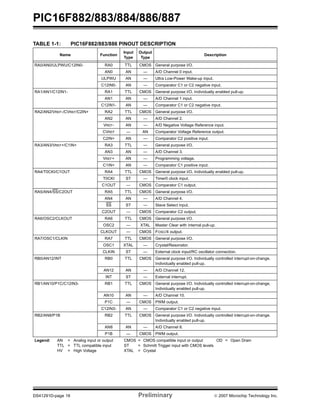
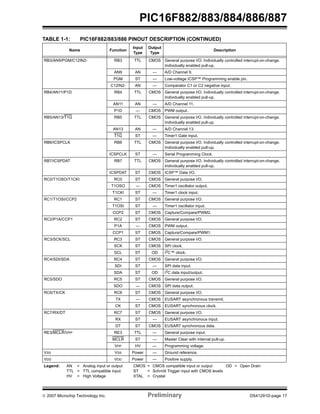
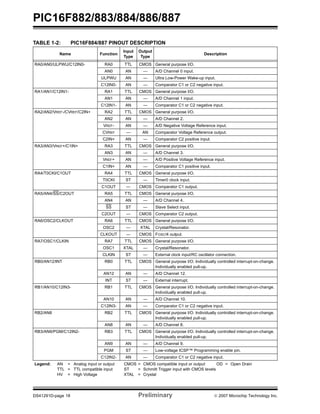
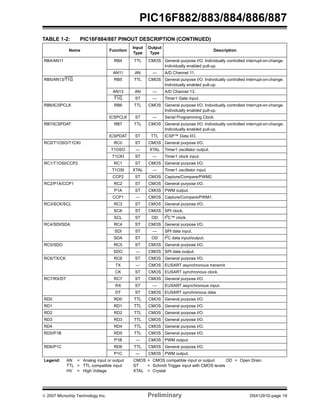
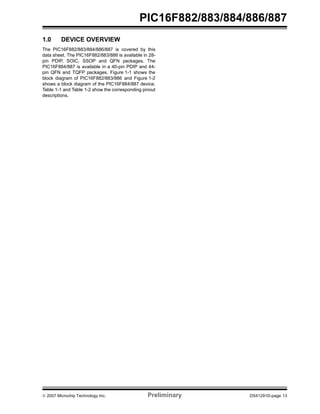
1.0 DEVICE OVERVIEW 
The PIC16F882/883/884/886/887 is covered by this 
data sheet. The PIC16F882/883/886 is available in 28- 
pin PDIP, SOIC, SSOP and QFN packages. The 
PIC16F884/887 is available in a 40-pin PDIP and 44- 
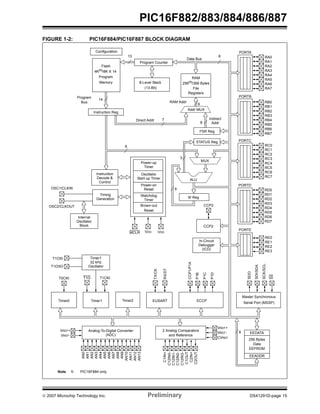
pin QFN and TQFP packages. Figure 1-1 shows the 
block diagram of PIC16F882/883/886 and Figure 1-2 
shows a block diagram of the PIC16F884/887 device. 
Table 1-1 and Table 1-2 show the corresponding pinout 
descriptions. 
© 2007 Microchip Technology Inc. Preliminary DS41291D-page 13
PIC16F882/883/884/886/887 
FIGURE 1-1: PIC16F882/883/886 BLOCK DIAGRAM 
Configuration 
Flash 
2K(2)/4K(1)/ 
8K X 14 
Program 
Memory 
13 
Data Bus 
8 
Program 
Bus 
14 
Instruction Reg 
Program Counter 
RAM 
8-Level Stack 128(2)/256(1)/ 
368 Bytes 
File 
Registers 
(13-Bit) 
Direct Addr 7 
RAM Addr 
9 
Addr MUX 
Indirect 
Addr 
8 
FSR Reg 
STATUS Reg 
MUX 
ALU 
W Reg 
Instruction 
Decode & 
Control 
Timing 
Generation 
OSC1/CLKIN 
OSC2/CLKOUT 
8 
8 
3 
Power-up 
Timer 
Oscillator 
Start-up Timer 
Power-on 
Reset 
Watchdog 
Timer 
Brown-out 
Reset 
VDD 
MCLR VSS 
Internal 
Oscillator 
Block 
Timer1 
32 kHz 
Oscillator 
T1OSI 
T1OSO 
T0CKI T1G 
T1CKI 
Timer0 Timer1 
PORTA 
PORTB 
PORTC 
PORTE 
SDO 
SDI/SDA 
SCK/SCL 
SS 
Master Synchronous 
Serial Port (MSSP) 
EEDATA 
128(2)/ 
RA0 
RA1 
RA2 
RA3 
RA4 
RA5 
RA6 
RA7 
RB0 
RB1 
RB2 
RB3 
RB4 
RB5 
RB6 
RB7 
RC0 
RC1 
RC2 
RC3 
RC4 
RC5 
RC6 
RC7 
RE3 
256 Bytes 
Data 
EEPROM 
EEADDR 
8 
CCP2 
CCP2 
In-Circuit 
Debugger 
(ICD) 
CCP1/P1A 
P1B 
P1C 
P1D 
TX/CK 
RX/DT 
Timer2 EUSART 
ECCP 
VREF+ 2 Analog Comparators 
and Reference 
Analog-To-Digital Converter 
(ADC) AN0 
AN1 
AN2 
AN3 
AN4 
AN8 
AN9 
AN10 
AN11 
AN12 
AN13 
C1IN+ 
C12IN0- 
C12IN1- 
C12IN2- 
C12IN3- 
C1OUT 
C2IN+ 
C2OUT 
VREF- 
Note 1: PIC16F883 only. 
2: PIC16F882 only. 
VREF+ 
VREF-CVREF 
DS41291D-page 14 Preliminary © 2007 Microchip Technology Inc.
PIC16F882/883/884/886/887 
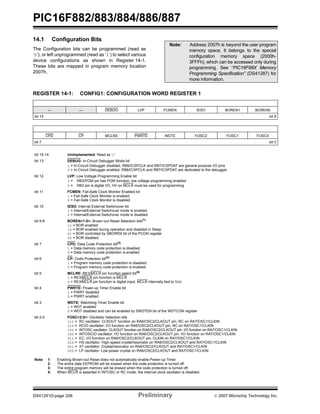
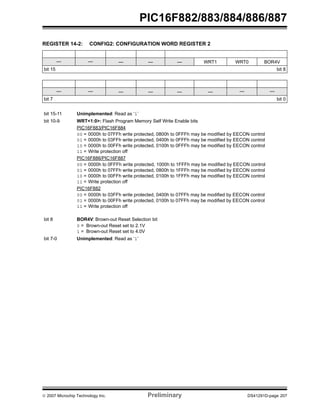
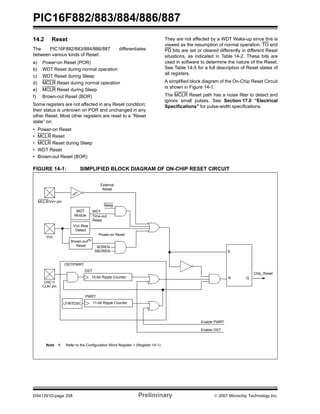
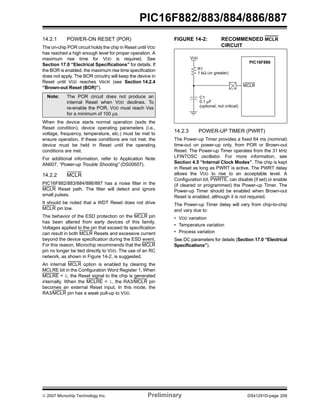
FIGURE 1-2: PIC16F884/PIC16F887 BLOCK DIAGRAM 
PORTA 
PORTB 
PORTC 
PORTD 
RA0 
RA1 
RA2 
RA3 
RA4 
RA5 
RA6 
RA7 
RB0 
RB1 
RB2 
RB3 
RB4 
RB5 
RB6 
RB7 
RC0 
RC1 
RC2 
RC3 
RC4 
RC5 
RC6 
RC7 
RD0 
RD1 
RD2 
RD3 
RD4 
RD5 
RD6 
RD7 
Configuration 
Flash 
4K(1)/8K X 14 
Program 
Memory 
13 
Data Bus 
8 
Program 
Bus 
14 
Instruction Reg 
Program Counter 
RAM 
8-Level Stack 256(1)/368 Bytes 
File 
Registers 
(13-Bit) 
Direct Addr 7 
RAM Addr 
9 
Addr MUX 
Indirect 
Addr 
8 
FSR Reg 
STATUS Reg 
MUX 
ALU 
W Reg 
Instruction 
Decode & 
Control 
Timing 
Generation 
OSC1/CLKIN 
OSC2/CLKOUT 
8 
8 
3 
Power-up 
Timer 
Oscillator 
Start-up Timer 
Power-on 
Reset 
Watchdog 
Timer 
Brown-out 
Reset 
VDD 
MCLR VSS 
Internal 
Oscillator 
Block 
Timer1 
32 kHz 
Oscillator 
T1OSI 
T1OSO 
T0CKI T1G 
T1CKI 
Timer0 Timer1 
PORTE 
RE0 
RE1 
RE2 
RE3 
SDO 
SDI/SDA 
SCK/SCL 
SS 
Master Synchronous 
Serial Port (MSSP) 
EEDATA 
256 Bytes 
Data 
EEPROM 
EEADDR 
8 
CCP2 
CCP2 
In-Circuit 
Debugger 
(ICD) 
CCP1/P1A 
P1B 
P1C 
P1D 
TX/CK 
RX/DT 
Timer2 ECCP 
EUSART 
2 Analog Comparators 
and Reference 
Analog-To-Digital Converter 
(ADC) 
AN0 
AN1 
AN2 
AN3 
AN4 
AN5 
AN6 
AN7 
AN8 
AN9 
AN10 
AN11 
AN12 
AN13 
VREF+ 
VREF-VREF+ 
Note 1: PIC16F884 only. 
VREF-CVREF 
C1IN+ 
C12IN0- 
C12IN1- 
C12IN2- 
C12IN3- 
C1OUT 
C2IN+ 
C2OUT 
© 2007 Microchip Technology Inc. Preliminary DS41291D-page 15
PIC16F882/883/884/886/887 
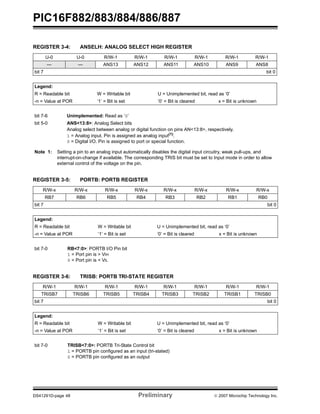
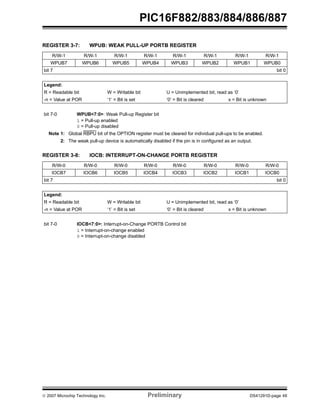
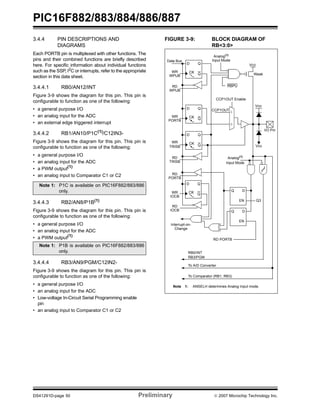
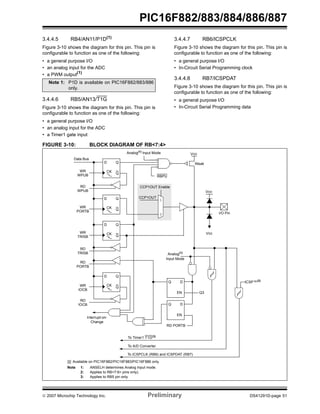
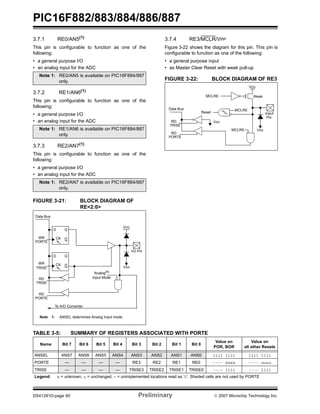
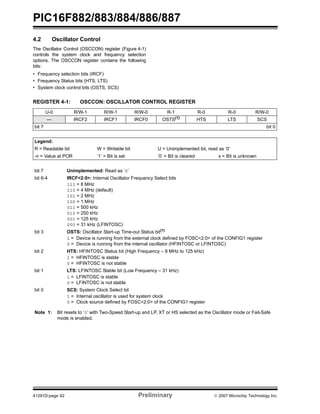
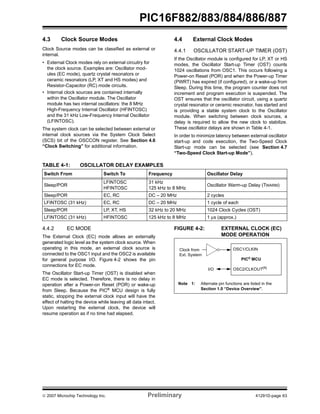
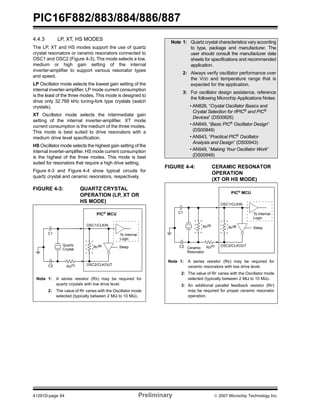
TABLE 1-1: PIC16F882/883/886 PINOUT DESCRIPTION 
Name Function 
Input 
Type 
Output 
Type 
Description 
RA0/AN0/ULPWU/C12IN0- RA0 TTL CMOS General purpose I/O. 
AN0 AN — A/D Channel 0 input. 
ULPWU AN — Ultra Low-Power Wake-up input. 
C12IN0- AN — Comparator C1 or C2 negative input. 
RA1/AN1/C12IN1- RA1 TTL CMOS General purpose I/O. Individually enabled pull-up. 
AN1 AN — A/D Channel 1 input. 
C12IN1- AN — Comparator C1 or C2 negative input. 
RA2/AN2/VREF-/CVREF/C2IN+ RA2 TTL CMOS General purpose I/O. 
AN2 AN — A/D Channel 2. 
VREF- AN — A/D Negative Voltage Reference input. 
CVREF — AN Comparator Voltage Reference output. 
C2IN+ AN — Comparator C2 positive input. 
RA3/AN3/VREF+/C1IN+ RA3 TTL — General purpose I/O. 
AN3 AN — A/D Channel 3. 
VREF+ AN — Programming voltage. 
C1IN+ AN — Comparator C1 positive input. 
RA4/T0CKI/C1OUT RA4 TTL CMOS General purpose I/O. Individually enabled pull-up. 
T0CKI ST — Timer0 clock input. 
C1OUT — CMOS Comparator C1 output. 
RA5/AN4/SS/C2OUT RA5 TTL CMOS General purpose I/O. 
AN4 AN — A/D Channel 4. 
SS ST — Slave Select input. 
C2OUT — CMOS Comparator C2 output. 
RA6/OSC2/CLKOUT RA6 TTL CMOS General purpose I/O. 
OSC2 — XTAL Master Clear with internal pull-up. 
CLKOUT — CMOS FOSC/4 output. 
RA7/OSC1/CLKIN RA7 TTL CMOS General purpose I/O. 
OSC1 XTAL — Crystal/Resonator. 
CLKIN ST — External clock input/RC oscillator connection. 
RB0/AN12/INT RB0 TTL CMOS General purpose I/O. Individually controlled interrupt-on-change. 
Individually enabled pull-up. 
AN12 AN — A/D Channel 12. 
INT ST — External interrupt. 
RB1/AN10/P1C/C12IN3- RB1 TTL CMOS General purpose I/O. Individually controlled interrupt-on-change. 
Individually enabled pull-up. 
AN10 AN — A/D Channel 10. 
P1C — CMOS PWM output. 
C12IN3- AN — Comparator C1 or C2 negative input. 
RB2/AN8/P1B RB2 TTL CMOS General purpose I/O. Individually controlled interrupt-on-change. 
Individually enabled pull-up. 
AN8 AN — A/D Channel 8. 
P1B — CMOS PWM output. 
Legend: AN = Analog input or output CMOS = CMOS compatible input or output OD = Open Drain 
TTL = TTL compatible input ST = Schmitt Trigger input with CMOS levels 
HV = High Voltage XTAL = Crystal 
DS41291D-page 16 Preliminary © 2007 Microchip Technology Inc.
PIC16F882/883/884/886/887 
TABLE 1-1: PIC16F882/883/886 PINOUT DESCRIPTION (CONTINUED) 
Name Function 
Input 
Type 
Output 
Type 
Description 
RB3/AN9/PGM/C12IN2- RB3 TTL CMOS General purpose I/O. Individually controlled interrupt-on-change. 
Individually enabled pull-up. 
AN9 AN — A/D Channel 9. 
PGM ST — Low-voltage ICSP™ Programming enable pin. 
C12IN2- AN — Comparator C1 or C2 negative input. 
RB4/AN11/P1D RB4 TTL CMOS General purpose I/O. Individually controlled interrupt-on-change. 
Individually enabled pull-up. 
AN11 AN — A/D Channel 11. 
P1D — CMOS PWM output. 
RB5/AN13/T1G RB5 TTL CMOS General purpose I/O. Individually controlled interrupt-on-change. 
Individually enabled pull-up. 
AN13 AN — A/D Channel 13. 
T1G ST — Timer1 Gate input. 
RB6/ICSPCLK RB6 TTL CMOS General purpose I/O. Individually controlled interrupt-on-change. 
Individually enabled pull-up. 
ICSPCLK ST — Serial Programming Clock. 
RB7/ICSPDAT RB7 TTL CMOS General purpose I/O. Individually controlled interrupt-on-change. 
Individually enabled pull-up. 
ICSPDAT ST CMOS ICSP™ Data I/O. 
RC0/T1OSO/T1CKI RC0 ST CMOS General purpose I/O. 
T1OSO — CMOS Timer1 oscillator output. 
T1CKI ST — Timer1 clock input. 
RC1/T1OSI/CCP2 RC1 ST CMOS General purpose I/O. 
T1OSI ST — Timer1 oscillator input. 
CCP2 ST CMOS Capture/Compare/PWM2. 
RC2/P1A/CCP1 RC2 ST CMOS General purpose I/O. 
P1A — CMOS PWM output. 
CCP1 ST CMOS Capture/Compare/PWM1. 
RC3/SCK/SCL RC3 ST CMOS General purpose I/O. 
SCK ST CMOS SPI clock. 
SCL ST OD I2C™ clock. 
RC4/SDI/SDA RC4 ST CMOS General purpose I/O. 
SDI ST — SPI data input. 
SDA ST OD I2C data input/output. 
RC5/SDO RC5 ST CMOS General purpose I/O. 
SDO — CMOS SPI data output. 
RC6/TX/CK RC6 ST CMOS General purpose I/O. 
TX — CMOS EUSART asynchronous transmit. 
CK ST CMOS EUSART synchronous clock. 
RC7/RX/DT RC7 ST CMOS General purpose I/O. 
RX ST — EUSART asynchronous input. 
DT ST CMOS EUSART synchronous data. 
RE3/MCLR/VPP RE3 TTL — General purpose input. 
MCLR ST — Master Clear with internal pull-up. 
VPP HV — Programming voltage. 
VSS VSS Power — Ground reference. 
VDD VDD Power — Positive supply. 
Legend: AN = Analog input or output CMOS = CMOS compatible input or output OD = Open Drain 
TTL = TTL compatible input ST = Schmitt Trigger input with CMOS levels 
HV = High Voltage XTAL = Crystal 
© 2007 Microchip Technology Inc. Preliminary DS41291D-page 17
PIC16F882/883/884/886/887 
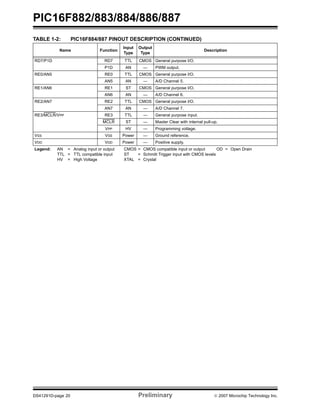
TABLE 1-2: PIC16F884/887 PINOUT DESCRIPTION 
Name Function 
Input 
Type 
Output 
Type 
Description 
RA0/AN0/ULPWU/C12IN0- RA0 TTL CMOS General purpose I/O. 
AN0 AN — A/D Channel 0 input. 
ULPWU AN — Ultra Low-Power Wake-up input. 
C12IN0- AN — Comparator C1 or C2 negative input. 
RA1/AN1/C12IN1- RA1 TTL CMOS General purpose I/O. 
AN1 AN — A/D Channel 1 input. 
C12IN1- AN — Comparator C1 or C2 negative input. 
RA2/AN2/VREF-/CVREF/C2IN+ RA2 TTL CMOS General purpose I/O. 
AN2 AN — A/D Channel 2. 
VREF- AN — A/D Negative Voltage Reference input. 
CVREF — AN Comparator Voltage Reference output. 
C2IN+ AN — Comparator C2 positive input. 
RA3/AN3/VREF+/C1IN+ RA3 TTL CMOS General purpose I/O. 
AN3 AN — A/D Channel 3. 
VREF+ AN — A/D Positive Voltage Reference input. 
C1IN+ AN — Comparator C1 positive input. 
RA4/T0CKI/C1OUT RA4 TTL CMOS General purpose I/O. 
T0CKI ST — Timer0 clock input. 
C1OUT — CMOS Comparator C1 output. 
RA5/AN4/SS/C2OUT RA5 TTL CMOS General purpose I/O. 
AN4 AN — A/D Channel 4. 
SS ST — Slave Select input. 
C2OUT — CMOS Comparator C2 output. 
RA6/OSC2/CLKOUT RA6 TTL CMOS General purpose I/O. 
OSC2 — XTAL Crystal/Resonator. 
CLKOUT — CMOS FOSC/4 output. 
RA7/OSC1/CLKIN RA7 TTL CMOS General purpose I/O. 
OSC1 XTAL — Crystal/Resonator. 
CLKIN ST — External clock input/RC oscillator connection. 
RB0/AN12/INT RB0 TTL CMOS General purpose I/O. Individually controlled interrupt-on-change. 
Individually enabled pull-up. 
AN12 AN — A/D Channel 12. 
INT ST — External interrupt. 
RB1/AN10/C12IN3- RB1 TTL CMOS General purpose I/O. Individually controlled interrupt-on-change. 
Individually enabled pull-up. 
AN10 AN — A/D Channel 10. 
C12IN3- AN — Comparator C1 or C2 negative input. 
RB2/AN8 RB2 TTL CMOS General purpose I/O. Individually controlled interrupt-on-change. 
Individually enabled pull-up. 
AN8 AN — A/D Channel 8. 
RB3/AN9/PGM/C12IN2- RB3 TTL CMOS General purpose I/O. Individually controlled interrupt-on-change. 
Individually enabled pull-up. 
AN9 AN — A/D Channel 9. 
PGM ST — Low-voltage ICSP™ Programming enable pin. 
C12IN2- AN — Comparator C1 or C2 negative input. 
Legend: AN = Analog input or output CMOS = CMOS compatible input or output OD = Open Drain 
TTL = TTL compatible input ST = Schmitt Trigger input with CMOS levels 
HV = High Voltage XTAL = Crystal 
DS41291D-page 18 Preliminary © 2007 Microchip Technology Inc.
PIC16F882/883/884/886/887 
TABLE 1-2: PIC16F884/887 PINOUT DESCRIPTION (CONTINUED) 
Name Function 
Input 
Type 
Output 
Type 
Description 
RB4/AN11 RB4 TTL CMOS General purpose I/O. Individually controlled interrupt-on-change. 
Individually enabled pull-up. 
AN11 AN — A/D Channel 11. 
RB5/AN13/T1G RB5 TTL CMOS General purpose I/O. Individually controlled interrupt-on-change. 
Individually enabled pull-up. 
AN13 AN — A/D Channel 13. 
T1G ST — Timer1 Gate input. 
RB6/ICSPCLK RB6 TTL CMOS General purpose I/O. Individually controlled interrupt-on-change. 
Individually enabled pull-up. 
ICSPCLK ST — Serial Programming Clock. 
RB7/ICSPDAT RB7 TTL CMOS General purpose I/O. Individually controlled interrupt-on-change. 
Individually enabled pull-up. 
ICSPDAT ST TTL ICSP™ Data I/O. 
RC0/T1OSO/T1CKI RC0 ST CMOS General purpose I/O. 
T1OSO — XTAL Timer1 oscillator output. 
T1CKI ST — Timer1 clock input. 
RC1/T1OSI/CCP2 RC1 ST CMOS General purpose I/O. 
T1OSI XTAL — Timer1 oscillator input. 
CCP2 ST CMOS Capture/Compare/PWM2. 
RC2/P1A/CCP1 RC2 ST CMOS General purpose I/O. 
P1A ST CMOS PWM output. 
CCP1 — CMOS Capture/Compare/PWM1. 
RC3/SCK/SCL RC3 ST CMOS General purpose I/O. 
SCK ST CMOS SPI clock. 
SCL ST OD I2C™ clock. 
RC4/SDI/SDA RC4 ST CMOS General purpose I/O. 
SDI ST — SPI data input. 
SDA ST OD I2C data input/output. 
RC5/SDO RC5 ST CMOS General purpose I/O. 
SDO — CMOS SPI data output. 
RC6/TX/CK RC6 ST CMOS General purpose I/O. 
TX — CMOS EUSART asynchronous transmit. 
CK ST CMOS EUSART synchronous clock. 
RC7/RX/DT RC7 ST CMOS General purpose I/O. 
RX ST — EUSART asynchronous input. 
DT ST CMOS EUSART synchronous data. 
RD0 RD0 TTL CMOS General purpose I/O. 
RD1 RD1 TTL CMOS General purpose I/O. 
RD2 RD2 TTL CMOS General purpose I/O. 
RD3 RD3 TTL CMOS General purpose I/O. 
RD4 RD4 TTL CMOS General purpose I/O. 
RD5/P1B RD5 TTL CMOS General purpose I/O. 
P1B — CMOS PWM output. 
RD6/P1C RD6 TTL CMOS General purpose I/O. 
P1C — CMOS PWM output. 
Legend: AN = Analog input or output CMOS = CMOS compatible input or output OD = Open Drain 
TTL = TTL compatible input ST = Schmitt Trigger input with CMOS levels 
HV = High Voltage XTAL = Crystal 
© 2007 Microchip Technology Inc. Preliminary DS41291D-page 19
PIC16F882/883/884/886/887 
TABLE 1-2: PIC16F884/887 PINOUT DESCRIPTION (CONTINUED) 
Name Function 
Input 
Type 
Output 
Type 
RD7/P1D RD7 TTL CMOS General purpose I/O. 
P1D AN — PWM output. 
RE0/AN5 RE0 TTL CMOS General purpose I/O. 
AN5 AN — A/D Channel 5. 
RE1/AN6 RE1 ST CMOS General purpose I/O. 
AN6 AN — A/D Channel 6. 
RE2/AN7 RE2 TTL CMOS General purpose I/O. 
AN7 AN — A/D Channel 7. 
RE3/MCLR/VPP RE3 TTL — General purpose input. 
Description 
MCLR ST — Master Clear with internal pull-up. 
VPP HV — Programming voltage. 
VSS VSS Power — Ground reference. 
VDD VDD Power — Positive supply. 
Legend: AN = Analog input or output CMOS = CMOS compatible input or output OD = Open Drain 
TTL = TTL compatible input ST = Schmitt Trigger input with CMOS levels 
HV = High Voltage XTAL = Crystal 
DS41291D-page 20 Preliminary © 2007 Microchip Technology Inc.
PIC16F882/883/884/886/887 
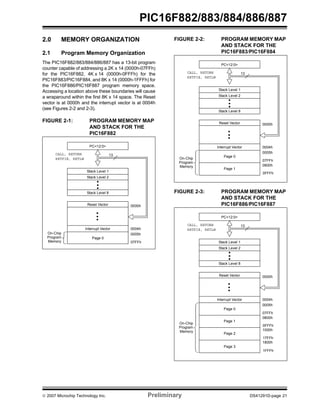
2.0 MEMORY ORGANIZATION 
2.1 Program Memory Organization 
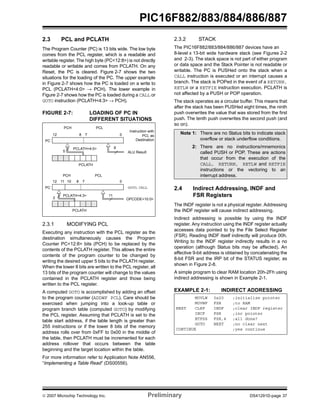
The PIC16F882/883/884/886/887 has a 13-bit program 
counter capable of addressing a 2K x 14 (0000h-07FFh) 
for the PIC16F882, 4K x 14 (0000h-0FFFh) for the 
PIC16F883/PIC16F884, and 8K x 14 (0000h-1FFFh) for 
the PIC16F886/PIC16F887 program memory space. 
Accessing a location above these boundaries will cause 
a wraparound within the first 8K x 14 space. The Reset 
vector is at 0000h and the interrupt vector is at 0004h 
(see Figures 2-2 and 2-3). 
FIGURE 2-1: PROGRAM MEMORY MAP 
AND STACK FOR THE 
PIC16F882 
FIGURE 2-2: PROGRAM MEMORY MAP 
AND STACK FOR THE 
PIC16F883/PIC16F884 
PC<12:0> 
13 
0000h 
0004h 
0005h 
07FFh 
0800h 
Stack Level 1 
Stack Level 2 
Stack Level 8 
Reset Vector 
Interrupt Vector 
CALL, RETURN 
RETFIE, RETLW 
Page 0 
Page 1 
0FFFh 
On-Chip 
Program 
Memory 
FIGURE 2-3: PROGRAM MEMORY MAP 
AND STACK FOR THE 
PIC16F886/PIC16F887 
PC<12:0> 
13 
0000h 
0004h 
0005h 
07FFh 
Stack Level 1 
Stack Level 2 
Stack Level 8 
Reset Vector 
Interrupt Vector 
CALL, RETURN 
RETFIE, RETLW 
Page 0 
On-Chip 
Program 
Memory 
PC<12:0> 
13 
0000h 
0004h 
0005h 
07FFh 
0800h 
0FFFh 
1000h 
17FFh 
Stack Level 1 
Stack Level 2 
Stack Level 8 
Reset Vector 
Interrupt Vector 
CALL, RETURN 
RETFIE, RETLW 
Page 0 
Page 1 
Page 2 
Page 3 
1800h 
1FFFh 
On-Chip 
Program 
Memory 
© 2007 Microchip Technology Inc. Preliminary DS41291D-page 21
PIC16F882/883/884/886/887 
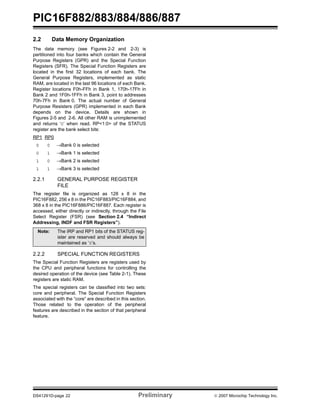
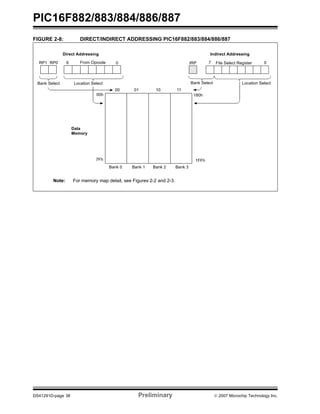
2.2 Data Memory Organization 
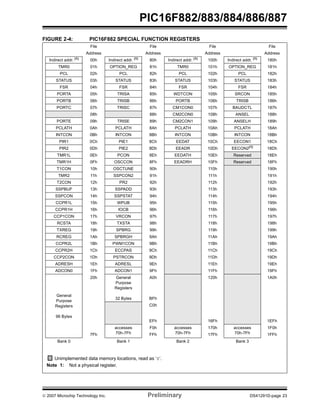
The data memory (see Figures 2-2 and 2-3) is 
partitioned into four banks which contain the General 
Purpose Registers (GPR) and the Special Function 
Registers (SFR). The Special Function Registers are 
located in the first 32 locations of each bank. The 
General Purpose Registers, implemented as static 
RAM, are located in the last 96 locations of each Bank. 
Register locations F0h-FFh in Bank 1, 170h-17Fh in 
Bank 2 and 1F0h-1FFh in Bank 3, point to addresses 
70h-7Fh in Bank 0. The actual number of General 
Purpose Resisters (GPR) implemented in each Bank 
depends on the device. Details are shown in 
Figures 2-5 and 2-6. All other RAM is unimplemented 
and returns ‘0’ when read. RP<1:0> of the STATUS 
register are the bank select bits: 
RP1 RP0 
0 0 →Bank 0 is selected 
0 1 →Bank 1 is selected 
1 0 →Bank 2 is selected 
1 1 →Bank 3 is selected 
2.2.1 GENERAL PURPOSE REGISTER 
FILE 
The register file is organized as 128 x 8 in the 
PIC16F882, 256 x 8 in the PIC16F883/PIC16F884, and 
368 x 8 in the PIC16F886/PIC16F887. Each register is 
accessed, either directly or indirectly, through the File 
Select Register (FSR) (see Section 2.4 “Indirect 
Addressing, INDF and FSR Registers”). 
Note: The IRP and RP1 bits of the STATUS reg-ister 
are reserved and should always be 
maintained as ‘0’s. 
2.2.2 SPECIAL FUNCTION REGISTERS 
The Special Function Registers are registers used by 
the CPU and peripheral functions for controlling the 
desired operation of the device (see Table 2-1). These 
registers are static RAM. 
The special registers can be classified into two sets: 
core and peripheral. The Special Function Registers 
associated with the “core” are described in this section. 
Those related to the operation of the peripheral 
features are described in the section of that peripheral 
feature. 
DS41291D-page 22 Preliminary © 2007 Microchip Technology Inc.
PIC16F882/883/884/886/887 
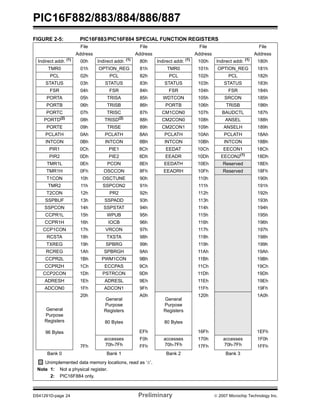
FIGURE 2-4: PIC16F882 SPECIAL FUNCTION REGISTERS 
File File File File 
Address Address Address Address 
Indirect addr. (1) 00h Indirect addr. (1) 80h Indirect addr. (1) 100h Indirect addr. (1) 180h 
TMR0 01h OPTION_REG 81h TMR0 101h OPTION_REG 181h 
PCL 02h PCL 82h PCL 102h PCL 182h 
STATUS 03h STATUS 83h STATUS 103h STATUS 183h 
FSR 04h FSR 84h FSR 104h FSR 184h 
PORTA 05h TRISA 85h WDTCON 105h SRCON 185h 
PORTB 06h TRISB 86h PORTB 106h TRISB 186h 
PORTC 07h TRISC 87h CM1CON0 107h BAUDCTL 187h 
08h 88h CM2CON0 108h ANSEL 188h 
PORTE 09h TRISE 89h CM2CON1 109h ANSELH 189h 
PCLATH 0Ah PCLATH 8Ah PCLATH 10Ah PCLATH 18Ah 
INTCON 0Bh INTCON 8Bh INTCON 10Bh INTCON 18Bh 
PIR1 0Ch PIE1 8Ch EEDAT 10Ch EECON1 18Ch 
PIR2 0Dh PIE2 8Dh EEADR 10Dh EECON2(1) 18Dh 
TMR1L 0Eh PCON 8Eh EEDATH 10Eh Reserved 18Eh 
TMR1H 0Fh OSCCON 8Fh EEADRH 10Fh Reserved 18Fh 
T1CON 10h OSCTUNE 90h 110h 190h 
TMR2 11h SSPCON2 91h 111h 191h 
T2CON 12h PR2 92h 112h 192h 
SSPBUF 13h SSPADD 93h 113h 193h 
SSPCON 14h SSPSTAT 94h 114h 194h 
CCPR1L 15h WPUB 95h 115h 195h 
CCPR1H 16h IOCB 96h 116h 196h 
CCP1CON 17h VRCON 97h 117h 197h 
RCSTA 18h TXSTA 98h 118h 198h 
TXREG 19h SPBRG 99h 119h 199h 
RCREG 1Ah SPBRGH 9Ah 11Ah 19Ah 
CCPR2L 1Bh PWM1CON 9Bh 11Bh 19Bh 
CCPR2H 1Ch ECCPAS 9Ch 11Ch 19Ch 
CCP2CON 1Dh PSTRCON 9Dh 11Dh 19Dh 
ADRESH 1Eh ADRESL 9Eh 11Eh 19Eh 
ADCON0 1Fh ADCON1 9Fh 11Fh 19Fh 
General 
Purpose 
Registers 
96 Bytes 
20h General 
Purpose 
Registers 
32 Bytes 
A0h 
BFh 
120h 1A0h 
C0h 
EFh 16Fh 1EFh 
accesses 
70h-7Fh 
F0h accesses 
70h-7Fh 
170h accesses 
70h-7Fh 
1F0h 
7Fh FFh 17Fh 1FFh 
Bank 0 Bank 1 Bank 2 Bank 3 
Unimplemented data memory locations, read as ‘0’. 
Note 1: Not a physical register. 
© 2007 Microchip Technology Inc. Preliminary DS41291D-page 23
PIC16F882/883/884/886/887 
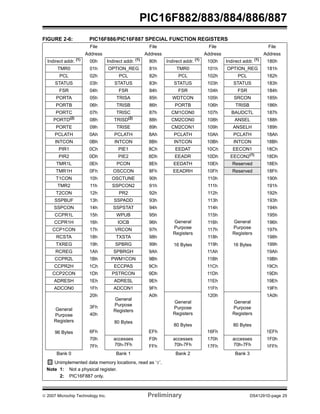
FIGURE 2-5: PIC16F883/PIC16F884 SPECIAL FUNCTION REGISTERS 
File File File File 
Address Address Address Address 
Indirect addr. (1) 00h Indirect addr. (1) 80h Indirect addr. (1) 100h Indirect addr. (1) 180h 
TMR0 01h OPTION_REG 81h TMR0 101h OPTION_REG 181h 
PCL 02h PCL 82h PCL 102h PCL 182h 
STATUS 03h STATUS 83h STATUS 103h STATUS 183h 
FSR 04h FSR 84h FSR 104h FSR 184h 
PORTA 05h TRISA 85h WDTCON 105h SRCON 185h 
PORTB 06h TRISB 86h PORTB 106h TRISB 186h 
PORTC 07h TRISC 87h CM1CON0 107h BAUDCTL 187h 
PORTD(2) 08h TRISD(2) 88h CM2CON0 108h ANSEL 188h 
PORTE 09h TRISE 89h CM2CON1 109h ANSELH 189h 
PCLATH 0Ah PCLATH 8Ah PCLATH 10Ah PCLATH 18Ah 
INTCON 0Bh INTCON 8Bh INTCON 10Bh INTCON 18Bh 
PIR1 0Ch PIE1 8Ch EEDAT 10Ch EECON1 18Ch 
PIR2 0Dh PIE2 8Dh EEADR 10Dh EECON2(1) 18Dh 
TMR1L 0Eh PCON 8Eh EEDATH 10Eh Reserved 18Eh 
TMR1H 0Fh OSCCON 8Fh EEADRH 10Fh Reserved 18Fh 
T1CON 10h OSCTUNE 90h 110h 190h 
TMR2 11h SSPCON2 91h 111h 191h 
T2CON 12h PR2 92h 112h 192h 
SSPBUF 13h SSPADD 93h 113h 193h 
SSPCON 14h SSPSTAT 94h 114h 194h 
CCPR1L 15h WPUB 95h 115h 195h 
CCPR1H 16h IOCB 96h 116h 196h 
CCP1CON 17h VRCON 97h 117h 197h 
RCSTA 18h TXSTA 98h 118h 198h 
TXREG 19h SPBRG 99h 119h 199h 
RCREG 1Ah SPBRGH 9Ah 11Ah 19Ah 
CCPR2L 1Bh PWM1CON 9Bh 11Bh 19Bh 
CCPR2H 1Ch ECCPAS 9Ch 11Ch 19Ch 
CCP2CON 1Dh PSTRCON 9Dh 11Dh 19Dh 
ADRESH 1Eh ADRESL 9Eh 11Eh 19Eh 
ADCON0 1Fh ADCON1 9Fh 11Fh 19Fh 
General 
Purpose 
Registers 
96 Bytes 
20h 
General 
Purpose 
Registers 
80 Bytes 
A0h 
General 
Purpose 
Registers 
80 Bytes 
120h 1A0h 
EFh 16Fh 1EFh 
accesses 
70h-7Fh 
F0h accesses 
70h-7Fh 
170h accesses 
70h-7Fh 
1F0h 
7Fh FFh 17Fh 1FFh 
Bank 0 Bank 1 Bank 2 Bank 3 
Unimplemented data memory locations, read as ‘0’. 
Note 1: Not a physical register. 
2: PIC16F884 only. 
DS41291D-page 24 Preliminary © 2007 Microchip Technology Inc.
PIC16F882/883/884/886/887 
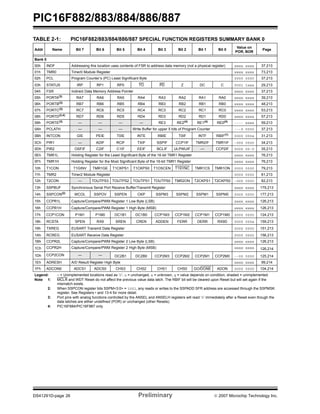
FIGURE 2-6: PIC16F886/PIC16F887 SPECIAL FUNCTION REGISTERS 
File File File File 
Address Address Address Address 
Indirect addr. (1) 00h Indirect addr. (1) 80h Indirect addr. (1) 100h Indirect addr. (1) 180h 
TMR0 01h OPTION_REG 81h TMR0 101h OPTION_REG 181h 
PCL 02h PCL 82h PCL 102h PCL 182h 
STATUS 03h STATUS 83h STATUS 103h STATUS 183h 
FSR 04h FSR 84h FSR 104h FSR 184h 
PORTA 05h TRISA 85h WDTCON 105h SRCON 185h 
PORTB 06h TRISB 86h PORTB 106h TRISB 186h 
PORTC 07h TRISC 87h CM1CON0 107h BAUDCTL 187h 
PORTD(2) 08h TRISD(2) 88h CM2CON0 108h ANSEL 188h 
PORTE 09h TRISE 89h CM2CON1 109h ANSELH 189h 
PCLATH 0Ah PCLATH 8Ah PCLATH 10Ah PCLATH 18Ah 
INTCON 0Bh INTCON 8Bh INTCON 10Bh INTCON 18Bh 
PIR1 0Ch PIE1 8Ch EEDAT 10Ch EECON1 18Ch 
PIR2 0Dh PIE2 8Dh EEADR 10Dh EECON2(1) 18Dh 
TMR1L 0Eh PCON 8Eh EEDATH 10Eh Reserved 18Eh 
TMR1H 0Fh OSCCON 8Fh EEADRH 10Fh Reserved 18Fh 
T1CON 10h OSCTUNE 90h 
TMR2 11h SSPCON2 91h 111h 191h 
T2CON 12h PR2 92h 112h 192h 
SSPBUF 13h SSPADD 93h 113h 193h 
SSPCON 14h SSPSTAT 94h 114h 194h 
CCPR1L 15h WPUB 95h 115h 195h 
CCPR1H 16h IOCB 96h General 
116h 196h 
CCP1CON 17h VRCON 97h Purpose 
117h 197h 
Registers 
RCSTA 18h TXSTA 98h 118h 198h 
TXREG 19h SPBRG 99h 16 Bytes 
119h 199h 
RCREG 1Ah SPBRGH 9Ah 11Ah 19Ah 
CCPR2L 1Bh PWM1CON 9Bh 11Bh 19Bh 
CCPR2H 1Ch ECCPAS 9Ch 11Ch 19Ch 
CCP2CON 1Dh PSTRCON 9Dh 11Dh 19Dh 
ADRESH 1Eh ADRESL 9Eh 11Eh 19Eh 
ADCON0 1Fh ADCON1 9Fh 11Fh 19Fh 
110h 
General 
Purpose 
Registers 
16 Bytes 
190h 
General 
Purpose 
Registers 
96 Bytes 
20h 
3Fh 
General 
Purpose 
Registers 
80 Bytes 
A0h 
General 
Purpose 
Registers 
80 Bytes 
120h 
General 
Purpose 
Registers 
80 Bytes 
1A0h 
40h 
6Fh EFh 16Fh 1EFh 
70h accesses 
70h-7Fh 
F0h accesses 
70h-7Fh 
170h accesses 
70h-7Fh 
1F0h 
7Fh FFh 17Fh 1FFh 
Bank 0 Bank 1 Bank 2 Bank 3 
Unimplemented data memory locations, read as ‘0’. 
Note 1: Not a physical register. 
2: PIC16F887 only. 
© 2007 Microchip Technology Inc. Preliminary DS41291D-page 25
PIC16F882/883/884/886/887 
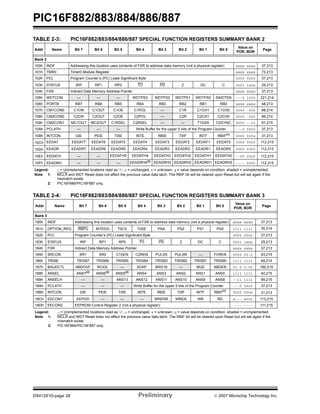
TABLE 2-1: PIC16F882/883/884/886/887 SPECIAL FUNCTION REGISTERS SUMMARY BANK 0 
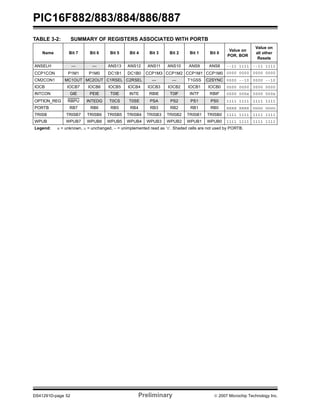
Addr Name Bit 7 Bit 6 Bit 5 Bit 4 Bit 3 Bit 2 Bit 1 Bit 0 Value on 
POR, BOR Page 
Bank 0 
00h INDF Addressing this location uses contents of FSR to address data memory (not a physical register) xxxx xxxx 37,213 
01h TMR0 Timer0 Module Register xxxx xxxx 73,213 
02h PCL Program Counter’s (PC) Least Significant Byte 0000 0000 37,213 
03h STATUS IRP RP1 RP0 TO PD Z DC C 0001 1xxx 29,213 
04h FSR Indirect Data Memory Address Pointer xxxx xxxx 37,213 
05h PORTA(3) RA7 RA6 RA5 RA4 RA3 RA2 RA1 RA0 xxxx xxxx 39,213 
06h PORTB(3) RB7 RB6 RB5 RB4 RB3 RB2 RB1 RB0 xxxx xxxx 48,213 
07h PORTC(3) RC7 RC6 RC5 RC4 RC3 RC2 RC1 RC0 xxxx xxxx 53,213 
08h PORTD(3,4) RD7 RD6 RD5 RD4 RD3 RD2 RD1 RD0 xxxx xxxx 57,213 
09h PORTE(3) — — — — RE3 RE2(4) RE1(4) RE0(4) ---- xxxx 59,213 
0Ah PCLATH — — — Write Buffer for upper 5 bits of Program Counter ---0 0000 37,213 
0Bh INTCON GIE PEIE T0IE INTE RBIE T0IF INTF RBIF(1) 0000 000x 31,213 
0Ch PIR1 — ADIF RCIF TXIF SSPIF CCP1IF TMR2IF TMR1IF -000 0000 34,213 
0Dh PIR2 OSFIF C2IF C1IF EEIF BCLIF ULPWUIF — CCP2IF 0000 00-0 35,213 
0Eh TMR1L Holding Register for the Least Significant Byte of the 16-bit TMR1 Register xxxx xxxx 76,213 
0Fh TMR1H Holding Register for the Most Significant Byte of the 16-bit TMR1 Register xxxx xxxx 76,213 
10h T1CON T1GINV TMR1GE T1CKPS1 T1CKPS0 T1OSCEN T1SYNC TMR1CS TMR1ON 0000 0000 79,213 
11h TMR2 Timer2 Module Register 0000 0000 81,213 
12h T2CON — TOUTPS3 TOUTPS2 TOUTPS1 TOUTPS0 TMR2ON T2CKPS1 T2CKPS0 -000 0000 82,213 
13h SSPBUF Synchronous Serial Port Receive Buffer/Transmit Register xxxx xxxx 179,213 
14h SSPCON(2) WCOL SSPOV SSPEN CKP SSPM3 SSPM2 SSPM1 SSPM0 0000 0000 177,213 
15h CCPR1L Capture/Compare/PWM Register 1 Low Byte (LSB) xxxx xxxx 126,213 
16h CCPR1H Capture/Compare/PWM Register 1 High Byte (MSB) xxxx xxxx 126,213 
17h CCP1CON P1M1 P1M0 DC1B1 DC1B0 CCP1M3 CCP1M2 CCP1M1 CCP1M0 0000 0000 124,213 
18h RCSTA SPEN RX9 SREN CREN ADDEN FERR OERR RX9D 0000 000x 159,213 
19h TXREG EUSART Transmit Data Register 0000 0000 151,213 
1Ah RCREG EUSART Receive Data Register 0000 0000 156,213 
1Bh CCPR2L Capture/Compare/PWM Register 2 Low Byte (LSB) xxxx xxxx 126,213 
1Ch CCPR2H Capture/Compare/PWM Register 2 High Byte (MSB) xxxx xxxx 126,214 
1Dh CCP2CON — — DC2B1 DC2B0 CCP2M3 CCP2M2 CCP2M1 CCP2M0 --00 0000 125,214 
1Eh ADRESH A/D Result Register High Byte xxxx xxxx 99,214 
1Fh ADCON0 ADCS1 ADCS0 CHS3 CHS2 CHS1 CHS0 GO/DONE ADON 0000 0000 104,214 
Legend: – = Unimplemented locations read as ‘0’, u = unchanged, x = unknown, q = value depends on condition, shaded = unimplemented 
Note 1: MCLR and WDT Reset do not affect the previous value data latch. The RBIF bit will be cleared upon Reset but will set again if the 
mismatch exists. 
2: When SSPCON register bits SSPM<3:0> = 1001, any reads or writes to the SSPADD SFR address are accessed through the SSPMSK 
register. See Registers • and 13-4 for more detail. 
3: Port pins with analog functions controlled by the ANSEL and ANSELH registers will read ‘0’ immediately after a Reset even though the 
data latches are either undefined (POR) or unchanged (other Resets). 
4: PIC16F884/PIC16F887 only. 
DS41291D-page 26 Preliminary © 2007 Microchip Technology Inc.
PIC16F882/883/884/886/887 
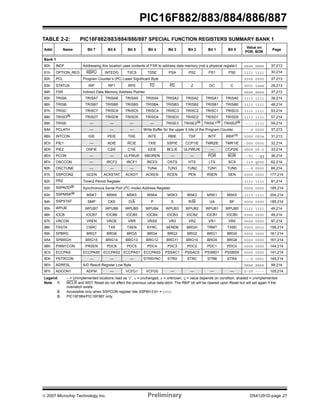
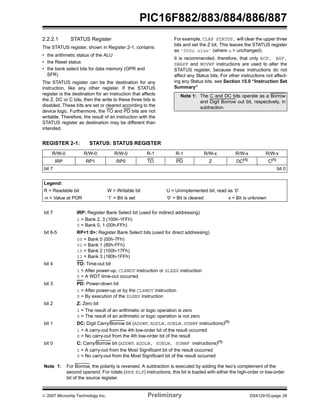
TABLE 2-2: PIC16F882/883/884/886/887 SPECIAL FUNCTION REGISTERS SUMMARY BANK 1 
Addr Name Bit 7 Bit 6 Bit 5 Bit 4 Bit 3 Bit 2 Bit 1 Bit 0 Value on 
POR, BOR Page 
Bank 1 
80h INDF Addressing this location uses contents of FSR to address data memory (not a physical register) xxxx xxxx 37,213 
81h OPTION_REG RBPU INTEDG T0CS T0SE PSA PS2 PS1 PS0 1111 1111 30,214 
82h PCL Program Counter’s (PC) Least Significant Byte 0000 0000 37,213 
83h STATUS IRP RP1 RP0 TO PD Z DC C 0001 1xxx 29,213 
84h FSR Indirect Data Memory Address Pointer xxxx xxxx 37,213 
85h TRISA TRISA7 TRISA6 TRISA5 TRISA4 TRISA3 TRISA2 TRISA1 TRISA0 1111 1111 39,214 
86h TRISB TRISB7 TRISB6 TRISB5 TRISB4 TRISB3 TRISB2 TRISB1 TRISB0 1111 1111 48,214 
87h TRISC TRISC7 TRISC6 TRISC5 TRISC4 TRISC3 TRISC2 TRISC1 TRISC0 1111 1111 53,214 
88h TRISD(3) TRISD7 TRISD6 TRISD5 TRISD4 TRISD3 TRISD2 TRISD1 TRISD0 1111 1111 57,214 
89h TRISE — — — — TRISE3 TRISE2(3) TRISE1(3) TRISE0(3) ---- 1111 59,214 
8Ah PCLATH — — — Write Buffer for the upper 5 bits of the Program Counter ---0 0000 37,213 
8Bh INTCON GIE PEIE T0IE INTE RBIE T0IF INTF RBIF(1) 0000 000x 31,213 
8Ch PIE1 — ADIE RCIE TXIE SSPIE CCP1IE TMR2IE TMR1IE -000 0000 32,214 
8Dh PIE2 OSFIE C2IE C1IE EEIE BCLIE ULPWUIE — CCP2IE 0000 00-0 33,214 
8Eh PCON — — ULPWUE SBOREN — — POR BOR --01 --qq 36,214 
8Fh OSCCON — IRCF2 IRCF1 IRCF0 OSTS HTS LTS SCS -110 q000 62,214 
90h OSCTUNE — — — TUN4 TUN3 TUN2 TUN1 TUN0 ---0 0000 66,214 
91h SSPCON2 GCEN ACKSTAT ACKDT ACKEN RCEN PEN RSEN SEN 0000 0000 177,214 
92h PR2 Timer2 Period Register 1111 1111 81,214 
93h SSPADD(2) Synchronous Serial Port (I2C mode) Address Register 0000 0000 185,214 
93h SSPMSK(2) MSK7 MSK6 MSK5 MSK4 MSK3 MSK2 MSK1 MSK0 1111 1111 204,214 
94h SSPSTAT SMP CKE D/A P S R/W UA BF 0000 0000 185,214 
95h WPUB WPUB7 WPUB6 WPUB5 WPUB4 WPUB3 WPUB2 WPUB1 WPUB0 1111 1111 49,214 
96h IOCB IOCB7 IOCB6 IOCB5 IOCB4 IOCB3 IOCB2 IOCB1 IOCB0 0000 0000 49,214 
97h VRCON VREN VROE VRR VRSS VR3 VR2 VR1 VR0 0000 0000 97,214 
98h TXSTA CSRC TX9 TXEN SYNC SENDB BRGH TRMT TX9D 0000 0010 158,214 
99h SPBRG BRG7 BRG6 BRG5 BRG4 BRG3 BRG2 BRG1 BRG0 0000 0000 161,214 
9Ah SPBRGH BRG15 BRG14 BRG13 BRG12 BRG11 BRG10 BRG9 BRG8 0000 0000 161,214 
9Bh PWM1CON PRSEN PDC6 PDC5 PDC4 PDC3 PDC2 PDC1 PDC0 0000 0000 144,214 
9Ch ECCPAS ECCPASE ECCPAS2 ECCPAS1 ECCPAS0 PSSAC1 PSSAC0 PSSBD1 PSSBD0 0000 0000 141,214 
9Dh PSTRCON — — — STRSYNC STRD STRC STRB STRA ---0 0001 145,214 
9Eh ADRESL A/D Result Register Low Byte xxxx xxxx 99,214 
9Fh ADCON1 ADFM — VCFG1 VCFG0 — — — — 0-00 ---- 105,214 
Legend: – = Unimplemented locations read as ‘0’, u = unchanged, x = unknown, q = value depends on condition, shaded = unimplemented 
Note 1: MCLR and WDT Reset do not affect the previous value data latch. The RBIF bit will be cleared upon Reset but will set again if the 
mismatch exists. 
2: Accessible only when SSPCON register bits SSPM<3:0> = 1001. 
3: PIC16F884/PIC16F887 only. 
© 2007 Microchip Technology Inc. Preliminary DS41291D-page 27
PIC16F882/883/884/886/887 
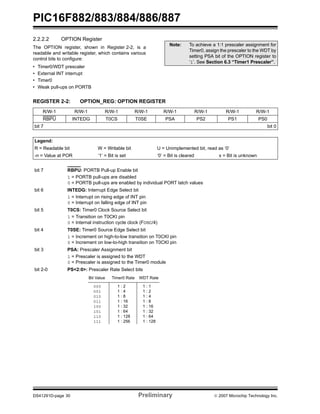
TABLE 2-3: PIC16F882/883/884/886/887 SPECIAL FUNCTION REGISTERS SUMMARY BANK 2 
Addr Name Bit 7 Bit 6 Bit 5 Bit 4 Bit 3 Bit 2 Bit 1 Bit 0 Value on 
POR, BOR Page 
Bank 2 
100h INDF Addressing this location uses contents of FSR to address data memory (not a physical register) xxxx xxxx 37,213 
101h TMR0 Timer0 Module Register xxxx xxxx 73,213 
102h PCL Program Counter’s (PC) Least Significant Byte 0000 0000 37,213 
103h STATUS IRP RP1 RP0 TO PD Z DC C 0001 1xxx 29,213 
104h FSR Indirect Data Memory Address Pointer xxxx xxxx 37,213 
105h WDTCON — — — WDTPS3 WDTPS2 WDTPS1 WDTPS0 SWDTEN ---0 1000 221,214 
106h PORTB RB7 RB6 RB5 RB4 RB3 RB2 RB1 RB0 xxxx xxxx 48,213 
107h CM1CON0 C1ON C1OUT C1OE C1POL — C1R C1CH1 C1CH0 0000 -000 88,214 
108h CM2CON0 C2ON C2OUT C2OE C2POL — C2R C2CH1 C2CH0 0000 -000 89,214 
109h CM2CON1 MC1OUT MC2OUT C1RSEL C2RSEL — — T1GSS C2SYNC 0000 --10 91,215 
10Ah PCLATH — — — Write Buffer for the upper 5 bits of the Program Counter ---0 0000 37,213 
10Bh INTCON GIE PEIE T0IE INTE RBIE T0IF INTF RBIF(1) 0000 000x 31,213 
10Ch EEDAT EEDAT7 EEDAT6 EEDAT5 EEDAT4 EEDAT3 EEDAT2 EEDAT1 EEDAT0 0000 0000 112,215 
10Dh EEADR EEADR7 EEADR6 EEADR5 EEADR4 EEADR3 EEADR2 EEADR1 EEADR0 0000 0000 112,215 
10Eh EEDATH — — EEDATH5 EEDATH4 EEDATH3 EEDATH2 EEDATH1 EEDATH0 --00 0000 112,215 
10Fh EEADRH — — — EEADRH4(2) EEADRH3 EEADRH2 EEADRH1 EEADRH0 ---- 0000 112,215 
Legend: – = Unimplemented locations read as ‘0’, u = unchanged, x = unknown, q = value depends on condition, shaded = unimplemented 
Note 1: MCLR and WDT Reset does not affect the previous value data latch. The RBIF bit will be cleared upon Reset but will set again if the 
mismatch exists. 
2: PIC16F886/PIC16F887 only. 
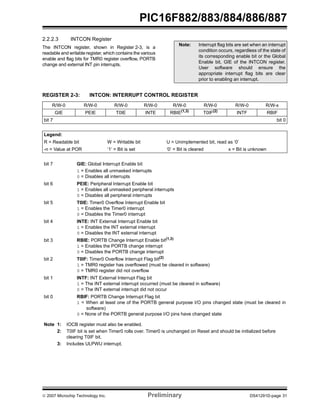
TABLE 2-4: PIC16F882/883/884/886/887 SPECIAL FUNCTION REGISTERS SUMMARY BANK 3 
Addr Name Bit 7 Bit 6 Bit 5 Bit 4 Bit 3 Bit 2 Bit 1 Bit 0 Value on 
POR, BOR Page 
Bank 3 
180h INDF Addressing this location uses contents of FSR to address data memory (not a physical register) xxxx xxxx 37,213 
181h OPTION_REG RBPU INTEDG T0CS T0SE PSA PS2 PS1 PS0 1111 1111 30,214 
182h PCL Program Counter’s (PC) Least Significant Byte 0000 0000 37,213 
183h STATUS IRP RP1 RP0 TO PD Z DC C 0001 1xxx 29,213 
184h FSR Indirect Data Memory Address Pointer xxxx xxxx 37,213 
185h SRCON SR1 SR0 C1SEN C2REN PULSS PULSR — FVREN 0000 00-0 93,215 
186h TRISB TRISB7 TRISB6 TRISB5 TRISB4 TRISB3 TRISB2 TRISB1 TRISB0 1111 1111 48,214 
187h BAUDCTL ABDOVF RCIDL — SCKP BRG16 — WUE ABDEN 01-0 0-00 160,215 
188h ANSEL ANS7(2) ANS6(2) ANS5(2) ANS4 ANS3 ANS2 ANS1 ANS0 1111 1111 40,215 
189h ANSELH — — ANS13 ANS12 ANS11 ANS10 ANS9 ANS8 --11 1111 99,215 
18Ah PCLATH — — — Write Buffer for the upper 5 bits of the Program Counter ---0 0000 37,213 
18Bh INTCON GIE PEIE T0IE INTE RBIE T0IF INTF RBIF(1) 0000 000x 31,213 
18Ch EECON1 EEPGD — — — WRERR WREN WR RD x--- x000 113,215 
18Dh EECON2 EEPROM Control Register 2 (not a physical register) ---- ---- 111,215 
Legend: – = Unimplemented locations read as ‘0’, u = unchanged, x = unknown, q = value depends on condition, shaded = unimplemented 
Note 1: MCLR and WDT Reset does not affect the previous value data latch. The RBIF bit will be cleared upon Reset but will set again if the 
mismatch exists. 
2: PIC16F884/PIC16F887 only. 
DS41291D-page 28 Preliminary © 2007 Microchip Technology Inc.
PIC16F882/883/884/886/887 
2.2.2.1 STATUS Register 
The STATUS register, shown in Register 2-1, contains: 
• the arithmetic status of the ALU 
• the Reset status 
• the bank select bits for data memory (GPR and 
SFR) 
The STATUS register can be the destination for any 
instruction, like any other register. If the STATUS 
register is the destination for an instruction that affects 
the Z, DC or C bits, then the write to these three bits is 
disabled. These bits are set or cleared according to the 
device logic. Furthermore, the TO and PD bits are not 
writable. Therefore, the result of an instruction with the 
STATUS register as destination may be different than 
intended. 
For example, CLRF STATUS, will clear the upper three 
bits and set the Z bit. This leaves the STATUS register 
as ‘000u u1uu’ (where u = unchanged). 
It is recommended, therefore, that only BCF, BSF, 
SWAPF and MOVWF instructions are used to alter the 
STATUS register, because these instructions do not 
affect any Status bits. For other instructions not affect-ing 
any Status bits, see Section 15.0 “Instruction Set 
Summary” 
Note 1: The C and DC bits operate as a Borrow 
and Digit Borrow out bit, respectively, in 
subtraction. 
REGISTER 2-1: STATUS: STATUS REGISTER 
R/W-0 R/W-0 R/W-0 R-1 R-1 R/W-x R/W-x R/W-x 
IRP RP1 RP0 TO PD Z DC(1) C(1) 
bit 7 bit 0 
Legend: 
R = Readable bit W = Writable bit U = Unimplemented bit, read as ‘0’ 
-n = Value at POR ‘1’ = Bit is set ‘0’ = Bit is cleared x = Bit is unknown 
bit 7 IRP: Register Bank Select bit (used for indirect addressing) 
1 = Bank 2, 3 (100h-1FFh) 
0 = Bank 0, 1 (00h-FFh) 
bit 6-5 RP<1:0>: Register Bank Select bits (used for direct addressing) 
00 = Bank 0 (00h-7Fh) 
01 = Bank 1 (80h-FFh) 
10 = Bank 2 (100h-17Fh) 
11 = Bank 3 (180h-1FFh) 
bit 4 TO: Time-out bit 
1 = After power-up, CLRWDT instruction or SLEEP instruction 
0 = A WDT time-out occurred 
bit 3 PD: Power-down bit 
1 = After power-up or by the CLRWDT instruction 
0 = By execution of the SLEEP instruction 
bit 2 Z: Zero bit 
1 = The result of an arithmetic or logic operation is zero 
0 = The result of an arithmetic or logic operation is not zero 
bit 1 DC: Digit Carry/Borrow bit (ADDWF, ADDLW,SUBLW,SUBWF instructions)(1) 
1 = A carry-out from the 4th low-order bit of the result occurred 
0 = No carry-out from the 4th low-order bit of the result 
bit 0 C: Carry/Borrow bit (ADDWF, ADDLW, SUBLW, SUBWF instructions)(1) 
1 = A carry-out from the Most Significant bit of the result occurred 
0 = No carry-out from the Most Significant bit of the result occurred 
Note 1: For Borrow, the polarity is reversed. A subtraction is executed by adding the two’s complement of the 
second operand. For rotate (RRF, RLF) instructions, this bit is loaded with either the high-order or low-order 
bit of the source register. 
© 2007 Microchip Technology Inc. Preliminary DS41291D-page 29
PIC16F882/883/884/886/887 
2.2.2.2 OPTION Register 
The OPTION register, shown in Register 2-2, is a 
readable and writable register, which contains various 
control bits to configure: 
• Timer0/WDT prescaler 
• External INT interrupt 
• Timer0 
• Weak pull-ups on PORTB 
Note: To achieve a 1:1 prescaler assignment for 
Timer0, assign the prescaler to the WDT by 
setting PSA bit of the OPTION register to 
‘1’. See Section 6.3 “Timer1 Prescaler”. 
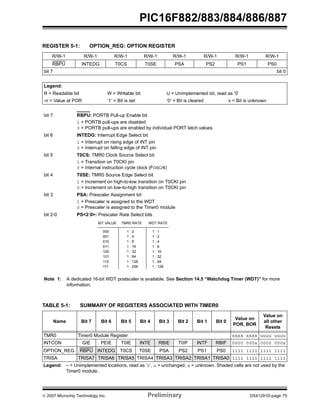
REGISTER 2-2: OPTION_REG: OPTION REGISTER 
R/W-1 R/W-1 R/W-1 R/W-1 R/W-1 R/W-1 R/W-1 R/W-1 
RBPU INTEDG T0CS T0SE PSA PS2 PS1 PS0 
bit 7 bit 0 
Legend: 
R = Readable bit W = Writable bit U = Unimplemented bit, read as ‘0’ 
-n = Value at POR ‘1’ = Bit is set ‘0’ = Bit is cleared x = Bit is unknown 
bit 7 RBPU: PORTB Pull-up Enable bit 
1 = PORTB pull-ups are disabled 
0 = PORTB pull-ups are enabled by individual PORT latch values 
bit 6 INTEDG: Interrupt Edge Select bit 
1 = Interrupt on rising edge of INT pin 
0 = Interrupt on falling edge of INT pin 
bit 5 T0CS: Timer0 Clock Source Select bit 
1 = Transition on T0CKI pin 
0 = Internal instruction cycle clock (FOSC/4) 
bit 4 T0SE: Timer0 Source Edge Select bit 
1 = Increment on high-to-low transition on T0CKI pin 
0 = Increment on low-to-high transition on T0CKI pin 
bit 3 PSA: Prescaler Assignment bit 
1 = Prescaler is assigned to the WDT 
0 = Prescaler is assigned to the Timer0 module 
bit 2-0 PS<2:0>: Prescaler Rate Select bits 
Bit Value Timer0 Rate WDT Rate 
000 
001 
010 
011 
100 
101 
110 
111 
1 : 2 
1 : 4 
1 : 8 
1 : 16 
1 : 32 
1 : 64 
1 : 128 
1 : 256 
1 : 1 
1 : 2 
1 : 4 
1 : 8 
1 : 16 
1 : 32 
1 : 64 
1 : 128 
DS41291D-page 30 Preliminary © 2007 Microchip Technology Inc.
PIC16F882/883/884/886/887 
2.2.2.3 INTCON Register 
The INTCON register, shown in Register 2-3, is a 
readable and writable register, which contains the various 
enable and flag bits for TMR0 register overflow, PORTB 
change and external INT pin interrupts. 
Note: Interrupt flag bits are set when an interrupt 
condition occurs, regardless of the state of 
its corresponding enable bit or the Global 
Enable bit, GIE of the INTCON register. 
User software should ensure the 
appropriate interrupt flag bits are clear 
prior to enabling an interrupt. 
REGISTER 2-3: INTCON: INTERRUPT CONTROL REGISTER 
R/W-0 R/W-0 R/W-0 R/W-0 R/W-0 R/W-0 R/W-0 R/W-x 
GIE PEIE T0IE INTE RBIE(1,3) T0IF(2) INTF RBIF 
bit 7 bit 0 
Legend: 
R = Readable bit W = Writable bit U = Unimplemented bit, read as ‘0’ 
-n = Value at POR ‘1’ = Bit is set ‘0’ = Bit is cleared x = Bit is unknown 
bit 7 GIE: Global Interrupt Enable bit 
1 = Enables all unmasked interrupts 
0 = Disables all interrupts 
bit 6 PEIE: Peripheral Interrupt Enable bit 
1 = Enables all unmasked peripheral interrupts 
0 = Disables all peripheral interrupts 
bit 5 T0IE: Timer0 Overflow Interrupt Enable bit 
1 = Enables the Timer0 interrupt 
0 = Disables the Timer0 interrupt 
bit 4 INTE: INT External Interrupt Enable bit 
1 = Enables the INT external interrupt 
0 = Disables the INT external interrupt 
bit 3 RBIE: PORTB Change Interrupt Enable bit(1,3) 
1 = Enables the PORTB change interrupt 
0 = Disables the PORTB change interrupt 
bit 2 T0IF: Timer0 Overflow Interrupt Flag bit(2) 
1 = TMR0 register has overflowed (must be cleared in software) 
0 = TMR0 register did not overflow 
bit 1 INTF: INT External Interrupt Flag bit 
1 = The INT external interrupt occurred (must be cleared in software) 
0 = The INT external interrupt did not occur 
bit 0 RBIF: PORTB Change Interrupt Flag bit 
1 = When at least one of the PORTB general purpose I/O pins changed state (must be cleared in 
software) 
0 = None of the PORTB general purpose I/O pins have changed state 
Note 1: IOCB register must also be enabled. 
2: T0IF bit is set when Timer0 rolls over. Timer0 is unchanged on Reset and should be initialized before 
clearing T0IF bit. 
3: Includes ULPWU interrupt. 
© 2007 Microchip Technology Inc. Preliminary DS41291D-page 31
PIC16F882/883/884/886/887 
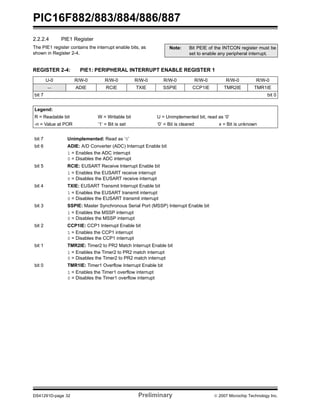
2.2.2.4 PIE1 Register 
The PIE1 register contains the interrupt enable bits, as 
shown in Register 2-4. 
Note: Bit PEIE of the INTCON register must be 
set to enable any peripheral interrupt. 
REGISTER 2-4: PIE1: PERIPHERAL INTERRUPT ENABLE REGISTER 1 
U-0 R/W-0 R/W-0 R/W-0 R/W-0 R/W-0 R/W-0 R/W-0 
— ADIE RCIE TXIE SSPIE CCP1IE TMR2IE TMR1IE 
bit 7 bit 0 
Legend: 
R = Readable bit W = Writable bit U = Unimplemented bit, read as ‘0’ 
-n = Value at POR ‘1’ = Bit is set ‘0’ = Bit is cleared x = Bit is unknown 
bit 7 Unimplemented: Read as ‘0’ 
bit 6 ADIE: A/D Converter (ADC) Interrupt Enable bit 
1 = Enables the ADC interrupt 
0 = Disables the ADC interrupt 
bit 5 RCIE: EUSART Receive Interrupt Enable bit 
1 = Enables the EUSART receive interrupt 
0 = Disables the EUSART receive interrupt 
bit 4 TXIE: EUSART Transmit Interrupt Enable bit 
1 = Enables the EUSART transmit interrupt 
0 = Disables the EUSART transmit interrupt 
bit 3 SSPIE: Master Synchronous Serial Port (MSSP) Interrupt Enable bit 
1 = Enables the MSSP interrupt 
0 = Disables the MSSP interrupt 
bit 2 CCP1IE: CCP1 Interrupt Enable bit 
1 = Enables the CCP1 interrupt 
0 = Disables the CCP1 interrupt 
bit 1 TMR2IE: Timer2 to PR2 Match Interrupt Enable bit 
1 = Enables the Timer2 to PR2 match interrupt 
0 = Disables the Timer2 to PR2 match interrupt 
bit 0 TMR1IE: Timer1 Overflow Interrupt Enable bit 
1 = Enables the Timer1 overflow interrupt 
0 = Disables the Timer1 overflow interrupt 
DS41291D-page 32 Preliminary © 2007 Microchip Technology Inc.
PIC16F882/883/884/886/887 
2.2.2.5 PIE2 Register 
The PIE2 register contains the interrupt enable bits, as 
shown in Register 2-5. 
Note: Bit PEIE of the INTCON register must be 
set to enable any peripheral interrupt. 
REGISTER 2-5: PIE2: PERIPHERAL INTERRUPT ENABLE REGISTER 2 
R/W-0 R/W-0 R/W-0 R/W-0 R/W-0 R/W-0 U-0 R/W-0 
OSFIE C2IE C1IE EEIE BCLIE ULPWUIE — CCP2IE 
bit 7 bit 0 
Legend: 
R = Readable bit W = Writable bit U = Unimplemented bit, read as ‘0’ 
-n = Value at POR ‘1’ = Bit is set ‘0’ = Bit is cleared x = Bit is unknown 
bit 7 OSFIE: Oscillator Fail Interrupt Enable bit 
1 = Enables oscillator fail interrupt 
0 = Disables oscillator fail interrupt 
bit 6 C2IE: Comparator C2 Interrupt Enable bit 
1 = Enables Comparator C2 interrupt 
0 = Disables Comparator C2 interrupt 
bit 5 C1IE: Comparator C1 Interrupt Enable bit 
1 = Enables Comparator C1 interrupt 
0 = Disables Comparator C1 interrupt 
bit 4 EEIE: EEPROM Write Operation Interrupt Enable bit 
1 = Enables EEPROM write operation interrupt 
0 = Disables EEPROM write operation interrupt 
bit 3 BCLIE: Bus Collision Interrupt Enable bit 
1 = Enables Bus Collision interrupt 
0 = Disables Bus Collision interrupt 
bit 2 ULPWUIE: Ultra Low-Power Wake-up Interrupt Enable bit 
1 = Enables Ultra Low-Power Wake-up interrupt 
0 = Disables Ultra Low-Power Wake-up interrupt 
bit 1 Unimplemented: Read as ‘0’ 
bit 0 CCP2IE: CCP2 Interrupt Enable bit 
1 = Enables CCP2 interrupt 
0 = Disables CCP2 interrupt 
© 2007 Microchip Technology Inc. Preliminary DS41291D-page 33
PIC16F882/883/884/886/887 
2.2.2.6 PIR1 Register 
The PIR1 register contains the interrupt flag bits, as 
shown in Register 2-6. 
Note: Interrupt flag bits are set when an interrupt 
condition occurs, regardless of the state of 
its corresponding enable bit or the Global 
Enable bit, GIE of the INTCON register. 
User software should ensure the 
appropriate interrupt flag bits are clear prior 
to enabling an interrupt. 
REGISTER 2-6: PIR1: PERIPHERAL INTERRUPT REQUEST REGISTER 1 
U-0 R/W-0 R-0 R-0 R/W-0 R/W-0 R/W-0 R/W-0 
— ADIF RCIF TXIF SSPIF CCP1IF TMR2IF TMR1IF 
bit 7 bit 0 
Legend: 
R = Readable bit W = Writable bit U = Unimplemented bit, read as ‘0’ 
-n = Value at POR ‘1’ = Bit is set ‘0’ = Bit is cleared x = Bit is unknown 
bit 7 Unimplemented: Read as ‘0’ 
bit 6 ADIF: A/D Converter Interrupt Flag bit 
1 = A/D conversion complete (must be cleared in software) 
0 = A/D conversion has not completed or has not been started 
bit 5 RCIF: EUSART Receive Interrupt Flag bit 
1 = The EUSART receive buffer is full (cleared by reading RCREG) 
0 = The EUSART receive buffer is not full 
bit 4 TXIF: EUSART Transmit Interrupt Flag bit 
1 = The EUSART transmit buffer is empty (cleared by writing to TXREG) 
0 = The EUSART transmit buffer is full 
bit 3 SSPIF: Master Synchronous Serial Port (MSSP) Interrupt Flag bit 
1 = The MSSP interrupt condition has occurred, and must be cleared in software before returning from the 
Interrupt Service Routine. The conditions that will set this bit are: 
SPI 
A transmission/reception has taken place 
I2 C Slave/Master 
A transmission/reception has taken place 
I2 C Master 
The initiated Start condition was completed by the MSSP module 
The initiated Stop condition was completed by the MSSP module 
The initiated restart condition was completed by the MSSP module 
The initiated Acknowledge condition was completed by the MSSP module 
A Start condition occurred while the MSSP module was idle (Multi-master system) 
A Stop condition occurred while the MSSP module was idle (Multi-master system) 
0 = No MSSP interrupt condition has occurred 
bit 2 CCP1IF: CCP1 Interrupt Flag bit 
Capture mode: 
1 = A TMR1 register capture occurred (must be cleared in software) 
0 = No TMR1 register capture occurred 
Compare mode: 
1 = A TMR1 register compare match occurred (must be cleared in software) 
0 = No TMR1 register compare match occurred 
PWM mode: 
Unused in this mode 
bit 1 TMR2IF: Timer2 to PR2 Interrupt Flag bit 
1 = A Timer2 to PR2 match occurred (must be cleared in software) 
0 = No Timer2 to PR2 match occurred 
bit 0 TMR1IF: Timer1 Overflow Interrupt Flag bit 
1 = The TMR1 register overflowed (must be cleared in software) 
0 = The TMR1 register did not overflow 
DS41291D-page 34 Preliminary © 2007 Microchip Technology Inc.
PIC16F882/883/884/886/887 
2.2.2.7 PIR2 Register 
The PIR2 register contains the interrupt flag bits, as 
shown in Register 2-7. 
Note: Interrupt flag bits are set when an interrupt 
condition occurs, regardless of the state of 
its corresponding enable bit or the Global 
Enable bit, GIE of the INTCON register. 
User software should ensure the 
appropriate interrupt flag bits are clear prior 
to enabling an interrupt. 
REGISTER 2-7: PIR2: PERIPHERAL INTERRUPT REQUEST REGISTER 2 
R/W-0 R/W-0 R/W-0 R/W-0 R/W-0 R/W-0 U-0 R/W-0 
OSFIF C2IF C1IF EEIF BCLIF ULPWUIF — CCP2IF 
bit 7 bit 0 
Legend: 
R = Readable bit W = Writable bit U = Unimplemented bit, read as ‘0’ 
-n = Value at POR ‘1’ = Bit is set ‘0’ = Bit is cleared x = Bit is unknown 
bit 7 OSFIF: Oscillator Fail Interrupt Flag bit 
1 = System oscillator failed, clock input has changed to INTOSC (must be cleared in software) 
0 = System clock operating 
bit 6 C2IF: Comparator C2 Interrupt Flag bit 
1 = Comparator output (C2OUT bit) has changed (must be cleared in software) 
0 = Comparator output (C2OUT bit) has not changed 
bit 5 C1IF: Comparator C1 Interrupt Flag bit 
1 = Comparator output (C1OUT bit) has changed (must be cleared in software) 
0 = Comparator output (C1OUT bit) has not changed 
bit 4 EEIF: EE Write Operation Interrupt Flag bit 
1 = Write operation completed (must be cleared in software) 
0 = Write operation has not completed or has not started 
bit 3 BCLIF: Bus Collision Interrupt Flag bit 
1 = A bus collision has occurred in the MSSP when configured for I2C Master mode 
0 = No bus collision has occurred 
bit 2 ULPWUIF: Ultra Low-Power Wake-up Interrupt Flag bit 
1 = Wake-up condition has occurred (must be cleared in software) 
0 = No Wake-up condition has occurred 
bit 1 Unimplemented: Read as ‘0’ 
bit 0 CCP2IF: CCP2 Interrupt Flag bit 
Capture mode: 
1 = A TMR1 register capture occurred (must be cleared in software) 
0 = No TMR1 register capture occurred 
Compare mode: 
1 = A TMR1 register compare match occurred (must be cleared in software) 
0 = No TMR1 register compare match occurred 
PWM mode: 
Unused in this mode 
© 2007 Microchip Technology Inc. Preliminary DS41291D-page 35
PIC16F882/883/884/886/887 
2.2.2.8 PCON Register 
The Power Control (PCON) register (see Register 2-8) 
contains flag bits to differentiate between a: 
• Power-on Reset (POR) 
• Brown-out Reset (BOR) 
• Watchdog Timer Reset (WDT) 
• External MCLR Reset 
The PCON register also controls the Ultra Low-Power 
Wake-up and software enable of the BOR. 
REGISTER 2-8: PCON: POWER CONTROL REGISTER 
U-0 U-0 R/W-0 R/W-1 U-0 U-0 R/W-0 R/W-x 
— — ULPWUE SBOREN(1) — — POR BOR 
bit 7 bit 0 
Legend: 
R = Readable bit W = Writable bit U = Unimplemented bit, read as ‘0’ 
-n = Value at POR ‘1’ = Bit is set ‘0’ = Bit is cleared x = Bit is unknown 
bit 7-6 Unimplemented: Read as ‘0’ 
bit 5 ULPWUE: Ultra Low-Power Wake-up Enable bit 
1 = Ultra Low-Power Wake-up enabled 
0 = Ultra Low-Power Wake-up disabled 
bit 4 SBOREN: Software BOR Enable bit(1) 
1 = BOR enabled 
0 = BOR disabled 
bit 3-2 Unimplemented: Read as ‘0’ 
bit 1 POR: Power-on Reset Status bit 
1 = No Power-on Reset occurred 
0 = A Power-on Reset occurred (must be set in software after a Power-on Reset occurs) 
bit 0 BOR: Brown-out Reset Status bit 
1 = No Brown-out Reset occurred 
0 = A Brown-out Reset occurred (must be set in software after a Brown-out Reset occurs) 
Note 1: BOREN<1:0> = 01 in the Configuration Word Register 1 for this bit to control the BOR. 
DS41291D-page 36 Preliminary © 2007 Microchip Technology Inc.
PIC16F882/883/884/886/887 
2.3 PCL and PCLATH 
The Program Counter (PC) is 13 bits wide. The low byte 
comes from the PCL register, which is a readable and 
writable register. The high byte (PC<12:8>) is not directly 
readable or writable and comes from PCLATH. On any 
Reset, the PC is cleared. Figure 2-7 shows the two 
situations for the loading of the PC. The upper example 
in Figure 2-7 shows how the PC is loaded on a write to 
PCL (PCLATH<4:0> → PCH). The lower example in 
Figure 2-7 shows how the PC is loaded during a CALL or 
GOTO instruction (PCLATH<4:3> → PCH). 
FIGURE 2-7: LOADING OF PC IN 
DIFFERENT SITUATIONS 
PC 
PCH PCL 
12 8 7 0 
5 
PCLATH<4:0> 
PCLATH 
Instruction with 
PCL as 
Destination 
ALU Result 
GOTO, CALL 
OPCODE<10:0> 
8 
PC 
PCH PCL 
12 11 10 0 
8 7 
PCLATH<4:3> 11 
2 
PCLATH 
2.3.1 MODIFYING PCL 
Executing any instruction with the PCL register as the 
destination simultaneously causes the Program 
Counter PC<12:8> bits (PCH) to be replaced by the 
contents of the PCLATH register. This allows the entire 
contents of the program counter to be changed by 
writing the desired upper 5 bits to the PCLATH register. 
When the lower 8 bits are written to the PCL register, all 
13 bits of the program counter will change to the values 
contained in the PCLATH register and those being 
written to the PCL register. 
A computed GOTO is accomplished by adding an offset 
to the program counter (ADDWF PCL). Care should be 
exercised when jumping into a look-up table or 
program branch table (computed GOTO) by modifying 
the PCL register. Assuming that PCLATH is set to the 
table start address, if the table length is greater than 
255 instructions or if the lower 8 bits of the memory 
address rolls over from 0xFF to 0x00 in the middle of 
the table, then PCLATH must be incremented for each 
address rollover that occurs between the table 
beginning and the target location within the table. 
For more information refer to Application Note AN556, 
“Implementing a Table Read” (DS00556). 
2.3.2 STACK 
The PIC16F882/883/884/886/887 devices have an 
8-level x 13-bit wide hardware stack (see Figures 2-2 
and 2-3). The stack space is not part of either program 
or data space and the Stack Pointer is not readable or 
writable. The PC is PUSHed onto the stack when a 
CALL instruction is executed or an interrupt causes a 
branch. The stack is POPed in the event of a RETURN, 
RETLW or a RETFIE instruction execution. PCLATH is 
not affected by a PUSH or POP operation. 
The stack operates as a circular buffer. This means that 
after the stack has been PUSHed eight times, the ninth 
push overwrites the value that was stored from the first 
push. The tenth push overwrites the second push (and 
so on). 
Note 1: There are no Status bits to indicate stack 
overflow or stack underflow conditions. 
2: There are no instructions/mnemonics 
called PUSH or POP. These are actions 
that occur from the execution of the 
CALL, RETURN, RETLW and RETFIE 
instructions or the vectoring to an 
interrupt address. 
2.4 Indirect Addressing, INDF and 
FSR Registers 
The INDF register is not a physical register. Addressing 
the INDF register will cause indirect addressing. 
Indirect addressing is possible by using the INDF 
register. Any instruction using the INDF register actually 
accesses data pointed to by the File Select Register 
(FSR). Reading INDF itself indirectly will produce 00h. 
Writing to the INDF register indirectly results in a no 
operation (although Status bits may be affected). An 
effective 9-bit address is obtained by concatenating the 
8-bit FSR and the IRP bit of the STATUS register, as 
shown in Figure 2-8. 
A simple program to clear RAM location 20h-2Fh using 
indirect addressing is shown in Example 2-1. 
EXAMPLE 2-1: INDIRECT ADDRESSING 
MOVLW 0x20 ;initialize pointer 
MOVWF FSR ;to RAM 
NEXT CLRF INDF ;clear INDF register 
INCF FSR ;inc pointer 
BTFSS FSR,4 ;all done? 
GOTO NEXT ;no clear next 
CONTINUE ;yes continue 
© 2007 Microchip Technology Inc. Preliminary DS41291D-page 37
PIC16F882/883/884/886/887 
FIGURE 2-8: DIRECT/INDIRECT ADDRESSING PIC16F882/883/884/886/887 
Direct Addressing Indirect Addressing 
RP1 RP0 6 From Opcode 0 IRP 7 File Select Register 0 
Bank Select Location Select 
Data 
Memory 
00 01 10 11 
00h 
7Fh 
Bank 0 Bank 1 Bank 2 Bank 3 
Note: For memory map detail, see Figures 2-2 and 2-3. 
Bank Select Location Select 
180h 
1FFh 
DS41291D-page 38 Preliminary © 2007 Microchip Technology Inc.
PIC16F882/883/884/886/887 
3.0 I/O PORTS 
There are as many as thirty-five general purpose I/O 
pins available. Depending on which peripherals are 
enabled, some or all of the pins may not be available as 
general purpose I/O. In general, when a peripheral is 
enabled, the associated pin may not be used as a 
general purpose I/O pin. 
3.1 PORTA and the TRISA Registers 
PORTA is a 8-bit wide, bidirectional port. The 
corresponding data direction register is TRISA 
(Register 3-2). Setting a TRISA bit (= 1) will make the 
corresponding PORTA pin an input (i.e., disable the 
output driver). Clearing a TRISA bit (= 0) will make the 
corresponding PORTA pin an output (i.e., enables 
output driver and puts the contents of the output latch 
on the selected pin). Example 3-1 shows how to 
initialize PORTA. 
Reading the PORTA register (Register 3-1) reads the 
status of the pins, whereas writing to it will write to the 
PORT latch. All write operations are read-modify-write 
operations. Therefore, a write to a port implies that the 
port pins are read, this value is modified and then 
written to the PORT data latch. 
The TRISA register (Register 3-2) controls the PORTA 
pin output drivers, even when they are being used as 
analog inputs. The user should ensure the bits in the 
TRISA register are maintained set when using them as 
analog inputs. I/O pins configured as analog input always 
read ‘0’. 
Note: The ANSEL register must be initialized to 
configure an analog channel as a digital 
input. Pins configured as analog inputs will 
read ‘0’. 
EXAMPLE 3-1: INITIALIZING PORTA 
BANKSEL PORTA ; 
CLRF PORTA ;Init PORTA 
BANKSEL ANSEL ; 
CLRF ANSEL ;digital I/O 
BCF STATUS,RP1 ;Bank 1 
BANKSEL TRISA ; 
MOVLW 0Ch ;Set RA<3:2> as inputs 
MOVWF TRISA ;and set RA<5:4,1:0> 
;as outputs 
REGISTER 3-1: PORTA: PORTA REGISTER 
R/W-x R/W-x R/W-x R/W-x R/W-x R/W-x R/W-x R/W-x 
RA7 RA6 RA5 RA4 RA3 RA2 RA1 RA0 
bit 7 bit 0 
Legend: 
R = Readable bit W = Writable bit U = Unimplemented bit, read as ‘0’ 
-n = Value at POR ‘1’ = Bit is set ‘0’ = Bit is cleared x = Bit is unknown 
bit 7-0 RA<7:0>: PORTA I/O Pin bit 
1 = Port pin is > VIH 
0 = Port pin is < VIL 
REGISTER 3-2: TRISA: PORTA TRI-STATE REGISTER 
R/W-1(1) R/W-1(1) R/W-1 R/W-1 R/W-1 R/W-1 R/W-1 R/W-1 
TRISA7 TRISA6 TRISA5 TRISA4 TRISA3 TRISA2 TRISA1 TRISA0 
bit 7 bit 0 
Legend: 
R = Readable bit W = Writable bit U = Unimplemented bit, read as ‘0’ 
-n = Value at POR ‘1’ = Bit is set ‘0’ = Bit is cleared x = Bit is unknown 
bit 7-0 TRISA<7:0>: PORTA Tri-State Control bit 
1 = PORTA pin configured as an input (tri-stated) 
0 = PORTA pin configured as an output 
Note 1: TRISA<7:6> always reads ‘1’ in XT, HS and LP Oscillator modes. 
© 2007 Microchip Technology Inc. Preliminary DS41291D-page 39
PIC16F882/883/884/886/887 
3.2 Additional Pin Functions 
RA0 also has an Ultra Low-Power Wake-up option. The 
next three sections describe these functions. 
3.2.1 ANSEL REGISTER 
The ANSEL register (Register 3-3) is used to configure 
the Input mode of an I/O pin to analog. Setting the 
appropriate ANSEL bit high will cause all digital reads 
on the pin to be read as ‘0’ and allow analog functions 
on the pin to operate correctly. 
The state of the ANSEL bits has no affect on digital out-put 
functions. A pin with TRIS clear and ANSEL set will 
still operate as a digital output, but the Input mode will 
be analog. This can cause unexpected behavior when 
executing read-modify-write instructions on the 
affected port. 
REGISTER 3-3: ANSEL: ANALOG SELECT REGISTER 
R/W-1 R/W-1 R/W-1 R/W-1 R/W-1 R/W-1 R/W-1 R/W-1 
ANS7(2) ANS6(2) ANS5(2) ANS4 ANS3 ANS2 ANS1 ANS0 
bit 7 bit 0 
Legend: 
R = Readable bit W = Writable bit U = Unimplemented bit, read as ‘0’ 
-n = Value at POR ‘1’ = Bit is set ‘0’ = Bit is cleared x = Bit is unknown 
bit 7-0 ANS<7:0>: Analog Select bits 
Analog select between analog or digital function on pins AN<7:0>, respectively. 
1 = Analog input. Pin is assigned as analog input(1). 
0 = Digital I/O. Pin is assigned to port or special function. 
Note 1: Setting a pin to an analog input automatically disables the digital input circuitry, weak pull-ups, and 
interrupt-on-change if available. The corresponding TRIS bit must be set to Input mode in order to allow 
external control of the voltage on the pin. 
2: Not implemented on PIC16F883/886. 
DS41291D-page 40 Preliminary © 2007 Microchip Technology Inc.
PIC16F882/883/884/886/887 
3.2.2 ULTRA LOW-POWER WAKE-UP 
The Ultra Low-Power Wake-up (ULPWU) on RA0 allows 
a slow falling voltage to generate an interrupt-on-change 
on RA0 without excess current consumption. The mode 
is selected by setting the ULPWUE bit of the PCON 
register. This enables a small current sink, which can be 
used to discharge a capacitor on RA0. 
Follow these steps to use this feature: 
a) Charge the capacitor on RA0 by configuring the 
RA0 pin to output (= 1). 
b) Configure RA0 as an input. 
c) Enable interrupt-on-change for RA0. 
d) Set the ULPWUE bit of the PCON register to 
begin the capacitor discharge. 
e) Execute a SLEEP instruction. 
When the voltage on RA0 drops below VIL, an interrupt 
will be generated which will cause the device to 
wake-up and execute the next instruction. If the GIE bit 
of the INTCON register is set, the device will then call 
the interrupt vector (0004h). See Section 3.4.3 “Inter-rupt- 
on-Change” for more information. 
This feature provides a low-power technique for 
periodically waking up the device from Sleep. The 
time-out is dependent on the discharge time of the RC 
circuit on RA0. See Example 3-2 for initializing the 
Ultra Low-Power Wake-up module. 
A series resistor between RA0 and the external 
capacitor provides overcurrent protection for the 
RA0/AN0/ULPWU/C12IN0- pin and can allow for 
software calibration of the time-out (see Figure 3-1). A 
timer can be used to measure the charge time and 
discharge time of the capacitor. The charge time can 
then be adjusted to provide the desired interrupt delay. 
This technique will compensate for the affects of 
temperature, voltage and component accuracy. The 
Ultra Low-Power Wake-up peripheral can also be 
configured as a simple Programmable Low Voltage 
Detect or temperature sensor. 
Note: For more information, refer to AN879, 
“Using the Microchip Ultra Low-Power 
Wake-up Module” Application Note 
(DS00879). 
EXAMPLE 3-2: ULTRA LOW-POWER 
WAKE-UP INITIALIZATION 
BANKSEL PORTA ; 
BSF PORTA,0 ;Set RA0 data latch 
BANKSEL ANSEL ; 
BCF ANSEL,0 ;RA0 to digital I/O 
BANKSEL TRISA ; 
BCF TRISA,0 ;Output high to 
CALL CapDelay ;charge capacitor 
BANKSEL PIR2 ; 
BCF PIR2,ULPWUIF ;Clear flag 
BSF PCON,ULPWUE ;Enable ULP Wake-up 
BSF IOCB,0 ;Select RA0 IOC 
BSF TRISA,0 ;RA0 to input 
MOVLW B’10001000’ ;Enable interrupt 
MOVWF INTCON ;and clear flag 
SLEEP ;Wait for IOC 
NOP ; 
© 2007 Microchip Technology Inc. Preliminary DS41291D-page 41
PIC16F882/883/884/886/887 
3.2.3 PIN DESCRIPTIONS AND 
DIAGRAMS 
Each PORTA pin is multiplexed with other functions. The 
pins and their combined functions are briefly described 
here. For specific information about individual functions 
such as the comparator or the A/D Converter (ADC), 
refer to the appropriate section in this data sheet. 
3.2.3.1 RA0/AN0/ULPWU/C12IN0- 
Figure 3-1 shows the diagram for this pin. This pin is 
configurable to function as one of the following: 
• a general purpose I/O 
• an analog input for the ADC 
• a negative analog input to Comparator C1 or C2 
• an analog input for the Ultra Low-Power Wake-up 
FIGURE 3-1: BLOCK DIAGRAM OF RA0 
I/O Pin 
VDD 
VSS 
D 
Q 
CK Q 
D 
Q 
CK Q 
Data Bus 
WR 
PORTA 
WR 
TRISA 
RD 
TRISA 
RD 
Analog(1) 
Input Mode 
To Comparator 
0 1 
- 
+ VTRG 
IULP 
PORTA 
To A/D Converter 
Note 1: ANSEL determines Analog Input mode. 
VSS 
ULPWUE 
DS41291D-page 42 Preliminary © 2007 Microchip Technology Inc.
PIC16F882/883/884/886/887 
3.2.3.2 RA1/AN1/C12IN1- 
Figure 3-2 shows the diagram for this pin. This pin is 
configurable to function as one of the following: 
• a general purpose I/O 
• an analog input for the ADC 
• a negative analog input to Comparator C1 or C2 
FIGURE 3-2: BLOCK DIAGRAM OF RA1 
3.2.3.3 RA2/AN2/VREF-/CVREF/C2IN+ 
Figure 3-3 shows the diagram for this pin. This pin is 
configurable to function as one of the following: 
• a general purpose I/O 
• an analog input for the ADC 
• a negative voltage reference input for the ADC 
and CVREF 
• a comparator voltage reference output 
• a positive analog input to Comparator C2 
FIGURE 3-3: BLOCK DIAGRAM OF RA2 
I/O Pin 
VDD 
VSS 
D 
Q 
CK Q 
D 
Q 
CK Q 
Analog(1) 
Input Mode 
Data Bus 
WR 
PORTA 
WR 
TRISA 
RD 
TRISA 
RD 
PORTA 
To Comparator 
To A/D Converter 
Note 1: ANSEL determines Analog Input mode. 
I/O Pin 
VDD 
VSS 
D 
Q 
CK Q 
D 
Q 
CK Q 
CVREF 
Analog(1) 
Input Mode 
Data Bus 
WR 
PORTA 
WR 
TRISA 
RD 
TRISA 
RD 
PORTA 
VROE 
To Comparator (positive input) 
To Comparator (VREF-) 
To A/D Converter (VREF-) 
To A/D Converter (analog channel) 
Note 1: ANSEL determines Analog Input mode. 
© 2007 Microchip Technology Inc. Preliminary DS41291D-page 43
PIC16F882/883/884/886/887 
3.2.3.4 RA3/AN3/VREF+/C1IN+ 
Figure 3-4 shows the diagram for this pin. This pin is 
configurable to function as one of the following: 
• a general purpose input 
• an analog input for the ADC 
• a positive voltage reference input for the ADC and 
CVREF 
• a positive analog input to Comparator C1 
FIGURE 3-4: BLOCK DIAGRAM OF RA3 
3.2.3.5 RA4/T0CKI/C1OUT 
Figure 3-5 shows the diagram for this pin. This pin is 
configurable to function as one of the following: 
• a general purpose I/O 
• a clock input for Timer0 
• a digital output from Comparator C1 
FIGURE 3-5: BLOCK DIAGRAM OF RA4 
I/O Pin 
VDD 
VSS 
D 
Q 
CK Q 
D 
Q 
CK Q 
Analog(1) 
Input Mode 
Data Bus 
WR 
PORTA 
WR 
TRISA 
RD 
TRISA 
RD 
PORTA 
To Comparator (positive input) 
To Comparator (VREF+) 
To A/D Converter (VREF+) 
To A/D Converter (analog channel) 
Note 1: ANSEL determines Analog Input mode. 
I/O Pin 
VDD 
VSS 
D 
Q 
CK Q 
D 
Q 
CK Q 
Data Bus 
WR 
PORTA 
WR 
TRISA 
RD 
TRISA 
RD 
PORTA 
C1OUT 
Enable 
C1OUT 1 
0 
To Timer0 
DS41291D-page 44 Preliminary © 2007 Microchip Technology Inc.
PIC16F882/883/884/886/887 
3.2.3.6 RA5/AN4/SS/C2OUT 
Figure 3-6 shows the diagram for this pin. This pin is 
configurable to function as one of the following: 
• a general purpose I/O 
• an analog input for the ADC 
• a slave select input 
• a digital output from Comparator C2 
FIGURE 3-6: BLOCK DIAGRAM OF RA5 
3.2.3.7 RA6/OSC2/CLKOUT 
Figure 3-7 shows the diagram for this pin. This pin is 
configurable to function as one of the following: 
• a general purpose I/O 
• a crystal/resonator connection 
• a clock output 
FIGURE 3-7: BLOCK DIAGRAM OF RA6 
I/O Pin 
VDD 
VSS 
D 
Q 
CK Q 
D 
Q 
CK Q 
C2OUT 
Enable 
C2OUT 1 
0 
Analog(1) 
Input Mode 
Data Bus 
WR 
PORTA 
WR 
TRISA 
RD 
TRISA 
RD 
PORTA 
To SS Input 
To A/D Converter 
Note 1: ANSEL determines Analog Input mode. 
I/O Pin 
VDD 
VSS 
D 
Q 
CK Q 
D 
Q 
CK Q 
Data Bus 
WR 
PORTA 
WR 
TRISA 
RD 
TRISA 
RD 
PORTA 
OSC2 
Oscillator 
Circuit 
CLKOUT 
Enable 
FOSC/4 
1 
0 
CLKOUT 
Enable 
INTOSCIO/ 
EXTRCIO/EC(1) 
CLKOUT 
Enable 
Note 1: With I/O option. 
© 2007 Microchip Technology Inc. Preliminary DS41291D-page 45
PIC16F882/883/884/886/887 
3.2.3.8 RA7/OSC1/CLKIN 
Figure 3-8 shows the diagram for this pin. This pin is 
configurable to function as one of the following: 
• a general purpose I/O 
• a crystal/resonator connection 
• a clock input 
FIGURE 3-8: BLOCK DIAGRAM OF RA7 
I/O Pin 
VDD 
VSS 
D 
Q 
CK Q 
D 
Q 
CK Q 
Data Bus 
WR 
PORTA 
WR 
TRISA 
RD 
TRISA 
RD 
PORTA 
OSC1 
Oscillator 
Circuit 
INTOSC 
Mode 
CLKIN 
TABLE 3-1: SUMMARY OF REGISTERS ASSOCIATED WITH PORTA 
Name Bit 7 Bit 6 Bit 5 Bit 4 Bit 3 Bit 2 Bit 1 Bit 0 Value on 
POR, BOR 
Value on 
all other 
Resets 
ADCON0 ADCS1 ADCS0 CHS3 CHS2 CHS1 CHS0 GO/DONE ADON 0000 0000 0000 0000 
ANSEL ANS7 ANS6 ANS5 ANS4 ANS3 ANS2 ANS1 ANS0 1111 1111 1111 1111 
CM1CON0 C1ON C1OUT C1OE C1POL — C1R C1CH1 C1CH0 0000 -000 0000 -000 
CM2CON0 C2ON C2OUT C2OE C2POL — C2R C2CH1 C2CH0 0000 -000 0000 -000 
CM2CON1 MC1OUT MC2OUT C1RSEL C2RSEL — — T1GSS C2SYNC 0000 --10 0000 --10 
PCON — — ULPWUE SBOREN — — POR BOR --01 --qq --0u --uu 
OPTION_REG RBPU INTEDG T0CS T0SE PSA PS2 PS1 PS0 1111 1111 1111 1111 
PORTA RA7 RA6 RA5 RA4 RA3 RA2 RA1 RA0 xxxx xxxx uuuu uuuu 
SSPCON WCOL SSPOV SSPEN CKP SSPM3 SSPM2 SSPM1 SSPM0 0000 0000 0000 0000 
TRISA TRISA7 TRISA6 TRISA5 TRISA4 TRISA3 TRISA2 TRISA1 TRISA0 1111 1111 1111 1111 
Legend: x = unknown, u = unchanged, – = unimplemented locations read as ‘0’. Shaded cells are not used by PORTA. 
DS41291D-page 46 Preliminary © 2007 Microchip Technology Inc.
PIC16F882/883/884/886/887 
3.3 PORTB and TRISB Registers 
PORTB is an 8-bit wide, bidirectional port. The 
corresponding data direction register is TRISB 
(Register 3-6). Setting a TRISB bit (= 1) will make the 
corresponding PORTB pin an input (i.e., put the 
corresponding output driver in a High-Impedance mode). 
Clearing a TRISB bit (= 0) will make the corresponding 
PORTB pin an output (i.e., enable the output driver and 
put the contents of the output latch on the selected pin). 
Example 3-3 shows how to initialize PORTB. 
Reading the PORTB register (Register 3-5) reads the 
status of the pins, whereas writing to it will write to the 
PORT latch. All write operations are read-modify-write 
operations. Therefore, a write to a port implies that the 
port pins are read, this value is modified and then written 
to the PORT data latch. 
The TRISB register (Register 3-6) controls the PORTB 
pin output drivers, even when they are being used as 
analog inputs. The user should ensure the bits in the 
TRISB register are maintained set when using them as 
analog inputs. I/O pins configured as analog input always 
read ‘0’. Example 3-3 shows how to initialize PORTB. 
EXAMPLE 3-3: INITIALIZING PORTB 
BANKSEL PORTB ; 
CLRF PORTB ;Init PORTB 
BANKSEL TRISB ; 
MOVLW B‘11110000’ ;Set RB<7:4> as inputs 
;and RB<3:0> as outputs 
MOVWF TRISB ; 
Note: The ANSELH register must be initialized 
to configure an analog channel as a digital 
input. Pins configured as analog inputs will 
read ‘0’. 
3.4 Additional PORTB Pin Functions 
PORTB pins RB<7:0> on the device family device have 
an interrupt-on-change option and a weak pull-up 
option. The following three sections describe these 
PORTB pin functions. 
Every PORTB pin on this device family has an 
interrupt-on-change option and a weak pull-up option. 
3.4.1 ANSELH REGISTER 
The ANSELH register (Register 3-4) is used to 
configure the Input mode of an I/O pin to analog. 
Setting the appropriate ANSELH bit high will cause all 
digital reads on the pin to be read as ‘0’ and allow 
analog functions on the pin to operate correctly. 
The state of the ANSELH bits has no affect on digital 
output functions. A pin with TRIS clear and ANSELH 
set will still operate as a digital output, but the Input 
mode will be analog. This can cause unexpected 
behavior when executing read-modify-write 
instructions on the affected port. 
3.4.2 WEAK PULL-UPS 
Each of the PORTB pins has an individually configurable 
internal weak pull-up. Control bits WPUB<7:0> enable or 
disable each pull-up (see Register 3-7). Each weak 
pull-up is automatically turned off when the port pin is 
configured as an output. All pull-ups are disabled on a 
Power-on Reset by the RBPU bit of the OPTION register. 
3.4.3 INTERRUPT-ON-CHANGE 
All of the PORTB pins are individually configurable as an 
interrupt-on-change pin. Control bits IOCB<7:0> enable 
or disable the interrupt function for each pin. Refer to 
Register 3-8. The interrupt-on-change feature is 
disabled on a Power-on Reset. 
For enabled interrupt-on-change pins, the present value 
is compared with the old value latched on the last read 
of PORTB to determine which bits have changed or 
mismatched the old value. The ‘mismatch’ outputs of 
the last read are OR’d together to set the PORTB 
Change Interrupt flag bit (RBIF) in the INTCON register. 
This interrupt can wake the device from Sleep. The user, 
in the Interrupt Service Routine, clears the interrupt by: 
a) Any read or write of PORTB. This will end the 
mismatch condition. 
b) Clear the flag bit RBIF. 
A mismatch condition will continue to set flag bit RBIF. 
Reading or writing PORTB will end the mismatch 
condition and allow flag bit RBIF to be cleared. The latch 
holding the last read value is not affected by a MCLR nor 
Brown-out Reset. After these Resets, the RBIF flag will 
continue to be set if a mismatch is present. 
Note: If a change on the I/O pin should occur when 
the read operation is being executed (start of 
the Q2 cycle), then the RBIF interrupt flag 
may not get set. Furthermore, since a read 
or write on a port affects all bits of that port, 
care must be taken when using multiple pins 
in Interrupt-on-Change mode. Changes on 
one pin may not be seen while servicing 
changes on another pin. 
© 2007 Microchip Technology Inc. Preliminary DS41291D-page 47
PIC16F882/883/884/886/887 
REGISTER 3-4: ANSELH: ANALOG SELECT HIGH REGISTER 
U-0 U-0 R/W-1 R/W-1 R/W-1 R/W-1 R/W-1 R/W-1 
— — ANS13 ANS12 ANS11 ANS10 ANS9 ANS8 
bit 7 bit 0 
Legend: 
R = Readable bit W = Writable bit U = Unimplemented bit, read as ‘0’ 
-n = Value at POR ‘1’ = Bit is set ‘0’ = Bit is cleared x = Bit is unknown 
bit 7-6 Unimplemented: Read as ‘0’ 
bit 5-0 ANS<13:8>: Analog Select bits 
Analog select between analog or digital function on pins AN<13:8>, respectively. 
1 = Analog input. Pin is assigned as analog input(1). 
0 = Digital I/O. Pin is assigned to port or special function. 
Note 1: Setting a pin to an analog input automatically disables the digital input circuitry, weak pull-ups, and 
interrupt-on-change if available. The corresponding TRIS bit must be set to Input mode in order to allow 
external control of the voltage on the pin. 
REGISTER 3-5: PORTB: PORTB REGISTER 
R/W-x R/W-x R/W-x R/W-x R/W-x R/W-x R/W-x R/W-x 
RB7 RB6 RB5 RB4 RB3 RB2 RB1 RB0 
bit 7 bit 0 
Legend: 
R = Readable bit W = Writable bit U = Unimplemented bit, read as ‘0’ 
-n = Value at POR ‘1’ = Bit is set ‘0’ = Bit is cleared x = Bit is unknown 
bit 7-0 RB<7:0>: PORTB I/O Pin bit 
1 = Port pin is > VIH 
0 = Port pin is < VIL 
REGISTER 3-6: TRISB: PORTB TRI-STATE REGISTER 
R/W-1 R/W-1 R/W-1 R/W-1 R/W-1 R/W-1 R/W-1 R/W-1 
TRISB7 TRISB6 TRISB5 TRISB4 TRISB3 TRISB2 TRISB1 TRISB0 
bit 7 bit 0 
Legend: 
R = Readable bit W = Writable bit U = Unimplemented bit, read as ‘0’ 
-n = Value at POR ‘1’ = Bit is set ‘0’ = Bit is cleared x = Bit is unknown 
bit 7-0 TRISB<7:0>: PORTB Tri-State Control bit 
1 = PORTB pin configured as an input (tri-stated) 
0 = PORTB pin configured as an output 
DS41291D-page 48 Preliminary © 2007 Microchip Technology Inc.
PIC16F882/883/884/886/887 
REGISTER 3-7: WPUB: WEAK PULL-UP PORTB REGISTER 
R/W-1 R/W-1 R/W-1 R/W-1 R/W-1 R/W-1 R/W-1 R/W-1 
WPUB7 WPUB6 WPUB5 WPUB4 WPUB3 WPUB2 WPUB1 WPUB0 
bit 7 bit 0 
Legend: 
R = Readable bit W = Writable bit U = Unimplemented bit, read as ‘0’ 
-n = Value at POR ‘1’ = Bit is set ‘0’ = Bit is cleared x = Bit is unknown 
bit 7-0 WPUB<7:0>: Weak Pull-up Register bit 
1 = Pull-up enabled 
0 = Pull-up disabled 
Note 1: Global RBPU bit of the OPTION register must be cleared for individual pull-ups to be enabled. 
2: The weak pull-up device is automatically disabled if the pin is in configured as an output. 
REGISTER 3-8: IOCB: INTERRUPT-ON-CHANGE PORTB REGISTER 
R/W-0 R/W-0 R/W-0 R/W-0 R/W-0 R/W-0 R/W-0 R/W-0 
IOCB7 IOCB6 IOCB5 IOCB4 IOCB3 IOCB2 IOCB1 IOCB0 
bit 7 bit 0 
Legend: 
R = Readable bit W = Writable bit U = Unimplemented bit, read as ‘0’ 
-n = Value at POR ‘1’ = Bit is set ‘0’ = Bit is cleared x = Bit is unknown 
bit 7-0 IOCB<7:0>: Interrupt-on-Change PORTB Control bit 
1 = Interrupt-on-change enabled 
0 = Interrupt-on-change disabled 
© 2007 Microchip Technology Inc. Preliminary DS41291D-page 49
PIC16F882/883/884/886/887 
3.4.4 PIN DESCRIPTIONS AND 
DIAGRAMS 
Each PORTB pin is multiplexed with other functions. The 
pins and their combined functions are briefly described 
here. For specific information about individual functions 
such as the SSP, I2C or interrupts, refer to the appropriate 
section in this data sheet. 
3.4.4.1 RB0/AN12/INT 
Figure 3-9 shows the diagram for this pin. This pin is 
configurable to function as one of the following: 
• a general purpose I/O 
• an analog input for the ADC 
• an external edge triggered interrupt 
3.4.4.2 RB1/AN10/P1C(1)/C12IN3- 
Figure 3-9 shows the diagram for this pin. This pin is 
configurable to function as one of the following: 
• a general purpose I/O 
• an analog input for the ADC 
• a PWM output(1) 
• an analog input to Comparator C1 or C2 
Note 1: P1C is available on PIC16F882/883/886 
only. 
3.4.4.3 RB2/AN8/P1B(1) 
Figure 3-9 shows the diagram for this pin. This pin is 
configurable to function as one of the following: 
• a general purpose I/O 
• an analog input for the ADC 
• a PWM output(1) 
Note 1: P1B is available on PIC16F882/883/886 
only. 
3.4.4.4 RB3/AN9/PGM/C12IN2- 
Figure 3-9 shows the diagram for this pin. This pin is 
configurable to function as one of the following: 
• a general purpose I/O 
• an analog input for the ADC 
• Low-voltage In-Circuit Serial Programming enable 
pin 
• an analog input to Comparator C1 or C2 
FIGURE 3-9: BLOCK DIAGRAM OF 
RB<3:0> 
I/O Pin 
VDD 
Weak 
VDD 
VSS 
D 
Q 
CK Q 
D 
Q 
CK Q 
D 
Q 
CK Q 
Analog(1) 
Input Mode 
RBPU 
CCP1OUT Enable 
1 
0 
CCP1OUT 
Analog(1) 
Input Mode 
Data Bus 
WR 
WPUB 
RD 
WPUB 
WR 
PORTB 
WR 
TRISB 
RD 
TRISB 
D 
Q 
CK Q 
Interrupt-on- 
Change 
RB0/INT 
RB3/PGM 
RD PORTB 
To A/D Converter 
Q 
Q 
To Comparator (RB1, RB3) 
D 
EN 
D 
EN 
RD 
PORTB 
WR 
IOCB 
RD 
IOCB 
Q3 
Note 1: ANSELH determines Analog Input mode. 
DS41291D-page 50 Preliminary © 2007 Microchip Technology Inc.
PIC16F882/883/884/886/887 
3.4.4.5 RB4/AN11/P1D(1) 
Figure 3-10 shows the diagram for this pin. This pin is 
configurable to function as one of the following: 
• a general purpose I/O 
• an analog input for the ADC 
• a PWM output(1) 
Note 1: P1D is available on PIC16F882/883/886 
only. 
3.4.4.6 RB5/AN13/T1G 
Figure 3-10 shows the diagram for this pin. This pin is 
configurable to function as one of the following: 
• a general purpose I/O 
• an analog input for the ADC 
• a Timer1 gate input 
3.4.4.7 RB6/ICSPCLK 
Figure 3-10 shows the diagram for this pin. This pin is 
configurable to function as one of the following: 
• a general purpose I/O 
• In-Circuit Serial Programming clock 
3.4.4.8 RB7/ICSPDAT 
Figure 3-10 shows the diagram for this pin. This pin is 
configurable to function as one of the following: 
• a general purpose I/O 
• In-Circuit Serial Programming data 
FIGURE 3-10: BLOCK DIAGRAM OF RB<7:4> 
I/O Pin 
VDD 
VSS 
D 
Q 
CK Q 
D 
Q 
CK Q 
D 
Q 
CK Q 
D 
Q 
CK Q 
VDD 
Analog(1) 
Input Mode 
D 
EN 
D 
EN 
CCP1OUT Enable 
Q 
Q 
Weak 
Data Bus 
WR 
WPUB 
RD 
WPUB 
RBPU 
RD PORTB 
WR 
PORTB 
WR 
TRISB 
RD 
TRISB 
RD 
PORTB 
WR 
IOCB 
RD 
IOCB 
Interrupt-on- 
Analog(1) Input Mode 
Change 
Q3 
CCP1OUT 
To Timer1 T1G(3) 
To A/D Converter 
0 
1 
1 
1 
0 
To ICSPCLK (RB6) and ICSPDAT (RB7) 
Available on PIC16F882/PIC16F883/PIC16F886 only. 
Note 1: ANSELH determines Analog Input mode. 
2: Applies to RB<7:6> pins only). 
3: Applies to RB5 pin only. 
ICSP™(2) 
© 2007 Microchip Technology Inc. Preliminary DS41291D-page 51
PIC16F882/883/884/886/887 
TABLE 3-2: SUMMARY OF REGISTERS ASSOCIATED WITH PORTB 
Name Bit 7 Bit 6 Bit 5 Bit 4 Bit 3 Bit 2 Bit 1 Bit 0 
Value on 
POR, BOR 
Value on 
all other 
Resets 
ANSELH — — ANS13 ANS12 ANS11 ANS10 ANS9 ANS8 --11 1111 --11 1111 
CCP1CON P1M1 P1M0 DC1B1 DC1B0 CCP1M3 CCP1M2 CCP1M1 CCP1M0 0000 0000 0000 0000 
CM2CON1 MC1OUT MC2OUT C1RSEL C2RSEL — — T1GSS C2SYNC 0000 --10 0000 --10 
IOCB IOCB7 IOCB6 IOCB5 IOCB4 IOCB3 IOCB2 IOCB1 IOCB0 0000 0000 0000 0000 
INTCON GIE PEIE T0IE INTE RBIE T0IF INTF RBIF 0000 000x 0000 000x 
OPTION_REG RBPU INTEDG T0CS T0SE PSA PS2 PS1 PS0 1111 1111 1111 1111 
PORTB RB7 RB6 RB5 RB4 RB3 RB2 RB1 RB0 xxxx xxxx uuuu uuuu 
TRISB TRISB7 TRISB6 TRISB5 TRISB4 TRISB3 TRISB2 TRISB1 TRISB0 1111 1111 1111 1111 
WPUB WPUB7 WPUB6 WPUB5 WPUB4 WPUB3 WPUB2 WPUB1 WPUB0 1111 1111 1111 1111 
Legend: x = unknown, u = unchanged, — = unimplemented read as ‘0’. Shaded cells are not used by PORTB. 
DS41291D-page 52 Preliminary © 2007 Microchip Technology Inc.
PIC16F882/883/884/886/887 
3.5 PORTC and TRISC Registers 
PORTC is a 8-bit wide, bidirectional port. The 
corresponding data direction register is TRISC 
(Register 3-10). Setting a TRISC bit (= 1) will make the 
corresponding PORTC pin an input (i.e., put the 
corresponding output driver in a High-Impedance mode). 
Clearing a TRISC bit (= 0) will make the corresponding 
PORTC pin an output (i.e., enable the output driver and 
put the contents of the output latch on the selected pin). 
Example 3-4 shows how to initialize PORTC. 
Reading the PORTC register (Register 3-9) reads the 
status of the pins, whereas writing to it will write to the 
PORT latch. All write operations are read-modify-write 
operations. Therefore, a write to a port implies that the 
port pins are read, this value is modified and then written 
to the PORT data latch. 
The TRISC register (Register 3-10) controls the PORTC 
pin output drivers, even when they are being used as 
analog inputs. The user should ensure the bits in the 
TRISC register are maintained set when using them as 
analog inputs. I/O pins configured as analog input always 
read ‘0’. 
EXAMPLE 3-4: INITIALIZING PORTC 
BANKSEL PORTC ; 
CLRF PORTC ;Init PORTC 
BANKSEL TRISC ; 
MOVLW B‘00001100’ ;Set RC<3:2> as inputs 
MOVWF TRISC ;and set RC<7:4,1:0> 
;as outputs 
REGISTER 3-9: PORTC: PORTC REGISTER 
R/W-x R/W-x R/W-x R/W-x R/W-x R/W-x R/W-x R/W-x 
RC7 RC6 RC5 RC4 RC3 RC2 RC1 RC0 
bit 7 bit 0 
Legend: 
R = Readable bit W = Writable bit U = Unimplemented bit, read as ‘0’ 
-n = Value at POR ‘1’ = Bit is set ‘0’ = Bit is cleared x = Bit is unknown 
bit 7-0 RC<7:0>: PORTC General Purpose I/O Pin bit 
1 = Port pin is > VIH 
0 = Port pin is < VIL 
REGISTER 3-10: TRISC: PORTC TRI-STATE REGISTER 
R/W-1 R/W-1 R/W-1 R/W-1 R/W-1 R/W-1 R/W-1(1) R/W-1(1) 
TRISC7 TRISC6 TRISC5 TRISC4 TRISC3 TRISC2 TRISC1 TRISC0 
bit 7 bit 0 
Legend: 
R = Readable bit W = Writable bit U = Unimplemented bit, read as ‘0’ 
-n = Value at POR ‘1’ = Bit is set ‘0’ = Bit is cleared x = Bit is unknown 
bit 7-0 TRISC<7:0>: PORTC Tri-State Control bit 
1 = PORTC pin configured as an input (tri-stated) 
0 = PORTC pin configured as an output 
Note 1: TRISC<1:0> always reads ‘1’ in LP Oscillator mode. 
© 2007 Microchip Technology Inc. Preliminary DS41291D-page 53
PIC16F882/883/884/886/887 
3.5.1 RC0/T1OSO/T1CKI 
Figure 3-11 shows the diagram for this pin. This pin is 
configurable to function as one of the following: 
• a general purpose I/O 
• a Timer1 oscillator output 
• a Timer1 clock input 
FIGURE 3-11: BLOCK DIAGRAM OF RC0 
I/O Pin 
VDD 
VSS 
D 
Timer1 Oscillator 
T1OSCEN Circuit 
Q 
CK Q 
D 
Q 
CK Q 
Data Bus 
WR 
PORTC 
WR 
TRISC 
RD 
TRISC 
RD 
PORTC 
To Timer1 clock input 
3.5.2 RC1/T1OSI/CCP2 
Figure 3-12 shows the diagram for this pin. This pin is 
configurable to function as one of the following: 
• a general purpose I/O 
• a Timer1 oscillator input 
• a Capture input and Compare/PWM output for 
Comparator C2 
FIGURE 3-12: BLOCK DIAGRAM OF RC1 
3.5.3 RC2/P1A/CCP1 
Figure 3-13 shows the diagram for this pin. This pin is 
configurable to function as one of the following: 
• a general purpose I/O 
• a PWM output 
• a Capture input and Compare output for 
Comparator C1 
FIGURE 3-13: BLOCK DIAGRAM OF RC2 
I/O Pin 
VDD 
VSS 
D 
T1OSCEN 
Q 
CK Q 
D 
Q 
CK Q 
Data Bus 
WR 
PORTC 
WR 
TRISC 
RD 
TRISC 
RD 
PORTC 
Timer1 Oscillator 
T1OSI 
CCP2CON 
CCP2 
To CCP2 
Circuit 
1 
0 
0 
1 
T1OSCEN 
VDD 
0 I/O Pin 
VSS 
D 
Q 
CK Q 
D 
Q 
CK Q 
Data bus 
WR 
PORTC 
WR 
TRISC 
RD 
TRISC 
CCP1CON 
CCP1/P1A 
To Enhanced CCP1 
RD 
PORTC 
1 
0 
1 
DS41291D-page 54 Preliminary © 2007 Microchip Technology Inc.
PIC16F882/883/884/886/887 
3.5.4 RC3/SCK/SCL 
Figure 3-14 shows the diagram for this pin. This pin is 
configurable to function as one of the following: 
• a general purpose I/O 
• a SPI clock 
• an I2C™ clock 
FIGURE 3-14: BLOCK DIAGRAM OF RC3 
I/O Pin 
VDD 
VSS 
D 
Q 
CK Q 
D 
Q 
CK Q 
Data Bus 
WR 
PORTC 
WR 
TRISC 
RD 
TRISC 
RD 
PORTC 
SSPEN 
SCK 
To SSPSR 
1 
0 
0 
1 
3.5.5 RC4/SDI/SDA 
Figure 3-15 shows the diagram for this pin. This pin is 
configurable to function as one of the following: 
• a general purpose I/O 
• a SPI data I/O 
• an I2C data I/O 
FIGURE 3-15: BLOCK DIAGRAM OF RC4 
3.5.6 RC5/SDO 
Figure 3-16 shows the diagram for this pin. This pin is 
configurable to function as one of the following: 
• a general purpose I/O 
• a serial data output 
FIGURE 3-16: BLOCK DIAGRAM OF RC5 
I/O Pin 
VDD 
VSS 
D 
Q 
CK Q 
D 
Q 
CK Q 
Data Bus 
WR 
PORTC 
WR 
TRISC 
RD 
TRISC 
RD 
PORTC 
SSPEN 
SDI/SDA 
To SSPSR 
1 
0 
0 
1 
I/O Pin 
VDD 
VSS 
D 
Q 
CK Q 
D 
Q 
CK Q 
Data Bus 
WR 
PORTC 
WR 
TRISC 
RD 
TRISC 
RD 
PORTC 
Port/SDO 
Select 
1 
0 
0 
1 
SDO 
© 2007 Microchip Technology Inc. Preliminary DS41291D-page 55
PIC16F882/883/884/886/887 
3.5.7 RC6/TX/CK 
Figure 3-17 shows the diagram for this pin. This pin is 
configurable to function as one of the following: 
• a general purpose I/O 
• an asynchronous serial output 
• a synchronous clock I/O 
FIGURE 3-17: BLOCK DIAGRAM OF RC6 
3.5.8 RC7/RX/DT 
Figure 3-18 shows the diagram for this pin. This pin is 
configurable to function as one of the following: 
• a general purpose I/O 
• an asynchronous serial input 
• a synchronous serial data I/O 
FIGURE 3-18: BLOCK DIAGRAM OF RC7 
I/O Pin 
VDD 
VSS 
D 
Q 
CK Q 
D 
Q 
CK Q 
Data Bus 
WR 
PORTC 
WR 
TRISC 
RD 
TRISC 
RD 
PORTC 
SPEN 
TXEN 
SYNC 
EUSART 
CK 
EUSART 
TX 
1 
0 
0 
1 
1 
0 
0 
1 
D 
Q 
CK Q 
D 
Q 
CK Q 
Data Bus 
WR 
PORTC 
WR 
TRISC 
RD 
TRISC 
RD 
PORTC 
EUSART RX/DT 
TABLE 3-3: SUMMARY OF REGISTERS ASSOCIATED WITH PORTC 
I/O Pin 
VDD 
VSS 
SPEN 
SYNC 
EUSART 
1 
0 
0 
1 
DT 
Name Bit 7 Bit 6 Bit 5 Bit 4 Bit 3 Bit 2 Bit 1 Bit 0 Value on 
POR, BOR 
Value on 
all other 
Resets 
CCP1CON P1M1 P1M0 DC1B1 DC1B0 CCP1M3 CCP1M2 CCP1M1 CCP1M0 0000 0000 0000 0000 
CCP2CON — — DC2B1 DC2B0 CCP2M3 CCP2M2 CCP2M1 CCP2M0 --00 0000 --00 0000 
PORTC RC7 RC6 RC5 RC4 RC3 RC2 RC1 RC0 xxxx xxxx uuuu uuuu 
PSTRCON — — — STRSYNC STRD STRC STRB STRA ---0 0001 ---0 0001 
RCSTA SPEN RX9 SREN CREN ADDEN FERR OERR RX9D 0000 000x 0000 000x 
SSPCON WCOL SSPOV SSPEN CKP SSPM3 SSPM2 SSPM1 SSPM0 0000 0000 0000 0000 
T1CON T1GINV TMR1GE T1CKPS1 T1CKPS0 T1OSCEN T1SYNC TMR1CS TMR1ON 0000 0000 0000 0000 
TRISC TRISC7 TRISC6 TRISC5 TRISC4 TRISC3 TRISC2 TRISC1 TRISC0 1111 1111 1111 1111 
Legend: x = unknown, u = unchanged, – = unimplemented locations read as ‘0’. Shaded cells are not used by PORTC. 
DS41291D-page 56 Preliminary © 2007 Microchip Technology Inc.
PIC16F882/883/884/886/887 
3.6 PORTD and TRISD Registers 
PORTD(1) is a 8-bit wide, bidirectional port. The 
corresponding data direction register is TRISD 
(Register 3-12). Setting a TRISD bit (= 1) will make the 
corresponding PORTD pin an input (i.e., put the 
corresponding output driver in a High-Impedance mode). 
Clearing a TRISD bit (= 0) will make the corresponding 
PORTD pin an output (i.e., enable the output driver and 
put the contents of the output latch on the selected pin). 
Example 3-5 shows how to initialize PORTD. 
Reading the PORTD register (Register 3-11) reads the 
status of the pins, whereas writing to it will write to the 
PORT latch. All write operations are read-modify-write 
operations. Therefore, a write to a port implies that the 
port pins are read, this value is modified and then written 
to the PORT data latch. 
The TRISD register (Register 3-12) controls the PORTD 
pin output drivers, even when they are being used as 
analog inputs. The user should ensure the bits in the 
TRISD register are maintained set when using them as 
analog inputs. I/O pins configured as analog input always 
read ‘0’. 
EXAMPLE 3-5: INITIALIZING PORTD 
Note 1: PORTD is available on PIC16F884/887 
only. 
BANKSEL PORTD ; 
CLRF PORTD ;Init PORTD 
BANKSEL TRISD ; 
MOVLW B‘00001100’ ;Set RD<3:2> as inputs 
MOVWF TRISD ;and set RD<7:4,1:0> 
;as outputs 
REGISTER 3-11: PORTD: PORTD REGISTER 
R/W-x R/W-x R/W-x R/W-x R/W-x R/W-x R/W-x R/W-x 
RD7 RD6 RD5 RD4 RD3 RD2 RD1 RD0 
bit 7 bit 0 
Legend: 
R = Readable bit W = Writable bit U = Unimplemented bit, read as ‘0’ 
-n = Value at POR ‘1’ = Bit is set ‘0’ = Bit is cleared x = Bit is unknown 
bit 7-0 RD<7:0>: PORTD General Purpose I/O Pin bit 
1 = Port pin is > VIH 
0 = Port pin is < VIL 
REGISTER 3-12: TRISD: PORTD TRI-STATE REGISTER 
R/W-1 R/W-1 R/W-1 R/W-1 R/W-1 R/W-1 R/W-1 R/W-1 
TRISD7 TRISD6 TRISD5 TRISD4 TRISD3 TRISD2 TRISD1 TRISD0 
bit 7 bit 0 
Legend: 
R = Readable bit W = Writable bit U = Unimplemented bit, read as ‘0’ 
-n = Value at POR ‘1’ = Bit is set ‘0’ = Bit is cleared x = Bit is unknown 
bit 7-0 TRISD<7:0>: PORTD Tri-State Control bit 
1 = PORTD pin configured as an input (tri-stated) 
0 = PORTD pin configured as an output 
© 2007 Microchip Technology Inc. Preliminary DS41291D-page 57
PIC16F882/883/884/886/887 
3.6.1 RD<4:0> 
Figure 3-19 shows the diagram for these pins. These 
pins are configured to function as general purpose 
I/O’s. 
Note: RD<4:0> is available on PIC16F884/887 
only. 
FIGURE 3-19: BLOCK DIAGRAM OF 
RD<4:0> 
VDD 
VSS 
D 
Q 
CK Q 
D 
Q 
CK Q 
Data Bus 
WR 
PORTD 
WR 
TRISD 
RD 
TRISD 
RD 
PORTD 
I/O Pin 
3.6.2 RD5/P1B(1) 
Figure 3-20 shows the diagram for this pin. This pin is 
configurable to function as one of the following: 
• a general purpose I/O 
• a PWM output 
3.6.3 RD6/P1C(1) 
Figure 3-20 shows the diagram for this pin. This pin is 
configurable to function as one of the following: 
• a general purpose I/O 
• a PWM output 
Note 1: RD6/P1C is available on PIC16F884/887 
only. See RB1/AN10/P1C/C12IN3- for 
this function on PIC16F882/883/886. 
3.6.4 RD7/P1D(1) 
Figure 3-20 shows the diagram for this pin. This pin is 
configurable to function as one of the following: 
• a general purpose I/O 
• a PWM output 
Note 1: RD7/P1D is available on PIC16F884/887 
only. See RB4/AN11/P1D for this function 
on PIC16F882/883/886. 
FIGURE 3-20: BLOCK DIAGRAM OF 
RD<7:5> 
Note 1: RD5/P1B is available on PIC16F884/887 
only. See RB2/AN8/P1B for this function 
on PIC16F882/883/886. 
D 
Q 
CK Q 
D 
Q 
CK Q 
Data Bus 
WR 
PORTD 
WR 
TRISD 
RD 
TRISD 
RD 
PORTD 
PSTRCON 
TABLE 3-4: SUMMARY OF REGISTERS ASSOCIATED WITH PORTD 
VDD 
0 I/O Pin 
VSS 
CCP1 
1 
0 
1 
Name Bit 7 Bit 6 Bit 5 Bit 4 Bit 3 Bit 2 Bit 1 Bit 0 Value on 
POR, BOR 
Value on 
all other 
Resets 
PORTD RD7 RD6 RD5 RD4 RD3 RD2 RD1 RD0 xxxx xxxx uuuu uuuu 
PSTRCON — — — STRSYNC STRD STRC STRB STRA ---0 0001 ---0 0001 
TRISD TRISD7 TRISD6 TRISD5 TRISD4 TRISD3 TRISD2 TRISD1 TRISD0 1111 1111 1111 1111 
Legend: x = unknown, u = unchanged, – = unimplemented locations read as ‘0’. Shaded cells are not used by PORTD. 
DS41291D-page 58 Preliminary © 2007 Microchip Technology Inc.
PIC16F882/883/884/886/887 
3.7 PORTE and TRISE Registers 
PORTE(1) is a 4-bit wide, bidirectional port. The 
corresponding data direction register is TRISE. Setting a 
TRISE bit (= 1) will make the corresponding PORTE pin 
an input (i.e., put the corresponding output driver in a 
High-Impedance mode). Clearing a TRISE bit (= 0) will 
make the corresponding PORTE pin an output (i.e., 
enable the output driver and put the contents of the 
output latch on the selected pin). The exception is RE3, 
which is input only and its TRIS bit will always read as 
‘1’. Example 3-6 shows how to initialize PORTE. 
Reading the PORTE register (Register 3-13) reads the 
status of the pins, whereas writing to it will write to the 
PORT latch. All write operations are read-modify-write 
operations. Therefore, a write to a port implies that the 
port pins are read, this value is modified and then written 
to the PORT data latch. RE3 reads ‘0’ when MCLRE = 
1. 
The TRISE register (Register 3-14) controls the PORTE 
pin output drivers, even when they are being used as 
analog inputs. The user should ensure the bits in the 
TRISE register are maintained set when using them as 
analog inputs. I/O pins configured as analog input always 
read ‘0’. 
Note: The ANSEL register must be initialized to 
configure an analog channel as a digital 
input. Pins configured as analog inputs will 
read ‘0’. 
EXAMPLE 3-6: INITIALIZING PORTE 
Note 1: RE<2:0> pins are available on 
PIC16F884/887 only. 
BANKSEL PORTE ; 
CLRF PORTE ;Init PORTE 
BANKSEL ANSEL ; 
CLRF ANSEL ;digital I/O 
BCF STATUS,RP1 ;Bank 1 
BANKSEL TRISE ; 
MOVLW B‘00001100’ ;Set RE<3:2> as inputs 
MOVWF TRISE ;and set RE<1:0> 
;as outputs 
REGISTER 3-13: PORTE: PORTE REGISTER 
U-0 U-0 U-0 U-0 R-x R/W-x R/W-x R/W-x 
— — — — RE3 RE2 RE1 RE0 
bit 7 bit 0 
Legend: 
R = Readable bit W = Writable bit U = Unimplemented bit, read as ‘0’ 
-n = Value at POR ‘1’ = Bit is set ‘0’ = Bit is cleared x = Bit is unknown 
bit 7-4 Unimplemented: Read as ‘0’ 
bit 3-0 RD<3:0>: PORTE General Purpose I/O Pin bit 
1 = Port pin is > VIH 
0 = Port pin is < VIL 
REGISTER 3-14: TRISE: PORTE TRI-STATE REGISTER 
U-0 U-0 U-0 U-0 R-1(1) R/W-1 R/W-1 R/W-1 
— — — — TRISE3 TRISE2 TRISE1 TRISE0 
bit 7 bit 0 
Legend: 
R = Readable bit W = Writable bit U = Unimplemented bit, read as ‘0’ 
-n = Value at POR ‘1’ = Bit is set ‘0’ = Bit is cleared x = Bit is unknown 
bit 7-4 Unimplemented: Read as ‘0’ 
bit 3-0 TRISE<3:0>: PORTE Tri-State Control bit 
1 = PORTE pin configured as an input (tri-stated) 
0 = PORTE pin configured as an output 
Note 1: TRISE<3> always reads ‘1’. 
© 2007 Microchip Technology Inc. Preliminary DS41291D-page 59
PIC16F882/883/884/886/887 
3.7.1 RE0/AN5(1) 
This pin is configurable to function as one of the 
following: 
• a general purpose I/O 
• an analog input for the ADC 
Note 1: RE0/AN5 is available on PIC16F884/887 
only. 
3.7.2 RE1/AN6(1) 
This pin is configurable to function as one of the 
following: 
• a general purpose I/O 
• an analog input for the ADC 
Note 1: RE1/AN6 is available on PIC16F884/887 
only. 
3.7.3 RE2/AN7(1) 
This pin is configurable to function as one of the 
following: 
• a general purpose I/O 
• an analog input for the ADC 
Note 1: RE2/AN7 is available on PIC16F884/887 
only. 
FIGURE 3-21: BLOCK DIAGRAM OF 
RE<2:0> 
3.7.4 RE3/MCLR/VPP 
Figure 3-22 shows the diagram for this pin. This pin is 
configurable to function as one of the following: 
• a general purpose input 
• as Master Clear Reset with weak pull-up 
FIGURE 3-22: BLOCK DIAGRAM OF RE3 
I/O Pin 
VDD 
VSS 
D 
Q 
CK Q 
D 
Q 
CK Q 
Analog(1) 
Input Mode 
Data Bus 
WR 
PORTE 
WR 
TRISE 
RD 
TRISE 
RD 
PORTE 
To A/D Converter 
Note 1: ANSEL determines Analog Input mode. 
Data Bus 
RD 
TRISE 
RD 
PORTE 
MCLRE Weak 
Reset MCLRE 
TABLE 3-5: SUMMARY OF REGISTERS ASSOCIATED WITH PORTE 
Input 
VSS 
VSS 
MCLRE 
VDD 
Pin 
Name Bit 7 Bit 6 Bit 5 Bit 4 Bit 3 Bit 2 Bit 1 Bit 0 
Value on 
POR, BOR 
Value on 
all other Resets 
ANSEL ANS7 ANS6 ANS5 ANS4 ANS3 ANS2 ANS1 ANS0 1111 1111 1111 1111 
PORTE — — — — RE3 RE2 RE1 RE0 ---- xxxx ---- uuuu 
TRISE — — — — TRISE3 TRISE2 TRISE1 TRISE0 ---- 1111 ---- 1111 
Legend: x = unknown, u = unchanged, – = unimplemented locations read as ‘0’. Shaded cells are not used by PORTE 
DS41291D-page 60 Preliminary © 2007 Microchip Technology Inc.
PIC16F882/883/884/886/887 
4.0 OSCILLATOR MODULE (WITH 
FAIL-SAFE CLOCK MONITOR) 
4.1 Overview 
The Oscillator module has a wide variety of clock 
sources and selection features that allow it to be used 
in a wide range of applications while maximizing perfor-mance 
and minimizing power consumption. Figure 4-1 
illustrates a block diagram of the Oscillator module. 
Clock sources can be configured from external 
oscillators, quartz crystal resonators, ceramic resonators 
and Resistor-Capacitor (RC) circuits. In addition, the 
system clock source can be configured from one of two 
internal oscillators, with a choice of speeds selectable via 
software. Additional clock features include: 
• Selectable system clock source between external 
or internal via software. 
• Two-Speed Start-up mode, which minimizes 
latency between external oscillator start-up and 
code execution. 
• Fail-Safe Clock Monitor (FSCM) designed to 
detect a failure of the external clock source (LP, 
XT, HS, EC or RC modes) and switch 
automatically to the internal oscillator. 
The Oscillator module can be configured in one of eight 
clock modes. 
1. EC – External clock with I/O on OSC2/CLKOUT. 
2. LP – 32 kHz Low-Power Crystal mode. 
3. XT – Medium Gain Crystal or Ceramic Resonator 
Oscillator mode. 
4. HS – High Gain Crystal or Ceramic Resonator 
mode. 
5. RC – External Resistor-Capacitor (RC) with 
FOSC/4 output on OSC2/CLKOUT. 
6. RCIO – External Resistor-Capacitor (RC) with 
I/O on OSC2/CLKOUT. 
7. INTOSC – Internal oscillator with FOSC/4 output 
on OSC2 and I/O on OSC1/CLKIN. 
8. INTOSCIO – Internal oscillator with I/O on 
OSC1/CLKIN and OSC2/CLKOUT. 
Clock Source modes are configured by the FOSC<2:0> 
bits in the Configuration Word Register 1 (CONFIG1). 
The internal clock can be generated from two internal 
oscillators. The HFINTOSC is a calibrated 
high-frequency oscillator. The LFINTOSC is an 
uncalibrated low-frequency oscillator. 
FIGURE 4-1: PIC® MCU CLOCK SOURCE BLOCK DIAGRAM 
(Configuration Word Register 1) 
System Clock 
FOSC<2:0> 
SCS<0> 
(OSCCON Register) 
(CPU and Peripherals) 
OSC2 
OSC1 
External Oscillator 
Sleep 
LP, XT, HS, RC, RCIO, EC 
Postscaler 
MUX 
IRCF<2:0> 
(OSCCON Register) 
MUX 
8 MHz 
4 MHz 
2 MHz 
1 MHz 
500 kHz 
250 kHz 
125 kHz 
111 
110 
101 
100 
011 
010 
001 
000 
31 kHz 
INTOSC 
Power-up Timer (PWRT) 
Internal Oscillator 
Watchdog Timer (WDT) 
Fail-Safe Clock Monitor (FSCM) 
HFINTOSC 
8 MHz 
LFINTOSC 
31 kHz 
© 2007 Microchip Technology Inc. Preliminary 41291D-page 61
PIC16F882/883/884/886/887 
4.2 Oscillator Control 
The Oscillator Control (OSCCON) register (Figure 4-1) 
controls the system clock and frequency selection 
options. The OSCCON register contains the following 
bits: 
• Frequency selection bits (IRCF) 
• Frequency Status bits (HTS, LTS) 
• System clock control bits (OSTS, SCS) 
REGISTER 4-1: OSCCON: OSCILLATOR CONTROL REGISTER 
U-0 R/W-1 R/W-1 R/W-0 R-1 R-0 R-0 R/W-0 
— IRCF2 IRCF1 IRCF0 OSTS(1) HTS LTS SCS 
bit 7 bit 0 
Legend: 
R = Readable bit W = Writable bit U = Unimplemented bit, read as ‘0’ 
-n = Value at POR ‘1’ = Bit is set ‘0’ = Bit is cleared x = Bit is unknown 
bit 7 Unimplemented: Read as ‘0’ 
bit 6-4 IRCF<2:0>: Internal Oscillator Frequency Select bits 
111 = 8 MHz 
110 = 4 MHz (default) 
101 = 2 MHz 
100 = 1 MHz 
011 = 500 kHz 
010 = 250 kHz 
001 = 125 kHz 
000 = 31 kHz (LFINTOSC) 
bit 3 OSTS: Oscillator Start-up Time-out Status bit(1) 
1 = Device is running from the external clock defined by FOSC<2:0> of the CONFIG1 register 
0 = Device is running from the internal oscillator (HFINTOSC or LFINTOSC) 
bit 2 HTS: HFINTOSC Status bit (High Frequency – 8 MHz to 125 kHz) 
1 = HFINTOSC is stable 
0 = HFINTOSC is not stable 
bit 1 LTS: LFINTOSC Stable bit (Low Frequency – 31 kHz) 
1 = LFINTOSC is stable 
0 = LFINTOSC is not stable 
bit 0 SCS: System Clock Select bit 
1 = Internal oscillator is used for system clock 
0 = Clock source defined by FOSC<2:0> of the CONFIG1 register 
Note 1: Bit resets to ‘0’ with Two-Speed Start-up and LP, XT or HS selected as the Oscillator mode or Fail-Safe 
mode is enabled. 
41291D-page 62 Preliminary © 2007 Microchip Technology Inc.
PIC16F882/883/884/886/887 
4.3 Clock Source Modes 
Clock Source modes can be classified as external or 
internal. 
• External Clock modes rely on external circuitry for 
the clock source. Examples are: Oscillator mod-ules 
(EC mode), quartz crystal resonators or 
ceramic resonators (LP, XT and HS modes) and 
Resistor-Capacitor (RC) mode circuits. 
• Internal clock sources are contained internally 
within the Oscillator module. The Oscillator 
module has two internal oscillators: the 8 MHz 
High-Frequency Internal Oscillator (HFINTOSC) 
and the 31 kHz Low-Frequency Internal Oscillator 
(LFINTOSC). 
The system clock can be selected between external or 
internal clock sources via the System Clock Select 
(SCS) bit of the OSCCON register. See Section 4.6 
“Clock Switching” for additional information. 
4.4 External Clock Modes 
4.4.1 OSCILLATOR START-UP TIMER (OST) 
If the Oscillator module is configured for LP, XT or HS 
modes, the Oscillator Start-up Timer (OST) counts 
1024 oscillations from OSC1. This occurs following a 
Power-on Reset (POR) and when the Power-up Timer 
(PWRT) has expired (if configured), or a wake-up from 
Sleep. During this time, the program counter does not 
increment and program execution is suspended. The 
OST ensures that the oscillator circuit, using a quartz 
crystal resonator or ceramic resonator, has started and 
is providing a stable system clock to the Oscillator 
module. When switching between clock sources, a 
delay is required to allow the new clock to stabilize. 
These oscillator delays are shown in Table 4-1. 
In order to minimize latency between external oscillator 
start-up and code execution, the Two-Speed Clock 
Start-up mode can be selected (see Section 4.7 
“Two-Speed Clock Start-up Mode”). 
TABLE 4-1: OSCILLATOR DELAY EXAMPLES 
Switch From Switch To Frequency Oscillator Delay 
Sleep/POR 
LFINTOSC 
HFINTOSC 
31 kHz 
125 kHz to 8 MHz 
Sleep/POR EC, RC DC – 20 MHz 2 cycles 
LFINTOSC (31 kHz) EC, RC DC – 20 MHz 1 cycle of each 
Sleep/POR LP, XT, HS 32 kHz to 20 MHz 1024 Clock Cycles (OST) 
LFINTOSC (31 kHz) HFINTOSC 125 kHz to 8 MHz 1 μs (approx.) 
4.4.2 EC MODE 
The External Clock (EC) mode allows an externally 
generated logic level as the system clock source. When 
operating in this mode, an external clock source is 
connected to the OSC1 input and the OSC2 is available 
for general purpose I/O. Figure 4-2 shows the pin 
connections for EC mode. 
The Oscillator Start-up Timer (OST) is disabled when 
EC mode is selected. Therefore, there is no delay in 
operation after a Power-on Reset (POR) or wake-up 
from Sleep. Because the PIC® MCU design is fully 
static, stopping the external clock input will have the 
effect of halting the device while leaving all data intact. 
Upon restarting the external clock, the device will 
resume operation as if no time had elapsed. 
Oscillator Warm-up Delay (TWARM) 
FIGURE 4-2: EXTERNAL CLOCK (EC) 
MODE OPERATION 
OSC1/CLKIN 
PIC® MCU 
I/O OSC2/CLKOUT(1) 
Clock from 
Ext. System 
Note 1: Alternate pin functions are listed in the 
Section 1.0 “Device Overview”. 
© 2007 Microchip Technology Inc. Preliminary 41291D-page 63
PIC16F882/883/884/886/887 
4.4.3 LP, XT, HS MODES 
The LP, XT and HS modes support the use of quartz 
crystal resonators or ceramic resonators connected to 
OSC1 and OSC2 (Figure 4-3). The mode selects a low, 
medium or high gain setting of the internal 
inverter-amplifier to support various resonator types 
and speed. 
LP Oscillator mode selects the lowest gain setting of the 
internal inverter-amplifier. LP mode current consumption 
is the least of the three modes. This mode is designed to 
drive only 32.768 kHz tuning-fork type crystals (watch 
crystals). 
XT Oscillator mode selects the intermediate gain 
setting of the internal inverter-amplifier. XT mode 
current consumption is the medium of the three modes. 
This mode is best suited to drive resonators with a 
medium drive level specification. 
HS Oscillator mode selects the highest gain setting of the 
internal inverter-amplifier. HS mode current consumption 
is the highest of the three modes. This mode is best 
suited for resonators that require a high drive setting. 
Figure 4-3 and Figure 4-4 show typical circuits for 
quartz crystal and ceramic resonators, respectively. 
FIGURE 4-3: QUARTZ CRYSTAL 
OPERATION (LP, XT OR 
HS MODE) 
Note 1: Quartz crystal characteristics vary according 
to type, package and manufacturer. The 
user should consult the manufacturer data 
sheets for specifications and recommended 
application. 
2: Always verify oscillator performance over 
the VDD and temperature range that is 
expected for the application. 
3: For oscillator design assistance, reference 
the following Microchip Applications Notes: 
• AN826, “Crystal Oscillator Basics and 
Crystal Selection for rfPIC® and PIC® 
Devices” (DS00826) 
• AN849, “Basic PIC® Oscillator Design” 
(DS00849) 
• AN943, “Practical PIC® Oscillator 
Analysis and Design” (DS00943) 
• AN949, “Making Your Oscillator Work” 
(DS00949) 
FIGURE 4-4: CERAMIC RESONATOR 
OPERATION 
(XT OR HS MODE) 
C1 
C2 
Quartz 
Crystal 
RS(1) 
PIC® MCU 
OSC1/CLKIN 
To Internal 
Logic 
RF(2) Sleep 
OSC2/CLKOUT 
Note 1: A series resistor (RS) may be required for 
quartz crystals with low drive level. 
2: The value of RF varies with the Oscillator mode 
selected (typically between 2 MΩ to 10 MΩ). 
C1 
RP(3) 
C2 Ceramic RS(1) 
PIC® MCU 
OSC1/CLKIN 
To Internal 
Logic 
RF(2) Sleep 
Resonator 
OSC2/CLKOUT 
Note 1: A series resistor (RS) may be required for 
ceramic resonators with low drive level. 
2: The value of RF varies with the Oscillator mode 
selected (typically between 2 MΩ to 10 MΩ). 
3: An additional parallel feedback resistor (RP) 
may be required for proper ceramic resonator 
operation. 
41291D-page 64 Preliminary © 2007 Microchip Technology Inc.
PIC16F882/883/884/886/887 
4.4.4 EXTERNAL RC MODES 
The external Resistor-Capacitor (RC) modes support 
the use of an external RC circuit. This allows the 
designer maximum flexibility in frequency choice while 
keeping costs to a minimum when clock accuracy is not 
required. There are two modes: RC and RCIO. 
In RC mode, the RC circuit connects to OSC1. 
OSC2/CLKOUT outputs the RC oscillator frequency 
divided by 4. This signal may be used to provide a clock 
for external circuitry, synchronization, calibration, test 
or other application requirements. Figure 4-5 shows 
the external RC mode connections. 
FIGURE 4-5: EXTERNAL RC MODES 
PIC® MCU 
OSC1/CLKIN 
OSC2/CLKOUT(1) 
VDD 
REXT 
CEXT 
VSS 
FOSC/4 or 
Internal 
Clock 
I/O(2) 
Recommended values: 10 kΩ ≤ REXT ≤ 100 kΩ, <3V 
3 kΩ ≤ REXT ≤ 100 kΩ, 3-5V 
CEXT > 20 pF, 2-5V 
Note 1: Alternate pin functions are listed in the 
Section 1.0 “Device Overview”. 
2: Output depends upon RC or RCIO Clock 
mode. 
In RCIO mode, the RC circuit is connected to OSC1. 
OSC2 becomes an additional general purpose I/O pin. 
The RC oscillator frequency is a function of the supply 
voltage, the resistor (REXT) and capacitor (CEXT) values 
and the operating temperature. Other factors affecting 
the oscillator frequency are: 
• threshold voltage variation 
• component tolerances 
• packaging variations in capacitance 
The user also needs to take into account variation due 
to tolerance of external RC components used. 
4.5 Internal Clock Modes 
The Oscillator module has two independent, internal 
oscillators that can be configured or selected as the 
system clock source. 
1. The HFINTOSC (High-Frequency Internal 
Oscillator) is factory calibrated and operates at 
8 MHz. The frequency of the HFINTOSC can be 
user-adjusted via software using the OSCTUNE 
register (Register 4-2). 
2. The LFINTOSC (Low-Frequency Internal 
Oscillator) is uncalibrated and operates at 
31 kHz. 
The system clock speed can be selected via software 
using the Internal Oscillator Frequency Select bits 
IRCF<2:0> of the OSCCON register. 
The system clock can be selected between external or 
internal clock sources via the System Clock Selection 
(SCS) bit of the OSCCON register. See Section 4.6 
“Clock Switching” for more information. 
4.5.1 INTOSC AND INTOSCIO MODES 
The INTOSC and INTOSCIO modes configure the 
internal oscillators as the system clock source when 
the device is programmed using the oscillator selection 
or the FOSC<2:0> bits in the Configuration Word 
Register 1 (CONFIG1). 
In INTOSC mode, OSC1/CLKIN is available for general 
purpose I/O. OSC2/CLKOUT outputs the selected 
internal oscillator frequency divided by 4. The CLKOUT 
signal may be used to provide a clock for external 
circuitry, synchronization, calibration, test or other 
application requirements. 
In INTOSCIO mode, OSC1/CLKIN and OSC2/CLKOUT 
are available for general purpose I/O. 
4.5.2 HFINTOSC 
The High-Frequency Internal Oscillator (HFINTOSC) is 
a factory calibrated 8 MHz internal clock source. The 
frequency of the HFINTOSC can be altered via 
software using the OSCTUNE register (Register 4-2). 
The output of the HFINTOSC connects to a postscaler 
and multiplexer (see Figure 4-1). One of seven 
frequencies can be selected via software using the 
IRCF<2:0> bits of the OSCCON register. See 
Section 4.5.4 “Frequency Select Bits (IRCF)” for 
more information. 
The HFINTOSC is enabled by selecting any frequency 
between 8 MHz and 125 kHz by setting the IRCF<2:0> 
bits of the OSCCON register ≠ 000. Then, set the 
System Clock Source (SCS) bit of the OSCCON 
register to ‘1’ or enable Two-Speed Start-up by setting 
the IESO bit in the Configuration Word Register 1 
(CONFIG1) to ‘1’. 
The HF Internal Oscillator (HTS) bit of the OSCCON 
register indicates whether the HFINTOSC is stable or not. 
© 2007 Microchip Technology Inc. Preliminary 41291D-page 65
PIC16F882/883/884/886/887 
4.5.2.1 OSCTUNE Register 
The HFINTOSC is factory calibrated but can be 
adjusted in software by writing to the OSCTUNE 
register (Register 4-2). 
The default value of the OSCTUNE register is ‘0’. The 
value is a 5-bit two’s complement number. 
When the OSCTUNE register is modified, the 
HFINTOSC frequency will begin shifting to the new 
frequency. Code execution continues during this shift. 
There is no indication that the shift has occurred. 
OSCTUNE does not affect the LFINTOSC frequency. 
Operation of features that depend on the LFINTOSC 
clock source frequency, such as the Power-up Timer 
(PWRT), Watchdog Timer (WDT), Fail-Safe Clock 
Monitor (FSCM) and peripherals, are not affected by the 
change in frequency. 
REGISTER 4-2: OSCTUNE: OSCILLATOR TUNING REGISTER 
U-0 U-0 U-0 R/W-0 R/W-0 R/W-0 R/W-0 R/W-0 
— — — TUN4 TUN3 TUN2 TUN1 TUN0 
bit 7 bit 0 
Legend: 
R = Readable bit W = Writable bit U = Unimplemented bit, read as ‘0’ 
-n = Value at POR ‘1’ = Bit is set ‘0’ = Bit is cleared x = Bit is unknown 
bit 7-5 Unimplemented: Read as ‘0’ 
bit 4-0 TUN<4:0>: Frequency Tuning bits 
01111 = Maximum frequency 
01110 = 
• 
• 
• 
00001 = 
00000 = Oscillator module is running at the calibrated frequency. 
11111 = 
• 
• 
• 
10000 = Minimum frequency 
41291D-page 66 Preliminary © 2007 Microchip Technology Inc.
PIC16F882/883/884/886/887 
4.5.3 LFINTOSC 
The Low-Frequency Internal Oscillator (LFINTOSC) is 
an uncalibrated 31 kHz internal clock source. 
The output of the LFINTOSC connects to a postscaler 
and multiplexer (see Figure 4-1). Select 31 kHz, via 
software, using the IRCF<2:0> bits of the OSCCON 
register. See Section 4.5.4 “Frequency Select Bits 
(IRCF)” for more information. The LFINTOSC is also the 
frequency for the Power-up Timer (PWRT), Watchdog 
Timer (WDT) and Fail-Safe Clock Monitor (FSCM). 
The LFINTOSC is enabled by selecting 31 kHz 
(IRCF<2:0> bits of the OSCCON register = 000) as the 
system clock source (SCS bit of the OSCCON 
register = 1), or when any of the following are enabled: 
• Two-Speed Start-up IESO bit of the Configuration 
Word Register 1 = 1 and IRCF<2:0> bits of the 
OSCCON register = 000 
• Power-up Timer (PWRT) 
• Watchdog Timer (WDT) 
• Fail-Safe Clock Monitor (FSCM) 
The LF Internal Oscillator (LTS) bit of the OSCCON 
register indicates whether the LFINTOSC is stable or 
not. 
4.5.4 FREQUENCY SELECT BITS (IRCF) 
The output of the 8 MHz HFINTOSC and 31 kHz 
LFINTOSC connects to a postscaler and multiplexer 
(see Figure 4-1). The Internal Oscillator Frequency 
Select bits IRCF<2:0> of the OSCCON register select 
the frequency output of the internal oscillators. One of 
eight frequencies can be selected via software: 
• 8 MHz 
• 4 MHz (Default after Reset) 
• 2 MHz 
• 1 MHz 
• 500 kHz 
• 250 kHz 
• 125 kHz 
• 31 kHz (LFINTOSC) 
4.5.5 HFINTOSC AND LFINTOSC CLOCK 
SWITCH TIMING 
When switching between the LFINTOSC and the 
HFINTOSC, the new oscillator may already be shut 
down to save power (see Figure 4-6). If this is the case, 
there is a delay after the IRCF<2:0> bits of the 
OSCCON register are modified before the frequency 
selection takes place. The LTS and HTS bits of the 
OSCCON register will reflect the current active status 
of the LFINTOSC and HFINTOSC oscillators. The 
timing of a frequency selection is as follows: 
1. IRCF<2:0> bits of the OSCCON register are 
modified. 
2. If the new clock is shut down, a clock start-up 
delay is started. 
3. Clock switch circuitry waits for a falling edge of 
the current clock. 
4. CLKOUT is held low and the clock switch 
circuitry waits for a rising edge in the new clock. 
5. CLKOUT is now connected with the new clock. 
LTS and HTS bits of the OSCCON register are 
updated as required. 
6. Clock switch is complete. 
See Figure 4-1 for more details. 
If the internal oscillator speed selected is between 
8 MHz and 125 kHz, there is no start-up delay before 
the new frequency is selected. This is because the old 
and new frequencies are derived from the HFINTOSC 
via the postscaler and multiplexer. 
Start-up delay specifications are located in the 
oscillator tables of Section 17.0 “Electrical 
Specifications”. 
Note: Following any Reset, the IRCF<2:0> bits of 
the OSCCON register are set to ‘110’ and 
the frequency selection is set to 4 MHz. 
The user can modify the IRCF bits to 
select a different frequency. 
© 2007 Microchip Technology Inc. Preliminary 41291D-page 67
PIC16F882/883/884/886/887 
FIGURE 4-6: INTERNAL OSCILLATOR SWITCH TIMING 
HFINTOSC LFINTOSC (FSCM and WDT disabled) 
HFINTOSC 
LFINTOSC 
IRCF <2:0> 
System Clock 
HFINTOSC LFINTOSC (Either FSCM or WDT enabled) 
HFINTOSC 
LFINTOSC 
IRCF <2:0> 
System Clock 
Start-up Time 2-cycle Sync Running 
≠ 0 = 0 
2-cycle Sync Running 
≠ 0 = 0 
LFINTOSC HFINTOSC 
LFINTOSC 
HFINTOSC 
IRCF <2:0> 
System Clock 
LFINTOSC turns off unless WDT or FSCM is enabled 
Start-up Time 2-cycle Sync Running 
= 0 ¼ 0 
41291D-page 68 Preliminary © 2007 Microchip Technology Inc.
PIC16F882/883/884/886/887 
4.6 Clock Switching 
The system clock source can be switched between 
external and internal clock sources via software using 
the System Clock Select (SCS) bit of the OSCCON 
register. 
4.6.1 SYSTEM CLOCK SELECT (SCS) BIT 
The System Clock Select (SCS) bit of the OSCCON 
register selects the system clock source that is used for 
the CPU and peripherals. 
• When the SCS bit of the OSCCON register = 0, 
the system clock source is determined by 
configuration of the FOSC<2:0> bits in the 
Configuration Word Register 1 (CONFIG1). 
• When the SCS bit of the OSCCON register = 1, 
the system clock source is chosen by the internal 
oscillator frequency selected by the IRCF<2:0> 
bits of the OSCCON register. After a Reset, the 
SCS bit of the OSCCON register is always 
cleared. 
Note: Any automatic clock switch, which may 
occur from Two-Speed Start-up or Fail-Safe 
Clock Monitor, does not update the SCS bit 
of the OSCCON register. The user can 
monitor the OSTS bit of the OSCCON 
register to determine the current system 
clock source. 
4.6.2 OSCILLATOR START-UP TIME-OUT 
STATUS (OSTS) BIT 
The Oscillator Start-up Time-out Status (OSTS) bit of 
the OSCCON register indicates whether the system 
clock is running from the external clock source, as 
defined by the FOSC<2:0> bits in the Configuration 
Word Register 1 (CONFIG1), or from the internal clock 
source. In particular, OSTS indicates that the Oscillator 
Start-up Timer (OST) has timed out for LP, XT or HS 
modes. 
4.7 Two-Speed Clock Start-up Mode 
Two-Speed Start-up mode provides additional power 
savings by minimizing the latency between external 
oscillator start-up and code execution. In applications 
that make heavy use of the Sleep mode, Two-Speed 
Start-up will remove the external oscillator start-up 
time from the time spent awake and can reduce the 
overall power consumption of the device. 
This mode allows the application to wake-up from 
Sleep, perform a few instructions using the INTOSC 
as the clock source and go back to Sleep without 
waiting for the primary oscillator to become stable. 
When the Oscillator module is configured for LP, XT or 
HS modes, the Oscillator Start-up Timer (OST) is 
enabled (see Section 4.4.1 “Oscillator Start-up Timer 
(OST)”). The OST will suspend program execution until 
1024 oscillations are counted. Two-Speed Start-up 
mode minimizes the delay in code execution by 
operating from the internal oscillator as the OST is 
counting. When the OST count reaches 1024 and the 
OSTS bit of the OSCCON register is set, program 
execution switches to the external oscillator. 
4.7.1 TWO-SPEED START-UP MODE 
CONFIGURATION 
Two-Speed Start-up mode is configured by the 
following settings: 
• IESO (of the Configuration Word Register 1) = 1; 
Internal/External Switchover bit (Two-Speed 
Start-up mode enabled). 
• SCS (of the OSCCON register) = 0. 
• FOSC<2:0> bits in the Configuration Word 
Register 1 (CONFIG1) configured for LP, XT or 
HS mode. 
Two-Speed Start-up mode is entered after: 
• Power-on Reset (POR) and, if enabled, after 
Power-up Timer (PWRT) has expired, or 
• Wake-up from Sleep. 
If the external clock oscillator is configured to be 
anything other than LP, XT or HS mode, then 
Two-speed Start-up is disabled. This is because the 
external clock oscillator does not require any 
stabilization time after POR or an exit from Sleep. 
4.7.2 TWO-SPEED START-UP 
SEQUENCE 
1. Wake-up from Power-on Reset or Sleep. 
2. Instructions begin execution by the internal 
oscillator at the frequency set in the IRCF<2:0> 
bits of the OSCCON register. 
3. OST enabled to count 1024 clock cycles. 
4. OST timed out, wait for falling edge of the 
internal oscillator. 
5. OSTS is set. 
6. System clock held low until the next falling edge 
of new clock (LP, XT or HS mode). 
7. System clock is switched to external clock 
source. 
Note: Executing a SLEEP instruction will abort 
the oscillator start-up time and will cause 
the OSTS bit of the OSCCON register to 
remain clear. 
© 2007 Microchip Technology Inc. Preliminary 41291D-page 69
PIC16F882/883/884/886/887 
4.7.3 CHECKING TWO-SPEED CLOCK 
STATUS 
Checking the state of the OSTS bit of the OSCCON 
register will confirm if the microcontroller is running 
from the external clock source, as defined by the 
FOSC<2:0> bits in the Configuration Word Register 1 
(CONFIG1), or the internal oscillator. 
FIGURE 4-7: TWO-SPEED START-UP 
TOST 
0 1 1022 1023 
PC + 1 
HFINTOSC 
OSC1 
OSC2 
Program Counter 
System Clock 
PC - N PC 
41291D-page 70 Preliminary © 2007 Microchip Technology Inc.
PIC16F882/883/884/886/887 
4.8 Fail-Safe Clock Monitor 
The Fail-Safe Clock Monitor (FSCM) allows the device 
to continue operating should the external oscillator fail. 
The FSCM can detect oscillator failure any time after 
the Oscillator Start-up Timer (OST) has expired. The 
FSCM is enabled by setting the FCMEN bit in the 
Configuration Word Register 1 (CONFIG1). The FSCM 
is applicable to all external Oscillator modes (LP, XT, 
HS, EC, RC and RCIO). 
FIGURE 4-8: FSCM BLOCK DIAGRAM 
External 
Clock 
LFINTOSC 
÷ 64 
Clock Monitor 
Latch 
S 
R 
Q 
Oscillator 
31 kHz 
(~32 μs) 
488 Hz 
(~2 ms) 
Clock 
Failure 
Detected 
Q 
Sample Clock 
4.8.1 FAIL-SAFE DETECTION 
The FSCM module detects a failed oscillator by 
comparing the external oscillator to the FSCM sample 
clock. The sample clock is generated by dividing the 
LFINTOSC by 64. See Figure 4-8. Inside the fail 
detector block is a latch. The external clock sets the 
latch on each falling edge of the external clock. The 
sample clock clears the latch on each rising edge of the 
sample clock. A failure is detected when an entire 
half-cycle of the sample clock elapses before the 
primary clock goes low. 
4.8.2 FAIL-SAFE OPERATION 
When the external clock fails, the FSCM switches the 
device clock to an internal clock source and sets the bit 
flag OSFIF of the PIR2 register. Setting this flag will 
generate an interrupt if the OSFIE bit of the PIE2 
register is also set. The device firmware can then take 
steps to mitigate the problems that may arise from a 
failed clock. The system clock will continue to be 
sourced from the internal clock source until the device 
firmware successfully restarts the external oscillator 
and switches back to external operation. 
The internal clock source chosen by the FSCM is 
determined by the IRCF<2:0> bits of the OSCCON 
register. This allows the internal oscillator to be 
configured before a failure occurs. 
4.8.3 FAIL-SAFE CONDITION CLEARING 
The Fail-Safe condition is cleared after a Reset, 
executing a SLEEP instruction or toggling the SCS bit 
of the OSCCON register. When the SCS bit is toggled, 
the OST is restarted. While the OST is running, the 
device continues to operate from the INTOSC selected 
in OSCCON. When the OST times out, the Fail-Safe 
condition is cleared and the device will be operating 
from the external clock source. The Fail-Safe condition 
must be cleared before the OSFIF flag can be cleared. 
4.8.4 RESET OR WAKE-UP FROM SLEEP 
The FSCM is designed to detect an oscillator failure 
after the Oscillator Start-up Timer (OST) has expired. 
The OST is used after waking up from Sleep and after 
any type of Reset. The OST is not used with the EC or 
RC Clock modes so that the FSCM will be active as 
soon as the Reset or wake-up has completed. When 
the FSCM is enabled, the Two-Speed Start-up is also 
enabled. Therefore, the device will always be executing 
code while the OST is operating. 
Note: Due to the wide range of oscillator start-up 
times, the Fail-Safe circuit is not active 
during oscillator start-up (i.e., after exiting 
Reset or Sleep). After an appropriate 
amount of time, the user should check the 
OSTS bit of the OSCCON register to verify 
the oscillator start-up and that the system 
clock switchover has successfully 
completed. 
© 2007 Microchip Technology Inc. Preliminary 41291D-page 71
PIC16F882/883/884/886/887 
FIGURE 4-9: FSCM TIMING DIAGRAM 
Sample Clock 
System 
Clock 
Output 
Clock Monitor Output 
(Q) 
OSCFIF 
Failure 
Detected 
Oscillator 
Failure 
Test Test Test 
Note: The system clock is normally at a much higher frequency than the sample clock. The relative frequencies in 
this example have been chosen for clarity. 
TABLE 4-2: SUMMARY OF REGISTERS ASSOCIATED WITH CLOCK SOURCES 
Name Bit 7 Bit 6 Bit 5 Bit 4 Bit 3 Bit 2 Bit 1 Bit 0 
Value on 
POR, BOR 
Value on 
all other 
Resets(1) 
CONFIG1(2) CPD CP MCLRE PWRTE WDTE FOSC2 FOSC1 FOSC0 — — 
OSCCON — IRCF2 IRCF1 IRCF0 OSTS HTS LTS SCS -110 x000 -110 x000 
OSCTUNE — — — TUN4 TUN3 TUN2 TUN1 TUN0 ---0 0000 ---u uuuu 
PIE2 OSFIE C2IE C1IE EEIE BCLIE ULPWUIE — CCP2IE 0000 00-0 0000 00-0 
PIR2 OSFIF C2IF C1IF EEIF BCLIF ULPWUIF — CCP2IF 0000 00-0 0000 00-0 
Legend: x = unknown, u = unchanged, – = unimplemented locations read as ‘0’. Shaded cells are not used by oscillators. 
Note 1: Other (non Power-up) Resets include MCLR Reset and Watchdog Timer Reset during normal operation. 
2: See Configuration Word Register 1 (Register 14-1) for operation of all register bits. 
41291D-page 72 Preliminary © 2007 Microchip Technology Inc.
PIC16F882/883/884/886/887 
5.0 TIMER0 MODULE 
The Timer0 module is an 8-bit timer/counter with the 
following features: 
• 8-bit timer/counter register (TMR0) 
• 8-bit prescaler (shared with Watchdog Timer) 
• Programmable internal or external clock source 
• Programmable external clock edge selection 
• Interrupt on overflow 
Figure 5-1 is a block diagram of the Timer0 module. 
5.1 Timer0 Operation 
When used as a timer, the Timer0 module can be used 
as either an 8-bit timer or an 8-bit counter. 
5.1.1 8-BIT TIMER MODE 
When used as a timer, the Timer0 module will 
increment every instruction cycle (without prescaler). 
Timer mode is selected by clearing the T0CS bit of the 
OPTION register to ‘0’. 
When TMR0 is written, the increment is inhibited for 
two instruction cycles immediately following the write. 
Note: The value written to the TMR0 register can 
be adjusted, in order to account for the two 
instruction cycle delay when TMR0 is 
written. 
5.1.2 8-BIT COUNTER MODE 
When used as a counter, the Timer0 module will 
increment on every rising or falling edge of the T0CKI 
pin. The incrementing edge is determined by the T0SE 
bit of the OPTION register. Counter mode is selected by 
setting the T0CS bit of the OPTION register to ‘1’. 
FIGURE 5-1: TIMER0/WDT PRESCALER BLOCK DIAGRAM 
FOSC/4 
T0CKI 
T0SE 
pin 
Data Bus 
8 
TMR0 
0 
1 
T0CS 
Watchdog 
Timer 
Sync 
2 Tcy 
WDT 
Time-out 
PS<2:0> 
WDTE 
Set Flag bit T0IF 
on Overflow 
0 
1 
8-bit 
Prescaler 
8 
PSA 
16-bit 
Prescaler 16 
WDTPS<3:0> 
SWDTEN 
31 kHz 
INTOSC 
Note 1: T0SE, T0CS, PSA, PS<2:0> are bits in the OPTION register. 
2: SWDTEN and WDTPS<3:0> are bits in the WDTCON register. 
3: WDTE bit is in the Configuration Word Register1. 
1 
0 
PSA 
1 
0 
PSA 
© 2007 Microchip Technology Inc. Preliminary DS41291D-page 73
PIC16F882/883/884/886/887 
5.1.3 SOFTWARE PROGRAMMABLE 
PRESCALER 
A single software programmable prescaler is available 
for use with either Timer0 or the Watchdog Timer 
(WDT), but not both simultaneously. The prescaler 
assignment is controlled by the PSA bit of the OPTION 
register. To assign the prescaler to Timer0, the PSA bit 
must be cleared to a ‘0’. 
There are 8 prescaler options for the Timer0 module 
ranging from 1:2 to 1:256. The prescale values are 
selectable via the PS<2:0> bits of the OPTION register. 
In order to have a 1:1 prescaler value for the Timer0 
module, the prescaler must be assigned to the WDT 
module. 
The prescaler is not readable or writable. When 
assigned to the Timer0 module, all instructions writing to 
the TMR0 register will clear the prescaler. 
When the prescaler is assigned to WDT, a CLRWDT 
instruction will clear the prescaler along with the WDT. 
5.1.3.1 Switching Prescaler Between 
Timer0 and WDT Modules 
As a result of having the prescaler assigned to either 
Timer0 or the WDT, it is possible to generate an 
unintended device Reset when switching prescaler 
values. When changing the prescaler assignment from 
Timer0 to the WDT module, the instruction sequence 
shown in Example 5-1, must be executed. 
EXAMPLE 5-1: CHANGING PRESCALER 
(TIMER0 → WDT) 
When changing the prescaler assignment from the 
WDT to the Timer0 module, the following instruction 
sequence must be executed (see Example 5-2). 
EXAMPLE 5-2: CHANGING PRESCALER 
(WDT → TIMER0) 
CLRWDT ;Clear WDT and 
;prescaler 
BANKSEL OPTION_REG ; 
MOVLW b’11110000’ ;Mask TMR0 select and 
ANDWF OPTION_REG,W ;prescaler bits 
IORLW b’00000011’ ;Set prescale to 1:16 
MOVWF OPTION_REG ; 
5.1.4 TIMER0 INTERRUPT 
Timer0 will generate an interrupt when the TMR0 
register overflows from FFh to 00h. The T0IF interrupt 
flag bit of the INTCON register is set every time the 
TMR0 register overflows, regardless of whether or not 
the Timer0 interrupt is enabled. The T0IF bit must be 
cleared in software. The Timer0 interrupt enable is the 
T0IE bit of the INTCON register. 
Note: The Timer0 interrupt cannot wake the 
processor from Sleep since the timer is 
frozen during Sleep. 
5.1.5 USING TIMER0 WITH AN 
EXTERNAL CLOCK 
When Timer0 is in Counter mode, the synchronization 
of the T0CKI input and the Timer0 register is accom-plished 
by sampling the prescaler output on the Q2 and 
Q4 cycles of the internal phase clocks. Therefore, the 
high and low periods of the external clock source must 
meet the timing requirements as shown in the 
Section 17.0 “Electrical Specifications”. 
BANKSEL TMR0 ; 
CLRWDT ;Clear WDT 
CLRF TMR0 ;Clear TMR0 and 
;prescaler 
BANKSEL OPTION_REG ; 
BSF OPTION_REG,PSA ;Select WDT 
CLRWDT ; 
; 
MOVLW b’11111000’ ;Mask prescaler 
ANDWF OPTION_REG,W ;bits 
IORLW b’00000101’ ;Set WDT prescaler 
MOVWF OPTION_REG ;to 1:32 
DS41291D-page 74 Preliminary © 2007 Microchip Technology Inc.
PIC16F882/883/884/886/887 
REGISTER 5-1: OPTION_REG: OPTION REGISTER 
R/W-1 R/W-1 R/W-1 R/W-1 R/W-1 R/W-1 R/W-1 R/W-1 
RBPU INTEDG T0CS T0SE PSA PS2 PS1 PS0 
bit 7 bit 0 
Legend: 
R = Readable bit W = Writable bit U = Unimplemented bit, read as ‘0’ 
-n = Value at POR ‘1’ = Bit is set ‘0’ = Bit is cleared x = Bit is unknown 
bit 7 RBPU: PORTB Pull-up Enable bit 
1 = PORTB pull-ups are disabled 
0 = PORTB pull-ups are enabled by individual PORT latch values 
bit 6 INTEDG: Interrupt Edge Select bit 
1 = Interrupt on rising edge of INT pin 
0 = Interrupt on falling edge of INT pin 
bit 5 T0CS: TMR0 Clock Source Select bit 
1 = Transition on T0CKI pin 
0 = Internal instruction cycle clock (FOSC/4) 
bit 4 T0SE: TMR0 Source Edge Select bit 
1 = Increment on high-to-low transition on T0CKI pin 
0 = Increment on low-to-high transition on T0CKI pin 
bit 3 PSA: Prescaler Assignment bit 
1 = Prescaler is assigned to the WDT 
0 = Prescaler is assigned to the Timer0 module 
bit 2-0 PS<2:0>: Prescaler Rate Select bits 
BIT VALUE TMR0 RATE WDT RATE 
000 
001 
010 
011 
100 
101 
110 
111 
1 : 2 
1 : 4 
1 : 8 
1 : 16 
1 : 32 
1 : 64 
1 : 128 
1 : 256 
1 : 1 
1 : 2 
1 : 4 
1 : 8 
1 : 16 
1 : 32 
1 : 64 
1 : 128 
Note 1: A dedicated 16-bit WDT postscaler is available. See Section 14.5 “Watchdog Timer (WDT)” for more 
information. 
TABLE 5-1: SUMMARY OF REGISTERS ASSOCIATED WITH TIMER0 
Name Bit 7 Bit 6 Bit 5 Bit 4 Bit 3 Bit 2 Bit 1 Bit 0 
Value on 
POR, BOR 
Value on 
all other 
Resets 
TMR0 Timer0 Module Register xxxx xxxx uuuu uuuu 
INTCON GIE PEIE T0IE INTE RBIE T0IF INTF RBIF 0000 000x 0000 000x 
OPTION_REG RBPU INTEDG T0CS T0SE PSA PS2 PS1 PS0 1111 1111 1111 1111 
TRISA TRISA7 TRISA6 TRISA5 TRISA4 TRISA3 TRISA2 TRISA1 TRISA0 1111 1111 1111 1111 
Legend: – = Unimplemented locations, read as ‘0’, u = unchanged, x = unknown. Shaded cells are not used by the 
Timer0 module. 
© 2007 Microchip Technology Inc. Preliminary DS41291D-page 75
PIC16F882/883/884/886/887 
6.0 TIMER1 MODULE WITH GATE 
CONTROL 
The Timer1 module is a 16-bit timer/counter with the 
following features: 
• 16-bit timer/counter register pair (TMR1H:TMR1L) 
• Programmable internal or external clock source 
• 3-bit prescaler 
• Optional LP oscillator 
• Synchronous or asynchronous operation 
• Timer1 gate (count enable) via comparator or 
T1G pin 
• Interrupt on overflow 
• Wake-up on overflow (external clock, 
Asynchronous mode only) 
• Time base for the Capture/Compare function 
• Special Event Trigger (with ECCP) 
• Comparator output synchronization to Timer1 
clock 
Figure 6-1 is a block diagram of the Timer1 module. 
6.1 Timer1 Operation 
The Timer1 module is a 16-bit incrementing counter 
which is accessed through the TMR1H:TMR1L register 
pair. Writes to TMR1H or TMR1L directly update the 
counter. 
When used with an internal clock source, the module is 
a timer. When used with an external clock source, the 
module can be used as either a timer or counter. 
6.2 Clock Source Selection 
The TMR1CS bit of the T1CON register is used to select 
the clock source. When TMR1CS = 0, the clock source 
is FOSC/4. When TMR1CS = 1, the clock source is 
supplied externally. 
FIGURE 6-1: TIMER1 BLOCK DIAGRAM 
Clock Source TMR1CS 
FOSC/4 0 
T1CKI pin 1 
Set flag bit 
TMR1IF on 
Overflow TMR1(2) 
TMR1H TMR1L 
TMR1ON 
To C2 Comparator Module 
Timer1 Clock 
0 
1 
T1SYNC 
Prescaler 
1, 2, 4, 8 
2 
T1CKPS<1:0> 
TMR1GE 
Synchronized 
clock input 
Synchronize(3) 
Sleep input 
1 
T1G 
C2OUT 0 
det 
T1GSS 
T1GINV 
EN 
T1 OSC 
FOSC/4 
Internal 
Clock 
1 
0 
T1OSI 
T1OSO 
T1OSCEN 
1 
0 
T1CKI 
TMR1CS 
(1) 
Note 1: ST Buffer is low power type when using LP oscillator, or high speed type when using T1CKI. 
2: Timer1 register increments on rising edge. 
3: Synchronize does not operate while in Sleep. 
DS41291D-page 76 Preliminary © 2007 Microchip Technology Inc.
PIC16F882/883/884/886/887 
6.2.1 INTERNAL CLOCK SOURCE 
When the internal clock source is selected the 
TMR1H:TMR1L register pair will increment on multiples 
of FOSC as determined by the Timer1 prescaler. 
6.2.2 EXTERNAL CLOCK SOURCE 
When the external clock source is selected, the Timer1 
module may work as a timer or a counter. 
When counting, Timer1 is incremented on the rising 
edge of the external clock input T1CKI. In addition, the 
Counter mode clock can be synchronized to the 
microcontroller system clock or run asynchronously. 
If an external clock oscillator is needed (and the 
microcontroller is using the INTOSC without CLKOUT), 
Timer1 can use the LP oscillator as a clock source. 
Note: In Counter mode, a falling edge must be 
registered by the counter prior to the first 
incrementing rising edge. 
6.3 Timer1 Prescaler 
Timer1 has four prescaler options allowing 1, 2, 4 or 8 
divisions of the clock input. The T1CKPS bits of the 
T1CON register control the prescale counter. The 
prescale counter is not directly readable or writable; 
however, the prescaler counter is cleared upon a write to 
TMR1H or TMR1L. 
6.4 Timer1 Oscillator 
A low-power 32.768 kHz crystal oscillator is built-in 
between pins T1OSI (input) and T1OSO (amplifier 
output). The oscillator is enabled by setting the 
T1OSCEN control bit of the T1CON register. The 
oscillator will continue to run during Sleep. 
The Timer1 oscillator is identical to the LP oscillator. 
The user must provide a software time delay to ensure 
proper oscillator start-up. 
TRISC0 and TRISC1 bits are set when the Timer1 
oscillator is enabled. RC0 and RC1 bits read as ‘0’ and 
TRISC0 and TRISC1 bits read as ‘1’. 
6.5 Timer1 Operation in 
Asynchronous Counter Mode 
If control bit T1SYNC of the T1CON register is set, the 
external clock input is not synchronized. The timer 
continues to increment asynchronous to the internal 
phase clocks. The timer will continue to run during 
Sleep and can generate an interrupt on overflow, 
which will wake-up the processor. However, special 
precautions in software are needed to read/write the 
timer (see Section 6.5.1 “Reading and Writing 
Timer1 in Asynchronous Counter Mode”). 
Note: When switching from synchronous to 
asynchronous operation, it is possible to 
skip an increment. When switching from 
asynchronous to synchronous operation, 
it is possible to produce a single spurious 
increment. 
6.5.1 READING AND WRITING TIMER1 IN 
ASYNCHRONOUS COUNTER 
MODE 
Reading TMR1H or TMR1L while the timer is running 
from an external asynchronous clock will ensure a valid 
read (taken care of in hardware). However, the user 
should keep in mind that reading the 16-bit timer in two 
8-bit values itself, poses certain problems, since the 
timer may overflow between the reads. 
For writes, it is recommended that the user simply stop 
the timer and write the desired values. A write 
contention may occur by writing to the timer registers, 
while the register is incrementing. This may produce an 
unpredictable value in the TMR1H:TTMR1L register 
pair. 
6.6 Timer1 Gate 
Timer1 gate source is software configurable to be the 
T1G pin or the output of Comparator C2. This allows the 
device to directly time external events using T1G or 
analog events using Comparator C2. See the 
CM2CON1 register (Register 8-3) for selecting the 
Timer1 gate source. This feature can simplify the 
software for a Delta-Sigma A/D converter and many 
other applications. For more information on Delta-Sigma 
A/D converters, see the Microchip web site 
(www.microchip.com). 
Note: TMR1GE bit of the T1CON register must 
be set to use either T1G or C2OUT as the 
Timer1 gate source. See Register 8-3 for 
more information on selecting the Timer1 
gate source. 
Timer1 gate can be inverted using the T1GINV bit of 
the T1CON register, whether it originates from the T1G 
pin or Comparator C2 output. This configures Timer1 to 
measure either the active-high or active-low time 
between events. 
Note: The oscillator requires a start-up and 
stabilization time before use. Thus, 
T1OSCEN should be set and a suitable 
delay observed prior to enabling Timer1. 
© 2007 Microchip Technology Inc. Preliminary DS41291D-page 77
PIC16F882/883/884/886/887 
6.7 Timer1 Interrupt 
The Timer1 register pair (TMR1H:TMR1L) increments 
to FFFFh and rolls over to 0000h. When Timer1 rolls 
over, the Timer1 interrupt flag bit of the PIR1 register is 
set. To enable the interrupt on rollover, you must set 
these bits: 
• Timer1 interrupt enable bit of the PIE1 register 
• PEIE bit of the INTCON register 
• GIE bit of the INTCON register 
The interrupt is cleared by clearing the TMR1IF bit in 
the Interrupt Service Routine. 
Note: The TMR1H:TTMR1L register pair and the 
TMR1IF bit should be cleared before 
enabling interrupts. 
6.8 Timer1 Operation During Sleep 
Timer1 can only operate during Sleep when setup in 
Asynchronous Counter mode. In this mode, an external 
crystal or clock source can be used to increment the 
counter. To set up the timer to wake the device: 
• TMR1ON bit of the T1CON register must be set 
• TMR1IE bit of the PIE1 register must be set 
• PEIE bit of the INTCON register must be set 
The device will wake-up on an overflow and execute 
the next instruction. If the GIE bit of the INTCON 
register is set, the device will call the Interrupt Service 
Routine (0004h). 
6.9 ECCP Capture/Compare Time Base 
The ECCP module uses the TMR1H:TMR1L register 
pair as the time base when operating in Capture or 
Compare mode. 
In Capture mode, the value in the TMR1H:TMR1L 
register pair is copied into the CCPRxH:CCPRxL 
register pair on a configured event. 
In Compare mode, an event is triggered when the value 
CCPRxH:CCPRxL register pair matches the value in 
the TMR1H:TMR1L register pair. This event can be a 
Special Event Trigger. 
See Section 11.0 “Capture/Compare/PWM Modules 
(CCP1 and CCP2)” for more information. 
6.10 ECCP Special Event Trigger 
If an ECCP is configured to trigger a special event, the 
trigger will clear the TMR1H:TMR1L register pair. This 
special event does not cause a Timer1 interrupt. The 
ECCP module may still be configured to generate a 
ECCP interrupt. 
In this mode of operation, the CCPRxH:CCPRxL 
register pair effectively becomes the period register for 
Timer1. 
Timer1 should be synchronized to the FOSC to utilize 
the Special Event Trigger. Asynchronous operation of 
Timer1 can cause a Special Event Trigger to be 
missed. 
In the event that a write to TMR1H or TMR1L coincides 
with a Special Event Trigger from the ECCP, the write 
will take precedence. 
For more information, see Section 11.0 
“Capture/Compare/PWM Modules (CCP1 and 
CCP2)”. 
6.11 Comparator Synchronization 
The same clock used to increment Timer1 can also be 
used to synchronize the comparator output. This 
feature is enabled in the Comparator module. 
When using the comparator for Timer1 gate, the 
comparator output should be synchronized to Timer1. 
This ensures Timer1 does not miss an increment if the 
comparator changes. 
For more information, see Section 8.0 “Comparator 
Module”. 
FIGURE 6-2: TIMER1 INCREMENTING EDGE 
T1CKI = 1 
when TMR1 
Enabled 
T1CKI = 0 
when TMR1 
Enabled 
Note 1: Arrows indicate counter increments. 
2: In Counter mode, a falling edge must be registered by the counter prior to the first incrementing rising edge of 
the clock. 
DS41291D-page 78 Preliminary © 2007 Microchip Technology Inc.
PIC16F882/883/884/886/887 
6.12 Timer1 Control Register 
The Timer1 Control register (T1CON), shown in 
Register 6-1, is used to control Timer1 and select the 
various features of the Timer1 module. 
REGISTER 6-1: T1CON: TIMER1 CONTROL REGISTER 
R/W-0 R/W-0 R/W-0 R/W-0 R/W-0 R/W-0 R/W-0 R/W-0 
T1GINV(1) TMR1GE(2) T1CKPS1 T1CKPS0 T1OSCEN T1SYNC TMR1CS TMR1ON 
bit 7 bit 0 
Legend: 
R = Readable bit W = Writable bit U = Unimplemented bit, read as ‘0’ 
-n = Value at POR ‘1’ = Bit is set ‘0’ = Bit is cleared x = Bit is unknown 
bit 7 T1GINV: Timer1 Gate Invert bit(1) 
1 = Timer1 gate is active-high (Timer1 counts when gate is high) 
0 = Timer1 gate is active-low (Timer1 counts when gate is low) 
bit 6 TMR1GE: Timer1 Gate Enable bit(2) 
If TMR1ON = 0: 
This bit is ignored 
If TMR1ON = 1: 
1 = Timer1 is on if Timer1 gate is not active 
0 = Timer1 is on 
bit 5-4 T1CKPS<1:0>: Timer1 Input Clock Prescale Select bits 
11 = 1:8 Prescale Value 
10 = 1:4 Prescale Value 
01 = 1:2 Prescale Value 
00 = 1:1 Prescale Value 
bit 3 T1OSCEN: LP Oscillator Enable Control bit 
1 = LP oscillator is enabled for Timer1 clock 
0 = LP oscillator is off 
bit 2 T1SYNC: Timer1 External Clock Input Synchronization Control bit 
TMR1CS = 1: 
1 = Do not synchronize external clock input 
0 = Synchronize external clock input 
TMR1CS = 0: 
This bit is ignored. Timer1 uses the internal clock 
bit 1 TMR1CS: Timer1 Clock Source Select bit 
1 = External clock from T1CKI pin (on the rising edge) 
0 = Internal clock (FOSC/4) 
bit 0 TMR1ON: Timer1 On bit 
1 = Enables Timer1 
0 = Stops Timer1 
Note 1: T1GINV bit inverts the Timer1 gate logic, regardless of source. 
2: TMR1GE bit must be set to use either T1G pin or C2OUT, as selected by the T1GSS bit of the CM2CON1 
register, as a Timer1 gate source. 
© 2007 Microchip Technology Inc. Preliminary DS41291D-page 79
PIC16F882/883/884/886/887 
TABLE 6-1: SUMMARY OF REGISTERS ASSOCIATED WITH TIMER1 
Name Bit 7 Bit 6 Bit 5 Bit 4 Bit 3 Bit 2 Bit 1 Bit 0 Value on 
POR, BOR 
Value on 
all other 
Resets 
CM2CON1 MC1OUT MC2OUT C1RSEL C2RSEL — — T1GSS C2SYNC 0000 --10 0000 --10 
INTCON GIE PEIE T0IE INTE RBIE T0IF INTF RBIF 0000 000x 0000 000x 
PIE1 — ADIE RCIE TXIE SSPIE CCP1IE TMR2IE TMR1IE -000 0000 -000 0000 
PIR1 — ADIF RCIF TXIF SSPIF CCP1IF TMR2IF TMR1IF -000 0000 -000 0000 
TMR1H Holding Register for the Most Significant Byte of the 16-bit TMR1 Register xxxx xxxx uuuu uuuu 
TMR1L Holding Register for the Least Significant Byte of the 16-bit TMR1 Register xxxx xxxx uuuu uuuu 
T1CON T1GINV TMR1GE T1CKPS1 T1CKPS0 T1OSCEN T1SYNC TMR1CS TMR1ON 0000 0000 uuuu uuuu 
Legend: x = unknown, u = unchanged, – = unimplemented, read as ‘0’. Shaded cells are not used by the Timer1 module. 
DS41291D-page 80 Preliminary © 2007 Microchip Technology Inc.
PIC16F882/883/884/886/887 
7.0 TIMER2 MODULE 
The Timer2 module is an eight-bit timer with the 
following features: 
• 8-bit timer register (TMR2) 
• 8-bit period register (PR2) 
• Interrupt on TMR2 match with PR2 
• Software programmable prescaler (1:1, 1:4, 1:16) 
• Software programmable postscaler (1:1 to 1:16) 
See Figure 7-1 for a block diagram of Timer2. 
7.1 Timer2 Operation 
The clock input to the Timer2 module is the system 
instruction clock (FOSC/4). The clock is fed into the 
Timer2 prescaler, which has prescale options of 1:1, 
1:4 or 1:16. The output of the prescaler is then used to 
increment the TMR2 register. 
The values of TMR2 and PR2 are constantly compared 
to determine when they match. TMR2 will increment 
from 00h until it matches the value in PR2. When a 
match occurs, two things happen: 
• TMR2 is reset to 00h on the next increment cycle 
• The Timer2 postscaler is incremented 
The match output of the Timer2/PR2 comparator is 
then fed into the Timer2 postscaler. The postscaler has 
postscale options of 1:1 to 1:16 inclusive. The output of 
the Timer2 postscaler is used to set the TMR2IF 
interrupt flag bit in the PIR1 register. 
The TMR2 and PR2 registers are both fully readable 
and writable. On any Reset, the TMR2 register is set to 
00h and the PR2 register is set to FFh. 
Timer2 is turned on by setting the TMR2ON bit in the 
T2CON register to a ‘1’. Timer2 is turned off by clearing 
the TMR2ON bit to a ‘0’. 
The Timer2 prescaler is controlled by the T2CKPS bits 
in the T2CON register. The Timer2 postscaler is 
controlled by the TOUTPS bits in the T2CON register. 
The prescaler and postscaler counters are cleared 
when: 
• A write to TMR2 occurs. 
• A write to T2CON occurs. 
• Any device Reset occurs (Power-on Reset, MCLR 
Reset, Watchdog Timer Reset, or Brown-out 
Reset). 
FIGURE 7-1: TIMER2 BLOCK DIAGRAM 
Note: TMR2 is not cleared when T2CON is 
written. 
TMR2 
Comparator 
TMR2 
Sets Flag 
Output 
Reset 
Postscaler 
Prescaler 
PR2 
1:1, 1:4, 1:16 
2 
FOSC/4 
1:1 to 1:16 
EQ 
4 
bit TMR2IF 
TOUTPS<3:0> 
T2CKPS<1:0> 
© 2007 Microchip Technology Inc. Preliminary DS41291D-page 81
PIC16F882/883/884/886/887 
REGISTER 7-1: T2CON: TIMER2 CONTROL REGISTER 
U-0 R/W-0 R/W-0 R/W-0 R/W-0 R/W-0 R/W-0 R/W-0 
— TOUTPS3 TOUTPS2 TOUTPS1 TOUTPS0 TMR2ON T2CKPS1 T2CKPS0 
bit 7 bit 0 
Legend: 
R = Readable bit W = Writable bit U = Unimplemented bit, read as ‘0’ 
-n = Value at POR ‘1’ = Bit is set ‘0’ = Bit is cleared x = Bit is unknown 
bit 7 Unimplemented: Read as ‘0’ 
bit 6-3 TOUTPS<3:0>: Timer2 Output Postscaler Select bits 
0000 = 1:1 Postscaler 
0001 = 1:2 Postscaler 
0010 = 1:3 Postscaler 
0011 = 1:4 Postscaler 
0100 = 1:5 Postscaler 
0101 = 1:6 Postscaler 
0110 = 1:7 Postscaler 
0111 = 1:8 Postscaler 
1000 = 1:9 Postscaler 
1001 = 1:10 Postscaler 
1010 = 1:11 Postscaler 
1011 = 1:12 Postscaler 
1100 = 1:13 Postscaler 
1101 = 1:14 Postscaler 
1110 = 1:15 Postscaler 
1111 = 1:16 Postscaler 
bit 2 TMR2ON: Timer2 On bit 
1 = Timer2 is on 
0 = Timer2 is off 
bit 1-0 T2CKPS<1:0>: Timer2 Clock Prescale Select bits 
00 = Prescaler is 1 
01 = Prescaler is 4 
1x = Prescaler is 16 
TABLE 7-1: SUMMARY OF ASSOCIATED TIMER2 REGISTERS 
Name Bit 7 Bit 6 Bit 5 Bit 4 Bit 3 Bit 2 Bit 1 Bit 0 Value on 
POR, BOR 
Value on 
all other 
Resets 
INTCON GIE PEIE T0IE INTE RBIE T0IF INTF RBIF 0000 000x 0000 000x 
PIE1 — ADIE RCIE TXIE SSPIE CCP1IE TMR2IE TMR1IE -000 0000 -000 0000 
PIR1 — ADIF RCIF TXIF SSPIF CCP1IF TMR2IF TMR1IF -000 0000 -000 0000 
PR2 Timer2 Module Period Register 1111 1111 1111 1111 
TMR2 Holding Register for the 8-bit TMR2 Register 0000 0000 0000 0000 
T2CON — TOUTPS3 TOUTPS2 TOUTPS1 TOUTPS0 TMR2ON T2CKPS1 T2CKPS0 -000 0000 -000 0000 
Legend: x = unknown, u = unchanged, — = unimplemented read as ‘0’. Shaded cells are not used for Timer2 module. 
DS41291D-page 82 Preliminary © 2007 Microchip Technology Inc.
PIC16F882/883/884/886/887 
8.0 COMPARATOR MODULE 
Comparators are used to interface analog circuits to a 
digital circuit by comparing two analog voltages and 
providing a digital indication of their relative magnitudes. 
The comparators are very useful mixed signal building 
blocks because they provide analog functionality 
independent of the program execution. The analog 
Comparator module includes the following features: 
• Independent comparator control 
• Programmable input selection 
• Comparator output is available internally/externally 
• Programmable output polarity 
• Interrupt-on-change 
• Wake-up from Sleep 
• PWM shutdown 
• Timer1 gate (count enable) 
• Output synchronization to Timer1 clock input 
• SR Latch 
• Programmable and fixed voltage reference 
8.1 Comparator Overview 
A single comparator is shown in Figure 8-1 along with 
the relationship between the analog input levels and 
the digital output. When the analog voltage at VIN+ is 
less than the analog voltage at VIN-, the output of the 
comparator is a digital low level. When the analog 
voltage at VIN+ is greater than the analog voltage at 
VIN-, the output of the comparator is a digital high level. 
FIGURE 8-1: SINGLE COMPARATOR 
Note: Only Comparator C2 can be linked to 
Timer1. 
VIN+ + 
VIN-Output 
– 
VIN-Note: 
VIN+ 
Output 
The black areas of the output of the 
comparator represents the uncertainty 
due to input offsets and response time. 
© 2007 Microchip Technology Inc. Preliminary DS41291D-page 83
PIC16F882/883/884/886/887 
FIGURE 8-2: COMPARATOR C1 SIMPLIFIED BLOCK DIAGRAM 
C1ON(1) 
C1POL 
D Q 
EN 
D Q 
EN 
CL 
Q3*RD_CM1CON0 
Reset 
C1OUT 
To 
Data Bus 
RD_CM1CON0 
Set C1IF 
To PWM Logic 
Q1 
C1POL 
C1OUT (to SR Latch) 
2 
0 
1 
MUX 
C1 
2 
3 
C1CH<1:0> 
C1R 
0 
MUX 
1 
C1VIN-C1VIN+ 
C12IN0- 
C12IN1- 
C12IN2- 
C12IN3- 
C1IN+ 
- 
+ 
0 
MUX 
1 
C1VREF 
Note 1: When C1ON = 0, the C1 comparator will produce a ‘0’ output to the XOR Gate. 
2: Q1 and Q3 are phases of the four-phase system clock (FOSC). 
3: Q1 is held high during Sleep mode. 
FixedRef 
CVREF 
C1RSEL 
FIGURE 8-3: COMPARATOR C2 SIMPLIFIED BLOCK DIAGRAM 
2 
0 
1 
MUX 
C2ON(1) 
C2 
C2POL 
C2POL 
D Q 
EN 
D Q 
EN 
Q1 
Q3*RD_CM2CON0 
Reset 
C2OUT 
2 
3 
C2CH<1:0> 
C2R 
0 
MUX 
1 
From Timer1 
Clock 
CL 
D Q 
To 
Data Bus 
RD_CM2CON0 
Set C2IF 
C2VIN-C2VIN+ 
SYNCC2OUT 
C12IN0- 
C12IN1- 
C2IN2- 
C2IN3- 
C2IN+ 
C2SYNC 
0 
MUX 
1 
To Timer1 Gate, SR Latch 
MUX 
C2VREF 
and other peripherals 
Note 1: When C2ON = 0, the C2 comparator will produce a ‘0’ output to the XOR Gate. 
2: Q1 and Q3 are phases of the four-phase system clock (FOSC). 
3: Q1 is held high during Sleep mode. 
0 
1 
FixedRef 
CVREF 
C2RSEL 
DS41291D-page 84 Preliminary © 2007 Microchip Technology Inc.
PIC16F882/883/884/886/887 
8.2 Comparator Control 
Each comparator has a separate control and 
configuration register: CM1CON0 for Comparator C1 and 
CM2CON0 for Comparator C2. In addition, Comparator 
C2 has a second control register, CM2CON1, for 
controlling the interaction with Timer1 and simultaneous 
reading of both comparator outputs. 
The CM1CON0 and CM2CON0 registers (see Registers 
8-1 and 8-2, respectively) contain the control and Status 
bits for the following: 
• Enable 
• Input selection 
• Reference selection 
• Output selection 
• Output polarity 
8.2.1 COMPARATOR ENABLE 
Setting the CxON bit of the CMxCON0 register enables 
the comparator for operation. Clearing the CxON bit 
disables the comparator resulting in minimum current 
consumption. 
8.2.2 COMPARATOR INPUT SELECTION 
The CxCH<1:0> bits of the CMxCON0 register direct 
one of four analog input pins to the comparator 
inverting input. 
Note: To use CxIN+ and CxIN- pins as analog 
inputs, the appropriate bits must be set in 
the ANSEL and ANSELH registers and the 
corresponding TRIS bits must also be set 
to disable the output drivers. 
8.2.3 COMPARATOR REFERENCE 
SELECTION 
Setting the CxR bit of the CMxCON0 register directs an 
internal voltage reference or an analog input pin to the 
non-inverting input of the comparator. See 
Section 8.10 “Comparator Voltage Reference” for 
more information on the internal Voltage Reference 
module. 
8.2.4 COMPARATOR OUTPUT 
SELECTION 
The output of the comparator can be monitored by 
reading either the CxOUT bit of the CMxCON0 register 
or the MCxOUT bit of the CM2CON1 register. In order 
to make the output available for an external connection, 
the following conditions must be true: 
• CxOE bit of the CMxCON0 register must be set 
• Corresponding TRIS bit must be cleared 
• CxON bit of the CMxCON0 register must be set 
Note 1: The CxOE bit overrides the PORT data 
latch. Setting the CxON has no impact on 
the port override. 
2: The internal output of the comparator is 
latched with each instruction cycle. 
Unless otherwise specified, external 
outputs are not latched. 
8.2.5 COMPARATOR OUTPUT POLARITY 
Inverting the output of the comparator is functionally 
equivalent to swapping the comparator inputs. The 
polarity of the comparator output can be inverted by 
setting the CxPOL bit of the CMxCON0 register. 
Clearing the CxPOL bit results in a non-inverted output. 
Table 8-1 shows the output state versus input 
conditions, including polarity control. 
TABLE 8-1: COMPARATOR OUTPUT 
STATE VS. INPUT 
CONDITIONS 
Input Condition CxPOL CxOUT 
CxVIN- > CxVIN+ 0 0 
CxVIN- < CxVIN+ 0 1 
CxVIN- > CxVIN+ 1 1 
CxVIN- < CxVIN+ 1 0 
8.3 Comparator Response Time 
The comparator output is indeterminate for a period of 
time after the change of an input source or the selection 
of a new reference voltage. This period is referred to as 
the response time. The response time of the 
comparator differs from the settling time of the voltage 
reference. Therefore, both of these times must be 
considered when determining the total response time 
to a comparator input change. See the Comparator and 
Voltage Reference specifications in Section 17.0 
“Electrical Specifications” for more details. 
© 2007 Microchip Technology Inc. Preliminary DS41291D-page 85
PIC16F882/883/884/886/887 
8.4 Comparator Interrupt Operation 
The comparator interrupt flag can be set whenever 
there is a change in the output value of the comparator. 
Changes are recognized by means of a mismatch 
circuit which consists of two latches and an exclusive-or 
gate (see Figures 8-2 and 8-3). One latch is updated 
with the comparator output level when the CMxCON0 
register is read. This latch retains the value until the 
next read of the CMxCON0 register or the occurrence 
of a Reset. The other latch of the mismatch circuit is 
updated on every Q1 system clock. A mismatch 
condition will occur when a comparator output change 
is clocked through the second latch on the Q1 clock 
cycle. At this point the two mismatch latches have 
opposite output levels which is detected by the 
exclusive-or gate and fed to the interrupt circuitry. The 
mismatch condition persists until either the CMxCON0 
register is read or the comparator output returns to the 
previous state. 
Note 1: A write operation to the CMxCON0 
register will also clear the mismatch 
condition because all writes include a read 
operation at the beginning of the write 
cycle. 
2: Comparator interrupts will operate correctly 
regardless of the state of CxOE. 
The comparator interrupt is set by the mismatch edge 
and not the mismatch level. This means that the inter-rupt 
flag can be reset without the additional step of 
reading or writing the CMxCON0 register to clear the 
mismatch registers. When the mismatch registers are 
cleared, an interrupt will occur upon the comparator’s 
return to the previous state, otherwise no interrupt will 
be generated. 
Software will need to maintain information about the 
status of the comparator output, as read from the 
CMxCON0 register, or CM2CON1 register, to determine 
the actual change that has occurred. 
The CxIF bit of the PIR2 register is the comparator 
interrupt flag. This bit must be reset in software by 
clearing it to ‘0’. Since it is also possible to write a ‘1’ to 
this register, an interrupt can be generated. 
The CxIE bit of the PIE2 register and the PEIE and GIE 
bits of the INTCON register must all be set to enable 
comparator interrupts. If any of these bits are cleared, 
the interrupt is not enabled, although the CxIF bit of the 
PIR2 register will still be set if an interrupt condition 
occurs. 
FIGURE 8-4: COMPARATOR 
INTERRUPT TIMING W/O 
CMxCON0 READ 
Q1 
Q3 
CxIN+ 
CxOUT 
Set CxIF (edge) 
CxIF 
TRT 
reset by software 
FIGURE 8-5: COMPARATOR 
INTERRUPT TIMING WITH 
CMxCON0 READ 
Q1 
Q3 
CxIN+ 
CxOUT 
Set CxIF (edge) 
CxIF 
TRT 
cleared by CMxCON0 read reset by software 
Note 1: If a change in the CMxCON0 register 
(CxOUT) should occur when a read oper-ation 
is being executed (start of the Q2 
cycle), then the CxIF of the PIR2 register 
interrupt flag may not get set. 
2: When either comparator is first enabled, 
bias circuitry in the Comparator module 
may cause an invalid output from the 
comparator until the bias circuitry is stable. 
Allow about 1 μs for bias settling then clear 
the mismatch condition and interrupt flags 
before enabling comparator interrupts. 
DS41291D-page 86 Preliminary © 2007 Microchip Technology Inc.
PIC16F882/883/884/886/887 
8.5 Operation During Sleep 
The comparator, if enabled before entering Sleep mode, 
remains active during Sleep. The additional current 
consumed by the comparator is shown separately in the 
Section 17.0 “Electrical Specifications”. If the 
comparator is not used to wake the device, power 
consumption can be minimized while in Sleep mode by 
turning off the comparator. Each comparator is turned off 
by clearing the CxON bit of the CMxCON0 register. 
A change to the comparator output can wake-up the 
device from Sleep. To enable the comparator to wake 
the device from Sleep, the CxIE bit of the PIE2 register 
and the PEIE bit of the INTCON register must be set. 
The instruction following the Sleep instruction always 
executes following a wake from Sleep. If the GIE bit of 
the INTCON register is also set, the device will then 
execute the Interrupt Service Routine. 
8.6 Effects of a Reset 
A device Reset forces the CMxCON0 and CM2CON1 
registers to their Reset states. This forces both 
comparators and the voltage references to their Off 
states. 
© 2007 Microchip Technology Inc. Preliminary DS41291D-page 87
PIC16F882/883/884/886/887 
REGISTER 8-1: CM1CON0: COMPARATOR C1 CONTROL REGISTER 0 
R/W-0 R-0 R/W-0 R/W-0 U-0 R/W-0 R/W-0 R/W-0 
C1ON C1OUT C1OE C1POL — C1R C1CH1 C1CH0 
bit 7 bit 0 
Legend: 
R = Readable bit W = Writable bit U = Unimplemented bit, read as ‘0’ 
-n = Value at POR ‘1’ = Bit is set ‘0’ = Bit is cleared x = Bit is unknown 
bit 7 C1ON: Comparator C1 Enable bit 
1 = Comparator C1 is enabled 
0 = Comparator C1 is disabled 
bit 6 C1OUT: Comparator C1 Output bit 
If C1POL = 1 (inverted polarity): 
C1OUT = 0 when C1VIN+ > C1VIN-C1OUT 
= 1 when C1VIN+ < C1VIN-If 
C1POL = 0 (non-inverted polarity): 
C1OUT = 1 when C1VIN+ > C1VIN-C1OUT 
= 0 when C1VIN+ < C1VIN-bit 
5 C1OE: Comparator C1 Output Enable bit 
1 = C1OUT is present on the C1OUT pin(1) 
0 = C1OUT is internal only 
bit 4 C1POL: Comparator C1 Output Polarity Select bit 
1 = C1OUT logic is inverted 
0 = C1OUT logic is not inverted 
bit 3 Unimplemented: Read as ‘0’ 
bit 2 C1R: Comparator C1 Reference Select bit (non-inverting input) 
1 = C1VIN+ connects to C1VREF output 
0 = C1VIN+ connects to C1IN+ pin 
bit 1-0 C1CH<1:0>: Comparator C1 Channel Select bit 
00 = C12IN0- pin of C1 connects to C1VIN- 
01 = C12IN1- pin of C1 connects to C1VIN- 
10 = C12IN2- pin of C1 connects to C1VIN- 
11 = C12IN3- pin of C1 connects to C1VIN-Note 
1: Comparator output requires the following three conditions: C1OE = 1, C1ON = 1 and corresponding port 
TRIS bit = 0. 
DS41291D-page 88 Preliminary © 2007 Microchip Technology Inc.
PIC16F882/883/884/886/887 
REGISTER 8-2: CM2CON0: COMPARATOR C2 CONTROL REGISTER 0 
R/W-0 R-0 R/W-0 R/W-0 U-0 R/W-0 R/W-0 R/W-0 
C2ON C2OUT C2OE C2POL — C2R C2CH1 C2CH0 
bit 7 bit 0 
Legend: 
R = Readable bit W = Writable bit U = Unimplemented bit, read as ‘0’ 
-n = Value at POR ‘1’ = Bit is set ‘0’ = Bit is cleared x = Bit is unknown 
bit 7 C2ON: Comparator C2 Enable bit 
1 = Comparator C2 is enabled 
0 = Comparator C2 is disabled 
bit 6 C2OUT: Comparator C2 Output bit 
If C2POL = 1 (inverted polarity): 
C2OUT = 0 when C2VIN+ > C2VIN-C2OUT 
= 1 when C2VIN+ < C2VIN-If 
C2POL = 0 (non-inverted polarity): 
C2OUT = 1 when C2VIN+ > C2VIN-C2OUT 
= 0 when C2VIN+ < C2VIN-bit 
5 C2OE: Comparator C2 Output Enable bit 
1 = C2OUT is present on C2OUT pin(1) 
0 = C2OUT is internal only 
bit 4 C2POL: Comparator C2 Output Polarity Select bit 
1 = C2OUT logic is inverted 
0 = C2OUT logic is not inverted 
bit 3 Unimplemented: Read as ‘0’ 
bit 2 C2R: Comparator C2 Reference Select bits (non-inverting input) 
1 = C2VIN+ connects to C2VREF 
0 = C2VIN+ connects to C2IN+ pin 
bit 1-0 C2CH<1:0>: Comparator C2 Channel Select bits 
00 = C12IN0- pin of C2 connects to C2VIN- 
01 = C12IN1- pin of C2 connects to C2VIN- 
10 = C12IN2- pin of C2 connects to C2VIN- 
11 = C12IN3- pin of C2 connects to C2VIN-Note 
1: Comparator output requires the following three conditions: C2OE = 1, C2ON = 1 and corresponding port 
TRIS bit = 0. 
© 2007 Microchip Technology Inc. Preliminary DS41291D-page 89
PIC16F882/883/884/886/887 
8.7 Analog Input Connection 
Considerations 
A simplified circuit for an analog input is shown in 
Figure 8-6. Since the analog input pins share their con-nection 
with a digital input, they have reverse biased 
ESD protection diodes to VDD and VSS. The analog 
input, therefore, must be between VSS and VDD. If the 
input voltage deviates from this range by more than 
0.6V in either direction, one of the diodes is forward 
biased and a latch-up may occur. 
A maximum source impedance of 10 kΩ is recommended 
for the analog sources. Also, any external component 
connected to an analog input pin, such as a capacitor or 
a Zener diode, should have very little leakage current to 
minimize inaccuracies introduced. 
FIGURE 8-6: ANALOG INPUT MODEL 
Note 1: When reading a PORT register, all pins 
configured as analog inputs will read as a 
‘0’. Pins configured as digital inputs will 
convert as an analog input, according to 
the input specification. 
2: Analog levels on any pin defined as a 
digital input, may cause the input buffer to 
consume more current than is specified. 
Rs < 10K 
VA 
CPIN 
5 pF 
VDD 
VT ≈ 0.6V 
VT ≈ 0.6V 
RIC 
ILEAKAGE 
±500 nA 
Vss 
AIN 
Legend: CPIN = Input Capacitance 
ILEAKAGE = Leakage Current at the pin due to various junctions 
RIC = Interconnect Resistance 
RS = Source Impedance 
VA = Analog Voltage 
VT = Threshold Voltage 
To ADC Input 
DS41291D-page 90 Preliminary © 2007 Microchip Technology Inc.
PIC16F882/883/884/886/887 
8.8 Additional Comparator Features 
There are three additional comparator features: 
• Timer1 count enable (gate) 
• Synchronizing output with Timer1 
• Simultaneous read of comparator outputs 
8.8.1 COMPARATOR C2 GATING TIMER1 
This feature can be used to time the duration or interval 
of analog events. Clearing the T1GSS bit of the 
CM2CON1 register will enable Timer1 to increment 
based on the output of Comparator C2. This requires 
that Timer1 is on and gating is enabled. See 
Section 6.0 “Timer1 Module with Gate Control” for 
details. 
It is recommended to synchronize the comparator with 
Timer1 by setting the C2SYNC bit when the comparator 
is used as the Timer1 gate source. This ensures Timer1 
does not miss an increment if the comparator changes 
during an increment. 
8.8.2 SYNCHRONIZING COMPARATOR 
C2 OUTPUT TO TIMER1 
The Comparator C2 output can be synchronized with 
Timer1 by setting the C2SYNC bit of the CM2CON1 
register. When enabled, the C2 output is latched on the 
falling edge of the Timer1 clock source. If a prescaler is 
used with Timer1, the comparator output is latched after 
the prescaling function. To prevent a race condition, the 
comparator output is latched on the falling edge of the 
Timer1 clock source and Timer1 increments on the 
rising edge of its clock source. See the Comparator 
Block Diagram (Figures 8-2 and 8-3) and the Timer1 
Block Diagram (Figure 6-1) for more information. 
8.8.3 SIMULTANEOUS COMPARATOR 
OUTPUT READ 
The MC1OUT and MC2OUT bits of the CM2CON1 
register are mirror copies of both comparator outputs. 
The ability to read both outputs simultaneously from a 
single register eliminates the timing skew of reading 
separate registers. 
Note 1: Obtaining the status of C1OUT or C2OUT 
by reading CM2CON1 does not affect the 
comparator interrupt mismatch registers. 
REGISTER 8-3: CM2CON1: COMPARATOR C2 CONTROL REGISTER 1 
R-0 R-0 R/W-0 R/W-0 U-0 U-0 R/W-1 R/W-0 
MC1OUT MC2OUT C1RSEL C2RSEL — — T1GSS C2SYNC 
bit 7 bit 0 
Legend: 
R = Readable bit W = Writable bit U = Unimplemented bit, read as ‘0’ 
-n = Value at POR ‘1’ = Bit is set ‘0’ = Bit is cleared x = Bit is unknown 
bit 7 MC1OUT: Mirror Copy of C1OUT bit 
bit 6 MC2OUT: Mirror Copy of C2OUT bit 
bit 5 C1RSEL: Comparator C1 Reference Select bit 
1 = CVREF routed to C1VREF input of Comparator C1 
0 = Absolute voltage reference (0.6) routed to C1VREF input of Comparator C1 (or 1.2V precision 
reference on parts so equipped) 
bit 4 C2RSEL: Comparator C2 Reference Select bit 
1 = CVREF routed to C2VREF input of Comparator C2 
0 = Absolute voltage reference (0.6) routed to C2VREF input of Comparator C2 (or 1.2V precision 
reference on parts so equipped) 
bit 3-2 Unimplemented: Read as ‘0’ 
bit 1 T1GSS: Timer1 Gate Source Select bit 
1 = Timer1 gate source is T1G 
0 = Timer1 gate source is SYNCC2OUT. 
bit 0 C2SYNC: Comparator C2 Output Synchronization bit 
1 = Output is synchronous to falling edge of Timer1 clock 
0 = Output is asynchronous 
© 2007 Microchip Technology Inc. Preliminary DS41291D-page 91
PIC16F882/883/884/886/887 
8.9 Comparator SR Latch 
The SR Latch module provides additional control of the 
comparator outputs. The module consists of a single 
SR latch and output multiplexers. The SR latch can be 
set, reset or toggled by the comparator outputs. The SR 
latch may also be set or reset, independent of 
comparator output, by control bits in the SRCON control 
register. The SR latch output multiplexers select 
whether the latch outputs or the comparator outputs are 
directed to the I/O port logic for eventual output to a pin. 
8.9.1 LATCH OPERATION 
The latch is a Set-Reset latch that does not depend on a 
clock source. Each of the Set and Reset inputs are 
active-high. Each latch input is connected to a 
comparator output and a software controlled pulse 
generator. The latch can be set by C1OUT or the PULSS 
bit of the SRCON register. The latch can be reset by 
C2OUT or the PULSR bit of the SRCON register. The 
latch is reset-dominant, therefore, if both Set and Reset 
inputs are high the latch will go to the Reset state. Both 
the PULSS and PULSR bits are self resetting which 
means that a single write to either of the bits is all that is 
necessary to complete a latch set or Reset operation. 
8.9.2 LATCH OUTPUT 
The SR<1:0> bits of the SRCON register control the 
latch output multiplexers and determine four possible 
output configurations. In these four configurations, the 
CxOUT I/O port logic is connected to: 
• C1OUT and C2OUT 
• C1OUT and SR latch Q 
• C2OUT and SR latch Q 
• SR latch Q and Q 
After any Reset, the default output configuration is the 
unlatched C1OUT and C2OUT mode. This maintains 
compatibility with devices that do not have the SR latch 
feature. 
The applicable TRIS bits of the corresponding ports 
must be cleared to enable the port pin output drivers. 
Additionally, the CxOE comparator output enable bits of 
the CMxCON0 registers must be set in order to make the 
comparator or latch outputs available on the output pins. 
The latch configuration enable states are completely 
independent of the enable states for the comparators. 
FIGURE 8-7: SR LATCH SIMPLIFIED BLOCK DIAGRAM 
PULSS 
C1OUT (from comparator) 
C1SEN 
SR0 
S 
Pulse 
Gen(2) 
SYNCC2OUT (from comparator) 
SR 
Latch(1) 
C2REN R 
Q 
Q 
PULSR SR1 
Pulse 
Gen(2) 
Note 1: If R = 1 and S = 1 simultaneously, Q = 0, Q = 1 
0 
MUX 
1 
1 
MUX 
0 
2: Pulse generator causes a 1/2 Q-state (1 Tosc) pulse width. 
3: Output shown for reference only. See I/O port pin block diagram for more detail. 
C1OE 
C2OE 
C1OUT pin(3) 
C2OUT pin(3) 
DS41291D-page 92 Preliminary © 2007 Microchip Technology Inc.
PIC16F882/883/884/886/887 
REGISTER 8-4: SRCON: SR LATCH CONTROL REGISTER 
R/W-0 R/W-0 R/W-0 R/W-0 R/S-0 R/S-0 U-0 R/W-0 
SR1(2) SR0(2) C1SEN C2REN PULSS PULSR — FVREN 
bit 7 bit 0 
Legend: S = Bit is set only - 
R = Readable bit W = Writable bit U = Unimplemented bit, read as ‘0’ 
-n = Value at POR ‘1’ = Bit is set ‘0’ = Bit is cleared x = Bit is unknown 
bit 7 SR1: SR Latch Configuration bit(2) 
1 = C2OUT pin is the latch Q output 
0 = C2OUT pin is the C2 comparator output 
bit 6 SR0: SR Latch Configuration bits(2) 
1 = C1OUT pin is the latch Q output 
0 = C1OUT pin is the C1 Comparator output 
bit 5 C1SEN: C1 Set Enable bit 
1 = C1 comparator output sets SR latch 
0 = C1 comparator output has no effect on SR latch 
bit 4 C2REN: C2 Reset Enable bit 
1 = C2 comparator output resets SR latch 
0 = C2 comparator output has no effect on SR latch 
bit 3 PULSS: Pulse the SET Input of the SR Latch bit 
1 = Triggers pulse generator to set SR latch. Bit is immediately reset by hardware. 
0 = Does not trigger pulse generator 
bit 2 PULSR: Pulse the Reset Input of the SR Latch bit 
1 = Triggers pulse generator to reset SR latch. Bit is immediately reset by hardware. 
0 = Does not trigger pulse generator 
bit 1 Unimplemented: Read as ‘0’ 
bit 0 FVREN: Fixed Voltage Reference Enable bit 
1 = 0.6V Reference FROM INTOSC LDO is enabled 
0 = 0.6V Reference FROM INTOSC LDO is disabled 
Note 1: The CxOUT bit in the CMxCON0 register will always reflect the actual comparator output (not the level on 
the pin), regardless of the SR latch operation. 
2: To enable an SR Latch output to the pin, the appropriate CxOE and TRIS bits must be properly 
configured. 
© 2007 Microchip Technology Inc. Preliminary DS41291D-page 93
PIC16F882/883/884/886/887 
8.10 Comparator Voltage Reference 
The Comparator Voltage Reference module provides 
an internally generated voltage reference for the com-parators. 
The following features are available: 
• Independent from Comparator operation 
• Two 16-level voltage ranges 
• Output clamped to VSS 
• Ratiometric with VDD 
• Fixed Reference (0.6V) 
The VRCON register (Register 8-5) controls the 
Voltage Reference module shown in Figure 8-8. 
The voltage source is selectable through both ends of 
the 16 connection resistor ladder network. Bit VRSS of 
the VRCON register selects either the internal or 
external voltage source. 
The PIC16F883/884/886/887 allows the CVREF signal 
to be output to the RA2 pin of PORTA under certain 
configurations only. For more details, see Figure 8-9. 
8.10.1 INDEPENDENT OPERATION 
The comparator voltage reference is independent of 
the comparator configuration. Setting the VREN bit of 
the VRCON register will enable the voltage reference. 
8.10.2 OUTPUT VOLTAGE SELECTION 
The CVREF voltage reference has 2 ranges with 16 
voltage levels in each range. Range selection is 
controlled by the VRR bit of the VRCON register. The 
16 levels are set with the VR<3:0> bits of the VRCON 
register. 
The CVREF output voltage is determined by the following 
equations: 
EQUATION 8-1: CVREF OUTPUT VOLTAGE 
VRR = 1 (low range): 
CVREF = (VR<3:0>/24) × VLADDER 
VRR = 0 (high range): 
CVREF = (VLADDER/4) + 
(VR<3:0> × VLADDER/32) 
VLADDER = VDD or ([VREF+] - [VREF-]) or VREF+ 
The full range of VSS to VDD cannot be realized due to 
the construction of the module. See Figure 8-8. 
8.10.3 OUTPUT CLAMPED TO VSS 
The CVREF output voltage can be set to Vss with no 
power consumption by configuring VRCON as follows: 
• VREN=0 
• VRR=1 
• VR<3:0>=0000 
This allows the comparator to detect a zero-crossing 
while not consuming additional CVREF module current. 
8.10.4 OUTPUT RATIOMETRIC TO VDD 
The comparator voltage reference is VDD derived and 
therefore, the CVREF output changes with fluctuations in 
VDD. The tested absolute accuracy of the Comparator 
Voltage Reference can be found in Section 17.0 
“Electrical Specifications”. 
8.10.5 FIXED VOLTAGE REFERENCE 
The fixed voltage reference is independent of VDD, with 
a nominal output voltage of 0.6V. This reference can be 
enabled by setting the FVREN bit of the SRCON 
register to ‘1’. This reference is always enabled when 
the HFINTOSC oscillator is active. 
8.10.6 FIXED VOLTAGE REFERENCE 
STABILIZATION PERIOD 
When the fixed Voltage Reference module is enabled, 
it will require some time for the reference and its 
amplifier circuits to stabilize. The user program must 
include a small delay routine to allow the module to 
settle. See the electrical specifications section for the 
minimum delay requirement. 
8.10.7 VOLTAGE REFERENCE 
SELECTION 
Multiplexers on the output of the Voltage Reference 
module enable selection of either the CVREF or fixed 
voltage reference for use by the comparators. 
Setting the C1VREN bit of the VRCON register enables 
current to flow in the CVREF voltage divider and selects 
the CVREF voltage for use by C1. Clearing the C1VREN 
bit selects the fixed voltage for use by C1. 
Setting the C2VREN bit of the VRCON register enables 
current to flow in the CVREF voltage divider and selects 
the CVREF voltage for use by C2. Clearing the C2VREN 
bit selects the fixed voltage for use by C2. 
When both the C1VREN and C2VREN bits are cleared, 
current flow in the CVREF voltage divider is disabled 
minimizing the power drain of the voltage reference 
peripheral. 
DS41291D-page 94 Preliminary © 2007 Microchip Technology Inc.
PIC16F882/883/884/886/887 
FIGURE 8-8: COMPARATOR VOLTAGE REFERENCE BLOCK DIAGRAM 
8R VRR 
16 Stages 
8R R R R R 
Analog 
MUX 
VR<3:0>(1) 
EN 
Fixed Voltage 
15 
0 
4 
VREN 
VREF+ 
VRSS = 1 
VRSS = 0 
CVREF 
Reference 
VREF-VRSS 
VRSS = 1 
FVREN 
Sleep 
HFINTOSC enable 
VDD 
To Comparators 
and ADC Module 
VROE 
C1RSEL 
C2RSEL 
FixedRef 0.6V 
To Comparators 
and ADC Module 
CVREF 
Note 1: Care should be taken when using VREF- with Comparator. 
FIGURE 8-9: COMPARATOR AND ADC VOLTAGE REFERENCE BLOCK DIAGRAM 
= 0 
VREF+ 
VCFG0 
AVDD 
VREF-VCFG1 
1 
0 
Comparator ADC 
AVSS 
AVDD 
VROE 
VCFG1 
VRSS 
CVREF 
VRSS 
AVSS 
Voltage 
Reference 
Voltage 
Reference 
1 
0 
0 
1 
0 
1 
© 2007 Microchip Technology Inc. Preliminary DS41291D-page 95
PIC16F882/883/884/886/887 
TABLE 8-2: COMPARATOR AND ADC VOLTAGE REFERENCE PRIORITY 
RA3 RA2 
Comp. 
Reference (+) 
Comp. 
Reference (-) 
ADC 
Reference (+) 
ADC 
Reference (-) 
CFG1 CFG0 VRSS VROE 
I/O I/O AVDD AVSS AVDD AVSS 0 0 0 0 
I/O CVREF AVDD AVSS AVDD AVSS 0 0 0 1 
VREF+ VREF- VREF+ VREF- AVDD AVSS 0 0 1 0 
VREF+ CVREF VREF+ AVSS AVDD AVSS 0 0 1 1 
VREF+ I/O AVDD AVSS VREF+ AVSS 0 1 0 0 
VREF+ CVREF AVDD AVSS VREF+ AVSS 0 1 0 1 
VREF+ VREF- VREF+ VREF- VREF+ AVSS 0 1 1 0 
VREF+ CVREF VREF+ AVSS VREF+ AVSS 0 1 1 1 
I/O VREF- AVDD AVSS AVDD VREF- 1 0 0 0 
I/O VREF- AVDD AVSS AVDD VREF- 1 0 0 1 
VREF+ VREF- VREF+ VREF- AVDD VREF- 1 0 1 0 
VREF+ VREF- VREF+ VREF- AVDD VREF- 1 0 1 1 
VREF+ VREF- AVDD AVSS VREF+ VREF- 1 1 0 0 
VREF+ VREF- AVDD AVSS VREF+ VREF- 1 1 0 1 
VREF+ VREF- VREF+ VREF- VREF+ VREF- 1 1 1 0 
VREF+ VREF- VREF+ VREF- VREF+ VREF- 1 1 1 1 
DS41291D-page 96 Preliminary © 2007 Microchip Technology Inc.
PIC16F882/883/884/886/887 
REGISTER 8-5: VRCON: VOLTAGE REFERENCE CONTROL REGISTER 
R/W-0 R/W-0 R/W-0 R/W-0 R/W-0 R/W-0 R/W-0 R/W-0 
VREN VROE VRR VRSS VR3 VR2 VR1 VR0 
bit 7 bit 0 
Legend: 
R = Readable bit W = Writable bit U = Unimplemented bit, read as ‘0’ 
-n = Value at POR ‘1’ = Bit is set ‘0’ = Bit is cleared x = Bit is unknown 
bit 7 VREN: Comparator C1 Voltage Reference Enable bit 
1 = CVREF circuit powered on 
0 = CVREF circuit powered down 
bit 6 VROE: Comparator C2 Voltage Reference Enable bit 
1 = CVREF voltage level is also output on the RA2/AN2/VREF-/CVREF/C2IN+ pin 
0 = CVREF voltage is disconnected from the RA2/AN2/VREF-/CVREF/C2IN+ pin 
bit 5 VRR: CVREF Range Selection bit 
1 = Low range 
0 = High range 
bit 4 VRSS: Comparator VREF Range Selection bit 
1 = Comparator Reference Source, CVRSRC = (VREF+) - (VREF-) 
0 = Comparator Reference Source, CVRSRC = VDD - VSS 
bit 3-0 VR<3:0>: CVREF Value Selection 0 ≤ VR<3:0> ≤ 15 
When VRR = 1: CVREF = (VR<3:0>/24) * VDD 
When VRR = 0: CVREF = VDD/4 + (VR<3:0>/32) * VDD 
TABLE 8-3: SUMMARY OF REGISTERS ASSOCIATED WITH THE COMPARATOR AND VOLTAGE 
REFERENCE MODULES 
Name Bit 7 Bit 6 Bit 5 Bit 4 Bit 3 Bit 2 Bit 1 Bit 0 
Value on 
POR, BOR 
Value on 
all other 
Resets 
ANSEL ANS7 ANS6 ANS5 ANS4 ANS3 ANS2 ANS1 ANS0 1111 1111 1111 1111 
ANSELH — — ANS13 ANS12 ANS11 ANS10 ANS9 ANS8 --11 1111 --11 1111 
CM1CON0 C1ON C1OUT C1OE C1POL — C1R C1CH1 C1CH0 0000 -000 0000 -000 
CM2CON0 C2ON C2OUT C2OE C2POL — C2R C2CH1 C2CH0 0000 -000 0000 -000 
CM2CON1 MC1OUT MC2OUT C1RSEL C2RSEL — — T1GSS C2SYNC 0000 --10 0000 --10 
INTCON GIE PEIE T0IE INTE RBIE T0IF INTF RBIF 0000 000x 0000 000x 
PIE2 OSFIE C2IE C1IE EEIE BCLIE ULPWUIE — CCP2IE 0000 00-0 0000 00-0 
PIR2 OSFIF C2IF C1IF EEIF BCLIF ULPWUIF — CCP2IF 0000 00-0 0000 00-0 
PORTA RA7 RA6 RA5 RA4 RA3 RA2 RA1 RA0 xxxx xxxx uuuu uuuu 
PORTB RB7 RB6 RB5 RB4 RB3 RB2 RB1 RB0 xxxx xxxx uuuu uuuu 
SRCON SR1 SR0 C1SEN C2SEN PULSS PULSR — FVREN 0000 00-0 0000 00-0 
TRISA TRISA7 TRISA6 TRISA5 TRISA4 TRISA3 TRISA2 TRISA1 TRISA0 1111 1111 1111 1111 
TRISB TRISB7 TRISB6 TRISB5 TRISB4 TRISB3 TRISB2 TRISB1 TRISB0 1111 1111 1111 1111 
VRCON VREN VROE VRR VRSS VR3 VR2 VR1 VR0 0000 0000 0000 0000 
Legend: x = unknown, u = unchanged, – = unimplemented, read as ‘0’. Shaded cells are not used for comparator. 
© 2007 Microchip Technology Inc. Preliminary DS41291D-page 97
PIC16F882/883/884/886/887 
NOTES: 
DS41291D-page 98 Preliminary © 2007 Microchip Technology Inc.
PIC16F882/883/884/886/887 
9.0 ANALOG-TO-DIGITAL 
CONVERTER (ADC) MODULE 
The Analog-to-Digital Converter (ADC) allows 
conversion of an analog input signal to a 10-bit binary 
representation of that signal. This device uses analog 
inputs, which are multiplexed into a single sample and 
hold circuit. The output of the sample and hold is 
connected to the input of the converter. The converter 
generates a 10-bit binary result via successive 
approximation and stores the conversion result into the 
ADC result registers (ADRESL and ADRESH). 
The ADC voltage reference is software selectable to 
either VDD or a voltage applied to the external reference 
pins. 
The ADC can generate an interrupt upon completion of 
a conversion. This interrupt can be used to wake-up the 
device from Sleep. 
Figure 9-1 shows the block diagram of the ADC. 
FIGURE 9-1: ADC BLOCK DIAGRAM 
AN0 
ADC 
AN1 
AN2 
AN3 
AN4 
AVSS 
VCFG1 = 0 
VREF- VCFG1 = 1 
AVDD 
VREF+ 
VCFG0 = 0 
VCFG0 = 1 
GO/DONE 
ADON 
CHS<3:0> 
VSS 
AN5 
AN6 
AN7 
AN8 
AN9 
AN10 
AN11 
AN12 
AN13 
CVREF 
Fixed Ref 
0000 
0001 
0010 
0011 
0100 
0101 
0110 
0111 
1000 
1001 
1010 
1011 
1100 
1101 
1110 
1111 
10 
ADFM 0 = Left Justify 
1 = Right Justify 
10 
ADRESH ADRESL 
© 2007 Microchip Technology Inc. Preliminary DS41291D-page 99
PIC16F882/883/884/886/887 
9.1 ADC Configuration 
When configuring and using the ADC the following 
functions must be considered: 
• Port configuration 
• Channel selection 
• ADC voltage reference selection 
• ADC conversion clock source 
• Interrupt control 
• Results formatting 
9.1.1 PORT CONFIGURATION 
The ADC can be used to convert both analog and digital 
signals. When converting analog signals, the I/O pin 
should be configured for analog by setting the associated 
TRIS and ANSEL bits. See the corresponding Port 
section for more information. 
Note: Analog voltages on any pin that is defined 
as a digital input may cause the input 
buffer to conduct excess current. 
9.1.2 CHANNEL SELECTION 
The CHS bits of the ADCON0 register determine which 
channel is connected to the sample and hold circuit. 
When changing channels, a delay is required before 
starting the next conversion. Refer to Section 9.2 
“ADC Operation” for more information. 
9.1.3 ADC VOLTAGE REFERENCE 
The VCFG bits of the ADCON0 register provide 
independent control of the positive and negative 
voltage references. The positive voltage reference can 
be either VDD or an external voltage source. Likewise, 
the negative voltage reference can be either VSS or an 
external voltage source. 
9.1.4 CONVERSION CLOCK 
The source of the conversion clock is software select-able 
via the ADCS bits of the ADCON0 register. There 
are four possible clock options: 
• FOSC/2 
• FOSC/8 
• FOSC/32 
• FRC (dedicated internal oscillator) 
The time to complete one bit conversion is defined as 
TAD. One full 10-bit conversion requires 11 TAD periods 
as shown in Figure 9-3. 
For correct conversion, the appropriate TAD specification 
must be met. See A/D conversion requirements in 
Section 17.0 “Electrical Specifications” for more 
information. Table 9-1 gives examples of appropriate 
ADC clock selections. 
Note: Unless using the FRC, any changes in the 
system clock frequency will change the 
ADC clock frequency, which may 
adversely affect the ADC result. 
DS41291D-page 100 Preliminary © 2007 Microchip Technology Inc.
PIC16F882/883/884/886/887 
TABLE 9-1: ADC CLOCK PERIOD (TAD) VS. DEVICE OPERATING FREQUENCIES (VDD > 3.0V) 
ADC Clock Period (TAD) Device Frequency (FOSC) 
ADC Clock Source ADCS<2:0> 20 MHz 8 MHz 4 MHz 1 MHz 
FOSC/2 000 100 ns(2) 250 ns(2) 500 ns(2) 2.0 μs 
FOSC/8 001 400 ns(2) 1.0 μs(2) 2.0 μs 8.0 μs(3) 
FOSC/32 010 1.6 μs 4.0 μs 8.0 μs(3) 32.0 μs(3) 
FRC x11 2-6 μs(1,4) 2-6 μs(1,4) 2-6 μs(1,4) 2-6 μs(1,4) 
Legend: Shaded cells are outside of recommended range. 
Note 1: The FRC source has a typical TAD time of 4 μs for VDD > 3.0V. 
2: These values violate the minimum required TAD time. 
3: For faster conversion times, the selection of another clock source is recommended. 
4: When the device frequency is greater than 1 MHz, the FRC clock source is only recommended if the 
conversion will be performed during Sleep. 
FIGURE 9-2: ANALOG-TO-DIGITAL CONVERSION TAD CYCLES 
TAD1 TAD2 TAD3 TAD4 TAD5 TAD6 TAD7 TAD8 TAD9 
b9 b8 b7 b6 b5 b4 b3 b2 
TAD10 TAD11 
b1 b0 
TCY to TAD 
Conversion Starts 
Holding Capacitor is Disconnected from Analog Input (typically 100 ns) 
Set GO/DONE bit 
9.1.5 INTERRUPTS 
The ADC module allows for the ability to generate an 
interrupt upon completion of an Analog-to-Digital 
conversion. The ADC interrupt flag is the ADIF bit in the 
PIR1 register. The ADC interrupt enable is the ADIE bit 
in the PIE1 register. The ADIF bit must be cleared in 
software. 
Note: The ADIF bit is set at the completion of 
every conversion, regardless of whether 
or not the ADC interrupt is enabled. 
This interrupt can be generated while the device is 
operating or while in Sleep. If the device is in Sleep, the 
interrupt will wake-up the device. Upon waking from 
Sleep, the next instruction following the SLEEP 
instruction is always executed. If the user is attempting 
to wake-up from Sleep and resume in-line code 
execution, the global interrupt must be disabled. If the 
global interrupt is enabled, execution will switch to the 
Interrupt Service Routine. 
Please see Section 14.3 “Interrupts” for more 
information. 
ADRESH and ADRESL registers are loaded, 
GO bit is cleared, 
ADIF bit is set, 
Holding capacitor is connected to analog input 
© 2007 Microchip Technology Inc. Preliminary DS41291D-page 101
PIC16F882/883/884/886/887 
9.1.6 RESULT FORMATTING 
The 10-bit A/D conversion result can be supplied in two 
formats, left justified or right justified. The ADFM bit of 
the ADCON0 register controls the output format. 
Figure 9-3 shows the two output formats. 
FIGURE 9-3: 10-BIT A/D CONVERSION RESULT FORMAT 
ADRESH ADRESL 
(ADFM = 0) MSB LSB 
bit 7 bit 0 bit 7 bit 0 
10-bit A/D Result Unimplemented: Read as ‘0’ 
(ADFM = 1) MSB LSB 
bit 7 bit 0 bit 7 bit 0 
Unimplemented: Read as ‘0’ 10-bit A/D Result 
9.2 ADC Operation 
9.2.1 STARTING A CONVERSION 
To enable the ADC module, the ADON bit of the 
ADCON0 register must be set to a ‘1’. Setting the 
GO/DONE bit of the ADCON0 register to a ‘1’ will start 
the Analog-to-Digital conversion. 
Note: The GO/DONE bit should not be set in the 
same instruction that turns on the ADC. 
Refer to Section 9.2.6 “A/D Conversion 
Procedure”. 
9.2.2 COMPLETION OF A CONVERSION 
When the conversion is complete, the ADC module will: 
• Clear the GO/DONE bit 
• Set the ADIF flag bit 
• Update the ADRESH:ADRESL registers with new 
conversion result 
9.2.3 TERMINATING A CONVERSION 
If a conversion must be terminated before completion, 
the GO/DONE bit can be cleared in software. The 
ADRESH:ADRESL registers will not be updated with 
the partially complete Analog-to-Digital conversion 
sample. Instead, the ADRESH:ADRESL register pair 
will retain the value of the previous conversion. Addi-tionally, 
a 2 TAD delay is required before another acqui-sition 
can be initiated. Following this delay, an input 
acquisition is automatically started on the selected 
channel. 
9.2.4 ADC OPERATION DURING SLEEP 
The ADC module can operate during Sleep. This 
requires the ADC clock source to be set to the FRC 
option. When the FRC clock source is selected, the 
ADC waits one additional instruction before starting the 
conversion. This allows the SLEEP instruction to be 
executed, which can reduce system noise during the 
conversion. If the ADC interrupt is enabled, the device 
will wake-up from Sleep when the conversion 
completes. If the ADC interrupt is disabled, the ADC 
module is turned off after the conversion completes, 
although the ADON bit remains set. 
When the ADC clock source is something other than 
FRC, a SLEEP instruction causes the present conver-sion 
to be aborted and the ADC module is turned off, 
although the ADON bit remains set. 
9.2.5 SPECIAL EVENT TRIGGER 
The ECCP Special Event Trigger allows periodic ADC 
measurements without software intervention. When 
this trigger occurs, the GO/DONE bit is set by hardware 
and the Timer1 counter resets to zero. 
Using the Special Event Trigger does not assure proper 
ADC timing. It is the user’s responsibility to ensure that 
the ADC timing requirements are met. 
See Section 11.0 “Capture/Compare/PWM Modules 
(CCP1 and CCP2)” for more information. 
Note: A device Reset forces all registers to their 
Reset state. Thus, the ADC module is 
turned off and any pending conversion is 
terminated. 
DS41291D-page 102 Preliminary © 2007 Microchip Technology Inc.
PIC16F882/883/884/886/887 
9.2.6 A/D CONVERSION PROCEDURE 
This is an example procedure for using the ADC to 
perform an Analog-to-Digital conversion: 
1. Configure Port: 
• Disable pin output driver (See TRIS register) 
• Configure pin as analog 
2. Configure the ADC module: 
• Select ADC conversion clock 
• Configure voltage reference 
• Select ADC input channel 
• Select result format 
• Turn on ADC module 
3. Configure ADC interrupt (optional): 
• Clear ADC interrupt flag 
• Enable ADC interrupt 
• Enable peripheral interrupt 
• Enable global interrupt(1) 
4. Wait the required acquisition time(2). 
5. Start conversion by setting the GO/DONE bit. 
6. Wait for ADC conversion to complete by one of 
the following: 
• Polling the GO/DONE bit 
• Waiting for the ADC interrupt (interrupts 
enabled) 
7. Read ADC Result 
8. Clear the ADC interrupt flag (required if interrupt 
is enabled). 
EXAMPLE 9-1: A/D CONVERSION 
Note 1: The global interrupt can be disabled if the 
user is attempting to wake-up from Sleep 
and resume in-line code execution. 
2: See Section 9.3 “A/D Acquisition 
Requirements”. 
;This code block configures the ADC 
;for polling, Vdd and Vss as reference, Frc 
clock and AN0 input. 
; 
;Conversion start & polling for completion 
; are included. 
; 
BANKSEL ADCON1 ; 
MOVLW B’10000000’ ;right justify 
MOVWF ADCON1 ;Vdd and Vss as Vref 
BANKSEL TRISA ; 
BSF TRISA,0 ;Set RA0 to input 
BANKSEL ANSEL ; 
BSF ANSEL,0 ;Set RA0 to analog 
BANKSEL ADCON0 ; 
MOVLW B’11000001’ ;ADC Frc clock, 
MOVWF ADCON0 ;AN0, On 
CALL SampleTime ;Acquisiton delay 
BSF ADCON0,GO ;Start conversion 
BTFSC ADCON0,GO ;Is conversion done? 
GOTO $-1 ;No, test again 
BANKSEL ADRESH ; 
MOVF ADRESH,W ;Read upper 2 bits 
MOVWF RESULTHI ;store in GPR space 
BANKSEL ADRESL ; 
MOVF ADRESL,W ;Read lower 8 bits 
MOVWF RESULTLO ;Store in GPR space 
© 2007 Microchip Technology Inc. Preliminary DS41291D-page 103
PIC16F882/883/884/886/887 
9.2.7 ADC REGISTER DEFINITIONS 
The following registers are used to control the opera-tion 
of the ADC. 
Note: For ANSEL and ANSELH registers, see 
Register 3-3 and Register 3-4, respectively. 
REGISTER 9-1: ADCON0: A/D CONTROL REGISTER 0 
R/W-0 R/W-0 R/W-0 R/W-0 R/W-0 R/W-0 R/W-0 R/W-0 
ADCS1 ADCS0 CHS3 CHS2 CHS1 CHS0 GO/DONE ADON 
bit 7 bit 0 
Legend: 
R = Readable bit W = Writable bit U = Unimplemented bit, read as ‘0’ 
-n = Value at POR ‘1’ = Bit is set ‘0’ = Bit is cleared x = Bit is unknown 
bit 7-6 ADCS<1:0>: A/D Conversion Clock Select bits 
00 = FOSC/2 
01 = FOSC/8 
10 = FOSC/32 
11 = FRC (clock derived from a dedicated internal oscillator = 500 kHz max) 
bit 5-2 CHS<3:0>: Analog Channel Select bits 
0000 = AN0 
0001 = AN1 
0010 = AN2 
0011 = AN3 
0100 = AN4 
0101 = AN5 
0110 = AN6 
0111 = AN7 
1000 = AN8 
1001 = AN9 
1010 = AN10 
1011 = AN11 
1100 = AN12 
1101 = AN13 
1110 = CVREF 
1111 = Fixed Ref (0.6 volt fixed reference) 
bit 1 GO/DONE: A/D Conversion Status bit 
1 = A/D conversion cycle in progress. Setting this bit starts an A/D conversion cycle. 
This bit is automatically cleared by hardware when the A/D conversion has completed. 
0 = A/D conversion completed/not in progress 
bit 0 ADON: ADC Enable bit 
1 = ADC is enabled 
0 = ADC is disabled and consumes no operating current 
DS41291D-page 104 Preliminary © 2007 Microchip Technology Inc.
PIC16F882/883/884/886/887 
REGISTER 9-2: ADCON1: A/D CONTROL REGISTER 1 
R/W-0 U-0 R/W-0 R/W-0 U-0 U-0 U-0 U-0 
ADFM — VCFG1 VCFG0 — — — — 
bit 7 bit 0 
Legend: 
R = Readable bit W = Writable bit U = Unimplemented bit, read as ‘0’ 
-n = Value at POR ‘1’ = Bit is set ‘0’ = Bit is cleared x = Bit is unknown 
bit 7 ADFM: A/D Conversion Result Format Select bit 
1 = Right justified 
0 = Left justified 
bit 6 Unimplemented: Read as ‘0’ 
bit 5 VCFG1: Voltage Reference bit 
1 = VREF- pin 
0 = VSS 
bit 4 VCFG0: Voltage Reference bit 
1 = VREF+ pin 
0 = VDD 
bit 3-0 Unimplemented: Read as ‘0’ 
© 2007 Microchip Technology Inc. Preliminary DS41291D-page 105
PIC16F882/883/884/886/887 
REGISTER 9-3: ADRESH: ADC RESULT REGISTER HIGH (ADRESH) ADFM = 0 
R/W-x R/W-x R/W-x R/W-x R/W-x R/W-x R/W-x R/W-x 
ADRES9 ADRES8 ADRES7 ADRES6 ADRES5 ADRES4 ADRES3 ADRES2 
bit 7 bit 0 
Legend: 
R = Readable bit W = Writable bit U = Unimplemented bit, read as ‘0’ 
-n = Value at POR ‘1’ = Bit is set ‘0’ = Bit is cleared x = Bit is unknown 
bit 7-0 ADRES<9:2>: ADC Result Register bits 
Upper 8 bits of 10-bit conversion result 
REGISTER 9-4: ADRESL: ADC RESULT REGISTER LOW (ADRESL) ADFM = 0 
R/W-x R/W-x R/W-x R/W-x R/W-x R/W-x R/W-x R/W-x 
ADRES1 ADRES0 — — — — — — 
bit 7 bit 0 
Legend: 
R = Readable bit W = Writable bit U = Unimplemented bit, read as ‘0’ 
-n = Value at POR ‘1’ = Bit is set ‘0’ = Bit is cleared x = Bit is unknown 
bit 7-6 ADRES<1:0>: ADC Result Register bits 
Lower 2 bits of 10-bit conversion result 
bit 5-0 Reserved: Do not use. 
REGISTER 9-5: ADRESH: ADC RESULT REGISTER HIGH (ADRESH) ADFM = 1 
R/W-x R/W-x R/W-x R/W-x R/W-x R/W-x R/W-x R/W-x 
— — — — — — ADRES9 ADRES8 
bit 7 bit 0 
Legend: 
R = Readable bit W = Writable bit U = Unimplemented bit, read as ‘0’ 
-n = Value at POR ‘1’ = Bit is set ‘0’ = Bit is cleared x = Bit is unknown 
bit 7-2 Reserved: Do not use. 
bit 1-0 ADRES<9:8>: ADC Result Register bits 
Upper 2 bits of 10-bit conversion result 
REGISTER 9-6: ADRESL: ADC RESULT REGISTER LOW (ADRESL) ADFM = 1 
R/W-x R/W-x R/W-x R/W-x R/W-x R/W-x R/W-x R/W-x 
ADRES7 ADRES6 ADRES5 ADRES4 ADRES3 ADRES2 ADRES1 ADRES0 
bit 7 bit 0 
Legend: 
R = Readable bit W = Writable bit U = Unimplemented bit, read as ‘0’ 
-n = Value at POR ‘1’ = Bit is set ‘0’ = Bit is cleared x = Bit is unknown 
bit 7-0 ADRES<7:0>: ADC Result Register bits 
Lower 8 bits of 10-bit conversion result 
DS41291D-page 106 Preliminary © 2007 Microchip Technology Inc.
PIC16F882/883/884/886/887 
9.3 A/D Acquisition Requirements 
For the ADC to meet its specified accuracy, the charge 
holding capacitor (CHOLD) must be allowed to fully 
charge to the input channel voltage level. The Analog 
Input model is shown in Figure 9-4. The source 
impedance (RS) and the internal sampling switch (RSS) 
impedance directly affect the time required to charge the 
capacitor CHOLD. The sampling switch (RSS) impedance 
varies over the device voltage (VDD), see Figure 9-4. 
The maximum recommended impedance for analog 
sources is 10 kΩ. As the source impedance is 
decreased, the acquisition time may be decreased. 
After the analog input channel is selected (or changed), 
an A/D acquisition must be done before the conversion 
can be started. To calculate the minimum acquisition 
time, Equation 9-1 may be used. This equation 
assumes that 1/2 LSb error is used (1024 steps for the 
ADC). The 1/2 LSb error is the maximum error allowed 
for the ADC to meet its specified resolution. 
EQUATION 9-1: ACQUISITION TIME EXAMPLE 
Assumptions: Temperature = 50°C and external impedance of 10kΩ 5.0V VDD 
TACQ Amplifier Settling Time Hold Capacitor Charging = + Time + Temperature Coefficient 
= TAMP + TC + TCOFF 
= 2μs + TC + [(Temperature - 25°C)(0.05μs/°C)] 
The value for TC can be approximated with the following equations: 
⎛ ⎞ = VCHOLD 
⎝ – -----------⎠ 
VAPPLIED 1 
1 
2047 
⎛ ⎞ 
⎜ ⎟ 
– 
⎝ ⎠ 
VAPPLIED 1 e 
–--------- 
TC 
RC 
⎛ ⎞ 
⎜ ⎟ 
– 
⎝ ⎠ 
VAPPLIED 1 e 
–Tc 
RC 
--------- 
= VCHOLD 
= ⎛ ⎞ 
⎝ – -----------⎠ 
VAPPLIED 1 
1 
2047 
Solving for TC: 
TC = –CHOLD(RIC + RSS + RS) ln(1/2047) 
= –10pF(1kΩ + 7kΩ + 10kΩ) ln(0.0004885) 
= 1.37μs 
Therefore: 
TACQ = 2μS + 1.37μS + [(50°C- 25°C)(0.05μS/°C)] 
= 4.67μS 
;[1] VCHOLD charged to within 1/2 lsb 
;[2] VCHOLD charge response to VAPPLIED 
;combining [1] and [2] 
Note 1: The reference voltage (VREF) has no effect on the equation, since it cancels itself out. 
2: The charge holding capacitor (CHOLD) is not discharged after each conversion. 
3: The maximum recommended impedance for analog sources is 10 kΩ. This is required to meet the pin 
leakage specification. 
© 2007 Microchip Technology Inc. Preliminary DS41291D-page 107
PIC16F882/883/884/886/887 
FIGURE 9-4: ANALOG INPUT MODEL 
Rs ANx 
VA CPIN 
5 pF 
VDD 
VT = 0.6V 
RIC ≤ 1k 
VT = 0.6V I LEAKAGE 
Legend: CPIN 
VT 
I LEAKAGE 
RIC 
SS 
CHOLD 
= Input Capacitance 
= Threshold Voltage 
= Leakage current at the pin due to 
various junctions 
= Interconnect Resistance 
= Sampling Switch 
= Sample/Hold Capacitance 
FIGURE 9-5: ADC TRANSFER FUNCTION 
Sampling 
Switch 
SS Rss 
VDD 
CHOLD = 10 pF 
VSS/VREF- 
6V 
RSS 
5 6 7 8 91011 
Sampling Switch 
5V 
4V 
3V 
2V 
(kΩ) 
± 500 nA 
3FFh 
3FEh 
ADC Output Code 
3FDh 
3FCh 
3FBh 
004h 
003h 
002h 
001h 
000h 
1 LSB ideal 
Full-Scale 
Full-Scale Range 
1 LSB ideal 
VSS/VREF- Zero-Scale 
Transition 
Transition 
VDD/VREF+ 
Analog Input Voltage 
DS41291D-page 108 Preliminary © 2007 Microchip Technology Inc.
PIC16F882/883/884/886/887 
TABLE 9-2: SUMMARY OF ASSOCIATED ADC REGISTERS 
Name Bit 7 Bit 6 Bit 5 Bit 4 Bit 3 Bit 2 Bit 1 Bit 0 Value on 
POR, BOR 
Value on 
all other 
Resets 
ADCON0 ADCS1 ADCS0 CHS3 CHS2 CHS1 CHS0 GO/DONE ADON 0000 0000 0000 0000 
ADCON1 ADFM — VCFG1 VCFG0 — — — — 0-00 ---- -000 ---- 
ANSEL ANS7 ANS6 ANS5 ANS4 ANS3 ANS2 ANS1 ANS0 1111 1111 1111 1111 
ANSELH — — ANS13 ANS12 ANS11 ANS10 ANS9 ANS8 --11 1111 --11 1111 
ADRESH A/D Result Register High Byte xxxx xxxx uuuu uuuu 
ADRESL A/D Result Register Low Byte xxxx xxxx uuuu uuuu 
INTCON GIE PEIE T0IE INTE RBIE T0IF INTF RBIF 0000 000x 0000 000x 
PIE1 — ADIE RCIE TXIE SSPIE CCP1IE TMR2IE TMR1IE -000 0000 -000 0000 
PIR1 — ADIF RCIF TXIF SSPIF CCP1IF TMR2IF TMR1IF -000 0000 -000 0000 
PORTA RA7 RA6 RA5 RA4 RA3 RA2 RA1 RA0 xxxx xxxx uuuu uuuu 
PORTB RB7 RB6 RB5 RB4 RB3 RB2 RB1 RB0 xxxx xxxx uuuu uuuu 
PORTE — — — — RE3 RE2 RE1 RE0 ---- xxxx ---- uuuu 
TRISA TRISA7 TRISA6 TRISA5 TRISA4 TRISA3 TRISA2 TRISA1 TRISA0 1111 1111 1111 1111 
TRISB TRISB7 TRISB6 TRISB5 TRISB4 TRISB3 TRISB2 TRISB1 TRISB0 1111 1111 1111 111 
TRISE — — — — TRISE3 TRISE2 TRISE1 TRISE0 ---- 1111 ---- 111 
Legend: x = unknown, u = unchanged, — = unimplemented read as ‘0’. Shaded cells are not used for ADC module. 
© 2007 Microchip Technology Inc. Preliminary DS41291D-page 109
PIC16F882/883/884/886/887 
NOTES: 
DS41291D-page 110 Preliminary © 2007 Microchip Technology Inc.
PIC16F882/883/884/886/887 
10.0 DATA EEPROM AND FLASH 
PROGRAM MEMORY 
CONTROL 
The Data EEPROM and Flash program memory are 
readable and writable during normal operation (full VDD 
range). These memories are not directly mapped in the 
register file space. Instead, they are indirectly 
addressed through the Special Function Registers 
(SFRs). There are six SFRs used to access these 
memories: 
• EECON1 
• EECON2 
• EEDAT 
• EEDATH 
• EEADR 
• EEADRH (bit 4 on PIC16F886/PIC16F887 only) 
When interfacing the data memory block, EEDAT holds 
the 8-bit data for read/write, and EEADR holds the 
address of the EEDAT location being accessed. These 
devices have 256 bytes of data EEPROM with an 
address range from 0h to 0FFh. 
When accessing the program memory block of the 
PIC16F886/PIC16F887 devices, the EEDAT and 
EEDATH registers form a 2-byte word that holds the 
14-bit data for read/write, and the EEADR and 
EEADRH registers form a 2-byte word that holds the 
12-bit address of the EEPROM location being read. 
The PIC16F882 devices have 2K words of program 
EEPROM with an address range from 0h to 07FFh. 
The PIC16F883/PIC16F884 devices have 4K words of 
program EEPROM with an address range from 0h to 
0FFFh. The program memory allows one-word reads. 
The EEPROM data memory allows byte read and write. 
A byte write automatically erases the location and 
writes the new data (erase before write). 
The write time is controlled by an on-chip timer. The 
write/erase voltages are generated by an on-chip 
charge pump rated to operate over the voltage range of 
the device for byte or word operations. 
Depending on the setting of the Flash Program 
Memory Self Write Enable bits WRT<1:0> of the 
Configuration Word Register 2, the device may or may 
not be able to write certain blocks of the program 
memory. However, reads from the program memory 
are allowed. 
When the device is code-protected, the CPU may 
continue to read and write the data EEPROM memory 
and Flash program memory. When code-protected, the 
device programmer can no longer access data or 
program memory. 
10.1 EEADR and EEADRH Registers 
The EEADR and EEADRH registers can address up to 
a maximum of 256 bytes of data EEPROM or up to a 
maximum of 8K words of program EEPROM. 
When selecting a program address value, the MSB of 
the address is written to the EEADRH register and the 
LSB is written to the EEADR register. When selecting a 
data address value, only the LSB of the address is 
written to the EEADR register. 
10.1.1 EECON1 AND EECON2 REGISTERS 
EECON1 is the control register for EE memory 
accesses. 
Control bit EEPGD determines if the access will be a pro-gram 
or data memory access. When clear, as it is when 
reset, any subsequent operations will operate on the data 
memory. When set, any subsequent operations will oper-ate 
on the program memory. Program memory can only 
be read. 
Control bits RD and WR initiate read and write, 
respectively. These bits cannot be cleared, only set, in 
software. They are cleared in hardware at completion 
of the read or write operation. The inability to clear the 
WR bit in software prevents the accidental, premature 
termination of a write operation. 
The WREN bit, when set, will allow a write operation to 
data EEPROM. On power-up, the WREN bit is clear. 
The WRERR bit is set when a write operation is 
interrupted by a MCLR or a WDT Time-out Reset 
during normal operation. In these situations, following 
Reset, the user can check the WRERR bit and rewrite 
the location. 
Interrupt flag bit EEIF of the PIR2 register is set when 
write is complete. It must be cleared in the software. 
EECON2 is not a physical register. Reading EECON2 
will read all ‘0’s. The EECON2 register is used 
exclusively in the data EEPROM write sequence. 
© 2007 Microchip Technology Inc. Preliminary DS41291D-page 111
PIC16F882/883/884/886/887 
REGISTER 10-1: EEDAT: EEPROM DATA REGISTER 
R/W-0 R/W-0 R/W-0 R/W-0 R/W-0 R/W-0 R/W-0 R/W-0 
EEDAT7 EEDAT6 EEDAT5 EEDAT4 EEDAT3 EEDAT2 EEDAT1 EEDAT0 
bit 7 bit 0 
Legend: 
R = Readable bit W = Writable bit U = Unimplemented bit, read as ‘0’ 
-n = Value at POR ‘1’ = Bit is set ‘0’ = Bit is cleared x = Bit is unknown 
bit 7-0 EEDAT<7:0>: 8 Least Significant Address bits to Write to or Read from data EEPROM or Read from program memory 
REGISTER 10-2: EEADR: EEPROM ADDRESS REGISTER 
R/W-0 R/W-0 R/W-0 R/W-0 R/W-0 R/W-0 R/W-0 R/W-0 
EEADR7 EEADR6 EEADR5 EEADR4 EEADR3 EEADR2 EEADR1 EEADR0 
bit 7 bit 0 
Legend: 
R = Readable bit W = Writable bit U = Unimplemented bit, read as ‘0’ 
-n = Value at POR ‘1’ = Bit is set ‘0’ = Bit is cleared x = Bit is unknown 
bit 7-0 EEADR<7:0>: 8 Least Significant Address bits for EEPROM Read/Write Operation(1) or Read from program memory 
REGISTER 10-3: EEDATH: EEPROM DATA HIGH BYTE REGISTER 
U-0 U-0 R/W-0 R/W-0 R/W-0 R/W-0 R/W-0 R/W-0 
— — EEDATH5 EEDATH4 EEDATH3 EEDATH2 EEDATH1 EEDATH0 
bit 7 bit 0 
Legend: 
R = Readable bit W = Writable bit U = Unimplemented bit, read as ‘0’ 
-n = Value at POR ‘1’ = Bit is set ‘0’ = Bit is cleared x = Bit is unknown 
bit 7-6 Unimplemented: Read as ‘0’ 
bit 5-0 EEDATH<5:0>: 6 Most Significant Data bits from program memory 
REGISTER 10-4: EEADRH: EEPROM ADDRESS HIGH BYTE REGISTER 
U-0 U-0 U-0 R/W-0 R/W-0 R/W-0 R/W-0 R/W-0 
— — — EEADRH4(1) EEADRH3 EEADRH2 EEADRH1 EEADRH0 
bit 7 bit 0 
Legend: 
R = Readable bit W = Writable bit U = Unimplemented bit, read as ‘0’ 
-n = Value at POR ‘1’ = Bit is set ‘0’ = Bit is cleared x = Bit is unknown 
bit 7-5 Unimplemented: Read as ‘0’ 
bit 4-0 EEADRH<4:0>: Specifies the 4 Most Significant Address bits or high bits for program memory reads 
Note 1: PIC16F886/PIC16F887 only. 
DS41291D-page 112 Preliminary © 2007 Microchip Technology Inc.
PIC16F882/883/884/886/887 
REGISTER 10-5: EECON1: EEPROM CONTROL REGISTER 
R/W-x U-0 U-0 U-0 R/W-x R/W-0 R/S-0 R/S-0 
EEPGD — — — WRERR WREN WR RD 
bit 7 bit 0 
Legend: 
S = Bit can only be set 
R = Readable bit W = Writable bit U = Unimplemented bit, read as ‘0’ 
-n = Value at POR ‘1’ = Bit is set ‘0’ = Bit is cleared x = Bit is unknown 
bit 7 EEPGD: Program/Data EEPROM Select bit 
1 = Accesses program memory 
0 = Accesses data memory 
bit 6-4 Unimplemented: Read as ‘0’ 
bit 3 WRERR: EEPROM Error Flag bit 
1 = A write operation is prematurely terminated (any MCLR Reset, any WDT Reset during 
normal operation or BOR Reset) 
0 = The write operation completed 
bit 2 WREN: EEPROM Write Enable bit 
1 = Allows write cycles 
0 = Inhibits write to the data EEPROM 
bit 1 WR: Write Control bit 
1 = Initiates a write cycle (The bit is cleared by hardware once write is complete. The WR bit can only 
be set, not cleared, in software.) 
0 = Write cycle to the data EEPROM is complete 
bit 0 RD: Read Control bit 
1 = Initiates a memory read (the RD is cleared in hardware and can only be set, not cleared, in 
software.) 
0 = Does not initiate a memory read 
© 2007 Microchip Technology Inc. Preliminary DS41291D-page 113
PIC16F882/883/884/886/887 
10.1.2 READING THE DATA EEPROM 
MEMORY 
To read a data memory location, the user must write the 
address to the EEADR register, clear the EEPGD 
control bit of the EECON1 register, and then set control 
bit RD. The data is available at the very next cycle, in 
the EEDAT register; therefore, it can be read in the next 
instruction. EEDAT will hold this value until another 
read or until it is written to by the user (during a write 
operation). 
EXAMPLE 10-1: DATA EEPROM READ 
10.1.3 WRITING TO THE DATA EEPROM 
MEMORY 
To write an EEPROM data location, the user must first 
write the address to the EEADR register and the data 
to the EEDAT register. Then the user must follow a 
specific sequence to initiate the write for each byte. 
The write will not initiate if the above sequence is not 
followed exactly (write 55h to EECON2, write AAh to 
EECON2, then set WR bit) for each byte. Interrupts 
should be disabled during this code segment. 
Additionally, the WREN bit in EECON1 must be set to 
enable write. This mechanism prevents accidental 
writes to data EEPROM due to errant (unexpected) 
code execution (i.e., lost programs). The user should 
keep the WREN bit clear at all times, except when 
updating EEPROM. The WREN bit is not cleared 
by hardware. 
After a write sequence has been initiated, clearing the 
WREN bit will not affect this write cycle. The WR bit will 
be inhibited from being set unless the WREN bit is set. 
At the completion of the write cycle, the WR bit is 
cleared in hardware and the EE Write Complete 
Interrupt Flag bit (EEIF) is set. The user can either 
enable this interrupt or poll this bit. EEIF must be 
cleared by software. 
BANKSEL EEADR ; 
MOVLW DATA_EE_ADDR ; 
MOVWF EEADR ;Data Memory 
;Address to read 
BANKSEL EECON1 ; 
BCF EECON1, EEPGD ;Point to DATA memory 
BSF EECON1, RD ;EE Read 
BANKSEL EEDAT ; 
MOVF EEDAT, W ;W = EEDAT 
BCF STATUS, RP1 ;Bank 0 
EXAMPLE 10-2: DATA EEPROM WRITE 
BANKSEL EEADR ; 
MOVLW DATA_EE_ADDR ; 
MOVWF EEADR ;Data Memory Address to write 
MOVLW DATA_EE_DATA ; 
MOVWF EEDAT ;Data Memory Value to write 
BANKSEL EECON1 ; 
BCF EECON1, EEPGD ;Point to DATA memory 
BSF EECON1, WREN ;Enable writes 
BCF INTCON, GIE ;Disable INTs. 
BTFSC INTCON, GIE ;SEE AN576 
GOTO $-2 
MOVLW 55h ; 
MOVWF EECON2 ;Write 55h 
MOVLW AAh ; 
MOVWF EECON2 ;Write AAh 
BSF EECON1, WR ;Set WR bit to begin write 
BSF INTCON, GIE ;Enable INTs. 
SLEEP ;Wait for interrupt to signal write complete 
BCF EECON1, WREN ;Disable writes 
BCF STATUS, RP0 ;Bank 0 
BCF STATUS, RP1 
Required 
Sequence 
DS41291D-page 114 Preliminary © 2007 Microchip Technology Inc.
PIC16F882/883/884/886/887 
10.1.4 READING THE FLASH PROGRAM 
MEMORY 
To read a program memory location, the user must 
write the Least and Most Significant address bits to the 
EEADR and EEADRH registers, set the EEPGD con-trol 
bit of the EECON1 register, and then set control bit 
RD. Once the read control bit is set, the program mem-ory 
Flash controller will use the second instruction 
cycle to read the data. This causes the second instruc-tion 
immediately following the “BSF EECON1,RD” 
instruction to be ignored. The data is available in the 
very next cycle, in the EEDAT and EEDATH registers; 
therefore, it can be read as two bytes in the following 
instructions. 
EEDAT and EEDATH registers will hold this value until 
another read or until it is written to by the user. 
EXAMPLE 10-3: FLASH PROGRAM READ 
Note 1: The two instructions following a program 
memory read are required to be NOPs. 
This prevents the user from executing a 
two-cycle instruction on the next 
instruction after the RD bit is set. 
2: If the WR bit is set when EEPGD = 1, it 
will be immediately reset to ‘0’ and no 
operation will take place. 
BANKSEL EEADR ; 
MOVLW MS_PROG_EE_ADDR ; 
MOVWF EEADRH ;MS Byte of Program Address to read 
MOVLW LS_PROG_EE_ADDR ; 
MOVWF EEADR ;LS Byte of Program Address to read 
BANKSEL EECON1 ; 
BSF EECON1, EEPGD ;Point to PROGRAM memory 
BSF EECON1, RD ;EE Read 
Required 
Sequence 
; 
;First instruction after BSF EECON1,RD executes normally 
NOP 
NOP ;Any instructions here are ignored as program 
;memory is read in second cycle after BSF EECON1,RD 
; 
BANKSEL EEDAT ; 
MOVF EEDAT, W ;W = LS Byte of Program Memory 
MOVWF LOWPMBYTE ; 
MOVF EEDATH, W ;W = MS Byte of Program EEDAT 
MOVWF HIGHPMBYTE ; 
BCF STATUS, RP1 ;Bank 0 
© 2007 Microchip Technology Inc. Preliminary DS41291D-page 115
PIC16F882/883/884/886/887 
FIGURE 10-1: FLASH PROGRAM MEMORY READ CYCLE EXECUTION 
Q1 Q2 Q3 Q4 Q1 Q2 Q3 Q4 Q1 Q2 Q3 Q4 Q1 Q2 Q3 Q4 Q1 Q2 Q3 Q4 Q1 Q2 Q3 Q4 
Flash ADDR PC PC + 1 EEADRH,EEADR PC+3 PC + 5 
INSTR (PC) INSTR (PC + 1) 
INSTR (PC + 3) INSTR (PC + 4) 
BSF EECON1,RD 
executed here 
PC + 3 PC + 4 
EEDATH,EEDAT 
INSTR(PC + 1) 
executed here 
Forced NOP 
executed here 
Flash Data 
RD bit 
INSTR(PC - 1) 
executed here 
INSTR(PC + 3) 
executed here 
INSTR(PC + 4) 
executed here 
EEDATH 
EEDAT 
Register 
EERHLT 
DS41291D-page 116 Preliminary © 2007 Microchip Technology Inc.
PIC16F882/883/884/886/887 
10.2 Writing to Flash Program Memory 
Flash program memory may only be written to if the 
destination address is in a segment of memory that is 
not write-protected, as defined in bits WRT<1:0> of the 
Configuration Word Register 2. Flash program memory 
must be written in eight-word blocks (four-word blocks 
for 4K memory devices). See Figures 10-2 and 10-3 for 
more details. A block consists of eight words with 
sequential addresses, with a lower boundary defined by 
an address, where EEADR<2:0> = 000. All block writes 
to program memory are done as 16-word erase by 
eight-word write operations. The write operation is 
edge-aligned and cannot occur across boundaries. 
To write program data, it must first be loaded into the 
buffer registers (see Figure 10-2). This is accomplished 
by first writing the destination address to EEADR and 
EEADRH and then writing the data to EEDATA and 
EEDATH. After the address and data have been set up, 
then the following sequence of events must be 
executed: 
1. Set the EEPGD control bit of the EECON1 
register. 
2. Write 55h, then AAh, to EECON2 (Flash 
programming sequence). 
3. Set the WR control bit of the EECON1 register. 
All eight buffer register locations should be written to 
with correct data. If less than eight words are being writ-ten 
to in the block of eight words, then a read from the 
program memory location(s) not being written to must 
be performed. This takes the data from the program 
location(s) not being written and loads it into the 
EEDATA and EEDATH registers. Then the sequence of 
events to transfer data to the buffer registers must be 
executed. 
To transfer data from the buffer registers to the program 
memory, the EEADR and EEADRH must point to the last 
location in the eight-word block (EEADR<2:0> = 111). 
Then the following sequence of events must be 
executed: 
1. Set the EEPGD control bit of the EECON1 
register. 
2. Write 55h, then AAh, to EECON2 (Flash 
programming sequence). 
3. Set control bit WR of the EECON1 register to 
begin the write operation. 
The user must follow the same specific sequence to 
initiate the write for each word in the program block, 
writing each program word in sequence (000, 001, 
010, 011, 100, 101, 110, 111). When the write is 
performed on the last word (EEADR<2:0> = 111), a 
block of sixteen words is automatically erased and the 
content of the eight word buffer registers are written 
into the program memory. 
After the “BSF EECON1,WR” instruction, the processor 
requires two cycles to set up the erase/write operation. 
The user must place two NOP instructions after the WR 
bit is set. Since data is being written to buffer registers, 
the writing of the first seven words of the block appears 
to occur immediately. The processor will halt internal 
operations for the typical 4 ms, only during the cycle in 
which the erase takes place (i.e., the last word of the 
sixteen-word block erase). This is not Sleep mode as 
the clocks and peripherals will continue to run. After the 
eight-word write cycle, the processor will resume oper-ation 
with the third instruction after the EECON1 write 
instruction. The above sequence must be repeated for 
the higher eight words. 
© 2007 Microchip Technology Inc. Preliminary DS41291D-page 117
PIC16F882/883/884/886/887 
FIGURE 10-2: BLOCK WRITES TO 2K AND 4K FLASH PROGRAM MEMORY 
7 5 0 7 0 
EEDATH EEDATA 
6 8 
First word of block 
to be written 
Sixteen words of 
Flash are erased, 
then four buffers 
are transferred 
to Flash 
automatically 
after this word 
is written 
14 14 14 14 
EEADR<1:0> = 01 
Buffer Register 
EEADR<1:0> = 10 
Buffer Register 
Program Memory 
EEADR<1:0> = 00 
Buffer Register 
EEADR<1:0> = 11 
FIGURE 10-3: BLOCK WRITES TO 8K FLASH PROGRAM MEMORY 
Buffer Register 
7 5 0 7 0 
EEDATH EEDATA 
6 8 
First word of block 
to be written 
Sixteen words of 
Flash are erased, 
then eight buffers 
are transferred 
to Flash 
automatically 
after this word 
is written 
14 14 14 14 
EEADR<2:0> = 001 
Buffer Register 
EEADR<2:0> = 010 
Buffer Register 
Program Memory 
EEADR<2:0> = 000 
Buffer Register 
EEADR<2:0> = 111 
Buffer Register 
DS41291D-page 118 Preliminary © 2007 Microchip Technology Inc.
PIC16F882/883/884/886/887 
An example of the complete eight-word write sequence 
is shown in Example 10-4. The initial address is loaded 
into the EEADRH and EEADR register pair; the eight 
words of data are loaded using indirect addressing. 
EXAMPLE 10-4: WRITING TO FLASH PROGRAM MEMORY 
; This write routine assumes the following: 
; 
; 1. A valid starting address (the least significant bits = ‘00’)is loaded in ADDRH:ADDRL 
; 2. The 8 bytes of data are loaded, starting at the address in DATADDR 
; 3. ADDRH, ADDRL and DATADDR are all located in shared data memory 0x70 - 0x7f 
; 
BSF STATUS,RP1 ; 
BCF STATUS,RP0 ; Bank 2 
MOVF ADDRH,W ; Load initial address 
MOVWF EEADRH ; 
MOVF ADDRL,W ; 
MOVWF EEADR ; 
MOVF DATAADDR,W ; Load initial data address 
MOVWF FSR ; 
LOOP MOVF INDF,W ; Load first data byte into lower 
MOVWF EEDATA ; 
INCF FSR,F ; Next byte 
MOVF INDF,W ; Load second data byte into upper 
MOVWF EEDATH ; 
INCF FSR,F ; 
BSF STATUS,RP0 ; Bank 3 
BSF EECON1,EEPGD ; Point to program memory 
BSF EECON1,WREN ; Enable writes 
BCF INTCON,GIE ; Disable interrupts (if using) 
BTFSC INTCON,GIE ; See AN576 
GOTO 1-2 
MOVLW 55h ; Start of required write sequence: 
MOVWF EECON2 ; Write 55h 
MOVLW AAh ; 
MOVWF EECON2 ; Write AAh 
BSF EECON1,WR ; Set WR bit to begin write 
NOP ; Any instructions here are ignored as processor 
; halts to begin write sequence 
NOP ; processor will stop here and wait for write complete 
; after write processor continues with 3rd instruction 
BCF EECON1,WREN ; Disable writes 
BSF INTCON,GIE ; Enable interrupts (if using) 
BCF STATUS,RP0 ; Bank 2 
INCF EEADR,F ; Increment address 
MOVF EEADR,W ; Check if lower two bits of address are ‘00’ 
ANDLW 0x07 ; Indicates when four words have been programmed 
XORLW 0x07 ; 
BTFSC STATUS,Z ; Exit if more than eight words, 
GOTO LOOP ; Continue if less than eight words 
Required 
Sequence 
© 2007 Microchip Technology Inc. Preliminary DS41291D-page 119
PIC16F882/883/884/886/887 
10.3 Write Verify 
Depending on the application, good programming 
practice may dictate that the value written to the data 
EEPROM should be verified (see Example 10-5) to the 
desired value to be written. 
EXAMPLE 10-5: WRITE VERIFY 
BANKSEL EEDAT ; 
MOVF EEDAT, W ;EEDAT not changed 
;from previous write 
BANKSEL EECON1 ; 
BSF EECON1, RD ;YES, Read the 
;value written 
BANKSEL EEDAT ; 
XORWF EEDAT, W ; 
BTFSS STATUS, Z ;Is data the same 
GOTO WRITE_ERR ;No, handle error 
: ;Yes, continue 
BCF STATUS, RP1 ;Bank 0 
10.3.1 USING THE DATA EEPROM 
The data EEPROM is a high-endurance, byte 
addressable array that has been optimized for the 
storage of frequently changing information (e.g., 
program variables or other data that are updated often). 
When variables in one section change frequently, while 
variables in another section do not change, it is possible 
to exceed the total number of write cycles to the 
EEPROM (specification D124) without exceeding the 
total number of write cycles to a single byte 
(specifications D120 and D120A). If this is the case, 
then a refresh of the array must be performed. For this 
reason, variables that change infrequently (such as 
constants, IDs, calibration, etc.) should be stored in 
Flash program memory. 
10.4 Protection Against Spurious Write 
There are conditions when the user may not want to 
write to the data EEPROM memory. To protect against 
spurious EEPROM writes, various mechanisms have 
been built in. On power-up, WREN is cleared. Also, the 
Power-up Timer (64 ms duration) prevents 
EEPROM write. 
The write initiate sequence and the WREN bit together 
help prevent an accidental write during: 
• Brown-out 
• Power Glitch 
• Software Malfunction 
10.5 Data EEPROM Operation During 
Code-Protect 
Data memory can be code-protected by programming 
the CPD bit in the Configuration Word Register 1 
(Register 14-1) to ‘0’. 
When the data memory is code-protected, only the 
CPU is able to read and write data to the data 
EEPROM. It is recommended to code-protect the pro-gram 
memory when code-protecting data memory. 
This prevents anyone from programming zeroes over 
the existing code (which will execute as NOPs) to reach 
an added routine, programmed in unused program 
memory, which outputs the contents of data memory. 
Programming unused locations in program memory to 
‘0’ will also help prevent data memory code protection 
from becoming breached. 
DS41291D-page 120 Preliminary © 2007 Microchip Technology Inc.
PIC16F882/883/884/886/887 
TABLE 10-1: SUMMARY OF REGISTERS ASSOCIATED WITH DATA EEPROM 
Name Bit 7 Bit 6 Bit 5 Bit 4 Bit 3 Bit 2 Bit 1 Bit 0 Value on 
POR, BOR 
Value on 
all other 
Resets 
EECON1 EEPGD — — — WRERR WREN WR RD x--- x000 0--- q000 
EECON2 EEPROM Control Register 2 (not a physical register) ---- ---- ---- ---- 
EEADR EEADR7 EEADR6 EEADR5 EEADR4 EEADR3 EEADR2 EEADR1 EEADR0 0000 0000 0000 0000 
EEADRH — — — EEADRH4(1) EEADRH3 EEADRH2 EEADRH1 EEADRH0 ---0 0000 ---0 0000 
EEDAT EEDAT7 EEDAT6 EEDAT5 EEDAT4 EEDAT3 EEDAT2 EEDAT1 EEDAT0 0000 0000 0000 0000 
EEDATH — — EEDATH5 EEDATH4 EEDATH3 EEDATH2 EEDATH1 EEDATH0 --00 0000 --00 0000 
INTCON GIE PEIE T0IE INTE RBIE T0IF INTF RBIF 0000 000x 0000 000x 
PIE2 OSFIE C2IE C1IE EEIE BCLIE ULPWUIE — CCP2IE 0000 00-0 0000 00-0 
PIR2 OSFIF C2IF C1IF EEIF BCLIF ULPWUIF — CCP2IF 0000 00-0 0000 00-0 
Legend: x = unknown, u = unchanged, — = unimplemented read as ‘0’, q = value depends upon condition. 
Shaded cells are not used by data EEPROM module. 
Note 1: PIC16F886/PIC16F887 only. 
© 2007 Microchip Technology Inc. Preliminary DS41291D-page 121
PIC16F882/883/884/886/887 
NOTES: 
DS41291D-page 122 Preliminary © 2007 Microchip Technology Inc.
PIC16F882/883/884/886/887 
11.0 CAPTURE/COMPARE/PWM 
MODULES (CCP1 AND CCP2) 
This device contains one Enhanced Capture/Compare/ 
PWM (CCP1) and Capture/Compare/PWM module 
(CCP2). The CCP1 and CCP2 modules are identical in 
operation, with the exception of the Enhanced PWM 
features available on CCP1 only. See Section 11.6 
“PWM (Enhanced Mode)” for more information. 
Note: CCPRx and CCPx throughout this 
document refer to CCPR1 or CCPR2 and 
CCP1 or CCP2, respectively. 
© 2007 Microchip Technology Inc. Preliminary DS41291D-page 123
PIC16F882/883/884/886/887 
11.1 Enhanced Capture/Compare/PWM 
(CCP1) 
The Enhanced Capture/Compare/PWM module is a 
peripheral which allows the user to time and control 
different events. In Capture mode, the peripheral 
allows the timing of the duration of an event. The 
Compare mode allows the user to trigger an external 
event when a predetermined amount of time has 
expired. The PWM mode can generate a Pulse-Width 
Modulated signal of varying frequency and duty cycle. 
Table 11-1 shows the timer resources required by the 
ECCP module. 
TABLE 11-1: ECCP MODE – TIMER 
RESOURCES REQUIRED 
ECCP Mode Timer Resource 
Capture Timer1 
Compare Timer1 
PWM Timer2 
REGISTER 11-1: CCP1CON: ENHANCED CCP1 CONTROL REGISTER 
R/W-0 R/W-0 R/W-0 R/W-0 R/W-0 R/W-0 R/W-0 R/W-0 
P1M1 P1M0 DC1B1 DC1B0 CCP1M3 CCP1M2 CCP1M1 CCP1M0 
bit 7 bit 0 
Legend: 
R = Readable bit W = Writable bit U = Unimplemented bit, read as ‘0’ 
-n = Value at POR ‘1’ = Bit is set ‘0’ = Bit is cleared x = Bit is unknown 
bit 7-6 P1M<1:0>: PWM Output Configuration bits 
If CCP1M<3:2> = 00, 01, 10: 
xx = P1A assigned as Capture/Compare input; P1B, P1C, P1D assigned as port pins 
If CCP1M<3:2> = 11: 
00 = Single output; P1A modulated; P1B, P1C, P1D assigned as port pins 
01 = Full-Bridge output forward; P1D modulated; P1A active; P1B, P1C inactive 
10 = Half-Bridge output; P1A, P1B modulated with dead-band control; P1C, P1D assigned as port pins 
11 = Full-Bridge output reverse; P1B modulated; P1C active; P1A, P1D inactive 
bit 5-4 DC1B<1:0>: PWM Duty Cycle Least Significant bits 
Capture mode: 
Unused. 
Compare mode: 
Unused. 
PWM mode: 
These bits are the two LSbs of the PWM duty cycle. The eight MSbs are found in CCPR1L. 
bit 3-0 CCP1M<3:0>: ECCP Mode Select bits 
0000 = Capture/Compare/PWM off (resets ECCP module) 
0001 = Unused (reserved) 
0010 = Compare mode, toggle output on match (CCP1IF bit is set) 
0011 = Unused (reserved) 
0100 = Capture mode, every falling edge 
0101 = Capture mode, every rising edge 
0110 = Capture mode, every 4th rising edge 
0111 = Capture mode, every 16th rising edge 
1000 = Compare mode, set output on match (CCP1IF bit is set) 
1001 = Compare mode, clear output on match (CCP1IF bit is set) 
1010 = Compare mode, generate software interrupt on match (CCP1IF bit is set, CCP1 pin is unaffected) 
1011 = Compare mode, trigger special event (CCP1IF bit is set; CCP1 resets TMR1 or TMR2 
1100 = PWM mode; P1A, P1C active-high; P1B, P1D active-high 
1101 = PWM mode; P1A, P1C active-high; P1B, P1D active-low 
1110 = PWM mode; P1A, P1C active-low; P1B, P1D active-high 
1111 = PWM mode; P1A, P1C active-low; P1B, P1D active-low 
DS41291D-page 124 Preliminary © 2007 Microchip Technology Inc.
PIC16F882/883/884/886/887 
11.2 Capture/Compare/PWM (CCP2) 
The Capture/Compare/PWM module is a peripheral 
which allows the user to time and control different 
events. In Capture mode, the peripheral allows the 
timing of the duration of an event. The Compare mode 
allows the user to trigger an external event when a 
predetermined amount of time has expired. The PWM 
mode can generate a Pulse-Width Modulated signal of 
varying frequency and duty cycle. 
The timer resources used by the module are shown in 
Table 11-2. 
Additional information on CCP modules is available in 
the Application Note AN594, “Using the CCP Modules” 
(DS00594). 
TABLE 11-2: CCP MODE – TIMER 
RESOURCES REQUIRED 
CCP Mode Timer Resource 
Capture Timer1 
Compare Timer1 
PWM Timer2 
REGISTER 11-2: CCP2CON: CCP2 CONTROL REGISTER 
U-0 U-0 R/W-0 R/W-0 R/W-0 R/W-0 R/W-0 R/W-0 
— — DC2B1 DC2B0 CCP2M3 CCP2M2 CCP2M1 CCP2M0 
bit 7 bit 0 
Legend: 
R = Readable bit W = Writable bit U = Unimplemented bit, read as ‘0’ 
-n = Value at POR ‘1’ = Bit is set ‘0’ = Bit is cleared x = Bit is unknown 
bit 7-6 Unimplemented: Read as ‘0’ 
bit 5-4 DC2B<1:0>: PWM Duty Cycle Least Significant bits 
Capture mode: 
Unused. 
Compare mode: 
Unused. 
PWM mode: 
These bits are the two LSbs of the PWM duty cycle. The eight MSbs are found in CCPR2L. 
bit 3-0 CCP2M<3:0>: CCP2 Mode Select bits 
0000 = Capture/Compare/PWM off (resets CCP2 module) 
0001 = Unused (reserved) 
0010 = Unused (reserved) 
0011 = Unused (reserved) 
0100 = Capture mode, every falling edge 
0101 = Capture mode, every rising edge 
0110 = Capture mode, every 4th rising edge 
0111 = Capture mode, every 16th rising edge 
1000 = Compare mode, set output on match (CCP2IF bit is set) 
1001 = Compare mode, clear output on match (CCP2IF bit is set) 
1010 = Compare mode, generate software interrupt on match (CCP2IF bit is set, CCP2 pin 
is unaffected) 
1011 = Compare mode, trigger special event (CCP2IF bit is set, TMR1 is reset and A/D 
conversion is started if the ADC module is enabled. CCP2 pin is unaffected.) 
11xx = PWM mode. 
© 2007 Microchip Technology Inc. Preliminary DS41291D-page 125
PIC16F882/883/884/886/887 
11.3 Capture Mode 
In Capture mode, the CCPRxH, CCPRxL register pair 
captures the 16-bit value of the TMR1 register when an 
event occurs on pin CCPx. An event is defined as one 
of the following and is configured by the CCP1M<3:0> 
bits of the CCP1CON register: 
• Every falling edge 
• Every rising edge 
• Every 4th rising edge 
• Every 16th rising edge 
When a capture is made, the Interrupt Request Flag bit 
CCPxIF of the PIRx register is set. The interrupt flag 
must be cleared in software. If another capture occurs 
before the value in the CCPRxH, CCPRxL register pair 
is read, the old captured value is overwritten by the new 
captured value (see Figure 11-1). 
11.3.1 CCP PIN CONFIGURATION 
In Capture mode, the CCPx pin should be configured 
as an input by setting the associated TRIS control bit. 
Note: If the CCPx pin is configured as an output, 
a write to the port can cause a capture 
condition. 
FIGURE 11-1: CAPTURE MODE 
OPERATION BLOCK 
DIAGRAM 
11.3.2 TIMER1 MODE SELECTION 
Timer1 must be running in Timer mode or Synchronized 
Counter mode for the CCP module to use the capture 
feature. In Asynchronous Counter mode, the capture 
operation may not work. 
11.3.3 SOFTWARE INTERRUPT 
When the Capture mode is changed, a false capture 
interrupt may be generated. The user should keep the 
CCPxIE interrupt enable bit of the PIEx register clear to 
avoid false interrupts. Additionally, the user should 
clear the CCPxIF interrupt flag bit of the PIRx register 
following any change in Operating mode. 
11.3.4 CCP PRESCALER 
There are four prescaler settings specified by the 
CCPxM<3:0> bits of the CCPxCON register. Whenever 
the CCP module is turned off, or the CCP module is not 
in Capture mode, the prescaler counter is cleared. Any 
Reset will clear the prescaler counter. 
Switching from one capture prescaler to another does not 
clear the prescaler and may generate a false interrupt. To 
avoid this unexpected operation, turn the module off by 
clearing the CCPxCON register before changing the 
prescaler (see Example 11-1). 
EXAMPLE 11-1: CHANGING BETWEEN 
CAPTURE PRESCALERS 
Set Flag bit CCPxIF 
CCPRxH CCPRxL 
Capture 
Enable 
TMR1H TMR1L 
(PIRx register) 
Prescaler 
÷ 1, 4, 16 
and 
Edge Detect 
CCPxCON<3:0> 
CCPx 
pin 
System Clock (FOSC) 
BANKSEL CCP1CON ;Set Bank bits to point 
;to CCP1CON 
CLRF CCP1CON ;Turn CCP module off 
MOVLW NEW_CAPT_PS ;Load the W reg with 
; the new prescaler 
; move value and CCP ON 
MOVWF CCP1CON ;Load CCP1CON with this 
; value 
DS41291D-page 126 Preliminary © 2007 Microchip Technology Inc.
PIC16F882/883/884/886/887 
11.4 Compare Mode 
In Compare mode, the 16-bit CCPRx register value is 
constantly compared against the TMR1 register pair 
value. When a match occurs, the CCPx module may: 
• Toggle the CCPx output 
• Set the CCPx output 
• Clear the CCPx output 
• Generate a Special Event Trigger 
• Generate a Software Interrupt 
The action on the pin is based on the value of the 
CCPxM<3:0> control bits of the CCPx1CON register. 
All Compare modes can generate an interrupt. 
FIGURE 11-2: COMPARE MODE 
OPERATION BLOCK 
DIAGRAM 
CCPxCON<3:0> 
Mode Select 
Set CCPxIF Interrupt Flag 
CCPRxH CCPRxL 
Comparator 
TMR1H TMR1L 
CCPx 4 
Q S 
R 
Output 
Logic 
(PIRx) 
Match 
Output Enable 
Special Event Trigger 
TRIS 
Pin 
Special Event Trigger will: 
• Clear TMR1H and TMR1L registers. 
• NOT set interrupt flag bit TMR1IF of the PIR1 register. 
• Set the GO/DONE bit to start the ADC conversion. 
11.4.1 CCP PIN CONFIGURATION 
The user must configure the CCPx pin as an output by 
clearing the associated TRIS bit. 
11.4.2 TIMER1 MODE SELECTION 
In Compare mode, Timer1 must be running in either 
Timer mode or Synchronized Counter mode. The 
compare operation may not work in Asynchronous 
Counter mode. 
11.4.3 SOFTWARE INTERRUPT MODE 
When Generate Software Interrupt mode is chosen 
(CCPxM<3:0> = 1010), the CCPx module does not 
assert control of the CCPx pin (see the CCP1CON 
register). 
11.4.4 SPECIAL EVENT TRIGGER 
When Special Event Trigger mode is chosen 
(CCPxM<3:0> = 1011), the CCPx module does the 
following: 
• Resets Timer1 
• Starts an ADC conversion if ADC is enabled 
The CCPx module does not assert control of the CCPx 
pin in this mode (see the CCPxCON register). 
The Special Event Trigger output of the CCP occurs 
immediately upon a match between the TMR1H, 
TMR1L register pair and the CCPRxH, CCPRxL 
register pair. The TMR1H, TMR1L register pair is not 
reset until the next rising edge of the Timer1 clock. This 
allows the CCPRxH, CCPRxL register pair to 
effectively provide a 16-bit programmable period 
register for Timer1. 
Note: Clearing the CCP1CON register will force 
the CCPx compare output latch to the 
default low level. This is not the PORT I/O 
data latch. 
Note 1: The Special Event Trigger from the CCP 
module does not set interrupt flag bit 
TMRxIF of the PIR1 register. 
2: Removing the match condition by 
changing the contents of the CCPRxH 
and CCPRxL register pair, between the 
clock edge that generates the Special 
Event Trigger and the clock edge that 
generates the Timer1 Reset, will preclude 
the Reset from occurring. 
© 2007 Microchip Technology Inc. Preliminary DS41291D-page 127
PIC16F882/883/884/886/887 
11.5 PWM Mode 
The PWM mode generates a Pulse-Width Modulated 
signal on the CCPx pin. The duty cycle, period and 
resolution are determined by the following registers: 
• PR2 
• T2CON 
• CCPRxL 
• CCPxCON 
In Pulse-Width Modulation (PWM) mode, the CCP 
module produces up to a 10-bit resolution PWM output 
on the CCPx pin. Since the CCPx pin is multiplexed 
with the PORT data latch, the TRIS for that pin must be 
cleared to enable the CCPx pin output driver. 
Note: Clearing the CCPxCON register will 
relinquish CCPx control of the CCPx pin. 
Figure 11-3 shows a simplified block diagram of PWM 
operation. 
Figure 11-4 shows a typical waveform of the PWM 
signal. 
For a step-by-step procedure on how to set up the CCP 
module for PWM operation, see Section 11.5.7 
“Setup for PWM Operation”. 
FIGURE 11-3: SIMPLIFIED PWM BLOCK 
DIAGRAM 
The PWM output (Figure 11-4) has a time base 
(period) and a time that the output stays high (duty 
cycle). 
FIGURE 11-4: CCP PWM OUTPUT 
Duty Cycle Registers 
CCPRxL 
CCPRxH(2) (Slave) 
Comparator 
TMR2 
Comparator 
PR2 
(1) 
CCPxCON<5:4> 
R Q 
S 
Clear Timer2, 
toggle CCPx pin and 
latch duty cycle 
TRIS 
CCPx 
Note 1: The 8-bit timer TMR2 register is concatenated 
with the 2-bit internal system clock (FOSC), or 
2 bits of the prescaler, to create the 10-bit time 
base. 
2: In PWM mode, CCPRxH is a read-only register. 
Period 
Pulse Width 
TMR2 = 0 
TMR2 = PR2 
TMR2 = CCPRxL:CCPxCON<5:4> 
DS41291D-page 128 Preliminary © 2007 Microchip Technology Inc.
PIC16F882/883/884/886/887 
11.5.1 PWM PERIOD 
The PWM period is specified by the PR2 register of 
Timer2. The PWM period can be calculated using the 
formula of Equation 11-1. 
EQUATION 11-1: PWM PERIOD 
PWM Period = [(PR2) + 1] • 4 • TOSC • 
(TMR2 Prescale Value) 
When TMR2 is equal to PR2, the following three events 
occur on the next increment cycle: 
• TMR2 is cleared 
• The CCPx pin is set. (Exception: If the PWM duty 
cycle = 0%, the pin will not be set.) 
• The PWM duty cycle is latched from CCPRxL into 
CCPRxH. 
11.5.2 PWM DUTY CYCLE 
The PWM duty cycle is specified by writing a 10-bit 
value to multiple registers: CCPRxL register and 
DCxB<1:0> bits of the CCPxCON register. The 
CCPRxL contains the eight MSbs and the DCxB<1:0> 
bits of the CCPxCON register contain the two LSbs. 
CCPRxL and DCxB<1:0> bits of the CCPxCON 
register can be written to at any time. The duty cycle 
value is not latched into CCPRxH until after the period 
completes (i.e., a match between PR2 and TMR2 
registers occurs). While using the PWM, the CCPRxH 
register is read-only. 
Equation 11-2 is used to calculate the PWM pulse 
width. 
Equation 11-3 is used to calculate the PWM duty cycle 
ratio. 
EQUATION 11-2: PULSE WIDTH 
Pulse Width = (CCPRxL:CCPxCON<5:4>) • 
TOSC • (TMR2 Prescale Value) 
EQUATION 11-3: DUTY CYCLE RATIO 
Duty Cycle Ratio (CCPRxL:CCPxCON<5:4>) 
= ---------------------------------------------------------------------- 
4(PR2 + 1) 
The CCPRxH register and a 2-bit internal latch are 
used to double buffer the PWM duty cycle. This double 
buffering is essential for glitchless PWM operation. 
The 8-bit timer TMR2 register is concatenated with 
either the 2-bit internal system clock (FOSC), or 2 bits of 
the prescaler, to create the 10-bit time base. The system 
clock is used if the Timer2 prescaler is set to 1:1. 
When the 10-bit time base matches the CCPRxH and 
2-bit latch, then the CCPx pin is cleared (see 
Figure 11-3). 
Note: The Timer2 postscaler (see Section 7.1 
“Timer2 Operation”) is not used in the 
determination of the PWM frequency. 
© 2007 Microchip Technology Inc. Preliminary DS41291D-page 129
PIC16F882/883/884/886/887 
11.5.3 PWM RESOLUTION 
The resolution determines the number of available duty 
cycles for a given period. For example, a 10-bit resolution 
will result in 1024 discrete duty cycles, whereas an 8-bit 
resolution will result in 256 discrete duty cycles. 
The maximum PWM resolution is 10 bits when PR2 is 
255. The resolution is a function of the PR2 register 
value as shown by Equation 11-4. 
EQUATION 11-4: PWM RESOLUTION 
Resolution log[4(PR2 + 1)] 
= ------------------------------------------ bits 
log(2) 
Note: If the pulse width value is greater than the 
period the assigned PWM pin(s) will 
remain unchanged. 
TABLE 11-3: EXAMPLE PWM FREQUENCIES AND RESOLUTIONS (FOSC = 20 MHz) 
PWM Frequency 1.22 kHz 4.88 kHz 19.53 kHz 78.12 kHz 156.3 kHz 208.3 kHz 
Timer Prescale (1, 4, 16) 16 4 1 1 1 1 
PR2 Value 0xFF 0xFF 0xFF 0x3F 0x1F 0x17 
Maximum Resolution (bits) 10 10 10 8 7 6.6 
TABLE 11-4: EXAMPLE PWM FREQUENCIES AND RESOLUTIONS (FOSC = 8 MHz) 
PWM Frequency 1.22 kHz 4.90 kHz 19.61 kHz 76.92 kHz 153.85 kHz 200.0 kHz 
Timer Prescale (1, 4, 16) 16 4 1 1 1 1 
PR2 Value 0x65 0x65 0x65 0x19 0x0C 0x09 
Maximum Resolution (bits) 8 8 8 6 5 5 
DS41291D-page 130 Preliminary © 2007 Microchip Technology Inc.
PIC16F882/883/884/886/887 
11.5.4 OPERATION IN SLEEP MODE 
In Sleep mode, the TMR2 register will not increment 
and the state of the module will not change. If the CCPx 
pin is driving a value, it will continue to drive that value. 
When the device wakes up, TMR2 will continue from its 
previous state. 
11.5.5 CHANGES IN SYSTEM CLOCK 
FREQUENCY 
The PWM frequency is derived from the system clock 
frequency. Any changes in the system clock frequency 
will result in changes to the PWM frequency. See 
Section 4.0 “Oscillator Module (With Fail-Safe 
Clock Monitor)” for additional details. 
11.5.6 EFFECTS OF RESET 
Any Reset will force all ports to Input mode and the 
CCP registers to their Reset states. 
11.5.7 SETUP FOR PWM OPERATION 
The following steps should be taken when configuring 
the CCP module for PWM operation: 
1. Disable the PWM pin (CCPx) output drivers as 
an input by setting the associated TRIS bit. 
2. Set the PWM period by loading the PR2 register. 
3. Configure the CCP module for the PWM mode 
by loading the CCPxCON register with the 
appropriate values. 
4. Set the PWM duty cycle by loading the CCPRxL 
register and DCxB<1:0> bits of the CCPxCON 
register. 
5. Configure and start Timer2: 
• Clear the TMR2IF interrupt flag bit of the 
PIR1 register. 
• Set the Timer2 prescale value by loading the 
T2CKPS bits of the T2CON register. 
• Enable Timer2 by setting the TMR2ON bit of 
the T2CON register. 
6. Enable PWM output after a new PWM cycle has 
started: 
• Wait until Timer2 overflows (TMR2IF bit of 
the PIR1 register is set). 
• Enable the CCPx pin output driver by clearing 
the associated TRIS bit. 
© 2007 Microchip Technology Inc. Preliminary DS41291D-page 131
PIC16F882/883/884/886/887 
11.6 PWM (Enhanced Mode) 
The Enhanced PWM Mode can generate a PWM signal 
on up to four different output pins with up to 10-bits of 
resolution. It can do this through four different PWM 
output modes: 
• Single PWM 
• Half-Bridge PWM 
• Full-Bridge PWM, Forward mode 
• Full-Bridge PWM, Reverse mode 
To select an Enhanced PWM mode, the P1M bits of the 
CCP1CON register must be set appropriately. 
The PWM outputs are multiplexed with I/O pins and are 
designated P1A, P1B, P1C and P1D. The polarity of the 
PWM pins is configurable and is selected by setting the 
CCP1M bits in the CCP1CON register appropriately. 
Table 11-5 shows the pin assignments for each 
Enhanced PWM mode. 
Figure 11-5 shows an example of a simplified block 
diagram of the Enhanced PWM module. 
Note: The PWM Enhanced mode is available on 
the Enhanced Capture/Compare/PWM 
module (CCP1) only. 
Note: To prevent the generation of an 
incomplete waveform when the PWM is 
first enabled, the ECCP module waits until 
the start of a new PWM period before 
generating a PWM signal. 
FIGURE 11-5: EXAMPLE SIMPLIFIED BLOCK DIAGRAM OF THE ENHANCED PWM MODE 
Duty Cycle Registers 
CCPR1L 
CCPR1H (Slave) 
Comparator 
TMR2 
Comparator 
PR2 
(1) 
P1M<1:0> 
R Q 
S 
DC1B<1:0> 
Clear Timer2, 
toggle PWM pin and 
latch duty cycle 
CCP1M<3:0> 
4 
TRISn 
CCP1/P1A 
TRISn 
P1B 
TRISn 
P1C 
TRISn 
P1D 
2 
CCP1/P1A 
P1B 
Output 
Controller 
P1C 
P1D 
PWM1CON 
Note 1: The 8-bit timer TMR2 register is concatenated with the 2-bit internal Q clock, or 2 bits of the prescaler to create the 10-bit 
time base. 
Note 1: The TRIS register value for each PWM output must be configured appropriately. 
2: Clearing the CCPxCON register will relinquish ECCP control of all PWM output pins. 
3: Any pin not used by an Enhanced PWM mode is available for alternate pin functions. 
TABLE 11-5: EXAMPLE PIN ASSIGNMENTS FOR VARIOUS PWM ENHANCED MODES 
ECCP Mode P1M<1:0> CCP1/P1A P1B P1C P1D 
Single 00 Yes(1) Yes(1) Yes(1) Yes(1) 
Half-Bridge 10 Yes Yes No No 
Full-Bridge, Forward 01 Yes Yes Yes Yes 
Full-Bridge, Reverse 11 Yes Yes Yes Yes 
Note 1: Pulse Steering enables outputs in Single mode. 
DS41291D-page 132 Preliminary © 2007 Microchip Technology Inc.
PIC16F882/883/884/886/887 
FIGURE 11-6: EXAMPLE PWM (ENHANCED MODE) OUTPUT RELATIONSHIPS (ACTIVE-HIGH 
STATE) 
0 
Period 
P1M<1:0> 
00 
10 
01 
11 
Signal 
PR2+1 
P1A Modulated 
P1A Modulated 
P1B Modulated 
P1A Active 
P1B Inactive 
P1C Inactive 
P1D Modulated 
P1A Inactive 
P1B Modulated 
P1C Active 
P1D Inactive 
Pulse 
Width 
(Single Output) 
(Half-Bridge) 
(Full-Bridge, 
Forward) 
(Full-Bridge, 
Reverse) 
Delay(1) Delay(1) 
Relationships: 
• Period = 4 * TOSC * (PR2 + 1) * (TMR2 Prescale Value) 
• Pulse Width = TOSC * (CCPR1L<7:0>:CCP1CON<5:4>) * (TMR2 Prescale Value) 
• Delay = 4 * TOSC * (PWM1CON<6:0>) 
Note 1: Dead-band delay is programmed using the PWM1CON register (Section 11.6.6 “Programmable Dead-Band Delay 
Mode”). 
© 2007 Microchip Technology Inc. Preliminary DS41291D-page 133
PIC16F882/883/884/886/887 
FIGURE 11-7: EXAMPLE ENHANCED PWM OUTPUT RELATIONSHIPS (ACTIVE-LOW STATE) 
0 
Period 
P1M<1:0> 
00 
10 
01 
11 
Signal 
PR2+1 
P1A Modulated 
P1A Modulated 
P1B Modulated 
P1A Active 
P1B Inactive 
P1C Inactive 
P1D Modulated 
P1A Inactive 
P1B Modulated 
P1C Active 
P1D Inactive 
Pulse 
Width 
(Single Output) 
(Half-Bridge) 
(Full-Bridge, 
Forward) 
(Full-Bridge, 
Reverse) 
Delay(1) Delay(1) 
Relationships: 
• Period = 4 * TOSC * (PR2 + 1) * (TMR2 Prescale Value) 
• Pulse Width = TOSC * (CCPR1L<7:0>:CCP1CON<5:4>) * (TMR2 Prescale Value) 
• Delay = 4 * TOSC * (PWM1CON<6:0>) 
Note 1: Dead-band delay is programmed using the PWM1CON register (Section 11.6.6 “Programmable Dead-Band Delay 
Mode”). 
DS41291D-page 134 Preliminary © 2007 Microchip Technology Inc.
PIC16F882/883/884/886/887 
11.6.1 HALF-BRIDGE MODE 
In Half-Bridge mode, two pins are used as outputs to 
drive push-pull loads. The PWM output signal is output 
on the CCPx/P1A pin, while the complementary PWM 
output signal is output on the P1B pin (see 
Figure 11-9). This mode can be used for Half-Bridge 
applications, as shown in Figure 11-9, or for Full-Bridge 
applications, where four power switches are being 
modulated with two PWM signals. 
In Half-Bridge mode, the programmable dead-band delay 
can be used to prevent shoot-through current in 
Half-Bridge power devices. The value of the PDC<6:0> 
bits of the PWM1CON register sets the number of 
instruction cycles before the output is driven active. If the 
value is greater than the duty cycle, the corresponding 
output remains inactive during the entire cycle. See 
Section 11.6.6 “Programmable Dead-Band Delay 
Mode” for more details of the dead-band delay 
operations. 
Since the P1A and P1B outputs are multiplexed with 
the PORT data latches, the associated TRIS bits must 
be cleared to configure P1A and P1B as outputs. 
FIGURE 11-8: EXAMPLE OF 
HALF-BRIDGE PWM 
OUTPUT 
Pulse Width 
td 
(1) 
P1A(2) 
P1B(2) 
td = Dead-Band Delay 
Note 1: At this time, the TMR2 register is equal to the 
PR2 register. 
2: Output signals are shown as active-high. 
FIGURE 11-9: EXAMPLE OF HALF-BRIDGE APPLICATIONS 
Period 
td 
Period 
(1) (1) 
Standard Half-Bridge Circuit (“Push-Pull”) 
P1A 
P1B 
FET 
Driver 
FET 
Driver 
Load 
+ 
- 
+ 
- 
Half-Bridge Output Driving a Full-Bridge Circuit 
FET 
Driver 
FET 
Driver 
V+ 
Load 
FET 
Driver 
FET 
Driver 
P1A 
P1B 
© 2007 Microchip Technology Inc. Preliminary DS41291D-page 135
PIC16F882/883/884/886/887 
11.6.2 FULL-BRIDGE MODE 
In Full-Bridge mode, all four pins are used as outputs. 
An example of Full-Bridge application is shown in 
Figure 11-10. 
In the Forward mode, pin CCP1/P1A is driven to its 
active state, pin P1D is modulated, while P1B and P1C 
will be driven to their inactive state as shown in 
Figure 11-11. 
In the Reverse mode, P1C is driven to its active state, 
pin P1B is modulated, while P1A and P1D will be driven 
to their inactive state as shown Figure 11-11. 
P1A, P1B, P1C and P1D outputs are multiplexed with 
the PORT data latches. The associated TRIS bits must 
be cleared to configure the P1A, P1B, P1C and P1D 
pins as outputs. 
FIGURE 11-10: EXAMPLE OF FULL-BRIDGE APPLICATION 
P1A 
P1B 
P1C 
FET 
Driver 
FET 
Driver 
V+ 
QC 
QB QD 
V-Load 
FET 
Driver 
FET 
Driver 
P1D 
QA 
DS41291D-page 136 Preliminary © 2007 Microchip Technology Inc.
PIC16F882/883/884/886/887 
FIGURE 11-11: EXAMPLE OF FULL-BRIDGE PWM OUTPUT 
Period 
Pulse Width 
Forward Mode 
P1A(2) 
P1B(2) 
P1C(2) 
P1D(2) 
(1) 
Period 
Pulse Width 
Reverse Mode 
P1A(2) 
P1B(2) 
P1C(2) 
P1D(2) 
(1) 
(1) (1) 
Note 1: At this time, the TMR2 register is equal to the PR2 register. 
2: Output signal is shown as active-high. 
© 2007 Microchip Technology Inc. Preliminary DS41291D-page 137
PIC16F882/883/884/886/887 
11.6.2.1 Direction Change in Full-Bridge 
Mode 
In the Full-Bridge mode, the P1M1 bit in the CCP1CON 
register allows users to control the forward/reverse 
direction. When the application firmware changes this 
direction control bit, the module will change to the new 
direction on the next PWM cycle. 
A direction change is initiated in software by changing 
the P1M1 bit of the CCP1CON register. The following 
sequence occurs four Timer2 cycles prior to the end of 
the current PWM period: 
• The modulated outputs (P1B and P1D) are placed 
in their inactive state. 
• The associated unmodulated outputs (P1A and 
P1C) are switched to drive in the opposite 
direction. 
• PWM modulation resumes at the beginning of the 
next period. 
See Figure 11-12 for an illustration of this sequence. 
The Full-Bridge mode does not provide dead-band 
delay. As one output is modulated at a time, dead-band 
delay is generally not required. There is a situation 
where dead-band delay is required. This situation 
occurs when both of the following conditions are true: 
1. The direction of the PWM output changes when 
the duty cycle of the output is at or near 100%. 
2. The turn off time of the power switch, including 
the power device and driver circuit, is greater 
than the turn on time. 
Figure 11-13 shows an example of the PWM direction 
changing from forward to reverse, at a near 100% duty 
cycle. In this example, at time t1, the output P1A and 
P1D become inactive, while output P1C becomes 
active. Since the turn off time of the power devices is 
longer than the turn on time, a shoot-through current 
will flow through power devices QC and QD (see 
Figure 11-10) for the duration of ‘t’. The same 
phenomenon will occur to power devices QA and QB 
for PWM direction change from reverse to forward. 
If changing PWM direction at high duty cycle is required 
for an application, two possible solutions for eliminating 
the shoot-through current are: 
1. Reduce PWM duty cycle for one PWM period 
before changing directions. 
2. Use switch drivers that can drive the switches off 
faster than they can drive them on. 
Other options to prevent shoot-through current may 
exist. 
FIGURE 11-12: EXAMPLE OF PWM DIRECTION CHANGE 
Pulse Width 
Period(1) 
Signal 
Period 
Pulse Width 
(2) 
P1A (Active-High) 
P1B (Active-High) 
P1C (Active-High) 
P1D (Active-High) 
Note 1: The direction bit P1M1 of the CCP1CON register is written any time during the PWM cycle. 
2: When changing directions, the P1A and P1C signals switch before the end of the current PWM cycle. The 
modulated P1B and P1D signals are inactive at this time. The length of this time is four Timer2 counts. 
DS41291D-page 138 Preliminary © 2007 Microchip Technology Inc.
PIC16F882/883/884/886/887 
FIGURE 11-13: EXAMPLE OF PWM DIRECTION CHANGE AT NEAR 100% DUTY CYCLE 
Forward Period Reverse Period 
P1A 
TON 
TOFF 
PW 
T = TOFF – TON 
P1B 
P1C 
P1D 
External Switch C 
External Switch D 
Potential 
Shoot-Through Current 
PW 
Note 1: All signals are shown as active-high. 
2: TON is the turn on delay of power switch QC and its driver. 
3: TOFF is the turn off delay of power switch QD and its driver. 
t1 
© 2007 Microchip Technology Inc. Preliminary DS41291D-page 139
PIC16F882/883/884/886/887 
11.6.3 START-UP CONSIDERATIONS 
When any PWM mode is used, the application 
hardware must use the proper external pull-up and/or 
pull-down resistors on the PWM output pins. 
Note: When the microcontroller is released from 
Reset, all of the I/O pins are in the 
high-impedance state. The external cir-cuits 
must keep the power switch devices 
in the Off state until the microcontroller 
drives the I/O pins with the proper signal 
levels or activates the PWM output(s). 
The CCP1M<1:0> bits of the CCP1CON register allow 
the user to choose whether the PWM output signals are 
active-high or active-low for each pair of PWM output pins 
(P1A/P1C and P1B/P1D). The PWM output polarities 
must be selected before the PWM pin output drivers are 
enabled. Changing the polarity configuration while the 
PWM pin output drivers are enable is not recommended 
since it may result in damage to the application circuits. 
The P1A, P1B, P1C and P1D output latches may not be 
in the proper states when the PWM module is 
initialized. Enabling the PWM pin output drivers at the 
same time as the Enhanced PWM modes may cause 
damage to the application circuit. The Enhanced PWM 
modes must be enabled in the proper Output mode and 
complete a full PWM cycle before enabling the PWM 
pin output drivers. The completion of a full PWM cycle 
is indicated by the TMR2IF bit of the PIR1 register 
being set as the second PWM period begins. 
DS41291D-page 140 Preliminary © 2007 Microchip Technology Inc.
PIC16F882/883/884/886/887 
11.6.4 ENHANCED PWM 
AUTO-SHUTDOWN MODE 
The PWM mode supports an Auto-Shutdown mode that 
will disable the PWM outputs when an external 
shutdown event occurs. Auto-Shutdown mode places 
the PWM output pins into a predetermined state. This 
mode is used to help prevent the PWM from damaging 
the application. 
The auto-shutdown sources are selected using the 
ECCPAS<2:0> bits of the ECCPAS register. A shutdown 
event may be generated by: 
• A logic ‘0’ on the INT pin 
• Comparator C1 
• Comparator C2 
• Setting the ECCPASE bit in firmware 
A shutdown condition is indicated by the ECCPASE 
(Auto-Shutdown Event Status) bit of the ECCPAS 
register. If the bit is a ‘0’, the PWM pins are operating 
normally. If the bit is a ‘1’, the PWM outputs are in the 
shutdown state. 
When a shutdown event occurs, two things happen: 
The ECCPASE bit is set to ‘1’. The ECCPASE will 
remain set until cleared in firmware or an auto-restart 
occurs (see Section 11.6.5 “Auto-Restart Mode”). 
The enabled PWM pins are asynchronously placed in 
their shutdown states. The PWM output pins are 
grouped into pairs [P1A/P1C] and [P1B/P1D]. The state 
of each pin pair is determined by the PSSAC and 
PSSBD bits of the ECCPAS register. Each pin pair may 
be placed into one of three states: 
• Drive logic ‘1’ 
• Drive logic ‘0’ 
• Tri-state (high-impedance) 
REGISTER 11-3: ECCPAS: ENHANCED CAPTURE/COMPARE/PWM AUTO-SHUTDOWN 
CONTROL REGISTER 
R/W-0 R/W-0 R/W-0 R/W-0 R/W-0 R/W-0 R/W-0 R/W-0 
ECCPASE ECCPAS2 ECCPAS1 ECCPAS0 PSSAC1 PSSAC0 PSSBD1 PSSBD0 
bit 7 bit 0 
Legend: 
R = Readable bit W = Writable bit U = Unimplemented bit, read as ‘0’ 
-n = Value at POR ‘1’ = Bit is set ‘0’ = Bit is cleared x = Bit is unknown 
bit 7 ECCPASE: ECCP Auto-Shutdown Event Status bit 
1 = A shutdown event has occurred; ECCP outputs are in shutdown state 
0 = ECCP outputs are operating 
bit 6-4 ECCPAS<2:0>: ECCP Auto-shutdown Source Select bits 
000 = Auto-Shutdown is disabled 
001 = Comparator C1 output change 
010 = Comparator C2 output change(1) 
011 = Either Comparator C1 or C2 change 
100 = VIL on INT pin 
101 = VIL on INT pin or Comparator C1 change 
110 = VIL on INT pin or Comparator C2 change 
111 = VIL on INT pin or Comparator C1 or Comparator C2 change 
bit 3-2 PSSACn: Pins P1A and P1C Shutdown State Control bits 
00 = Drive pins P1A and P1C to ‘0’ 
01 = Drive pins P1A and P1C to ‘1’ 
1x = Pins P1A and P1C tri-state 
bit 1-0 PSSBDn: Pins P1B and P1D Shutdown State Control bits 
00 = Drive pins P1B and P1D to ‘0’ 
01 = Drive pins P1B and P1D to ‘1’ 
1x = Pins P1B and P1D tri-state 
Note 1: If C2SYNC is enabled, the shutdown will be delayed by Timer1. 
© 2007 Microchip Technology Inc. Preliminary DS41291D-page 141
PIC16F882/883/884/886/887 
Note 1: The auto-shutdown condition is a 
level-based signal, not an edge-based 
signal. As long as the level is present, the 
auto-shutdown will persist. 
2: Writing to the ECCPASE bit is disabled 
while an auto-shutdown condition 
persists. 
3: Once the auto-shutdown condition has 
been removed and the PWM restarted 
(either through firmware or auto-restart) 
the PWM signal will always restart at the 
beginning of the next PWM period. 
FIGURE 11-14: PWM AUTO-SHUTDOWN WITH FIRMWARE RESTART (PRSEN = 0) 
Shutdown 
Event 
ECCPASE bit 
PWM 
Activity 
Normal PWM 
Start of 
PWM Period 
11.6.5 AUTO-RESTART MODE 
The Enhanced PWM can be configured to automati-cally 
PWM Period 
Shutdown 
Event Occurs 
restart the PWM signal once the auto-shutdown 
ECCPASE 
Cleared by 
Firmware 
Shutdown 
Event Clears 
PWM 
Resumes 
condition has been removed. Auto-restart is enabled by 
setting the PRSEN bit in the PWM1CON register. 
If auto-restart is enabled, the ECCPASE bit will remain 
set as long as the auto-shutdown condition is active. 
When the auto-shutdown condition is removed, the 
ECCPASE bit will be cleared via hardware and normal 
operation will resume. 
FIGURE 11-15: PWM AUTO-SHUTDOWN WITH AUTO-RESTART ENABLED (PRSEN = 1) 
Shutdown 
Event 
ECCPASE bit 
PWM 
Activity 
PWM Period 
Shutdown 
Event Occurs 
Shutdown 
Event Clears 
PWM 
Resumes 
Normal PWM 
Start of 
PWM Period 
DS41291D-page 142 Preliminary © 2007 Microchip Technology Inc.
PIC16F882/883/884/886/887 
11.6.6 PROGRAMMABLE DEAD-BAND 
DELAY MODE 
In Half-Bridge applications where all power switches 
are modulated at the PWM frequency, the power 
switches normally require more time to turn off than to 
turn on. If both the upper and lower power switches are 
switched at the same time (one turned on, and the 
other turned off), both switches may be on for a short 
period of time until one switch completely turns off. 
During this brief interval, a very high current 
(shoot-through current) will flow through both power 
switches, shorting the bridge supply. To avoid this 
potentially destructive shoot-through current from 
flowing during switching, turning on either of the power 
switches is normally delayed to allow the other switch 
to completely turn off. 
In Half-Bridge mode, a digitally programmable 
dead-band delay is available to avoid shoot-through 
current from destroying the bridge power switches. The 
delay occurs at the signal transition from the non-active 
state to the active state. See Figure 11-16 for 
illustration. The lower seven bits of the associated 
PWM1CON register (Register 11-4) sets the delay 
period in terms of microcontroller instruction cycles 
(TCY or 4 TOSC). 
FIGURE 11-16: EXAMPLE OF 
HALF-BRIDGE PWM 
OUTPUT 
Pulse Width 
td 
(1) 
P1A(2) 
P1B(2) 
td = Dead-Band Delay 
Note 1: At this time, the TMR2 register is equal to the 
PR2 register. 
2: Output signals are shown as active-high. 
FIGURE 11-17: EXAMPLE OF HALF-BRIDGE APPLICATIONS 
Period 
td 
Period 
(1) (1) 
Standard Half-Bridge Circuit (“Push-Pull”) 
P1A 
P1B 
FET 
Driver 
FET 
Driver 
V+ 
V-Load 
+ 
V- 
+ 
V- 
© 2007 Microchip Technology Inc. Preliminary DS41291D-page 143
PIC16F882/883/884/886/887 
REGISTER 11-4: PWM1CON: ENHANCED PWM CONTROL REGISTER 
R/W-0 R/W-0 R/W-0 R/W-0 R/W-0 R/W-0 R/W-0 R/W-0 
PRSEN PDC6 PDC5 PDC4 PDC3 PDC2 PDC1 PDC0 
bit 7 bit 0 
Legend: 
R = Readable bit W = Writable bit U = Unimplemented bit, read as ‘0’ 
-n = Value at POR ‘1’ = Bit is set ‘0’ = Bit is cleared x = Bit is unknown 
bit 7 PRSEN: PWM Restart Enable bit 
1 = Upon auto-shutdown, the ECCPASE bit clears automatically once the shutdown event goes 
away; the PWM restarts automatically 
0 = Upon auto-shutdown, ECCPASE must be cleared in software to restart the PWM 
bit 6-0 PDC<6:0>: PWM Delay Count bits 
PDCn = Number of FOSC/4 (4 * TOSC) cycles between the scheduled time when a PWM signal 
should transition active and the actual time it transitions active 
Note 1: Bit resets to ‘0’ with Two-Speed Start-up and LP, XT or HS selected as the Oscillator mode or Fail-Safe 
mode is enabled. 
DS41291D-page 144 Preliminary © 2007 Microchip Technology Inc.
PIC16F882/883/884/886/887 
11.6.7 PULSE STEERING MODE 
In Single Output mode, pulse steering allows any of the 
PWM pins to be the modulated signal. Additionally, the 
same PWM signal can be simultaneously available on 
multiple pins. 
Once the Single Output mode is selected 
(CCP1M<3:2> = 11 and P1M<1:0> = 00 of the 
CCP1CON register), the user firmware can bring out 
the same PWM signal to one, two, three or four output 
pins by setting the appropriate STR<D:A> bits of the 
PSTRCON register, as shown in Table 11-5. 
Note: The associated TRIS bits must be set to 
output (‘0’) to enable the pin output driver 
in order to see the PWM signal on the pin. 
While the PWM Steering mode is active, CCP1M<1:0> 
bits of the CCP1CON register select the PWM output 
polarity for the P1<D:A> pins. 
The PWM auto-shutdown operation also applies to 
PWM Steering mode as described in Section 11.6.4 
“Enhanced PWM Auto-shutdown mode”. An 
auto-shutdown event will only affect pins that have 
PWM outputs enabled. 
REGISTER 11-5: PSTRCON: PULSE STEERING CONTROL REGISTER(1) 
U-0 U-0 U-0 R/W-0 R/W-0 R/W-0 R/W-0 R/W-1 
— — — STRSYNC STRD STRC STRB STRA 
bit 7 bit 0 
Legend: 
R = Readable bit W = Writable bit U = Unimplemented bit, read as ‘0’ 
-n = Value at POR ‘1’ = Bit is set ‘0’ = Bit is cleared x = Bit is unknown 
bit 7-5 Unimplemented: Read as ‘0’ 
bit 4 STRSYNC: Steering Sync bit 
1 = Output steering update occurs on next PWM period 
0 = Output steering update occurs at the beginning of the instruction cycle boundary 
bit 3 STRD: Steering Enable bit D 
1 = P1D pin has the PWM waveform with polarity control from CCPxM<1:0> 
0 = P1D pin is assigned to port pin 
bit 2 STRC: Steering Enable bit C 
1 = P1C pin has the PWM waveform with polarity control from CCPxM<1:0> 
0 = P1C pin is assigned to port pin 
bit 1 STRB: Steering Enable bit B 
1 = P1B pin has the PWM waveform with polarity control from CCPxM<1:0> 
0 = P1B pin is assigned to port pin 
bit 0 STRA: Steering Enable bit A 
1 = P1A pin has the PWM waveform with polarity control from CCPxM<1:0> 
0 = P1A pin is assigned to port pin 
Note 1: The PWM Steering mode is available only when the CCP1CON register bits CCP1M<3:2> = 11 and 
P1M<1:0> = 00. 
© 2007 Microchip Technology Inc. Preliminary DS41291D-page 145
PIC16F882/883/884/886/887 
FIGURE 11-18: SIMPLIFIED STEERING 
BLOCK DIAGRAM 
1 
0 TRIS 
P1A pin 
STRA 
P1A Signal 
CCP1M1 
PORT Data 
1 
0 
TRIS 
P1B pin 
STRB 
CCP1M0 
PORT Data 
1 
0 
TRIS 
P1C pin 
STRC 
CCP1M1 
PORT Data 
1 
0 
TRIS 
P1D pin 
STRD 
CCP1M0 
PORT Data 
Note 1: Port outputs are configured as shown when 
the CCP1CON register bits P1M<1:0> = 00 
and CCP1M<3:2> = 11. 
2: Single PWM output requires setting at least 
one of the STRx bits. 
DS41291D-page 146 Preliminary © 2007 Microchip Technology Inc.
PIC16F882/883/884/886/887 
11.6.7.1 Steering Synchronization 
The STRSYNC bit of the PSTRCON register gives the 
user two selections of when the steering event will 
happen. When the STRSYNC bit is ‘0’, the steering 
event will happen at the end of the instruction that 
writes to the PSTRCON register. In this case, the 
output signal at the P1<D:A> pins may be an 
incomplete PWM waveform. This operation is useful 
when the user firmware needs to immediately remove 
a PWM signal from the pin. 
When the STRSYNC bit is ‘1’, the effective steering 
update will happen at the beginning of the next PWM 
period. In this case, steering on/off the PWM output will 
always produce a complete PWM waveform. 
Figures 11-19 and 11-20 illustrate the timing diagrams 
of the PWM steering depending on the STRSYNC 
setting. 
FIGURE 11-19: EXAMPLE OF STEERING EVENT AT END OF INSTRUCTION (STRSYNC = 0) 
PWM 
PWM Period 
P1<D:A> PORT Data 
P1n = PWM 
STRn 
PORT Data 
FIGURE 11-20: EXAMPLE OF STEERING EVENT AT BEGINNING OF INSTRUCTION 
(STRSYNC = 1) 
PWM 
P1<D:A> PORT Data 
PORT Data 
P1n = PWM 
STRn 
© 2007 Microchip Technology Inc. Preliminary DS41291D-page 147
PIC16F882/883/884/886/887 
TABLE 11-6: REGISTERS ASSOCIATED WITH CAPTURE, COMPARE AND TIMER1 
Name Bit 7 Bit 6 Bit 5 Bit 4 Bit 3 Bit 2 Bit 1 Bit 0 
CCP1CON P1M1 P1M0 DC1B1 DC1B0 CCP1M3 CCP1M2 CCP1M1 CCP1M0 0000 0000 0000 0000 
CCP2CON — — DC2B1 DC2B0 CCP2M3 CCP2M2 CCP2M1 CCP2M0 --00 0000 --00 0000 
CCPR1L Capture/Compare/PWM Register 1 Low Byte (LSB) xxxx xxxx xxxx xxxx 
CCPR1H Capture/Compare/PWM Register 1 High Byte (MSB) xxxx xxxx xxxx xxxx 
CCPR2L Capture/Compare/PWM Register 2 Low Byte (LSB) xxxx xxxx xxxx xxxx 
CCPR2H Capture/Compare/PWM Register 2 High Byte (MSB) xxxx xxxx xxxx xxxx 
CM2CON1 MC1OUT MC2OUT C1RSEL C2RSEL — — T1GSS C2SYNC 0000 --10 0000 --10 
INTCON GIE PEIE T0IE INTE RBIE T0IF INTF RBIF 0000 000x 0000 000x 
PIE1 — ADIE RCIE TXIE SSPIE CCP1IE TMR2IE TMR1IE -000 0000 -000 0000 
PIE2 OSFIE C2IE C1IE EEIE BCLIE ULPWUIE — CCP2IE 0000 00-0 0000 00-0 
PIR1 — ADIF RCIF TXIF SSPIF CCP1IF TMR2IF TMR1IF -000 0000 -000 0000 
PIR2 OSFIF C2IF C1IF EEIF BCLIF ULPWUIF — CCP2IF 0000 00-0 0000 00-0 
T1CON T1GINV TMR1GE T1CKPS1 T1CKPS0 T1OSCEN T1SYNC TMR1CS TMR1ON 0000 0000 0000 0000 
TMR1L Holding Register for the Least Significant Byte of the 16-bit TMR1 Register xxxx xxxx xxxx xxxx 
TMR1H Holding Register for the Most Significant Byte of the 16-bit TMR1 Register xxxx xxxx xxxx xxxx 
TRISC TRISC7 TRISC6 TRISC5 TRISC4 TRISC3 TRISC2 TRISC1 TRISC0 1111 1111 1111 1111 
Legend: – = Unimplemented locations, read as ‘0’, u = unchanged, x = unknown. Shaded cells are not used by the Capture and 
Compare. 
TABLE 11-7: REGISTERS ASSOCIATED WITH PWM AND TIMER2 
Value on 
POR, BOR 
Value on 
all other 
Resets 
Name Bit 7 Bit 6 Bit 5 Bit 4 Bit 3 Bit 2 Bit 1 Bit 0 
Value on 
POR, BOR 
Value on 
all other 
Resets 
CCP1CON P1M1 P1M0 DC1B1 DC1B0 CCP1M3 CCP1M2 CCP1M1 CCP1M0 0000 0000 0000 0000 
CCP2CON — — DC2B1 DC2B0 CCP2M3 CCP2M2 CCP2M1 CCP2M0 --00 0000 --00 0000 
ECCPAS ECCPASE ECCPAS2 ECCPAS1 ECCPAS0 PSSAC1 PSSAC0 PSSBD1 PSSBD0 0000 0000 0000 0000 
INTCON GIE PEIE T0IE INTE RBIE T0IF INTF RBIF 0000 000x 0000 000x 
PR2 Timer2 Period Register 1111 1111 1111 1111 
PSTRCON — — — STRSYNC STRD STRC STRB STRA ---0 0001 ---0 0001 
PWM1CON PRSEN PDC6 PDC5 PDC4 PDC3 PDC2 PDC1 PDC0 0000 0000 0000 0000 
T2CON — TOUTPS3 TOUTPS2 TOUTPS1 TOUTPS0 TMR2ON T2CKPS1 T2CKPS0 -000 0000 -000 0000 
TMR2 Timer2 Module Register 0000 0000 0000 0000 
TRISB TRISB7 TRISB6 TRISB5 TRISB4 TRISB3 TRISB2 TRISB1 TRISB0 1111 1111 1111 1111 
TRISC TRISC7 TRISC6 TRISC5 TRISC4 TRISC3 TRISC2 TRISC1 TRISC0 1111 1111 1111 1111 
TRISD TRISD7 TRISD6 TRISD5 TRISD4 TRISD3 TRISD2 TRISD1 TRISD0 1111 1111 1111 1111 
Legend: – = Unimplemented locations, read as ‘0’, u = unchanged, x = unknown. Shaded cells are not used by the PWM. 
DS41291D-page 148 Preliminary © 2007 Microchip Technology Inc.
PIC16F822/883/884/886/887 
12.0 ENHANCED UNIVERSAL 
SYNCHRONOUS 
ASYNCHRONOUS RECEIVER 
TRANSMITTER (EUSART) 
The Enhanced Universal Synchronous Asynchronous 
Receiver Transmitter (EUSART) module is a serial I/O 
communications peripheral. It contains all the clock 
generators, shift registers and data buffers necessary 
to perform an input or output serial data transfer 
independent of device program execution. The 
EUSART, also known as a Serial Communications 
Interface (SCI), can be configured as a full-duplex 
asynchronous system or half-duplex synchronous 
system. Full-Duplex mode is useful for 
communications with peripheral systems, such as CRT 
terminals and personal computers. Half-Duplex 
Synchronous mode is intended for communications 
with peripheral devices, such as A/D or D/A integrated 
circuits, serial EEPROMs or other microcontrollers. 
These devices typically do not have internal clocks for 
baud rate generation and require the external clock 
signal provided by a master synchronous device. 
The EUSART module includes the following capabilities: 
• Full-duplex asynchronous transmit and receive 
• Two-character input buffer 
• One-character output buffer 
• Programmable 8-bit or 9-bit character length 
• Address detection in 9-bit mode 
• Input buffer overrun error detection 
• Received character framing error detection 
• Half-duplex synchronous master 
• Half-duplex synchronous slave 
• Programmable clock polarity in synchronous 
modes 
The EUSART module implements the following 
additional features, making it ideally suited for use in 
Local Interconnect Network (LIN) bus systems: 
• Automatic detection and calibration of the baud rate 
• Wake-up on Break reception 
• 13-bit Break character transmit 
Block diagrams of the EUSART transmitter and 
receiver are shown in Figure 12-1 and Figure 12-2. 
FIGURE 12-1: EUSART TRANSMIT BLOCK DIAGRAM 
TXIE 
TXIF 
Interrupt 
TXEN 
Data Bus 
TXREG Register 
8 
MSb LSb 
(8) 0 
• • • 
Transmit Shift Register (TSR) 
TX9D 
TX9 
Pin Buffer 
and Control 
TRMT SPEN 
TX/CK pin 
Baud Rate Generator 
BRG16 
+ 1 Multiplier x4 x16 x64 
SPBRGH SPBRG 
FOSC 
÷ n 
n 
SYNC 1 X 0 0 0 
BRGH X 1 1 0 0 
BRG16 X 1 0 1 0 
© 2007 Microchip Technology Inc. Preliminary DS41291D-page 149
PIC16F822/883/884/886/887 
FIGURE 12-2: EUSART RECEIVE BLOCK DIAGRAM 
RX/DT pin 
SPEN 
Pin Buffer 
and Control 
Baud Rate Generator 
BRG16 
+ 1 Multiplier x4 x16 x64 n 
SPBRGH SPBRG 
FOSC 
SYNC 1 X 0 0 0 
BRGH X 1 1 0 0 
BRG16 X 1 0 1 0 
The operation of the EUSART module is controlled 
through three registers: 
• Transmit Status and Control (TXSTA) 
• Receive Status and Control (RCSTA) 
• Baud Rate Control (BAUDCTL) 
These registers are detailed in Register 12-1, 
Register 12-2 and Register 12-3, respectively. 
Data 
Recovery 
CREN OERR 
• • • 
RCIDL 
Stop (8) 7 1 0 Start 
FERR 
MSb RSR Register LSb 
RX9 
RX9D RCREG Register 
FIFO 
Data Bus 
RCIF Interrupt 
RCIE 
8 
÷ n 
DS41291D-page 150 Preliminary © 2007 Microchip Technology Inc.
PIC16F822/883/884/886/887 
12.1 EUSART Asynchronous Mode 
The EUSART transmits and receives data using the 
standard non-return-to-zero (NRZ) format. NRZ is 
implemented with two levels: a VOH mark state which 
represents a ‘1’ data bit, and a VOL space state which 
represents a ‘0’ data bit. NRZ refers to the fact that 
consecutively transmitted data bits of the same value 
stay at the output level of that bit without returning to a 
neutral level between each bit transmission. An NRZ 
transmission port idles in the mark state. Each character 
transmission consists of one Start bit followed by eight 
or nine data bits and is always terminated by one or 
more Stop bits. The Start bit is always a space and the 
Stop bits are always marks. The most common data 
format is 8 bits. Each transmitted bit persists for a period 
of 1/(Baud Rate). An on-chip dedicated 8-bit/16-bit Baud 
Rate Generator is used to derive standard baud rate 
frequencies from the system oscillator. See Table 12-5 
for examples of baud rate configurations. 
The EUSART transmits and receives the LSb first. The 
EUSART’s transmitter and receiver are functionally 
independent, but share the same data format and baud 
rate. Parity is not supported by the hardware, but can 
be implemented in software and stored as the ninth 
data bit. 
12.1.1 EUSART ASYNCHRONOUS 
TRANSMITTER 
The EUSART transmitter block diagram is shown in 
Figure 12-1. The heart of the transmitter is the serial 
Transmit Shift Register (TSR), which is not directly 
accessible by software. The TSR obtains its data from 
the transmit buffer, which is the TXREG register. 
12.1.1.1 Enabling the Transmitter 
The EUSART transmitter is enabled for asynchronous 
operations by configuring the following three control 
bits: 
• TXEN = 1 
• SYNC = 0 
• SPEN = 1 
All other EUSART control bits are assumed to be in 
their default state. 
Setting the TXEN bit of the TXSTA register enables the 
transmitter circuitry of the EUSART. Clearing the SYNC 
bit of the TXSTA register configures the EUSART for 
asynchronous operation. Setting the SPEN bit of the 
RCSTA register enables the EUSART and automatically 
configures the TX/CK I/O pin as an output. If the TX/CK 
pin is shared with an analog peripheral the analog I/O 
function must be disabled by clearing the corresponding 
ANSEL bit. 
Note 1: When the SPEN bit is set the RX/DT I/O pin 
is automatically configured as an input, 
regardless of the state of the corresponding 
TRIS bit and whether or not the EUSART 
receiver is enabled. The RX/DT pin data 
can be read via a normal PORT read but 
PORT latch data output is precluded. 
2: The TXIF transmitter interrupt flag is set 
when the TXEN enable bit is set. 
12.1.1.2 Transmitting Data 
A transmission is initiated by writing a character to the 
TXREG register. If this is the first character, or the 
previous character has been completely flushed from 
the TSR, the data in the TXREG is immediately 
transferred to the TSR register. If the TSR still contains 
all or part of a previous character, the new character 
data is held in the TXREG until the Stop bit of the 
previous character has been transmitted. The pending 
character in the TXREG is then transferred to the TSR 
in one TCY immediately following the Stop bit 
transmission. The transmission of the Start bit, data bits 
and Stop bit sequence commences immediately 
following the transfer of the data to the TSR from the 
TXREG. 
12.1.1.3 Transmit Interrupt Flag 
The TXIF interrupt flag bit of the PIR1 register is set 
whenever the EUSART transmitter is enabled and no 
character is being held for transmission in the TXREG. 
In other words, the TXIF bit is only clear when the TSR 
is busy with a character and a new character has been 
queued for transmission in the TXREG. The TXIF flag bit 
is not cleared immediately upon writing TXREG. TXIF 
becomes valid in the second instruction cycle following 
the write execution. Polling TXIF immediately following 
the TXREG write will return invalid results. The TXIF bit 
is read-only, it cannot be set or cleared by software. 
The TXIF interrupt can be enabled by setting the TXIE 
interrupt enable bit of the PIE1 register. However, the 
TXIF flag bit will be set whenever the TXREG is empty, 
regardless of the state of TXIE enable bit. 
To use interrupts when transmitting data, set the TXIE 
bit only when there is more data to send. Clear the 
TXIE interrupt enable bit upon writing the last character 
of the transmission to the TXREG. 
© 2007 Microchip Technology Inc. Preliminary DS41291D-page 151
PIC16F822/883/884/886/887 
12.1.1.4 TSR Status 
The TRMT bit of the TXSTA register indicates the 
status of the TSR register. This is a read-only bit. The 
TRMT bit is set when the TSR register is empty and is 
cleared when a character is transferred to the TSR 
register from the TXREG. The TRMT bit remains clear 
until all bits have been shifted out of the TSR register. 
No interrupt logic is tied to this bit, so the user has to 
poll this bit to determine the TSR status. 
Note: The TSR register is not mapped in data 
memory, so it is not available to the user. 
12.1.1.5 Transmitting 9-Bit Characters 
The EUSART supports 9-bit character transmissions. 
When the TX9 bit of the TXSTA register is set the 
EUSART will shift 9 bits out for each character transmit-ted. 
The TX9D bit of the TXSTA register is the ninth, 
and Most Significant, data bit. When transmitting 9-bit 
data, the TX9D data bit must be written before writing 
the 8 Least Significant bits into the TXREG. All nine bits 
of data will be transferred to the TSR shift register 
immediately after the TXREG is written. 
A special 9-bit Address mode is available for use with 
multiple receivers. See Section 12.1.2.7 “Address 
Detection” for more information on the Address mode. 
12.1.1.6 Asynchronous Transmission Set-up: 
1. Initialize the SPBRGH, SPBRG register pair and 
the BRGH and BRG16 bits to achieve the desired 
baud rate (see Section 12.3 “EUSART Baud 
Rate Generator (BRG)”). 
2. Enable the asynchronous serial port by clearing 
the SYNC bit and setting the SPEN bit. 
3. If 9-bit transmission is desired, set the TX9 con-trol 
bit. A set ninth data bit will indicate that the 8 
Least Significant data bits are an address when 
the receiver is set for address detection. 
4. Enable the transmission by setting the TXEN 
control bit. This will cause the TXIF interrupt bit 
to be set. 
5. If interrupts are desired, set the TXIE interrupt 
enable bit. An interrupt will occur immediately 
provided that the GIE and PEIE bits of the 
INTCON register are also set. 
6. If 9-bit transmission is selected, the ninth bit 
should be loaded into the TX9D data bit. 
7. Load 8-bit data into the TXREG register. This 
will start the transmission. 
FIGURE 12-3: ASYNCHRONOUS TRANSMISSION 
Start bit bit 0 bit 1 bit 7/8 
Word 1 
Word 1 
1 TCY 
Word 1 
Transmit Shift Reg 
Write to TXREG 
BRG Output 
(Shift Clock) 
RC4/C2OUT/TX/CK 
pin 
TXIF bit 
(Transmit Buffer 
Reg. Empty Flag) 
TRMT bit 
(Transmit Shift 
Reg. Empty Flag) 
FIGURE 12-4: ASYNCHRONOUS TRANSMISSION (BACK-TO-BACK) 
Stop bit 
Word 1 Word 2 
Start bit Stop bit Start bit 
bit 0 bit 1 bit 7/8 bit 0 
Word 1 Word 2 
1 TCY 
1 TCY 
Word 1 Word 2 
Transmit Shift Reg. 
Write to TXREG 
BRG Output 
(Shift Clock) 
RC4/C2OUT/TX/CK 
pin 
TXIF bit 
(Interrupt Reg. Flag) 
TRMT bit 
(Transmit Shift 
Reg. Empty Flag) 
Transmit Shift Reg. 
Note: This timing diagram shows two consecutive transmissions. 
DS41291D-page 152 Preliminary © 2007 Microchip Technology Inc.
PIC16F822/883/884/886/887 
TABLE 12-1: REGISTERS ASSOCIATED WITH ASYNCHRONOUS TRANSMISSION 
Name Bit 7 Bit 6 Bit 5 Bit 4 Bit 3 Bit 2 Bit 1 Bit 0 
Value on 
POR, BOR 
Value on 
all other 
Resets 
BAUDCTL ABDOVF RCIDL — SCKP BRG16 — WUE ABDEN 01-0 0-00 01-0 0-00 
INTCON GIE PEIE T0IE INTE RBIE T0IF INTF RBIF 0000 000x 0000 000x 
PIE1 — ADIE RCIE TXIE SSPIE CCP1IE TMR2IE TMR1IE -000 0000 -000 0000 
PIR1 — ADIF RCIF TXIF SSPIF CCP1IF TMR2IF TMR1IF -000 0000 -000 0000 
RCREG EUSART Receive Data Register 0000 0000 0000 0000 
RCSTA SPEN RX9 SREN CREN ADDEN FERR OERR RX9D 0000 000x 0000 000x 
SPBRG BRG7 BRG6 BRG5 BRG4 BRG3 BRG2 BRG1 BRG0 0000 0000 0000 0000 
SPBRGH BRG15 BRG14 BRG13 BRG12 BRG11 BRG10 BRG9 BRG8 0000 0000 0000 0000 
TRISC TRISC7 TRISC6 TRISC5 TRISC4 TRISC3 TRISC2 TRISC1 TRISC0 1111 1111 1111 1111 
TXREG EUSART Transmit Data Register 0000 0000 0000 0000 
TXSTA CSRC TX9 TXEN SYNC SENDB BRGH TRMT TX9D 0000 0010 0000 0010 
Legend: x = unknown, – = unimplemented read as ‘0’. Shaded cells are not used for Asynchronous Transmission. 
© 2007 Microchip Technology Inc. Preliminary DS41291D-page 153
PIC16F822/883/884/886/887 
12.1.2 EUSART ASYNCHRONOUS 
RECEIVER 
The Asynchronous mode would typically be used in 
RS-232 systems. The receiver block diagram is shown 
in Figure 12-2. The data is received on the RX/DT pin 
and drives the data recovery block. The data recovery 
block is actually a high-speed shifter operating at 16 
times the baud rate, whereas the serial Receive Shift 
Register (RSR) operates at the bit rate. When all 8 or 9 
bits of the character have been shifted in, they are 
immediately transferred to a two character First-In- 
First-Out (FIFO) memory. The FIFO buffering allows 
reception of two complete characters and the start of a 
third character before software must start servicing the 
EUSART receiver. The FIFO and RSR registers are not 
directly accessible by software. Access to the received 
data is via the RCREG register. 
12.1.2.1 Enabling the Receiver 
The EUSART receiver is enabled for asynchronous 
operation by configuring the following three control bits: 
• CREN = 1 
• SYNC = 0 
• SPEN = 1 
All other EUSART control bits are assumed to be in 
their default state. 
Setting the CREN bit of the RCSTA register enables the 
receiver circuitry of the EUSART. Clearing the SYNC bit 
of the TXSTA register configures the EUSART for 
asynchronous operation. Setting the SPEN bit of the 
RCSTA register enables the EUSART and automatically 
configures the RX/DT I/O pin as an input. If the RX/DT 
pin is shared with an analog peripheral the analog I/O 
function must be disabled by clearing the corresponding 
ANSEL bit. 
12.1.2.2 Receiving Data 
The receiver data recovery circuit initiates character 
reception on the falling edge of the first bit. The first bit, 
also known as the Start bit, is always a zero. The data 
recovery circuit counts one-half bit time to the center of 
the Start bit and verifies that the bit is still a zero. If it is 
not a zero then the data recovery circuit aborts 
character reception, without generating an error, and 
resumes looking for the falling edge of the Start bit. If 
the Start bit zero verification succeeds then the data 
recovery circuit counts a full bit time to the center of the 
next bit. The bit is then sampled by a majority detect 
circuit and the resulting ‘0’ or ‘1’ is shifted into the RSR. 
This repeats until all data bits have been sampled and 
shifted into the RSR. One final bit time is measured and 
the level sampled. This is the Stop bit, which is always 
a ‘1’. If the data recovery circuit samples a ‘0’ in the 
Stop bit position then a framing error is set for this 
character, otherwise the framing error is cleared for this 
character. See Section 12.1.2.4 “Receive Framing 
Error” for more information on framing errors. 
Immediately after all data bits and the Stop bit have 
been received, the character in the RSR is transferred 
to the EUSART receive FIFO and the RCIF interrupt 
flag bit of the PIR1 register is set. The top character in 
the FIFO is transferred out of the FIFO by reading the 
RCREG register. 
Note: If the receive FIFO is overrun, no additional 
characters will be received until the overrun 
condition is cleared. See Section 12.1.2.5 
“Receive Overrun Error” for more 
information on overrun errors. 
12.1.2.3 Receive Interrupts 
The RCIF interrupt flag bit of the PIR1 register is set 
whenever the EUSART receiver is enabled and there is 
an unread character in the receive FIFO. The RCIF 
interrupt flag bit is read-only, it cannot be set or cleared 
by software. 
RCIF interrupts are enabled by setting the following 
bits: 
• RCIE interrupt enable bit of the PIE1 register 
• PEIE peripheral interrupt enable bit of the 
INTCON register 
• GIE global interrupt enable bit of the INTCON 
register 
The RCIF interrupt flag bit will be set when there is an 
unread character in the FIFO, regardless of the state of 
interrupt enable bits. 
Note: When the SPEN bit is set the TX/CK I/O 
pin is automatically configured as an 
output, regardless of the state of the 
corresponding TRIS bit and whether or not 
the EUSART transmitter is enabled. The 
PORT latch is disconnected from the 
output driver so it is not possible to use the 
TX/CK pin as a general purpose output. 
DS41291D-page 154 Preliminary © 2007 Microchip Technology Inc.
PIC16F822/883/884/886/887 
12.1.2.4 Receive Framing Error 
Each character in the receive FIFO buffer has a 
corresponding framing error Status bit. A framing error 
indicates that a Stop bit was not seen at the expected 
time. The framing error status is accessed via the 
FERR bit of the RCSTA register. The FERR bit 
represents the status of the top unread character in the 
receive FIFO. Therefore, the FERR bit must be read 
before reading the RCREG. 
The FERR bit is read-only and only applies to the top 
unread character in the receive FIFO. A framing error 
(FERR = 1) does not preclude reception of additional 
characters. It is not necessary to clear the FERR bit. 
Reading the next character from the FIFO buffer will 
advance the FIFO to the next character and the next 
corresponding framing error. 
The FERR bit can be forced clear by clearing the SPEN 
bit of the RCSTA register which resets the EUSART. 
Clearing the CREN bit of the RCSTA register does not 
affect the FERR bit. A framing error by itself does not 
generate an interrupt. 
Note: If all receive characters in the receive 
FIFO have framing errors, repeated reads 
of the RCREG will not clear the FERR bit. 
12.1.2.5 Receive Overrun Error 
The receive FIFO buffer can hold two characters. An 
overrun error will be generated If a third character, in its 
entirety, is received before the FIFO is accessed. When 
this happens the OERR bit of the RCSTA register is set. 
The characters already in the FIFO buffer can be read 
but no additional characters will be received until the 
error is cleared. The error must be cleared by either 
clearing the CREN bit of the RCSTA register or by 
resetting the EUSART by clearing the SPEN bit of the 
RCSTA register. 
12.1.2.6 Receiving 9-bit Characters 
The EUSART supports 9-bit character reception. When 
the RX9 bit of the RCSTA register is set the EUSART 
will shift 9 bits into the RSR for each character 
received. The RX9D bit of the RCSTA register is the 
ninth and Most Significant data bit of the top unread 
character in the receive FIFO. When reading 9-bit data 
from the receive FIFO buffer, the RX9D data bit must 
be read before reading the 8 Least Significant bits from 
the RCREG. 
12.1.2.7 Address Detection 
A special Address Detection mode is available for use 
when multiple receivers share the same transmission 
line, such as in RS-485 systems. Address detection is 
enabled by setting the ADDEN bit of the RCSTA 
register. 
Address detection requires 9-bit character reception. 
When address detection is enabled, only characters 
with the ninth data bit set will be transferred to the 
receive FIFO buffer, thereby setting the RCIF interrupt 
bit. All other characters will be ignored. 
Upon receiving an address character, user software 
determines if the address matches its own. Upon 
address match, user software must disable address 
detection by clearing the ADDEN bit before the next 
Stop bit occurs. When user software detects the end of 
the message, determined by the message protocol 
used, software places the receiver back into the 
Address Detection mode by setting the ADDEN bit. 
© 2007 Microchip Technology Inc. Preliminary DS41291D-page 155
PIC16F822/883/884/886/887 
12.1.2.8 Asynchronous Reception Set-up: 
1. Initialize the SPBRGH, SPBRG register pair and 
the BRGH and BRG16 bits to achieve the 
desired baud rate (see Section 12.3 “EUSART 
Baud Rate Generator (BRG)”). 
2. Enable the serial port by setting the SPEN bit. 
The SYNC bit must be clear for asynchronous 
operation. 
3. If interrupts are desired, set the RCIE interrupt 
enable bit and set the GIE and PEIE bits of the 
INTCON register. 
4. If 9-bit reception is desired, set the RX9 bit. 
5. Enable reception by setting the CREN bit. 
6. The RCIF interrupt flag bit will be set when a 
character is transferred from the RSR to the 
receive buffer. An interrupt will be generated if 
the RCIE interrupt enable bit was also set. 
7. Read the RCSTA register to get the error flags 
and, if 9-bit data reception is enabled, the ninth 
data bit. 
8. Get the received 8 Least Significant data bits 
from the receive buffer by reading the RCREG 
register. 
9. If an overrun occurred, clear the OERR flag by 
clearing the CREN receiver enable bit. 
12.1.2.9 9-bit Address Detection Mode Set-up 
This mode would typically be used in RS-485 systems. 
To set up an Asynchronous Reception with Address 
Detect Enable: 
1. Initialize the SPBRGH, SPBRG register pair and 
the BRGH and BRG16 bits to achieve the 
desired baud rate (see Section 12.3 “EUSART 
Baud Rate Generator (BRG)”). 
2. Enable the serial port by setting the SPEN bit. 
The SYNC bit must be clear for asynchronous 
operation. 
3. If interrupts are desired, set the RCIE interrupt 
enable bit and set the GIE and PEIE bits of the 
INTCON register. 
4. Enable 9-bit reception by setting the RX9 bit. 
5. Enable address detection by setting the ADDEN 
bit. 
6. Enable reception by setting the CREN bit. 
7. The RCIF interrupt flag bit will be set when a 
character with the ninth bit set is transferred 
from the RSR to the receive buffer. An interrupt 
will be generated if the RCIE interrupt enable bit 
was also set. 
8. Read the RCSTA register to get the error flags. 
The ninth data bit will always be set. 
9. Get the received 8 Least Significant data bits 
from the receive buffer by reading the RCREG 
register. Software determines if this is the 
device’s address. 
10. If an overrun occurred, clear the OERR flag by 
clearing the CREN receiver enable bit. 
11. If the device has been addressed, clear the 
ADDEN bit to allow all received data into the 
receive buffer and generate interrupts. 
FIGURE 12-5: ASYNCHRONOUS RECEPTION 
Start 
bit bit 0 bit 1 bit 7/8 Stop bit 0 bit 7/8 
bit 
Start 
bit 
Start 
bit 7/8 Stop bit 
bit 
RX/DT pin 
Rcv Shift 
Reg 
Rcv Buffer Reg 
RCIDL 
Read Rcv 
Buffer Reg 
RCREG 
RCIF 
(Interrupt Flag) 
OERR bit 
CREN 
Word 1 
RCREG 
Word 2 
RCREG 
Stop 
bit 
Note: This timing diagram shows three words appearing on the RX input. The RCREG (receive buffer) is read after the third word, 
causing the OERR (overrun) bit to be set. 
DS41291D-page 156 Preliminary © 2007 Microchip Technology Inc.
PIC16F822/883/884/886/887 
TABLE 12-2: REGISTERS ASSOCIATED WITH ASYNCHRONOUS RECEPTION 
Name Bit 7 Bit 6 Bit 5 Bit 4 Bit 3 Bit 2 Bit 1 Bit 0 
Value on 
POR, BOR 
Value on 
all other 
Resets 
BAUDCTL ABDOVF RCIDL — SCKP BRG16 — WUE ABDEN 01-0 0-00 01-0 0-00 
INTCON GIE PEIE T0IE INTE RBIE T0IF INTF RBIF 0000 000x 0000 000x 
PIE1 — ADIE RCIE TXIE SSPIE CCP1IE TMR2IE TMR1IE -000 0000 -000 0000 
PIR1 — ADIF RCIF TXIF SSPIF CCP1IF TMR2IF TMR1IF -000 0000 -000 0000 
RCREG EUSART Receive Data Register 0000 0000 0000 0000 
RCSTA SPEN RX9 SREN CREN ADDEN FERR OERR RX9D 0000 000x 0000 000x 
SPBRG BRG7 BRG6 BRG5 BRG4 BRG3 BRG2 BRG1 BRG0 0000 0000 0000 0000 
SPBRGH BRG15 BRG14 BRG13 BRG12 BRG11 BRG10 BRG9 BRG8 0000 0000 0000 0000 
TRISC TRISC7 TRISC6 TRISC5 TRISC4 TRISC3 TRISC2 TRISC1 TRISC0 1111 1111 1111 1111 
TXREG EUSART Transmit Data Register 0000 0000 0000 0000 
TXSTA CSRC TX9 TXEN SYNC SENDB BRGH TRMT TX9D 0000 0010 0000 0010 
Legend: x = unknown, – = unimplemented read as ‘0’. Shaded cells are not used for Asynchronous Reception. 
© 2007 Microchip Technology Inc. Preliminary DS41291D-page 157
PIC16F822/883/884/886/887 
12.2 Clock Accuracy with 
Asynchronous Operation 
The factory calibrates the internal oscillator block out-put 
(INTOSC). However, the INTOSC frequency may 
drift as VDD or temperature changes, and this directly 
affects the asynchronous baud rate. Two methods may 
be used to adjust the baud rate clock, but both require 
a reference clock source of some kind. 
The first (preferred) method uses the OSCTUNE 
register to adjust the INTOSC output. Adjusting the 
value in the OSCTUNE register allows for fine resolution 
changes to the system clock source. See 4.5 “Internal 
Clock Modes” for more information. 
The other method adjusts the value in the Baud Rate 
Generator. This can be done automatically with the 
Auto-Baud Detect feature (see Section 12.3.1 “Auto- 
Baud Detect”). There may not be fine enough 
resolution when adjusting the Baud Rate Generator to 
compensate for a gradual change in the peripheral 
clock frequency. 
REGISTER 12-1: TXSTA: TRANSMIT STATUS AND CONTROL REGISTER 
R/W-0 R/W-0 R/W-0 R/W-0 R/W-0 R/W-0 R-1 R/W-0 
CSRC TX9 TXEN(1) SYNC SENDB BRGH TRMT TX9D 
bit 7 bit 0 
Legend: 
R = Readable bit W = Writable bit U = Unimplemented bit, read as ‘0’ 
-n = Value at POR ‘1’ = Bit is set ‘0’ = Bit is cleared x = Bit is unknown 
bit 7 CSRC: Clock Source Select bit 
Asynchronous mode: 
Don’t care 
Synchronous mode: 
1 = Master mode (clock generated internally from BRG) 
0 = Slave mode (clock from external source) 
bit 6 TX9: 9-bit Transmit Enable bit 
1 = Selects 9-bit transmission 
0 = Selects 8-bit transmission 
bit 5 TXEN: Transmit Enable bit(1) 
1 = Transmit enabled 
0 = Transmit disabled 
bit 4 SYNC: EUSART Mode Select bit 
1 = Synchronous mode 
0 = Asynchronous mode 
bit 3 SENDB: Send Break Character bit 
Asynchronous mode: 
1 = Send Sync Break on next transmission (cleared by hardware upon completion) 
0 = Sync Break transmission completed 
Synchronous mode: 
Don’t care 
bit 2 BRGH: High Baud Rate Select bit 
Asynchronous mode: 
1 = High speed 
0 = Low speed 
Synchronous mode: 
Unused in this mode 
bit 1 TRMT: Transmit Shift Register Status bit 
1 = TSR empty 
0 = TSR full 
bit 0 TX9D: Ninth bit of Transmit Data 
Can be address/data bit or a parity bit. 
Note 1: SREN/CREN overrides TXEN in Sync mode. 
DS41291D-page 158 Preliminary © 2007 Microchip Technology Inc.
PIC16F822/883/884/886/887 
REGISTER 12-2: RCSTA: RECEIVE STATUS AND CONTROL REGISTER(1) 
R/W-0 R/W-0 R/W-0 R/W-0 R/W-0 R-0 R-0 R-x 
SPEN RX9 SREN CREN ADDEN FERR OERR RX9D 
bit 7 bit 0 
Legend: 
R = Readable bit W = Writable bit U = Unimplemented bit, read as ‘0’ 
-n = Value at POR ‘1’ = Bit is set ‘0’ = Bit is cleared x = Bit is unknown 
bit 7 SPEN: Serial Port Enable bit 
1 = Serial port enabled (configures RX/DT and TX/CK pins as serial port pins) 
0 = Serial port disabled (held in Reset) 
bit 6 RX9: 9-bit Receive Enable bit 
1 = Selects 9-bit reception 
0 = Selects 8-bit reception 
bit 5 SREN: Single Receive Enable bit 
Asynchronous mode: 
Don’t care 
Synchronous mode – Master: 
1 = Enables single receive 
0 = Disables single receive 
This bit is cleared after reception is complete. 
Synchronous mode – Slave 
Don’t care 
bit 4 CREN: Continuous Receive Enable bit 
Asynchronous mode: 
1 = Enables receiver 
0 = Disables receiver 
Synchronous mode: 
1 = Enables continuous receive until enable bit CREN is cleared (CREN overrides SREN) 
0 = Disables continuous receive 
bit 3 ADDEN: Address Detect Enable bit 
Asynchronous mode 9-bit (RX9 = 1): 
1 = Enables address detection, enable interrupt and load the receive buffer when RSR<8> is set 
0 = Disables address detection, all bytes are received and ninth bit can be used as parity bit 
Asynchronous mode 8-bit (RX9 = 0): 
Don’t care 
bit 2 FERR: Framing Error bit 
1 = Framing error (can be updated by reading RCREG register and receive next valid byte) 
0 = No framing error 
bit 1 OERR: Overrun Error bit 
1 = Overrun error (can be cleared by clearing bit CREN) 
0 = No overrun error 
bit 0 RX9D: Ninth bit of Received Data 
This can be address/data bit or a parity bit and must be calculated by user firmware. 
© 2007 Microchip Technology Inc. Preliminary DS41291D-page 159
PIC16F822/883/884/886/887 
REGISTER 12-3: BAUDCTL: BAUD RATE CONTROL REGISTER 
R-0 R-1 U-0 R/W-0 R/W-0 U-0 R/W-0 R/W-0 
ABDOVF RCIDL — SCKP BRG16 — WUE ABDEN 
bit 7 bit 0 
Legend: 
R = Readable bit W = Writable bit U = Unimplemented bit, read as ‘0’ 
-n = Value at POR ‘1’ = Bit is set ‘0’ = Bit is cleared x = Bit is unknown 
bit 7 ABDOVF: Auto-Baud Detect Overflow bit 
Asynchronous mode: 
1 = Auto-baud timer overflowed 
0 = Auto-baud timer did not overflow 
Synchronous mode: 
Don’t care 
bit 6 RCIDL: Receive Idle Flag bit 
Asynchronous mode: 
1 = Receiver is Idle 
0 = Start bit has been received and the receiver is receiving 
Synchronous mode: 
Don’t care 
bit 5 Unimplemented: Read as ‘0’ 
bit 4 SCKP: Synchronous Clock Polarity Select bit 
Asynchronous mode: 
1 = Transmit inverted data to the RB7/TX/CK pin 
0 = Transmit non-inverted data to the RB7/TX/CK pin 
Synchronous mode: 
1 = Data is clocked on rising edge of the clock 
0 = Data is clocked on falling edge of the clock 
bit 3 BRG16: 16-bit Baud Rate Generator bit 
1 = 16-bit Baud Rate Generator is used 
0 = 8-bit Baud Rate Generator is used 
bit 2 Unimplemented: Read as ‘0’ 
bit 1 WUE: Wake-up Enable bit 
Asynchronous mode: 
1 = Receiver is waiting for a falling edge. No character will be received byte RCIF will be set. WUE will 
automatically clear after RCIF is set. 
0 = Receiver is operating normally 
Synchronous mode: 
Don’t care 
bit 0 ABDEN: Auto-Baud Detect Enable bit 
Asynchronous mode: 
1 = Auto-Baud Detect mode is enabled (clears when auto-baud is complete) 
0 = Auto-Baud Detect mode is disabled 
Synchronous mode: 
Don’t care 
DS41291D-page 160 Preliminary © 2007 Microchip Technology Inc.
PIC16F822/883/884/886/887 
12.3 EUSART Baud Rate Generator 
(BRG) 
The Baud Rate Generator (BRG) is an 8-bit or 16-bit 
timer that is dedicated to the support of both the 
asynchronous and synchronous EUSART operation. 
By default, the BRG operates in 8-bit mode. Setting the 
BRG16 bit of the BAUDCTL register selects 16-bit 
mode. 
The SPBRGH, SPBRG register pair determines the 
period of the free running baud rate timer. In 
Asynchronous mode the multiplier of the baud rate 
period is determined by both the BRGH bit of the TXSTA 
register and the BRG16 bit of the BAUDCTL register. In 
Synchronous mode, the BRGH bit is ignored. 
Table 12-3 contains the formulas for determining the 
baud rate. Example 12-1 provides a sample calculation 
for determining the baud rate and baud rate error. 
Typical baud rates and error values for various 
asynchronous modes have been computed for your 
convenience and are shown in Table 12-3. It may be 
advantageous to use the high baud rate (BRGH = 1), 
or the 16-bit BRG (BRG16 = 1) to reduce the baud rate 
error. The 16-bit BRG mode is used to achieve slow 
baud rates for fast oscillator frequencies. 
Writing a new value to the SPBRGH, SPBRG register 
pair causes the BRG timer to be reset (or cleared). This 
ensures that the BRG does not wait for a timer overflow 
before outputting the new baud rate. 
If the system clock is changed during an active receive 
operation, a receive error or data loss may result. To 
avoid this problem, check the status of the RCIDL bit to 
make sure that the receive operation is Idle before 
changing the system clock. 
EXAMPLE 12-1: CALCULATING BAUD 
RATE ERROR 
TABLE 12-3: BAUD RATE FORMULAS 
For a device with FOSC of 16 MHz, desired baud rate 
of 9600, Asynchronous mode, 8-bit BRG: 
Desired Baud Rate 
= -------------------------------------------------------------------- 
64([SPBRGH:SPBRG] + 1) 
Solving for SPBRGH:SPBRG: 
X 
FOSC 
FOSC 
--------------------------------------------- 
Desired Baud Rate 
= --------------------------------------------- – 1 
64 
16000000 
----------------------- 
9600 
= ----------------------- – 1 
64 
= [25.042] = 25 
Calculated Baud Rate 
16000000 
64(25 + 1) 
= --------------------------- 
= 9615 
Error 
Calc. Baud Rate – Desired Baud Rate 
= -------------------------------------------------------------------------------------------- 
Desired Baud Rate 
(9615 – 9600) 
= ---------------------------------- = 0.16% 
9600 
Configuration Bits 
BRG/EUSART Mode Baud Rate Formula 
SYNC BRG16 BRGH 
0 0 0 8-bit/Asynchronous FOSC/[64 (n+1)] 
0 0 1 8-bit/Asynchronous 
FOSC/[16 (n+1)] 
0 1 0 16-bit/Asynchronous 
0 1 1 16-bit/Asynchronous 
1 0 x 8-bit/Synchronous FOSC/[4 (n+1)] 
1 1 x 16-bit/Synchronous 
Legend: x = don’t care, n = value of SPBRGH, SPBRG register pair 
TABLE 12-4: REGISTERS ASSOCIATED WITH THE BAUD RATE GENERATOR 
Name Bit 7 Bit 6 Bit 5 Bit 4 Bit 3 Bit 2 Bit 1 Bit 0 
Value on 
POR, BOR 
Value on 
all other 
Resets 
BAUDCTL ABDOVF RCIDL — SCKP BRG16 — WUE ABDEN 01-0 0-00 01-0 0-00 
RCSTA SPEN RX9 SREN CREN ADDEN FERR OERR RX9D 0000 000x 0000 000x 
SPBRG BRG7 BRG6 BRG5 BRG4 BRG3 BRG2 BRG1 BRG0 0000 0000 0000 0000 
SPBRGH BRG15 BRG14 BRG13 BRG12 BRG11 BRG10 BRG9 BRG8 0000 0000 0000 0000 
TXSTA CSRC TX9 TXEN SYNC SENDB BRGH TRMT TX9D 0000 0010 0000 0010 
Legend: x = unknown, – = unimplemented read as ‘0’. Shaded cells are not used for the Baud Rate Generator. 
© 2007 Microchip Technology Inc. Preliminary DS41291D-page 161
PIC16F822/883/884/886/887 
TABLE 12-5: BAUD RATES FOR ASYNCHRONOUS MODES 
BAUD 
RATE 
SYNC = 0, BRGH = 0, BRG16 = 0 
FOSC = 20.000 MHz FOSC = 18.432 MHz FOSC = 11.0592 MHz FOSC = 8.000 MHz 
Actual 
Rate 
% 
Error 
SPBRG 
value 
(decimal) 
Actual 
Rate 
% 
Error 
SPBRG 
value 
(decimal) 
Actual 
Rate 
% 
Error 
SPBRG 
value 
(decimal) 
Actual 
Rate 
% 
Error 
SPBRG 
value 
(decimal) 
300 — — — — — — — — — — — — 
1200 1221 1.73 255 1200 0.00 239 1200 0.00 143 1202 0.16 103 
2400 2404 0.16 129 2400 0.00 119 2400 0.00 71 2404 0.16 51 
9600 9470 -1.36 32 9600 0.00 29 9600 0.00 17 9615 0.16 12 
10417 10417 0.00 29 10286 -1.26 27 10165 -2.42 16 10417 0.00 11 
19.2k 19.53k 1.73 15 19.20k 0.00 14 19.20k 0.00 8 — — — 
57.6k — — — 57.60k 0.00 7 57.60k 0.00 2 — — — 
115.2k — — — — — — — — — — — — 
BAUD 
RATE 
SYNC = 0, BRGH = 0, BRG16 = 0 
FOSC = 4.000 MHz FOSC = 3.6864 MHz FOSC = 2.000 MHz FOSC = 1.000 MHz 
Actual 
Rate 
% 
Error 
SPBRG 
value 
(decimal) 
Actual 
Rate 
% 
Error 
SPBRG 
value 
(decimal) 
Actual 
Rate 
% 
Error 
SPBRG 
value 
(decimal) 
Actual 
Rate 
% 
Error 
SPBRG 
value 
(decimal) 
300 300 0.16 207 300 0.00 191 300 0.16 103 300 0.16 51 
1200 1202 0.16 51 1200 0.00 47 1202 0.16 25 1202 0.16 12 
2400 2404 0.16 25 2400 0.00 23 2404 0.16 12 — — — 
9600 — — — 9600 0.00 5 — — — — — — 
10417 10417 0.00 5 — — — 10417 0.00 2 — — — 
19.2k — — — 19.20k 0.00 2 — — — — — — 
57.6k — — — 57.60k 0.00 0 — — — — — — 
115.2k — — — — — — — — — — — — 
BAUD 
RATE 
SYNC = 0, BRGH = 1, BRG16 = 0 
FOSC = 20.000 MHz FOSC = 18.432 MHz FOSC = 11.0592 MHz FOSC = 8.000 MHz 
Actual 
Rate 
% 
Error 
SPBRG 
value 
(decimal) 
Actual 
Rate 
% 
Error 
SPBRG 
value 
(decimal) 
Actual 
Rate 
% 
Error 
SPBRG 
value 
(decimal) 
Actual 
Rate 
% 
Error 
SPBRG 
value 
(decimal) 
300 — — — — — — — — — — — — 
1200 — — — — — — — — — — — — 
2400 — — — — — — — — — 2404 0.16 207 
9600 9615 0.16 129 9600 0.00 119 9600 0.00 71 9615 0.16 51 
10417 10417 0.00 119 10378 -0.37 110 10473 0.53 65 10417 0.00 47 
19.2k 19.23k 0.16 64 19.20k 0.00 59 19.20k 0.00 35 19231 0.16 25 
57.6k 56.82k -1.36 21 57.60k 0.00 19 57.60k 0.00 11 55556 -3.55 8 
115.2k 113.64k -1.36 10 115.2k 0.00 9 115.2k 0.00 5 — — — 
DS41291D-page 162 Preliminary © 2007 Microchip Technology Inc.
PIC16F822/883/884/886/887 
TABLE 12-5: BAUD RATES FOR ASYNCHRONOUS MODES (CONTINUED) 
BAUD 
RATE 
SYNC = 0, BRGH = 1, BRG16 = 0 
FOSC = 4.000 MHz FOSC = 3.6864 MHz FOSC = 2.000 MHz FOSC = 1.000 MHz 
Actual 
Rate 
% 
Error 
SPBRG 
value 
(decimal) 
Actual 
Rate 
% 
Error 
SPBRG 
value 
(decimal) 
Actual 
Rate 
% 
Error 
SPBRG 
value 
(decimal) 
Actual 
Rate 
% 
Error 
SPBRG 
value 
(decimal) 
300 — — — — — — — — — 300 0.16 207 
1200 1202 0.16 207 1200 0.00 191 1202 0.16 103 1202 0.16 51 
2400 2404 0.16 103 2400 0.00 95 2404 0.16 51 2404 0.16 25 
9600 9615 0.16 25 9600 0.00 23 9615 0.16 12 — — — 
10417 10417 0.00 23 10473 0.53 21 10417 0.00 11 10417 0.00 5 
19.2k 19.23k 0.16 12 19.2k 0.00 11 — — — — — — 
57.6k — — — 57.60k 0.00 3 — — — — — — 
115.2k — — — 115.2k 0.00 1 — — — — — — 
BAUD 
RATE 
SYNC = 0, BRGH = 0, BRG16 = 1 
FOSC = 20.000 MHz FOSC = 18.432 MHz FOSC = 11.0592 MHz FOSC = 8.000 MHz 
Actual 
Rate 
% 
Error 
SPBRG 
value 
(decimal) 
Actual 
Rate 
% 
Error 
SPBRG 
value 
(decimal) 
Actual 
Rate 
% 
Error 
SPBRG 
value 
(decimal) 
Actual 
Rate 
% 
Error 
SPBRG 
value 
(decimal) 
300 300.0 -0.01 4166 300.0 0.00 3839 300.0 0.00 2303 299.9 -0.02 1666 
1200 1200 -0.03 1041 1200 0.00 959 1200 0.00 575 1199 -0.08 416 
2400 2399 -0.03 520 2400 0.00 479 2400 0.00 287 2404 0.16 207 
9600 9615 0.16 129 9600 0.00 119 9600 0.00 71 9615 0.16 51 
10417 10417 0.00 119 10378 -0.37 110 10473 0.53 65 10417 0.00 47 
19.2k 19.23k 0.16 64 19.20k 0.00 59 19.20k 0.00 35 19.23k 0.16 25 
57.6k 56.818 -1.36 21 57.60k 0.00 19 57.60k 0.00 11 55556 -3.55 8 
115.2k 113.636 -1.36 10 115.2k 0.00 9 115.2k 0.00 5 — — — 
BAUD 
RATE 
SYNC = 0, BRGH = 0, BRG16 = 1 
FOSC = 4.000 MHz FOSC = 3.6864 MHz FOSC = 2.000 MHz FOSC = 1.000 MHz 
Actual 
Rate 
% 
Error 
SPBRG 
value 
(decimal) 
Actual 
Rate 
% 
Error 
SPBRG 
value 
(decimal) 
Actual 
Rate 
% 
Error 
SPBRG 
value 
(decimal) 
Actual 
Rate 
% 
Error 
SPBRG 
value 
(decimal) 
300 300.1 0.04 832 300.0 0.00 767 299.8 -0.108 416 300.5 0.16 207 
1200 1202 0.16 207 1200 0.00 191 1202 0.16 103 1202 0.16 51 
2400 2404 0.16 103 2400 0.00 95 2404 0.16 51 2404 0.16 25 
9600 9615 0.16 25 9600 0.00 23 9615 0.16 12 — — — 
10417 10417 0.00 23 10473 0.53 21 10417 0.00 11 10417 0.00 5 
19.2k 19.23k 0.16 12 19.20k 0.00 11 — — — — — — 
57.6k — — — 57.60k 0.00 3 — — — — — — 
115.2k — — — 115.2k 0.00 1 — — — — — — 
© 2007 Microchip Technology Inc. Preliminary DS41291D-page 163
PIC16F822/883/884/886/887 
TABLE 12-5: BAUD RATES FOR ASYNCHRONOUS MODES (CONTINUED) 
BAUD 
RATE 
SYNC = 0, BRGH = 1, BRG16 = 1 or SYNC = 1, BRG16 = 1 
FOSC = 20.000 MHz FOSC = 18.432 MHz FOSC = 11.0592 MHz FOSC = 8.000 MHz 
Actual 
Rate 
% 
Error 
SPBRG 
value 
(decimal) 
Actual 
Rate 
% 
Error 
SPBRG 
value 
(decimal) 
Actual 
Rate 
% 
Error 
SPBRG 
value 
(decimal) 
Actual 
Rate 
% 
Error 
SPBRG 
value 
(decimal) 
300 300.0 0.00 16665 300.0 0.00 15359 300.0 0.00 9215 300.0 0.00 6666 
1200 1200 -0.01 4166 1200 0.00 3839 1200 0.00 2303 1200 -0.02 1666 
2400 2400 0.02 2082 2400 0.00 1919 2400 0.00 1151 2401 0.04 832 
9600 9597 -0.03 520 9600 0.00 479 9600 0.00 287 9615 0.16 207 
10417 10417 0.00 479 10425 0.08 441 10433 0.16 264 10417 0 191 
19.2k 19.23k 0.16 259 19.20k 0.00 239 19.20k 0.00 143 19.23k 0.16 103 
57.6k 57.47k -0.22 86 57.60k 0.00 79 57.60k 0.00 47 57.14k -0.79 34 
115.2k 116.3k 0.94 42 115.2k 0.00 39 115.2k 0.00 23 117.6k 2.12 16 
BAUD 
RATE 
SYNC = 0, BRGH = 1, BRG16 = 1 or SYNC = 1, BRG16 = 1 
FOSC = 4.000 MHz FOSC = 3.6864 MHz FOSC = 2.000 MHz FOSC = 1.000 MHz 
Actual 
Rate 
% 
Error 
SPBRG 
value 
(decimal) 
Actual 
Rate 
% 
Error 
SPBRG 
value 
(decimal) 
Actual 
Rate 
% 
Error 
SPBRG 
value 
(decimal) 
Actual 
Rate 
% 
Error 
SPBRG 
value 
(decimal) 
300 300.0 0.01 3332 300.0 0.00 3071 299.9 -0.02 1666 300.1 0.04 832 
1200 1200 0.04 832 1200 0.00 767 1199 -0.08 416 1202 0.16 207 
2400 2398 0.08 416 2400 0.00 383 2404 0.16 207 2404 0.16 103 
9600 9615 0.16 103 9600 0.00 95 9615 0.16 51 9615 0.16 25 
10417 10417 0.00 95 10473 0.53 87 10417 0.00 47 10417 0.00 23 
19.2k 19.23k 0.16 51 19.20k 0.00 47 19.23k 0.16 25 19.23k 0.16 12 
57.6k 58.82k 2.12 16 57.60k 0.00 15 55.56k -3.55 8 — — — 
115.2k 111.1k -3.55 8 115.2k 0.00 7 — — — — — — 
DS41291D-page 164 Preliminary © 2007 Microchip Technology Inc.
PIC16F822/883/884/886/887 
12.3.1 AUTO-BAUD DETECT 
The EUSART module supports automatic detection 
and calibration of the baud rate. 
In the Auto-Baud Detect (ABD) mode, the clock to the 
BRG is reversed. Rather than the BRG clocking the 
incoming RX signal, the RX signal is timing the BRG. 
The Baud Rate Generator is used to time the period of 
a received 55h (ASCII “U”) which is the Sync character 
for the LIN bus. The unique feature of this character is 
that it has five rising edges including the Stop bit edge. 
Setting the ABDEN bit of the BAUDCTL register starts 
the auto-baud calibration sequence (Figure 12-6). 
While the ABD sequence takes place, the EUSART 
state machine is held in Idle. On the first rising edge of 
the receive line, after the Start bit, the SPBRG begins 
counting up using the BRG counter clock as shown in 
Table 12-6. The fifth rising edge will occur on the RX 
pin at the end of the eighth bit period. At that time, an 
accumulated value totaling the proper BRG period is 
left in SPBRGH, SPBRG register pair, the ABDEN bit is 
automatically cleared and the RCIF interrupt flag is set. 
The value in the RCREG needs to be read to clear the 
RCIF interrupt. RCREG content should be discarded. 
When calibrating for modes that do not use the 
SPBRGH register the user can verify that the SPBRG 
register did not overflow by checking for 00h in the 
SPBRGH register. 
The BRG auto-baud clock is determined by the BRG16 
and BRGH bits as shown in Table 12-6. During ABD, 
both the SPBRGH and SPBRG registers are used as a 
16-bit counter, independent of the BRG16 bit setting. 
While calibrating the baud rate period, the SPBRGH 
and SPBRG registers are clocked at 1/8th the BRG 
base clock rate. The resulting byte measurement is the 
average bit time when clocked at full speed. 
Note 1: If the WUE bit is set with the ABDEN bit, 
auto-baud detection will occur on the byte 
following the Break character (see 
Section 12.3.2 “Auto-Wake-up on 
Break”). 
2: It is up to the user to determine that the 
incoming character baud rate is within the 
range of the selected BRG clock source. 
Some combinations of oscillator frequency 
and EUSART baud rates are not possible 
due to bit error rates. Overall system timing 
and communication baud rates must be 
taken into consideration when using the 
Auto-Baud Detect feature. 
3: After completion of the auto-baud 
sequence, the calculated auto-baud 
value will be the baud-rate plus 1. 
TABLE 12-6: BRG COUNTER CLOCK RATES 
BRG16 BRGH 
0 0 FOSC/64 FOSC/512 
0 1 FOSC/16 FOSC/128 
1 0 FOSC/16 FOSC/128 
1 1 FOSC/4 FOSC/32 
Note: During the ABD sequence, SPBRG and 
FIGURE 12-6: AUTOMATIC BAUD RATE CALIBRATION 
BRG Base 
Clock 
BRG ABD 
Clock 
SPBRGH registers are both used as a 16-bit 
counter, independent of BRG16 setting. 
BRG Value 
RX pin 
BRG Clock 
ABDEN bit 
RCIDL 
RCIF bit 
Edge #1 
bit 0 bit 1 
(Interrupt) 
Read 
RCREG 
Start 
XXXXh 0000h 
Edge #2 
bit 2 bit 3 
Edge #3 
bit 4 bit 5 
Edge #4 
bit 6 bit 7 
001Ch 
Edge #5 
Stop bit 
Set by User Auto Cleared 
SPBRG XXh 1Ch 
SPBRGH XXh 00h 
Note 1: The ABD sequence requires the EUSART module to be configured in Asynchronous mode 
© 2007 Microchip Technology Inc. Preliminary DS41291D-page 165
PIC16F822/883/884/886/887 
12.3.2 AUTO-WAKE-UP ON BREAK 
During Sleep mode, all clocks to the EUSART are 
suspended. Because of this, the Baud Rate Generator 
is inactive and a proper character reception cannot be 
performed. The Auto-Wake-up feature allows the 
controller to wake-up due to activity on the RX/DT line. 
This feature is available only in Asynchronous mode. 
The Auto-Wake-up feature is enabled by setting the 
WUE bit of the BAUDCTL register. Once set, the normal 
receive sequence on RX/DT is disabled and the 
EUSART remains in an Idle state, monitoring for a wake-up 
event independent of the CPU mode. A wake-up 
event consists of a high-to-low transition on the RX/DT 
line. (This coincides with the start of a Sync Break or a 
wake-up signal character for the LIN protocol.) 
The EUSART module generates an RCIF interrupt 
coincident with the wake-up event. The interrupt is 
generated synchronously to the Q clocks in normal CPU 
operating modes (Figure 12-7), and asynchronously if 
the device is in Sleep mode (Figure 12-8). The interrupt 
condition is cleared by reading the RCREG register. 
The WUE bit is automatically cleared by the low-to-high 
transition on the RX line at the end of the Break. This 
signals to the user that the Break event is over. At this 
point, the EUSART module is in Idle mode waiting to 
receive the next character. 
12.3.2.1 Special Considerations 
Break Character 
To avoid character errors or character fragments during 
a wake-up event, the wake-up character must be all 
zeros. 
When the wake-up is enabled the function works 
independent of the low time on the data stream. If the 
WUE bit is set and a valid non-zero character is 
received, the low time from the Start bit to the first rising 
edge will be interpreted as the wake-up event. The 
remaining bits in the character will be received as a 
fragmented character and subsequent characters can 
result in framing or overrun errors. 
Therefore, the initial character in the transmission must 
be all ‘0’s. This must be 10 or more bit times, 13-bit 
times recommended for LIN bus, or any number of bit 
times for standard RS-232 devices. 
Oscillator Startup Time 
Oscillator start-up time must be considered, especially 
in applications using oscillators with longer start-up 
intervals (i.e., LP, XT or HS/PLL mode). The Sync 
Break (or wake-up signal) character must be of 
sufficient length, and be followed by a sufficient 
interval, to allow enough time for the selected oscillator 
to start and provide proper initialization of the EUSART. 
WUE Bit 
The wake-up event causes a receive interrupt by 
setting the RCIF bit. The WUE bit is cleared in 
hardware by a rising edge on RX/DT. The interrupt 
condition is then cleared in software by reading the 
RCREG register and discarding its contents. 
To ensure that no actual data is lost, check the RCIDL 
bit to verify that a receive operation is not in process 
before setting the WUE bit. If a receive operation is not 
occurring, the WUE bit may then be set just prior to 
entering the Sleep mode. 
FIGURE 12-7: AUTO-WAKE-UP BIT (WUE) TIMING DURING NORMAL OPERATION 
Q1 Q2 Q3 Q4 Q1 Q2Q3Q4 Q1Q2Q3Q4 Q1Q2 Q3 Q4 Q1Q2 Q3 Q4 Q1Q2 Q3 Q4 Q1Q2 Q3Q4 Q1Q2 Q3Q4 Q1 Q2Q3 Q4 Q1Q2 Q3Q4 
OSC1 
WUE bit 
RX/DT Line 
RCIF 
Bit set by user Auto Cleared 
Cleared due to User Read of RCREG 
Note 1: The EUSART remains in Idle while the WUE bit is set. 
DS41291D-page 166 Preliminary © 2007 Microchip Technology Inc.
PIC16F822/883/884/886/887 
FIGURE 12-8: AUTO-WAKE-UP BIT (WUE) TIMINGS DURING SLEEP 
Q1Q2Q3 Q4 Q1Q2Q3Q4 Q1Q2Q3Q4 Q1 Q2 Q3Q4 Q1Q2Q3 Q4 Q1Q2Q3Q4 Q1Q2Q3 Q4 Q1Q2 Q3Q4 
OSC1 
WUE bit 
RX/DT Line 
RCIF 
Bit Set by User Auto Cleared 
Sleep Command Executed 
Sleep Ends 
Note 1: If the wake-up event requires long oscillator warm-up time, the automatic clearing of the WUE bit can occur while the stposc signal is 
still active. This sequence should not depend on the presence of Q clocks. 
2: The EUSART remains in Idle while the WUE bit is set. 
12.3.3 BREAK CHARACTER SEQUENCE 
The EUSART module has the capability of sending the 
special Break character sequences that are required by 
the LIN bus standard. A Break character consists of a 
Start bit, followed by 12 ‘0’ bits and a Stop bit. 
To send a Break character, set the SENDB and TXEN 
bits of the TXSTA register. The Break character trans-mission 
is then initiated by a write to the TXREG. The 
value of data written to TXREG will be ignored and all 
‘0’s will be transmitted. 
The SENDB bit is automatically reset by hardware after 
the corresponding Stop bit is sent. This allows the user 
to preload the transmit FIFO with the next transmit byte 
following the Break character (typically, the Sync 
character in the LIN specification). 
The TRMT bit of the TXSTA register indicates when the 
transmit operation is active or idle, just as it does during 
normal transmission. See Figure 12-9 for the timing of 
the Break character sequence. 
12.3.3.1 Break and Sync Transmit Sequence 
The following sequence will start a message frame 
header made up of a Break, followed by an auto-baud 
Sync byte. This sequence is typical of a LIN bus 
master. 
1. Configure the EUSART for the desired mode. 
2. Set the TXEN and SENDB bits to enable the 
Break sequence. 
3. Load the TXREG with a dummy character to 
initiate transmission (the value is ignored). 
4. Write ‘55h’ to TXREG to load the Sync character 
into the transmit FIFO buffer. 
5. After the Break has been sent, the SENDB bit is 
reset by hardware and the Sync character is 
then transmitted. 
When the TXREG becomes empty, as indicated by the 
TXIF, the next data byte can be written to TXREG. 
Note 1 
Cleared due to User Read of RCREG 
12.3.4 RECEIVING A BREAK CHARACTER 
The Enhanced EUSART module can receive a Break 
character in two ways. 
The first method to detect a Break character uses the 
FERR bit of the RCSTA register and the Received data 
as indicated by RCREG. The Baud Rate Generator is 
assumed to have been initialized to the expected baud 
rate. 
A Break character has been received when: 
• RCIF bit is set 
• FERR bit is set 
• RCREG = 00h 
The second method uses the Auto-Wake-up feature 
described in Section 12.3.2 “Auto-Wake-up on 
Break”. By enabling this feature, the EUSART will 
sample the next two transitions on RX/DT, cause an 
RCIF interrupt, and receive the next data byte followed 
by another interrupt. 
Note that following a Break character, the user will 
typically want to enable the Auto-Baud Detect feature. 
For both methods, the user can set the ABDEN bit of 
the BAUDCTL register before placing the EUSART in 
Sleep mode. 
© 2007 Microchip Technology Inc. Preliminary DS41291D-page 167
PIC16F822/883/884/886/887 
FIGURE 12-9: SEND BREAK CHARACTER SEQUENCE 
Write to TXREG 
Dummy Write 
BRG Output 
(Shift Clock) 
Start bit bit 0 bit 1 bit 11 Stop bit 
Break 
TX (pin) 
TXIF bit 
(Transmit 
interrupt Flag) 
TRMT bit 
(Transmit Shift 
Reg. Empty Flag) 
SENDB 
(send Break 
control bit) 
SENDB Sampled Here Auto Cleared 
DS41291D-page 168 Preliminary © 2007 Microchip Technology Inc.
PIC16F822/883/884/886/887 
12.4 EUSART Synchronous Mode 
Synchronous serial communications are typically used 
in systems with a single master and one or more 
slaves. The master device contains the necessary cir-cuitry 
for baud rate generation and supplies the clock 
for all devices in the system. Slave devices can take 
advantage of the master clock by eliminating the 
internal clock generation circuitry. 
There are two signal lines in Synchronous mode: a bidi-rectional 
data line and a clock line. Slaves use the 
external clock supplied by the master to shift the serial 
data into and out of their respective receive and trans-mit 
shift registers. Since the data line is bidirectional, 
synchronous operation is half-duplex only. Half-duplex 
refers to the fact that master and slave devices can 
receive and transmit data, but not both simultaneously. 
The EUSART can operate as either a master or slave 
device. 
Start and Stop bits are not used in synchronous 
transmissions. 
12.4.1 SYNCHRONOUS MASTER MODE 
The following bits are used to configure the EUSART 
for Synchronous Master operation: 
• SYNC = 1 
• CSRC = 1 
• SREN = 0 (for transmit); SREN = 1 (for receive) 
• CREN = 0 (for transmit); CREN = 1 (for receive) 
• SPEN = 1 
Setting the SYNC bit of the TXSTA register configures 
the device for synchronous operation. Setting the CSRC 
bit of the TXSTA register configures the device as a 
master. Clearing the SREN and CREN bits of the RCSTA 
register ensures that the device is in the Transmit mode, 
otherwise the device will be configured to receive. Setting 
the SPEN bit of the RCSTA register enables the 
EUSART. If the RX/DT or TX/CK pins are shared with an 
analog peripheral the analog I/O functions must be 
disabled by clearing the corresponding ANSEL bits. 
12.4.1.1 Master Clock 
Synchronous data transfers use a separate clock line, 
which is synchronous with the data. A device config-ured 
as a master transmits the clock on the TX/CK line. 
The TX/CK pin is automatically configured as an output 
when the EUSART is configured for synchronous 
transmit operation. Serial data bits change on the lead-ing 
edge to ensure they are valid at the trailing edge of 
each clock. One clock cycle is generated for each data 
bit. Only as many clock cycles are generated as there 
are data bits. 
12.4.1.2 Clock Polarity 
A clock polarity option is provided for Microwire 
compatability. Clock polarity is selected with the SCKP 
bit of the BAUDCTL register. Setting the SCKP bit sets 
the clock Idle state as high. When the SCKP bit is set, 
the data changes on the falling edge of each clock. 
Clearing the SCKP bit sets the Idle state as low. When 
the SCKP bit is cleared, the data changes on the rising 
edge of each clock. 
12.4.1.3 Synchronous Master Transmission 
Data is transferred out of the device on the RX/DT pin. 
The RX/DT and TX/CK pin output drivers are automat-ically 
enabled when the EUSART is configured for 
synchronous master transmit operation. 
A transmission is initiated by writing a character to the 
TXREG register. If the TSR still contains all or part of a 
previous character the new character data is held in the 
TXREG until the last bit of the previous character has 
been transmitted. If this is the first character, or the pre-vious 
character has been completely flushed from the 
TSR, the data in the TXREG is immediately transferred 
to the TSR. The transmission of the character 
commences immediately following the transfer of the 
data to the TSR from the TXREG. 
Each data bit changes on the leading edge of the 
master clock and remains valid until the subsequent 
leading clock edge. 
Note: The TSR register is not mapped in data 
memory, so it is not available to the user. 
12.4.1.4 Synchronous Master Transmission 
Set-up: 
1. Initialize the SPBRGH, SPBRG register pair and 
the BRGH and BRG16 bits to achieve the 
desired baud rate (see Section 12.3 “EUSART 
Baud Rate Generator (BRG)”). 
2. Enable the synchronous master serial port by 
setting bits SYNC, SPEN and CSRC. 
3. Disable Receive mode by clearing bits SREN 
and CREN. 
4. Enable Transmit mode by setting the TXEN bit. 
5. If 9-bit transmission is desired, set the TX9 bit. 
6. If interrupts are desired, set the TXIE, GIE and 
PEIE interrupt enable bits. 
7. If 9-bit transmission is selected, the ninth bit 
should be loaded in the TX9D bit. 
8. Start transmission by loading data to the TXREG 
register. 
© 2007 Microchip Technology Inc. Preliminary DS41291D-page 169
PIC16F822/883/884/886/887 
FIGURE 12-10: SYNCHRONOUS TRANSMISSION 
bit 0 bit 1 bit 7 
Word 1 
bit 2 bit 0 bit 1 bit 7 
RX/DT 
pin 
TX/CK pin 
(SCKP = 0) 
TX/CK pin 
(SCKP = 1) 
Write to 
TXREG Reg 
TXIF bit 
(Interrupt Flag) 
TRMT bit 
TXEN bit 
Word 2 
Write Word 1 Write Word 2 
‘1’ ‘1’ 
Note: Sync Master mode, SPBRG = 0, continuous transmission of two 8-bit words. 
FIGURE 12-11: SYNCHRONOUS TRANSMISSION (THROUGH TXEN) 
RX/DT pin 
TX/CK pin 
Write to 
TXREG reg 
TXIF bit 
TRMT bit 
bit 0 bit 1 bit 2 bit 6 bit 7 
TXEN bit 
TABLE 12-7: REGISTERS ASSOCIATED WITH SYNCHRONOUS MASTER TRANSMISSION 
Name Bit 7 Bit 6 Bit 5 Bit 4 Bit 3 Bit 2 Bit 1 Bit 0 
Value on 
POR, BOR 
Value on 
all other 
Resets 
BAUDCTL ABDOVF RCIDL — SCKP BRG16 — WUE ABDEN 01-0 0-00 01-0 0-00 
INTCON GIE PEIE T0IE INTE RBIE T0IF INTF RBIF 0000 000x 0000 000x 
PIE1 — ADIE RCIE TXIE SSPIE CCP1IE TMR2IE TMR1IE -000 0000 -000 0000 
PIR1 — ADIF RCIF TXIF SSPIF CCP1IF TMR2IF TMR1IF -000 0000 -000 0000 
RCREG EUSART Receive Data Register 0000 0000 0000 0000 
RCSTA SPEN RX9 SREN CREN ADDEN FERR OERR RX9D 0000 000x 0000 000x 
SPBRG BRG7 BRG6 BRG5 BRG4 BRG3 BRG2 BRG1 BRG0 0000 0000 0000 0000 
SPBRGH BRG15 BRG14 BRG13 BRG12 BRG11 BRG10 BRG9 BRG8 0000 0000 0000 0000 
TRISC TRISC7 TRISC6 TRISC5 TRISC4 TRISC3 TRISC2 TRISC1 TRISC0 1111 1111 1111 1111 
TXREG EUSART Transmit Data Register 0000 0000 0000 0000 
TXSTA CSRC TX9 TXEN SYNC SENDB BRGH TRMT TX9D 0000 0010 0000 0010 
Legend: x = unknown, – = unimplemented read as ‘0’. Shaded cells are not used for Synchronous Master Transmission. 
DS41291D-page 170 Preliminary © 2007 Microchip Technology Inc.
PIC16F822/883/884/886/887 
12.4.1.5 Synchronous Master Reception 
Data is received at the RX/DT pin. The RX/DT and TX/ 
CK pin output drivers are automatically disabled when 
the EUSART is configured for synchronous master 
receive operation. 
In Synchronous mode, reception is enabled by setting 
either the Single Receive Enable bit (SREN of the 
RCSTA register) or the Continuous Receive Enable bit 
(CREN of the RCSTA register). 
When SREN is set and CREN is clear, only as many 
clock cycles are generated as there are data bits in a 
single character. The SREN bit is automatically cleared 
at the completion of one character. When CREN is set, 
clocks are continuously generated until CREN is 
cleared. If CREN is cleared in the middle of a character 
the CK clock stops immediately and the partial charac-ter 
is discarded. If SREN and CREN are both set, then 
SREN is cleared at the completion of the first character 
and CREN takes precedence. 
To initiate reception, set either SREN or CREN. Data is 
sampled at the RX/DT pin on the trailing edge of the 
TX/CK clock pin and is shifted into the Receive Shift 
Register (RSR). When a complete character is 
received into the RSR, the RCIF bit is set and the char-acter 
is automatically transferred to the two character 
receive FIFO. The Least Significant eight bits of the top 
character in the receive FIFO are available in RCREG. 
The RCIF bit remains set as long as there are un-read 
characters in the receive FIFO. 
12.4.1.6 Receive Overrun Error 
The receive FIFO buffer can hold two characters. An 
overrun error will be generated if a third character, in its 
entirety, is received before RCREG is read to access 
the FIFO. When this happens the OERR bit of the 
RCSTA register is set. Previous data in the FIFO will 
not be overwritten. The two characters in the FIFO 
buffer can be read, however, no additional characters 
will be received until the error is cleared. The OERR bit 
can only be cleared by clearing the overrun condition. 
If the overrun error occurred when the SREN bit is set 
and CREN is clear then the error is cleared by reading 
RCREG. If the overrun occurred when the CREN bit is 
set then the error condition is cleared by either clearing 
the CREN bit of the RCSTA register or by clearing the 
SPEN bit which resets the EUSART. 
12.4.1.7 Receiving 9-bit Characters 
The EUSART supports 9-bit character reception. When 
the RX9 bit of the RCSTA register is set the EUSART 
will shift 9-bits into the RSR for each character 
received. The RX9D bit of the RCSTA register is the 
ninth, and Most Significant, data bit of the top unread 
character in the receive FIFO. When reading 9-bit data 
from the receive FIFO buffer, the RX9D data bit must 
be read before reading the 8 Least Significant bits from 
the RCREG. 
12.4.1.8 Synchronous Master Reception Set-up: 
1. Initialize the SPBRGH, SPBRG register pair for 
the appropriate baud rate. Set or clear the 
BRGH and BRG16 bits, as required, to achieve 
the desired baud rate. 
2. Enable the synchronous master serial port by 
setting bits SYNC, SPEN and CSRC. 
3. Ensure bits CREN and SREN are clear. 
4. If using interrupts, set the GIE and PEIE bits of 
the INTCON register and set RCIE. 
5. If 9-bit reception is desired, set bit RX9. 
6. Start reception by setting the SREN bit or for 
continuous reception, set the CREN bit. 
7. Interrupt flag bit RCIF will be set when reception 
of a character is complete. An interrupt will be 
generated if the enable bit RCIE was set. 
8. Read the RCSTA register to get the ninth bit (if 
enabled) and determine if any error occurred 
during reception. 
9. Read the 8-bit received data by reading the 
RCREG register. 
10. If an overrun error occurs, clear the error by 
either clearing the CREN bit of the RCSTA 
register or by clearing the SPEN bit which resets 
the EUSART. 
© 2007 Microchip Technology Inc. Preliminary DS41291D-page 171
PIC16F822/883/884/886/887 
FIGURE 12-12: SYNCHRONOUS RECEPTION (MASTER MODE, SREN) 
RX/DT 
pin 
TX/CK pin 
(SCKP = 0) 
TX/CK pin 
(SCKP = 1) 
Write to 
bit SREN 
SREN bit 
CREN bit 
RCIF bit 
(Interrupt) 
Read 
RXREG 
bit 0 bit 1 bit 2 bit 3 bit 4 bit 5 bit 6 bit 7 
‘0’ 
Note: Timing diagram demonstrates Sync Master mode with bit SREN = 1 and bit BRGH = 0. 
TABLE 12-8: REGISTERS ASSOCIATED WITH SYNCHRONOUS MASTER RECEPTION 
Name Bit 7 Bit 6 Bit 5 Bit 4 Bit 3 Bit 2 Bit 1 Bit 0 
Value on 
POR, BOR 
‘0’ 
Value on 
all other 
Resets 
BAUDCTL ABDOVF RCIDL — SCKP BRG16 — WUE ABDEN 01-0 0-00 01-0 0-00 
INTCON GIE PEIE T0IE INTE RBIE T0IF INTF RBIF 0000 000x 0000 000x 
PIE1 — ADIE RCIE TXIE SSPIE CCP1IE TMR2IE TMR1IE -000 0000 -000 0000 
PIR1 — ADIF RCIF TXIF SSPIF CCP1IF TMR2IF TMR1IF -000 0000 -000 0000 
RCREG EUSART Receive Data Register 0000 0000 0000 0000 
RCSTA SPEN RX9 SREN CREN ADDEN FERR OERR RX9D 0000 000x 0000 000x 
SPBRG BRG7 BRG6 BRG5 BRG4 BRG3 BRG2 BRG1 BRG0 0000 0000 0000 0000 
SPBRGH BRG15 BRG14 BRG13 BRG12 BRG11 BRG10 BRG9 BRG8 0000 0000 0000 0000 
TRISC TRISC7 TRISC6 TRISC5 TRISC4 TRISC3 TRISC2 TRISC1 TRISC0 1111 1111 1111 1111 
TXREG EUSART Transmit Data Register 0000 0000 0000 0000 
TXSTA CSRC TX9 TXEN SYNC SENDB BRGH TRMT TX9D 0000 0010 0000 0010 
Legend: x = unknown, – = unimplemented read as ‘0’. Shaded cells are not used for Synchronous Master Reception. 
DS41291D-page 172 Preliminary © 2007 Microchip Technology Inc.
PIC16F822/883/884/886/887 
12.4.2 SYNCHRONOUS SLAVE MODE 
The following bits are used to configure the EUSART 
for Synchronous slave operation: 
• SYNC = 1 
• CSRC = 0 
• SREN = 0 (for transmit); SREN = 1 (for receive) 
• CREN = 0 (for transmit); CREN = 1 (for receive) 
• SPEN = 1 
Setting the SYNC bit of the TXSTA register configures the 
device for synchronous operation. Clearing the CSRC bit 
of the TXSTA register configures the device as a slave. 
Clearing the SREN and CREN bits of the RCSTA register 
ensures that the device is in the Transmit mode, 
otherwise the device will be configured to receive. Setting 
the SPEN bit of the RCSTA register enables the 
EUSART. If the RX/DT or TX/CK pins are shared with an 
analog peripheral the analog I/O functions must be 
disabled by clearing the corresponding ANSEL bits. 
12.4.2.1 EUSART Synchronous Slave 
Transmit 
The operation of the Synchronous Master and Slave 
modes are identical (see Section 12.4.1.3 
“Synchronous Master Transmission”), except in the 
case of the Sleep mode. 
If two words are written to the TXREG and then the 
SLEEP instruction is executed, the following will occur: 
1. The first character will immediately transfer to 
the TSR register and transmit. 
2. The second word will remain in TXREG register. 
3. The TXIF bit will not be set. 
4. After the first character has been shifted out of 
TSR, the TXREG register will transfer the second 
character to the TSR and the TXIF bit will now be 
set. 
5. If the PEIE and TXIE bits are set, the interrupt 
will wake the device from Sleep and execute the 
next instruction. If the GIE bit is also set, the 
program will call the interrupt service routine. 
12.4.2.2 Synchronous Slave Transmission 
Set-up: 
1. Set the SYNC and SPEN bits and clear the 
CSRC bit. 
2. Clear the CREN and SREN bits. 
3. If using interrupts, ensure that the GIE and PEIE 
bits of the INTCON register are set and set the 
TXIE bit. 
4. If 9-bit transmission is desired, set the TX9 bit. 
5. Enable transmission by setting the TXEN bit. 
6. If 9-bit transmission is selected, insert the Most 
Significant bit into the TX9D bit. 
7. Start transmission by writing the Least 
Significant 8 bits to the TXREG register. 
TABLE 12-9: REGISTERS ASSOCIATED WITH SYNCHRONOUS SLAVE TRANSMISSION 
Name Bit 7 Bit 6 Bit 5 Bit 4 Bit 3 Bit 2 Bit 1 Bit 0 
Value on 
POR, BOR 
Value on 
all other 
Resets 
BAUDCTL ABDOVF RCIDL — SCKP BRG16 — WUE ABDEN 01-0 0-00 01-0 0-00 
INTCON GIE PEIE T0IE INTE RBIE T0IF INTF RBIF 0000 000x 0000 000x 
PIE1 — ADIE RCIE TXIE SSPIE CCP1IE TMR2IE TMR1IE -000 0000 -000 0000 
PIR1 — ADIF RCIF TXIF SSPIF CCP1IF TMR2IF TMR1IF -000 0000 -000 0000 
RCREG EUSART Receive Data Register 0000 0000 0000 0000 
RCSTA SPEN RX9 SREN CREN ADDEN FERR OERR RX9D 0000 000x 0000 000x 
SPBRG BRG7 BRG6 BRG5 BRG4 BRG3 BRG2 BRG1 BRG0 0000 0000 0000 0000 
SPBRGH BRG15 BRG14 BRG13 BRG12 BRG11 BRG10 BRG9 BRG8 0000 0000 0000 0000 
TRISC TRISC7 TRISC6 TRISC5 TRISC4 TRISC3 TRISC2 TRISC1 TRISC0 1111 1111 1111 1111 
TXREG EUSART Transmit Data Register 0000 0000 0000 0000 
TXSTA CSRC TX9 TXEN SYNC SENDB BRGH TRMT TX9D 0000 0010 0000 0010 
Legend: x = unknown, – = unimplemented read as ‘0’. Shaded cells are not used for Synchronous Slave Transmission. 
© 2007 Microchip Technology Inc. Preliminary DS41291D-page 173
PIC16F822/883/884/886/887 
12.4.2.3 EUSART Synchronous Slave 
Reception 
The operation of the Synchronous Master and Slave 
modes is identical (Section 12.4.1.5 “Synchronous 
Master Reception”), with the following exceptions: 
• Sleep 
• CREN bit is always set, therefore the receiver is 
never idle 
• SREN bit, which is a “don’t care” in Slave mode 
A character may be received while in Sleep mode by 
setting the CREN bit prior to entering Sleep. Once the 
word is received, the RSR register will transfer the data 
to the RCREG register. If the RCIE enable bit is set, the 
interrupt generated will wake the device from Sleep 
and execute the next instruction. If the GIE bit is also 
set, the program will branch to the interrupt vector. 
12.4.2.4 Synchronous Slave Reception Set-up: 
1. Set the SYNC and SPEN bits and clear the 
CSRC bit. 
2. If using interrupts, ensure that the GIE and PEIE 
bits of the INTCON register are set and set the 
RCIE bit. 
3. If 9-bit reception is desired, set the RX9 bit. 
4. Set the CREN bit to enable reception. 
5. The RCIF bit will be set when reception is 
complete. An interrupt will be generated if the 
RCIE bit was set. 
6. If 9-bit mode is enabled, retrieve the Most 
Significant bit from the RX9D bit of the RCSTA 
register. 
7. Retrieve the 8 Least Significant bits from the 
receive FIFO by reading the RCREG register. 
8. If an overrun error occurs, clear the error by 
either clearing the CREN bit of the RCSTA 
register or by clearing the SPEN bit which resets 
the EUSART. 
TABLE 12-10: REGISTERS ASSOCIATED WITH SYNCHRONOUS SLAVE RECEPTION 
Name Bit 7 Bit 6 Bit 5 Bit 4 Bit 3 Bit 2 Bit 1 Bit 0 
Value on 
POR, BOR 
Value on 
all other 
Resets 
BAUDCTL ABDOVF RCIDL — SCKP BRG16 — WUE ABDEN 01-0 0-00 01-0 0-00 
INTCON GIE PEIE T0IE INTE RBIE T0IF INTF RBIF 0000 000x 0000 000x 
PIE1 — ADIE RCIE TXIE SSPIE CCP1IE TMR2IE TMR1IE -000 0000 -000 0000 
PIR1 — ADIF RCIF TXIF SSPIF CCP1IF TMR2IF TMR1IF -000 0000 -000 0000 
RCREG EUSART Receive Data Register 0000 0000 0000 0000 
RCSTA SPEN RX9 SREN CREN ADDEN FERR OERR RX9D 0000 000x 0000 000x 
SPBRG BRG7 BRG6 BRG5 BRG4 BRG3 BRG2 BRG1 BRG0 0000 0000 0000 0000 
SPBRGH BRG15 BRG14 BRG13 BRG12 BRG11 BRG10 BRG9 BRG8 0000 0000 0000 0000 
TRISC TRISC7 TRISC6 TRISC5 TRISC4 TRISC3 TRISC2 TRISC1 TRISC0 1111 1111 1111 1111 
TXREG EUSART Transmit Data Register 0000 0000 0000 0000 
TXSTA CSRC TX9 TXEN SYNC SENDB BRGH TRMT TX9D 0000 0010 0000 0010 
Legend: x = unknown, – = unimplemented read as ‘0’. Shaded cells are not used for Synchronous Slave Reception. 
DS41291D-page 174 Preliminary © 2007 Microchip Technology Inc.
PIC16F882/883/884/886/887 
13.0 MASTER SYNCHRONOUS 
SERIAL PORT (MSSP) 
MODULE 
13.1 Master SSP (MSSP) Module 
Overview 
The Master Synchronous Serial Port (MSSP) module is 
a serial interface useful for communicating with other 
peripheral or microcontroller devices. These peripheral 
devices may be Serial EEPROMs, shift registers, dis-play 
drivers, A/D converters, etc. The MSSP module 
can operate in one of two modes: 
• Serial Peripheral Interface (SPI) 
• Inter-Integrated CircuitTM (I2CTM) 
- Full Master mode 
- Slave mode (with general address call). 
The I2C interface supports the following modes in 
hardware: 
• Master mode 
• Multi-Master mode 
• Slave mode. 
13.2 Control Registers 
The MSSP module has three associated registers. 
These include a STATUS register and two control 
registers. 
Register 13-1 shows the MSSP STATUS register 
(SSPSTAT), Register 13-2 shows the MSSP Control 
Register 1 (SSPCON), and Register 13-3 shows the 
MSSP Control Register 2 (SSPCON2). 
© 2007 Microchip Technology Inc. Preliminary DS41291D-page 175
PIC16F882/883/884/886/887 
REGISTER 13-1: SSPSTAT: SSP STATUS REGISTER 
R/W-0 R/W-0 R-0 R-0 R-0 R-0 R-0 R-0 
SMP CKE D/A P S R/W UA BF 
bit 7 bit 0 
Legend: 
R = Readable bit W = Writable bit U = Unimplemented bit, read as ‘0’ 
-n = Value at POR ‘1’ = Bit is set ‘0’ = Bit is cleared x = Bit is unknown 
bit 7 SMP: Sample bit 
SPI Master mode: 
1 = Input data sampled at end of data output time 
0 = Input data sampled at middle of data output time 
SPI Slave mode: 
SMP must be cleared when SPI is used in Slave mode 
In I2 C Master or Slave mode: 
1 = Slew rate control disabled for standard speed mode (100 kHz and 1 MHz) 
0 = Slew rate control enabled for high speed mode (400 kHz) 
bit 6 CKE: SPI Clock Edge Select bit 
CKP = 0: 
1 = Data transmitted on rising edge of SCK 
0 = Data transmitted on falling edge of SCK 
CKP = 1: 
1 = Data transmitted on falling edge of SCK 
0 = Data transmitted on rising edge of SCK 
bit 5 D/A: Data/Address bit (I2C mode only) 
1 = Indicates that the last byte received or transmitted was data 
0 = Indicates that the last byte received or transmitted was address 
bit 4 P: Stop bit 
(I2C mode only. This bit is cleared when the MSSP module is disabled, SSPEN is cleared.) 
1 = Indicates that a Stop bit has been detected last (this bit is ‘0’ on Reset) 
0 = Stop bit was not detected last 
bit 3 S: Start bit 
(I2C mode only. This bit is cleared when the MSSP module is disabled, SSPEN is cleared.) 
1 = Indicates that a Start bit has been detected last (this bit is ‘0’ on Reset) 
0 = Start bit was not detected last 
bit 2 R/W: Read/Write bit information (I2C mode only) 
This bit holds the R/W bit information following the last address match. This bit is only valid from the address match to 
the next Start bit, Stop bit, or not ACK bit. 
In I2 C Slave mode: 
1 = Read 
0 = Write 
In I2 C Master mode: 
1 = Transmit is in progress 
0 = Transmit is not in progress 
OR-ing this bit with SEN, RSEN, PEN, RCEN, or ACKEN will indicate if the MSSP is in Idle mode. 
bit 1 UA: Update Address bit (10-bit I2C mode only) 
1 = Indicates that the user needs to update the address in the SSPADD register 
0 = Address does not need to be updated 
bit 0 BF: Buffer Full Status bit 
Receive (SPI and I2 C modes): 
1 = Receive complete, SSPBUF is full 
0 = Receive not complete, SSPBUF is empty 
Transmit (I2 C mode only): 
1 = Data transmit in progress (does not include the ACK and Stop bits), SSPBUF is full 
0 = Data transmit complete (does not include the ACK and Stop bits), SSPBUF is empty 
DS41291D-page 176 Preliminary © 2007 Microchip Technology Inc.
PIC16F882/883/884/886/887 
REGISTER 13-2: SSPCON: SSP CONTROL REGISTER 1 
R/W-0 R/W-0 R/W-0 R/W-0 R/W-0 R/W-0 R/W-0 R/W-0 
WCOL SSPOV SSPEN CKP SSPM3 SSPM2 SSPM1 SSPM0 
bit 7 bit 0 
Legend: 
R = Readable bit W = Writable bit U = Unimplemented bit, read as ‘0’ 
-n = Value at POR ‘1’ = Bit is set ‘0’ = Bit is cleared x = Bit is unknown 
bit 7 WCOL: Write Collision Detect bit 
Master mode: 
1 = A write to the SSPBUF register was attempted while the I2C conditions were not valid for a transmission to be started 
0 = No collision 
Slave mode: 
1 = The SSPBUF register is written while it is still transmitting the previous word (must be cleared in software) 
0 = No collision 
bit 6 SSPOV: Receive Overflow Indicator bit 
In SPI mode: 
1 = A new byte is received while the SSPBUF register is still holding the previous data. In case of overflow, the data in SSPSR 
is lost. Overflow can only occur in Slave mode. In Slave mode, the user must read the SSPBUF, even if only transmitting 
data, to avoid setting overflow. In Master mode, the overflow bit is not set since each new reception (and transmission) is 
initiated by writing to the SSPBUF register (must be cleared in software). 
0 = No overflow 
In I2 C mode: 
1 = A byte is received while the SSPBUF register is still holding the previous byte. SSPOV is a “don’t care” in Transmit 
mode (must be cleared in software). 
0 = No overflow 
bit 5 SSPEN: Synchronous Serial Port Enable bit 
In both modes, when enabled, these pins must be properly configured as input or output 
In SPI mode: 
1 = Enables serial port and configures SCK, SDO, SDI and SS as the source of the serial port pins 
0 = Disables serial port and configures these pins as I/O port pins 
In I2 C mode: 
1 = Enables the serial port and configures the SDA and SCL pins as the source of the serial port pins 
0 = Disables serial port and configures these pins as I/O port pins 
bit 4 CKP: Clock Polarity Select bit 
In SPI mode: 
1 = Idle state for clock is a high level 
0 = Idle state for clock is a low level 
In I2 C Slave mode: 
SCK release control 
1 = Enable clock 
0 = Holds clock low (clock stretch). (Used to ensure data setup time.) 
In I2 C Master mode: 
Unused in this mode 
bit 3-0 SSPM<3:0>: Synchronous Serial Port Mode Select bits 
0000 = SPI Master mode, clock = FOSC/4 
0001 = SPI Master mode, clock = FOSC/16 
0010 = SPI Master mode, clock = FOSC/64 
0011 = SPI Master mode, clock = TMR2 output/2 
0100 = SPI Slave mode, clock = SCK pin, SS pin control enabled 
0101 = SPI Slave mode, clock = SCK pin, SS pin control disabled, SS can be used as I/O pin 
0110 = I2C Slave mode, 7-bit address 
0111 = I2C Slave mode, 10-bit address 
1000 = I2C Master mode, clock = FOSC / (4 * (SSPADD+1)) 
1001 = Load Mask function 
1010 = Reserved 
1011 = I2C firmware controlled Master mode (Slave idle) 
1100 = Reserved 
1101 = Reserved 
1110 = I2C Slave mode, 7-bit address with Start and Stop bit interrupts enabled 
1111 = I2C Slave mode, 10-bit address with Start and Stop bit interrupts enabled 
© 2007 Microchip Technology Inc. Preliminary DS41291D-page 177
PIC16F882/883/884/886/887 
REGISTER 13-3: SSPCON2: SSP CONTROL REGISTER 2 
R/W-0 R-0 R/W-0 R/W-0 R/W-0 R/W-0 R/W-0 R/W-0 
GCEN ACKSTAT ACKDT ACKEN RCEN PEN RSEN SEN 
bit 7 bit 0 
Legend: 
R = Readable bit W = Writable bit U = Unimplemented bit, read as ‘0’ 
-n = Value at POR ‘1’ = Bit is set ‘0’ = Bit is cleared x = Bit is unknown 
bit 7 GCEN: General Call Enable bit (in I2C Slave mode only) 
1 = Enable interrupt when a general call address (0000h) is received in the SSPSR 
0 = General call address disabled 
bit 6 ACKSTAT: Acknowledge Status bit (in I2C Master mode only) 
In Master Transmit mode: 
1 = Acknowledge was not received from slave 
0 = Acknowledge was received from slave 
bit 5 ACKDT: Acknowledge Data bit (in I2C Master mode only) 
In Master Receive mode: 
Value transmitted when the user initiates an Acknowledge sequence at the end of a receive 
1 = Not Acknowledge 
0 = Acknowledge 
bit 4 ACKEN: Acknowledge Sequence Enable bit (in I2C Master mode only) 
In Master Receive mode: 
1 = Initiate Acknowledge sequence on SDA and SCL pins, and transmit ACKDT data bit. 
Automatically cleared by hardware. 
0 = Acknowledge sequence idle 
bit 3 RCEN: Receive Enable bit (in I2C Master mode only) 
1 = Enables Receive mode for I2C 
0 = Receive idle 
bit 2 PEN: Stop Condition Enable bit (in I2C Master mode only) 
SCK Release Control: 
1 = Initiate Stop condition on SDA and SCL pins. Automatically cleared by hardware. 
0 = Stop condition Idle 
bit 1 RSEN: Repeated Start Condition Enabled bit (in I2C Master mode only) 
1 = Initiate Repeated Start condition on SDA and SCL pins. Automatically cleared by hardware. 
0 = Repeated Start condition Idle 
bit 0 SEN: Start Condition Enabled bit (in I2C Master mode only) 
1 = Initiate Start condition on SDA and SCL pins. Automatically cleared by hardware. 
0 = Start condition Idle 
Note 1: For bits ACKEN, RCEN, PEN, RSEN, SEN: If the I2C module is not in the Idle mode, this bit may not be 
set (no spooling) and the SSPBUF may not be written (or writes to the SSPBUF are disabled). 
DS41291D-page 178 Preliminary © 2007 Microchip Technology Inc.
PIC16F882/883/884/886/887 
13.3 SPI Mode 
The SPI mode allows 8 bits of data to be synchronously 
transmitted and received, simultaneously. All four modes 
of SPI are supported. To accomplish communication, 
typically three pins are used: 
• Serial Data Out (SDO) – RC5/SDO 
• Serial Data In (SDI) – RC4/SDI/SDA 
• Serial Clock (SCK) – RC3/SCK/SCL 
Additionally, a fourth pin may be used when in any 
Slave mode of operation: 
• Slave Select (SS) – RA5/SS/AN4 
13.3.1 OPERATION 
When initializing the SPI, several options need to be 
specified. This is done by programming the appropriate 
control bits SSPCON<5:0> and SSPSTAT<7:6>. 
These control bits allow the following to be specified: 
• Master mode (SCK is the clock output) 
• Slave mode (SCK is the clock input) 
• Clock polarity (Idle state of SCK) 
• Data input sample phase (middle or end of data 
output time) 
• Clock edge (output data on rising/falling edge of 
SCK) 
• Clock rate (Master mode only) 
• Slave Select mode (Slave mode only) 
Figure 13-1 shows the block diagram of the MSSP 
module, when in SPI mode. 
FIGURE 13-1: MSSP BLOCK DIAGRAM 
(SPI MODE) 
Internal 
Data Bus 
Read Write 
SSPBUF Reg 
bit 0 Shift 
SS Control 
Enable 
2 
Clock Select 
SSPM<3:0> 
Clock 
( ) 
SSPSR Reg 
Edge 
Select 
TMR2 Output 
2 
Prescaler TOSC 
4, 16, 64 
SMP:CKE 
2 
Edge 
Select 
4 
Data to TX/RX in SSPSR 
TRIS bit 
SDI 
SDO 
SS 
SCK 
Note: I/O pins have diode protection to VDD and VSS. 
The MSSP consists of a transmit/receive shift register 
(SSPSR) and a buffer register (SSPBUF). The SSPSR 
shifts the data in and out of the device, MSb first. The 
SSPBUF holds the data that was written to the SSPSR, 
until the received data is ready. Once the 8 bits of data 
have been received, that byte is moved to the SSPBUF 
register. Then, the buffer full-detect bit BF of the SSP-STAT 
register and the interrupt flag bit SSPIF of the 
PIR1 register are set. This double buffering of the 
received data (SSPBUF) allows the next byte to start 
reception before reading the data that was just 
received. Any write to the SSPBUF register during 
transmission/reception of data will be ignored, and the 
write collision detect bit WCOL of the SSPCON register 
will be set. User software must clear the WCOL bit so 
that it can be determined if the following write(s) to the 
SSPBUF register completed successfully. 
© 2007 Microchip Technology Inc. Preliminary DS41291D-page 179
PIC16F882/883/884/886/887 
When the application software is expecting to receive 
valid data, the SSPBUF should be read before the next 
byte of data to transfer is written to the SSPBUF. The 
buffer full bit BF of the SSPSTAT register indicates 
when SSPBUF has been loaded with the received data 
(transmission is complete). When the SSPBUF is read, 
the BF bit is cleared. This data may be irrelevant if the 
SPI is only a transmitter. Generally, the MSSP Interrupt 
is used to determine when the transmission/reception 
has completed. The SSPBUF must be read and/or 
written. If the interrupt method is not going to be used, 
then software polling can be done to ensure that a write 
collision does not occur. Example 13-1 shows the 
loading of the SSPBUF (SSPSR) for data transmission. 
The SSPSR is not directly readable or writable, and 
can only be accessed by addressing the SSPBUF 
register. Additionally, the MSSP STATUS register 
(SSPSTAT register) indicates the various status 
conditions. 
13.3.2 ENABLING SPI I/O 
To enable the serial port, SSP Enable bit SSPEN of the 
SSPCON register must be set. To reset or reconfigure 
SPI mode, clear the SSPEN bit, re-initialize the 
SSPCON registers, and then set the SSPEN bit. This 
configures the SDI, SDO, SCK and SS pins as serial 
port pins. For the pins to behave as the serial port 
function, some must have their data direction bits (in 
the TRIS register) appropriately programmed. That is: 
• SDI is automatically controlled by the SPI module 
• SDO must have TRISC<5> bit cleared 
• SCK (Master mode) must have TRISC<3> bit 
cleared 
• SCK (Slave mode) must have TRISC<3> bit set 
• SS must have TRISA<5> bit set 
Any serial port function that is not desired may be 
overridden by programming the corresponding data 
direction (TRIS) register to the opposite value. 
EXAMPLE 13-1: LOADING THE SSPBUF (SSPSR) REGISTER 
LOOP BTFSS SSPSTAT, BF ;Has data been received (transmit complete)? 
GOTO LOOP ;No 
MOVF SSPBUF, W ;WREG reg = contents of SSPBUF 
MOVWF RXDATA ;Save in user RAM, if data is meaningful 
MOVF TXDATA, W ;W reg = contents of TXDATA 
MOVWF SSPBUF ;New data to xmit 
DS41291D-page 180 Preliminary © 2007 Microchip Technology Inc.
PIC16F882/883/884/886/887 
13.3.3 MASTER MODE 
The master can initiate the data transfer at any time 
because it controls the SCK. The master determines 
when the slave is to broadcast data by the software 
protocol. 
In Master mode, the data is transmitted/received as 
soon as the SSPBUF register is written to. If the SPI is 
only going to receive, the SDO output could be dis-abled 
(programmed as an input). The SSPSR register 
will continue to shift in the signal present on the SDI pin 
at the programmed clock rate. As each byte is 
received, it will be loaded into the SSPBUF register as 
a normal received byte (interrupts and Status bits 
appropriately set). This could be useful in receiver 
applications as a “Line Activity Monitor” mode. 
The clock polarity is selected by appropriately program-ming 
the CKP bit of the SSPCON register. This, then, 
would give waveforms for SPI communication as 
shown in Figure 13-2, Figure 13-4 and Figure 13-5, 
where the MSb is transmitted first. In Master mode, the 
SPI clock rate (bit rate) is user programmable to be one 
of the following: 
• FOSC/4 (or TCY) 
• FOSC/16 (or 4 • TCY) 
• FOSC/64 (or 16 • TCY) 
• Timer2 output/2 
This allows a maximum data rate (at 40 MHz) of 
10.00 Mbps. 
Figure 13-2 shows the waveforms for Master mode. 
When the CKE bit of the SSPSTAT register is set, the 
SDO data is valid before there is a clock edge on SCK. 
The change of the input sample is shown based on the 
state of the SMP bit of the SSPSTAT register. The time 
when the SSPBUF is loaded with the received data is 
shown. 
FIGURE 13-2: SPI MODE WAVEFORM (MASTER MODE) 
Write to 
SSPBUF 
SCK 
(CKP = 0 
CKE = 0) 
SCK 
(CKP = 1 
CKE = 0) 
SCK 
(CKP = 0 
CKE = 1) 
SCK 
(CKP = 1 
4 Clock 
Modes 
CKE = 1) 
SDO bit 7 bit 6 bit 5 bit 4 bit 3 bit 2 bit 1 bit 0 
(CKE = 0) 
SDO bit 7 bit 6 bit 5 bit 4 bit 3 bit 2 bit 1 bit 0 
(CKE = 1) 
SDI 
(SMP = 0) 
Input 
Sample 
(SMP = 0) 
SDI 
(SMP = 1) 
Input 
Sample 
bit 7 bit 0 
bit7 bit 0 
(SMP = 1) 
SSPIF 
SSPSR to 
SSPBUF 
Next Q4 Cycle 
after Q2↓ 
© 2007 Microchip Technology Inc. Preliminary DS41291D-page 181
PIC16F882/883/884/886/887 
13.3.4 SLAVE MODE 
In Slave mode, the data is transmitted and received as 
the external clock pulses appear on SCK. When the 
last bit is latched, the SSPIF interrupt flag bit of the 
PIR1 register is set. 
While in Slave mode, the external clock is supplied by 
the external clock source on the SCK pin. This external 
clock must meet the minimum high and low times, as 
specified in the electrical specifications. 
While in Sleep mode, the slave can transmit/receive 
data. When a byte is received, the device will wake-up 
from Sleep. 
13.3.5 SLAVE SELECT 
SYNCHRONIZATION 
The SS pin allows a Synchronous Slave mode. The 
SPI must be in Slave mode with SS pin control 
enabled (SSPCON<3:0> = 04h). The pin must not 
be driven low for the SS pin to function as an input. 
The Data Latch must be high. When the SS pin is 
low, transmission and reception are enabled and 
the SDO pin is driven. When the SS pin goes high, 
the SDO pin is no longer driven, even if in the mid-dle 
of a transmitted byte, and becomes a floating 
output. External pull-up/pull-down resistors may be 
desirable, depending on the application. 
Note 1: When the SPI is in Slave mode with SS 
pin control enabled (SSPCON<3:0> = 
0100), the SPI module will reset if the SS 
pin is set to VDD. 
2: If the SPI is used in Slave mode with CKE 
set (SSPSTAT register), then the SS pin 
control must be enabled. 
When the SPI module resets, the bit counter is forced 
to ‘0’. This can be done by either forcing the SS pin to 
a high level, or clearing the SSPEN bit. 
To emulate two-wire communication, the SDO pin can 
be connected to the SDI pin. When the SPI needs to 
operate as a receiver, the SDO pin can be configured 
as an input. This disables transmissions from the SDO. 
The SDI can always be left as an input (SDI function), 
since it cannot create a bus conflict. 
FIGURE 13-3: SLAVE SYNCHRONIZATION WAVEFORM 
SS 
SCK 
(CKP = 0 
CKE = 0) 
SCK 
(CKP = 1 
CKE = 0) 
Write to 
SSPBUF 
SDO bit 7 bit 6 bit 7 
SDI 
(SMP = 0) 
Input 
Sample 
bit 7 
(SMP = 0) 
SSPIF 
SSPSR to 
SSPBUF 
bit 0 
bit 7 
bit 0 
Next Q4 Cycle 
after Q2↓ 
DS41291D-page 182 Preliminary © 2007 Microchip Technology Inc.
PIC16F882/883/884/886/887 
FIGURE 13-4: SPI MODE WAVEFORM (SLAVE MODE WITH CKE = 0) 
SS 
Optional 
SCK 
(CKP = 0 
CKE = 0) 
SCK 
(CKP = 1 
CKE = 0) 
Write to 
SSPBUF 
SDO bit 7 bit 6 bit 5 bit 4 bit 3 bit 2 bit 1 bit 0 
SDI 
(SMP = 0) 
Input 
Sample 
bit 7 bit 0 
(SMP = 0) 
SSPIF 
SSPSR to 
SSPBUF 
FIGURE 13-5: SPI MODE WAVEFORM (SLAVE MODE WITH CKE = 1) 
Next Q4 Cycle 
after Q2↓ 
SS 
Required 
SCK 
(CKP = 0 
CKE = 1) 
SCK 
(CKP = 1 
CKE = 1) 
Write to 
SSPBUF 
SDO bit 7 bit 6 bit 5 bit 4 bit 3 bit 2 bit 1 bit 0 
SDI 
(SMP = 0) 
Input 
Sample 
bit 7 bit 0 
(SMP = 0) 
SSPIF 
SSPSR to 
SSPBUF 
Next Q4 Cycle 
after Q2↓ 
© 2007 Microchip Technology Inc. Preliminary DS41291D-page 183
PIC16F882/883/884/886/887 
13.3.6 SLEEP OPERATION 
In Master mode, all module clocks are halted, and the 
transmission/reception will remain in that state until the 
device wakes from Sleep. After the device returns to 
normal mode, the module will continue to 
transmit/receive data. 
In Slave mode, the SPI transmit/receive shift register 
operates asynchronously to the device. This allows the 
device to be placed in Sleep mode and data to be 
shifted into the SPI transmit/receive shift register. 
When all eight bits have been received, the MSSP 
interrupt flag bit will be set and, if enabled, will wake the 
device from Sleep. 
13.3.7 EFFECTS OF A RESET 
A Reset disables the MSSP module and terminates the 
current transfer. 
13.3.8 BUS MODE COMPATIBILITY 
Table 13-1 shows the compatibility between the 
standard SPI modes and the states of the CKP and 
CKE control bits. 
TABLE 13-1: SPI BUS MODES 
Standard SPI Mode 
Terminology 
Control Bits State 
CKP CKE 
0, 0 0 1 
0, 1 0 0 
1, 0 1 1 
1, 1 1 0 
There is also a SMP bit that controls when the data will 
be sampled. 
TABLE 13-2: REGISTERS ASSOCIATED WITH SPI OPERATION 
Name Bit 7 Bit 6 Bit 5 Bit 4 Bit 3 Bit 2 Bit 1 Bit 0 
Value on 
POR, 
BOR 
Value on 
all other 
RESETS 
INTCON GIE/GIEH PEIE/GIEL T0IE INTE RBIE T0IF INTF RBIF 0000 000x 0000 000u 
PIE1 — ADIE RCIE TXIE SSPIE CCP1IE TMR2IE TMR1IE 0000 0000 0000 0000 
PIR1 — ADIF RCIF TXIF SSPIF CCP1IF TMR2IF TMR1IF -000 0000 0000 0000 
SSPBUF Synchronous Serial Port Receive Buffer/Transmit Register xxxx xxxx uuuu uuuu 
SSPCON WCOL SSPOV SSPEN CKP SSPM3 SSPM2 SSPM1 SSPM0 0000 0000 0000 0000 
SSPSTAT SMP CKE D/A P S R/W UA BF 0000 0000 0000 0000 
TRISA TRISA7 TRISA6 TRISA5 TRISA4 TRISA3 TRISA2 TRISA1 TRISA0 1111 1111 1111 1111 
TRISC TRISC7 TRISC6 TRISC5 TRISC4 TRISC3 TRISC2 TRISC1 TRISC0 1111 1111 1111 1111 
Legend: x = unknown, u = unchanged, – = unimplemented, read as ‘0’. Shaded cells are not used by the MSSP in SPI mode. 
Note 1: Bit 6 of PORTA, LATA and TRISA are enabled in ECIO and RCIO Oscillator modes only. In all other oscillator modes, they are disabled and 
read ‘0’. 
DS41291D-page 184 Preliminary © 2007 Microchip Technology Inc.
PIC16F882/883/884/886/887 
13.4 MSSP I2C Operation 
The MSSP module in I2C mode, fully implements all 
master and slave functions (including general call 
support) and provides interrupts on Start and Stop bits in 
hardware, to determine a free bus (Multi-Master mode). 
The MSSP module implements the standard mode 
specifications, as well as 7-bit and 10-bit addressing. 
Two pins are used for data transfer. These are the 
RC3/SCK/SCL pin, which is the clock (SCL), and the 
RC4/SDI/SDA pin, which is the data (SDA). The user 
must configure these pins as inputs or outputs through 
the TRISC<4:3> bits. 
The MSSP module functions are enabled by setting 
MSSP Enable bit SSPEN of the SSPCON register. 
FIGURE 13-6: MSSP BLOCK DIAGRAM 
(I2C MODE) 
Internal 
Data Bus 
Read Write 
SSPBUF Reg 
SSPSR Reg 
Match Detect 
SSPMSK Reg 
SSPADD Reg 
MSb 
Start and 
Stop bit Detect 
Addr Match 
Set, Reset 
S, P bits 
(SSPSTAT Reg) 
RC3/SCK/SCL 
RC4/ 
Shift 
Clock 
SDI/ 
LSb 
SDA 
Note: I/O pins have diode protection to VDD and VSS. 
The MSSP module has these six registers for I2C 
operation: 
• MSSP Control Register 1 (SSPCON) 
• MSSP Control Register 2 (SSPCON2) 
• MSSP STATUS register (SSPSTAT) 
• Serial Receive/Transmit Buffer (SSPBUF) 
• MSSP Shift Register (SSPSR) – Not directly 
accessible 
• MSSP Address register (SSPADD) 
• MSSP Mask register (SSPMSK) 
The SSPCON register allows control of the I2C 
operation. The SSPM<3:0> mode selection bits 
(SSPCON register) allow one of the following I2C modes 
to be selected: 
• I2C Master mode, clock = OSC/4 (SSPADD +1) 
• I2C Slave mode (7-bit address) 
• I2C Slave mode (10-bit address) 
• I2C Slave mode (7-bit address), with Start and 
Stop bit interrupts enabled 
• I2C Slave mode (10-bit address), with Start and 
Stop bit interrupts enabled 
• I2C firmware controlled master operation, slave is 
idle 
Selection of any I2C mode with the SSPEN bit set, 
forces the SCL and SDA pins to be open drain, 
provided these pins are programmed to be inputs by 
setting the appropriate TRISC bits. 
13.4.1 SLAVE MODE 
In Slave mode, the SCL and SDA pins must be 
configured as inputs (TRISC<4:3> set). The MSSP 
module will override the input state with the output data 
when required (slave-transmitter). 
When an address is matched, or the data transfer after 
an address match is received, the hardware 
automatically will generate the Acknowledge (ACK) 
pulse and load the SSPBUF register with the received 
value currently in the SSPSR register. 
If either or both of the following conditions are true, the 
MSSP module will not give this ACK pulse: 
a) The buffer full bit BF (SSPCON register) was set 
before the transfer was received. 
b) The overflow bit SSPOV (SSPCON register) 
was set before the transfer was received. 
In this event, the SSPSR register value is not loaded 
into the SSPBUF, but bit SSPIF of the PIR1 register is 
set. The BF bit is cleared by reading the SSPBUF 
register, while bit SSPOV is cleared through software. 
The SCL clock input must have a minimum high and 
low for proper operation. The high and low times of the 
I2C specification, as well as the requirement of the 
MSSP module, are shown in timing parameter #100 
and parameter #101. 
© 2007 Microchip Technology Inc. Preliminary DS41291D-page 185
PIC16F882/883/884/886/887 
13.4.1.1 Addressing 
Once the MSSP module has been enabled, it waits for 
a Start condition to occur. Following the Start condition, 
the eight bits are shifted into the SSPSR register. All 
incoming bits are sampled with the rising edge of the 
clock (SCL) line. The value of register SSPSR<7:1> is 
compared to the value of the SSPADD register. The 
address is compared on the falling edge of the eighth 
clock (SCL) pulse. If the addresses match, and the BF 
and SSPOV bits are clear, the following events occur: 
a) The SSPSR register value is loaded into the 
SSPBUF register. 
b) The buffer full bit BF is set. 
c) An ACK pulse is generated. 
d) MSSP interrupt flag bit, SSPIF of the PIR1 
register, is set on the falling edge of the ninth 
SCL pulse (interrupt is generated, if enabled). 
In 10-bit address mode, two address bytes need to be 
received by the slave. The five Most Significant bits 
(MSb) of the first address byte specify if this is a 10-bit 
address. The R/W bit (SSPSTAT register) must specify 
a write so the slave device will receive the second 
address byte. For a 10-bit address, the first byte would 
equal ‘1111 0 A9 A8 0’, where A9 and A8 are the 
two MSb’s of the address. 
The sequence of events for 10-bit addressing is as 
follows, with steps 7-9 for slave-transmitter: 
1. Receive first (high) byte of address (bit SSPIF of 
the PIR1 register and bits BF and UA of the 
SSPSTAT register are set). 
2. Update the SSPADD register with second (low) 
byte of address (clears bit UA and releases the 
SCL line). 
3. Read the SSPBUF register (clears bit BF) and 
clear flag bit SSPIF. 
4. Receive second (low) byte of address (bits 
SSPIF, BF, and UA are set). 
5. Update the SSPADD register with the first (high) 
byte of address. If match releases SCL line, this 
will clear bit UA. 
6. Read the SSPBUF register (clears bit BF) and 
clear flag bit SSPIF. 
7. Receive Repeated Start condition. 
8. Receive first (high) byte of address (bits SSPIF 
and BF are set). 
9. Read the SSPBUF register (clears bit BF) and 
clear flag bit SSPIF. 
13.4.1.2 Reception 
When the R/W bit of the address byte is clear and an 
address match occurs, the R/W bit of the SSPSTAT 
register is cleared. The received address is loaded into 
the SSPBUF register. 
When the address byte overflow condition exists, then 
no Acknowledge (ACK) pulse is given. An overflow 
condition is defined as either bit BF (SSPSTAT register) 
is set, or bit SSPOV (SSPCON register) is set. 
An MSSP interrupt is generated for each data transfer 
byte. Flag bit SSPIF of the PIR1 register must be 
cleared in software. The SSPSTAT register is used to 
determine the status of the byte. 
13.4.1.3 Transmission 
When the R/W bit of the incoming address byte is set 
and an address match occurs, the R/W bit of the 
SSPSTAT register is set. The received address is 
loaded into the SSPBUF register. The ACK pulse will 
be sent on the ninth bit and pin RC3/SCK/SCL is held 
low. The transmit data must be loaded into the 
SSPBUF register, which also loads the SSPSR regis-ter. 
Then pin RC3/SCK/SCL should be enabled by set-ting 
bit CKP (SSPCON register). The master must 
monitor the SCL pin prior to asserting another clock 
pulse. The slave devices may be holding off the master 
by stretching the clock. The eight data bits are shifted 
out on the falling edge of the SCL input. This ensures 
that the SDA signal is valid during the SCL high time 
(Figure 13-8). 
An MSSP interrupt is generated for each data transfer 
byte. The SSPIF bit must be cleared in software and 
the SSPSTAT register is used to determine the status 
of the byte. The SSPIF bit is set on the falling edge of 
the ninth clock pulse. 
As a slave-transmitter, the ACK pulse from the 
master-receiver is latched on the rising edge of the 
ninth SCL input pulse. If the SDA line is high (not ACK), 
then the data transfer is complete. When the ACK is 
latched by the slave, the slave logic is reset and the 
slave monitors for another occurrence of the Start bit. If 
the SDA line was low (ACK), the transmit data must be 
loaded into the SSPBUF register, which also loads the 
SSPSR register. Pin RC3/SCK/SCL should be enabled 
by setting bit CKP. 
DS41291D-page 186 Preliminary © 2007 Microchip Technology Inc.
PIC16F882/883/884/886/887 
FIGURE 13-7: I2C™ SLAVE MODE WAVEFORMS FOR RECEPTION (7-BIT ADDRESS) 
Receiving Data ACK Receiving Data 
Not ACK 
D7 D6 D5 D4 D3 D2 D1 D0 
5 6 7 8 9 P 
Receiving Address R/W = 0 
SDA A7 A6 A5 A4 A3 A2 A1 
D7 D6 D5 D4 D3 D2 D1 D0 
ACK 
SCL S 
1 2 3 4 5 6 7 8 9 1 2 3 4 5 6 7 8 9 1 2 3 4 
Bus Master 
Terminates 
Transfer 
Cleared in software 
SSPBUF register is read 
Bit SSPOV is set because the SSPBUF register is still full 
SSPIF 
BF 
SSPOV 
ACK is not sent 
FIGURE 13-8: I2C™ SLAVE MODE WAVEFORMS FOR TRANSMISSION (7-BIT ADDRESS) 
SDA 
SCL 
SSPIF 
BF 
CKP 
R/W = 0 
Receiving Address R/W = 1 Transmitting Data Not ACK 
A7 A6 A5 A4 A3 A2 A1 ACK D7 D6 D5 D4 D3 D2 D1 D0 
1 2 3 4 5 6 7 8 9 1 2 3 4 5 6 7 8 9 P 
Cleared in software 
SCL held low 
while CPU 
responds to SSPIF 
SSPBUF is written in software 
From SSP Interrupt 
Service Routine 
Set bit after writing to SSPBUF 
S 
Data in 
Sampled 
(the SSPBUF must be written to 
before the CKP bit can be set) 
© 2007 Microchip Technology Inc. Preliminary DS41291D-page 187
PIC16F882/883/884/886/887 
13.4.2 GENERAL CALL ADDRESS 
SUPPORT 
The addressing procedure for the I2C bus is such that, 
the first byte after the Start condition usually deter-mines 
which device will be the slave addressed by the 
master. The exception is the general call address, 
which can address all devices. When this address is 
used, all devices should, in theory, respond with an 
Acknowledge. 
The general call address is one of eight addresses 
reserved for specific purposes by the I2C protocol. It 
consists of all 0’s with R/W = 0. 
The general call address is recognized (enabled) when 
the General Call Enable (GCEN) bit is set (SSPCON2 
register). Following a Start bit detect, eight bits are 
shifted into the SSPSR and the address is compared 
against the SSPADD. It is also compared to the general 
call address and fixed in hardware. 
If the general call address matches, the SSPSR is 
transferred to the SSPBUF, the BF bit is set (eighth bit), 
and on the falling edge of the ninth bit (ACK bit), the 
SSPIF interrupt flag bit is set. 
When the interrupt is serviced, the source for the inter-rupt 
can be checked by reading the contents of the 
SSPBUF. The value can be used to determine if the 
address was device specific or a general call address. 
In 10-bit mode, the SSPADD is required to be updated 
for the second half of the address to match, and the UA 
bit is set (SSPSTAT register). If the general call address 
is sampled when the GCEN bit is set, and while the 
slave is configured in 10-bit address mode, then the 
second half of the address is not necessary. The UA bit 
will not be set, and the slave will begin receiving data 
after the Acknowledge (Figure 13-9). 
FIGURE 13-9: SLAVE MODE GENERAL CALL ADDRESS SEQUENCE (7 OR 10-BIT ADDRESS) 
SDA 
SCL 
S 
SSPIF 
BF 
SSPOV 
Address is compared to General Call Address 
after ACK, set interrupt 
Receiving Data ACK 
D7 D6 D5 D4 D3 D2 D1 D0 
1 2 3 4 5 6 7 8 9 1 2 3 4 5 6 7 8 9 
Cleared in software 
SSPBUF is read 
R/W = 0 
General Call Address ACK 
GCEN 
‘0’ 
‘1’ 
DS41291D-page 188 Preliminary © 2007 Microchip Technology Inc.
PIC16F882/883/884/886/887 
13.4.3 MASTER MODE 
Master mode of operation is supported by interrupt 
generation on the detection of the Start and Stop 
conditions. The Stop (P) and Start (S) bits are cleared 
from a Reset, or when the MSSP module is disabled. 
Control of the I2C bus may be taken when the P bit is 
set, or the bus is idle, with both the S and P bits clear. 
In Master mode, the SCL and SDA lines are manipu-lated 
by the MSSP hardware. 
The following events will cause SSP Interrupt Flag bit, 
SSPIF, to be set (SSP Interrupt if enabled): 
• Start condition 
• Stop condition 
• Data transfer byte transmitted/received 
• Acknowledge transmit 
• Repeated Start condition 
13.4.4 I2C™ MASTER MODE SUPPORT 
Master mode is enabled by setting and clearing the 
appropriate SSPM bits in SSPCON and by setting the 
SSPEN bit. Once Master mode is enabled, the user 
has the following six options: 
1. Assert a Start condition on SDA and SCL. 
2. Assert a Repeated Start condition on SDA and 
SCL. 
3. Write to the SSPBUF register initiating 
transmission of data/address. 
4. Generate a Stop condition on SDA and SCL. 
5. Configure the I2C port to receive data. 
6. Generate an Acknowledge condition at the end 
of a received byte of data. 
Note: The MSSP module, when configured in I2C 
Master mode, does not allow queueing of 
events. For instance, the user is not 
allowed to initiate a Start condition and 
immediately write the SSPBUF register to 
imitate transmission, before the Start 
condition is complete. In this case, the 
SSPBUF will not be written to and the 
WCOL bit will be set, indicating that a write 
to the SSPBUF did not occur. 
FIGURE 13-10: MSSP BLOCK DIAGRAM (I2C™ MASTER MODE) 
Internal 
Data Bus 
Read Write 
SSPBUF 
SSPSR 
MSb LSb 
Start bit, Stop bit, 
Clock Cntl 
SSPM<3:0> 
SSPADD<6:0> 
Baud 
Rate 
Generator 
Clock Arbitrate/WCOL Detect 
(hold off clock source) 
Set/Reset, S, P, WCOL (SSPSTAT) 
Shift 
Clock 
SDA 
Acknowledge 
Generate 
SCL 
SDA In 
Receive Enable 
SCL In 
Bus Collision 
Set SSPIF, BCLIF 
Reset ACKSTAT, PEN (SSPCON2) 
Start bit Detect 
Stop bit Detect 
Write Collision Detect 
Clock Arbitration 
State Counter for 
End of XMIT/RCV 
Note: I/O pins have diode protection to VDD and VSS. 
© 2007 Microchip Technology Inc. Preliminary DS41291D-page 189
PIC16F882/883/884/886/887 
13.4.4.1 I2C™ Master Mode Operation 
The master device generates all of the serial clock 
pulses and the Start and Stop conditions. A transfer is 
ended with a Stop condition or with a Repeated Start 
condition. Since the Repeated Start condition is also 
the beginning of the next serial transfer, the I2C bus will 
not be released. 
In Master Transmitter mode, serial data is output 
through SDA, while SCL outputs the serial clock. The 
first byte transmitted contains the slave address of the 
receiving device (7 bits) and the Read/Write (R/W) bit. 
In this case, the R/W bit will be logic ‘0’. Serial data is 
transmitted eight bits at a time. After each byte is trans-mitted, 
an Acknowledge bit is received. Start and Stop 
conditions are output to indicate the beginning and the 
end of a serial transfer. 
In Master Receive mode, the first byte transmitted con-tains 
the slave address of the transmitting device 
(7 bits) and the R/W bit. In this case, the R/W bit will be 
logic ‘1’. Thus, the first byte transmitted is a 7-bit slave 
address followed by a ‘1’ to indicate receive bit. Serial 
data is received via SDA, while SCL outputs the serial 
clock. Serial data is received eight bits at a time. After 
each byte is received, an Acknowledge bit is transmit-ted. 
Start and Stop conditions indicate the beginning 
and end of transmission. 
The Baud Rate Generator used for the SPI mode oper-ation 
is now used to set the SCL clock frequency for 
either 100 kHz, 400 kHz, or 1 MHz I2C operation. The 
Baud Rate Generator reload value is contained in the 
lower 7 bits of the SSPADD register. The Baud Rate 
Generator will automatically begin counting on a write 
to the SSPBUF. Once the given operation is complete 
(i.e., transmission of the last data bit is followed by 
ACK), the internal clock will automatically stop counting 
and the SCL pin will remain in its last state. 
A typical transmit sequence would go as follows: 
a) The user generates a Start condition by setting 
the Start Enable (SEN) bit (SSPCON2 register). 
b) SSPIF is set. The MSSP module will wait the 
required start time before any other operation 
takes place. 
c) The user loads the SSPBUF with the address to 
transmit. 
d) Address is shifted out the SDA pin until all eight 
bits are transmitted. 
e) The MSSP module shifts in the ACK bit from the 
slave device and writes its value into the 
ACKSTAT bit (SSPCON2 register). 
f) The MSSP module generates an interrupt at the 
end of the ninth clock cycle by setting the SSPIF 
bit. 
g) The user loads the SSPBUF with eight bits of 
data. 
h) Data is shifted out the SDA pin until all eight bits 
are transmitted. 
i) The MSSP module shifts in the ACK bit from the 
slave device and writes its value into the 
ACKSTAT bit (SSPCON2 register). 
j) The MSSP module generates an interrupt at the 
end of the ninth clock cycle by setting the SSPIF 
bit. 
k) The user generates a Stop condition by setting 
the Stop Enable bit PEN (SSPCON2 register). 
l) Interrupt is generated once the Stop condition is 
complete. 
DS41291D-page 190 Preliminary © 2007 Microchip Technology Inc.
PIC16F882/883/884/886/887 
13.4.5 BAUD RATE GENERATOR 
In I2C Master mode, the reload value for the BRG is 
located in the lower 7 bits of the SSPADD register 
(Figure 13-11). When the BRG is loaded with this 
value, the BRG counts down to 0 and stops until 
another reload has taken place. The BRG count is 
decremented twice per instruction cycle (TCY) on the 
Q2 and Q4 clocks. In I2C Master mode, the BRG is 
reloaded automatically. If clock arbitration is taking 
place, for instance, the BRG will be reloaded when the 
SCL pin is sampled high (Figure 13-12). 
FIGURE 13-11: BAUD RATE GENERATOR BLOCK DIAGRAM 
SSPM<3:0> 
SSPADD<6:0> 
Reload 
Control 
Reload 
CLKOUT BRG Down Counter FOSC/4 
SSPM<3:0> 
SCL 
FIGURE 13-12: BAUD RATE GENERATOR TIMING WITH CLOCK ARBITRATION 
SDA 
SCL 
DX DX-1 
SCL de-asserted but slave holds 
BRG 
Value 
BRG 
SCL low (clock arbitration) 
SCL allowed to transition high 
BRG decrements on 
Q2 and Q4 cycles 
03h 02h 01h 00h (hold off) 03h 02h 
SCL is sampled high, reload takes 
place and BRG starts its count 
Reload 
© 2007 Microchip Technology Inc. Preliminary DS41291D-page 191
PIC16F882/883/884/886/887 
13.4.6 I2C™ MASTER MODE START 
CONDITION TIMING 
To initiate a Start condition, the user sets the Start Con-dition 
Enable bit SEN of the SSPCON2 register. If the 
SDA and SCL pins are sampled high, the Baud Rate 
Generator is reloaded with the contents of 
SSPADD<6:0> and starts its count. If SCL and SDA are 
both sampled high when the Baud Rate Generator 
times out (TBRG), the SDA pin is driven low. The action 
of the SDA being driven low, while SCL is high, is the 
Start condition, and causes the S bit of the SSPSTAT 
register to be set. Following this, the Baud Rate Gener-ator 
is reloaded with the contents of SSPADD<6:0> 
and resumes its count. When the Baud Rate Generator 
times out (TBRG), the SEN bit of the SSPCON2 register 
will be automatically cleared by hardware, the Baud 
Rate Generator is suspended leaving the SDA line held 
low and the Start condition is complete. 
13.4.6.1 WCOL Status Flag 
If the user writes the SSPBUF when a Start sequence 
is in progress, the WCOL is set and the contents of the 
buffer are unchanged (the write doesn’t occur). 
Note: If, at the beginning of the Start condition, 
the SDA and SCL pins are already sam-pled 
low, or if during the Start condition the 
SCL line is sampled low before the SDA 
line is driven low, a bus collision occurs, the 
Bus Collision Interrupt Flag, BCLIF, is set, 
the Start condition is aborted, and the I2C 
module is reset into its Idle state. 
FIGURE 13-13: FIRST START BIT TIMING 
Note: Because queueing of events is not 
allowed, writing to the lower 5 bits of 
SSPCON2 is disabled until the Start condi-tion 
is complete. 
Write to SEN bit occurs here 
SDA 
SCL 
Set S bit (SSPSTAT) 
SDA = 1, 
SCL = At completion of Start bit, 1 
hardware clears SEN bit 
and sets SSPIF bit 
TBRG Write to SSPBUF occurs here 
S 
1st Bit 2nd Bit 
TBRG 
TBRG 
TBRG 
DS41291D-page 192 Preliminary © 2007 Microchip Technology Inc.
PIC16F882/883/884/886/887 
13.4.7 I2C™ MASTER MODE REPEATED 
START CONDITION TIMING 
A Repeated Start condition occurs when the RSEN bit 
(SSPCON2 register) is programmed high and the I2C 
Logic module is in the Idle state. When the RSEN bit is 
set, the SCL pin is asserted low. When the SCL pin is 
sampled low, the Baud Rate Generator is loaded with 
the contents of SSPADD<5:0> and begins counting. 
The SDA pin is released (brought high) for one Baud 
Rate Generator count (TBRG). When the Baud Rate 
Generator times out, if SDA is sampled high, the SCL 
pin will be de-asserted (brought high). When SCL is 
sampled high, the Baud Rate Generator is reloaded 
with the contents of SSPADD<6:0> and begins count-ing. 
SDA and SCL must be sampled high for one TBRG. 
This action is then followed by assertion of the SDA pin 
(SDA = 0) for one TBRG, while SCL is high. Following 
this, the RSEN bit (SSPCON2 register) will be automat-ically 
cleared and the Baud Rate Generator will not be 
reloaded, leaving the SDA pin held low. As soon as a 
Start condition is detected on the SDA and SCL pins, 
the S bit (SSPSTAT register) will be set. The SSPIF bit 
will not be set until the Baud Rate Generator has timed 
out. 
Note 1: If RSEN is programmed while any other 
event is in progress, it will not take effect. 
2: A bus collision during the Repeated Start 
condition occurs if: 
• SDA is sampled low when SCL goes 
from low-to-high. 
• SCL goes low before SDA is 
asserted low. This may indicate that 
another master is attempting to 
transmit a data “1”. 
Immediately following the SSPIF bit getting set, the 
user may write the SSPBUF with the 7-bit address in 
7-bit mode, or the default first address in 10-bit mode. 
After the first eight bits are transmitted and an ACK is 
received, the user may then transmit an additional eight 
bits of address (10-bit mode), or eight bits of data (7-bit 
mode). 
13.4.7.1 WCOL Status Flag 
If the user writes the SSPBUF when a Repeated Start 
sequence is in progress, the WCOL is set and the con-tents 
of the buffer are unchanged (the write doesn’t 
occur). 
Note: Because queueing of events is not 
FIGURE 13-14: REPEAT START CONDITION WAVEFORM 
allowed, writing of the lower 5 bits of 
SSPCON2 is disabled until the Repeated 
Start condition is complete. 
SDA 
Set S (SSPSTAT<3>) 
At completion of Start bit, 
hardware clear RSEN bit 
and set SSPIF 
1st bit 
occurs here, 
SDA = 1, 
SDA = 1, 
SCL (no change) 
SCL = 1 
TBRG TBRG TBRG 
Falling edge of ninth clock Write to SSPBUF occurs here 
SCL 
TBRG 
Sr = Repeated Start 
Write to SSPCON2 
End of Xmit 
TBRG 
© 2007 Microchip Technology Inc. Preliminary DS41291D-page 193
PIC16F882/883/884/886/887 
13.4.8 I2C™ MASTER MODE 
TRANSMISSION 
Transmission of a data byte, a 7-bit address, or the 
other half of a 10-bit address, is accomplished by sim-ply 
writing a value to the SSPBUF register. This action 
will set the Buffer Full bit, BF, and allow the Baud Rate 
Generator to begin counting and start the next trans-mission. 
Each bit of address/data will be shifted out 
onto the SDA pin after the falling edge of SCL is 
asserted (see data hold time specification, parameter 
106). SCL is held low for one Baud Rate Generator roll-over 
count (TBRG). Data should be valid before SCL is 
released high (see data setup time specification, 
parameter 107). When the SCL pin is released high, it 
is held that way for TBRG. The data on the SDA pin 
must remain stable for that duration and some hold 
time after the next falling edge of SCL. After the eighth 
bit is shifted out (the falling edge of the eighth clock), 
the BF bit is cleared and the master releases SDA, 
allowing the slave device being addressed to respond 
with an ACK bit during the ninth bit time, if an address 
match occurs, or if data was received properly. The 
status of ACK is written into the ACKDT bit on the fall-ing 
edge of the ninth clock. If the master receives an 
Acknowledge, the Acknowledge Status bit, ACKSTAT, 
is cleared. If not, the bit is set. After the ninth clock, the 
SSPIF bit is set and the master clock (Baud Rate Gen-erator) 
is suspended until the next data byte is loaded 
into the SSPBUF, leaving SCL low and SDA 
unchanged (Figure 13-15). 
After the write to the SSPBUF, each bit of the address 
will be shifted out on the falling edge of SCL, until all 
seven address bits and the R/W bit, are completed. On 
the falling edge of the eighth clock, the master will 
de-assert the SDA pin, allowing the slave to respond 
with an Acknowledge. On the falling edge of the ninth 
clock, the master will sample the SDA pin to see if the 
address was recognized by a slave. The status of the 
ACK bit is loaded into the ACKSTAT Status bit 
(SSPCON2 register). Following the falling edge of the 
ninth clock transmission of the address, the SSPIF is 
set, the BF bit is cleared and the Baud Rate Generator 
is turned off, until another write to the SSPBUF takes 
place, holding SCL low and allowing SDA to float. 
13.4.8.1 BF Status Flag 
In Transmit mode, the BF bit (SSPSTAT register) is set 
when the CPU writes to SSPBUF, and is cleared when 
all eight bits are shifted out. 
13.4.8.2 WCOL Status Flag 
If the user writes the SSPBUF when a transmit is 
already in progress (i.e., SSPSR is still shifting out a 
data byte), the WCOL is set and the contents of the 
buffer are unchanged (the write doesn’t occur). WCOL 
must be cleared in software. 
13.4.8.3 ACKSTAT Status Flag 
In Transmit mode, the ACKSTAT bit (SSPCON2 
register) is cleared when the slave has sent an 
Acknowledge (ACK = 0), and is set when the slave 
does not Acknowledge (ACK = 1). A slave sends an 
Acknowledge when it has recognized its address 
(including a general call), or when the slave has 
properly received its data. 
13.4.9 I2C™ MASTER MODE RECEPTION 
Master mode reception is enabled by programming the 
Receive Enable bit, RCEN (SSPCON2 register). 
Note: The MSSP module must be in an Idle state 
before the RCEN bit is set, or the RCEN bit 
will be disregarded. 
The Baud Rate Generator begins counting, and on 
each rollover, the state of the SCL pin changes 
(high-to-low/low-to-high) and data is shifted into the 
SSPSR. After the falling edge of the eighth clock, the 
RCEN bit is automatically cleared, the contents of the 
SSPSR are loaded into the SSPBUF, the BF bit is set, 
the SSPIF flag bit is set and the Baud Rate Generator 
is suspended from counting, holding SCL low. The 
MSSP is now in Idle state, awaiting the next command. 
When the buffer is read by the CPU, the BF bit is auto-matically 
cleared. The user can then send an Acknowl-edge 
bit at the end of reception, by setting the 
Acknowledge Sequence Enable bit ACKEN 
(SSPCON2 register). 
13.4.9.1 BF Status Flag 
In receive operation, the BF bit is set when an address 
or data byte is loaded into SSPBUF from SSPSR. It is 
cleared when the SSPBUF register is read. 
13.4.9.2 SSPOV Status Flag 
In receive operation, the SSPOV bit is set when eight 
bits are received into the SSPSR and the BF bit is 
already set from a previous reception. 
13.4.9.3 WCOL Status Flag 
If the user writes the SSPBUF when a receive is 
already in progress (i.e., SSPSR is still shifting in a data 
byte), the WCOL bit is set and the contents of the buffer 
are unchanged (the write doesn’t occur). 
DS41291D-page 194 Preliminary © 2007 Microchip Technology Inc.
© 2007 Microchip Technology Inc. Preliminary DS41291D-page 195 
PIC16F882/883/884/886/887 
FIGURE 13-15: I2C™ MASTER MODE WAVEFORM (TRANSMISSION, 7 OR 10-BIT ADDRESS) 
SDA 
SCL 
SSPIF 
BF 
SEN 
A7 A6 A5 A4 A3 A2 A1 ACK = 0 D7 D6 D5 D4 D3 D2 D1 D0 
ACK 
Transmitting Data or Second Half 
Transmit Address to Slave R/W = 0 
1 2 3 4 5 6 7 8 9 1 2 3 4 5 6 7 8 9 P 
Cleared in software service routine 
From SSP interrupt 
SSPBUF is written in software 
After Start condition, SEN cleared by hardware. 
S 
SSPBUF written with 7-bit address and R/W 
start transmit 
SCL held low 
while CPU 
responds to SSPIF 
SEN = 0 
of 10-bit Address 
Write SSPCON2<0> SEN = 1 
Start condition begins 
From slave, clear ACKSTAT bit SSPCON2<6> 
ACKSTAT in 
SSPCON2 = 1 
Cleared in software 
SSPBUF written 
PEN 
Cleared in software 
R/W
PIC16F882/883/884/886/887 
DS41291D-page 196 Preliminary © 2007 Microchip Technology Inc. 
FIGURE 13-16: I2C™ MASTER MODE WAVEFORM (RECEPTION, 7-BIT ADDRESS) 
Set ACKEN start Acknowledge sequence 
P 
Write to SSPCON2<4> 
to start Acknowledge sequence 
SDA = ACKDT (SSPCON2<5>) = 0 
Master configured as a receiver 
by programming SSPCON2<3>, (RCEN = 1) 
RCEN cleared 
automatically 
Receiving Data from Slave Receiving Data from Slave 
SDA = ACKDT = 1 
D7 D6 D5 D4 D3 D2 D1 D0 
5 6 7 8 9 
Begin Start Condition 
Start XMIT 
Transmit Address to Slave R/W = 1 
SDA A7 A6 A5 A4 A3 A2 A1 
SCL 1 2 3 4 5 6 7 8 9 1 2 3 4 5 6 7 8 9 1 2 3 4 
S 
Bus Master 
terminates 
transfer 
ACK 
ACK D7 D6 D5 D4 D3 D2 D1 D0 
SSPIF 
SDA = 0, SCL = 1 
while CPU 
BF 
ACK is not sent 
Write to SSPCON2<0> (SEN = 1) 
Write to SSPBUF occurs here 
ACK from Slave 
PEN bit = 1 
written here 
Data shifted in on falling edge of CLK 
Cleared in software 
SEN = 0 
SSPOV 
ACK 
Cleared in software Cleared in software 
Last bit is shifted into SSPSR and 
contents are unloaded into SSPBUF 
Set SSPIF interrupt 
at end of receive 
Set P bit 
(SSPSTAT<4>) 
and SSPIF 
Cleared in 
software 
ACK from Master 
Set SSPIF at end 
Set SSPIF interrupt 
at end of Acknowledge 
sequence 
Set SSPIF interrupt 
at end of Acknow-ledge 
sequence 
of receive 
SSPOV is set because 
SSPBUF is still full 
RCEN = 1 start 
next receive 
RCEN cleared 
automatically 
responds to SSPIF 
ACKEN 
Cleared in software 
SDA = ACKDT = 0
PIC16F882/883/884/886/887 
13.4.10 ACKNOWLEDGE SEQUENCE TIMING 
An Acknowledge sequence is enabled by setting the 
Acknowledge Sequence Enable bit, ACKEN (SSPCON2 
register). When this bit is set, the SCL pin is pulled low 
and the contents of the Acknowledge Data bit (ACKDT) 
is presented on the SDA pin. If the user wishes to gener-ate 
an Acknowledge, then the ACKDT bit should be 
cleared. If not, the user should set the ACKDT bit before 
starting an Acknowledge sequence. The Baud Rate 
Generator then counts for one rollover period (TBRG) and 
the SCL pin is de-asserted (pulled high). When the SCL 
pin is sampled high (clock arbitration), the Baud Rate 
Generator counts for TBRG. The SCL pin is then pulled 
low. Following this, the ACKEN bit is automatically 
cleared, the Baud Rate Generator is turned off and the 
MSSP module then goes into Idle mode (Figure 13-17). 
13.4.10.1 WCOL Status Flag 
If the user writes the SSPBUF when an Acknowledge 
sequence is in progress, then WCOL is set and the 
contents of the buffer are unchanged (the write doesn’t 
occur). 
13.4.11 STOP CONDITION TIMING 
A Stop bit is asserted on the SDA pin at the end of a 
receive/transmit by setting the Stop Sequence Enable 
bit, PEN (SSPCON2 register). At the end of a 
receive/transmit, the SCL line is held low after the fall-ing 
edge of the ninth clock. When the PEN bit is set, the 
master will assert the SDA line low. When the SDA line 
is sampled low, the Baud Rate Generator is reloaded 
and counts down to 0. When the Baud Rate Generator 
times out, the SCL pin will be brought high, and one 
TBRG (Baud Rate Generator rollover count) later, the 
SDA pin will be de-asserted. When the SDA pin is sam-pled 
high while SCL is high, the P bit (SSPSTAT regis-ter) 
is set. A TBRG later, the PEN bit is cleared and the 
SSPIF bit is set (Figure 13-18). 
13.4.11.1 WCOL Status Flag 
If the user writes the SSPBUF when a Stop sequence 
is in progress, then the WCOL bit is set and the 
contents of the buffer are unchanged (the write doesn’t 
occur). 
FIGURE 13-17: ACKNOWLEDGE SEQUENCE WAVEFORM 
Acknowledge sequence starts here, 
SDA 
SCL 
Write to SSPCON2 
ACKEN = 1, ACKDT = 0 
D0 
8 
Set SSPIF at the end 
of receive 
SSPIF 
Note: TBRG = one Baud Rate Generator period. 
ACKEN automatically cleared 
TBRG TBRG 
ACK 
Cleared in 
9 
software 
Cleared in 
software 
Set SSPIF at the end 
of Acknowledge sequence 
© 2007 Microchip Technology Inc. Preliminary DS41291D-page 197
PIC16F882/883/884/886/887 
FIGURE 13-18: STOP CONDITION RECEIVE OR TRANSMIT MODE 
SCL 
SDA 
SCL = 1 for TBRG, followed by SDA = 1 for TBRG 
after SDA sampled high, P bit (SSPSTAT) is set 
P 
TBRG TBRG 
PEN bit (SSPCON2) is cleared by 
hardware and the SSPIF bit is set 
SCL brought high after TBRG 
TBRG 
TBRG 
SDA asserted low before rising edge of clock 
Write to SSPCON2 
Set PEN 
Falling edge of 
9th clock 
to set up Stop condition 
ACK 
Note: TBRG = one Baud Rate Generator period. 
13.4.12 CLOCK ARBITRATION 
Clock arbitration occurs when the master, during any 
receive, transmit or Repeated Start/Stop condition, 
de-asserts the SCL pin (SCL allowed to float high). 
When the SCL pin is allowed to float high, the Baud 
Rate Generator (BRG) is suspended from counting 
until the SCL pin is actually sampled high. When the 
SCL pin is sampled high, the Baud Rate Generator is 
reloaded with the contents of SSPADD<6:0> and 
begins counting. This ensures that the SCL high time 
will always be at least one BRG rollover count, in the 
event that the clock is held low by an external device 
(Figure 13-19). 
13.4.13 SLEEP OPERATION 
While in Sleep mode, the I2C module can receive 
addresses or data, and when an address match or 
complete byte transfer occurs, wake the processor 
from Sleep (if the MSSP interrupt is enabled). 
13.4.14 EFFECT OF A RESET 
A Reset disables the MSSP module and terminates the 
current transfer. 
FIGURE 13-19: CLOCK ARBITRATION TIMING IN MASTER TRANSMIT MODE 
BRG overflow, 
Release SCL, 
If SCL = 1, load BRG with 
SSPADD<6:0>, and start count BRG overflow occurs, 
to measure high time interval 
SCL 
SDA 
Release SCL, Slave device holds SCL low 
SCL = 1, BRG starts counting 
clock high interval 
SCL line sampled once every machine cycle (TOSC*4), 
Hold off BRG until SCL is sampled high 
TBRG TBRG TBRG 
DS41291D-page 198 Preliminary © 2007 Microchip Technology Inc.
PIC16F882/883/884/886/887 
13.4.15 MULTI-MASTER MODE 
In Multi-Master mode, the interrupt generation on the 
detection of the Start and Stop conditions allows the 
determination of when the bus is free. The Stop (P) and 
Start (S) bits are cleared from a Reset, or when the 
MSSP module is disabled. Control of the I2C bus may 
be taken when the P bit (SSPSTAT register) is set, or 
the bus is idle with both the S and P bits clear. When 
the bus is busy, enabling the SSP Interrupt will gener-ate 
the interrupt when the Stop condition occurs. 
In Multi-Master operation, the SDA line must be moni-tored 
for arbitration, to see if the signal level is the 
expected output level. This check is performed in hard-ware, 
with the result placed in the BCLIF bit. 
Arbitration can be lost in the following states: 
• Address transfer 
• Data transfer 
• A Start condition 
• A Repeated Start condition 
• An Acknowledge condition 
13.4.16 MULTI -MASTER 
COMMUNICATION, BUS 
COLLISION, AND BUS 
ARBITRATION 
Multi-Master mode support is achieved by bus arbitra-tion. 
When the master outputs address/data bits onto 
the SDA pin, arbitration takes place when the master 
outputs a ‘1’ on SDA, by letting SDA float high and 
another master asserts a ‘0’. When the SCL pin floats 
high, data should be stable. If the expected data on 
SDA is a ‘1’ and the data sampled on the SDA pin = 0, 
then a bus collision has taken place. The master will set 
the Bus Collision Interrupt Flag (BCLIF) and reset the 
I2C port to its Idle state (Figure 13-20). 
If a transmit was in progress when the bus collision 
occurred, the transmission is halted, the BF bit is 
cleared, the SDA and SCL lines are de-asserted, and 
the SSPBUF can be written to. When the user services 
the bus collision interrupt service routine, and if the I2C 
bus is free, the user can resume communication by 
asserting a Start condition. 
If a Start, Repeated Start, Stop, or Acknowledge 
condition was in progress when the bus collision 
occurred, the condition is aborted, the SDA and SCL 
lines are de-asserted, and the respective control bits in 
the SSPCON2 register are cleared. When the user 
services the bus collision interrupt service routine, and 
if the I2C bus is free, the user can resume 
communication by asserting a Start condition. 
The master will continue to monitor the SDA and SCL 
pins. If a Stop condition occurs, the SSPIF bit will be 
set. 
A write to the SSPBUF will start the transmission of 
data at the first data bit, regardless of where the trans-mitter 
left off when the bus collision occurred. 
In Multi-Master mode, the interrupt generation on the 
detection of Start and Stop conditions allows the 
determination of when the bus is free. Control of the I2C 
bus can be taken when the P bit is set in the SSPSTAT 
register, or the bus is idle and the S and P bits are 
cleared. 
FIGURE 13-20: BUS COLLISION TIMING FOR TRANSMIT AND ACKNOWLEDGE 
SDA 
SCL 
BCLIF 
SDA line pulled low 
by another source 
SDA released 
Sample SDA, 
While SCL is high, data doesn’t 
Bus collision has occurred 
match what is driven by the master, 
Set bus collision 
interrupt (BCLIF) 
by master 
Data changes 
while SCL = 0 
© 2007 Microchip Technology Inc. Preliminary DS41291D-page 199
PIC16F882/883/884/886/887 
13.4.16.1 Bus Collision During a Start 
Condition 
During a Start condition, a bus collision occurs if: 
a) SDA or SCL are sampled low at the beginning of 
the Start condition (Figure 13-21). 
b) SCL is sampled low before SDA is asserted low 
(Figure 13-22). 
During a Start condition, both the SDA and the SCL 
pins are monitored, if: 
the SDA pin is already low, 
or the SCL pin is already low, 
then: 
the Start condition is aborted, 
and the BCLIF flag is set, 
and the MSSP module is reset to its Idle state 
(Figure 13-21). 
The Start condition begins with the SDA and SCL pins 
de-asserted. When the SDA pin is sampled high, the 
Baud Rate Generator is loaded from SSPADD<6:0> 
and counts down to 0. If the SCL pin is sampled low 
while SDA is high, a bus collision occurs, because it is 
assumed that another master is attempting to drive a 
data ‘1’ during the Start condition. 
If the SDA pin is sampled low during this count, the 
BRG is reset and the SDA line is asserted early 
(Figure 13-23). If, however, a ‘1’ is sampled on the SDA 
pin, the SDA pin is asserted low at the end of the BRG 
count. The Baud Rate Generator is then reloaded and 
counts down to 0, and during this time, if the SCL pin is 
sampled as ‘0’, a bus collision does not occur. At the 
end of the BRG count, the SCL pin is asserted low. 
Note: The reason that bus collision is not a factor 
during a Start condition, is that no two bus 
masters can assert a Start condition at the 
exact same time. Therefore, one master 
will always assert SDA before the other. 
This condition does not cause a bus colli-sion, 
because the two masters must be 
allowed to arbitrate the first address follow-ing 
the Start condition. If the address is the 
same, arbitration must be allowed to con-tinue 
into the data portion, Repeated Start 
or Stop conditions. 
FIGURE 13-21: BUS COLLISION DURING START CONDITION (SDA ONLY) 
SDA 
SCL 
SEN 
SDA goes low before the SEN bit is set. 
Set BCLIF, 
S bit and SSPIF set because 
SDA = 0, SCL = 1. 
Set SEN, enable Start 
condition if SDA = 1, SCL = 1. 
SDA sampled low before 
SEN cleared automatically because of bus collision. 
SSP module reset into Idle state. 
Start condition. Set BCLIF. 
S bit and SSPIF set because 
BCLIF 
S 
SSPIF 
SDA = 0, SCL = 1. 
SSPIF and BCLIF are 
cleared in software. 
SSPIF and BCLIF are 
cleared in software. 
DS41291D-page 200 Preliminary © 2007 Microchip Technology Inc.
PIC16F882/883/884/886/887 
FIGURE 13-22: BUS COLLISION DURING START CONDITION (SCL = 0) 
SDA 
SCL 
SCL = 0 before SDA = 0, 
SDA = 0, SCL = 1 
TBRG TBRG 
Set SEN, enable Start 
sequence if SDA = 1, SCL = 1 
SEN Bus collision occurs, set BCLIF 
BCLIF 
S 
SSPIF 
Interrupt cleared 
in software 
SCL =0 before BRG time-out, 
Bus collision occurs, set BCLIF 
‘0’ ‘0’ 
‘0’ ‘0’ 
FIGURE 13-23: BRG RESET DUE TO SDA ARBITRATION DURING START CONDITION 
SDA 
SCL 
SEN 
Set S 
TBRG 
SDA = 0, SCL = 1 
S 
Set SSPIF 
SCL pulled low after BRG 
time-out 
Set SEN, enable Start 
sequence if SDA = 1, SCL = 1 
Less than TBRG 
BCLIF 
S 
SSPIF 
‘0’ 
Interrupts cleared 
SDA = 0, SCL = 1 
Set SSPIF in software 
SDA pulled low by other master 
Reset BRG and assert SDA 
© 2007 Microchip Technology Inc. Preliminary DS41291D-page 201
PIC16F882/883/884/886/887 
13.4.16.2 Bus Collision During a Repeated 
Start Condition 
During a Repeated Start condition, a bus collision 
occurs if: 
a) A low level is sampled on SDA when SCL goes 
from low level to high level. 
b) SCL goes low before SDA is asserted low, indi-cating 
that another master is attempting to trans-mit 
a data ’1’. 
When the user de-asserts SDA and the pin is allowed 
to float high, the BRG is loaded with SSPADD<6:0> 
and counts down to 0. The SCL pin is then de-asserted, 
and when sampled high, the SDA pin is sampled. 
If SDA is low, a bus collision has occurred (i.e, another 
master is attempting to transmit a data ‘0’, see 
Figure 13-24). If SDA is sampled high, the BRG is 
reloaded and begins counting. If SDA goes from 
high-to-low before the BRG times out, no bus collision 
occurs because no two masters can assert SDA at 
exactly the same time. 
If SCL goes from high-to-low before the BRG times out 
and SDA has not already been asserted, a bus collision 
occurs. In this case, another master is attempting to 
transmit a data ‘1’ during the Repeated Start condition 
(Figure 13-25). 
If at the end of the BRG time-out, both SCL and SDA are 
still high, the SDA pin is driven low and the BRG is 
reloaded and begins counting. At the end of the count, 
regardless of the status of the SCL pin, the SCL pin is 
driven low and the Repeated Start condition is complete. 
FIGURE 13-24: BUS COLLISION DURING A REPEATED START CONDITION (CASE 1) 
SDA 
SCL 
RSEN 
BCLIF 
S 
SSPIF 
Sample SDA when SCL goes high, 
If SDA = 0, set BCLIF and release SDA and SCL 
Cleared in software 
‘0’ 
‘0’ 
FIGURE 13-25: BUS COLLISION DURING REPEATED START CONDITION (CASE 2) 
SDA 
SCL 
BCLIF 
RSEN 
S 
SSPIF 
Interrupt cleared 
in software 
TBRG TBRG 
SCL goes low before SDA, 
Set BCLIF, release SDA and SCL 
‘0’ 
DS41291D-page 202 Preliminary © 2007 Microchip Technology Inc.
PIC16F882/883/884/886/887 
13.4.16.3 Bus Collision During a Stop 
Condition 
Bus collision occurs during a Stop condition if: 
a) After the SDA pin has been de-asserted and 
allowed to float high, SDA is sampled low after 
the BRG has timed out. 
b) After the SCL pin is de-asserted, SCL is 
sampled low before SDA goes high. 
The Stop condition begins with SDA asserted low. 
When SDA is sampled low, the SCL pin is allowed to 
float. When the pin is sampled high (clock arbitration), 
the Baud Rate Generator is loaded with SSPADD<6:0> 
and counts down to 0. After the BRG times out, SDA is 
sampled. If SDA is sampled low, a bus collision has 
occurred. This is due to another master attempting to 
drive a data ‘0’ (Figure 13-26). If the SCL pin is sam-pled 
low before SDA is allowed to float high, a bus col-lision 
occurs. This is another case of another master 
attempting to drive a data ‘0’ (Figure 13-27). 
FIGURE 13-26: BUS COLLISION DURING A STOP CONDITION (CASE 1) 
SDA 
SCL 
PEN 
BCLIF 
P 
SSPIF 
TBRG TBRG TBRG 
SDA asserted low 
FIGURE 13-27: BUS COLLISION DURING A STOP CONDITION (CASE 2) 
SDA sampled 
low after TBRG, 
set BCLIF 
‘0’ 
‘0’ 
SDA 
SCL 
PEN 
BCLIF 
P 
SSPIF 
TBRG TBRG TBRG 
Assert SDA SCL goes low before SDA goes high, 
set BCLIF 
‘0’ 
‘0’ 
© 2007 Microchip Technology Inc. Preliminary DS41291D-page 203
PIC16F882/883/884/886/887 
13.4.17 SSP MASK REGISTER 
An SSP Mask (SSPMSK) register is available in I2C 
Slave mode as a mask for the value held in the 
SSPSR register during an address comparison 
operation. A zero (‘0’) bit in the SSPMSK register has 
the effect of making the corresponding bit in the 
SSPSR register a “don’t care”. 
This register is reset to all ‘1’s upon any Reset 
condition and, therefore, has no effect on standard 
SSP operation until written with a mask value. 
This register must be initiated prior to setting 
SSPM<3:0> bits to select the I2C Slave mode (7-bit or 
10-bit address). 
This register can only be accessed when the appropriate 
mode is selected by bits (SSPM<3:0> of SSPCON). 
The SSP Mask register is active during: 
• 7-bit Address mode: address compare of A<7:1>. 
• 10-bit Address mode: address compare of A<7:0> 
only. The SSP mask has no effect during the 
reception of the first (high) byte of the address. 
REGISTER 13-4: SSPMSK: SSP MASK REGISTER(1) 
R/W-1 R/W-1 R/W-1 R/W-1 R/W-1 R/W-1 R/W-1 R/W-1 
MSK7 MSK6 MSK5 MSK4 MSK3 MSK2 MSK1 MSK0(2) 
bit 7 bit 0 
Legend: 
R = Readable bit W = Writable bit U = Unimplemented bit, read as ‘0’ 
-n = Value at POR ‘1’ = Bit is set ‘0’ = Bit is cleared x = Bit is unknown 
bit 7-1 MSK<7:1>: Mask bits 
1 = The received address bit n is compared to SSPADD<n> to detect I2C address match 
0 = The received address bit n is not used to detect I2C address match 
bit 0 MSK<0>: Mask bit for I2C Slave mode, 10-bit Address(2) 
I2C Slave mode, 10-bit Address (SSPM<3:0> = 0111): 
1 = The received address bit 0 is compared to SSPADD<0> to detect I2C address match 
0 = The received address bit 0 is not used to detect I2C address match 
Note 1: When SSPCON bits SSPM<3:0> = 1001, any reads or writes to the SSPADD SFR address are accessed 
through the SSPMSK register. 
2: In all other SSP modes, this bit has no effect. 
DS41291D-page 204 Preliminary © 2007 Microchip Technology Inc.
PIC16F882/883/884/886/887 
14.0 SPECIAL FEATURES OF THE 
CPU 
The PIC16F882/883/884/886/887 have a host of fea-tures 
intended to maximize system reliability, minimize 
cost through elimination of external components, pro-vide 
power-saving features and offer code protection. 
These features are: 
• Reset 
- Power-on Reset (POR) 
- Power-up Timer (PWRT) 
- Oscillator Start-up Timer (OST) 
- Brown-out Reset (BOR) 
• Interrupts 
• Watchdog Timer (WDT) 
• Oscillator selection 
• Sleep 
• Code protection 
• ID Locations 
• In-Circuit Serial Programming™ 
The PIC16F882/883/884/886/887 have two timers that 
offer necessary delays on power-up. One is the 
Oscillator Start-up Timer (OST), intended to keep the 
chip in Reset until the crystal oscillator is stable. The 
other is the Power-up Timer (PWRT), which provides a 
fixed delay of 64 ms (nominal) on power-up only, 
designed to keep the part in Reset while the power 
supply stabilizes. There is also circuitry to reset the 
device if a brown-out occurs, which can use the Power-up 
Timer to provide at least a 64 ms Reset. With these 
three functions-on-chip, most applications need no 
external Reset circuitry. 
The Sleep mode is designed to offer a very low-current 
Power-Down mode. The user can wake-up from Sleep 
through: 
• External Reset 
• Watchdog Timer Wake-up 
• An interrupt 
Several oscillator options are also made available to 
allow the part to fit the application. The INTOSC option 
saves system cost while the LP crystal option saves 
power. A set of Configuration bits are used to select 
various options (see Register 14-3). 
© 2007 Microchip Technology Inc. Preliminary DS41291D-page 205
PIC16F882/883/884/886/887 
14.1 Configuration Bits 
The Configuration bits can be programmed (read as 
‘0’), or left unprogrammed (read as ‘1’) to select various 
device configurations as shown in Register 14-1. 
These bits are mapped in program memory location 
2007h. 
Note: Address 2007h is beyond the user program 
memory space. It belongs to the special 
configuration memory space (2000h- 
3FFFh), which can be accessed only during 
programming. See “PIC16F88X Memory 
Programming Specification” (DS41287) for 
more information. 
REGISTER 14-1: CONFIG1: CONFIGURATION WORD REGISTER 1 
— — DEBUG LVP FCMEN IESO BOREN1 BOREN0 
bit 15 bit 8 
CPD CP MCLRE PWRTE WDTE FOSC2 FOSC1 FOSC0 
bit 7 bit 0 
bit 15-14 Unimplemented: Read as ‘1’ 
bit 13 DEBUG: In-Circuit Debugger Mode bit 
1 = In-Circuit Debugger disabled, RB6/ICSPCLK and RB7/ICSPDAT are general purpose I/O pins 
0 = In-Circuit Debugger enabled, RB6/ICSPCLK and RB7/ICSPDAT are dedicated to the debugger 
bit 12 LVP: Low Voltage Programming Enable bit 
1 = RB3/PGM pin has PGM function, low voltage programming enabled 
0 = RB3 pin is digital I/O, HV on MCLR must be used for programming 
bit 11 FCMEN: Fail-Safe Clock Monitor Enabled bit 
1 = Fail-Safe Clock Monitor is enabled 
0 = Fail-Safe Clock Monitor is disabled 
bit 10 IESO: Internal External Switchover bit 
1 = Internal/External Switchover mode is enabled 
0 = Internal/External Switchover mode is disabled 
bit 9-8 BOREN<1:0>: Brown-out Reset Selection bits(1) 
11 = BOR enabled 
10 = BOR enabled during operation and disabled in Sleep 
01 = BOR controlled by SBOREN bit of the PCON register 
00 = BOR disabled 
bit 7 CPD: Data Code Protection bit(2) 
1 = Data memory code protection is disabled 
0 = Data memory code protection is enabled 
bit 6 CP: Code Protection bit(3) 
1 = Program memory code protection is disabled 
0 = Program memory code protection is enabled 
bit 5 MCLRE: RE3/MCLR pin function select bit(4) 
1 = RE3/MCLR pin function is MCLR 
0 = RE3/MCLR pin function is digital input, MCLR internally tied to VDD 
bit 4 PWRTE: Power-up Timer Enable bit 
1 = PWRT disabled 
0 = PWRT enabled 
bit 3 WDTE: Watchdog Timer Enable bit 
1 = WDT enabled 
0 = WDT disabled and can be enabled by SWDTEN bit of the WDTCON register 
bit 2-0 FOSC<2:0>: Oscillator Selection bits 
111 = RC oscillator: CLKOUT function on RA6/OSC2/CLKOUT pin, RC on RA7/OSC1/CLKIN 
110 = RCIO oscillator: I/O function on RA6/OSC2/CLKOUT pin, RC on RA7/OSC1/CLKIN 
101 = INTOSC oscillator: CLKOUT function on RA6/OSC2/CLKOUT pin, I/O function on RA7/OSC1/CLKIN 
100 = INTOSCIO oscillator: I/O function on RA6/OSC2/CLKOUT pin, I/O function on RA7/OSC1/CLKIN 
011 = EC: I/O function on RA6/OSC2/CLKOUT pin, CLKIN on RA7/OSC1/CLKIN 
010 = HS oscillator: High-speed crystal/resonator on RA6/OSC2/CLKOUT and RA7/OSC1/CLKIN 
001 = XT oscillator: Crystal/resonator on RA6/OSC2/CLKOUT and RA7/OSC1/CLKIN 
000 = LP oscillator: Low-power crystal on RA6/OSC2/CLKOUT and RA7/OSC1/CLKIN 
Note 1: Enabling Brown-out Reset does not automatically enable Power-up Timer. 
2: The entire data EEPROM will be erased when the code protection is turned off. 
3: The entire program memory will be erased when the code protection is turned off. 
4: When MCLR is asserted in INTOSC or RC mode, the internal clock oscillator is disabled. 
DS41291D-page 206 Preliminary © 2007 Microchip Technology Inc.
PIC16F882/883/884/886/887 
REGISTER 14-2: CONFIG2: CONFIGURATION WORD REGISTER 2 
— — — — — WRT1 WRT0 BOR4V 
bit 15 bit 8 
— — — — — — — — 
bit 7 bit 0 
bit 15-11 Unimplemented: Read as ‘1’ 
bit 10-9 WRT<1:0>: Flash Program Memory Self Write Enable bits 
PIC16F883/PIC16F884 
00 = 0000h to 07FFh write protected, 0800h to 0FFFh may be modified by EECON control 
01 = 0000h to 03FFh write protected, 0400h to 0FFFh may be modified by EECON control 
10 = 0000h to 00FFh write protected, 0100h to 0FFFh may be modified by EECON control 
11 = Write protection off 
PIC16F886/PIC16F887 
00 = 0000h to 0FFFh write protected, 1000h to 1FFFh may be modified by EECON control 
01 = 0000h to 07FFh write protected, 0800h to 1FFFh may be modified by EECON control 
10 = 0000h to 00FFh write protected, 0100h to 1FFFh may be modified by EECON control 
11 = Write protection off 
PIC16F882 
00 = 0000h to 03FFh write protected, 0400h to 07FFh may be modified by EECON control 
01 = 0000h to 00FFh write protected, 0100h to 07FFh may be modified by EECON control 
11 = Write protection off 
bit 8 BOR4V: Brown-out Reset Selection bit 
0 = Brown-out Reset set to 2.1V 
1 = Brown-out Reset set to 4.0V 
bit 7-0 Unimplemented: Read as ‘1’ 
© 2007 Microchip Technology Inc. Preliminary DS41291D-page 207
PIC16F882/883/884/886/887 
14.2 Reset 
The PIC16F882/883/884/886/887 differentiates 
between various kinds of Reset: 
a) Power-on Reset (POR) 
b) WDT Reset during normal operation 
c) WDT Reset during Sleep 
d) MCLR Reset during normal operation 
e) MCLR Reset during Sleep 
f) Brown-out Reset (BOR) 
Some registers are not affected in any Reset condition; 
their status is unknown on POR and unchanged in any 
other Reset. Most other registers are reset to a “Reset 
state” on: 
• Power-on Reset 
• MCLR Reset 
• MCLR Reset during Sleep 
• WDT Reset 
• Brown-out Reset (BOR) 
They are not affected by a WDT Wake-up since this is 
viewed as the resumption of normal operation. TO and 
PD bits are set or cleared differently in different Reset 
situations, as indicated in Table 14-2. These bits are 
used in software to determine the nature of the Reset. 
See Table 14-5 for a full description of Reset states of 
all registers. 
A simplified block diagram of the On-Chip Reset Circuit 
is shown in Figure 14-1. 
The MCLR Reset path has a noise filter to detect and 
ignore small pulses. See Section 17.0 “Electrical 
Specifications” for pulse-width specifications. 
FIGURE 14-1: SIMPLIFIED BLOCK DIAGRAM OF ON-CHIP RESET CIRCUIT 
S 
R Q 
External 
Reset 
MCLR/VPP pin 
VDD 
OSC1/ 
WDT 
Module 
VDD Rise 
Detect 
Brown-out(1) 
Reset 
OST/PWRT 
LFINTOSC 
Sleep 
WDT 
Time-out 
Reset 
Power-on Reset 
OST 
BOREN 
SBOREN 
10-bit Ripple Counter 
PWRT 
Chip_Reset 
11-bit Ripple Counter 
Enable PWRT 
Enable OST 
CLKI pin 
Note 1: Refer to the Configuration Word Register 1 (Register 14-1). 
DS41291D-page 208 Preliminary © 2007 Microchip Technology Inc.
PIC16F882/883/884/886/887 
14.2.1 POWER-ON RESET (POR) 
The on-chip POR circuit holds the chip in Reset until VDD 
has reached a high enough level for proper operation. A 
maximum rise time for VDD is required. See 
Section 17.0 “Electrical Specifications” for details. If 
the BOR is enabled, the maximum rise time specification 
does not apply. The BOR circuitry will keep the device in 
Reset until VDD reaches VBOR (see Section 14.2.4 
“Brown-out Reset (BOR)”). 
Note: The POR circuit does not produce an 
internal Reset when VDD declines. To 
re-enable the POR, VDD must reach Vss 
for a minimum of 100 μs. 
When the device starts normal operation (exits the 
Reset condition), device operating parameters (i.e., 
voltage, frequency, temperature, etc.) must be met to 
ensure operation. If these conditions are not met, the 
device must be held in Reset until the operating 
conditions are met. 
For additional information, refer to Application Note 
AN607, “Power-up Trouble Shooting” (DS00607). 
14.2.2 MCLR 
PIC16F882/883/884/886/887 has a noise filter in the 
MCLR Reset path. The filter will detect and ignore 
small pulses. 
It should be noted that a WDT Reset does not drive 
MCLR pin low. 
The behavior of the ESD protection on the MCLR pin 
has been altered from early devices of this family. 
Voltages applied to the pin that exceed its specification 
can result in both MCLR Resets and excessive current 
beyond the device specification during the ESD event. 
For this reason, Microchip recommends that the MCLR 
pin no longer be tied directly to VDD. The use of an RC 
network, as shown in Figure 14-2, is suggested. 
An internal MCLR option is enabled by clearing the 
MCLRE bit in the Configuration Word Register 1. When 
MCLRE = 0, the Reset signal to the chip is generated 
internally. When the MCLRE = 1, the RA3/MCLR pin 
becomes an external Reset input. In this mode, the 
RA3/MCLR pin has a weak pull-up to VDD. 
FIGURE 14-2: RECOMMENDED MCLR 
CIRCUIT 
VDD 
PIC16F886 
MCLR 
R1 
1 kΩ (or greater) 
C1 
0.1 μF 
(optional, not critical) 
14.2.3 POWER-UP TIMER (PWRT) 
The Power-up Timer provides a fixed 64 ms (nominal) 
time-out on power-up only, from POR or Brown-out 
Reset. The Power-up Timer operates from the 31 kHz 
LFINTOSC oscillator. For more information, see 
Section 4.5 “Internal Clock Modes”. The chip is kept 
in Reset as long as PWRT is active. The PWRT delay 
allows the VDD to rise to an acceptable level. A 
Configuration bit, PWRTE, can disable (if set) or enable 
(if cleared or programmed) the Power-up Timer. The 
Power-up Timer should be enabled when Brown-out 
Reset is enabled, although it is not required. 
The Power-up Timer delay will vary from chip-to-chip 
and vary due to: 
• VDD variation 
• Temperature variation 
• Process variation 
See DC parameters for details (Section 17.0 “Electrical 
Specifications”). 
© 2007 Microchip Technology Inc. Preliminary DS41291D-page 209
PIC16F882/883/884/886/887 
14.2.4 BROWN-OUT RESET (BOR) 
The BOREN0 and BOREN1 bits in the Configuration 
Word Register 1 select one of four BOR modes. Two 
modes have been added to allow software or hardware 
control of the BOR enable. When BOREN<1:0> = 01, 
the SBOREN bit (PCON<4>) enables/disables the 
BOR allowing it to be controlled in software. By 
selecting BOREN<1:0>, the BOR is automatically 
disabled in Sleep to conserve power and enabled on 
wake-up. In this mode, the SBOREN bit is disabled. 
See Register 14-3 for the Configuration Word 
definition. 
The BOR4V bit in the Configuration Word Register 2 
selects one of two Brown-out Reset voltages. When 
BOR4B = 1, VBOR is set to 4V. When BOR4V = 0, VBOR 
is set to 2.1V. 
If VDD falls below VBOR for greater than parameter 
(TBOR) (see Section 17.0 “Electrical Specifications”), 
the Brown-out situation will reset the device. This will 
occur regardless of VDD slew rate. A Reset is not insured 
to occur if VDD falls below VBOR for less than parameter 
(TBOR). 
On any Reset (Power-on, Brown-out Reset, Watchdog 
Timer, etc.), the chip will remain in Reset until VDD rises 
above VBOR (see Figure 14-3). The Power-up Timer 
will now be invoked, if enabled and will keep the chip in 
Reset an additional 64 ms. 
Note: The Power-up Timer is enabled by the 
PWRTE bit in the Configuration Word 
Register 1. 
If VDD drops below VBOR while the Power-up Timer is 
running, the chip will go back into a Brown-out Reset 
and the Power-up Timer will be re-initialized. Once VDD 
rises above VBOR, the Power-up Timer will execute a 
64 ms Reset. 
FIGURE 14-3: BROWN-OUT SITUATIONS 
64 ms(1) 
VBOR 
VDD 
Internal 
Reset 
VBOR 
VDD 
Internal 
Reset 64 ms < 64 ms (1) 
64 ms(1) 
VBOR 
VDD 
Internal 
Reset 
Note 1: 64 ms delay only if PWRTE bit is programmed to ‘0’. 
DS41291D-page 210 Preliminary © 2007 Microchip Technology Inc.
PIC16F882/883/884/886/887 
14.2.5 TIME-OUT SEQUENCE 
On power-up, the time-out sequence is as follows: first, 
PWRT time-out is invoked after POR has expired, then 
OST is activated after the PWRT time-out has expired. 
The total time-out will vary based on oscillator 
configuration and PWRTE bit status. For example, in 
EC mode with PWRTE bit erased (PWRT disabled), 
there will be no time-out at all. Figures 14-4, 14-5 
and 14-6 depict time-out sequences. The device can 
execute code from the INTOSC while OST is active by 
enabling Two-Speed Start-up or Fail-Safe Monitor (see 
Section 4.7.2 “Two-speed Start-up Sequence” and 
Section 4.8 “Fail-Safe Clock Monitor”). 
Since the time-outs occur from the POR pulse, if MCLR 
is kept low long enough, the time-outs will expire. Then, 
bringing MCLR high will begin execution immediately 
(see Figure 14-5). This is useful for testing purposes or 
to synchronize more than one PIC16F882/883/884/ 
886/887 device operating in parallel. 
Table 14-5 shows the Reset conditions for some 
special registers, while Table 14-4 shows the Reset 
conditions for all the registers. 
14.2.6 POWER CONTROL (PCON) 
REGISTER 
The Power Control register PCON (address 8Eh) has 
two Status bits to indicate what type of Reset that last 
occurred. 
Bit 0 is BOR (Brown-out Reset). BOR is unknown on 
Power-on Reset. It must then be set by the user and 
checked on subsequent Resets to see if BOR = 0, 
indicating that a Brown-out has occurred. The BOR 
Status bit is a “don’t care” and is not necessarily 
predictable if the brown-out circuit is disabled 
(BOREN<1:0> = 00 in the Configuration Word 
Register 1). 
Bit 1 is POR (Power-on Reset). It is a ‘0’ on Power-on 
Reset and unaffected otherwise. The user must write a 
‘1’ to this bit following a Power-on Reset. On a 
subsequent Reset, if POR is ‘0’, it will indicate that a 
Power-on Reset has occurred (i.e., VDD may have 
gone too low). 
For more information, see Section 3.2.2 “Ultra Low- 
Power Wake-up” and Section 14.2.4 “Brown-out 
Reset (BOR)”. 
TABLE 14-1: TIME-OUT IN VARIOUS SITUATIONS 
Oscillator Configuration 
Power-up Brown-out Reset Wake-up from 
PWRTE = 0 PWRTE = 1 PWRTE = 0 PWRTE = 1 Sleep 
XT, HS, LP TPWRT + 
1024 • TOSC 
1024 • TOSC TPWRT + 
1024 • TOSC 
LP, T1OSCIN = 1 TPWRT — TPWRT — — 
RC, EC, INTOSC TPWRT — TPWRT — — 
TABLE 14-2: STATUS/PCON BITS AND THEIR SIGNIFICANCE 
1024 • TOSC 1024 • TOSC 
POR BOR TO PD Condition 
0 x 1 1 Power-on Reset 
u 0 1 1 Brown-out Reset 
u u 0 u WDT Reset 
u u 0 0 WDT Wake-up 
u u u u MCLR Reset during normal operation 
u u 1 0 MCLR Reset during Sleep 
Legend: u = unchanged, x = unknown 
TABLE 14-3: SUMMARY OF REGISTERS ASSOCIATED WITH BROWN-OUT 
Name Bit 7 Bit 6 Bit 5 Bit 4 Bit 3 Bit 2 Bit 1 Bit 0 Value on 
POR, BOR 
Value on 
all other 
Resets 
PCON — — ULPWUE SBOREN — — POR BOR --01 --qq --0u --uu 
STATUS IRP RP1 RPO TO PD Z DC C 0001 1xxx 000q quuu 
Legend: u = unchanged, x = unknown, — = unimplemented bit, reads as ‘0’, q = value depends on condition. Shaded cells are not used by BOR. 
Note 1: Other (non Power-up) Resets include MCLR Reset and Watchdog Timer Reset during normal operation. 
© 2007 Microchip Technology Inc. Preliminary DS41291D-page 211
PIC16F882/883/884/886/887 
FIGURE 14-4: TIME-OUT SEQUENCE ON POWER-UP (DELAYED MCLR): CASE 1 
TPWRT 
TOST 
VDD 
MCLR 
Internal POR 
PWRT Time-out 
OST Time-out 
Internal Reset 
FIGURE 14-5: TIME-OUT SEQUENCE ON POWER-UP (DELAYED MCLR): CASE 2 
VDD 
MCLR 
Internal POR 
PWRT Time-out 
OST Time-out 
Internal Reset 
TPWRT 
TOST 
FIGURE 14-6: TIME-OUT SEQUENCE ON POWER-UP (MCLR WITH VDD) 
TPWRT 
TOST 
VDD 
MCLR 
Internal POR 
PWRT Time-out 
OST Time-out 
Internal Reset 
DS41291D-page 212 Preliminary © 2007 Microchip Technology Inc.
PIC16F882/883/884/886/887 
TABLE 14-4: INITIALIZATION CONDITION FOR REGISTER 
Register Address 
Power-on 
Reset 
MCLR Reset 
WDT Reset 
Brown-out Reset(1) 
Wake-up from Sleep through 
Interrupt 
Wake-up from Sleep through 
WDT Time-out 
W — xxxx xxxx uuuu uuuu uuuu uuuu 
INDF 00h/80h/ 
100h/180h 
xxxx xxxx xxxx xxxx uuuu uuuu 
TMR0 01h/101h xxxx xxxx uuuu uuuu uuuu uuuu 
PCL 02h/82h/ 
102h/182h 
0000 0000 0000 0000 PC + 1(3) 
STATUS 03h/83h/ 
103h/183h 
0001 1xxx 000q quuu(4) uuuq quuu(4) 
FSR 04h/84h/ 
104h/184h 
xxxx xxxx uuuu uuuu uuuu uuuu 
PORTA 05h xxxx xxxx 0000 0000 uuuu uuuu 
PORTB 06h/106h xxxx xxxx 0000 0000 uuuu uuuu 
PORTC 07h xxxx xxxx 0000 0000 uuuu uuuu 
PORTD 08h xxxx xxxx 0000 0000 uuuu uuuu 
PORTE 09h ---- xxxx ---- 0000 ---- uuuu 
PCLATH 0Ah/8Ah/ 
10Ah/18Ah 
---0 0000 ---0 0000 ---u uuuu 
INTCON 0Bh/8Bh/ 
10Bh/18Bh 
0000 000x 0000 000u uuuu uuuu(2) 
PIR1 0Ch 0000 0000 0000 0000 uuuu uuuu(2) 
PIR2 0Dh 0000 0000 0000 0000 uuuu uuuu(2) 
TMR1L 0Eh xxxx xxxx uuuu uuuu uuuu uuuu 
TMR1H 0Fh xxxx xxxx uuuu uuuu uuuu uuuu 
T1CON 10h 0000 0000 uuuu uuuu -uuu uuuu 
TMR2 11h 0000 0000 0000 0000 uuuu uuuu 
T2CON 12h -000 0000 -000 0000 -uuu uuuu 
SSPBUF 13h xxxx xxxx uuuu uuuu uuuu uuuu 
SSPCON 14h 0000 0000 0000 0000 uuuu uuuu 
CCPR1L 15h xxxx xxxx uuuu uuuu uuuu uuuu 
CCPR1H 16h xxxx xxxx uuuu uuuu uuuu uuuu 
CCP1CON 17h 0000 0000 0000 0000 uuuu uuuu 
RCSTA 18h 0000 000x 0000 0000 uuuu uuuu 
TXREG 19h 0000 0000 0000 0000 uuuu uuuu 
RCREG 1Ah 0000 0000 0000 0000 uuuu uuuu 
CCPR2L 1Bh xxxx xxxx uuuu uuuu uuuu uuuu 
Legend: u = unchanged, x = unknown, – = unimplemented bit, reads as ‘0’, q = value depends on condition. 
Note 1: If VDD goes too low, Power-on Reset will be activated and registers will be affected differently. 
2: One or more bits in INTCON and/or PIR1 will be affected (to cause wake-up). 
3: When the wake-up is due to an interrupt and the GIE bit is set, the PC is loaded with the interrupt 
vector (0004h). 
4: See Table 14-5 for Reset value for specific condition. 
5: If Reset was due to brown-out, then bit 0 = 0. All other Resets will cause bit 0 = u. 
6: Accessible only when SSPCON register bits SSPM<3:0> = 1001. 
© 2007 Microchip Technology Inc. Preliminary DS41291D-page 213
PIC16F882/883/884/886/887 
TABLE 14-4: INITIALIZATION CONDITION FOR REGISTER (CONTINUED) 
Register Address 
Power-on 
Reset 
MCLR Reset 
WDT Reset (Continued) 
Brown-out Reset(1) 
Wake-up from Sleep through 
Interrupt 
Wake-up from Sleep through 
WDT Time-out (Continued) 
CCPR2H 1Ch xxxx xxxx uuuu uuuu uuuu uuuu 
CCP2CON 1Dh --00 0000 --00 0000 --uu uuuu 
ADRESH 1Eh xxxx xxxx uuuu uuuu uuuu uuuu 
ADCON0 1Fh 00-0 0000 00-0 0000 uu-u uuuu 
OPTION_REG 81h/181h 1111 1111 1111 1111 uuuu uuuu 
TRISA 85h 1111 1111 1111 1111 uuuu uuuu 
TRISB 86h/186h 1111 1111 1111 1111 uuuu uuuu 
TRISC 87h 1111 1111 1111 1111 uuuu uuuu 
TRISD 88h 1111 1111 1111 1111 uuuu uuuu 
TRISE 89h ---- 1111 ---- 1111 ---- uuuu 
PIE1 8Ch 0000 0000 0000 0000 uuuu uuuu 
PIE2 8Dh 0000 0000 0000 0000 uuuu uuuu 
PCON 8Eh --01 --0x --0u --uu(1, 5) --uu --uu 
OSCCON 8Fh -110 q000 -110 q000 -uuu uuuu 
OSCTUNE 90h ---0 0000 ---u uuuu ---u uuuu 
SSPCON2 91h 0000 0000 0000 0000 uuuu uuuu 
PR2 92h 1111 1111 1111 1111 1111 1111 
SSPADD(6) 93h 0000 0000 0000 0000 uuuu uuuu 
SSPMSK(6) 93h 1111 1111 1111 1111 1111 1111 
SSPSTAT 94h 0000 0000 0000 0000 uuuu uuuu 
WPUB 95h 1111 1111 1111 1111 uuuu uuuu 
IOCB 96h 0000 0000 0000 0000 uuuu uuuu 
VRCON 97h 0000 0000 0000 0000 uuuu uuuu 
TXSTA 98h 0000 -010 0000 -010 uuuu -uuu 
SPBRG 99h 0000 0000 0000 0000 uuuu uuuu 
SPBRGH 9Ah 0000 0000 0000 0000 uuuu uuuu 
PWM1CON 9Bh 0000 0000 0000 0000 uuuu uuuu 
ECCPAS 9Ch 0000 0000 0000 0000 uuuu uuuu 
PSTRCON 9Dh ---0 0001 ---0 0001 ---u uuuu 
ADRESL 9Eh xxxx xxxx uuuu uuuu uuuu uuuu 
ADCON1 9Fh 0-00 ---- 0-00 ---- u-uu ---- 
WDTCON 105h ---0 1000 ---0 1000 ---u uuuu 
CM1CON0 107h 0000 0-00 0000 0-00 uuuu u-uu 
CM2CON0 108h 0000 0-00 0000 0-00 uuuu u-uu 
Legend: u = unchanged, x = unknown, – = unimplemented bit, reads as ‘0’, q = value depends on condition. 
Note 1: If VDD goes too low, Power-on Reset will be activated and registers will be affected differently. 
2: One or more bits in INTCON and/or PIR1 will be affected (to cause wake-up). 
3: When the wake-up is due to an interrupt and the GIE bit is set, the PC is loaded with the interrupt 
vector (0004h). 
4: See Table 14-5 for Reset value for specific condition. 
5: If Reset was due to brown-out, then bit 0 = 0. All other Resets will cause bit 0 = u. 
6: Accessible only when SSPCON register bits SSPM<3:0> = 1001. 
DS41291D-page 214 Preliminary © 2007 Microchip Technology Inc.
PIC16F882/883/884/886/887 
TABLE 14-4: INITIALIZATION CONDITION FOR REGISTER (CONTINUED) 
Register Address 
Power-on 
Reset 
MCLR Reset 
WDT Reset (Continued) 
Brown-out Reset(1) 
Wake-up from Sleep through 
Interrupt 
Wake-up from Sleep through 
WDT Time-out (Continued) 
CM2CON1 109h 0000 0--0 0000 0--0 uuuu u--u 
EEDAT 10Ch 0000 0000 0000 0000 uuuu uuuu 
EEADR 10Dh 0000 0000 0000 0000 uuuu uuuu 
EEDATH 10Eh --00 0000 --00 0000 --uu uuuu 
EEADRH 10Fh ---0 0000 ---0 0000 ---u uuuu 
SRCON 185h 0000 00-0 0000 00-0 uuuu uu-u 
BAUDCTL 187h 01-0 0-00 01-0 0-00 uu-u u-uu 
ANSEL 188h 1111 1111 1111 1111 uuuu uuuu 
ANSELH 189h 1111 1111 1111 1111 uuuu uuuu 
EECON1 18Ch ---- x000 ---- q000 ---- uuuu 
EECON2 18Dh ---- ---- ---- ---- ---- ---- 
Legend: u = unchanged, x = unknown, – = unimplemented bit, reads as ‘0’, q = value depends on condition. 
Note 1: If VDD goes too low, Power-on Reset will be activated and registers will be affected differently. 
2: One or more bits in INTCON and/or PIR1 will be affected (to cause wake-up). 
3: When the wake-up is due to an interrupt and the GIE bit is set, the PC is loaded with the interrupt 
vector (0004h). 
4: See Table 14-5 for Reset value for specific condition. 
5: If Reset was due to brown-out, then bit 0 = 0. All other Resets will cause bit 0 = u. 
6: Accessible only when SSPCON register bits SSPM<3:0> = 1001. 
TABLE 14-5: INITIALIZATION CONDITION FOR SPECIAL REGISTERS 
Condition 
Program 
Counter 
Status 
Register 
PCON 
Register 
Power-on Reset 000h 0001 1xxx --01 --0x 
MCLR Reset during normal operation 000h 000u uuuu --0u --uu 
MCLR Reset during Sleep 000h 0001 0uuu --0u --uu 
WDT Reset 000h 0000 uuuu --0u --uu 
WDT Wake-up PC + 1 uuu0 0uuu --uu --uu 
Brown-out Reset 000h 0001 1uuu --01 --u0 
Interrupt Wake-up from Sleep PC + 1(1) uuu1 0uuu --uu --uu 
Legend: u = unchanged, x = unknown, — = unimplemented bit, reads as ‘0’. 
Note 1: When the wake-up is due to an interrupt and Global Interrupt Enable bit, GIE, is set, the PC is loaded with 
the interrupt vector (0004h) after execution of PC + 1. 
© 2007 Microchip Technology Inc. Preliminary DS41291D-page 215
PIC16F882/883/884/886/887 
14.3 Interrupts 
The PIC16F882/883/884/886/887 has multiple inter-rupt 
sources: 
• External Interrupt RB0/INT 
• Timer0 Overflow Interrupt 
• PORTB Change Interrupts 
• 2 Comparator Interrupts 
• A/D Interrupt 
• Timer1 Overflow Interrupt 
• Timer2 Match Interrupt 
• EEPROM Data Write Interrupt 
• Fail-Safe Clock Monitor Interrupt 
• Enhanced CCP Interrupt 
• EUSART Receive and Transmit Interrupts 
• Ultra Low-Power Wake-up Interrupt 
• MSSP Interrupt 
The Interrupt Control register (INTCON) and Peripheral 
Interrupt Request Register 1 (PIR1) record individual 
interrupt requests in flag bits. The INTCON register 
also has individual and global interrupt enable bits. 
A Global Interrupt Enable bit, GIE (INTCON<7>), 
enables (if set) all unmasked interrupts, or disables (if 
cleared) all interrupts. Individual interrupts can be 
disabled through their corresponding enable bits in the 
INTCON, PIE1 and PIE2 registers, respectively. GIE is 
cleared on Reset. 
The Return from Interrupt instruction, RETFIE, exits 
the interrupt routine, as well as sets the GIE bit, which 
re-enables unmasked interrupts. 
The following interrupt flags are contained in the 
INTCON register: 
• INT Pin Interrupt 
• PORTB Change Interrupts 
• Timer0 Overflow Interrupt 
The peripheral interrupt flags are contained in the PIR1 
and PIR2 registers. The corresponding interrupt enable 
bits are contained in PIE1 and PIE2 registers. 
The following interrupt flags are contained in the PIR1 
register: 
• A/D Interrupt 
• EUSART Receive and Transmit Interrupts 
• Timer1 Overflow Interrupt 
• Synchronous Serial Port (SSP) Interrupt 
• Enhanced CCP1 Interrupt 
• Timer1 Overflow Interrupt 
• Timer2 Match Interrupt 
The following interrupt flags are contained in the PIR2 
register: 
• Fail-Safe Clock Monitor Interrupt 
• 2 Comparator Interrupts 
• EEPROM Data Write Interrupt 
• Ultra Low-Power Wake-up Interrupt 
• CCP2 Interrupt 
When an interrupt is serviced: 
• The GIE is cleared to disable any further interrupt. 
• The return address is pushed onto the stack. 
• The PC is loaded with 0004h. 
For external interrupt events, such as the INT pin, 
PORTB change interrupts, the interrupt latency will be 
three or four instruction cycles. The exact latency 
depends upon when the interrupt event occurs (see 
Figure 14-8). The latency is the same for one or two-cycle 
instructions. Once in the Interrupt Service 
Routine, the source(s) of the interrupt can be 
determined by polling the interrupt flag bits. The 
interrupt flag bit(s) must be cleared in software before 
re-enabling interrupts to avoid multiple interrupt 
requests. 
Note 1: Individual interrupt flag bits are set, 
regardless of the status of their 
corresponding mask bit or the GIE bit. 
2: When an instruction that clears the GIE 
bit is executed, any interrupts that were 
pending for execution in the next cycle 
are ignored. The interrupts, which were 
ignored, are still pending to be serviced 
when the GIE bit is set again. 
For additional information on Timer1, Timer2, 
comparators, A/D, data EEPROM, EUSART, MSSP or 
Enhanced CCP modules, refer to the respective 
peripheral section. 
14.3.1 RB0/INT INTERRUPT 
External interrupt on RB0/INT pin is edge-triggered; 
either rising if the INTEDG bit (OPTION_REG<6>) is 
set, or falling, if the INTEDG bit is clear. When a valid 
edge appears on the RB0/INT pin, the INTF bit 
(INTCON<1>) is set. This interrupt can be disabled by 
clearing the INTE control bit (INTCON<4>). The INTF 
bit must be cleared in software in the Interrupt Service 
Routine before re-enabling this interrupt. The RB0/INT 
interrupt can wake-up the processor from Sleep, if the 
INTE bit was set prior to going into Sleep. The status of 
the GIE bit decides whether or not the processor 
branches to the interrupt vector following wake-up 
(0004h). See Section 14.6 “Power-Down Mode 
(Sleep)” for details on Sleep and Figure 14-10 for 
timing of wake-up from Sleep through RB0/INT 
interrupt. 
DS41291D-page 216 Preliminary © 2007 Microchip Technology Inc.
PIC16F882/883/884/886/887 
14.3.2 TIMER0 INTERRUPT 
An overflow (FFh → 00h) in the TMR0 register will set 
the T0IF (INTCON<2>) bit. The interrupt can be 
enabled/disabled by setting/clearing T0IE (INTCON<5>) 
bit. See Section 5.0 “Timer0 Module” for operation of 
the Timer0 module. 
14.3.3 PORTB INTERRUPT 
An input change on PORTB change sets the RBIF 
(INTCON<0>) bit. The interrupt can be enabled/ 
disabled by setting/clearing the RBIE (INTCON<3>) 
bit. Plus, individual pins can be configured through the 
IOCB register. 
FIGURE 14-7: INTERRUPT LOGIC 
Note: If a change on the I/O pin should occur 
when the read operation is being executed 
(start of the Q2 cycle), then the RBIF inter-rupt 
flag may not get set. See 
Section 3.4.3 “Interrupt-on-Change” for 
more information. 
BCLIF 
BCLIE 
SSPIF 
SSPIE 
TXIF 
TXIE 
RCIF 
RCIE 
TMR2IF 
TMR2IE 
TMR1IF 
TMR1IE 
C1IF 
C1IE 
T0IF 
T0IE 
INTF 
INTE 
RBIF 
RBIE 
PEIE 
GIE 
Wake-up (If in Sleep mode)(1) 
Interrupt to CPU 
C2IF 
C2IE 
ADIF 
ADIE 
EEIF 
EEIE 
IOC-RB0 
IOCB0 
IOC-RB1 
IOCB1 
IOC-RB2 
IOCB2 
IOC-RB3 
IOCB3 
OSFIF 
OSFIE 
CCP1IF 
CCP1IE 
IOC-RB4 
IOCB4 
IOC-RB5 
IOCB5 
IOC-RB6 
IOCB6 
IOC-RB7 
IOCB7 
Note 1: Some peripherals depend upon the 
system clock for operation. Since the 
system clock is suspended during 
Sleep, these peripherals will not wake 
the part from Sleep. See Section 14.6.1 
“Wake-up from Sleep”. 
CCP2IF 
CCP2IE 
ULPWUIF 
ULPWUIE 
© 2007 Microchip Technology Inc. Preliminary DS41291D-page 217
PIC16F882/883/884/886/887 
FIGURE 14-8: INT PIN INTERRUPT TIMING 
Q1 Q2 Q3 Q4 Q1 Q2 Q3 Q4 Q1 Q2 Q3 Q4 Q1 Q2 Q3 Q4 Q1 Q2 Q3 Q4 
OSC1 
CLKOUT 
INT pin 
(3) 
INTF flag 
(INTCON<1>) 
GIE bit 
(INTCON<7>) 
INSTRUCTION FLOW 
PC 
Instruction 
Fetched 
Instruction 
Executed 
Interrupt Latency 
(1) 
(2) 
(4) 
(5) 
(1) 
PC PC + 1 PC + 1 0004h 0005h 
— 
Inst (PC – 1) Inst (PC) Dummy Cycle 
Dummy Cycle Inst (0004h) 
Inst (PC) Inst (PC + 1) 
Note 1: INTF flag is sampled here (every Q1). 
2: Asynchronous interrupt latency = 3-4 TCY. Synchronous latency = 3 TCY, where TCY = instruction cycle time. Latency 
is the same whether Inst (PC) is a single cycle or a 2-cycle instruction. 
3: CLKOUT is available only in INTOSC and RC Oscillator modes. 
4: For minimum width of INT pulse, refer to AC specifications in Section 17.0 “Electrical Specifications”. 
5: INTF is enabled to be set any time during the Q4-Q1 cycles. 
TABLE 14-6: SUMMARY OF INTERRUPT REGISTERS 
Inst (0004h) Inst (0005h) 
Name Bit 7 Bit 6 Bit 5 Bit 4 Bit 3 Bit 2 Bit 1 Bit 0 Value on 
POR, BOR 
Value on 
all other 
Resets 
INTCON GIE PEIE T0IE INTE RBIE T0IF INTF RBIF 0000 000x 0000 000x 
PIE1 — ADIE RCIE TXIE SSPIE CCP1IE TMR2IE TMR1IE -000 0000 -000 0000 
PIE2 OSFIE C2IE C1IE EEIE BCLIE ULPWUIE — CCP2IE 0000 00-0 0000 00-0 
PIR1 — ADIF RCIF TXIF SSPIF CCP1IF TMR2IF TMR1IF -000 0000 -000 0000 
PIR2 OSFIF C2IF C1IF EEIF BCLIF ULPWUIF — CCP2IF 0000 00-0 0000 00-0 
Legend: x = unknown, u = unchanged, — = unimplemented read as ‘0’, q = value depends upon condition. 
Shaded cells are not used by the Interrupt module. 
DS41291D-page 218 Preliminary © 2007 Microchip Technology Inc.
PIC16F882/883/884/886/887 
14.4 Context Saving During Interrupts 
During an interrupt, only the return PC value is saved 
on the stack. Typically, users may wish to save key 
registers during an interrupt (e.g., W and STATUS 
registers). This must be implemented in software. 
Since the upper 16 bytes of all GPR banks are com-mon 
in the PIC16F882/883/884/886/887 (see 
Figures 2-2 and 2-3), temporary holding registers, 
W_TEMP and STATUS_TEMP, should be placed in 
here. These 16 locations do not require banking and 
therefore, make it easier to context save and restore. 
The same code shown in Example 14-1 can be used 
to: 
• Store the W register 
• Store the STATUS register 
• Execute the ISR code 
• Restore the Status (and Bank Select Bit register) 
• Restore the W register 
Note: The PIC16F882/883/884/886/887 nor-mally 
does not require saving the 
PCLATH. However, if computed GOTO’s 
are used in the ISR and the main code, the 
PCLATH must be saved and restored in 
the ISR. 
EXAMPLE 14-1: SAVING STATUS AND W REGISTERS IN RAM 
MOVWF W_TEMP ;Copy W to TEMP register 
SWAPF STATUS,W ;Swap status to be saved into W 
;Swaps are used because they do not affect the status bits 
MOVWF STATUS_TEMP ;Save status to bank zero STATUS_TEMP register 
: 
:(ISR) ;Insert user code here 
: 
SWAPF STATUS_TEMP,W ;Swap STATUS_TEMP register into W 
;(sets bank to original state) 
MOVWF STATUS ;Move W into STATUS register 
SWAPF W_TEMP,F ;Swap W_TEMP 
SWAPF W_TEMP,W ;Swap W_TEMP into W 
© 2007 Microchip Technology Inc. Preliminary DS41291D-page 219
PIC16F882/883/884/886/887 
14.5 Watchdog Timer (WDT) 
The WDT has the following features: 
• Operates from the LFINTOSC (31 kHz) 
• Contains a 16-bit prescaler 
• Shares an 8-bit prescaler with Timer0 
• Time-out period is from 1 ms to 268 seconds 
• Configuration bit and software controlled 
WDT is cleared under certain conditions described in 
Table 14-7. 
14.5.1 WDT OSCILLATOR 
The WDT derives its time base from the 31 kHz 
LFINTOSC. The LTS bit of the OSCCON register does 
not reflect that the LFINTOSC is enabled. 
The value of WDTCON is ‘---0 1000’ on all Resets. 
This gives a nominal time base of 17 ms. 
14.5.2 WDT CONTROL 
The WDTE bit is located in the Configuration Word 
Register 1. When set, the WDT runs continuously. 
When the WDTE bit in the Configuration Word 
Register 1 is set, the SWDTEN bit of the WDTCON 
register has no effect. If WDTE is clear, then the 
SWDTEN bit can be used to enable and disable the 
WDT. Setting the bit will enable it and clearing the bit 
will disable it. 
The PSA and PS<2:0> bits of the OPTION register 
have the same function as in previous versions of the 
PIC16F882/883/884/886/887 Family of microcontrol-lers. 
See Section 5.0 “Timer0 Module” for more infor-mation. 
Note: When the Oscillator Start-up Timer (OST) 
is invoked, the WDT is held in Reset, 
because the WDT Ripple Counter is used 
by the OST to perform the oscillator delay 
count. When the OST count has expired, 
the WDT will begin counting (if enabled). 
FIGURE 14-9: WATCHDOG TIMER BLOCK DIAGRAM 
31 kHz 
WDTE from the Configuration Word Register 1 
SWDTEN from WDTCON 
LFINTOSC Clock 
Note 1: This is the shared Timer0/WDT prescaler. See Section 5.4 “Prescaler” for more information. 
TABLE 14-7: WDT STATUS 
PSA 
From TMR0 Clock Source 
16-bit WDT Prescaler 
Prescaler(1) 
8 
0 
1 
WDTPS<3:0> To TMR0 
0 1 
WDT Time-out 
Conditions WDT 
PS<2:0> 
PSA 
WDTE = 0 Cleared 
CLRWDT Command 
Oscillator Fail Detected 
Exit Sleep + System Clock = T1OSC, EXTRC, INTOSC, EXTCLK 
Exit Sleep + System Clock = XT, HS, LP Cleared until the end of OST 
DS41291D-page 220 Preliminary © 2007 Microchip Technology Inc.
PIC16F882/883/884/886/887 
REGISTER 14-3: WDTCON: WATCHDOG TIMER CONTROL REGISTER 
U-0 U-0 U-0 R/W-0 R/W-1 R/W-0 R/W-0 R/W-0 
— — — WDTPS3 WDTPS2 WDTPS1 WDTPS0 SWDTEN(1) 
bit 7 bit 0 
Legend: 
R = Readable bit W = Writable bit U = Unimplemented bit, read as ‘0’ 
-n = Value at POR ‘1’ = Bit is set ‘0’ = Bit is cleared x = Bit is unknown 
bit 7-5 Unimplemented: Read as ‘0’ 
bit 4-1 WDTPS<3:0>: Watchdog Timer Period Select bits 
Bit Value = Prescale Rate 
0000 = 1:32 
0001 = 1:64 
0010 = 1:128 
0011 = 1:256 
0100 = 1:512 (Reset value) 
0101 = 1:1024 
0110 = 1:2048 
0111 = 1:4096 
1000 = 1:8192 
1001 = 1:16384 
1010 = 1:32768 
1011 = 1:65536 
1100 = reserved 
1101 = reserved 
1110 = reserved 
1111 = reserved 
bit 0 SWDTEN: Software Enable or Disable the Watchdog Timer(1) 
1 = WDT is turned on 
0 = WDT is turned off (Reset value) 
Note 1: If WDTE configuration bit = 1, then WDT is always enabled, irrespective of this control bit. If WDTE 
Configuration bit = 0, then it is possible to turn WDT on/off with this control bit. 
TABLE 14-8: SUMMARY OF WATCHDOG TIMER REGISTER 
Name Bit 7 Bit 6 Bit 5 Bit 4 Bit 3 Bit 2 Bit 1 Bit 0 
Value on 
POR, BOR 
Value on 
all other 
Resets 
CONFIG1(1) CPD CP MCLRE PWRTE WDTE FOSC2 FOSC1 FOSC0 — — 
OPTION_REG RBPU INTEDG T0CS T0SE PSA PS2 PS1 PS0 1111 1111 1111 1111 
WDTCON — — — WDTPS3 WDTPS2 WSTPS1 WDTPS0 SWDTEN ---0 1000 ---0 1000 
Legend: Shaded cells are not used by the Watchdog Timer. 
Note 1: See Register 14-1 for operation of all Configuration Word Register 1 bits. 
© 2007 Microchip Technology Inc. Preliminary DS41291D-page 221
PIC16F882/883/884/886/887 
14.6 Power-Down Mode (Sleep) 
The Power-down mode is entered by executing a 
SLEEP instruction. 
If the Watchdog Timer is enabled: 
• WDT will be cleared but keeps running. 
• PD bit in the STATUS register is cleared. 
• TO bit is set. 
• Oscillator driver is turned off. 
• I/O ports maintain the status they had before 
SLEEP was executed (driving high, low or high-impedance). 
For lowest current consumption in this mode, all I/O pins 
should be either at VDD or VSS, with no external circuitry 
drawing current from the I/O pin and the comparators 
and CVREF should be disabled. I/O pins that are high-impedance 
inputs should be pulled high or low externally 
to avoid switching currents caused by floating inputs. 
The T0CKI input should also be at VDD or VSS for lowest 
current consumption. The contribution from on-chip pull-ups 
on PORTA should be considered. 
The MCLR pin must be at a logic high level. 
Note: It should be noted that a Reset generated 
by a WDT time-out does not drive MCLR 
pin low. 
14.6.1 WAKE-UP FROM SLEEP 
The device can wake-up from Sleep through one of the 
following events: 
1. External Reset input on MCLR pin. 
2. Watchdog Timer Wake-up (if WDT was enabled). 
3. Interrupt from RB0/INT pin, PORTB change or a 
peripheral interrupt. 
The first event will cause a device Reset. The two latter 
events are considered a continuation of program exe-cution. 
The TO and PD bits in the STATUS register can 
be used to determine the cause of device Reset. The 
PD bit, which is set on power-up, is cleared when Sleep 
is invoked. TO bit is cleared if WDT Wake-up occurred. 
The following peripheral interrupts can wake the device 
from Sleep: 
1. TMR1 interrupt. Timer1 must be operating as an 
asynchronous counter. 
2. ECCP Capture mode interrupt. 
3. A/D conversion (when A/D clock source is FRC). 
4. EEPROM write operation completion. 
5. Comparator output changes state. 
6. Interrupt-on-change. 
7. External Interrupt from INT pin. 
8. EUSART Break detect, I2C slave. 
Other peripherals cannot generate interrupts since 
during Sleep, no on-chip clocks are present. 
When the SLEEP instruction is being executed, the next 
instruction (PC + 1) is prefetched. For the device to 
wake-up through an interrupt event, the corresponding 
interrupt enable bit must be set (enabled). Wake-up 
occurs regardless of the state of the GIE bit. If the GIE 
bit is clear (disabled), the device continues execution at 
the instruction after the SLEEP instruction. If the GIE bit 
is set (enabled), the device executes the instruction 
after the SLEEP instruction, then branches to the inter-rupt 
address (0004h). In cases where the execution of 
the instruction following SLEEP is not desirable, the 
user should have a NOP after the SLEEP instruction. 
Note: If the global interrupts are disabled (GIE is 
cleared), but any interrupt source has both 
its interrupt enable bit and the corresponding 
interrupt flag bits set, the device will 
immediately wake-up from Sleep. The 
SLEEP instruction is completely executed. 
The WDT is cleared when the device wakes up from 
Sleep, regardless of the source of wake-up. 
14.6.2 WAKE-UP USING INTERRUPTS 
When global interrupts are disabled (GIE cleared) and 
any interrupt source has both its interrupt enable bit 
and interrupt flag bit set, one of the following will occur: 
• If the interrupt occurs before the execution of a 
SLEEP instruction, the SLEEP instruction will 
complete as a NOP. Therefore, the WDT and WDT 
prescaler and postscaler (if enabled) will not be 
cleared, the TO bit will not be set and the PD bit 
will not be cleared. 
• If the interrupt occurs during or after the execu-tion 
of a SLEEP instruction, the device will imme-diately 
wake-up from Sleep. The SLEEP 
instruction will be completely executed before the 
wake-up. Therefore, the WDT and WDT prescaler 
and postscaler (if enabled) will be cleared, the TO 
bit will be set and the PD bit will be cleared. 
Even if the flag bits were checked before executing a 
SLEEP instruction, it may be possible for flag bits to 
become set before the SLEEP instruction completes. To 
determine whether a SLEEP instruction executed, test 
the PD bit. If the PD bit is set, the SLEEP instruction 
was executed as a NOP. 
To ensure that the WDT is cleared, a CLRWDT instruction 
should be executed before a SLEEP instruction. 
DS41291D-page 222 Preliminary © 2007 Microchip Technology Inc.
PIC16F882/883/884/886/887 
FIGURE 14-10: WAKE-UP FROM SLEEP THROUGH INTERRUPT 
Q1 Q2 Q3 Q4 Q1 Q2 Q3 Q4 Q1 Q1 Q2 Q3 Q4 Q1 Q2 Q3 Q4 Q1 Q2 Q3 Q4 Q1 Q2 Q3 Q4 
OSC1 
CLKOUT(4) 
INT pin 
INTF flag 
(INTCON<1>) 
GIE bit 
(INTCON<7>) 
Instruction Flow 
PC 
Instruction 
Fetched 
Instruction 
Executed 
Processor in 
Sleep 
TOST(2) 
PC PC + 1 PC + 2 
Inst(PC) = Sleep 
Inst(PC – 1) 
Inst(PC + 1) 
Sleep 
Note 1: XT, HS or LP Oscillator mode assumed. 
2: TOST = 1024 TOSC (drawing not to scale). This delay does not apply to EC and RC Oscillator modes. 
3: GIE = 1 assumed. In this case after wake-up, the processor jumps to 0004h. If GIE = 0, execution will continue in-line. 
4: CLKOUT is not available in XT, HS, LP or EC Oscillator modes, but shown here for timing reference. 
14.7 Code Protection 
If the code protection bit(s) have not been 
programmed, the on-chip program memory can be 
read out using ICSP™ for verification purposes. 
Note: The entire data EEPROM and Flash 
program memory will be erased when the 
code protection is switched from on to off. 
See the “PIC16F88X Memory Programming 
Specification” (DS41287) for more 
information. 
14.8 ID Locations 
Four memory locations (2000h-2003h) are designated 
as ID locations where the user can store checksum or 
other code identification numbers. These locations are 
not accessible during normal execution but are readable 
and writable during Program/Verify mode. Only the 
Least Significant 7 bits of the ID locations are used. 
14.9 In-Circuit Serial Programming™ 
The PIC16F882/883/884/886/887 microcontrollers can 
be serially programmed while in the end application cir-cuit. 
This is simply done with two lines for clock and 
data and three other lines for: 
• power 
• ground 
• programming voltage 
This allows customers to manufacture boards with 
unprogrammed devices and then program the micro-controller 
just before shipping the product. This also 
allows the most recent firmware or a custom firmware 
to be programmed. 
Interrupt Latency(3) 
PC + 2 
Inst(PC + 2) 
Inst(PC + 1) 
PC + 2 0004h 0005h 
Inst(0004h) Inst(0005h) 
Dummy Cycle Dummy Cycle 
Inst(0004h) 
The device is placed into a Program/Verify mode by 
holding the RB6/ICSPCLK and RB7/ICSPDAT pins low, 
while raising the MCLR (VPP) pin from VIL to VIHH. See 
the “PIC16F88X Memory Programming Specification” 
(DS41287) for more information. RB7 becomes the 
programming data and RB0 becomes the programming 
clock. Both RB7 and RB0 are Schmitt Trigger inputs in 
this mode. 
After Reset, to place the device into Program/Verify 
mode, the Program Counter (PC) is at location 00h. A 
6-bit command is then supplied to the device. 
Depending on the command, 14 bits of program data 
are then supplied to or from the device, depending on 
whether the command was a Load or a Read. For 
complete details of serial programming, please refer to 
the “PIC16F88X Memory Programming Specification” 
(DS41287). 
A typical In-Circuit Serial Programming connection is 
shown in Figure 14-11. 
© 2007 Microchip Technology Inc. Preliminary DS41291D-page 223
PIC16F882/883/884/886/887 
FIGURE 14-11: TYPICAL IN-CIRCUIT 
SERIAL 
PROGRAMMING™ 
CONNECTION 
14.10 In-Circuit Debugger 
The PIC16F882/883/884/886/887-ICD can be used in 
any of the package types. The device will be mounted 
on the target application board, which in turn has a 3 or 
4 wire connection to the ICD tool. 
When the debug bit in the Configuration Word 
(CONFIG<13>) is programmed to a ‘0’, the In-Circuit 
Debugger functionality is enabled. This function allows 
simple debugging functions when used with MPLAB® 
ICD 2. When the microcontroller has this feature 
enabled, some of the resources are not available for 
general use. See Table 14-9 for more detail. 
Note: The user’s application must have the 
circuitry required to support ICD 
functionality. Once the ICD circuitry is 
enabled, normal device pin functions on 
RB6/ICSPCLK and RB7/ICSPDAT will not 
be usable. The ICD circuitry uses these pins 
for communication with the ICD2 external 
debugger. 
For more information, see “Using MPLAB® ICD 2” 
(DS51265), available on Microchip’s web site 
(www.microchip.com). 
14.10.1 ICD PINOUT 
The devices in the PIC16F88X family carry the 
circuitry for the In-Circuit Debugger on-chip and on 
existing device pins. This eliminates the need for a 
separate die or package for the ICD device. The pinout 
for the ICD device is the same as the devices (see 
Section 1.0 “Device Overview” for complete pinout 
and pin descriptions). Table 14-9 shows the location 
and function of the ICD related pins on the 28 and 40 
pin devices. 
External 
Connector 
Signals 
To Normal 
Connections 
* 
* * * 
To Normal 
Connections 
PIC16F882/883/ 
884/886/887 
VDD 
VSS 
RE3/MCLR/VPP 
RB6 
RB7 
+5V 
0V 
VPP 
CLK 
Data I/O 
* Isolation devices (as required) 
TABLE 14-9: PIC16F883/884/886/887-ICD PIN DESCRIPTIONS 
Pin (PDIP) 
Name Type Pull-up Description 
PIC16F884/887 
PIC16F882/883/ 
886 
40 28 ICDDATA TTL — In-Circuit Debugger Bidirectional data 
39 27 ICDCLK ST — In-Circuit Debugger Bidirectional clock 
1 1 MCLR/VPP HV — Programming voltage 
11,32 20 VDD P — 
12,31 8,19 VSS P — 
Legend: TTL = TTL input buffer, ST = Schmitt Trigger input buffer, P = Power, HV = High Voltage 
DS41291D-page 224 Preliminary © 2007 Microchip Technology Inc.
PIC16F882/883/884/886/887 
15.0 INSTRUCTION SET SUMMARY 
The PIC16F883/884/886/887 instruction set is highly 
orthogonal and is comprised of three basic categories: 
• Byte-oriented operations 
• Bit-oriented operations 
• Literal and control operations 
Each PIC16 instruction is a 14-bit word divided into an 
opcode, which specifies the instruction type and one or 
more operands, which further specify the operation of 
the instruction. The formats for each of the categories 
is presented in Figure 15-1, while the various opcode 
fields are summarized in Table 15-1. 
Table 15-2 lists the instructions recognized by the 
MPASMTM assembler. 
For byte-oriented instructions, ‘f’ represents a file 
register designator and ‘d’ represents a destination 
designator. The file register designator specifies which 
file register is to be used by the instruction. 
The destination designator specifies where the result of 
the operation is to be placed. If ‘d’ is zero, the result is 
placed in the W register. If ‘d’ is one, the result is placed 
in the file register specified in the instruction. 
For bit-oriented instructions, ‘b’ represents a bit field 
designator, which selects the bit affected by the 
operation, while ‘f’ represents the address of the file in 
which the bit is located. 
For literal and control operations, ‘k’ represents an 
8-bit or 11-bit constant, or literal value. 
One instruction cycle consists of four oscillator periods; 
for an oscillator frequency of 4 MHz, this gives a normal 
instruction execution time of 1 μs. All instructions are 
executed within a single instruction cycle, unless a 
conditional test is true, or the program counter is 
changed as a result of an instruction. When this occurs, 
the execution takes two instruction cycles, with the 
second cycle executed as a NOP. 
All instruction examples use the format ‘0xhh’ to 
represent a hexadecimal number, where ‘h’ signifies a 
hexadecimal digit. 
15.1 Read-Modify-Write Operations 
Any instruction that specifies a file register as part of 
the instruction performs a Read-Modify-Write (RMW) 
operation. The register is read, the data is modified, 
and the result is stored according to either the instruc-tion, 
or the destination designator ‘d’. A read operation 
is performed on a register even if the instruction writes 
to that register. 
For example, a CLRF PORTA instruction will read 
PORTA, clear all the data bits, then write the result back 
to PORTA. This example would have the unintended 
consequence of clearing the condition that set the RAIF 
flag. 
TABLE 15-1: OPCODE FIELD 
DESCRIPTIONS 
Field Description 
f Register file address (0x00 to 0x7F) 
W Working register (accumulator) 
b Bit address within an 8-bit file register 
k Literal field, constant data or label 
x Don’t care location (= 0 or 1). 
The assembler will generate code with x = 0. 
It is the recommended form of use for 
compatibility with all Microchip software tools. 
d Destination select; d = 0: store result in W, 
d = 1: store result in file register f. 
Default is d = 1. 
PC Program Counter 
TO Time-out bit 
C Carry bit 
DC Digit carry bit 
Z Zero bit 
PD Power-down bit 
FIGURE 15-1: GENERAL FORMAT FOR 
INSTRUCTIONS 
Byte-oriented file register operations 
13 8 7 6 0 
OPCODE d f (FILE #) 
d = 0 for destination W 
d = 1 for destination f 
f = 7-bit file register address 
Bit-oriented file register operations 
13 10 9 7 6 0 
OPCODE b (BIT #) f (FILE #) 
b = 3-bit bit address 
f = 7-bit file register address 
Literal and control operations 
General 
13 8 7 0 
OPCODE k (literal) 
k = 8-bit immediate value 
CALL and GOTO instructions only 
13 11 10 0 
OPCODE k (literal) 
k = 11-bit immediate value 
© 2007 Microchip Technology Inc. Preliminary DS41291D-page 225
PIC16F882/883/884/886/887 
TABLE 15-2: PIC16F883/884/886/887 INSTRUCTION SET 
Mnemonic, 
Operands 
Description Cycles 
14-Bit Opcode Status 
Affected 
Notes 
MSb LSb 
BYTE-ORIENTED FILE REGISTER OPERATIONS 
ADDWF 
ANDWF 
CLRF 
CLRW 
COMF 
DECF 
DECFSZ 
INCF 
INCFSZ 
IORWF 
MOVF 
MOVWF 
NOP 
RLF 
RRF 
SUBWF 
SWAPF 
XORWF 
f, d 
f, d 
f 
– 
f, d 
f, d 
f, d 
f, d 
f, d 
f, d 
f, d 
f 
– 
f, d 
f, d 
f, d 
f, d 
f, d 
Add W and f 
AND W with f 
Clear f 
Clear W 
Complement f 
Decrement f 
Decrement f, Skip if 0 
Increment f 
Increment f, Skip if 0 
Inclusive OR W with f 
Move f 
Move W to f 
No Operation 
Rotate Left f through Carry 
Rotate Right f through Carry 
Subtract W from f 
Swap nibbles in f 
Exclusive OR W with f 
1 
1 
1 
1 
1 
1 
1(2) 
1 
1(2) 
1 
1 
1 
1 
1 
1 
1 
1 
1 
00 
00 
00 
00 
00 
00 
00 
00 
00 
00 
00 
00 
00 
00 
00 
00 
00 
00 
0111 
0101 
0001 
0001 
1001 
0011 
1011 
1010 
1111 
0100 
1000 
0000 
0000 
1101 
1100 
0010 
1110 
0110 
dfff 
dfff 
lfff 
0xxx 
dfff 
dfff 
dfff 
dfff 
dfff 
dfff 
dfff 
lfff 
0xx0 
dfff 
dfff 
dfff 
dfff 
dfff 
ffff 
ffff 
ffff 
xxxx 
ffff 
ffff 
ffff 
ffff 
ffff 
ffff 
ffff 
ffff 
0000 
ffff 
ffff 
ffff 
ffff 
ffff 
C, DC, Z 
Z 
Z 
Z 
Z 
Z 
Z 
Z 
Z 
C 
C 
C, DC, Z 
Z 
1, 2 
1, 2 
2 
1, 2 
1, 2 
1, 2, 3 
1, 2 
1, 2, 3 
1, 2 
1, 2 
1, 2 
1, 2 
1, 2 
1, 2 
1, 2 
BIT-ORIENTED FILE REGISTER OPERATIONS 
BCF 
BSF 
BTFSC 
BTFSS 
f, b 
f, b 
f, b 
f, b 
Bit Clear f 
Bit Set f 
Bit Test f, Skip if Clear 
Bit Test f, Skip if Set 
1 
1 
1 (2) 
1 (2) 
01 
01 
01 
01 
00bb 
01bb 
10bb 
11bb 
bfff 
bfff 
bfff 
bfff 
ffff 
ffff 
ffff 
ffff 
1, 2 
1, 2 
3 
3 
LITERAL AND CONTROL OPERATIONS 
ADDLW 
ANDLW 
CALL 
CLRWDT 
GOTO 
IORLW 
MOVLW 
RETFIE 
RETLW 
RETURN 
SLEEP 
SUBLW 
XORLW 
k 
k 
k 
– 
k 
k 
k 
– 
k 
– 
– 
k 
k 
Add literal and W 
AND literal with W 
Call Subroutine 
Clear Watchdog Timer 
Go to address 
Inclusive OR literal with W 
Move literal to W 
Return from interrupt 
Return with literal in W 
Return from Subroutine 
Go into Standby mode 
Subtract W from literal 
Exclusive OR literal with W 
1 
1 
2 
1 
2 
1 
1 
2 
2 
2 
1 
1 
1 
11 
11 
10 
00 
10 
11 
11 
00 
11 
00 
00 
11 
11 
111x 
1001 
0kkk 
0000 
1kkk 
1000 
00xx 
0000 
01xx 
0000 
0000 
110x 
1010 
kkkk 
kkkk 
kkkk 
0110 
kkkk 
kkkk 
kkkk 
0000 
kkkk 
0000 
0110 
kkkk 
kkkk 
kkkk 
kkkk 
kkkk 
0100 
kkkk 
kkkk 
kkkk 
1001 
kkkk 
1000 
0011 
kkkk 
kkkk 
C, DC, Z 
Z 
TO, PD 
Z 
TO, PD 
C, DC, Z 
Z 
Note 1: When an I/O register is modified as a function of itself (e.g., MOVF GPIO, 1), the value used will be that value present 
on the pins themselves. For example, if the data latch is ‘1’ for a pin configured as input and is driven low by an external 
device, the data will be written back with a ‘0’. 
2: If this instruction is executed on the TMR0 register (and where applicable, d = 1), the prescaler will be cleared if 
assigned to the Timer0 module. 
3: If the Program Counter (PC) is modified, or a conditional test is true, the instruction requires two cycles. The second 
cycle is executed as a NOP. 
DS41291D-page 226 Preliminary © 2007 Microchip Technology Inc.
PIC16F882/883/884/886/887 
15.2 Instruction Descriptions 
ADDLW Add literal and W 
Syntax: [ label ] ADDLW k 
Operands: 0 ≤ k ≤ 255 
Operation: (W) + k → (W) 
Status Affected: C, DC, Z 
Description: The contents of the W register 
are added to the eight-bit literal ‘k’ 
and the result is placed in the 
W register. 
ADDWF Add W and f 
Syntax: [ label ] ADDWF f,d 
Operands: 0 ≤ f ≤ 127 
d ∈ [0,1] 
Operation: (W) + (f) → (destination) 
Status Affected: C, DC, Z 
Description: Add the contents of the W register 
with register ‘f’. If ‘d’ is ‘0’, the 
result is stored in the W register. If 
‘d’ is ‘1’, the result is stored back 
in register ‘f’. 
ANDLW AND literal with W 
Syntax: [ label ] ANDLW k 
Operands: 0 ≤ k ≤ 255 
Operation: (W) .AND. (k) → (W) 
Status Affected: Z 
Description: The contents of W register are 
AND’ed with the eight-bit literal 
‘k’. The result is placed in the W 
register. 
ANDWF AND W with f 
Syntax: [ label ] ANDWF f,d 
Operands: 0 ≤ f ≤ 127 
d ∈ [0,1] 
Operation: (W) .AND. (f) → (destination) 
Status Affected: Z 
Description: AND the W register with register 
‘f’. If ‘d’ is ‘0’, the result is stored in 
the W register. If ‘d’ is ‘1’, the 
result is stored back in register ‘f’. 
BCF Bit Clear f 
Syntax: [ label ] BCF f,b 
Operands: 0 ≤ f ≤ 127 
0 ≤ b ≤ 7 
Operation: 0 → (f<b>) 
Status Affected: None 
Description: Bit ‘b’ in register ‘f’ is cleared. 
BSF Bit Set f 
Syntax: [ label ] BSF f,b 
Operands: 0 ≤ f ≤ 127 
0 ≤ b ≤ 7 
Operation: 1 → (f<b>) 
Status Affected: None 
Description: Bit ‘b’ in register ‘f’ is set. 
BTFSC Bit Test f, Skip if Clear 
Syntax: [ label ] BTFSC f,b 
Operands: 0 ≤ f ≤ 127 
0 ≤ b ≤ 7 
Operation: skip if (f<b>) = 0 
Status Affected: None 
Description: If bit ‘b’ in register ‘f’ is ‘1’, the next 
instruction is executed. 
If bit ‘b’ in register ‘f’ is ‘0’, the next 
instruction is discarded, and a NOP 
is executed instead, making this a 
two-cycle instruction. 
© 2007 Microchip Technology Inc. Preliminary DS41291D-page 227
PIC16F882/883/884/886/887 
BTFSS Bit Test f, Skip if Set 
Syntax: [ label ] BTFSS f,b 
Operands: 0 ≤ f ≤ 127 
0 ≤ b < 7 
Operation: skip if (f<b>) = 1 
Status Affected: None 
Description: If bit ‘b’ in register ‘f’ is ‘0’, the next 
instruction is executed. 
If bit ‘b’ is ‘1’, then the next 
instruction is discarded and a NOP 
is executed instead, making this a 
two-cycle instruction. 
CALL Call Subroutine 
Syntax: [ label ] CALL k 
Operands: 0 ≤ k ≤ 2047 
Operation: (PC)+ 1→ TOS, 
k → PC<10:0>, 
(PCLATH<4:3>) → PC<12:11> 
Status Affected: None 
Description: Call Subroutine. First, return 
address (PC + 1) is pushed onto 
the stack. The eleven-bit 
immediate address is loaded into 
PC bits <10:0>. The upper bits of 
the PC are loaded from PCLATH. 
CALL is a two-cycle instruction. 
CLRF Clear f 
Syntax: [ label ] CLRF f 
Operands: 0 ≤ f ≤ 127 
Operation: 00h → (f) 
1 → Z 
Status Affected: Z 
Description: The contents of register ‘f’ are 
cleared and the Z bit is set. 
CLRW Clear W 
Syntax: [ label ] CLRW 
Operands: None 
Operation: 00h → (W) 
1 → Z 
Status Affected: Z 
Description: W register is cleared. Zero bit (Z) 
is set. 
CLRWDT Clear Watchdog Timer 
Syntax: [ label ] CLRWDT 
Operands: None 
Operation: 00h → WDT 
0 → WDT prescaler, 
1 → TO 
1 → PD 
Status Affected: TO, PD 
Description: CLRWDT instruction resets the 
Watchdog Timer. It also resets the 
prescaler of the WDT. 
Status bits TO and PD are set. 
COMF Complement f 
Syntax: [ label ] COMF f,d 
Operands: 0 ≤ f ≤ 127 
d ∈ [0,1] 
Operation: (f) → (destination) 
Status Affected: Z 
Description: The contents of register ‘f’ are 
complemented. If ‘d’ is ‘0’, the 
result is stored in W. If ‘d’ is ‘1’, 
the result is stored back in 
register ‘f’. 
DECF Decrement f 
Syntax: [ label ] DECF f,d 
Operands: 0 ≤ f ≤ 127 
d ∈ [0,1] 
Operation: (f) - 1 → (destination) 
Status Affected: Z 
Description: Decrement register ‘f’. If ‘d’ is ‘0’, 
the result is stored in the W 
register. If ‘d’ is ‘1’, the result is 
stored back in register ‘f’. 
DS41291D-page 228 Preliminary © 2007 Microchip Technology Inc.
PIC16F882/883/884/886/887 
DECFSZ Decrement f, Skip if 0 
Syntax: [ label ] DECFSZ f,d 
Operands: 0 ≤ f ≤ 127 
d ∈ [0,1] 
Operation: (f) - 1 → (destination); 
skip if result = 0 
Status Affected: None 
Description: The contents of register ‘f’ are 
decremented. If ‘d’ is ‘0’, the result 
is placed in the W register. If ‘d’ is 
‘1’, the result is placed back in 
register ‘f’. 
If the result is ‘1’, the next 
instruction is executed. If the 
result is ‘0’, then a NOP is 
executed instead, making it a 
two-cycle instruction. 
GOTO Unconditional Branch 
Syntax: [ label ] GOTO k 
Operands: 0 ≤ k ≤ 2047 
Operation: k → PC<10:0> 
PCLATH<4:3> → PC<12:11> 
Status Affected: None 
Description: GOTO is an unconditional branch. 
The eleven-bit immediate value is 
loaded into PC bits <10:0>. The 
upper bits of PC are loaded from 
PCLATH<4:3>. GOTO is a 
two-cycle instruction. 
INCF Increment f 
Syntax: [ label ] INCF f,d 
Operands: 0 ≤ f ≤ 127 
d ∈ [0,1] 
Operation: (f) + 1 → (destination) 
Status Affected: Z 
Description: The contents of register ‘f’ are 
incremented. If ‘d’ is ‘0’, the result 
is placed in the W register. If ‘d’ is 
‘1’, the result is placed back in 
register ‘f’. 
INCFSZ Increment f, Skip if 0 
Syntax: [ label ] INCFSZ f,d 
Operands: 0 ≤ f ≤ 127 
d ∈ [0,1] 
Operation: (f) + 1 → (destination), 
skip if result = 0 
Status Affected: None 
Description: The contents of register ‘f’ are 
incremented. If ‘d’ is ‘0’, the result 
is placed in the W register. If ‘d’ is 
‘1’, the result is placed back in 
register ‘f’. 
If the result is ‘1’, the next 
instruction is executed. If the 
result is ‘0’, a NOP is executed 
instead, making it a two-cycle 
instruction. 
IORLW Inclusive OR literal with W 
Syntax: [ label ] IORLW k 
Operands: 0 ≤ k ≤ 255 
Operation: (W) .OR. k → (W) 
Status Affected: Z 
Description: The contents of the W register are 
OR’ed with the eight-bit literal ‘k’. 
The result is placed in the 
W register. 
IORWF Inclusive OR W with f 
Syntax: [ label ] IORWF f,d 
Operands: 0 ≤ f ≤ 127 
d ∈ [0,1] 
Operation: (W) .OR. (f) → (destination) 
Status Affected: Z 
Description: Inclusive OR the W register with 
register ‘f’. If ‘d’ is ‘0’, the result is 
placed in the W register. If ‘d’ is 
‘1’, the result is placed back in 
register ‘f’. 
© 2007 Microchip Technology Inc. Preliminary DS41291D-page 229
PIC16F882/883/884/886/887 
MOVF Move f 
Syntax: [ label ] MOVF f,d 
Operands: 0 ≤ f ≤ 127 
d ∈ [0,1] 
Operation: (f) → (dest) 
Status Affected: Z 
Description: The contents of register ‘f’ is 
moved to a destination dependent 
upon the status of ‘d’. If d = 0, 
destination is W register. If d = 1, 
the destination is file register ‘f’ 
itself. d = 1 is useful to test a file 
register since status flag Z is 
affected. 
Words: 1 
Cycles: 1 
Example: MOVF FSR, 0 
After Instruction 
W = value in FSR 
register 
Z = 1 
MOVLW Move literal to W 
Syntax: [ label ] MOVLW k 
Operands: 0 ≤ k ≤ 255 
Operation: k → (W) 
Status Affected: None 
Description: The eight-bit literal ‘k’ is loaded into 
W register. The “don’t cares” will 
assemble as ‘0’s. 
Words: 1 
Cycles: 1 
Example: MOVLW 0x5A 
After Instruction 
W = 0x5A 
MOVWF Move W to f 
Syntax: [ label ] MOVWF f 
Operands: 0 ≤ f ≤ 127 
Operation: (W) → (f) 
Status Affected: None 
Description: Move data from W register to 
register ‘f’. 
Words: 1 
Cycles: 1 
Example: MOVW 
F 
OPTION 
Before Instruction 
OPTION = 0xFF 
W = 0x4F 
After Instruction 
OPTION = 0x4F 
W = 0x4F 
NOP No Operation 
Syntax: [ label ] NOP 
Operands: None 
Operation: No operation 
Status Affected: None 
Description: No operation. 
Words: 1 
Cycles: 1 
Example: NOP 
DS41291D-page 230 Preliminary © 2007 Microchip Technology Inc.
PIC16F882/883/884/886/887 
RETFIE Return from Interrupt 
Syntax: [ label ] RETFIE 
Operands: None 
Operation: TOS → PC, 
1 → GIE 
Status Affected: None 
Description: Return from Interrupt. Stack is 
POPed and Top-of-Stack (TOS) is 
loaded in the PC. Interrupts are 
enabled by setting Global 
Interrupt Enable bit, GIE 
(INTCON<7>). This is a two-cycle 
instruction. 
Words: 1 
Cycles: 2 
Example: RETFIE 
After Interrupt 
PC = TOS 
GIE = 1 
RETLW Return with literal in W 
Syntax: [ label ] RETLW k 
Operands: 0 ≤ k ≤ 255 
Operation: k → (W); 
TOS → PC 
Status Affected: None 
Description: The W register is loaded with the 
eight-bit literal ‘k’. The program 
counter is loaded from the top of 
the stack (the return address). 
This is a two-cycle instruction. 
Words: 1 
Cycles: 2 
Example: 
TABLE 
CALL TABLE;W contains 
table 
;offset value 
• ;W now has 
• ;table value 
• 
• 
ADDWF PC ;W = offset 
RETLW k1 ;Begin table 
RETLW k2 ; 
• 
• 
• 
RETLW kn ;End of table 
Before Instruction 
W = 0x07 
After Instruction 
W = value of k8 
RETURN Return from Subroutine 
Syntax: [ label ] RETURN 
Operands: None 
Operation: TOS → PC 
Status Affected: None 
Description: Return from subroutine. The stack 
is POPed and the top of the stack 
(TOS) is loaded into the program 
counter. This is a two-cycle 
instruction. 
© 2007 Microchip Technology Inc. Preliminary DS41291D-page 231
PIC16F882/883/884/886/887 
RLF Rotate Left f through Carry 
Syntax: [ label ] RLF f,d 
Operands: 0 ≤ f ≤ 127 
d ∈ [0,1] 
Operation: See description below 
Status Affected: C 
Description: The contents of register ‘f’ are 
rotated one bit to the left through 
the Carry flag. If ‘d’ is ‘0’, the 
result is placed in the W register. 
If ‘d’ is ‘1’, the result is stored 
back in register ‘f’. 
C Register f 
Words: 1 
Cycles: 1 
Example: RLF REG1,0 
Before Instruction 
REG1 = 1110 0110 
C = 0 
After Instruction 
REG1 = 1110 0110 
W = 1100 1100 
C = 1 
RRF Rotate Right f through Carry 
Syntax: [ label ] RRF f,d 
Operands: 0 ≤ f ≤ 127 
d ∈ [0,1] 
Operation: See description below 
Status Affected: C 
Description: The contents of register ‘f’ are 
rotated one bit to the right through 
the Carry flag. If ‘d’ is ‘0’, the 
result is placed in the W register. 
If ‘d’ is ‘1’, the result is placed 
back in register ‘f’. 
C Register f 
SLEEP Enter Sleep mode 
Syntax: [ label ] SLEEP 
Operands: None 
Operation: 00h → WDT, 
0 → WDT prescaler, 
1 → TO, 
0 → PD 
Status Affected: TO, PD 
Description: The power-down Status bit, PD is 
cleared. Time-out Status bit, TO 
is set. Watchdog Timer and its 
prescaler are cleared. 
The processor is put into Sleep 
mode with the oscillator stopped. 
SUBLW Subtract W from literal 
Syntax: [ label ] SUBLW k 
Operands: 0 ≤ k ≤ 255 
Operation: k - (W) → (W) 
Status Affected: C, DC, Z 
Description: The W register is subtracted (2’s 
complement method) from the 
eight-bit literal ‘k’. The result is 
placed in the W register. 
C = 0 W > k 
C = 1 W ≤ k 
DC = 0 W<3:0> > k<3:0> 
DC = 1 W<3:0> ≤ k<3:0> 
DS41291D-page 232 Preliminary © 2007 Microchip Technology Inc.
PIC16F882/883/884/886/887 
SUBWF Subtract W from f 
Syntax: [ label ] SUBWF f,d 
Operands: 0 ≤ f ≤ 127 
d ∈ [0,1] 
Operation: (f) - (W) → (destination) 
Status Affected: C, DC, Z 
Description: Subtract (2’s complement method) 
W register from register ‘f’. If ‘d’ is 
‘0’, the result is stored in the W 
register. If ‘d’ is ‘1’, the result is 
stored back in register ‘f’. 
C = 0 W > f 
C = 1 W ≤ f 
DC = 0 W<3:0> > f<3:0> 
DC = 1 W<3:0> ≤ f<3:0> 
SWAPF Swap Nibbles in f 
Syntax: [ label ] SWAPF f,d 
Operands: 0 ≤ f ≤ 127 
d ∈ [0,1] 
Operation: (f<3:0>) → (destination<7:4>), 
(f<7:4>) → (destination<3:0>) 
Status Affected: None 
Description: The upper and lower nibbles of 
register ‘f’ are exchanged. If ‘d’ is 
‘0’, the result is placed in the W 
register. If ‘d’ is ‘1’, the result is 
placed in register ‘f’. 
XORLW Exclusive OR literal with W 
Syntax: [ label ] XORLW k 
Operands: 0 ≤ k ≤ 255 
Operation: (W) .XOR. k → (W) 
Status Affected: Z 
Description: The contents of the W register 
are XOR’ed with the eight-bit 
literal ‘k’. The result is placed in 
the W register. 
XORWF Exclusive OR W with f 
Syntax: [ label ] XORWF f,d 
Operands: 0 ≤ f ≤ 127 
d ∈ [0,1] 
Operation: (W) .XOR. (f) → (destination) 
Status Affected: Z 
Description: Exclusive OR the contents of the 
W register with register ‘f’. If ‘d’ is 
‘0’, the result is stored in the W 
register. If ‘d’ is ‘1’, the result is 
stored back in register ‘f’. 
© 2007 Microchip Technology Inc. Preliminary DS41291D-page 233
PIC16F882/883/884/886/887 
NOTES: 
DS41291D-page 234 Preliminary © 2007 Microchip Technology Inc.
PIC16F882/883/884/886/887 
16.0 DEVELOPMENT SUPPORT 
The PIC® microcontrollers are supported with a full 
range of hardware and software development tools: 
• Integrated Development Environment 
- MPLAB® IDE Software 
• Assemblers/Compilers/Linkers 
- MPASMTM Assembler 
- MPLAB C18 and MPLAB C30 C Compilers 
- MPLINKTM Object Linker/ 
MPLIBTM Object Librarian 
- MPLAB ASM30 Assembler/Linker/Library 
• Simulators 
- MPLAB SIM Software Simulator 
• Emulators 
- MPLAB ICE 2000 In-Circuit Emulator 
- MPLAB REAL ICE™ In-Circuit Emulator 
• In-Circuit Debugger 
- MPLAB ICD 2 
• Device Programmers 
- PICSTART® Plus Development Programmer 
- MPLAB PM3 Device Programmer 
- PICkit™ 2 Development Programmer 
• Low-Cost Demonstration and Development 
Boards and Evaluation Kits 
16.1 MPLAB Integrated Development 
Environment Software 
The MPLAB IDE software brings an ease of software 
development previously unseen in the 8/16-bit micro-controller 
market. The MPLAB IDE is a Windows® 
operating system-based application that contains: 
• A single graphical interface to all debugging tools 
- Simulator 
- Programmer (sold separately) 
- Emulator (sold separately) 
- In-Circuit Debugger (sold separately) 
• A full-featured editor with color-coded context 
• A multiple project manager 
• Customizable data windows with direct edit of 
contents 
• High-level source code debugging 
• Visual device initializer for easy register 
initialization 
• Mouse over variable inspection 
• Drag and drop variables from source to watch 
windows 
• Extensive on-line help 
• Integration of select third party tools, such as 
HI-TECH Software C Compilers and IAR 
C Compilers 
The MPLAB IDE allows you to: 
• Edit your source files (either assembly or C) 
• One touch assemble (or compile) and download 
to PIC MCU emulator and simulator tools 
(automatically updates all project information) 
• Debug using: 
- Source files (assembly or C) 
- Mixed assembly and C 
- Machine code 
MPLAB IDE supports multiple debugging tools in a 
single development paradigm, from the cost-effective 
simulators, through low-cost in-circuit debuggers, to 
full-featured emulators. This eliminates the learning 
curve when upgrading to tools with increased flexibility 
and power. 
© 2007 Microchip Technology Inc. Preliminary DS41291D-page 235
PIC16F882/883/884/886/887 
16.2 MPASM Assembler 
The MPASM Assembler is a full-featured, universal 
macro assembler for all PIC MCUs. 
The MPASM Assembler generates relocatable object 
files for the MPLINK Object Linker, Intel® standard HEX 
files, MAP files to detail memory usage and symbol 
reference, absolute LST files that contain source lines 
and generated machine code and COFF files for 
debugging. 
The MPASM Assembler features include: 
• Integration into MPLAB IDE projects 
• User-defined macros to streamline 
assembly code 
• Conditional assembly for multi-purpose 
source files 
• Directives that allow complete control over the 
assembly process 
16.3 MPLAB C18 and MPLAB C30 
C Compilers 
The MPLAB C18 and MPLAB C30 Code Development 
Systems are complete ANSI C compilers for 
Microchip’s PIC18 and PIC24 families of microcontrol-lers 
and the dsPIC30 and dsPIC33 family of digital sig-nal 
controllers. These compilers provide powerful 
integration capabilities, superior code optimization and 
ease of use not found with other compilers. 
For easy source level debugging, the compilers provide 
symbol information that is optimized to the MPLAB IDE 
debugger. 
16.4 MPLINK Object Linker/ 
MPLIB Object Librarian 
The MPLINK Object Linker combines relocatable 
objects created by the MPASM Assembler and the 
MPLAB C18 C Compiler. It can link relocatable objects 
from precompiled libraries, using directives from a 
linker script. 
The MPLIB Object Librarian manages the creation and 
modification of library files of precompiled code. When 
a routine from a library is called from a source file, only 
the modules that contain that routine will be linked in 
with the application. This allows large libraries to be 
used efficiently in many different applications. 
The object linker/library features include: 
• Efficient linking of single libraries instead of many 
smaller files 
• Enhanced code maintainability by grouping 
related modules together 
• Flexible creation of libraries with easy module 
listing, replacement, deletion and extraction 
16.5 MPLAB ASM30 Assembler, Linker 
and Librarian 
MPLAB ASM30 Assembler produces relocatable 
machine code from symbolic assembly language for 
dsPIC30F devices. MPLAB C30 C Compiler uses the 
assembler to produce its object file. The assembler 
generates relocatable object files that can then be 
archived or linked with other relocatable object files and 
archives to create an executable file. Notable features 
of the assembler include: 
• Support for the entire dsPIC30F instruction set 
• Support for fixed-point and floating-point data 
• Command line interface 
• Rich directive set 
• Flexible macro language 
• MPLAB IDE compatibility 
16.6 MPLAB SIM Software Simulator 
The MPLAB SIM Software Simulator allows code 
development in a PC-hosted environment by simulat-ing 
the PIC MCUs and dsPIC® DSCs on an instruction 
level. On any given instruction, the data areas can be 
examined or modified and stimuli can be applied from 
a comprehensive stimulus controller. Registers can be 
logged to files for further run-time analysis. The trace 
buffer and logic analyzer display extend the power of 
the simulator to record and track program execution, 
actions on I/O, most peripherals and internal registers. 
The MPLAB SIM Software Simulator fully supports 
symbolic debugging using the MPLAB C18 and 
MPLAB C30 C Compilers, and the MPASM and 
MPLAB ASM30 Assemblers. The software simulator 
offers the flexibility to develop and debug code outside 
of the hardware laboratory environment, making it an 
excellent, economical software development tool. 
DS41291D-page 236 Preliminary © 2007 Microchip Technology Inc.
PIC16F882/883/884/886/887 
16.7 MPLAB ICE 2000 
High-Performance 
In-Circuit Emulator 
The MPLAB ICE 2000 In-Circuit Emulator is intended 
to provide the product development engineer with a 
complete microcontroller design tool set for PIC 
microcontrollers. Software control of the MPLAB ICE 
2000 In-Circuit Emulator is advanced by the MPLAB 
Integrated Development Environment, which allows 
editing, building, downloading and source debugging 
from a single environment. 
The MPLAB ICE 2000 is a full-featured emulator 
system with enhanced trace, trigger and data monitor-ing 
features. Interchangeable processor modules allow 
the system to be easily reconfigured for emulation of 
different processors. The architecture of the MPLAB 
ICE 2000 In-Circuit Emulator allows expansion to 
support new PIC microcontrollers. 
The MPLAB ICE 2000 In-Circuit Emulator system has 
been designed as a real-time emulation system with 
advanced features that are typically found on more 
expensive development tools. The PC platform and 
Microsoft® Windows® 32-bit operating system were 
chosen to best make these features available in a 
simple, unified application. 
16.8 MPLAB REAL ICE In-Circuit 
Emulator System 
MPLAB REAL ICE In-Circuit Emulator System is 
Microchip’s next generation high-speed emulator for 
Microchip Flash DSC® and MCU devices. It debugs and 
programs PIC® and dsPIC® Flash microcontrollers with 
the easy-to-use, powerful graphical user interface of the 
MPLAB Integrated Development Environment (IDE), 
included with each kit. 
The MPLAB REAL ICE probe is connected to the design 
engineer’s PC using a high-speed USB 2.0 interface and 
is connected to the target with either a connector 
compatible with the popular MPLAB ICD 2 system 
(RJ11) or with the new high speed, noise tolerant, low-voltage 
differential signal (LVDS) interconnection 
(CAT5). 
MPLAB REAL ICE is field upgradeable through future 
firmware downloads in MPLAB IDE. In upcoming 
releases of MPLAB IDE, new devices will be supported, 
and new features will be added, such as software break-points 
and assembly code trace. MPLAB REAL ICE 
offers significant advantages over competitive emulators 
including low-cost, full-speed emulation, real-time 
variable watches, trace analysis, complex breakpoints, a 
ruggedized probe interface and long (up to three meters) 
interconnection cables. 
16.9 MPLAB ICD 2 In-Circuit Debugger 
Microchip’s In-Circuit Debugger, MPLAB ICD 2, is a 
powerful, low-cost, run-time development tool, 
connecting to the host PC via an RS-232 or high-speed 
USB interface. This tool is based on the Flash PIC 
MCUs and can be used to develop for these and other 
PIC MCUs and dsPIC DSCs. The MPLAB ICD 2 utilizes 
the in-circuit debugging capability built into the Flash 
devices. This feature, along with Microchip’s In-Circuit 
Serial ProgrammingTM (ICSPTM) protocol, offers cost-effective, 
in-circuit Flash debugging from the graphical 
user interface of the MPLAB Integrated Development 
Environment. This enables a designer to develop and 
debug source code by setting breakpoints, single step-ping 
and watching variables, and CPU status and 
peripheral registers. Running at full speed enables 
testing hardware and applications in real time. MPLAB 
ICD 2 also serves as a development programmer for 
selected PIC devices. 
16.10 MPLAB PM3 Device Programmer 
The MPLAB PM3 Device Programmer is a universal, 
CE compliant device programmer with programmable 
voltage verification at VDDMIN and VDDMAX for 
maximum reliability. It features a large LCD display 
(128 x 64) for menus and error messages and a modu-lar, 
detachable socket assembly to support various 
package types. The ICSP™ cable assembly is included 
as a standard item. In Stand-Alone mode, the MPLAB 
PM3 Device Programmer can read, verify and program 
PIC devices without a PC connection. It can also set 
code protection in this mode. The MPLAB PM3 
connects to the host PC via an RS-232 or USB cable. 
The MPLAB PM3 has high-speed communications and 
optimized algorithms for quick programming of large 
memory devices and incorporates an SD/MMC card for 
file storage and secure data applications. 
© 2007 Microchip Technology Inc. Preliminary DS41291D-page 237
PIC16F882/883/884/886/887 
16.11 PICSTART Plus Development 
Programmer 
The PICSTART Plus Development Programmer is an 
easy-to-use, low-cost, prototype programmer. It 
connects to the PC via a COM (RS-232) port. MPLAB 
Integrated Development Environment software makes 
using the programmer simple and efficient. The 
PICSTART Plus Development Programmer supports 
most PIC devices in DIP packages up to 40 pins. 
Larger pin count devices, such as the PIC16C92X and 
PIC17C76X, may be supported with an adapter socket. 
The PICSTART Plus Development Programmer is CE 
compliant. 
16.12 PICkit 2 Development Programmer 
The PICkit™ 2 Development Programmer is a low-cost 
programmer and selected Flash device debugger with 
an easy-to-use interface for programming many of 
Microchip’s baseline, mid-range and PIC18F families of 
Flash memory microcontrollers. The PICkit 2 Starter Kit 
includes a prototyping development board, twelve 
sequential lessons, software and HI-TECH’s PICC™ 
Lite C compiler, and is designed to help get up to speed 
quickly using PIC® microcontrollers. The kit provides 
everything needed to program, evaluate and develop 
applications using Microchip’s powerful, mid-range 
Flash memory family of microcontrollers. 
16.13 Demonstration, Development and 
Evaluation Boards 
A wide variety of demonstration, development and 
evaluation boards for various PIC MCUs and dsPIC 
DSCs allows quick application development on fully func-tional 
systems. Most boards include prototyping areas for 
adding custom circuitry and provide application firmware 
and source code for examination and modification. 
The boards support a variety of features, including LEDs, 
temperature sensors, switches, speakers, RS-232 
interfaces, LCD displays, potentiometers and additional 
EEPROM memory. 
The demonstration and development boards can be 
used in teaching environments, for prototyping custom 
circuits and for learning about various microcontroller 
applications. 
In addition to the PICDEM™ and dsPICDEM™ demon-stration/ 
development board series of circuits, Microchip 
has a line of evaluation kits and demonstration software 
for analog filter design, KEELOQ® security ICs, CAN, 
IrDA®, PowerSmart® battery management, SEEVAL® 
evaluation system, Sigma-Delta ADC, flow rate 
sensing, plus many more. 
Check the Microchip web page (www.microchip.com) 
and the latest “Product Selector Guide” (DS00148) for 
the complete list of demonstration, development and 
evaluation kits. 
DS41291D-page 238 Preliminary © 2007 Microchip Technology Inc.
PIC16F882/883/884/886/887 
17.0 ELECTRICAL SPECIFICATIONS 
Absolute Maximum Ratings(†) 
Ambient temperature under bias..........................................................................................................-40° to +125°C 
Storage temperature ........................................................................................................................ -65°C to +150°C 
Voltage on VDD with respect to VSS ................................................................................................... -0.3V to +6.5V 
Voltage on MCLR with respect to Vss ............................................................................................... -0.3V to +13.5V 
Voltage on all other pins with respect to VSS ........................................................................... -0.3V to (VDD + 0.3V) 
Total power dissipation(1) ............................................................................................................................... 800 mW 
Maximum current out of VSS pin .................................................................................................................... 300 mA 
Maximum current into VDD pin ....................................................................................................................... 250 mA 
Input clamp current, IIK (VI < 0 or VI > VDD)...............................................................................................................± 20 mA 
Output clamp current, IOK (Vo < 0 or Vo >VDD).........................................................................................................± 20 mA 
Maximum output current sunk by any I/O pin.................................................................................................... 25 mA 
Maximum output current sourced by any I/O pin .............................................................................................. 25 mA 
Maximum current sunk by PORTA, PORTB and PORTE (combined)(2)........................................................ 200 mA 
Maximum current sourced by PORTA, PORTB and PORTE (combined)(2) .................................................. 200 mA 
Maximum current sunk by PORTC and PORTD (combined)(2) ..................................................................... 200 mA 
Maximum current sourced by PORTC and PORTD (combined)(2) ................................................................ 200 mA 
Note 1: Power dissipation is calculated as follows: PDIS = VDD x {IDD – Σ IOH} + Σ {(VDD – VOH) x IOH} + Σ(VOl x IOL). 
2: PORTD and PORTE are implemented on PIC16F886/PIC16F887 only. 
† NOTICE: Stresses above those listed under “Absolute Maximum Ratings” may cause permanent damage to the 
device. This is a stress rating only and functional operation of the device at those or any other conditions above those 
indicated in the operation listings of this specification is not implied. Exposure above maximum rating conditions for 
extended periods may affect device reliability. 
© 2007 Microchip Technology Inc. Preliminary DS41291D-page 239
PIC16F882/883/884/886/887 
FIGURE 17-1: PIC16F882/883/884/886/887 VOLTAGE-FREQUENCY GRAPH, 
-40°C ≤ TA ≤ +125°C 
5.5 
5.0 
4.5 
4.0 
3.5 
3.0 
2.5 
2.0 
0 
8 10 20 
Frequency (MHz) 
VDD (V) 
Note 1: The shaded region indicates the permissible combinations of voltage and frequency. 
FIGURE 17-2: HFINTOSC FREQUENCY ACCURACY OVER DEVICE VDD AND TEMPERATURE 
125 
85 
60 
25 
2.0 
0 
± 5% 
± 2% 
± 1% 
2.5 3.0 3.5 4.0 4.5 5.0 
5.5 
VDD (V) 
Temperature (°C) 
DS41291D-page 240 Preliminary © 2007 Microchip Technology Inc.
PIC16F882/883/884/886/887 
17.1 DC Characteristics: PIC16F882/883/884/886/887-I (Industrial) 
PIC16F882/883/884/886/887-E (Extended) 
DC CHARACTERISTICS 
Standard Operating Conditions (unless otherwise stated) 
Operating temperature -40°C ≤ TA ≤ +85°C for industrial 
-40°C ≤ TA ≤ +125°C for extended 
Param 
No. 
Sym Characteristic Min Typ† Max Units Conditions 
D001 
D001C 
D001D 
VDD Supply Voltage 2.0 
2.0 
3.0 
4.5 
— 
— 
— 
— 
5.5 
5.5 
5.5 
5.5 
V 
V 
V 
V 
FOSC < = 8 MHz: HFINTOSC, EC 
FOSC < = 4 MHz 
FOSC < = 10 MHz 
FOSC < = 20 MHz 
D002* VDR RAM Data Retention 
Voltage(1) 
1.5 — — V Device in Sleep mode 
D003 VPOR VDD Start Voltage to 
ensure internal Power-on 
Reset signal 
— VSS — V See Section 14.2.1 “Power-on Reset 
(POR)” for details. 
D004* SVDD VDD Rise Rate to ensure 
internal Power-on Reset 
signal 
0.05 — — V/ms See Section 14.2.1 “Power-on Reset 
(POR)” for details. 
* These parameters are characterized but not tested. 
† Data in “Typ” column is at 5.0V, 25°C unless otherwise stated. These parameters are for design guidance 
only and are not tested. 
Note 1: This is the limit to which VDD can be lowered in Sleep mode without losing RAM data. 
© 2007 Microchip Technology Inc. Preliminary DS41291D-page 241
PIC16F882/883/884/886/887 
17.2 DC Characteristics: PIC16F882/883/884/886/887-I (Industrial) 
PIC16F882/883/884/886/887-E (Extended) 
DC CHARACTERISTICS 
Standard Operating Conditions (unless otherwise stated) 
Operating temperature -40°C ≤ TA ≤ +85°C for industrial 
-40°C ≤ TA ≤ +125°C for extended 
Param 
No. 
Device Characteristics Min Typ† Max Units 
Conditions 
VDD Note 
D010 Supply Current (IDD)(1, 2) — 11 23 μA 2.0 FOSC = 32 kHz 
— 18 38 μA 3.0 LP Oscillator mode 
— 35 75 μA 5.0 
D011* — 140 250 μA 2.0 FOSC = 1 MHz 
— 220 400 μA 3.0 XT Oscillator mode 
— 380 650 μA 5.0 
D012 — 260 380 μA 2.0 FOSC = 4 MHz 
— 420 670 μA 3.0 XT Oscillator mode 
— 0.8 1.4 mA 5.0 
D013* — 130 220 μA 2.0 FOSC = 1 MHz 
— 215 360 μA 3.0 EC Oscillator mode 
— 360 520 μA 5.0 
D014 — 220 340 μA 2.0 FOSC = 4 MHz 
— 375 550 μA 3.0 EC Oscillator mode 
— 0.65 1.0 mA 5.0 
D015 — 8 20 μA 2.0 FOSC = 31 kHz 
— 16 40 μA 3.0 LFINTOSC mode 
— 31 65 μA 5.0 
D016* — 340 400 μA 2.0 FOSC = 4 MHz 
— 500 650 μA 3.0 HFINTOSC mode 
— 0.8 1.2 mA 5.0 
D017 — 410 0.7 μA 2.0 FOSC = 8 MHz 
— 700 1 μA 3.0 HFINTOSC mode 
— 1.30 1.8 mA 5.0 
D018 — 230 580 μA 2.0 FOSC = 4 MHz 
EXTRC mode(3) 
— 400 950 μA 3.0 
— 0.63 1.6 mA 5.0 
D019 — 2.6 3.7 mA 4.5 FOSC = 20 MHz 
— 2.8 3.8 mA 5.0 HS Oscillator mode 
* These parameters are characterized but not tested. 
† Data in “Typ” column is at 5.0V, 25°C unless otherwise stated. These parameters are for design guidance 
only and are not tested. 
Note 1: The test conditions for all IDD measurements in active operation mode are: OSC1 = external square wave, 
from rail-to-rail; all I/O pins tri-stated, pulled to VDD; MCLR = VDD; WDT disabled. 
2: The supply current is mainly a function of the operating voltage and frequency. Other factors, such as I/O 
pin loading and switching rate, oscillator type, internal code execution pattern and temperature, also have 
an impact on the current consumption. 
3: For RC oscillator configurations, current through REXT is not included. The current through the resistor can 
be extended by the formula IR = VDD/2REXT (mA) with REXT in kΩ. 
DS41291D-page 242 Preliminary © 2007 Microchip Technology Inc.
PIC16F882/883/884/886/887 
17.3 DC Characteristics: PIC16F882/883/884/886/887-I (Industrial) 
DC CHARACTERISTICS 
Standard Operating Conditions (unless otherwise stated) 
Operating temperature -40°C ≤ TA ≤ +85°C for industrial 
Param 
No. 
Device Characteristics Min Typ† Max Units 
Conditions 
VDD Note 
D020 Power-down Base 
Current(IPD)(2) 
— 0.05 1.2 μA 2.0 WDT, BOR, Comparators, VREF and 
— 0.15 1.5 μA 3.0 T1OSC disabled 
— 0.35 1.8 μA 5.0 
— 150 500 nA 3.0 -40°C ≤ TA ≤ +25°C 
D021 — 1.0 2.2 μA 2.0 WDT Current(1) 
— 2.0 4.0 μA 3.0 
— 3.0 7.0 μA 5.0 
D022 — 42 60 μA 3.0 BOR Current(1) 
— 85 122 μA 5.0 
D023 — 32 45 μA 2.0 Comparator Current(1), both 
— 60 78 μA 3.0 comparators enabled 
— 120 160 μA 5.0 
D024 — 30 36 μA 2.0 CVREF Current(1) (high range) 
— 45 55 μA 3.0 
— 75 95 μA 5.0 
D025* — 39 47 μA 2.0 CVREF Current(1) (low range) 
— 59 72 μA 3.0 
— 98 124 μA 5.0 
D026 — 4.5 7.0 μA 2.0 T1OSC Current(1), 32.768 kHz 
— 5.0 8.0 μA 3.0 
— 6.0 12 μA 5.0 
D027 — 0.30 1.6 μA 3.0 A/D Current(1), no conversion in 
— 0.36 1.9 μA 5.0 progress 
* These parameters are characterized but not tested. 
† Data in “Typ” column is at 5.0V, 25°C unless otherwise stated. These parameters are for design guidance 
only and are not tested. 
Note 1: The peripheral current is the sum of the base IDD or IPD and the additional current consumed when this 
peripheral is enabled. The peripheral Δ current can be determined by subtracting the base IDD or IPD 
current from this limit. Max values should be used when calculating total current consumption. 
2: The power-down current in Sleep mode does not depend on the oscillator type. Power-down current is 
measured with the part in Sleep mode, with all I/O pins in high-impedance state and tied to VDD. 
© 2007 Microchip Technology Inc. Preliminary DS41291D-page 243
PIC16F882/883/884/886/887 
17.4 DC Characteristics: PIC16F882/883/884/886/887-E (Extended) 
DC CHARACTERISTICS 
Standard Operating Conditions (unless otherwise stated) 
Operating temperature -40°C ≤ TA ≤ +125°C for extended 
Param 
No. 
Device Characteristics Min Typ† Max Units 
Conditions 
VDD Note 
D020E Power-down Base 
Current (IPD)(2) 
— 0.05 9 μA 2.0 WDT, BOR, Comparators, VREF and 
— 0.15 11 μA 3.0 T1OSC disabled 
— 0.35 15 μA 5.0 
D021E — 1 28 μA 2.0 WDT Current(1) 
— 2 30 μA 3.0 
— 3 35 μA 5.0 
D022E — 42 65 μA 3.0 BOR Current(1) 
— 85 127 μA 5.0 
D023E — 32 45 μA 2.0 Comparator Current(1), both 
— 60 78 μA 3.0 comparators enabled 
— 120 160 μA 5.0 
D024E — 30 70 μA 2.0 CVREF Current(1) (high range) 
— 45 90 μA 3.0 
— 75 120 μA 5.0 
D025E* — 39 91 μA 2.0 CVREF Current(1) (low range) 
— 59 117 μA 3.0 
— 98 156 μA 5.0 
D026E — 4.5 25 μA 2.0 T1OSC Current(1), 32.768 kHz 
— 5 30 μA 3.0 
— 6 40 μA 5.0 
D027E — 0.30 12 μA 3.0 A/D Current(1), no conversion in 
— 0.36 16 μA 5.0 progress 
* These parameters are characterized but not tested. 
† Data in “Typ” column is at 5.0V, 25°C unless otherwise stated. These parameters are for design guidance 
only and are not tested. 
Note 1: The peripheral current is the sum of the base IDD or IPD and the additional current consumed when this 
peripheral is enabled. The peripheral Δ current can be determined by subtracting the base IDD or IPD 
current from this limit. Max values should be used when calculating total current consumption. 
2: The power-down current in Sleep mode does not depend on the oscillator type. Power-down current is 
measured with the part in Sleep mode, with all I/O pins in high-impedance state and tied to VDD. 
DS41291D-page 244 Preliminary © 2007 Microchip Technology Inc.
PIC16F882/883/884/886/887 
17.5 DC Characteristics: PIC16F882/883/884/886/887-I (Industrial) 
PIC16F882/883/884/886/887-E (Extended) 
DC CHARACTERISTICS 
Standard Operating Conditions (unless otherwise stated) 
Operating temperature -40°C ≤ TA ≤ +85°C for industrial 
-40°C ≤ TA ≤ +125°C for extended 
Param 
No. 
Sym Characteristic Min Typ† Max Units Conditions 
VIL Input Low Voltage 
I/O Port: 
D030 with TTL buffer Vss — 0.8 V 4.5V ≤ VDD ≤ 5.5V 
D030A Vss — 0.15 VDD V 2.0V ≤ VDD ≤ 4.5V 
D031 with Schmitt Trigger buffer Vss — 0.2 VDD V 2.0V ≤ VDD ≤ 5.5V 
D032 MCLR, OSC1 (RC mode)(1) VSS — 0.2 VDD V 
D033 OSC1 (XT and LP modes) VSS — 0.3 V 
D033A OSC1 (HS mode) VSS — 0.3 VDD V 
VIH Input High Voltage 
I/O ports: — 
D040 with TTL buffer 2.0 — VDD V 4.5V ≤ VDD ≤ 5.5V 
D040A 0.25 VDD + 0.8 — VDD V 2.0V ≤ VDD ≤ 4.5V 
D041 with Schmitt Trigger buffer 0.8 VDD — VDD V 2.0V ≤ VDD ≤ 5.5V 
D042 MCLR 0.8 VDD — VDD V 
D043 OSC1 (XT and LP modes) 1.6 — VDD V 
D043A OSC1 (HS mode) 0.7 VDD — VDD V 
D043B OSC1 (RC mode) 0.9 VDD — VDD V (Note 1) 
IIL Input Leakage Current(2) 
D060 I/O ports — ± 0.1 ± 1 μA VSS ≤ VPIN ≤ VDD, 
Pin at high-impedance 
D061 MCLR(3) — ± 0.1 ± 5 μA VSS ≤ VPIN ≤ VDD 
D063 OSC1 — ± 0.1 ± 5 μA VSS ≤ VPIN ≤ VDD, XT, HS and 
LP oscillator configuration 
D070* IPUR PORTA Weak Pull-up Current 50 250 400 μA VDD = 5.0V, VPIN = VSS 
VOL Output Low Voltage(5) 
D080 I/O ports — — 0.6 V IOL = 8.5 mA, VDD = 4.5V (Ind.) 
VOH Output High Voltage(5) 
D090 I/O ports VDD – 0.7 — — V IOH = -3.0 mA, VDD = 4.5V (Ind.) 
* These parameters are characterized but not tested. 
† Data in “Typ” column is at 5.0V, 25°C unless otherwise stated. These parameters are for design guidance only and are 
not tested. 
Note 1: In RC oscillator configuration, the OSC1/CLKIN pin is a Schmitt Trigger input. It is not recommended to use an external 
clock in RC mode. 
2: Negative current is defined as current sourced by the pin. 
3: The leakage current on the MCLR pin is strongly dependent on the applied voltage level. The specified levels represent 
normal operating conditions. Higher leakage current may be measured at different input voltages. 
4: See Section 10.3.1 “Using the Data EEPROM” for additional information. 
5: Including OSC2 in CLKOUT mode. 
© 2007 Microchip Technology Inc. Preliminary DS41291D-page 245
PIC16F882/883/884/886/887 
17.5 DC Characteristics: PIC16F882/883/884/886/887-I (Industrial) 
PIC16F882/883/884/886/887-E (Extended) (Continued) 
DC CHARACTERISTICS 
Param 
No. 
Sym Characteristic Min Typ† Max Units Conditions 
D100 IULP Ultra Low-Power Wake-Up 
Current 
Standard Operating Conditions (unless otherwise stated) 
Operating temperature -40°C ≤ TA ≤ +85°C for industrial 
-40°C ≤ TA ≤ +125°C for extended 
— 200 — nA See Application Note AN879, 
“Using the Microchip Ultra 
Low-Power Wake-up Module” 
(DS00879) 
Capacitive Loading Specs on 
Output Pins 
D101* COSC2 OSC2 pin — — 15 pF In XT, HS and LP modes when 
external clock is used to drive 
OSC1 
D101A* CIO All I/O pins — — 50 pF 
Data EEPROM Memory 
D120 ED Byte Endurance 100K 1M — E/W -40°C ≤ TA ≤ +85°C 
D120A ED Byte Endurance 10K 100K — E/W +85°C ≤ TA ≤ +125°C 
D121 VDRW VDD for Read/Write VMIN — 5.5 V Using EECON1 to read/write 
VMIN = Minimum operating 
voltage 
D122 TDEW Erase/Write Cycle Time — 5 6 ms 
D123 TRETD Characteristic Retention 40 — — Year Provided no other specifications 
are violated 
D124 TREF Number of Total Erase/Write 
Cycles before Refresh(4) 
1M 10M — E/W -40°C ≤ TA ≤ +85°C 
Program Flash Memory 
D130 EP Cell Endurance 10K 100K — E/W -40°C ≤ TA ≤ +85°C 
D130A ED Cell Endurance 1K 10K — E/W +85°C ≤ TA ≤ +125°C 
D131 VPR VDD for Read VMIN — 5.5 V VMIN = Minimum operating 
voltage 
D132 VPEW VDD for Erase/Write 4.5 — 5.5 V 
D133 TPEW Erase/Write cycle time — 2 2.5 ms 
D134 TRETD Characteristic Retention 40 — — Year Provided no other specifications 
are violated 
* These parameters are characterized but not tested. 
† Data in “Typ” column is at 5.0V, 25°C unless otherwise stated. These parameters are for design guidance only and are 
not tested. 
Note 1: In RC oscillator configuration, the OSC1/CLKIN pin is a Schmitt Trigger input. It is not recommended to use an external 
clock in RC mode. 
2: Negative current is defined as current sourced by the pin. 
3: The leakage current on the MCLR pin is strongly dependent on the applied voltage level. The specified levels represent 
normal operating conditions. Higher leakage current may be measured at different input voltages. 
4: See Section 10.3.1 “Using the Data EEPROM” for additional information. 
5: Including OSC2 in CLKOUT mode. 
DS41291D-page 246 Preliminary © 2007 Microchip Technology Inc.
PIC16F882/883/884/886/887 
17.6 Thermal Considerations 
Standard Operating Conditions (unless otherwise stated) 
Operating temperature -40°C ≤ TA ≤ +125°C 
Param 
No. 
Sym Characteristic Typ Units Conditions 
TH01 θJA Thermal Resistance 
Junction to Ambient 
47.2 C/W 40-pin PDIP package 
24.4 C/W 44-pin QFN package 
45.8 C/W 44-pin TQFP package 
60.2 C/W 28-pin PDIP package 
80.2 C/W 28-pin SOIC package 
89.4 C/W 28-pin SSOP package 
29 C/W 28-pin QFN package 
TH02 θJC Thermal Resistance 
Junction to Case 
24.7 C/W 40-pin PDIP package 
TBD C/W 44-pin QFN package 
14.5 C/W 44-pin TQFP package 
29 C/W 28-pin PDIP package 
23.8 C/W 28-pin SOIC package 
23.9 C/W 28-pin SSOP package 
TBD C/W 28-pin QFN package 
TH03 TJ Junction Temperature 150 C For derated power calculations 
TH04 PD Power Dissipation — W PD = PINTERNAL + PI/O 
TH05 PINTERNAL Internal Power Dissipation — W PINTERNAL = IDD x VDD 
(NOTE 1) 
TH06 PI/O I/O Power Dissipation — W PI/O = Σ (IOL * VOL) + Σ (IOH * (VDD - VOH)) 
TH07 PDER Derated Power — W PDER = (TJ - TA)/θJA 
(NOTE 2, 3) 
Legend: TBD = To Be Determined. 
Note 1: IDD is current to run the chip alone without driving any load on the output pins. 
2: TA = Ambient Temperature. 
3: Maximum allowable power dissipation is the lower value of either the absolute maximum total power 
dissipation or derated power (PDER). 
© 2007 Microchip Technology Inc. Preliminary DS41291D-page 247
PIC16F882/883/884/886/887 
17.7 Timing Parameter Symbology 
The timing parameter symbols have been created with 
one of the following formats: 
1. TppS2ppS 
2. TppS 
T 
F Frequency T Time 
Lowercase letters (pp) and their meanings: 
pp 
cc CCP1 osc OSC1 
ck CLKOUT rd RD 
cs CS rw RD or WR 
di SDI sc SCK 
do SDO ss SS 
dt Data in t0 T0CKI 
io I/O PORT t1 T1CKI 
mc MCLR wr WR 
Uppercase letters and their meanings: 
S 
F Fall P Period 
H High R Rise 
I Invalid (High-impedance) V Valid 
L Low Z High-impedance 
FIGURE 17-3: LOAD CONDITIONS 
Load Condition 
VSS 
CL 
Pin 
Legend: CL = 50 pF for all pins 
15 pF for OSC2 output 
DS41291D-page 248 Preliminary © 2007 Microchip Technology Inc.
PIC16F882/883/884/886/887 
17.8 AC Characteristics: PIC16F882/883/884/886/887 (Industrial, Extended) 
FIGURE 17-4: CLOCK TIMING 
OSC1/CLKIN 
OSC2/CLKOUT 
(LP,XT,HS Modes) 
OSC2/CLKOUT 
Q4 Q1 Q2 Q3 Q4 Q1 
OS02 
OS03 
OS04 OS04 
(CLKOUT Mode) 
TABLE 17-1: CLOCK OSCILLATOR TIMING REQUIREMENTS 
Standard Operating Conditions (unless otherwise stated) 
Operating temperature -40°C ≤ TA ≤ +125°C 
Param 
No. 
Sym Characteristic Min Typ† Max Units Conditions 
OS01 FOSC External CLKIN Frequency(1) DC — 37 kHz LP Oscillator mode 
DC — 4 MHz XT Oscillator mode 
DC — 20 MHz HS Oscillator mode 
DC — 20 MHz EC Oscillator mode 
Oscillator Frequency(1) — 32.768 — kHz LP Oscillator mode 
0.1 — 4 MHz XT Oscillator mode 
1 — 20 MHz HS Oscillator mode 
DC — 4 MHz RC Oscillator mode 
OS02 TOSC External CLKIN Period(1) 27 — • μs LP Oscillator mode 
250 — • ns XT Oscillator mode 
50 — • ns HS Oscillator mode 
50 — • ns EC Oscillator mode 
Oscillator Period(1) — 30.5 — μs LP Oscillator mode 
250 — 10,000 ns XT Oscillator mode 
50 — 1,000 ns HS Oscillator mode 
250 — — ns RC Oscillator mode 
OS03 TCY Instruction Cycle Time(1) 200 TCY DC ns TCY = 4/FOSC 
OS04* TosH, 
TosL 
External CLKIN High, 
External CLKIN Low 
2 — — μs LP oscillator 
100 — — ns XT oscillator 
20 — — ns HS oscillator 
OS05* TosR, 
TosF 
External CLKIN Rise, 
External CLKIN Fall 
0 — • ns LP oscillator 
0 — • ns XT oscillator 
0 — • ns HS oscillator 
* These parameters are characterized but not tested. 
† Data in “Typ” column is at 5V, 25°C unless otherwise stated. These parameters are for design guidance only and 
are not tested. 
Note 1: Instruction cycle period (TCY) equals four times the input oscillator time base period. All specified values are 
based on characterization data for that particular oscillator type under standard operating conditions with the 
device executing code. Exceeding these specified limits may result in an unstable oscillator operation and/or 
higher than expected current consumption. All devices are tested to operate at “min” values with an external 
clock applied to OSC1 pin. When an external clock input is used, the “max” cycle time limit is “DC” (no clock) for 
all devices. 
© 2007 Microchip Technology Inc. Preliminary DS41291D-page 249
PIC16F882/883/884/886/887 
TABLE 17-2: OSCILLATOR PARAMETERS 
Standard Operating Conditions (unless otherwise stated) 
Operating Temperature -40°C ≤ TA ≤ +125°C 
Param 
No. 
Sym Characteristic 
Freq 
Tolerance 
Min Typ† Max Units Conditions 
OS06 TWARM Internal Oscillator Switch 
when running(3) 
— — — 2 TOSC Slowest clock 
OS07 TSC Fail-Safe Sample Clock 
Period(1) 
— — 21 — ms LFINTOSC/64 
OS08 HFOSC Internal Calibrated 
HFINTOSC Frequency(2) 
±1% 7.92 8.0 8.08 MHz VDD = 3.5V, 25°C 
±2% 7.84 8.0 8.16 MHz 2.5V ≤ VDD ≤ 5.5V, 
0°C ≤ TA ≤ +85°C 
±5% 7.60 8.0 8.40 MHz 2.0V ≤ VDD ≤ 5.5V, 
-40°C ≤ TA ≤ +85°C (Ind.), 
-40°C ≤ TA ≤ +125°C (Ext.) 
OS09* LFOSC Internal Uncalibrated 
LFINTOSC Frequency 
— 15 31 45 kHz 
OS10* TIOSC 
ST 
HFINTOSC Oscillator 
Wake-up from Sleep 
Start-up Time 
— 5.5 12 24 μs VDD = 2.0V, -40°C to +85°C 
— 3.5 7 14 μs VDD = 3.0V, -40°C to +85°C 
— 3 6 11 μs VDD = 5.0V, -40°C to +85°C 
* These parameters are characterized but not tested. 
† Data in “Typ” column is at 5.0V, 25°C unless otherwise stated. These parameters are for design guidance only 
and are not tested. 
Note 1: Instruction cycle period (TCY) equals four times the input oscillator time base period. All specified values are 
based on characterization data for that particular oscillator type under standard operating conditions with the 
device executing code. Exceeding these specified limits may result in an unstable oscillator operation and/or 
higher than expected current consumption. All devices are tested to operate at “min” values with an external 
clock applied to the OSC1 pin. When an external clock input is used, the “max” cycle time limit is “DC” (no clock) 
for all devices. 
2: To ensure these oscillator frequency tolerances, VDD and VSS must be capacitively decoupled as close to the 
device as possible. 0.1 μF and 0.01 μF values in parallel are recommended. 
3: By design. 
DS41291D-page 250 Preliminary © 2007 Microchip Technology Inc.
PIC16F882/883/884/886/887 
FIGURE 17-5: CLKOUT AND I/O TIMING 
Cycle Write Fetch Read Execute 
FOSC 
CLKOUT 
I/O pin 
(Input) 
I/O pin 
(Output) 
Q4 Q1 Q2 Q3 
OS11 
OS19 
OS13 
OS15 
OS17 
Old Value New Value 
OS18, OS19 
OS20 
OS21 
OS16 
OS14 
OS12 
OS18 
TABLE 17-3: CLKOUT AND I/O TIMING PARAMETERS 
Standard Operating Conditions (unless otherwise stated) 
Operating Temperature -40°C ≤ TA ≤ +125°C 
Param 
No. 
Sym Characteristic Min Typ† Max Units Conditions 
OS11 TOSH2CKL FOSC↑ to CLKOUT↓ (1) — — 70 ns VDD = 5.0V 
OS12 TOSH2CKH FOSC↑ to CLKOUT↑ (1) — — 72 ns VDD = 5.0V 
OS13 TCKL2IOV CLKOUT↓ to Port out valid(1) — — 20 ns 
OS14 TIOV2CKH Port input valid before CLKOUT↑(1) TOSC + 200 ns — — ns 
OS15* TOSH2IOV FOSC↑ (Q1 cycle) to Port out valid — 50 70 ns VDD = 5.0V 
OS16 TOSH2IOI FOSC↑ (Q2 cycle) to Port input invalid 
(I/O in hold time) 
50 — — ns VDD = 5.0V 
OS17 TIOV2OSH Port input valid to FOSC↑ (Q2 cycle) 
(I/O in setup time) 
20 — — ns 
OS18 TIOR Port output rise time(2) — 
— 
15 
40 
72 
32 
ns VDD = 2.0V 
VDD = 5.0V 
OS19 TIOF Port output fall time(2) — 
— 
28 
15 
55 
30 
ns VDD = 2.0V 
VDD = 5.0V 
OS20* TINP INT pin input high or low time 25 — — ns 
OS21* TRAP PORTA interrupt-on-change new input 
level time 
TCY — — ns 
* These parameters are characterized but not tested. 
† Data in “Typ” column is at 5.0V, 25°C unless otherwise stated. 
Note 1: Measurements are taken in RC mode where CLKOUT output is 4 x TOSC. 
2: Includes OSC2 in CLKOUT mode. 
© 2007 Microchip Technology Inc. Preliminary DS41291D-page 251
PIC16F882/883/884/886/887 
FIGURE 17-6: RESET, WATCHDOG TIMER, OSCILLATOR START-UP TIMER AND 
POWER-UP TIMER TIMING 
VDD 
MCLR 
Internal 
POR 
PWRT 
Time-out 
OSC 
Start-Up Time 
Internal Reset(1) 
Watchdog Timer 
33 
32 
30 
31 
34 
Reset(1) 
I/O pins 
Note 1: Asserted low. 
FIGURE 17-7: BROWN-OUT RESET TIMING AND CHARACTERISTICS 
34 
VBOR 
VDD 
VBOR + VHYST 
(Device in Brown-out Reset) (Device not in Brown-out Reset) 
33* 
37 
Reset 
(due to BOR) 
* 64 ms delay only if PWRTE bit in the Configuration Word Register 1 is programmed to ‘0’. 
DS41291D-page 252 Preliminary © 2007 Microchip Technology Inc.
PIC16F882/883/884/886/887 
TABLE 17-4: RESET, WATCHDOG TIMER, OSCILLATOR START-UP TIMER, POWER-UP TIMER 
AND BROWN-OUT RESET PARAMETERS 
Standard Operating Conditions (unless otherwise stated) 
Operating Temperature -40°C ≤ TA ≤ +125°C 
Param 
No. 
Sym Characteristic Min Typ† Max Units Conditions 
30 TMCL MCLR Pulse Width (low) 2 
5 
— 
— 
— 
— 
μs 
μs 
VDD = 5V, -40°C to +85°C 
VDD = 5V 
31 TWDT Watchdog Timer Time-out 
Period (No Prescaler) 
10 
10 
16 
16 
29 
31 
ms 
ms 
VDD = 5V, -40°C to +85°C 
VDD = 5V 
32 TOST Oscillation Start-up Timer 
Period(1, 2) 
— 1024 — TOSC (NOTE 3) 
33* TPWRT Power-up Timer Period 40 65 140 ms 
34* TIOZ I/O High-impedance from 
MCLR Low or Watchdog Timer 
Reset 
— — 2.0 μs 
35 VBOR Brown-out Reset Voltage 2.0 — 2.2 V BOR4V bit = 0 (NOTE 4) 
35 VBOR Brown-out Reset Voltage TBD 4.0 TBD V BOR4V bit = 1 (NOTE 4) 
36* VHYST Brown-out Reset Hysteresis — 50 — mV 
37* TBOR Brown-out Reset Minimum 
Detection Period 
100 — — μs VDD ≤ VBOR 
* These parameters are characterized but not tested. 
† Data in “Typ” column is at 5V, 25°C unless otherwise stated. These parameters are for design guidance 
only and are not tested. 
Note 1: Instruction cycle period (TCY) equals four times the input oscillator time base period. All specified values 
are based on characterization data for that particular oscillator type under standard operating conditions 
with the device executing code. Exceeding these specified limits may result in an unstable oscillator oper-ation 
and/or higher than expected current consumption. All devices are tested to operate at “min” values 
with an external clock applied to the OSC1 pin. When an external clock input is used, the “max” cycle time 
limit is “DC” (no clock) for all devices. 
2: By design. 
3: Period of the slower clock. 
4: To ensure these voltage tolerances, VDD and VSS must be capacitively decoupled as close to the device as 
possible. 0.1 μF and 0.01 μF values in parallel are recommended. 
© 2007 Microchip Technology Inc. Preliminary DS41291D-page 253
PIC16F882/883/884/886/887 
FIGURE 17-8: TIMER0 AND TIMER1 EXTERNAL CLOCK TIMINGS 
T0CKI 
T1CKI 
40 41 
42 
45 46 
47 49 
TMR0 or 
TMR1 
TABLE 17-5: TIMER0 AND TIMER1 EXTERNAL CLOCK REQUIREMENTS 
Standard Operating Conditions (unless otherwise stated) 
Operating Temperature -40°C ≤ TA ≤ +125°C 
Param 
No. 
Sym Characteristic Min Typ† Max Units Conditions 
40* TT0H T0CKI High Pulse Width No Prescaler 0.5 TCY + 20 — — ns 
With Prescaler 10 — — ns 
41* TT0L T0CKI Low Pulse Width No Prescaler 0.5 TCY + 20 — — ns 
With Prescaler 10 — — ns 
42* TT0P T0CKI Period Greater of: 
20 or TCY + 40 
N 
— — ns N = prescale value 
(2, 4, ..., 256) 
45* TT1H T1CKI High 
Time 
Synchronous, No Prescaler 0.5 TCY + 20 — — ns 
Synchronous, 
15 — — ns 
with Prescaler 
Asynchronous 30 — — ns 
46* TT1L T1CKI Low 
Time 
Synchronous, No Prescaler 0.5 TCY + 20 — — ns 
Synchronous, 
15 — — ns 
with Prescaler 
Asynchronous 30 — — ns 
47* TT1P T1CKI Input 
Period 
Synchronous Greater of: 
30 or TCY + 40 
N 
— — ns N = prescale value 
(1, 2, 4, 8) 
Asynchronous 60 — — ns 
48 FT1 Timer1 Oscillator Input Frequency Range 
(oscillator enabled by setting bit T1OSCEN) 
— 32.768 — kHz 
49* TCKEZTMR1 Delay from External Clock Edge to Timer 
Increment 
2 TOSC — 7 TOSC — Timers in Sync 
mode 
* These parameters are characterized but not tested. 
† Data in “Typ” column is at 5V, 25°C unless otherwise stated. These parameters are for design guidance only and are not 
tested. 
DS41291D-page 254 Preliminary © 2007 Microchip Technology Inc.
PIC16F882/883/884/886/887 
FIGURE 17-9: CAPTURE/COMPARE/PWM TIMINGS (ECCP) 
CCP1 
(Capture mode) 
Note: Refer to Figure 17-3 for load conditions. 
CC01 CC02 
CC03 
TABLE 17-6: CAPTURE/COMPARE/PWM REQUIREMENTS (ECCP) 
Standard Operating Conditions (unless otherwise stated) 
Operating Temperature -40°C ≤ TA ≤ +125°C 
Param 
No. 
Sym Characteristic Min Typ† Max Units Conditions 
CC01* TccL CCP1 Input Low Time No Prescaler 0.5TCY + 20 — — ns 
With Prescaler 20 — — ns 
CC02* TccH CCP1 Input High Time No Prescaler 0.5TCY + 20 — — ns 
With Prescaler 20 — — ns 
CC03* TccP CCP1 Input Period 3TCY + 40 
N 
— — ns N = prescale 
value (1, 4 or 
16) 
* These parameters are characterized but not tested. 
† Data in “Typ” column is at 5V, 25°C unless otherwise stated. These parameters are for design guidance 
only and are not tested. 
© 2007 Microchip Technology Inc. Preliminary DS41291D-page 255
PIC16F882/883/884/886/887 
TABLE 17-7: COMPARATOR SPECIFICATIONS 
Standard Operating Conditions (unless otherwise stated) 
Operating Temperature -40°C ≤ TA ≤ +125°C 
Param 
No. 
Sym Characteristics Min Typ† Max Units Comments 
CM01 VOS Input Offset Voltage — ± 5.0 ± 10 mV (VDD - 1.5)/2 
CM02 VCM Input Common Mode Voltage 0 — VDD - 1.5 V 
CM03* CMRR Common Mode Rejection Ratio +55 — — dB 
CM04* TRT Response Time Falling — 150 600 ns (NOTE 1) 
Rising — 200 1000 ns 
CM05* TMC2COV Comparator Mode Change to 
Output Valid 
— — 10 μs 
* These parameters are characterized but not tested. 
† Data in “Typ” column is at 5V, 25°C unless otherwise stated. These parameters are for design guidance 
only and are not tested. 
Note 1: Response time is measured with one comparator input at (VDD - 1.5)/2 - 100 mV to (VDD - 1.5)/2 + 20 mV. 
TABLE 17-8: COMPARATOR VOLTAGE REFERENCE (CVREF) SPECIFICATIONS 
Standard Operating Conditions (unless otherwise stated) 
Operating temperature -40°C ≤ TA ≤ +125°C 
Param 
No. 
Sym Characteristics Min Typ† Max Units Comments 
CV01* CLSB Step Size(2) — 
— 
VDD/24 
VDD/32 
— 
— 
V 
V 
Low Range (VRR = 1) 
High Range (VRR = 0) 
CV02* CACC Absolute Accuracy — 
— 
— 
— 
± 1/2 
± 1/2 
LSb 
LSb 
Low Range (VRR = 1) 
High Range (VRR = 0) 
CV03* CR Unit Resistor Value (R) — 2k — Ω 
CV04* CST Settling Time(1) — — 10 μs 
* These parameters are characterized but not tested. 
† Data in “Typ” column is at 5V, 25°C unless otherwise stated. These parameters are for design 
guidance only and are not tested. 
Note 1: Settling time measured while VRR = 1 and VR<3:0> transitions from ‘0000’ to ‘1111’. 
2: See Section 8.10 “Comparator Voltage Reference” for more information. 
DS41291D-page 256 Preliminary © 2007 Microchip Technology Inc.
PIC16F882/883/884/886/887 
TABLE 17-9: PIC16F882/883/884/886/887 A/D CONVERTER (ADC) CHARACTERISTICS 
Standard Operating Conditions (unless otherwise stated) 
Operating temperature -40°C ≤ TA ≤ +125°C 
Param 
Sym Characteristic Min Typ† Max Units Conditions 
No. 
AD01 NR Resolution — — 10 bits bit 
AD02 EIL Integral Error — — ±1 LSb VREF = 5.12V 
AD03 EDL Differential Error — — ±1 LSb No missing codes to 10 bits 
VREF = 5.12V 
AD04 EOFF Offset Error — 1.5 TBD LSb VREF = 5.12V 
AD07 EGN Gain Error — ±1 TBD LSb VREF = 5.12V 
AD06 
VREF Reference Voltage(3) 2.2 
AD06A 
2.7 
— — 
VDD 
V 
Absolute minimum to ensure 1 LSb 
accuracy 
AD07 VAIN Full-Scale Range VSS — VREF V 
AD08 ZAIN Recommended 
Impedance of Analog 
Voltage Source 
— — 10 kΩ 
AD09* IREF VREF Input Current(3) 10 — 1000 μA During VAIN acquisition. 
Based on differential of VHOLD to VAIN. 
— — 50 μA During A/D conversion cycle. 
Legend: TBD = To Be Determined. 
* These parameters are characterized but not tested. 
† Data in “Typ” column is at 5.0V, 25°C unless otherwise stated. These parameters are for design guidance 
only and are not tested. 
Note 1: Total Absolute Error includes integral, differential, offset and gain errors. 
2: The A/D conversion result never decreases with an increase in the input voltage and has no missing 
codes. 
3: ADC VREF is from external VREF or VDD pin, whichever is selected as reference input. 
4: When ADC is off, it will not consume any current other than leakage current. The power-down current 
specification includes any such leakage from the ADC module. 
© 2007 Microchip Technology Inc. Preliminary DS41291D-page 257
PIC16F882/883/884/886/887 
TABLE 17-10: PIC16F882/883/884/886/887 A/D CONVERSION REQUIREMENTS 
Standard Operating Conditions (unless otherwise stated) 
Operating temperature -40°C ≤ TA ≤ +125°C 
Param 
No. 
Sym Characteristic Min Typ† Max Units Conditions 
AD130* TAD A/D Clock Period 1.6 — 9.0 μs TOSC-based, VREF ≥ 3.0V 
3.0 — 9.0 μs TOSC-based, VREF full range 
A/D Internal RC 
Oscillator Period 3.0 6.0 9.0 μs 
ADCS<1:0> = 11 (ADRC mode) 
At VDD = 2.5V 
1.6 4.0 6.0 μs At VDD = 5.0V 
AD131 TCNV Conversion Time 
(not including 
Acquisition Time)(1) 
— 11 — TAD Set GO/DONE bit to new data in A/D 
Result register 
AD132* TACQ Acquisition Time 11.5 — μs 
AD133* TAMP Amplifier Settling Time — — 5 μs 
AD134 TGO Q4 to A/D Clock Start — 
— 
TOSC/2 
TOSC/2 + TCY 
— 
— 
— 
— If the A/D clock source is selected as 
RC, a time of TCY is added before the 
A/D clock starts. This allows the SLEEP 
instruction to be executed. 
* These parameters are characterized but not tested. 
† Data in “Typ” column is at 5.0V, 25°C unless otherwise stated. These parameters are for design guidance 
only and are not tested. 
Note 1: ADRESH and ADRESL registers may be read on the following TCY cycle. 
2: See Section 9.3 “A/D Acquisition Requirements” for minimum conditions. 
DS41291D-page 258 Preliminary © 2007 Microchip Technology Inc.
PIC16F882/883/884/886/887 
FIGURE 17-10: PIC16F882/883/884/886/887 A/D CONVERSION TIMING (NORMAL MODE) 
AD131 
AD130 
BSF ADCON0, GO 
AD134 (TOSC/2(1)) 
Q4 
A/D CLK 
A/D Data 
ADRES 
ADIF 
GO 
Sample 
9 8 7 3 2 1 0 
OLD_DATA 
6 
Sampling Stopped 
1 TCY 
NEW_DATA 
1 TCY 
DONE 
AD132 
Note 1: If the A/D clock source is selected as RC, a time of TCY is added before the A/D clock starts. This allows the 
SLEEP instruction to be executed. 
FIGURE 17-11: PIC16F882/883/884/886/887 A/D CONVERSION TIMING (SLEEP MODE) 
BSF ADCON0, GO 
AD134 
AD132 
(TOSC/2 + TCY(1)) 1 TCY 
AD131 
AD130 
Q4 
A/D CLK 
A/D Data 
ADRES 
ADIF 
GO 
Sample 
9 7 3 2 1 0 
8 6 
OLD_DATA 
Sampling Stopped 
NEW_DATA 
1 TCY 
DONE 
Note 1: If the A/D clock source is selected as RC, a time of TCY is added before the A/D clock starts. This allows the 
SLEEP instruction to be executed. 
© 2007 Microchip Technology Inc. Preliminary DS41291D-page 259
PIC16F882/883/884/886/887 
NOTES: 
DS41291D-page 260 Preliminary © 2007 Microchip Technology Inc.
PIC16F882/883/884/886/887 
18.0 DC AND AC 
CHARACTERISTICS GRAPHS 
AND TABLES 
Graphs are not available at this time. 
© 2007 Microchip Technology Inc. Preliminary DS41291D-page 261
PIC16F882/883/884/886/887 
NOTES: 
DS41291D-page 262 Preliminary © 2007 Microchip Technology Inc.
PIC16F882/883/884/886/887 
19.0 PACKAGING INFORMATION 
19.1 Package Marking Information 
PIC16F883 
e3 
28-Lead PDIP 
XXXXXXXXXXXXXXX 
XXXXXXXXXXXXXXX 
XXXXXXXXXXXXXXX 
YYWWNNN 
28-Lead SOIC (7.50 mm) 
XXXXXXXXXXXXXXXXXXXX 
YYWWNNN 
28-Lead SSOP 
XXXXXXXXXXXX 
XXXXXXXXXXXX 
YYWWNNN 
28-Lead QFN 
XXXXXXXX 
XXXXXXXX 
YYWWNNN 
Example 
Example 
-I/P 
0510017 
PIC16F886/SO 
Example 
PIC16F883 
-I/SS 
Example 
0510017 
e3 
0510017 
16F886 
/ML 
0510017 
e3 
e3 
Legend: XX...X Customer-specific information 
Y Year code (last digit of calendar year) 
YY Year code (last 2 digits of calendar year) 
WW Week code (week of January 1 is week ‘01’) 
NNN Alphanumeric traceability code 
Pb-free JEDEC designator for Matte Tin (Sn) 
e3 
* This package is Pb-free. The Pb-free JEDEC designator ( ) 
can be found on the outer packaging for this package. 
e3 
Note: In the event the full Microchip part number cannot be marked on one line, it will 
be carried over to the next line, thus limiting the number of available 
characters for customer-specific information. 
© 2007 Microchip Technology Inc. Preliminary DS41291D-page 263
PIC16F882/883/884/886/887 
19.1 Package Marking Information (Continued) 
PIC16F885 
e3 
40-Lead PDIP 
XXXXXXXXXXXXXXXXXX 
XXXXXXXXXXXXXXXXXX 
XXXXXXXXXXXXXXXXXX 
YYWWNNN 
Example 
-I/P 
0510017 
44-Lead QFN 
XXXXXXXXXX 
XXXXXXXXXX 
XXXXXXXXXX 
YYWWNNN 
Example 
PIC16F887 
-I/ML 
0510017 
44-Lead TQFP 
XXXXXXXXXX 
XXXXXXXXXX 
XXXXXXXXXX 
YYWWNNN 
Example 
e3 
PIC16F887 
-I/PT 
e3 
0510017 
Legend: XX...X Customer-specific information 
Y Year code (last digit of calendar year) 
YY Year code (last 2 digits of calendar year) 
WW Week code (week of January 1 is week ‘01’) 
NNN Alphanumeric traceability code 
Pb-free JEDEC designator for Matte Tin (Sn) 
e3 
* This package is Pb-free. The Pb-free JEDEC designator ( ) 
can be found on the outer packaging for this package. 
e3 
Note: In the event the full Microchip part number cannot be marked on one line, it will 
be carried over to the next line, thus limiting the number of available 
characters for customer-specific information. 
DS41291D-page 264 Preliminary © 2007 Microchip Technology Inc.
PIC16F882/883/884/886/887 
19.2 Package Details 
The following sections give the technical details of the packages. 
28-Lead Skinny Plastic Dual In-Line (SP or PJ) – 300 mil Body [SPDIP] 
Note: For the most current package drawings, please see the Microchip Packaging Specification located at 
http://www.microchip.com/packaging 
E1 
L 
A2 
A 
3 
A1 b1 
b e 
Units INCHES 
E 
eB 
Dimension Limits MIN NOM MAX 
D 
Number of Pins N 28 
Pitch e .100 BSC 
Top to Seating Plane A – – .200 
Molded Package Thickness A2 .120 .135 .150 
Base to Seating Plane A1 .015 – – 
Shoulder to Shoulder Width E .290 .310 .335 
Molded Package Width E1 .240 .285 .295 
Overall Length D 1.345 1.365 1.400 
Tip to Seating Plane L .110 .130 .150 
Lead Thickness c .008 .010 .015 
Upper Lead Width b1 .040 .050 .070 
Lower Lead Width b .014 .018 .022 
Overall Row Spacing § eB – – .430 
NOTE 1 
N 
1 2 
c 
Notes: 
1. Pin 1 visual index feature may vary, but must be located within the hatched area. 
2. § Significant Characteristic. 
3. Dimensions D and E1 do not include mold flash or protrusions. Mold flash or protrusions shall not exceed .010" per side. 
4. Dimensioning and tolerancing per ASME Y14.5M. 
BSC: Basic Dimension. Theoretically exact value shown without tolerances. 
Microchip Technology Drawing C04-070B 
© 2007 Microchip Technology Inc. Preliminary DS41291D-page 265
PIC16F882/883/884/886/887 
28-Lead Plastic Small Outline (SO or OI) – Wide, 7.50 mm Body [SOIC] 
Note: For the most current package drawings, please see the Microchip Packaging Specification located at 
http://www.microchip.com/packaging 
h 
h 
L 
L1 
E1 
A2 
E 
φ 
α 
Units MILLIMETERS 
e 
β 
Dimension Limits MIN NOM MAX 
NOTE 1 
A 
A1 
N 
1 2 3 
b 
D 
Number of Pins N 28 
Pitch e 1.27 BSC 
Overall Height A – – 2.65 
Molded Package Thickness A2 2.05 – – 
Standoff § A1 0.10 – 0.30 
Overall Width E 10.30 BSC 
Molded Package Width E1 7.50 BSC 
Overall Length D 17.90 BSC 
Chamfer (optional) h 0.25 – 0.75 
Foot Length L 0.40 – 1.27 
Footprint L1 1.40 REF 
Foot Angle Top φ 0° – 8° 
Lead Thickness c 0.18 – 0.33 
Lead Width b 0.31 – 0.51 
Mold Draft Angle Top α 5° – 15° 
Mold Draft Angle Bottom β 5° – 15° 
c 
Notes: 
1. Pin 1 visual index feature may vary, but must be located within the hatched area. 
2. § Significant Characteristic. 
3. Dimensions D and E1 do not include mold flash or protrusions. Mold flash or protrusions shall not exceed 0.15 mm per side. 
4. Dimensioning and tolerancing per ASME Y14.5M. 
BSC: Basic Dimension. Theoretically exact value shown without tolerances. 
REF: Reference Dimension, usually without tolerance, for information purposes only. 
Microchip Technology Drawing C04-052B 
DS41291D-page 266 Preliminary © 2007 Microchip Technology Inc.
PIC16F882/883/884/886/887 
28-Lead Plastic Shrink Small Outline (SS) – 5.30 mm Body [SSOP] 
Note: For the most current package drawings, please see the Microchip Packaging Specification located at 
http://www.microchip.com/packaging 
φ 
L1 L 
c 
E 
A2 
E1 
Units MILLIMETERS 
e 
Dimension Limits MIN NOM MAX 
D 
N 
1 2 
NOTE 1 
b 
Number of Pins N 28 
Pitch e 0.65 BSC 
Overall Height A – – 2.00 
Molded Package Thickness A2 1.65 1.75 1.85 
Standoff A1 0.05 – – 
Overall Width E 7.40 7.80 8.20 
Molded Package Width E1 5.00 5.30 5.60 
Overall Length D 9.90 10.20 10.50 
Foot Length L 0.55 0.75 0.95 
Footprint L1 1.25 REF 
Lead Thickness c 0.09 – 0.25 
Foot Angle φ 0° 4° 8° 
Lead Width b 0.22 – 0.38 
A 
A1 
Notes: 
1. Pin 1 visual index feature may vary, but must be located within the hatched area. 
2. Dimensions D and E1 do not include mold flash or protrusions. Mold flash or protrusions shall not exceed 0.20 mm per side. 
3. Dimensioning and tolerancing per ASME Y14.5M. 
BSC: Basic Dimension. Theoretically exact value shown without tolerances. 
REF: Reference Dimension, usually without tolerance, for information purposes only. 
Microchip Technology Drawing C04-073B 
© 2007 Microchip Technology Inc. Preliminary DS41291D-page 267
PIC16F882/883/884/886/887 
28-Lead Plastic Quad Flat, No Lead Package (MM) – 6x6x0.9 mm Body [QFN-S] 
with 0.40 mm Contact Length 
Note: For the most current package drawings, please see the Microchip Packaging Specification located at 
http://www.microchip.com/packaging 
EXPOSED 
PAD 
E2 
2 
1 
D2 
N 
NOTE 1 
TOP VIEW BOTTOM VIEW 
Units MILLIMETERS 
E 
2 
1 
L 
A 
A1 
Dimension Limits MIN NOM MAX 
D 
N 
Number of Pins N 28 
Pitch e 0.65 BSC 
Overall Height A 0.80 0.90 1.00 
Standoff A1 0.00 0.02 0.05 
Contact Thickness A3 0.20 REF 
Overall Width E 6.00 BSC 
Exposed Pad Width E2 3.65 3.70 4.70 
Overall Length D 6.00 BSC 
Exposed Pad Length D2 3.65 3.70 4.70 
Contact Width b 0.23 0.38 0.43 
Contact Length L 0.30 0.40 0.50 
Contact-to-Exposed Pad K 0.20 – – 
A3 
Notes: 
1. Pin 1 visual index feature may vary, but must be located within the hatched area. 
2. Package is saw singulated. 
3. Dimensioning and tolerancing per ASME Y14.5M. 
BSC: Basic Dimension. Theoretically exact value shown without tolerances. 
REF: Reference Dimension, usually without tolerance, for information purposes only. 
e 
b 
K 
Microchip Technology Drawing C04-124B 
DS41291D-page 268 Preliminary © 2007 Microchip Technology Inc.
PIC16F882/883/884/886/887 
40-Lead Plastic Dual In-Line (P or PL) – 600 mil Body [PDIP] 
Note: For the most current package drawings, please see the Microchip Packaging Specification located at 
http://www.microchip.com/packaging 
E1 
b e 
L 
A2 
Units INCHES 
E 
eB 
Dimension Limits MIN NOM MAX 
D 
1 2 3 
b1 
Number of Pins N 40 
Pitch e .100 BSC 
Top to Seating Plane A – – .250 
Molded Package Thickness A2 .125 – .195 
Base to Seating Plane A1 .015 – – 
Shoulder to Shoulder Width E .590 – .625 
Molded Package Width E1 .485 – .580 
Overall Length D 1.980 – 2.095 
Tip to Seating Plane L .115 – .200 
Lead Thickness c .008 – .015 
Upper Lead Width b1 .030 – .070 
Lower Lead Width b .014 – .023 
Overall Row Spacing § eB – – .700 
N 
NOTE 1 
A 
A1 
c 
Notes: 
1. Pin 1 visual index feature may vary, but must be located within the hatched area. 
2. § Significant Characteristic. 
3. Dimensions D and E1 do not include mold flash or protrusions. Mold flash or protrusions shall not exceed .010" per side. 
4. Dimensioning and tolerancing per ASME Y14.5M. 
BSC: Basic Dimension. Theoretically exact value shown without tolerances. 
Microchip Technology Drawing C04-016B 
© 2007 Microchip Technology Inc. Preliminary DS41291D-page 269
PIC16F882/883/884/886/887 
44-Lead Plastic Quad Flat, No Lead Package (ML) – 8x8 mm Body [QFN] 
Note: For the most current package drawings, please see the Microchip Packaging Specification located at 
http://www.microchip.com/packaging 
EXPOSED 
PAD 
D2 
E2 
2 
1 
N 
NOTE 1 
TOP VIEW BOTTOM VIEW 
Units MILLIMETERS 
L 
2 
1 
E 
A3 A1 
A 
Dimension Limits MIN NOM MAX 
D 
N 
Number of Pins N 44 
Pitch e 0.65 BSC 
Overall Height A 0.80 0.90 1.00 
Standoff A1 0.00 0.02 0.05 
Contact Thickness A3 0.20 REF 
Overall Width E 8.00 BSC 
Exposed Pad Width E2 6.30 6.45 6.80 
Overall Length D 8.00 BSC 
Exposed Pad Length D2 6.30 6.45 6.80 
Contact Width b 0.25 0.30 0.38 
Contact Length L 0.30 0.40 0.50 
Contact-to-Exposed Pad K 0.20 – – 
Notes: 
1. Pin 1 visual index feature may vary, but must be located within the hatched area. 
2. Package is saw singulated. 
3. Dimensioning and tolerancing per ASME Y14.5M. 
BSC: Basic Dimension. Theoretically exact value shown without tolerances. 
REF: Reference Dimension, usually without tolerance, for information purposes only. 
e 
b 
K 
Microchip Technology Drawing C04-103B 
DS41291D-page 270 Preliminary © 2007 Microchip Technology Inc.
PIC16F882/883/884/886/887 
44-Lead Plastic Thin Quad Flatpack (PT) – 10x10x1 mm Body, 2.00 mm Footprint [TQFP] 
Note: For the most current package drawings, please see the Microchip Packaging Specification located at 
http://www.microchip.com/packaging 
A 
E 
E1 
NOTE 2 
A1 
L 
L1 
φ 
Units MILLIMETERS 
α 
Dimension Limits MIN NOM MAX 
D 
D1 
e 
b 
N 
NOTE 1 
1 2 3 
β 
Number of Leads N 44 
Lead Pitch e 0.80 BSC 
Overall Height A – – 1.20 
Molded Package Thickness A2 0.95 1.00 1.05 
Standoff A1 0.05 – 0.15 
Foot Length L 0.45 0.60 0.75 
Footprint L1 1.00 REF 
Foot Angle φ 0° 3.5° 7° 
Overall Width E 12.00 BSC 
Overall Length D 12.00 BSC 
Molded Package Width E1 10.00 BSC 
Molded Package Length D1 10.00 BSC 
Lead Thickness c 0.09 – 0.20 
Lead Width b 0.30 0.37 0.45 
Mold Draft Angle Top α 11° 12° 13° 
Mold Draft Angle Bottom β 11° 12° 13° 
c 
A2 
Notes: 
1. Pin 1 visual index feature may vary, but must be located within the hatched area. 
2. Chamfers at corners are optional; size may vary. 
3. Dimensions D1 and E1 do not include mold flash or protrusions. Mold flash or protrusions shall not exceed 0.25 mm per side. 
4. Dimensioning and tolerancing per ASME Y14.5M. 
BSC: Basic Dimension. Theoretically exact value shown without tolerances. 
REF: Reference Dimension, usually without tolerance, for information purposes only. 
Microchip Technology Drawing C04-076B 
© 2007 Microchip Technology Inc. Preliminary DS41291D-page 271
PIC16F882/883/884/886/887 
NOTES: 
DS41291D-page 272 Preliminary © 2007 Microchip Technology Inc.
PIC16F882/883/884/886/887 
APPENDIX A: DATA SHEET 
REVISION HISTORY 
Revision A (5/2006) 
Initial release of this data sheet. 
Revision B (7/2006) 
Pin Diagrams (44-Pin QFN drawing); Revised Table 2- 
1, Addr. 1DH (CCP2CON); Section 3.0, 3.1; Section 
3.4.4.6; Table 3; Table 3-1 (ANSEL); Table 3-3 
(CCP2CON); Register 3-1; Register 3.2; Register 3-3; 
Register 3-4; Register 3-9; Register 3-10; Register 3- 
11; Register 3-12; Register 3-14; Table 3-5 (ANSEL); 
Figure 3-5; Figure 3-11; Figure 8-2; Figure 8-3; Figure 
9-1; Register 9-1; Section 9.1.4; Example 10-4; Figure 
11-5; Table 11-5 (P1M); Section 11.5.2; Section 11.5.7, 
Number 4; Table 11-7 (CCP2CON); Section 12.3.1 
(Para. 3); Figure 12-6 (Title); Sections 14.2, 14.3 and 
14.4 DC Characteristics (Max); Table 14-4 (OSCCON); 
Section 14.3 (TMR0); Section 14.3.2 (TMR0). 
Revision C 
Section 19.0 Packaging Information: Replaced 
package drawings and added note. 
Added PIC16F882 part number. 
Replaced PICmicro with PIC. 
Revision D 
Replaced Package Drawings (Rev. AM); Replaced 
Development Support Section; Revised Product ID 
Section. 
APPENDIX B: MIGRATING FROM 
OTHER PIC® 
DEVICES 
This discusses some of the issues in migrating from 
other PIC devices to the PIC16F88X Family of devices. 
B.1 PIC16F87X to PIC16F88X 
TABLE B-1: FEATURE COMPARISON 
Feature PIC16F87X PIC16F88X 
Max Operating Speed 20 MHz 20 MHz 
Max Program 
8192 8192 
Memory (Words) 
SRAM (bytes) 368 368 
A/D Resolution 10-bit 10-bit 
Data EEPROM (Bytes) 256 256 
Timers (8/16-bit) 2/1 2/1 
Oscillator Modes 4 8 
Brown-out Reset Y Y (2.1V/4V) 
Software Control Option 
N Y 
of WDT/BOR 
Internal Pull-ups RB<7:4> RB<7:0>, 
MCLR 
Interrupt-on-change RB<7:4> RB<7:0> 
Comparator 2 2 
References CVREF CVREF and 
VP6 
ECCP/CCP 0/2 1/1 
Ultra Low-Power 
N Y 
Wake-Up 
Extended WDT N Y 
INTOSC Frequencies N 32 kHz-8 MHz 
Clock Switching N Y 
MSSP Standard w/Slave 
Address Mask 
USART AUSART EUSART 
ADC Channels 8 14 
Note: This device has been designed to perform 
to the parameters of its data sheet. It has 
been tested to an electrical specification 
designed to determine its conformance 
with these parameters. Due to process 
differences in the manufacture of this 
device, this device may have different 
performance characteristics than its earlier 
version. These differences may cause this 
device to perform differently in your 
application than the earlier version of this 
device. 
© 2007 Microchip Technology Inc. Preliminary DS41291D-page 273
PIC16F882/883/884/886/887 
NOTES: 
DS41291D-page 274 Preliminary © 2007 Microchip Technology Inc.
PIC16F882/883/884/886/887 
INDEX 
A 
A/D 
Specifications.................................................... 257, 258 
Absolute Maximum Ratings .............................................. 239 
AC Characteristics 
Industrial and Extended ............................................ 249 
Load Conditions ........................................................ 248 
ACKSTAT ......................................................................... 194 
ACKSTAT Status Flag ...................................................... 194 
ADC .................................................................................... 99 
Acquisition Requirements ......................................... 107 
Associated Registers ................................................ 109 
Block Diagram............................................................. 99 
Calculating Acquisition Time..................................... 107 
Channel Selection..................................................... 100 
Configuration............................................................. 100 
Configuring Interrupt ................................................. 103 
Conversion Clock...................................................... 100 
Conversion Procedure .............................................. 103 
Internal Sampling Switch (RSS) Impedance.............. 107 
Interrupts................................................................... 101 
Operation .................................................................. 102 
Operation During Sleep ............................................ 102 
Port Configuration..................................................... 100 
Reference Voltage (VREF)......................................... 100 
Result Formatting...................................................... 102 
Source Impedance.................................................... 107 
Special Event Trigger................................................ 102 
Starting an A/D Conversion ...................................... 102 
ADCON0 Register............................................................. 104 
ADCON1 Register............................................................. 105 
ADRESH Register (ADFM = 0) ......................................... 106 
ADRESH Register (ADFM = 1) ......................................... 106 
ADRESL Register (ADFM = 0).......................................... 106 
ADRESL Register (ADFM = 1).......................................... 106 
Analog Input Connection Considerations............................ 90 
Analog-to-Digital Converter. See ADC 
ANSEL Register .................................................................. 40 
ANSELH Register ............................................................... 48 
Assembler 
MPASM Assembler................................................... 236 
B 
Baud Rate Generator........................................................ 191 
BAUDCTL Register ........................................................... 160 
BF ..................................................................................... 194 
BF Status Flag .................................................................. 194 
Block Diagrams 
(CCP) Capture Mode Operation ............................... 126 
ADC ............................................................................ 99 
ADC Transfer Function ............................................. 108 
Analog Input Model ............................................. 90, 108 
Baud Rate Generator................................................ 191 
CCP PWM................................................................. 128 
Clock Source............................................................... 61 
Comparator C1 ........................................................... 84 
Comparator C1 and ADC Voltage Reference ............. 95 
Comparator C2 ........................................................... 84 
Compare ................................................................... 127 
Crystal Operation........................................................ 64 
EUSART Receive ..................................................... 150 
EUSART Transmit .................................................... 149 
External RC Mode....................................................... 65 
Fail-Safe Clock Monitor (FSCM)................................. 71 
In-Circuit Serial Programming Connections ............. 224 
Interrupt Logic........................................................... 217 
MSSP (I2C Master Mode)......................................... 189 
MSSP (I2C Mode)..................................................... 185 
MSSP (SPI Mode) .................................................... 179 
On-Chip Reset Circuit............................................... 208 
PIC16F883/886 .......................................................... 14 
PIC16F884/887 .......................................................... 15 
PWM (Enhanced) ..................................................... 132 
RA0 Pins..................................................................... 42 
RA1 Pin ...................................................................... 43 
RA2 Pin ...................................................................... 43 
RA3 Pin ...................................................................... 44 
RA4 Pin ...................................................................... 44 
RA5 Pin ...................................................................... 45 
RA6 Pin ...................................................................... 45 
RA7 Pin ...................................................................... 46 
RB0, RB1, RB2, RB3 Pins.......................................... 50 
RB4, RB5, RB6, RB7 Pins.......................................... 51 
RC0 Pin ...................................................................... 54 
RC1 Pin ...................................................................... 54 
RC2 Pin ...................................................................... 54 
RC3 Pin ...................................................................... 55 
RC4 Pin ...................................................................... 55 
RC5 Pin ...................................................................... 55 
RC6 Pin ...................................................................... 56 
RC7 Pin ...................................................................... 56 
RD0, RD1, RD2, RD3, RD4 Pins................................ 58 
RD5, RD6, RD7 Pins .................................................. 58 
RE3 Pin ...................................................................... 60 
Resonator Operation .................................................. 64 
Timer1 ........................................................................ 76 
Timer2 ........................................................................ 81 
TMR0/WDT Prescaler ................................................ 73 
Watchdog Timer (WDT)............................................ 220 
Break Character (12-bit) Transmit and Receive ............... 167 
BRG.................................................................................. 191 
Brown-out Reset (BOR).................................................... 210 
Associated................................................................ 211 
Specifications ........................................................... 253 
Timing and Characteristics ....................................... 252 
Bus Collision During a Repeated Start Condition............. 202 
Bus Collision During a Start Condition.............................. 200 
Bus Collision During a Stop Condition.............................. 203 
C 
C Compilers 
MPLAB C18.............................................................. 236 
MPLAB C30.............................................................. 236 
Capture Module. See Enhanced 
Capture/Compare/PWM(ECCP) 
Capture/Compare/PWM (CCP) 
Associated Registers w/ Capture, 
Compare and Timer1........................................ 148 
Associated Registers w/ PWM and Timer2 .............. 148 
Capture Mode........................................................... 126 
CCP Pin Configuration ............................................. 126 
Compare Mode......................................................... 127 
CCP Pin Configuration ..................................... 127 
Software Interrupt Mode........................... 126, 127 
Special Event Trigger ....................................... 127 
Timer1 Mode Selection............................. 126, 127 
Prescaler .................................................................. 126 
© 2007 Microchip Technology Inc. Preliminary DS41291D-page 275
PIC16F882/883/884/886/887 
PWM Mode ............................................................... 128 
Duty Cycle......................................................... 129 
Effects of Reset.................................................131 
Example PWM Frequencies and 
Resolutions, 20 MHZ ................................ 130 
Example PWM Frequencies and 
Resolutions, 8 MHz................................... 130 
Operation in Sleep Mode .................................. 131 
Setup for Operation........................................... 131 
System Clock Frequency Changes................... 131 
PWM Period.............................................................. 129 
Setup for PWM Operation......................................... 131 
Timer Resources....................................................... 125 
CCP1CON (Enhanced) Register....................................... 124 
CCP2CON Register .......................................................... 125 
Clock Accuracy with Asynchronous Operation ................. 158 
Clock Sources 
External Modes ........................................................... 63 
EC....................................................................... 63 
HS....................................................................... 64 
LP........................................................................64 
OST..................................................................... 63 
RC....................................................................... 65 
XT ....................................................................... 64 
Internal Modes ............................................................ 65 
Frequency Selection ........................................... 67 
HFINTOSC.......................................................... 65 
HFINTOSC/LFINTOSC Switch Timing ............... 67 
INTOSC .............................................................. 65 
INTOSCIO........................................................... 65 
LFINTOSC .......................................................... 67 
Clock Switching................................................................... 69 
CM1CON0 Register ............................................................ 88 
CM2CON0 Register ............................................................ 89 
CM2CON1 Register ............................................................ 91 
Code Examples 
A/D Conversion......................................................... 103 
Assigning Prescaler to Timer0 .................................... 74 
Assigning Prescaler to WDT ....................................... 74 
Changing Between Capture Prescalers .................... 126 
Indirect Addressing .....................................................37 
Initializing PORTA....................................................... 39 
Initializing PORTB....................................................... 47 
Initializing PORTC....................................................... 53 
Initializing PORTD....................................................... 57 
Initializing PORTE....................................................... 59 
Loading the SSPBUF Register ................................. 180 
Saving STATUS and W Registers in RAM ............... 219 
Ultra Low-Power Wake-up Initialization ...................... 41 
Write Verify ............................................................... 120 
Writing to Flash Program Memory ............................119 
Code Protection ................................................................ 223 
Comparator 
C2OUT as T1 Gate ............................................... 77, 91 
Effects of a Reset........................................................ 87 
Operation .................................................................... 83 
Operation During Sleep .............................................. 87 
Response Time........................................................... 85 
Specifications............................................................ 256 
Synchronizing COUT w/Timer1 .................................. 91 
Comparator Module ............................................................ 83 
Associated Registers .................................................. 97 
C1 Output State Versus Input Conditions ................... 85 
Comparator Voltage Reference (CVREF) 
Response Time........................................................... 85 
Comparator Voltage Reference (CVREF) ............................ 94 
Effects of a Reset ....................................................... 87 
Specifications ........................................................... 256 
Compare Module. See Enhanced 
Capture/Compare/PWM (ECCP) 
CONFIG1 Register ........................................................... 206 
CONFIG2 Register ........................................................... 207 
Configuration Bits ............................................................. 206 
CPU Features ................................................................... 205 
Customer Change Notification Service............................. 283 
Customer Notification Service .......................................... 283 
Customer Support............................................................. 283 
D 
Data EEPROM Memory.................................................... 111 
Associated Registers................................................ 121 
Code Protection........................................................ 120 
Reading .................................................................... 114 
Writing ...................................................................... 114 
Data Memory ...................................................................... 22 
DC Characteristics 
Extended .................................................................. 244 
Industrial ................................................................... 243 
Industrial and Extended............................ 241, 242, 245 
Development Support ....................................................... 235 
Device Overview................................................................. 13 
E 
ECCP. See Enhanced Capture/Compare/PWM 
ECCPAS Register............................................................. 141 
EEADR Register ............................................................... 112 
EEADR Registers ............................................................. 111 
EEADRH Registers........................................................... 111 
EECON1 Register..................................................... 111, 113 
EECON2 Register............................................................. 111 
EEDAT Register ............................................................... 112 
EEDATH Register............................................................. 112 
EEPROM Data Memory 
Avoiding Spurious Write ........................................... 120 
Write Verify ............................................................... 120 
Effects of Reset 
PWM mode............................................................... 131 
Electrical Specifications .................................................... 239 
Enhanced Capture/Compare/PWM .................................. 123 
Enhanced Capture/Compare/PWM (ECCP) 
Enhanced PWM Mode.............................................. 132 
Auto-Restart ..................................................... 142 
Auto-shutdown.................................................. 141 
Direction Change in Full-Bridge Output Mode.. 138 
Full-Bridge Application...................................... 136 
Full-Bridge Mode .............................................. 136 
Half-Bridge Application ..................................... 135 
Half-Bridge Application Examples .................... 143 
Half-Bridge Mode.............................................. 135 
Output Relationships (Active-High and 
Active-Low)............................................... 133 
Output Relationships Diagram.......................... 134 
Programmable Dead Band Delay..................... 143 
Shoot-through Current...................................... 143 
Start-up Considerations.................................... 140 
Specifications ........................................................... 255 
Timer Resources ...................................................... 124 
Enhanced Universal Synchronous Asynchronous 
Receiver Transmitter (EUSART) .............................. 149 
Errata .................................................................................. 12 
EUSART ........................................................................... 149 
DS41291D-page 276 Preliminary © 2007 Microchip Technology Inc.
PIC16F882/883/884/886/887 
Associated Registers 
Baud Rate Generator........................................ 161 
Asynchronous Mode ................................................. 151 
12-bit Break Transmit and Receive .................. 167 
Associated Registers 
Receive..................................................... 157 
Transmit.................................................... 153 
Auto-Wake-up on Break ................................... 166 
Baud Rate Generator (BRG) ............................ 161 
Clock Accuracy ................................................. 158 
Receiver............................................................ 154 
Setting up 9-bit Mode with Address Detect....... 156 
Transmitter........................................................ 151 
Baud Rate Generator (BRG) 
Auto Baud Rate Detect ..................................... 165 
Baud Rate Error, Calculating ............................ 161 
Baud Rates, Asynchronous Modes .................. 162 
Formulas........................................................... 161 
High Baud Rate Select (BRGH Bit) .................. 161 
Synchronous Master Mode ............................... 169, 173 
Associated Registers 
Receive..................................................... 172 
Transmit.................................................... 170 
Reception.......................................................... 171 
Transmission .................................................... 169 
Synchronous Slave Mode 
Associated Registers 
Receive..................................................... 174 
Transmit.................................................... 173 
Reception.......................................................... 174 
Transmission .................................................... 173 
F 
Fail-Safe Clock Monitor....................................................... 71 
Fail-Safe Condition Clearing ....................................... 71 
Fail-Safe Detection ..................................................... 71 
Fail-Safe Operation..................................................... 71 
Reset or Wake-up from Sleep..................................... 71 
Firmware Instructions........................................................ 225 
Flash Program Memory .................................................... 111 
Writing....................................................................... 117 
Fuses. See Configuration Bits 
G 
General Call Address Support .......................................... 188 
General Purpose Register File............................................ 22 
I 
I2C (MSSP Module) 
ACK Pulse......................................................... 185, 186 
Addressing................................................................ 186 
Read/Write Bit Information (R/W Bit) ........................ 186 
Reception.................................................................. 186 
Serial Clock (RC3/SCK/SCL).................................... 186 
Slave Mode............................................................... 185 
Transmission............................................................. 186 
I2C Master Mode Reception.............................................. 194 
I2C Master Mode Repeated Start Condition Timing.......... 193 
I2C Module 
Acknowledge Sequence Timing................................ 197 
Baud Rate Generator................................................ 191 
BRG Block Diagram.................................................. 191 
BRG Reset Due to SDA Arbitration During 
Start Condition .................................................. 201 
BRG Timing .............................................................. 191 
Bus Collision 
Acknowledge .................................................... 199 
Repeated Start Condition ................................. 202 
Repeated Start Condition Timing (Case1)........ 202 
Repeated Start Condition Timing (Case2)........ 202 
Start Condition.................................................. 200 
Start Condition Timing.............................. 200, 201 
Stop Condition.................................................. 203 
Stop Condition Timing (Case 1) ....................... 203 
Stop Condition Timing (Case 2) ....................... 203 
Bus Collision timing .................................................. 199 
Clock Arbitration ....................................................... 198 
Clock Arbitration Timing (Master Transmit) .............. 198 
Effect of a Reset ....................................................... 198 
General Call Address Support.................................. 188 
Master Mode............................................................. 189 
Master Mode 7-bit Reception Timing........................ 196 
Master Mode Operation............................................ 190 
Master Mode Start Condition Timing ........................ 192 
Master Mode Support ............................................... 189 
Master Mode Transmission ...................................... 194 
Master Mode Transmit Sequence ............................ 190 
Multi-Master Mode.................................................... 199 
Repeat Start Condition Timing Waveform ................ 193 
Sleep Operation........................................................ 198 
Stop Condition Receive or Transmit Timing ............. 198 
Stop Condition Timing .............................................. 197 
Waveforms for 7-bit Reception................................. 187 
Waveforms for 7-bit Transmission............................ 187 
ID Locations...................................................................... 223 
In-Circuit Debugger........................................................... 224 
In-Circuit Serial Programming (ICSP)............................... 223 
Indirect Addressing, INDF and FSR registers..................... 37 
Instruction Format............................................................. 225 
Instruction Set................................................................... 225 
ADDLW..................................................................... 227 
ADDWF .................................................................... 227 
ANDLW..................................................................... 227 
ANDWF .................................................................... 227 
BCF .......................................................................... 227 
BSF........................................................................... 227 
BTFSC...................................................................... 227 
BTFSS...................................................................... 228 
CALL......................................................................... 228 
CLRF ........................................................................ 228 
CLRW....................................................................... 228 
CLRWDT .................................................................. 228 
COMF....................................................................... 228 
DECF........................................................................ 228 
DECFSZ ................................................................... 229 
GOTO....................................................................... 229 
INCF ......................................................................... 229 
INCFSZ..................................................................... 229 
IORLW...................................................................... 229 
IORWF...................................................................... 229 
MOVF ....................................................................... 230 
MOVLW.................................................................... 230 
MOVWF.................................................................... 230 
NOP.......................................................................... 230 
RETFIE..................................................................... 231 
RETLW..................................................................... 231 
RETURN................................................................... 231 
RLF........................................................................... 232 
RRF .......................................................................... 232 
SLEEP...................................................................... 232 
SUBLW..................................................................... 232 
© 2007 Microchip Technology Inc. Preliminary DS41291D-page 277
PIC16F882/883/884/886/887 
SUBWF..................................................................... 233 
SWAPF ..................................................................... 233 
XORLW..................................................................... 233 
XORWF..................................................................... 233 
Summary Table......................................................... 226 
INTCON Register ................................................................ 31 
Inter-Integrated Circuit. See I2C 
Internal Oscillator Block .................................................... 250 
INTOSC 
Specifications.................................................... 251 
Internal Sampling Switch (RSS) Impedance ...................... 107 
Internet Address................................................................ 283 
Interrupts ........................................................................... 216 
ADC .......................................................................... 103 
Associated Registers ................................................ 218 
Context Saving.......................................................... 219 
Interrupt-on-Change.................................................... 47 
PORTB Interrupt-on-Change .................................... 217 
RB0/INT ....................................................................216 
Timer0....................................................................... 217 
TMR1 ..........................................................................78 
INTOSC 
Specifications............................................................ 250 
INTOSC Specifications ............................................. 250, 251 
IOCB Register ..................................................................... 49 
L 
Load Conditions ................................................................ 248 
M 
Master Mode ..................................................................... 189 
Master Mode Support........................................................ 189 
Master Synchronous Serial Port. See MSSP 
MCLR................................................................................ 209 
Internal ......................................................................209 
Memory Organization.......................................................... 21 
Data ............................................................................ 22 
Program ......................................................................21 
Microchip Internet Web Site.............................................. 283 
Migrating from other PIC Devices ..................................... 273 
MPLAB ASM30 Assembler, Linker, Librarian ................... 236 
MPLAB ICD 2 In-Circuit Debugger.................................... 237 
MPLAB ICE 2000 High-Performance Universal 
In-Circuit Emulator .................................................... 237 
MPLAB ICE 4000 High-Performance Universal 
In-Circuit Emulator .................................................... 237 
MPLAB Integrated Development Environment Software .. 235 
MPLAB PM3 Device Programmer..................................... 237 
MPLINK Object Linker/MPLIB Object Librarian ................ 236 
MSSP................................................................................ 175 
Block Diagram (SPI Mode) ....................................... 179 
I2C Mode. See I2C 
SPI Mode .................................................................. 179 
SPI Mode. See SPI 
MSSP Module 
Control Registers ...................................................... 175 
I2C Operation ............................................................ 185 
SPI Master Mode ...................................................... 181 
SPI Slave Mode ........................................................ 182 
Multi-Master Communication, Bus Collision and Bus Arbitra-tion 
............................................................................ 199 
Multi-Master Mode ............................................................ 199 
O 
OPCODE Field Descriptions ............................................. 225 
OPTION Register ................................................................ 30 
OPTION_REG Register...................................................... 75 
OSCCON Register.............................................................. 62 
Oscillator 
Associated Registers............................................ 72, 80 
Oscillator Module ................................................................ 61 
EC............................................................................... 61 
HFINTOSC ................................................................. 61 
HS............................................................................... 61 
INTOSC ...................................................................... 61 
INTOSCIO .................................................................. 61 
LFINTOSC.................................................................. 61 
LP ............................................................................... 61 
RC .............................................................................. 61 
RCIO........................................................................... 61 
XT ............................................................................... 61 
Oscillator Parameters ....................................................... 250 
Oscillator Specifications.................................................... 249 
Oscillator Start-up Timer (OST) 
Specifications ........................................................... 253 
Oscillator Switching 
Fail-Safe Clock Monitor .............................................. 71 
Two-Speed Clock Start-up.......................................... 69 
OSCTUNE Register............................................................ 66 
P 
P1A/P1B/P1C/P1D.See Enhanced 
Capture/Compare/PWM (ECCP).............................. 132 
Packaging......................................................................... 263 
Marking............................................................. 263, 264 
PDIP Details ............................................................. 265 
PCL and PCLATH............................................................... 37 
Stack........................................................................... 37 
PCON Register ........................................................... 36, 211 
PICSTART Plus Development Programmer..................... 238 
PIE1 Register...................................................................... 32 
PIE2 Register...................................................................... 33 
Pin Diagram 
PIC16F883/886, 28-pin (PDIP, SOIC, SSOP) .............. 3 
PIC16F883/886, 28-pin (QFN)...................................... 4 
PIC16F884/887, 40-Pin (PDIP) .................................... 6 
PIC16F884/887, 44-pin (QFN)...................................... 8 
PIC16F884/887, 44-pin (TQFP).................................. 10 
Pinout Descriptions 
PIC16F883/886 .......................................................... 16 
PIC16F884/887 .......................................................... 18 
PIR1 Register ..................................................................... 34 
PIR2 Register ..................................................................... 35 
PORTA ............................................................................... 39 
Additional Pin Functions ............................................. 40 
ANSEL Register ................................................. 40 
Ultra Low-Power Wake-up............................ 40, 41 
Associated Registers.................................................. 46 
Pin Descriptions and Diagrams .................................. 42 
RA0............................................................................. 42 
RA1............................................................................. 43 
RA2............................................................................. 43 
RA3............................................................................. 44 
RA4............................................................................. 44 
RA5............................................................................. 45 
RA6............................................................................. 45 
RA7............................................................................. 46 
Specifications ........................................................... 251 
PORTA Register ................................................................. 39 
PORTB ............................................................................... 47 
Additional Pin Functions ............................................. 47 
ANSELH Register............................................... 47 
DS41291D-page 278 Preliminary © 2007 Microchip Technology Inc.
PIC16F882/883/884/886/887 
Weak Pull-up ...................................................... 47 
Associated Registers .................................................. 52 
Interrupt-on-Change.................................................... 47 
P1B/P1C/P1D.See Enhanced 
Capture/Compare/PWM+ (ECCP+) .................... 47 
Pin Descriptions and Diagrams................................... 50 
RB0............................................................................. 50 
RB1............................................................................. 50 
RB2............................................................................. 50 
RB3............................................................................. 50 
RB4............................................................................. 51 
RB5............................................................................. 51 
RB6............................................................................. 51 
RB7............................................................................. 51 
PORTB Register ................................................................. 48 
PORTC ............................................................................... 53 
Associated Registers .................................................. 56 
P1A.See Enhanced Capture/Compare/PWM+ 
(ECCP+) ............................................................. 53 
RC0............................................................................. 54 
RC1............................................................................. 54 
RC2............................................................................. 54 
RC3............................................................................. 55 
RC3 Pin..................................................................... 186 
RC4............................................................................. 55 
RC5............................................................................. 55 
RC6............................................................................. 56 
RC7............................................................................. 56 
Specifications............................................................ 251 
PORTC Register ................................................................. 53 
PORTD ............................................................................... 57 
Associated Registers .................................................. 58 
P1B/P1C/P1D.See Enhanced 
Capture/Compare/PWM+ (ECCP+) .................... 57 
RD0, RD1, RD2, RD3, RD4 ........................................ 58 
RD5............................................................................. 58 
RD6............................................................................. 58 
RD7............................................................................. 58 
PORTD Register ................................................................. 57 
PORTE................................................................................ 59 
Associated Registers .................................................. 60 
RE0............................................................................. 60 
RE1............................................................................. 60 
RE2............................................................................. 60 
RE3............................................................................. 60 
PORTE Register ................................................................. 59 
Power-Down Mode (Sleep)............................................... 222 
Power-on Reset (POR) ..................................................... 209 
Power-up Timer (PWRT) .................................................. 209 
Specifications............................................................ 253 
Precision Internal Oscillator Parameters........................... 251 
Prescaler 
Shared WDT/Timer0................................................... 74 
Switching Prescaler Assignment................................. 74 
Program Memory ................................................................ 21 
Map and Stack ............................................................ 21 
Map and Stack (PIC16F883/884) ............................... 21 
Map and Stack (PIC16F886/887) ............................... 21 
Programming, Device Instructions .................................... 225 
PSTRCON Register .......................................................... 145 
Pulse Steering................................................................... 145 
PWM (ECCP Module) 
Pulse Steering........................................................... 145 
Steering Synchronization.......................................... 147 
PWM Mode. See Enhanced Capture/Compare/PWM ...... 132 
PWM1CON Register......................................................... 144 
R 
RCREG............................................................................. 156 
RCSTA Register ............................................................... 159 
Reader Response............................................................. 284 
Read-Modify-Write Operations ......................................... 225 
Register 
RCREG Register ...................................................... 165 
Registers 
ADCON0 (ADC Control 0) ........................................ 104 
ADCON1 (ADC Control 1) ........................................ 105 
ADRESH (ADC Result High) with ADFM = 0) .......... 106 
ADRESH (ADC Result High) with ADFM = 1) .......... 106 
ADRESL (ADC Result Low) with ADFM = 0)............ 106 
ADRESL (ADC Result Low) with ADFM = 1)............ 106 
ANSEL (Analog Select) .............................................. 40 
ANSELH (Analog Select High) ................................... 48 
BAUDCTL (Baud Rate Control)................................ 160 
CCP1CON (Enhanced CCP1 Control) ..................... 124 
CCP2CON (CCP2 Control) ...................................... 125 
CM1CON0 (C1 Control) ............................................. 88 
CM2CON0 (C2 Control) ............................................. 89 
CM2CON1 (C2 Control) ............................................. 91 
CONFIG1 (Configuration Word Register 1).............. 206 
CONFIG2 (Configuration Word Register 2).............. 207 
ECCPAS (Enhanced CCP Auto-shutdown Control) . 141 
EEADR (EEPROM Address) .................................... 112 
EECON1 (EEPROM Control 1) ................................ 113 
EEDAT (EEPROM Data) .......................................... 112 
EEDATH (EEPROM Data) ....................................... 112 
INTCON (Interrupt Control) ........................................ 31 
IOCB (Interrupt-on-Change PORTB).......................... 49 
OPTION_REG (OPTION)..................................... 30, 75 
OSCCON (Oscillator Control)..................................... 62 
OSCTUNE (Oscillator Tuning).................................... 66 
PCON (Power Control Register)................................. 36 
PCON (Power Control) ............................................. 211 
PIE1 (Peripheral Interrupt Enable 1) .......................... 32 
PIE2 (Peripheral Interrupt Enable 2) .......................... 33 
PIR1 (Peripheral Interrupt Register 1) ........................ 34 
PIR2 (Peripheral Interrupt Request 2) ........................ 35 
PORTA ....................................................................... 39 
PORTB ....................................................................... 48 
PORTC....................................................................... 53 
PORTD....................................................................... 57 
PORTE ....................................................................... 59 
PSTRCON (Pulse Steering Control)......................... 145 
PWM1CON (Enhanced PWM Control) ..................... 144 
RCSTA (Receive Status and Control) ...................... 159 
Reset Values ............................................................ 213 
Reset Values (special registers)............................... 215 
Special Function Register Map 
PIC16F883/884 ............................................ 23, 24 
PIC16F886/887 .................................................. 25 
Special Function Registers......................................... 22 
Special Register Summary 
Bank 0 ................................................................ 26 
Bank 1 ................................................................ 27 
Bank 2 ................................................................ 28 
Bank 3 ................................................................ 28 
SRCON (SR Latch Control)........................................ 93 
SSPCON (MSSP Control 1) ..................................... 177 
SSPCON2 (SSP Control 2) ...................................... 178 
SSPMSK (SSP Mask) .............................................. 204 
SSPSTAT (SSP Status) ........................................... 176 
© 2007 Microchip Technology Inc. Preliminary DS41291D-page 279
PIC16F882/883/884/886/887 
STATUS......................................................................29 
T1CON........................................................................79 
T2CON........................................................................82 
TRISA (Tri-State PORTA) ........................................... 39 
TRISB (Tri-State PORTB) ........................................... 48 
TRISC (Tri-State PORTC) .......................................... 53 
TRISD (Tri-State PORTD) .......................................... 57 
TRISE (Tri-State PORTE) ........................................... 59 
TXSTA (Transmit Status and Control) ...................... 158 
VRCON (Voltage Reference Control) ......................... 97 
WDTCON (Watchdog Timer Control)........................ 221 
WPUB (Weak Pull-up PORTB) ................................... 49 
Reset................................................................................. 208 
Revision History ................................................................ 273 
S 
SCK................................................................................... 179 
SDI .................................................................................... 179 
SDO .................................................................................. 179 
Serial Clock, SCK.............................................................. 179 
Serial Data In, SDI ............................................................ 179 
Serial Data Out, SDO........................................................ 179 
Serial Peripheral Interface. See SPI 
Shoot-through Current ...................................................... 143 
Slave Mode General Call Address Sequence................... 188 
Slave Select Synchronization............................................ 182 
Slave Select, SS ............................................................... 179 
Sleep................................................................................. 222 
Wake-up....................................................................222 
Wake-up Using Interrupts ......................................... 222 
Software Simulator (MPLAB SIM)..................................... 236 
SPBRG.............................................................................. 161 
SPBRGH........................................................................... 161 
Special Event Trigger........................................................ 102 
Special Function Registers .................................................22 
SPI 
Master Mode ............................................................. 181 
Serial Clock............................................................... 179 
Serial Data In ............................................................ 179 
Serial Data Out ......................................................... 179 
Slave Select .............................................................. 179 
SPI clock ................................................................... 181 
SPI Mode .................................................................. 179 
SPI Bus Modes ................................................................. 184 
SPI Mode 
Associated Registers with SPI Operation ................. 184 
Bus Mode Compatibility ............................................ 184 
Effects of a Reset...................................................... 184 
Enabling SPI I/O ....................................................... 180 
Operation .................................................................. 179 
Sleep Operation ........................................................ 184 
SPI Module 
Slave Mode ............................................................... 182 
Slave Select Synchronization ................................... 182 
Slave Synchronization Timing................................... 182 
Slave Timing with CKE = 0 ....................................... 183 
Slave Timing with CKE = 1 ....................................... 183 
SRCON Register................................................................. 93 
SS ..................................................................................... 179 
SSP 
SSPBUF....................................................................181 
SSPSR......................................................................181 
SSPCON Register............................................................. 177 
SSPCON2 Register........................................................... 178 
SSPMSK Register............................................................. 204 
SSPOV.............................................................................. 194 
SSPOV Status Flag .......................................................... 194 
SSPSTAT Register ........................................................... 176 
R/W Bit ..................................................................... 186 
STATUS Register ............................................................... 29 
T 
T1CON Register ................................................................. 79 
T2CON Register ................................................................. 82 
Thermal Considerations.................................................... 247 
Time-out Sequence .......................................................... 211 
Timer0................................................................................. 73 
Associated Registers.................................................. 75 
External Clock............................................................. 74 
Interrupt ...................................................................... 75 
Operation.............................................................. 73, 76 
Specifications ........................................................... 254 
T0CKI ......................................................................... 74 
Timer1................................................................................. 76 
Associated Registers.................................................. 80 
Asynchronous Counter Mode ..................................... 77 
Reading and Writing ........................................... 77 
Interrupt ...................................................................... 78 
Modes of Operation .................................................... 76 
Operation During Sleep .............................................. 78 
Oscillator..................................................................... 77 
Prescaler .................................................................... 77 
Specifications ........................................................... 254 
Timer1 Gate 
Inverting Gate ..................................................... 77 
Selecting Source .......................................... 77, 91 
SR Latch............................................................. 92 
Synchronizing COUT w/Timer1 .......................... 91 
TMR1H Register ......................................................... 76 
TMR1L Register.......................................................... 76 
Timer2 
Associated Registers.................................................. 82 
Timers 
Timer1 
T1CON ............................................................... 79 
Timer2 
T2CON ............................................................... 82 
Timing Diagrams 
A/D Conversion......................................................... 259 
A/D Conversion (Sleep Mode).................................. 259 
Acknowledge Sequence Timing ............................... 197 
Asynchronous Reception.......................................... 156 
Asynchronous Transmission..................................... 152 
Asynchronous Transmission (Back to Back) ............ 152 
Auto Wake-up Bit (WUE) During Normal Operation . 166 
Auto Wake-up Bit (WUE) During Sleep .................... 167 
Automatic Baud Rate Calibration.............................. 165 
Baud Rate Generator with Clock Arbitration............. 191 
BRG Reset Due to SDA Arbitration .......................... 201 
Brown-out Reset (BOR)............................................ 252 
Brown-out Reset Situations ...................................... 210 
Bus Collision 
Start Condition Timing ...................................... 200 
Bus Collision During a Repeated Start 
Condition (Case 1)............................................ 202 
Bus Collision During a Repeated Start Condition 
(Case2)............................................................. 202 
Bus Collision During a Start Condition (SCL = 0) ..... 201 
Bus Collision During a Stop Condition...................... 203 
Bus Collision for Transmit and Acknowledge ........... 199 
CLKOUT and I/O ...................................................... 251 
Clock Timing............................................................. 249 
DS41291D-page 280 Preliminary © 2007 Microchip Technology Inc.
PIC16F882/883/884/886/887 
Comparator Output ..................................................... 83 
Enhanced Capture/Compare/PWM (ECCP) ............. 255 
Fail-Safe Clock Monitor (FSCM) ................................. 72 
Full-Bridge PWM Output ........................................... 137 
Half-Bridge PWM Output .................................. 135, 143 
I2C Master Mode First Start Bit Timing ..................... 192 
I2C Master Mode Reception Timing.......................... 196 
I2C Master Mode Transmission Timing..................... 195 
I2C Module 
Bus Collision 
Transmit Timing........................................ 199 
INT Pin Interrupt........................................................ 218 
Internal Oscillator Switch Timing................................. 68 
Master Mode Transmit Clock Arbitration................... 198 
PWM Auto-shutdown 
Auto-restart Enabled......................................... 142 
Firmware Restart .............................................. 142 
PWM Direction Change ............................................ 138 
PWM Direction Change at Near 100% Duty Cycle ... 139 
PWM Output (Active-High)........................................ 133 
PWM Output (Active-Low) ........................................ 134 
Repeat Start Condition.............................................. 193 
Reset, WDT, OST and Power-up Timer ................... 252 
Send Break Character Sequence ............................. 168 
Slave Synchronization .............................................. 182 
SPI Mode Timing (Master Mode) SPI Mode 
Master Mode Timing Diagram .......................... 181 
SPI Mode Timing (Slave Mode with CKE = 0) .......... 183 
SPI Mode Timing (Slave Mode with CKE = 1) .......... 183 
Stop Condition Receive or Transmit ......................... 198 
Synchronous Reception (Master Mode, SREN) ....... 172 
Synchronous Transmission....................................... 170 
Synchronous Transmission (Through TXEN) ........... 170 
Time-out Sequence 
Case 1 .............................................................. 212 
Case 2 .............................................................. 212 
Case 3 .............................................................. 212 
Timer0 and Timer1 External Clock ........................... 254 
Timer1 Incrementing Edge.......................................... 78 
Two Speed Start-up .................................................... 70 
Wake-up from Interrupt ............................................. 223 
Timing Parameter Symbology........................................... 248 
TRISA ................................................................................. 39 
TRISA Register ................................................................... 39 
TRISB ................................................................................. 47 
TRISB Register ................................................................... 48 
TRISC ................................................................................. 53 
TRISC Register ................................................................... 53 
TRISD ................................................................................. 57 
TRISD Register ................................................................... 57 
TRISE ................................................................................. 59 
TRISE Register ................................................................... 59 
Two-Speed Clock Start-up Mode........................................ 69 
TXREG.............................................................................. 151 
TXSTA Register ................................................................ 158 
BRGH Bit .................................................................. 161 
U 
Ultra Low-Power Wake-up ................................ 16, 18, 40, 41 
V 
Voltage Reference. See Comparator Voltage 
Reference (CVREF) 
Voltage References 
Associated Registers.................................................. 97 
VP6 Stabilization ........................................................ 94 
VREF. SEE ADC Reference Voltage 
W 
Wake-up on Break............................................................ 166 
Wake-up Using Interrupts................................................. 222 
Watchdog Timer (WDT).................................................... 220 
Associated Registers................................................ 221 
Clock Source ............................................................ 220 
Modes....................................................................... 220 
Period ....................................................................... 220 
Specifications ........................................................... 253 
Waveform for Slave Mode General Call Address 
Sequence ................................................................. 188 
WCOL............................................................... 192, 194, 197 
WCOL Status Flag............................................ 192, 194, 197 
WDTCON Register ........................................................... 221 
WPUB Register................................................................... 49 
WWW Address ................................................................. 283 
WWW, On-Line Support ..................................................... 12 
© 2007 Microchip Technology Inc. Preliminary DS41291D-page 281
PIC16F882/883/884/886/887 
NOTES: 
DS41291D-page 282 Preliminary © 2007 Microchip Technology Inc.
PIC16F882/883/884/886/887 
THE MICROCHIP WEB SITE 
Microchip provides online support via our WWW site at 
www.microchip.com. This web site is used as a means 
to make files and information easily available to 
customers. Accessible by using your favorite Internet 
browser, the web site contains the following 
information: 
• Product Support – Data sheets and errata, 
application notes and sample programs, design 
resources, user’s guides and hardware support 
documents, latest software releases and archived 
software 
• General Technical Support – Frequently Asked 
Questions (FAQ), technical support requests, 
online discussion groups, Microchip consultant 
program member listing 
• Business of Microchip – Product selector and 
ordering guides, latest Microchip press releases, 
listing of seminars and events, listings of 
Microchip sales offices, distributors and factory 
representatives 
CUSTOMER CHANGE NOTIFICATION 
SERVICE 
Microchip’s customer notification service helps keep 
customers current on Microchip products. Subscribers 
will receive e-mail notification whenever there are 
changes, updates, revisions or errata related to a 
specified product family or development tool of interest. 
To register, access the Microchip web site at 
www.microchip.com, click on Customer Change 
Notification and follow the registration instructions. 
CUSTOMER SUPPORT 
Users of Microchip products can receive assistance 
through several channels: 
• Distributor or Representative 
• Local Sales Office 
• Field Application Engineer (FAE) 
• Technical Support 
• Development Systems Information Line 
Customers should contact their distributor, 
representative or field application engineer (FAE) for 
support. Local sales offices are also available to help 
customers. A listing of sales offices and locations is 
included in the back of this document. 
Technical support is available through the web site 
at: http://support.microchip.com 
© 2007 Microchip Technology Inc. Preliminary DS41291D-page 283
PIC16F882/883/884/886/887 
READER RESPONSE 
It is our intention to provide you with the best documentation possible to ensure successful use of your Microchip prod-uct. 
If you wish to provide your comments on organization, clarity, subject matter, and ways in which our documentation 
can better serve you, please FAX your comments to the Technical Publications Manager at (480) 792-4150. 
Please list the following information, and use this outline to provide us with your comments about this document. 
To: Technical Publications Manager 
RE: Reader Response 
Total Pages Sent ________ 
From: Name 
Company 
Address 
City / State / ZIP / Country 
Telephone: (_______) _________ - _________ 
Application (optional): 
Would you like a reply? Y N 
Device: Literature Number: 
Questions: 
FAX: (______) _________ - _________ 
PIC16F882/883/884/886/887 DS41291D 
1. What are the best features of this document? 
2. How does this document meet your hardware and software development needs? 
3. Do you find the organization of this document easy to follow? If not, why? 
4. What additions to the document do you think would enhance the structure and subject? 
5. What deletions from the document could be made without affecting the overall usefulness? 
6. Is there any incorrect or misleading information (what and where)? 
7. How would you improve this document? 
DS41291D-page 284 Preliminary © 2007 Microchip Technology Inc.
PIC16F882/883/884/886/887 
PRODUCT IDENTIFICATION SYSTEM 
To order or obtain information, e.g., on pricing or delivery, refer to the factory or the listed sales office. 
PART NO. X /XX XXX 
Temperature Package Pattern 
Range 
Device 
Device: PIC16F883F(1), PIC16F883FT(1, 2), PIC16F884F(1), 
PIC16F884FT(1, 2), PIC16F886F(1), PIC16F886FT(1, 2), 
PIC16F887F(1), PIC16F887FT(1, 2) 
VDD range 2.0V to 5.5V 
Temperature 
Range: 
I = -40°C to +85°C (Industrial) 
E = -40°C to +125°C (Extended) 
Package: ML = Quad Flat No Leads (QFN) 
P = Plastic DIP 
PT = Plastic Thin-Quad Flatpack (TQFP) 
SO = Plastic Small Outline (SOIC) (7.50 mm) 
SS = Plastic Shrink Small Outline 
Pattern: QTP, SQTP, Code or Special Requirements 
(blank otherwise) 
Examples: 
a) PIC16F883-E/P 301 = Extended Temp., PDIP 
package, 20 MHz, QTP pattern #301 
b) PIC16F883-I/SO = Industrial Temp., SOIC 
package, 20 MHz 
Note 1: F = Standard Voltage Range 
2: T = in tape and reel SSOP, SOIC and 
QFN packages only. 
© 2007 Microchip Technology Inc. Preliminary DS41291D-page 285
AMERICAS 
Corporate Office 
2355 West Chandler Blvd. 
Chandler, AZ 85224-6199 
Tel: 480-792-7200 
Fax: 480-792-7277 
Technical Support: 
http://support.microchip.com 
Web Address: 
www.microchip.com 
Atlanta 
Duluth, GA 
Tel: 678-957-9614 
Fax: 678-957-1455 
Boston 
Westborough, MA 
Tel: 774-760-0087 
Fax: 774-760-0088 
Chicago 
Itasca, IL 
Tel: 630-285-0071 
Fax: 630-285-0075 
Dallas 
Addison, TX 
Tel: 972-818-7423 
Fax: 972-818-2924 
Detroit 
Farmington Hills, MI 
Tel: 248-538-2250 
Fax: 248-538-2260 
Kokomo 
Kokomo, IN 
Tel: 765-864-8360 
Fax: 765-864-8387 
Los Angeles 
Mission Viejo, CA 
Tel: 949-462-9523 
Fax: 949-462-9608 
Santa Clara 
Santa Clara, CA 
Tel: 408-961-6444 
Fax: 408-961-6445 
Toronto 
Mississauga, Ontario, 
Canada 
Tel: 905-673-0699 
Fax: 905-673-6509 
WORLDWIDE SALES AND SERVICE 
ASIA/PACIFIC 
Asia Pacific Office 
Suites 3707-14, 37th Floor 
Tower 6, The Gateway 
Habour City, Kowloon 
Hong Kong 
Tel: 852-2401-1200 
Fax: 852-2401-3431 
Australia - Sydney 
Tel: 61-2-9868-6733 
Fax: 61-2-9868-6755 
China - Beijing 
Tel: 86-10-8528-2100 
Fax: 86-10-8528-2104 
China - Chengdu 
Tel: 86-28-8665-5511 
Fax: 86-28-8665-7889 
China - Fuzhou 
Tel: 86-591-8750-3506 
Fax: 86-591-8750-3521 
China - Hong Kong SAR 
Tel: 852-2401-1200 
Fax: 852-2401-3431 
China - Qingdao 
Tel: 86-532-8502-7355 
Fax: 86-532-8502-7205 
China - Shanghai 
Tel: 86-21-5407-5533 
Fax: 86-21-5407-5066 
China - Shenyang 
Tel: 86-24-2334-2829 
Fax: 86-24-2334-2393 
China - Shenzhen 
Tel: 86-755-8203-2660 
Fax: 86-755-8203-1760 
China - Shunde 
Tel: 86-757-2839-5507 
Fax: 86-757-2839-5571 
China - Wuhan 
Tel: 86-27-5980-5300 
Fax: 86-27-5980-5118 
China - Xian 
Tel: 86-29-8833-7250 
Fax: 86-29-8833-7256 
ASIA/PACIFIC 
India - Bangalore 
Tel: 91-80-4182-8400 
Fax: 91-80-4182-8422 
India - New Delhi 
Tel: 91-11-4160-8631 
Fax: 91-11-4160-8632 
India - Pune 
Tel: 91-20-2566-1512 
Fax: 91-20-2566-1513 
Japan - Yokohama 
Tel: 81-45-471- 6166 
Fax: 81-45-471-6122 
Korea - Gumi 
Tel: 82-54-473-4301 
Fax: 82-54-473-4302 
Korea - Seoul 
Tel: 82-2-554-7200 
Fax: 82-2-558-5932 or 
82-2-558-5934 
Malaysia - Penang 
Tel: 60-4-646-8870 
Fax: 60-4-646-5086 
Philippines - Manila 
Tel: 63-2-634-9065 
Fax: 63-2-634-9069 
Singapore 
Tel: 65-6334-8870 
Fax: 65-6334-8850 
Taiwan - Hsin Chu 
Tel: 886-3-572-9526 
Fax: 886-3-572-6459 
Taiwan - Kaohsiung 
Tel: 886-7-536-4818 
Fax: 886-7-536-4803 
Taiwan - Taipei 
Tel: 886-2-2500-6610 
Fax: 886-2-2508-0102 
Thailand - Bangkok 
Tel: 66-2-694-1351 
Fax: 66-2-694-1350 
EUROPE 
Austria - Wels 
Tel: 43-7242-2244-39 
Fax: 43-7242-2244-393 
Denmark - Copenhagen 
Tel: 45-4450-2828 
Fax: 45-4485-2829 
France - Paris 
Tel: 33-1-69-53-63-20 
Fax: 33-1-69-30-90-79 
Germany - Munich 
Tel: 49-89-627-144-0 
Fax: 49-89-627-144-44 
Italy - Milan 
Tel: 39-0331-742611 
Fax: 39-0331-466781 
Netherlands - Drunen 
Tel: 31-416-690399 
Fax: 31-416-690340 
Spain - Madrid 
Tel: 34-91-708-08-90 
Fax: 34-91-708-08-91 
UK - Wokingham 
Tel: 44-118-921-5869 
Fax: 44-118-921-5820 
12/08/06 
DS41291D-page 286 Preliminary © 2007 Microchip Technology Inc.

Pic16F887

  • 1.
    PIC16F882/883/884/886/887 Data Sheet 28/40/44-Pin, Enhanced Flash-Based 8-Bit CMOS Microcontrollers with nanoWatt Technology © 2007 Microchip Technology Inc. Preliminary DS41291D
  • 2.
    Note the followingdetails of the code protection feature on Microchip devices: • Microchip products meet the specification contained in their particular Microchip Data Sheet. • Microchip believes that its family of products is one of the most secure families of its kind on the market today, when used in the intended manner and under normal conditions. • There are dishonest and possibly illegal methods used to breach the code protection feature. All of these methods, to our knowledge, require using the Microchip products in a manner outside the operating specifications contained in Microchip’s Data Sheets. Most likely, the person doing so is engaged in theft of intellectual property. • Microchip is willing to work with the customer who is concerned about the integrity of their code. • Neither Microchip nor any other semiconductor manufacturer can guarantee the security of their code. Code protection does not mean that we are guaranteeing the product as “unbreakable.” Code protection is constantly evolving. We at Microchip are committed to continuously improving the code protection features of our products. Attempts to break Microchip’s code protection feature may be a violation of the Digital Millennium Copyright Act. If such acts allow unauthorized access to your software or other copyrighted work, you may have a right to sue for relief under that Act. Information contained in this publication regarding device applications and the like is provided only for your convenience and may be superseded by updates. It is your responsibility to ensure that your application meets with your specifications. MICROCHIP MAKES NO REPRESENTATIONS OR WARRANTIES OF ANY KIND WHETHER EXPRESS OR IMPLIED, WRITTEN OR ORAL, STATUTORY OR OTHERWISE, RELATED TO THE INFORMATION, INCLUDING BUT NOT LIMITED TO ITS CONDITION, QUALITY, PERFORMANCE, MERCHANTABILITY OR FITNESS FOR PURPOSE. Microchip disclaims all liability arising from this information and its use. Use of Microchip devices in life support and/or safety applications is entirely at the buyer’s risk, and the buyer agrees to defend, indemnify and hold harmless Microchip from any and all damages, claims, suits, or expenses resulting from such use. No licenses are conveyed, implicitly or otherwise, under any Microchip intellectual property rights. Trademarks The Microchip name and logo, the Microchip logo, Accuron, dsPIC, KEELOQ, KEELOQ logo, microID, MPLAB, PIC, PICmicro, PICSTART, PRO MATE, PowerSmart, rfPIC, and SmartShunt are registered trademarks of Microchip Technology Incorporated in the U.S.A. and other countries. AmpLab, FilterLab, Linear Active Thermistor, Migratable Memory, MXDEV, MXLAB, PS logo, SEEVAL, SmartSensor and The Embedded Control Solutions Company are registered trademarks of Microchip Technology Incorporated in the U.S.A. Analog-for-the-Digital Age, Application Maestro, CodeGuard, dsPICDEM, dsPICDEM.net, dsPICworks, ECAN, ECONOMONITOR, FanSense, FlexROM, fuzzyLAB, In-Circuit Serial Programming, ICSP, ICEPIC, Mindi, MiWi, MPASM, MPLAB Certified logo, MPLIB, MPLINK, PICkit, PICDEM, PICDEM.net, PICLAB, PICtail, PowerCal, PowerInfo, PowerMate, PowerTool, REAL ICE, rfLAB, rfPICDEM, Select Mode, Smart Serial, SmartTel, Total Endurance, UNI/O, WiperLock and ZENA are trademarks of Microchip Technology Incorporated in the U.S.A. and other countries. SQTP is a service mark of Microchip Technology Incorporated in the U.S.A. All other trademarks mentioned herein are property of their respective companies. © 2007, Microchip Technology Incorporated, Printed in the U.S.A., All Rights Reserved. Printed on recycled paper. Microchip received ISO/TS-16949:2002 certification for its worldwide headquarters, design and wafer fabrication facilities in Chandler and Tempe, Arizona, Gresham, Oregon and Mountain View, California. The Company’s quality system processes and procedures are for its PIC® MCUs and dsPIC® DSCs, KEELOQ® code hopping devices, Serial EEPROMs, microperipherals, nonvolatile memory and analog products. In addition, Microchip’s quality system for the design and manufacture of development systems is ISO 9001:2000 certified. DS41291D-page ii Preliminary © 2007 Microchip Technology Inc.
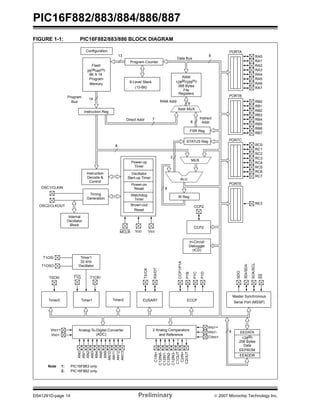
  • 3.
    PIC16F882/883/884/886/887 28/40/44-Pin Flash-Based,8-Bit CMOS Microcontrollers with nanoWatt Technology High-Performance RISC CPU: • Only 35 instructions to learn: - All single-cycle instructions except branches • Operating speed: - DC – 20 MHz oscillator/clock input - DC – 200 ns instruction cycle • Interrupt capability • 8-level deep hardware stack • Direct, Indirect and Relative Addressing modes Special Microcontroller Features: • Precision Internal Oscillator: - Factory calibrated to ±1% - Software selectable frequency range of 8 MHz to 31 kHz - Software tunable - Two-Speed Start-up mode - Crystal fail detect for critical applications - Clock mode switching during operation for power savings • Power-Saving Sleep mode • Wide operating voltage range (2.0V-5.5V) • Industrial and Extended Temperature range • Power-on Reset (POR) • Power-up Timer (PWRT) and Oscillator Start-up Timer (OST) • Brown-out Reset (BOR) with software control option • Enhanced low-current Watchdog Timer (WDT) with on-chip oscillator (software selectable nominal 268 seconds with full prescaler) with software enable • Multiplexed Master Clear with pull-up/input pin • Programmable code protection • High Endurance Flash/EEPROM cell: - 100,000 write Flash endurance - 1,000,000 write EEPROM endurance - Flash/Data EEPROM retention: > 40 years • Program memory Read/Write during run time • In-Circuit Debugger (on board) Low-Power Features: • Standby Current: - 50 nA @ 2.0V, typical • Operating Current: - 11μA @ 32 kHz, 2.0V, typical - 220μA @ 4 MHz, 2.0V, typical • Watchdog Timer Current: - 1μA @ 2.0V, typical Peripheral Features: • 24/35 I/O pins with individual direction control: - High current source/sink for direct LED drive - Interrupt-on-Change pin - Individually programmable weak pull-ups - Ultra Low-Power Wake-up (ULPWU) • Analog Comparator module with: - Two analog comparators - Programmable on-chip voltage reference (CVREF) module (% of VDD) - Fixed voltage reference (0.6V) - Comparator inputs and outputs externally accessible - SR Latch mode - External Timer1 Gate (count enable) • A/D Converter: - 10-bit resolution and 11/14 channels • Timer0: 8-bit timer/counter with 8-bit programmable prescaler • Enhanced Timer1: - 16-bit timer/counter with prescaler - External Gate Input mode - Dedicated low-power 32 kHz oscillator • Timer2: 8-bit timer/counter with 8-bit period register, prescaler and postscaler • Enhanced Capture, Compare, PWM+ module: - 16-bit Capture, max. resolution 12.5 ns - Compare, max. resolution 200 ns - 10-bit PWM with 1, 2 or 4 output channels, programmable “dead time”, max. frequency 20 kHz - PWM output steering control • Capture, Compare, PWM module: - 16-bit Capture, max. resolution 12.5 ns - 16-bit Compare, max. resolution 200 ns - 10-bit PWM, max. frequency 20 kHz • Enhanced USART module: - Supports RS-485, RS-232, and LIN 2.0 - Auto-Baud Detect - Auto-Wake-Up on Start bit • In-Circuit Serial ProgrammingTM (ICSPTM) via two pins • Master Synchronous Serial Port (MSSP) module supporting 3-wire SPI (all 4 modes) and I2C™ Master and Slave Modes with I2C address mask © 2007 Microchip Technology Inc. Preliminary DS41291D-page 1
  • 4.
    PIC16F882/883/884/886/887 Device Program Memory Data Memory I/O 10-bit A/D Flash (ch) 8/16-bit (words) ECCP/ CCP EUSART MSSP Comparators Timers SRAM (bytes) EEPROM (bytes) PIC16F882 2048 128 128 28 11 1/1 1 1 2 2/1 PIC16F883 4096 256 256 24 11 1/1 1 1 2 2/1 PIC16F884 4096 256 256 35 14 1/1 1 1 2 2/1 PIC16F886 8192 368 256 24 11 1/1 1 1 2 2/1 PIC16F887 8192 368 256 35 14 1/1 1 1 2 2/1 DS41291D-page 2 Preliminary © 2007 Microchip Technology Inc.
  • 5.
    PIC16F882/883/884/886/887 Pin Diagrams– PIC16F882/883/886, 28-Pin PDIP, SOIC, SSOP 1 2 3 4 5 6 7 8 9 10 11 28 27 26 25 24 23 22 21 20 19 18 17 PIC16F882/883/886 12 13 16 14 15 28-pin PDIP, SOIC, SSOP RE3/MCLR/VPP RA0/AN0/ULPWU/C12IN0- RA1/AN1/C12IN1- RA2/AN2/VREF-/CVREF/C2IN+ RA3/AN3/VREF+/C1IN+ RA4/T0CKI/C1OUT RA5/AN4/SS/C2OUT VSS RA7/OSC1/CLKIN RA6/OSC2/CLKOUT RC0/T1OSO/T1CKI RC1/T1OSI/CCP2 RC2/P1A/CCP1 RC3/SCK/SCL RB7/ICSPDAT RB6/ICSPCLK RB5/AN13/T1G RB4/AN11/P1D RB3/AN9/PGM/C12IN2- RB2/AN8/P1B RB1/AN10/P1C/C12IN3- RB0/AN12/INT VDD VSS RC7/RX/DT RC6/TX/CK RC5/SDO RC4/SDI/SDA TABLE 1: PIC16F882/883/886 28-PIN SUMMARY (PDIP, SOIC, SSOP) I/O Pin Analog Comparators Timers ECCP EUSART MSSP Interrupt Pull-up Basic RA0 2 AN0/ULPWU C12IN0- — — — — — — — RA1 3 AN1 C12IN1- — — — — — — — RA2 4 AN2 C2IN+ — — — — — — VREF-/CVREF RA3 5 AN3 C1IN+ — — — — — — VREF+ RA4 6 — C1OUT T0CKI — — — — — — RA5 7 AN4 C2OUT — — — SS — — — RA6 10 — — — — — — — — OSC2/CLKOUT RA7 9 — — — — — — — — OSC1/CLKIN RB0 21 AN12 — — — — — IOC/INT Y — RB1 22 AN10 C12IN3- — P1C — — IOC Y — RB2 23 AN8 — — P1B — — IOC Y — RB3 24 AN9 C12IN2- — — — — IOC Y PGM RB4 25 AN11 — — P1D — — IOC Y — RB5 26 AN13 — T1G — — — IOC Y — RB6 27 — — — — — — IOC Y ICSPCLK RB7 28 — — — — — — IOC Y ICSPDAT RC0 11 — — T1OSO/T1CKI — — — — — — RC1 12 — — T1OSI CCP2 — — — — — RC2 13 — — — CCP1/P1A — — — — — RC3 14 — — — — — SCK/SCL — — — RC4 15 — — — — — SDI/SDA — — — RC5 16 — — — — — SDO — — — RC6 17 — — — — TX/CK — — — — RC7 18 — — — — RX/DT — — — — RE3 1 — — — — — — — Y(1) MCLR/VPP — 20 — — — — — — — — VDD — 8 — — — — — — — — VSS — 19 — — — — — — — — VSS Note 1: Pull-up activated only with external MCLR configuration. © 2007 Microchip Technology Inc. Preliminary DS41291D-page 3
  • 6.
    PIC16F882/883/884/886/887 Pin Diagrams– PIC16F882/883/886, 28-Pin QFN 21 20 19 18 17 16 1 2 3 4 5 6 7 15 RA1/AN1/C12IN1- RA0/AN0/ULPWU/C12IN0- RE3/MCLR/VPP RB7/ICSPDAT RB6/ICSPCLK RB5/AN13/T1G RB4/AN11/P1D 22 28 26 27 23 24 25 PIC16F882/883/886 14 8 10 9 13 12 11 RC0/T1OSO/T1CKI RC1/T1OSI/CCP2 RC2/P1A/CCP1 RC3/SCK/SCL RC4/SDI/SDA RC5/SDO RC6/TX/CK 28-pin QFN RA2/AN2/VREF-/CVREF/C2IN+ RA3/AN3/VREF+/C1IN+ RA4/T0CKI/C1OUT RA5/AN4/SS/C2OUT VSS RA7/OSC1/CLKIN RA6/OSC2/CLKOUT RB3/AN9/PGM/C12IN2- RB2/AN8/P1B RB1/AN10/P1C/C12IN3- RB0/AN12/INT VDD VSS RC7/RX/DT DS41291D-page 4 Preliminary © 2007 Microchip Technology Inc.
  • 7.
    PIC16F882/883/884/886/887 TABLE 2:PIC16F882/883/886 28-PIN SUMMARY (QFN) I/O Pin Analog Comparators Timers ECCP EUSART MSSP Interrupt Pull-up Basic RA0 27 AN0/ULPWU C12IN0- — — — — — — — RA1 28 AN1 C12IN1- — — — — — — — RA2 1 AN2 C2IN+ — — — — — — VREF-/CVREF RA3 2 AN3 C1IN+ — — — — — — VREF+ RA4 3 — C1OUT T0CKI — — — — — — RA5 4 AN4 C2OUT — — — SS — — — RA6 7 — — — — — — — — OSC2/CLKOUT RA7 6 — — — — — — — — OSC1/CLKIN RB0 18 AN12 — — — — — IOC/INT Y — RB1 19 AN10 C12IN3- — P1C — — IOC Y — RB2 20 AN8 — — P1B — — IOC Y — RB3 21 AN9 C12IN2- — — — — IOC Y PGM RB4 22 AN11 — — P1D — — IOC Y — RB5 23 AN13 — T1G — — — IOC Y — RB6 24 — — — — — — IOC Y ICSPCLK RB7 25 — — — — — — IOC Y ICSPDAT RC0 8 — — T1OSO/T1CKI — — — — — — RC1 9 — — T1OSI CCP2 — — — — — RC2 10 — — — CCP1/P1A — — — — — RC3 11 — — — — — SCK/SCL — — — RC4 12 — — — — — SDI/SDA — — — RC5 13 — — — — — SDO — — — RC6 14 — — — — TX/CK — — — — RC7 15 — — — — RX/DT — — — — RE3 26 — — — — — — — Y(1) MCLR/VPP — 17 — — — — — — — — VDD — 5 — — — — — — — — VSS — 16 — — — — — — — — VSS Note 1: Pull-up activated only with external MCLR configuration. © 2007 Microchip Technology Inc. Preliminary DS41291D-page 5
  • 8.
    PIC16F882/883/884/886/887 Pin Diagrams– PIC16F884/887, 40-Pin PDIP 1 2 3 4 5 6 7 8 9 10 11 12 13 14 15 16 17 18 19 20 40 39 38 37 36 35 34 33 32 31 30 29 28 27 26 25 24 23 22 21 PIC16F884/887 RE3/MCLR/VPP 40-pin PDIP RA0/AN0/ULPWU/C12IN0- RA1/AN1/C12IN1- RA2/AN2/VREF-/CVREF/C2IN+ RA3/AN3/VREF+/C1IN+ RA4/T0CKI/C1OUT RA5/AN4/SS/C2OUT RE0/AN5 RE1/AN6 RE2/AN7 VDD VSS RA7/OSC1/CLKIN RA6/OSC2/CLKOUT RC0/T1OSO/T1CKI RC1/T1OSI/CCP2 RC2/P1A/CCP1 RC3/SCK/SCL RD0 RD1 RB7/ICSPDAT RB6/ICSPCLK RB5/AN13/T1G RB4/AN11 RB3/AN9/PGM/C12IN2- RB2/AN8 RB1/AN10/C12IN3- RB0/AN12/INT VDD VSS RD7/P1D RD6/P1C RD5/P1B RD4 RC7/RX/DT RC6/TX/CK RC5/SDO RC4/SDI/SDA RD3 RD2 DS41291D-page 6 Preliminary © 2007 Microchip Technology Inc.
  • 9.
    PIC16F882/883/884/886/887 TABLE 3:PIC16F884/887 40-PIN SUMMARY (PDIP) I/O Pin Analog Comparators Timers ECCP EUSART MSSP Interrupt Pull-up Basic RA0 2 AN0/ULPWU C12IN0- — — — — — — — RA1 3 AN1 C12IN1- — — — — — — — RA2 4 AN2 C2IN+ — — — — — — VREF-/CVREF RA3 5 AN3 C1IN+ — — — — — — VREF+ RA4 6 — C1OUT T0CKI — — — — — — RA5 7 AN4 C2OUT — — — SS — — — RA6 14 — — — — — — — — OSC2/CLKOUT RA7 13 — — — — — — — — OSC1/CLKIN RB0 33 AN12 — — — — — IOC/INT Y — RB1 34 AN10 C12IN3- — — — — IOC Y — RB2 35 AN8 — — — — — IOC Y — RB3 36 AN9 C12IN2- — — — — IOC Y PGM RB4 37 AN11 — — — — — IOC Y — RB5 38 AN13 — T1G — — — IOC Y — RB6 39 — — — — — — IOC Y ICSPCLK RB7 40 — — — — — — IOC Y ICSPDAT RC0 15 — — T1OSO/T1CKI — — — — — — RC1 16 — — T1OSI CCP2 — — — — — RC2 17 — — — CCP1/P1A — — — — — RC3 18 — — — — — SCK/SCL — — — RC4 23 — — — — — SDI/SDA — — — RC5 24 — — — — — SDO — — — RC6 25 — — — — TX/CK — — — — RC7 26 — — — — RX/DT — — — — RD0 19 — — — — — — — — — RD1 20 — — — — — — — — — RD2 21 — — — — — — — — — RD3 22 — — — — — — — — — RD4 27 — — — — — — — — — RD5 28 — — — P1B — — — — — RD6 29 — — — P1C — — — — — RD7 30 — — — P1D — — — — — RE0 8 AN5 — — — — — — — — RE1 9 AN6 — — — — — — — — RE2 10 AN7 — — — — — — — — RE3 1 — — — — — — — Y(1) MCLR/VPP — 11 — — — — — — — — VDD — 32 — — — — — — — — VDD — 12 — — — — — — — — VSS — 31 — — — — — — — — VSS Note 1: Pull-up activated only with external MCLR configuration. © 2007 Microchip Technology Inc. Preliminary DS41291D-page 7
  • 10.
    PIC16F882/883/884/886/887 Pin Diagrams– PIC16F884/887, 44-Pin QFN 44-pin QFN 1 23 4 5 6 8 7 RC6/TX/CK RC5/SDO RC4/SDI/SDA RD3 RD2 RD1 RD0 RC3/SCK/SCL RC2/P1A/CCP1 RC1/T1OSCI/CCP2 RC0/T1OSO/T1CKI 44 43 42 41 40 39 9 10 11 38 PIC16F884/887 16 17 37 36 34 33 32 31 30 29 28 27 26 25 24 23 12 13 14 15 35 18 19 20 21 22 RA6/OSC2/CLKOUT RA7/OSC1/CLKIN VSS VSS NC VDD RE2/AN7 RE1/AN6 RE0/AN5 RA5/AN4/SS/C2OUT RA4/T0CKI/C1OUT RC7/RX/DT RD4 RD5/P1B RD6/P1C RD7/P1D VSS VDD VDD RB0/AN12/INT RB1/AN10/C12IN3- RB2/AN8 RB3/AN9/PGM/C12IN2- NC RB5/AN13/T1G RB6/ICSPCLK RB7/ICSPDAT RE3/MCLR/VPP RB4/AN11 RA1/AN1/C12IN1- RA0/AN0/ULPWU/C12IN0- RA3/AN3//VREF+/C1IN+ RA2/AN2/VREF-/CVREF/C2IN+ DS41291D-page 8 Preliminary © 2007 Microchip Technology Inc.
  • 11.
    PIC16F882/883/884/886/887 TABLE 4:PIC16F884/887 44-PIN SUMMARY (QFN) I/O Pin Analog Comparators Timers ECCP EUSART MSSP Interrupt Pull-up Basic RA0 19 AN0/ULPWU C12IN0- — — — — — — — RA1 20 AN1 C12IN1- — — — — — — — RA2 21 AN2 C2IN+ — — — — — — VREF-/CVREF RA3 22 AN3 C1IN+ — — — — — — VREF+ RA4 23 — C1OUT T0CKI — — — — — — RA5 24 AN4 C2OUT — — — SS — — — RA6 33 — — — — — — — — OSC2/CLKOUT RA7 32 — — — — — — — — OSC1/CLKIN RB0 9 AN12 — — — — — IOC/INT Y — RB1 10 AN10 C12IN3- — — — — IOC Y — RB2 11 AN8 — — — — — IOC Y — RB3 12 AN9 C12IN2- — — — — IOC Y PGM RB4 14 AN11 — — — — — IOC Y — RB5 15 AN13 — T1G — — — IOC Y — RB6 16 — — — — — — IOC Y ICSPCLK RB7 17 — — — — — — IOC Y ICSPDAT RC0 34 — — T1OSO/T1CKI — — — — — — RC1 35 — — T1OSI CCP2 — — — — — RC2 36 — — — CCP1/P1A — — — — — RC3 37 — — — — — SCK/SCL — — — RC4 42 — — — — — SDI/SDA — — — RC5 43 — — — — — SDO — — — RC6 44 — — — — TX/CK — — — — RC7 1 — — — — RX/DT — — — — RD0 38 — — — — — — — — — RD1 39 — — — — — — — — — RD2 40 — — — — — — — — — RD3 41 — — — — — — — — — RD4 2 — — — — — — — — — RD5 3 — — — P1B — — — — — RD6 4 — — — P1C — — — — — RD7 5 — — — P1D — — — — — RE0 25 AN5 — — — — — — — — RE1 26 AN6 — — — — — — — — RE2 27 AN7 — — — — — — — — RE3 18 — — — — — — — Y(1) MCLR/VPP — 7 — — — — — — — — VDD — 8 — — — — — — — — VDD — 28 — — — — — — — — VDD — 6 — — — — — — — — VSS — 30 — — — — — — — — VSS — 31 — — — — — — — — VSS — 13 — — — — — — — — NC (no connect) — 29 — — — — — — — — NC (no connect) Note 1: Pull-up activated only with external MCLR configuration. © 2007 Microchip Technology Inc. Preliminary DS41291D-page 9
  • 12.
    PIC16F882/883/884/886/887 Pin Diagrams– PIC16F884/887, 44-Pin TQFP 44-pin TQFP 1 23 4 5 6 8 7 RC6/TX/CK RC5/SDO RC4/SDI/SDA RD3 RD2 RD1 RD0 RC3/SCK/SCL RC2/P1A/CCP1 RC1/T1OSCI/CCP2 NC 44 43 42 41 40 39 9 10 11 38 PIC16F884/887 16 17 37 36 34 33 32 31 30 29 28 27 26 25 24 23 12 13 14 15 35 18 19 20 21 22 NC RC0/T1OSO/T1CKI RA6/OSC2/CLKOUT RA7/OSC1/CLKIN VSS VDD RE2/AN7 RE1/AN6 RE0/AN5 RA5/AN4/SS/C2OUT RA4/T0CKI/C1OUT RC7/RX/DT RD4 RD5/P1B RD6/P1C RD7/P1D VSS VDD RB0/AN12/INT RB1/AN10/C12IN3- RB2/AN8 RB3/AN9/PGM/C12IN2- NC NC RB5/AN13/T1G RB6/ICSPCLK RB7/ICSPDAT RE3/MCLR/VPP RB4/AN11 RA1/AN1/C12IN1- RA0/AN0/ULPWU/C12IN0- RA3/AN3//VREF+/C1IN+ RA2/AN2/VREF-/CVREF/C2IN+ DS41291D-page 10 Preliminary © 2007 Microchip Technology Inc.
  • 13.
    PIC16F882/883/884/886/887 TABLE 5:PIC16F884/887 44-PIN SUMMARY (TQFP) I/O Pin Analog Comparators Timers ECCP EUSART MSSP Interrupt Pull-up Basic RA0 19 AN0/ULPWU C12IN0- — — — — — — — RA1 20 AN1 C12IN1- — — — — — — — RA2 21 AN2 C2IN+ — — — — — — VREF-/CVREF RA3 22 AN3 C1IN+ — — — — — — VREF+ RA4 23 — C1OUT T0CKI — — — — — — RA5 24 AN4 C2OUT — — — SS — — — RA6 31 — — — — — — — — OSC2/CLKOUT RA7 31 — — — — — — — — OSC1/CLKIN RB0 8 AN12 — — — — — IOC/INT Y — RB1 9 AN10 C12IN3- — — — — IOC Y — RB2 10 AN8 — — — — — IOC Y — RB3 11 AN9 C12IN2- — — — — IOC Y PGM RB4 14 AN11 — — — — — IOC Y — RB5 15 AN13 — T1G — — — IOC Y — RB6 16 — — — — — — IOC Y ICSPCLK RB7 17 — — — — — — IOC Y ICSPDAT RC0 32 — — T1OSO/T1CKI — — — — — — RC1 35 — — T1OSI CCP2 — — — — — RC2 36 — — — CCP1/P1A — — — — — RC3 37 — — — — — SCK/SCL — — — RC4 42 — — — — — SDI/SDA — — — RC5 43 — — — — — SDO — — — RC6 44 — — — — TX/CK — — — — RC7 1 — — — — RX/DT — — — — RD0 38 — — — — — — — — — RD1 39 — — — — — — — — — RD2 40 — — — — — — — — — RD3 41 — — — — — — — — — RD4 2 — — — — — — — — — RD5 3 — — — P1B — — — — — RD6 4 — — — P1C — — — — — RD7 5 — — — P1D — — — — — RE0 25 AN5 — — — — — — — — RE1 26 AN6 — — — — — — — — RE2 27 AN7 — — — — — — — — RE3 18 — — — — — — — Y(1) MCLR/VPP — 7 — — — — — — — — VDD — 28 — — — — — — — — VDD — 6 — — — — — — — — VSS — 13 — — — — — — — — NC (no connect) — 29 — — — — — — — — VSS — 34 — — — — — — — — NC (no connect) — 33 — — — — — — — — NC (no connect) — 12 — — — — — — — — NC (no connect) Note 1: Pull-up activated only with external MCLR configuration. © 2007 Microchip Technology Inc. Preliminary DS41291D-page 11
  • 14.
    PIC16F882/883/884/886/887 Table ofContents 1.0 Device Overview ........................................................................................................................................................................ 13 2.0 Memory Organization ................................................................................................................................................................. 21 3.0 I/O Ports ..................................................................................................................................................................................... 39 4.0 Oscillator Module (With Fail-Safe Clock Monitor)....................................................................................................................... 61 5.0 Timer0 Module ........................................................................................................................................................................... 73 6.0 Timer1 Module with Gate Control............................................................................................................................................... 76 7.0 Timer2 Module ........................................................................................................................................................................... 81 8.0 Comparator Module.................................................................................................................................................................... 83 9.0 Analog-to-Digital Converter (ADC) Module ................................................................................................................................ 99 10.0 Data EEPROM and Flash Program Memory Control ............................................................................................................... 111 11.0 Enhanced Capture/Compare/PWM Module ............................................................................................................................. 123 12.0 Enhanced Universal Synchronous Asynchronous Receiver Transmitter (EUSART) ............................................................... 149 13.0 Master Synchronous Serial Port (MSSP) Module .................................................................................................................... 175 14.0 Special Features of the CPU.................................................................................................................................................... 205 15.0 Instruction Set Summary .......................................................................................................................................................... 225 16.0 Development Support............................................................................................................................................................... 235 17.0 Electrical Specifications............................................................................................................................................................ 239 18.0 DC and AC Characteristics Graphs and Tables....................................................................................................................... 261 19.0 Packaging Information.............................................................................................................................................................. 263 Appendix A: Data Sheet Revision History.......................................................................................................................................... 273 Appendix B: Migrating from other PIC® Devices ............................................................................................................................... 273 Index .................................................................................................................................................................................................. 275 The Microchip Web Site ..................................................................................................................................................................... 283 Customer Change Notification Service .............................................................................................................................................. 283 Customer Support .............................................................................................................................................................................. 283 Reader Response .............................................................................................................................................................................. 284 Product Identification System............................................................................................................................................................. 285 TO OUR VALUED CUSTOMERS It is our intention to provide our valued customers with the best documentation possible to ensure successful use of your Microchip products. To this end, we will continue to improve our publications to better suit your needs. Our publications will be refined and enhanced as new volumes and updates are introduced. If you have any questions or comments regarding this publication, please contact the Marketing Communications Department via E-mail at docerrors@microchip.com or fax the Reader Response Form in the back of this data sheet to (480) 792-4150. We wel-come your feedback. Most Current Data Sheet To obtain the most up-to-date version of this data sheet, please register at our Worldwide Web site at: http://www.microchip.com You can determine the version of a data sheet by examining its literature number found on the bottom outside corner of any page. The last character of the literature number is the version number, (e.g., DS30000A is version A of document DS30000). Errata An errata sheet, describing minor operational differences from the data sheet and recommended workarounds, may exist for current devices. As device/documentation issues become known to us, we will publish an errata sheet. The errata will specify the revision of silicon and revision of document to which it applies. To determine if an errata sheet exists for a particular device, please check with one of the following: • Microchip’s Worldwide Web site; http://www.microchip.com • Your local Microchip sales office (see last page) When contacting a sales office, please specify which device, revision of silicon and data sheet (include literature number) you are using. Customer Notification System Register on our web site at www.microchip.com to receive the most current information on all of our products. DS41291D-page 12 Preliminary © 2007 Microchip Technology Inc.
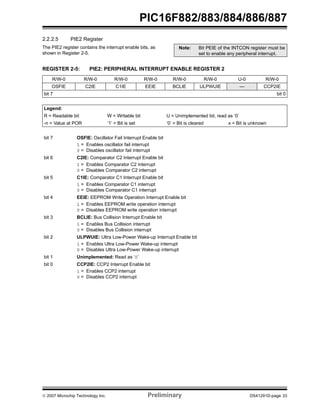
  • 15.
    PIC16F882/883/884/886/887 1.0 DEVICEOVERVIEW The PIC16F882/883/884/886/887 is covered by this data sheet. The PIC16F882/883/886 is available in 28- pin PDIP, SOIC, SSOP and QFN packages. The PIC16F884/887 is available in a 40-pin PDIP and 44- pin QFN and TQFP packages. Figure 1-1 shows the block diagram of PIC16F882/883/886 and Figure 1-2 shows a block diagram of the PIC16F884/887 device. Table 1-1 and Table 1-2 show the corresponding pinout descriptions. © 2007 Microchip Technology Inc. Preliminary DS41291D-page 13
  • 16.
    PIC16F882/883/884/886/887 FIGURE 1-1:PIC16F882/883/886 BLOCK DIAGRAM Configuration Flash 2K(2)/4K(1)/ 8K X 14 Program Memory 13 Data Bus 8 Program Bus 14 Instruction Reg Program Counter RAM 8-Level Stack 128(2)/256(1)/ 368 Bytes File Registers (13-Bit) Direct Addr 7 RAM Addr 9 Addr MUX Indirect Addr 8 FSR Reg STATUS Reg MUX ALU W Reg Instruction Decode & Control Timing Generation OSC1/CLKIN OSC2/CLKOUT 8 8 3 Power-up Timer Oscillator Start-up Timer Power-on Reset Watchdog Timer Brown-out Reset VDD MCLR VSS Internal Oscillator Block Timer1 32 kHz Oscillator T1OSI T1OSO T0CKI T1G T1CKI Timer0 Timer1 PORTA PORTB PORTC PORTE SDO SDI/SDA SCK/SCL SS Master Synchronous Serial Port (MSSP) EEDATA 128(2)/ RA0 RA1 RA2 RA3 RA4 RA5 RA6 RA7 RB0 RB1 RB2 RB3 RB4 RB5 RB6 RB7 RC0 RC1 RC2 RC3 RC4 RC5 RC6 RC7 RE3 256 Bytes Data EEPROM EEADDR 8 CCP2 CCP2 In-Circuit Debugger (ICD) CCP1/P1A P1B P1C P1D TX/CK RX/DT Timer2 EUSART ECCP VREF+ 2 Analog Comparators and Reference Analog-To-Digital Converter (ADC) AN0 AN1 AN2 AN3 AN4 AN8 AN9 AN10 AN11 AN12 AN13 C1IN+ C12IN0- C12IN1- C12IN2- C12IN3- C1OUT C2IN+ C2OUT VREF- Note 1: PIC16F883 only. 2: PIC16F882 only. VREF+ VREF-CVREF DS41291D-page 14 Preliminary © 2007 Microchip Technology Inc.
  • 17.
    PIC16F882/883/884/886/887 FIGURE 1-2:PIC16F884/PIC16F887 BLOCK DIAGRAM PORTA PORTB PORTC PORTD RA0 RA1 RA2 RA3 RA4 RA5 RA6 RA7 RB0 RB1 RB2 RB3 RB4 RB5 RB6 RB7 RC0 RC1 RC2 RC3 RC4 RC5 RC6 RC7 RD0 RD1 RD2 RD3 RD4 RD5 RD6 RD7 Configuration Flash 4K(1)/8K X 14 Program Memory 13 Data Bus 8 Program Bus 14 Instruction Reg Program Counter RAM 8-Level Stack 256(1)/368 Bytes File Registers (13-Bit) Direct Addr 7 RAM Addr 9 Addr MUX Indirect Addr 8 FSR Reg STATUS Reg MUX ALU W Reg Instruction Decode & Control Timing Generation OSC1/CLKIN OSC2/CLKOUT 8 8 3 Power-up Timer Oscillator Start-up Timer Power-on Reset Watchdog Timer Brown-out Reset VDD MCLR VSS Internal Oscillator Block Timer1 32 kHz Oscillator T1OSI T1OSO T0CKI T1G T1CKI Timer0 Timer1 PORTE RE0 RE1 RE2 RE3 SDO SDI/SDA SCK/SCL SS Master Synchronous Serial Port (MSSP) EEDATA 256 Bytes Data EEPROM EEADDR 8 CCP2 CCP2 In-Circuit Debugger (ICD) CCP1/P1A P1B P1C P1D TX/CK RX/DT Timer2 ECCP EUSART 2 Analog Comparators and Reference Analog-To-Digital Converter (ADC) AN0 AN1 AN2 AN3 AN4 AN5 AN6 AN7 AN8 AN9 AN10 AN11 AN12 AN13 VREF+ VREF-VREF+ Note 1: PIC16F884 only. VREF-CVREF C1IN+ C12IN0- C12IN1- C12IN2- C12IN3- C1OUT C2IN+ C2OUT © 2007 Microchip Technology Inc. Preliminary DS41291D-page 15
  • 18.
    PIC16F882/883/884/886/887 TABLE 1-1:PIC16F882/883/886 PINOUT DESCRIPTION Name Function Input Type Output Type Description RA0/AN0/ULPWU/C12IN0- RA0 TTL CMOS General purpose I/O. AN0 AN — A/D Channel 0 input. ULPWU AN — Ultra Low-Power Wake-up input. C12IN0- AN — Comparator C1 or C2 negative input. RA1/AN1/C12IN1- RA1 TTL CMOS General purpose I/O. Individually enabled pull-up. AN1 AN — A/D Channel 1 input. C12IN1- AN — Comparator C1 or C2 negative input. RA2/AN2/VREF-/CVREF/C2IN+ RA2 TTL CMOS General purpose I/O. AN2 AN — A/D Channel 2. VREF- AN — A/D Negative Voltage Reference input. CVREF — AN Comparator Voltage Reference output. C2IN+ AN — Comparator C2 positive input. RA3/AN3/VREF+/C1IN+ RA3 TTL — General purpose I/O. AN3 AN — A/D Channel 3. VREF+ AN — Programming voltage. C1IN+ AN — Comparator C1 positive input. RA4/T0CKI/C1OUT RA4 TTL CMOS General purpose I/O. Individually enabled pull-up. T0CKI ST — Timer0 clock input. C1OUT — CMOS Comparator C1 output. RA5/AN4/SS/C2OUT RA5 TTL CMOS General purpose I/O. AN4 AN — A/D Channel 4. SS ST — Slave Select input. C2OUT — CMOS Comparator C2 output. RA6/OSC2/CLKOUT RA6 TTL CMOS General purpose I/O. OSC2 — XTAL Master Clear with internal pull-up. CLKOUT — CMOS FOSC/4 output. RA7/OSC1/CLKIN RA7 TTL CMOS General purpose I/O. OSC1 XTAL — Crystal/Resonator. CLKIN ST — External clock input/RC oscillator connection. RB0/AN12/INT RB0 TTL CMOS General purpose I/O. Individually controlled interrupt-on-change. Individually enabled pull-up. AN12 AN — A/D Channel 12. INT ST — External interrupt. RB1/AN10/P1C/C12IN3- RB1 TTL CMOS General purpose I/O. Individually controlled interrupt-on-change. Individually enabled pull-up. AN10 AN — A/D Channel 10. P1C — CMOS PWM output. C12IN3- AN — Comparator C1 or C2 negative input. RB2/AN8/P1B RB2 TTL CMOS General purpose I/O. Individually controlled interrupt-on-change. Individually enabled pull-up. AN8 AN — A/D Channel 8. P1B — CMOS PWM output. Legend: AN = Analog input or output CMOS = CMOS compatible input or output OD = Open Drain TTL = TTL compatible input ST = Schmitt Trigger input with CMOS levels HV = High Voltage XTAL = Crystal DS41291D-page 16 Preliminary © 2007 Microchip Technology Inc.
  • 19.
    PIC16F882/883/884/886/887 TABLE 1-1:PIC16F882/883/886 PINOUT DESCRIPTION (CONTINUED) Name Function Input Type Output Type Description RB3/AN9/PGM/C12IN2- RB3 TTL CMOS General purpose I/O. Individually controlled interrupt-on-change. Individually enabled pull-up. AN9 AN — A/D Channel 9. PGM ST — Low-voltage ICSP™ Programming enable pin. C12IN2- AN — Comparator C1 or C2 negative input. RB4/AN11/P1D RB4 TTL CMOS General purpose I/O. Individually controlled interrupt-on-change. Individually enabled pull-up. AN11 AN — A/D Channel 11. P1D — CMOS PWM output. RB5/AN13/T1G RB5 TTL CMOS General purpose I/O. Individually controlled interrupt-on-change. Individually enabled pull-up. AN13 AN — A/D Channel 13. T1G ST — Timer1 Gate input. RB6/ICSPCLK RB6 TTL CMOS General purpose I/O. Individually controlled interrupt-on-change. Individually enabled pull-up. ICSPCLK ST — Serial Programming Clock. RB7/ICSPDAT RB7 TTL CMOS General purpose I/O. Individually controlled interrupt-on-change. Individually enabled pull-up. ICSPDAT ST CMOS ICSP™ Data I/O. RC0/T1OSO/T1CKI RC0 ST CMOS General purpose I/O. T1OSO — CMOS Timer1 oscillator output. T1CKI ST — Timer1 clock input. RC1/T1OSI/CCP2 RC1 ST CMOS General purpose I/O. T1OSI ST — Timer1 oscillator input. CCP2 ST CMOS Capture/Compare/PWM2. RC2/P1A/CCP1 RC2 ST CMOS General purpose I/O. P1A — CMOS PWM output. CCP1 ST CMOS Capture/Compare/PWM1. RC3/SCK/SCL RC3 ST CMOS General purpose I/O. SCK ST CMOS SPI clock. SCL ST OD I2C™ clock. RC4/SDI/SDA RC4 ST CMOS General purpose I/O. SDI ST — SPI data input. SDA ST OD I2C data input/output. RC5/SDO RC5 ST CMOS General purpose I/O. SDO — CMOS SPI data output. RC6/TX/CK RC6 ST CMOS General purpose I/O. TX — CMOS EUSART asynchronous transmit. CK ST CMOS EUSART synchronous clock. RC7/RX/DT RC7 ST CMOS General purpose I/O. RX ST — EUSART asynchronous input. DT ST CMOS EUSART synchronous data. RE3/MCLR/VPP RE3 TTL — General purpose input. MCLR ST — Master Clear with internal pull-up. VPP HV — Programming voltage. VSS VSS Power — Ground reference. VDD VDD Power — Positive supply. Legend: AN = Analog input or output CMOS = CMOS compatible input or output OD = Open Drain TTL = TTL compatible input ST = Schmitt Trigger input with CMOS levels HV = High Voltage XTAL = Crystal © 2007 Microchip Technology Inc. Preliminary DS41291D-page 17
  • 20.
    PIC16F882/883/884/886/887 TABLE 1-2:PIC16F884/887 PINOUT DESCRIPTION Name Function Input Type Output Type Description RA0/AN0/ULPWU/C12IN0- RA0 TTL CMOS General purpose I/O. AN0 AN — A/D Channel 0 input. ULPWU AN — Ultra Low-Power Wake-up input. C12IN0- AN — Comparator C1 or C2 negative input. RA1/AN1/C12IN1- RA1 TTL CMOS General purpose I/O. AN1 AN — A/D Channel 1 input. C12IN1- AN — Comparator C1 or C2 negative input. RA2/AN2/VREF-/CVREF/C2IN+ RA2 TTL CMOS General purpose I/O. AN2 AN — A/D Channel 2. VREF- AN — A/D Negative Voltage Reference input. CVREF — AN Comparator Voltage Reference output. C2IN+ AN — Comparator C2 positive input. RA3/AN3/VREF+/C1IN+ RA3 TTL CMOS General purpose I/O. AN3 AN — A/D Channel 3. VREF+ AN — A/D Positive Voltage Reference input. C1IN+ AN — Comparator C1 positive input. RA4/T0CKI/C1OUT RA4 TTL CMOS General purpose I/O. T0CKI ST — Timer0 clock input. C1OUT — CMOS Comparator C1 output. RA5/AN4/SS/C2OUT RA5 TTL CMOS General purpose I/O. AN4 AN — A/D Channel 4. SS ST — Slave Select input. C2OUT — CMOS Comparator C2 output. RA6/OSC2/CLKOUT RA6 TTL CMOS General purpose I/O. OSC2 — XTAL Crystal/Resonator. CLKOUT — CMOS FOSC/4 output. RA7/OSC1/CLKIN RA7 TTL CMOS General purpose I/O. OSC1 XTAL — Crystal/Resonator. CLKIN ST — External clock input/RC oscillator connection. RB0/AN12/INT RB0 TTL CMOS General purpose I/O. Individually controlled interrupt-on-change. Individually enabled pull-up. AN12 AN — A/D Channel 12. INT ST — External interrupt. RB1/AN10/C12IN3- RB1 TTL CMOS General purpose I/O. Individually controlled interrupt-on-change. Individually enabled pull-up. AN10 AN — A/D Channel 10. C12IN3- AN — Comparator C1 or C2 negative input. RB2/AN8 RB2 TTL CMOS General purpose I/O. Individually controlled interrupt-on-change. Individually enabled pull-up. AN8 AN — A/D Channel 8. RB3/AN9/PGM/C12IN2- RB3 TTL CMOS General purpose I/O. Individually controlled interrupt-on-change. Individually enabled pull-up. AN9 AN — A/D Channel 9. PGM ST — Low-voltage ICSP™ Programming enable pin. C12IN2- AN — Comparator C1 or C2 negative input. Legend: AN = Analog input or output CMOS = CMOS compatible input or output OD = Open Drain TTL = TTL compatible input ST = Schmitt Trigger input with CMOS levels HV = High Voltage XTAL = Crystal DS41291D-page 18 Preliminary © 2007 Microchip Technology Inc.
  • 21.
    PIC16F882/883/884/886/887 TABLE 1-2:PIC16F884/887 PINOUT DESCRIPTION (CONTINUED) Name Function Input Type Output Type Description RB4/AN11 RB4 TTL CMOS General purpose I/O. Individually controlled interrupt-on-change. Individually enabled pull-up. AN11 AN — A/D Channel 11. RB5/AN13/T1G RB5 TTL CMOS General purpose I/O. Individually controlled interrupt-on-change. Individually enabled pull-up. AN13 AN — A/D Channel 13. T1G ST — Timer1 Gate input. RB6/ICSPCLK RB6 TTL CMOS General purpose I/O. Individually controlled interrupt-on-change. Individually enabled pull-up. ICSPCLK ST — Serial Programming Clock. RB7/ICSPDAT RB7 TTL CMOS General purpose I/O. Individually controlled interrupt-on-change. Individually enabled pull-up. ICSPDAT ST TTL ICSP™ Data I/O. RC0/T1OSO/T1CKI RC0 ST CMOS General purpose I/O. T1OSO — XTAL Timer1 oscillator output. T1CKI ST — Timer1 clock input. RC1/T1OSI/CCP2 RC1 ST CMOS General purpose I/O. T1OSI XTAL — Timer1 oscillator input. CCP2 ST CMOS Capture/Compare/PWM2. RC2/P1A/CCP1 RC2 ST CMOS General purpose I/O. P1A ST CMOS PWM output. CCP1 — CMOS Capture/Compare/PWM1. RC3/SCK/SCL RC3 ST CMOS General purpose I/O. SCK ST CMOS SPI clock. SCL ST OD I2C™ clock. RC4/SDI/SDA RC4 ST CMOS General purpose I/O. SDI ST — SPI data input. SDA ST OD I2C data input/output. RC5/SDO RC5 ST CMOS General purpose I/O. SDO — CMOS SPI data output. RC6/TX/CK RC6 ST CMOS General purpose I/O. TX — CMOS EUSART asynchronous transmit. CK ST CMOS EUSART synchronous clock. RC7/RX/DT RC7 ST CMOS General purpose I/O. RX ST — EUSART asynchronous input. DT ST CMOS EUSART synchronous data. RD0 RD0 TTL CMOS General purpose I/O. RD1 RD1 TTL CMOS General purpose I/O. RD2 RD2 TTL CMOS General purpose I/O. RD3 RD3 TTL CMOS General purpose I/O. RD4 RD4 TTL CMOS General purpose I/O. RD5/P1B RD5 TTL CMOS General purpose I/O. P1B — CMOS PWM output. RD6/P1C RD6 TTL CMOS General purpose I/O. P1C — CMOS PWM output. Legend: AN = Analog input or output CMOS = CMOS compatible input or output OD = Open Drain TTL = TTL compatible input ST = Schmitt Trigger input with CMOS levels HV = High Voltage XTAL = Crystal © 2007 Microchip Technology Inc. Preliminary DS41291D-page 19
  • 22.
    PIC16F882/883/884/886/887 TABLE 1-2:PIC16F884/887 PINOUT DESCRIPTION (CONTINUED) Name Function Input Type Output Type RD7/P1D RD7 TTL CMOS General purpose I/O. P1D AN — PWM output. RE0/AN5 RE0 TTL CMOS General purpose I/O. AN5 AN — A/D Channel 5. RE1/AN6 RE1 ST CMOS General purpose I/O. AN6 AN — A/D Channel 6. RE2/AN7 RE2 TTL CMOS General purpose I/O. AN7 AN — A/D Channel 7. RE3/MCLR/VPP RE3 TTL — General purpose input. Description MCLR ST — Master Clear with internal pull-up. VPP HV — Programming voltage. VSS VSS Power — Ground reference. VDD VDD Power — Positive supply. Legend: AN = Analog input or output CMOS = CMOS compatible input or output OD = Open Drain TTL = TTL compatible input ST = Schmitt Trigger input with CMOS levels HV = High Voltage XTAL = Crystal DS41291D-page 20 Preliminary © 2007 Microchip Technology Inc.
  • 23.
    PIC16F882/883/884/886/887 2.0 MEMORYORGANIZATION 2.1 Program Memory Organization The PIC16F882/883/884/886/887 has a 13-bit program counter capable of addressing a 2K x 14 (0000h-07FFh) for the PIC16F882, 4K x 14 (0000h-0FFFh) for the PIC16F883/PIC16F884, and 8K x 14 (0000h-1FFFh) for the PIC16F886/PIC16F887 program memory space. Accessing a location above these boundaries will cause a wraparound within the first 8K x 14 space. The Reset vector is at 0000h and the interrupt vector is at 0004h (see Figures 2-2 and 2-3). FIGURE 2-1: PROGRAM MEMORY MAP AND STACK FOR THE PIC16F882 FIGURE 2-2: PROGRAM MEMORY MAP AND STACK FOR THE PIC16F883/PIC16F884 PC<12:0> 13 0000h 0004h 0005h 07FFh 0800h Stack Level 1 Stack Level 2 Stack Level 8 Reset Vector Interrupt Vector CALL, RETURN RETFIE, RETLW Page 0 Page 1 0FFFh On-Chip Program Memory FIGURE 2-3: PROGRAM MEMORY MAP AND STACK FOR THE PIC16F886/PIC16F887 PC<12:0> 13 0000h 0004h 0005h 07FFh Stack Level 1 Stack Level 2 Stack Level 8 Reset Vector Interrupt Vector CALL, RETURN RETFIE, RETLW Page 0 On-Chip Program Memory PC<12:0> 13 0000h 0004h 0005h 07FFh 0800h 0FFFh 1000h 17FFh Stack Level 1 Stack Level 2 Stack Level 8 Reset Vector Interrupt Vector CALL, RETURN RETFIE, RETLW Page 0 Page 1 Page 2 Page 3 1800h 1FFFh On-Chip Program Memory © 2007 Microchip Technology Inc. Preliminary DS41291D-page 21
  • 24.
    PIC16F882/883/884/886/887 2.2 DataMemory Organization The data memory (see Figures 2-2 and 2-3) is partitioned into four banks which contain the General Purpose Registers (GPR) and the Special Function Registers (SFR). The Special Function Registers are located in the first 32 locations of each bank. The General Purpose Registers, implemented as static RAM, are located in the last 96 locations of each Bank. Register locations F0h-FFh in Bank 1, 170h-17Fh in Bank 2 and 1F0h-1FFh in Bank 3, point to addresses 70h-7Fh in Bank 0. The actual number of General Purpose Resisters (GPR) implemented in each Bank depends on the device. Details are shown in Figures 2-5 and 2-6. All other RAM is unimplemented and returns ‘0’ when read. RP<1:0> of the STATUS register are the bank select bits: RP1 RP0 0 0 →Bank 0 is selected 0 1 →Bank 1 is selected 1 0 →Bank 2 is selected 1 1 →Bank 3 is selected 2.2.1 GENERAL PURPOSE REGISTER FILE The register file is organized as 128 x 8 in the PIC16F882, 256 x 8 in the PIC16F883/PIC16F884, and 368 x 8 in the PIC16F886/PIC16F887. Each register is accessed, either directly or indirectly, through the File Select Register (FSR) (see Section 2.4 “Indirect Addressing, INDF and FSR Registers”). Note: The IRP and RP1 bits of the STATUS reg-ister are reserved and should always be maintained as ‘0’s. 2.2.2 SPECIAL FUNCTION REGISTERS The Special Function Registers are registers used by the CPU and peripheral functions for controlling the desired operation of the device (see Table 2-1). These registers are static RAM. The special registers can be classified into two sets: core and peripheral. The Special Function Registers associated with the “core” are described in this section. Those related to the operation of the peripheral features are described in the section of that peripheral feature. DS41291D-page 22 Preliminary © 2007 Microchip Technology Inc.
  • 25.
    PIC16F882/883/884/886/887 FIGURE 2-4:PIC16F882 SPECIAL FUNCTION REGISTERS File File File File Address Address Address Address Indirect addr. (1) 00h Indirect addr. (1) 80h Indirect addr. (1) 100h Indirect addr. (1) 180h TMR0 01h OPTION_REG 81h TMR0 101h OPTION_REG 181h PCL 02h PCL 82h PCL 102h PCL 182h STATUS 03h STATUS 83h STATUS 103h STATUS 183h FSR 04h FSR 84h FSR 104h FSR 184h PORTA 05h TRISA 85h WDTCON 105h SRCON 185h PORTB 06h TRISB 86h PORTB 106h TRISB 186h PORTC 07h TRISC 87h CM1CON0 107h BAUDCTL 187h 08h 88h CM2CON0 108h ANSEL 188h PORTE 09h TRISE 89h CM2CON1 109h ANSELH 189h PCLATH 0Ah PCLATH 8Ah PCLATH 10Ah PCLATH 18Ah INTCON 0Bh INTCON 8Bh INTCON 10Bh INTCON 18Bh PIR1 0Ch PIE1 8Ch EEDAT 10Ch EECON1 18Ch PIR2 0Dh PIE2 8Dh EEADR 10Dh EECON2(1) 18Dh TMR1L 0Eh PCON 8Eh EEDATH 10Eh Reserved 18Eh TMR1H 0Fh OSCCON 8Fh EEADRH 10Fh Reserved 18Fh T1CON 10h OSCTUNE 90h 110h 190h TMR2 11h SSPCON2 91h 111h 191h T2CON 12h PR2 92h 112h 192h SSPBUF 13h SSPADD 93h 113h 193h SSPCON 14h SSPSTAT 94h 114h 194h CCPR1L 15h WPUB 95h 115h 195h CCPR1H 16h IOCB 96h 116h 196h CCP1CON 17h VRCON 97h 117h 197h RCSTA 18h TXSTA 98h 118h 198h TXREG 19h SPBRG 99h 119h 199h RCREG 1Ah SPBRGH 9Ah 11Ah 19Ah CCPR2L 1Bh PWM1CON 9Bh 11Bh 19Bh CCPR2H 1Ch ECCPAS 9Ch 11Ch 19Ch CCP2CON 1Dh PSTRCON 9Dh 11Dh 19Dh ADRESH 1Eh ADRESL 9Eh 11Eh 19Eh ADCON0 1Fh ADCON1 9Fh 11Fh 19Fh General Purpose Registers 96 Bytes 20h General Purpose Registers 32 Bytes A0h BFh 120h 1A0h C0h EFh 16Fh 1EFh accesses 70h-7Fh F0h accesses 70h-7Fh 170h accesses 70h-7Fh 1F0h 7Fh FFh 17Fh 1FFh Bank 0 Bank 1 Bank 2 Bank 3 Unimplemented data memory locations, read as ‘0’. Note 1: Not a physical register. © 2007 Microchip Technology Inc. Preliminary DS41291D-page 23
  • 26.
    PIC16F882/883/884/886/887 FIGURE 2-5:PIC16F883/PIC16F884 SPECIAL FUNCTION REGISTERS File File File File Address Address Address Address Indirect addr. (1) 00h Indirect addr. (1) 80h Indirect addr. (1) 100h Indirect addr. (1) 180h TMR0 01h OPTION_REG 81h TMR0 101h OPTION_REG 181h PCL 02h PCL 82h PCL 102h PCL 182h STATUS 03h STATUS 83h STATUS 103h STATUS 183h FSR 04h FSR 84h FSR 104h FSR 184h PORTA 05h TRISA 85h WDTCON 105h SRCON 185h PORTB 06h TRISB 86h PORTB 106h TRISB 186h PORTC 07h TRISC 87h CM1CON0 107h BAUDCTL 187h PORTD(2) 08h TRISD(2) 88h CM2CON0 108h ANSEL 188h PORTE 09h TRISE 89h CM2CON1 109h ANSELH 189h PCLATH 0Ah PCLATH 8Ah PCLATH 10Ah PCLATH 18Ah INTCON 0Bh INTCON 8Bh INTCON 10Bh INTCON 18Bh PIR1 0Ch PIE1 8Ch EEDAT 10Ch EECON1 18Ch PIR2 0Dh PIE2 8Dh EEADR 10Dh EECON2(1) 18Dh TMR1L 0Eh PCON 8Eh EEDATH 10Eh Reserved 18Eh TMR1H 0Fh OSCCON 8Fh EEADRH 10Fh Reserved 18Fh T1CON 10h OSCTUNE 90h 110h 190h TMR2 11h SSPCON2 91h 111h 191h T2CON 12h PR2 92h 112h 192h SSPBUF 13h SSPADD 93h 113h 193h SSPCON 14h SSPSTAT 94h 114h 194h CCPR1L 15h WPUB 95h 115h 195h CCPR1H 16h IOCB 96h 116h 196h CCP1CON 17h VRCON 97h 117h 197h RCSTA 18h TXSTA 98h 118h 198h TXREG 19h SPBRG 99h 119h 199h RCREG 1Ah SPBRGH 9Ah 11Ah 19Ah CCPR2L 1Bh PWM1CON 9Bh 11Bh 19Bh CCPR2H 1Ch ECCPAS 9Ch 11Ch 19Ch CCP2CON 1Dh PSTRCON 9Dh 11Dh 19Dh ADRESH 1Eh ADRESL 9Eh 11Eh 19Eh ADCON0 1Fh ADCON1 9Fh 11Fh 19Fh General Purpose Registers 96 Bytes 20h General Purpose Registers 80 Bytes A0h General Purpose Registers 80 Bytes 120h 1A0h EFh 16Fh 1EFh accesses 70h-7Fh F0h accesses 70h-7Fh 170h accesses 70h-7Fh 1F0h 7Fh FFh 17Fh 1FFh Bank 0 Bank 1 Bank 2 Bank 3 Unimplemented data memory locations, read as ‘0’. Note 1: Not a physical register. 2: PIC16F884 only. DS41291D-page 24 Preliminary © 2007 Microchip Technology Inc.
  • 27.
    PIC16F882/883/884/886/887 FIGURE 2-6:PIC16F886/PIC16F887 SPECIAL FUNCTION REGISTERS File File File File Address Address Address Address Indirect addr. (1) 00h Indirect addr. (1) 80h Indirect addr. (1) 100h Indirect addr. (1) 180h TMR0 01h OPTION_REG 81h TMR0 101h OPTION_REG 181h PCL 02h PCL 82h PCL 102h PCL 182h STATUS 03h STATUS 83h STATUS 103h STATUS 183h FSR 04h FSR 84h FSR 104h FSR 184h PORTA 05h TRISA 85h WDTCON 105h SRCON 185h PORTB 06h TRISB 86h PORTB 106h TRISB 186h PORTC 07h TRISC 87h CM1CON0 107h BAUDCTL 187h PORTD(2) 08h TRISD(2) 88h CM2CON0 108h ANSEL 188h PORTE 09h TRISE 89h CM2CON1 109h ANSELH 189h PCLATH 0Ah PCLATH 8Ah PCLATH 10Ah PCLATH 18Ah INTCON 0Bh INTCON 8Bh INTCON 10Bh INTCON 18Bh PIR1 0Ch PIE1 8Ch EEDAT 10Ch EECON1 18Ch PIR2 0Dh PIE2 8Dh EEADR 10Dh EECON2(1) 18Dh TMR1L 0Eh PCON 8Eh EEDATH 10Eh Reserved 18Eh TMR1H 0Fh OSCCON 8Fh EEADRH 10Fh Reserved 18Fh T1CON 10h OSCTUNE 90h TMR2 11h SSPCON2 91h 111h 191h T2CON 12h PR2 92h 112h 192h SSPBUF 13h SSPADD 93h 113h 193h SSPCON 14h SSPSTAT 94h 114h 194h CCPR1L 15h WPUB 95h 115h 195h CCPR1H 16h IOCB 96h General 116h 196h CCP1CON 17h VRCON 97h Purpose 117h 197h Registers RCSTA 18h TXSTA 98h 118h 198h TXREG 19h SPBRG 99h 16 Bytes 119h 199h RCREG 1Ah SPBRGH 9Ah 11Ah 19Ah CCPR2L 1Bh PWM1CON 9Bh 11Bh 19Bh CCPR2H 1Ch ECCPAS 9Ch 11Ch 19Ch CCP2CON 1Dh PSTRCON 9Dh 11Dh 19Dh ADRESH 1Eh ADRESL 9Eh 11Eh 19Eh ADCON0 1Fh ADCON1 9Fh 11Fh 19Fh 110h General Purpose Registers 16 Bytes 190h General Purpose Registers 96 Bytes 20h 3Fh General Purpose Registers 80 Bytes A0h General Purpose Registers 80 Bytes 120h General Purpose Registers 80 Bytes 1A0h 40h 6Fh EFh 16Fh 1EFh 70h accesses 70h-7Fh F0h accesses 70h-7Fh 170h accesses 70h-7Fh 1F0h 7Fh FFh 17Fh 1FFh Bank 0 Bank 1 Bank 2 Bank 3 Unimplemented data memory locations, read as ‘0’. Note 1: Not a physical register. 2: PIC16F887 only. © 2007 Microchip Technology Inc. Preliminary DS41291D-page 25
  • 28.
    PIC16F882/883/884/886/887 TABLE 2-1:PIC16F882/883/884/886/887 SPECIAL FUNCTION REGISTERS SUMMARY BANK 0 Addr Name Bit 7 Bit 6 Bit 5 Bit 4 Bit 3 Bit 2 Bit 1 Bit 0 Value on POR, BOR Page Bank 0 00h INDF Addressing this location uses contents of FSR to address data memory (not a physical register) xxxx xxxx 37,213 01h TMR0 Timer0 Module Register xxxx xxxx 73,213 02h PCL Program Counter’s (PC) Least Significant Byte 0000 0000 37,213 03h STATUS IRP RP1 RP0 TO PD Z DC C 0001 1xxx 29,213 04h FSR Indirect Data Memory Address Pointer xxxx xxxx 37,213 05h PORTA(3) RA7 RA6 RA5 RA4 RA3 RA2 RA1 RA0 xxxx xxxx 39,213 06h PORTB(3) RB7 RB6 RB5 RB4 RB3 RB2 RB1 RB0 xxxx xxxx 48,213 07h PORTC(3) RC7 RC6 RC5 RC4 RC3 RC2 RC1 RC0 xxxx xxxx 53,213 08h PORTD(3,4) RD7 RD6 RD5 RD4 RD3 RD2 RD1 RD0 xxxx xxxx 57,213 09h PORTE(3) — — — — RE3 RE2(4) RE1(4) RE0(4) ---- xxxx 59,213 0Ah PCLATH — — — Write Buffer for upper 5 bits of Program Counter ---0 0000 37,213 0Bh INTCON GIE PEIE T0IE INTE RBIE T0IF INTF RBIF(1) 0000 000x 31,213 0Ch PIR1 — ADIF RCIF TXIF SSPIF CCP1IF TMR2IF TMR1IF -000 0000 34,213 0Dh PIR2 OSFIF C2IF C1IF EEIF BCLIF ULPWUIF — CCP2IF 0000 00-0 35,213 0Eh TMR1L Holding Register for the Least Significant Byte of the 16-bit TMR1 Register xxxx xxxx 76,213 0Fh TMR1H Holding Register for the Most Significant Byte of the 16-bit TMR1 Register xxxx xxxx 76,213 10h T1CON T1GINV TMR1GE T1CKPS1 T1CKPS0 T1OSCEN T1SYNC TMR1CS TMR1ON 0000 0000 79,213 11h TMR2 Timer2 Module Register 0000 0000 81,213 12h T2CON — TOUTPS3 TOUTPS2 TOUTPS1 TOUTPS0 TMR2ON T2CKPS1 T2CKPS0 -000 0000 82,213 13h SSPBUF Synchronous Serial Port Receive Buffer/Transmit Register xxxx xxxx 179,213 14h SSPCON(2) WCOL SSPOV SSPEN CKP SSPM3 SSPM2 SSPM1 SSPM0 0000 0000 177,213 15h CCPR1L Capture/Compare/PWM Register 1 Low Byte (LSB) xxxx xxxx 126,213 16h CCPR1H Capture/Compare/PWM Register 1 High Byte (MSB) xxxx xxxx 126,213 17h CCP1CON P1M1 P1M0 DC1B1 DC1B0 CCP1M3 CCP1M2 CCP1M1 CCP1M0 0000 0000 124,213 18h RCSTA SPEN RX9 SREN CREN ADDEN FERR OERR RX9D 0000 000x 159,213 19h TXREG EUSART Transmit Data Register 0000 0000 151,213 1Ah RCREG EUSART Receive Data Register 0000 0000 156,213 1Bh CCPR2L Capture/Compare/PWM Register 2 Low Byte (LSB) xxxx xxxx 126,213 1Ch CCPR2H Capture/Compare/PWM Register 2 High Byte (MSB) xxxx xxxx 126,214 1Dh CCP2CON — — DC2B1 DC2B0 CCP2M3 CCP2M2 CCP2M1 CCP2M0 --00 0000 125,214 1Eh ADRESH A/D Result Register High Byte xxxx xxxx 99,214 1Fh ADCON0 ADCS1 ADCS0 CHS3 CHS2 CHS1 CHS0 GO/DONE ADON 0000 0000 104,214 Legend: – = Unimplemented locations read as ‘0’, u = unchanged, x = unknown, q = value depends on condition, shaded = unimplemented Note 1: MCLR and WDT Reset do not affect the previous value data latch. The RBIF bit will be cleared upon Reset but will set again if the mismatch exists. 2: When SSPCON register bits SSPM<3:0> = 1001, any reads or writes to the SSPADD SFR address are accessed through the SSPMSK register. See Registers • and 13-4 for more detail. 3: Port pins with analog functions controlled by the ANSEL and ANSELH registers will read ‘0’ immediately after a Reset even though the data latches are either undefined (POR) or unchanged (other Resets). 4: PIC16F884/PIC16F887 only. DS41291D-page 26 Preliminary © 2007 Microchip Technology Inc.
  • 29.
    PIC16F882/883/884/886/887 TABLE 2-2:PIC16F882/883/884/886/887 SPECIAL FUNCTION REGISTERS SUMMARY BANK 1 Addr Name Bit 7 Bit 6 Bit 5 Bit 4 Bit 3 Bit 2 Bit 1 Bit 0 Value on POR, BOR Page Bank 1 80h INDF Addressing this location uses contents of FSR to address data memory (not a physical register) xxxx xxxx 37,213 81h OPTION_REG RBPU INTEDG T0CS T0SE PSA PS2 PS1 PS0 1111 1111 30,214 82h PCL Program Counter’s (PC) Least Significant Byte 0000 0000 37,213 83h STATUS IRP RP1 RP0 TO PD Z DC C 0001 1xxx 29,213 84h FSR Indirect Data Memory Address Pointer xxxx xxxx 37,213 85h TRISA TRISA7 TRISA6 TRISA5 TRISA4 TRISA3 TRISA2 TRISA1 TRISA0 1111 1111 39,214 86h TRISB TRISB7 TRISB6 TRISB5 TRISB4 TRISB3 TRISB2 TRISB1 TRISB0 1111 1111 48,214 87h TRISC TRISC7 TRISC6 TRISC5 TRISC4 TRISC3 TRISC2 TRISC1 TRISC0 1111 1111 53,214 88h TRISD(3) TRISD7 TRISD6 TRISD5 TRISD4 TRISD3 TRISD2 TRISD1 TRISD0 1111 1111 57,214 89h TRISE — — — — TRISE3 TRISE2(3) TRISE1(3) TRISE0(3) ---- 1111 59,214 8Ah PCLATH — — — Write Buffer for the upper 5 bits of the Program Counter ---0 0000 37,213 8Bh INTCON GIE PEIE T0IE INTE RBIE T0IF INTF RBIF(1) 0000 000x 31,213 8Ch PIE1 — ADIE RCIE TXIE SSPIE CCP1IE TMR2IE TMR1IE -000 0000 32,214 8Dh PIE2 OSFIE C2IE C1IE EEIE BCLIE ULPWUIE — CCP2IE 0000 00-0 33,214 8Eh PCON — — ULPWUE SBOREN — — POR BOR --01 --qq 36,214 8Fh OSCCON — IRCF2 IRCF1 IRCF0 OSTS HTS LTS SCS -110 q000 62,214 90h OSCTUNE — — — TUN4 TUN3 TUN2 TUN1 TUN0 ---0 0000 66,214 91h SSPCON2 GCEN ACKSTAT ACKDT ACKEN RCEN PEN RSEN SEN 0000 0000 177,214 92h PR2 Timer2 Period Register 1111 1111 81,214 93h SSPADD(2) Synchronous Serial Port (I2C mode) Address Register 0000 0000 185,214 93h SSPMSK(2) MSK7 MSK6 MSK5 MSK4 MSK3 MSK2 MSK1 MSK0 1111 1111 204,214 94h SSPSTAT SMP CKE D/A P S R/W UA BF 0000 0000 185,214 95h WPUB WPUB7 WPUB6 WPUB5 WPUB4 WPUB3 WPUB2 WPUB1 WPUB0 1111 1111 49,214 96h IOCB IOCB7 IOCB6 IOCB5 IOCB4 IOCB3 IOCB2 IOCB1 IOCB0 0000 0000 49,214 97h VRCON VREN VROE VRR VRSS VR3 VR2 VR1 VR0 0000 0000 97,214 98h TXSTA CSRC TX9 TXEN SYNC SENDB BRGH TRMT TX9D 0000 0010 158,214 99h SPBRG BRG7 BRG6 BRG5 BRG4 BRG3 BRG2 BRG1 BRG0 0000 0000 161,214 9Ah SPBRGH BRG15 BRG14 BRG13 BRG12 BRG11 BRG10 BRG9 BRG8 0000 0000 161,214 9Bh PWM1CON PRSEN PDC6 PDC5 PDC4 PDC3 PDC2 PDC1 PDC0 0000 0000 144,214 9Ch ECCPAS ECCPASE ECCPAS2 ECCPAS1 ECCPAS0 PSSAC1 PSSAC0 PSSBD1 PSSBD0 0000 0000 141,214 9Dh PSTRCON — — — STRSYNC STRD STRC STRB STRA ---0 0001 145,214 9Eh ADRESL A/D Result Register Low Byte xxxx xxxx 99,214 9Fh ADCON1 ADFM — VCFG1 VCFG0 — — — — 0-00 ---- 105,214 Legend: – = Unimplemented locations read as ‘0’, u = unchanged, x = unknown, q = value depends on condition, shaded = unimplemented Note 1: MCLR and WDT Reset do not affect the previous value data latch. The RBIF bit will be cleared upon Reset but will set again if the mismatch exists. 2: Accessible only when SSPCON register bits SSPM<3:0> = 1001. 3: PIC16F884/PIC16F887 only. © 2007 Microchip Technology Inc. Preliminary DS41291D-page 27
  • 30.
    PIC16F882/883/884/886/887 TABLE 2-3:PIC16F882/883/884/886/887 SPECIAL FUNCTION REGISTERS SUMMARY BANK 2 Addr Name Bit 7 Bit 6 Bit 5 Bit 4 Bit 3 Bit 2 Bit 1 Bit 0 Value on POR, BOR Page Bank 2 100h INDF Addressing this location uses contents of FSR to address data memory (not a physical register) xxxx xxxx 37,213 101h TMR0 Timer0 Module Register xxxx xxxx 73,213 102h PCL Program Counter’s (PC) Least Significant Byte 0000 0000 37,213 103h STATUS IRP RP1 RP0 TO PD Z DC C 0001 1xxx 29,213 104h FSR Indirect Data Memory Address Pointer xxxx xxxx 37,213 105h WDTCON — — — WDTPS3 WDTPS2 WDTPS1 WDTPS0 SWDTEN ---0 1000 221,214 106h PORTB RB7 RB6 RB5 RB4 RB3 RB2 RB1 RB0 xxxx xxxx 48,213 107h CM1CON0 C1ON C1OUT C1OE C1POL — C1R C1CH1 C1CH0 0000 -000 88,214 108h CM2CON0 C2ON C2OUT C2OE C2POL — C2R C2CH1 C2CH0 0000 -000 89,214 109h CM2CON1 MC1OUT MC2OUT C1RSEL C2RSEL — — T1GSS C2SYNC 0000 --10 91,215 10Ah PCLATH — — — Write Buffer for the upper 5 bits of the Program Counter ---0 0000 37,213 10Bh INTCON GIE PEIE T0IE INTE RBIE T0IF INTF RBIF(1) 0000 000x 31,213 10Ch EEDAT EEDAT7 EEDAT6 EEDAT5 EEDAT4 EEDAT3 EEDAT2 EEDAT1 EEDAT0 0000 0000 112,215 10Dh EEADR EEADR7 EEADR6 EEADR5 EEADR4 EEADR3 EEADR2 EEADR1 EEADR0 0000 0000 112,215 10Eh EEDATH — — EEDATH5 EEDATH4 EEDATH3 EEDATH2 EEDATH1 EEDATH0 --00 0000 112,215 10Fh EEADRH — — — EEADRH4(2) EEADRH3 EEADRH2 EEADRH1 EEADRH0 ---- 0000 112,215 Legend: – = Unimplemented locations read as ‘0’, u = unchanged, x = unknown, q = value depends on condition, shaded = unimplemented Note 1: MCLR and WDT Reset does not affect the previous value data latch. The RBIF bit will be cleared upon Reset but will set again if the mismatch exists. 2: PIC16F886/PIC16F887 only. TABLE 2-4: PIC16F882/883/884/886/887 SPECIAL FUNCTION REGISTERS SUMMARY BANK 3 Addr Name Bit 7 Bit 6 Bit 5 Bit 4 Bit 3 Bit 2 Bit 1 Bit 0 Value on POR, BOR Page Bank 3 180h INDF Addressing this location uses contents of FSR to address data memory (not a physical register) xxxx xxxx 37,213 181h OPTION_REG RBPU INTEDG T0CS T0SE PSA PS2 PS1 PS0 1111 1111 30,214 182h PCL Program Counter’s (PC) Least Significant Byte 0000 0000 37,213 183h STATUS IRP RP1 RP0 TO PD Z DC C 0001 1xxx 29,213 184h FSR Indirect Data Memory Address Pointer xxxx xxxx 37,213 185h SRCON SR1 SR0 C1SEN C2REN PULSS PULSR — FVREN 0000 00-0 93,215 186h TRISB TRISB7 TRISB6 TRISB5 TRISB4 TRISB3 TRISB2 TRISB1 TRISB0 1111 1111 48,214 187h BAUDCTL ABDOVF RCIDL — SCKP BRG16 — WUE ABDEN 01-0 0-00 160,215 188h ANSEL ANS7(2) ANS6(2) ANS5(2) ANS4 ANS3 ANS2 ANS1 ANS0 1111 1111 40,215 189h ANSELH — — ANS13 ANS12 ANS11 ANS10 ANS9 ANS8 --11 1111 99,215 18Ah PCLATH — — — Write Buffer for the upper 5 bits of the Program Counter ---0 0000 37,213 18Bh INTCON GIE PEIE T0IE INTE RBIE T0IF INTF RBIF(1) 0000 000x 31,213 18Ch EECON1 EEPGD — — — WRERR WREN WR RD x--- x000 113,215 18Dh EECON2 EEPROM Control Register 2 (not a physical register) ---- ---- 111,215 Legend: – = Unimplemented locations read as ‘0’, u = unchanged, x = unknown, q = value depends on condition, shaded = unimplemented Note 1: MCLR and WDT Reset does not affect the previous value data latch. The RBIF bit will be cleared upon Reset but will set again if the mismatch exists. 2: PIC16F884/PIC16F887 only. DS41291D-page 28 Preliminary © 2007 Microchip Technology Inc.
  • 31.
    PIC16F882/883/884/886/887 2.2.2.1 STATUSRegister The STATUS register, shown in Register 2-1, contains: • the arithmetic status of the ALU • the Reset status • the bank select bits for data memory (GPR and SFR) The STATUS register can be the destination for any instruction, like any other register. If the STATUS register is the destination for an instruction that affects the Z, DC or C bits, then the write to these three bits is disabled. These bits are set or cleared according to the device logic. Furthermore, the TO and PD bits are not writable. Therefore, the result of an instruction with the STATUS register as destination may be different than intended. For example, CLRF STATUS, will clear the upper three bits and set the Z bit. This leaves the STATUS register as ‘000u u1uu’ (where u = unchanged). It is recommended, therefore, that only BCF, BSF, SWAPF and MOVWF instructions are used to alter the STATUS register, because these instructions do not affect any Status bits. For other instructions not affect-ing any Status bits, see Section 15.0 “Instruction Set Summary” Note 1: The C and DC bits operate as a Borrow and Digit Borrow out bit, respectively, in subtraction. REGISTER 2-1: STATUS: STATUS REGISTER R/W-0 R/W-0 R/W-0 R-1 R-1 R/W-x R/W-x R/W-x IRP RP1 RP0 TO PD Z DC(1) C(1) bit 7 bit 0 Legend: R = Readable bit W = Writable bit U = Unimplemented bit, read as ‘0’ -n = Value at POR ‘1’ = Bit is set ‘0’ = Bit is cleared x = Bit is unknown bit 7 IRP: Register Bank Select bit (used for indirect addressing) 1 = Bank 2, 3 (100h-1FFh) 0 = Bank 0, 1 (00h-FFh) bit 6-5 RP<1:0>: Register Bank Select bits (used for direct addressing) 00 = Bank 0 (00h-7Fh) 01 = Bank 1 (80h-FFh) 10 = Bank 2 (100h-17Fh) 11 = Bank 3 (180h-1FFh) bit 4 TO: Time-out bit 1 = After power-up, CLRWDT instruction or SLEEP instruction 0 = A WDT time-out occurred bit 3 PD: Power-down bit 1 = After power-up or by the CLRWDT instruction 0 = By execution of the SLEEP instruction bit 2 Z: Zero bit 1 = The result of an arithmetic or logic operation is zero 0 = The result of an arithmetic or logic operation is not zero bit 1 DC: Digit Carry/Borrow bit (ADDWF, ADDLW,SUBLW,SUBWF instructions)(1) 1 = A carry-out from the 4th low-order bit of the result occurred 0 = No carry-out from the 4th low-order bit of the result bit 0 C: Carry/Borrow bit (ADDWF, ADDLW, SUBLW, SUBWF instructions)(1) 1 = A carry-out from the Most Significant bit of the result occurred 0 = No carry-out from the Most Significant bit of the result occurred Note 1: For Borrow, the polarity is reversed. A subtraction is executed by adding the two’s complement of the second operand. For rotate (RRF, RLF) instructions, this bit is loaded with either the high-order or low-order bit of the source register. © 2007 Microchip Technology Inc. Preliminary DS41291D-page 29
  • 32.
    PIC16F882/883/884/886/887 2.2.2.2 OPTIONRegister The OPTION register, shown in Register 2-2, is a readable and writable register, which contains various control bits to configure: • Timer0/WDT prescaler • External INT interrupt • Timer0 • Weak pull-ups on PORTB Note: To achieve a 1:1 prescaler assignment for Timer0, assign the prescaler to the WDT by setting PSA bit of the OPTION register to ‘1’. See Section 6.3 “Timer1 Prescaler”. REGISTER 2-2: OPTION_REG: OPTION REGISTER R/W-1 R/W-1 R/W-1 R/W-1 R/W-1 R/W-1 R/W-1 R/W-1 RBPU INTEDG T0CS T0SE PSA PS2 PS1 PS0 bit 7 bit 0 Legend: R = Readable bit W = Writable bit U = Unimplemented bit, read as ‘0’ -n = Value at POR ‘1’ = Bit is set ‘0’ = Bit is cleared x = Bit is unknown bit 7 RBPU: PORTB Pull-up Enable bit 1 = PORTB pull-ups are disabled 0 = PORTB pull-ups are enabled by individual PORT latch values bit 6 INTEDG: Interrupt Edge Select bit 1 = Interrupt on rising edge of INT pin 0 = Interrupt on falling edge of INT pin bit 5 T0CS: Timer0 Clock Source Select bit 1 = Transition on T0CKI pin 0 = Internal instruction cycle clock (FOSC/4) bit 4 T0SE: Timer0 Source Edge Select bit 1 = Increment on high-to-low transition on T0CKI pin 0 = Increment on low-to-high transition on T0CKI pin bit 3 PSA: Prescaler Assignment bit 1 = Prescaler is assigned to the WDT 0 = Prescaler is assigned to the Timer0 module bit 2-0 PS<2:0>: Prescaler Rate Select bits Bit Value Timer0 Rate WDT Rate 000 001 010 011 100 101 110 111 1 : 2 1 : 4 1 : 8 1 : 16 1 : 32 1 : 64 1 : 128 1 : 256 1 : 1 1 : 2 1 : 4 1 : 8 1 : 16 1 : 32 1 : 64 1 : 128 DS41291D-page 30 Preliminary © 2007 Microchip Technology Inc.
  • 33.
    PIC16F882/883/884/886/887 2.2.2.3 INTCONRegister The INTCON register, shown in Register 2-3, is a readable and writable register, which contains the various enable and flag bits for TMR0 register overflow, PORTB change and external INT pin interrupts. Note: Interrupt flag bits are set when an interrupt condition occurs, regardless of the state of its corresponding enable bit or the Global Enable bit, GIE of the INTCON register. User software should ensure the appropriate interrupt flag bits are clear prior to enabling an interrupt. REGISTER 2-3: INTCON: INTERRUPT CONTROL REGISTER R/W-0 R/W-0 R/W-0 R/W-0 R/W-0 R/W-0 R/W-0 R/W-x GIE PEIE T0IE INTE RBIE(1,3) T0IF(2) INTF RBIF bit 7 bit 0 Legend: R = Readable bit W = Writable bit U = Unimplemented bit, read as ‘0’ -n = Value at POR ‘1’ = Bit is set ‘0’ = Bit is cleared x = Bit is unknown bit 7 GIE: Global Interrupt Enable bit 1 = Enables all unmasked interrupts 0 = Disables all interrupts bit 6 PEIE: Peripheral Interrupt Enable bit 1 = Enables all unmasked peripheral interrupts 0 = Disables all peripheral interrupts bit 5 T0IE: Timer0 Overflow Interrupt Enable bit 1 = Enables the Timer0 interrupt 0 = Disables the Timer0 interrupt bit 4 INTE: INT External Interrupt Enable bit 1 = Enables the INT external interrupt 0 = Disables the INT external interrupt bit 3 RBIE: PORTB Change Interrupt Enable bit(1,3) 1 = Enables the PORTB change interrupt 0 = Disables the PORTB change interrupt bit 2 T0IF: Timer0 Overflow Interrupt Flag bit(2) 1 = TMR0 register has overflowed (must be cleared in software) 0 = TMR0 register did not overflow bit 1 INTF: INT External Interrupt Flag bit 1 = The INT external interrupt occurred (must be cleared in software) 0 = The INT external interrupt did not occur bit 0 RBIF: PORTB Change Interrupt Flag bit 1 = When at least one of the PORTB general purpose I/O pins changed state (must be cleared in software) 0 = None of the PORTB general purpose I/O pins have changed state Note 1: IOCB register must also be enabled. 2: T0IF bit is set when Timer0 rolls over. Timer0 is unchanged on Reset and should be initialized before clearing T0IF bit. 3: Includes ULPWU interrupt. © 2007 Microchip Technology Inc. Preliminary DS41291D-page 31
  • 34.
    PIC16F882/883/884/886/887 2.2.2.4 PIE1Register The PIE1 register contains the interrupt enable bits, as shown in Register 2-4. Note: Bit PEIE of the INTCON register must be set to enable any peripheral interrupt. REGISTER 2-4: PIE1: PERIPHERAL INTERRUPT ENABLE REGISTER 1 U-0 R/W-0 R/W-0 R/W-0 R/W-0 R/W-0 R/W-0 R/W-0 — ADIE RCIE TXIE SSPIE CCP1IE TMR2IE TMR1IE bit 7 bit 0 Legend: R = Readable bit W = Writable bit U = Unimplemented bit, read as ‘0’ -n = Value at POR ‘1’ = Bit is set ‘0’ = Bit is cleared x = Bit is unknown bit 7 Unimplemented: Read as ‘0’ bit 6 ADIE: A/D Converter (ADC) Interrupt Enable bit 1 = Enables the ADC interrupt 0 = Disables the ADC interrupt bit 5 RCIE: EUSART Receive Interrupt Enable bit 1 = Enables the EUSART receive interrupt 0 = Disables the EUSART receive interrupt bit 4 TXIE: EUSART Transmit Interrupt Enable bit 1 = Enables the EUSART transmit interrupt 0 = Disables the EUSART transmit interrupt bit 3 SSPIE: Master Synchronous Serial Port (MSSP) Interrupt Enable bit 1 = Enables the MSSP interrupt 0 = Disables the MSSP interrupt bit 2 CCP1IE: CCP1 Interrupt Enable bit 1 = Enables the CCP1 interrupt 0 = Disables the CCP1 interrupt bit 1 TMR2IE: Timer2 to PR2 Match Interrupt Enable bit 1 = Enables the Timer2 to PR2 match interrupt 0 = Disables the Timer2 to PR2 match interrupt bit 0 TMR1IE: Timer1 Overflow Interrupt Enable bit 1 = Enables the Timer1 overflow interrupt 0 = Disables the Timer1 overflow interrupt DS41291D-page 32 Preliminary © 2007 Microchip Technology Inc.
  • 35.
    PIC16F882/883/884/886/887 2.2.2.5 PIE2Register The PIE2 register contains the interrupt enable bits, as shown in Register 2-5. Note: Bit PEIE of the INTCON register must be set to enable any peripheral interrupt. REGISTER 2-5: PIE2: PERIPHERAL INTERRUPT ENABLE REGISTER 2 R/W-0 R/W-0 R/W-0 R/W-0 R/W-0 R/W-0 U-0 R/W-0 OSFIE C2IE C1IE EEIE BCLIE ULPWUIE — CCP2IE bit 7 bit 0 Legend: R = Readable bit W = Writable bit U = Unimplemented bit, read as ‘0’ -n = Value at POR ‘1’ = Bit is set ‘0’ = Bit is cleared x = Bit is unknown bit 7 OSFIE: Oscillator Fail Interrupt Enable bit 1 = Enables oscillator fail interrupt 0 = Disables oscillator fail interrupt bit 6 C2IE: Comparator C2 Interrupt Enable bit 1 = Enables Comparator C2 interrupt 0 = Disables Comparator C2 interrupt bit 5 C1IE: Comparator C1 Interrupt Enable bit 1 = Enables Comparator C1 interrupt 0 = Disables Comparator C1 interrupt bit 4 EEIE: EEPROM Write Operation Interrupt Enable bit 1 = Enables EEPROM write operation interrupt 0 = Disables EEPROM write operation interrupt bit 3 BCLIE: Bus Collision Interrupt Enable bit 1 = Enables Bus Collision interrupt 0 = Disables Bus Collision interrupt bit 2 ULPWUIE: Ultra Low-Power Wake-up Interrupt Enable bit 1 = Enables Ultra Low-Power Wake-up interrupt 0 = Disables Ultra Low-Power Wake-up interrupt bit 1 Unimplemented: Read as ‘0’ bit 0 CCP2IE: CCP2 Interrupt Enable bit 1 = Enables CCP2 interrupt 0 = Disables CCP2 interrupt © 2007 Microchip Technology Inc. Preliminary DS41291D-page 33
  • 36.
    PIC16F882/883/884/886/887 2.2.2.6 PIR1Register The PIR1 register contains the interrupt flag bits, as shown in Register 2-6. Note: Interrupt flag bits are set when an interrupt condition occurs, regardless of the state of its corresponding enable bit or the Global Enable bit, GIE of the INTCON register. User software should ensure the appropriate interrupt flag bits are clear prior to enabling an interrupt. REGISTER 2-6: PIR1: PERIPHERAL INTERRUPT REQUEST REGISTER 1 U-0 R/W-0 R-0 R-0 R/W-0 R/W-0 R/W-0 R/W-0 — ADIF RCIF TXIF SSPIF CCP1IF TMR2IF TMR1IF bit 7 bit 0 Legend: R = Readable bit W = Writable bit U = Unimplemented bit, read as ‘0’ -n = Value at POR ‘1’ = Bit is set ‘0’ = Bit is cleared x = Bit is unknown bit 7 Unimplemented: Read as ‘0’ bit 6 ADIF: A/D Converter Interrupt Flag bit 1 = A/D conversion complete (must be cleared in software) 0 = A/D conversion has not completed or has not been started bit 5 RCIF: EUSART Receive Interrupt Flag bit 1 = The EUSART receive buffer is full (cleared by reading RCREG) 0 = The EUSART receive buffer is not full bit 4 TXIF: EUSART Transmit Interrupt Flag bit 1 = The EUSART transmit buffer is empty (cleared by writing to TXREG) 0 = The EUSART transmit buffer is full bit 3 SSPIF: Master Synchronous Serial Port (MSSP) Interrupt Flag bit 1 = The MSSP interrupt condition has occurred, and must be cleared in software before returning from the Interrupt Service Routine. The conditions that will set this bit are: SPI A transmission/reception has taken place I2 C Slave/Master A transmission/reception has taken place I2 C Master The initiated Start condition was completed by the MSSP module The initiated Stop condition was completed by the MSSP module The initiated restart condition was completed by the MSSP module The initiated Acknowledge condition was completed by the MSSP module A Start condition occurred while the MSSP module was idle (Multi-master system) A Stop condition occurred while the MSSP module was idle (Multi-master system) 0 = No MSSP interrupt condition has occurred bit 2 CCP1IF: CCP1 Interrupt Flag bit Capture mode: 1 = A TMR1 register capture occurred (must be cleared in software) 0 = No TMR1 register capture occurred Compare mode: 1 = A TMR1 register compare match occurred (must be cleared in software) 0 = No TMR1 register compare match occurred PWM mode: Unused in this mode bit 1 TMR2IF: Timer2 to PR2 Interrupt Flag bit 1 = A Timer2 to PR2 match occurred (must be cleared in software) 0 = No Timer2 to PR2 match occurred bit 0 TMR1IF: Timer1 Overflow Interrupt Flag bit 1 = The TMR1 register overflowed (must be cleared in software) 0 = The TMR1 register did not overflow DS41291D-page 34 Preliminary © 2007 Microchip Technology Inc.
  • 37.
    PIC16F882/883/884/886/887 2.2.2.7 PIR2Register The PIR2 register contains the interrupt flag bits, as shown in Register 2-7. Note: Interrupt flag bits are set when an interrupt condition occurs, regardless of the state of its corresponding enable bit or the Global Enable bit, GIE of the INTCON register. User software should ensure the appropriate interrupt flag bits are clear prior to enabling an interrupt. REGISTER 2-7: PIR2: PERIPHERAL INTERRUPT REQUEST REGISTER 2 R/W-0 R/W-0 R/W-0 R/W-0 R/W-0 R/W-0 U-0 R/W-0 OSFIF C2IF C1IF EEIF BCLIF ULPWUIF — CCP2IF bit 7 bit 0 Legend: R = Readable bit W = Writable bit U = Unimplemented bit, read as ‘0’ -n = Value at POR ‘1’ = Bit is set ‘0’ = Bit is cleared x = Bit is unknown bit 7 OSFIF: Oscillator Fail Interrupt Flag bit 1 = System oscillator failed, clock input has changed to INTOSC (must be cleared in software) 0 = System clock operating bit 6 C2IF: Comparator C2 Interrupt Flag bit 1 = Comparator output (C2OUT bit) has changed (must be cleared in software) 0 = Comparator output (C2OUT bit) has not changed bit 5 C1IF: Comparator C1 Interrupt Flag bit 1 = Comparator output (C1OUT bit) has changed (must be cleared in software) 0 = Comparator output (C1OUT bit) has not changed bit 4 EEIF: EE Write Operation Interrupt Flag bit 1 = Write operation completed (must be cleared in software) 0 = Write operation has not completed or has not started bit 3 BCLIF: Bus Collision Interrupt Flag bit 1 = A bus collision has occurred in the MSSP when configured for I2C Master mode 0 = No bus collision has occurred bit 2 ULPWUIF: Ultra Low-Power Wake-up Interrupt Flag bit 1 = Wake-up condition has occurred (must be cleared in software) 0 = No Wake-up condition has occurred bit 1 Unimplemented: Read as ‘0’ bit 0 CCP2IF: CCP2 Interrupt Flag bit Capture mode: 1 = A TMR1 register capture occurred (must be cleared in software) 0 = No TMR1 register capture occurred Compare mode: 1 = A TMR1 register compare match occurred (must be cleared in software) 0 = No TMR1 register compare match occurred PWM mode: Unused in this mode © 2007 Microchip Technology Inc. Preliminary DS41291D-page 35
  • 38.
    PIC16F882/883/884/886/887 2.2.2.8 PCONRegister The Power Control (PCON) register (see Register 2-8) contains flag bits to differentiate between a: • Power-on Reset (POR) • Brown-out Reset (BOR) • Watchdog Timer Reset (WDT) • External MCLR Reset The PCON register also controls the Ultra Low-Power Wake-up and software enable of the BOR. REGISTER 2-8: PCON: POWER CONTROL REGISTER U-0 U-0 R/W-0 R/W-1 U-0 U-0 R/W-0 R/W-x — — ULPWUE SBOREN(1) — — POR BOR bit 7 bit 0 Legend: R = Readable bit W = Writable bit U = Unimplemented bit, read as ‘0’ -n = Value at POR ‘1’ = Bit is set ‘0’ = Bit is cleared x = Bit is unknown bit 7-6 Unimplemented: Read as ‘0’ bit 5 ULPWUE: Ultra Low-Power Wake-up Enable bit 1 = Ultra Low-Power Wake-up enabled 0 = Ultra Low-Power Wake-up disabled bit 4 SBOREN: Software BOR Enable bit(1) 1 = BOR enabled 0 = BOR disabled bit 3-2 Unimplemented: Read as ‘0’ bit 1 POR: Power-on Reset Status bit 1 = No Power-on Reset occurred 0 = A Power-on Reset occurred (must be set in software after a Power-on Reset occurs) bit 0 BOR: Brown-out Reset Status bit 1 = No Brown-out Reset occurred 0 = A Brown-out Reset occurred (must be set in software after a Brown-out Reset occurs) Note 1: BOREN<1:0> = 01 in the Configuration Word Register 1 for this bit to control the BOR. DS41291D-page 36 Preliminary © 2007 Microchip Technology Inc.
  • 39.
    PIC16F882/883/884/886/887 2.3 PCLand PCLATH The Program Counter (PC) is 13 bits wide. The low byte comes from the PCL register, which is a readable and writable register. The high byte (PC<12:8>) is not directly readable or writable and comes from PCLATH. On any Reset, the PC is cleared. Figure 2-7 shows the two situations for the loading of the PC. The upper example in Figure 2-7 shows how the PC is loaded on a write to PCL (PCLATH<4:0> → PCH). The lower example in Figure 2-7 shows how the PC is loaded during a CALL or GOTO instruction (PCLATH<4:3> → PCH). FIGURE 2-7: LOADING OF PC IN DIFFERENT SITUATIONS PC PCH PCL 12 8 7 0 5 PCLATH<4:0> PCLATH Instruction with PCL as Destination ALU Result GOTO, CALL OPCODE<10:0> 8 PC PCH PCL 12 11 10 0 8 7 PCLATH<4:3> 11 2 PCLATH 2.3.1 MODIFYING PCL Executing any instruction with the PCL register as the destination simultaneously causes the Program Counter PC<12:8> bits (PCH) to be replaced by the contents of the PCLATH register. This allows the entire contents of the program counter to be changed by writing the desired upper 5 bits to the PCLATH register. When the lower 8 bits are written to the PCL register, all 13 bits of the program counter will change to the values contained in the PCLATH register and those being written to the PCL register. A computed GOTO is accomplished by adding an offset to the program counter (ADDWF PCL). Care should be exercised when jumping into a look-up table or program branch table (computed GOTO) by modifying the PCL register. Assuming that PCLATH is set to the table start address, if the table length is greater than 255 instructions or if the lower 8 bits of the memory address rolls over from 0xFF to 0x00 in the middle of the table, then PCLATH must be incremented for each address rollover that occurs between the table beginning and the target location within the table. For more information refer to Application Note AN556, “Implementing a Table Read” (DS00556). 2.3.2 STACK The PIC16F882/883/884/886/887 devices have an 8-level x 13-bit wide hardware stack (see Figures 2-2 and 2-3). The stack space is not part of either program or data space and the Stack Pointer is not readable or writable. The PC is PUSHed onto the stack when a CALL instruction is executed or an interrupt causes a branch. The stack is POPed in the event of a RETURN, RETLW or a RETFIE instruction execution. PCLATH is not affected by a PUSH or POP operation. The stack operates as a circular buffer. This means that after the stack has been PUSHed eight times, the ninth push overwrites the value that was stored from the first push. The tenth push overwrites the second push (and so on). Note 1: There are no Status bits to indicate stack overflow or stack underflow conditions. 2: There are no instructions/mnemonics called PUSH or POP. These are actions that occur from the execution of the CALL, RETURN, RETLW and RETFIE instructions or the vectoring to an interrupt address. 2.4 Indirect Addressing, INDF and FSR Registers The INDF register is not a physical register. Addressing the INDF register will cause indirect addressing. Indirect addressing is possible by using the INDF register. Any instruction using the INDF register actually accesses data pointed to by the File Select Register (FSR). Reading INDF itself indirectly will produce 00h. Writing to the INDF register indirectly results in a no operation (although Status bits may be affected). An effective 9-bit address is obtained by concatenating the 8-bit FSR and the IRP bit of the STATUS register, as shown in Figure 2-8. A simple program to clear RAM location 20h-2Fh using indirect addressing is shown in Example 2-1. EXAMPLE 2-1: INDIRECT ADDRESSING MOVLW 0x20 ;initialize pointer MOVWF FSR ;to RAM NEXT CLRF INDF ;clear INDF register INCF FSR ;inc pointer BTFSS FSR,4 ;all done? GOTO NEXT ;no clear next CONTINUE ;yes continue © 2007 Microchip Technology Inc. Preliminary DS41291D-page 37
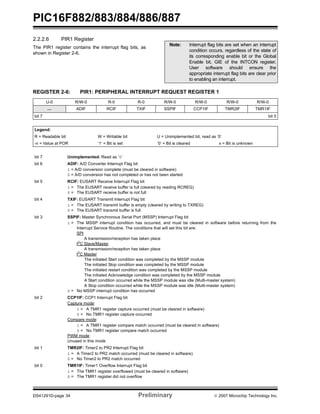
  • 40.
    PIC16F882/883/884/886/887 FIGURE 2-8:DIRECT/INDIRECT ADDRESSING PIC16F882/883/884/886/887 Direct Addressing Indirect Addressing RP1 RP0 6 From Opcode 0 IRP 7 File Select Register 0 Bank Select Location Select Data Memory 00 01 10 11 00h 7Fh Bank 0 Bank 1 Bank 2 Bank 3 Note: For memory map detail, see Figures 2-2 and 2-3. Bank Select Location Select 180h 1FFh DS41291D-page 38 Preliminary © 2007 Microchip Technology Inc.
  • 41.
    PIC16F882/883/884/886/887 3.0 I/OPORTS There are as many as thirty-five general purpose I/O pins available. Depending on which peripherals are enabled, some or all of the pins may not be available as general purpose I/O. In general, when a peripheral is enabled, the associated pin may not be used as a general purpose I/O pin. 3.1 PORTA and the TRISA Registers PORTA is a 8-bit wide, bidirectional port. The corresponding data direction register is TRISA (Register 3-2). Setting a TRISA bit (= 1) will make the corresponding PORTA pin an input (i.e., disable the output driver). Clearing a TRISA bit (= 0) will make the corresponding PORTA pin an output (i.e., enables output driver and puts the contents of the output latch on the selected pin). Example 3-1 shows how to initialize PORTA. Reading the PORTA register (Register 3-1) reads the status of the pins, whereas writing to it will write to the PORT latch. All write operations are read-modify-write operations. Therefore, a write to a port implies that the port pins are read, this value is modified and then written to the PORT data latch. The TRISA register (Register 3-2) controls the PORTA pin output drivers, even when they are being used as analog inputs. The user should ensure the bits in the TRISA register are maintained set when using them as analog inputs. I/O pins configured as analog input always read ‘0’. Note: The ANSEL register must be initialized to configure an analog channel as a digital input. Pins configured as analog inputs will read ‘0’. EXAMPLE 3-1: INITIALIZING PORTA BANKSEL PORTA ; CLRF PORTA ;Init PORTA BANKSEL ANSEL ; CLRF ANSEL ;digital I/O BCF STATUS,RP1 ;Bank 1 BANKSEL TRISA ; MOVLW 0Ch ;Set RA<3:2> as inputs MOVWF TRISA ;and set RA<5:4,1:0> ;as outputs REGISTER 3-1: PORTA: PORTA REGISTER R/W-x R/W-x R/W-x R/W-x R/W-x R/W-x R/W-x R/W-x RA7 RA6 RA5 RA4 RA3 RA2 RA1 RA0 bit 7 bit 0 Legend: R = Readable bit W = Writable bit U = Unimplemented bit, read as ‘0’ -n = Value at POR ‘1’ = Bit is set ‘0’ = Bit is cleared x = Bit is unknown bit 7-0 RA<7:0>: PORTA I/O Pin bit 1 = Port pin is > VIH 0 = Port pin is < VIL REGISTER 3-2: TRISA: PORTA TRI-STATE REGISTER R/W-1(1) R/W-1(1) R/W-1 R/W-1 R/W-1 R/W-1 R/W-1 R/W-1 TRISA7 TRISA6 TRISA5 TRISA4 TRISA3 TRISA2 TRISA1 TRISA0 bit 7 bit 0 Legend: R = Readable bit W = Writable bit U = Unimplemented bit, read as ‘0’ -n = Value at POR ‘1’ = Bit is set ‘0’ = Bit is cleared x = Bit is unknown bit 7-0 TRISA<7:0>: PORTA Tri-State Control bit 1 = PORTA pin configured as an input (tri-stated) 0 = PORTA pin configured as an output Note 1: TRISA<7:6> always reads ‘1’ in XT, HS and LP Oscillator modes. © 2007 Microchip Technology Inc. Preliminary DS41291D-page 39
  • 42.
    PIC16F882/883/884/886/887 3.2 AdditionalPin Functions RA0 also has an Ultra Low-Power Wake-up option. The next three sections describe these functions. 3.2.1 ANSEL REGISTER The ANSEL register (Register 3-3) is used to configure the Input mode of an I/O pin to analog. Setting the appropriate ANSEL bit high will cause all digital reads on the pin to be read as ‘0’ and allow analog functions on the pin to operate correctly. The state of the ANSEL bits has no affect on digital out-put functions. A pin with TRIS clear and ANSEL set will still operate as a digital output, but the Input mode will be analog. This can cause unexpected behavior when executing read-modify-write instructions on the affected port. REGISTER 3-3: ANSEL: ANALOG SELECT REGISTER R/W-1 R/W-1 R/W-1 R/W-1 R/W-1 R/W-1 R/W-1 R/W-1 ANS7(2) ANS6(2) ANS5(2) ANS4 ANS3 ANS2 ANS1 ANS0 bit 7 bit 0 Legend: R = Readable bit W = Writable bit U = Unimplemented bit, read as ‘0’ -n = Value at POR ‘1’ = Bit is set ‘0’ = Bit is cleared x = Bit is unknown bit 7-0 ANS<7:0>: Analog Select bits Analog select between analog or digital function on pins AN<7:0>, respectively. 1 = Analog input. Pin is assigned as analog input(1). 0 = Digital I/O. Pin is assigned to port or special function. Note 1: Setting a pin to an analog input automatically disables the digital input circuitry, weak pull-ups, and interrupt-on-change if available. The corresponding TRIS bit must be set to Input mode in order to allow external control of the voltage on the pin. 2: Not implemented on PIC16F883/886. DS41291D-page 40 Preliminary © 2007 Microchip Technology Inc.
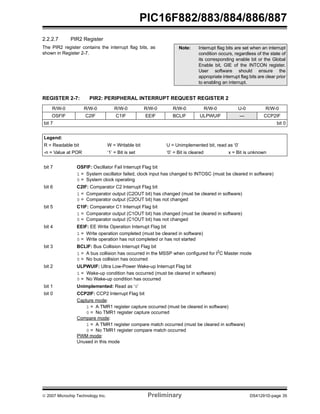
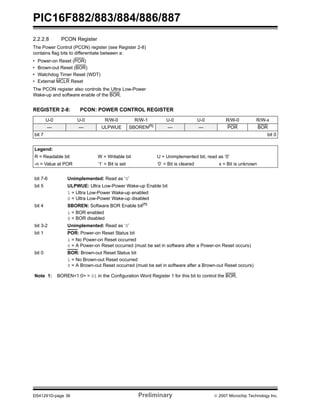
  • 43.
    PIC16F882/883/884/886/887 3.2.2 ULTRALOW-POWER WAKE-UP The Ultra Low-Power Wake-up (ULPWU) on RA0 allows a slow falling voltage to generate an interrupt-on-change on RA0 without excess current consumption. The mode is selected by setting the ULPWUE bit of the PCON register. This enables a small current sink, which can be used to discharge a capacitor on RA0. Follow these steps to use this feature: a) Charge the capacitor on RA0 by configuring the RA0 pin to output (= 1). b) Configure RA0 as an input. c) Enable interrupt-on-change for RA0. d) Set the ULPWUE bit of the PCON register to begin the capacitor discharge. e) Execute a SLEEP instruction. When the voltage on RA0 drops below VIL, an interrupt will be generated which will cause the device to wake-up and execute the next instruction. If the GIE bit of the INTCON register is set, the device will then call the interrupt vector (0004h). See Section 3.4.3 “Inter-rupt- on-Change” for more information. This feature provides a low-power technique for periodically waking up the device from Sleep. The time-out is dependent on the discharge time of the RC circuit on RA0. See Example 3-2 for initializing the Ultra Low-Power Wake-up module. A series resistor between RA0 and the external capacitor provides overcurrent protection for the RA0/AN0/ULPWU/C12IN0- pin and can allow for software calibration of the time-out (see Figure 3-1). A timer can be used to measure the charge time and discharge time of the capacitor. The charge time can then be adjusted to provide the desired interrupt delay. This technique will compensate for the affects of temperature, voltage and component accuracy. The Ultra Low-Power Wake-up peripheral can also be configured as a simple Programmable Low Voltage Detect or temperature sensor. Note: For more information, refer to AN879, “Using the Microchip Ultra Low-Power Wake-up Module” Application Note (DS00879). EXAMPLE 3-2: ULTRA LOW-POWER WAKE-UP INITIALIZATION BANKSEL PORTA ; BSF PORTA,0 ;Set RA0 data latch BANKSEL ANSEL ; BCF ANSEL,0 ;RA0 to digital I/O BANKSEL TRISA ; BCF TRISA,0 ;Output high to CALL CapDelay ;charge capacitor BANKSEL PIR2 ; BCF PIR2,ULPWUIF ;Clear flag BSF PCON,ULPWUE ;Enable ULP Wake-up BSF IOCB,0 ;Select RA0 IOC BSF TRISA,0 ;RA0 to input MOVLW B’10001000’ ;Enable interrupt MOVWF INTCON ;and clear flag SLEEP ;Wait for IOC NOP ; © 2007 Microchip Technology Inc. Preliminary DS41291D-page 41
  • 44.
    PIC16F882/883/884/886/887 3.2.3 PINDESCRIPTIONS AND DIAGRAMS Each PORTA pin is multiplexed with other functions. The pins and their combined functions are briefly described here. For specific information about individual functions such as the comparator or the A/D Converter (ADC), refer to the appropriate section in this data sheet. 3.2.3.1 RA0/AN0/ULPWU/C12IN0- Figure 3-1 shows the diagram for this pin. This pin is configurable to function as one of the following: • a general purpose I/O • an analog input for the ADC • a negative analog input to Comparator C1 or C2 • an analog input for the Ultra Low-Power Wake-up FIGURE 3-1: BLOCK DIAGRAM OF RA0 I/O Pin VDD VSS D Q CK Q D Q CK Q Data Bus WR PORTA WR TRISA RD TRISA RD Analog(1) Input Mode To Comparator 0 1 - + VTRG IULP PORTA To A/D Converter Note 1: ANSEL determines Analog Input mode. VSS ULPWUE DS41291D-page 42 Preliminary © 2007 Microchip Technology Inc.
  • 45.
    PIC16F882/883/884/886/887 3.2.3.2 RA1/AN1/C12IN1- Figure 3-2 shows the diagram for this pin. This pin is configurable to function as one of the following: • a general purpose I/O • an analog input for the ADC • a negative analog input to Comparator C1 or C2 FIGURE 3-2: BLOCK DIAGRAM OF RA1 3.2.3.3 RA2/AN2/VREF-/CVREF/C2IN+ Figure 3-3 shows the diagram for this pin. This pin is configurable to function as one of the following: • a general purpose I/O • an analog input for the ADC • a negative voltage reference input for the ADC and CVREF • a comparator voltage reference output • a positive analog input to Comparator C2 FIGURE 3-3: BLOCK DIAGRAM OF RA2 I/O Pin VDD VSS D Q CK Q D Q CK Q Analog(1) Input Mode Data Bus WR PORTA WR TRISA RD TRISA RD PORTA To Comparator To A/D Converter Note 1: ANSEL determines Analog Input mode. I/O Pin VDD VSS D Q CK Q D Q CK Q CVREF Analog(1) Input Mode Data Bus WR PORTA WR TRISA RD TRISA RD PORTA VROE To Comparator (positive input) To Comparator (VREF-) To A/D Converter (VREF-) To A/D Converter (analog channel) Note 1: ANSEL determines Analog Input mode. © 2007 Microchip Technology Inc. Preliminary DS41291D-page 43
  • 46.
    PIC16F882/883/884/886/887 3.2.3.4 RA3/AN3/VREF+/C1IN+ Figure 3-4 shows the diagram for this pin. This pin is configurable to function as one of the following: • a general purpose input • an analog input for the ADC • a positive voltage reference input for the ADC and CVREF • a positive analog input to Comparator C1 FIGURE 3-4: BLOCK DIAGRAM OF RA3 3.2.3.5 RA4/T0CKI/C1OUT Figure 3-5 shows the diagram for this pin. This pin is configurable to function as one of the following: • a general purpose I/O • a clock input for Timer0 • a digital output from Comparator C1 FIGURE 3-5: BLOCK DIAGRAM OF RA4 I/O Pin VDD VSS D Q CK Q D Q CK Q Analog(1) Input Mode Data Bus WR PORTA WR TRISA RD TRISA RD PORTA To Comparator (positive input) To Comparator (VREF+) To A/D Converter (VREF+) To A/D Converter (analog channel) Note 1: ANSEL determines Analog Input mode. I/O Pin VDD VSS D Q CK Q D Q CK Q Data Bus WR PORTA WR TRISA RD TRISA RD PORTA C1OUT Enable C1OUT 1 0 To Timer0 DS41291D-page 44 Preliminary © 2007 Microchip Technology Inc.
  • 47.
    PIC16F882/883/884/886/887 3.2.3.6 RA5/AN4/SS/C2OUT Figure 3-6 shows the diagram for this pin. This pin is configurable to function as one of the following: • a general purpose I/O • an analog input for the ADC • a slave select input • a digital output from Comparator C2 FIGURE 3-6: BLOCK DIAGRAM OF RA5 3.2.3.7 RA6/OSC2/CLKOUT Figure 3-7 shows the diagram for this pin. This pin is configurable to function as one of the following: • a general purpose I/O • a crystal/resonator connection • a clock output FIGURE 3-7: BLOCK DIAGRAM OF RA6 I/O Pin VDD VSS D Q CK Q D Q CK Q C2OUT Enable C2OUT 1 0 Analog(1) Input Mode Data Bus WR PORTA WR TRISA RD TRISA RD PORTA To SS Input To A/D Converter Note 1: ANSEL determines Analog Input mode. I/O Pin VDD VSS D Q CK Q D Q CK Q Data Bus WR PORTA WR TRISA RD TRISA RD PORTA OSC2 Oscillator Circuit CLKOUT Enable FOSC/4 1 0 CLKOUT Enable INTOSCIO/ EXTRCIO/EC(1) CLKOUT Enable Note 1: With I/O option. © 2007 Microchip Technology Inc. Preliminary DS41291D-page 45
  • 48.
    PIC16F882/883/884/886/887 3.2.3.8 RA7/OSC1/CLKIN Figure 3-8 shows the diagram for this pin. This pin is configurable to function as one of the following: • a general purpose I/O • a crystal/resonator connection • a clock input FIGURE 3-8: BLOCK DIAGRAM OF RA7 I/O Pin VDD VSS D Q CK Q D Q CK Q Data Bus WR PORTA WR TRISA RD TRISA RD PORTA OSC1 Oscillator Circuit INTOSC Mode CLKIN TABLE 3-1: SUMMARY OF REGISTERS ASSOCIATED WITH PORTA Name Bit 7 Bit 6 Bit 5 Bit 4 Bit 3 Bit 2 Bit 1 Bit 0 Value on POR, BOR Value on all other Resets ADCON0 ADCS1 ADCS0 CHS3 CHS2 CHS1 CHS0 GO/DONE ADON 0000 0000 0000 0000 ANSEL ANS7 ANS6 ANS5 ANS4 ANS3 ANS2 ANS1 ANS0 1111 1111 1111 1111 CM1CON0 C1ON C1OUT C1OE C1POL — C1R C1CH1 C1CH0 0000 -000 0000 -000 CM2CON0 C2ON C2OUT C2OE C2POL — C2R C2CH1 C2CH0 0000 -000 0000 -000 CM2CON1 MC1OUT MC2OUT C1RSEL C2RSEL — — T1GSS C2SYNC 0000 --10 0000 --10 PCON — — ULPWUE SBOREN — — POR BOR --01 --qq --0u --uu OPTION_REG RBPU INTEDG T0CS T0SE PSA PS2 PS1 PS0 1111 1111 1111 1111 PORTA RA7 RA6 RA5 RA4 RA3 RA2 RA1 RA0 xxxx xxxx uuuu uuuu SSPCON WCOL SSPOV SSPEN CKP SSPM3 SSPM2 SSPM1 SSPM0 0000 0000 0000 0000 TRISA TRISA7 TRISA6 TRISA5 TRISA4 TRISA3 TRISA2 TRISA1 TRISA0 1111 1111 1111 1111 Legend: x = unknown, u = unchanged, – = unimplemented locations read as ‘0’. Shaded cells are not used by PORTA. DS41291D-page 46 Preliminary © 2007 Microchip Technology Inc.
  • 49.
    PIC16F882/883/884/886/887 3.3 PORTBand TRISB Registers PORTB is an 8-bit wide, bidirectional port. The corresponding data direction register is TRISB (Register 3-6). Setting a TRISB bit (= 1) will make the corresponding PORTB pin an input (i.e., put the corresponding output driver in a High-Impedance mode). Clearing a TRISB bit (= 0) will make the corresponding PORTB pin an output (i.e., enable the output driver and put the contents of the output latch on the selected pin). Example 3-3 shows how to initialize PORTB. Reading the PORTB register (Register 3-5) reads the status of the pins, whereas writing to it will write to the PORT latch. All write operations are read-modify-write operations. Therefore, a write to a port implies that the port pins are read, this value is modified and then written to the PORT data latch. The TRISB register (Register 3-6) controls the PORTB pin output drivers, even when they are being used as analog inputs. The user should ensure the bits in the TRISB register are maintained set when using them as analog inputs. I/O pins configured as analog input always read ‘0’. Example 3-3 shows how to initialize PORTB. EXAMPLE 3-3: INITIALIZING PORTB BANKSEL PORTB ; CLRF PORTB ;Init PORTB BANKSEL TRISB ; MOVLW B‘11110000’ ;Set RB<7:4> as inputs ;and RB<3:0> as outputs MOVWF TRISB ; Note: The ANSELH register must be initialized to configure an analog channel as a digital input. Pins configured as analog inputs will read ‘0’. 3.4 Additional PORTB Pin Functions PORTB pins RB<7:0> on the device family device have an interrupt-on-change option and a weak pull-up option. The following three sections describe these PORTB pin functions. Every PORTB pin on this device family has an interrupt-on-change option and a weak pull-up option. 3.4.1 ANSELH REGISTER The ANSELH register (Register 3-4) is used to configure the Input mode of an I/O pin to analog. Setting the appropriate ANSELH bit high will cause all digital reads on the pin to be read as ‘0’ and allow analog functions on the pin to operate correctly. The state of the ANSELH bits has no affect on digital output functions. A pin with TRIS clear and ANSELH set will still operate as a digital output, but the Input mode will be analog. This can cause unexpected behavior when executing read-modify-write instructions on the affected port. 3.4.2 WEAK PULL-UPS Each of the PORTB pins has an individually configurable internal weak pull-up. Control bits WPUB<7:0> enable or disable each pull-up (see Register 3-7). Each weak pull-up is automatically turned off when the port pin is configured as an output. All pull-ups are disabled on a Power-on Reset by the RBPU bit of the OPTION register. 3.4.3 INTERRUPT-ON-CHANGE All of the PORTB pins are individually configurable as an interrupt-on-change pin. Control bits IOCB<7:0> enable or disable the interrupt function for each pin. Refer to Register 3-8. The interrupt-on-change feature is disabled on a Power-on Reset. For enabled interrupt-on-change pins, the present value is compared with the old value latched on the last read of PORTB to determine which bits have changed or mismatched the old value. The ‘mismatch’ outputs of the last read are OR’d together to set the PORTB Change Interrupt flag bit (RBIF) in the INTCON register. This interrupt can wake the device from Sleep. The user, in the Interrupt Service Routine, clears the interrupt by: a) Any read or write of PORTB. This will end the mismatch condition. b) Clear the flag bit RBIF. A mismatch condition will continue to set flag bit RBIF. Reading or writing PORTB will end the mismatch condition and allow flag bit RBIF to be cleared. The latch holding the last read value is not affected by a MCLR nor Brown-out Reset. After these Resets, the RBIF flag will continue to be set if a mismatch is present. Note: If a change on the I/O pin should occur when the read operation is being executed (start of the Q2 cycle), then the RBIF interrupt flag may not get set. Furthermore, since a read or write on a port affects all bits of that port, care must be taken when using multiple pins in Interrupt-on-Change mode. Changes on one pin may not be seen while servicing changes on another pin. © 2007 Microchip Technology Inc. Preliminary DS41291D-page 47
  • 50.
    PIC16F882/883/884/886/887 REGISTER 3-4:ANSELH: ANALOG SELECT HIGH REGISTER U-0 U-0 R/W-1 R/W-1 R/W-1 R/W-1 R/W-1 R/W-1 — — ANS13 ANS12 ANS11 ANS10 ANS9 ANS8 bit 7 bit 0 Legend: R = Readable bit W = Writable bit U = Unimplemented bit, read as ‘0’ -n = Value at POR ‘1’ = Bit is set ‘0’ = Bit is cleared x = Bit is unknown bit 7-6 Unimplemented: Read as ‘0’ bit 5-0 ANS<13:8>: Analog Select bits Analog select between analog or digital function on pins AN<13:8>, respectively. 1 = Analog input. Pin is assigned as analog input(1). 0 = Digital I/O. Pin is assigned to port or special function. Note 1: Setting a pin to an analog input automatically disables the digital input circuitry, weak pull-ups, and interrupt-on-change if available. The corresponding TRIS bit must be set to Input mode in order to allow external control of the voltage on the pin. REGISTER 3-5: PORTB: PORTB REGISTER R/W-x R/W-x R/W-x R/W-x R/W-x R/W-x R/W-x R/W-x RB7 RB6 RB5 RB4 RB3 RB2 RB1 RB0 bit 7 bit 0 Legend: R = Readable bit W = Writable bit U = Unimplemented bit, read as ‘0’ -n = Value at POR ‘1’ = Bit is set ‘0’ = Bit is cleared x = Bit is unknown bit 7-0 RB<7:0>: PORTB I/O Pin bit 1 = Port pin is > VIH 0 = Port pin is < VIL REGISTER 3-6: TRISB: PORTB TRI-STATE REGISTER R/W-1 R/W-1 R/W-1 R/W-1 R/W-1 R/W-1 R/W-1 R/W-1 TRISB7 TRISB6 TRISB5 TRISB4 TRISB3 TRISB2 TRISB1 TRISB0 bit 7 bit 0 Legend: R = Readable bit W = Writable bit U = Unimplemented bit, read as ‘0’ -n = Value at POR ‘1’ = Bit is set ‘0’ = Bit is cleared x = Bit is unknown bit 7-0 TRISB<7:0>: PORTB Tri-State Control bit 1 = PORTB pin configured as an input (tri-stated) 0 = PORTB pin configured as an output DS41291D-page 48 Preliminary © 2007 Microchip Technology Inc.
  • 51.
    PIC16F882/883/884/886/887 REGISTER 3-7:WPUB: WEAK PULL-UP PORTB REGISTER R/W-1 R/W-1 R/W-1 R/W-1 R/W-1 R/W-1 R/W-1 R/W-1 WPUB7 WPUB6 WPUB5 WPUB4 WPUB3 WPUB2 WPUB1 WPUB0 bit 7 bit 0 Legend: R = Readable bit W = Writable bit U = Unimplemented bit, read as ‘0’ -n = Value at POR ‘1’ = Bit is set ‘0’ = Bit is cleared x = Bit is unknown bit 7-0 WPUB<7:0>: Weak Pull-up Register bit 1 = Pull-up enabled 0 = Pull-up disabled Note 1: Global RBPU bit of the OPTION register must be cleared for individual pull-ups to be enabled. 2: The weak pull-up device is automatically disabled if the pin is in configured as an output. REGISTER 3-8: IOCB: INTERRUPT-ON-CHANGE PORTB REGISTER R/W-0 R/W-0 R/W-0 R/W-0 R/W-0 R/W-0 R/W-0 R/W-0 IOCB7 IOCB6 IOCB5 IOCB4 IOCB3 IOCB2 IOCB1 IOCB0 bit 7 bit 0 Legend: R = Readable bit W = Writable bit U = Unimplemented bit, read as ‘0’ -n = Value at POR ‘1’ = Bit is set ‘0’ = Bit is cleared x = Bit is unknown bit 7-0 IOCB<7:0>: Interrupt-on-Change PORTB Control bit 1 = Interrupt-on-change enabled 0 = Interrupt-on-change disabled © 2007 Microchip Technology Inc. Preliminary DS41291D-page 49
  • 52.
    PIC16F882/883/884/886/887 3.4.4 PINDESCRIPTIONS AND DIAGRAMS Each PORTB pin is multiplexed with other functions. The pins and their combined functions are briefly described here. For specific information about individual functions such as the SSP, I2C or interrupts, refer to the appropriate section in this data sheet. 3.4.4.1 RB0/AN12/INT Figure 3-9 shows the diagram for this pin. This pin is configurable to function as one of the following: • a general purpose I/O • an analog input for the ADC • an external edge triggered interrupt 3.4.4.2 RB1/AN10/P1C(1)/C12IN3- Figure 3-9 shows the diagram for this pin. This pin is configurable to function as one of the following: • a general purpose I/O • an analog input for the ADC • a PWM output(1) • an analog input to Comparator C1 or C2 Note 1: P1C is available on PIC16F882/883/886 only. 3.4.4.3 RB2/AN8/P1B(1) Figure 3-9 shows the diagram for this pin. This pin is configurable to function as one of the following: • a general purpose I/O • an analog input for the ADC • a PWM output(1) Note 1: P1B is available on PIC16F882/883/886 only. 3.4.4.4 RB3/AN9/PGM/C12IN2- Figure 3-9 shows the diagram for this pin. This pin is configurable to function as one of the following: • a general purpose I/O • an analog input for the ADC • Low-voltage In-Circuit Serial Programming enable pin • an analog input to Comparator C1 or C2 FIGURE 3-9: BLOCK DIAGRAM OF RB<3:0> I/O Pin VDD Weak VDD VSS D Q CK Q D Q CK Q D Q CK Q Analog(1) Input Mode RBPU CCP1OUT Enable 1 0 CCP1OUT Analog(1) Input Mode Data Bus WR WPUB RD WPUB WR PORTB WR TRISB RD TRISB D Q CK Q Interrupt-on- Change RB0/INT RB3/PGM RD PORTB To A/D Converter Q Q To Comparator (RB1, RB3) D EN D EN RD PORTB WR IOCB RD IOCB Q3 Note 1: ANSELH determines Analog Input mode. DS41291D-page 50 Preliminary © 2007 Microchip Technology Inc.
  • 53.
    PIC16F882/883/884/886/887 3.4.4.5 RB4/AN11/P1D(1) Figure 3-10 shows the diagram for this pin. This pin is configurable to function as one of the following: • a general purpose I/O • an analog input for the ADC • a PWM output(1) Note 1: P1D is available on PIC16F882/883/886 only. 3.4.4.6 RB5/AN13/T1G Figure 3-10 shows the diagram for this pin. This pin is configurable to function as one of the following: • a general purpose I/O • an analog input for the ADC • a Timer1 gate input 3.4.4.7 RB6/ICSPCLK Figure 3-10 shows the diagram for this pin. This pin is configurable to function as one of the following: • a general purpose I/O • In-Circuit Serial Programming clock 3.4.4.8 RB7/ICSPDAT Figure 3-10 shows the diagram for this pin. This pin is configurable to function as one of the following: • a general purpose I/O • In-Circuit Serial Programming data FIGURE 3-10: BLOCK DIAGRAM OF RB<7:4> I/O Pin VDD VSS D Q CK Q D Q CK Q D Q CK Q D Q CK Q VDD Analog(1) Input Mode D EN D EN CCP1OUT Enable Q Q Weak Data Bus WR WPUB RD WPUB RBPU RD PORTB WR PORTB WR TRISB RD TRISB RD PORTB WR IOCB RD IOCB Interrupt-on- Analog(1) Input Mode Change Q3 CCP1OUT To Timer1 T1G(3) To A/D Converter 0 1 1 1 0 To ICSPCLK (RB6) and ICSPDAT (RB7) Available on PIC16F882/PIC16F883/PIC16F886 only. Note 1: ANSELH determines Analog Input mode. 2: Applies to RB<7:6> pins only). 3: Applies to RB5 pin only. ICSP™(2) © 2007 Microchip Technology Inc. Preliminary DS41291D-page 51
  • 54.
    PIC16F882/883/884/886/887 TABLE 3-2:SUMMARY OF REGISTERS ASSOCIATED WITH PORTB Name Bit 7 Bit 6 Bit 5 Bit 4 Bit 3 Bit 2 Bit 1 Bit 0 Value on POR, BOR Value on all other Resets ANSELH — — ANS13 ANS12 ANS11 ANS10 ANS9 ANS8 --11 1111 --11 1111 CCP1CON P1M1 P1M0 DC1B1 DC1B0 CCP1M3 CCP1M2 CCP1M1 CCP1M0 0000 0000 0000 0000 CM2CON1 MC1OUT MC2OUT C1RSEL C2RSEL — — T1GSS C2SYNC 0000 --10 0000 --10 IOCB IOCB7 IOCB6 IOCB5 IOCB4 IOCB3 IOCB2 IOCB1 IOCB0 0000 0000 0000 0000 INTCON GIE PEIE T0IE INTE RBIE T0IF INTF RBIF 0000 000x 0000 000x OPTION_REG RBPU INTEDG T0CS T0SE PSA PS2 PS1 PS0 1111 1111 1111 1111 PORTB RB7 RB6 RB5 RB4 RB3 RB2 RB1 RB0 xxxx xxxx uuuu uuuu TRISB TRISB7 TRISB6 TRISB5 TRISB4 TRISB3 TRISB2 TRISB1 TRISB0 1111 1111 1111 1111 WPUB WPUB7 WPUB6 WPUB5 WPUB4 WPUB3 WPUB2 WPUB1 WPUB0 1111 1111 1111 1111 Legend: x = unknown, u = unchanged, — = unimplemented read as ‘0’. Shaded cells are not used by PORTB. DS41291D-page 52 Preliminary © 2007 Microchip Technology Inc.
  • 55.
    PIC16F882/883/884/886/887 3.5 PORTCand TRISC Registers PORTC is a 8-bit wide, bidirectional port. The corresponding data direction register is TRISC (Register 3-10). Setting a TRISC bit (= 1) will make the corresponding PORTC pin an input (i.e., put the corresponding output driver in a High-Impedance mode). Clearing a TRISC bit (= 0) will make the corresponding PORTC pin an output (i.e., enable the output driver and put the contents of the output latch on the selected pin). Example 3-4 shows how to initialize PORTC. Reading the PORTC register (Register 3-9) reads the status of the pins, whereas writing to it will write to the PORT latch. All write operations are read-modify-write operations. Therefore, a write to a port implies that the port pins are read, this value is modified and then written to the PORT data latch. The TRISC register (Register 3-10) controls the PORTC pin output drivers, even when they are being used as analog inputs. The user should ensure the bits in the TRISC register are maintained set when using them as analog inputs. I/O pins configured as analog input always read ‘0’. EXAMPLE 3-4: INITIALIZING PORTC BANKSEL PORTC ; CLRF PORTC ;Init PORTC BANKSEL TRISC ; MOVLW B‘00001100’ ;Set RC<3:2> as inputs MOVWF TRISC ;and set RC<7:4,1:0> ;as outputs REGISTER 3-9: PORTC: PORTC REGISTER R/W-x R/W-x R/W-x R/W-x R/W-x R/W-x R/W-x R/W-x RC7 RC6 RC5 RC4 RC3 RC2 RC1 RC0 bit 7 bit 0 Legend: R = Readable bit W = Writable bit U = Unimplemented bit, read as ‘0’ -n = Value at POR ‘1’ = Bit is set ‘0’ = Bit is cleared x = Bit is unknown bit 7-0 RC<7:0>: PORTC General Purpose I/O Pin bit 1 = Port pin is > VIH 0 = Port pin is < VIL REGISTER 3-10: TRISC: PORTC TRI-STATE REGISTER R/W-1 R/W-1 R/W-1 R/W-1 R/W-1 R/W-1 R/W-1(1) R/W-1(1) TRISC7 TRISC6 TRISC5 TRISC4 TRISC3 TRISC2 TRISC1 TRISC0 bit 7 bit 0 Legend: R = Readable bit W = Writable bit U = Unimplemented bit, read as ‘0’ -n = Value at POR ‘1’ = Bit is set ‘0’ = Bit is cleared x = Bit is unknown bit 7-0 TRISC<7:0>: PORTC Tri-State Control bit 1 = PORTC pin configured as an input (tri-stated) 0 = PORTC pin configured as an output Note 1: TRISC<1:0> always reads ‘1’ in LP Oscillator mode. © 2007 Microchip Technology Inc. Preliminary DS41291D-page 53
  • 56.
    PIC16F882/883/884/886/887 3.5.1 RC0/T1OSO/T1CKI Figure 3-11 shows the diagram for this pin. This pin is configurable to function as one of the following: • a general purpose I/O • a Timer1 oscillator output • a Timer1 clock input FIGURE 3-11: BLOCK DIAGRAM OF RC0 I/O Pin VDD VSS D Timer1 Oscillator T1OSCEN Circuit Q CK Q D Q CK Q Data Bus WR PORTC WR TRISC RD TRISC RD PORTC To Timer1 clock input 3.5.2 RC1/T1OSI/CCP2 Figure 3-12 shows the diagram for this pin. This pin is configurable to function as one of the following: • a general purpose I/O • a Timer1 oscillator input • a Capture input and Compare/PWM output for Comparator C2 FIGURE 3-12: BLOCK DIAGRAM OF RC1 3.5.3 RC2/P1A/CCP1 Figure 3-13 shows the diagram for this pin. This pin is configurable to function as one of the following: • a general purpose I/O • a PWM output • a Capture input and Compare output for Comparator C1 FIGURE 3-13: BLOCK DIAGRAM OF RC2 I/O Pin VDD VSS D T1OSCEN Q CK Q D Q CK Q Data Bus WR PORTC WR TRISC RD TRISC RD PORTC Timer1 Oscillator T1OSI CCP2CON CCP2 To CCP2 Circuit 1 0 0 1 T1OSCEN VDD 0 I/O Pin VSS D Q CK Q D Q CK Q Data bus WR PORTC WR TRISC RD TRISC CCP1CON CCP1/P1A To Enhanced CCP1 RD PORTC 1 0 1 DS41291D-page 54 Preliminary © 2007 Microchip Technology Inc.
  • 57.
    PIC16F882/883/884/886/887 3.5.4 RC3/SCK/SCL Figure 3-14 shows the diagram for this pin. This pin is configurable to function as one of the following: • a general purpose I/O • a SPI clock • an I2C™ clock FIGURE 3-14: BLOCK DIAGRAM OF RC3 I/O Pin VDD VSS D Q CK Q D Q CK Q Data Bus WR PORTC WR TRISC RD TRISC RD PORTC SSPEN SCK To SSPSR 1 0 0 1 3.5.5 RC4/SDI/SDA Figure 3-15 shows the diagram for this pin. This pin is configurable to function as one of the following: • a general purpose I/O • a SPI data I/O • an I2C data I/O FIGURE 3-15: BLOCK DIAGRAM OF RC4 3.5.6 RC5/SDO Figure 3-16 shows the diagram for this pin. This pin is configurable to function as one of the following: • a general purpose I/O • a serial data output FIGURE 3-16: BLOCK DIAGRAM OF RC5 I/O Pin VDD VSS D Q CK Q D Q CK Q Data Bus WR PORTC WR TRISC RD TRISC RD PORTC SSPEN SDI/SDA To SSPSR 1 0 0 1 I/O Pin VDD VSS D Q CK Q D Q CK Q Data Bus WR PORTC WR TRISC RD TRISC RD PORTC Port/SDO Select 1 0 0 1 SDO © 2007 Microchip Technology Inc. Preliminary DS41291D-page 55
  • 58.
    PIC16F882/883/884/886/887 3.5.7 RC6/TX/CK Figure 3-17 shows the diagram for this pin. This pin is configurable to function as one of the following: • a general purpose I/O • an asynchronous serial output • a synchronous clock I/O FIGURE 3-17: BLOCK DIAGRAM OF RC6 3.5.8 RC7/RX/DT Figure 3-18 shows the diagram for this pin. This pin is configurable to function as one of the following: • a general purpose I/O • an asynchronous serial input • a synchronous serial data I/O FIGURE 3-18: BLOCK DIAGRAM OF RC7 I/O Pin VDD VSS D Q CK Q D Q CK Q Data Bus WR PORTC WR TRISC RD TRISC RD PORTC SPEN TXEN SYNC EUSART CK EUSART TX 1 0 0 1 1 0 0 1 D Q CK Q D Q CK Q Data Bus WR PORTC WR TRISC RD TRISC RD PORTC EUSART RX/DT TABLE 3-3: SUMMARY OF REGISTERS ASSOCIATED WITH PORTC I/O Pin VDD VSS SPEN SYNC EUSART 1 0 0 1 DT Name Bit 7 Bit 6 Bit 5 Bit 4 Bit 3 Bit 2 Bit 1 Bit 0 Value on POR, BOR Value on all other Resets CCP1CON P1M1 P1M0 DC1B1 DC1B0 CCP1M3 CCP1M2 CCP1M1 CCP1M0 0000 0000 0000 0000 CCP2CON — — DC2B1 DC2B0 CCP2M3 CCP2M2 CCP2M1 CCP2M0 --00 0000 --00 0000 PORTC RC7 RC6 RC5 RC4 RC3 RC2 RC1 RC0 xxxx xxxx uuuu uuuu PSTRCON — — — STRSYNC STRD STRC STRB STRA ---0 0001 ---0 0001 RCSTA SPEN RX9 SREN CREN ADDEN FERR OERR RX9D 0000 000x 0000 000x SSPCON WCOL SSPOV SSPEN CKP SSPM3 SSPM2 SSPM1 SSPM0 0000 0000 0000 0000 T1CON T1GINV TMR1GE T1CKPS1 T1CKPS0 T1OSCEN T1SYNC TMR1CS TMR1ON 0000 0000 0000 0000 TRISC TRISC7 TRISC6 TRISC5 TRISC4 TRISC3 TRISC2 TRISC1 TRISC0 1111 1111 1111 1111 Legend: x = unknown, u = unchanged, – = unimplemented locations read as ‘0’. Shaded cells are not used by PORTC. DS41291D-page 56 Preliminary © 2007 Microchip Technology Inc.
  • 59.
    PIC16F882/883/884/886/887 3.6 PORTDand TRISD Registers PORTD(1) is a 8-bit wide, bidirectional port. The corresponding data direction register is TRISD (Register 3-12). Setting a TRISD bit (= 1) will make the corresponding PORTD pin an input (i.e., put the corresponding output driver in a High-Impedance mode). Clearing a TRISD bit (= 0) will make the corresponding PORTD pin an output (i.e., enable the output driver and put the contents of the output latch on the selected pin). Example 3-5 shows how to initialize PORTD. Reading the PORTD register (Register 3-11) reads the status of the pins, whereas writing to it will write to the PORT latch. All write operations are read-modify-write operations. Therefore, a write to a port implies that the port pins are read, this value is modified and then written to the PORT data latch. The TRISD register (Register 3-12) controls the PORTD pin output drivers, even when they are being used as analog inputs. The user should ensure the bits in the TRISD register are maintained set when using them as analog inputs. I/O pins configured as analog input always read ‘0’. EXAMPLE 3-5: INITIALIZING PORTD Note 1: PORTD is available on PIC16F884/887 only. BANKSEL PORTD ; CLRF PORTD ;Init PORTD BANKSEL TRISD ; MOVLW B‘00001100’ ;Set RD<3:2> as inputs MOVWF TRISD ;and set RD<7:4,1:0> ;as outputs REGISTER 3-11: PORTD: PORTD REGISTER R/W-x R/W-x R/W-x R/W-x R/W-x R/W-x R/W-x R/W-x RD7 RD6 RD5 RD4 RD3 RD2 RD1 RD0 bit 7 bit 0 Legend: R = Readable bit W = Writable bit U = Unimplemented bit, read as ‘0’ -n = Value at POR ‘1’ = Bit is set ‘0’ = Bit is cleared x = Bit is unknown bit 7-0 RD<7:0>: PORTD General Purpose I/O Pin bit 1 = Port pin is > VIH 0 = Port pin is < VIL REGISTER 3-12: TRISD: PORTD TRI-STATE REGISTER R/W-1 R/W-1 R/W-1 R/W-1 R/W-1 R/W-1 R/W-1 R/W-1 TRISD7 TRISD6 TRISD5 TRISD4 TRISD3 TRISD2 TRISD1 TRISD0 bit 7 bit 0 Legend: R = Readable bit W = Writable bit U = Unimplemented bit, read as ‘0’ -n = Value at POR ‘1’ = Bit is set ‘0’ = Bit is cleared x = Bit is unknown bit 7-0 TRISD<7:0>: PORTD Tri-State Control bit 1 = PORTD pin configured as an input (tri-stated) 0 = PORTD pin configured as an output © 2007 Microchip Technology Inc. Preliminary DS41291D-page 57
  • 60.
    PIC16F882/883/884/886/887 3.6.1 RD<4:0> Figure 3-19 shows the diagram for these pins. These pins are configured to function as general purpose I/O’s. Note: RD<4:0> is available on PIC16F884/887 only. FIGURE 3-19: BLOCK DIAGRAM OF RD<4:0> VDD VSS D Q CK Q D Q CK Q Data Bus WR PORTD WR TRISD RD TRISD RD PORTD I/O Pin 3.6.2 RD5/P1B(1) Figure 3-20 shows the diagram for this pin. This pin is configurable to function as one of the following: • a general purpose I/O • a PWM output 3.6.3 RD6/P1C(1) Figure 3-20 shows the diagram for this pin. This pin is configurable to function as one of the following: • a general purpose I/O • a PWM output Note 1: RD6/P1C is available on PIC16F884/887 only. See RB1/AN10/P1C/C12IN3- for this function on PIC16F882/883/886. 3.6.4 RD7/P1D(1) Figure 3-20 shows the diagram for this pin. This pin is configurable to function as one of the following: • a general purpose I/O • a PWM output Note 1: RD7/P1D is available on PIC16F884/887 only. See RB4/AN11/P1D for this function on PIC16F882/883/886. FIGURE 3-20: BLOCK DIAGRAM OF RD<7:5> Note 1: RD5/P1B is available on PIC16F884/887 only. See RB2/AN8/P1B for this function on PIC16F882/883/886. D Q CK Q D Q CK Q Data Bus WR PORTD WR TRISD RD TRISD RD PORTD PSTRCON TABLE 3-4: SUMMARY OF REGISTERS ASSOCIATED WITH PORTD VDD 0 I/O Pin VSS CCP1 1 0 1 Name Bit 7 Bit 6 Bit 5 Bit 4 Bit 3 Bit 2 Bit 1 Bit 0 Value on POR, BOR Value on all other Resets PORTD RD7 RD6 RD5 RD4 RD3 RD2 RD1 RD0 xxxx xxxx uuuu uuuu PSTRCON — — — STRSYNC STRD STRC STRB STRA ---0 0001 ---0 0001 TRISD TRISD7 TRISD6 TRISD5 TRISD4 TRISD3 TRISD2 TRISD1 TRISD0 1111 1111 1111 1111 Legend: x = unknown, u = unchanged, – = unimplemented locations read as ‘0’. Shaded cells are not used by PORTD. DS41291D-page 58 Preliminary © 2007 Microchip Technology Inc.
  • 61.
    PIC16F882/883/884/886/887 3.7 PORTEand TRISE Registers PORTE(1) is a 4-bit wide, bidirectional port. The corresponding data direction register is TRISE. Setting a TRISE bit (= 1) will make the corresponding PORTE pin an input (i.e., put the corresponding output driver in a High-Impedance mode). Clearing a TRISE bit (= 0) will make the corresponding PORTE pin an output (i.e., enable the output driver and put the contents of the output latch on the selected pin). The exception is RE3, which is input only and its TRIS bit will always read as ‘1’. Example 3-6 shows how to initialize PORTE. Reading the PORTE register (Register 3-13) reads the status of the pins, whereas writing to it will write to the PORT latch. All write operations are read-modify-write operations. Therefore, a write to a port implies that the port pins are read, this value is modified and then written to the PORT data latch. RE3 reads ‘0’ when MCLRE = 1. The TRISE register (Register 3-14) controls the PORTE pin output drivers, even when they are being used as analog inputs. The user should ensure the bits in the TRISE register are maintained set when using them as analog inputs. I/O pins configured as analog input always read ‘0’. Note: The ANSEL register must be initialized to configure an analog channel as a digital input. Pins configured as analog inputs will read ‘0’. EXAMPLE 3-6: INITIALIZING PORTE Note 1: RE<2:0> pins are available on PIC16F884/887 only. BANKSEL PORTE ; CLRF PORTE ;Init PORTE BANKSEL ANSEL ; CLRF ANSEL ;digital I/O BCF STATUS,RP1 ;Bank 1 BANKSEL TRISE ; MOVLW B‘00001100’ ;Set RE<3:2> as inputs MOVWF TRISE ;and set RE<1:0> ;as outputs REGISTER 3-13: PORTE: PORTE REGISTER U-0 U-0 U-0 U-0 R-x R/W-x R/W-x R/W-x — — — — RE3 RE2 RE1 RE0 bit 7 bit 0 Legend: R = Readable bit W = Writable bit U = Unimplemented bit, read as ‘0’ -n = Value at POR ‘1’ = Bit is set ‘0’ = Bit is cleared x = Bit is unknown bit 7-4 Unimplemented: Read as ‘0’ bit 3-0 RD<3:0>: PORTE General Purpose I/O Pin bit 1 = Port pin is > VIH 0 = Port pin is < VIL REGISTER 3-14: TRISE: PORTE TRI-STATE REGISTER U-0 U-0 U-0 U-0 R-1(1) R/W-1 R/W-1 R/W-1 — — — — TRISE3 TRISE2 TRISE1 TRISE0 bit 7 bit 0 Legend: R = Readable bit W = Writable bit U = Unimplemented bit, read as ‘0’ -n = Value at POR ‘1’ = Bit is set ‘0’ = Bit is cleared x = Bit is unknown bit 7-4 Unimplemented: Read as ‘0’ bit 3-0 TRISE<3:0>: PORTE Tri-State Control bit 1 = PORTE pin configured as an input (tri-stated) 0 = PORTE pin configured as an output Note 1: TRISE<3> always reads ‘1’. © 2007 Microchip Technology Inc. Preliminary DS41291D-page 59
  • 62.
    PIC16F882/883/884/886/887 3.7.1 RE0/AN5(1) This pin is configurable to function as one of the following: • a general purpose I/O • an analog input for the ADC Note 1: RE0/AN5 is available on PIC16F884/887 only. 3.7.2 RE1/AN6(1) This pin is configurable to function as one of the following: • a general purpose I/O • an analog input for the ADC Note 1: RE1/AN6 is available on PIC16F884/887 only. 3.7.3 RE2/AN7(1) This pin is configurable to function as one of the following: • a general purpose I/O • an analog input for the ADC Note 1: RE2/AN7 is available on PIC16F884/887 only. FIGURE 3-21: BLOCK DIAGRAM OF RE<2:0> 3.7.4 RE3/MCLR/VPP Figure 3-22 shows the diagram for this pin. This pin is configurable to function as one of the following: • a general purpose input • as Master Clear Reset with weak pull-up FIGURE 3-22: BLOCK DIAGRAM OF RE3 I/O Pin VDD VSS D Q CK Q D Q CK Q Analog(1) Input Mode Data Bus WR PORTE WR TRISE RD TRISE RD PORTE To A/D Converter Note 1: ANSEL determines Analog Input mode. Data Bus RD TRISE RD PORTE MCLRE Weak Reset MCLRE TABLE 3-5: SUMMARY OF REGISTERS ASSOCIATED WITH PORTE Input VSS VSS MCLRE VDD Pin Name Bit 7 Bit 6 Bit 5 Bit 4 Bit 3 Bit 2 Bit 1 Bit 0 Value on POR, BOR Value on all other Resets ANSEL ANS7 ANS6 ANS5 ANS4 ANS3 ANS2 ANS1 ANS0 1111 1111 1111 1111 PORTE — — — — RE3 RE2 RE1 RE0 ---- xxxx ---- uuuu TRISE — — — — TRISE3 TRISE2 TRISE1 TRISE0 ---- 1111 ---- 1111 Legend: x = unknown, u = unchanged, – = unimplemented locations read as ‘0’. Shaded cells are not used by PORTE DS41291D-page 60 Preliminary © 2007 Microchip Technology Inc.
  • 63.
    PIC16F882/883/884/886/887 4.0 OSCILLATORMODULE (WITH FAIL-SAFE CLOCK MONITOR) 4.1 Overview The Oscillator module has a wide variety of clock sources and selection features that allow it to be used in a wide range of applications while maximizing perfor-mance and minimizing power consumption. Figure 4-1 illustrates a block diagram of the Oscillator module. Clock sources can be configured from external oscillators, quartz crystal resonators, ceramic resonators and Resistor-Capacitor (RC) circuits. In addition, the system clock source can be configured from one of two internal oscillators, with a choice of speeds selectable via software. Additional clock features include: • Selectable system clock source between external or internal via software. • Two-Speed Start-up mode, which minimizes latency between external oscillator start-up and code execution. • Fail-Safe Clock Monitor (FSCM) designed to detect a failure of the external clock source (LP, XT, HS, EC or RC modes) and switch automatically to the internal oscillator. The Oscillator module can be configured in one of eight clock modes. 1. EC – External clock with I/O on OSC2/CLKOUT. 2. LP – 32 kHz Low-Power Crystal mode. 3. XT – Medium Gain Crystal or Ceramic Resonator Oscillator mode. 4. HS – High Gain Crystal or Ceramic Resonator mode. 5. RC – External Resistor-Capacitor (RC) with FOSC/4 output on OSC2/CLKOUT. 6. RCIO – External Resistor-Capacitor (RC) with I/O on OSC2/CLKOUT. 7. INTOSC – Internal oscillator with FOSC/4 output on OSC2 and I/O on OSC1/CLKIN. 8. INTOSCIO – Internal oscillator with I/O on OSC1/CLKIN and OSC2/CLKOUT. Clock Source modes are configured by the FOSC<2:0> bits in the Configuration Word Register 1 (CONFIG1). The internal clock can be generated from two internal oscillators. The HFINTOSC is a calibrated high-frequency oscillator. The LFINTOSC is an uncalibrated low-frequency oscillator. FIGURE 4-1: PIC® MCU CLOCK SOURCE BLOCK DIAGRAM (Configuration Word Register 1) System Clock FOSC<2:0> SCS<0> (OSCCON Register) (CPU and Peripherals) OSC2 OSC1 External Oscillator Sleep LP, XT, HS, RC, RCIO, EC Postscaler MUX IRCF<2:0> (OSCCON Register) MUX 8 MHz 4 MHz 2 MHz 1 MHz 500 kHz 250 kHz 125 kHz 111 110 101 100 011 010 001 000 31 kHz INTOSC Power-up Timer (PWRT) Internal Oscillator Watchdog Timer (WDT) Fail-Safe Clock Monitor (FSCM) HFINTOSC 8 MHz LFINTOSC 31 kHz © 2007 Microchip Technology Inc. Preliminary 41291D-page 61
  • 64.
    PIC16F882/883/884/886/887 4.2 OscillatorControl The Oscillator Control (OSCCON) register (Figure 4-1) controls the system clock and frequency selection options. The OSCCON register contains the following bits: • Frequency selection bits (IRCF) • Frequency Status bits (HTS, LTS) • System clock control bits (OSTS, SCS) REGISTER 4-1: OSCCON: OSCILLATOR CONTROL REGISTER U-0 R/W-1 R/W-1 R/W-0 R-1 R-0 R-0 R/W-0 — IRCF2 IRCF1 IRCF0 OSTS(1) HTS LTS SCS bit 7 bit 0 Legend: R = Readable bit W = Writable bit U = Unimplemented bit, read as ‘0’ -n = Value at POR ‘1’ = Bit is set ‘0’ = Bit is cleared x = Bit is unknown bit 7 Unimplemented: Read as ‘0’ bit 6-4 IRCF<2:0>: Internal Oscillator Frequency Select bits 111 = 8 MHz 110 = 4 MHz (default) 101 = 2 MHz 100 = 1 MHz 011 = 500 kHz 010 = 250 kHz 001 = 125 kHz 000 = 31 kHz (LFINTOSC) bit 3 OSTS: Oscillator Start-up Time-out Status bit(1) 1 = Device is running from the external clock defined by FOSC<2:0> of the CONFIG1 register 0 = Device is running from the internal oscillator (HFINTOSC or LFINTOSC) bit 2 HTS: HFINTOSC Status bit (High Frequency – 8 MHz to 125 kHz) 1 = HFINTOSC is stable 0 = HFINTOSC is not stable bit 1 LTS: LFINTOSC Stable bit (Low Frequency – 31 kHz) 1 = LFINTOSC is stable 0 = LFINTOSC is not stable bit 0 SCS: System Clock Select bit 1 = Internal oscillator is used for system clock 0 = Clock source defined by FOSC<2:0> of the CONFIG1 register Note 1: Bit resets to ‘0’ with Two-Speed Start-up and LP, XT or HS selected as the Oscillator mode or Fail-Safe mode is enabled. 41291D-page 62 Preliminary © 2007 Microchip Technology Inc.
  • 65.
    PIC16F882/883/884/886/887 4.3 ClockSource Modes Clock Source modes can be classified as external or internal. • External Clock modes rely on external circuitry for the clock source. Examples are: Oscillator mod-ules (EC mode), quartz crystal resonators or ceramic resonators (LP, XT and HS modes) and Resistor-Capacitor (RC) mode circuits. • Internal clock sources are contained internally within the Oscillator module. The Oscillator module has two internal oscillators: the 8 MHz High-Frequency Internal Oscillator (HFINTOSC) and the 31 kHz Low-Frequency Internal Oscillator (LFINTOSC). The system clock can be selected between external or internal clock sources via the System Clock Select (SCS) bit of the OSCCON register. See Section 4.6 “Clock Switching” for additional information. 4.4 External Clock Modes 4.4.1 OSCILLATOR START-UP TIMER (OST) If the Oscillator module is configured for LP, XT or HS modes, the Oscillator Start-up Timer (OST) counts 1024 oscillations from OSC1. This occurs following a Power-on Reset (POR) and when the Power-up Timer (PWRT) has expired (if configured), or a wake-up from Sleep. During this time, the program counter does not increment and program execution is suspended. The OST ensures that the oscillator circuit, using a quartz crystal resonator or ceramic resonator, has started and is providing a stable system clock to the Oscillator module. When switching between clock sources, a delay is required to allow the new clock to stabilize. These oscillator delays are shown in Table 4-1. In order to minimize latency between external oscillator start-up and code execution, the Two-Speed Clock Start-up mode can be selected (see Section 4.7 “Two-Speed Clock Start-up Mode”). TABLE 4-1: OSCILLATOR DELAY EXAMPLES Switch From Switch To Frequency Oscillator Delay Sleep/POR LFINTOSC HFINTOSC 31 kHz 125 kHz to 8 MHz Sleep/POR EC, RC DC – 20 MHz 2 cycles LFINTOSC (31 kHz) EC, RC DC – 20 MHz 1 cycle of each Sleep/POR LP, XT, HS 32 kHz to 20 MHz 1024 Clock Cycles (OST) LFINTOSC (31 kHz) HFINTOSC 125 kHz to 8 MHz 1 μs (approx.) 4.4.2 EC MODE The External Clock (EC) mode allows an externally generated logic level as the system clock source. When operating in this mode, an external clock source is connected to the OSC1 input and the OSC2 is available for general purpose I/O. Figure 4-2 shows the pin connections for EC mode. The Oscillator Start-up Timer (OST) is disabled when EC mode is selected. Therefore, there is no delay in operation after a Power-on Reset (POR) or wake-up from Sleep. Because the PIC® MCU design is fully static, stopping the external clock input will have the effect of halting the device while leaving all data intact. Upon restarting the external clock, the device will resume operation as if no time had elapsed. Oscillator Warm-up Delay (TWARM) FIGURE 4-2: EXTERNAL CLOCK (EC) MODE OPERATION OSC1/CLKIN PIC® MCU I/O OSC2/CLKOUT(1) Clock from Ext. System Note 1: Alternate pin functions are listed in the Section 1.0 “Device Overview”. © 2007 Microchip Technology Inc. Preliminary 41291D-page 63
  • 66.
    PIC16F882/883/884/886/887 4.4.3 LP,XT, HS MODES The LP, XT and HS modes support the use of quartz crystal resonators or ceramic resonators connected to OSC1 and OSC2 (Figure 4-3). The mode selects a low, medium or high gain setting of the internal inverter-amplifier to support various resonator types and speed. LP Oscillator mode selects the lowest gain setting of the internal inverter-amplifier. LP mode current consumption is the least of the three modes. This mode is designed to drive only 32.768 kHz tuning-fork type crystals (watch crystals). XT Oscillator mode selects the intermediate gain setting of the internal inverter-amplifier. XT mode current consumption is the medium of the three modes. This mode is best suited to drive resonators with a medium drive level specification. HS Oscillator mode selects the highest gain setting of the internal inverter-amplifier. HS mode current consumption is the highest of the three modes. This mode is best suited for resonators that require a high drive setting. Figure 4-3 and Figure 4-4 show typical circuits for quartz crystal and ceramic resonators, respectively. FIGURE 4-3: QUARTZ CRYSTAL OPERATION (LP, XT OR HS MODE) Note 1: Quartz crystal characteristics vary according to type, package and manufacturer. The user should consult the manufacturer data sheets for specifications and recommended application. 2: Always verify oscillator performance over the VDD and temperature range that is expected for the application. 3: For oscillator design assistance, reference the following Microchip Applications Notes: • AN826, “Crystal Oscillator Basics and Crystal Selection for rfPIC® and PIC® Devices” (DS00826) • AN849, “Basic PIC® Oscillator Design” (DS00849) • AN943, “Practical PIC® Oscillator Analysis and Design” (DS00943) • AN949, “Making Your Oscillator Work” (DS00949) FIGURE 4-4: CERAMIC RESONATOR OPERATION (XT OR HS MODE) C1 C2 Quartz Crystal RS(1) PIC® MCU OSC1/CLKIN To Internal Logic RF(2) Sleep OSC2/CLKOUT Note 1: A series resistor (RS) may be required for quartz crystals with low drive level. 2: The value of RF varies with the Oscillator mode selected (typically between 2 MΩ to 10 MΩ). C1 RP(3) C2 Ceramic RS(1) PIC® MCU OSC1/CLKIN To Internal Logic RF(2) Sleep Resonator OSC2/CLKOUT Note 1: A series resistor (RS) may be required for ceramic resonators with low drive level. 2: The value of RF varies with the Oscillator mode selected (typically between 2 MΩ to 10 MΩ). 3: An additional parallel feedback resistor (RP) may be required for proper ceramic resonator operation. 41291D-page 64 Preliminary © 2007 Microchip Technology Inc.
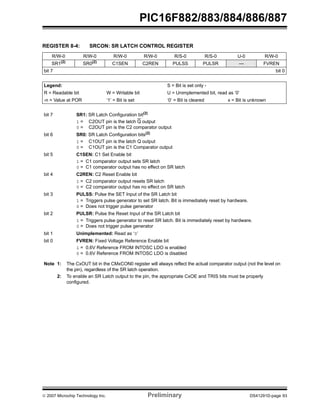
  • 67.
    PIC16F882/883/884/886/887 4.4.4 EXTERNALRC MODES The external Resistor-Capacitor (RC) modes support the use of an external RC circuit. This allows the designer maximum flexibility in frequency choice while keeping costs to a minimum when clock accuracy is not required. There are two modes: RC and RCIO. In RC mode, the RC circuit connects to OSC1. OSC2/CLKOUT outputs the RC oscillator frequency divided by 4. This signal may be used to provide a clock for external circuitry, synchronization, calibration, test or other application requirements. Figure 4-5 shows the external RC mode connections. FIGURE 4-5: EXTERNAL RC MODES PIC® MCU OSC1/CLKIN OSC2/CLKOUT(1) VDD REXT CEXT VSS FOSC/4 or Internal Clock I/O(2) Recommended values: 10 kΩ ≤ REXT ≤ 100 kΩ, <3V 3 kΩ ≤ REXT ≤ 100 kΩ, 3-5V CEXT > 20 pF, 2-5V Note 1: Alternate pin functions are listed in the Section 1.0 “Device Overview”. 2: Output depends upon RC or RCIO Clock mode. In RCIO mode, the RC circuit is connected to OSC1. OSC2 becomes an additional general purpose I/O pin. The RC oscillator frequency is a function of the supply voltage, the resistor (REXT) and capacitor (CEXT) values and the operating temperature. Other factors affecting the oscillator frequency are: • threshold voltage variation • component tolerances • packaging variations in capacitance The user also needs to take into account variation due to tolerance of external RC components used. 4.5 Internal Clock Modes The Oscillator module has two independent, internal oscillators that can be configured or selected as the system clock source. 1. The HFINTOSC (High-Frequency Internal Oscillator) is factory calibrated and operates at 8 MHz. The frequency of the HFINTOSC can be user-adjusted via software using the OSCTUNE register (Register 4-2). 2. The LFINTOSC (Low-Frequency Internal Oscillator) is uncalibrated and operates at 31 kHz. The system clock speed can be selected via software using the Internal Oscillator Frequency Select bits IRCF<2:0> of the OSCCON register. The system clock can be selected between external or internal clock sources via the System Clock Selection (SCS) bit of the OSCCON register. See Section 4.6 “Clock Switching” for more information. 4.5.1 INTOSC AND INTOSCIO MODES The INTOSC and INTOSCIO modes configure the internal oscillators as the system clock source when the device is programmed using the oscillator selection or the FOSC<2:0> bits in the Configuration Word Register 1 (CONFIG1). In INTOSC mode, OSC1/CLKIN is available for general purpose I/O. OSC2/CLKOUT outputs the selected internal oscillator frequency divided by 4. The CLKOUT signal may be used to provide a clock for external circuitry, synchronization, calibration, test or other application requirements. In INTOSCIO mode, OSC1/CLKIN and OSC2/CLKOUT are available for general purpose I/O. 4.5.2 HFINTOSC The High-Frequency Internal Oscillator (HFINTOSC) is a factory calibrated 8 MHz internal clock source. The frequency of the HFINTOSC can be altered via software using the OSCTUNE register (Register 4-2). The output of the HFINTOSC connects to a postscaler and multiplexer (see Figure 4-1). One of seven frequencies can be selected via software using the IRCF<2:0> bits of the OSCCON register. See Section 4.5.4 “Frequency Select Bits (IRCF)” for more information. The HFINTOSC is enabled by selecting any frequency between 8 MHz and 125 kHz by setting the IRCF<2:0> bits of the OSCCON register ≠ 000. Then, set the System Clock Source (SCS) bit of the OSCCON register to ‘1’ or enable Two-Speed Start-up by setting the IESO bit in the Configuration Word Register 1 (CONFIG1) to ‘1’. The HF Internal Oscillator (HTS) bit of the OSCCON register indicates whether the HFINTOSC is stable or not. © 2007 Microchip Technology Inc. Preliminary 41291D-page 65
  • 68.
    PIC16F882/883/884/886/887 4.5.2.1 OSCTUNERegister The HFINTOSC is factory calibrated but can be adjusted in software by writing to the OSCTUNE register (Register 4-2). The default value of the OSCTUNE register is ‘0’. The value is a 5-bit two’s complement number. When the OSCTUNE register is modified, the HFINTOSC frequency will begin shifting to the new frequency. Code execution continues during this shift. There is no indication that the shift has occurred. OSCTUNE does not affect the LFINTOSC frequency. Operation of features that depend on the LFINTOSC clock source frequency, such as the Power-up Timer (PWRT), Watchdog Timer (WDT), Fail-Safe Clock Monitor (FSCM) and peripherals, are not affected by the change in frequency. REGISTER 4-2: OSCTUNE: OSCILLATOR TUNING REGISTER U-0 U-0 U-0 R/W-0 R/W-0 R/W-0 R/W-0 R/W-0 — — — TUN4 TUN3 TUN2 TUN1 TUN0 bit 7 bit 0 Legend: R = Readable bit W = Writable bit U = Unimplemented bit, read as ‘0’ -n = Value at POR ‘1’ = Bit is set ‘0’ = Bit is cleared x = Bit is unknown bit 7-5 Unimplemented: Read as ‘0’ bit 4-0 TUN<4:0>: Frequency Tuning bits 01111 = Maximum frequency 01110 = • • • 00001 = 00000 = Oscillator module is running at the calibrated frequency. 11111 = • • • 10000 = Minimum frequency 41291D-page 66 Preliminary © 2007 Microchip Technology Inc.
  • 69.
    PIC16F882/883/884/886/887 4.5.3 LFINTOSC The Low-Frequency Internal Oscillator (LFINTOSC) is an uncalibrated 31 kHz internal clock source. The output of the LFINTOSC connects to a postscaler and multiplexer (see Figure 4-1). Select 31 kHz, via software, using the IRCF<2:0> bits of the OSCCON register. See Section 4.5.4 “Frequency Select Bits (IRCF)” for more information. The LFINTOSC is also the frequency for the Power-up Timer (PWRT), Watchdog Timer (WDT) and Fail-Safe Clock Monitor (FSCM). The LFINTOSC is enabled by selecting 31 kHz (IRCF<2:0> bits of the OSCCON register = 000) as the system clock source (SCS bit of the OSCCON register = 1), or when any of the following are enabled: • Two-Speed Start-up IESO bit of the Configuration Word Register 1 = 1 and IRCF<2:0> bits of the OSCCON register = 000 • Power-up Timer (PWRT) • Watchdog Timer (WDT) • Fail-Safe Clock Monitor (FSCM) The LF Internal Oscillator (LTS) bit of the OSCCON register indicates whether the LFINTOSC is stable or not. 4.5.4 FREQUENCY SELECT BITS (IRCF) The output of the 8 MHz HFINTOSC and 31 kHz LFINTOSC connects to a postscaler and multiplexer (see Figure 4-1). The Internal Oscillator Frequency Select bits IRCF<2:0> of the OSCCON register select the frequency output of the internal oscillators. One of eight frequencies can be selected via software: • 8 MHz • 4 MHz (Default after Reset) • 2 MHz • 1 MHz • 500 kHz • 250 kHz • 125 kHz • 31 kHz (LFINTOSC) 4.5.5 HFINTOSC AND LFINTOSC CLOCK SWITCH TIMING When switching between the LFINTOSC and the HFINTOSC, the new oscillator may already be shut down to save power (see Figure 4-6). If this is the case, there is a delay after the IRCF<2:0> bits of the OSCCON register are modified before the frequency selection takes place. The LTS and HTS bits of the OSCCON register will reflect the current active status of the LFINTOSC and HFINTOSC oscillators. The timing of a frequency selection is as follows: 1. IRCF<2:0> bits of the OSCCON register are modified. 2. If the new clock is shut down, a clock start-up delay is started. 3. Clock switch circuitry waits for a falling edge of the current clock. 4. CLKOUT is held low and the clock switch circuitry waits for a rising edge in the new clock. 5. CLKOUT is now connected with the new clock. LTS and HTS bits of the OSCCON register are updated as required. 6. Clock switch is complete. See Figure 4-1 for more details. If the internal oscillator speed selected is between 8 MHz and 125 kHz, there is no start-up delay before the new frequency is selected. This is because the old and new frequencies are derived from the HFINTOSC via the postscaler and multiplexer. Start-up delay specifications are located in the oscillator tables of Section 17.0 “Electrical Specifications”. Note: Following any Reset, the IRCF<2:0> bits of the OSCCON register are set to ‘110’ and the frequency selection is set to 4 MHz. The user can modify the IRCF bits to select a different frequency. © 2007 Microchip Technology Inc. Preliminary 41291D-page 67
  • 70.
    PIC16F882/883/884/886/887 FIGURE 4-6:INTERNAL OSCILLATOR SWITCH TIMING HFINTOSC LFINTOSC (FSCM and WDT disabled) HFINTOSC LFINTOSC IRCF <2:0> System Clock HFINTOSC LFINTOSC (Either FSCM or WDT enabled) HFINTOSC LFINTOSC IRCF <2:0> System Clock Start-up Time 2-cycle Sync Running ≠ 0 = 0 2-cycle Sync Running ≠ 0 = 0 LFINTOSC HFINTOSC LFINTOSC HFINTOSC IRCF <2:0> System Clock LFINTOSC turns off unless WDT or FSCM is enabled Start-up Time 2-cycle Sync Running = 0 ¼ 0 41291D-page 68 Preliminary © 2007 Microchip Technology Inc.
  • 71.
    PIC16F882/883/884/886/887 4.6 ClockSwitching The system clock source can be switched between external and internal clock sources via software using the System Clock Select (SCS) bit of the OSCCON register. 4.6.1 SYSTEM CLOCK SELECT (SCS) BIT The System Clock Select (SCS) bit of the OSCCON register selects the system clock source that is used for the CPU and peripherals. • When the SCS bit of the OSCCON register = 0, the system clock source is determined by configuration of the FOSC<2:0> bits in the Configuration Word Register 1 (CONFIG1). • When the SCS bit of the OSCCON register = 1, the system clock source is chosen by the internal oscillator frequency selected by the IRCF<2:0> bits of the OSCCON register. After a Reset, the SCS bit of the OSCCON register is always cleared. Note: Any automatic clock switch, which may occur from Two-Speed Start-up or Fail-Safe Clock Monitor, does not update the SCS bit of the OSCCON register. The user can monitor the OSTS bit of the OSCCON register to determine the current system clock source. 4.6.2 OSCILLATOR START-UP TIME-OUT STATUS (OSTS) BIT The Oscillator Start-up Time-out Status (OSTS) bit of the OSCCON register indicates whether the system clock is running from the external clock source, as defined by the FOSC<2:0> bits in the Configuration Word Register 1 (CONFIG1), or from the internal clock source. In particular, OSTS indicates that the Oscillator Start-up Timer (OST) has timed out for LP, XT or HS modes. 4.7 Two-Speed Clock Start-up Mode Two-Speed Start-up mode provides additional power savings by minimizing the latency between external oscillator start-up and code execution. In applications that make heavy use of the Sleep mode, Two-Speed Start-up will remove the external oscillator start-up time from the time spent awake and can reduce the overall power consumption of the device. This mode allows the application to wake-up from Sleep, perform a few instructions using the INTOSC as the clock source and go back to Sleep without waiting for the primary oscillator to become stable. When the Oscillator module is configured for LP, XT or HS modes, the Oscillator Start-up Timer (OST) is enabled (see Section 4.4.1 “Oscillator Start-up Timer (OST)”). The OST will suspend program execution until 1024 oscillations are counted. Two-Speed Start-up mode minimizes the delay in code execution by operating from the internal oscillator as the OST is counting. When the OST count reaches 1024 and the OSTS bit of the OSCCON register is set, program execution switches to the external oscillator. 4.7.1 TWO-SPEED START-UP MODE CONFIGURATION Two-Speed Start-up mode is configured by the following settings: • IESO (of the Configuration Word Register 1) = 1; Internal/External Switchover bit (Two-Speed Start-up mode enabled). • SCS (of the OSCCON register) = 0. • FOSC<2:0> bits in the Configuration Word Register 1 (CONFIG1) configured for LP, XT or HS mode. Two-Speed Start-up mode is entered after: • Power-on Reset (POR) and, if enabled, after Power-up Timer (PWRT) has expired, or • Wake-up from Sleep. If the external clock oscillator is configured to be anything other than LP, XT or HS mode, then Two-speed Start-up is disabled. This is because the external clock oscillator does not require any stabilization time after POR or an exit from Sleep. 4.7.2 TWO-SPEED START-UP SEQUENCE 1. Wake-up from Power-on Reset or Sleep. 2. Instructions begin execution by the internal oscillator at the frequency set in the IRCF<2:0> bits of the OSCCON register. 3. OST enabled to count 1024 clock cycles. 4. OST timed out, wait for falling edge of the internal oscillator. 5. OSTS is set. 6. System clock held low until the next falling edge of new clock (LP, XT or HS mode). 7. System clock is switched to external clock source. Note: Executing a SLEEP instruction will abort the oscillator start-up time and will cause the OSTS bit of the OSCCON register to remain clear. © 2007 Microchip Technology Inc. Preliminary 41291D-page 69
  • 72.
    PIC16F882/883/884/886/887 4.7.3 CHECKINGTWO-SPEED CLOCK STATUS Checking the state of the OSTS bit of the OSCCON register will confirm if the microcontroller is running from the external clock source, as defined by the FOSC<2:0> bits in the Configuration Word Register 1 (CONFIG1), or the internal oscillator. FIGURE 4-7: TWO-SPEED START-UP TOST 0 1 1022 1023 PC + 1 HFINTOSC OSC1 OSC2 Program Counter System Clock PC - N PC 41291D-page 70 Preliminary © 2007 Microchip Technology Inc.
  • 73.
    PIC16F882/883/884/886/887 4.8 Fail-SafeClock Monitor The Fail-Safe Clock Monitor (FSCM) allows the device to continue operating should the external oscillator fail. The FSCM can detect oscillator failure any time after the Oscillator Start-up Timer (OST) has expired. The FSCM is enabled by setting the FCMEN bit in the Configuration Word Register 1 (CONFIG1). The FSCM is applicable to all external Oscillator modes (LP, XT, HS, EC, RC and RCIO). FIGURE 4-8: FSCM BLOCK DIAGRAM External Clock LFINTOSC ÷ 64 Clock Monitor Latch S R Q Oscillator 31 kHz (~32 μs) 488 Hz (~2 ms) Clock Failure Detected Q Sample Clock 4.8.1 FAIL-SAFE DETECTION The FSCM module detects a failed oscillator by comparing the external oscillator to the FSCM sample clock. The sample clock is generated by dividing the LFINTOSC by 64. See Figure 4-8. Inside the fail detector block is a latch. The external clock sets the latch on each falling edge of the external clock. The sample clock clears the latch on each rising edge of the sample clock. A failure is detected when an entire half-cycle of the sample clock elapses before the primary clock goes low. 4.8.2 FAIL-SAFE OPERATION When the external clock fails, the FSCM switches the device clock to an internal clock source and sets the bit flag OSFIF of the PIR2 register. Setting this flag will generate an interrupt if the OSFIE bit of the PIE2 register is also set. The device firmware can then take steps to mitigate the problems that may arise from a failed clock. The system clock will continue to be sourced from the internal clock source until the device firmware successfully restarts the external oscillator and switches back to external operation. The internal clock source chosen by the FSCM is determined by the IRCF<2:0> bits of the OSCCON register. This allows the internal oscillator to be configured before a failure occurs. 4.8.3 FAIL-SAFE CONDITION CLEARING The Fail-Safe condition is cleared after a Reset, executing a SLEEP instruction or toggling the SCS bit of the OSCCON register. When the SCS bit is toggled, the OST is restarted. While the OST is running, the device continues to operate from the INTOSC selected in OSCCON. When the OST times out, the Fail-Safe condition is cleared and the device will be operating from the external clock source. The Fail-Safe condition must be cleared before the OSFIF flag can be cleared. 4.8.4 RESET OR WAKE-UP FROM SLEEP The FSCM is designed to detect an oscillator failure after the Oscillator Start-up Timer (OST) has expired. The OST is used after waking up from Sleep and after any type of Reset. The OST is not used with the EC or RC Clock modes so that the FSCM will be active as soon as the Reset or wake-up has completed. When the FSCM is enabled, the Two-Speed Start-up is also enabled. Therefore, the device will always be executing code while the OST is operating. Note: Due to the wide range of oscillator start-up times, the Fail-Safe circuit is not active during oscillator start-up (i.e., after exiting Reset or Sleep). After an appropriate amount of time, the user should check the OSTS bit of the OSCCON register to verify the oscillator start-up and that the system clock switchover has successfully completed. © 2007 Microchip Technology Inc. Preliminary 41291D-page 71
  • 74.
    PIC16F882/883/884/886/887 FIGURE 4-9:FSCM TIMING DIAGRAM Sample Clock System Clock Output Clock Monitor Output (Q) OSCFIF Failure Detected Oscillator Failure Test Test Test Note: The system clock is normally at a much higher frequency than the sample clock. The relative frequencies in this example have been chosen for clarity. TABLE 4-2: SUMMARY OF REGISTERS ASSOCIATED WITH CLOCK SOURCES Name Bit 7 Bit 6 Bit 5 Bit 4 Bit 3 Bit 2 Bit 1 Bit 0 Value on POR, BOR Value on all other Resets(1) CONFIG1(2) CPD CP MCLRE PWRTE WDTE FOSC2 FOSC1 FOSC0 — — OSCCON — IRCF2 IRCF1 IRCF0 OSTS HTS LTS SCS -110 x000 -110 x000 OSCTUNE — — — TUN4 TUN3 TUN2 TUN1 TUN0 ---0 0000 ---u uuuu PIE2 OSFIE C2IE C1IE EEIE BCLIE ULPWUIE — CCP2IE 0000 00-0 0000 00-0 PIR2 OSFIF C2IF C1IF EEIF BCLIF ULPWUIF — CCP2IF 0000 00-0 0000 00-0 Legend: x = unknown, u = unchanged, – = unimplemented locations read as ‘0’. Shaded cells are not used by oscillators. Note 1: Other (non Power-up) Resets include MCLR Reset and Watchdog Timer Reset during normal operation. 2: See Configuration Word Register 1 (Register 14-1) for operation of all register bits. 41291D-page 72 Preliminary © 2007 Microchip Technology Inc.
  • 75.
    PIC16F882/883/884/886/887 5.0 TIMER0MODULE The Timer0 module is an 8-bit timer/counter with the following features: • 8-bit timer/counter register (TMR0) • 8-bit prescaler (shared with Watchdog Timer) • Programmable internal or external clock source • Programmable external clock edge selection • Interrupt on overflow Figure 5-1 is a block diagram of the Timer0 module. 5.1 Timer0 Operation When used as a timer, the Timer0 module can be used as either an 8-bit timer or an 8-bit counter. 5.1.1 8-BIT TIMER MODE When used as a timer, the Timer0 module will increment every instruction cycle (without prescaler). Timer mode is selected by clearing the T0CS bit of the OPTION register to ‘0’. When TMR0 is written, the increment is inhibited for two instruction cycles immediately following the write. Note: The value written to the TMR0 register can be adjusted, in order to account for the two instruction cycle delay when TMR0 is written. 5.1.2 8-BIT COUNTER MODE When used as a counter, the Timer0 module will increment on every rising or falling edge of the T0CKI pin. The incrementing edge is determined by the T0SE bit of the OPTION register. Counter mode is selected by setting the T0CS bit of the OPTION register to ‘1’. FIGURE 5-1: TIMER0/WDT PRESCALER BLOCK DIAGRAM FOSC/4 T0CKI T0SE pin Data Bus 8 TMR0 0 1 T0CS Watchdog Timer Sync 2 Tcy WDT Time-out PS<2:0> WDTE Set Flag bit T0IF on Overflow 0 1 8-bit Prescaler 8 PSA 16-bit Prescaler 16 WDTPS<3:0> SWDTEN 31 kHz INTOSC Note 1: T0SE, T0CS, PSA, PS<2:0> are bits in the OPTION register. 2: SWDTEN and WDTPS<3:0> are bits in the WDTCON register. 3: WDTE bit is in the Configuration Word Register1. 1 0 PSA 1 0 PSA © 2007 Microchip Technology Inc. Preliminary DS41291D-page 73
  • 76.
    PIC16F882/883/884/886/887 5.1.3 SOFTWAREPROGRAMMABLE PRESCALER A single software programmable prescaler is available for use with either Timer0 or the Watchdog Timer (WDT), but not both simultaneously. The prescaler assignment is controlled by the PSA bit of the OPTION register. To assign the prescaler to Timer0, the PSA bit must be cleared to a ‘0’. There are 8 prescaler options for the Timer0 module ranging from 1:2 to 1:256. The prescale values are selectable via the PS<2:0> bits of the OPTION register. In order to have a 1:1 prescaler value for the Timer0 module, the prescaler must be assigned to the WDT module. The prescaler is not readable or writable. When assigned to the Timer0 module, all instructions writing to the TMR0 register will clear the prescaler. When the prescaler is assigned to WDT, a CLRWDT instruction will clear the prescaler along with the WDT. 5.1.3.1 Switching Prescaler Between Timer0 and WDT Modules As a result of having the prescaler assigned to either Timer0 or the WDT, it is possible to generate an unintended device Reset when switching prescaler values. When changing the prescaler assignment from Timer0 to the WDT module, the instruction sequence shown in Example 5-1, must be executed. EXAMPLE 5-1: CHANGING PRESCALER (TIMER0 → WDT) When changing the prescaler assignment from the WDT to the Timer0 module, the following instruction sequence must be executed (see Example 5-2). EXAMPLE 5-2: CHANGING PRESCALER (WDT → TIMER0) CLRWDT ;Clear WDT and ;prescaler BANKSEL OPTION_REG ; MOVLW b’11110000’ ;Mask TMR0 select and ANDWF OPTION_REG,W ;prescaler bits IORLW b’00000011’ ;Set prescale to 1:16 MOVWF OPTION_REG ; 5.1.4 TIMER0 INTERRUPT Timer0 will generate an interrupt when the TMR0 register overflows from FFh to 00h. The T0IF interrupt flag bit of the INTCON register is set every time the TMR0 register overflows, regardless of whether or not the Timer0 interrupt is enabled. The T0IF bit must be cleared in software. The Timer0 interrupt enable is the T0IE bit of the INTCON register. Note: The Timer0 interrupt cannot wake the processor from Sleep since the timer is frozen during Sleep. 5.1.5 USING TIMER0 WITH AN EXTERNAL CLOCK When Timer0 is in Counter mode, the synchronization of the T0CKI input and the Timer0 register is accom-plished by sampling the prescaler output on the Q2 and Q4 cycles of the internal phase clocks. Therefore, the high and low periods of the external clock source must meet the timing requirements as shown in the Section 17.0 “Electrical Specifications”. BANKSEL TMR0 ; CLRWDT ;Clear WDT CLRF TMR0 ;Clear TMR0 and ;prescaler BANKSEL OPTION_REG ; BSF OPTION_REG,PSA ;Select WDT CLRWDT ; ; MOVLW b’11111000’ ;Mask prescaler ANDWF OPTION_REG,W ;bits IORLW b’00000101’ ;Set WDT prescaler MOVWF OPTION_REG ;to 1:32 DS41291D-page 74 Preliminary © 2007 Microchip Technology Inc.
  • 77.
    PIC16F882/883/884/886/887 REGISTER 5-1:OPTION_REG: OPTION REGISTER R/W-1 R/W-1 R/W-1 R/W-1 R/W-1 R/W-1 R/W-1 R/W-1 RBPU INTEDG T0CS T0SE PSA PS2 PS1 PS0 bit 7 bit 0 Legend: R = Readable bit W = Writable bit U = Unimplemented bit, read as ‘0’ -n = Value at POR ‘1’ = Bit is set ‘0’ = Bit is cleared x = Bit is unknown bit 7 RBPU: PORTB Pull-up Enable bit 1 = PORTB pull-ups are disabled 0 = PORTB pull-ups are enabled by individual PORT latch values bit 6 INTEDG: Interrupt Edge Select bit 1 = Interrupt on rising edge of INT pin 0 = Interrupt on falling edge of INT pin bit 5 T0CS: TMR0 Clock Source Select bit 1 = Transition on T0CKI pin 0 = Internal instruction cycle clock (FOSC/4) bit 4 T0SE: TMR0 Source Edge Select bit 1 = Increment on high-to-low transition on T0CKI pin 0 = Increment on low-to-high transition on T0CKI pin bit 3 PSA: Prescaler Assignment bit 1 = Prescaler is assigned to the WDT 0 = Prescaler is assigned to the Timer0 module bit 2-0 PS<2:0>: Prescaler Rate Select bits BIT VALUE TMR0 RATE WDT RATE 000 001 010 011 100 101 110 111 1 : 2 1 : 4 1 : 8 1 : 16 1 : 32 1 : 64 1 : 128 1 : 256 1 : 1 1 : 2 1 : 4 1 : 8 1 : 16 1 : 32 1 : 64 1 : 128 Note 1: A dedicated 16-bit WDT postscaler is available. See Section 14.5 “Watchdog Timer (WDT)” for more information. TABLE 5-1: SUMMARY OF REGISTERS ASSOCIATED WITH TIMER0 Name Bit 7 Bit 6 Bit 5 Bit 4 Bit 3 Bit 2 Bit 1 Bit 0 Value on POR, BOR Value on all other Resets TMR0 Timer0 Module Register xxxx xxxx uuuu uuuu INTCON GIE PEIE T0IE INTE RBIE T0IF INTF RBIF 0000 000x 0000 000x OPTION_REG RBPU INTEDG T0CS T0SE PSA PS2 PS1 PS0 1111 1111 1111 1111 TRISA TRISA7 TRISA6 TRISA5 TRISA4 TRISA3 TRISA2 TRISA1 TRISA0 1111 1111 1111 1111 Legend: – = Unimplemented locations, read as ‘0’, u = unchanged, x = unknown. Shaded cells are not used by the Timer0 module. © 2007 Microchip Technology Inc. Preliminary DS41291D-page 75
  • 78.
    PIC16F882/883/884/886/887 6.0 TIMER1MODULE WITH GATE CONTROL The Timer1 module is a 16-bit timer/counter with the following features: • 16-bit timer/counter register pair (TMR1H:TMR1L) • Programmable internal or external clock source • 3-bit prescaler • Optional LP oscillator • Synchronous or asynchronous operation • Timer1 gate (count enable) via comparator or T1G pin • Interrupt on overflow • Wake-up on overflow (external clock, Asynchronous mode only) • Time base for the Capture/Compare function • Special Event Trigger (with ECCP) • Comparator output synchronization to Timer1 clock Figure 6-1 is a block diagram of the Timer1 module. 6.1 Timer1 Operation The Timer1 module is a 16-bit incrementing counter which is accessed through the TMR1H:TMR1L register pair. Writes to TMR1H or TMR1L directly update the counter. When used with an internal clock source, the module is a timer. When used with an external clock source, the module can be used as either a timer or counter. 6.2 Clock Source Selection The TMR1CS bit of the T1CON register is used to select the clock source. When TMR1CS = 0, the clock source is FOSC/4. When TMR1CS = 1, the clock source is supplied externally. FIGURE 6-1: TIMER1 BLOCK DIAGRAM Clock Source TMR1CS FOSC/4 0 T1CKI pin 1 Set flag bit TMR1IF on Overflow TMR1(2) TMR1H TMR1L TMR1ON To C2 Comparator Module Timer1 Clock 0 1 T1SYNC Prescaler 1, 2, 4, 8 2 T1CKPS<1:0> TMR1GE Synchronized clock input Synchronize(3) Sleep input 1 T1G C2OUT 0 det T1GSS T1GINV EN T1 OSC FOSC/4 Internal Clock 1 0 T1OSI T1OSO T1OSCEN 1 0 T1CKI TMR1CS (1) Note 1: ST Buffer is low power type when using LP oscillator, or high speed type when using T1CKI. 2: Timer1 register increments on rising edge. 3: Synchronize does not operate while in Sleep. DS41291D-page 76 Preliminary © 2007 Microchip Technology Inc.
  • 79.
    PIC16F882/883/884/886/887 6.2.1 INTERNALCLOCK SOURCE When the internal clock source is selected the TMR1H:TMR1L register pair will increment on multiples of FOSC as determined by the Timer1 prescaler. 6.2.2 EXTERNAL CLOCK SOURCE When the external clock source is selected, the Timer1 module may work as a timer or a counter. When counting, Timer1 is incremented on the rising edge of the external clock input T1CKI. In addition, the Counter mode clock can be synchronized to the microcontroller system clock or run asynchronously. If an external clock oscillator is needed (and the microcontroller is using the INTOSC without CLKOUT), Timer1 can use the LP oscillator as a clock source. Note: In Counter mode, a falling edge must be registered by the counter prior to the first incrementing rising edge. 6.3 Timer1 Prescaler Timer1 has four prescaler options allowing 1, 2, 4 or 8 divisions of the clock input. The T1CKPS bits of the T1CON register control the prescale counter. The prescale counter is not directly readable or writable; however, the prescaler counter is cleared upon a write to TMR1H or TMR1L. 6.4 Timer1 Oscillator A low-power 32.768 kHz crystal oscillator is built-in between pins T1OSI (input) and T1OSO (amplifier output). The oscillator is enabled by setting the T1OSCEN control bit of the T1CON register. The oscillator will continue to run during Sleep. The Timer1 oscillator is identical to the LP oscillator. The user must provide a software time delay to ensure proper oscillator start-up. TRISC0 and TRISC1 bits are set when the Timer1 oscillator is enabled. RC0 and RC1 bits read as ‘0’ and TRISC0 and TRISC1 bits read as ‘1’. 6.5 Timer1 Operation in Asynchronous Counter Mode If control bit T1SYNC of the T1CON register is set, the external clock input is not synchronized. The timer continues to increment asynchronous to the internal phase clocks. The timer will continue to run during Sleep and can generate an interrupt on overflow, which will wake-up the processor. However, special precautions in software are needed to read/write the timer (see Section 6.5.1 “Reading and Writing Timer1 in Asynchronous Counter Mode”). Note: When switching from synchronous to asynchronous operation, it is possible to skip an increment. When switching from asynchronous to synchronous operation, it is possible to produce a single spurious increment. 6.5.1 READING AND WRITING TIMER1 IN ASYNCHRONOUS COUNTER MODE Reading TMR1H or TMR1L while the timer is running from an external asynchronous clock will ensure a valid read (taken care of in hardware). However, the user should keep in mind that reading the 16-bit timer in two 8-bit values itself, poses certain problems, since the timer may overflow between the reads. For writes, it is recommended that the user simply stop the timer and write the desired values. A write contention may occur by writing to the timer registers, while the register is incrementing. This may produce an unpredictable value in the TMR1H:TTMR1L register pair. 6.6 Timer1 Gate Timer1 gate source is software configurable to be the T1G pin or the output of Comparator C2. This allows the device to directly time external events using T1G or analog events using Comparator C2. See the CM2CON1 register (Register 8-3) for selecting the Timer1 gate source. This feature can simplify the software for a Delta-Sigma A/D converter and many other applications. For more information on Delta-Sigma A/D converters, see the Microchip web site (www.microchip.com). Note: TMR1GE bit of the T1CON register must be set to use either T1G or C2OUT as the Timer1 gate source. See Register 8-3 for more information on selecting the Timer1 gate source. Timer1 gate can be inverted using the T1GINV bit of the T1CON register, whether it originates from the T1G pin or Comparator C2 output. This configures Timer1 to measure either the active-high or active-low time between events. Note: The oscillator requires a start-up and stabilization time before use. Thus, T1OSCEN should be set and a suitable delay observed prior to enabling Timer1. © 2007 Microchip Technology Inc. Preliminary DS41291D-page 77
  • 80.
    PIC16F882/883/884/886/887 6.7 Timer1Interrupt The Timer1 register pair (TMR1H:TMR1L) increments to FFFFh and rolls over to 0000h. When Timer1 rolls over, the Timer1 interrupt flag bit of the PIR1 register is set. To enable the interrupt on rollover, you must set these bits: • Timer1 interrupt enable bit of the PIE1 register • PEIE bit of the INTCON register • GIE bit of the INTCON register The interrupt is cleared by clearing the TMR1IF bit in the Interrupt Service Routine. Note: The TMR1H:TTMR1L register pair and the TMR1IF bit should be cleared before enabling interrupts. 6.8 Timer1 Operation During Sleep Timer1 can only operate during Sleep when setup in Asynchronous Counter mode. In this mode, an external crystal or clock source can be used to increment the counter. To set up the timer to wake the device: • TMR1ON bit of the T1CON register must be set • TMR1IE bit of the PIE1 register must be set • PEIE bit of the INTCON register must be set The device will wake-up on an overflow and execute the next instruction. If the GIE bit of the INTCON register is set, the device will call the Interrupt Service Routine (0004h). 6.9 ECCP Capture/Compare Time Base The ECCP module uses the TMR1H:TMR1L register pair as the time base when operating in Capture or Compare mode. In Capture mode, the value in the TMR1H:TMR1L register pair is copied into the CCPRxH:CCPRxL register pair on a configured event. In Compare mode, an event is triggered when the value CCPRxH:CCPRxL register pair matches the value in the TMR1H:TMR1L register pair. This event can be a Special Event Trigger. See Section 11.0 “Capture/Compare/PWM Modules (CCP1 and CCP2)” for more information. 6.10 ECCP Special Event Trigger If an ECCP is configured to trigger a special event, the trigger will clear the TMR1H:TMR1L register pair. This special event does not cause a Timer1 interrupt. The ECCP module may still be configured to generate a ECCP interrupt. In this mode of operation, the CCPRxH:CCPRxL register pair effectively becomes the period register for Timer1. Timer1 should be synchronized to the FOSC to utilize the Special Event Trigger. Asynchronous operation of Timer1 can cause a Special Event Trigger to be missed. In the event that a write to TMR1H or TMR1L coincides with a Special Event Trigger from the ECCP, the write will take precedence. For more information, see Section 11.0 “Capture/Compare/PWM Modules (CCP1 and CCP2)”. 6.11 Comparator Synchronization The same clock used to increment Timer1 can also be used to synchronize the comparator output. This feature is enabled in the Comparator module. When using the comparator for Timer1 gate, the comparator output should be synchronized to Timer1. This ensures Timer1 does not miss an increment if the comparator changes. For more information, see Section 8.0 “Comparator Module”. FIGURE 6-2: TIMER1 INCREMENTING EDGE T1CKI = 1 when TMR1 Enabled T1CKI = 0 when TMR1 Enabled Note 1: Arrows indicate counter increments. 2: In Counter mode, a falling edge must be registered by the counter prior to the first incrementing rising edge of the clock. DS41291D-page 78 Preliminary © 2007 Microchip Technology Inc.
  • 81.
    PIC16F882/883/884/886/887 6.12 Timer1Control Register The Timer1 Control register (T1CON), shown in Register 6-1, is used to control Timer1 and select the various features of the Timer1 module. REGISTER 6-1: T1CON: TIMER1 CONTROL REGISTER R/W-0 R/W-0 R/W-0 R/W-0 R/W-0 R/W-0 R/W-0 R/W-0 T1GINV(1) TMR1GE(2) T1CKPS1 T1CKPS0 T1OSCEN T1SYNC TMR1CS TMR1ON bit 7 bit 0 Legend: R = Readable bit W = Writable bit U = Unimplemented bit, read as ‘0’ -n = Value at POR ‘1’ = Bit is set ‘0’ = Bit is cleared x = Bit is unknown bit 7 T1GINV: Timer1 Gate Invert bit(1) 1 = Timer1 gate is active-high (Timer1 counts when gate is high) 0 = Timer1 gate is active-low (Timer1 counts when gate is low) bit 6 TMR1GE: Timer1 Gate Enable bit(2) If TMR1ON = 0: This bit is ignored If TMR1ON = 1: 1 = Timer1 is on if Timer1 gate is not active 0 = Timer1 is on bit 5-4 T1CKPS<1:0>: Timer1 Input Clock Prescale Select bits 11 = 1:8 Prescale Value 10 = 1:4 Prescale Value 01 = 1:2 Prescale Value 00 = 1:1 Prescale Value bit 3 T1OSCEN: LP Oscillator Enable Control bit 1 = LP oscillator is enabled for Timer1 clock 0 = LP oscillator is off bit 2 T1SYNC: Timer1 External Clock Input Synchronization Control bit TMR1CS = 1: 1 = Do not synchronize external clock input 0 = Synchronize external clock input TMR1CS = 0: This bit is ignored. Timer1 uses the internal clock bit 1 TMR1CS: Timer1 Clock Source Select bit 1 = External clock from T1CKI pin (on the rising edge) 0 = Internal clock (FOSC/4) bit 0 TMR1ON: Timer1 On bit 1 = Enables Timer1 0 = Stops Timer1 Note 1: T1GINV bit inverts the Timer1 gate logic, regardless of source. 2: TMR1GE bit must be set to use either T1G pin or C2OUT, as selected by the T1GSS bit of the CM2CON1 register, as a Timer1 gate source. © 2007 Microchip Technology Inc. Preliminary DS41291D-page 79
  • 82.
    PIC16F882/883/884/886/887 TABLE 6-1:SUMMARY OF REGISTERS ASSOCIATED WITH TIMER1 Name Bit 7 Bit 6 Bit 5 Bit 4 Bit 3 Bit 2 Bit 1 Bit 0 Value on POR, BOR Value on all other Resets CM2CON1 MC1OUT MC2OUT C1RSEL C2RSEL — — T1GSS C2SYNC 0000 --10 0000 --10 INTCON GIE PEIE T0IE INTE RBIE T0IF INTF RBIF 0000 000x 0000 000x PIE1 — ADIE RCIE TXIE SSPIE CCP1IE TMR2IE TMR1IE -000 0000 -000 0000 PIR1 — ADIF RCIF TXIF SSPIF CCP1IF TMR2IF TMR1IF -000 0000 -000 0000 TMR1H Holding Register for the Most Significant Byte of the 16-bit TMR1 Register xxxx xxxx uuuu uuuu TMR1L Holding Register for the Least Significant Byte of the 16-bit TMR1 Register xxxx xxxx uuuu uuuu T1CON T1GINV TMR1GE T1CKPS1 T1CKPS0 T1OSCEN T1SYNC TMR1CS TMR1ON 0000 0000 uuuu uuuu Legend: x = unknown, u = unchanged, – = unimplemented, read as ‘0’. Shaded cells are not used by the Timer1 module. DS41291D-page 80 Preliminary © 2007 Microchip Technology Inc.
  • 83.
    PIC16F882/883/884/886/887 7.0 TIMER2MODULE The Timer2 module is an eight-bit timer with the following features: • 8-bit timer register (TMR2) • 8-bit period register (PR2) • Interrupt on TMR2 match with PR2 • Software programmable prescaler (1:1, 1:4, 1:16) • Software programmable postscaler (1:1 to 1:16) See Figure 7-1 for a block diagram of Timer2. 7.1 Timer2 Operation The clock input to the Timer2 module is the system instruction clock (FOSC/4). The clock is fed into the Timer2 prescaler, which has prescale options of 1:1, 1:4 or 1:16. The output of the prescaler is then used to increment the TMR2 register. The values of TMR2 and PR2 are constantly compared to determine when they match. TMR2 will increment from 00h until it matches the value in PR2. When a match occurs, two things happen: • TMR2 is reset to 00h on the next increment cycle • The Timer2 postscaler is incremented The match output of the Timer2/PR2 comparator is then fed into the Timer2 postscaler. The postscaler has postscale options of 1:1 to 1:16 inclusive. The output of the Timer2 postscaler is used to set the TMR2IF interrupt flag bit in the PIR1 register. The TMR2 and PR2 registers are both fully readable and writable. On any Reset, the TMR2 register is set to 00h and the PR2 register is set to FFh. Timer2 is turned on by setting the TMR2ON bit in the T2CON register to a ‘1’. Timer2 is turned off by clearing the TMR2ON bit to a ‘0’. The Timer2 prescaler is controlled by the T2CKPS bits in the T2CON register. The Timer2 postscaler is controlled by the TOUTPS bits in the T2CON register. The prescaler and postscaler counters are cleared when: • A write to TMR2 occurs. • A write to T2CON occurs. • Any device Reset occurs (Power-on Reset, MCLR Reset, Watchdog Timer Reset, or Brown-out Reset). FIGURE 7-1: TIMER2 BLOCK DIAGRAM Note: TMR2 is not cleared when T2CON is written. TMR2 Comparator TMR2 Sets Flag Output Reset Postscaler Prescaler PR2 1:1, 1:4, 1:16 2 FOSC/4 1:1 to 1:16 EQ 4 bit TMR2IF TOUTPS<3:0> T2CKPS<1:0> © 2007 Microchip Technology Inc. Preliminary DS41291D-page 81
  • 84.
    PIC16F882/883/884/886/887 REGISTER 7-1:T2CON: TIMER2 CONTROL REGISTER U-0 R/W-0 R/W-0 R/W-0 R/W-0 R/W-0 R/W-0 R/W-0 — TOUTPS3 TOUTPS2 TOUTPS1 TOUTPS0 TMR2ON T2CKPS1 T2CKPS0 bit 7 bit 0 Legend: R = Readable bit W = Writable bit U = Unimplemented bit, read as ‘0’ -n = Value at POR ‘1’ = Bit is set ‘0’ = Bit is cleared x = Bit is unknown bit 7 Unimplemented: Read as ‘0’ bit 6-3 TOUTPS<3:0>: Timer2 Output Postscaler Select bits 0000 = 1:1 Postscaler 0001 = 1:2 Postscaler 0010 = 1:3 Postscaler 0011 = 1:4 Postscaler 0100 = 1:5 Postscaler 0101 = 1:6 Postscaler 0110 = 1:7 Postscaler 0111 = 1:8 Postscaler 1000 = 1:9 Postscaler 1001 = 1:10 Postscaler 1010 = 1:11 Postscaler 1011 = 1:12 Postscaler 1100 = 1:13 Postscaler 1101 = 1:14 Postscaler 1110 = 1:15 Postscaler 1111 = 1:16 Postscaler bit 2 TMR2ON: Timer2 On bit 1 = Timer2 is on 0 = Timer2 is off bit 1-0 T2CKPS<1:0>: Timer2 Clock Prescale Select bits 00 = Prescaler is 1 01 = Prescaler is 4 1x = Prescaler is 16 TABLE 7-1: SUMMARY OF ASSOCIATED TIMER2 REGISTERS Name Bit 7 Bit 6 Bit 5 Bit 4 Bit 3 Bit 2 Bit 1 Bit 0 Value on POR, BOR Value on all other Resets INTCON GIE PEIE T0IE INTE RBIE T0IF INTF RBIF 0000 000x 0000 000x PIE1 — ADIE RCIE TXIE SSPIE CCP1IE TMR2IE TMR1IE -000 0000 -000 0000 PIR1 — ADIF RCIF TXIF SSPIF CCP1IF TMR2IF TMR1IF -000 0000 -000 0000 PR2 Timer2 Module Period Register 1111 1111 1111 1111 TMR2 Holding Register for the 8-bit TMR2 Register 0000 0000 0000 0000 T2CON — TOUTPS3 TOUTPS2 TOUTPS1 TOUTPS0 TMR2ON T2CKPS1 T2CKPS0 -000 0000 -000 0000 Legend: x = unknown, u = unchanged, — = unimplemented read as ‘0’. Shaded cells are not used for Timer2 module. DS41291D-page 82 Preliminary © 2007 Microchip Technology Inc.
  • 85.
    PIC16F882/883/884/886/887 8.0 COMPARATORMODULE Comparators are used to interface analog circuits to a digital circuit by comparing two analog voltages and providing a digital indication of their relative magnitudes. The comparators are very useful mixed signal building blocks because they provide analog functionality independent of the program execution. The analog Comparator module includes the following features: • Independent comparator control • Programmable input selection • Comparator output is available internally/externally • Programmable output polarity • Interrupt-on-change • Wake-up from Sleep • PWM shutdown • Timer1 gate (count enable) • Output synchronization to Timer1 clock input • SR Latch • Programmable and fixed voltage reference 8.1 Comparator Overview A single comparator is shown in Figure 8-1 along with the relationship between the analog input levels and the digital output. When the analog voltage at VIN+ is less than the analog voltage at VIN-, the output of the comparator is a digital low level. When the analog voltage at VIN+ is greater than the analog voltage at VIN-, the output of the comparator is a digital high level. FIGURE 8-1: SINGLE COMPARATOR Note: Only Comparator C2 can be linked to Timer1. VIN+ + VIN-Output – VIN-Note: VIN+ Output The black areas of the output of the comparator represents the uncertainty due to input offsets and response time. © 2007 Microchip Technology Inc. Preliminary DS41291D-page 83
  • 86.
    PIC16F882/883/884/886/887 FIGURE 8-2:COMPARATOR C1 SIMPLIFIED BLOCK DIAGRAM C1ON(1) C1POL D Q EN D Q EN CL Q3*RD_CM1CON0 Reset C1OUT To Data Bus RD_CM1CON0 Set C1IF To PWM Logic Q1 C1POL C1OUT (to SR Latch) 2 0 1 MUX C1 2 3 C1CH<1:0> C1R 0 MUX 1 C1VIN-C1VIN+ C12IN0- C12IN1- C12IN2- C12IN3- C1IN+ - + 0 MUX 1 C1VREF Note 1: When C1ON = 0, the C1 comparator will produce a ‘0’ output to the XOR Gate. 2: Q1 and Q3 are phases of the four-phase system clock (FOSC). 3: Q1 is held high during Sleep mode. FixedRef CVREF C1RSEL FIGURE 8-3: COMPARATOR C2 SIMPLIFIED BLOCK DIAGRAM 2 0 1 MUX C2ON(1) C2 C2POL C2POL D Q EN D Q EN Q1 Q3*RD_CM2CON0 Reset C2OUT 2 3 C2CH<1:0> C2R 0 MUX 1 From Timer1 Clock CL D Q To Data Bus RD_CM2CON0 Set C2IF C2VIN-C2VIN+ SYNCC2OUT C12IN0- C12IN1- C2IN2- C2IN3- C2IN+ C2SYNC 0 MUX 1 To Timer1 Gate, SR Latch MUX C2VREF and other peripherals Note 1: When C2ON = 0, the C2 comparator will produce a ‘0’ output to the XOR Gate. 2: Q1 and Q3 are phases of the four-phase system clock (FOSC). 3: Q1 is held high during Sleep mode. 0 1 FixedRef CVREF C2RSEL DS41291D-page 84 Preliminary © 2007 Microchip Technology Inc.
  • 87.
    PIC16F882/883/884/886/887 8.2 ComparatorControl Each comparator has a separate control and configuration register: CM1CON0 for Comparator C1 and CM2CON0 for Comparator C2. In addition, Comparator C2 has a second control register, CM2CON1, for controlling the interaction with Timer1 and simultaneous reading of both comparator outputs. The CM1CON0 and CM2CON0 registers (see Registers 8-1 and 8-2, respectively) contain the control and Status bits for the following: • Enable • Input selection • Reference selection • Output selection • Output polarity 8.2.1 COMPARATOR ENABLE Setting the CxON bit of the CMxCON0 register enables the comparator for operation. Clearing the CxON bit disables the comparator resulting in minimum current consumption. 8.2.2 COMPARATOR INPUT SELECTION The CxCH<1:0> bits of the CMxCON0 register direct one of four analog input pins to the comparator inverting input. Note: To use CxIN+ and CxIN- pins as analog inputs, the appropriate bits must be set in the ANSEL and ANSELH registers and the corresponding TRIS bits must also be set to disable the output drivers. 8.2.3 COMPARATOR REFERENCE SELECTION Setting the CxR bit of the CMxCON0 register directs an internal voltage reference or an analog input pin to the non-inverting input of the comparator. See Section 8.10 “Comparator Voltage Reference” for more information on the internal Voltage Reference module. 8.2.4 COMPARATOR OUTPUT SELECTION The output of the comparator can be monitored by reading either the CxOUT bit of the CMxCON0 register or the MCxOUT bit of the CM2CON1 register. In order to make the output available for an external connection, the following conditions must be true: • CxOE bit of the CMxCON0 register must be set • Corresponding TRIS bit must be cleared • CxON bit of the CMxCON0 register must be set Note 1: The CxOE bit overrides the PORT data latch. Setting the CxON has no impact on the port override. 2: The internal output of the comparator is latched with each instruction cycle. Unless otherwise specified, external outputs are not latched. 8.2.5 COMPARATOR OUTPUT POLARITY Inverting the output of the comparator is functionally equivalent to swapping the comparator inputs. The polarity of the comparator output can be inverted by setting the CxPOL bit of the CMxCON0 register. Clearing the CxPOL bit results in a non-inverted output. Table 8-1 shows the output state versus input conditions, including polarity control. TABLE 8-1: COMPARATOR OUTPUT STATE VS. INPUT CONDITIONS Input Condition CxPOL CxOUT CxVIN- > CxVIN+ 0 0 CxVIN- < CxVIN+ 0 1 CxVIN- > CxVIN+ 1 1 CxVIN- < CxVIN+ 1 0 8.3 Comparator Response Time The comparator output is indeterminate for a period of time after the change of an input source or the selection of a new reference voltage. This period is referred to as the response time. The response time of the comparator differs from the settling time of the voltage reference. Therefore, both of these times must be considered when determining the total response time to a comparator input change. See the Comparator and Voltage Reference specifications in Section 17.0 “Electrical Specifications” for more details. © 2007 Microchip Technology Inc. Preliminary DS41291D-page 85
  • 88.
    PIC16F882/883/884/886/887 8.4 ComparatorInterrupt Operation The comparator interrupt flag can be set whenever there is a change in the output value of the comparator. Changes are recognized by means of a mismatch circuit which consists of two latches and an exclusive-or gate (see Figures 8-2 and 8-3). One latch is updated with the comparator output level when the CMxCON0 register is read. This latch retains the value until the next read of the CMxCON0 register or the occurrence of a Reset. The other latch of the mismatch circuit is updated on every Q1 system clock. A mismatch condition will occur when a comparator output change is clocked through the second latch on the Q1 clock cycle. At this point the two mismatch latches have opposite output levels which is detected by the exclusive-or gate and fed to the interrupt circuitry. The mismatch condition persists until either the CMxCON0 register is read or the comparator output returns to the previous state. Note 1: A write operation to the CMxCON0 register will also clear the mismatch condition because all writes include a read operation at the beginning of the write cycle. 2: Comparator interrupts will operate correctly regardless of the state of CxOE. The comparator interrupt is set by the mismatch edge and not the mismatch level. This means that the inter-rupt flag can be reset without the additional step of reading or writing the CMxCON0 register to clear the mismatch registers. When the mismatch registers are cleared, an interrupt will occur upon the comparator’s return to the previous state, otherwise no interrupt will be generated. Software will need to maintain information about the status of the comparator output, as read from the CMxCON0 register, or CM2CON1 register, to determine the actual change that has occurred. The CxIF bit of the PIR2 register is the comparator interrupt flag. This bit must be reset in software by clearing it to ‘0’. Since it is also possible to write a ‘1’ to this register, an interrupt can be generated. The CxIE bit of the PIE2 register and the PEIE and GIE bits of the INTCON register must all be set to enable comparator interrupts. If any of these bits are cleared, the interrupt is not enabled, although the CxIF bit of the PIR2 register will still be set if an interrupt condition occurs. FIGURE 8-4: COMPARATOR INTERRUPT TIMING W/O CMxCON0 READ Q1 Q3 CxIN+ CxOUT Set CxIF (edge) CxIF TRT reset by software FIGURE 8-5: COMPARATOR INTERRUPT TIMING WITH CMxCON0 READ Q1 Q3 CxIN+ CxOUT Set CxIF (edge) CxIF TRT cleared by CMxCON0 read reset by software Note 1: If a change in the CMxCON0 register (CxOUT) should occur when a read oper-ation is being executed (start of the Q2 cycle), then the CxIF of the PIR2 register interrupt flag may not get set. 2: When either comparator is first enabled, bias circuitry in the Comparator module may cause an invalid output from the comparator until the bias circuitry is stable. Allow about 1 μs for bias settling then clear the mismatch condition and interrupt flags before enabling comparator interrupts. DS41291D-page 86 Preliminary © 2007 Microchip Technology Inc.
  • 89.
    PIC16F882/883/884/886/887 8.5 OperationDuring Sleep The comparator, if enabled before entering Sleep mode, remains active during Sleep. The additional current consumed by the comparator is shown separately in the Section 17.0 “Electrical Specifications”. If the comparator is not used to wake the device, power consumption can be minimized while in Sleep mode by turning off the comparator. Each comparator is turned off by clearing the CxON bit of the CMxCON0 register. A change to the comparator output can wake-up the device from Sleep. To enable the comparator to wake the device from Sleep, the CxIE bit of the PIE2 register and the PEIE bit of the INTCON register must be set. The instruction following the Sleep instruction always executes following a wake from Sleep. If the GIE bit of the INTCON register is also set, the device will then execute the Interrupt Service Routine. 8.6 Effects of a Reset A device Reset forces the CMxCON0 and CM2CON1 registers to their Reset states. This forces both comparators and the voltage references to their Off states. © 2007 Microchip Technology Inc. Preliminary DS41291D-page 87
  • 90.
    PIC16F882/883/884/886/887 REGISTER 8-1:CM1CON0: COMPARATOR C1 CONTROL REGISTER 0 R/W-0 R-0 R/W-0 R/W-0 U-0 R/W-0 R/W-0 R/W-0 C1ON C1OUT C1OE C1POL — C1R C1CH1 C1CH0 bit 7 bit 0 Legend: R = Readable bit W = Writable bit U = Unimplemented bit, read as ‘0’ -n = Value at POR ‘1’ = Bit is set ‘0’ = Bit is cleared x = Bit is unknown bit 7 C1ON: Comparator C1 Enable bit 1 = Comparator C1 is enabled 0 = Comparator C1 is disabled bit 6 C1OUT: Comparator C1 Output bit If C1POL = 1 (inverted polarity): C1OUT = 0 when C1VIN+ > C1VIN-C1OUT = 1 when C1VIN+ < C1VIN-If C1POL = 0 (non-inverted polarity): C1OUT = 1 when C1VIN+ > C1VIN-C1OUT = 0 when C1VIN+ < C1VIN-bit 5 C1OE: Comparator C1 Output Enable bit 1 = C1OUT is present on the C1OUT pin(1) 0 = C1OUT is internal only bit 4 C1POL: Comparator C1 Output Polarity Select bit 1 = C1OUT logic is inverted 0 = C1OUT logic is not inverted bit 3 Unimplemented: Read as ‘0’ bit 2 C1R: Comparator C1 Reference Select bit (non-inverting input) 1 = C1VIN+ connects to C1VREF output 0 = C1VIN+ connects to C1IN+ pin bit 1-0 C1CH<1:0>: Comparator C1 Channel Select bit 00 = C12IN0- pin of C1 connects to C1VIN- 01 = C12IN1- pin of C1 connects to C1VIN- 10 = C12IN2- pin of C1 connects to C1VIN- 11 = C12IN3- pin of C1 connects to C1VIN-Note 1: Comparator output requires the following three conditions: C1OE = 1, C1ON = 1 and corresponding port TRIS bit = 0. DS41291D-page 88 Preliminary © 2007 Microchip Technology Inc.
  • 91.
    PIC16F882/883/884/886/887 REGISTER 8-2:CM2CON0: COMPARATOR C2 CONTROL REGISTER 0 R/W-0 R-0 R/W-0 R/W-0 U-0 R/W-0 R/W-0 R/W-0 C2ON C2OUT C2OE C2POL — C2R C2CH1 C2CH0 bit 7 bit 0 Legend: R = Readable bit W = Writable bit U = Unimplemented bit, read as ‘0’ -n = Value at POR ‘1’ = Bit is set ‘0’ = Bit is cleared x = Bit is unknown bit 7 C2ON: Comparator C2 Enable bit 1 = Comparator C2 is enabled 0 = Comparator C2 is disabled bit 6 C2OUT: Comparator C2 Output bit If C2POL = 1 (inverted polarity): C2OUT = 0 when C2VIN+ > C2VIN-C2OUT = 1 when C2VIN+ < C2VIN-If C2POL = 0 (non-inverted polarity): C2OUT = 1 when C2VIN+ > C2VIN-C2OUT = 0 when C2VIN+ < C2VIN-bit 5 C2OE: Comparator C2 Output Enable bit 1 = C2OUT is present on C2OUT pin(1) 0 = C2OUT is internal only bit 4 C2POL: Comparator C2 Output Polarity Select bit 1 = C2OUT logic is inverted 0 = C2OUT logic is not inverted bit 3 Unimplemented: Read as ‘0’ bit 2 C2R: Comparator C2 Reference Select bits (non-inverting input) 1 = C2VIN+ connects to C2VREF 0 = C2VIN+ connects to C2IN+ pin bit 1-0 C2CH<1:0>: Comparator C2 Channel Select bits 00 = C12IN0- pin of C2 connects to C2VIN- 01 = C12IN1- pin of C2 connects to C2VIN- 10 = C12IN2- pin of C2 connects to C2VIN- 11 = C12IN3- pin of C2 connects to C2VIN-Note 1: Comparator output requires the following three conditions: C2OE = 1, C2ON = 1 and corresponding port TRIS bit = 0. © 2007 Microchip Technology Inc. Preliminary DS41291D-page 89
  • 92.
    PIC16F882/883/884/886/887 8.7 AnalogInput Connection Considerations A simplified circuit for an analog input is shown in Figure 8-6. Since the analog input pins share their con-nection with a digital input, they have reverse biased ESD protection diodes to VDD and VSS. The analog input, therefore, must be between VSS and VDD. If the input voltage deviates from this range by more than 0.6V in either direction, one of the diodes is forward biased and a latch-up may occur. A maximum source impedance of 10 kΩ is recommended for the analog sources. Also, any external component connected to an analog input pin, such as a capacitor or a Zener diode, should have very little leakage current to minimize inaccuracies introduced. FIGURE 8-6: ANALOG INPUT MODEL Note 1: When reading a PORT register, all pins configured as analog inputs will read as a ‘0’. Pins configured as digital inputs will convert as an analog input, according to the input specification. 2: Analog levels on any pin defined as a digital input, may cause the input buffer to consume more current than is specified. Rs < 10K VA CPIN 5 pF VDD VT ≈ 0.6V VT ≈ 0.6V RIC ILEAKAGE ±500 nA Vss AIN Legend: CPIN = Input Capacitance ILEAKAGE = Leakage Current at the pin due to various junctions RIC = Interconnect Resistance RS = Source Impedance VA = Analog Voltage VT = Threshold Voltage To ADC Input DS41291D-page 90 Preliminary © 2007 Microchip Technology Inc.
  • 93.
    PIC16F882/883/884/886/887 8.8 AdditionalComparator Features There are three additional comparator features: • Timer1 count enable (gate) • Synchronizing output with Timer1 • Simultaneous read of comparator outputs 8.8.1 COMPARATOR C2 GATING TIMER1 This feature can be used to time the duration or interval of analog events. Clearing the T1GSS bit of the CM2CON1 register will enable Timer1 to increment based on the output of Comparator C2. This requires that Timer1 is on and gating is enabled. See Section 6.0 “Timer1 Module with Gate Control” for details. It is recommended to synchronize the comparator with Timer1 by setting the C2SYNC bit when the comparator is used as the Timer1 gate source. This ensures Timer1 does not miss an increment if the comparator changes during an increment. 8.8.2 SYNCHRONIZING COMPARATOR C2 OUTPUT TO TIMER1 The Comparator C2 output can be synchronized with Timer1 by setting the C2SYNC bit of the CM2CON1 register. When enabled, the C2 output is latched on the falling edge of the Timer1 clock source. If a prescaler is used with Timer1, the comparator output is latched after the prescaling function. To prevent a race condition, the comparator output is latched on the falling edge of the Timer1 clock source and Timer1 increments on the rising edge of its clock source. See the Comparator Block Diagram (Figures 8-2 and 8-3) and the Timer1 Block Diagram (Figure 6-1) for more information. 8.8.3 SIMULTANEOUS COMPARATOR OUTPUT READ The MC1OUT and MC2OUT bits of the CM2CON1 register are mirror copies of both comparator outputs. The ability to read both outputs simultaneously from a single register eliminates the timing skew of reading separate registers. Note 1: Obtaining the status of C1OUT or C2OUT by reading CM2CON1 does not affect the comparator interrupt mismatch registers. REGISTER 8-3: CM2CON1: COMPARATOR C2 CONTROL REGISTER 1 R-0 R-0 R/W-0 R/W-0 U-0 U-0 R/W-1 R/W-0 MC1OUT MC2OUT C1RSEL C2RSEL — — T1GSS C2SYNC bit 7 bit 0 Legend: R = Readable bit W = Writable bit U = Unimplemented bit, read as ‘0’ -n = Value at POR ‘1’ = Bit is set ‘0’ = Bit is cleared x = Bit is unknown bit 7 MC1OUT: Mirror Copy of C1OUT bit bit 6 MC2OUT: Mirror Copy of C2OUT bit bit 5 C1RSEL: Comparator C1 Reference Select bit 1 = CVREF routed to C1VREF input of Comparator C1 0 = Absolute voltage reference (0.6) routed to C1VREF input of Comparator C1 (or 1.2V precision reference on parts so equipped) bit 4 C2RSEL: Comparator C2 Reference Select bit 1 = CVREF routed to C2VREF input of Comparator C2 0 = Absolute voltage reference (0.6) routed to C2VREF input of Comparator C2 (or 1.2V precision reference on parts so equipped) bit 3-2 Unimplemented: Read as ‘0’ bit 1 T1GSS: Timer1 Gate Source Select bit 1 = Timer1 gate source is T1G 0 = Timer1 gate source is SYNCC2OUT. bit 0 C2SYNC: Comparator C2 Output Synchronization bit 1 = Output is synchronous to falling edge of Timer1 clock 0 = Output is asynchronous © 2007 Microchip Technology Inc. Preliminary DS41291D-page 91
  • 94.
    PIC16F882/883/884/886/887 8.9 ComparatorSR Latch The SR Latch module provides additional control of the comparator outputs. The module consists of a single SR latch and output multiplexers. The SR latch can be set, reset or toggled by the comparator outputs. The SR latch may also be set or reset, independent of comparator output, by control bits in the SRCON control register. The SR latch output multiplexers select whether the latch outputs or the comparator outputs are directed to the I/O port logic for eventual output to a pin. 8.9.1 LATCH OPERATION The latch is a Set-Reset latch that does not depend on a clock source. Each of the Set and Reset inputs are active-high. Each latch input is connected to a comparator output and a software controlled pulse generator. The latch can be set by C1OUT or the PULSS bit of the SRCON register. The latch can be reset by C2OUT or the PULSR bit of the SRCON register. The latch is reset-dominant, therefore, if both Set and Reset inputs are high the latch will go to the Reset state. Both the PULSS and PULSR bits are self resetting which means that a single write to either of the bits is all that is necessary to complete a latch set or Reset operation. 8.9.2 LATCH OUTPUT The SR<1:0> bits of the SRCON register control the latch output multiplexers and determine four possible output configurations. In these four configurations, the CxOUT I/O port logic is connected to: • C1OUT and C2OUT • C1OUT and SR latch Q • C2OUT and SR latch Q • SR latch Q and Q After any Reset, the default output configuration is the unlatched C1OUT and C2OUT mode. This maintains compatibility with devices that do not have the SR latch feature. The applicable TRIS bits of the corresponding ports must be cleared to enable the port pin output drivers. Additionally, the CxOE comparator output enable bits of the CMxCON0 registers must be set in order to make the comparator or latch outputs available on the output pins. The latch configuration enable states are completely independent of the enable states for the comparators. FIGURE 8-7: SR LATCH SIMPLIFIED BLOCK DIAGRAM PULSS C1OUT (from comparator) C1SEN SR0 S Pulse Gen(2) SYNCC2OUT (from comparator) SR Latch(1) C2REN R Q Q PULSR SR1 Pulse Gen(2) Note 1: If R = 1 and S = 1 simultaneously, Q = 0, Q = 1 0 MUX 1 1 MUX 0 2: Pulse generator causes a 1/2 Q-state (1 Tosc) pulse width. 3: Output shown for reference only. See I/O port pin block diagram for more detail. C1OE C2OE C1OUT pin(3) C2OUT pin(3) DS41291D-page 92 Preliminary © 2007 Microchip Technology Inc.
  • 95.
    PIC16F882/883/884/886/887 REGISTER 8-4:SRCON: SR LATCH CONTROL REGISTER R/W-0 R/W-0 R/W-0 R/W-0 R/S-0 R/S-0 U-0 R/W-0 SR1(2) SR0(2) C1SEN C2REN PULSS PULSR — FVREN bit 7 bit 0 Legend: S = Bit is set only - R = Readable bit W = Writable bit U = Unimplemented bit, read as ‘0’ -n = Value at POR ‘1’ = Bit is set ‘0’ = Bit is cleared x = Bit is unknown bit 7 SR1: SR Latch Configuration bit(2) 1 = C2OUT pin is the latch Q output 0 = C2OUT pin is the C2 comparator output bit 6 SR0: SR Latch Configuration bits(2) 1 = C1OUT pin is the latch Q output 0 = C1OUT pin is the C1 Comparator output bit 5 C1SEN: C1 Set Enable bit 1 = C1 comparator output sets SR latch 0 = C1 comparator output has no effect on SR latch bit 4 C2REN: C2 Reset Enable bit 1 = C2 comparator output resets SR latch 0 = C2 comparator output has no effect on SR latch bit 3 PULSS: Pulse the SET Input of the SR Latch bit 1 = Triggers pulse generator to set SR latch. Bit is immediately reset by hardware. 0 = Does not trigger pulse generator bit 2 PULSR: Pulse the Reset Input of the SR Latch bit 1 = Triggers pulse generator to reset SR latch. Bit is immediately reset by hardware. 0 = Does not trigger pulse generator bit 1 Unimplemented: Read as ‘0’ bit 0 FVREN: Fixed Voltage Reference Enable bit 1 = 0.6V Reference FROM INTOSC LDO is enabled 0 = 0.6V Reference FROM INTOSC LDO is disabled Note 1: The CxOUT bit in the CMxCON0 register will always reflect the actual comparator output (not the level on the pin), regardless of the SR latch operation. 2: To enable an SR Latch output to the pin, the appropriate CxOE and TRIS bits must be properly configured. © 2007 Microchip Technology Inc. Preliminary DS41291D-page 93
  • 96.
    PIC16F882/883/884/886/887 8.10 ComparatorVoltage Reference The Comparator Voltage Reference module provides an internally generated voltage reference for the com-parators. The following features are available: • Independent from Comparator operation • Two 16-level voltage ranges • Output clamped to VSS • Ratiometric with VDD • Fixed Reference (0.6V) The VRCON register (Register 8-5) controls the Voltage Reference module shown in Figure 8-8. The voltage source is selectable through both ends of the 16 connection resistor ladder network. Bit VRSS of the VRCON register selects either the internal or external voltage source. The PIC16F883/884/886/887 allows the CVREF signal to be output to the RA2 pin of PORTA under certain configurations only. For more details, see Figure 8-9. 8.10.1 INDEPENDENT OPERATION The comparator voltage reference is independent of the comparator configuration. Setting the VREN bit of the VRCON register will enable the voltage reference. 8.10.2 OUTPUT VOLTAGE SELECTION The CVREF voltage reference has 2 ranges with 16 voltage levels in each range. Range selection is controlled by the VRR bit of the VRCON register. The 16 levels are set with the VR<3:0> bits of the VRCON register. The CVREF output voltage is determined by the following equations: EQUATION 8-1: CVREF OUTPUT VOLTAGE VRR = 1 (low range): CVREF = (VR<3:0>/24) × VLADDER VRR = 0 (high range): CVREF = (VLADDER/4) + (VR<3:0> × VLADDER/32) VLADDER = VDD or ([VREF+] - [VREF-]) or VREF+ The full range of VSS to VDD cannot be realized due to the construction of the module. See Figure 8-8. 8.10.3 OUTPUT CLAMPED TO VSS The CVREF output voltage can be set to Vss with no power consumption by configuring VRCON as follows: • VREN=0 • VRR=1 • VR<3:0>=0000 This allows the comparator to detect a zero-crossing while not consuming additional CVREF module current. 8.10.4 OUTPUT RATIOMETRIC TO VDD The comparator voltage reference is VDD derived and therefore, the CVREF output changes with fluctuations in VDD. The tested absolute accuracy of the Comparator Voltage Reference can be found in Section 17.0 “Electrical Specifications”. 8.10.5 FIXED VOLTAGE REFERENCE The fixed voltage reference is independent of VDD, with a nominal output voltage of 0.6V. This reference can be enabled by setting the FVREN bit of the SRCON register to ‘1’. This reference is always enabled when the HFINTOSC oscillator is active. 8.10.6 FIXED VOLTAGE REFERENCE STABILIZATION PERIOD When the fixed Voltage Reference module is enabled, it will require some time for the reference and its amplifier circuits to stabilize. The user program must include a small delay routine to allow the module to settle. See the electrical specifications section for the minimum delay requirement. 8.10.7 VOLTAGE REFERENCE SELECTION Multiplexers on the output of the Voltage Reference module enable selection of either the CVREF or fixed voltage reference for use by the comparators. Setting the C1VREN bit of the VRCON register enables current to flow in the CVREF voltage divider and selects the CVREF voltage for use by C1. Clearing the C1VREN bit selects the fixed voltage for use by C1. Setting the C2VREN bit of the VRCON register enables current to flow in the CVREF voltage divider and selects the CVREF voltage for use by C2. Clearing the C2VREN bit selects the fixed voltage for use by C2. When both the C1VREN and C2VREN bits are cleared, current flow in the CVREF voltage divider is disabled minimizing the power drain of the voltage reference peripheral. DS41291D-page 94 Preliminary © 2007 Microchip Technology Inc.
  • 97.
    PIC16F882/883/884/886/887 FIGURE 8-8:COMPARATOR VOLTAGE REFERENCE BLOCK DIAGRAM 8R VRR 16 Stages 8R R R R R Analog MUX VR<3:0>(1) EN Fixed Voltage 15 0 4 VREN VREF+ VRSS = 1 VRSS = 0 CVREF Reference VREF-VRSS VRSS = 1 FVREN Sleep HFINTOSC enable VDD To Comparators and ADC Module VROE C1RSEL C2RSEL FixedRef 0.6V To Comparators and ADC Module CVREF Note 1: Care should be taken when using VREF- with Comparator. FIGURE 8-9: COMPARATOR AND ADC VOLTAGE REFERENCE BLOCK DIAGRAM = 0 VREF+ VCFG0 AVDD VREF-VCFG1 1 0 Comparator ADC AVSS AVDD VROE VCFG1 VRSS CVREF VRSS AVSS Voltage Reference Voltage Reference 1 0 0 1 0 1 © 2007 Microchip Technology Inc. Preliminary DS41291D-page 95
  • 98.
    PIC16F882/883/884/886/887 TABLE 8-2:COMPARATOR AND ADC VOLTAGE REFERENCE PRIORITY RA3 RA2 Comp. Reference (+) Comp. Reference (-) ADC Reference (+) ADC Reference (-) CFG1 CFG0 VRSS VROE I/O I/O AVDD AVSS AVDD AVSS 0 0 0 0 I/O CVREF AVDD AVSS AVDD AVSS 0 0 0 1 VREF+ VREF- VREF+ VREF- AVDD AVSS 0 0 1 0 VREF+ CVREF VREF+ AVSS AVDD AVSS 0 0 1 1 VREF+ I/O AVDD AVSS VREF+ AVSS 0 1 0 0 VREF+ CVREF AVDD AVSS VREF+ AVSS 0 1 0 1 VREF+ VREF- VREF+ VREF- VREF+ AVSS 0 1 1 0 VREF+ CVREF VREF+ AVSS VREF+ AVSS 0 1 1 1 I/O VREF- AVDD AVSS AVDD VREF- 1 0 0 0 I/O VREF- AVDD AVSS AVDD VREF- 1 0 0 1 VREF+ VREF- VREF+ VREF- AVDD VREF- 1 0 1 0 VREF+ VREF- VREF+ VREF- AVDD VREF- 1 0 1 1 VREF+ VREF- AVDD AVSS VREF+ VREF- 1 1 0 0 VREF+ VREF- AVDD AVSS VREF+ VREF- 1 1 0 1 VREF+ VREF- VREF+ VREF- VREF+ VREF- 1 1 1 0 VREF+ VREF- VREF+ VREF- VREF+ VREF- 1 1 1 1 DS41291D-page 96 Preliminary © 2007 Microchip Technology Inc.
  • 99.
    PIC16F882/883/884/886/887 REGISTER 8-5:VRCON: VOLTAGE REFERENCE CONTROL REGISTER R/W-0 R/W-0 R/W-0 R/W-0 R/W-0 R/W-0 R/W-0 R/W-0 VREN VROE VRR VRSS VR3 VR2 VR1 VR0 bit 7 bit 0 Legend: R = Readable bit W = Writable bit U = Unimplemented bit, read as ‘0’ -n = Value at POR ‘1’ = Bit is set ‘0’ = Bit is cleared x = Bit is unknown bit 7 VREN: Comparator C1 Voltage Reference Enable bit 1 = CVREF circuit powered on 0 = CVREF circuit powered down bit 6 VROE: Comparator C2 Voltage Reference Enable bit 1 = CVREF voltage level is also output on the RA2/AN2/VREF-/CVREF/C2IN+ pin 0 = CVREF voltage is disconnected from the RA2/AN2/VREF-/CVREF/C2IN+ pin bit 5 VRR: CVREF Range Selection bit 1 = Low range 0 = High range bit 4 VRSS: Comparator VREF Range Selection bit 1 = Comparator Reference Source, CVRSRC = (VREF+) - (VREF-) 0 = Comparator Reference Source, CVRSRC = VDD - VSS bit 3-0 VR<3:0>: CVREF Value Selection 0 ≤ VR<3:0> ≤ 15 When VRR = 1: CVREF = (VR<3:0>/24) * VDD When VRR = 0: CVREF = VDD/4 + (VR<3:0>/32) * VDD TABLE 8-3: SUMMARY OF REGISTERS ASSOCIATED WITH THE COMPARATOR AND VOLTAGE REFERENCE MODULES Name Bit 7 Bit 6 Bit 5 Bit 4 Bit 3 Bit 2 Bit 1 Bit 0 Value on POR, BOR Value on all other Resets ANSEL ANS7 ANS6 ANS5 ANS4 ANS3 ANS2 ANS1 ANS0 1111 1111 1111 1111 ANSELH — — ANS13 ANS12 ANS11 ANS10 ANS9 ANS8 --11 1111 --11 1111 CM1CON0 C1ON C1OUT C1OE C1POL — C1R C1CH1 C1CH0 0000 -000 0000 -000 CM2CON0 C2ON C2OUT C2OE C2POL — C2R C2CH1 C2CH0 0000 -000 0000 -000 CM2CON1 MC1OUT MC2OUT C1RSEL C2RSEL — — T1GSS C2SYNC 0000 --10 0000 --10 INTCON GIE PEIE T0IE INTE RBIE T0IF INTF RBIF 0000 000x 0000 000x PIE2 OSFIE C2IE C1IE EEIE BCLIE ULPWUIE — CCP2IE 0000 00-0 0000 00-0 PIR2 OSFIF C2IF C1IF EEIF BCLIF ULPWUIF — CCP2IF 0000 00-0 0000 00-0 PORTA RA7 RA6 RA5 RA4 RA3 RA2 RA1 RA0 xxxx xxxx uuuu uuuu PORTB RB7 RB6 RB5 RB4 RB3 RB2 RB1 RB0 xxxx xxxx uuuu uuuu SRCON SR1 SR0 C1SEN C2SEN PULSS PULSR — FVREN 0000 00-0 0000 00-0 TRISA TRISA7 TRISA6 TRISA5 TRISA4 TRISA3 TRISA2 TRISA1 TRISA0 1111 1111 1111 1111 TRISB TRISB7 TRISB6 TRISB5 TRISB4 TRISB3 TRISB2 TRISB1 TRISB0 1111 1111 1111 1111 VRCON VREN VROE VRR VRSS VR3 VR2 VR1 VR0 0000 0000 0000 0000 Legend: x = unknown, u = unchanged, – = unimplemented, read as ‘0’. Shaded cells are not used for comparator. © 2007 Microchip Technology Inc. Preliminary DS41291D-page 97
  • 100.
    PIC16F882/883/884/886/887 NOTES: DS41291D-page98 Preliminary © 2007 Microchip Technology Inc.
  • 101.
    PIC16F882/883/884/886/887 9.0 ANALOG-TO-DIGITAL CONVERTER (ADC) MODULE The Analog-to-Digital Converter (ADC) allows conversion of an analog input signal to a 10-bit binary representation of that signal. This device uses analog inputs, which are multiplexed into a single sample and hold circuit. The output of the sample and hold is connected to the input of the converter. The converter generates a 10-bit binary result via successive approximation and stores the conversion result into the ADC result registers (ADRESL and ADRESH). The ADC voltage reference is software selectable to either VDD or a voltage applied to the external reference pins. The ADC can generate an interrupt upon completion of a conversion. This interrupt can be used to wake-up the device from Sleep. Figure 9-1 shows the block diagram of the ADC. FIGURE 9-1: ADC BLOCK DIAGRAM AN0 ADC AN1 AN2 AN3 AN4 AVSS VCFG1 = 0 VREF- VCFG1 = 1 AVDD VREF+ VCFG0 = 0 VCFG0 = 1 GO/DONE ADON CHS<3:0> VSS AN5 AN6 AN7 AN8 AN9 AN10 AN11 AN12 AN13 CVREF Fixed Ref 0000 0001 0010 0011 0100 0101 0110 0111 1000 1001 1010 1011 1100 1101 1110 1111 10 ADFM 0 = Left Justify 1 = Right Justify 10 ADRESH ADRESL © 2007 Microchip Technology Inc. Preliminary DS41291D-page 99
  • 102.
    PIC16F882/883/884/886/887 9.1 ADCConfiguration When configuring and using the ADC the following functions must be considered: • Port configuration • Channel selection • ADC voltage reference selection • ADC conversion clock source • Interrupt control • Results formatting 9.1.1 PORT CONFIGURATION The ADC can be used to convert both analog and digital signals. When converting analog signals, the I/O pin should be configured for analog by setting the associated TRIS and ANSEL bits. See the corresponding Port section for more information. Note: Analog voltages on any pin that is defined as a digital input may cause the input buffer to conduct excess current. 9.1.2 CHANNEL SELECTION The CHS bits of the ADCON0 register determine which channel is connected to the sample and hold circuit. When changing channels, a delay is required before starting the next conversion. Refer to Section 9.2 “ADC Operation” for more information. 9.1.3 ADC VOLTAGE REFERENCE The VCFG bits of the ADCON0 register provide independent control of the positive and negative voltage references. The positive voltage reference can be either VDD or an external voltage source. Likewise, the negative voltage reference can be either VSS or an external voltage source. 9.1.4 CONVERSION CLOCK The source of the conversion clock is software select-able via the ADCS bits of the ADCON0 register. There are four possible clock options: • FOSC/2 • FOSC/8 • FOSC/32 • FRC (dedicated internal oscillator) The time to complete one bit conversion is defined as TAD. One full 10-bit conversion requires 11 TAD periods as shown in Figure 9-3. For correct conversion, the appropriate TAD specification must be met. See A/D conversion requirements in Section 17.0 “Electrical Specifications” for more information. Table 9-1 gives examples of appropriate ADC clock selections. Note: Unless using the FRC, any changes in the system clock frequency will change the ADC clock frequency, which may adversely affect the ADC result. DS41291D-page 100 Preliminary © 2007 Microchip Technology Inc.
  • 103.
    PIC16F882/883/884/886/887 TABLE 9-1:ADC CLOCK PERIOD (TAD) VS. DEVICE OPERATING FREQUENCIES (VDD > 3.0V) ADC Clock Period (TAD) Device Frequency (FOSC) ADC Clock Source ADCS<2:0> 20 MHz 8 MHz 4 MHz 1 MHz FOSC/2 000 100 ns(2) 250 ns(2) 500 ns(2) 2.0 μs FOSC/8 001 400 ns(2) 1.0 μs(2) 2.0 μs 8.0 μs(3) FOSC/32 010 1.6 μs 4.0 μs 8.0 μs(3) 32.0 μs(3) FRC x11 2-6 μs(1,4) 2-6 μs(1,4) 2-6 μs(1,4) 2-6 μs(1,4) Legend: Shaded cells are outside of recommended range. Note 1: The FRC source has a typical TAD time of 4 μs for VDD > 3.0V. 2: These values violate the minimum required TAD time. 3: For faster conversion times, the selection of another clock source is recommended. 4: When the device frequency is greater than 1 MHz, the FRC clock source is only recommended if the conversion will be performed during Sleep. FIGURE 9-2: ANALOG-TO-DIGITAL CONVERSION TAD CYCLES TAD1 TAD2 TAD3 TAD4 TAD5 TAD6 TAD7 TAD8 TAD9 b9 b8 b7 b6 b5 b4 b3 b2 TAD10 TAD11 b1 b0 TCY to TAD Conversion Starts Holding Capacitor is Disconnected from Analog Input (typically 100 ns) Set GO/DONE bit 9.1.5 INTERRUPTS The ADC module allows for the ability to generate an interrupt upon completion of an Analog-to-Digital conversion. The ADC interrupt flag is the ADIF bit in the PIR1 register. The ADC interrupt enable is the ADIE bit in the PIE1 register. The ADIF bit must be cleared in software. Note: The ADIF bit is set at the completion of every conversion, regardless of whether or not the ADC interrupt is enabled. This interrupt can be generated while the device is operating or while in Sleep. If the device is in Sleep, the interrupt will wake-up the device. Upon waking from Sleep, the next instruction following the SLEEP instruction is always executed. If the user is attempting to wake-up from Sleep and resume in-line code execution, the global interrupt must be disabled. If the global interrupt is enabled, execution will switch to the Interrupt Service Routine. Please see Section 14.3 “Interrupts” for more information. ADRESH and ADRESL registers are loaded, GO bit is cleared, ADIF bit is set, Holding capacitor is connected to analog input © 2007 Microchip Technology Inc. Preliminary DS41291D-page 101
  • 104.
    PIC16F882/883/884/886/887 9.1.6 RESULTFORMATTING The 10-bit A/D conversion result can be supplied in two formats, left justified or right justified. The ADFM bit of the ADCON0 register controls the output format. Figure 9-3 shows the two output formats. FIGURE 9-3: 10-BIT A/D CONVERSION RESULT FORMAT ADRESH ADRESL (ADFM = 0) MSB LSB bit 7 bit 0 bit 7 bit 0 10-bit A/D Result Unimplemented: Read as ‘0’ (ADFM = 1) MSB LSB bit 7 bit 0 bit 7 bit 0 Unimplemented: Read as ‘0’ 10-bit A/D Result 9.2 ADC Operation 9.2.1 STARTING A CONVERSION To enable the ADC module, the ADON bit of the ADCON0 register must be set to a ‘1’. Setting the GO/DONE bit of the ADCON0 register to a ‘1’ will start the Analog-to-Digital conversion. Note: The GO/DONE bit should not be set in the same instruction that turns on the ADC. Refer to Section 9.2.6 “A/D Conversion Procedure”. 9.2.2 COMPLETION OF A CONVERSION When the conversion is complete, the ADC module will: • Clear the GO/DONE bit • Set the ADIF flag bit • Update the ADRESH:ADRESL registers with new conversion result 9.2.3 TERMINATING A CONVERSION If a conversion must be terminated before completion, the GO/DONE bit can be cleared in software. The ADRESH:ADRESL registers will not be updated with the partially complete Analog-to-Digital conversion sample. Instead, the ADRESH:ADRESL register pair will retain the value of the previous conversion. Addi-tionally, a 2 TAD delay is required before another acqui-sition can be initiated. Following this delay, an input acquisition is automatically started on the selected channel. 9.2.4 ADC OPERATION DURING SLEEP The ADC module can operate during Sleep. This requires the ADC clock source to be set to the FRC option. When the FRC clock source is selected, the ADC waits one additional instruction before starting the conversion. This allows the SLEEP instruction to be executed, which can reduce system noise during the conversion. If the ADC interrupt is enabled, the device will wake-up from Sleep when the conversion completes. If the ADC interrupt is disabled, the ADC module is turned off after the conversion completes, although the ADON bit remains set. When the ADC clock source is something other than FRC, a SLEEP instruction causes the present conver-sion to be aborted and the ADC module is turned off, although the ADON bit remains set. 9.2.5 SPECIAL EVENT TRIGGER The ECCP Special Event Trigger allows periodic ADC measurements without software intervention. When this trigger occurs, the GO/DONE bit is set by hardware and the Timer1 counter resets to zero. Using the Special Event Trigger does not assure proper ADC timing. It is the user’s responsibility to ensure that the ADC timing requirements are met. See Section 11.0 “Capture/Compare/PWM Modules (CCP1 and CCP2)” for more information. Note: A device Reset forces all registers to their Reset state. Thus, the ADC module is turned off and any pending conversion is terminated. DS41291D-page 102 Preliminary © 2007 Microchip Technology Inc.
  • 105.
    PIC16F882/883/884/886/887 9.2.6 A/DCONVERSION PROCEDURE This is an example procedure for using the ADC to perform an Analog-to-Digital conversion: 1. Configure Port: • Disable pin output driver (See TRIS register) • Configure pin as analog 2. Configure the ADC module: • Select ADC conversion clock • Configure voltage reference • Select ADC input channel • Select result format • Turn on ADC module 3. Configure ADC interrupt (optional): • Clear ADC interrupt flag • Enable ADC interrupt • Enable peripheral interrupt • Enable global interrupt(1) 4. Wait the required acquisition time(2). 5. Start conversion by setting the GO/DONE bit. 6. Wait for ADC conversion to complete by one of the following: • Polling the GO/DONE bit • Waiting for the ADC interrupt (interrupts enabled) 7. Read ADC Result 8. Clear the ADC interrupt flag (required if interrupt is enabled). EXAMPLE 9-1: A/D CONVERSION Note 1: The global interrupt can be disabled if the user is attempting to wake-up from Sleep and resume in-line code execution. 2: See Section 9.3 “A/D Acquisition Requirements”. ;This code block configures the ADC ;for polling, Vdd and Vss as reference, Frc clock and AN0 input. ; ;Conversion start & polling for completion ; are included. ; BANKSEL ADCON1 ; MOVLW B’10000000’ ;right justify MOVWF ADCON1 ;Vdd and Vss as Vref BANKSEL TRISA ; BSF TRISA,0 ;Set RA0 to input BANKSEL ANSEL ; BSF ANSEL,0 ;Set RA0 to analog BANKSEL ADCON0 ; MOVLW B’11000001’ ;ADC Frc clock, MOVWF ADCON0 ;AN0, On CALL SampleTime ;Acquisiton delay BSF ADCON0,GO ;Start conversion BTFSC ADCON0,GO ;Is conversion done? GOTO $-1 ;No, test again BANKSEL ADRESH ; MOVF ADRESH,W ;Read upper 2 bits MOVWF RESULTHI ;store in GPR space BANKSEL ADRESL ; MOVF ADRESL,W ;Read lower 8 bits MOVWF RESULTLO ;Store in GPR space © 2007 Microchip Technology Inc. Preliminary DS41291D-page 103
  • 106.
    PIC16F882/883/884/886/887 9.2.7 ADCREGISTER DEFINITIONS The following registers are used to control the opera-tion of the ADC. Note: For ANSEL and ANSELH registers, see Register 3-3 and Register 3-4, respectively. REGISTER 9-1: ADCON0: A/D CONTROL REGISTER 0 R/W-0 R/W-0 R/W-0 R/W-0 R/W-0 R/W-0 R/W-0 R/W-0 ADCS1 ADCS0 CHS3 CHS2 CHS1 CHS0 GO/DONE ADON bit 7 bit 0 Legend: R = Readable bit W = Writable bit U = Unimplemented bit, read as ‘0’ -n = Value at POR ‘1’ = Bit is set ‘0’ = Bit is cleared x = Bit is unknown bit 7-6 ADCS<1:0>: A/D Conversion Clock Select bits 00 = FOSC/2 01 = FOSC/8 10 = FOSC/32 11 = FRC (clock derived from a dedicated internal oscillator = 500 kHz max) bit 5-2 CHS<3:0>: Analog Channel Select bits 0000 = AN0 0001 = AN1 0010 = AN2 0011 = AN3 0100 = AN4 0101 = AN5 0110 = AN6 0111 = AN7 1000 = AN8 1001 = AN9 1010 = AN10 1011 = AN11 1100 = AN12 1101 = AN13 1110 = CVREF 1111 = Fixed Ref (0.6 volt fixed reference) bit 1 GO/DONE: A/D Conversion Status bit 1 = A/D conversion cycle in progress. Setting this bit starts an A/D conversion cycle. This bit is automatically cleared by hardware when the A/D conversion has completed. 0 = A/D conversion completed/not in progress bit 0 ADON: ADC Enable bit 1 = ADC is enabled 0 = ADC is disabled and consumes no operating current DS41291D-page 104 Preliminary © 2007 Microchip Technology Inc.
  • 107.
    PIC16F882/883/884/886/887 REGISTER 9-2:ADCON1: A/D CONTROL REGISTER 1 R/W-0 U-0 R/W-0 R/W-0 U-0 U-0 U-0 U-0 ADFM — VCFG1 VCFG0 — — — — bit 7 bit 0 Legend: R = Readable bit W = Writable bit U = Unimplemented bit, read as ‘0’ -n = Value at POR ‘1’ = Bit is set ‘0’ = Bit is cleared x = Bit is unknown bit 7 ADFM: A/D Conversion Result Format Select bit 1 = Right justified 0 = Left justified bit 6 Unimplemented: Read as ‘0’ bit 5 VCFG1: Voltage Reference bit 1 = VREF- pin 0 = VSS bit 4 VCFG0: Voltage Reference bit 1 = VREF+ pin 0 = VDD bit 3-0 Unimplemented: Read as ‘0’ © 2007 Microchip Technology Inc. Preliminary DS41291D-page 105
  • 108.
    PIC16F882/883/884/886/887 REGISTER 9-3:ADRESH: ADC RESULT REGISTER HIGH (ADRESH) ADFM = 0 R/W-x R/W-x R/W-x R/W-x R/W-x R/W-x R/W-x R/W-x ADRES9 ADRES8 ADRES7 ADRES6 ADRES5 ADRES4 ADRES3 ADRES2 bit 7 bit 0 Legend: R = Readable bit W = Writable bit U = Unimplemented bit, read as ‘0’ -n = Value at POR ‘1’ = Bit is set ‘0’ = Bit is cleared x = Bit is unknown bit 7-0 ADRES<9:2>: ADC Result Register bits Upper 8 bits of 10-bit conversion result REGISTER 9-4: ADRESL: ADC RESULT REGISTER LOW (ADRESL) ADFM = 0 R/W-x R/W-x R/W-x R/W-x R/W-x R/W-x R/W-x R/W-x ADRES1 ADRES0 — — — — — — bit 7 bit 0 Legend: R = Readable bit W = Writable bit U = Unimplemented bit, read as ‘0’ -n = Value at POR ‘1’ = Bit is set ‘0’ = Bit is cleared x = Bit is unknown bit 7-6 ADRES<1:0>: ADC Result Register bits Lower 2 bits of 10-bit conversion result bit 5-0 Reserved: Do not use. REGISTER 9-5: ADRESH: ADC RESULT REGISTER HIGH (ADRESH) ADFM = 1 R/W-x R/W-x R/W-x R/W-x R/W-x R/W-x R/W-x R/W-x — — — — — — ADRES9 ADRES8 bit 7 bit 0 Legend: R = Readable bit W = Writable bit U = Unimplemented bit, read as ‘0’ -n = Value at POR ‘1’ = Bit is set ‘0’ = Bit is cleared x = Bit is unknown bit 7-2 Reserved: Do not use. bit 1-0 ADRES<9:8>: ADC Result Register bits Upper 2 bits of 10-bit conversion result REGISTER 9-6: ADRESL: ADC RESULT REGISTER LOW (ADRESL) ADFM = 1 R/W-x R/W-x R/W-x R/W-x R/W-x R/W-x R/W-x R/W-x ADRES7 ADRES6 ADRES5 ADRES4 ADRES3 ADRES2 ADRES1 ADRES0 bit 7 bit 0 Legend: R = Readable bit W = Writable bit U = Unimplemented bit, read as ‘0’ -n = Value at POR ‘1’ = Bit is set ‘0’ = Bit is cleared x = Bit is unknown bit 7-0 ADRES<7:0>: ADC Result Register bits Lower 8 bits of 10-bit conversion result DS41291D-page 106 Preliminary © 2007 Microchip Technology Inc.
  • 109.
    PIC16F882/883/884/886/887 9.3 A/DAcquisition Requirements For the ADC to meet its specified accuracy, the charge holding capacitor (CHOLD) must be allowed to fully charge to the input channel voltage level. The Analog Input model is shown in Figure 9-4. The source impedance (RS) and the internal sampling switch (RSS) impedance directly affect the time required to charge the capacitor CHOLD. The sampling switch (RSS) impedance varies over the device voltage (VDD), see Figure 9-4. The maximum recommended impedance for analog sources is 10 kΩ. As the source impedance is decreased, the acquisition time may be decreased. After the analog input channel is selected (or changed), an A/D acquisition must be done before the conversion can be started. To calculate the minimum acquisition time, Equation 9-1 may be used. This equation assumes that 1/2 LSb error is used (1024 steps for the ADC). The 1/2 LSb error is the maximum error allowed for the ADC to meet its specified resolution. EQUATION 9-1: ACQUISITION TIME EXAMPLE Assumptions: Temperature = 50°C and external impedance of 10kΩ 5.0V VDD TACQ Amplifier Settling Time Hold Capacitor Charging = + Time + Temperature Coefficient = TAMP + TC + TCOFF = 2μs + TC + [(Temperature - 25°C)(0.05μs/°C)] The value for TC can be approximated with the following equations: ⎛ ⎞ = VCHOLD ⎝ – -----------⎠ VAPPLIED 1 1 2047 ⎛ ⎞ ⎜ ⎟ – ⎝ ⎠ VAPPLIED 1 e –--------- TC RC ⎛ ⎞ ⎜ ⎟ – ⎝ ⎠ VAPPLIED 1 e –Tc RC --------- = VCHOLD = ⎛ ⎞ ⎝ – -----------⎠ VAPPLIED 1 1 2047 Solving for TC: TC = –CHOLD(RIC + RSS + RS) ln(1/2047) = –10pF(1kΩ + 7kΩ + 10kΩ) ln(0.0004885) = 1.37μs Therefore: TACQ = 2μS + 1.37μS + [(50°C- 25°C)(0.05μS/°C)] = 4.67μS ;[1] VCHOLD charged to within 1/2 lsb ;[2] VCHOLD charge response to VAPPLIED ;combining [1] and [2] Note 1: The reference voltage (VREF) has no effect on the equation, since it cancels itself out. 2: The charge holding capacitor (CHOLD) is not discharged after each conversion. 3: The maximum recommended impedance for analog sources is 10 kΩ. This is required to meet the pin leakage specification. © 2007 Microchip Technology Inc. Preliminary DS41291D-page 107
  • 110.
    PIC16F882/883/884/886/887 FIGURE 9-4:ANALOG INPUT MODEL Rs ANx VA CPIN 5 pF VDD VT = 0.6V RIC ≤ 1k VT = 0.6V I LEAKAGE Legend: CPIN VT I LEAKAGE RIC SS CHOLD = Input Capacitance = Threshold Voltage = Leakage current at the pin due to various junctions = Interconnect Resistance = Sampling Switch = Sample/Hold Capacitance FIGURE 9-5: ADC TRANSFER FUNCTION Sampling Switch SS Rss VDD CHOLD = 10 pF VSS/VREF- 6V RSS 5 6 7 8 91011 Sampling Switch 5V 4V 3V 2V (kΩ) ± 500 nA 3FFh 3FEh ADC Output Code 3FDh 3FCh 3FBh 004h 003h 002h 001h 000h 1 LSB ideal Full-Scale Full-Scale Range 1 LSB ideal VSS/VREF- Zero-Scale Transition Transition VDD/VREF+ Analog Input Voltage DS41291D-page 108 Preliminary © 2007 Microchip Technology Inc.
  • 111.
    PIC16F882/883/884/886/887 TABLE 9-2:SUMMARY OF ASSOCIATED ADC REGISTERS Name Bit 7 Bit 6 Bit 5 Bit 4 Bit 3 Bit 2 Bit 1 Bit 0 Value on POR, BOR Value on all other Resets ADCON0 ADCS1 ADCS0 CHS3 CHS2 CHS1 CHS0 GO/DONE ADON 0000 0000 0000 0000 ADCON1 ADFM — VCFG1 VCFG0 — — — — 0-00 ---- -000 ---- ANSEL ANS7 ANS6 ANS5 ANS4 ANS3 ANS2 ANS1 ANS0 1111 1111 1111 1111 ANSELH — — ANS13 ANS12 ANS11 ANS10 ANS9 ANS8 --11 1111 --11 1111 ADRESH A/D Result Register High Byte xxxx xxxx uuuu uuuu ADRESL A/D Result Register Low Byte xxxx xxxx uuuu uuuu INTCON GIE PEIE T0IE INTE RBIE T0IF INTF RBIF 0000 000x 0000 000x PIE1 — ADIE RCIE TXIE SSPIE CCP1IE TMR2IE TMR1IE -000 0000 -000 0000 PIR1 — ADIF RCIF TXIF SSPIF CCP1IF TMR2IF TMR1IF -000 0000 -000 0000 PORTA RA7 RA6 RA5 RA4 RA3 RA2 RA1 RA0 xxxx xxxx uuuu uuuu PORTB RB7 RB6 RB5 RB4 RB3 RB2 RB1 RB0 xxxx xxxx uuuu uuuu PORTE — — — — RE3 RE2 RE1 RE0 ---- xxxx ---- uuuu TRISA TRISA7 TRISA6 TRISA5 TRISA4 TRISA3 TRISA2 TRISA1 TRISA0 1111 1111 1111 1111 TRISB TRISB7 TRISB6 TRISB5 TRISB4 TRISB3 TRISB2 TRISB1 TRISB0 1111 1111 1111 111 TRISE — — — — TRISE3 TRISE2 TRISE1 TRISE0 ---- 1111 ---- 111 Legend: x = unknown, u = unchanged, — = unimplemented read as ‘0’. Shaded cells are not used for ADC module. © 2007 Microchip Technology Inc. Preliminary DS41291D-page 109
  • 112.
    PIC16F882/883/884/886/887 NOTES: DS41291D-page110 Preliminary © 2007 Microchip Technology Inc.
  • 113.
    PIC16F882/883/884/886/887 10.0 DATAEEPROM AND FLASH PROGRAM MEMORY CONTROL The Data EEPROM and Flash program memory are readable and writable during normal operation (full VDD range). These memories are not directly mapped in the register file space. Instead, they are indirectly addressed through the Special Function Registers (SFRs). There are six SFRs used to access these memories: • EECON1 • EECON2 • EEDAT • EEDATH • EEADR • EEADRH (bit 4 on PIC16F886/PIC16F887 only) When interfacing the data memory block, EEDAT holds the 8-bit data for read/write, and EEADR holds the address of the EEDAT location being accessed. These devices have 256 bytes of data EEPROM with an address range from 0h to 0FFh. When accessing the program memory block of the PIC16F886/PIC16F887 devices, the EEDAT and EEDATH registers form a 2-byte word that holds the 14-bit data for read/write, and the EEADR and EEADRH registers form a 2-byte word that holds the 12-bit address of the EEPROM location being read. The PIC16F882 devices have 2K words of program EEPROM with an address range from 0h to 07FFh. The PIC16F883/PIC16F884 devices have 4K words of program EEPROM with an address range from 0h to 0FFFh. The program memory allows one-word reads. The EEPROM data memory allows byte read and write. A byte write automatically erases the location and writes the new data (erase before write). The write time is controlled by an on-chip timer. The write/erase voltages are generated by an on-chip charge pump rated to operate over the voltage range of the device for byte or word operations. Depending on the setting of the Flash Program Memory Self Write Enable bits WRT<1:0> of the Configuration Word Register 2, the device may or may not be able to write certain blocks of the program memory. However, reads from the program memory are allowed. When the device is code-protected, the CPU may continue to read and write the data EEPROM memory and Flash program memory. When code-protected, the device programmer can no longer access data or program memory. 10.1 EEADR and EEADRH Registers The EEADR and EEADRH registers can address up to a maximum of 256 bytes of data EEPROM or up to a maximum of 8K words of program EEPROM. When selecting a program address value, the MSB of the address is written to the EEADRH register and the LSB is written to the EEADR register. When selecting a data address value, only the LSB of the address is written to the EEADR register. 10.1.1 EECON1 AND EECON2 REGISTERS EECON1 is the control register for EE memory accesses. Control bit EEPGD determines if the access will be a pro-gram or data memory access. When clear, as it is when reset, any subsequent operations will operate on the data memory. When set, any subsequent operations will oper-ate on the program memory. Program memory can only be read. Control bits RD and WR initiate read and write, respectively. These bits cannot be cleared, only set, in software. They are cleared in hardware at completion of the read or write operation. The inability to clear the WR bit in software prevents the accidental, premature termination of a write operation. The WREN bit, when set, will allow a write operation to data EEPROM. On power-up, the WREN bit is clear. The WRERR bit is set when a write operation is interrupted by a MCLR or a WDT Time-out Reset during normal operation. In these situations, following Reset, the user can check the WRERR bit and rewrite the location. Interrupt flag bit EEIF of the PIR2 register is set when write is complete. It must be cleared in the software. EECON2 is not a physical register. Reading EECON2 will read all ‘0’s. The EECON2 register is used exclusively in the data EEPROM write sequence. © 2007 Microchip Technology Inc. Preliminary DS41291D-page 111
  • 114.
    PIC16F882/883/884/886/887 REGISTER 10-1:EEDAT: EEPROM DATA REGISTER R/W-0 R/W-0 R/W-0 R/W-0 R/W-0 R/W-0 R/W-0 R/W-0 EEDAT7 EEDAT6 EEDAT5 EEDAT4 EEDAT3 EEDAT2 EEDAT1 EEDAT0 bit 7 bit 0 Legend: R = Readable bit W = Writable bit U = Unimplemented bit, read as ‘0’ -n = Value at POR ‘1’ = Bit is set ‘0’ = Bit is cleared x = Bit is unknown bit 7-0 EEDAT<7:0>: 8 Least Significant Address bits to Write to or Read from data EEPROM or Read from program memory REGISTER 10-2: EEADR: EEPROM ADDRESS REGISTER R/W-0 R/W-0 R/W-0 R/W-0 R/W-0 R/W-0 R/W-0 R/W-0 EEADR7 EEADR6 EEADR5 EEADR4 EEADR3 EEADR2 EEADR1 EEADR0 bit 7 bit 0 Legend: R = Readable bit W = Writable bit U = Unimplemented bit, read as ‘0’ -n = Value at POR ‘1’ = Bit is set ‘0’ = Bit is cleared x = Bit is unknown bit 7-0 EEADR<7:0>: 8 Least Significant Address bits for EEPROM Read/Write Operation(1) or Read from program memory REGISTER 10-3: EEDATH: EEPROM DATA HIGH BYTE REGISTER U-0 U-0 R/W-0 R/W-0 R/W-0 R/W-0 R/W-0 R/W-0 — — EEDATH5 EEDATH4 EEDATH3 EEDATH2 EEDATH1 EEDATH0 bit 7 bit 0 Legend: R = Readable bit W = Writable bit U = Unimplemented bit, read as ‘0’ -n = Value at POR ‘1’ = Bit is set ‘0’ = Bit is cleared x = Bit is unknown bit 7-6 Unimplemented: Read as ‘0’ bit 5-0 EEDATH<5:0>: 6 Most Significant Data bits from program memory REGISTER 10-4: EEADRH: EEPROM ADDRESS HIGH BYTE REGISTER U-0 U-0 U-0 R/W-0 R/W-0 R/W-0 R/W-0 R/W-0 — — — EEADRH4(1) EEADRH3 EEADRH2 EEADRH1 EEADRH0 bit 7 bit 0 Legend: R = Readable bit W = Writable bit U = Unimplemented bit, read as ‘0’ -n = Value at POR ‘1’ = Bit is set ‘0’ = Bit is cleared x = Bit is unknown bit 7-5 Unimplemented: Read as ‘0’ bit 4-0 EEADRH<4:0>: Specifies the 4 Most Significant Address bits or high bits for program memory reads Note 1: PIC16F886/PIC16F887 only. DS41291D-page 112 Preliminary © 2007 Microchip Technology Inc.
  • 115.
    PIC16F882/883/884/886/887 REGISTER 10-5:EECON1: EEPROM CONTROL REGISTER R/W-x U-0 U-0 U-0 R/W-x R/W-0 R/S-0 R/S-0 EEPGD — — — WRERR WREN WR RD bit 7 bit 0 Legend: S = Bit can only be set R = Readable bit W = Writable bit U = Unimplemented bit, read as ‘0’ -n = Value at POR ‘1’ = Bit is set ‘0’ = Bit is cleared x = Bit is unknown bit 7 EEPGD: Program/Data EEPROM Select bit 1 = Accesses program memory 0 = Accesses data memory bit 6-4 Unimplemented: Read as ‘0’ bit 3 WRERR: EEPROM Error Flag bit 1 = A write operation is prematurely terminated (any MCLR Reset, any WDT Reset during normal operation or BOR Reset) 0 = The write operation completed bit 2 WREN: EEPROM Write Enable bit 1 = Allows write cycles 0 = Inhibits write to the data EEPROM bit 1 WR: Write Control bit 1 = Initiates a write cycle (The bit is cleared by hardware once write is complete. The WR bit can only be set, not cleared, in software.) 0 = Write cycle to the data EEPROM is complete bit 0 RD: Read Control bit 1 = Initiates a memory read (the RD is cleared in hardware and can only be set, not cleared, in software.) 0 = Does not initiate a memory read © 2007 Microchip Technology Inc. Preliminary DS41291D-page 113
  • 116.
    PIC16F882/883/884/886/887 10.1.2 READINGTHE DATA EEPROM MEMORY To read a data memory location, the user must write the address to the EEADR register, clear the EEPGD control bit of the EECON1 register, and then set control bit RD. The data is available at the very next cycle, in the EEDAT register; therefore, it can be read in the next instruction. EEDAT will hold this value until another read or until it is written to by the user (during a write operation). EXAMPLE 10-1: DATA EEPROM READ 10.1.3 WRITING TO THE DATA EEPROM MEMORY To write an EEPROM data location, the user must first write the address to the EEADR register and the data to the EEDAT register. Then the user must follow a specific sequence to initiate the write for each byte. The write will not initiate if the above sequence is not followed exactly (write 55h to EECON2, write AAh to EECON2, then set WR bit) for each byte. Interrupts should be disabled during this code segment. Additionally, the WREN bit in EECON1 must be set to enable write. This mechanism prevents accidental writes to data EEPROM due to errant (unexpected) code execution (i.e., lost programs). The user should keep the WREN bit clear at all times, except when updating EEPROM. The WREN bit is not cleared by hardware. After a write sequence has been initiated, clearing the WREN bit will not affect this write cycle. The WR bit will be inhibited from being set unless the WREN bit is set. At the completion of the write cycle, the WR bit is cleared in hardware and the EE Write Complete Interrupt Flag bit (EEIF) is set. The user can either enable this interrupt or poll this bit. EEIF must be cleared by software. BANKSEL EEADR ; MOVLW DATA_EE_ADDR ; MOVWF EEADR ;Data Memory ;Address to read BANKSEL EECON1 ; BCF EECON1, EEPGD ;Point to DATA memory BSF EECON1, RD ;EE Read BANKSEL EEDAT ; MOVF EEDAT, W ;W = EEDAT BCF STATUS, RP1 ;Bank 0 EXAMPLE 10-2: DATA EEPROM WRITE BANKSEL EEADR ; MOVLW DATA_EE_ADDR ; MOVWF EEADR ;Data Memory Address to write MOVLW DATA_EE_DATA ; MOVWF EEDAT ;Data Memory Value to write BANKSEL EECON1 ; BCF EECON1, EEPGD ;Point to DATA memory BSF EECON1, WREN ;Enable writes BCF INTCON, GIE ;Disable INTs. BTFSC INTCON, GIE ;SEE AN576 GOTO $-2 MOVLW 55h ; MOVWF EECON2 ;Write 55h MOVLW AAh ; MOVWF EECON2 ;Write AAh BSF EECON1, WR ;Set WR bit to begin write BSF INTCON, GIE ;Enable INTs. SLEEP ;Wait for interrupt to signal write complete BCF EECON1, WREN ;Disable writes BCF STATUS, RP0 ;Bank 0 BCF STATUS, RP1 Required Sequence DS41291D-page 114 Preliminary © 2007 Microchip Technology Inc.
  • 117.
    PIC16F882/883/884/886/887 10.1.4 READINGTHE FLASH PROGRAM MEMORY To read a program memory location, the user must write the Least and Most Significant address bits to the EEADR and EEADRH registers, set the EEPGD con-trol bit of the EECON1 register, and then set control bit RD. Once the read control bit is set, the program mem-ory Flash controller will use the second instruction cycle to read the data. This causes the second instruc-tion immediately following the “BSF EECON1,RD” instruction to be ignored. The data is available in the very next cycle, in the EEDAT and EEDATH registers; therefore, it can be read as two bytes in the following instructions. EEDAT and EEDATH registers will hold this value until another read or until it is written to by the user. EXAMPLE 10-3: FLASH PROGRAM READ Note 1: The two instructions following a program memory read are required to be NOPs. This prevents the user from executing a two-cycle instruction on the next instruction after the RD bit is set. 2: If the WR bit is set when EEPGD = 1, it will be immediately reset to ‘0’ and no operation will take place. BANKSEL EEADR ; MOVLW MS_PROG_EE_ADDR ; MOVWF EEADRH ;MS Byte of Program Address to read MOVLW LS_PROG_EE_ADDR ; MOVWF EEADR ;LS Byte of Program Address to read BANKSEL EECON1 ; BSF EECON1, EEPGD ;Point to PROGRAM memory BSF EECON1, RD ;EE Read Required Sequence ; ;First instruction after BSF EECON1,RD executes normally NOP NOP ;Any instructions here are ignored as program ;memory is read in second cycle after BSF EECON1,RD ; BANKSEL EEDAT ; MOVF EEDAT, W ;W = LS Byte of Program Memory MOVWF LOWPMBYTE ; MOVF EEDATH, W ;W = MS Byte of Program EEDAT MOVWF HIGHPMBYTE ; BCF STATUS, RP1 ;Bank 0 © 2007 Microchip Technology Inc. Preliminary DS41291D-page 115
  • 118.
    PIC16F882/883/884/886/887 FIGURE 10-1:FLASH PROGRAM MEMORY READ CYCLE EXECUTION Q1 Q2 Q3 Q4 Q1 Q2 Q3 Q4 Q1 Q2 Q3 Q4 Q1 Q2 Q3 Q4 Q1 Q2 Q3 Q4 Q1 Q2 Q3 Q4 Flash ADDR PC PC + 1 EEADRH,EEADR PC+3 PC + 5 INSTR (PC) INSTR (PC + 1) INSTR (PC + 3) INSTR (PC + 4) BSF EECON1,RD executed here PC + 3 PC + 4 EEDATH,EEDAT INSTR(PC + 1) executed here Forced NOP executed here Flash Data RD bit INSTR(PC - 1) executed here INSTR(PC + 3) executed here INSTR(PC + 4) executed here EEDATH EEDAT Register EERHLT DS41291D-page 116 Preliminary © 2007 Microchip Technology Inc.
  • 119.
    PIC16F882/883/884/886/887 10.2 Writingto Flash Program Memory Flash program memory may only be written to if the destination address is in a segment of memory that is not write-protected, as defined in bits WRT<1:0> of the Configuration Word Register 2. Flash program memory must be written in eight-word blocks (four-word blocks for 4K memory devices). See Figures 10-2 and 10-3 for more details. A block consists of eight words with sequential addresses, with a lower boundary defined by an address, where EEADR<2:0> = 000. All block writes to program memory are done as 16-word erase by eight-word write operations. The write operation is edge-aligned and cannot occur across boundaries. To write program data, it must first be loaded into the buffer registers (see Figure 10-2). This is accomplished by first writing the destination address to EEADR and EEADRH and then writing the data to EEDATA and EEDATH. After the address and data have been set up, then the following sequence of events must be executed: 1. Set the EEPGD control bit of the EECON1 register. 2. Write 55h, then AAh, to EECON2 (Flash programming sequence). 3. Set the WR control bit of the EECON1 register. All eight buffer register locations should be written to with correct data. If less than eight words are being writ-ten to in the block of eight words, then a read from the program memory location(s) not being written to must be performed. This takes the data from the program location(s) not being written and loads it into the EEDATA and EEDATH registers. Then the sequence of events to transfer data to the buffer registers must be executed. To transfer data from the buffer registers to the program memory, the EEADR and EEADRH must point to the last location in the eight-word block (EEADR<2:0> = 111). Then the following sequence of events must be executed: 1. Set the EEPGD control bit of the EECON1 register. 2. Write 55h, then AAh, to EECON2 (Flash programming sequence). 3. Set control bit WR of the EECON1 register to begin the write operation. The user must follow the same specific sequence to initiate the write for each word in the program block, writing each program word in sequence (000, 001, 010, 011, 100, 101, 110, 111). When the write is performed on the last word (EEADR<2:0> = 111), a block of sixteen words is automatically erased and the content of the eight word buffer registers are written into the program memory. After the “BSF EECON1,WR” instruction, the processor requires two cycles to set up the erase/write operation. The user must place two NOP instructions after the WR bit is set. Since data is being written to buffer registers, the writing of the first seven words of the block appears to occur immediately. The processor will halt internal operations for the typical 4 ms, only during the cycle in which the erase takes place (i.e., the last word of the sixteen-word block erase). This is not Sleep mode as the clocks and peripherals will continue to run. After the eight-word write cycle, the processor will resume oper-ation with the third instruction after the EECON1 write instruction. The above sequence must be repeated for the higher eight words. © 2007 Microchip Technology Inc. Preliminary DS41291D-page 117
  • 120.
    PIC16F882/883/884/886/887 FIGURE 10-2:BLOCK WRITES TO 2K AND 4K FLASH PROGRAM MEMORY 7 5 0 7 0 EEDATH EEDATA 6 8 First word of block to be written Sixteen words of Flash are erased, then four buffers are transferred to Flash automatically after this word is written 14 14 14 14 EEADR<1:0> = 01 Buffer Register EEADR<1:0> = 10 Buffer Register Program Memory EEADR<1:0> = 00 Buffer Register EEADR<1:0> = 11 FIGURE 10-3: BLOCK WRITES TO 8K FLASH PROGRAM MEMORY Buffer Register 7 5 0 7 0 EEDATH EEDATA 6 8 First word of block to be written Sixteen words of Flash are erased, then eight buffers are transferred to Flash automatically after this word is written 14 14 14 14 EEADR<2:0> = 001 Buffer Register EEADR<2:0> = 010 Buffer Register Program Memory EEADR<2:0> = 000 Buffer Register EEADR<2:0> = 111 Buffer Register DS41291D-page 118 Preliminary © 2007 Microchip Technology Inc.
  • 121.
    PIC16F882/883/884/886/887 An exampleof the complete eight-word write sequence is shown in Example 10-4. The initial address is loaded into the EEADRH and EEADR register pair; the eight words of data are loaded using indirect addressing. EXAMPLE 10-4: WRITING TO FLASH PROGRAM MEMORY ; This write routine assumes the following: ; ; 1. A valid starting address (the least significant bits = ‘00’)is loaded in ADDRH:ADDRL ; 2. The 8 bytes of data are loaded, starting at the address in DATADDR ; 3. ADDRH, ADDRL and DATADDR are all located in shared data memory 0x70 - 0x7f ; BSF STATUS,RP1 ; BCF STATUS,RP0 ; Bank 2 MOVF ADDRH,W ; Load initial address MOVWF EEADRH ; MOVF ADDRL,W ; MOVWF EEADR ; MOVF DATAADDR,W ; Load initial data address MOVWF FSR ; LOOP MOVF INDF,W ; Load first data byte into lower MOVWF EEDATA ; INCF FSR,F ; Next byte MOVF INDF,W ; Load second data byte into upper MOVWF EEDATH ; INCF FSR,F ; BSF STATUS,RP0 ; Bank 3 BSF EECON1,EEPGD ; Point to program memory BSF EECON1,WREN ; Enable writes BCF INTCON,GIE ; Disable interrupts (if using) BTFSC INTCON,GIE ; See AN576 GOTO 1-2 MOVLW 55h ; Start of required write sequence: MOVWF EECON2 ; Write 55h MOVLW AAh ; MOVWF EECON2 ; Write AAh BSF EECON1,WR ; Set WR bit to begin write NOP ; Any instructions here are ignored as processor ; halts to begin write sequence NOP ; processor will stop here and wait for write complete ; after write processor continues with 3rd instruction BCF EECON1,WREN ; Disable writes BSF INTCON,GIE ; Enable interrupts (if using) BCF STATUS,RP0 ; Bank 2 INCF EEADR,F ; Increment address MOVF EEADR,W ; Check if lower two bits of address are ‘00’ ANDLW 0x07 ; Indicates when four words have been programmed XORLW 0x07 ; BTFSC STATUS,Z ; Exit if more than eight words, GOTO LOOP ; Continue if less than eight words Required Sequence © 2007 Microchip Technology Inc. Preliminary DS41291D-page 119
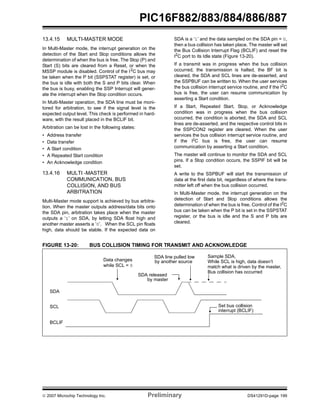
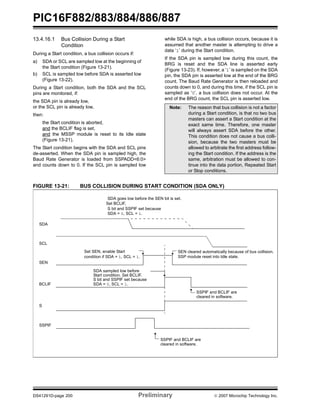
  • 122.
    PIC16F882/883/884/886/887 10.3 WriteVerify Depending on the application, good programming practice may dictate that the value written to the data EEPROM should be verified (see Example 10-5) to the desired value to be written. EXAMPLE 10-5: WRITE VERIFY BANKSEL EEDAT ; MOVF EEDAT, W ;EEDAT not changed ;from previous write BANKSEL EECON1 ; BSF EECON1, RD ;YES, Read the ;value written BANKSEL EEDAT ; XORWF EEDAT, W ; BTFSS STATUS, Z ;Is data the same GOTO WRITE_ERR ;No, handle error : ;Yes, continue BCF STATUS, RP1 ;Bank 0 10.3.1 USING THE DATA EEPROM The data EEPROM is a high-endurance, byte addressable array that has been optimized for the storage of frequently changing information (e.g., program variables or other data that are updated often). When variables in one section change frequently, while variables in another section do not change, it is possible to exceed the total number of write cycles to the EEPROM (specification D124) without exceeding the total number of write cycles to a single byte (specifications D120 and D120A). If this is the case, then a refresh of the array must be performed. For this reason, variables that change infrequently (such as constants, IDs, calibration, etc.) should be stored in Flash program memory. 10.4 Protection Against Spurious Write There are conditions when the user may not want to write to the data EEPROM memory. To protect against spurious EEPROM writes, various mechanisms have been built in. On power-up, WREN is cleared. Also, the Power-up Timer (64 ms duration) prevents EEPROM write. The write initiate sequence and the WREN bit together help prevent an accidental write during: • Brown-out • Power Glitch • Software Malfunction 10.5 Data EEPROM Operation During Code-Protect Data memory can be code-protected by programming the CPD bit in the Configuration Word Register 1 (Register 14-1) to ‘0’. When the data memory is code-protected, only the CPU is able to read and write data to the data EEPROM. It is recommended to code-protect the pro-gram memory when code-protecting data memory. This prevents anyone from programming zeroes over the existing code (which will execute as NOPs) to reach an added routine, programmed in unused program memory, which outputs the contents of data memory. Programming unused locations in program memory to ‘0’ will also help prevent data memory code protection from becoming breached. DS41291D-page 120 Preliminary © 2007 Microchip Technology Inc.
  • 123.
    PIC16F882/883/884/886/887 TABLE 10-1:SUMMARY OF REGISTERS ASSOCIATED WITH DATA EEPROM Name Bit 7 Bit 6 Bit 5 Bit 4 Bit 3 Bit 2 Bit 1 Bit 0 Value on POR, BOR Value on all other Resets EECON1 EEPGD — — — WRERR WREN WR RD x--- x000 0--- q000 EECON2 EEPROM Control Register 2 (not a physical register) ---- ---- ---- ---- EEADR EEADR7 EEADR6 EEADR5 EEADR4 EEADR3 EEADR2 EEADR1 EEADR0 0000 0000 0000 0000 EEADRH — — — EEADRH4(1) EEADRH3 EEADRH2 EEADRH1 EEADRH0 ---0 0000 ---0 0000 EEDAT EEDAT7 EEDAT6 EEDAT5 EEDAT4 EEDAT3 EEDAT2 EEDAT1 EEDAT0 0000 0000 0000 0000 EEDATH — — EEDATH5 EEDATH4 EEDATH3 EEDATH2 EEDATH1 EEDATH0 --00 0000 --00 0000 INTCON GIE PEIE T0IE INTE RBIE T0IF INTF RBIF 0000 000x 0000 000x PIE2 OSFIE C2IE C1IE EEIE BCLIE ULPWUIE — CCP2IE 0000 00-0 0000 00-0 PIR2 OSFIF C2IF C1IF EEIF BCLIF ULPWUIF — CCP2IF 0000 00-0 0000 00-0 Legend: x = unknown, u = unchanged, — = unimplemented read as ‘0’, q = value depends upon condition. Shaded cells are not used by data EEPROM module. Note 1: PIC16F886/PIC16F887 only. © 2007 Microchip Technology Inc. Preliminary DS41291D-page 121
  • 124.
    PIC16F882/883/884/886/887 NOTES: DS41291D-page122 Preliminary © 2007 Microchip Technology Inc.
  • 125.
    PIC16F882/883/884/886/887 11.0 CAPTURE/COMPARE/PWM MODULES (CCP1 AND CCP2) This device contains one Enhanced Capture/Compare/ PWM (CCP1) and Capture/Compare/PWM module (CCP2). The CCP1 and CCP2 modules are identical in operation, with the exception of the Enhanced PWM features available on CCP1 only. See Section 11.6 “PWM (Enhanced Mode)” for more information. Note: CCPRx and CCPx throughout this document refer to CCPR1 or CCPR2 and CCP1 or CCP2, respectively. © 2007 Microchip Technology Inc. Preliminary DS41291D-page 123
  • 126.
    PIC16F882/883/884/886/887 11.1 EnhancedCapture/Compare/PWM (CCP1) The Enhanced Capture/Compare/PWM module is a peripheral which allows the user to time and control different events. In Capture mode, the peripheral allows the timing of the duration of an event. The Compare mode allows the user to trigger an external event when a predetermined amount of time has expired. The PWM mode can generate a Pulse-Width Modulated signal of varying frequency and duty cycle. Table 11-1 shows the timer resources required by the ECCP module. TABLE 11-1: ECCP MODE – TIMER RESOURCES REQUIRED ECCP Mode Timer Resource Capture Timer1 Compare Timer1 PWM Timer2 REGISTER 11-1: CCP1CON: ENHANCED CCP1 CONTROL REGISTER R/W-0 R/W-0 R/W-0 R/W-0 R/W-0 R/W-0 R/W-0 R/W-0 P1M1 P1M0 DC1B1 DC1B0 CCP1M3 CCP1M2 CCP1M1 CCP1M0 bit 7 bit 0 Legend: R = Readable bit W = Writable bit U = Unimplemented bit, read as ‘0’ -n = Value at POR ‘1’ = Bit is set ‘0’ = Bit is cleared x = Bit is unknown bit 7-6 P1M<1:0>: PWM Output Configuration bits If CCP1M<3:2> = 00, 01, 10: xx = P1A assigned as Capture/Compare input; P1B, P1C, P1D assigned as port pins If CCP1M<3:2> = 11: 00 = Single output; P1A modulated; P1B, P1C, P1D assigned as port pins 01 = Full-Bridge output forward; P1D modulated; P1A active; P1B, P1C inactive 10 = Half-Bridge output; P1A, P1B modulated with dead-band control; P1C, P1D assigned as port pins 11 = Full-Bridge output reverse; P1B modulated; P1C active; P1A, P1D inactive bit 5-4 DC1B<1:0>: PWM Duty Cycle Least Significant bits Capture mode: Unused. Compare mode: Unused. PWM mode: These bits are the two LSbs of the PWM duty cycle. The eight MSbs are found in CCPR1L. bit 3-0 CCP1M<3:0>: ECCP Mode Select bits 0000 = Capture/Compare/PWM off (resets ECCP module) 0001 = Unused (reserved) 0010 = Compare mode, toggle output on match (CCP1IF bit is set) 0011 = Unused (reserved) 0100 = Capture mode, every falling edge 0101 = Capture mode, every rising edge 0110 = Capture mode, every 4th rising edge 0111 = Capture mode, every 16th rising edge 1000 = Compare mode, set output on match (CCP1IF bit is set) 1001 = Compare mode, clear output on match (CCP1IF bit is set) 1010 = Compare mode, generate software interrupt on match (CCP1IF bit is set, CCP1 pin is unaffected) 1011 = Compare mode, trigger special event (CCP1IF bit is set; CCP1 resets TMR1 or TMR2 1100 = PWM mode; P1A, P1C active-high; P1B, P1D active-high 1101 = PWM mode; P1A, P1C active-high; P1B, P1D active-low 1110 = PWM mode; P1A, P1C active-low; P1B, P1D active-high 1111 = PWM mode; P1A, P1C active-low; P1B, P1D active-low DS41291D-page 124 Preliminary © 2007 Microchip Technology Inc.
  • 127.
    PIC16F882/883/884/886/887 11.2 Capture/Compare/PWM(CCP2) The Capture/Compare/PWM module is a peripheral which allows the user to time and control different events. In Capture mode, the peripheral allows the timing of the duration of an event. The Compare mode allows the user to trigger an external event when a predetermined amount of time has expired. The PWM mode can generate a Pulse-Width Modulated signal of varying frequency and duty cycle. The timer resources used by the module are shown in Table 11-2. Additional information on CCP modules is available in the Application Note AN594, “Using the CCP Modules” (DS00594). TABLE 11-2: CCP MODE – TIMER RESOURCES REQUIRED CCP Mode Timer Resource Capture Timer1 Compare Timer1 PWM Timer2 REGISTER 11-2: CCP2CON: CCP2 CONTROL REGISTER U-0 U-0 R/W-0 R/W-0 R/W-0 R/W-0 R/W-0 R/W-0 — — DC2B1 DC2B0 CCP2M3 CCP2M2 CCP2M1 CCP2M0 bit 7 bit 0 Legend: R = Readable bit W = Writable bit U = Unimplemented bit, read as ‘0’ -n = Value at POR ‘1’ = Bit is set ‘0’ = Bit is cleared x = Bit is unknown bit 7-6 Unimplemented: Read as ‘0’ bit 5-4 DC2B<1:0>: PWM Duty Cycle Least Significant bits Capture mode: Unused. Compare mode: Unused. PWM mode: These bits are the two LSbs of the PWM duty cycle. The eight MSbs are found in CCPR2L. bit 3-0 CCP2M<3:0>: CCP2 Mode Select bits 0000 = Capture/Compare/PWM off (resets CCP2 module) 0001 = Unused (reserved) 0010 = Unused (reserved) 0011 = Unused (reserved) 0100 = Capture mode, every falling edge 0101 = Capture mode, every rising edge 0110 = Capture mode, every 4th rising edge 0111 = Capture mode, every 16th rising edge 1000 = Compare mode, set output on match (CCP2IF bit is set) 1001 = Compare mode, clear output on match (CCP2IF bit is set) 1010 = Compare mode, generate software interrupt on match (CCP2IF bit is set, CCP2 pin is unaffected) 1011 = Compare mode, trigger special event (CCP2IF bit is set, TMR1 is reset and A/D conversion is started if the ADC module is enabled. CCP2 pin is unaffected.) 11xx = PWM mode. © 2007 Microchip Technology Inc. Preliminary DS41291D-page 125
  • 128.
    PIC16F882/883/884/886/887 11.3 CaptureMode In Capture mode, the CCPRxH, CCPRxL register pair captures the 16-bit value of the TMR1 register when an event occurs on pin CCPx. An event is defined as one of the following and is configured by the CCP1M<3:0> bits of the CCP1CON register: • Every falling edge • Every rising edge • Every 4th rising edge • Every 16th rising edge When a capture is made, the Interrupt Request Flag bit CCPxIF of the PIRx register is set. The interrupt flag must be cleared in software. If another capture occurs before the value in the CCPRxH, CCPRxL register pair is read, the old captured value is overwritten by the new captured value (see Figure 11-1). 11.3.1 CCP PIN CONFIGURATION In Capture mode, the CCPx pin should be configured as an input by setting the associated TRIS control bit. Note: If the CCPx pin is configured as an output, a write to the port can cause a capture condition. FIGURE 11-1: CAPTURE MODE OPERATION BLOCK DIAGRAM 11.3.2 TIMER1 MODE SELECTION Timer1 must be running in Timer mode or Synchronized Counter mode for the CCP module to use the capture feature. In Asynchronous Counter mode, the capture operation may not work. 11.3.3 SOFTWARE INTERRUPT When the Capture mode is changed, a false capture interrupt may be generated. The user should keep the CCPxIE interrupt enable bit of the PIEx register clear to avoid false interrupts. Additionally, the user should clear the CCPxIF interrupt flag bit of the PIRx register following any change in Operating mode. 11.3.4 CCP PRESCALER There are four prescaler settings specified by the CCPxM<3:0> bits of the CCPxCON register. Whenever the CCP module is turned off, or the CCP module is not in Capture mode, the prescaler counter is cleared. Any Reset will clear the prescaler counter. Switching from one capture prescaler to another does not clear the prescaler and may generate a false interrupt. To avoid this unexpected operation, turn the module off by clearing the CCPxCON register before changing the prescaler (see Example 11-1). EXAMPLE 11-1: CHANGING BETWEEN CAPTURE PRESCALERS Set Flag bit CCPxIF CCPRxH CCPRxL Capture Enable TMR1H TMR1L (PIRx register) Prescaler ÷ 1, 4, 16 and Edge Detect CCPxCON<3:0> CCPx pin System Clock (FOSC) BANKSEL CCP1CON ;Set Bank bits to point ;to CCP1CON CLRF CCP1CON ;Turn CCP module off MOVLW NEW_CAPT_PS ;Load the W reg with ; the new prescaler ; move value and CCP ON MOVWF CCP1CON ;Load CCP1CON with this ; value DS41291D-page 126 Preliminary © 2007 Microchip Technology Inc.
  • 129.
    PIC16F882/883/884/886/887 11.4 CompareMode In Compare mode, the 16-bit CCPRx register value is constantly compared against the TMR1 register pair value. When a match occurs, the CCPx module may: • Toggle the CCPx output • Set the CCPx output • Clear the CCPx output • Generate a Special Event Trigger • Generate a Software Interrupt The action on the pin is based on the value of the CCPxM<3:0> control bits of the CCPx1CON register. All Compare modes can generate an interrupt. FIGURE 11-2: COMPARE MODE OPERATION BLOCK DIAGRAM CCPxCON<3:0> Mode Select Set CCPxIF Interrupt Flag CCPRxH CCPRxL Comparator TMR1H TMR1L CCPx 4 Q S R Output Logic (PIRx) Match Output Enable Special Event Trigger TRIS Pin Special Event Trigger will: • Clear TMR1H and TMR1L registers. • NOT set interrupt flag bit TMR1IF of the PIR1 register. • Set the GO/DONE bit to start the ADC conversion. 11.4.1 CCP PIN CONFIGURATION The user must configure the CCPx pin as an output by clearing the associated TRIS bit. 11.4.2 TIMER1 MODE SELECTION In Compare mode, Timer1 must be running in either Timer mode or Synchronized Counter mode. The compare operation may not work in Asynchronous Counter mode. 11.4.3 SOFTWARE INTERRUPT MODE When Generate Software Interrupt mode is chosen (CCPxM<3:0> = 1010), the CCPx module does not assert control of the CCPx pin (see the CCP1CON register). 11.4.4 SPECIAL EVENT TRIGGER When Special Event Trigger mode is chosen (CCPxM<3:0> = 1011), the CCPx module does the following: • Resets Timer1 • Starts an ADC conversion if ADC is enabled The CCPx module does not assert control of the CCPx pin in this mode (see the CCPxCON register). The Special Event Trigger output of the CCP occurs immediately upon a match between the TMR1H, TMR1L register pair and the CCPRxH, CCPRxL register pair. The TMR1H, TMR1L register pair is not reset until the next rising edge of the Timer1 clock. This allows the CCPRxH, CCPRxL register pair to effectively provide a 16-bit programmable period register for Timer1. Note: Clearing the CCP1CON register will force the CCPx compare output latch to the default low level. This is not the PORT I/O data latch. Note 1: The Special Event Trigger from the CCP module does not set interrupt flag bit TMRxIF of the PIR1 register. 2: Removing the match condition by changing the contents of the CCPRxH and CCPRxL register pair, between the clock edge that generates the Special Event Trigger and the clock edge that generates the Timer1 Reset, will preclude the Reset from occurring. © 2007 Microchip Technology Inc. Preliminary DS41291D-page 127
  • 130.
    PIC16F882/883/884/886/887 11.5 PWMMode The PWM mode generates a Pulse-Width Modulated signal on the CCPx pin. The duty cycle, period and resolution are determined by the following registers: • PR2 • T2CON • CCPRxL • CCPxCON In Pulse-Width Modulation (PWM) mode, the CCP module produces up to a 10-bit resolution PWM output on the CCPx pin. Since the CCPx pin is multiplexed with the PORT data latch, the TRIS for that pin must be cleared to enable the CCPx pin output driver. Note: Clearing the CCPxCON register will relinquish CCPx control of the CCPx pin. Figure 11-3 shows a simplified block diagram of PWM operation. Figure 11-4 shows a typical waveform of the PWM signal. For a step-by-step procedure on how to set up the CCP module for PWM operation, see Section 11.5.7 “Setup for PWM Operation”. FIGURE 11-3: SIMPLIFIED PWM BLOCK DIAGRAM The PWM output (Figure 11-4) has a time base (period) and a time that the output stays high (duty cycle). FIGURE 11-4: CCP PWM OUTPUT Duty Cycle Registers CCPRxL CCPRxH(2) (Slave) Comparator TMR2 Comparator PR2 (1) CCPxCON<5:4> R Q S Clear Timer2, toggle CCPx pin and latch duty cycle TRIS CCPx Note 1: The 8-bit timer TMR2 register is concatenated with the 2-bit internal system clock (FOSC), or 2 bits of the prescaler, to create the 10-bit time base. 2: In PWM mode, CCPRxH is a read-only register. Period Pulse Width TMR2 = 0 TMR2 = PR2 TMR2 = CCPRxL:CCPxCON<5:4> DS41291D-page 128 Preliminary © 2007 Microchip Technology Inc.
  • 131.
    PIC16F882/883/884/886/887 11.5.1 PWMPERIOD The PWM period is specified by the PR2 register of Timer2. The PWM period can be calculated using the formula of Equation 11-1. EQUATION 11-1: PWM PERIOD PWM Period = [(PR2) + 1] • 4 • TOSC • (TMR2 Prescale Value) When TMR2 is equal to PR2, the following three events occur on the next increment cycle: • TMR2 is cleared • The CCPx pin is set. (Exception: If the PWM duty cycle = 0%, the pin will not be set.) • The PWM duty cycle is latched from CCPRxL into CCPRxH. 11.5.2 PWM DUTY CYCLE The PWM duty cycle is specified by writing a 10-bit value to multiple registers: CCPRxL register and DCxB<1:0> bits of the CCPxCON register. The CCPRxL contains the eight MSbs and the DCxB<1:0> bits of the CCPxCON register contain the two LSbs. CCPRxL and DCxB<1:0> bits of the CCPxCON register can be written to at any time. The duty cycle value is not latched into CCPRxH until after the period completes (i.e., a match between PR2 and TMR2 registers occurs). While using the PWM, the CCPRxH register is read-only. Equation 11-2 is used to calculate the PWM pulse width. Equation 11-3 is used to calculate the PWM duty cycle ratio. EQUATION 11-2: PULSE WIDTH Pulse Width = (CCPRxL:CCPxCON<5:4>) • TOSC • (TMR2 Prescale Value) EQUATION 11-3: DUTY CYCLE RATIO Duty Cycle Ratio (CCPRxL:CCPxCON<5:4>) = ---------------------------------------------------------------------- 4(PR2 + 1) The CCPRxH register and a 2-bit internal latch are used to double buffer the PWM duty cycle. This double buffering is essential for glitchless PWM operation. The 8-bit timer TMR2 register is concatenated with either the 2-bit internal system clock (FOSC), or 2 bits of the prescaler, to create the 10-bit time base. The system clock is used if the Timer2 prescaler is set to 1:1. When the 10-bit time base matches the CCPRxH and 2-bit latch, then the CCPx pin is cleared (see Figure 11-3). Note: The Timer2 postscaler (see Section 7.1 “Timer2 Operation”) is not used in the determination of the PWM frequency. © 2007 Microchip Technology Inc. Preliminary DS41291D-page 129
  • 132.
    PIC16F882/883/884/886/887 11.5.3 PWMRESOLUTION The resolution determines the number of available duty cycles for a given period. For example, a 10-bit resolution will result in 1024 discrete duty cycles, whereas an 8-bit resolution will result in 256 discrete duty cycles. The maximum PWM resolution is 10 bits when PR2 is 255. The resolution is a function of the PR2 register value as shown by Equation 11-4. EQUATION 11-4: PWM RESOLUTION Resolution log[4(PR2 + 1)] = ------------------------------------------ bits log(2) Note: If the pulse width value is greater than the period the assigned PWM pin(s) will remain unchanged. TABLE 11-3: EXAMPLE PWM FREQUENCIES AND RESOLUTIONS (FOSC = 20 MHz) PWM Frequency 1.22 kHz 4.88 kHz 19.53 kHz 78.12 kHz 156.3 kHz 208.3 kHz Timer Prescale (1, 4, 16) 16 4 1 1 1 1 PR2 Value 0xFF 0xFF 0xFF 0x3F 0x1F 0x17 Maximum Resolution (bits) 10 10 10 8 7 6.6 TABLE 11-4: EXAMPLE PWM FREQUENCIES AND RESOLUTIONS (FOSC = 8 MHz) PWM Frequency 1.22 kHz 4.90 kHz 19.61 kHz 76.92 kHz 153.85 kHz 200.0 kHz Timer Prescale (1, 4, 16) 16 4 1 1 1 1 PR2 Value 0x65 0x65 0x65 0x19 0x0C 0x09 Maximum Resolution (bits) 8 8 8 6 5 5 DS41291D-page 130 Preliminary © 2007 Microchip Technology Inc.
  • 133.
    PIC16F882/883/884/886/887 11.5.4 OPERATIONIN SLEEP MODE In Sleep mode, the TMR2 register will not increment and the state of the module will not change. If the CCPx pin is driving a value, it will continue to drive that value. When the device wakes up, TMR2 will continue from its previous state. 11.5.5 CHANGES IN SYSTEM CLOCK FREQUENCY The PWM frequency is derived from the system clock frequency. Any changes in the system clock frequency will result in changes to the PWM frequency. See Section 4.0 “Oscillator Module (With Fail-Safe Clock Monitor)” for additional details. 11.5.6 EFFECTS OF RESET Any Reset will force all ports to Input mode and the CCP registers to their Reset states. 11.5.7 SETUP FOR PWM OPERATION The following steps should be taken when configuring the CCP module for PWM operation: 1. Disable the PWM pin (CCPx) output drivers as an input by setting the associated TRIS bit. 2. Set the PWM period by loading the PR2 register. 3. Configure the CCP module for the PWM mode by loading the CCPxCON register with the appropriate values. 4. Set the PWM duty cycle by loading the CCPRxL register and DCxB<1:0> bits of the CCPxCON register. 5. Configure and start Timer2: • Clear the TMR2IF interrupt flag bit of the PIR1 register. • Set the Timer2 prescale value by loading the T2CKPS bits of the T2CON register. • Enable Timer2 by setting the TMR2ON bit of the T2CON register. 6. Enable PWM output after a new PWM cycle has started: • Wait until Timer2 overflows (TMR2IF bit of the PIR1 register is set). • Enable the CCPx pin output driver by clearing the associated TRIS bit. © 2007 Microchip Technology Inc. Preliminary DS41291D-page 131
  • 134.
    PIC16F882/883/884/886/887 11.6 PWM(Enhanced Mode) The Enhanced PWM Mode can generate a PWM signal on up to four different output pins with up to 10-bits of resolution. It can do this through four different PWM output modes: • Single PWM • Half-Bridge PWM • Full-Bridge PWM, Forward mode • Full-Bridge PWM, Reverse mode To select an Enhanced PWM mode, the P1M bits of the CCP1CON register must be set appropriately. The PWM outputs are multiplexed with I/O pins and are designated P1A, P1B, P1C and P1D. The polarity of the PWM pins is configurable and is selected by setting the CCP1M bits in the CCP1CON register appropriately. Table 11-5 shows the pin assignments for each Enhanced PWM mode. Figure 11-5 shows an example of a simplified block diagram of the Enhanced PWM module. Note: The PWM Enhanced mode is available on the Enhanced Capture/Compare/PWM module (CCP1) only. Note: To prevent the generation of an incomplete waveform when the PWM is first enabled, the ECCP module waits until the start of a new PWM period before generating a PWM signal. FIGURE 11-5: EXAMPLE SIMPLIFIED BLOCK DIAGRAM OF THE ENHANCED PWM MODE Duty Cycle Registers CCPR1L CCPR1H (Slave) Comparator TMR2 Comparator PR2 (1) P1M<1:0> R Q S DC1B<1:0> Clear Timer2, toggle PWM pin and latch duty cycle CCP1M<3:0> 4 TRISn CCP1/P1A TRISn P1B TRISn P1C TRISn P1D 2 CCP1/P1A P1B Output Controller P1C P1D PWM1CON Note 1: The 8-bit timer TMR2 register is concatenated with the 2-bit internal Q clock, or 2 bits of the prescaler to create the 10-bit time base. Note 1: The TRIS register value for each PWM output must be configured appropriately. 2: Clearing the CCPxCON register will relinquish ECCP control of all PWM output pins. 3: Any pin not used by an Enhanced PWM mode is available for alternate pin functions. TABLE 11-5: EXAMPLE PIN ASSIGNMENTS FOR VARIOUS PWM ENHANCED MODES ECCP Mode P1M<1:0> CCP1/P1A P1B P1C P1D Single 00 Yes(1) Yes(1) Yes(1) Yes(1) Half-Bridge 10 Yes Yes No No Full-Bridge, Forward 01 Yes Yes Yes Yes Full-Bridge, Reverse 11 Yes Yes Yes Yes Note 1: Pulse Steering enables outputs in Single mode. DS41291D-page 132 Preliminary © 2007 Microchip Technology Inc.
  • 135.
    PIC16F882/883/884/886/887 FIGURE 11-6:EXAMPLE PWM (ENHANCED MODE) OUTPUT RELATIONSHIPS (ACTIVE-HIGH STATE) 0 Period P1M<1:0> 00 10 01 11 Signal PR2+1 P1A Modulated P1A Modulated P1B Modulated P1A Active P1B Inactive P1C Inactive P1D Modulated P1A Inactive P1B Modulated P1C Active P1D Inactive Pulse Width (Single Output) (Half-Bridge) (Full-Bridge, Forward) (Full-Bridge, Reverse) Delay(1) Delay(1) Relationships: • Period = 4 * TOSC * (PR2 + 1) * (TMR2 Prescale Value) • Pulse Width = TOSC * (CCPR1L<7:0>:CCP1CON<5:4>) * (TMR2 Prescale Value) • Delay = 4 * TOSC * (PWM1CON<6:0>) Note 1: Dead-band delay is programmed using the PWM1CON register (Section 11.6.6 “Programmable Dead-Band Delay Mode”). © 2007 Microchip Technology Inc. Preliminary DS41291D-page 133
  • 136.
    PIC16F882/883/884/886/887 FIGURE 11-7:EXAMPLE ENHANCED PWM OUTPUT RELATIONSHIPS (ACTIVE-LOW STATE) 0 Period P1M<1:0> 00 10 01 11 Signal PR2+1 P1A Modulated P1A Modulated P1B Modulated P1A Active P1B Inactive P1C Inactive P1D Modulated P1A Inactive P1B Modulated P1C Active P1D Inactive Pulse Width (Single Output) (Half-Bridge) (Full-Bridge, Forward) (Full-Bridge, Reverse) Delay(1) Delay(1) Relationships: • Period = 4 * TOSC * (PR2 + 1) * (TMR2 Prescale Value) • Pulse Width = TOSC * (CCPR1L<7:0>:CCP1CON<5:4>) * (TMR2 Prescale Value) • Delay = 4 * TOSC * (PWM1CON<6:0>) Note 1: Dead-band delay is programmed using the PWM1CON register (Section 11.6.6 “Programmable Dead-Band Delay Mode”). DS41291D-page 134 Preliminary © 2007 Microchip Technology Inc.
  • 137.
    PIC16F882/883/884/886/887 11.6.1 HALF-BRIDGEMODE In Half-Bridge mode, two pins are used as outputs to drive push-pull loads. The PWM output signal is output on the CCPx/P1A pin, while the complementary PWM output signal is output on the P1B pin (see Figure 11-9). This mode can be used for Half-Bridge applications, as shown in Figure 11-9, or for Full-Bridge applications, where four power switches are being modulated with two PWM signals. In Half-Bridge mode, the programmable dead-band delay can be used to prevent shoot-through current in Half-Bridge power devices. The value of the PDC<6:0> bits of the PWM1CON register sets the number of instruction cycles before the output is driven active. If the value is greater than the duty cycle, the corresponding output remains inactive during the entire cycle. See Section 11.6.6 “Programmable Dead-Band Delay Mode” for more details of the dead-band delay operations. Since the P1A and P1B outputs are multiplexed with the PORT data latches, the associated TRIS bits must be cleared to configure P1A and P1B as outputs. FIGURE 11-8: EXAMPLE OF HALF-BRIDGE PWM OUTPUT Pulse Width td (1) P1A(2) P1B(2) td = Dead-Band Delay Note 1: At this time, the TMR2 register is equal to the PR2 register. 2: Output signals are shown as active-high. FIGURE 11-9: EXAMPLE OF HALF-BRIDGE APPLICATIONS Period td Period (1) (1) Standard Half-Bridge Circuit (“Push-Pull”) P1A P1B FET Driver FET Driver Load + - + - Half-Bridge Output Driving a Full-Bridge Circuit FET Driver FET Driver V+ Load FET Driver FET Driver P1A P1B © 2007 Microchip Technology Inc. Preliminary DS41291D-page 135
  • 138.
    PIC16F882/883/884/886/887 11.6.2 FULL-BRIDGEMODE In Full-Bridge mode, all four pins are used as outputs. An example of Full-Bridge application is shown in Figure 11-10. In the Forward mode, pin CCP1/P1A is driven to its active state, pin P1D is modulated, while P1B and P1C will be driven to their inactive state as shown in Figure 11-11. In the Reverse mode, P1C is driven to its active state, pin P1B is modulated, while P1A and P1D will be driven to their inactive state as shown Figure 11-11. P1A, P1B, P1C and P1D outputs are multiplexed with the PORT data latches. The associated TRIS bits must be cleared to configure the P1A, P1B, P1C and P1D pins as outputs. FIGURE 11-10: EXAMPLE OF FULL-BRIDGE APPLICATION P1A P1B P1C FET Driver FET Driver V+ QC QB QD V-Load FET Driver FET Driver P1D QA DS41291D-page 136 Preliminary © 2007 Microchip Technology Inc.
  • 139.
    PIC16F882/883/884/886/887 FIGURE 11-11:EXAMPLE OF FULL-BRIDGE PWM OUTPUT Period Pulse Width Forward Mode P1A(2) P1B(2) P1C(2) P1D(2) (1) Period Pulse Width Reverse Mode P1A(2) P1B(2) P1C(2) P1D(2) (1) (1) (1) Note 1: At this time, the TMR2 register is equal to the PR2 register. 2: Output signal is shown as active-high. © 2007 Microchip Technology Inc. Preliminary DS41291D-page 137
  • 140.
    PIC16F882/883/884/886/887 11.6.2.1 DirectionChange in Full-Bridge Mode In the Full-Bridge mode, the P1M1 bit in the CCP1CON register allows users to control the forward/reverse direction. When the application firmware changes this direction control bit, the module will change to the new direction on the next PWM cycle. A direction change is initiated in software by changing the P1M1 bit of the CCP1CON register. The following sequence occurs four Timer2 cycles prior to the end of the current PWM period: • The modulated outputs (P1B and P1D) are placed in their inactive state. • The associated unmodulated outputs (P1A and P1C) are switched to drive in the opposite direction. • PWM modulation resumes at the beginning of the next period. See Figure 11-12 for an illustration of this sequence. The Full-Bridge mode does not provide dead-band delay. As one output is modulated at a time, dead-band delay is generally not required. There is a situation where dead-band delay is required. This situation occurs when both of the following conditions are true: 1. The direction of the PWM output changes when the duty cycle of the output is at or near 100%. 2. The turn off time of the power switch, including the power device and driver circuit, is greater than the turn on time. Figure 11-13 shows an example of the PWM direction changing from forward to reverse, at a near 100% duty cycle. In this example, at time t1, the output P1A and P1D become inactive, while output P1C becomes active. Since the turn off time of the power devices is longer than the turn on time, a shoot-through current will flow through power devices QC and QD (see Figure 11-10) for the duration of ‘t’. The same phenomenon will occur to power devices QA and QB for PWM direction change from reverse to forward. If changing PWM direction at high duty cycle is required for an application, two possible solutions for eliminating the shoot-through current are: 1. Reduce PWM duty cycle for one PWM period before changing directions. 2. Use switch drivers that can drive the switches off faster than they can drive them on. Other options to prevent shoot-through current may exist. FIGURE 11-12: EXAMPLE OF PWM DIRECTION CHANGE Pulse Width Period(1) Signal Period Pulse Width (2) P1A (Active-High) P1B (Active-High) P1C (Active-High) P1D (Active-High) Note 1: The direction bit P1M1 of the CCP1CON register is written any time during the PWM cycle. 2: When changing directions, the P1A and P1C signals switch before the end of the current PWM cycle. The modulated P1B and P1D signals are inactive at this time. The length of this time is four Timer2 counts. DS41291D-page 138 Preliminary © 2007 Microchip Technology Inc.
  • 141.
    PIC16F882/883/884/886/887 FIGURE 11-13:EXAMPLE OF PWM DIRECTION CHANGE AT NEAR 100% DUTY CYCLE Forward Period Reverse Period P1A TON TOFF PW T = TOFF – TON P1B P1C P1D External Switch C External Switch D Potential Shoot-Through Current PW Note 1: All signals are shown as active-high. 2: TON is the turn on delay of power switch QC and its driver. 3: TOFF is the turn off delay of power switch QD and its driver. t1 © 2007 Microchip Technology Inc. Preliminary DS41291D-page 139
  • 142.
    PIC16F882/883/884/886/887 11.6.3 START-UPCONSIDERATIONS When any PWM mode is used, the application hardware must use the proper external pull-up and/or pull-down resistors on the PWM output pins. Note: When the microcontroller is released from Reset, all of the I/O pins are in the high-impedance state. The external cir-cuits must keep the power switch devices in the Off state until the microcontroller drives the I/O pins with the proper signal levels or activates the PWM output(s). The CCP1M<1:0> bits of the CCP1CON register allow the user to choose whether the PWM output signals are active-high or active-low for each pair of PWM output pins (P1A/P1C and P1B/P1D). The PWM output polarities must be selected before the PWM pin output drivers are enabled. Changing the polarity configuration while the PWM pin output drivers are enable is not recommended since it may result in damage to the application circuits. The P1A, P1B, P1C and P1D output latches may not be in the proper states when the PWM module is initialized. Enabling the PWM pin output drivers at the same time as the Enhanced PWM modes may cause damage to the application circuit. The Enhanced PWM modes must be enabled in the proper Output mode and complete a full PWM cycle before enabling the PWM pin output drivers. The completion of a full PWM cycle is indicated by the TMR2IF bit of the PIR1 register being set as the second PWM period begins. DS41291D-page 140 Preliminary © 2007 Microchip Technology Inc.
  • 143.
    PIC16F882/883/884/886/887 11.6.4 ENHANCEDPWM AUTO-SHUTDOWN MODE The PWM mode supports an Auto-Shutdown mode that will disable the PWM outputs when an external shutdown event occurs. Auto-Shutdown mode places the PWM output pins into a predetermined state. This mode is used to help prevent the PWM from damaging the application. The auto-shutdown sources are selected using the ECCPAS<2:0> bits of the ECCPAS register. A shutdown event may be generated by: • A logic ‘0’ on the INT pin • Comparator C1 • Comparator C2 • Setting the ECCPASE bit in firmware A shutdown condition is indicated by the ECCPASE (Auto-Shutdown Event Status) bit of the ECCPAS register. If the bit is a ‘0’, the PWM pins are operating normally. If the bit is a ‘1’, the PWM outputs are in the shutdown state. When a shutdown event occurs, two things happen: The ECCPASE bit is set to ‘1’. The ECCPASE will remain set until cleared in firmware or an auto-restart occurs (see Section 11.6.5 “Auto-Restart Mode”). The enabled PWM pins are asynchronously placed in their shutdown states. The PWM output pins are grouped into pairs [P1A/P1C] and [P1B/P1D]. The state of each pin pair is determined by the PSSAC and PSSBD bits of the ECCPAS register. Each pin pair may be placed into one of three states: • Drive logic ‘1’ • Drive logic ‘0’ • Tri-state (high-impedance) REGISTER 11-3: ECCPAS: ENHANCED CAPTURE/COMPARE/PWM AUTO-SHUTDOWN CONTROL REGISTER R/W-0 R/W-0 R/W-0 R/W-0 R/W-0 R/W-0 R/W-0 R/W-0 ECCPASE ECCPAS2 ECCPAS1 ECCPAS0 PSSAC1 PSSAC0 PSSBD1 PSSBD0 bit 7 bit 0 Legend: R = Readable bit W = Writable bit U = Unimplemented bit, read as ‘0’ -n = Value at POR ‘1’ = Bit is set ‘0’ = Bit is cleared x = Bit is unknown bit 7 ECCPASE: ECCP Auto-Shutdown Event Status bit 1 = A shutdown event has occurred; ECCP outputs are in shutdown state 0 = ECCP outputs are operating bit 6-4 ECCPAS<2:0>: ECCP Auto-shutdown Source Select bits 000 = Auto-Shutdown is disabled 001 = Comparator C1 output change 010 = Comparator C2 output change(1) 011 = Either Comparator C1 or C2 change 100 = VIL on INT pin 101 = VIL on INT pin or Comparator C1 change 110 = VIL on INT pin or Comparator C2 change 111 = VIL on INT pin or Comparator C1 or Comparator C2 change bit 3-2 PSSACn: Pins P1A and P1C Shutdown State Control bits 00 = Drive pins P1A and P1C to ‘0’ 01 = Drive pins P1A and P1C to ‘1’ 1x = Pins P1A and P1C tri-state bit 1-0 PSSBDn: Pins P1B and P1D Shutdown State Control bits 00 = Drive pins P1B and P1D to ‘0’ 01 = Drive pins P1B and P1D to ‘1’ 1x = Pins P1B and P1D tri-state Note 1: If C2SYNC is enabled, the shutdown will be delayed by Timer1. © 2007 Microchip Technology Inc. Preliminary DS41291D-page 141
  • 144.
    PIC16F882/883/884/886/887 Note 1:The auto-shutdown condition is a level-based signal, not an edge-based signal. As long as the level is present, the auto-shutdown will persist. 2: Writing to the ECCPASE bit is disabled while an auto-shutdown condition persists. 3: Once the auto-shutdown condition has been removed and the PWM restarted (either through firmware or auto-restart) the PWM signal will always restart at the beginning of the next PWM period. FIGURE 11-14: PWM AUTO-SHUTDOWN WITH FIRMWARE RESTART (PRSEN = 0) Shutdown Event ECCPASE bit PWM Activity Normal PWM Start of PWM Period 11.6.5 AUTO-RESTART MODE The Enhanced PWM can be configured to automati-cally PWM Period Shutdown Event Occurs restart the PWM signal once the auto-shutdown ECCPASE Cleared by Firmware Shutdown Event Clears PWM Resumes condition has been removed. Auto-restart is enabled by setting the PRSEN bit in the PWM1CON register. If auto-restart is enabled, the ECCPASE bit will remain set as long as the auto-shutdown condition is active. When the auto-shutdown condition is removed, the ECCPASE bit will be cleared via hardware and normal operation will resume. FIGURE 11-15: PWM AUTO-SHUTDOWN WITH AUTO-RESTART ENABLED (PRSEN = 1) Shutdown Event ECCPASE bit PWM Activity PWM Period Shutdown Event Occurs Shutdown Event Clears PWM Resumes Normal PWM Start of PWM Period DS41291D-page 142 Preliminary © 2007 Microchip Technology Inc.
  • 145.
    PIC16F882/883/884/886/887 11.6.6 PROGRAMMABLEDEAD-BAND DELAY MODE In Half-Bridge applications where all power switches are modulated at the PWM frequency, the power switches normally require more time to turn off than to turn on. If both the upper and lower power switches are switched at the same time (one turned on, and the other turned off), both switches may be on for a short period of time until one switch completely turns off. During this brief interval, a very high current (shoot-through current) will flow through both power switches, shorting the bridge supply. To avoid this potentially destructive shoot-through current from flowing during switching, turning on either of the power switches is normally delayed to allow the other switch to completely turn off. In Half-Bridge mode, a digitally programmable dead-band delay is available to avoid shoot-through current from destroying the bridge power switches. The delay occurs at the signal transition from the non-active state to the active state. See Figure 11-16 for illustration. The lower seven bits of the associated PWM1CON register (Register 11-4) sets the delay period in terms of microcontroller instruction cycles (TCY or 4 TOSC). FIGURE 11-16: EXAMPLE OF HALF-BRIDGE PWM OUTPUT Pulse Width td (1) P1A(2) P1B(2) td = Dead-Band Delay Note 1: At this time, the TMR2 register is equal to the PR2 register. 2: Output signals are shown as active-high. FIGURE 11-17: EXAMPLE OF HALF-BRIDGE APPLICATIONS Period td Period (1) (1) Standard Half-Bridge Circuit (“Push-Pull”) P1A P1B FET Driver FET Driver V+ V-Load + V- + V- © 2007 Microchip Technology Inc. Preliminary DS41291D-page 143
  • 146.
    PIC16F882/883/884/886/887 REGISTER 11-4:PWM1CON: ENHANCED PWM CONTROL REGISTER R/W-0 R/W-0 R/W-0 R/W-0 R/W-0 R/W-0 R/W-0 R/W-0 PRSEN PDC6 PDC5 PDC4 PDC3 PDC2 PDC1 PDC0 bit 7 bit 0 Legend: R = Readable bit W = Writable bit U = Unimplemented bit, read as ‘0’ -n = Value at POR ‘1’ = Bit is set ‘0’ = Bit is cleared x = Bit is unknown bit 7 PRSEN: PWM Restart Enable bit 1 = Upon auto-shutdown, the ECCPASE bit clears automatically once the shutdown event goes away; the PWM restarts automatically 0 = Upon auto-shutdown, ECCPASE must be cleared in software to restart the PWM bit 6-0 PDC<6:0>: PWM Delay Count bits PDCn = Number of FOSC/4 (4 * TOSC) cycles between the scheduled time when a PWM signal should transition active and the actual time it transitions active Note 1: Bit resets to ‘0’ with Two-Speed Start-up and LP, XT or HS selected as the Oscillator mode or Fail-Safe mode is enabled. DS41291D-page 144 Preliminary © 2007 Microchip Technology Inc.
  • 147.
    PIC16F882/883/884/886/887 11.6.7 PULSESTEERING MODE In Single Output mode, pulse steering allows any of the PWM pins to be the modulated signal. Additionally, the same PWM signal can be simultaneously available on multiple pins. Once the Single Output mode is selected (CCP1M<3:2> = 11 and P1M<1:0> = 00 of the CCP1CON register), the user firmware can bring out the same PWM signal to one, two, three or four output pins by setting the appropriate STR<D:A> bits of the PSTRCON register, as shown in Table 11-5. Note: The associated TRIS bits must be set to output (‘0’) to enable the pin output driver in order to see the PWM signal on the pin. While the PWM Steering mode is active, CCP1M<1:0> bits of the CCP1CON register select the PWM output polarity for the P1<D:A> pins. The PWM auto-shutdown operation also applies to PWM Steering mode as described in Section 11.6.4 “Enhanced PWM Auto-shutdown mode”. An auto-shutdown event will only affect pins that have PWM outputs enabled. REGISTER 11-5: PSTRCON: PULSE STEERING CONTROL REGISTER(1) U-0 U-0 U-0 R/W-0 R/W-0 R/W-0 R/W-0 R/W-1 — — — STRSYNC STRD STRC STRB STRA bit 7 bit 0 Legend: R = Readable bit W = Writable bit U = Unimplemented bit, read as ‘0’ -n = Value at POR ‘1’ = Bit is set ‘0’ = Bit is cleared x = Bit is unknown bit 7-5 Unimplemented: Read as ‘0’ bit 4 STRSYNC: Steering Sync bit 1 = Output steering update occurs on next PWM period 0 = Output steering update occurs at the beginning of the instruction cycle boundary bit 3 STRD: Steering Enable bit D 1 = P1D pin has the PWM waveform with polarity control from CCPxM<1:0> 0 = P1D pin is assigned to port pin bit 2 STRC: Steering Enable bit C 1 = P1C pin has the PWM waveform with polarity control from CCPxM<1:0> 0 = P1C pin is assigned to port pin bit 1 STRB: Steering Enable bit B 1 = P1B pin has the PWM waveform with polarity control from CCPxM<1:0> 0 = P1B pin is assigned to port pin bit 0 STRA: Steering Enable bit A 1 = P1A pin has the PWM waveform with polarity control from CCPxM<1:0> 0 = P1A pin is assigned to port pin Note 1: The PWM Steering mode is available only when the CCP1CON register bits CCP1M<3:2> = 11 and P1M<1:0> = 00. © 2007 Microchip Technology Inc. Preliminary DS41291D-page 145
  • 148.
    PIC16F882/883/884/886/887 FIGURE 11-18:SIMPLIFIED STEERING BLOCK DIAGRAM 1 0 TRIS P1A pin STRA P1A Signal CCP1M1 PORT Data 1 0 TRIS P1B pin STRB CCP1M0 PORT Data 1 0 TRIS P1C pin STRC CCP1M1 PORT Data 1 0 TRIS P1D pin STRD CCP1M0 PORT Data Note 1: Port outputs are configured as shown when the CCP1CON register bits P1M<1:0> = 00 and CCP1M<3:2> = 11. 2: Single PWM output requires setting at least one of the STRx bits. DS41291D-page 146 Preliminary © 2007 Microchip Technology Inc.
  • 149.
    PIC16F882/883/884/886/887 11.6.7.1 SteeringSynchronization The STRSYNC bit of the PSTRCON register gives the user two selections of when the steering event will happen. When the STRSYNC bit is ‘0’, the steering event will happen at the end of the instruction that writes to the PSTRCON register. In this case, the output signal at the P1<D:A> pins may be an incomplete PWM waveform. This operation is useful when the user firmware needs to immediately remove a PWM signal from the pin. When the STRSYNC bit is ‘1’, the effective steering update will happen at the beginning of the next PWM period. In this case, steering on/off the PWM output will always produce a complete PWM waveform. Figures 11-19 and 11-20 illustrate the timing diagrams of the PWM steering depending on the STRSYNC setting. FIGURE 11-19: EXAMPLE OF STEERING EVENT AT END OF INSTRUCTION (STRSYNC = 0) PWM PWM Period P1<D:A> PORT Data P1n = PWM STRn PORT Data FIGURE 11-20: EXAMPLE OF STEERING EVENT AT BEGINNING OF INSTRUCTION (STRSYNC = 1) PWM P1<D:A> PORT Data PORT Data P1n = PWM STRn © 2007 Microchip Technology Inc. Preliminary DS41291D-page 147
  • 150.
    PIC16F882/883/884/886/887 TABLE 11-6:REGISTERS ASSOCIATED WITH CAPTURE, COMPARE AND TIMER1 Name Bit 7 Bit 6 Bit 5 Bit 4 Bit 3 Bit 2 Bit 1 Bit 0 CCP1CON P1M1 P1M0 DC1B1 DC1B0 CCP1M3 CCP1M2 CCP1M1 CCP1M0 0000 0000 0000 0000 CCP2CON — — DC2B1 DC2B0 CCP2M3 CCP2M2 CCP2M1 CCP2M0 --00 0000 --00 0000 CCPR1L Capture/Compare/PWM Register 1 Low Byte (LSB) xxxx xxxx xxxx xxxx CCPR1H Capture/Compare/PWM Register 1 High Byte (MSB) xxxx xxxx xxxx xxxx CCPR2L Capture/Compare/PWM Register 2 Low Byte (LSB) xxxx xxxx xxxx xxxx CCPR2H Capture/Compare/PWM Register 2 High Byte (MSB) xxxx xxxx xxxx xxxx CM2CON1 MC1OUT MC2OUT C1RSEL C2RSEL — — T1GSS C2SYNC 0000 --10 0000 --10 INTCON GIE PEIE T0IE INTE RBIE T0IF INTF RBIF 0000 000x 0000 000x PIE1 — ADIE RCIE TXIE SSPIE CCP1IE TMR2IE TMR1IE -000 0000 -000 0000 PIE2 OSFIE C2IE C1IE EEIE BCLIE ULPWUIE — CCP2IE 0000 00-0 0000 00-0 PIR1 — ADIF RCIF TXIF SSPIF CCP1IF TMR2IF TMR1IF -000 0000 -000 0000 PIR2 OSFIF C2IF C1IF EEIF BCLIF ULPWUIF — CCP2IF 0000 00-0 0000 00-0 T1CON T1GINV TMR1GE T1CKPS1 T1CKPS0 T1OSCEN T1SYNC TMR1CS TMR1ON 0000 0000 0000 0000 TMR1L Holding Register for the Least Significant Byte of the 16-bit TMR1 Register xxxx xxxx xxxx xxxx TMR1H Holding Register for the Most Significant Byte of the 16-bit TMR1 Register xxxx xxxx xxxx xxxx TRISC TRISC7 TRISC6 TRISC5 TRISC4 TRISC3 TRISC2 TRISC1 TRISC0 1111 1111 1111 1111 Legend: – = Unimplemented locations, read as ‘0’, u = unchanged, x = unknown. Shaded cells are not used by the Capture and Compare. TABLE 11-7: REGISTERS ASSOCIATED WITH PWM AND TIMER2 Value on POR, BOR Value on all other Resets Name Bit 7 Bit 6 Bit 5 Bit 4 Bit 3 Bit 2 Bit 1 Bit 0 Value on POR, BOR Value on all other Resets CCP1CON P1M1 P1M0 DC1B1 DC1B0 CCP1M3 CCP1M2 CCP1M1 CCP1M0 0000 0000 0000 0000 CCP2CON — — DC2B1 DC2B0 CCP2M3 CCP2M2 CCP2M1 CCP2M0 --00 0000 --00 0000 ECCPAS ECCPASE ECCPAS2 ECCPAS1 ECCPAS0 PSSAC1 PSSAC0 PSSBD1 PSSBD0 0000 0000 0000 0000 INTCON GIE PEIE T0IE INTE RBIE T0IF INTF RBIF 0000 000x 0000 000x PR2 Timer2 Period Register 1111 1111 1111 1111 PSTRCON — — — STRSYNC STRD STRC STRB STRA ---0 0001 ---0 0001 PWM1CON PRSEN PDC6 PDC5 PDC4 PDC3 PDC2 PDC1 PDC0 0000 0000 0000 0000 T2CON — TOUTPS3 TOUTPS2 TOUTPS1 TOUTPS0 TMR2ON T2CKPS1 T2CKPS0 -000 0000 -000 0000 TMR2 Timer2 Module Register 0000 0000 0000 0000 TRISB TRISB7 TRISB6 TRISB5 TRISB4 TRISB3 TRISB2 TRISB1 TRISB0 1111 1111 1111 1111 TRISC TRISC7 TRISC6 TRISC5 TRISC4 TRISC3 TRISC2 TRISC1 TRISC0 1111 1111 1111 1111 TRISD TRISD7 TRISD6 TRISD5 TRISD4 TRISD3 TRISD2 TRISD1 TRISD0 1111 1111 1111 1111 Legend: – = Unimplemented locations, read as ‘0’, u = unchanged, x = unknown. Shaded cells are not used by the PWM. DS41291D-page 148 Preliminary © 2007 Microchip Technology Inc.
  • 151.
    PIC16F822/883/884/886/887 12.0 ENHANCEDUNIVERSAL SYNCHRONOUS ASYNCHRONOUS RECEIVER TRANSMITTER (EUSART) The Enhanced Universal Synchronous Asynchronous Receiver Transmitter (EUSART) module is a serial I/O communications peripheral. It contains all the clock generators, shift registers and data buffers necessary to perform an input or output serial data transfer independent of device program execution. The EUSART, also known as a Serial Communications Interface (SCI), can be configured as a full-duplex asynchronous system or half-duplex synchronous system. Full-Duplex mode is useful for communications with peripheral systems, such as CRT terminals and personal computers. Half-Duplex Synchronous mode is intended for communications with peripheral devices, such as A/D or D/A integrated circuits, serial EEPROMs or other microcontrollers. These devices typically do not have internal clocks for baud rate generation and require the external clock signal provided by a master synchronous device. The EUSART module includes the following capabilities: • Full-duplex asynchronous transmit and receive • Two-character input buffer • One-character output buffer • Programmable 8-bit or 9-bit character length • Address detection in 9-bit mode • Input buffer overrun error detection • Received character framing error detection • Half-duplex synchronous master • Half-duplex synchronous slave • Programmable clock polarity in synchronous modes The EUSART module implements the following additional features, making it ideally suited for use in Local Interconnect Network (LIN) bus systems: • Automatic detection and calibration of the baud rate • Wake-up on Break reception • 13-bit Break character transmit Block diagrams of the EUSART transmitter and receiver are shown in Figure 12-1 and Figure 12-2. FIGURE 12-1: EUSART TRANSMIT BLOCK DIAGRAM TXIE TXIF Interrupt TXEN Data Bus TXREG Register 8 MSb LSb (8) 0 • • • Transmit Shift Register (TSR) TX9D TX9 Pin Buffer and Control TRMT SPEN TX/CK pin Baud Rate Generator BRG16 + 1 Multiplier x4 x16 x64 SPBRGH SPBRG FOSC ÷ n n SYNC 1 X 0 0 0 BRGH X 1 1 0 0 BRG16 X 1 0 1 0 © 2007 Microchip Technology Inc. Preliminary DS41291D-page 149
  • 152.
    PIC16F822/883/884/886/887 FIGURE 12-2:EUSART RECEIVE BLOCK DIAGRAM RX/DT pin SPEN Pin Buffer and Control Baud Rate Generator BRG16 + 1 Multiplier x4 x16 x64 n SPBRGH SPBRG FOSC SYNC 1 X 0 0 0 BRGH X 1 1 0 0 BRG16 X 1 0 1 0 The operation of the EUSART module is controlled through three registers: • Transmit Status and Control (TXSTA) • Receive Status and Control (RCSTA) • Baud Rate Control (BAUDCTL) These registers are detailed in Register 12-1, Register 12-2 and Register 12-3, respectively. Data Recovery CREN OERR • • • RCIDL Stop (8) 7 1 0 Start FERR MSb RSR Register LSb RX9 RX9D RCREG Register FIFO Data Bus RCIF Interrupt RCIE 8 ÷ n DS41291D-page 150 Preliminary © 2007 Microchip Technology Inc.
  • 153.
    PIC16F822/883/884/886/887 12.1 EUSARTAsynchronous Mode The EUSART transmits and receives data using the standard non-return-to-zero (NRZ) format. NRZ is implemented with two levels: a VOH mark state which represents a ‘1’ data bit, and a VOL space state which represents a ‘0’ data bit. NRZ refers to the fact that consecutively transmitted data bits of the same value stay at the output level of that bit without returning to a neutral level between each bit transmission. An NRZ transmission port idles in the mark state. Each character transmission consists of one Start bit followed by eight or nine data bits and is always terminated by one or more Stop bits. The Start bit is always a space and the Stop bits are always marks. The most common data format is 8 bits. Each transmitted bit persists for a period of 1/(Baud Rate). An on-chip dedicated 8-bit/16-bit Baud Rate Generator is used to derive standard baud rate frequencies from the system oscillator. See Table 12-5 for examples of baud rate configurations. The EUSART transmits and receives the LSb first. The EUSART’s transmitter and receiver are functionally independent, but share the same data format and baud rate. Parity is not supported by the hardware, but can be implemented in software and stored as the ninth data bit. 12.1.1 EUSART ASYNCHRONOUS TRANSMITTER The EUSART transmitter block diagram is shown in Figure 12-1. The heart of the transmitter is the serial Transmit Shift Register (TSR), which is not directly accessible by software. The TSR obtains its data from the transmit buffer, which is the TXREG register. 12.1.1.1 Enabling the Transmitter The EUSART transmitter is enabled for asynchronous operations by configuring the following three control bits: • TXEN = 1 • SYNC = 0 • SPEN = 1 All other EUSART control bits are assumed to be in their default state. Setting the TXEN bit of the TXSTA register enables the transmitter circuitry of the EUSART. Clearing the SYNC bit of the TXSTA register configures the EUSART for asynchronous operation. Setting the SPEN bit of the RCSTA register enables the EUSART and automatically configures the TX/CK I/O pin as an output. If the TX/CK pin is shared with an analog peripheral the analog I/O function must be disabled by clearing the corresponding ANSEL bit. Note 1: When the SPEN bit is set the RX/DT I/O pin is automatically configured as an input, regardless of the state of the corresponding TRIS bit and whether or not the EUSART receiver is enabled. The RX/DT pin data can be read via a normal PORT read but PORT latch data output is precluded. 2: The TXIF transmitter interrupt flag is set when the TXEN enable bit is set. 12.1.1.2 Transmitting Data A transmission is initiated by writing a character to the TXREG register. If this is the first character, or the previous character has been completely flushed from the TSR, the data in the TXREG is immediately transferred to the TSR register. If the TSR still contains all or part of a previous character, the new character data is held in the TXREG until the Stop bit of the previous character has been transmitted. The pending character in the TXREG is then transferred to the TSR in one TCY immediately following the Stop bit transmission. The transmission of the Start bit, data bits and Stop bit sequence commences immediately following the transfer of the data to the TSR from the TXREG. 12.1.1.3 Transmit Interrupt Flag The TXIF interrupt flag bit of the PIR1 register is set whenever the EUSART transmitter is enabled and no character is being held for transmission in the TXREG. In other words, the TXIF bit is only clear when the TSR is busy with a character and a new character has been queued for transmission in the TXREG. The TXIF flag bit is not cleared immediately upon writing TXREG. TXIF becomes valid in the second instruction cycle following the write execution. Polling TXIF immediately following the TXREG write will return invalid results. The TXIF bit is read-only, it cannot be set or cleared by software. The TXIF interrupt can be enabled by setting the TXIE interrupt enable bit of the PIE1 register. However, the TXIF flag bit will be set whenever the TXREG is empty, regardless of the state of TXIE enable bit. To use interrupts when transmitting data, set the TXIE bit only when there is more data to send. Clear the TXIE interrupt enable bit upon writing the last character of the transmission to the TXREG. © 2007 Microchip Technology Inc. Preliminary DS41291D-page 151
  • 154.
    PIC16F822/883/884/886/887 12.1.1.4 TSRStatus The TRMT bit of the TXSTA register indicates the status of the TSR register. This is a read-only bit. The TRMT bit is set when the TSR register is empty and is cleared when a character is transferred to the TSR register from the TXREG. The TRMT bit remains clear until all bits have been shifted out of the TSR register. No interrupt logic is tied to this bit, so the user has to poll this bit to determine the TSR status. Note: The TSR register is not mapped in data memory, so it is not available to the user. 12.1.1.5 Transmitting 9-Bit Characters The EUSART supports 9-bit character transmissions. When the TX9 bit of the TXSTA register is set the EUSART will shift 9 bits out for each character transmit-ted. The TX9D bit of the TXSTA register is the ninth, and Most Significant, data bit. When transmitting 9-bit data, the TX9D data bit must be written before writing the 8 Least Significant bits into the TXREG. All nine bits of data will be transferred to the TSR shift register immediately after the TXREG is written. A special 9-bit Address mode is available for use with multiple receivers. See Section 12.1.2.7 “Address Detection” for more information on the Address mode. 12.1.1.6 Asynchronous Transmission Set-up: 1. Initialize the SPBRGH, SPBRG register pair and the BRGH and BRG16 bits to achieve the desired baud rate (see Section 12.3 “EUSART Baud Rate Generator (BRG)”). 2. Enable the asynchronous serial port by clearing the SYNC bit and setting the SPEN bit. 3. If 9-bit transmission is desired, set the TX9 con-trol bit. A set ninth data bit will indicate that the 8 Least Significant data bits are an address when the receiver is set for address detection. 4. Enable the transmission by setting the TXEN control bit. This will cause the TXIF interrupt bit to be set. 5. If interrupts are desired, set the TXIE interrupt enable bit. An interrupt will occur immediately provided that the GIE and PEIE bits of the INTCON register are also set. 6. If 9-bit transmission is selected, the ninth bit should be loaded into the TX9D data bit. 7. Load 8-bit data into the TXREG register. This will start the transmission. FIGURE 12-3: ASYNCHRONOUS TRANSMISSION Start bit bit 0 bit 1 bit 7/8 Word 1 Word 1 1 TCY Word 1 Transmit Shift Reg Write to TXREG BRG Output (Shift Clock) RC4/C2OUT/TX/CK pin TXIF bit (Transmit Buffer Reg. Empty Flag) TRMT bit (Transmit Shift Reg. Empty Flag) FIGURE 12-4: ASYNCHRONOUS TRANSMISSION (BACK-TO-BACK) Stop bit Word 1 Word 2 Start bit Stop bit Start bit bit 0 bit 1 bit 7/8 bit 0 Word 1 Word 2 1 TCY 1 TCY Word 1 Word 2 Transmit Shift Reg. Write to TXREG BRG Output (Shift Clock) RC4/C2OUT/TX/CK pin TXIF bit (Interrupt Reg. Flag) TRMT bit (Transmit Shift Reg. Empty Flag) Transmit Shift Reg. Note: This timing diagram shows two consecutive transmissions. DS41291D-page 152 Preliminary © 2007 Microchip Technology Inc.
  • 155.
    PIC16F822/883/884/886/887 TABLE 12-1:REGISTERS ASSOCIATED WITH ASYNCHRONOUS TRANSMISSION Name Bit 7 Bit 6 Bit 5 Bit 4 Bit 3 Bit 2 Bit 1 Bit 0 Value on POR, BOR Value on all other Resets BAUDCTL ABDOVF RCIDL — SCKP BRG16 — WUE ABDEN 01-0 0-00 01-0 0-00 INTCON GIE PEIE T0IE INTE RBIE T0IF INTF RBIF 0000 000x 0000 000x PIE1 — ADIE RCIE TXIE SSPIE CCP1IE TMR2IE TMR1IE -000 0000 -000 0000 PIR1 — ADIF RCIF TXIF SSPIF CCP1IF TMR2IF TMR1IF -000 0000 -000 0000 RCREG EUSART Receive Data Register 0000 0000 0000 0000 RCSTA SPEN RX9 SREN CREN ADDEN FERR OERR RX9D 0000 000x 0000 000x SPBRG BRG7 BRG6 BRG5 BRG4 BRG3 BRG2 BRG1 BRG0 0000 0000 0000 0000 SPBRGH BRG15 BRG14 BRG13 BRG12 BRG11 BRG10 BRG9 BRG8 0000 0000 0000 0000 TRISC TRISC7 TRISC6 TRISC5 TRISC4 TRISC3 TRISC2 TRISC1 TRISC0 1111 1111 1111 1111 TXREG EUSART Transmit Data Register 0000 0000 0000 0000 TXSTA CSRC TX9 TXEN SYNC SENDB BRGH TRMT TX9D 0000 0010 0000 0010 Legend: x = unknown, – = unimplemented read as ‘0’. Shaded cells are not used for Asynchronous Transmission. © 2007 Microchip Technology Inc. Preliminary DS41291D-page 153
  • 156.
    PIC16F822/883/884/886/887 12.1.2 EUSARTASYNCHRONOUS RECEIVER The Asynchronous mode would typically be used in RS-232 systems. The receiver block diagram is shown in Figure 12-2. The data is received on the RX/DT pin and drives the data recovery block. The data recovery block is actually a high-speed shifter operating at 16 times the baud rate, whereas the serial Receive Shift Register (RSR) operates at the bit rate. When all 8 or 9 bits of the character have been shifted in, they are immediately transferred to a two character First-In- First-Out (FIFO) memory. The FIFO buffering allows reception of two complete characters and the start of a third character before software must start servicing the EUSART receiver. The FIFO and RSR registers are not directly accessible by software. Access to the received data is via the RCREG register. 12.1.2.1 Enabling the Receiver The EUSART receiver is enabled for asynchronous operation by configuring the following three control bits: • CREN = 1 • SYNC = 0 • SPEN = 1 All other EUSART control bits are assumed to be in their default state. Setting the CREN bit of the RCSTA register enables the receiver circuitry of the EUSART. Clearing the SYNC bit of the TXSTA register configures the EUSART for asynchronous operation. Setting the SPEN bit of the RCSTA register enables the EUSART and automatically configures the RX/DT I/O pin as an input. If the RX/DT pin is shared with an analog peripheral the analog I/O function must be disabled by clearing the corresponding ANSEL bit. 12.1.2.2 Receiving Data The receiver data recovery circuit initiates character reception on the falling edge of the first bit. The first bit, also known as the Start bit, is always a zero. The data recovery circuit counts one-half bit time to the center of the Start bit and verifies that the bit is still a zero. If it is not a zero then the data recovery circuit aborts character reception, without generating an error, and resumes looking for the falling edge of the Start bit. If the Start bit zero verification succeeds then the data recovery circuit counts a full bit time to the center of the next bit. The bit is then sampled by a majority detect circuit and the resulting ‘0’ or ‘1’ is shifted into the RSR. This repeats until all data bits have been sampled and shifted into the RSR. One final bit time is measured and the level sampled. This is the Stop bit, which is always a ‘1’. If the data recovery circuit samples a ‘0’ in the Stop bit position then a framing error is set for this character, otherwise the framing error is cleared for this character. See Section 12.1.2.4 “Receive Framing Error” for more information on framing errors. Immediately after all data bits and the Stop bit have been received, the character in the RSR is transferred to the EUSART receive FIFO and the RCIF interrupt flag bit of the PIR1 register is set. The top character in the FIFO is transferred out of the FIFO by reading the RCREG register. Note: If the receive FIFO is overrun, no additional characters will be received until the overrun condition is cleared. See Section 12.1.2.5 “Receive Overrun Error” for more information on overrun errors. 12.1.2.3 Receive Interrupts The RCIF interrupt flag bit of the PIR1 register is set whenever the EUSART receiver is enabled and there is an unread character in the receive FIFO. The RCIF interrupt flag bit is read-only, it cannot be set or cleared by software. RCIF interrupts are enabled by setting the following bits: • RCIE interrupt enable bit of the PIE1 register • PEIE peripheral interrupt enable bit of the INTCON register • GIE global interrupt enable bit of the INTCON register The RCIF interrupt flag bit will be set when there is an unread character in the FIFO, regardless of the state of interrupt enable bits. Note: When the SPEN bit is set the TX/CK I/O pin is automatically configured as an output, regardless of the state of the corresponding TRIS bit and whether or not the EUSART transmitter is enabled. The PORT latch is disconnected from the output driver so it is not possible to use the TX/CK pin as a general purpose output. DS41291D-page 154 Preliminary © 2007 Microchip Technology Inc.
  • 157.
    PIC16F822/883/884/886/887 12.1.2.4 ReceiveFraming Error Each character in the receive FIFO buffer has a corresponding framing error Status bit. A framing error indicates that a Stop bit was not seen at the expected time. The framing error status is accessed via the FERR bit of the RCSTA register. The FERR bit represents the status of the top unread character in the receive FIFO. Therefore, the FERR bit must be read before reading the RCREG. The FERR bit is read-only and only applies to the top unread character in the receive FIFO. A framing error (FERR = 1) does not preclude reception of additional characters. It is not necessary to clear the FERR bit. Reading the next character from the FIFO buffer will advance the FIFO to the next character and the next corresponding framing error. The FERR bit can be forced clear by clearing the SPEN bit of the RCSTA register which resets the EUSART. Clearing the CREN bit of the RCSTA register does not affect the FERR bit. A framing error by itself does not generate an interrupt. Note: If all receive characters in the receive FIFO have framing errors, repeated reads of the RCREG will not clear the FERR bit. 12.1.2.5 Receive Overrun Error The receive FIFO buffer can hold two characters. An overrun error will be generated If a third character, in its entirety, is received before the FIFO is accessed. When this happens the OERR bit of the RCSTA register is set. The characters already in the FIFO buffer can be read but no additional characters will be received until the error is cleared. The error must be cleared by either clearing the CREN bit of the RCSTA register or by resetting the EUSART by clearing the SPEN bit of the RCSTA register. 12.1.2.6 Receiving 9-bit Characters The EUSART supports 9-bit character reception. When the RX9 bit of the RCSTA register is set the EUSART will shift 9 bits into the RSR for each character received. The RX9D bit of the RCSTA register is the ninth and Most Significant data bit of the top unread character in the receive FIFO. When reading 9-bit data from the receive FIFO buffer, the RX9D data bit must be read before reading the 8 Least Significant bits from the RCREG. 12.1.2.7 Address Detection A special Address Detection mode is available for use when multiple receivers share the same transmission line, such as in RS-485 systems. Address detection is enabled by setting the ADDEN bit of the RCSTA register. Address detection requires 9-bit character reception. When address detection is enabled, only characters with the ninth data bit set will be transferred to the receive FIFO buffer, thereby setting the RCIF interrupt bit. All other characters will be ignored. Upon receiving an address character, user software determines if the address matches its own. Upon address match, user software must disable address detection by clearing the ADDEN bit before the next Stop bit occurs. When user software detects the end of the message, determined by the message protocol used, software places the receiver back into the Address Detection mode by setting the ADDEN bit. © 2007 Microchip Technology Inc. Preliminary DS41291D-page 155
  • 158.
    PIC16F822/883/884/886/887 12.1.2.8 AsynchronousReception Set-up: 1. Initialize the SPBRGH, SPBRG register pair and the BRGH and BRG16 bits to achieve the desired baud rate (see Section 12.3 “EUSART Baud Rate Generator (BRG)”). 2. Enable the serial port by setting the SPEN bit. The SYNC bit must be clear for asynchronous operation. 3. If interrupts are desired, set the RCIE interrupt enable bit and set the GIE and PEIE bits of the INTCON register. 4. If 9-bit reception is desired, set the RX9 bit. 5. Enable reception by setting the CREN bit. 6. The RCIF interrupt flag bit will be set when a character is transferred from the RSR to the receive buffer. An interrupt will be generated if the RCIE interrupt enable bit was also set. 7. Read the RCSTA register to get the error flags and, if 9-bit data reception is enabled, the ninth data bit. 8. Get the received 8 Least Significant data bits from the receive buffer by reading the RCREG register. 9. If an overrun occurred, clear the OERR flag by clearing the CREN receiver enable bit. 12.1.2.9 9-bit Address Detection Mode Set-up This mode would typically be used in RS-485 systems. To set up an Asynchronous Reception with Address Detect Enable: 1. Initialize the SPBRGH, SPBRG register pair and the BRGH and BRG16 bits to achieve the desired baud rate (see Section 12.3 “EUSART Baud Rate Generator (BRG)”). 2. Enable the serial port by setting the SPEN bit. The SYNC bit must be clear for asynchronous operation. 3. If interrupts are desired, set the RCIE interrupt enable bit and set the GIE and PEIE bits of the INTCON register. 4. Enable 9-bit reception by setting the RX9 bit. 5. Enable address detection by setting the ADDEN bit. 6. Enable reception by setting the CREN bit. 7. The RCIF interrupt flag bit will be set when a character with the ninth bit set is transferred from the RSR to the receive buffer. An interrupt will be generated if the RCIE interrupt enable bit was also set. 8. Read the RCSTA register to get the error flags. The ninth data bit will always be set. 9. Get the received 8 Least Significant data bits from the receive buffer by reading the RCREG register. Software determines if this is the device’s address. 10. If an overrun occurred, clear the OERR flag by clearing the CREN receiver enable bit. 11. If the device has been addressed, clear the ADDEN bit to allow all received data into the receive buffer and generate interrupts. FIGURE 12-5: ASYNCHRONOUS RECEPTION Start bit bit 0 bit 1 bit 7/8 Stop bit 0 bit 7/8 bit Start bit Start bit 7/8 Stop bit bit RX/DT pin Rcv Shift Reg Rcv Buffer Reg RCIDL Read Rcv Buffer Reg RCREG RCIF (Interrupt Flag) OERR bit CREN Word 1 RCREG Word 2 RCREG Stop bit Note: This timing diagram shows three words appearing on the RX input. The RCREG (receive buffer) is read after the third word, causing the OERR (overrun) bit to be set. DS41291D-page 156 Preliminary © 2007 Microchip Technology Inc.
  • 159.
    PIC16F822/883/884/886/887 TABLE 12-2:REGISTERS ASSOCIATED WITH ASYNCHRONOUS RECEPTION Name Bit 7 Bit 6 Bit 5 Bit 4 Bit 3 Bit 2 Bit 1 Bit 0 Value on POR, BOR Value on all other Resets BAUDCTL ABDOVF RCIDL — SCKP BRG16 — WUE ABDEN 01-0 0-00 01-0 0-00 INTCON GIE PEIE T0IE INTE RBIE T0IF INTF RBIF 0000 000x 0000 000x PIE1 — ADIE RCIE TXIE SSPIE CCP1IE TMR2IE TMR1IE -000 0000 -000 0000 PIR1 — ADIF RCIF TXIF SSPIF CCP1IF TMR2IF TMR1IF -000 0000 -000 0000 RCREG EUSART Receive Data Register 0000 0000 0000 0000 RCSTA SPEN RX9 SREN CREN ADDEN FERR OERR RX9D 0000 000x 0000 000x SPBRG BRG7 BRG6 BRG5 BRG4 BRG3 BRG2 BRG1 BRG0 0000 0000 0000 0000 SPBRGH BRG15 BRG14 BRG13 BRG12 BRG11 BRG10 BRG9 BRG8 0000 0000 0000 0000 TRISC TRISC7 TRISC6 TRISC5 TRISC4 TRISC3 TRISC2 TRISC1 TRISC0 1111 1111 1111 1111 TXREG EUSART Transmit Data Register 0000 0000 0000 0000 TXSTA CSRC TX9 TXEN SYNC SENDB BRGH TRMT TX9D 0000 0010 0000 0010 Legend: x = unknown, – = unimplemented read as ‘0’. Shaded cells are not used for Asynchronous Reception. © 2007 Microchip Technology Inc. Preliminary DS41291D-page 157
  • 160.
    PIC16F822/883/884/886/887 12.2 ClockAccuracy with Asynchronous Operation The factory calibrates the internal oscillator block out-put (INTOSC). However, the INTOSC frequency may drift as VDD or temperature changes, and this directly affects the asynchronous baud rate. Two methods may be used to adjust the baud rate clock, but both require a reference clock source of some kind. The first (preferred) method uses the OSCTUNE register to adjust the INTOSC output. Adjusting the value in the OSCTUNE register allows for fine resolution changes to the system clock source. See 4.5 “Internal Clock Modes” for more information. The other method adjusts the value in the Baud Rate Generator. This can be done automatically with the Auto-Baud Detect feature (see Section 12.3.1 “Auto- Baud Detect”). There may not be fine enough resolution when adjusting the Baud Rate Generator to compensate for a gradual change in the peripheral clock frequency. REGISTER 12-1: TXSTA: TRANSMIT STATUS AND CONTROL REGISTER R/W-0 R/W-0 R/W-0 R/W-0 R/W-0 R/W-0 R-1 R/W-0 CSRC TX9 TXEN(1) SYNC SENDB BRGH TRMT TX9D bit 7 bit 0 Legend: R = Readable bit W = Writable bit U = Unimplemented bit, read as ‘0’ -n = Value at POR ‘1’ = Bit is set ‘0’ = Bit is cleared x = Bit is unknown bit 7 CSRC: Clock Source Select bit Asynchronous mode: Don’t care Synchronous mode: 1 = Master mode (clock generated internally from BRG) 0 = Slave mode (clock from external source) bit 6 TX9: 9-bit Transmit Enable bit 1 = Selects 9-bit transmission 0 = Selects 8-bit transmission bit 5 TXEN: Transmit Enable bit(1) 1 = Transmit enabled 0 = Transmit disabled bit 4 SYNC: EUSART Mode Select bit 1 = Synchronous mode 0 = Asynchronous mode bit 3 SENDB: Send Break Character bit Asynchronous mode: 1 = Send Sync Break on next transmission (cleared by hardware upon completion) 0 = Sync Break transmission completed Synchronous mode: Don’t care bit 2 BRGH: High Baud Rate Select bit Asynchronous mode: 1 = High speed 0 = Low speed Synchronous mode: Unused in this mode bit 1 TRMT: Transmit Shift Register Status bit 1 = TSR empty 0 = TSR full bit 0 TX9D: Ninth bit of Transmit Data Can be address/data bit or a parity bit. Note 1: SREN/CREN overrides TXEN in Sync mode. DS41291D-page 158 Preliminary © 2007 Microchip Technology Inc.
  • 161.
    PIC16F822/883/884/886/887 REGISTER 12-2:RCSTA: RECEIVE STATUS AND CONTROL REGISTER(1) R/W-0 R/W-0 R/W-0 R/W-0 R/W-0 R-0 R-0 R-x SPEN RX9 SREN CREN ADDEN FERR OERR RX9D bit 7 bit 0 Legend: R = Readable bit W = Writable bit U = Unimplemented bit, read as ‘0’ -n = Value at POR ‘1’ = Bit is set ‘0’ = Bit is cleared x = Bit is unknown bit 7 SPEN: Serial Port Enable bit 1 = Serial port enabled (configures RX/DT and TX/CK pins as serial port pins) 0 = Serial port disabled (held in Reset) bit 6 RX9: 9-bit Receive Enable bit 1 = Selects 9-bit reception 0 = Selects 8-bit reception bit 5 SREN: Single Receive Enable bit Asynchronous mode: Don’t care Synchronous mode – Master: 1 = Enables single receive 0 = Disables single receive This bit is cleared after reception is complete. Synchronous mode – Slave Don’t care bit 4 CREN: Continuous Receive Enable bit Asynchronous mode: 1 = Enables receiver 0 = Disables receiver Synchronous mode: 1 = Enables continuous receive until enable bit CREN is cleared (CREN overrides SREN) 0 = Disables continuous receive bit 3 ADDEN: Address Detect Enable bit Asynchronous mode 9-bit (RX9 = 1): 1 = Enables address detection, enable interrupt and load the receive buffer when RSR<8> is set 0 = Disables address detection, all bytes are received and ninth bit can be used as parity bit Asynchronous mode 8-bit (RX9 = 0): Don’t care bit 2 FERR: Framing Error bit 1 = Framing error (can be updated by reading RCREG register and receive next valid byte) 0 = No framing error bit 1 OERR: Overrun Error bit 1 = Overrun error (can be cleared by clearing bit CREN) 0 = No overrun error bit 0 RX9D: Ninth bit of Received Data This can be address/data bit or a parity bit and must be calculated by user firmware. © 2007 Microchip Technology Inc. Preliminary DS41291D-page 159
  • 162.
    PIC16F822/883/884/886/887 REGISTER 12-3:BAUDCTL: BAUD RATE CONTROL REGISTER R-0 R-1 U-0 R/W-0 R/W-0 U-0 R/W-0 R/W-0 ABDOVF RCIDL — SCKP BRG16 — WUE ABDEN bit 7 bit 0 Legend: R = Readable bit W = Writable bit U = Unimplemented bit, read as ‘0’ -n = Value at POR ‘1’ = Bit is set ‘0’ = Bit is cleared x = Bit is unknown bit 7 ABDOVF: Auto-Baud Detect Overflow bit Asynchronous mode: 1 = Auto-baud timer overflowed 0 = Auto-baud timer did not overflow Synchronous mode: Don’t care bit 6 RCIDL: Receive Idle Flag bit Asynchronous mode: 1 = Receiver is Idle 0 = Start bit has been received and the receiver is receiving Synchronous mode: Don’t care bit 5 Unimplemented: Read as ‘0’ bit 4 SCKP: Synchronous Clock Polarity Select bit Asynchronous mode: 1 = Transmit inverted data to the RB7/TX/CK pin 0 = Transmit non-inverted data to the RB7/TX/CK pin Synchronous mode: 1 = Data is clocked on rising edge of the clock 0 = Data is clocked on falling edge of the clock bit 3 BRG16: 16-bit Baud Rate Generator bit 1 = 16-bit Baud Rate Generator is used 0 = 8-bit Baud Rate Generator is used bit 2 Unimplemented: Read as ‘0’ bit 1 WUE: Wake-up Enable bit Asynchronous mode: 1 = Receiver is waiting for a falling edge. No character will be received byte RCIF will be set. WUE will automatically clear after RCIF is set. 0 = Receiver is operating normally Synchronous mode: Don’t care bit 0 ABDEN: Auto-Baud Detect Enable bit Asynchronous mode: 1 = Auto-Baud Detect mode is enabled (clears when auto-baud is complete) 0 = Auto-Baud Detect mode is disabled Synchronous mode: Don’t care DS41291D-page 160 Preliminary © 2007 Microchip Technology Inc.
  • 163.
    PIC16F822/883/884/886/887 12.3 EUSARTBaud Rate Generator (BRG) The Baud Rate Generator (BRG) is an 8-bit or 16-bit timer that is dedicated to the support of both the asynchronous and synchronous EUSART operation. By default, the BRG operates in 8-bit mode. Setting the BRG16 bit of the BAUDCTL register selects 16-bit mode. The SPBRGH, SPBRG register pair determines the period of the free running baud rate timer. In Asynchronous mode the multiplier of the baud rate period is determined by both the BRGH bit of the TXSTA register and the BRG16 bit of the BAUDCTL register. In Synchronous mode, the BRGH bit is ignored. Table 12-3 contains the formulas for determining the baud rate. Example 12-1 provides a sample calculation for determining the baud rate and baud rate error. Typical baud rates and error values for various asynchronous modes have been computed for your convenience and are shown in Table 12-3. It may be advantageous to use the high baud rate (BRGH = 1), or the 16-bit BRG (BRG16 = 1) to reduce the baud rate error. The 16-bit BRG mode is used to achieve slow baud rates for fast oscillator frequencies. Writing a new value to the SPBRGH, SPBRG register pair causes the BRG timer to be reset (or cleared). This ensures that the BRG does not wait for a timer overflow before outputting the new baud rate. If the system clock is changed during an active receive operation, a receive error or data loss may result. To avoid this problem, check the status of the RCIDL bit to make sure that the receive operation is Idle before changing the system clock. EXAMPLE 12-1: CALCULATING BAUD RATE ERROR TABLE 12-3: BAUD RATE FORMULAS For a device with FOSC of 16 MHz, desired baud rate of 9600, Asynchronous mode, 8-bit BRG: Desired Baud Rate = -------------------------------------------------------------------- 64([SPBRGH:SPBRG] + 1) Solving for SPBRGH:SPBRG: X FOSC FOSC --------------------------------------------- Desired Baud Rate = --------------------------------------------- – 1 64 16000000 ----------------------- 9600 = ----------------------- – 1 64 = [25.042] = 25 Calculated Baud Rate 16000000 64(25 + 1) = --------------------------- = 9615 Error Calc. Baud Rate – Desired Baud Rate = -------------------------------------------------------------------------------------------- Desired Baud Rate (9615 – 9600) = ---------------------------------- = 0.16% 9600 Configuration Bits BRG/EUSART Mode Baud Rate Formula SYNC BRG16 BRGH 0 0 0 8-bit/Asynchronous FOSC/[64 (n+1)] 0 0 1 8-bit/Asynchronous FOSC/[16 (n+1)] 0 1 0 16-bit/Asynchronous 0 1 1 16-bit/Asynchronous 1 0 x 8-bit/Synchronous FOSC/[4 (n+1)] 1 1 x 16-bit/Synchronous Legend: x = don’t care, n = value of SPBRGH, SPBRG register pair TABLE 12-4: REGISTERS ASSOCIATED WITH THE BAUD RATE GENERATOR Name Bit 7 Bit 6 Bit 5 Bit 4 Bit 3 Bit 2 Bit 1 Bit 0 Value on POR, BOR Value on all other Resets BAUDCTL ABDOVF RCIDL — SCKP BRG16 — WUE ABDEN 01-0 0-00 01-0 0-00 RCSTA SPEN RX9 SREN CREN ADDEN FERR OERR RX9D 0000 000x 0000 000x SPBRG BRG7 BRG6 BRG5 BRG4 BRG3 BRG2 BRG1 BRG0 0000 0000 0000 0000 SPBRGH BRG15 BRG14 BRG13 BRG12 BRG11 BRG10 BRG9 BRG8 0000 0000 0000 0000 TXSTA CSRC TX9 TXEN SYNC SENDB BRGH TRMT TX9D 0000 0010 0000 0010 Legend: x = unknown, – = unimplemented read as ‘0’. Shaded cells are not used for the Baud Rate Generator. © 2007 Microchip Technology Inc. Preliminary DS41291D-page 161
  • 164.
    PIC16F822/883/884/886/887 TABLE 12-5:BAUD RATES FOR ASYNCHRONOUS MODES BAUD RATE SYNC = 0, BRGH = 0, BRG16 = 0 FOSC = 20.000 MHz FOSC = 18.432 MHz FOSC = 11.0592 MHz FOSC = 8.000 MHz Actual Rate % Error SPBRG value (decimal) Actual Rate % Error SPBRG value (decimal) Actual Rate % Error SPBRG value (decimal) Actual Rate % Error SPBRG value (decimal) 300 — — — — — — — — — — — — 1200 1221 1.73 255 1200 0.00 239 1200 0.00 143 1202 0.16 103 2400 2404 0.16 129 2400 0.00 119 2400 0.00 71 2404 0.16 51 9600 9470 -1.36 32 9600 0.00 29 9600 0.00 17 9615 0.16 12 10417 10417 0.00 29 10286 -1.26 27 10165 -2.42 16 10417 0.00 11 19.2k 19.53k 1.73 15 19.20k 0.00 14 19.20k 0.00 8 — — — 57.6k — — — 57.60k 0.00 7 57.60k 0.00 2 — — — 115.2k — — — — — — — — — — — — BAUD RATE SYNC = 0, BRGH = 0, BRG16 = 0 FOSC = 4.000 MHz FOSC = 3.6864 MHz FOSC = 2.000 MHz FOSC = 1.000 MHz Actual Rate % Error SPBRG value (decimal) Actual Rate % Error SPBRG value (decimal) Actual Rate % Error SPBRG value (decimal) Actual Rate % Error SPBRG value (decimal) 300 300 0.16 207 300 0.00 191 300 0.16 103 300 0.16 51 1200 1202 0.16 51 1200 0.00 47 1202 0.16 25 1202 0.16 12 2400 2404 0.16 25 2400 0.00 23 2404 0.16 12 — — — 9600 — — — 9600 0.00 5 — — — — — — 10417 10417 0.00 5 — — — 10417 0.00 2 — — — 19.2k — — — 19.20k 0.00 2 — — — — — — 57.6k — — — 57.60k 0.00 0 — — — — — — 115.2k — — — — — — — — — — — — BAUD RATE SYNC = 0, BRGH = 1, BRG16 = 0 FOSC = 20.000 MHz FOSC = 18.432 MHz FOSC = 11.0592 MHz FOSC = 8.000 MHz Actual Rate % Error SPBRG value (decimal) Actual Rate % Error SPBRG value (decimal) Actual Rate % Error SPBRG value (decimal) Actual Rate % Error SPBRG value (decimal) 300 — — — — — — — — — — — — 1200 — — — — — — — — — — — — 2400 — — — — — — — — — 2404 0.16 207 9600 9615 0.16 129 9600 0.00 119 9600 0.00 71 9615 0.16 51 10417 10417 0.00 119 10378 -0.37 110 10473 0.53 65 10417 0.00 47 19.2k 19.23k 0.16 64 19.20k 0.00 59 19.20k 0.00 35 19231 0.16 25 57.6k 56.82k -1.36 21 57.60k 0.00 19 57.60k 0.00 11 55556 -3.55 8 115.2k 113.64k -1.36 10 115.2k 0.00 9 115.2k 0.00 5 — — — DS41291D-page 162 Preliminary © 2007 Microchip Technology Inc.
  • 165.
    PIC16F822/883/884/886/887 TABLE 12-5:BAUD RATES FOR ASYNCHRONOUS MODES (CONTINUED) BAUD RATE SYNC = 0, BRGH = 1, BRG16 = 0 FOSC = 4.000 MHz FOSC = 3.6864 MHz FOSC = 2.000 MHz FOSC = 1.000 MHz Actual Rate % Error SPBRG value (decimal) Actual Rate % Error SPBRG value (decimal) Actual Rate % Error SPBRG value (decimal) Actual Rate % Error SPBRG value (decimal) 300 — — — — — — — — — 300 0.16 207 1200 1202 0.16 207 1200 0.00 191 1202 0.16 103 1202 0.16 51 2400 2404 0.16 103 2400 0.00 95 2404 0.16 51 2404 0.16 25 9600 9615 0.16 25 9600 0.00 23 9615 0.16 12 — — — 10417 10417 0.00 23 10473 0.53 21 10417 0.00 11 10417 0.00 5 19.2k 19.23k 0.16 12 19.2k 0.00 11 — — — — — — 57.6k — — — 57.60k 0.00 3 — — — — — — 115.2k — — — 115.2k 0.00 1 — — — — — — BAUD RATE SYNC = 0, BRGH = 0, BRG16 = 1 FOSC = 20.000 MHz FOSC = 18.432 MHz FOSC = 11.0592 MHz FOSC = 8.000 MHz Actual Rate % Error SPBRG value (decimal) Actual Rate % Error SPBRG value (decimal) Actual Rate % Error SPBRG value (decimal) Actual Rate % Error SPBRG value (decimal) 300 300.0 -0.01 4166 300.0 0.00 3839 300.0 0.00 2303 299.9 -0.02 1666 1200 1200 -0.03 1041 1200 0.00 959 1200 0.00 575 1199 -0.08 416 2400 2399 -0.03 520 2400 0.00 479 2400 0.00 287 2404 0.16 207 9600 9615 0.16 129 9600 0.00 119 9600 0.00 71 9615 0.16 51 10417 10417 0.00 119 10378 -0.37 110 10473 0.53 65 10417 0.00 47 19.2k 19.23k 0.16 64 19.20k 0.00 59 19.20k 0.00 35 19.23k 0.16 25 57.6k 56.818 -1.36 21 57.60k 0.00 19 57.60k 0.00 11 55556 -3.55 8 115.2k 113.636 -1.36 10 115.2k 0.00 9 115.2k 0.00 5 — — — BAUD RATE SYNC = 0, BRGH = 0, BRG16 = 1 FOSC = 4.000 MHz FOSC = 3.6864 MHz FOSC = 2.000 MHz FOSC = 1.000 MHz Actual Rate % Error SPBRG value (decimal) Actual Rate % Error SPBRG value (decimal) Actual Rate % Error SPBRG value (decimal) Actual Rate % Error SPBRG value (decimal) 300 300.1 0.04 832 300.0 0.00 767 299.8 -0.108 416 300.5 0.16 207 1200 1202 0.16 207 1200 0.00 191 1202 0.16 103 1202 0.16 51 2400 2404 0.16 103 2400 0.00 95 2404 0.16 51 2404 0.16 25 9600 9615 0.16 25 9600 0.00 23 9615 0.16 12 — — — 10417 10417 0.00 23 10473 0.53 21 10417 0.00 11 10417 0.00 5 19.2k 19.23k 0.16 12 19.20k 0.00 11 — — — — — — 57.6k — — — 57.60k 0.00 3 — — — — — — 115.2k — — — 115.2k 0.00 1 — — — — — — © 2007 Microchip Technology Inc. Preliminary DS41291D-page 163
  • 166.
    PIC16F822/883/884/886/887 TABLE 12-5:BAUD RATES FOR ASYNCHRONOUS MODES (CONTINUED) BAUD RATE SYNC = 0, BRGH = 1, BRG16 = 1 or SYNC = 1, BRG16 = 1 FOSC = 20.000 MHz FOSC = 18.432 MHz FOSC = 11.0592 MHz FOSC = 8.000 MHz Actual Rate % Error SPBRG value (decimal) Actual Rate % Error SPBRG value (decimal) Actual Rate % Error SPBRG value (decimal) Actual Rate % Error SPBRG value (decimal) 300 300.0 0.00 16665 300.0 0.00 15359 300.0 0.00 9215 300.0 0.00 6666 1200 1200 -0.01 4166 1200 0.00 3839 1200 0.00 2303 1200 -0.02 1666 2400 2400 0.02 2082 2400 0.00 1919 2400 0.00 1151 2401 0.04 832 9600 9597 -0.03 520 9600 0.00 479 9600 0.00 287 9615 0.16 207 10417 10417 0.00 479 10425 0.08 441 10433 0.16 264 10417 0 191 19.2k 19.23k 0.16 259 19.20k 0.00 239 19.20k 0.00 143 19.23k 0.16 103 57.6k 57.47k -0.22 86 57.60k 0.00 79 57.60k 0.00 47 57.14k -0.79 34 115.2k 116.3k 0.94 42 115.2k 0.00 39 115.2k 0.00 23 117.6k 2.12 16 BAUD RATE SYNC = 0, BRGH = 1, BRG16 = 1 or SYNC = 1, BRG16 = 1 FOSC = 4.000 MHz FOSC = 3.6864 MHz FOSC = 2.000 MHz FOSC = 1.000 MHz Actual Rate % Error SPBRG value (decimal) Actual Rate % Error SPBRG value (decimal) Actual Rate % Error SPBRG value (decimal) Actual Rate % Error SPBRG value (decimal) 300 300.0 0.01 3332 300.0 0.00 3071 299.9 -0.02 1666 300.1 0.04 832 1200 1200 0.04 832 1200 0.00 767 1199 -0.08 416 1202 0.16 207 2400 2398 0.08 416 2400 0.00 383 2404 0.16 207 2404 0.16 103 9600 9615 0.16 103 9600 0.00 95 9615 0.16 51 9615 0.16 25 10417 10417 0.00 95 10473 0.53 87 10417 0.00 47 10417 0.00 23 19.2k 19.23k 0.16 51 19.20k 0.00 47 19.23k 0.16 25 19.23k 0.16 12 57.6k 58.82k 2.12 16 57.60k 0.00 15 55.56k -3.55 8 — — — 115.2k 111.1k -3.55 8 115.2k 0.00 7 — — — — — — DS41291D-page 164 Preliminary © 2007 Microchip Technology Inc.
  • 167.
    PIC16F822/883/884/886/887 12.3.1 AUTO-BAUDDETECT The EUSART module supports automatic detection and calibration of the baud rate. In the Auto-Baud Detect (ABD) mode, the clock to the BRG is reversed. Rather than the BRG clocking the incoming RX signal, the RX signal is timing the BRG. The Baud Rate Generator is used to time the period of a received 55h (ASCII “U”) which is the Sync character for the LIN bus. The unique feature of this character is that it has five rising edges including the Stop bit edge. Setting the ABDEN bit of the BAUDCTL register starts the auto-baud calibration sequence (Figure 12-6). While the ABD sequence takes place, the EUSART state machine is held in Idle. On the first rising edge of the receive line, after the Start bit, the SPBRG begins counting up using the BRG counter clock as shown in Table 12-6. The fifth rising edge will occur on the RX pin at the end of the eighth bit period. At that time, an accumulated value totaling the proper BRG period is left in SPBRGH, SPBRG register pair, the ABDEN bit is automatically cleared and the RCIF interrupt flag is set. The value in the RCREG needs to be read to clear the RCIF interrupt. RCREG content should be discarded. When calibrating for modes that do not use the SPBRGH register the user can verify that the SPBRG register did not overflow by checking for 00h in the SPBRGH register. The BRG auto-baud clock is determined by the BRG16 and BRGH bits as shown in Table 12-6. During ABD, both the SPBRGH and SPBRG registers are used as a 16-bit counter, independent of the BRG16 bit setting. While calibrating the baud rate period, the SPBRGH and SPBRG registers are clocked at 1/8th the BRG base clock rate. The resulting byte measurement is the average bit time when clocked at full speed. Note 1: If the WUE bit is set with the ABDEN bit, auto-baud detection will occur on the byte following the Break character (see Section 12.3.2 “Auto-Wake-up on Break”). 2: It is up to the user to determine that the incoming character baud rate is within the range of the selected BRG clock source. Some combinations of oscillator frequency and EUSART baud rates are not possible due to bit error rates. Overall system timing and communication baud rates must be taken into consideration when using the Auto-Baud Detect feature. 3: After completion of the auto-baud sequence, the calculated auto-baud value will be the baud-rate plus 1. TABLE 12-6: BRG COUNTER CLOCK RATES BRG16 BRGH 0 0 FOSC/64 FOSC/512 0 1 FOSC/16 FOSC/128 1 0 FOSC/16 FOSC/128 1 1 FOSC/4 FOSC/32 Note: During the ABD sequence, SPBRG and FIGURE 12-6: AUTOMATIC BAUD RATE CALIBRATION BRG Base Clock BRG ABD Clock SPBRGH registers are both used as a 16-bit counter, independent of BRG16 setting. BRG Value RX pin BRG Clock ABDEN bit RCIDL RCIF bit Edge #1 bit 0 bit 1 (Interrupt) Read RCREG Start XXXXh 0000h Edge #2 bit 2 bit 3 Edge #3 bit 4 bit 5 Edge #4 bit 6 bit 7 001Ch Edge #5 Stop bit Set by User Auto Cleared SPBRG XXh 1Ch SPBRGH XXh 00h Note 1: The ABD sequence requires the EUSART module to be configured in Asynchronous mode © 2007 Microchip Technology Inc. Preliminary DS41291D-page 165
  • 168.
    PIC16F822/883/884/886/887 12.3.2 AUTO-WAKE-UPON BREAK During Sleep mode, all clocks to the EUSART are suspended. Because of this, the Baud Rate Generator is inactive and a proper character reception cannot be performed. The Auto-Wake-up feature allows the controller to wake-up due to activity on the RX/DT line. This feature is available only in Asynchronous mode. The Auto-Wake-up feature is enabled by setting the WUE bit of the BAUDCTL register. Once set, the normal receive sequence on RX/DT is disabled and the EUSART remains in an Idle state, monitoring for a wake-up event independent of the CPU mode. A wake-up event consists of a high-to-low transition on the RX/DT line. (This coincides with the start of a Sync Break or a wake-up signal character for the LIN protocol.) The EUSART module generates an RCIF interrupt coincident with the wake-up event. The interrupt is generated synchronously to the Q clocks in normal CPU operating modes (Figure 12-7), and asynchronously if the device is in Sleep mode (Figure 12-8). The interrupt condition is cleared by reading the RCREG register. The WUE bit is automatically cleared by the low-to-high transition on the RX line at the end of the Break. This signals to the user that the Break event is over. At this point, the EUSART module is in Idle mode waiting to receive the next character. 12.3.2.1 Special Considerations Break Character To avoid character errors or character fragments during a wake-up event, the wake-up character must be all zeros. When the wake-up is enabled the function works independent of the low time on the data stream. If the WUE bit is set and a valid non-zero character is received, the low time from the Start bit to the first rising edge will be interpreted as the wake-up event. The remaining bits in the character will be received as a fragmented character and subsequent characters can result in framing or overrun errors. Therefore, the initial character in the transmission must be all ‘0’s. This must be 10 or more bit times, 13-bit times recommended for LIN bus, or any number of bit times for standard RS-232 devices. Oscillator Startup Time Oscillator start-up time must be considered, especially in applications using oscillators with longer start-up intervals (i.e., LP, XT or HS/PLL mode). The Sync Break (or wake-up signal) character must be of sufficient length, and be followed by a sufficient interval, to allow enough time for the selected oscillator to start and provide proper initialization of the EUSART. WUE Bit The wake-up event causes a receive interrupt by setting the RCIF bit. The WUE bit is cleared in hardware by a rising edge on RX/DT. The interrupt condition is then cleared in software by reading the RCREG register and discarding its contents. To ensure that no actual data is lost, check the RCIDL bit to verify that a receive operation is not in process before setting the WUE bit. If a receive operation is not occurring, the WUE bit may then be set just prior to entering the Sleep mode. FIGURE 12-7: AUTO-WAKE-UP BIT (WUE) TIMING DURING NORMAL OPERATION Q1 Q2 Q3 Q4 Q1 Q2Q3Q4 Q1Q2Q3Q4 Q1Q2 Q3 Q4 Q1Q2 Q3 Q4 Q1Q2 Q3 Q4 Q1Q2 Q3Q4 Q1Q2 Q3Q4 Q1 Q2Q3 Q4 Q1Q2 Q3Q4 OSC1 WUE bit RX/DT Line RCIF Bit set by user Auto Cleared Cleared due to User Read of RCREG Note 1: The EUSART remains in Idle while the WUE bit is set. DS41291D-page 166 Preliminary © 2007 Microchip Technology Inc.
  • 169.
    PIC16F822/883/884/886/887 FIGURE 12-8:AUTO-WAKE-UP BIT (WUE) TIMINGS DURING SLEEP Q1Q2Q3 Q4 Q1Q2Q3Q4 Q1Q2Q3Q4 Q1 Q2 Q3Q4 Q1Q2Q3 Q4 Q1Q2Q3Q4 Q1Q2Q3 Q4 Q1Q2 Q3Q4 OSC1 WUE bit RX/DT Line RCIF Bit Set by User Auto Cleared Sleep Command Executed Sleep Ends Note 1: If the wake-up event requires long oscillator warm-up time, the automatic clearing of the WUE bit can occur while the stposc signal is still active. This sequence should not depend on the presence of Q clocks. 2: The EUSART remains in Idle while the WUE bit is set. 12.3.3 BREAK CHARACTER SEQUENCE The EUSART module has the capability of sending the special Break character sequences that are required by the LIN bus standard. A Break character consists of a Start bit, followed by 12 ‘0’ bits and a Stop bit. To send a Break character, set the SENDB and TXEN bits of the TXSTA register. The Break character trans-mission is then initiated by a write to the TXREG. The value of data written to TXREG will be ignored and all ‘0’s will be transmitted. The SENDB bit is automatically reset by hardware after the corresponding Stop bit is sent. This allows the user to preload the transmit FIFO with the next transmit byte following the Break character (typically, the Sync character in the LIN specification). The TRMT bit of the TXSTA register indicates when the transmit operation is active or idle, just as it does during normal transmission. See Figure 12-9 for the timing of the Break character sequence. 12.3.3.1 Break and Sync Transmit Sequence The following sequence will start a message frame header made up of a Break, followed by an auto-baud Sync byte. This sequence is typical of a LIN bus master. 1. Configure the EUSART for the desired mode. 2. Set the TXEN and SENDB bits to enable the Break sequence. 3. Load the TXREG with a dummy character to initiate transmission (the value is ignored). 4. Write ‘55h’ to TXREG to load the Sync character into the transmit FIFO buffer. 5. After the Break has been sent, the SENDB bit is reset by hardware and the Sync character is then transmitted. When the TXREG becomes empty, as indicated by the TXIF, the next data byte can be written to TXREG. Note 1 Cleared due to User Read of RCREG 12.3.4 RECEIVING A BREAK CHARACTER The Enhanced EUSART module can receive a Break character in two ways. The first method to detect a Break character uses the FERR bit of the RCSTA register and the Received data as indicated by RCREG. The Baud Rate Generator is assumed to have been initialized to the expected baud rate. A Break character has been received when: • RCIF bit is set • FERR bit is set • RCREG = 00h The second method uses the Auto-Wake-up feature described in Section 12.3.2 “Auto-Wake-up on Break”. By enabling this feature, the EUSART will sample the next two transitions on RX/DT, cause an RCIF interrupt, and receive the next data byte followed by another interrupt. Note that following a Break character, the user will typically want to enable the Auto-Baud Detect feature. For both methods, the user can set the ABDEN bit of the BAUDCTL register before placing the EUSART in Sleep mode. © 2007 Microchip Technology Inc. Preliminary DS41291D-page 167
  • 170.
    PIC16F822/883/884/886/887 FIGURE 12-9:SEND BREAK CHARACTER SEQUENCE Write to TXREG Dummy Write BRG Output (Shift Clock) Start bit bit 0 bit 1 bit 11 Stop bit Break TX (pin) TXIF bit (Transmit interrupt Flag) TRMT bit (Transmit Shift Reg. Empty Flag) SENDB (send Break control bit) SENDB Sampled Here Auto Cleared DS41291D-page 168 Preliminary © 2007 Microchip Technology Inc.
  • 171.
    PIC16F822/883/884/886/887 12.4 EUSARTSynchronous Mode Synchronous serial communications are typically used in systems with a single master and one or more slaves. The master device contains the necessary cir-cuitry for baud rate generation and supplies the clock for all devices in the system. Slave devices can take advantage of the master clock by eliminating the internal clock generation circuitry. There are two signal lines in Synchronous mode: a bidi-rectional data line and a clock line. Slaves use the external clock supplied by the master to shift the serial data into and out of their respective receive and trans-mit shift registers. Since the data line is bidirectional, synchronous operation is half-duplex only. Half-duplex refers to the fact that master and slave devices can receive and transmit data, but not both simultaneously. The EUSART can operate as either a master or slave device. Start and Stop bits are not used in synchronous transmissions. 12.4.1 SYNCHRONOUS MASTER MODE The following bits are used to configure the EUSART for Synchronous Master operation: • SYNC = 1 • CSRC = 1 • SREN = 0 (for transmit); SREN = 1 (for receive) • CREN = 0 (for transmit); CREN = 1 (for receive) • SPEN = 1 Setting the SYNC bit of the TXSTA register configures the device for synchronous operation. Setting the CSRC bit of the TXSTA register configures the device as a master. Clearing the SREN and CREN bits of the RCSTA register ensures that the device is in the Transmit mode, otherwise the device will be configured to receive. Setting the SPEN bit of the RCSTA register enables the EUSART. If the RX/DT or TX/CK pins are shared with an analog peripheral the analog I/O functions must be disabled by clearing the corresponding ANSEL bits. 12.4.1.1 Master Clock Synchronous data transfers use a separate clock line, which is synchronous with the data. A device config-ured as a master transmits the clock on the TX/CK line. The TX/CK pin is automatically configured as an output when the EUSART is configured for synchronous transmit operation. Serial data bits change on the lead-ing edge to ensure they are valid at the trailing edge of each clock. One clock cycle is generated for each data bit. Only as many clock cycles are generated as there are data bits. 12.4.1.2 Clock Polarity A clock polarity option is provided for Microwire compatability. Clock polarity is selected with the SCKP bit of the BAUDCTL register. Setting the SCKP bit sets the clock Idle state as high. When the SCKP bit is set, the data changes on the falling edge of each clock. Clearing the SCKP bit sets the Idle state as low. When the SCKP bit is cleared, the data changes on the rising edge of each clock. 12.4.1.3 Synchronous Master Transmission Data is transferred out of the device on the RX/DT pin. The RX/DT and TX/CK pin output drivers are automat-ically enabled when the EUSART is configured for synchronous master transmit operation. A transmission is initiated by writing a character to the TXREG register. If the TSR still contains all or part of a previous character the new character data is held in the TXREG until the last bit of the previous character has been transmitted. If this is the first character, or the pre-vious character has been completely flushed from the TSR, the data in the TXREG is immediately transferred to the TSR. The transmission of the character commences immediately following the transfer of the data to the TSR from the TXREG. Each data bit changes on the leading edge of the master clock and remains valid until the subsequent leading clock edge. Note: The TSR register is not mapped in data memory, so it is not available to the user. 12.4.1.4 Synchronous Master Transmission Set-up: 1. Initialize the SPBRGH, SPBRG register pair and the BRGH and BRG16 bits to achieve the desired baud rate (see Section 12.3 “EUSART Baud Rate Generator (BRG)”). 2. Enable the synchronous master serial port by setting bits SYNC, SPEN and CSRC. 3. Disable Receive mode by clearing bits SREN and CREN. 4. Enable Transmit mode by setting the TXEN bit. 5. If 9-bit transmission is desired, set the TX9 bit. 6. If interrupts are desired, set the TXIE, GIE and PEIE interrupt enable bits. 7. If 9-bit transmission is selected, the ninth bit should be loaded in the TX9D bit. 8. Start transmission by loading data to the TXREG register. © 2007 Microchip Technology Inc. Preliminary DS41291D-page 169
  • 172.
    PIC16F822/883/884/886/887 FIGURE 12-10:SYNCHRONOUS TRANSMISSION bit 0 bit 1 bit 7 Word 1 bit 2 bit 0 bit 1 bit 7 RX/DT pin TX/CK pin (SCKP = 0) TX/CK pin (SCKP = 1) Write to TXREG Reg TXIF bit (Interrupt Flag) TRMT bit TXEN bit Word 2 Write Word 1 Write Word 2 ‘1’ ‘1’ Note: Sync Master mode, SPBRG = 0, continuous transmission of two 8-bit words. FIGURE 12-11: SYNCHRONOUS TRANSMISSION (THROUGH TXEN) RX/DT pin TX/CK pin Write to TXREG reg TXIF bit TRMT bit bit 0 bit 1 bit 2 bit 6 bit 7 TXEN bit TABLE 12-7: REGISTERS ASSOCIATED WITH SYNCHRONOUS MASTER TRANSMISSION Name Bit 7 Bit 6 Bit 5 Bit 4 Bit 3 Bit 2 Bit 1 Bit 0 Value on POR, BOR Value on all other Resets BAUDCTL ABDOVF RCIDL — SCKP BRG16 — WUE ABDEN 01-0 0-00 01-0 0-00 INTCON GIE PEIE T0IE INTE RBIE T0IF INTF RBIF 0000 000x 0000 000x PIE1 — ADIE RCIE TXIE SSPIE CCP1IE TMR2IE TMR1IE -000 0000 -000 0000 PIR1 — ADIF RCIF TXIF SSPIF CCP1IF TMR2IF TMR1IF -000 0000 -000 0000 RCREG EUSART Receive Data Register 0000 0000 0000 0000 RCSTA SPEN RX9 SREN CREN ADDEN FERR OERR RX9D 0000 000x 0000 000x SPBRG BRG7 BRG6 BRG5 BRG4 BRG3 BRG2 BRG1 BRG0 0000 0000 0000 0000 SPBRGH BRG15 BRG14 BRG13 BRG12 BRG11 BRG10 BRG9 BRG8 0000 0000 0000 0000 TRISC TRISC7 TRISC6 TRISC5 TRISC4 TRISC3 TRISC2 TRISC1 TRISC0 1111 1111 1111 1111 TXREG EUSART Transmit Data Register 0000 0000 0000 0000 TXSTA CSRC TX9 TXEN SYNC SENDB BRGH TRMT TX9D 0000 0010 0000 0010 Legend: x = unknown, – = unimplemented read as ‘0’. Shaded cells are not used for Synchronous Master Transmission. DS41291D-page 170 Preliminary © 2007 Microchip Technology Inc.
  • 173.
    PIC16F822/883/884/886/887 12.4.1.5 SynchronousMaster Reception Data is received at the RX/DT pin. The RX/DT and TX/ CK pin output drivers are automatically disabled when the EUSART is configured for synchronous master receive operation. In Synchronous mode, reception is enabled by setting either the Single Receive Enable bit (SREN of the RCSTA register) or the Continuous Receive Enable bit (CREN of the RCSTA register). When SREN is set and CREN is clear, only as many clock cycles are generated as there are data bits in a single character. The SREN bit is automatically cleared at the completion of one character. When CREN is set, clocks are continuously generated until CREN is cleared. If CREN is cleared in the middle of a character the CK clock stops immediately and the partial charac-ter is discarded. If SREN and CREN are both set, then SREN is cleared at the completion of the first character and CREN takes precedence. To initiate reception, set either SREN or CREN. Data is sampled at the RX/DT pin on the trailing edge of the TX/CK clock pin and is shifted into the Receive Shift Register (RSR). When a complete character is received into the RSR, the RCIF bit is set and the char-acter is automatically transferred to the two character receive FIFO. The Least Significant eight bits of the top character in the receive FIFO are available in RCREG. The RCIF bit remains set as long as there are un-read characters in the receive FIFO. 12.4.1.6 Receive Overrun Error The receive FIFO buffer can hold two characters. An overrun error will be generated if a third character, in its entirety, is received before RCREG is read to access the FIFO. When this happens the OERR bit of the RCSTA register is set. Previous data in the FIFO will not be overwritten. The two characters in the FIFO buffer can be read, however, no additional characters will be received until the error is cleared. The OERR bit can only be cleared by clearing the overrun condition. If the overrun error occurred when the SREN bit is set and CREN is clear then the error is cleared by reading RCREG. If the overrun occurred when the CREN bit is set then the error condition is cleared by either clearing the CREN bit of the RCSTA register or by clearing the SPEN bit which resets the EUSART. 12.4.1.7 Receiving 9-bit Characters The EUSART supports 9-bit character reception. When the RX9 bit of the RCSTA register is set the EUSART will shift 9-bits into the RSR for each character received. The RX9D bit of the RCSTA register is the ninth, and Most Significant, data bit of the top unread character in the receive FIFO. When reading 9-bit data from the receive FIFO buffer, the RX9D data bit must be read before reading the 8 Least Significant bits from the RCREG. 12.4.1.8 Synchronous Master Reception Set-up: 1. Initialize the SPBRGH, SPBRG register pair for the appropriate baud rate. Set or clear the BRGH and BRG16 bits, as required, to achieve the desired baud rate. 2. Enable the synchronous master serial port by setting bits SYNC, SPEN and CSRC. 3. Ensure bits CREN and SREN are clear. 4. If using interrupts, set the GIE and PEIE bits of the INTCON register and set RCIE. 5. If 9-bit reception is desired, set bit RX9. 6. Start reception by setting the SREN bit or for continuous reception, set the CREN bit. 7. Interrupt flag bit RCIF will be set when reception of a character is complete. An interrupt will be generated if the enable bit RCIE was set. 8. Read the RCSTA register to get the ninth bit (if enabled) and determine if any error occurred during reception. 9. Read the 8-bit received data by reading the RCREG register. 10. If an overrun error occurs, clear the error by either clearing the CREN bit of the RCSTA register or by clearing the SPEN bit which resets the EUSART. © 2007 Microchip Technology Inc. Preliminary DS41291D-page 171
  • 174.
    PIC16F822/883/884/886/887 FIGURE 12-12:SYNCHRONOUS RECEPTION (MASTER MODE, SREN) RX/DT pin TX/CK pin (SCKP = 0) TX/CK pin (SCKP = 1) Write to bit SREN SREN bit CREN bit RCIF bit (Interrupt) Read RXREG bit 0 bit 1 bit 2 bit 3 bit 4 bit 5 bit 6 bit 7 ‘0’ Note: Timing diagram demonstrates Sync Master mode with bit SREN = 1 and bit BRGH = 0. TABLE 12-8: REGISTERS ASSOCIATED WITH SYNCHRONOUS MASTER RECEPTION Name Bit 7 Bit 6 Bit 5 Bit 4 Bit 3 Bit 2 Bit 1 Bit 0 Value on POR, BOR ‘0’ Value on all other Resets BAUDCTL ABDOVF RCIDL — SCKP BRG16 — WUE ABDEN 01-0 0-00 01-0 0-00 INTCON GIE PEIE T0IE INTE RBIE T0IF INTF RBIF 0000 000x 0000 000x PIE1 — ADIE RCIE TXIE SSPIE CCP1IE TMR2IE TMR1IE -000 0000 -000 0000 PIR1 — ADIF RCIF TXIF SSPIF CCP1IF TMR2IF TMR1IF -000 0000 -000 0000 RCREG EUSART Receive Data Register 0000 0000 0000 0000 RCSTA SPEN RX9 SREN CREN ADDEN FERR OERR RX9D 0000 000x 0000 000x SPBRG BRG7 BRG6 BRG5 BRG4 BRG3 BRG2 BRG1 BRG0 0000 0000 0000 0000 SPBRGH BRG15 BRG14 BRG13 BRG12 BRG11 BRG10 BRG9 BRG8 0000 0000 0000 0000 TRISC TRISC7 TRISC6 TRISC5 TRISC4 TRISC3 TRISC2 TRISC1 TRISC0 1111 1111 1111 1111 TXREG EUSART Transmit Data Register 0000 0000 0000 0000 TXSTA CSRC TX9 TXEN SYNC SENDB BRGH TRMT TX9D 0000 0010 0000 0010 Legend: x = unknown, – = unimplemented read as ‘0’. Shaded cells are not used for Synchronous Master Reception. DS41291D-page 172 Preliminary © 2007 Microchip Technology Inc.
  • 175.
    PIC16F822/883/884/886/887 12.4.2 SYNCHRONOUSSLAVE MODE The following bits are used to configure the EUSART for Synchronous slave operation: • SYNC = 1 • CSRC = 0 • SREN = 0 (for transmit); SREN = 1 (for receive) • CREN = 0 (for transmit); CREN = 1 (for receive) • SPEN = 1 Setting the SYNC bit of the TXSTA register configures the device for synchronous operation. Clearing the CSRC bit of the TXSTA register configures the device as a slave. Clearing the SREN and CREN bits of the RCSTA register ensures that the device is in the Transmit mode, otherwise the device will be configured to receive. Setting the SPEN bit of the RCSTA register enables the EUSART. If the RX/DT or TX/CK pins are shared with an analog peripheral the analog I/O functions must be disabled by clearing the corresponding ANSEL bits. 12.4.2.1 EUSART Synchronous Slave Transmit The operation of the Synchronous Master and Slave modes are identical (see Section 12.4.1.3 “Synchronous Master Transmission”), except in the case of the Sleep mode. If two words are written to the TXREG and then the SLEEP instruction is executed, the following will occur: 1. The first character will immediately transfer to the TSR register and transmit. 2. The second word will remain in TXREG register. 3. The TXIF bit will not be set. 4. After the first character has been shifted out of TSR, the TXREG register will transfer the second character to the TSR and the TXIF bit will now be set. 5. If the PEIE and TXIE bits are set, the interrupt will wake the device from Sleep and execute the next instruction. If the GIE bit is also set, the program will call the interrupt service routine. 12.4.2.2 Synchronous Slave Transmission Set-up: 1. Set the SYNC and SPEN bits and clear the CSRC bit. 2. Clear the CREN and SREN bits. 3. If using interrupts, ensure that the GIE and PEIE bits of the INTCON register are set and set the TXIE bit. 4. If 9-bit transmission is desired, set the TX9 bit. 5. Enable transmission by setting the TXEN bit. 6. If 9-bit transmission is selected, insert the Most Significant bit into the TX9D bit. 7. Start transmission by writing the Least Significant 8 bits to the TXREG register. TABLE 12-9: REGISTERS ASSOCIATED WITH SYNCHRONOUS SLAVE TRANSMISSION Name Bit 7 Bit 6 Bit 5 Bit 4 Bit 3 Bit 2 Bit 1 Bit 0 Value on POR, BOR Value on all other Resets BAUDCTL ABDOVF RCIDL — SCKP BRG16 — WUE ABDEN 01-0 0-00 01-0 0-00 INTCON GIE PEIE T0IE INTE RBIE T0IF INTF RBIF 0000 000x 0000 000x PIE1 — ADIE RCIE TXIE SSPIE CCP1IE TMR2IE TMR1IE -000 0000 -000 0000 PIR1 — ADIF RCIF TXIF SSPIF CCP1IF TMR2IF TMR1IF -000 0000 -000 0000 RCREG EUSART Receive Data Register 0000 0000 0000 0000 RCSTA SPEN RX9 SREN CREN ADDEN FERR OERR RX9D 0000 000x 0000 000x SPBRG BRG7 BRG6 BRG5 BRG4 BRG3 BRG2 BRG1 BRG0 0000 0000 0000 0000 SPBRGH BRG15 BRG14 BRG13 BRG12 BRG11 BRG10 BRG9 BRG8 0000 0000 0000 0000 TRISC TRISC7 TRISC6 TRISC5 TRISC4 TRISC3 TRISC2 TRISC1 TRISC0 1111 1111 1111 1111 TXREG EUSART Transmit Data Register 0000 0000 0000 0000 TXSTA CSRC TX9 TXEN SYNC SENDB BRGH TRMT TX9D 0000 0010 0000 0010 Legend: x = unknown, – = unimplemented read as ‘0’. Shaded cells are not used for Synchronous Slave Transmission. © 2007 Microchip Technology Inc. Preliminary DS41291D-page 173
  • 176.
    PIC16F822/883/884/886/887 12.4.2.3 EUSARTSynchronous Slave Reception The operation of the Synchronous Master and Slave modes is identical (Section 12.4.1.5 “Synchronous Master Reception”), with the following exceptions: • Sleep • CREN bit is always set, therefore the receiver is never idle • SREN bit, which is a “don’t care” in Slave mode A character may be received while in Sleep mode by setting the CREN bit prior to entering Sleep. Once the word is received, the RSR register will transfer the data to the RCREG register. If the RCIE enable bit is set, the interrupt generated will wake the device from Sleep and execute the next instruction. If the GIE bit is also set, the program will branch to the interrupt vector. 12.4.2.4 Synchronous Slave Reception Set-up: 1. Set the SYNC and SPEN bits and clear the CSRC bit. 2. If using interrupts, ensure that the GIE and PEIE bits of the INTCON register are set and set the RCIE bit. 3. If 9-bit reception is desired, set the RX9 bit. 4. Set the CREN bit to enable reception. 5. The RCIF bit will be set when reception is complete. An interrupt will be generated if the RCIE bit was set. 6. If 9-bit mode is enabled, retrieve the Most Significant bit from the RX9D bit of the RCSTA register. 7. Retrieve the 8 Least Significant bits from the receive FIFO by reading the RCREG register. 8. If an overrun error occurs, clear the error by either clearing the CREN bit of the RCSTA register or by clearing the SPEN bit which resets the EUSART. TABLE 12-10: REGISTERS ASSOCIATED WITH SYNCHRONOUS SLAVE RECEPTION Name Bit 7 Bit 6 Bit 5 Bit 4 Bit 3 Bit 2 Bit 1 Bit 0 Value on POR, BOR Value on all other Resets BAUDCTL ABDOVF RCIDL — SCKP BRG16 — WUE ABDEN 01-0 0-00 01-0 0-00 INTCON GIE PEIE T0IE INTE RBIE T0IF INTF RBIF 0000 000x 0000 000x PIE1 — ADIE RCIE TXIE SSPIE CCP1IE TMR2IE TMR1IE -000 0000 -000 0000 PIR1 — ADIF RCIF TXIF SSPIF CCP1IF TMR2IF TMR1IF -000 0000 -000 0000 RCREG EUSART Receive Data Register 0000 0000 0000 0000 RCSTA SPEN RX9 SREN CREN ADDEN FERR OERR RX9D 0000 000x 0000 000x SPBRG BRG7 BRG6 BRG5 BRG4 BRG3 BRG2 BRG1 BRG0 0000 0000 0000 0000 SPBRGH BRG15 BRG14 BRG13 BRG12 BRG11 BRG10 BRG9 BRG8 0000 0000 0000 0000 TRISC TRISC7 TRISC6 TRISC5 TRISC4 TRISC3 TRISC2 TRISC1 TRISC0 1111 1111 1111 1111 TXREG EUSART Transmit Data Register 0000 0000 0000 0000 TXSTA CSRC TX9 TXEN SYNC SENDB BRGH TRMT TX9D 0000 0010 0000 0010 Legend: x = unknown, – = unimplemented read as ‘0’. Shaded cells are not used for Synchronous Slave Reception. DS41291D-page 174 Preliminary © 2007 Microchip Technology Inc.
  • 177.
    PIC16F882/883/884/886/887 13.0 MASTERSYNCHRONOUS SERIAL PORT (MSSP) MODULE 13.1 Master SSP (MSSP) Module Overview The Master Synchronous Serial Port (MSSP) module is a serial interface useful for communicating with other peripheral or microcontroller devices. These peripheral devices may be Serial EEPROMs, shift registers, dis-play drivers, A/D converters, etc. The MSSP module can operate in one of two modes: • Serial Peripheral Interface (SPI) • Inter-Integrated CircuitTM (I2CTM) - Full Master mode - Slave mode (with general address call). The I2C interface supports the following modes in hardware: • Master mode • Multi-Master mode • Slave mode. 13.2 Control Registers The MSSP module has three associated registers. These include a STATUS register and two control registers. Register 13-1 shows the MSSP STATUS register (SSPSTAT), Register 13-2 shows the MSSP Control Register 1 (SSPCON), and Register 13-3 shows the MSSP Control Register 2 (SSPCON2). © 2007 Microchip Technology Inc. Preliminary DS41291D-page 175
  • 178.
    PIC16F882/883/884/886/887 REGISTER 13-1:SSPSTAT: SSP STATUS REGISTER R/W-0 R/W-0 R-0 R-0 R-0 R-0 R-0 R-0 SMP CKE D/A P S R/W UA BF bit 7 bit 0 Legend: R = Readable bit W = Writable bit U = Unimplemented bit, read as ‘0’ -n = Value at POR ‘1’ = Bit is set ‘0’ = Bit is cleared x = Bit is unknown bit 7 SMP: Sample bit SPI Master mode: 1 = Input data sampled at end of data output time 0 = Input data sampled at middle of data output time SPI Slave mode: SMP must be cleared when SPI is used in Slave mode In I2 C Master or Slave mode: 1 = Slew rate control disabled for standard speed mode (100 kHz and 1 MHz) 0 = Slew rate control enabled for high speed mode (400 kHz) bit 6 CKE: SPI Clock Edge Select bit CKP = 0: 1 = Data transmitted on rising edge of SCK 0 = Data transmitted on falling edge of SCK CKP = 1: 1 = Data transmitted on falling edge of SCK 0 = Data transmitted on rising edge of SCK bit 5 D/A: Data/Address bit (I2C mode only) 1 = Indicates that the last byte received or transmitted was data 0 = Indicates that the last byte received or transmitted was address bit 4 P: Stop bit (I2C mode only. This bit is cleared when the MSSP module is disabled, SSPEN is cleared.) 1 = Indicates that a Stop bit has been detected last (this bit is ‘0’ on Reset) 0 = Stop bit was not detected last bit 3 S: Start bit (I2C mode only. This bit is cleared when the MSSP module is disabled, SSPEN is cleared.) 1 = Indicates that a Start bit has been detected last (this bit is ‘0’ on Reset) 0 = Start bit was not detected last bit 2 R/W: Read/Write bit information (I2C mode only) This bit holds the R/W bit information following the last address match. This bit is only valid from the address match to the next Start bit, Stop bit, or not ACK bit. In I2 C Slave mode: 1 = Read 0 = Write In I2 C Master mode: 1 = Transmit is in progress 0 = Transmit is not in progress OR-ing this bit with SEN, RSEN, PEN, RCEN, or ACKEN will indicate if the MSSP is in Idle mode. bit 1 UA: Update Address bit (10-bit I2C mode only) 1 = Indicates that the user needs to update the address in the SSPADD register 0 = Address does not need to be updated bit 0 BF: Buffer Full Status bit Receive (SPI and I2 C modes): 1 = Receive complete, SSPBUF is full 0 = Receive not complete, SSPBUF is empty Transmit (I2 C mode only): 1 = Data transmit in progress (does not include the ACK and Stop bits), SSPBUF is full 0 = Data transmit complete (does not include the ACK and Stop bits), SSPBUF is empty DS41291D-page 176 Preliminary © 2007 Microchip Technology Inc.
  • 179.
    PIC16F882/883/884/886/887 REGISTER 13-2:SSPCON: SSP CONTROL REGISTER 1 R/W-0 R/W-0 R/W-0 R/W-0 R/W-0 R/W-0 R/W-0 R/W-0 WCOL SSPOV SSPEN CKP SSPM3 SSPM2 SSPM1 SSPM0 bit 7 bit 0 Legend: R = Readable bit W = Writable bit U = Unimplemented bit, read as ‘0’ -n = Value at POR ‘1’ = Bit is set ‘0’ = Bit is cleared x = Bit is unknown bit 7 WCOL: Write Collision Detect bit Master mode: 1 = A write to the SSPBUF register was attempted while the I2C conditions were not valid for a transmission to be started 0 = No collision Slave mode: 1 = The SSPBUF register is written while it is still transmitting the previous word (must be cleared in software) 0 = No collision bit 6 SSPOV: Receive Overflow Indicator bit In SPI mode: 1 = A new byte is received while the SSPBUF register is still holding the previous data. In case of overflow, the data in SSPSR is lost. Overflow can only occur in Slave mode. In Slave mode, the user must read the SSPBUF, even if only transmitting data, to avoid setting overflow. In Master mode, the overflow bit is not set since each new reception (and transmission) is initiated by writing to the SSPBUF register (must be cleared in software). 0 = No overflow In I2 C mode: 1 = A byte is received while the SSPBUF register is still holding the previous byte. SSPOV is a “don’t care” in Transmit mode (must be cleared in software). 0 = No overflow bit 5 SSPEN: Synchronous Serial Port Enable bit In both modes, when enabled, these pins must be properly configured as input or output In SPI mode: 1 = Enables serial port and configures SCK, SDO, SDI and SS as the source of the serial port pins 0 = Disables serial port and configures these pins as I/O port pins In I2 C mode: 1 = Enables the serial port and configures the SDA and SCL pins as the source of the serial port pins 0 = Disables serial port and configures these pins as I/O port pins bit 4 CKP: Clock Polarity Select bit In SPI mode: 1 = Idle state for clock is a high level 0 = Idle state for clock is a low level In I2 C Slave mode: SCK release control 1 = Enable clock 0 = Holds clock low (clock stretch). (Used to ensure data setup time.) In I2 C Master mode: Unused in this mode bit 3-0 SSPM<3:0>: Synchronous Serial Port Mode Select bits 0000 = SPI Master mode, clock = FOSC/4 0001 = SPI Master mode, clock = FOSC/16 0010 = SPI Master mode, clock = FOSC/64 0011 = SPI Master mode, clock = TMR2 output/2 0100 = SPI Slave mode, clock = SCK pin, SS pin control enabled 0101 = SPI Slave mode, clock = SCK pin, SS pin control disabled, SS can be used as I/O pin 0110 = I2C Slave mode, 7-bit address 0111 = I2C Slave mode, 10-bit address 1000 = I2C Master mode, clock = FOSC / (4 * (SSPADD+1)) 1001 = Load Mask function 1010 = Reserved 1011 = I2C firmware controlled Master mode (Slave idle) 1100 = Reserved 1101 = Reserved 1110 = I2C Slave mode, 7-bit address with Start and Stop bit interrupts enabled 1111 = I2C Slave mode, 10-bit address with Start and Stop bit interrupts enabled © 2007 Microchip Technology Inc. Preliminary DS41291D-page 177
  • 180.
    PIC16F882/883/884/886/887 REGISTER 13-3:SSPCON2: SSP CONTROL REGISTER 2 R/W-0 R-0 R/W-0 R/W-0 R/W-0 R/W-0 R/W-0 R/W-0 GCEN ACKSTAT ACKDT ACKEN RCEN PEN RSEN SEN bit 7 bit 0 Legend: R = Readable bit W = Writable bit U = Unimplemented bit, read as ‘0’ -n = Value at POR ‘1’ = Bit is set ‘0’ = Bit is cleared x = Bit is unknown bit 7 GCEN: General Call Enable bit (in I2C Slave mode only) 1 = Enable interrupt when a general call address (0000h) is received in the SSPSR 0 = General call address disabled bit 6 ACKSTAT: Acknowledge Status bit (in I2C Master mode only) In Master Transmit mode: 1 = Acknowledge was not received from slave 0 = Acknowledge was received from slave bit 5 ACKDT: Acknowledge Data bit (in I2C Master mode only) In Master Receive mode: Value transmitted when the user initiates an Acknowledge sequence at the end of a receive 1 = Not Acknowledge 0 = Acknowledge bit 4 ACKEN: Acknowledge Sequence Enable bit (in I2C Master mode only) In Master Receive mode: 1 = Initiate Acknowledge sequence on SDA and SCL pins, and transmit ACKDT data bit. Automatically cleared by hardware. 0 = Acknowledge sequence idle bit 3 RCEN: Receive Enable bit (in I2C Master mode only) 1 = Enables Receive mode for I2C 0 = Receive idle bit 2 PEN: Stop Condition Enable bit (in I2C Master mode only) SCK Release Control: 1 = Initiate Stop condition on SDA and SCL pins. Automatically cleared by hardware. 0 = Stop condition Idle bit 1 RSEN: Repeated Start Condition Enabled bit (in I2C Master mode only) 1 = Initiate Repeated Start condition on SDA and SCL pins. Automatically cleared by hardware. 0 = Repeated Start condition Idle bit 0 SEN: Start Condition Enabled bit (in I2C Master mode only) 1 = Initiate Start condition on SDA and SCL pins. Automatically cleared by hardware. 0 = Start condition Idle Note 1: For bits ACKEN, RCEN, PEN, RSEN, SEN: If the I2C module is not in the Idle mode, this bit may not be set (no spooling) and the SSPBUF may not be written (or writes to the SSPBUF are disabled). DS41291D-page 178 Preliminary © 2007 Microchip Technology Inc.
  • 181.
    PIC16F882/883/884/886/887 13.3 SPIMode The SPI mode allows 8 bits of data to be synchronously transmitted and received, simultaneously. All four modes of SPI are supported. To accomplish communication, typically three pins are used: • Serial Data Out (SDO) – RC5/SDO • Serial Data In (SDI) – RC4/SDI/SDA • Serial Clock (SCK) – RC3/SCK/SCL Additionally, a fourth pin may be used when in any Slave mode of operation: • Slave Select (SS) – RA5/SS/AN4 13.3.1 OPERATION When initializing the SPI, several options need to be specified. This is done by programming the appropriate control bits SSPCON<5:0> and SSPSTAT<7:6>. These control bits allow the following to be specified: • Master mode (SCK is the clock output) • Slave mode (SCK is the clock input) • Clock polarity (Idle state of SCK) • Data input sample phase (middle or end of data output time) • Clock edge (output data on rising/falling edge of SCK) • Clock rate (Master mode only) • Slave Select mode (Slave mode only) Figure 13-1 shows the block diagram of the MSSP module, when in SPI mode. FIGURE 13-1: MSSP BLOCK DIAGRAM (SPI MODE) Internal Data Bus Read Write SSPBUF Reg bit 0 Shift SS Control Enable 2 Clock Select SSPM<3:0> Clock ( ) SSPSR Reg Edge Select TMR2 Output 2 Prescaler TOSC 4, 16, 64 SMP:CKE 2 Edge Select 4 Data to TX/RX in SSPSR TRIS bit SDI SDO SS SCK Note: I/O pins have diode protection to VDD and VSS. The MSSP consists of a transmit/receive shift register (SSPSR) and a buffer register (SSPBUF). The SSPSR shifts the data in and out of the device, MSb first. The SSPBUF holds the data that was written to the SSPSR, until the received data is ready. Once the 8 bits of data have been received, that byte is moved to the SSPBUF register. Then, the buffer full-detect bit BF of the SSP-STAT register and the interrupt flag bit SSPIF of the PIR1 register are set. This double buffering of the received data (SSPBUF) allows the next byte to start reception before reading the data that was just received. Any write to the SSPBUF register during transmission/reception of data will be ignored, and the write collision detect bit WCOL of the SSPCON register will be set. User software must clear the WCOL bit so that it can be determined if the following write(s) to the SSPBUF register completed successfully. © 2007 Microchip Technology Inc. Preliminary DS41291D-page 179
  • 182.
    PIC16F882/883/884/886/887 When theapplication software is expecting to receive valid data, the SSPBUF should be read before the next byte of data to transfer is written to the SSPBUF. The buffer full bit BF of the SSPSTAT register indicates when SSPBUF has been loaded with the received data (transmission is complete). When the SSPBUF is read, the BF bit is cleared. This data may be irrelevant if the SPI is only a transmitter. Generally, the MSSP Interrupt is used to determine when the transmission/reception has completed. The SSPBUF must be read and/or written. If the interrupt method is not going to be used, then software polling can be done to ensure that a write collision does not occur. Example 13-1 shows the loading of the SSPBUF (SSPSR) for data transmission. The SSPSR is not directly readable or writable, and can only be accessed by addressing the SSPBUF register. Additionally, the MSSP STATUS register (SSPSTAT register) indicates the various status conditions. 13.3.2 ENABLING SPI I/O To enable the serial port, SSP Enable bit SSPEN of the SSPCON register must be set. To reset or reconfigure SPI mode, clear the SSPEN bit, re-initialize the SSPCON registers, and then set the SSPEN bit. This configures the SDI, SDO, SCK and SS pins as serial port pins. For the pins to behave as the serial port function, some must have their data direction bits (in the TRIS register) appropriately programmed. That is: • SDI is automatically controlled by the SPI module • SDO must have TRISC<5> bit cleared • SCK (Master mode) must have TRISC<3> bit cleared • SCK (Slave mode) must have TRISC<3> bit set • SS must have TRISA<5> bit set Any serial port function that is not desired may be overridden by programming the corresponding data direction (TRIS) register to the opposite value. EXAMPLE 13-1: LOADING THE SSPBUF (SSPSR) REGISTER LOOP BTFSS SSPSTAT, BF ;Has data been received (transmit complete)? GOTO LOOP ;No MOVF SSPBUF, W ;WREG reg = contents of SSPBUF MOVWF RXDATA ;Save in user RAM, if data is meaningful MOVF TXDATA, W ;W reg = contents of TXDATA MOVWF SSPBUF ;New data to xmit DS41291D-page 180 Preliminary © 2007 Microchip Technology Inc.
  • 183.
    PIC16F882/883/884/886/887 13.3.3 MASTERMODE The master can initiate the data transfer at any time because it controls the SCK. The master determines when the slave is to broadcast data by the software protocol. In Master mode, the data is transmitted/received as soon as the SSPBUF register is written to. If the SPI is only going to receive, the SDO output could be dis-abled (programmed as an input). The SSPSR register will continue to shift in the signal present on the SDI pin at the programmed clock rate. As each byte is received, it will be loaded into the SSPBUF register as a normal received byte (interrupts and Status bits appropriately set). This could be useful in receiver applications as a “Line Activity Monitor” mode. The clock polarity is selected by appropriately program-ming the CKP bit of the SSPCON register. This, then, would give waveforms for SPI communication as shown in Figure 13-2, Figure 13-4 and Figure 13-5, where the MSb is transmitted first. In Master mode, the SPI clock rate (bit rate) is user programmable to be one of the following: • FOSC/4 (or TCY) • FOSC/16 (or 4 • TCY) • FOSC/64 (or 16 • TCY) • Timer2 output/2 This allows a maximum data rate (at 40 MHz) of 10.00 Mbps. Figure 13-2 shows the waveforms for Master mode. When the CKE bit of the SSPSTAT register is set, the SDO data is valid before there is a clock edge on SCK. The change of the input sample is shown based on the state of the SMP bit of the SSPSTAT register. The time when the SSPBUF is loaded with the received data is shown. FIGURE 13-2: SPI MODE WAVEFORM (MASTER MODE) Write to SSPBUF SCK (CKP = 0 CKE = 0) SCK (CKP = 1 CKE = 0) SCK (CKP = 0 CKE = 1) SCK (CKP = 1 4 Clock Modes CKE = 1) SDO bit 7 bit 6 bit 5 bit 4 bit 3 bit 2 bit 1 bit 0 (CKE = 0) SDO bit 7 bit 6 bit 5 bit 4 bit 3 bit 2 bit 1 bit 0 (CKE = 1) SDI (SMP = 0) Input Sample (SMP = 0) SDI (SMP = 1) Input Sample bit 7 bit 0 bit7 bit 0 (SMP = 1) SSPIF SSPSR to SSPBUF Next Q4 Cycle after Q2↓ © 2007 Microchip Technology Inc. Preliminary DS41291D-page 181
  • 184.
    PIC16F882/883/884/886/887 13.3.4 SLAVEMODE In Slave mode, the data is transmitted and received as the external clock pulses appear on SCK. When the last bit is latched, the SSPIF interrupt flag bit of the PIR1 register is set. While in Slave mode, the external clock is supplied by the external clock source on the SCK pin. This external clock must meet the minimum high and low times, as specified in the electrical specifications. While in Sleep mode, the slave can transmit/receive data. When a byte is received, the device will wake-up from Sleep. 13.3.5 SLAVE SELECT SYNCHRONIZATION The SS pin allows a Synchronous Slave mode. The SPI must be in Slave mode with SS pin control enabled (SSPCON<3:0> = 04h). The pin must not be driven low for the SS pin to function as an input. The Data Latch must be high. When the SS pin is low, transmission and reception are enabled and the SDO pin is driven. When the SS pin goes high, the SDO pin is no longer driven, even if in the mid-dle of a transmitted byte, and becomes a floating output. External pull-up/pull-down resistors may be desirable, depending on the application. Note 1: When the SPI is in Slave mode with SS pin control enabled (SSPCON<3:0> = 0100), the SPI module will reset if the SS pin is set to VDD. 2: If the SPI is used in Slave mode with CKE set (SSPSTAT register), then the SS pin control must be enabled. When the SPI module resets, the bit counter is forced to ‘0’. This can be done by either forcing the SS pin to a high level, or clearing the SSPEN bit. To emulate two-wire communication, the SDO pin can be connected to the SDI pin. When the SPI needs to operate as a receiver, the SDO pin can be configured as an input. This disables transmissions from the SDO. The SDI can always be left as an input (SDI function), since it cannot create a bus conflict. FIGURE 13-3: SLAVE SYNCHRONIZATION WAVEFORM SS SCK (CKP = 0 CKE = 0) SCK (CKP = 1 CKE = 0) Write to SSPBUF SDO bit 7 bit 6 bit 7 SDI (SMP = 0) Input Sample bit 7 (SMP = 0) SSPIF SSPSR to SSPBUF bit 0 bit 7 bit 0 Next Q4 Cycle after Q2↓ DS41291D-page 182 Preliminary © 2007 Microchip Technology Inc.
  • 185.
    PIC16F882/883/884/886/887 FIGURE 13-4:SPI MODE WAVEFORM (SLAVE MODE WITH CKE = 0) SS Optional SCK (CKP = 0 CKE = 0) SCK (CKP = 1 CKE = 0) Write to SSPBUF SDO bit 7 bit 6 bit 5 bit 4 bit 3 bit 2 bit 1 bit 0 SDI (SMP = 0) Input Sample bit 7 bit 0 (SMP = 0) SSPIF SSPSR to SSPBUF FIGURE 13-5: SPI MODE WAVEFORM (SLAVE MODE WITH CKE = 1) Next Q4 Cycle after Q2↓ SS Required SCK (CKP = 0 CKE = 1) SCK (CKP = 1 CKE = 1) Write to SSPBUF SDO bit 7 bit 6 bit 5 bit 4 bit 3 bit 2 bit 1 bit 0 SDI (SMP = 0) Input Sample bit 7 bit 0 (SMP = 0) SSPIF SSPSR to SSPBUF Next Q4 Cycle after Q2↓ © 2007 Microchip Technology Inc. Preliminary DS41291D-page 183
  • 186.
    PIC16F882/883/884/886/887 13.3.6 SLEEPOPERATION In Master mode, all module clocks are halted, and the transmission/reception will remain in that state until the device wakes from Sleep. After the device returns to normal mode, the module will continue to transmit/receive data. In Slave mode, the SPI transmit/receive shift register operates asynchronously to the device. This allows the device to be placed in Sleep mode and data to be shifted into the SPI transmit/receive shift register. When all eight bits have been received, the MSSP interrupt flag bit will be set and, if enabled, will wake the device from Sleep. 13.3.7 EFFECTS OF A RESET A Reset disables the MSSP module and terminates the current transfer. 13.3.8 BUS MODE COMPATIBILITY Table 13-1 shows the compatibility between the standard SPI modes and the states of the CKP and CKE control bits. TABLE 13-1: SPI BUS MODES Standard SPI Mode Terminology Control Bits State CKP CKE 0, 0 0 1 0, 1 0 0 1, 0 1 1 1, 1 1 0 There is also a SMP bit that controls when the data will be sampled. TABLE 13-2: REGISTERS ASSOCIATED WITH SPI OPERATION Name Bit 7 Bit 6 Bit 5 Bit 4 Bit 3 Bit 2 Bit 1 Bit 0 Value on POR, BOR Value on all other RESETS INTCON GIE/GIEH PEIE/GIEL T0IE INTE RBIE T0IF INTF RBIF 0000 000x 0000 000u PIE1 — ADIE RCIE TXIE SSPIE CCP1IE TMR2IE TMR1IE 0000 0000 0000 0000 PIR1 — ADIF RCIF TXIF SSPIF CCP1IF TMR2IF TMR1IF -000 0000 0000 0000 SSPBUF Synchronous Serial Port Receive Buffer/Transmit Register xxxx xxxx uuuu uuuu SSPCON WCOL SSPOV SSPEN CKP SSPM3 SSPM2 SSPM1 SSPM0 0000 0000 0000 0000 SSPSTAT SMP CKE D/A P S R/W UA BF 0000 0000 0000 0000 TRISA TRISA7 TRISA6 TRISA5 TRISA4 TRISA3 TRISA2 TRISA1 TRISA0 1111 1111 1111 1111 TRISC TRISC7 TRISC6 TRISC5 TRISC4 TRISC3 TRISC2 TRISC1 TRISC0 1111 1111 1111 1111 Legend: x = unknown, u = unchanged, – = unimplemented, read as ‘0’. Shaded cells are not used by the MSSP in SPI mode. Note 1: Bit 6 of PORTA, LATA and TRISA are enabled in ECIO and RCIO Oscillator modes only. In all other oscillator modes, they are disabled and read ‘0’. DS41291D-page 184 Preliminary © 2007 Microchip Technology Inc.
  • 187.
    PIC16F882/883/884/886/887 13.4 MSSPI2C Operation The MSSP module in I2C mode, fully implements all master and slave functions (including general call support) and provides interrupts on Start and Stop bits in hardware, to determine a free bus (Multi-Master mode). The MSSP module implements the standard mode specifications, as well as 7-bit and 10-bit addressing. Two pins are used for data transfer. These are the RC3/SCK/SCL pin, which is the clock (SCL), and the RC4/SDI/SDA pin, which is the data (SDA). The user must configure these pins as inputs or outputs through the TRISC<4:3> bits. The MSSP module functions are enabled by setting MSSP Enable bit SSPEN of the SSPCON register. FIGURE 13-6: MSSP BLOCK DIAGRAM (I2C MODE) Internal Data Bus Read Write SSPBUF Reg SSPSR Reg Match Detect SSPMSK Reg SSPADD Reg MSb Start and Stop bit Detect Addr Match Set, Reset S, P bits (SSPSTAT Reg) RC3/SCK/SCL RC4/ Shift Clock SDI/ LSb SDA Note: I/O pins have diode protection to VDD and VSS. The MSSP module has these six registers for I2C operation: • MSSP Control Register 1 (SSPCON) • MSSP Control Register 2 (SSPCON2) • MSSP STATUS register (SSPSTAT) • Serial Receive/Transmit Buffer (SSPBUF) • MSSP Shift Register (SSPSR) – Not directly accessible • MSSP Address register (SSPADD) • MSSP Mask register (SSPMSK) The SSPCON register allows control of the I2C operation. The SSPM<3:0> mode selection bits (SSPCON register) allow one of the following I2C modes to be selected: • I2C Master mode, clock = OSC/4 (SSPADD +1) • I2C Slave mode (7-bit address) • I2C Slave mode (10-bit address) • I2C Slave mode (7-bit address), with Start and Stop bit interrupts enabled • I2C Slave mode (10-bit address), with Start and Stop bit interrupts enabled • I2C firmware controlled master operation, slave is idle Selection of any I2C mode with the SSPEN bit set, forces the SCL and SDA pins to be open drain, provided these pins are programmed to be inputs by setting the appropriate TRISC bits. 13.4.1 SLAVE MODE In Slave mode, the SCL and SDA pins must be configured as inputs (TRISC<4:3> set). The MSSP module will override the input state with the output data when required (slave-transmitter). When an address is matched, or the data transfer after an address match is received, the hardware automatically will generate the Acknowledge (ACK) pulse and load the SSPBUF register with the received value currently in the SSPSR register. If either or both of the following conditions are true, the MSSP module will not give this ACK pulse: a) The buffer full bit BF (SSPCON register) was set before the transfer was received. b) The overflow bit SSPOV (SSPCON register) was set before the transfer was received. In this event, the SSPSR register value is not loaded into the SSPBUF, but bit SSPIF of the PIR1 register is set. The BF bit is cleared by reading the SSPBUF register, while bit SSPOV is cleared through software. The SCL clock input must have a minimum high and low for proper operation. The high and low times of the I2C specification, as well as the requirement of the MSSP module, are shown in timing parameter #100 and parameter #101. © 2007 Microchip Technology Inc. Preliminary DS41291D-page 185
  • 188.
    PIC16F882/883/884/886/887 13.4.1.1 Addressing Once the MSSP module has been enabled, it waits for a Start condition to occur. Following the Start condition, the eight bits are shifted into the SSPSR register. All incoming bits are sampled with the rising edge of the clock (SCL) line. The value of register SSPSR<7:1> is compared to the value of the SSPADD register. The address is compared on the falling edge of the eighth clock (SCL) pulse. If the addresses match, and the BF and SSPOV bits are clear, the following events occur: a) The SSPSR register value is loaded into the SSPBUF register. b) The buffer full bit BF is set. c) An ACK pulse is generated. d) MSSP interrupt flag bit, SSPIF of the PIR1 register, is set on the falling edge of the ninth SCL pulse (interrupt is generated, if enabled). In 10-bit address mode, two address bytes need to be received by the slave. The five Most Significant bits (MSb) of the first address byte specify if this is a 10-bit address. The R/W bit (SSPSTAT register) must specify a write so the slave device will receive the second address byte. For a 10-bit address, the first byte would equal ‘1111 0 A9 A8 0’, where A9 and A8 are the two MSb’s of the address. The sequence of events for 10-bit addressing is as follows, with steps 7-9 for slave-transmitter: 1. Receive first (high) byte of address (bit SSPIF of the PIR1 register and bits BF and UA of the SSPSTAT register are set). 2. Update the SSPADD register with second (low) byte of address (clears bit UA and releases the SCL line). 3. Read the SSPBUF register (clears bit BF) and clear flag bit SSPIF. 4. Receive second (low) byte of address (bits SSPIF, BF, and UA are set). 5. Update the SSPADD register with the first (high) byte of address. If match releases SCL line, this will clear bit UA. 6. Read the SSPBUF register (clears bit BF) and clear flag bit SSPIF. 7. Receive Repeated Start condition. 8. Receive first (high) byte of address (bits SSPIF and BF are set). 9. Read the SSPBUF register (clears bit BF) and clear flag bit SSPIF. 13.4.1.2 Reception When the R/W bit of the address byte is clear and an address match occurs, the R/W bit of the SSPSTAT register is cleared. The received address is loaded into the SSPBUF register. When the address byte overflow condition exists, then no Acknowledge (ACK) pulse is given. An overflow condition is defined as either bit BF (SSPSTAT register) is set, or bit SSPOV (SSPCON register) is set. An MSSP interrupt is generated for each data transfer byte. Flag bit SSPIF of the PIR1 register must be cleared in software. The SSPSTAT register is used to determine the status of the byte. 13.4.1.3 Transmission When the R/W bit of the incoming address byte is set and an address match occurs, the R/W bit of the SSPSTAT register is set. The received address is loaded into the SSPBUF register. The ACK pulse will be sent on the ninth bit and pin RC3/SCK/SCL is held low. The transmit data must be loaded into the SSPBUF register, which also loads the SSPSR regis-ter. Then pin RC3/SCK/SCL should be enabled by set-ting bit CKP (SSPCON register). The master must monitor the SCL pin prior to asserting another clock pulse. The slave devices may be holding off the master by stretching the clock. The eight data bits are shifted out on the falling edge of the SCL input. This ensures that the SDA signal is valid during the SCL high time (Figure 13-8). An MSSP interrupt is generated for each data transfer byte. The SSPIF bit must be cleared in software and the SSPSTAT register is used to determine the status of the byte. The SSPIF bit is set on the falling edge of the ninth clock pulse. As a slave-transmitter, the ACK pulse from the master-receiver is latched on the rising edge of the ninth SCL input pulse. If the SDA line is high (not ACK), then the data transfer is complete. When the ACK is latched by the slave, the slave logic is reset and the slave monitors for another occurrence of the Start bit. If the SDA line was low (ACK), the transmit data must be loaded into the SSPBUF register, which also loads the SSPSR register. Pin RC3/SCK/SCL should be enabled by setting bit CKP. DS41291D-page 186 Preliminary © 2007 Microchip Technology Inc.
  • 189.
    PIC16F882/883/884/886/887 FIGURE 13-7:I2C™ SLAVE MODE WAVEFORMS FOR RECEPTION (7-BIT ADDRESS) Receiving Data ACK Receiving Data Not ACK D7 D6 D5 D4 D3 D2 D1 D0 5 6 7 8 9 P Receiving Address R/W = 0 SDA A7 A6 A5 A4 A3 A2 A1 D7 D6 D5 D4 D3 D2 D1 D0 ACK SCL S 1 2 3 4 5 6 7 8 9 1 2 3 4 5 6 7 8 9 1 2 3 4 Bus Master Terminates Transfer Cleared in software SSPBUF register is read Bit SSPOV is set because the SSPBUF register is still full SSPIF BF SSPOV ACK is not sent FIGURE 13-8: I2C™ SLAVE MODE WAVEFORMS FOR TRANSMISSION (7-BIT ADDRESS) SDA SCL SSPIF BF CKP R/W = 0 Receiving Address R/W = 1 Transmitting Data Not ACK A7 A6 A5 A4 A3 A2 A1 ACK D7 D6 D5 D4 D3 D2 D1 D0 1 2 3 4 5 6 7 8 9 1 2 3 4 5 6 7 8 9 P Cleared in software SCL held low while CPU responds to SSPIF SSPBUF is written in software From SSP Interrupt Service Routine Set bit after writing to SSPBUF S Data in Sampled (the SSPBUF must be written to before the CKP bit can be set) © 2007 Microchip Technology Inc. Preliminary DS41291D-page 187
  • 190.
    PIC16F882/883/884/886/887 13.4.2 GENERALCALL ADDRESS SUPPORT The addressing procedure for the I2C bus is such that, the first byte after the Start condition usually deter-mines which device will be the slave addressed by the master. The exception is the general call address, which can address all devices. When this address is used, all devices should, in theory, respond with an Acknowledge. The general call address is one of eight addresses reserved for specific purposes by the I2C protocol. It consists of all 0’s with R/W = 0. The general call address is recognized (enabled) when the General Call Enable (GCEN) bit is set (SSPCON2 register). Following a Start bit detect, eight bits are shifted into the SSPSR and the address is compared against the SSPADD. It is also compared to the general call address and fixed in hardware. If the general call address matches, the SSPSR is transferred to the SSPBUF, the BF bit is set (eighth bit), and on the falling edge of the ninth bit (ACK bit), the SSPIF interrupt flag bit is set. When the interrupt is serviced, the source for the inter-rupt can be checked by reading the contents of the SSPBUF. The value can be used to determine if the address was device specific or a general call address. In 10-bit mode, the SSPADD is required to be updated for the second half of the address to match, and the UA bit is set (SSPSTAT register). If the general call address is sampled when the GCEN bit is set, and while the slave is configured in 10-bit address mode, then the second half of the address is not necessary. The UA bit will not be set, and the slave will begin receiving data after the Acknowledge (Figure 13-9). FIGURE 13-9: SLAVE MODE GENERAL CALL ADDRESS SEQUENCE (7 OR 10-BIT ADDRESS) SDA SCL S SSPIF BF SSPOV Address is compared to General Call Address after ACK, set interrupt Receiving Data ACK D7 D6 D5 D4 D3 D2 D1 D0 1 2 3 4 5 6 7 8 9 1 2 3 4 5 6 7 8 9 Cleared in software SSPBUF is read R/W = 0 General Call Address ACK GCEN ‘0’ ‘1’ DS41291D-page 188 Preliminary © 2007 Microchip Technology Inc.
  • 191.
    PIC16F882/883/884/886/887 13.4.3 MASTERMODE Master mode of operation is supported by interrupt generation on the detection of the Start and Stop conditions. The Stop (P) and Start (S) bits are cleared from a Reset, or when the MSSP module is disabled. Control of the I2C bus may be taken when the P bit is set, or the bus is idle, with both the S and P bits clear. In Master mode, the SCL and SDA lines are manipu-lated by the MSSP hardware. The following events will cause SSP Interrupt Flag bit, SSPIF, to be set (SSP Interrupt if enabled): • Start condition • Stop condition • Data transfer byte transmitted/received • Acknowledge transmit • Repeated Start condition 13.4.4 I2C™ MASTER MODE SUPPORT Master mode is enabled by setting and clearing the appropriate SSPM bits in SSPCON and by setting the SSPEN bit. Once Master mode is enabled, the user has the following six options: 1. Assert a Start condition on SDA and SCL. 2. Assert a Repeated Start condition on SDA and SCL. 3. Write to the SSPBUF register initiating transmission of data/address. 4. Generate a Stop condition on SDA and SCL. 5. Configure the I2C port to receive data. 6. Generate an Acknowledge condition at the end of a received byte of data. Note: The MSSP module, when configured in I2C Master mode, does not allow queueing of events. For instance, the user is not allowed to initiate a Start condition and immediately write the SSPBUF register to imitate transmission, before the Start condition is complete. In this case, the SSPBUF will not be written to and the WCOL bit will be set, indicating that a write to the SSPBUF did not occur. FIGURE 13-10: MSSP BLOCK DIAGRAM (I2C™ MASTER MODE) Internal Data Bus Read Write SSPBUF SSPSR MSb LSb Start bit, Stop bit, Clock Cntl SSPM<3:0> SSPADD<6:0> Baud Rate Generator Clock Arbitrate/WCOL Detect (hold off clock source) Set/Reset, S, P, WCOL (SSPSTAT) Shift Clock SDA Acknowledge Generate SCL SDA In Receive Enable SCL In Bus Collision Set SSPIF, BCLIF Reset ACKSTAT, PEN (SSPCON2) Start bit Detect Stop bit Detect Write Collision Detect Clock Arbitration State Counter for End of XMIT/RCV Note: I/O pins have diode protection to VDD and VSS. © 2007 Microchip Technology Inc. Preliminary DS41291D-page 189
  • 192.
    PIC16F882/883/884/886/887 13.4.4.1 I2C™Master Mode Operation The master device generates all of the serial clock pulses and the Start and Stop conditions. A transfer is ended with a Stop condition or with a Repeated Start condition. Since the Repeated Start condition is also the beginning of the next serial transfer, the I2C bus will not be released. In Master Transmitter mode, serial data is output through SDA, while SCL outputs the serial clock. The first byte transmitted contains the slave address of the receiving device (7 bits) and the Read/Write (R/W) bit. In this case, the R/W bit will be logic ‘0’. Serial data is transmitted eight bits at a time. After each byte is trans-mitted, an Acknowledge bit is received. Start and Stop conditions are output to indicate the beginning and the end of a serial transfer. In Master Receive mode, the first byte transmitted con-tains the slave address of the transmitting device (7 bits) and the R/W bit. In this case, the R/W bit will be logic ‘1’. Thus, the first byte transmitted is a 7-bit slave address followed by a ‘1’ to indicate receive bit. Serial data is received via SDA, while SCL outputs the serial clock. Serial data is received eight bits at a time. After each byte is received, an Acknowledge bit is transmit-ted. Start and Stop conditions indicate the beginning and end of transmission. The Baud Rate Generator used for the SPI mode oper-ation is now used to set the SCL clock frequency for either 100 kHz, 400 kHz, or 1 MHz I2C operation. The Baud Rate Generator reload value is contained in the lower 7 bits of the SSPADD register. The Baud Rate Generator will automatically begin counting on a write to the SSPBUF. Once the given operation is complete (i.e., transmission of the last data bit is followed by ACK), the internal clock will automatically stop counting and the SCL pin will remain in its last state. A typical transmit sequence would go as follows: a) The user generates a Start condition by setting the Start Enable (SEN) bit (SSPCON2 register). b) SSPIF is set. The MSSP module will wait the required start time before any other operation takes place. c) The user loads the SSPBUF with the address to transmit. d) Address is shifted out the SDA pin until all eight bits are transmitted. e) The MSSP module shifts in the ACK bit from the slave device and writes its value into the ACKSTAT bit (SSPCON2 register). f) The MSSP module generates an interrupt at the end of the ninth clock cycle by setting the SSPIF bit. g) The user loads the SSPBUF with eight bits of data. h) Data is shifted out the SDA pin until all eight bits are transmitted. i) The MSSP module shifts in the ACK bit from the slave device and writes its value into the ACKSTAT bit (SSPCON2 register). j) The MSSP module generates an interrupt at the end of the ninth clock cycle by setting the SSPIF bit. k) The user generates a Stop condition by setting the Stop Enable bit PEN (SSPCON2 register). l) Interrupt is generated once the Stop condition is complete. DS41291D-page 190 Preliminary © 2007 Microchip Technology Inc.
  • 193.
    PIC16F882/883/884/886/887 13.4.5 BAUDRATE GENERATOR In I2C Master mode, the reload value for the BRG is located in the lower 7 bits of the SSPADD register (Figure 13-11). When the BRG is loaded with this value, the BRG counts down to 0 and stops until another reload has taken place. The BRG count is decremented twice per instruction cycle (TCY) on the Q2 and Q4 clocks. In I2C Master mode, the BRG is reloaded automatically. If clock arbitration is taking place, for instance, the BRG will be reloaded when the SCL pin is sampled high (Figure 13-12). FIGURE 13-11: BAUD RATE GENERATOR BLOCK DIAGRAM SSPM<3:0> SSPADD<6:0> Reload Control Reload CLKOUT BRG Down Counter FOSC/4 SSPM<3:0> SCL FIGURE 13-12: BAUD RATE GENERATOR TIMING WITH CLOCK ARBITRATION SDA SCL DX DX-1 SCL de-asserted but slave holds BRG Value BRG SCL low (clock arbitration) SCL allowed to transition high BRG decrements on Q2 and Q4 cycles 03h 02h 01h 00h (hold off) 03h 02h SCL is sampled high, reload takes place and BRG starts its count Reload © 2007 Microchip Technology Inc. Preliminary DS41291D-page 191
  • 194.
    PIC16F882/883/884/886/887 13.4.6 I2C™MASTER MODE START CONDITION TIMING To initiate a Start condition, the user sets the Start Con-dition Enable bit SEN of the SSPCON2 register. If the SDA and SCL pins are sampled high, the Baud Rate Generator is reloaded with the contents of SSPADD<6:0> and starts its count. If SCL and SDA are both sampled high when the Baud Rate Generator times out (TBRG), the SDA pin is driven low. The action of the SDA being driven low, while SCL is high, is the Start condition, and causes the S bit of the SSPSTAT register to be set. Following this, the Baud Rate Gener-ator is reloaded with the contents of SSPADD<6:0> and resumes its count. When the Baud Rate Generator times out (TBRG), the SEN bit of the SSPCON2 register will be automatically cleared by hardware, the Baud Rate Generator is suspended leaving the SDA line held low and the Start condition is complete. 13.4.6.1 WCOL Status Flag If the user writes the SSPBUF when a Start sequence is in progress, the WCOL is set and the contents of the buffer are unchanged (the write doesn’t occur). Note: If, at the beginning of the Start condition, the SDA and SCL pins are already sam-pled low, or if during the Start condition the SCL line is sampled low before the SDA line is driven low, a bus collision occurs, the Bus Collision Interrupt Flag, BCLIF, is set, the Start condition is aborted, and the I2C module is reset into its Idle state. FIGURE 13-13: FIRST START BIT TIMING Note: Because queueing of events is not allowed, writing to the lower 5 bits of SSPCON2 is disabled until the Start condi-tion is complete. Write to SEN bit occurs here SDA SCL Set S bit (SSPSTAT) SDA = 1, SCL = At completion of Start bit, 1 hardware clears SEN bit and sets SSPIF bit TBRG Write to SSPBUF occurs here S 1st Bit 2nd Bit TBRG TBRG TBRG DS41291D-page 192 Preliminary © 2007 Microchip Technology Inc.
  • 195.
    PIC16F882/883/884/886/887 13.4.7 I2C™MASTER MODE REPEATED START CONDITION TIMING A Repeated Start condition occurs when the RSEN bit (SSPCON2 register) is programmed high and the I2C Logic module is in the Idle state. When the RSEN bit is set, the SCL pin is asserted low. When the SCL pin is sampled low, the Baud Rate Generator is loaded with the contents of SSPADD<5:0> and begins counting. The SDA pin is released (brought high) for one Baud Rate Generator count (TBRG). When the Baud Rate Generator times out, if SDA is sampled high, the SCL pin will be de-asserted (brought high). When SCL is sampled high, the Baud Rate Generator is reloaded with the contents of SSPADD<6:0> and begins count-ing. SDA and SCL must be sampled high for one TBRG. This action is then followed by assertion of the SDA pin (SDA = 0) for one TBRG, while SCL is high. Following this, the RSEN bit (SSPCON2 register) will be automat-ically cleared and the Baud Rate Generator will not be reloaded, leaving the SDA pin held low. As soon as a Start condition is detected on the SDA and SCL pins, the S bit (SSPSTAT register) will be set. The SSPIF bit will not be set until the Baud Rate Generator has timed out. Note 1: If RSEN is programmed while any other event is in progress, it will not take effect. 2: A bus collision during the Repeated Start condition occurs if: • SDA is sampled low when SCL goes from low-to-high. • SCL goes low before SDA is asserted low. This may indicate that another master is attempting to transmit a data “1”. Immediately following the SSPIF bit getting set, the user may write the SSPBUF with the 7-bit address in 7-bit mode, or the default first address in 10-bit mode. After the first eight bits are transmitted and an ACK is received, the user may then transmit an additional eight bits of address (10-bit mode), or eight bits of data (7-bit mode). 13.4.7.1 WCOL Status Flag If the user writes the SSPBUF when a Repeated Start sequence is in progress, the WCOL is set and the con-tents of the buffer are unchanged (the write doesn’t occur). Note: Because queueing of events is not FIGURE 13-14: REPEAT START CONDITION WAVEFORM allowed, writing of the lower 5 bits of SSPCON2 is disabled until the Repeated Start condition is complete. SDA Set S (SSPSTAT<3>) At completion of Start bit, hardware clear RSEN bit and set SSPIF 1st bit occurs here, SDA = 1, SDA = 1, SCL (no change) SCL = 1 TBRG TBRG TBRG Falling edge of ninth clock Write to SSPBUF occurs here SCL TBRG Sr = Repeated Start Write to SSPCON2 End of Xmit TBRG © 2007 Microchip Technology Inc. Preliminary DS41291D-page 193
  • 196.
    PIC16F882/883/884/886/887 13.4.8 I2C™MASTER MODE TRANSMISSION Transmission of a data byte, a 7-bit address, or the other half of a 10-bit address, is accomplished by sim-ply writing a value to the SSPBUF register. This action will set the Buffer Full bit, BF, and allow the Baud Rate Generator to begin counting and start the next trans-mission. Each bit of address/data will be shifted out onto the SDA pin after the falling edge of SCL is asserted (see data hold time specification, parameter 106). SCL is held low for one Baud Rate Generator roll-over count (TBRG). Data should be valid before SCL is released high (see data setup time specification, parameter 107). When the SCL pin is released high, it is held that way for TBRG. The data on the SDA pin must remain stable for that duration and some hold time after the next falling edge of SCL. After the eighth bit is shifted out (the falling edge of the eighth clock), the BF bit is cleared and the master releases SDA, allowing the slave device being addressed to respond with an ACK bit during the ninth bit time, if an address match occurs, or if data was received properly. The status of ACK is written into the ACKDT bit on the fall-ing edge of the ninth clock. If the master receives an Acknowledge, the Acknowledge Status bit, ACKSTAT, is cleared. If not, the bit is set. After the ninth clock, the SSPIF bit is set and the master clock (Baud Rate Gen-erator) is suspended until the next data byte is loaded into the SSPBUF, leaving SCL low and SDA unchanged (Figure 13-15). After the write to the SSPBUF, each bit of the address will be shifted out on the falling edge of SCL, until all seven address bits and the R/W bit, are completed. On the falling edge of the eighth clock, the master will de-assert the SDA pin, allowing the slave to respond with an Acknowledge. On the falling edge of the ninth clock, the master will sample the SDA pin to see if the address was recognized by a slave. The status of the ACK bit is loaded into the ACKSTAT Status bit (SSPCON2 register). Following the falling edge of the ninth clock transmission of the address, the SSPIF is set, the BF bit is cleared and the Baud Rate Generator is turned off, until another write to the SSPBUF takes place, holding SCL low and allowing SDA to float. 13.4.8.1 BF Status Flag In Transmit mode, the BF bit (SSPSTAT register) is set when the CPU writes to SSPBUF, and is cleared when all eight bits are shifted out. 13.4.8.2 WCOL Status Flag If the user writes the SSPBUF when a transmit is already in progress (i.e., SSPSR is still shifting out a data byte), the WCOL is set and the contents of the buffer are unchanged (the write doesn’t occur). WCOL must be cleared in software. 13.4.8.3 ACKSTAT Status Flag In Transmit mode, the ACKSTAT bit (SSPCON2 register) is cleared when the slave has sent an Acknowledge (ACK = 0), and is set when the slave does not Acknowledge (ACK = 1). A slave sends an Acknowledge when it has recognized its address (including a general call), or when the slave has properly received its data. 13.4.9 I2C™ MASTER MODE RECEPTION Master mode reception is enabled by programming the Receive Enable bit, RCEN (SSPCON2 register). Note: The MSSP module must be in an Idle state before the RCEN bit is set, or the RCEN bit will be disregarded. The Baud Rate Generator begins counting, and on each rollover, the state of the SCL pin changes (high-to-low/low-to-high) and data is shifted into the SSPSR. After the falling edge of the eighth clock, the RCEN bit is automatically cleared, the contents of the SSPSR are loaded into the SSPBUF, the BF bit is set, the SSPIF flag bit is set and the Baud Rate Generator is suspended from counting, holding SCL low. The MSSP is now in Idle state, awaiting the next command. When the buffer is read by the CPU, the BF bit is auto-matically cleared. The user can then send an Acknowl-edge bit at the end of reception, by setting the Acknowledge Sequence Enable bit ACKEN (SSPCON2 register). 13.4.9.1 BF Status Flag In receive operation, the BF bit is set when an address or data byte is loaded into SSPBUF from SSPSR. It is cleared when the SSPBUF register is read. 13.4.9.2 SSPOV Status Flag In receive operation, the SSPOV bit is set when eight bits are received into the SSPSR and the BF bit is already set from a previous reception. 13.4.9.3 WCOL Status Flag If the user writes the SSPBUF when a receive is already in progress (i.e., SSPSR is still shifting in a data byte), the WCOL bit is set and the contents of the buffer are unchanged (the write doesn’t occur). DS41291D-page 194 Preliminary © 2007 Microchip Technology Inc.
  • 197.
    © 2007 MicrochipTechnology Inc. Preliminary DS41291D-page 195 PIC16F882/883/884/886/887 FIGURE 13-15: I2C™ MASTER MODE WAVEFORM (TRANSMISSION, 7 OR 10-BIT ADDRESS) SDA SCL SSPIF BF SEN A7 A6 A5 A4 A3 A2 A1 ACK = 0 D7 D6 D5 D4 D3 D2 D1 D0 ACK Transmitting Data or Second Half Transmit Address to Slave R/W = 0 1 2 3 4 5 6 7 8 9 1 2 3 4 5 6 7 8 9 P Cleared in software service routine From SSP interrupt SSPBUF is written in software After Start condition, SEN cleared by hardware. S SSPBUF written with 7-bit address and R/W start transmit SCL held low while CPU responds to SSPIF SEN = 0 of 10-bit Address Write SSPCON2<0> SEN = 1 Start condition begins From slave, clear ACKSTAT bit SSPCON2<6> ACKSTAT in SSPCON2 = 1 Cleared in software SSPBUF written PEN Cleared in software R/W
  • 198.
    PIC16F882/883/884/886/887 DS41291D-page 196Preliminary © 2007 Microchip Technology Inc. FIGURE 13-16: I2C™ MASTER MODE WAVEFORM (RECEPTION, 7-BIT ADDRESS) Set ACKEN start Acknowledge sequence P Write to SSPCON2<4> to start Acknowledge sequence SDA = ACKDT (SSPCON2<5>) = 0 Master configured as a receiver by programming SSPCON2<3>, (RCEN = 1) RCEN cleared automatically Receiving Data from Slave Receiving Data from Slave SDA = ACKDT = 1 D7 D6 D5 D4 D3 D2 D1 D0 5 6 7 8 9 Begin Start Condition Start XMIT Transmit Address to Slave R/W = 1 SDA A7 A6 A5 A4 A3 A2 A1 SCL 1 2 3 4 5 6 7 8 9 1 2 3 4 5 6 7 8 9 1 2 3 4 S Bus Master terminates transfer ACK ACK D7 D6 D5 D4 D3 D2 D1 D0 SSPIF SDA = 0, SCL = 1 while CPU BF ACK is not sent Write to SSPCON2<0> (SEN = 1) Write to SSPBUF occurs here ACK from Slave PEN bit = 1 written here Data shifted in on falling edge of CLK Cleared in software SEN = 0 SSPOV ACK Cleared in software Cleared in software Last bit is shifted into SSPSR and contents are unloaded into SSPBUF Set SSPIF interrupt at end of receive Set P bit (SSPSTAT<4>) and SSPIF Cleared in software ACK from Master Set SSPIF at end Set SSPIF interrupt at end of Acknowledge sequence Set SSPIF interrupt at end of Acknow-ledge sequence of receive SSPOV is set because SSPBUF is still full RCEN = 1 start next receive RCEN cleared automatically responds to SSPIF ACKEN Cleared in software SDA = ACKDT = 0
  • 199.
    PIC16F882/883/884/886/887 13.4.10 ACKNOWLEDGESEQUENCE TIMING An Acknowledge sequence is enabled by setting the Acknowledge Sequence Enable bit, ACKEN (SSPCON2 register). When this bit is set, the SCL pin is pulled low and the contents of the Acknowledge Data bit (ACKDT) is presented on the SDA pin. If the user wishes to gener-ate an Acknowledge, then the ACKDT bit should be cleared. If not, the user should set the ACKDT bit before starting an Acknowledge sequence. The Baud Rate Generator then counts for one rollover period (TBRG) and the SCL pin is de-asserted (pulled high). When the SCL pin is sampled high (clock arbitration), the Baud Rate Generator counts for TBRG. The SCL pin is then pulled low. Following this, the ACKEN bit is automatically cleared, the Baud Rate Generator is turned off and the MSSP module then goes into Idle mode (Figure 13-17). 13.4.10.1 WCOL Status Flag If the user writes the SSPBUF when an Acknowledge sequence is in progress, then WCOL is set and the contents of the buffer are unchanged (the write doesn’t occur). 13.4.11 STOP CONDITION TIMING A Stop bit is asserted on the SDA pin at the end of a receive/transmit by setting the Stop Sequence Enable bit, PEN (SSPCON2 register). At the end of a receive/transmit, the SCL line is held low after the fall-ing edge of the ninth clock. When the PEN bit is set, the master will assert the SDA line low. When the SDA line is sampled low, the Baud Rate Generator is reloaded and counts down to 0. When the Baud Rate Generator times out, the SCL pin will be brought high, and one TBRG (Baud Rate Generator rollover count) later, the SDA pin will be de-asserted. When the SDA pin is sam-pled high while SCL is high, the P bit (SSPSTAT regis-ter) is set. A TBRG later, the PEN bit is cleared and the SSPIF bit is set (Figure 13-18). 13.4.11.1 WCOL Status Flag If the user writes the SSPBUF when a Stop sequence is in progress, then the WCOL bit is set and the contents of the buffer are unchanged (the write doesn’t occur). FIGURE 13-17: ACKNOWLEDGE SEQUENCE WAVEFORM Acknowledge sequence starts here, SDA SCL Write to SSPCON2 ACKEN = 1, ACKDT = 0 D0 8 Set SSPIF at the end of receive SSPIF Note: TBRG = one Baud Rate Generator period. ACKEN automatically cleared TBRG TBRG ACK Cleared in 9 software Cleared in software Set SSPIF at the end of Acknowledge sequence © 2007 Microchip Technology Inc. Preliminary DS41291D-page 197
  • 200.
    PIC16F882/883/884/886/887 FIGURE 13-18:STOP CONDITION RECEIVE OR TRANSMIT MODE SCL SDA SCL = 1 for TBRG, followed by SDA = 1 for TBRG after SDA sampled high, P bit (SSPSTAT) is set P TBRG TBRG PEN bit (SSPCON2) is cleared by hardware and the SSPIF bit is set SCL brought high after TBRG TBRG TBRG SDA asserted low before rising edge of clock Write to SSPCON2 Set PEN Falling edge of 9th clock to set up Stop condition ACK Note: TBRG = one Baud Rate Generator period. 13.4.12 CLOCK ARBITRATION Clock arbitration occurs when the master, during any receive, transmit or Repeated Start/Stop condition, de-asserts the SCL pin (SCL allowed to float high). When the SCL pin is allowed to float high, the Baud Rate Generator (BRG) is suspended from counting until the SCL pin is actually sampled high. When the SCL pin is sampled high, the Baud Rate Generator is reloaded with the contents of SSPADD<6:0> and begins counting. This ensures that the SCL high time will always be at least one BRG rollover count, in the event that the clock is held low by an external device (Figure 13-19). 13.4.13 SLEEP OPERATION While in Sleep mode, the I2C module can receive addresses or data, and when an address match or complete byte transfer occurs, wake the processor from Sleep (if the MSSP interrupt is enabled). 13.4.14 EFFECT OF A RESET A Reset disables the MSSP module and terminates the current transfer. FIGURE 13-19: CLOCK ARBITRATION TIMING IN MASTER TRANSMIT MODE BRG overflow, Release SCL, If SCL = 1, load BRG with SSPADD<6:0>, and start count BRG overflow occurs, to measure high time interval SCL SDA Release SCL, Slave device holds SCL low SCL = 1, BRG starts counting clock high interval SCL line sampled once every machine cycle (TOSC*4), Hold off BRG until SCL is sampled high TBRG TBRG TBRG DS41291D-page 198 Preliminary © 2007 Microchip Technology Inc.
  • 201.
    PIC16F882/883/884/886/887 13.4.15 MULTI-MASTERMODE In Multi-Master mode, the interrupt generation on the detection of the Start and Stop conditions allows the determination of when the bus is free. The Stop (P) and Start (S) bits are cleared from a Reset, or when the MSSP module is disabled. Control of the I2C bus may be taken when the P bit (SSPSTAT register) is set, or the bus is idle with both the S and P bits clear. When the bus is busy, enabling the SSP Interrupt will gener-ate the interrupt when the Stop condition occurs. In Multi-Master operation, the SDA line must be moni-tored for arbitration, to see if the signal level is the expected output level. This check is performed in hard-ware, with the result placed in the BCLIF bit. Arbitration can be lost in the following states: • Address transfer • Data transfer • A Start condition • A Repeated Start condition • An Acknowledge condition 13.4.16 MULTI -MASTER COMMUNICATION, BUS COLLISION, AND BUS ARBITRATION Multi-Master mode support is achieved by bus arbitra-tion. When the master outputs address/data bits onto the SDA pin, arbitration takes place when the master outputs a ‘1’ on SDA, by letting SDA float high and another master asserts a ‘0’. When the SCL pin floats high, data should be stable. If the expected data on SDA is a ‘1’ and the data sampled on the SDA pin = 0, then a bus collision has taken place. The master will set the Bus Collision Interrupt Flag (BCLIF) and reset the I2C port to its Idle state (Figure 13-20). If a transmit was in progress when the bus collision occurred, the transmission is halted, the BF bit is cleared, the SDA and SCL lines are de-asserted, and the SSPBUF can be written to. When the user services the bus collision interrupt service routine, and if the I2C bus is free, the user can resume communication by asserting a Start condition. If a Start, Repeated Start, Stop, or Acknowledge condition was in progress when the bus collision occurred, the condition is aborted, the SDA and SCL lines are de-asserted, and the respective control bits in the SSPCON2 register are cleared. When the user services the bus collision interrupt service routine, and if the I2C bus is free, the user can resume communication by asserting a Start condition. The master will continue to monitor the SDA and SCL pins. If a Stop condition occurs, the SSPIF bit will be set. A write to the SSPBUF will start the transmission of data at the first data bit, regardless of where the trans-mitter left off when the bus collision occurred. In Multi-Master mode, the interrupt generation on the detection of Start and Stop conditions allows the determination of when the bus is free. Control of the I2C bus can be taken when the P bit is set in the SSPSTAT register, or the bus is idle and the S and P bits are cleared. FIGURE 13-20: BUS COLLISION TIMING FOR TRANSMIT AND ACKNOWLEDGE SDA SCL BCLIF SDA line pulled low by another source SDA released Sample SDA, While SCL is high, data doesn’t Bus collision has occurred match what is driven by the master, Set bus collision interrupt (BCLIF) by master Data changes while SCL = 0 © 2007 Microchip Technology Inc. Preliminary DS41291D-page 199
  • 202.
    PIC16F882/883/884/886/887 13.4.16.1 BusCollision During a Start Condition During a Start condition, a bus collision occurs if: a) SDA or SCL are sampled low at the beginning of the Start condition (Figure 13-21). b) SCL is sampled low before SDA is asserted low (Figure 13-22). During a Start condition, both the SDA and the SCL pins are monitored, if: the SDA pin is already low, or the SCL pin is already low, then: the Start condition is aborted, and the BCLIF flag is set, and the MSSP module is reset to its Idle state (Figure 13-21). The Start condition begins with the SDA and SCL pins de-asserted. When the SDA pin is sampled high, the Baud Rate Generator is loaded from SSPADD<6:0> and counts down to 0. If the SCL pin is sampled low while SDA is high, a bus collision occurs, because it is assumed that another master is attempting to drive a data ‘1’ during the Start condition. If the SDA pin is sampled low during this count, the BRG is reset and the SDA line is asserted early (Figure 13-23). If, however, a ‘1’ is sampled on the SDA pin, the SDA pin is asserted low at the end of the BRG count. The Baud Rate Generator is then reloaded and counts down to 0, and during this time, if the SCL pin is sampled as ‘0’, a bus collision does not occur. At the end of the BRG count, the SCL pin is asserted low. Note: The reason that bus collision is not a factor during a Start condition, is that no two bus masters can assert a Start condition at the exact same time. Therefore, one master will always assert SDA before the other. This condition does not cause a bus colli-sion, because the two masters must be allowed to arbitrate the first address follow-ing the Start condition. If the address is the same, arbitration must be allowed to con-tinue into the data portion, Repeated Start or Stop conditions. FIGURE 13-21: BUS COLLISION DURING START CONDITION (SDA ONLY) SDA SCL SEN SDA goes low before the SEN bit is set. Set BCLIF, S bit and SSPIF set because SDA = 0, SCL = 1. Set SEN, enable Start condition if SDA = 1, SCL = 1. SDA sampled low before SEN cleared automatically because of bus collision. SSP module reset into Idle state. Start condition. Set BCLIF. S bit and SSPIF set because BCLIF S SSPIF SDA = 0, SCL = 1. SSPIF and BCLIF are cleared in software. SSPIF and BCLIF are cleared in software. DS41291D-page 200 Preliminary © 2007 Microchip Technology Inc.
  • 203.
    PIC16F882/883/884/886/887 FIGURE 13-22:BUS COLLISION DURING START CONDITION (SCL = 0) SDA SCL SCL = 0 before SDA = 0, SDA = 0, SCL = 1 TBRG TBRG Set SEN, enable Start sequence if SDA = 1, SCL = 1 SEN Bus collision occurs, set BCLIF BCLIF S SSPIF Interrupt cleared in software SCL =0 before BRG time-out, Bus collision occurs, set BCLIF ‘0’ ‘0’ ‘0’ ‘0’ FIGURE 13-23: BRG RESET DUE TO SDA ARBITRATION DURING START CONDITION SDA SCL SEN Set S TBRG SDA = 0, SCL = 1 S Set SSPIF SCL pulled low after BRG time-out Set SEN, enable Start sequence if SDA = 1, SCL = 1 Less than TBRG BCLIF S SSPIF ‘0’ Interrupts cleared SDA = 0, SCL = 1 Set SSPIF in software SDA pulled low by other master Reset BRG and assert SDA © 2007 Microchip Technology Inc. Preliminary DS41291D-page 201
  • 204.
    PIC16F882/883/884/886/887 13.4.16.2 BusCollision During a Repeated Start Condition During a Repeated Start condition, a bus collision occurs if: a) A low level is sampled on SDA when SCL goes from low level to high level. b) SCL goes low before SDA is asserted low, indi-cating that another master is attempting to trans-mit a data ’1’. When the user de-asserts SDA and the pin is allowed to float high, the BRG is loaded with SSPADD<6:0> and counts down to 0. The SCL pin is then de-asserted, and when sampled high, the SDA pin is sampled. If SDA is low, a bus collision has occurred (i.e, another master is attempting to transmit a data ‘0’, see Figure 13-24). If SDA is sampled high, the BRG is reloaded and begins counting. If SDA goes from high-to-low before the BRG times out, no bus collision occurs because no two masters can assert SDA at exactly the same time. If SCL goes from high-to-low before the BRG times out and SDA has not already been asserted, a bus collision occurs. In this case, another master is attempting to transmit a data ‘1’ during the Repeated Start condition (Figure 13-25). If at the end of the BRG time-out, both SCL and SDA are still high, the SDA pin is driven low and the BRG is reloaded and begins counting. At the end of the count, regardless of the status of the SCL pin, the SCL pin is driven low and the Repeated Start condition is complete. FIGURE 13-24: BUS COLLISION DURING A REPEATED START CONDITION (CASE 1) SDA SCL RSEN BCLIF S SSPIF Sample SDA when SCL goes high, If SDA = 0, set BCLIF and release SDA and SCL Cleared in software ‘0’ ‘0’ FIGURE 13-25: BUS COLLISION DURING REPEATED START CONDITION (CASE 2) SDA SCL BCLIF RSEN S SSPIF Interrupt cleared in software TBRG TBRG SCL goes low before SDA, Set BCLIF, release SDA and SCL ‘0’ DS41291D-page 202 Preliminary © 2007 Microchip Technology Inc.
  • 205.
    PIC16F882/883/884/886/887 13.4.16.3 BusCollision During a Stop Condition Bus collision occurs during a Stop condition if: a) After the SDA pin has been de-asserted and allowed to float high, SDA is sampled low after the BRG has timed out. b) After the SCL pin is de-asserted, SCL is sampled low before SDA goes high. The Stop condition begins with SDA asserted low. When SDA is sampled low, the SCL pin is allowed to float. When the pin is sampled high (clock arbitration), the Baud Rate Generator is loaded with SSPADD<6:0> and counts down to 0. After the BRG times out, SDA is sampled. If SDA is sampled low, a bus collision has occurred. This is due to another master attempting to drive a data ‘0’ (Figure 13-26). If the SCL pin is sam-pled low before SDA is allowed to float high, a bus col-lision occurs. This is another case of another master attempting to drive a data ‘0’ (Figure 13-27). FIGURE 13-26: BUS COLLISION DURING A STOP CONDITION (CASE 1) SDA SCL PEN BCLIF P SSPIF TBRG TBRG TBRG SDA asserted low FIGURE 13-27: BUS COLLISION DURING A STOP CONDITION (CASE 2) SDA sampled low after TBRG, set BCLIF ‘0’ ‘0’ SDA SCL PEN BCLIF P SSPIF TBRG TBRG TBRG Assert SDA SCL goes low before SDA goes high, set BCLIF ‘0’ ‘0’ © 2007 Microchip Technology Inc. Preliminary DS41291D-page 203
  • 206.
    PIC16F882/883/884/886/887 13.4.17 SSPMASK REGISTER An SSP Mask (SSPMSK) register is available in I2C Slave mode as a mask for the value held in the SSPSR register during an address comparison operation. A zero (‘0’) bit in the SSPMSK register has the effect of making the corresponding bit in the SSPSR register a “don’t care”. This register is reset to all ‘1’s upon any Reset condition and, therefore, has no effect on standard SSP operation until written with a mask value. This register must be initiated prior to setting SSPM<3:0> bits to select the I2C Slave mode (7-bit or 10-bit address). This register can only be accessed when the appropriate mode is selected by bits (SSPM<3:0> of SSPCON). The SSP Mask register is active during: • 7-bit Address mode: address compare of A<7:1>. • 10-bit Address mode: address compare of A<7:0> only. The SSP mask has no effect during the reception of the first (high) byte of the address. REGISTER 13-4: SSPMSK: SSP MASK REGISTER(1) R/W-1 R/W-1 R/W-1 R/W-1 R/W-1 R/W-1 R/W-1 R/W-1 MSK7 MSK6 MSK5 MSK4 MSK3 MSK2 MSK1 MSK0(2) bit 7 bit 0 Legend: R = Readable bit W = Writable bit U = Unimplemented bit, read as ‘0’ -n = Value at POR ‘1’ = Bit is set ‘0’ = Bit is cleared x = Bit is unknown bit 7-1 MSK<7:1>: Mask bits 1 = The received address bit n is compared to SSPADD<n> to detect I2C address match 0 = The received address bit n is not used to detect I2C address match bit 0 MSK<0>: Mask bit for I2C Slave mode, 10-bit Address(2) I2C Slave mode, 10-bit Address (SSPM<3:0> = 0111): 1 = The received address bit 0 is compared to SSPADD<0> to detect I2C address match 0 = The received address bit 0 is not used to detect I2C address match Note 1: When SSPCON bits SSPM<3:0> = 1001, any reads or writes to the SSPADD SFR address are accessed through the SSPMSK register. 2: In all other SSP modes, this bit has no effect. DS41291D-page 204 Preliminary © 2007 Microchip Technology Inc.
  • 207.
    PIC16F882/883/884/886/887 14.0 SPECIALFEATURES OF THE CPU The PIC16F882/883/884/886/887 have a host of fea-tures intended to maximize system reliability, minimize cost through elimination of external components, pro-vide power-saving features and offer code protection. These features are: • Reset - Power-on Reset (POR) - Power-up Timer (PWRT) - Oscillator Start-up Timer (OST) - Brown-out Reset (BOR) • Interrupts • Watchdog Timer (WDT) • Oscillator selection • Sleep • Code protection • ID Locations • In-Circuit Serial Programming™ The PIC16F882/883/884/886/887 have two timers that offer necessary delays on power-up. One is the Oscillator Start-up Timer (OST), intended to keep the chip in Reset until the crystal oscillator is stable. The other is the Power-up Timer (PWRT), which provides a fixed delay of 64 ms (nominal) on power-up only, designed to keep the part in Reset while the power supply stabilizes. There is also circuitry to reset the device if a brown-out occurs, which can use the Power-up Timer to provide at least a 64 ms Reset. With these three functions-on-chip, most applications need no external Reset circuitry. The Sleep mode is designed to offer a very low-current Power-Down mode. The user can wake-up from Sleep through: • External Reset • Watchdog Timer Wake-up • An interrupt Several oscillator options are also made available to allow the part to fit the application. The INTOSC option saves system cost while the LP crystal option saves power. A set of Configuration bits are used to select various options (see Register 14-3). © 2007 Microchip Technology Inc. Preliminary DS41291D-page 205
  • 208.
    PIC16F882/883/884/886/887 14.1 ConfigurationBits The Configuration bits can be programmed (read as ‘0’), or left unprogrammed (read as ‘1’) to select various device configurations as shown in Register 14-1. These bits are mapped in program memory location 2007h. Note: Address 2007h is beyond the user program memory space. It belongs to the special configuration memory space (2000h- 3FFFh), which can be accessed only during programming. See “PIC16F88X Memory Programming Specification” (DS41287) for more information. REGISTER 14-1: CONFIG1: CONFIGURATION WORD REGISTER 1 — — DEBUG LVP FCMEN IESO BOREN1 BOREN0 bit 15 bit 8 CPD CP MCLRE PWRTE WDTE FOSC2 FOSC1 FOSC0 bit 7 bit 0 bit 15-14 Unimplemented: Read as ‘1’ bit 13 DEBUG: In-Circuit Debugger Mode bit 1 = In-Circuit Debugger disabled, RB6/ICSPCLK and RB7/ICSPDAT are general purpose I/O pins 0 = In-Circuit Debugger enabled, RB6/ICSPCLK and RB7/ICSPDAT are dedicated to the debugger bit 12 LVP: Low Voltage Programming Enable bit 1 = RB3/PGM pin has PGM function, low voltage programming enabled 0 = RB3 pin is digital I/O, HV on MCLR must be used for programming bit 11 FCMEN: Fail-Safe Clock Monitor Enabled bit 1 = Fail-Safe Clock Monitor is enabled 0 = Fail-Safe Clock Monitor is disabled bit 10 IESO: Internal External Switchover bit 1 = Internal/External Switchover mode is enabled 0 = Internal/External Switchover mode is disabled bit 9-8 BOREN<1:0>: Brown-out Reset Selection bits(1) 11 = BOR enabled 10 = BOR enabled during operation and disabled in Sleep 01 = BOR controlled by SBOREN bit of the PCON register 00 = BOR disabled bit 7 CPD: Data Code Protection bit(2) 1 = Data memory code protection is disabled 0 = Data memory code protection is enabled bit 6 CP: Code Protection bit(3) 1 = Program memory code protection is disabled 0 = Program memory code protection is enabled bit 5 MCLRE: RE3/MCLR pin function select bit(4) 1 = RE3/MCLR pin function is MCLR 0 = RE3/MCLR pin function is digital input, MCLR internally tied to VDD bit 4 PWRTE: Power-up Timer Enable bit 1 = PWRT disabled 0 = PWRT enabled bit 3 WDTE: Watchdog Timer Enable bit 1 = WDT enabled 0 = WDT disabled and can be enabled by SWDTEN bit of the WDTCON register bit 2-0 FOSC<2:0>: Oscillator Selection bits 111 = RC oscillator: CLKOUT function on RA6/OSC2/CLKOUT pin, RC on RA7/OSC1/CLKIN 110 = RCIO oscillator: I/O function on RA6/OSC2/CLKOUT pin, RC on RA7/OSC1/CLKIN 101 = INTOSC oscillator: CLKOUT function on RA6/OSC2/CLKOUT pin, I/O function on RA7/OSC1/CLKIN 100 = INTOSCIO oscillator: I/O function on RA6/OSC2/CLKOUT pin, I/O function on RA7/OSC1/CLKIN 011 = EC: I/O function on RA6/OSC2/CLKOUT pin, CLKIN on RA7/OSC1/CLKIN 010 = HS oscillator: High-speed crystal/resonator on RA6/OSC2/CLKOUT and RA7/OSC1/CLKIN 001 = XT oscillator: Crystal/resonator on RA6/OSC2/CLKOUT and RA7/OSC1/CLKIN 000 = LP oscillator: Low-power crystal on RA6/OSC2/CLKOUT and RA7/OSC1/CLKIN Note 1: Enabling Brown-out Reset does not automatically enable Power-up Timer. 2: The entire data EEPROM will be erased when the code protection is turned off. 3: The entire program memory will be erased when the code protection is turned off. 4: When MCLR is asserted in INTOSC or RC mode, the internal clock oscillator is disabled. DS41291D-page 206 Preliminary © 2007 Microchip Technology Inc.
  • 209.
    PIC16F882/883/884/886/887 REGISTER 14-2:CONFIG2: CONFIGURATION WORD REGISTER 2 — — — — — WRT1 WRT0 BOR4V bit 15 bit 8 — — — — — — — — bit 7 bit 0 bit 15-11 Unimplemented: Read as ‘1’ bit 10-9 WRT<1:0>: Flash Program Memory Self Write Enable bits PIC16F883/PIC16F884 00 = 0000h to 07FFh write protected, 0800h to 0FFFh may be modified by EECON control 01 = 0000h to 03FFh write protected, 0400h to 0FFFh may be modified by EECON control 10 = 0000h to 00FFh write protected, 0100h to 0FFFh may be modified by EECON control 11 = Write protection off PIC16F886/PIC16F887 00 = 0000h to 0FFFh write protected, 1000h to 1FFFh may be modified by EECON control 01 = 0000h to 07FFh write protected, 0800h to 1FFFh may be modified by EECON control 10 = 0000h to 00FFh write protected, 0100h to 1FFFh may be modified by EECON control 11 = Write protection off PIC16F882 00 = 0000h to 03FFh write protected, 0400h to 07FFh may be modified by EECON control 01 = 0000h to 00FFh write protected, 0100h to 07FFh may be modified by EECON control 11 = Write protection off bit 8 BOR4V: Brown-out Reset Selection bit 0 = Brown-out Reset set to 2.1V 1 = Brown-out Reset set to 4.0V bit 7-0 Unimplemented: Read as ‘1’ © 2007 Microchip Technology Inc. Preliminary DS41291D-page 207
  • 210.
    PIC16F882/883/884/886/887 14.2 Reset The PIC16F882/883/884/886/887 differentiates between various kinds of Reset: a) Power-on Reset (POR) b) WDT Reset during normal operation c) WDT Reset during Sleep d) MCLR Reset during normal operation e) MCLR Reset during Sleep f) Brown-out Reset (BOR) Some registers are not affected in any Reset condition; their status is unknown on POR and unchanged in any other Reset. Most other registers are reset to a “Reset state” on: • Power-on Reset • MCLR Reset • MCLR Reset during Sleep • WDT Reset • Brown-out Reset (BOR) They are not affected by a WDT Wake-up since this is viewed as the resumption of normal operation. TO and PD bits are set or cleared differently in different Reset situations, as indicated in Table 14-2. These bits are used in software to determine the nature of the Reset. See Table 14-5 for a full description of Reset states of all registers. A simplified block diagram of the On-Chip Reset Circuit is shown in Figure 14-1. The MCLR Reset path has a noise filter to detect and ignore small pulses. See Section 17.0 “Electrical Specifications” for pulse-width specifications. FIGURE 14-1: SIMPLIFIED BLOCK DIAGRAM OF ON-CHIP RESET CIRCUIT S R Q External Reset MCLR/VPP pin VDD OSC1/ WDT Module VDD Rise Detect Brown-out(1) Reset OST/PWRT LFINTOSC Sleep WDT Time-out Reset Power-on Reset OST BOREN SBOREN 10-bit Ripple Counter PWRT Chip_Reset 11-bit Ripple Counter Enable PWRT Enable OST CLKI pin Note 1: Refer to the Configuration Word Register 1 (Register 14-1). DS41291D-page 208 Preliminary © 2007 Microchip Technology Inc.
  • 211.
    PIC16F882/883/884/886/887 14.2.1 POWER-ONRESET (POR) The on-chip POR circuit holds the chip in Reset until VDD has reached a high enough level for proper operation. A maximum rise time for VDD is required. See Section 17.0 “Electrical Specifications” for details. If the BOR is enabled, the maximum rise time specification does not apply. The BOR circuitry will keep the device in Reset until VDD reaches VBOR (see Section 14.2.4 “Brown-out Reset (BOR)”). Note: The POR circuit does not produce an internal Reset when VDD declines. To re-enable the POR, VDD must reach Vss for a minimum of 100 μs. When the device starts normal operation (exits the Reset condition), device operating parameters (i.e., voltage, frequency, temperature, etc.) must be met to ensure operation. If these conditions are not met, the device must be held in Reset until the operating conditions are met. For additional information, refer to Application Note AN607, “Power-up Trouble Shooting” (DS00607). 14.2.2 MCLR PIC16F882/883/884/886/887 has a noise filter in the MCLR Reset path. The filter will detect and ignore small pulses. It should be noted that a WDT Reset does not drive MCLR pin low. The behavior of the ESD protection on the MCLR pin has been altered from early devices of this family. Voltages applied to the pin that exceed its specification can result in both MCLR Resets and excessive current beyond the device specification during the ESD event. For this reason, Microchip recommends that the MCLR pin no longer be tied directly to VDD. The use of an RC network, as shown in Figure 14-2, is suggested. An internal MCLR option is enabled by clearing the MCLRE bit in the Configuration Word Register 1. When MCLRE = 0, the Reset signal to the chip is generated internally. When the MCLRE = 1, the RA3/MCLR pin becomes an external Reset input. In this mode, the RA3/MCLR pin has a weak pull-up to VDD. FIGURE 14-2: RECOMMENDED MCLR CIRCUIT VDD PIC16F886 MCLR R1 1 kΩ (or greater) C1 0.1 μF (optional, not critical) 14.2.3 POWER-UP TIMER (PWRT) The Power-up Timer provides a fixed 64 ms (nominal) time-out on power-up only, from POR or Brown-out Reset. The Power-up Timer operates from the 31 kHz LFINTOSC oscillator. For more information, see Section 4.5 “Internal Clock Modes”. The chip is kept in Reset as long as PWRT is active. The PWRT delay allows the VDD to rise to an acceptable level. A Configuration bit, PWRTE, can disable (if set) or enable (if cleared or programmed) the Power-up Timer. The Power-up Timer should be enabled when Brown-out Reset is enabled, although it is not required. The Power-up Timer delay will vary from chip-to-chip and vary due to: • VDD variation • Temperature variation • Process variation See DC parameters for details (Section 17.0 “Electrical Specifications”). © 2007 Microchip Technology Inc. Preliminary DS41291D-page 209
  • 212.
    PIC16F882/883/884/886/887 14.2.4 BROWN-OUTRESET (BOR) The BOREN0 and BOREN1 bits in the Configuration Word Register 1 select one of four BOR modes. Two modes have been added to allow software or hardware control of the BOR enable. When BOREN<1:0> = 01, the SBOREN bit (PCON<4>) enables/disables the BOR allowing it to be controlled in software. By selecting BOREN<1:0>, the BOR is automatically disabled in Sleep to conserve power and enabled on wake-up. In this mode, the SBOREN bit is disabled. See Register 14-3 for the Configuration Word definition. The BOR4V bit in the Configuration Word Register 2 selects one of two Brown-out Reset voltages. When BOR4B = 1, VBOR is set to 4V. When BOR4V = 0, VBOR is set to 2.1V. If VDD falls below VBOR for greater than parameter (TBOR) (see Section 17.0 “Electrical Specifications”), the Brown-out situation will reset the device. This will occur regardless of VDD slew rate. A Reset is not insured to occur if VDD falls below VBOR for less than parameter (TBOR). On any Reset (Power-on, Brown-out Reset, Watchdog Timer, etc.), the chip will remain in Reset until VDD rises above VBOR (see Figure 14-3). The Power-up Timer will now be invoked, if enabled and will keep the chip in Reset an additional 64 ms. Note: The Power-up Timer is enabled by the PWRTE bit in the Configuration Word Register 1. If VDD drops below VBOR while the Power-up Timer is running, the chip will go back into a Brown-out Reset and the Power-up Timer will be re-initialized. Once VDD rises above VBOR, the Power-up Timer will execute a 64 ms Reset. FIGURE 14-3: BROWN-OUT SITUATIONS 64 ms(1) VBOR VDD Internal Reset VBOR VDD Internal Reset 64 ms < 64 ms (1) 64 ms(1) VBOR VDD Internal Reset Note 1: 64 ms delay only if PWRTE bit is programmed to ‘0’. DS41291D-page 210 Preliminary © 2007 Microchip Technology Inc.
  • 213.
    PIC16F882/883/884/886/887 14.2.5 TIME-OUTSEQUENCE On power-up, the time-out sequence is as follows: first, PWRT time-out is invoked after POR has expired, then OST is activated after the PWRT time-out has expired. The total time-out will vary based on oscillator configuration and PWRTE bit status. For example, in EC mode with PWRTE bit erased (PWRT disabled), there will be no time-out at all. Figures 14-4, 14-5 and 14-6 depict time-out sequences. The device can execute code from the INTOSC while OST is active by enabling Two-Speed Start-up or Fail-Safe Monitor (see Section 4.7.2 “Two-speed Start-up Sequence” and Section 4.8 “Fail-Safe Clock Monitor”). Since the time-outs occur from the POR pulse, if MCLR is kept low long enough, the time-outs will expire. Then, bringing MCLR high will begin execution immediately (see Figure 14-5). This is useful for testing purposes or to synchronize more than one PIC16F882/883/884/ 886/887 device operating in parallel. Table 14-5 shows the Reset conditions for some special registers, while Table 14-4 shows the Reset conditions for all the registers. 14.2.6 POWER CONTROL (PCON) REGISTER The Power Control register PCON (address 8Eh) has two Status bits to indicate what type of Reset that last occurred. Bit 0 is BOR (Brown-out Reset). BOR is unknown on Power-on Reset. It must then be set by the user and checked on subsequent Resets to see if BOR = 0, indicating that a Brown-out has occurred. The BOR Status bit is a “don’t care” and is not necessarily predictable if the brown-out circuit is disabled (BOREN<1:0> = 00 in the Configuration Word Register 1). Bit 1 is POR (Power-on Reset). It is a ‘0’ on Power-on Reset and unaffected otherwise. The user must write a ‘1’ to this bit following a Power-on Reset. On a subsequent Reset, if POR is ‘0’, it will indicate that a Power-on Reset has occurred (i.e., VDD may have gone too low). For more information, see Section 3.2.2 “Ultra Low- Power Wake-up” and Section 14.2.4 “Brown-out Reset (BOR)”. TABLE 14-1: TIME-OUT IN VARIOUS SITUATIONS Oscillator Configuration Power-up Brown-out Reset Wake-up from PWRTE = 0 PWRTE = 1 PWRTE = 0 PWRTE = 1 Sleep XT, HS, LP TPWRT + 1024 • TOSC 1024 • TOSC TPWRT + 1024 • TOSC LP, T1OSCIN = 1 TPWRT — TPWRT — — RC, EC, INTOSC TPWRT — TPWRT — — TABLE 14-2: STATUS/PCON BITS AND THEIR SIGNIFICANCE 1024 • TOSC 1024 • TOSC POR BOR TO PD Condition 0 x 1 1 Power-on Reset u 0 1 1 Brown-out Reset u u 0 u WDT Reset u u 0 0 WDT Wake-up u u u u MCLR Reset during normal operation u u 1 0 MCLR Reset during Sleep Legend: u = unchanged, x = unknown TABLE 14-3: SUMMARY OF REGISTERS ASSOCIATED WITH BROWN-OUT Name Bit 7 Bit 6 Bit 5 Bit 4 Bit 3 Bit 2 Bit 1 Bit 0 Value on POR, BOR Value on all other Resets PCON — — ULPWUE SBOREN — — POR BOR --01 --qq --0u --uu STATUS IRP RP1 RPO TO PD Z DC C 0001 1xxx 000q quuu Legend: u = unchanged, x = unknown, — = unimplemented bit, reads as ‘0’, q = value depends on condition. Shaded cells are not used by BOR. Note 1: Other (non Power-up) Resets include MCLR Reset and Watchdog Timer Reset during normal operation. © 2007 Microchip Technology Inc. Preliminary DS41291D-page 211
  • 214.
    PIC16F882/883/884/886/887 FIGURE 14-4:TIME-OUT SEQUENCE ON POWER-UP (DELAYED MCLR): CASE 1 TPWRT TOST VDD MCLR Internal POR PWRT Time-out OST Time-out Internal Reset FIGURE 14-5: TIME-OUT SEQUENCE ON POWER-UP (DELAYED MCLR): CASE 2 VDD MCLR Internal POR PWRT Time-out OST Time-out Internal Reset TPWRT TOST FIGURE 14-6: TIME-OUT SEQUENCE ON POWER-UP (MCLR WITH VDD) TPWRT TOST VDD MCLR Internal POR PWRT Time-out OST Time-out Internal Reset DS41291D-page 212 Preliminary © 2007 Microchip Technology Inc.
  • 215.
    PIC16F882/883/884/886/887 TABLE 14-4:INITIALIZATION CONDITION FOR REGISTER Register Address Power-on Reset MCLR Reset WDT Reset Brown-out Reset(1) Wake-up from Sleep through Interrupt Wake-up from Sleep through WDT Time-out W — xxxx xxxx uuuu uuuu uuuu uuuu INDF 00h/80h/ 100h/180h xxxx xxxx xxxx xxxx uuuu uuuu TMR0 01h/101h xxxx xxxx uuuu uuuu uuuu uuuu PCL 02h/82h/ 102h/182h 0000 0000 0000 0000 PC + 1(3) STATUS 03h/83h/ 103h/183h 0001 1xxx 000q quuu(4) uuuq quuu(4) FSR 04h/84h/ 104h/184h xxxx xxxx uuuu uuuu uuuu uuuu PORTA 05h xxxx xxxx 0000 0000 uuuu uuuu PORTB 06h/106h xxxx xxxx 0000 0000 uuuu uuuu PORTC 07h xxxx xxxx 0000 0000 uuuu uuuu PORTD 08h xxxx xxxx 0000 0000 uuuu uuuu PORTE 09h ---- xxxx ---- 0000 ---- uuuu PCLATH 0Ah/8Ah/ 10Ah/18Ah ---0 0000 ---0 0000 ---u uuuu INTCON 0Bh/8Bh/ 10Bh/18Bh 0000 000x 0000 000u uuuu uuuu(2) PIR1 0Ch 0000 0000 0000 0000 uuuu uuuu(2) PIR2 0Dh 0000 0000 0000 0000 uuuu uuuu(2) TMR1L 0Eh xxxx xxxx uuuu uuuu uuuu uuuu TMR1H 0Fh xxxx xxxx uuuu uuuu uuuu uuuu T1CON 10h 0000 0000 uuuu uuuu -uuu uuuu TMR2 11h 0000 0000 0000 0000 uuuu uuuu T2CON 12h -000 0000 -000 0000 -uuu uuuu SSPBUF 13h xxxx xxxx uuuu uuuu uuuu uuuu SSPCON 14h 0000 0000 0000 0000 uuuu uuuu CCPR1L 15h xxxx xxxx uuuu uuuu uuuu uuuu CCPR1H 16h xxxx xxxx uuuu uuuu uuuu uuuu CCP1CON 17h 0000 0000 0000 0000 uuuu uuuu RCSTA 18h 0000 000x 0000 0000 uuuu uuuu TXREG 19h 0000 0000 0000 0000 uuuu uuuu RCREG 1Ah 0000 0000 0000 0000 uuuu uuuu CCPR2L 1Bh xxxx xxxx uuuu uuuu uuuu uuuu Legend: u = unchanged, x = unknown, – = unimplemented bit, reads as ‘0’, q = value depends on condition. Note 1: If VDD goes too low, Power-on Reset will be activated and registers will be affected differently. 2: One or more bits in INTCON and/or PIR1 will be affected (to cause wake-up). 3: When the wake-up is due to an interrupt and the GIE bit is set, the PC is loaded with the interrupt vector (0004h). 4: See Table 14-5 for Reset value for specific condition. 5: If Reset was due to brown-out, then bit 0 = 0. All other Resets will cause bit 0 = u. 6: Accessible only when SSPCON register bits SSPM<3:0> = 1001. © 2007 Microchip Technology Inc. Preliminary DS41291D-page 213
  • 216.
    PIC16F882/883/884/886/887 TABLE 14-4:INITIALIZATION CONDITION FOR REGISTER (CONTINUED) Register Address Power-on Reset MCLR Reset WDT Reset (Continued) Brown-out Reset(1) Wake-up from Sleep through Interrupt Wake-up from Sleep through WDT Time-out (Continued) CCPR2H 1Ch xxxx xxxx uuuu uuuu uuuu uuuu CCP2CON 1Dh --00 0000 --00 0000 --uu uuuu ADRESH 1Eh xxxx xxxx uuuu uuuu uuuu uuuu ADCON0 1Fh 00-0 0000 00-0 0000 uu-u uuuu OPTION_REG 81h/181h 1111 1111 1111 1111 uuuu uuuu TRISA 85h 1111 1111 1111 1111 uuuu uuuu TRISB 86h/186h 1111 1111 1111 1111 uuuu uuuu TRISC 87h 1111 1111 1111 1111 uuuu uuuu TRISD 88h 1111 1111 1111 1111 uuuu uuuu TRISE 89h ---- 1111 ---- 1111 ---- uuuu PIE1 8Ch 0000 0000 0000 0000 uuuu uuuu PIE2 8Dh 0000 0000 0000 0000 uuuu uuuu PCON 8Eh --01 --0x --0u --uu(1, 5) --uu --uu OSCCON 8Fh -110 q000 -110 q000 -uuu uuuu OSCTUNE 90h ---0 0000 ---u uuuu ---u uuuu SSPCON2 91h 0000 0000 0000 0000 uuuu uuuu PR2 92h 1111 1111 1111 1111 1111 1111 SSPADD(6) 93h 0000 0000 0000 0000 uuuu uuuu SSPMSK(6) 93h 1111 1111 1111 1111 1111 1111 SSPSTAT 94h 0000 0000 0000 0000 uuuu uuuu WPUB 95h 1111 1111 1111 1111 uuuu uuuu IOCB 96h 0000 0000 0000 0000 uuuu uuuu VRCON 97h 0000 0000 0000 0000 uuuu uuuu TXSTA 98h 0000 -010 0000 -010 uuuu -uuu SPBRG 99h 0000 0000 0000 0000 uuuu uuuu SPBRGH 9Ah 0000 0000 0000 0000 uuuu uuuu PWM1CON 9Bh 0000 0000 0000 0000 uuuu uuuu ECCPAS 9Ch 0000 0000 0000 0000 uuuu uuuu PSTRCON 9Dh ---0 0001 ---0 0001 ---u uuuu ADRESL 9Eh xxxx xxxx uuuu uuuu uuuu uuuu ADCON1 9Fh 0-00 ---- 0-00 ---- u-uu ---- WDTCON 105h ---0 1000 ---0 1000 ---u uuuu CM1CON0 107h 0000 0-00 0000 0-00 uuuu u-uu CM2CON0 108h 0000 0-00 0000 0-00 uuuu u-uu Legend: u = unchanged, x = unknown, – = unimplemented bit, reads as ‘0’, q = value depends on condition. Note 1: If VDD goes too low, Power-on Reset will be activated and registers will be affected differently. 2: One or more bits in INTCON and/or PIR1 will be affected (to cause wake-up). 3: When the wake-up is due to an interrupt and the GIE bit is set, the PC is loaded with the interrupt vector (0004h). 4: See Table 14-5 for Reset value for specific condition. 5: If Reset was due to brown-out, then bit 0 = 0. All other Resets will cause bit 0 = u. 6: Accessible only when SSPCON register bits SSPM<3:0> = 1001. DS41291D-page 214 Preliminary © 2007 Microchip Technology Inc.
  • 217.
    PIC16F882/883/884/886/887 TABLE 14-4:INITIALIZATION CONDITION FOR REGISTER (CONTINUED) Register Address Power-on Reset MCLR Reset WDT Reset (Continued) Brown-out Reset(1) Wake-up from Sleep through Interrupt Wake-up from Sleep through WDT Time-out (Continued) CM2CON1 109h 0000 0--0 0000 0--0 uuuu u--u EEDAT 10Ch 0000 0000 0000 0000 uuuu uuuu EEADR 10Dh 0000 0000 0000 0000 uuuu uuuu EEDATH 10Eh --00 0000 --00 0000 --uu uuuu EEADRH 10Fh ---0 0000 ---0 0000 ---u uuuu SRCON 185h 0000 00-0 0000 00-0 uuuu uu-u BAUDCTL 187h 01-0 0-00 01-0 0-00 uu-u u-uu ANSEL 188h 1111 1111 1111 1111 uuuu uuuu ANSELH 189h 1111 1111 1111 1111 uuuu uuuu EECON1 18Ch ---- x000 ---- q000 ---- uuuu EECON2 18Dh ---- ---- ---- ---- ---- ---- Legend: u = unchanged, x = unknown, – = unimplemented bit, reads as ‘0’, q = value depends on condition. Note 1: If VDD goes too low, Power-on Reset will be activated and registers will be affected differently. 2: One or more bits in INTCON and/or PIR1 will be affected (to cause wake-up). 3: When the wake-up is due to an interrupt and the GIE bit is set, the PC is loaded with the interrupt vector (0004h). 4: See Table 14-5 for Reset value for specific condition. 5: If Reset was due to brown-out, then bit 0 = 0. All other Resets will cause bit 0 = u. 6: Accessible only when SSPCON register bits SSPM<3:0> = 1001. TABLE 14-5: INITIALIZATION CONDITION FOR SPECIAL REGISTERS Condition Program Counter Status Register PCON Register Power-on Reset 000h 0001 1xxx --01 --0x MCLR Reset during normal operation 000h 000u uuuu --0u --uu MCLR Reset during Sleep 000h 0001 0uuu --0u --uu WDT Reset 000h 0000 uuuu --0u --uu WDT Wake-up PC + 1 uuu0 0uuu --uu --uu Brown-out Reset 000h 0001 1uuu --01 --u0 Interrupt Wake-up from Sleep PC + 1(1) uuu1 0uuu --uu --uu Legend: u = unchanged, x = unknown, — = unimplemented bit, reads as ‘0’. Note 1: When the wake-up is due to an interrupt and Global Interrupt Enable bit, GIE, is set, the PC is loaded with the interrupt vector (0004h) after execution of PC + 1. © 2007 Microchip Technology Inc. Preliminary DS41291D-page 215
  • 218.
    PIC16F882/883/884/886/887 14.3 Interrupts The PIC16F882/883/884/886/887 has multiple inter-rupt sources: • External Interrupt RB0/INT • Timer0 Overflow Interrupt • PORTB Change Interrupts • 2 Comparator Interrupts • A/D Interrupt • Timer1 Overflow Interrupt • Timer2 Match Interrupt • EEPROM Data Write Interrupt • Fail-Safe Clock Monitor Interrupt • Enhanced CCP Interrupt • EUSART Receive and Transmit Interrupts • Ultra Low-Power Wake-up Interrupt • MSSP Interrupt The Interrupt Control register (INTCON) and Peripheral Interrupt Request Register 1 (PIR1) record individual interrupt requests in flag bits. The INTCON register also has individual and global interrupt enable bits. A Global Interrupt Enable bit, GIE (INTCON<7>), enables (if set) all unmasked interrupts, or disables (if cleared) all interrupts. Individual interrupts can be disabled through their corresponding enable bits in the INTCON, PIE1 and PIE2 registers, respectively. GIE is cleared on Reset. The Return from Interrupt instruction, RETFIE, exits the interrupt routine, as well as sets the GIE bit, which re-enables unmasked interrupts. The following interrupt flags are contained in the INTCON register: • INT Pin Interrupt • PORTB Change Interrupts • Timer0 Overflow Interrupt The peripheral interrupt flags are contained in the PIR1 and PIR2 registers. The corresponding interrupt enable bits are contained in PIE1 and PIE2 registers. The following interrupt flags are contained in the PIR1 register: • A/D Interrupt • EUSART Receive and Transmit Interrupts • Timer1 Overflow Interrupt • Synchronous Serial Port (SSP) Interrupt • Enhanced CCP1 Interrupt • Timer1 Overflow Interrupt • Timer2 Match Interrupt The following interrupt flags are contained in the PIR2 register: • Fail-Safe Clock Monitor Interrupt • 2 Comparator Interrupts • EEPROM Data Write Interrupt • Ultra Low-Power Wake-up Interrupt • CCP2 Interrupt When an interrupt is serviced: • The GIE is cleared to disable any further interrupt. • The return address is pushed onto the stack. • The PC is loaded with 0004h. For external interrupt events, such as the INT pin, PORTB change interrupts, the interrupt latency will be three or four instruction cycles. The exact latency depends upon when the interrupt event occurs (see Figure 14-8). The latency is the same for one or two-cycle instructions. Once in the Interrupt Service Routine, the source(s) of the interrupt can be determined by polling the interrupt flag bits. The interrupt flag bit(s) must be cleared in software before re-enabling interrupts to avoid multiple interrupt requests. Note 1: Individual interrupt flag bits are set, regardless of the status of their corresponding mask bit or the GIE bit. 2: When an instruction that clears the GIE bit is executed, any interrupts that were pending for execution in the next cycle are ignored. The interrupts, which were ignored, are still pending to be serviced when the GIE bit is set again. For additional information on Timer1, Timer2, comparators, A/D, data EEPROM, EUSART, MSSP or Enhanced CCP modules, refer to the respective peripheral section. 14.3.1 RB0/INT INTERRUPT External interrupt on RB0/INT pin is edge-triggered; either rising if the INTEDG bit (OPTION_REG<6>) is set, or falling, if the INTEDG bit is clear. When a valid edge appears on the RB0/INT pin, the INTF bit (INTCON<1>) is set. This interrupt can be disabled by clearing the INTE control bit (INTCON<4>). The INTF bit must be cleared in software in the Interrupt Service Routine before re-enabling this interrupt. The RB0/INT interrupt can wake-up the processor from Sleep, if the INTE bit was set prior to going into Sleep. The status of the GIE bit decides whether or not the processor branches to the interrupt vector following wake-up (0004h). See Section 14.6 “Power-Down Mode (Sleep)” for details on Sleep and Figure 14-10 for timing of wake-up from Sleep through RB0/INT interrupt. DS41291D-page 216 Preliminary © 2007 Microchip Technology Inc.
  • 219.
    PIC16F882/883/884/886/887 14.3.2 TIMER0INTERRUPT An overflow (FFh → 00h) in the TMR0 register will set the T0IF (INTCON<2>) bit. The interrupt can be enabled/disabled by setting/clearing T0IE (INTCON<5>) bit. See Section 5.0 “Timer0 Module” for operation of the Timer0 module. 14.3.3 PORTB INTERRUPT An input change on PORTB change sets the RBIF (INTCON<0>) bit. The interrupt can be enabled/ disabled by setting/clearing the RBIE (INTCON<3>) bit. Plus, individual pins can be configured through the IOCB register. FIGURE 14-7: INTERRUPT LOGIC Note: If a change on the I/O pin should occur when the read operation is being executed (start of the Q2 cycle), then the RBIF inter-rupt flag may not get set. See Section 3.4.3 “Interrupt-on-Change” for more information. BCLIF BCLIE SSPIF SSPIE TXIF TXIE RCIF RCIE TMR2IF TMR2IE TMR1IF TMR1IE C1IF C1IE T0IF T0IE INTF INTE RBIF RBIE PEIE GIE Wake-up (If in Sleep mode)(1) Interrupt to CPU C2IF C2IE ADIF ADIE EEIF EEIE IOC-RB0 IOCB0 IOC-RB1 IOCB1 IOC-RB2 IOCB2 IOC-RB3 IOCB3 OSFIF OSFIE CCP1IF CCP1IE IOC-RB4 IOCB4 IOC-RB5 IOCB5 IOC-RB6 IOCB6 IOC-RB7 IOCB7 Note 1: Some peripherals depend upon the system clock for operation. Since the system clock is suspended during Sleep, these peripherals will not wake the part from Sleep. See Section 14.6.1 “Wake-up from Sleep”. CCP2IF CCP2IE ULPWUIF ULPWUIE © 2007 Microchip Technology Inc. Preliminary DS41291D-page 217
  • 220.
    PIC16F882/883/884/886/887 FIGURE 14-8:INT PIN INTERRUPT TIMING Q1 Q2 Q3 Q4 Q1 Q2 Q3 Q4 Q1 Q2 Q3 Q4 Q1 Q2 Q3 Q4 Q1 Q2 Q3 Q4 OSC1 CLKOUT INT pin (3) INTF flag (INTCON<1>) GIE bit (INTCON<7>) INSTRUCTION FLOW PC Instruction Fetched Instruction Executed Interrupt Latency (1) (2) (4) (5) (1) PC PC + 1 PC + 1 0004h 0005h — Inst (PC – 1) Inst (PC) Dummy Cycle Dummy Cycle Inst (0004h) Inst (PC) Inst (PC + 1) Note 1: INTF flag is sampled here (every Q1). 2: Asynchronous interrupt latency = 3-4 TCY. Synchronous latency = 3 TCY, where TCY = instruction cycle time. Latency is the same whether Inst (PC) is a single cycle or a 2-cycle instruction. 3: CLKOUT is available only in INTOSC and RC Oscillator modes. 4: For minimum width of INT pulse, refer to AC specifications in Section 17.0 “Electrical Specifications”. 5: INTF is enabled to be set any time during the Q4-Q1 cycles. TABLE 14-6: SUMMARY OF INTERRUPT REGISTERS Inst (0004h) Inst (0005h) Name Bit 7 Bit 6 Bit 5 Bit 4 Bit 3 Bit 2 Bit 1 Bit 0 Value on POR, BOR Value on all other Resets INTCON GIE PEIE T0IE INTE RBIE T0IF INTF RBIF 0000 000x 0000 000x PIE1 — ADIE RCIE TXIE SSPIE CCP1IE TMR2IE TMR1IE -000 0000 -000 0000 PIE2 OSFIE C2IE C1IE EEIE BCLIE ULPWUIE — CCP2IE 0000 00-0 0000 00-0 PIR1 — ADIF RCIF TXIF SSPIF CCP1IF TMR2IF TMR1IF -000 0000 -000 0000 PIR2 OSFIF C2IF C1IF EEIF BCLIF ULPWUIF — CCP2IF 0000 00-0 0000 00-0 Legend: x = unknown, u = unchanged, — = unimplemented read as ‘0’, q = value depends upon condition. Shaded cells are not used by the Interrupt module. DS41291D-page 218 Preliminary © 2007 Microchip Technology Inc.
  • 221.
    PIC16F882/883/884/886/887 14.4 ContextSaving During Interrupts During an interrupt, only the return PC value is saved on the stack. Typically, users may wish to save key registers during an interrupt (e.g., W and STATUS registers). This must be implemented in software. Since the upper 16 bytes of all GPR banks are com-mon in the PIC16F882/883/884/886/887 (see Figures 2-2 and 2-3), temporary holding registers, W_TEMP and STATUS_TEMP, should be placed in here. These 16 locations do not require banking and therefore, make it easier to context save and restore. The same code shown in Example 14-1 can be used to: • Store the W register • Store the STATUS register • Execute the ISR code • Restore the Status (and Bank Select Bit register) • Restore the W register Note: The PIC16F882/883/884/886/887 nor-mally does not require saving the PCLATH. However, if computed GOTO’s are used in the ISR and the main code, the PCLATH must be saved and restored in the ISR. EXAMPLE 14-1: SAVING STATUS AND W REGISTERS IN RAM MOVWF W_TEMP ;Copy W to TEMP register SWAPF STATUS,W ;Swap status to be saved into W ;Swaps are used because they do not affect the status bits MOVWF STATUS_TEMP ;Save status to bank zero STATUS_TEMP register : :(ISR) ;Insert user code here : SWAPF STATUS_TEMP,W ;Swap STATUS_TEMP register into W ;(sets bank to original state) MOVWF STATUS ;Move W into STATUS register SWAPF W_TEMP,F ;Swap W_TEMP SWAPF W_TEMP,W ;Swap W_TEMP into W © 2007 Microchip Technology Inc. Preliminary DS41291D-page 219
  • 222.
    PIC16F882/883/884/886/887 14.5 WatchdogTimer (WDT) The WDT has the following features: • Operates from the LFINTOSC (31 kHz) • Contains a 16-bit prescaler • Shares an 8-bit prescaler with Timer0 • Time-out period is from 1 ms to 268 seconds • Configuration bit and software controlled WDT is cleared under certain conditions described in Table 14-7. 14.5.1 WDT OSCILLATOR The WDT derives its time base from the 31 kHz LFINTOSC. The LTS bit of the OSCCON register does not reflect that the LFINTOSC is enabled. The value of WDTCON is ‘---0 1000’ on all Resets. This gives a nominal time base of 17 ms. 14.5.2 WDT CONTROL The WDTE bit is located in the Configuration Word Register 1. When set, the WDT runs continuously. When the WDTE bit in the Configuration Word Register 1 is set, the SWDTEN bit of the WDTCON register has no effect. If WDTE is clear, then the SWDTEN bit can be used to enable and disable the WDT. Setting the bit will enable it and clearing the bit will disable it. The PSA and PS<2:0> bits of the OPTION register have the same function as in previous versions of the PIC16F882/883/884/886/887 Family of microcontrol-lers. See Section 5.0 “Timer0 Module” for more infor-mation. Note: When the Oscillator Start-up Timer (OST) is invoked, the WDT is held in Reset, because the WDT Ripple Counter is used by the OST to perform the oscillator delay count. When the OST count has expired, the WDT will begin counting (if enabled). FIGURE 14-9: WATCHDOG TIMER BLOCK DIAGRAM 31 kHz WDTE from the Configuration Word Register 1 SWDTEN from WDTCON LFINTOSC Clock Note 1: This is the shared Timer0/WDT prescaler. See Section 5.4 “Prescaler” for more information. TABLE 14-7: WDT STATUS PSA From TMR0 Clock Source 16-bit WDT Prescaler Prescaler(1) 8 0 1 WDTPS<3:0> To TMR0 0 1 WDT Time-out Conditions WDT PS<2:0> PSA WDTE = 0 Cleared CLRWDT Command Oscillator Fail Detected Exit Sleep + System Clock = T1OSC, EXTRC, INTOSC, EXTCLK Exit Sleep + System Clock = XT, HS, LP Cleared until the end of OST DS41291D-page 220 Preliminary © 2007 Microchip Technology Inc.
  • 223.
    PIC16F882/883/884/886/887 REGISTER 14-3:WDTCON: WATCHDOG TIMER CONTROL REGISTER U-0 U-0 U-0 R/W-0 R/W-1 R/W-0 R/W-0 R/W-0 — — — WDTPS3 WDTPS2 WDTPS1 WDTPS0 SWDTEN(1) bit 7 bit 0 Legend: R = Readable bit W = Writable bit U = Unimplemented bit, read as ‘0’ -n = Value at POR ‘1’ = Bit is set ‘0’ = Bit is cleared x = Bit is unknown bit 7-5 Unimplemented: Read as ‘0’ bit 4-1 WDTPS<3:0>: Watchdog Timer Period Select bits Bit Value = Prescale Rate 0000 = 1:32 0001 = 1:64 0010 = 1:128 0011 = 1:256 0100 = 1:512 (Reset value) 0101 = 1:1024 0110 = 1:2048 0111 = 1:4096 1000 = 1:8192 1001 = 1:16384 1010 = 1:32768 1011 = 1:65536 1100 = reserved 1101 = reserved 1110 = reserved 1111 = reserved bit 0 SWDTEN: Software Enable or Disable the Watchdog Timer(1) 1 = WDT is turned on 0 = WDT is turned off (Reset value) Note 1: If WDTE configuration bit = 1, then WDT is always enabled, irrespective of this control bit. If WDTE Configuration bit = 0, then it is possible to turn WDT on/off with this control bit. TABLE 14-8: SUMMARY OF WATCHDOG TIMER REGISTER Name Bit 7 Bit 6 Bit 5 Bit 4 Bit 3 Bit 2 Bit 1 Bit 0 Value on POR, BOR Value on all other Resets CONFIG1(1) CPD CP MCLRE PWRTE WDTE FOSC2 FOSC1 FOSC0 — — OPTION_REG RBPU INTEDG T0CS T0SE PSA PS2 PS1 PS0 1111 1111 1111 1111 WDTCON — — — WDTPS3 WDTPS2 WSTPS1 WDTPS0 SWDTEN ---0 1000 ---0 1000 Legend: Shaded cells are not used by the Watchdog Timer. Note 1: See Register 14-1 for operation of all Configuration Word Register 1 bits. © 2007 Microchip Technology Inc. Preliminary DS41291D-page 221
  • 224.
    PIC16F882/883/884/886/887 14.6 Power-DownMode (Sleep) The Power-down mode is entered by executing a SLEEP instruction. If the Watchdog Timer is enabled: • WDT will be cleared but keeps running. • PD bit in the STATUS register is cleared. • TO bit is set. • Oscillator driver is turned off. • I/O ports maintain the status they had before SLEEP was executed (driving high, low or high-impedance). For lowest current consumption in this mode, all I/O pins should be either at VDD or VSS, with no external circuitry drawing current from the I/O pin and the comparators and CVREF should be disabled. I/O pins that are high-impedance inputs should be pulled high or low externally to avoid switching currents caused by floating inputs. The T0CKI input should also be at VDD or VSS for lowest current consumption. The contribution from on-chip pull-ups on PORTA should be considered. The MCLR pin must be at a logic high level. Note: It should be noted that a Reset generated by a WDT time-out does not drive MCLR pin low. 14.6.1 WAKE-UP FROM SLEEP The device can wake-up from Sleep through one of the following events: 1. External Reset input on MCLR pin. 2. Watchdog Timer Wake-up (if WDT was enabled). 3. Interrupt from RB0/INT pin, PORTB change or a peripheral interrupt. The first event will cause a device Reset. The two latter events are considered a continuation of program exe-cution. The TO and PD bits in the STATUS register can be used to determine the cause of device Reset. The PD bit, which is set on power-up, is cleared when Sleep is invoked. TO bit is cleared if WDT Wake-up occurred. The following peripheral interrupts can wake the device from Sleep: 1. TMR1 interrupt. Timer1 must be operating as an asynchronous counter. 2. ECCP Capture mode interrupt. 3. A/D conversion (when A/D clock source is FRC). 4. EEPROM write operation completion. 5. Comparator output changes state. 6. Interrupt-on-change. 7. External Interrupt from INT pin. 8. EUSART Break detect, I2C slave. Other peripherals cannot generate interrupts since during Sleep, no on-chip clocks are present. When the SLEEP instruction is being executed, the next instruction (PC + 1) is prefetched. For the device to wake-up through an interrupt event, the corresponding interrupt enable bit must be set (enabled). Wake-up occurs regardless of the state of the GIE bit. If the GIE bit is clear (disabled), the device continues execution at the instruction after the SLEEP instruction. If the GIE bit is set (enabled), the device executes the instruction after the SLEEP instruction, then branches to the inter-rupt address (0004h). In cases where the execution of the instruction following SLEEP is not desirable, the user should have a NOP after the SLEEP instruction. Note: If the global interrupts are disabled (GIE is cleared), but any interrupt source has both its interrupt enable bit and the corresponding interrupt flag bits set, the device will immediately wake-up from Sleep. The SLEEP instruction is completely executed. The WDT is cleared when the device wakes up from Sleep, regardless of the source of wake-up. 14.6.2 WAKE-UP USING INTERRUPTS When global interrupts are disabled (GIE cleared) and any interrupt source has both its interrupt enable bit and interrupt flag bit set, one of the following will occur: • If the interrupt occurs before the execution of a SLEEP instruction, the SLEEP instruction will complete as a NOP. Therefore, the WDT and WDT prescaler and postscaler (if enabled) will not be cleared, the TO bit will not be set and the PD bit will not be cleared. • If the interrupt occurs during or after the execu-tion of a SLEEP instruction, the device will imme-diately wake-up from Sleep. The SLEEP instruction will be completely executed before the wake-up. Therefore, the WDT and WDT prescaler and postscaler (if enabled) will be cleared, the TO bit will be set and the PD bit will be cleared. Even if the flag bits were checked before executing a SLEEP instruction, it may be possible for flag bits to become set before the SLEEP instruction completes. To determine whether a SLEEP instruction executed, test the PD bit. If the PD bit is set, the SLEEP instruction was executed as a NOP. To ensure that the WDT is cleared, a CLRWDT instruction should be executed before a SLEEP instruction. DS41291D-page 222 Preliminary © 2007 Microchip Technology Inc.
  • 225.
    PIC16F882/883/884/886/887 FIGURE 14-10:WAKE-UP FROM SLEEP THROUGH INTERRUPT Q1 Q2 Q3 Q4 Q1 Q2 Q3 Q4 Q1 Q1 Q2 Q3 Q4 Q1 Q2 Q3 Q4 Q1 Q2 Q3 Q4 Q1 Q2 Q3 Q4 OSC1 CLKOUT(4) INT pin INTF flag (INTCON<1>) GIE bit (INTCON<7>) Instruction Flow PC Instruction Fetched Instruction Executed Processor in Sleep TOST(2) PC PC + 1 PC + 2 Inst(PC) = Sleep Inst(PC – 1) Inst(PC + 1) Sleep Note 1: XT, HS or LP Oscillator mode assumed. 2: TOST = 1024 TOSC (drawing not to scale). This delay does not apply to EC and RC Oscillator modes. 3: GIE = 1 assumed. In this case after wake-up, the processor jumps to 0004h. If GIE = 0, execution will continue in-line. 4: CLKOUT is not available in XT, HS, LP or EC Oscillator modes, but shown here for timing reference. 14.7 Code Protection If the code protection bit(s) have not been programmed, the on-chip program memory can be read out using ICSP™ for verification purposes. Note: The entire data EEPROM and Flash program memory will be erased when the code protection is switched from on to off. See the “PIC16F88X Memory Programming Specification” (DS41287) for more information. 14.8 ID Locations Four memory locations (2000h-2003h) are designated as ID locations where the user can store checksum or other code identification numbers. These locations are not accessible during normal execution but are readable and writable during Program/Verify mode. Only the Least Significant 7 bits of the ID locations are used. 14.9 In-Circuit Serial Programming™ The PIC16F882/883/884/886/887 microcontrollers can be serially programmed while in the end application cir-cuit. This is simply done with two lines for clock and data and three other lines for: • power • ground • programming voltage This allows customers to manufacture boards with unprogrammed devices and then program the micro-controller just before shipping the product. This also allows the most recent firmware or a custom firmware to be programmed. Interrupt Latency(3) PC + 2 Inst(PC + 2) Inst(PC + 1) PC + 2 0004h 0005h Inst(0004h) Inst(0005h) Dummy Cycle Dummy Cycle Inst(0004h) The device is placed into a Program/Verify mode by holding the RB6/ICSPCLK and RB7/ICSPDAT pins low, while raising the MCLR (VPP) pin from VIL to VIHH. See the “PIC16F88X Memory Programming Specification” (DS41287) for more information. RB7 becomes the programming data and RB0 becomes the programming clock. Both RB7 and RB0 are Schmitt Trigger inputs in this mode. After Reset, to place the device into Program/Verify mode, the Program Counter (PC) is at location 00h. A 6-bit command is then supplied to the device. Depending on the command, 14 bits of program data are then supplied to or from the device, depending on whether the command was a Load or a Read. For complete details of serial programming, please refer to the “PIC16F88X Memory Programming Specification” (DS41287). A typical In-Circuit Serial Programming connection is shown in Figure 14-11. © 2007 Microchip Technology Inc. Preliminary DS41291D-page 223
  • 226.
    PIC16F882/883/884/886/887 FIGURE 14-11:TYPICAL IN-CIRCUIT SERIAL PROGRAMMING™ CONNECTION 14.10 In-Circuit Debugger The PIC16F882/883/884/886/887-ICD can be used in any of the package types. The device will be mounted on the target application board, which in turn has a 3 or 4 wire connection to the ICD tool. When the debug bit in the Configuration Word (CONFIG<13>) is programmed to a ‘0’, the In-Circuit Debugger functionality is enabled. This function allows simple debugging functions when used with MPLAB® ICD 2. When the microcontroller has this feature enabled, some of the resources are not available for general use. See Table 14-9 for more detail. Note: The user’s application must have the circuitry required to support ICD functionality. Once the ICD circuitry is enabled, normal device pin functions on RB6/ICSPCLK and RB7/ICSPDAT will not be usable. The ICD circuitry uses these pins for communication with the ICD2 external debugger. For more information, see “Using MPLAB® ICD 2” (DS51265), available on Microchip’s web site (www.microchip.com). 14.10.1 ICD PINOUT The devices in the PIC16F88X family carry the circuitry for the In-Circuit Debugger on-chip and on existing device pins. This eliminates the need for a separate die or package for the ICD device. The pinout for the ICD device is the same as the devices (see Section 1.0 “Device Overview” for complete pinout and pin descriptions). Table 14-9 shows the location and function of the ICD related pins on the 28 and 40 pin devices. External Connector Signals To Normal Connections * * * * To Normal Connections PIC16F882/883/ 884/886/887 VDD VSS RE3/MCLR/VPP RB6 RB7 +5V 0V VPP CLK Data I/O * Isolation devices (as required) TABLE 14-9: PIC16F883/884/886/887-ICD PIN DESCRIPTIONS Pin (PDIP) Name Type Pull-up Description PIC16F884/887 PIC16F882/883/ 886 40 28 ICDDATA TTL — In-Circuit Debugger Bidirectional data 39 27 ICDCLK ST — In-Circuit Debugger Bidirectional clock 1 1 MCLR/VPP HV — Programming voltage 11,32 20 VDD P — 12,31 8,19 VSS P — Legend: TTL = TTL input buffer, ST = Schmitt Trigger input buffer, P = Power, HV = High Voltage DS41291D-page 224 Preliminary © 2007 Microchip Technology Inc.
  • 227.
    PIC16F882/883/884/886/887 15.0 INSTRUCTIONSET SUMMARY The PIC16F883/884/886/887 instruction set is highly orthogonal and is comprised of three basic categories: • Byte-oriented operations • Bit-oriented operations • Literal and control operations Each PIC16 instruction is a 14-bit word divided into an opcode, which specifies the instruction type and one or more operands, which further specify the operation of the instruction. The formats for each of the categories is presented in Figure 15-1, while the various opcode fields are summarized in Table 15-1. Table 15-2 lists the instructions recognized by the MPASMTM assembler. For byte-oriented instructions, ‘f’ represents a file register designator and ‘d’ represents a destination designator. The file register designator specifies which file register is to be used by the instruction. The destination designator specifies where the result of the operation is to be placed. If ‘d’ is zero, the result is placed in the W register. If ‘d’ is one, the result is placed in the file register specified in the instruction. For bit-oriented instructions, ‘b’ represents a bit field designator, which selects the bit affected by the operation, while ‘f’ represents the address of the file in which the bit is located. For literal and control operations, ‘k’ represents an 8-bit or 11-bit constant, or literal value. One instruction cycle consists of four oscillator periods; for an oscillator frequency of 4 MHz, this gives a normal instruction execution time of 1 μs. All instructions are executed within a single instruction cycle, unless a conditional test is true, or the program counter is changed as a result of an instruction. When this occurs, the execution takes two instruction cycles, with the second cycle executed as a NOP. All instruction examples use the format ‘0xhh’ to represent a hexadecimal number, where ‘h’ signifies a hexadecimal digit. 15.1 Read-Modify-Write Operations Any instruction that specifies a file register as part of the instruction performs a Read-Modify-Write (RMW) operation. The register is read, the data is modified, and the result is stored according to either the instruc-tion, or the destination designator ‘d’. A read operation is performed on a register even if the instruction writes to that register. For example, a CLRF PORTA instruction will read PORTA, clear all the data bits, then write the result back to PORTA. This example would have the unintended consequence of clearing the condition that set the RAIF flag. TABLE 15-1: OPCODE FIELD DESCRIPTIONS Field Description f Register file address (0x00 to 0x7F) W Working register (accumulator) b Bit address within an 8-bit file register k Literal field, constant data or label x Don’t care location (= 0 or 1). The assembler will generate code with x = 0. It is the recommended form of use for compatibility with all Microchip software tools. d Destination select; d = 0: store result in W, d = 1: store result in file register f. Default is d = 1. PC Program Counter TO Time-out bit C Carry bit DC Digit carry bit Z Zero bit PD Power-down bit FIGURE 15-1: GENERAL FORMAT FOR INSTRUCTIONS Byte-oriented file register operations 13 8 7 6 0 OPCODE d f (FILE #) d = 0 for destination W d = 1 for destination f f = 7-bit file register address Bit-oriented file register operations 13 10 9 7 6 0 OPCODE b (BIT #) f (FILE #) b = 3-bit bit address f = 7-bit file register address Literal and control operations General 13 8 7 0 OPCODE k (literal) k = 8-bit immediate value CALL and GOTO instructions only 13 11 10 0 OPCODE k (literal) k = 11-bit immediate value © 2007 Microchip Technology Inc. Preliminary DS41291D-page 225
  • 228.
    PIC16F882/883/884/886/887 TABLE 15-2:PIC16F883/884/886/887 INSTRUCTION SET Mnemonic, Operands Description Cycles 14-Bit Opcode Status Affected Notes MSb LSb BYTE-ORIENTED FILE REGISTER OPERATIONS ADDWF ANDWF CLRF CLRW COMF DECF DECFSZ INCF INCFSZ IORWF MOVF MOVWF NOP RLF RRF SUBWF SWAPF XORWF f, d f, d f – f, d f, d f, d f, d f, d f, d f, d f – f, d f, d f, d f, d f, d Add W and f AND W with f Clear f Clear W Complement f Decrement f Decrement f, Skip if 0 Increment f Increment f, Skip if 0 Inclusive OR W with f Move f Move W to f No Operation Rotate Left f through Carry Rotate Right f through Carry Subtract W from f Swap nibbles in f Exclusive OR W with f 1 1 1 1 1 1 1(2) 1 1(2) 1 1 1 1 1 1 1 1 1 00 00 00 00 00 00 00 00 00 00 00 00 00 00 00 00 00 00 0111 0101 0001 0001 1001 0011 1011 1010 1111 0100 1000 0000 0000 1101 1100 0010 1110 0110 dfff dfff lfff 0xxx dfff dfff dfff dfff dfff dfff dfff lfff 0xx0 dfff dfff dfff dfff dfff ffff ffff ffff xxxx ffff ffff ffff ffff ffff ffff ffff ffff 0000 ffff ffff ffff ffff ffff C, DC, Z Z Z Z Z Z Z Z Z C C C, DC, Z Z 1, 2 1, 2 2 1, 2 1, 2 1, 2, 3 1, 2 1, 2, 3 1, 2 1, 2 1, 2 1, 2 1, 2 1, 2 1, 2 BIT-ORIENTED FILE REGISTER OPERATIONS BCF BSF BTFSC BTFSS f, b f, b f, b f, b Bit Clear f Bit Set f Bit Test f, Skip if Clear Bit Test f, Skip if Set 1 1 1 (2) 1 (2) 01 01 01 01 00bb 01bb 10bb 11bb bfff bfff bfff bfff ffff ffff ffff ffff 1, 2 1, 2 3 3 LITERAL AND CONTROL OPERATIONS ADDLW ANDLW CALL CLRWDT GOTO IORLW MOVLW RETFIE RETLW RETURN SLEEP SUBLW XORLW k k k – k k k – k – – k k Add literal and W AND literal with W Call Subroutine Clear Watchdog Timer Go to address Inclusive OR literal with W Move literal to W Return from interrupt Return with literal in W Return from Subroutine Go into Standby mode Subtract W from literal Exclusive OR literal with W 1 1 2 1 2 1 1 2 2 2 1 1 1 11 11 10 00 10 11 11 00 11 00 00 11 11 111x 1001 0kkk 0000 1kkk 1000 00xx 0000 01xx 0000 0000 110x 1010 kkkk kkkk kkkk 0110 kkkk kkkk kkkk 0000 kkkk 0000 0110 kkkk kkkk kkkk kkkk kkkk 0100 kkkk kkkk kkkk 1001 kkkk 1000 0011 kkkk kkkk C, DC, Z Z TO, PD Z TO, PD C, DC, Z Z Note 1: When an I/O register is modified as a function of itself (e.g., MOVF GPIO, 1), the value used will be that value present on the pins themselves. For example, if the data latch is ‘1’ for a pin configured as input and is driven low by an external device, the data will be written back with a ‘0’. 2: If this instruction is executed on the TMR0 register (and where applicable, d = 1), the prescaler will be cleared if assigned to the Timer0 module. 3: If the Program Counter (PC) is modified, or a conditional test is true, the instruction requires two cycles. The second cycle is executed as a NOP. DS41291D-page 226 Preliminary © 2007 Microchip Technology Inc.
  • 229.
    PIC16F882/883/884/886/887 15.2 InstructionDescriptions ADDLW Add literal and W Syntax: [ label ] ADDLW k Operands: 0 ≤ k ≤ 255 Operation: (W) + k → (W) Status Affected: C, DC, Z Description: The contents of the W register are added to the eight-bit literal ‘k’ and the result is placed in the W register. ADDWF Add W and f Syntax: [ label ] ADDWF f,d Operands: 0 ≤ f ≤ 127 d ∈ [0,1] Operation: (W) + (f) → (destination) Status Affected: C, DC, Z Description: Add the contents of the W register with register ‘f’. If ‘d’ is ‘0’, the result is stored in the W register. If ‘d’ is ‘1’, the result is stored back in register ‘f’. ANDLW AND literal with W Syntax: [ label ] ANDLW k Operands: 0 ≤ k ≤ 255 Operation: (W) .AND. (k) → (W) Status Affected: Z Description: The contents of W register are AND’ed with the eight-bit literal ‘k’. The result is placed in the W register. ANDWF AND W with f Syntax: [ label ] ANDWF f,d Operands: 0 ≤ f ≤ 127 d ∈ [0,1] Operation: (W) .AND. (f) → (destination) Status Affected: Z Description: AND the W register with register ‘f’. If ‘d’ is ‘0’, the result is stored in the W register. If ‘d’ is ‘1’, the result is stored back in register ‘f’. BCF Bit Clear f Syntax: [ label ] BCF f,b Operands: 0 ≤ f ≤ 127 0 ≤ b ≤ 7 Operation: 0 → (f<b>) Status Affected: None Description: Bit ‘b’ in register ‘f’ is cleared. BSF Bit Set f Syntax: [ label ] BSF f,b Operands: 0 ≤ f ≤ 127 0 ≤ b ≤ 7 Operation: 1 → (f<b>) Status Affected: None Description: Bit ‘b’ in register ‘f’ is set. BTFSC Bit Test f, Skip if Clear Syntax: [ label ] BTFSC f,b Operands: 0 ≤ f ≤ 127 0 ≤ b ≤ 7 Operation: skip if (f<b>) = 0 Status Affected: None Description: If bit ‘b’ in register ‘f’ is ‘1’, the next instruction is executed. If bit ‘b’ in register ‘f’ is ‘0’, the next instruction is discarded, and a NOP is executed instead, making this a two-cycle instruction. © 2007 Microchip Technology Inc. Preliminary DS41291D-page 227
  • 230.
    PIC16F882/883/884/886/887 BTFSS BitTest f, Skip if Set Syntax: [ label ] BTFSS f,b Operands: 0 ≤ f ≤ 127 0 ≤ b < 7 Operation: skip if (f<b>) = 1 Status Affected: None Description: If bit ‘b’ in register ‘f’ is ‘0’, the next instruction is executed. If bit ‘b’ is ‘1’, then the next instruction is discarded and a NOP is executed instead, making this a two-cycle instruction. CALL Call Subroutine Syntax: [ label ] CALL k Operands: 0 ≤ k ≤ 2047 Operation: (PC)+ 1→ TOS, k → PC<10:0>, (PCLATH<4:3>) → PC<12:11> Status Affected: None Description: Call Subroutine. First, return address (PC + 1) is pushed onto the stack. The eleven-bit immediate address is loaded into PC bits <10:0>. The upper bits of the PC are loaded from PCLATH. CALL is a two-cycle instruction. CLRF Clear f Syntax: [ label ] CLRF f Operands: 0 ≤ f ≤ 127 Operation: 00h → (f) 1 → Z Status Affected: Z Description: The contents of register ‘f’ are cleared and the Z bit is set. CLRW Clear W Syntax: [ label ] CLRW Operands: None Operation: 00h → (W) 1 → Z Status Affected: Z Description: W register is cleared. Zero bit (Z) is set. CLRWDT Clear Watchdog Timer Syntax: [ label ] CLRWDT Operands: None Operation: 00h → WDT 0 → WDT prescaler, 1 → TO 1 → PD Status Affected: TO, PD Description: CLRWDT instruction resets the Watchdog Timer. It also resets the prescaler of the WDT. Status bits TO and PD are set. COMF Complement f Syntax: [ label ] COMF f,d Operands: 0 ≤ f ≤ 127 d ∈ [0,1] Operation: (f) → (destination) Status Affected: Z Description: The contents of register ‘f’ are complemented. If ‘d’ is ‘0’, the result is stored in W. If ‘d’ is ‘1’, the result is stored back in register ‘f’. DECF Decrement f Syntax: [ label ] DECF f,d Operands: 0 ≤ f ≤ 127 d ∈ [0,1] Operation: (f) - 1 → (destination) Status Affected: Z Description: Decrement register ‘f’. If ‘d’ is ‘0’, the result is stored in the W register. If ‘d’ is ‘1’, the result is stored back in register ‘f’. DS41291D-page 228 Preliminary © 2007 Microchip Technology Inc.
  • 231.
    PIC16F882/883/884/886/887 DECFSZ Decrementf, Skip if 0 Syntax: [ label ] DECFSZ f,d Operands: 0 ≤ f ≤ 127 d ∈ [0,1] Operation: (f) - 1 → (destination); skip if result = 0 Status Affected: None Description: The contents of register ‘f’ are decremented. If ‘d’ is ‘0’, the result is placed in the W register. If ‘d’ is ‘1’, the result is placed back in register ‘f’. If the result is ‘1’, the next instruction is executed. If the result is ‘0’, then a NOP is executed instead, making it a two-cycle instruction. GOTO Unconditional Branch Syntax: [ label ] GOTO k Operands: 0 ≤ k ≤ 2047 Operation: k → PC<10:0> PCLATH<4:3> → PC<12:11> Status Affected: None Description: GOTO is an unconditional branch. The eleven-bit immediate value is loaded into PC bits <10:0>. The upper bits of PC are loaded from PCLATH<4:3>. GOTO is a two-cycle instruction. INCF Increment f Syntax: [ label ] INCF f,d Operands: 0 ≤ f ≤ 127 d ∈ [0,1] Operation: (f) + 1 → (destination) Status Affected: Z Description: The contents of register ‘f’ are incremented. If ‘d’ is ‘0’, the result is placed in the W register. If ‘d’ is ‘1’, the result is placed back in register ‘f’. INCFSZ Increment f, Skip if 0 Syntax: [ label ] INCFSZ f,d Operands: 0 ≤ f ≤ 127 d ∈ [0,1] Operation: (f) + 1 → (destination), skip if result = 0 Status Affected: None Description: The contents of register ‘f’ are incremented. If ‘d’ is ‘0’, the result is placed in the W register. If ‘d’ is ‘1’, the result is placed back in register ‘f’. If the result is ‘1’, the next instruction is executed. If the result is ‘0’, a NOP is executed instead, making it a two-cycle instruction. IORLW Inclusive OR literal with W Syntax: [ label ] IORLW k Operands: 0 ≤ k ≤ 255 Operation: (W) .OR. k → (W) Status Affected: Z Description: The contents of the W register are OR’ed with the eight-bit literal ‘k’. The result is placed in the W register. IORWF Inclusive OR W with f Syntax: [ label ] IORWF f,d Operands: 0 ≤ f ≤ 127 d ∈ [0,1] Operation: (W) .OR. (f) → (destination) Status Affected: Z Description: Inclusive OR the W register with register ‘f’. If ‘d’ is ‘0’, the result is placed in the W register. If ‘d’ is ‘1’, the result is placed back in register ‘f’. © 2007 Microchip Technology Inc. Preliminary DS41291D-page 229
  • 232.
    PIC16F882/883/884/886/887 MOVF Movef Syntax: [ label ] MOVF f,d Operands: 0 ≤ f ≤ 127 d ∈ [0,1] Operation: (f) → (dest) Status Affected: Z Description: The contents of register ‘f’ is moved to a destination dependent upon the status of ‘d’. If d = 0, destination is W register. If d = 1, the destination is file register ‘f’ itself. d = 1 is useful to test a file register since status flag Z is affected. Words: 1 Cycles: 1 Example: MOVF FSR, 0 After Instruction W = value in FSR register Z = 1 MOVLW Move literal to W Syntax: [ label ] MOVLW k Operands: 0 ≤ k ≤ 255 Operation: k → (W) Status Affected: None Description: The eight-bit literal ‘k’ is loaded into W register. The “don’t cares” will assemble as ‘0’s. Words: 1 Cycles: 1 Example: MOVLW 0x5A After Instruction W = 0x5A MOVWF Move W to f Syntax: [ label ] MOVWF f Operands: 0 ≤ f ≤ 127 Operation: (W) → (f) Status Affected: None Description: Move data from W register to register ‘f’. Words: 1 Cycles: 1 Example: MOVW F OPTION Before Instruction OPTION = 0xFF W = 0x4F After Instruction OPTION = 0x4F W = 0x4F NOP No Operation Syntax: [ label ] NOP Operands: None Operation: No operation Status Affected: None Description: No operation. Words: 1 Cycles: 1 Example: NOP DS41291D-page 230 Preliminary © 2007 Microchip Technology Inc.
  • 233.
    PIC16F882/883/884/886/887 RETFIE Returnfrom Interrupt Syntax: [ label ] RETFIE Operands: None Operation: TOS → PC, 1 → GIE Status Affected: None Description: Return from Interrupt. Stack is POPed and Top-of-Stack (TOS) is loaded in the PC. Interrupts are enabled by setting Global Interrupt Enable bit, GIE (INTCON<7>). This is a two-cycle instruction. Words: 1 Cycles: 2 Example: RETFIE After Interrupt PC = TOS GIE = 1 RETLW Return with literal in W Syntax: [ label ] RETLW k Operands: 0 ≤ k ≤ 255 Operation: k → (W); TOS → PC Status Affected: None Description: The W register is loaded with the eight-bit literal ‘k’. The program counter is loaded from the top of the stack (the return address). This is a two-cycle instruction. Words: 1 Cycles: 2 Example: TABLE CALL TABLE;W contains table ;offset value • ;W now has • ;table value • • ADDWF PC ;W = offset RETLW k1 ;Begin table RETLW k2 ; • • • RETLW kn ;End of table Before Instruction W = 0x07 After Instruction W = value of k8 RETURN Return from Subroutine Syntax: [ label ] RETURN Operands: None Operation: TOS → PC Status Affected: None Description: Return from subroutine. The stack is POPed and the top of the stack (TOS) is loaded into the program counter. This is a two-cycle instruction. © 2007 Microchip Technology Inc. Preliminary DS41291D-page 231
  • 234.
    PIC16F882/883/884/886/887 RLF RotateLeft f through Carry Syntax: [ label ] RLF f,d Operands: 0 ≤ f ≤ 127 d ∈ [0,1] Operation: See description below Status Affected: C Description: The contents of register ‘f’ are rotated one bit to the left through the Carry flag. If ‘d’ is ‘0’, the result is placed in the W register. If ‘d’ is ‘1’, the result is stored back in register ‘f’. C Register f Words: 1 Cycles: 1 Example: RLF REG1,0 Before Instruction REG1 = 1110 0110 C = 0 After Instruction REG1 = 1110 0110 W = 1100 1100 C = 1 RRF Rotate Right f through Carry Syntax: [ label ] RRF f,d Operands: 0 ≤ f ≤ 127 d ∈ [0,1] Operation: See description below Status Affected: C Description: The contents of register ‘f’ are rotated one bit to the right through the Carry flag. If ‘d’ is ‘0’, the result is placed in the W register. If ‘d’ is ‘1’, the result is placed back in register ‘f’. C Register f SLEEP Enter Sleep mode Syntax: [ label ] SLEEP Operands: None Operation: 00h → WDT, 0 → WDT prescaler, 1 → TO, 0 → PD Status Affected: TO, PD Description: The power-down Status bit, PD is cleared. Time-out Status bit, TO is set. Watchdog Timer and its prescaler are cleared. The processor is put into Sleep mode with the oscillator stopped. SUBLW Subtract W from literal Syntax: [ label ] SUBLW k Operands: 0 ≤ k ≤ 255 Operation: k - (W) → (W) Status Affected: C, DC, Z Description: The W register is subtracted (2’s complement method) from the eight-bit literal ‘k’. The result is placed in the W register. C = 0 W > k C = 1 W ≤ k DC = 0 W<3:0> > k<3:0> DC = 1 W<3:0> ≤ k<3:0> DS41291D-page 232 Preliminary © 2007 Microchip Technology Inc.
  • 235.
    PIC16F882/883/884/886/887 SUBWF SubtractW from f Syntax: [ label ] SUBWF f,d Operands: 0 ≤ f ≤ 127 d ∈ [0,1] Operation: (f) - (W) → (destination) Status Affected: C, DC, Z Description: Subtract (2’s complement method) W register from register ‘f’. If ‘d’ is ‘0’, the result is stored in the W register. If ‘d’ is ‘1’, the result is stored back in register ‘f’. C = 0 W > f C = 1 W ≤ f DC = 0 W<3:0> > f<3:0> DC = 1 W<3:0> ≤ f<3:0> SWAPF Swap Nibbles in f Syntax: [ label ] SWAPF f,d Operands: 0 ≤ f ≤ 127 d ∈ [0,1] Operation: (f<3:0>) → (destination<7:4>), (f<7:4>) → (destination<3:0>) Status Affected: None Description: The upper and lower nibbles of register ‘f’ are exchanged. If ‘d’ is ‘0’, the result is placed in the W register. If ‘d’ is ‘1’, the result is placed in register ‘f’. XORLW Exclusive OR literal with W Syntax: [ label ] XORLW k Operands: 0 ≤ k ≤ 255 Operation: (W) .XOR. k → (W) Status Affected: Z Description: The contents of the W register are XOR’ed with the eight-bit literal ‘k’. The result is placed in the W register. XORWF Exclusive OR W with f Syntax: [ label ] XORWF f,d Operands: 0 ≤ f ≤ 127 d ∈ [0,1] Operation: (W) .XOR. (f) → (destination) Status Affected: Z Description: Exclusive OR the contents of the W register with register ‘f’. If ‘d’ is ‘0’, the result is stored in the W register. If ‘d’ is ‘1’, the result is stored back in register ‘f’. © 2007 Microchip Technology Inc. Preliminary DS41291D-page 233
  • 236.
    PIC16F882/883/884/886/887 NOTES: DS41291D-page234 Preliminary © 2007 Microchip Technology Inc.
  • 237.
    PIC16F882/883/884/886/887 16.0 DEVELOPMENTSUPPORT The PIC® microcontrollers are supported with a full range of hardware and software development tools: • Integrated Development Environment - MPLAB® IDE Software • Assemblers/Compilers/Linkers - MPASMTM Assembler - MPLAB C18 and MPLAB C30 C Compilers - MPLINKTM Object Linker/ MPLIBTM Object Librarian - MPLAB ASM30 Assembler/Linker/Library • Simulators - MPLAB SIM Software Simulator • Emulators - MPLAB ICE 2000 In-Circuit Emulator - MPLAB REAL ICE™ In-Circuit Emulator • In-Circuit Debugger - MPLAB ICD 2 • Device Programmers - PICSTART® Plus Development Programmer - MPLAB PM3 Device Programmer - PICkit™ 2 Development Programmer • Low-Cost Demonstration and Development Boards and Evaluation Kits 16.1 MPLAB Integrated Development Environment Software The MPLAB IDE software brings an ease of software development previously unseen in the 8/16-bit micro-controller market. The MPLAB IDE is a Windows® operating system-based application that contains: • A single graphical interface to all debugging tools - Simulator - Programmer (sold separately) - Emulator (sold separately) - In-Circuit Debugger (sold separately) • A full-featured editor with color-coded context • A multiple project manager • Customizable data windows with direct edit of contents • High-level source code debugging • Visual device initializer for easy register initialization • Mouse over variable inspection • Drag and drop variables from source to watch windows • Extensive on-line help • Integration of select third party tools, such as HI-TECH Software C Compilers and IAR C Compilers The MPLAB IDE allows you to: • Edit your source files (either assembly or C) • One touch assemble (or compile) and download to PIC MCU emulator and simulator tools (automatically updates all project information) • Debug using: - Source files (assembly or C) - Mixed assembly and C - Machine code MPLAB IDE supports multiple debugging tools in a single development paradigm, from the cost-effective simulators, through low-cost in-circuit debuggers, to full-featured emulators. This eliminates the learning curve when upgrading to tools with increased flexibility and power. © 2007 Microchip Technology Inc. Preliminary DS41291D-page 235
  • 238.
    PIC16F882/883/884/886/887 16.2 MPASMAssembler The MPASM Assembler is a full-featured, universal macro assembler for all PIC MCUs. The MPASM Assembler generates relocatable object files for the MPLINK Object Linker, Intel® standard HEX files, MAP files to detail memory usage and symbol reference, absolute LST files that contain source lines and generated machine code and COFF files for debugging. The MPASM Assembler features include: • Integration into MPLAB IDE projects • User-defined macros to streamline assembly code • Conditional assembly for multi-purpose source files • Directives that allow complete control over the assembly process 16.3 MPLAB C18 and MPLAB C30 C Compilers The MPLAB C18 and MPLAB C30 Code Development Systems are complete ANSI C compilers for Microchip’s PIC18 and PIC24 families of microcontrol-lers and the dsPIC30 and dsPIC33 family of digital sig-nal controllers. These compilers provide powerful integration capabilities, superior code optimization and ease of use not found with other compilers. For easy source level debugging, the compilers provide symbol information that is optimized to the MPLAB IDE debugger. 16.4 MPLINK Object Linker/ MPLIB Object Librarian The MPLINK Object Linker combines relocatable objects created by the MPASM Assembler and the MPLAB C18 C Compiler. It can link relocatable objects from precompiled libraries, using directives from a linker script. The MPLIB Object Librarian manages the creation and modification of library files of precompiled code. When a routine from a library is called from a source file, only the modules that contain that routine will be linked in with the application. This allows large libraries to be used efficiently in many different applications. The object linker/library features include: • Efficient linking of single libraries instead of many smaller files • Enhanced code maintainability by grouping related modules together • Flexible creation of libraries with easy module listing, replacement, deletion and extraction 16.5 MPLAB ASM30 Assembler, Linker and Librarian MPLAB ASM30 Assembler produces relocatable machine code from symbolic assembly language for dsPIC30F devices. MPLAB C30 C Compiler uses the assembler to produce its object file. The assembler generates relocatable object files that can then be archived or linked with other relocatable object files and archives to create an executable file. Notable features of the assembler include: • Support for the entire dsPIC30F instruction set • Support for fixed-point and floating-point data • Command line interface • Rich directive set • Flexible macro language • MPLAB IDE compatibility 16.6 MPLAB SIM Software Simulator The MPLAB SIM Software Simulator allows code development in a PC-hosted environment by simulat-ing the PIC MCUs and dsPIC® DSCs on an instruction level. On any given instruction, the data areas can be examined or modified and stimuli can be applied from a comprehensive stimulus controller. Registers can be logged to files for further run-time analysis. The trace buffer and logic analyzer display extend the power of the simulator to record and track program execution, actions on I/O, most peripherals and internal registers. The MPLAB SIM Software Simulator fully supports symbolic debugging using the MPLAB C18 and MPLAB C30 C Compilers, and the MPASM and MPLAB ASM30 Assemblers. The software simulator offers the flexibility to develop and debug code outside of the hardware laboratory environment, making it an excellent, economical software development tool. DS41291D-page 236 Preliminary © 2007 Microchip Technology Inc.
  • 239.
    PIC16F882/883/884/886/887 16.7 MPLABICE 2000 High-Performance In-Circuit Emulator The MPLAB ICE 2000 In-Circuit Emulator is intended to provide the product development engineer with a complete microcontroller design tool set for PIC microcontrollers. Software control of the MPLAB ICE 2000 In-Circuit Emulator is advanced by the MPLAB Integrated Development Environment, which allows editing, building, downloading and source debugging from a single environment. The MPLAB ICE 2000 is a full-featured emulator system with enhanced trace, trigger and data monitor-ing features. Interchangeable processor modules allow the system to be easily reconfigured for emulation of different processors. The architecture of the MPLAB ICE 2000 In-Circuit Emulator allows expansion to support new PIC microcontrollers. The MPLAB ICE 2000 In-Circuit Emulator system has been designed as a real-time emulation system with advanced features that are typically found on more expensive development tools. The PC platform and Microsoft® Windows® 32-bit operating system were chosen to best make these features available in a simple, unified application. 16.8 MPLAB REAL ICE In-Circuit Emulator System MPLAB REAL ICE In-Circuit Emulator System is Microchip’s next generation high-speed emulator for Microchip Flash DSC® and MCU devices. It debugs and programs PIC® and dsPIC® Flash microcontrollers with the easy-to-use, powerful graphical user interface of the MPLAB Integrated Development Environment (IDE), included with each kit. The MPLAB REAL ICE probe is connected to the design engineer’s PC using a high-speed USB 2.0 interface and is connected to the target with either a connector compatible with the popular MPLAB ICD 2 system (RJ11) or with the new high speed, noise tolerant, low-voltage differential signal (LVDS) interconnection (CAT5). MPLAB REAL ICE is field upgradeable through future firmware downloads in MPLAB IDE. In upcoming releases of MPLAB IDE, new devices will be supported, and new features will be added, such as software break-points and assembly code trace. MPLAB REAL ICE offers significant advantages over competitive emulators including low-cost, full-speed emulation, real-time variable watches, trace analysis, complex breakpoints, a ruggedized probe interface and long (up to three meters) interconnection cables. 16.9 MPLAB ICD 2 In-Circuit Debugger Microchip’s In-Circuit Debugger, MPLAB ICD 2, is a powerful, low-cost, run-time development tool, connecting to the host PC via an RS-232 or high-speed USB interface. This tool is based on the Flash PIC MCUs and can be used to develop for these and other PIC MCUs and dsPIC DSCs. The MPLAB ICD 2 utilizes the in-circuit debugging capability built into the Flash devices. This feature, along with Microchip’s In-Circuit Serial ProgrammingTM (ICSPTM) protocol, offers cost-effective, in-circuit Flash debugging from the graphical user interface of the MPLAB Integrated Development Environment. This enables a designer to develop and debug source code by setting breakpoints, single step-ping and watching variables, and CPU status and peripheral registers. Running at full speed enables testing hardware and applications in real time. MPLAB ICD 2 also serves as a development programmer for selected PIC devices. 16.10 MPLAB PM3 Device Programmer The MPLAB PM3 Device Programmer is a universal, CE compliant device programmer with programmable voltage verification at VDDMIN and VDDMAX for maximum reliability. It features a large LCD display (128 x 64) for menus and error messages and a modu-lar, detachable socket assembly to support various package types. The ICSP™ cable assembly is included as a standard item. In Stand-Alone mode, the MPLAB PM3 Device Programmer can read, verify and program PIC devices without a PC connection. It can also set code protection in this mode. The MPLAB PM3 connects to the host PC via an RS-232 or USB cable. The MPLAB PM3 has high-speed communications and optimized algorithms for quick programming of large memory devices and incorporates an SD/MMC card for file storage and secure data applications. © 2007 Microchip Technology Inc. Preliminary DS41291D-page 237
  • 240.
    PIC16F882/883/884/886/887 16.11 PICSTARTPlus Development Programmer The PICSTART Plus Development Programmer is an easy-to-use, low-cost, prototype programmer. It connects to the PC via a COM (RS-232) port. MPLAB Integrated Development Environment software makes using the programmer simple and efficient. The PICSTART Plus Development Programmer supports most PIC devices in DIP packages up to 40 pins. Larger pin count devices, such as the PIC16C92X and PIC17C76X, may be supported with an adapter socket. The PICSTART Plus Development Programmer is CE compliant. 16.12 PICkit 2 Development Programmer The PICkit™ 2 Development Programmer is a low-cost programmer and selected Flash device debugger with an easy-to-use interface for programming many of Microchip’s baseline, mid-range and PIC18F families of Flash memory microcontrollers. The PICkit 2 Starter Kit includes a prototyping development board, twelve sequential lessons, software and HI-TECH’s PICC™ Lite C compiler, and is designed to help get up to speed quickly using PIC® microcontrollers. The kit provides everything needed to program, evaluate and develop applications using Microchip’s powerful, mid-range Flash memory family of microcontrollers. 16.13 Demonstration, Development and Evaluation Boards A wide variety of demonstration, development and evaluation boards for various PIC MCUs and dsPIC DSCs allows quick application development on fully func-tional systems. Most boards include prototyping areas for adding custom circuitry and provide application firmware and source code for examination and modification. The boards support a variety of features, including LEDs, temperature sensors, switches, speakers, RS-232 interfaces, LCD displays, potentiometers and additional EEPROM memory. The demonstration and development boards can be used in teaching environments, for prototyping custom circuits and for learning about various microcontroller applications. In addition to the PICDEM™ and dsPICDEM™ demon-stration/ development board series of circuits, Microchip has a line of evaluation kits and demonstration software for analog filter design, KEELOQ® security ICs, CAN, IrDA®, PowerSmart® battery management, SEEVAL® evaluation system, Sigma-Delta ADC, flow rate sensing, plus many more. Check the Microchip web page (www.microchip.com) and the latest “Product Selector Guide” (DS00148) for the complete list of demonstration, development and evaluation kits. DS41291D-page 238 Preliminary © 2007 Microchip Technology Inc.
  • 241.
    PIC16F882/883/884/886/887 17.0 ELECTRICALSPECIFICATIONS Absolute Maximum Ratings(†) Ambient temperature under bias..........................................................................................................-40° to +125°C Storage temperature ........................................................................................................................ -65°C to +150°C Voltage on VDD with respect to VSS ................................................................................................... -0.3V to +6.5V Voltage on MCLR with respect to Vss ............................................................................................... -0.3V to +13.5V Voltage on all other pins with respect to VSS ........................................................................... -0.3V to (VDD + 0.3V) Total power dissipation(1) ............................................................................................................................... 800 mW Maximum current out of VSS pin .................................................................................................................... 300 mA Maximum current into VDD pin ....................................................................................................................... 250 mA Input clamp current, IIK (VI < 0 or VI > VDD)...............................................................................................................± 20 mA Output clamp current, IOK (Vo < 0 or Vo >VDD).........................................................................................................± 20 mA Maximum output current sunk by any I/O pin.................................................................................................... 25 mA Maximum output current sourced by any I/O pin .............................................................................................. 25 mA Maximum current sunk by PORTA, PORTB and PORTE (combined)(2)........................................................ 200 mA Maximum current sourced by PORTA, PORTB and PORTE (combined)(2) .................................................. 200 mA Maximum current sunk by PORTC and PORTD (combined)(2) ..................................................................... 200 mA Maximum current sourced by PORTC and PORTD (combined)(2) ................................................................ 200 mA Note 1: Power dissipation is calculated as follows: PDIS = VDD x {IDD – Σ IOH} + Σ {(VDD – VOH) x IOH} + Σ(VOl x IOL). 2: PORTD and PORTE are implemented on PIC16F886/PIC16F887 only. † NOTICE: Stresses above those listed under “Absolute Maximum Ratings” may cause permanent damage to the device. This is a stress rating only and functional operation of the device at those or any other conditions above those indicated in the operation listings of this specification is not implied. Exposure above maximum rating conditions for extended periods may affect device reliability. © 2007 Microchip Technology Inc. Preliminary DS41291D-page 239
  • 242.
    PIC16F882/883/884/886/887 FIGURE 17-1:PIC16F882/883/884/886/887 VOLTAGE-FREQUENCY GRAPH, -40°C ≤ TA ≤ +125°C 5.5 5.0 4.5 4.0 3.5 3.0 2.5 2.0 0 8 10 20 Frequency (MHz) VDD (V) Note 1: The shaded region indicates the permissible combinations of voltage and frequency. FIGURE 17-2: HFINTOSC FREQUENCY ACCURACY OVER DEVICE VDD AND TEMPERATURE 125 85 60 25 2.0 0 ± 5% ± 2% ± 1% 2.5 3.0 3.5 4.0 4.5 5.0 5.5 VDD (V) Temperature (°C) DS41291D-page 240 Preliminary © 2007 Microchip Technology Inc.
  • 243.
    PIC16F882/883/884/886/887 17.1 DCCharacteristics: PIC16F882/883/884/886/887-I (Industrial) PIC16F882/883/884/886/887-E (Extended) DC CHARACTERISTICS Standard Operating Conditions (unless otherwise stated) Operating temperature -40°C ≤ TA ≤ +85°C for industrial -40°C ≤ TA ≤ +125°C for extended Param No. Sym Characteristic Min Typ† Max Units Conditions D001 D001C D001D VDD Supply Voltage 2.0 2.0 3.0 4.5 — — — — 5.5 5.5 5.5 5.5 V V V V FOSC < = 8 MHz: HFINTOSC, EC FOSC < = 4 MHz FOSC < = 10 MHz FOSC < = 20 MHz D002* VDR RAM Data Retention Voltage(1) 1.5 — — V Device in Sleep mode D003 VPOR VDD Start Voltage to ensure internal Power-on Reset signal — VSS — V See Section 14.2.1 “Power-on Reset (POR)” for details. D004* SVDD VDD Rise Rate to ensure internal Power-on Reset signal 0.05 — — V/ms See Section 14.2.1 “Power-on Reset (POR)” for details. * These parameters are characterized but not tested. † Data in “Typ” column is at 5.0V, 25°C unless otherwise stated. These parameters are for design guidance only and are not tested. Note 1: This is the limit to which VDD can be lowered in Sleep mode without losing RAM data. © 2007 Microchip Technology Inc. Preliminary DS41291D-page 241
  • 244.
    PIC16F882/883/884/886/887 17.2 DCCharacteristics: PIC16F882/883/884/886/887-I (Industrial) PIC16F882/883/884/886/887-E (Extended) DC CHARACTERISTICS Standard Operating Conditions (unless otherwise stated) Operating temperature -40°C ≤ TA ≤ +85°C for industrial -40°C ≤ TA ≤ +125°C for extended Param No. Device Characteristics Min Typ† Max Units Conditions VDD Note D010 Supply Current (IDD)(1, 2) — 11 23 μA 2.0 FOSC = 32 kHz — 18 38 μA 3.0 LP Oscillator mode — 35 75 μA 5.0 D011* — 140 250 μA 2.0 FOSC = 1 MHz — 220 400 μA 3.0 XT Oscillator mode — 380 650 μA 5.0 D012 — 260 380 μA 2.0 FOSC = 4 MHz — 420 670 μA 3.0 XT Oscillator mode — 0.8 1.4 mA 5.0 D013* — 130 220 μA 2.0 FOSC = 1 MHz — 215 360 μA 3.0 EC Oscillator mode — 360 520 μA 5.0 D014 — 220 340 μA 2.0 FOSC = 4 MHz — 375 550 μA 3.0 EC Oscillator mode — 0.65 1.0 mA 5.0 D015 — 8 20 μA 2.0 FOSC = 31 kHz — 16 40 μA 3.0 LFINTOSC mode — 31 65 μA 5.0 D016* — 340 400 μA 2.0 FOSC = 4 MHz — 500 650 μA 3.0 HFINTOSC mode — 0.8 1.2 mA 5.0 D017 — 410 0.7 μA 2.0 FOSC = 8 MHz — 700 1 μA 3.0 HFINTOSC mode — 1.30 1.8 mA 5.0 D018 — 230 580 μA 2.0 FOSC = 4 MHz EXTRC mode(3) — 400 950 μA 3.0 — 0.63 1.6 mA 5.0 D019 — 2.6 3.7 mA 4.5 FOSC = 20 MHz — 2.8 3.8 mA 5.0 HS Oscillator mode * These parameters are characterized but not tested. † Data in “Typ” column is at 5.0V, 25°C unless otherwise stated. These parameters are for design guidance only and are not tested. Note 1: The test conditions for all IDD measurements in active operation mode are: OSC1 = external square wave, from rail-to-rail; all I/O pins tri-stated, pulled to VDD; MCLR = VDD; WDT disabled. 2: The supply current is mainly a function of the operating voltage and frequency. Other factors, such as I/O pin loading and switching rate, oscillator type, internal code execution pattern and temperature, also have an impact on the current consumption. 3: For RC oscillator configurations, current through REXT is not included. The current through the resistor can be extended by the formula IR = VDD/2REXT (mA) with REXT in kΩ. DS41291D-page 242 Preliminary © 2007 Microchip Technology Inc.
  • 245.
    PIC16F882/883/884/886/887 17.3 DCCharacteristics: PIC16F882/883/884/886/887-I (Industrial) DC CHARACTERISTICS Standard Operating Conditions (unless otherwise stated) Operating temperature -40°C ≤ TA ≤ +85°C for industrial Param No. Device Characteristics Min Typ† Max Units Conditions VDD Note D020 Power-down Base Current(IPD)(2) — 0.05 1.2 μA 2.0 WDT, BOR, Comparators, VREF and — 0.15 1.5 μA 3.0 T1OSC disabled — 0.35 1.8 μA 5.0 — 150 500 nA 3.0 -40°C ≤ TA ≤ +25°C D021 — 1.0 2.2 μA 2.0 WDT Current(1) — 2.0 4.0 μA 3.0 — 3.0 7.0 μA 5.0 D022 — 42 60 μA 3.0 BOR Current(1) — 85 122 μA 5.0 D023 — 32 45 μA 2.0 Comparator Current(1), both — 60 78 μA 3.0 comparators enabled — 120 160 μA 5.0 D024 — 30 36 μA 2.0 CVREF Current(1) (high range) — 45 55 μA 3.0 — 75 95 μA 5.0 D025* — 39 47 μA 2.0 CVREF Current(1) (low range) — 59 72 μA 3.0 — 98 124 μA 5.0 D026 — 4.5 7.0 μA 2.0 T1OSC Current(1), 32.768 kHz — 5.0 8.0 μA 3.0 — 6.0 12 μA 5.0 D027 — 0.30 1.6 μA 3.0 A/D Current(1), no conversion in — 0.36 1.9 μA 5.0 progress * These parameters are characterized but not tested. † Data in “Typ” column is at 5.0V, 25°C unless otherwise stated. These parameters are for design guidance only and are not tested. Note 1: The peripheral current is the sum of the base IDD or IPD and the additional current consumed when this peripheral is enabled. The peripheral Δ current can be determined by subtracting the base IDD or IPD current from this limit. Max values should be used when calculating total current consumption. 2: The power-down current in Sleep mode does not depend on the oscillator type. Power-down current is measured with the part in Sleep mode, with all I/O pins in high-impedance state and tied to VDD. © 2007 Microchip Technology Inc. Preliminary DS41291D-page 243
  • 246.
    PIC16F882/883/884/886/887 17.4 DCCharacteristics: PIC16F882/883/884/886/887-E (Extended) DC CHARACTERISTICS Standard Operating Conditions (unless otherwise stated) Operating temperature -40°C ≤ TA ≤ +125°C for extended Param No. Device Characteristics Min Typ† Max Units Conditions VDD Note D020E Power-down Base Current (IPD)(2) — 0.05 9 μA 2.0 WDT, BOR, Comparators, VREF and — 0.15 11 μA 3.0 T1OSC disabled — 0.35 15 μA 5.0 D021E — 1 28 μA 2.0 WDT Current(1) — 2 30 μA 3.0 — 3 35 μA 5.0 D022E — 42 65 μA 3.0 BOR Current(1) — 85 127 μA 5.0 D023E — 32 45 μA 2.0 Comparator Current(1), both — 60 78 μA 3.0 comparators enabled — 120 160 μA 5.0 D024E — 30 70 μA 2.0 CVREF Current(1) (high range) — 45 90 μA 3.0 — 75 120 μA 5.0 D025E* — 39 91 μA 2.0 CVREF Current(1) (low range) — 59 117 μA 3.0 — 98 156 μA 5.0 D026E — 4.5 25 μA 2.0 T1OSC Current(1), 32.768 kHz — 5 30 μA 3.0 — 6 40 μA 5.0 D027E — 0.30 12 μA 3.0 A/D Current(1), no conversion in — 0.36 16 μA 5.0 progress * These parameters are characterized but not tested. † Data in “Typ” column is at 5.0V, 25°C unless otherwise stated. These parameters are for design guidance only and are not tested. Note 1: The peripheral current is the sum of the base IDD or IPD and the additional current consumed when this peripheral is enabled. The peripheral Δ current can be determined by subtracting the base IDD or IPD current from this limit. Max values should be used when calculating total current consumption. 2: The power-down current in Sleep mode does not depend on the oscillator type. Power-down current is measured with the part in Sleep mode, with all I/O pins in high-impedance state and tied to VDD. DS41291D-page 244 Preliminary © 2007 Microchip Technology Inc.
  • 247.
    PIC16F882/883/884/886/887 17.5 DCCharacteristics: PIC16F882/883/884/886/887-I (Industrial) PIC16F882/883/884/886/887-E (Extended) DC CHARACTERISTICS Standard Operating Conditions (unless otherwise stated) Operating temperature -40°C ≤ TA ≤ +85°C for industrial -40°C ≤ TA ≤ +125°C for extended Param No. Sym Characteristic Min Typ† Max Units Conditions VIL Input Low Voltage I/O Port: D030 with TTL buffer Vss — 0.8 V 4.5V ≤ VDD ≤ 5.5V D030A Vss — 0.15 VDD V 2.0V ≤ VDD ≤ 4.5V D031 with Schmitt Trigger buffer Vss — 0.2 VDD V 2.0V ≤ VDD ≤ 5.5V D032 MCLR, OSC1 (RC mode)(1) VSS — 0.2 VDD V D033 OSC1 (XT and LP modes) VSS — 0.3 V D033A OSC1 (HS mode) VSS — 0.3 VDD V VIH Input High Voltage I/O ports: — D040 with TTL buffer 2.0 — VDD V 4.5V ≤ VDD ≤ 5.5V D040A 0.25 VDD + 0.8 — VDD V 2.0V ≤ VDD ≤ 4.5V D041 with Schmitt Trigger buffer 0.8 VDD — VDD V 2.0V ≤ VDD ≤ 5.5V D042 MCLR 0.8 VDD — VDD V D043 OSC1 (XT and LP modes) 1.6 — VDD V D043A OSC1 (HS mode) 0.7 VDD — VDD V D043B OSC1 (RC mode) 0.9 VDD — VDD V (Note 1) IIL Input Leakage Current(2) D060 I/O ports — ± 0.1 ± 1 μA VSS ≤ VPIN ≤ VDD, Pin at high-impedance D061 MCLR(3) — ± 0.1 ± 5 μA VSS ≤ VPIN ≤ VDD D063 OSC1 — ± 0.1 ± 5 μA VSS ≤ VPIN ≤ VDD, XT, HS and LP oscillator configuration D070* IPUR PORTA Weak Pull-up Current 50 250 400 μA VDD = 5.0V, VPIN = VSS VOL Output Low Voltage(5) D080 I/O ports — — 0.6 V IOL = 8.5 mA, VDD = 4.5V (Ind.) VOH Output High Voltage(5) D090 I/O ports VDD – 0.7 — — V IOH = -3.0 mA, VDD = 4.5V (Ind.) * These parameters are characterized but not tested. † Data in “Typ” column is at 5.0V, 25°C unless otherwise stated. These parameters are for design guidance only and are not tested. Note 1: In RC oscillator configuration, the OSC1/CLKIN pin is a Schmitt Trigger input. It is not recommended to use an external clock in RC mode. 2: Negative current is defined as current sourced by the pin. 3: The leakage current on the MCLR pin is strongly dependent on the applied voltage level. The specified levels represent normal operating conditions. Higher leakage current may be measured at different input voltages. 4: See Section 10.3.1 “Using the Data EEPROM” for additional information. 5: Including OSC2 in CLKOUT mode. © 2007 Microchip Technology Inc. Preliminary DS41291D-page 245
  • 248.
    PIC16F882/883/884/886/887 17.5 DCCharacteristics: PIC16F882/883/884/886/887-I (Industrial) PIC16F882/883/884/886/887-E (Extended) (Continued) DC CHARACTERISTICS Param No. Sym Characteristic Min Typ† Max Units Conditions D100 IULP Ultra Low-Power Wake-Up Current Standard Operating Conditions (unless otherwise stated) Operating temperature -40°C ≤ TA ≤ +85°C for industrial -40°C ≤ TA ≤ +125°C for extended — 200 — nA See Application Note AN879, “Using the Microchip Ultra Low-Power Wake-up Module” (DS00879) Capacitive Loading Specs on Output Pins D101* COSC2 OSC2 pin — — 15 pF In XT, HS and LP modes when external clock is used to drive OSC1 D101A* CIO All I/O pins — — 50 pF Data EEPROM Memory D120 ED Byte Endurance 100K 1M — E/W -40°C ≤ TA ≤ +85°C D120A ED Byte Endurance 10K 100K — E/W +85°C ≤ TA ≤ +125°C D121 VDRW VDD for Read/Write VMIN — 5.5 V Using EECON1 to read/write VMIN = Minimum operating voltage D122 TDEW Erase/Write Cycle Time — 5 6 ms D123 TRETD Characteristic Retention 40 — — Year Provided no other specifications are violated D124 TREF Number of Total Erase/Write Cycles before Refresh(4) 1M 10M — E/W -40°C ≤ TA ≤ +85°C Program Flash Memory D130 EP Cell Endurance 10K 100K — E/W -40°C ≤ TA ≤ +85°C D130A ED Cell Endurance 1K 10K — E/W +85°C ≤ TA ≤ +125°C D131 VPR VDD for Read VMIN — 5.5 V VMIN = Minimum operating voltage D132 VPEW VDD for Erase/Write 4.5 — 5.5 V D133 TPEW Erase/Write cycle time — 2 2.5 ms D134 TRETD Characteristic Retention 40 — — Year Provided no other specifications are violated * These parameters are characterized but not tested. † Data in “Typ” column is at 5.0V, 25°C unless otherwise stated. These parameters are for design guidance only and are not tested. Note 1: In RC oscillator configuration, the OSC1/CLKIN pin is a Schmitt Trigger input. It is not recommended to use an external clock in RC mode. 2: Negative current is defined as current sourced by the pin. 3: The leakage current on the MCLR pin is strongly dependent on the applied voltage level. The specified levels represent normal operating conditions. Higher leakage current may be measured at different input voltages. 4: See Section 10.3.1 “Using the Data EEPROM” for additional information. 5: Including OSC2 in CLKOUT mode. DS41291D-page 246 Preliminary © 2007 Microchip Technology Inc.
  • 249.
    PIC16F882/883/884/886/887 17.6 ThermalConsiderations Standard Operating Conditions (unless otherwise stated) Operating temperature -40°C ≤ TA ≤ +125°C Param No. Sym Characteristic Typ Units Conditions TH01 θJA Thermal Resistance Junction to Ambient 47.2 C/W 40-pin PDIP package 24.4 C/W 44-pin QFN package 45.8 C/W 44-pin TQFP package 60.2 C/W 28-pin PDIP package 80.2 C/W 28-pin SOIC package 89.4 C/W 28-pin SSOP package 29 C/W 28-pin QFN package TH02 θJC Thermal Resistance Junction to Case 24.7 C/W 40-pin PDIP package TBD C/W 44-pin QFN package 14.5 C/W 44-pin TQFP package 29 C/W 28-pin PDIP package 23.8 C/W 28-pin SOIC package 23.9 C/W 28-pin SSOP package TBD C/W 28-pin QFN package TH03 TJ Junction Temperature 150 C For derated power calculations TH04 PD Power Dissipation — W PD = PINTERNAL + PI/O TH05 PINTERNAL Internal Power Dissipation — W PINTERNAL = IDD x VDD (NOTE 1) TH06 PI/O I/O Power Dissipation — W PI/O = Σ (IOL * VOL) + Σ (IOH * (VDD - VOH)) TH07 PDER Derated Power — W PDER = (TJ - TA)/θJA (NOTE 2, 3) Legend: TBD = To Be Determined. Note 1: IDD is current to run the chip alone without driving any load on the output pins. 2: TA = Ambient Temperature. 3: Maximum allowable power dissipation is the lower value of either the absolute maximum total power dissipation or derated power (PDER). © 2007 Microchip Technology Inc. Preliminary DS41291D-page 247
  • 250.
    PIC16F882/883/884/886/887 17.7 TimingParameter Symbology The timing parameter symbols have been created with one of the following formats: 1. TppS2ppS 2. TppS T F Frequency T Time Lowercase letters (pp) and their meanings: pp cc CCP1 osc OSC1 ck CLKOUT rd RD cs CS rw RD or WR di SDI sc SCK do SDO ss SS dt Data in t0 T0CKI io I/O PORT t1 T1CKI mc MCLR wr WR Uppercase letters and their meanings: S F Fall P Period H High R Rise I Invalid (High-impedance) V Valid L Low Z High-impedance FIGURE 17-3: LOAD CONDITIONS Load Condition VSS CL Pin Legend: CL = 50 pF for all pins 15 pF for OSC2 output DS41291D-page 248 Preliminary © 2007 Microchip Technology Inc.
  • 251.
    PIC16F882/883/884/886/887 17.8 ACCharacteristics: PIC16F882/883/884/886/887 (Industrial, Extended) FIGURE 17-4: CLOCK TIMING OSC1/CLKIN OSC2/CLKOUT (LP,XT,HS Modes) OSC2/CLKOUT Q4 Q1 Q2 Q3 Q4 Q1 OS02 OS03 OS04 OS04 (CLKOUT Mode) TABLE 17-1: CLOCK OSCILLATOR TIMING REQUIREMENTS Standard Operating Conditions (unless otherwise stated) Operating temperature -40°C ≤ TA ≤ +125°C Param No. Sym Characteristic Min Typ† Max Units Conditions OS01 FOSC External CLKIN Frequency(1) DC — 37 kHz LP Oscillator mode DC — 4 MHz XT Oscillator mode DC — 20 MHz HS Oscillator mode DC — 20 MHz EC Oscillator mode Oscillator Frequency(1) — 32.768 — kHz LP Oscillator mode 0.1 — 4 MHz XT Oscillator mode 1 — 20 MHz HS Oscillator mode DC — 4 MHz RC Oscillator mode OS02 TOSC External CLKIN Period(1) 27 — • μs LP Oscillator mode 250 — • ns XT Oscillator mode 50 — • ns HS Oscillator mode 50 — • ns EC Oscillator mode Oscillator Period(1) — 30.5 — μs LP Oscillator mode 250 — 10,000 ns XT Oscillator mode 50 — 1,000 ns HS Oscillator mode 250 — — ns RC Oscillator mode OS03 TCY Instruction Cycle Time(1) 200 TCY DC ns TCY = 4/FOSC OS04* TosH, TosL External CLKIN High, External CLKIN Low 2 — — μs LP oscillator 100 — — ns XT oscillator 20 — — ns HS oscillator OS05* TosR, TosF External CLKIN Rise, External CLKIN Fall 0 — • ns LP oscillator 0 — • ns XT oscillator 0 — • ns HS oscillator * These parameters are characterized but not tested. † Data in “Typ” column is at 5V, 25°C unless otherwise stated. These parameters are for design guidance only and are not tested. Note 1: Instruction cycle period (TCY) equals four times the input oscillator time base period. All specified values are based on characterization data for that particular oscillator type under standard operating conditions with the device executing code. Exceeding these specified limits may result in an unstable oscillator operation and/or higher than expected current consumption. All devices are tested to operate at “min” values with an external clock applied to OSC1 pin. When an external clock input is used, the “max” cycle time limit is “DC” (no clock) for all devices. © 2007 Microchip Technology Inc. Preliminary DS41291D-page 249
  • 252.
    PIC16F882/883/884/886/887 TABLE 17-2:OSCILLATOR PARAMETERS Standard Operating Conditions (unless otherwise stated) Operating Temperature -40°C ≤ TA ≤ +125°C Param No. Sym Characteristic Freq Tolerance Min Typ† Max Units Conditions OS06 TWARM Internal Oscillator Switch when running(3) — — — 2 TOSC Slowest clock OS07 TSC Fail-Safe Sample Clock Period(1) — — 21 — ms LFINTOSC/64 OS08 HFOSC Internal Calibrated HFINTOSC Frequency(2) ±1% 7.92 8.0 8.08 MHz VDD = 3.5V, 25°C ±2% 7.84 8.0 8.16 MHz 2.5V ≤ VDD ≤ 5.5V, 0°C ≤ TA ≤ +85°C ±5% 7.60 8.0 8.40 MHz 2.0V ≤ VDD ≤ 5.5V, -40°C ≤ TA ≤ +85°C (Ind.), -40°C ≤ TA ≤ +125°C (Ext.) OS09* LFOSC Internal Uncalibrated LFINTOSC Frequency — 15 31 45 kHz OS10* TIOSC ST HFINTOSC Oscillator Wake-up from Sleep Start-up Time — 5.5 12 24 μs VDD = 2.0V, -40°C to +85°C — 3.5 7 14 μs VDD = 3.0V, -40°C to +85°C — 3 6 11 μs VDD = 5.0V, -40°C to +85°C * These parameters are characterized but not tested. † Data in “Typ” column is at 5.0V, 25°C unless otherwise stated. These parameters are for design guidance only and are not tested. Note 1: Instruction cycle period (TCY) equals four times the input oscillator time base period. All specified values are based on characterization data for that particular oscillator type under standard operating conditions with the device executing code. Exceeding these specified limits may result in an unstable oscillator operation and/or higher than expected current consumption. All devices are tested to operate at “min” values with an external clock applied to the OSC1 pin. When an external clock input is used, the “max” cycle time limit is “DC” (no clock) for all devices. 2: To ensure these oscillator frequency tolerances, VDD and VSS must be capacitively decoupled as close to the device as possible. 0.1 μF and 0.01 μF values in parallel are recommended. 3: By design. DS41291D-page 250 Preliminary © 2007 Microchip Technology Inc.
  • 253.
    PIC16F882/883/884/886/887 FIGURE 17-5:CLKOUT AND I/O TIMING Cycle Write Fetch Read Execute FOSC CLKOUT I/O pin (Input) I/O pin (Output) Q4 Q1 Q2 Q3 OS11 OS19 OS13 OS15 OS17 Old Value New Value OS18, OS19 OS20 OS21 OS16 OS14 OS12 OS18 TABLE 17-3: CLKOUT AND I/O TIMING PARAMETERS Standard Operating Conditions (unless otherwise stated) Operating Temperature -40°C ≤ TA ≤ +125°C Param No. Sym Characteristic Min Typ† Max Units Conditions OS11 TOSH2CKL FOSC↑ to CLKOUT↓ (1) — — 70 ns VDD = 5.0V OS12 TOSH2CKH FOSC↑ to CLKOUT↑ (1) — — 72 ns VDD = 5.0V OS13 TCKL2IOV CLKOUT↓ to Port out valid(1) — — 20 ns OS14 TIOV2CKH Port input valid before CLKOUT↑(1) TOSC + 200 ns — — ns OS15* TOSH2IOV FOSC↑ (Q1 cycle) to Port out valid — 50 70 ns VDD = 5.0V OS16 TOSH2IOI FOSC↑ (Q2 cycle) to Port input invalid (I/O in hold time) 50 — — ns VDD = 5.0V OS17 TIOV2OSH Port input valid to FOSC↑ (Q2 cycle) (I/O in setup time) 20 — — ns OS18 TIOR Port output rise time(2) — — 15 40 72 32 ns VDD = 2.0V VDD = 5.0V OS19 TIOF Port output fall time(2) — — 28 15 55 30 ns VDD = 2.0V VDD = 5.0V OS20* TINP INT pin input high or low time 25 — — ns OS21* TRAP PORTA interrupt-on-change new input level time TCY — — ns * These parameters are characterized but not tested. † Data in “Typ” column is at 5.0V, 25°C unless otherwise stated. Note 1: Measurements are taken in RC mode where CLKOUT output is 4 x TOSC. 2: Includes OSC2 in CLKOUT mode. © 2007 Microchip Technology Inc. Preliminary DS41291D-page 251
  • 254.
    PIC16F882/883/884/886/887 FIGURE 17-6:RESET, WATCHDOG TIMER, OSCILLATOR START-UP TIMER AND POWER-UP TIMER TIMING VDD MCLR Internal POR PWRT Time-out OSC Start-Up Time Internal Reset(1) Watchdog Timer 33 32 30 31 34 Reset(1) I/O pins Note 1: Asserted low. FIGURE 17-7: BROWN-OUT RESET TIMING AND CHARACTERISTICS 34 VBOR VDD VBOR + VHYST (Device in Brown-out Reset) (Device not in Brown-out Reset) 33* 37 Reset (due to BOR) * 64 ms delay only if PWRTE bit in the Configuration Word Register 1 is programmed to ‘0’. DS41291D-page 252 Preliminary © 2007 Microchip Technology Inc.
  • 255.
    PIC16F882/883/884/886/887 TABLE 17-4:RESET, WATCHDOG TIMER, OSCILLATOR START-UP TIMER, POWER-UP TIMER AND BROWN-OUT RESET PARAMETERS Standard Operating Conditions (unless otherwise stated) Operating Temperature -40°C ≤ TA ≤ +125°C Param No. Sym Characteristic Min Typ† Max Units Conditions 30 TMCL MCLR Pulse Width (low) 2 5 — — — — μs μs VDD = 5V, -40°C to +85°C VDD = 5V 31 TWDT Watchdog Timer Time-out Period (No Prescaler) 10 10 16 16 29 31 ms ms VDD = 5V, -40°C to +85°C VDD = 5V 32 TOST Oscillation Start-up Timer Period(1, 2) — 1024 — TOSC (NOTE 3) 33* TPWRT Power-up Timer Period 40 65 140 ms 34* TIOZ I/O High-impedance from MCLR Low or Watchdog Timer Reset — — 2.0 μs 35 VBOR Brown-out Reset Voltage 2.0 — 2.2 V BOR4V bit = 0 (NOTE 4) 35 VBOR Brown-out Reset Voltage TBD 4.0 TBD V BOR4V bit = 1 (NOTE 4) 36* VHYST Brown-out Reset Hysteresis — 50 — mV 37* TBOR Brown-out Reset Minimum Detection Period 100 — — μs VDD ≤ VBOR * These parameters are characterized but not tested. † Data in “Typ” column is at 5V, 25°C unless otherwise stated. These parameters are for design guidance only and are not tested. Note 1: Instruction cycle period (TCY) equals four times the input oscillator time base period. All specified values are based on characterization data for that particular oscillator type under standard operating conditions with the device executing code. Exceeding these specified limits may result in an unstable oscillator oper-ation and/or higher than expected current consumption. All devices are tested to operate at “min” values with an external clock applied to the OSC1 pin. When an external clock input is used, the “max” cycle time limit is “DC” (no clock) for all devices. 2: By design. 3: Period of the slower clock. 4: To ensure these voltage tolerances, VDD and VSS must be capacitively decoupled as close to the device as possible. 0.1 μF and 0.01 μF values in parallel are recommended. © 2007 Microchip Technology Inc. Preliminary DS41291D-page 253
  • 256.
    PIC16F882/883/884/886/887 FIGURE 17-8:TIMER0 AND TIMER1 EXTERNAL CLOCK TIMINGS T0CKI T1CKI 40 41 42 45 46 47 49 TMR0 or TMR1 TABLE 17-5: TIMER0 AND TIMER1 EXTERNAL CLOCK REQUIREMENTS Standard Operating Conditions (unless otherwise stated) Operating Temperature -40°C ≤ TA ≤ +125°C Param No. Sym Characteristic Min Typ† Max Units Conditions 40* TT0H T0CKI High Pulse Width No Prescaler 0.5 TCY + 20 — — ns With Prescaler 10 — — ns 41* TT0L T0CKI Low Pulse Width No Prescaler 0.5 TCY + 20 — — ns With Prescaler 10 — — ns 42* TT0P T0CKI Period Greater of: 20 or TCY + 40 N — — ns N = prescale value (2, 4, ..., 256) 45* TT1H T1CKI High Time Synchronous, No Prescaler 0.5 TCY + 20 — — ns Synchronous, 15 — — ns with Prescaler Asynchronous 30 — — ns 46* TT1L T1CKI Low Time Synchronous, No Prescaler 0.5 TCY + 20 — — ns Synchronous, 15 — — ns with Prescaler Asynchronous 30 — — ns 47* TT1P T1CKI Input Period Synchronous Greater of: 30 or TCY + 40 N — — ns N = prescale value (1, 2, 4, 8) Asynchronous 60 — — ns 48 FT1 Timer1 Oscillator Input Frequency Range (oscillator enabled by setting bit T1OSCEN) — 32.768 — kHz 49* TCKEZTMR1 Delay from External Clock Edge to Timer Increment 2 TOSC — 7 TOSC — Timers in Sync mode * These parameters are characterized but not tested. † Data in “Typ” column is at 5V, 25°C unless otherwise stated. These parameters are for design guidance only and are not tested. DS41291D-page 254 Preliminary © 2007 Microchip Technology Inc.
  • 257.
    PIC16F882/883/884/886/887 FIGURE 17-9:CAPTURE/COMPARE/PWM TIMINGS (ECCP) CCP1 (Capture mode) Note: Refer to Figure 17-3 for load conditions. CC01 CC02 CC03 TABLE 17-6: CAPTURE/COMPARE/PWM REQUIREMENTS (ECCP) Standard Operating Conditions (unless otherwise stated) Operating Temperature -40°C ≤ TA ≤ +125°C Param No. Sym Characteristic Min Typ† Max Units Conditions CC01* TccL CCP1 Input Low Time No Prescaler 0.5TCY + 20 — — ns With Prescaler 20 — — ns CC02* TccH CCP1 Input High Time No Prescaler 0.5TCY + 20 — — ns With Prescaler 20 — — ns CC03* TccP CCP1 Input Period 3TCY + 40 N — — ns N = prescale value (1, 4 or 16) * These parameters are characterized but not tested. † Data in “Typ” column is at 5V, 25°C unless otherwise stated. These parameters are for design guidance only and are not tested. © 2007 Microchip Technology Inc. Preliminary DS41291D-page 255
  • 258.
    PIC16F882/883/884/886/887 TABLE 17-7:COMPARATOR SPECIFICATIONS Standard Operating Conditions (unless otherwise stated) Operating Temperature -40°C ≤ TA ≤ +125°C Param No. Sym Characteristics Min Typ† Max Units Comments CM01 VOS Input Offset Voltage — ± 5.0 ± 10 mV (VDD - 1.5)/2 CM02 VCM Input Common Mode Voltage 0 — VDD - 1.5 V CM03* CMRR Common Mode Rejection Ratio +55 — — dB CM04* TRT Response Time Falling — 150 600 ns (NOTE 1) Rising — 200 1000 ns CM05* TMC2COV Comparator Mode Change to Output Valid — — 10 μs * These parameters are characterized but not tested. † Data in “Typ” column is at 5V, 25°C unless otherwise stated. These parameters are for design guidance only and are not tested. Note 1: Response time is measured with one comparator input at (VDD - 1.5)/2 - 100 mV to (VDD - 1.5)/2 + 20 mV. TABLE 17-8: COMPARATOR VOLTAGE REFERENCE (CVREF) SPECIFICATIONS Standard Operating Conditions (unless otherwise stated) Operating temperature -40°C ≤ TA ≤ +125°C Param No. Sym Characteristics Min Typ† Max Units Comments CV01* CLSB Step Size(2) — — VDD/24 VDD/32 — — V V Low Range (VRR = 1) High Range (VRR = 0) CV02* CACC Absolute Accuracy — — — — ± 1/2 ± 1/2 LSb LSb Low Range (VRR = 1) High Range (VRR = 0) CV03* CR Unit Resistor Value (R) — 2k — Ω CV04* CST Settling Time(1) — — 10 μs * These parameters are characterized but not tested. † Data in “Typ” column is at 5V, 25°C unless otherwise stated. These parameters are for design guidance only and are not tested. Note 1: Settling time measured while VRR = 1 and VR<3:0> transitions from ‘0000’ to ‘1111’. 2: See Section 8.10 “Comparator Voltage Reference” for more information. DS41291D-page 256 Preliminary © 2007 Microchip Technology Inc.
  • 259.
    PIC16F882/883/884/886/887 TABLE 17-9:PIC16F882/883/884/886/887 A/D CONVERTER (ADC) CHARACTERISTICS Standard Operating Conditions (unless otherwise stated) Operating temperature -40°C ≤ TA ≤ +125°C Param Sym Characteristic Min Typ† Max Units Conditions No. AD01 NR Resolution — — 10 bits bit AD02 EIL Integral Error — — ±1 LSb VREF = 5.12V AD03 EDL Differential Error — — ±1 LSb No missing codes to 10 bits VREF = 5.12V AD04 EOFF Offset Error — 1.5 TBD LSb VREF = 5.12V AD07 EGN Gain Error — ±1 TBD LSb VREF = 5.12V AD06 VREF Reference Voltage(3) 2.2 AD06A 2.7 — — VDD V Absolute minimum to ensure 1 LSb accuracy AD07 VAIN Full-Scale Range VSS — VREF V AD08 ZAIN Recommended Impedance of Analog Voltage Source — — 10 kΩ AD09* IREF VREF Input Current(3) 10 — 1000 μA During VAIN acquisition. Based on differential of VHOLD to VAIN. — — 50 μA During A/D conversion cycle. Legend: TBD = To Be Determined. * These parameters are characterized but not tested. † Data in “Typ” column is at 5.0V, 25°C unless otherwise stated. These parameters are for design guidance only and are not tested. Note 1: Total Absolute Error includes integral, differential, offset and gain errors. 2: The A/D conversion result never decreases with an increase in the input voltage and has no missing codes. 3: ADC VREF is from external VREF or VDD pin, whichever is selected as reference input. 4: When ADC is off, it will not consume any current other than leakage current. The power-down current specification includes any such leakage from the ADC module. © 2007 Microchip Technology Inc. Preliminary DS41291D-page 257
  • 260.
    PIC16F882/883/884/886/887 TABLE 17-10:PIC16F882/883/884/886/887 A/D CONVERSION REQUIREMENTS Standard Operating Conditions (unless otherwise stated) Operating temperature -40°C ≤ TA ≤ +125°C Param No. Sym Characteristic Min Typ† Max Units Conditions AD130* TAD A/D Clock Period 1.6 — 9.0 μs TOSC-based, VREF ≥ 3.0V 3.0 — 9.0 μs TOSC-based, VREF full range A/D Internal RC Oscillator Period 3.0 6.0 9.0 μs ADCS<1:0> = 11 (ADRC mode) At VDD = 2.5V 1.6 4.0 6.0 μs At VDD = 5.0V AD131 TCNV Conversion Time (not including Acquisition Time)(1) — 11 — TAD Set GO/DONE bit to new data in A/D Result register AD132* TACQ Acquisition Time 11.5 — μs AD133* TAMP Amplifier Settling Time — — 5 μs AD134 TGO Q4 to A/D Clock Start — — TOSC/2 TOSC/2 + TCY — — — — If the A/D clock source is selected as RC, a time of TCY is added before the A/D clock starts. This allows the SLEEP instruction to be executed. * These parameters are characterized but not tested. † Data in “Typ” column is at 5.0V, 25°C unless otherwise stated. These parameters are for design guidance only and are not tested. Note 1: ADRESH and ADRESL registers may be read on the following TCY cycle. 2: See Section 9.3 “A/D Acquisition Requirements” for minimum conditions. DS41291D-page 258 Preliminary © 2007 Microchip Technology Inc.
  • 261.
    PIC16F882/883/884/886/887 FIGURE 17-10:PIC16F882/883/884/886/887 A/D CONVERSION TIMING (NORMAL MODE) AD131 AD130 BSF ADCON0, GO AD134 (TOSC/2(1)) Q4 A/D CLK A/D Data ADRES ADIF GO Sample 9 8 7 3 2 1 0 OLD_DATA 6 Sampling Stopped 1 TCY NEW_DATA 1 TCY DONE AD132 Note 1: If the A/D clock source is selected as RC, a time of TCY is added before the A/D clock starts. This allows the SLEEP instruction to be executed. FIGURE 17-11: PIC16F882/883/884/886/887 A/D CONVERSION TIMING (SLEEP MODE) BSF ADCON0, GO AD134 AD132 (TOSC/2 + TCY(1)) 1 TCY AD131 AD130 Q4 A/D CLK A/D Data ADRES ADIF GO Sample 9 7 3 2 1 0 8 6 OLD_DATA Sampling Stopped NEW_DATA 1 TCY DONE Note 1: If the A/D clock source is selected as RC, a time of TCY is added before the A/D clock starts. This allows the SLEEP instruction to be executed. © 2007 Microchip Technology Inc. Preliminary DS41291D-page 259
  • 262.
    PIC16F882/883/884/886/887 NOTES: DS41291D-page260 Preliminary © 2007 Microchip Technology Inc.
  • 263.
    PIC16F882/883/884/886/887 18.0 DCAND AC CHARACTERISTICS GRAPHS AND TABLES Graphs are not available at this time. © 2007 Microchip Technology Inc. Preliminary DS41291D-page 261
  • 264.
    PIC16F882/883/884/886/887 NOTES: DS41291D-page262 Preliminary © 2007 Microchip Technology Inc.
  • 265.
    PIC16F882/883/884/886/887 19.0 PACKAGINGINFORMATION 19.1 Package Marking Information PIC16F883 e3 28-Lead PDIP XXXXXXXXXXXXXXX XXXXXXXXXXXXXXX XXXXXXXXXXXXXXX YYWWNNN 28-Lead SOIC (7.50 mm) XXXXXXXXXXXXXXXXXXXX XXXXXXXXXXXXXXXXXXXX XXXXXXXXXXXXXXXXXXXX YYWWNNN 28-Lead SSOP XXXXXXXXXXXX XXXXXXXXXXXX YYWWNNN 28-Lead QFN XXXXXXXX XXXXXXXX YYWWNNN Example Example -I/P 0510017 PIC16F886/SO Example PIC16F883 -I/SS Example 0510017 e3 0510017 16F886 /ML 0510017 e3 e3 Legend: XX...X Customer-specific information Y Year code (last digit of calendar year) YY Year code (last 2 digits of calendar year) WW Week code (week of January 1 is week ‘01’) NNN Alphanumeric traceability code Pb-free JEDEC designator for Matte Tin (Sn) e3 * This package is Pb-free. The Pb-free JEDEC designator ( ) can be found on the outer packaging for this package. e3 Note: In the event the full Microchip part number cannot be marked on one line, it will be carried over to the next line, thus limiting the number of available characters for customer-specific information. © 2007 Microchip Technology Inc. Preliminary DS41291D-page 263
  • 266.
    PIC16F882/883/884/886/887 19.1 PackageMarking Information (Continued) PIC16F885 e3 40-Lead PDIP XXXXXXXXXXXXXXXXXX XXXXXXXXXXXXXXXXXX XXXXXXXXXXXXXXXXXX YYWWNNN Example -I/P 0510017 44-Lead QFN XXXXXXXXXX XXXXXXXXXX XXXXXXXXXX YYWWNNN Example PIC16F887 -I/ML 0510017 44-Lead TQFP XXXXXXXXXX XXXXXXXXXX XXXXXXXXXX YYWWNNN Example e3 PIC16F887 -I/PT e3 0510017 Legend: XX...X Customer-specific information Y Year code (last digit of calendar year) YY Year code (last 2 digits of calendar year) WW Week code (week of January 1 is week ‘01’) NNN Alphanumeric traceability code Pb-free JEDEC designator for Matte Tin (Sn) e3 * This package is Pb-free. The Pb-free JEDEC designator ( ) can be found on the outer packaging for this package. e3 Note: In the event the full Microchip part number cannot be marked on one line, it will be carried over to the next line, thus limiting the number of available characters for customer-specific information. DS41291D-page 264 Preliminary © 2007 Microchip Technology Inc.
  • 267.
    PIC16F882/883/884/886/887 19.2 PackageDetails The following sections give the technical details of the packages. 28-Lead Skinny Plastic Dual In-Line (SP or PJ) – 300 mil Body [SPDIP] Note: For the most current package drawings, please see the Microchip Packaging Specification located at http://www.microchip.com/packaging E1 L A2 A 3 A1 b1 b e Units INCHES E eB Dimension Limits MIN NOM MAX D Number of Pins N 28 Pitch e .100 BSC Top to Seating Plane A – – .200 Molded Package Thickness A2 .120 .135 .150 Base to Seating Plane A1 .015 – – Shoulder to Shoulder Width E .290 .310 .335 Molded Package Width E1 .240 .285 .295 Overall Length D 1.345 1.365 1.400 Tip to Seating Plane L .110 .130 .150 Lead Thickness c .008 .010 .015 Upper Lead Width b1 .040 .050 .070 Lower Lead Width b .014 .018 .022 Overall Row Spacing § eB – – .430 NOTE 1 N 1 2 c Notes: 1. Pin 1 visual index feature may vary, but must be located within the hatched area. 2. § Significant Characteristic. 3. Dimensions D and E1 do not include mold flash or protrusions. Mold flash or protrusions shall not exceed .010" per side. 4. Dimensioning and tolerancing per ASME Y14.5M. BSC: Basic Dimension. Theoretically exact value shown without tolerances. Microchip Technology Drawing C04-070B © 2007 Microchip Technology Inc. Preliminary DS41291D-page 265
  • 268.
    PIC16F882/883/884/886/887 28-Lead PlasticSmall Outline (SO or OI) – Wide, 7.50 mm Body [SOIC] Note: For the most current package drawings, please see the Microchip Packaging Specification located at http://www.microchip.com/packaging h h L L1 E1 A2 E φ α Units MILLIMETERS e β Dimension Limits MIN NOM MAX NOTE 1 A A1 N 1 2 3 b D Number of Pins N 28 Pitch e 1.27 BSC Overall Height A – – 2.65 Molded Package Thickness A2 2.05 – – Standoff § A1 0.10 – 0.30 Overall Width E 10.30 BSC Molded Package Width E1 7.50 BSC Overall Length D 17.90 BSC Chamfer (optional) h 0.25 – 0.75 Foot Length L 0.40 – 1.27 Footprint L1 1.40 REF Foot Angle Top φ 0° – 8° Lead Thickness c 0.18 – 0.33 Lead Width b 0.31 – 0.51 Mold Draft Angle Top α 5° – 15° Mold Draft Angle Bottom β 5° – 15° c Notes: 1. Pin 1 visual index feature may vary, but must be located within the hatched area. 2. § Significant Characteristic. 3. Dimensions D and E1 do not include mold flash or protrusions. Mold flash or protrusions shall not exceed 0.15 mm per side. 4. Dimensioning and tolerancing per ASME Y14.5M. BSC: Basic Dimension. Theoretically exact value shown without tolerances. REF: Reference Dimension, usually without tolerance, for information purposes only. Microchip Technology Drawing C04-052B DS41291D-page 266 Preliminary © 2007 Microchip Technology Inc.
  • 269.
    PIC16F882/883/884/886/887 28-Lead PlasticShrink Small Outline (SS) – 5.30 mm Body [SSOP] Note: For the most current package drawings, please see the Microchip Packaging Specification located at http://www.microchip.com/packaging φ L1 L c E A2 E1 Units MILLIMETERS e Dimension Limits MIN NOM MAX D N 1 2 NOTE 1 b Number of Pins N 28 Pitch e 0.65 BSC Overall Height A – – 2.00 Molded Package Thickness A2 1.65 1.75 1.85 Standoff A1 0.05 – – Overall Width E 7.40 7.80 8.20 Molded Package Width E1 5.00 5.30 5.60 Overall Length D 9.90 10.20 10.50 Foot Length L 0.55 0.75 0.95 Footprint L1 1.25 REF Lead Thickness c 0.09 – 0.25 Foot Angle φ 0° 4° 8° Lead Width b 0.22 – 0.38 A A1 Notes: 1. Pin 1 visual index feature may vary, but must be located within the hatched area. 2. Dimensions D and E1 do not include mold flash or protrusions. Mold flash or protrusions shall not exceed 0.20 mm per side. 3. Dimensioning and tolerancing per ASME Y14.5M. BSC: Basic Dimension. Theoretically exact value shown without tolerances. REF: Reference Dimension, usually without tolerance, for information purposes only. Microchip Technology Drawing C04-073B © 2007 Microchip Technology Inc. Preliminary DS41291D-page 267
  • 270.
    PIC16F882/883/884/886/887 28-Lead PlasticQuad Flat, No Lead Package (MM) – 6x6x0.9 mm Body [QFN-S] with 0.40 mm Contact Length Note: For the most current package drawings, please see the Microchip Packaging Specification located at http://www.microchip.com/packaging EXPOSED PAD E2 2 1 D2 N NOTE 1 TOP VIEW BOTTOM VIEW Units MILLIMETERS E 2 1 L A A1 Dimension Limits MIN NOM MAX D N Number of Pins N 28 Pitch e 0.65 BSC Overall Height A 0.80 0.90 1.00 Standoff A1 0.00 0.02 0.05 Contact Thickness A3 0.20 REF Overall Width E 6.00 BSC Exposed Pad Width E2 3.65 3.70 4.70 Overall Length D 6.00 BSC Exposed Pad Length D2 3.65 3.70 4.70 Contact Width b 0.23 0.38 0.43 Contact Length L 0.30 0.40 0.50 Contact-to-Exposed Pad K 0.20 – – A3 Notes: 1. Pin 1 visual index feature may vary, but must be located within the hatched area. 2. Package is saw singulated. 3. Dimensioning and tolerancing per ASME Y14.5M. BSC: Basic Dimension. Theoretically exact value shown without tolerances. REF: Reference Dimension, usually without tolerance, for information purposes only. e b K Microchip Technology Drawing C04-124B DS41291D-page 268 Preliminary © 2007 Microchip Technology Inc.
  • 271.
    PIC16F882/883/884/886/887 40-Lead PlasticDual In-Line (P or PL) – 600 mil Body [PDIP] Note: For the most current package drawings, please see the Microchip Packaging Specification located at http://www.microchip.com/packaging E1 b e L A2 Units INCHES E eB Dimension Limits MIN NOM MAX D 1 2 3 b1 Number of Pins N 40 Pitch e .100 BSC Top to Seating Plane A – – .250 Molded Package Thickness A2 .125 – .195 Base to Seating Plane A1 .015 – – Shoulder to Shoulder Width E .590 – .625 Molded Package Width E1 .485 – .580 Overall Length D 1.980 – 2.095 Tip to Seating Plane L .115 – .200 Lead Thickness c .008 – .015 Upper Lead Width b1 .030 – .070 Lower Lead Width b .014 – .023 Overall Row Spacing § eB – – .700 N NOTE 1 A A1 c Notes: 1. Pin 1 visual index feature may vary, but must be located within the hatched area. 2. § Significant Characteristic. 3. Dimensions D and E1 do not include mold flash or protrusions. Mold flash or protrusions shall not exceed .010" per side. 4. Dimensioning and tolerancing per ASME Y14.5M. BSC: Basic Dimension. Theoretically exact value shown without tolerances. Microchip Technology Drawing C04-016B © 2007 Microchip Technology Inc. Preliminary DS41291D-page 269
  • 272.
    PIC16F882/883/884/886/887 44-Lead PlasticQuad Flat, No Lead Package (ML) – 8x8 mm Body [QFN] Note: For the most current package drawings, please see the Microchip Packaging Specification located at http://www.microchip.com/packaging EXPOSED PAD D2 E2 2 1 N NOTE 1 TOP VIEW BOTTOM VIEW Units MILLIMETERS L 2 1 E A3 A1 A Dimension Limits MIN NOM MAX D N Number of Pins N 44 Pitch e 0.65 BSC Overall Height A 0.80 0.90 1.00 Standoff A1 0.00 0.02 0.05 Contact Thickness A3 0.20 REF Overall Width E 8.00 BSC Exposed Pad Width E2 6.30 6.45 6.80 Overall Length D 8.00 BSC Exposed Pad Length D2 6.30 6.45 6.80 Contact Width b 0.25 0.30 0.38 Contact Length L 0.30 0.40 0.50 Contact-to-Exposed Pad K 0.20 – – Notes: 1. Pin 1 visual index feature may vary, but must be located within the hatched area. 2. Package is saw singulated. 3. Dimensioning and tolerancing per ASME Y14.5M. BSC: Basic Dimension. Theoretically exact value shown without tolerances. REF: Reference Dimension, usually without tolerance, for information purposes only. e b K Microchip Technology Drawing C04-103B DS41291D-page 270 Preliminary © 2007 Microchip Technology Inc.
  • 273.
    PIC16F882/883/884/886/887 44-Lead PlasticThin Quad Flatpack (PT) – 10x10x1 mm Body, 2.00 mm Footprint [TQFP] Note: For the most current package drawings, please see the Microchip Packaging Specification located at http://www.microchip.com/packaging A E E1 NOTE 2 A1 L L1 φ Units MILLIMETERS α Dimension Limits MIN NOM MAX D D1 e b N NOTE 1 1 2 3 β Number of Leads N 44 Lead Pitch e 0.80 BSC Overall Height A – – 1.20 Molded Package Thickness A2 0.95 1.00 1.05 Standoff A1 0.05 – 0.15 Foot Length L 0.45 0.60 0.75 Footprint L1 1.00 REF Foot Angle φ 0° 3.5° 7° Overall Width E 12.00 BSC Overall Length D 12.00 BSC Molded Package Width E1 10.00 BSC Molded Package Length D1 10.00 BSC Lead Thickness c 0.09 – 0.20 Lead Width b 0.30 0.37 0.45 Mold Draft Angle Top α 11° 12° 13° Mold Draft Angle Bottom β 11° 12° 13° c A2 Notes: 1. Pin 1 visual index feature may vary, but must be located within the hatched area. 2. Chamfers at corners are optional; size may vary. 3. Dimensions D1 and E1 do not include mold flash or protrusions. Mold flash or protrusions shall not exceed 0.25 mm per side. 4. Dimensioning and tolerancing per ASME Y14.5M. BSC: Basic Dimension. Theoretically exact value shown without tolerances. REF: Reference Dimension, usually without tolerance, for information purposes only. Microchip Technology Drawing C04-076B © 2007 Microchip Technology Inc. Preliminary DS41291D-page 271
  • 274.
    PIC16F882/883/884/886/887 NOTES: DS41291D-page272 Preliminary © 2007 Microchip Technology Inc.
  • 275.
    PIC16F882/883/884/886/887 APPENDIX A:DATA SHEET REVISION HISTORY Revision A (5/2006) Initial release of this data sheet. Revision B (7/2006) Pin Diagrams (44-Pin QFN drawing); Revised Table 2- 1, Addr. 1DH (CCP2CON); Section 3.0, 3.1; Section 3.4.4.6; Table 3; Table 3-1 (ANSEL); Table 3-3 (CCP2CON); Register 3-1; Register 3.2; Register 3-3; Register 3-4; Register 3-9; Register 3-10; Register 3- 11; Register 3-12; Register 3-14; Table 3-5 (ANSEL); Figure 3-5; Figure 3-11; Figure 8-2; Figure 8-3; Figure 9-1; Register 9-1; Section 9.1.4; Example 10-4; Figure 11-5; Table 11-5 (P1M); Section 11.5.2; Section 11.5.7, Number 4; Table 11-7 (CCP2CON); Section 12.3.1 (Para. 3); Figure 12-6 (Title); Sections 14.2, 14.3 and 14.4 DC Characteristics (Max); Table 14-4 (OSCCON); Section 14.3 (TMR0); Section 14.3.2 (TMR0). Revision C Section 19.0 Packaging Information: Replaced package drawings and added note. Added PIC16F882 part number. Replaced PICmicro with PIC. Revision D Replaced Package Drawings (Rev. AM); Replaced Development Support Section; Revised Product ID Section. APPENDIX B: MIGRATING FROM OTHER PIC® DEVICES This discusses some of the issues in migrating from other PIC devices to the PIC16F88X Family of devices. B.1 PIC16F87X to PIC16F88X TABLE B-1: FEATURE COMPARISON Feature PIC16F87X PIC16F88X Max Operating Speed 20 MHz 20 MHz Max Program 8192 8192 Memory (Words) SRAM (bytes) 368 368 A/D Resolution 10-bit 10-bit Data EEPROM (Bytes) 256 256 Timers (8/16-bit) 2/1 2/1 Oscillator Modes 4 8 Brown-out Reset Y Y (2.1V/4V) Software Control Option N Y of WDT/BOR Internal Pull-ups RB<7:4> RB<7:0>, MCLR Interrupt-on-change RB<7:4> RB<7:0> Comparator 2 2 References CVREF CVREF and VP6 ECCP/CCP 0/2 1/1 Ultra Low-Power N Y Wake-Up Extended WDT N Y INTOSC Frequencies N 32 kHz-8 MHz Clock Switching N Y MSSP Standard w/Slave Address Mask USART AUSART EUSART ADC Channels 8 14 Note: This device has been designed to perform to the parameters of its data sheet. It has been tested to an electrical specification designed to determine its conformance with these parameters. Due to process differences in the manufacture of this device, this device may have different performance characteristics than its earlier version. These differences may cause this device to perform differently in your application than the earlier version of this device. © 2007 Microchip Technology Inc. Preliminary DS41291D-page 273
  • 276.
    PIC16F882/883/884/886/887 NOTES: DS41291D-page274 Preliminary © 2007 Microchip Technology Inc.
  • 277.
    PIC16F882/883/884/886/887 INDEX A A/D Specifications.................................................... 257, 258 Absolute Maximum Ratings .............................................. 239 AC Characteristics Industrial and Extended ............................................ 249 Load Conditions ........................................................ 248 ACKSTAT ......................................................................... 194 ACKSTAT Status Flag ...................................................... 194 ADC .................................................................................... 99 Acquisition Requirements ......................................... 107 Associated Registers ................................................ 109 Block Diagram............................................................. 99 Calculating Acquisition Time..................................... 107 Channel Selection..................................................... 100 Configuration............................................................. 100 Configuring Interrupt ................................................. 103 Conversion Clock...................................................... 100 Conversion Procedure .............................................. 103 Internal Sampling Switch (RSS) Impedance.............. 107 Interrupts................................................................... 101 Operation .................................................................. 102 Operation During Sleep ............................................ 102 Port Configuration..................................................... 100 Reference Voltage (VREF)......................................... 100 Result Formatting...................................................... 102 Source Impedance.................................................... 107 Special Event Trigger................................................ 102 Starting an A/D Conversion ...................................... 102 ADCON0 Register............................................................. 104 ADCON1 Register............................................................. 105 ADRESH Register (ADFM = 0) ......................................... 106 ADRESH Register (ADFM = 1) ......................................... 106 ADRESL Register (ADFM = 0).......................................... 106 ADRESL Register (ADFM = 1).......................................... 106 Analog Input Connection Considerations............................ 90 Analog-to-Digital Converter. See ADC ANSEL Register .................................................................. 40 ANSELH Register ............................................................... 48 Assembler MPASM Assembler................................................... 236 B Baud Rate Generator........................................................ 191 BAUDCTL Register ........................................................... 160 BF ..................................................................................... 194 BF Status Flag .................................................................. 194 Block Diagrams (CCP) Capture Mode Operation ............................... 126 ADC ............................................................................ 99 ADC Transfer Function ............................................. 108 Analog Input Model ............................................. 90, 108 Baud Rate Generator................................................ 191 CCP PWM................................................................. 128 Clock Source............................................................... 61 Comparator C1 ........................................................... 84 Comparator C1 and ADC Voltage Reference ............. 95 Comparator C2 ........................................................... 84 Compare ................................................................... 127 Crystal Operation........................................................ 64 EUSART Receive ..................................................... 150 EUSART Transmit .................................................... 149 External RC Mode....................................................... 65 Fail-Safe Clock Monitor (FSCM)................................. 71 In-Circuit Serial Programming Connections ............. 224 Interrupt Logic........................................................... 217 MSSP (I2C Master Mode)......................................... 189 MSSP (I2C Mode)..................................................... 185 MSSP (SPI Mode) .................................................... 179 On-Chip Reset Circuit............................................... 208 PIC16F883/886 .......................................................... 14 PIC16F884/887 .......................................................... 15 PWM (Enhanced) ..................................................... 132 RA0 Pins..................................................................... 42 RA1 Pin ...................................................................... 43 RA2 Pin ...................................................................... 43 RA3 Pin ...................................................................... 44 RA4 Pin ...................................................................... 44 RA5 Pin ...................................................................... 45 RA6 Pin ...................................................................... 45 RA7 Pin ...................................................................... 46 RB0, RB1, RB2, RB3 Pins.......................................... 50 RB4, RB5, RB6, RB7 Pins.......................................... 51 RC0 Pin ...................................................................... 54 RC1 Pin ...................................................................... 54 RC2 Pin ...................................................................... 54 RC3 Pin ...................................................................... 55 RC4 Pin ...................................................................... 55 RC5 Pin ...................................................................... 55 RC6 Pin ...................................................................... 56 RC7 Pin ...................................................................... 56 RD0, RD1, RD2, RD3, RD4 Pins................................ 58 RD5, RD6, RD7 Pins .................................................. 58 RE3 Pin ...................................................................... 60 Resonator Operation .................................................. 64 Timer1 ........................................................................ 76 Timer2 ........................................................................ 81 TMR0/WDT Prescaler ................................................ 73 Watchdog Timer (WDT)............................................ 220 Break Character (12-bit) Transmit and Receive ............... 167 BRG.................................................................................. 191 Brown-out Reset (BOR).................................................... 210 Associated................................................................ 211 Specifications ........................................................... 253 Timing and Characteristics ....................................... 252 Bus Collision During a Repeated Start Condition............. 202 Bus Collision During a Start Condition.............................. 200 Bus Collision During a Stop Condition.............................. 203 C C Compilers MPLAB C18.............................................................. 236 MPLAB C30.............................................................. 236 Capture Module. See Enhanced Capture/Compare/PWM(ECCP) Capture/Compare/PWM (CCP) Associated Registers w/ Capture, Compare and Timer1........................................ 148 Associated Registers w/ PWM and Timer2 .............. 148 Capture Mode........................................................... 126 CCP Pin Configuration ............................................. 126 Compare Mode......................................................... 127 CCP Pin Configuration ..................................... 127 Software Interrupt Mode........................... 126, 127 Special Event Trigger ....................................... 127 Timer1 Mode Selection............................. 126, 127 Prescaler .................................................................. 126 © 2007 Microchip Technology Inc. Preliminary DS41291D-page 275
  • 278.
    PIC16F882/883/884/886/887 PWM Mode............................................................... 128 Duty Cycle......................................................... 129 Effects of Reset.................................................131 Example PWM Frequencies and Resolutions, 20 MHZ ................................ 130 Example PWM Frequencies and Resolutions, 8 MHz................................... 130 Operation in Sleep Mode .................................. 131 Setup for Operation........................................... 131 System Clock Frequency Changes................... 131 PWM Period.............................................................. 129 Setup for PWM Operation......................................... 131 Timer Resources....................................................... 125 CCP1CON (Enhanced) Register....................................... 124 CCP2CON Register .......................................................... 125 Clock Accuracy with Asynchronous Operation ................. 158 Clock Sources External Modes ........................................................... 63 EC....................................................................... 63 HS....................................................................... 64 LP........................................................................64 OST..................................................................... 63 RC....................................................................... 65 XT ....................................................................... 64 Internal Modes ............................................................ 65 Frequency Selection ........................................... 67 HFINTOSC.......................................................... 65 HFINTOSC/LFINTOSC Switch Timing ............... 67 INTOSC .............................................................. 65 INTOSCIO........................................................... 65 LFINTOSC .......................................................... 67 Clock Switching................................................................... 69 CM1CON0 Register ............................................................ 88 CM2CON0 Register ............................................................ 89 CM2CON1 Register ............................................................ 91 Code Examples A/D Conversion......................................................... 103 Assigning Prescaler to Timer0 .................................... 74 Assigning Prescaler to WDT ....................................... 74 Changing Between Capture Prescalers .................... 126 Indirect Addressing .....................................................37 Initializing PORTA....................................................... 39 Initializing PORTB....................................................... 47 Initializing PORTC....................................................... 53 Initializing PORTD....................................................... 57 Initializing PORTE....................................................... 59 Loading the SSPBUF Register ................................. 180 Saving STATUS and W Registers in RAM ............... 219 Ultra Low-Power Wake-up Initialization ...................... 41 Write Verify ............................................................... 120 Writing to Flash Program Memory ............................119 Code Protection ................................................................ 223 Comparator C2OUT as T1 Gate ............................................... 77, 91 Effects of a Reset........................................................ 87 Operation .................................................................... 83 Operation During Sleep .............................................. 87 Response Time........................................................... 85 Specifications............................................................ 256 Synchronizing COUT w/Timer1 .................................. 91 Comparator Module ............................................................ 83 Associated Registers .................................................. 97 C1 Output State Versus Input Conditions ................... 85 Comparator Voltage Reference (CVREF) Response Time........................................................... 85 Comparator Voltage Reference (CVREF) ............................ 94 Effects of a Reset ....................................................... 87 Specifications ........................................................... 256 Compare Module. See Enhanced Capture/Compare/PWM (ECCP) CONFIG1 Register ........................................................... 206 CONFIG2 Register ........................................................... 207 Configuration Bits ............................................................. 206 CPU Features ................................................................... 205 Customer Change Notification Service............................. 283 Customer Notification Service .......................................... 283 Customer Support............................................................. 283 D Data EEPROM Memory.................................................... 111 Associated Registers................................................ 121 Code Protection........................................................ 120 Reading .................................................................... 114 Writing ...................................................................... 114 Data Memory ...................................................................... 22 DC Characteristics Extended .................................................................. 244 Industrial ................................................................... 243 Industrial and Extended............................ 241, 242, 245 Development Support ....................................................... 235 Device Overview................................................................. 13 E ECCP. See Enhanced Capture/Compare/PWM ECCPAS Register............................................................. 141 EEADR Register ............................................................... 112 EEADR Registers ............................................................. 111 EEADRH Registers........................................................... 111 EECON1 Register..................................................... 111, 113 EECON2 Register............................................................. 111 EEDAT Register ............................................................... 112 EEDATH Register............................................................. 112 EEPROM Data Memory Avoiding Spurious Write ........................................... 120 Write Verify ............................................................... 120 Effects of Reset PWM mode............................................................... 131 Electrical Specifications .................................................... 239 Enhanced Capture/Compare/PWM .................................. 123 Enhanced Capture/Compare/PWM (ECCP) Enhanced PWM Mode.............................................. 132 Auto-Restart ..................................................... 142 Auto-shutdown.................................................. 141 Direction Change in Full-Bridge Output Mode.. 138 Full-Bridge Application...................................... 136 Full-Bridge Mode .............................................. 136 Half-Bridge Application ..................................... 135 Half-Bridge Application Examples .................... 143 Half-Bridge Mode.............................................. 135 Output Relationships (Active-High and Active-Low)............................................... 133 Output Relationships Diagram.......................... 134 Programmable Dead Band Delay..................... 143 Shoot-through Current...................................... 143 Start-up Considerations.................................... 140 Specifications ........................................................... 255 Timer Resources ...................................................... 124 Enhanced Universal Synchronous Asynchronous Receiver Transmitter (EUSART) .............................. 149 Errata .................................................................................. 12 EUSART ........................................................................... 149 DS41291D-page 276 Preliminary © 2007 Microchip Technology Inc.
  • 279.
    PIC16F882/883/884/886/887 Associated Registers Baud Rate Generator........................................ 161 Asynchronous Mode ................................................. 151 12-bit Break Transmit and Receive .................. 167 Associated Registers Receive..................................................... 157 Transmit.................................................... 153 Auto-Wake-up on Break ................................... 166 Baud Rate Generator (BRG) ............................ 161 Clock Accuracy ................................................. 158 Receiver............................................................ 154 Setting up 9-bit Mode with Address Detect....... 156 Transmitter........................................................ 151 Baud Rate Generator (BRG) Auto Baud Rate Detect ..................................... 165 Baud Rate Error, Calculating ............................ 161 Baud Rates, Asynchronous Modes .................. 162 Formulas........................................................... 161 High Baud Rate Select (BRGH Bit) .................. 161 Synchronous Master Mode ............................... 169, 173 Associated Registers Receive..................................................... 172 Transmit.................................................... 170 Reception.......................................................... 171 Transmission .................................................... 169 Synchronous Slave Mode Associated Registers Receive..................................................... 174 Transmit.................................................... 173 Reception.......................................................... 174 Transmission .................................................... 173 F Fail-Safe Clock Monitor....................................................... 71 Fail-Safe Condition Clearing ....................................... 71 Fail-Safe Detection ..................................................... 71 Fail-Safe Operation..................................................... 71 Reset or Wake-up from Sleep..................................... 71 Firmware Instructions........................................................ 225 Flash Program Memory .................................................... 111 Writing....................................................................... 117 Fuses. See Configuration Bits G General Call Address Support .......................................... 188 General Purpose Register File............................................ 22 I I2C (MSSP Module) ACK Pulse......................................................... 185, 186 Addressing................................................................ 186 Read/Write Bit Information (R/W Bit) ........................ 186 Reception.................................................................. 186 Serial Clock (RC3/SCK/SCL).................................... 186 Slave Mode............................................................... 185 Transmission............................................................. 186 I2C Master Mode Reception.............................................. 194 I2C Master Mode Repeated Start Condition Timing.......... 193 I2C Module Acknowledge Sequence Timing................................ 197 Baud Rate Generator................................................ 191 BRG Block Diagram.................................................. 191 BRG Reset Due to SDA Arbitration During Start Condition .................................................. 201 BRG Timing .............................................................. 191 Bus Collision Acknowledge .................................................... 199 Repeated Start Condition ................................. 202 Repeated Start Condition Timing (Case1)........ 202 Repeated Start Condition Timing (Case2)........ 202 Start Condition.................................................. 200 Start Condition Timing.............................. 200, 201 Stop Condition.................................................. 203 Stop Condition Timing (Case 1) ....................... 203 Stop Condition Timing (Case 2) ....................... 203 Bus Collision timing .................................................. 199 Clock Arbitration ....................................................... 198 Clock Arbitration Timing (Master Transmit) .............. 198 Effect of a Reset ....................................................... 198 General Call Address Support.................................. 188 Master Mode............................................................. 189 Master Mode 7-bit Reception Timing........................ 196 Master Mode Operation............................................ 190 Master Mode Start Condition Timing ........................ 192 Master Mode Support ............................................... 189 Master Mode Transmission ...................................... 194 Master Mode Transmit Sequence ............................ 190 Multi-Master Mode.................................................... 199 Repeat Start Condition Timing Waveform ................ 193 Sleep Operation........................................................ 198 Stop Condition Receive or Transmit Timing ............. 198 Stop Condition Timing .............................................. 197 Waveforms for 7-bit Reception................................. 187 Waveforms for 7-bit Transmission............................ 187 ID Locations...................................................................... 223 In-Circuit Debugger........................................................... 224 In-Circuit Serial Programming (ICSP)............................... 223 Indirect Addressing, INDF and FSR registers..................... 37 Instruction Format............................................................. 225 Instruction Set................................................................... 225 ADDLW..................................................................... 227 ADDWF .................................................................... 227 ANDLW..................................................................... 227 ANDWF .................................................................... 227 BCF .......................................................................... 227 BSF........................................................................... 227 BTFSC...................................................................... 227 BTFSS...................................................................... 228 CALL......................................................................... 228 CLRF ........................................................................ 228 CLRW....................................................................... 228 CLRWDT .................................................................. 228 COMF....................................................................... 228 DECF........................................................................ 228 DECFSZ ................................................................... 229 GOTO....................................................................... 229 INCF ......................................................................... 229 INCFSZ..................................................................... 229 IORLW...................................................................... 229 IORWF...................................................................... 229 MOVF ....................................................................... 230 MOVLW.................................................................... 230 MOVWF.................................................................... 230 NOP.......................................................................... 230 RETFIE..................................................................... 231 RETLW..................................................................... 231 RETURN................................................................... 231 RLF........................................................................... 232 RRF .......................................................................... 232 SLEEP...................................................................... 232 SUBLW..................................................................... 232 © 2007 Microchip Technology Inc. Preliminary DS41291D-page 277
  • 280.
    PIC16F882/883/884/886/887 SUBWF..................................................................... 233 SWAPF ..................................................................... 233 XORLW..................................................................... 233 XORWF..................................................................... 233 Summary Table......................................................... 226 INTCON Register ................................................................ 31 Inter-Integrated Circuit. See I2C Internal Oscillator Block .................................................... 250 INTOSC Specifications.................................................... 251 Internal Sampling Switch (RSS) Impedance ...................... 107 Internet Address................................................................ 283 Interrupts ........................................................................... 216 ADC .......................................................................... 103 Associated Registers ................................................ 218 Context Saving.......................................................... 219 Interrupt-on-Change.................................................... 47 PORTB Interrupt-on-Change .................................... 217 RB0/INT ....................................................................216 Timer0....................................................................... 217 TMR1 ..........................................................................78 INTOSC Specifications............................................................ 250 INTOSC Specifications ............................................. 250, 251 IOCB Register ..................................................................... 49 L Load Conditions ................................................................ 248 M Master Mode ..................................................................... 189 Master Mode Support........................................................ 189 Master Synchronous Serial Port. See MSSP MCLR................................................................................ 209 Internal ......................................................................209 Memory Organization.......................................................... 21 Data ............................................................................ 22 Program ......................................................................21 Microchip Internet Web Site.............................................. 283 Migrating from other PIC Devices ..................................... 273 MPLAB ASM30 Assembler, Linker, Librarian ................... 236 MPLAB ICD 2 In-Circuit Debugger.................................... 237 MPLAB ICE 2000 High-Performance Universal In-Circuit Emulator .................................................... 237 MPLAB ICE 4000 High-Performance Universal In-Circuit Emulator .................................................... 237 MPLAB Integrated Development Environment Software .. 235 MPLAB PM3 Device Programmer..................................... 237 MPLINK Object Linker/MPLIB Object Librarian ................ 236 MSSP................................................................................ 175 Block Diagram (SPI Mode) ....................................... 179 I2C Mode. See I2C SPI Mode .................................................................. 179 SPI Mode. See SPI MSSP Module Control Registers ...................................................... 175 I2C Operation ............................................................ 185 SPI Master Mode ...................................................... 181 SPI Slave Mode ........................................................ 182 Multi-Master Communication, Bus Collision and Bus Arbitra-tion ............................................................................ 199 Multi-Master Mode ............................................................ 199 O OPCODE Field Descriptions ............................................. 225 OPTION Register ................................................................ 30 OPTION_REG Register...................................................... 75 OSCCON Register.............................................................. 62 Oscillator Associated Registers............................................ 72, 80 Oscillator Module ................................................................ 61 EC............................................................................... 61 HFINTOSC ................................................................. 61 HS............................................................................... 61 INTOSC ...................................................................... 61 INTOSCIO .................................................................. 61 LFINTOSC.................................................................. 61 LP ............................................................................... 61 RC .............................................................................. 61 RCIO........................................................................... 61 XT ............................................................................... 61 Oscillator Parameters ....................................................... 250 Oscillator Specifications.................................................... 249 Oscillator Start-up Timer (OST) Specifications ........................................................... 253 Oscillator Switching Fail-Safe Clock Monitor .............................................. 71 Two-Speed Clock Start-up.......................................... 69 OSCTUNE Register............................................................ 66 P P1A/P1B/P1C/P1D.See Enhanced Capture/Compare/PWM (ECCP).............................. 132 Packaging......................................................................... 263 Marking............................................................. 263, 264 PDIP Details ............................................................. 265 PCL and PCLATH............................................................... 37 Stack........................................................................... 37 PCON Register ........................................................... 36, 211 PICSTART Plus Development Programmer..................... 238 PIE1 Register...................................................................... 32 PIE2 Register...................................................................... 33 Pin Diagram PIC16F883/886, 28-pin (PDIP, SOIC, SSOP) .............. 3 PIC16F883/886, 28-pin (QFN)...................................... 4 PIC16F884/887, 40-Pin (PDIP) .................................... 6 PIC16F884/887, 44-pin (QFN)...................................... 8 PIC16F884/887, 44-pin (TQFP).................................. 10 Pinout Descriptions PIC16F883/886 .......................................................... 16 PIC16F884/887 .......................................................... 18 PIR1 Register ..................................................................... 34 PIR2 Register ..................................................................... 35 PORTA ............................................................................... 39 Additional Pin Functions ............................................. 40 ANSEL Register ................................................. 40 Ultra Low-Power Wake-up............................ 40, 41 Associated Registers.................................................. 46 Pin Descriptions and Diagrams .................................. 42 RA0............................................................................. 42 RA1............................................................................. 43 RA2............................................................................. 43 RA3............................................................................. 44 RA4............................................................................. 44 RA5............................................................................. 45 RA6............................................................................. 45 RA7............................................................................. 46 Specifications ........................................................... 251 PORTA Register ................................................................. 39 PORTB ............................................................................... 47 Additional Pin Functions ............................................. 47 ANSELH Register............................................... 47 DS41291D-page 278 Preliminary © 2007 Microchip Technology Inc.
  • 281.
    PIC16F882/883/884/886/887 Weak Pull-up...................................................... 47 Associated Registers .................................................. 52 Interrupt-on-Change.................................................... 47 P1B/P1C/P1D.See Enhanced Capture/Compare/PWM+ (ECCP+) .................... 47 Pin Descriptions and Diagrams................................... 50 RB0............................................................................. 50 RB1............................................................................. 50 RB2............................................................................. 50 RB3............................................................................. 50 RB4............................................................................. 51 RB5............................................................................. 51 RB6............................................................................. 51 RB7............................................................................. 51 PORTB Register ................................................................. 48 PORTC ............................................................................... 53 Associated Registers .................................................. 56 P1A.See Enhanced Capture/Compare/PWM+ (ECCP+) ............................................................. 53 RC0............................................................................. 54 RC1............................................................................. 54 RC2............................................................................. 54 RC3............................................................................. 55 RC3 Pin..................................................................... 186 RC4............................................................................. 55 RC5............................................................................. 55 RC6............................................................................. 56 RC7............................................................................. 56 Specifications............................................................ 251 PORTC Register ................................................................. 53 PORTD ............................................................................... 57 Associated Registers .................................................. 58 P1B/P1C/P1D.See Enhanced Capture/Compare/PWM+ (ECCP+) .................... 57 RD0, RD1, RD2, RD3, RD4 ........................................ 58 RD5............................................................................. 58 RD6............................................................................. 58 RD7............................................................................. 58 PORTD Register ................................................................. 57 PORTE................................................................................ 59 Associated Registers .................................................. 60 RE0............................................................................. 60 RE1............................................................................. 60 RE2............................................................................. 60 RE3............................................................................. 60 PORTE Register ................................................................. 59 Power-Down Mode (Sleep)............................................... 222 Power-on Reset (POR) ..................................................... 209 Power-up Timer (PWRT) .................................................. 209 Specifications............................................................ 253 Precision Internal Oscillator Parameters........................... 251 Prescaler Shared WDT/Timer0................................................... 74 Switching Prescaler Assignment................................. 74 Program Memory ................................................................ 21 Map and Stack ............................................................ 21 Map and Stack (PIC16F883/884) ............................... 21 Map and Stack (PIC16F886/887) ............................... 21 Programming, Device Instructions .................................... 225 PSTRCON Register .......................................................... 145 Pulse Steering................................................................... 145 PWM (ECCP Module) Pulse Steering........................................................... 145 Steering Synchronization.......................................... 147 PWM Mode. See Enhanced Capture/Compare/PWM ...... 132 PWM1CON Register......................................................... 144 R RCREG............................................................................. 156 RCSTA Register ............................................................... 159 Reader Response............................................................. 284 Read-Modify-Write Operations ......................................... 225 Register RCREG Register ...................................................... 165 Registers ADCON0 (ADC Control 0) ........................................ 104 ADCON1 (ADC Control 1) ........................................ 105 ADRESH (ADC Result High) with ADFM = 0) .......... 106 ADRESH (ADC Result High) with ADFM = 1) .......... 106 ADRESL (ADC Result Low) with ADFM = 0)............ 106 ADRESL (ADC Result Low) with ADFM = 1)............ 106 ANSEL (Analog Select) .............................................. 40 ANSELH (Analog Select High) ................................... 48 BAUDCTL (Baud Rate Control)................................ 160 CCP1CON (Enhanced CCP1 Control) ..................... 124 CCP2CON (CCP2 Control) ...................................... 125 CM1CON0 (C1 Control) ............................................. 88 CM2CON0 (C2 Control) ............................................. 89 CM2CON1 (C2 Control) ............................................. 91 CONFIG1 (Configuration Word Register 1).............. 206 CONFIG2 (Configuration Word Register 2).............. 207 ECCPAS (Enhanced CCP Auto-shutdown Control) . 141 EEADR (EEPROM Address) .................................... 112 EECON1 (EEPROM Control 1) ................................ 113 EEDAT (EEPROM Data) .......................................... 112 EEDATH (EEPROM Data) ....................................... 112 INTCON (Interrupt Control) ........................................ 31 IOCB (Interrupt-on-Change PORTB).......................... 49 OPTION_REG (OPTION)..................................... 30, 75 OSCCON (Oscillator Control)..................................... 62 OSCTUNE (Oscillator Tuning).................................... 66 PCON (Power Control Register)................................. 36 PCON (Power Control) ............................................. 211 PIE1 (Peripheral Interrupt Enable 1) .......................... 32 PIE2 (Peripheral Interrupt Enable 2) .......................... 33 PIR1 (Peripheral Interrupt Register 1) ........................ 34 PIR2 (Peripheral Interrupt Request 2) ........................ 35 PORTA ....................................................................... 39 PORTB ....................................................................... 48 PORTC....................................................................... 53 PORTD....................................................................... 57 PORTE ....................................................................... 59 PSTRCON (Pulse Steering Control)......................... 145 PWM1CON (Enhanced PWM Control) ..................... 144 RCSTA (Receive Status and Control) ...................... 159 Reset Values ............................................................ 213 Reset Values (special registers)............................... 215 Special Function Register Map PIC16F883/884 ............................................ 23, 24 PIC16F886/887 .................................................. 25 Special Function Registers......................................... 22 Special Register Summary Bank 0 ................................................................ 26 Bank 1 ................................................................ 27 Bank 2 ................................................................ 28 Bank 3 ................................................................ 28 SRCON (SR Latch Control)........................................ 93 SSPCON (MSSP Control 1) ..................................... 177 SSPCON2 (SSP Control 2) ...................................... 178 SSPMSK (SSP Mask) .............................................. 204 SSPSTAT (SSP Status) ........................................... 176 © 2007 Microchip Technology Inc. Preliminary DS41291D-page 279
  • 282.
    PIC16F882/883/884/886/887 STATUS......................................................................29 T1CON........................................................................79 T2CON........................................................................82 TRISA (Tri-State PORTA) ........................................... 39 TRISB (Tri-State PORTB) ........................................... 48 TRISC (Tri-State PORTC) .......................................... 53 TRISD (Tri-State PORTD) .......................................... 57 TRISE (Tri-State PORTE) ........................................... 59 TXSTA (Transmit Status and Control) ...................... 158 VRCON (Voltage Reference Control) ......................... 97 WDTCON (Watchdog Timer Control)........................ 221 WPUB (Weak Pull-up PORTB) ................................... 49 Reset................................................................................. 208 Revision History ................................................................ 273 S SCK................................................................................... 179 SDI .................................................................................... 179 SDO .................................................................................. 179 Serial Clock, SCK.............................................................. 179 Serial Data In, SDI ............................................................ 179 Serial Data Out, SDO........................................................ 179 Serial Peripheral Interface. See SPI Shoot-through Current ...................................................... 143 Slave Mode General Call Address Sequence................... 188 Slave Select Synchronization............................................ 182 Slave Select, SS ............................................................... 179 Sleep................................................................................. 222 Wake-up....................................................................222 Wake-up Using Interrupts ......................................... 222 Software Simulator (MPLAB SIM)..................................... 236 SPBRG.............................................................................. 161 SPBRGH........................................................................... 161 Special Event Trigger........................................................ 102 Special Function Registers .................................................22 SPI Master Mode ............................................................. 181 Serial Clock............................................................... 179 Serial Data In ............................................................ 179 Serial Data Out ......................................................... 179 Slave Select .............................................................. 179 SPI clock ................................................................... 181 SPI Mode .................................................................. 179 SPI Bus Modes ................................................................. 184 SPI Mode Associated Registers with SPI Operation ................. 184 Bus Mode Compatibility ............................................ 184 Effects of a Reset...................................................... 184 Enabling SPI I/O ....................................................... 180 Operation .................................................................. 179 Sleep Operation ........................................................ 184 SPI Module Slave Mode ............................................................... 182 Slave Select Synchronization ................................... 182 Slave Synchronization Timing................................... 182 Slave Timing with CKE = 0 ....................................... 183 Slave Timing with CKE = 1 ....................................... 183 SRCON Register................................................................. 93 SS ..................................................................................... 179 SSP SSPBUF....................................................................181 SSPSR......................................................................181 SSPCON Register............................................................. 177 SSPCON2 Register........................................................... 178 SSPMSK Register............................................................. 204 SSPOV.............................................................................. 194 SSPOV Status Flag .......................................................... 194 SSPSTAT Register ........................................................... 176 R/W Bit ..................................................................... 186 STATUS Register ............................................................... 29 T T1CON Register ................................................................. 79 T2CON Register ................................................................. 82 Thermal Considerations.................................................... 247 Time-out Sequence .......................................................... 211 Timer0................................................................................. 73 Associated Registers.................................................. 75 External Clock............................................................. 74 Interrupt ...................................................................... 75 Operation.............................................................. 73, 76 Specifications ........................................................... 254 T0CKI ......................................................................... 74 Timer1................................................................................. 76 Associated Registers.................................................. 80 Asynchronous Counter Mode ..................................... 77 Reading and Writing ........................................... 77 Interrupt ...................................................................... 78 Modes of Operation .................................................... 76 Operation During Sleep .............................................. 78 Oscillator..................................................................... 77 Prescaler .................................................................... 77 Specifications ........................................................... 254 Timer1 Gate Inverting Gate ..................................................... 77 Selecting Source .......................................... 77, 91 SR Latch............................................................. 92 Synchronizing COUT w/Timer1 .......................... 91 TMR1H Register ......................................................... 76 TMR1L Register.......................................................... 76 Timer2 Associated Registers.................................................. 82 Timers Timer1 T1CON ............................................................... 79 Timer2 T2CON ............................................................... 82 Timing Diagrams A/D Conversion......................................................... 259 A/D Conversion (Sleep Mode).................................. 259 Acknowledge Sequence Timing ............................... 197 Asynchronous Reception.......................................... 156 Asynchronous Transmission..................................... 152 Asynchronous Transmission (Back to Back) ............ 152 Auto Wake-up Bit (WUE) During Normal Operation . 166 Auto Wake-up Bit (WUE) During Sleep .................... 167 Automatic Baud Rate Calibration.............................. 165 Baud Rate Generator with Clock Arbitration............. 191 BRG Reset Due to SDA Arbitration .......................... 201 Brown-out Reset (BOR)............................................ 252 Brown-out Reset Situations ...................................... 210 Bus Collision Start Condition Timing ...................................... 200 Bus Collision During a Repeated Start Condition (Case 1)............................................ 202 Bus Collision During a Repeated Start Condition (Case2)............................................................. 202 Bus Collision During a Start Condition (SCL = 0) ..... 201 Bus Collision During a Stop Condition...................... 203 Bus Collision for Transmit and Acknowledge ........... 199 CLKOUT and I/O ...................................................... 251 Clock Timing............................................................. 249 DS41291D-page 280 Preliminary © 2007 Microchip Technology Inc.
  • 283.
    PIC16F882/883/884/886/887 Comparator Output..................................................... 83 Enhanced Capture/Compare/PWM (ECCP) ............. 255 Fail-Safe Clock Monitor (FSCM) ................................. 72 Full-Bridge PWM Output ........................................... 137 Half-Bridge PWM Output .................................. 135, 143 I2C Master Mode First Start Bit Timing ..................... 192 I2C Master Mode Reception Timing.......................... 196 I2C Master Mode Transmission Timing..................... 195 I2C Module Bus Collision Transmit Timing........................................ 199 INT Pin Interrupt........................................................ 218 Internal Oscillator Switch Timing................................. 68 Master Mode Transmit Clock Arbitration................... 198 PWM Auto-shutdown Auto-restart Enabled......................................... 142 Firmware Restart .............................................. 142 PWM Direction Change ............................................ 138 PWM Direction Change at Near 100% Duty Cycle ... 139 PWM Output (Active-High)........................................ 133 PWM Output (Active-Low) ........................................ 134 Repeat Start Condition.............................................. 193 Reset, WDT, OST and Power-up Timer ................... 252 Send Break Character Sequence ............................. 168 Slave Synchronization .............................................. 182 SPI Mode Timing (Master Mode) SPI Mode Master Mode Timing Diagram .......................... 181 SPI Mode Timing (Slave Mode with CKE = 0) .......... 183 SPI Mode Timing (Slave Mode with CKE = 1) .......... 183 Stop Condition Receive or Transmit ......................... 198 Synchronous Reception (Master Mode, SREN) ....... 172 Synchronous Transmission....................................... 170 Synchronous Transmission (Through TXEN) ........... 170 Time-out Sequence Case 1 .............................................................. 212 Case 2 .............................................................. 212 Case 3 .............................................................. 212 Timer0 and Timer1 External Clock ........................... 254 Timer1 Incrementing Edge.......................................... 78 Two Speed Start-up .................................................... 70 Wake-up from Interrupt ............................................. 223 Timing Parameter Symbology........................................... 248 TRISA ................................................................................. 39 TRISA Register ................................................................... 39 TRISB ................................................................................. 47 TRISB Register ................................................................... 48 TRISC ................................................................................. 53 TRISC Register ................................................................... 53 TRISD ................................................................................. 57 TRISD Register ................................................................... 57 TRISE ................................................................................. 59 TRISE Register ................................................................... 59 Two-Speed Clock Start-up Mode........................................ 69 TXREG.............................................................................. 151 TXSTA Register ................................................................ 158 BRGH Bit .................................................................. 161 U Ultra Low-Power Wake-up ................................ 16, 18, 40, 41 V Voltage Reference. See Comparator Voltage Reference (CVREF) Voltage References Associated Registers.................................................. 97 VP6 Stabilization ........................................................ 94 VREF. SEE ADC Reference Voltage W Wake-up on Break............................................................ 166 Wake-up Using Interrupts................................................. 222 Watchdog Timer (WDT).................................................... 220 Associated Registers................................................ 221 Clock Source ............................................................ 220 Modes....................................................................... 220 Period ....................................................................... 220 Specifications ........................................................... 253 Waveform for Slave Mode General Call Address Sequence ................................................................. 188 WCOL............................................................... 192, 194, 197 WCOL Status Flag............................................ 192, 194, 197 WDTCON Register ........................................................... 221 WPUB Register................................................................... 49 WWW Address ................................................................. 283 WWW, On-Line Support ..................................................... 12 © 2007 Microchip Technology Inc. Preliminary DS41291D-page 281
  • 284.
    PIC16F882/883/884/886/887 NOTES: DS41291D-page282 Preliminary © 2007 Microchip Technology Inc.
  • 285.
    PIC16F882/883/884/886/887 THE MICROCHIPWEB SITE Microchip provides online support via our WWW site at www.microchip.com. This web site is used as a means to make files and information easily available to customers. Accessible by using your favorite Internet browser, the web site contains the following information: • Product Support – Data sheets and errata, application notes and sample programs, design resources, user’s guides and hardware support documents, latest software releases and archived software • General Technical Support – Frequently Asked Questions (FAQ), technical support requests, online discussion groups, Microchip consultant program member listing • Business of Microchip – Product selector and ordering guides, latest Microchip press releases, listing of seminars and events, listings of Microchip sales offices, distributors and factory representatives CUSTOMER CHANGE NOTIFICATION SERVICE Microchip’s customer notification service helps keep customers current on Microchip products. Subscribers will receive e-mail notification whenever there are changes, updates, revisions or errata related to a specified product family or development tool of interest. To register, access the Microchip web site at www.microchip.com, click on Customer Change Notification and follow the registration instructions. CUSTOMER SUPPORT Users of Microchip products can receive assistance through several channels: • Distributor or Representative • Local Sales Office • Field Application Engineer (FAE) • Technical Support • Development Systems Information Line Customers should contact their distributor, representative or field application engineer (FAE) for support. Local sales offices are also available to help customers. A listing of sales offices and locations is included in the back of this document. Technical support is available through the web site at: http://support.microchip.com © 2007 Microchip Technology Inc. Preliminary DS41291D-page 283
  • 286.
    PIC16F882/883/884/886/887 READER RESPONSE It is our intention to provide you with the best documentation possible to ensure successful use of your Microchip prod-uct. If you wish to provide your comments on organization, clarity, subject matter, and ways in which our documentation can better serve you, please FAX your comments to the Technical Publications Manager at (480) 792-4150. Please list the following information, and use this outline to provide us with your comments about this document. To: Technical Publications Manager RE: Reader Response Total Pages Sent ________ From: Name Company Address City / State / ZIP / Country Telephone: (_______) _________ - _________ Application (optional): Would you like a reply? Y N Device: Literature Number: Questions: FAX: (______) _________ - _________ PIC16F882/883/884/886/887 DS41291D 1. What are the best features of this document? 2. How does this document meet your hardware and software development needs? 3. Do you find the organization of this document easy to follow? If not, why? 4. What additions to the document do you think would enhance the structure and subject? 5. What deletions from the document could be made without affecting the overall usefulness? 6. Is there any incorrect or misleading information (what and where)? 7. How would you improve this document? DS41291D-page 284 Preliminary © 2007 Microchip Technology Inc.
  • 287.
    PIC16F882/883/884/886/887 PRODUCT IDENTIFICATIONSYSTEM To order or obtain information, e.g., on pricing or delivery, refer to the factory or the listed sales office. PART NO. X /XX XXX Temperature Package Pattern Range Device Device: PIC16F883F(1), PIC16F883FT(1, 2), PIC16F884F(1), PIC16F884FT(1, 2), PIC16F886F(1), PIC16F886FT(1, 2), PIC16F887F(1), PIC16F887FT(1, 2) VDD range 2.0V to 5.5V Temperature Range: I = -40°C to +85°C (Industrial) E = -40°C to +125°C (Extended) Package: ML = Quad Flat No Leads (QFN) P = Plastic DIP PT = Plastic Thin-Quad Flatpack (TQFP) SO = Plastic Small Outline (SOIC) (7.50 mm) SS = Plastic Shrink Small Outline Pattern: QTP, SQTP, Code or Special Requirements (blank otherwise) Examples: a) PIC16F883-E/P 301 = Extended Temp., PDIP package, 20 MHz, QTP pattern #301 b) PIC16F883-I/SO = Industrial Temp., SOIC package, 20 MHz Note 1: F = Standard Voltage Range 2: T = in tape and reel SSOP, SOIC and QFN packages only. © 2007 Microchip Technology Inc. Preliminary DS41291D-page 285
  • 288.
    AMERICAS Corporate Office 2355 West Chandler Blvd. Chandler, AZ 85224-6199 Tel: 480-792-7200 Fax: 480-792-7277 Technical Support: http://support.microchip.com Web Address: www.microchip.com Atlanta Duluth, GA Tel: 678-957-9614 Fax: 678-957-1455 Boston Westborough, MA Tel: 774-760-0087 Fax: 774-760-0088 Chicago Itasca, IL Tel: 630-285-0071 Fax: 630-285-0075 Dallas Addison, TX Tel: 972-818-7423 Fax: 972-818-2924 Detroit Farmington Hills, MI Tel: 248-538-2250 Fax: 248-538-2260 Kokomo Kokomo, IN Tel: 765-864-8360 Fax: 765-864-8387 Los Angeles Mission Viejo, CA Tel: 949-462-9523 Fax: 949-462-9608 Santa Clara Santa Clara, CA Tel: 408-961-6444 Fax: 408-961-6445 Toronto Mississauga, Ontario, Canada Tel: 905-673-0699 Fax: 905-673-6509 WORLDWIDE SALES AND SERVICE ASIA/PACIFIC Asia Pacific Office Suites 3707-14, 37th Floor Tower 6, The Gateway Habour City, Kowloon Hong Kong Tel: 852-2401-1200 Fax: 852-2401-3431 Australia - Sydney Tel: 61-2-9868-6733 Fax: 61-2-9868-6755 China - Beijing Tel: 86-10-8528-2100 Fax: 86-10-8528-2104 China - Chengdu Tel: 86-28-8665-5511 Fax: 86-28-8665-7889 China - Fuzhou Tel: 86-591-8750-3506 Fax: 86-591-8750-3521 China - Hong Kong SAR Tel: 852-2401-1200 Fax: 852-2401-3431 China - Qingdao Tel: 86-532-8502-7355 Fax: 86-532-8502-7205 China - Shanghai Tel: 86-21-5407-5533 Fax: 86-21-5407-5066 China - Shenyang Tel: 86-24-2334-2829 Fax: 86-24-2334-2393 China - Shenzhen Tel: 86-755-8203-2660 Fax: 86-755-8203-1760 China - Shunde Tel: 86-757-2839-5507 Fax: 86-757-2839-5571 China - Wuhan Tel: 86-27-5980-5300 Fax: 86-27-5980-5118 China - Xian Tel: 86-29-8833-7250 Fax: 86-29-8833-7256 ASIA/PACIFIC India - Bangalore Tel: 91-80-4182-8400 Fax: 91-80-4182-8422 India - New Delhi Tel: 91-11-4160-8631 Fax: 91-11-4160-8632 India - Pune Tel: 91-20-2566-1512 Fax: 91-20-2566-1513 Japan - Yokohama Tel: 81-45-471- 6166 Fax: 81-45-471-6122 Korea - Gumi Tel: 82-54-473-4301 Fax: 82-54-473-4302 Korea - Seoul Tel: 82-2-554-7200 Fax: 82-2-558-5932 or 82-2-558-5934 Malaysia - Penang Tel: 60-4-646-8870 Fax: 60-4-646-5086 Philippines - Manila Tel: 63-2-634-9065 Fax: 63-2-634-9069 Singapore Tel: 65-6334-8870 Fax: 65-6334-8850 Taiwan - Hsin Chu Tel: 886-3-572-9526 Fax: 886-3-572-6459 Taiwan - Kaohsiung Tel: 886-7-536-4818 Fax: 886-7-536-4803 Taiwan - Taipei Tel: 886-2-2500-6610 Fax: 886-2-2508-0102 Thailand - Bangkok Tel: 66-2-694-1351 Fax: 66-2-694-1350 EUROPE Austria - Wels Tel: 43-7242-2244-39 Fax: 43-7242-2244-393 Denmark - Copenhagen Tel: 45-4450-2828 Fax: 45-4485-2829 France - Paris Tel: 33-1-69-53-63-20 Fax: 33-1-69-30-90-79 Germany - Munich Tel: 49-89-627-144-0 Fax: 49-89-627-144-44 Italy - Milan Tel: 39-0331-742611 Fax: 39-0331-466781 Netherlands - Drunen Tel: 31-416-690399 Fax: 31-416-690340 Spain - Madrid Tel: 34-91-708-08-90 Fax: 34-91-708-08-91 UK - Wokingham Tel: 44-118-921-5869 Fax: 44-118-921-5820 12/08/06 DS41291D-page 286 Preliminary © 2007 Microchip Technology Inc.