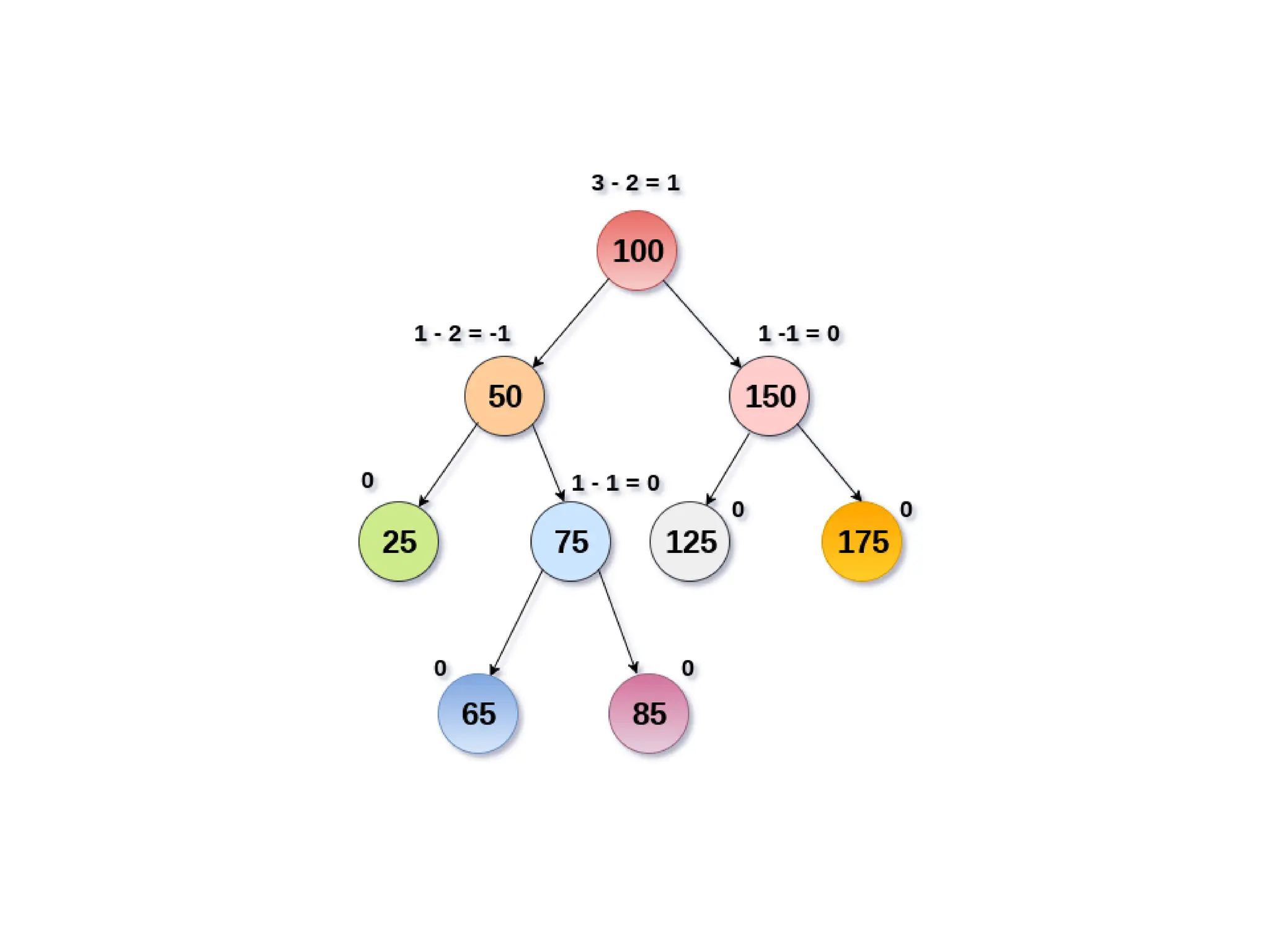
• AVL Treecan be defined as height balanced binary search tree in which
each node is associated with a balance factor which is calculated by
subtracting theheight of its right sub-tree from that of its left sub-tree.
• Tree is said to be balanced if balance factor of each node is in between -1
to 1, otherwise, the tree will be unbalanced and need to be balanced.
• Balance Factor (k) = height (left(k)) - height (right(k))
• If balance factor of any node is 1, it means that the left sub-tree is one
level higher than the right sub-tree.
• If balance factor of any node is 0, it means that the left sub-tree and right
sub-tree contain equal height.
• If balance factor of any node is -1, it means that the left sub-tree is one
level lower than the right sub-tree.
4.
AVL Rotations
• Weperform rotation in AVL tree only in case if Balance Factor is other
than -1, 0, and 1. There are basically four types of rotationswhich are as
follows:
• L L rotation:Inserted node is in the left subtree of left subtree of A
• R R rotation : Inserted node is in the right subtree of right subtree of A
• L R rotation: Inserted node is in the right subtree of left subtreeof A
• R L rotation: Inserted node is in the left subtreeof right subtreeof A
• Where nodeAis the nodewhose balanceFactor is otherthan -1, 0, 1.
• The first two rotationsLL and RR are single rotationsand the next two
rotationsLR and RL are doublerotations. For a tree to be unbalanced,
minimum height must be at least 2.
5.
RR Rotation
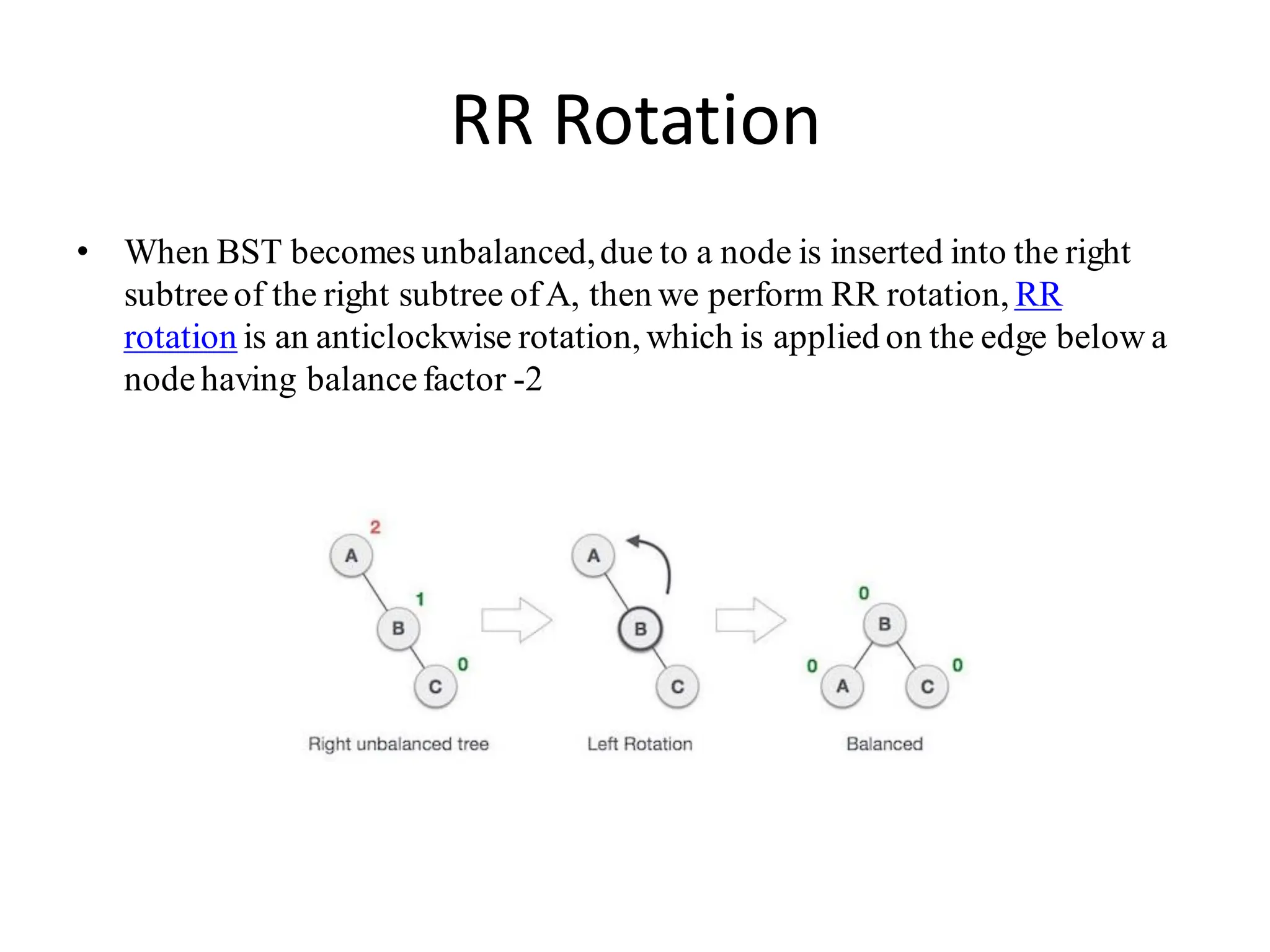
• WhenBST becomes unbalanced,due to a node is inserted into the right
subtreeof the right subtree ofA, then we perform RR rotation, RR
rotation is an anticlockwise rotation, which is applied on the edge below a
nodehaving balancefactor -2
6.
LL Rotation
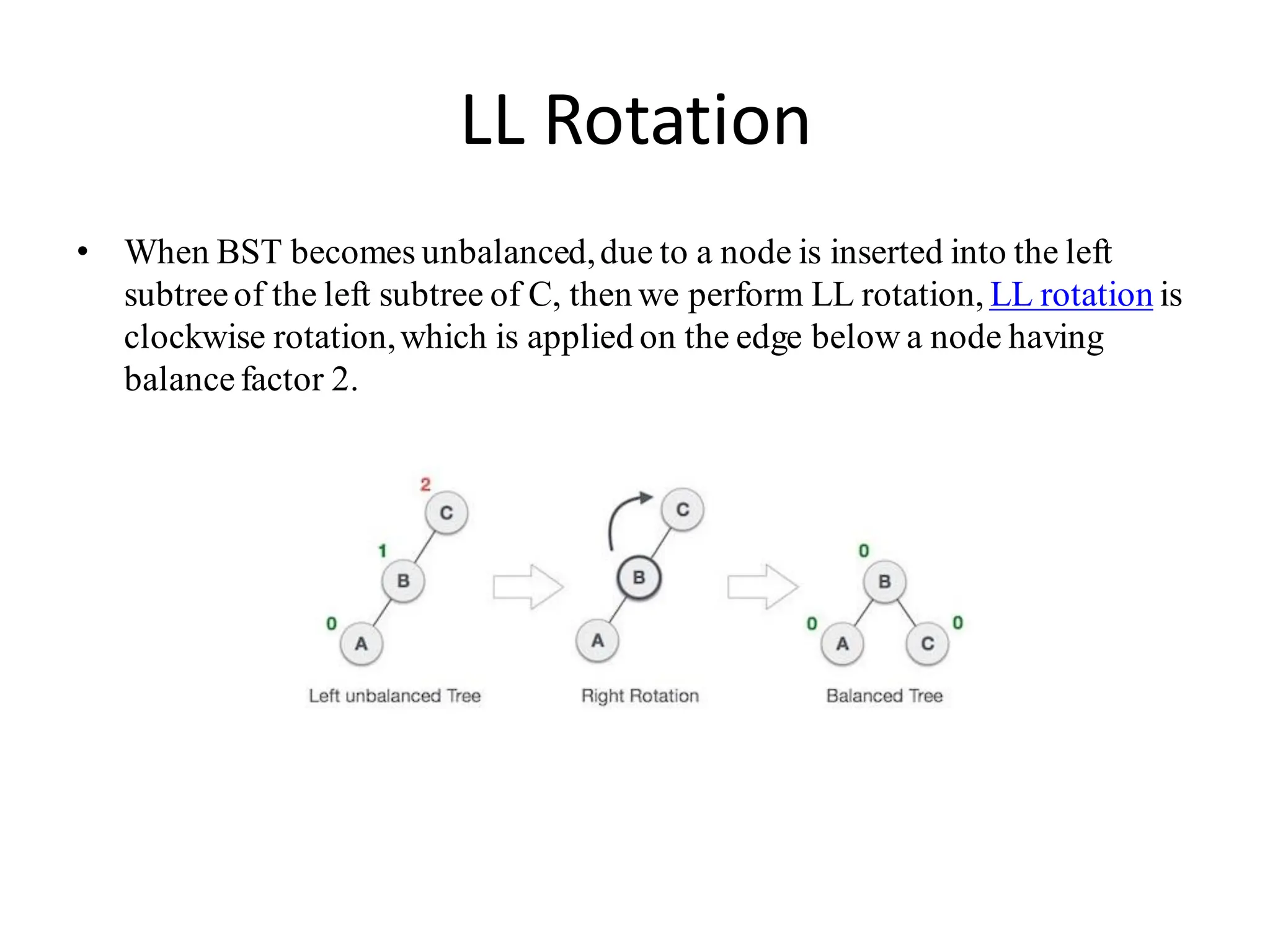
• WhenBST becomes unbalanced,due to a node is inserted into the left
subtreeof the left subtree of C, then we perform LL rotation, LL rotation is
clockwise rotation,which is applied on the edge below a node having
balancefactor 2.
7.
LR Rotation
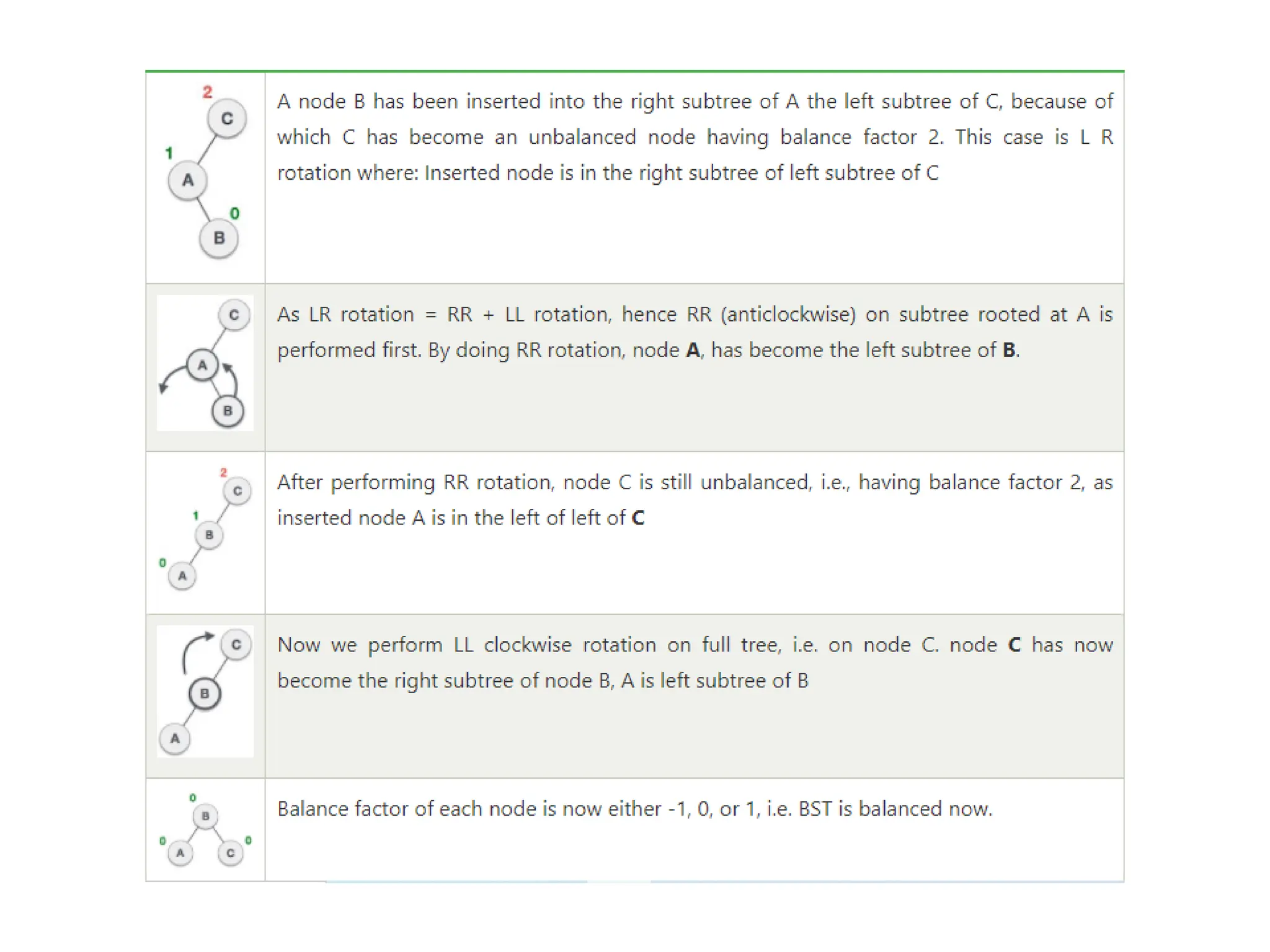
• Doublerotationsarebit tougher than single rotation which has already
explained above. LR rotation = RR rotation + LL rotation, i.e., first RR
rotation is performed on subtree and then LL rotation is performed on full
tree, by full tree we mean the first node from the path of inserted node
whose balancefactor is otherthan -1, 0, or 1.
9.
RL Rotation
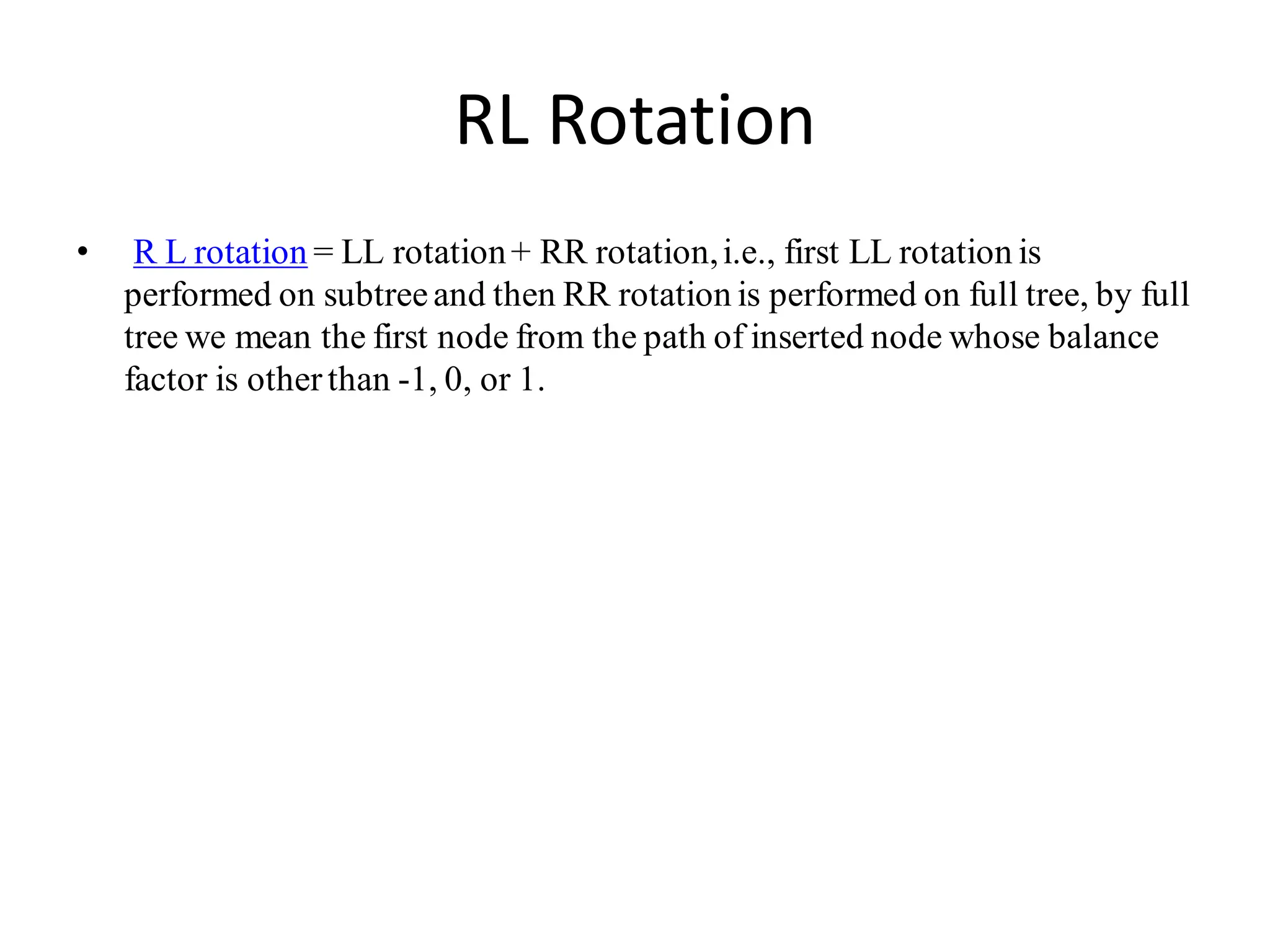
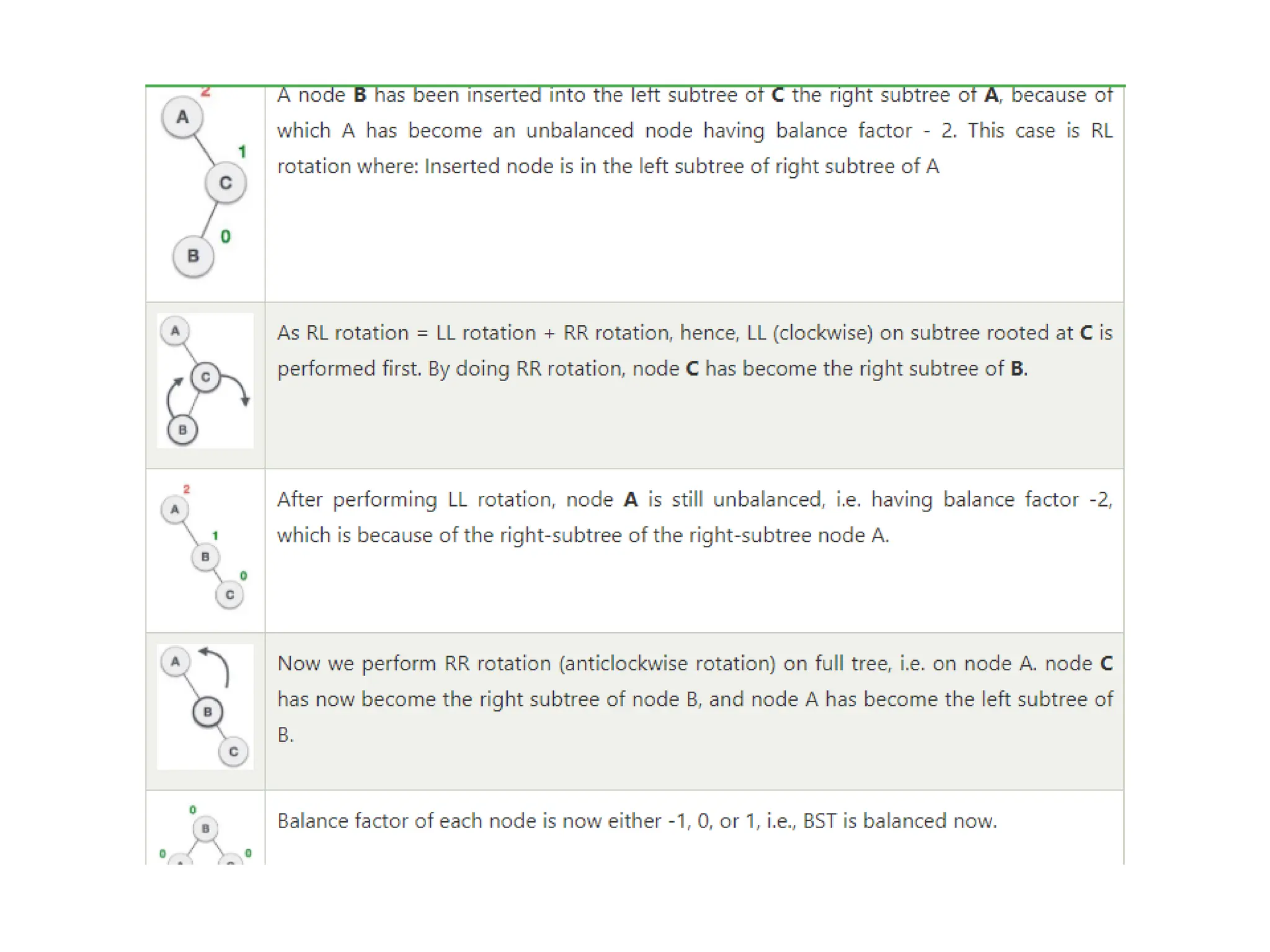
• RL rotation = LL rotation+ RR rotation,i.e., first LL rotation is
performed on subtreeand then RR rotation is performed on full tree, by full
tree we mean the first node from the path of inserted node whose balance
factor is otherthan -1, 0, or 1.
11.
Deletion in AVLTrees
• Deleting a node from an AVL tree is similar to that in a binary search tree.
Deletion may disturb the balance factor of an AVL tree and therefore the
tree needs to be rebalanced in order to maintain the AVLness. For this
purpose, we need to perform rotations. The two types of rotations are L
rotation and R rotation.
• If the node which is to be deleted is present in the left sub-tree of the
critical node, then L rotation needs to be applied else if, the node which is
to be deleted is present in the right sub-tree of the critical node, the R
rotation will be applied.
12.
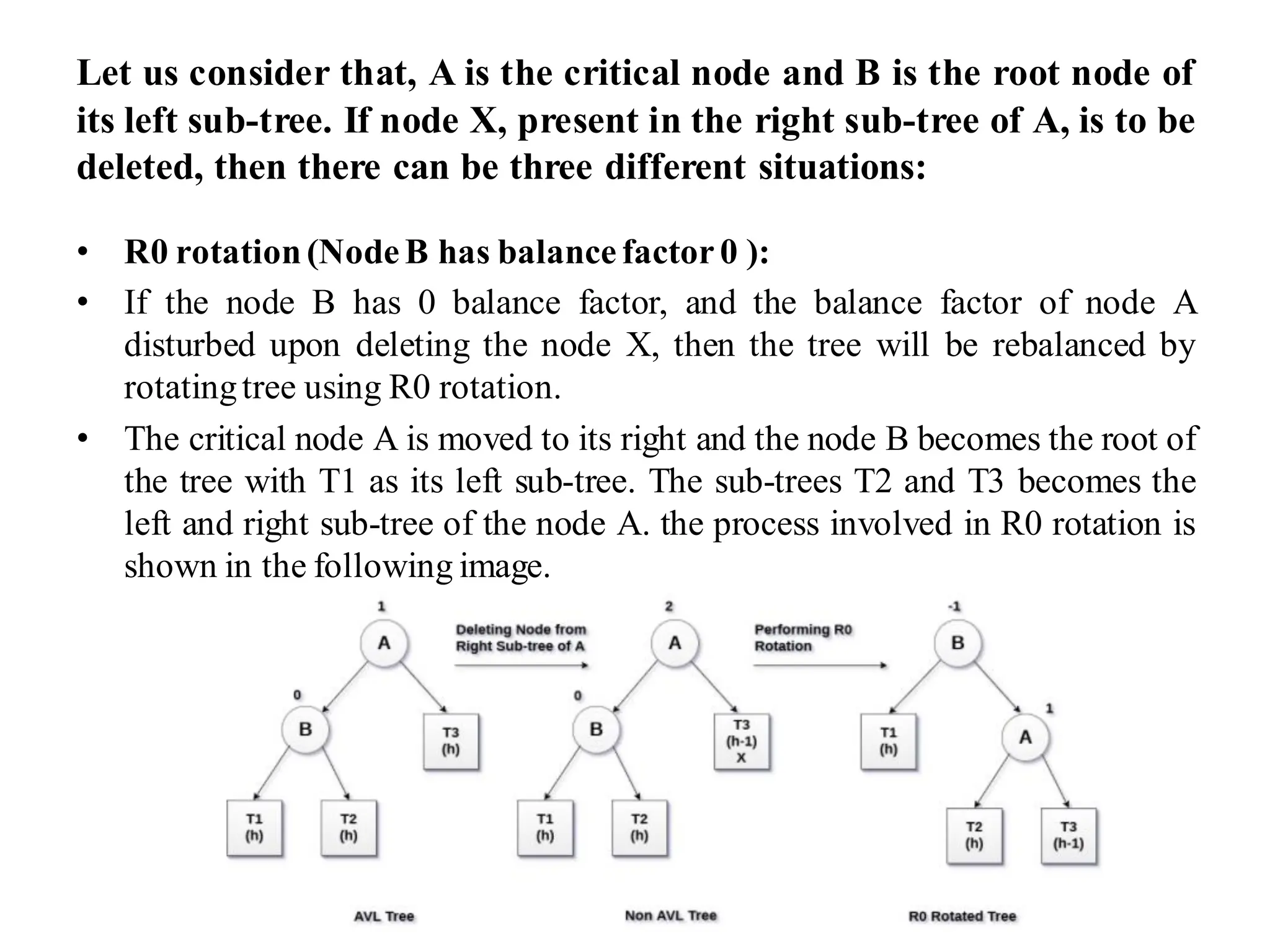
Let us considerthat, A is the critical node and B is the root node of
its left sub-tree. If node X, present in the right sub-tree of A, is to be
deleted, then there can be three different situations:
• R0 rotation (NodeB has balance factor 0 ):
• If the node B has 0 balance factor, and the balance factor of node A
disturbed upon deleting the node X, then the tree will be rebalanced by
rotatingtree using R0 rotation.
• The critical node A is moved to its right and the node B becomes the root of
the tree with T1 as its left sub-tree. The sub-trees T2 and T3 becomes the
left and right sub-tree of the node A. the process involved in R0 rotation is
shown in the following image.
13.
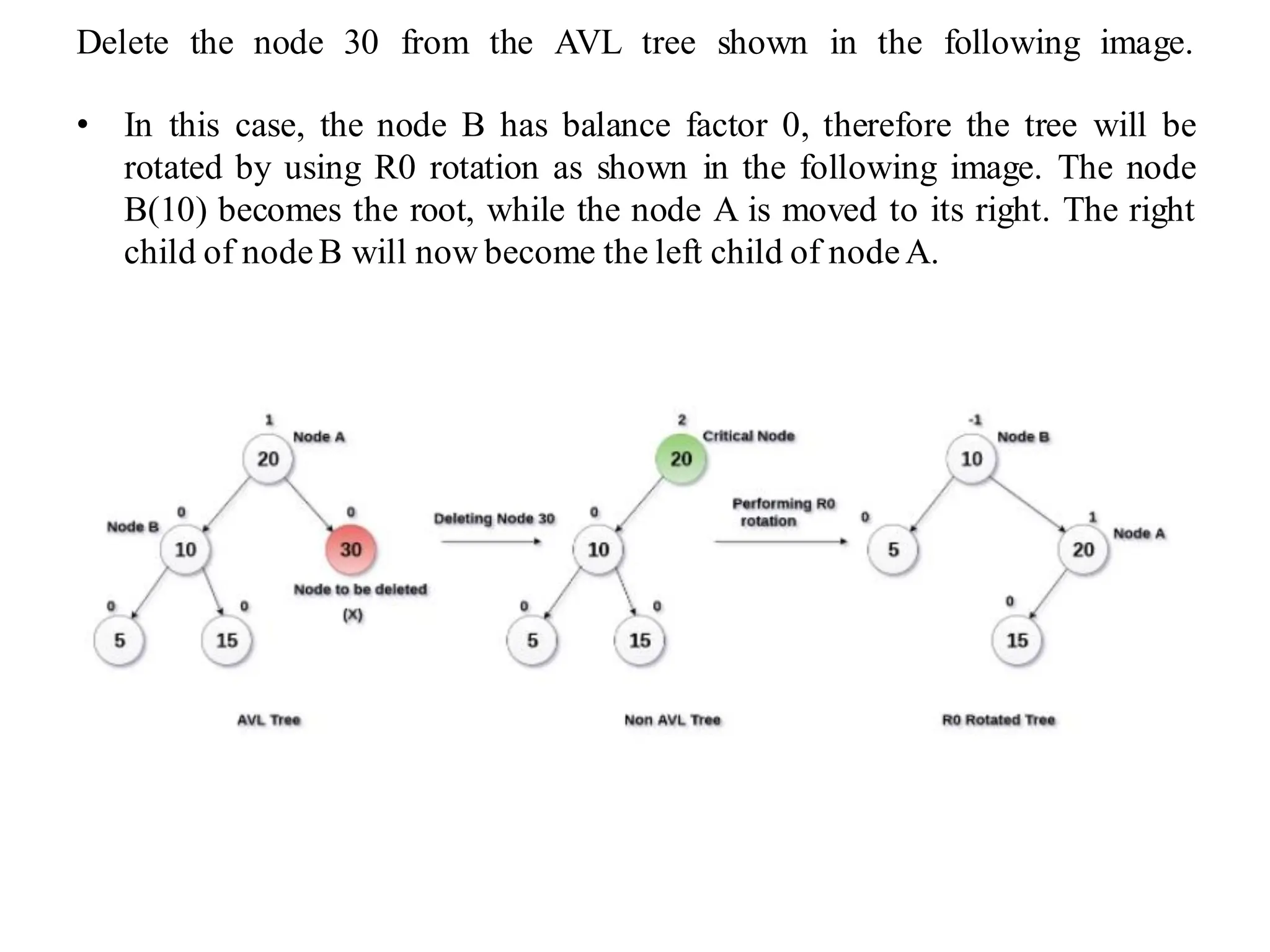
Delete the node30 from the AVL tree shown in the following image.
• In this case, the node B has balance factor 0, therefore the tree will be
rotated by using R0 rotation as shown in the following image. The node
B(10) becomes the root, while the node A is moved to its right. The right
child of nodeB will now become the left child of nodeA.
14.
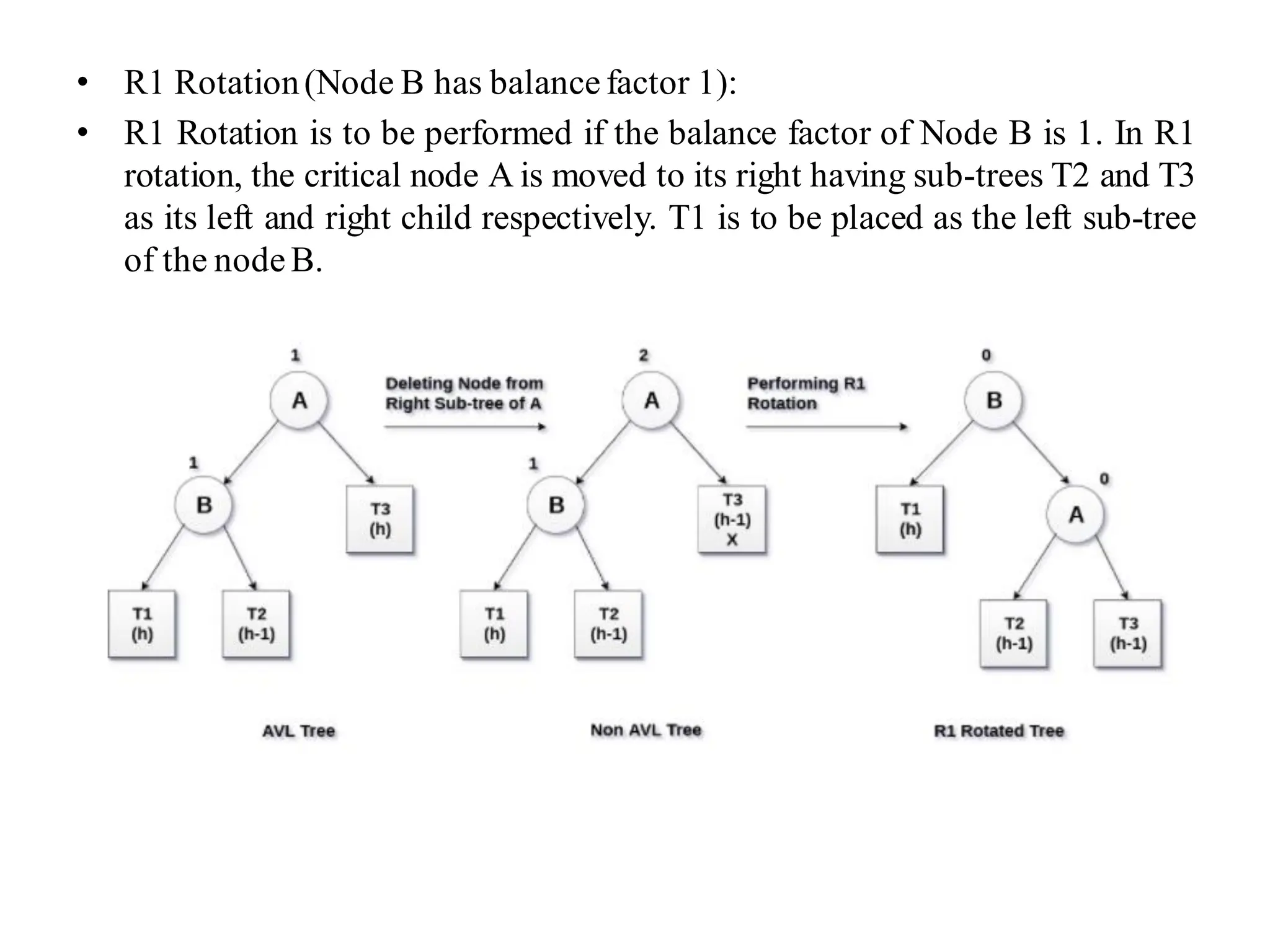
• R1 Rotation(NodeB has balance factor 1):
• R1 Rotation is to be performed if the balance factor of Node B is 1. In R1
rotation, the critical node A is moved to its right having sub-trees T2 and T3
as its left and right child respectively. T1 is to be placed as the left sub-tree
of the node B.
15.
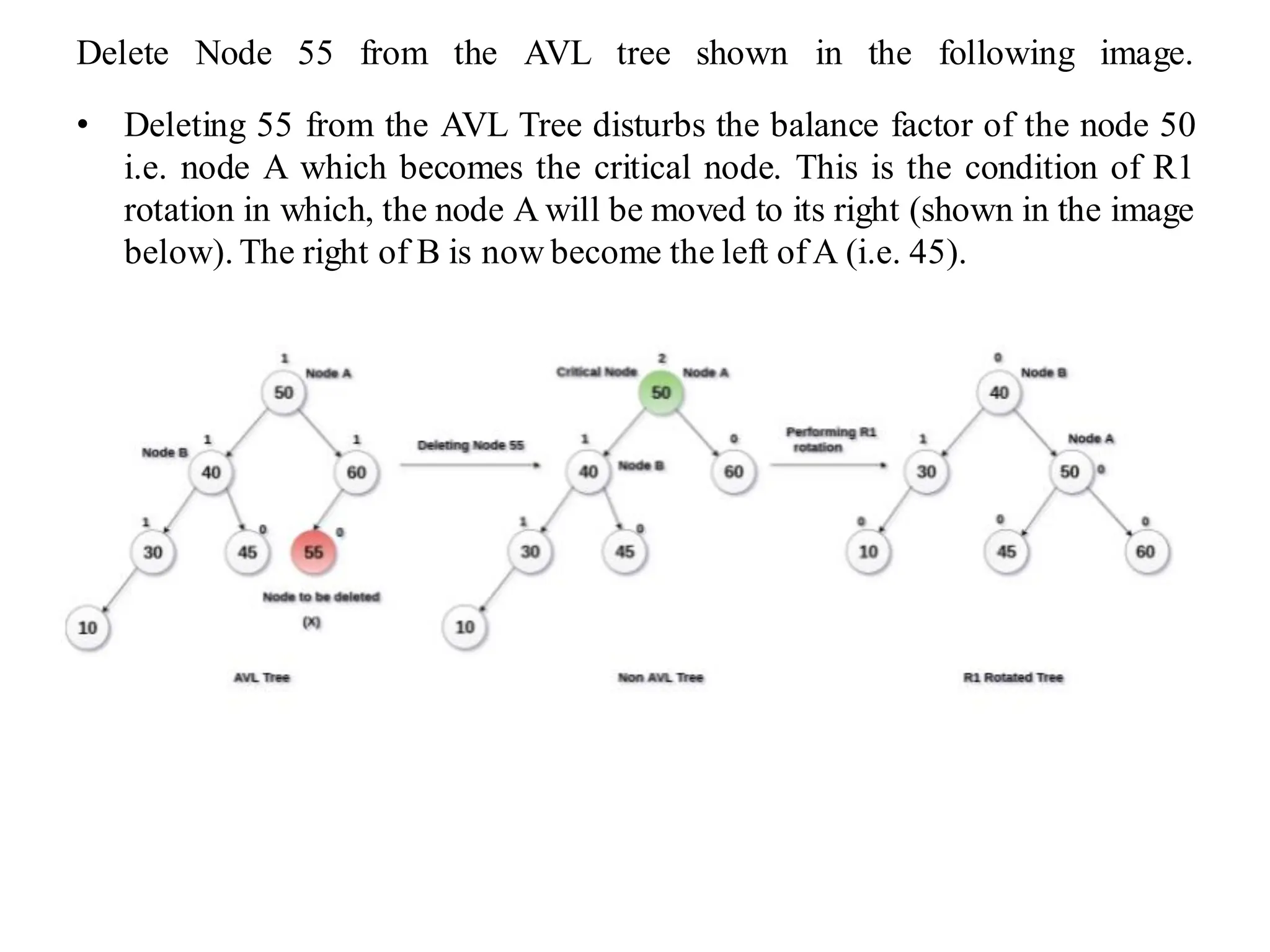
Delete Node 55from the AVL tree shown in the following image.
• Deleting 55 from the AVL Tree disturbs the balance factor of the node 50
i.e. node A which becomes the critical node. This is the condition of R1
rotation in which, the node A will be moved to its right (shown in the image
below). The right of B is now become the left ofA (i.e. 45).
16.
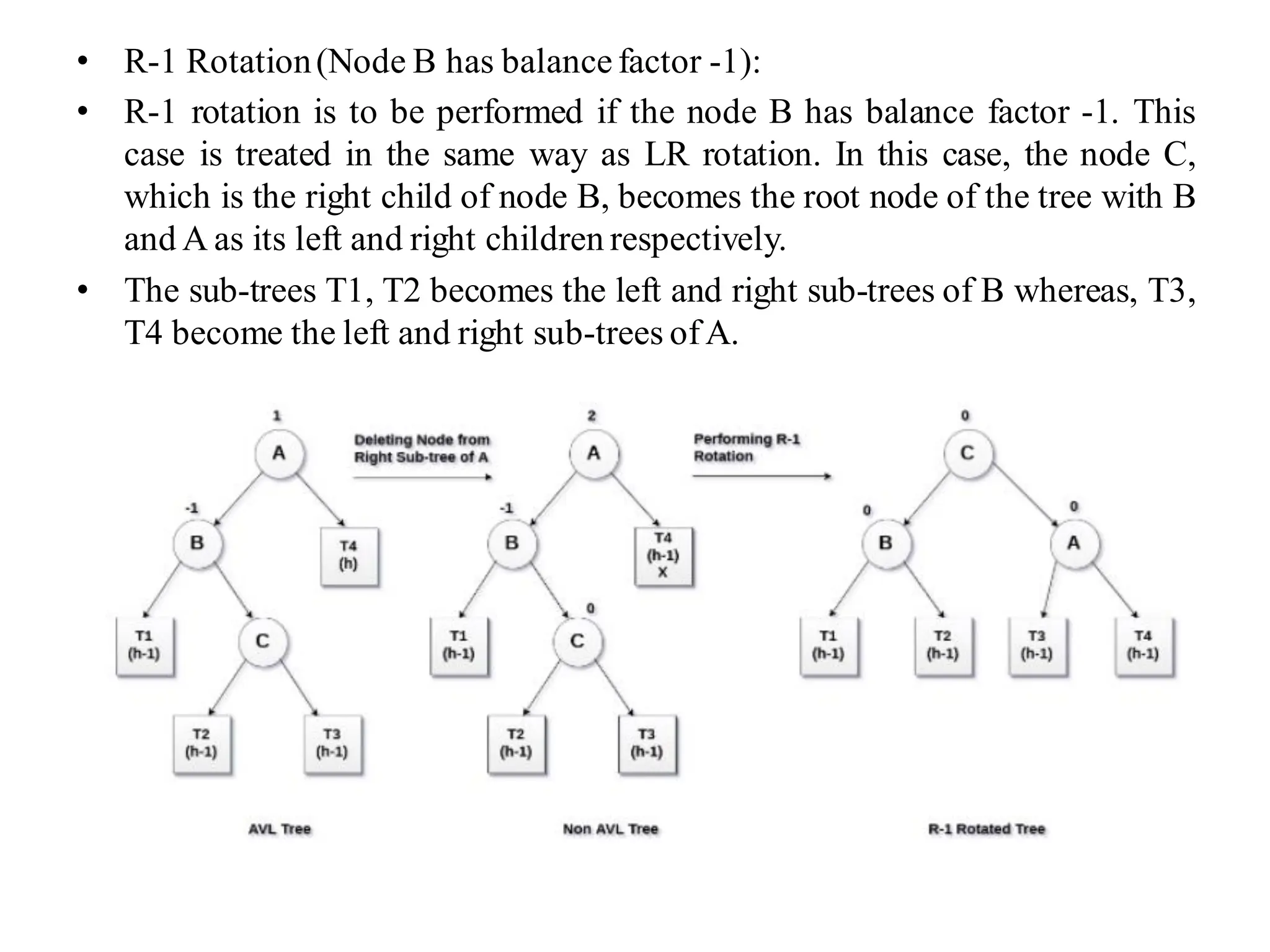
• R-1 Rotation(NodeB has balance factor -1):
• R-1 rotation is to be performed if the node B has balance factor -1. This
case is treated in the same way as LR rotation. In this case, the node C,
which is the right child of node B, becomes the root node of the tree with B
and A as its left and right children respectively.
• The sub-trees T1, T2 becomes the left and right sub-trees of B whereas, T3,
T4 become the left and right sub-trees ofA.
17.
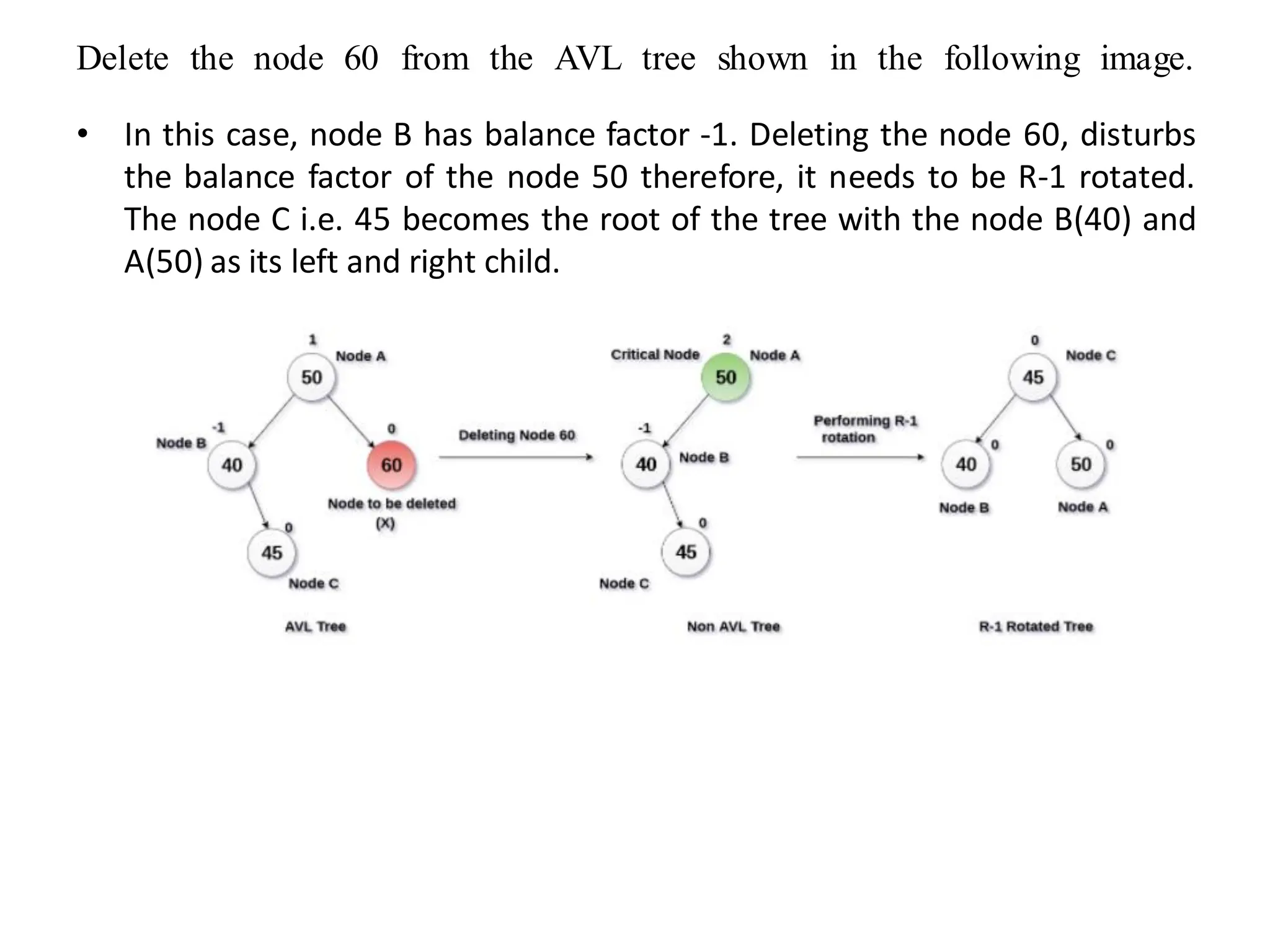
Delete the node60 from the AVL tree shown in the following image.
• In this case, node B has balance factor -1. Deleting the node 60, disturbs
the balance factor of the node 50 therefore, it needs to be R-1 rotated.
The node C i.e. 45 becomes the root of the tree with the node B(40) and
A(50) as its left and right child.