YueDu-for-Fun
Project 1: Behaviorist Paradigm
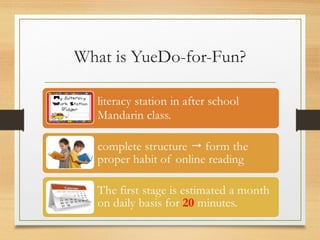
What is YueDo-for-Fun?
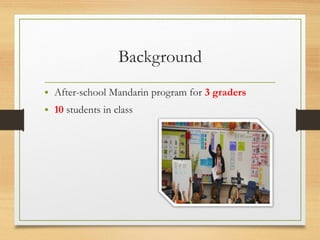
Background
• After-school Mandarin program for 3 graders
• 10 students in class
Objective
• Attempt to teach learners to form an
online reading habit on a regular basis
using the Behaviorist Paradigm.
• Use Skinner’s proposal of Contingencies
of Reinforcement: S-R-S
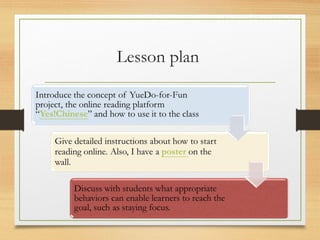
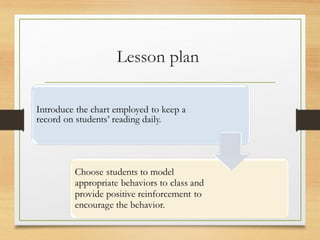
Lesson plan
Lesson plan
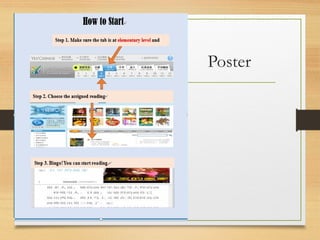
Poster
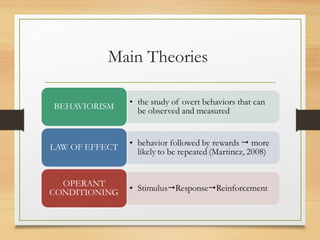
Main Theories
The Behavioral Goal
• Form an appropriate habit of reading a Mandarin
paragraph online on daily basis.
• Students read for 20 minutes following YueDu-for-
Fun behaviors.
• They have to accomplish a reading mission every
time, for example, find a meaning for the assigned
word.
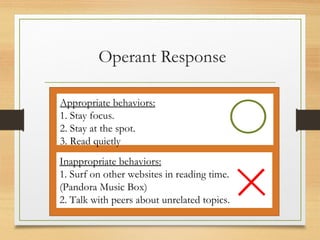
Operant Response
Appropriate behaviors:
1. Stay focus.
2. Stay at the spot.
3. Read quietly
Inappropriate behaviors:
1. Surf on other websites in reading time.
(Pandora Music Box)
2. Talk with peers about unrelated topics.
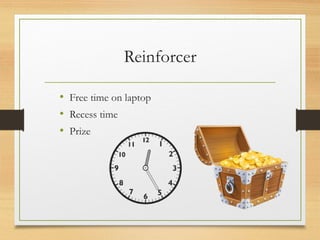
Reinforcer
• Free time on laptop
• Recess time
• Prize
Reinforcing/Punishing Stimulus
• Appropriate behaviors:
• Positive Reinforcer
(1) 5 minutes free time to surf on the Internet
(Positive Reinforcement)
(2) A prize from treasure box
(Positive Reinforcement)
(3) Less character writing sheets on weekend
(Negative stimulus Removal
Reinforcing/Punishing Stimulus
• Inappropriate behaviors:
• Negative Reinforcer
(1)Less recess time
(Positive stimulus Removal)
(2) Have to finish the reading mission during recess (Negative
Reinforcement)
Variable Ratio Schedules
• I randomly select a day to check who has three green
clippers and they can choose a prize from the
treasure box.
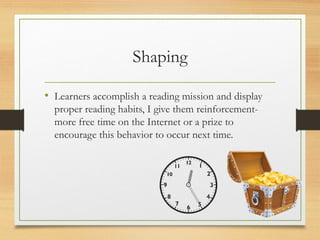
Shaping
• Learners accomplish a reading mission and display
proper reading habits, I give them reinforcement-
more free time on the Internet or a prize to
encourage this behavior to occur next time.
Chaining
• Apply this online reading habit to a language learning
behavior.
• Be an independent reader
Fading
• As students acquire these behaviors, I reduce times to
check their clippers and gradually reduce their free
time on Internet by giving them more tasks.
Implementation and record results
• Recorded through the chart for every week
Something to be revised…
• I notice that some of the learners who can finish the
task earlier disturbed other classmates who still are
reading.
So…how to revise?
Group positive reinforcement
• I will add a for this reading project, since most of the
reinforcers I utilized are for individual.
• The entire group all finish the reading mission on
that day, then they can watch a cartoon for ten
minutes for next class.
A question…?
• Will students be encouraged to help other to finish a
reading mission instead of bothering or disturbing?
Reference
• Good, T. L., Brophy, J.E (1990). Educational Psychology: A realistic
approach. (4th
ed.) White Plains, NY:Longman
• Mergel Brenda (1998), Instructional Design and Learning Theory, University
of Saskatchewan, Term Paper HTML, retrieved 14:46, 14 August 2007
(MEST)
• Thorndike, E.L. (1913). Educational Psychology: The Psychology of Learning
(Vol 2.), New York: Teachers College Press.
• Martinez, Michael E. (2008) Learning and Cognition: The Design of the
Mind. Irvine, CA. Pearson. 6-35
• Skinner, B.F. (1938) The Behavior of Organisms: An Experimental
Analysis  New York: Appleton-Century

Crystal hsia id#1

  • 1.
  • 2.
  • 3.
    Background • After-school Mandarinprogram for 3 graders • 10 students in class
  • 4.
    Objective • Attempt toteach learners to form an online reading habit on a regular basis using the Behaviorist Paradigm. • Use Skinner’s proposal of Contingencies of Reinforcement: S-R-S
  • 5.
  • 6.
  • 7.
  • 8.
  • 9.
    The Behavioral Goal •Form an appropriate habit of reading a Mandarin paragraph online on daily basis. • Students read for 20 minutes following YueDu-for- Fun behaviors. • They have to accomplish a reading mission every time, for example, find a meaning for the assigned word.
  • 10.
    Operant Response Appropriate behaviors: 1.Stay focus. 2. Stay at the spot. 3. Read quietly Inappropriate behaviors: 1. Surf on other websites in reading time. (Pandora Music Box) 2. Talk with peers about unrelated topics.
  • 11.
    Reinforcer • Free timeon laptop • Recess time • Prize
  • 12.
    Reinforcing/Punishing Stimulus • Appropriatebehaviors: • Positive Reinforcer (1) 5 minutes free time to surf on the Internet (Positive Reinforcement) (2) A prize from treasure box (Positive Reinforcement) (3) Less character writing sheets on weekend (Negative stimulus Removal
  • 13.
    Reinforcing/Punishing Stimulus • Inappropriatebehaviors: • Negative Reinforcer (1)Less recess time (Positive stimulus Removal) (2) Have to finish the reading mission during recess (Negative Reinforcement)
  • 14.
    Variable Ratio Schedules •I randomly select a day to check who has three green clippers and they can choose a prize from the treasure box.
  • 15.
    Shaping • Learners accomplisha reading mission and display proper reading habits, I give them reinforcement- more free time on the Internet or a prize to encourage this behavior to occur next time.
  • 16.
    Chaining • Apply thisonline reading habit to a language learning behavior. • Be an independent reader
  • 17.
    Fading • As studentsacquire these behaviors, I reduce times to check their clippers and gradually reduce their free time on Internet by giving them more tasks.
  • 18.
    Implementation and recordresults • Recorded through the chart for every week
  • 19.
    Something to berevised… • I notice that some of the learners who can finish the task earlier disturbed other classmates who still are reading. So…how to revise?
  • 20.
    Group positive reinforcement •I will add a for this reading project, since most of the reinforcers I utilized are for individual. • The entire group all finish the reading mission on that day, then they can watch a cartoon for ten minutes for next class.
  • 21.
    A question…? • Willstudents be encouraged to help other to finish a reading mission instead of bothering or disturbing?
  • 22.
    Reference • Good, T.L., Brophy, J.E (1990). Educational Psychology: A realistic approach. (4th ed.) White Plains, NY:Longman • Mergel Brenda (1998), Instructional Design and Learning Theory, University of Saskatchewan, Term Paper HTML, retrieved 14:46, 14 August 2007 (MEST) • Thorndike, E.L. (1913). Educational Psychology: The Psychology of Learning (Vol 2.), New York: Teachers College Press. • Martinez, Michael E. (2008) Learning and Cognition: The Design of the Mind. Irvine, CA. Pearson. 6-35 • Skinner, B.F. (1938) The Behavior of Organisms: An Experimental Analysis  New York: Appleton-Century

Editor's Notes

  • #13 1.Free time on laptop is something satisfying, so it’s a kind of positive reinforcement 2.A prize is also something satisfying, so add more on will encourage the behavior. 3. Less writing sheets :writing sheets are something they don’t like, so remove it from learning will also strengthen this behavior.
  • #14 Recess time is what learners like, so if I remove it, then this inappropriate behavior will be removed. Then, this misbehavior can be weakened. Have to finish the reading mission by using the recess time. Reading might be what they don’t like, so I add this negative reinforcement, so this behavior will be weakened.