Cryptography Made Easy
Mr. Abhijeet A. More
(Perfect Training Center)
Why Study Cryptography?
• Secrets are intrinsically interesting
• So much real-life drama:
– Mary Queen of Scots executed for treason
– primary evidence was an encoded letter
– they tricked the conspirators with a
forgery
• Students enjoy puzzles
• Real world application of mathematics
Some basic terminology
• Alice wants to send a secret message to Bob
• Eve is eavesdropping
• Cryptographers tell Alice and Bob how to
encode their messages
• Cryptanalysts help Eve to break the code
• Historic battle between the cryptographers
and the cryptanalysts that continues today
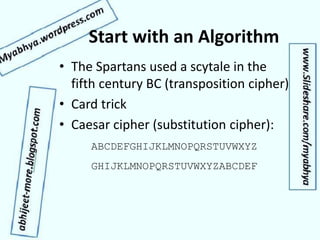
Start with an Algorithm
• The Spartans used a scytale in the
fifth century BC (transposition cipher)
• Card trick
• Caesar cipher (substitution cipher):
ABCDEFGHIJKLMNOPQRSTUVWXYZ
GHIJKLMNOPQRSTUVWXYZABCDEF
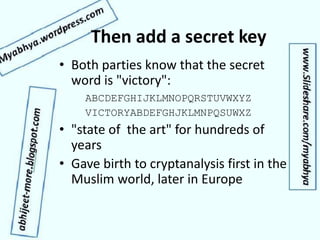
Then add a secret key
• Both parties know that the secret
word is "victory":
ABCDEFGHIJKLMNOPQRSTUVWXYZ
VICTORYABDEFGHJKLMNPQSUWXZ
• "state of the art" for hundreds of
years
• Gave birth to cryptanalysis first in the
Muslim world, later in Europe
Cryptographers v/s Cryptanalysts
• A battle that continues today
• Cryptographers try to devise more
clever algorithms and keys
• Cryptanalysts search for vulnerabilities
• Early cryptanalysts were linguists:
– frequency analysis
– properties of letters
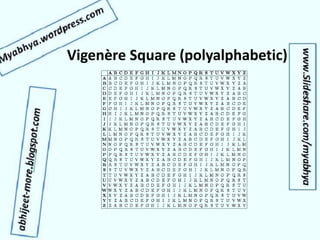
Vigenère Square (polyalphabetic)
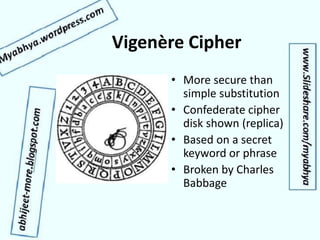
Vigenère Cipher
• More secure than
simple substitution
• Confederate cipher
disk shown (replica)
• Based on a secret
keyword or phrase
• Broken by Charles
Babbage
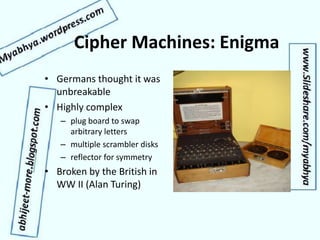
Cipher Machines: Enigma
• Germans thought it was
unbreakable
• Highly complex
– plug board to swap
arbitrary letters
– multiple scrambler disks
– reflector for symmetry
• Broken by the British in
WW II (Alan Turing)
Public Key Encryption
• Proposed by Diffie, Hellman, Merkle
• First big idea: use a function that cannot be
reversed (a humpty dumpty function):
Alice tells Bob a function to apply using a
public key, and Eve can’t compute the
inverse
• Second big idea: use asymmetric keys
(sender and receiver use different keys):
Alice has a private key to compute the
inverse
• Key benefit: doesn't require the sharing of
a secret key
RSA Encryption
• Named for Ron Rivest, Adi Shamir, and
Leonard Adleman
• Invented in 1977, still the premier approach
• Based on Fermat's Little Theorem:
ap-11 (mod p) for prime p, gcd(a, p) = 1
• Slight variation:
a(p-1)(q-1)1 (mod pq) for distinct primes p
and q, gcd(a,pq) = 1
• Requires large primes (100+ digit primes)
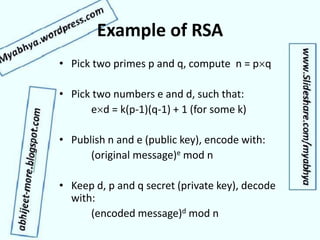
Example of RSA
• Pick two primes p and q, compute n = pq
• Pick two numbers e and d, such that:
ed = k(p-1)(q-1) + 1 (for some k)
• Publish n and e (public key), encode with:
(original message)e mod n
• Keep d, p and q secret (private key), decode
with:
(encoded message)d mod n
Politics of Cryptography
• British actually discovered RSA first
but kept it secret
• Phil Zimmerman tried to bring
cryptography to the masses with PGP
and ended up being investigated as
an arms dealer by the FBI and a
grand jury
• The NSA hires more mathematicians
than any other organization
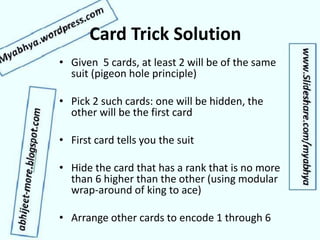
Card Trick Solution
• Given 5 cards, at least 2 will be of the same
suit (pigeon hole principle)
• Pick 2 such cards: one will be hidden, the
other will be the first card
• First card tells you the suit
• Hide the card that has a rank that is no more
than 6 higher than the other (using modular
wrap-around of king to ace)
• Arrange other cards to encode 1 through 6
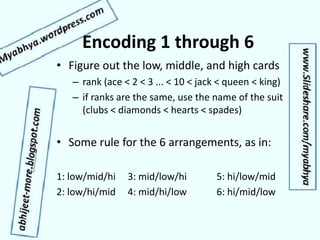
Encoding 1 through 6
• Figure out the low, middle, and high cards
– rank (ace < 2 < 3 ... < 10 < jack < queen < king)
– if ranks are the same, use the name of the suit
(clubs < diamonds < hearts < spades)
• Some rule for the 6 arrangements, as in:
1: low/mid/hi 3: mid/low/hi 5: hi/low/mid
2: low/hi/mid 4: mid/hi/low 6: hi/mid/low
Questions?
Those who have any Query Contact me on my
Whats App No : 9766677504(only message)
16

Cryptography make easy

  • 1.
    Cryptography Made Easy Mr.Abhijeet A. More (Perfect Training Center)
  • 2.
    Why Study Cryptography? •Secrets are intrinsically interesting • So much real-life drama: – Mary Queen of Scots executed for treason – primary evidence was an encoded letter – they tricked the conspirators with a forgery • Students enjoy puzzles • Real world application of mathematics
  • 3.
    Some basic terminology •Alice wants to send a secret message to Bob • Eve is eavesdropping • Cryptographers tell Alice and Bob how to encode their messages • Cryptanalysts help Eve to break the code • Historic battle between the cryptographers and the cryptanalysts that continues today
  • 4.
    Start with anAlgorithm • The Spartans used a scytale in the fifth century BC (transposition cipher) • Card trick • Caesar cipher (substitution cipher): ABCDEFGHIJKLMNOPQRSTUVWXYZ GHIJKLMNOPQRSTUVWXYZABCDEF
  • 5.
    Then add asecret key • Both parties know that the secret word is "victory": ABCDEFGHIJKLMNOPQRSTUVWXYZ VICTORYABDEFGHJKLMNPQSUWXZ • "state of the art" for hundreds of years • Gave birth to cryptanalysis first in the Muslim world, later in Europe
  • 6.
    Cryptographers v/s Cryptanalysts •A battle that continues today • Cryptographers try to devise more clever algorithms and keys • Cryptanalysts search for vulnerabilities • Early cryptanalysts were linguists: – frequency analysis – properties of letters
  • 7.
  • 8.
    Vigenère Cipher • Moresecure than simple substitution • Confederate cipher disk shown (replica) • Based on a secret keyword or phrase • Broken by Charles Babbage
  • 9.
    Cipher Machines: Enigma •Germans thought it was unbreakable • Highly complex – plug board to swap arbitrary letters – multiple scrambler disks – reflector for symmetry • Broken by the British in WW II (Alan Turing)
  • 10.
    Public Key Encryption •Proposed by Diffie, Hellman, Merkle • First big idea: use a function that cannot be reversed (a humpty dumpty function): Alice tells Bob a function to apply using a public key, and Eve can’t compute the inverse • Second big idea: use asymmetric keys (sender and receiver use different keys): Alice has a private key to compute the inverse • Key benefit: doesn't require the sharing of a secret key
  • 11.
    RSA Encryption • Namedfor Ron Rivest, Adi Shamir, and Leonard Adleman • Invented in 1977, still the premier approach • Based on Fermat's Little Theorem: ap-11 (mod p) for prime p, gcd(a, p) = 1 • Slight variation: a(p-1)(q-1)1 (mod pq) for distinct primes p and q, gcd(a,pq) = 1 • Requires large primes (100+ digit primes)
  • 12.
    Example of RSA •Pick two primes p and q, compute n = pq • Pick two numbers e and d, such that: ed = k(p-1)(q-1) + 1 (for some k) • Publish n and e (public key), encode with: (original message)e mod n • Keep d, p and q secret (private key), decode with: (encoded message)d mod n
  • 13.
    Politics of Cryptography •British actually discovered RSA first but kept it secret • Phil Zimmerman tried to bring cryptography to the masses with PGP and ended up being investigated as an arms dealer by the FBI and a grand jury • The NSA hires more mathematicians than any other organization
  • 14.
    Card Trick Solution •Given 5 cards, at least 2 will be of the same suit (pigeon hole principle) • Pick 2 such cards: one will be hidden, the other will be the first card • First card tells you the suit • Hide the card that has a rank that is no more than 6 higher than the other (using modular wrap-around of king to ace) • Arrange other cards to encode 1 through 6
  • 15.
    Encoding 1 through6 • Figure out the low, middle, and high cards – rank (ace < 2 < 3 ... < 10 < jack < queen < king) – if ranks are the same, use the name of the suit (clubs < diamonds < hearts < spades) • Some rule for the 6 arrangements, as in: 1: low/mid/hi 3: mid/low/hi 5: hi/low/mid 2: low/hi/mid 4: mid/hi/low 6: hi/mid/low
  • 16.
    Questions? Those who haveany Query Contact me on my Whats App No : 9766677504(only message) 16