Cryptanalytic Timing Attacks against IDEA Product block cipher 
(Ref: "Side Channel Cryptanalysis of Product Ciphers" by John Kelsey , Bruce Schneier , David Wagner , and Chris Hall in September 1998 ) 
Srilal Buddika
Outline 
1.Motivation 
2.About IDEA 
3.IDEA Block Cipher Design 
4.Cryptanalytic History on IDEA 
5.Timing Attack against IDEA 
6.Conclusion 
7.Discussion 
2
3About IDEA 
IDEAstands for International Data Encryption Algorithm (1991) 
IDEA is Block Cipher 
Block Size : 64 bits 
Key Size : 128 bits 
8Rounds + Output Transformation (half-round) 
WhyIDEA ? 
The algorithm was designed to achieve high data throughput for use in real-time communications system, especially for wireless communication
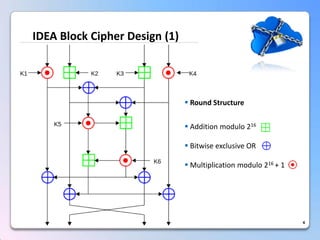
4IDEA Block Cipher Design (1) 
RoundStructure 
Additionmodulo216 
BitwiseexclusiveOR 
Multiplicationmodulo216+1
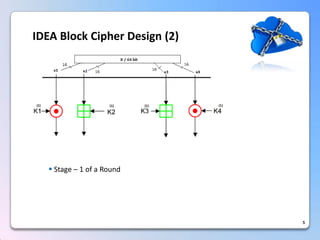
IDEA Block Cipher Design (2) 
5 
Stage–1ofaRound
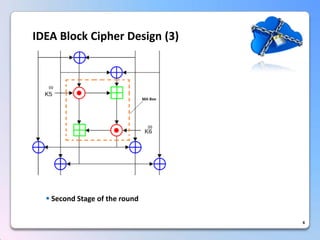
6IDEA Block Cipher Design (3) 
SecondStageoftheround
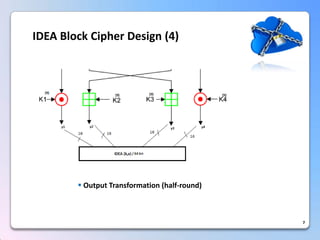
7IDEA Block Cipher Design (4) 
OutputTransformation(half-round)
8IDEA Block Cipher Design (5) 
KeyGeneration 
KeySize=128bit 
Sub-keySize=16bit 
i.e.SimplyKeydividedintoeightpieces 
Algorithm: 
1.Take1steightsub-keys 
2.Thenrotatethekey25bitstotheleft 
3.Repeatthestep-1
9 
Cryptanalytic History on IDEA 
Consideredasreallysecure 
BestattackcanbreakIDEAreducedto6rounds(FullIDEA=8.5rounds) 
WeakKeyproblemwithtoomany0-bits(ExposedtoSide-ChannelAttacks)
10 
IDEAcanbecryptanalyzedwithapieceofside-channelinformation 
E.g.Whetheroneoftheinputsintooneofthemultiplicationsiszero 
Timingscanbeacquiredintwosimpleways: 
1.The cryptanalyst makes extremely precise timings of each encryption (A Ciphertext-Only Timing Attack) 
2.The cryptanalyst measures total time to encrypt many similar plaintext blocks at a time (An Adaptive Chosen Plaintext Timing Attack) Timing Attack against IDEA (1)
11Timing Attacks against IDEA (2) Attacking Scenario 
1.Recordprecisetimingsfornencryptions.AlsostoretheresultingciphertextblocksandletT0..n-1bethetimings,andC0..n-1betheciphertextblocks. 
2.Grouptheciphertextblocksandtimingsinto216subsets,basedonthelow- order16bitsoftheoutput. 
3.Testtheaveragetimesofeachgroupagainsttheaveragetimesofallthegroupsstatistically,tofindwhetheroneofthesetshas(withsomeacceptablyhighprobability)aloweraveragethantheothersets. 
4.Ifso,thentheinputstothelastmultiplyoftheoutputtransformationmusthavebeen0forallinputsinthatset.Hencesolveforthelastmultiplicativesub-key.
12Timing Attacks against IDEA (3) 
5.Ifthereisnodifference,theneitherwe'vechosensomeparameters(i.e.,n) wrong,orthesub-keyisa0. 
6.Repeatsteps2-3,above,forthehigh-order16bitsandsolvethefirstmultiplicativesub-keyoftheoutputtransformation.Wenowhave32bitsofexpandedkey. 
7.Wenowattackthesecondadditivesub-keyintheoutputtransformation. Foreachpossiblevalueofthissub-key,welookatwhichciphertextblocksleadustoazerovaluegoingintothefirstmultiplicationofthelastround'sMAbox. 
8.Foroneofthesesub-keyguesses,theaveragetimingshouldbelessthanforalltheothersub-keyguesses.Thisrevealstherightsub-key. 
9.Ifthereisnodifference,theneitherwe'vechosensomeparameterswrong, orthefirstsub-keyintheMA-boxiszero.Wehavenowrecovered48bitsofexpandedkey.
13Timing Attacks against IDEA (4) 
10.Wenowattackthefirstadditivesub-keyintheoutputtransformation,andthefirstsub-keyintheMA-box.Wedothisasfollows: 
Breaktheciphertextblocksandtimingsupinto216subsetsbasedonthevalueoftheleftmost(first)inputtotheMA-box 
Foreachpossiblesub-keyvalueforthefirstadditivesub-keyoftheoutputtransformation,breakeachsubsetupinto216sub-subsets,basedonwhatthevalueofthesecondMA-boxinputwouldbeifthisweretherightsub-key 
Fortherightsub-key,eachsubsetwillhaveonesub-subsetwhichhasasmallertimingvaluethanalltheothersub-subsetsinthatsubset.Wehavenowfound64bitsofsub-key 
Wenowchooseanythreeofthesesub-subsets,andusethemtosolveforthefirstmultiplicativesub-keyoftheMA-box.Wehavenowfound80bitsofsub- key 
Finally,wecanbrute-force/exhaustivesearchtheremaining48bits.(Therearealsootherwaystocontinuethisattack)
Conclusion14 
ThiskindofattackmightalsobepracticalforrecoveringthekeyfromaCipherswhichalwaysencryptsunderthesameIDEAkey.Thecryptanalystortheattackerdoesnotneedtoknowanythingabouttheplaintextforthisattack,butmustalwaysknowpreciselywhentheencryptionstartedandwhenitendedwiththecollectedciphertextblocks. 
There'ssomethingimportanttoknowthat,thisisnottheonlysidechannelthatcandiscoverthiskindofinformationbutthingslikeradiationandpowerconsumptioncanalsoleakthismultiply-by-zerocondition.
Thank You ! 15

Cryptanalytic timing attacks 2

  • 1.
    Cryptanalytic Timing Attacksagainst IDEA Product block cipher (Ref: "Side Channel Cryptanalysis of Product Ciphers" by John Kelsey , Bruce Schneier , David Wagner , and Chris Hall in September 1998 ) Srilal Buddika
  • 2.
    Outline 1.Motivation 2.AboutIDEA 3.IDEA Block Cipher Design 4.Cryptanalytic History on IDEA 5.Timing Attack against IDEA 6.Conclusion 7.Discussion 2
  • 3.
    3About IDEA IDEAstandsfor International Data Encryption Algorithm (1991) IDEA is Block Cipher Block Size : 64 bits Key Size : 128 bits 8Rounds + Output Transformation (half-round) WhyIDEA ? The algorithm was designed to achieve high data throughput for use in real-time communications system, especially for wireless communication
  • 4.
    4IDEA Block CipherDesign (1) RoundStructure Additionmodulo216 BitwiseexclusiveOR Multiplicationmodulo216+1
  • 5.
    IDEA Block CipherDesign (2) 5 Stage–1ofaRound
  • 6.
    6IDEA Block CipherDesign (3) SecondStageoftheround
  • 7.
    7IDEA Block CipherDesign (4) OutputTransformation(half-round)
  • 8.
    8IDEA Block CipherDesign (5) KeyGeneration KeySize=128bit Sub-keySize=16bit i.e.SimplyKeydividedintoeightpieces Algorithm: 1.Take1steightsub-keys 2.Thenrotatethekey25bitstotheleft 3.Repeatthestep-1
  • 9.
    9 Cryptanalytic Historyon IDEA Consideredasreallysecure BestattackcanbreakIDEAreducedto6rounds(FullIDEA=8.5rounds) WeakKeyproblemwithtoomany0-bits(ExposedtoSide-ChannelAttacks)
  • 10.
    10 IDEAcanbecryptanalyzedwithapieceofside-channelinformation E.g.Whetheroneoftheinputsintooneofthemultiplicationsiszero Timingscanbeacquiredintwosimpleways: 1.The cryptanalyst makes extremely precise timings of each encryption (A Ciphertext-Only Timing Attack) 2.The cryptanalyst measures total time to encrypt many similar plaintext blocks at a time (An Adaptive Chosen Plaintext Timing Attack) Timing Attack against IDEA (1)
  • 11.
    11Timing Attacks againstIDEA (2) Attacking Scenario 1.Recordprecisetimingsfornencryptions.AlsostoretheresultingciphertextblocksandletT0..n-1bethetimings,andC0..n-1betheciphertextblocks. 2.Grouptheciphertextblocksandtimingsinto216subsets,basedonthelow- order16bitsoftheoutput. 3.Testtheaveragetimesofeachgroupagainsttheaveragetimesofallthegroupsstatistically,tofindwhetheroneofthesetshas(withsomeacceptablyhighprobability)aloweraveragethantheothersets. 4.Ifso,thentheinputstothelastmultiplyoftheoutputtransformationmusthavebeen0forallinputsinthatset.Hencesolveforthelastmultiplicativesub-key.
  • 12.
    12Timing Attacks againstIDEA (3) 5.Ifthereisnodifference,theneitherwe'vechosensomeparameters(i.e.,n) wrong,orthesub-keyisa0. 6.Repeatsteps2-3,above,forthehigh-order16bitsandsolvethefirstmultiplicativesub-keyoftheoutputtransformation.Wenowhave32bitsofexpandedkey. 7.Wenowattackthesecondadditivesub-keyintheoutputtransformation. Foreachpossiblevalueofthissub-key,welookatwhichciphertextblocksleadustoazerovaluegoingintothefirstmultiplicationofthelastround'sMAbox. 8.Foroneofthesesub-keyguesses,theaveragetimingshouldbelessthanforalltheothersub-keyguesses.Thisrevealstherightsub-key. 9.Ifthereisnodifference,theneitherwe'vechosensomeparameterswrong, orthefirstsub-keyintheMA-boxiszero.Wehavenowrecovered48bitsofexpandedkey.
  • 13.
    13Timing Attacks againstIDEA (4) 10.Wenowattackthefirstadditivesub-keyintheoutputtransformation,andthefirstsub-keyintheMA-box.Wedothisasfollows: Breaktheciphertextblocksandtimingsupinto216subsetsbasedonthevalueoftheleftmost(first)inputtotheMA-box Foreachpossiblesub-keyvalueforthefirstadditivesub-keyoftheoutputtransformation,breakeachsubsetupinto216sub-subsets,basedonwhatthevalueofthesecondMA-boxinputwouldbeifthisweretherightsub-key Fortherightsub-key,eachsubsetwillhaveonesub-subsetwhichhasasmallertimingvaluethanalltheothersub-subsetsinthatsubset.Wehavenowfound64bitsofsub-key Wenowchooseanythreeofthesesub-subsets,andusethemtosolveforthefirstmultiplicativesub-keyoftheMA-box.Wehavenowfound80bitsofsub- key Finally,wecanbrute-force/exhaustivesearchtheremaining48bits.(Therearealsootherwaystocontinuethisattack)
  • 14.
  • 15.