● Introducing data citation (Rachael Lammey, Crossref)
● Data citation & data repositories (Helena Cousijn, DataCite)
● Citing data in publication metadata (Patricia Feeney, Crossref)
● Using data citation information (Robin Dasler, DataCite)
● Q&A
●
●
●
●
●
●
●
●
●
○
○
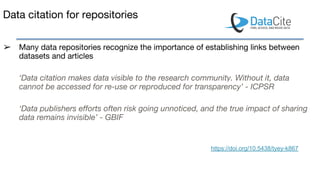
➢
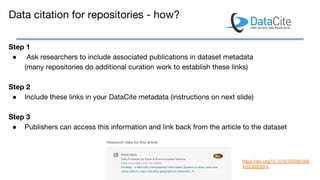
https://doi.org/10.5438/tyey-k867
●
●
●
https://doi.org/10.1016/S0098-300
4(02)00039-0
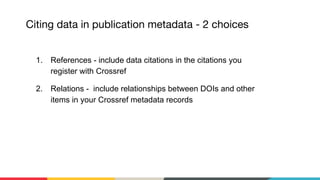
1. References - include data citations in the citations you
register with Crossref
2. Relations - include relationships between DOIs and other
items in your Crossref metadata records
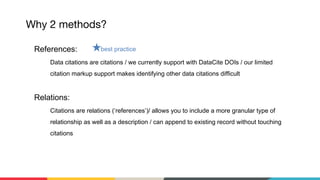
References:
Data citations are citations / we currently support with DataCite DOIs / our limited
citation markup support makes identifying other data citations difficult
Relations:
Citations are relations (‘references’)/ allows you to include a more granular type of
relationship as well as a description / can append to existing record without touching
citations
best practice
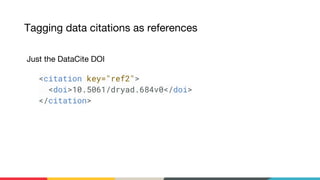
<citation key="ref2">
<doi>10.5061/dryad.684v0</doi>
</citation>
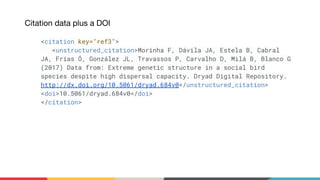
<citation key="ref3">
<unstructured_citation>Morinha F, Dávila JA, Estela B, Cabral
JA, Frías Ó, González JL, Travassos P, Carvalho D, Milá B, Blanco G
(2017) Data from: Extreme genetic structure in a social bird
species despite high dispersal capacity. Dryad Digital Repository.
http://dx.doi.org/10.5061/dryad.684v0</unstructured_citation>
<doi>10.5061/dryad.684v0</doi>
</citation>
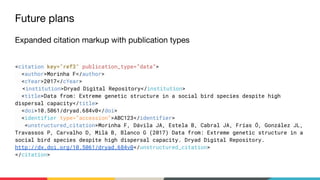
<citation key="ref3" publication_type=”data”>
<author>Morinha F</author>
<cYear>2017</cYear>
<institution>Dryad Digital Repository</institution>
<title>Data from: Extreme genetic structure in a social bird species despite high
dispersal capacity</title>
<doi>10.5061/dryad.684v0</doi>
<identifier type=”accession”>ABC123</identifier>
<unstructured_citation>Morinha F, Dávila JA, Estela B, Cabral JA, Frías Ó, González JL,
Travassos P, Carvalho D, Milá B, Blanco G (2017) Data from: Extreme genetic structure in a
social bird species despite high dispersal capacity. Dryad Digital Repository.
http://dx.doi.org/10.5061/dryad.684v0</unstructured_citation>
</citation>
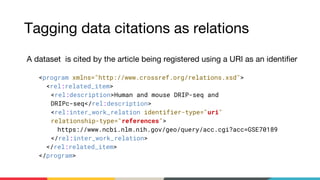
<program xmlns="http://www.crossref.org/relations.xsd">
<rel:related_item>
<rel:description>Human and mouse DRIP-seq and
DRIPc-seq</rel:description>
<rel:inter_work_relation identifier-type="uri"
relationship-type="references">
https://www.ncbi.nlm.nih.gov/geo/query/acc.cgi?acc=GSE70189
</rel:inter_work_relation>
</rel:related_item>
</program>
Tagging data citations as relations
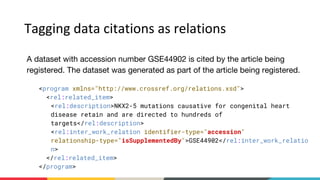
<program xmlns="http://www.crossref.org/relations.xsd">
<rel:related_item>
<rel:description>NKX2-5 mutations causative for congenital heart
disease retain and are directed to hundreds of
targets</rel:description>
<rel:inter_work_relation identifier-type="accession"
relationship-type="isSupplementedBy">GSE44902</rel:inter_work_relatio
n>
</rel:related_item>
</program>
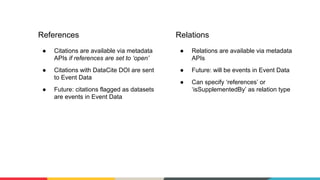
References
● Citations are available via metadata
APIs if references are set to ‘open’
● Citations with DataCite DOI are sent
to Event Data
● Future: citations flagged as datasets
are events in Event Data
Relations
● Relations are available via metadata
APIs
● Future: will be events in Event Data
● Can specify ‘references’ or
‘isSupplementedBy’ as relation type
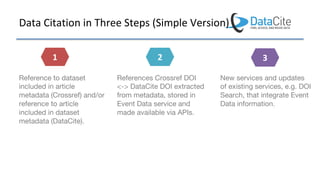
Data Citation in Three Steps (Simple Version)
1 2 3
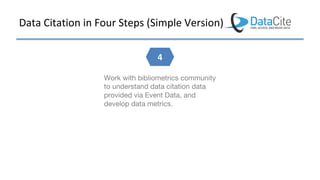
Data Citation in Four Steps (Simple Version)
4
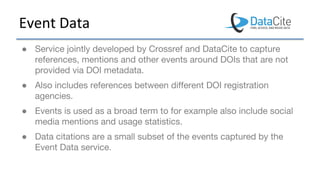
Event Data
●
●
●
●
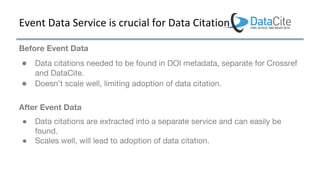
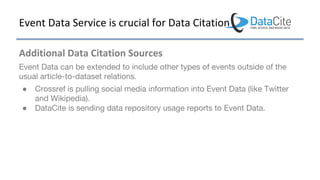
Event Data Service is crucial for Data Citation
●
●
●
●
Event Data Service is crucial for Data Citation
Additional Data Citation Sources
●
●
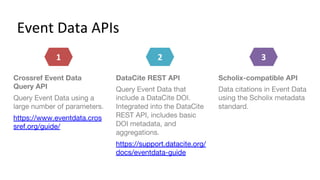
Event Data APIs
1 2 3
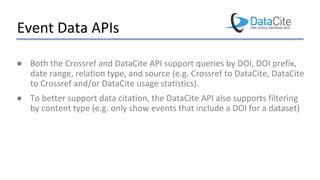
Event Data APIs
● Both the Crossref and DataCite API support queries by DOI, DOI prefix,
date range, relation type, and source (e.g. Crossref to DataCite, DataCite
to Crossref and/or DataCite usage statistics).
● To better support data citation, the DataCite API also supports filtering
by content type (e.g. only show events that include a DOI for a dataset)
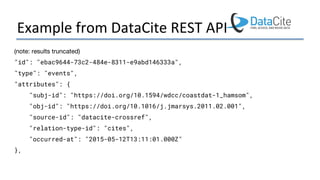
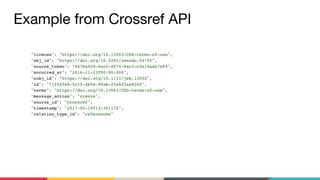
Example from DataCite REST API
"id": "ebac9644-73c2-484e-8311-e9abd146333a",
"type": "events",
"attributes": {
"subj-id": "https://doi.org/10.1594/wdcc/coastdat-1_hamsom",
"obj-id": "https://doi.org/10.1016/j.jmarsys.2011.02.001",
"source-id": "datacite-crossref",
"relation-type-id": "cites",
"occurred-at": "2015-05-12T13:11:01.000Z"
},
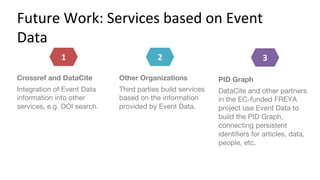
Future Work: Services based on Event
Data
1 2 3
●
●
●
●
●

Crossref DataCite joint data citation webinar

  • 2.
    ● Introducing datacitation (Rachael Lammey, Crossref) ● Data citation & data repositories (Helena Cousijn, DataCite) ● Citing data in publication metadata (Patricia Feeney, Crossref) ● Using data citation information (Robin Dasler, DataCite) ● Q&A
  • 3.
  • 4.
  • 7.
  • 8.
  • 10.
    1. References -include data citations in the citations you register with Crossref 2. Relations - include relationships between DOIs and other items in your Crossref metadata records
  • 11.
    References: Data citations arecitations / we currently support with DataCite DOIs / our limited citation markup support makes identifying other data citations difficult Relations: Citations are relations (‘references’)/ allows you to include a more granular type of relationship as well as a description / can append to existing record without touching citations best practice
  • 12.
  • 13.
    <citation key="ref3"> <unstructured_citation>Morinha F,Dávila JA, Estela B, Cabral JA, Frías Ó, González JL, Travassos P, Carvalho D, Milá B, Blanco G (2017) Data from: Extreme genetic structure in a social bird species despite high dispersal capacity. Dryad Digital Repository. http://dx.doi.org/10.5061/dryad.684v0</unstructured_citation> <doi>10.5061/dryad.684v0</doi> </citation>
  • 14.
    <citation key="ref3" publication_type=”data”> <author>MorinhaF</author> <cYear>2017</cYear> <institution>Dryad Digital Repository</institution> <title>Data from: Extreme genetic structure in a social bird species despite high dispersal capacity</title> <doi>10.5061/dryad.684v0</doi> <identifier type=”accession”>ABC123</identifier> <unstructured_citation>Morinha F, Dávila JA, Estela B, Cabral JA, Frías Ó, González JL, Travassos P, Carvalho D, Milá B, Blanco G (2017) Data from: Extreme genetic structure in a social bird species despite high dispersal capacity. Dryad Digital Repository. http://dx.doi.org/10.5061/dryad.684v0</unstructured_citation> </citation>
  • 15.
    <program xmlns="http://www.crossref.org/relations.xsd"> <rel:related_item> <rel:description>Human andmouse DRIP-seq and DRIPc-seq</rel:description> <rel:inter_work_relation identifier-type="uri" relationship-type="references"> https://www.ncbi.nlm.nih.gov/geo/query/acc.cgi?acc=GSE70189 </rel:inter_work_relation> </rel:related_item> </program>
  • 16.
    Tagging data citationsas relations <program xmlns="http://www.crossref.org/relations.xsd"> <rel:related_item> <rel:description>NKX2-5 mutations causative for congenital heart disease retain and are directed to hundreds of targets</rel:description> <rel:inter_work_relation identifier-type="accession" relationship-type="isSupplementedBy">GSE44902</rel:inter_work_relatio n> </rel:related_item> </program>
  • 17.
    References ● Citations areavailable via metadata APIs if references are set to ‘open’ ● Citations with DataCite DOI are sent to Event Data ● Future: citations flagged as datasets are events in Event Data Relations ● Relations are available via metadata APIs ● Future: will be events in Event Data ● Can specify ‘references’ or ‘isSupplementedBy’ as relation type
  • 18.
    Data Citation inThree Steps (Simple Version) 1 2 3
  • 19.
    Data Citation inFour Steps (Simple Version) 4
  • 20.
  • 21.
    Event Data Serviceis crucial for Data Citation ● ● ● ●
  • 22.
    Event Data Serviceis crucial for Data Citation Additional Data Citation Sources ● ●
  • 23.
  • 24.
    Event Data APIs ●Both the Crossref and DataCite API support queries by DOI, DOI prefix, date range, relation type, and source (e.g. Crossref to DataCite, DataCite to Crossref and/or DataCite usage statistics). ● To better support data citation, the DataCite API also supports filtering by content type (e.g. only show events that include a DOI for a dataset)
  • 25.
    Example from DataCiteREST API "id": "ebac9644-73c2-484e-8311-e9abd146333a", "type": "events", "attributes": { "subj-id": "https://doi.org/10.1594/wdcc/coastdat-1_hamsom", "obj-id": "https://doi.org/10.1016/j.jmarsys.2011.02.001", "source-id": "datacite-crossref", "relation-type-id": "cites", "occurred-at": "2015-05-12T13:11:01.000Z" },
  • 27.
    Future Work: Servicesbased on Event Data 1 2 3
  • 29.