KRISTIAN AUSTINKIMBERLY HENNEJESSE NGUYENJESSIE OSTROWBRITTANY TAITThe Psychology of nigrescence
This stage focuses on the pre-existing identity to be changedThere are attitudes and characteristics that define this stage:AttitudesLow SalienceSocial StigmaAnti-BlackCharacteristicsMiseducationA Eurocentric Cultural PerspectiveSpotlight AnxietyAssimilation-IntegrationValue Structure and OrientationStage 1: pre encounter
Low Salient AttitudesBeing Black does not contribute to their lives in any meaningful way. For some, other aspects of their lives (religion, career, social status) hold more importance.Social Stigma AttitudesBeing Black is a stigma or problem. The experience is negative and centered on oppression.Anti-Black AttitudesBlack as a “negative reference group”Loathes other Black men and women, the community.Takes a “blame the victim” approach to race relations.Stage 1: pre encounter attitudes
MiseducationProducts of a formal education system that is monoracial and monocultural (white and Western). They don’t realize the importance of Black history in American culture or history in general.Black anti-Black people have a negatively distorted view of Black history.Believe that Black people came from a strange, uncivilized land and that slavery was a civilizing experience for them.A Eurocentric Cultural PerspectiveDespite those that think bi-culturally, more emphasis and value is put on Western concepts and art.Black anti-Black men and women see Black art and concepts as “primitive.”Stage 1: pre encounter Characteristics
Spotlight, or Race Image, AnxietyAnxiety about being “too Black,” fulfilling stereotypes.Changes language and actions when around white people.Black anti-Black people are above anxiety because they believe the stereotypes are true. Enslaved in a body and community they hate.Assimilation-IntegrationAssimilate into white culture since other disadvantaged, ethnically white groups have.One-way change. White people simply have to accept, whereas Black people need to change their identities.Value Structure and OrientationPriority on organizations and causes that have low race salience.Stage 1: pre encounter Characteristics
Requires established identityActs as defense to change in identity perceptionEncounter: must have “the effect of catching him or her ‘off guard’” (pg. XXX)Not encounter if it does not impact world viewStage 2: Encounter
Can be a single dramatic eventMore common to be a chain of eventsMust personalize event in order to have the impact of “Encounter”Reactions will vary, but many feel confusion, alarm and anxietyStage 2: Encounter
In this period of transition, a person begins to demolish their former identity while constructing a new identity. Person has made the decision to change, but still in process of transformationThey begin to reject aspects of their familiar identityIn becoming familiar with their new identity, they immerse themselves in idealistic visions of BlacknessWeusior “Black” anxietyOld identity is “bad” and new ideas are “good”Stage 3: Immersion-Emersion
ImmersionIndividual immerses herself in black cultureJoins new organizations and political parties focused on Black issuesDrops membership in Pre-encounter oriented groupsIndividuals in this stage zealously embrace Black culture as liberation from whitenessFocuses on black culture, including music, art, literature, and dress stylesMay turn to creative expressionPrimary communication mode for early converts is confrontation/bluntness Blacker-than-thou syndrome Individual becomes especially community-mindedStage 3: Immersion-Emersion
EmersionAn emergence from the oversimplified and emotionally charged immersion experienceUnderstands that Blackness and Black identity are complexMay switch memberships to organizations considered more committed to BlacknessPrepares to internalize a new identityStage 3: Immersion-Emersion
Negative Consequences of Transitional StageRegressionFixation at Stage 3Dropping OutStage 3: Immersion-Emersion
The new identity is internalizedReturn to steady state of personality and cognitive styleCore personality is re-establishedShift from how others see you to how you see yourselfConception of Blackness tends to become more open, expansive and sophisticatedPerson perceives themselves to be completely changedMore of an effect on group identityStage 3: INternalization
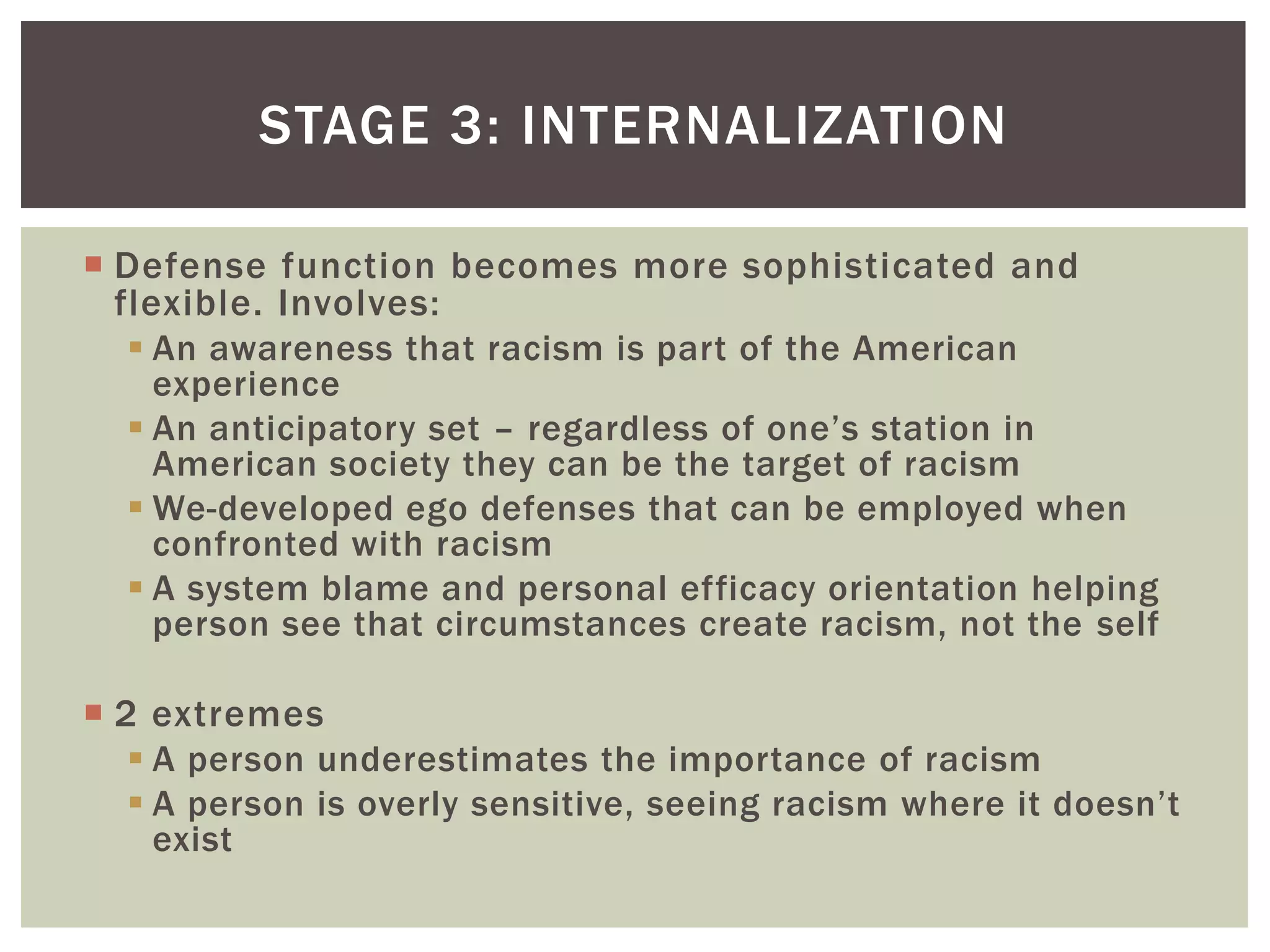
Defense function becomes more sophisticated and flexible. Involves:An awareness that racism is part of the American experienceAn anticipatory set – regardless of one’s station in American society they can be the target of racismWe-developed ego defenses that can be employed when confronted with racismA system blame and personal efficacy orientation helping person see that circumstances create racism, not the self2 extremesA person underestimates the importance of racismA person is overly sensitive, seeing racism where it doesn’t existStage 3: INternalization
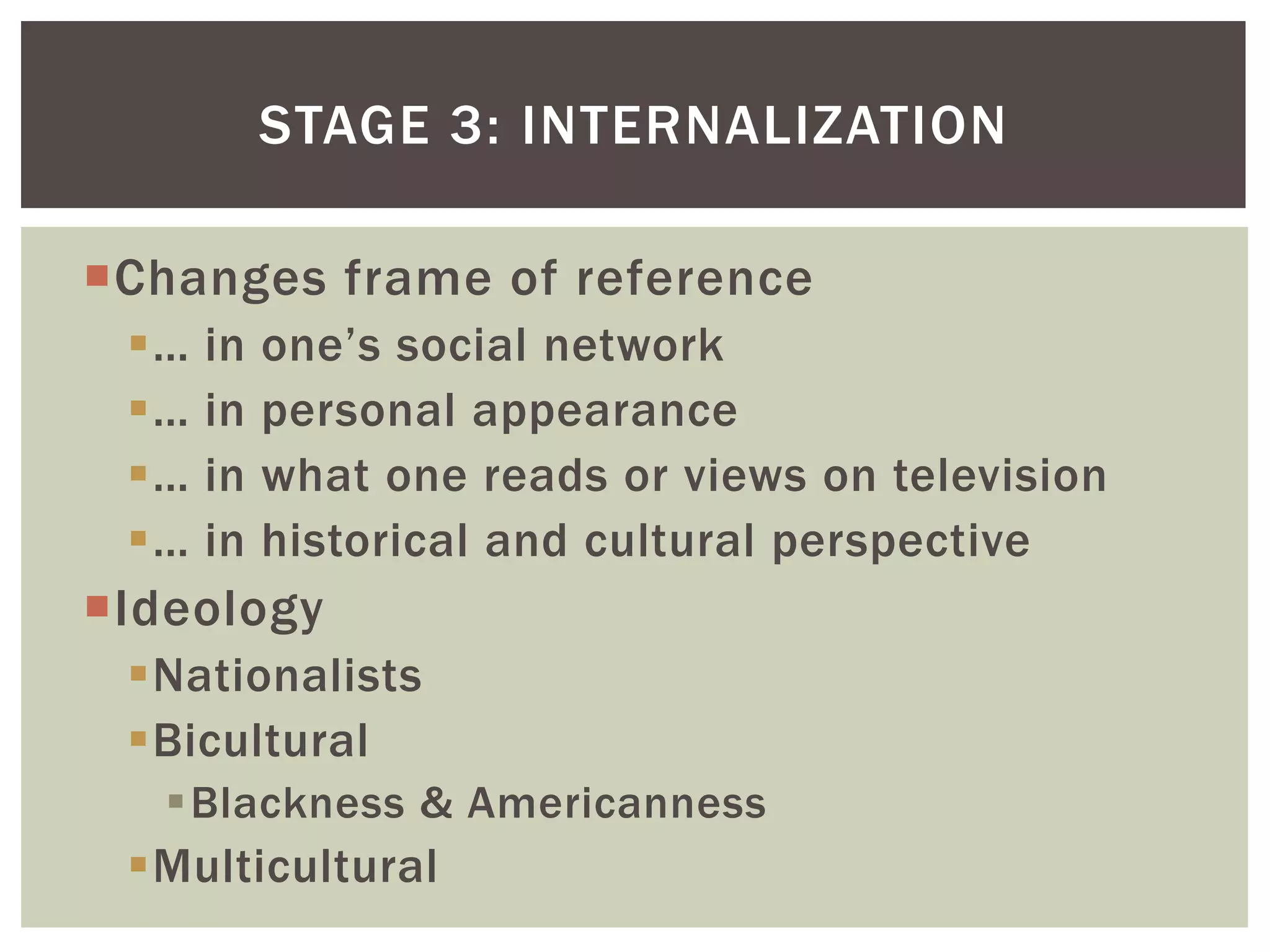
Changes frame of reference… in one’s social network… in personal appearance… in what one reads or views on television… in historical and cultural perspectiveIdeologyNationalistsBiculturalBlackness & AmericannessMulticulturalStage 3: INternalization
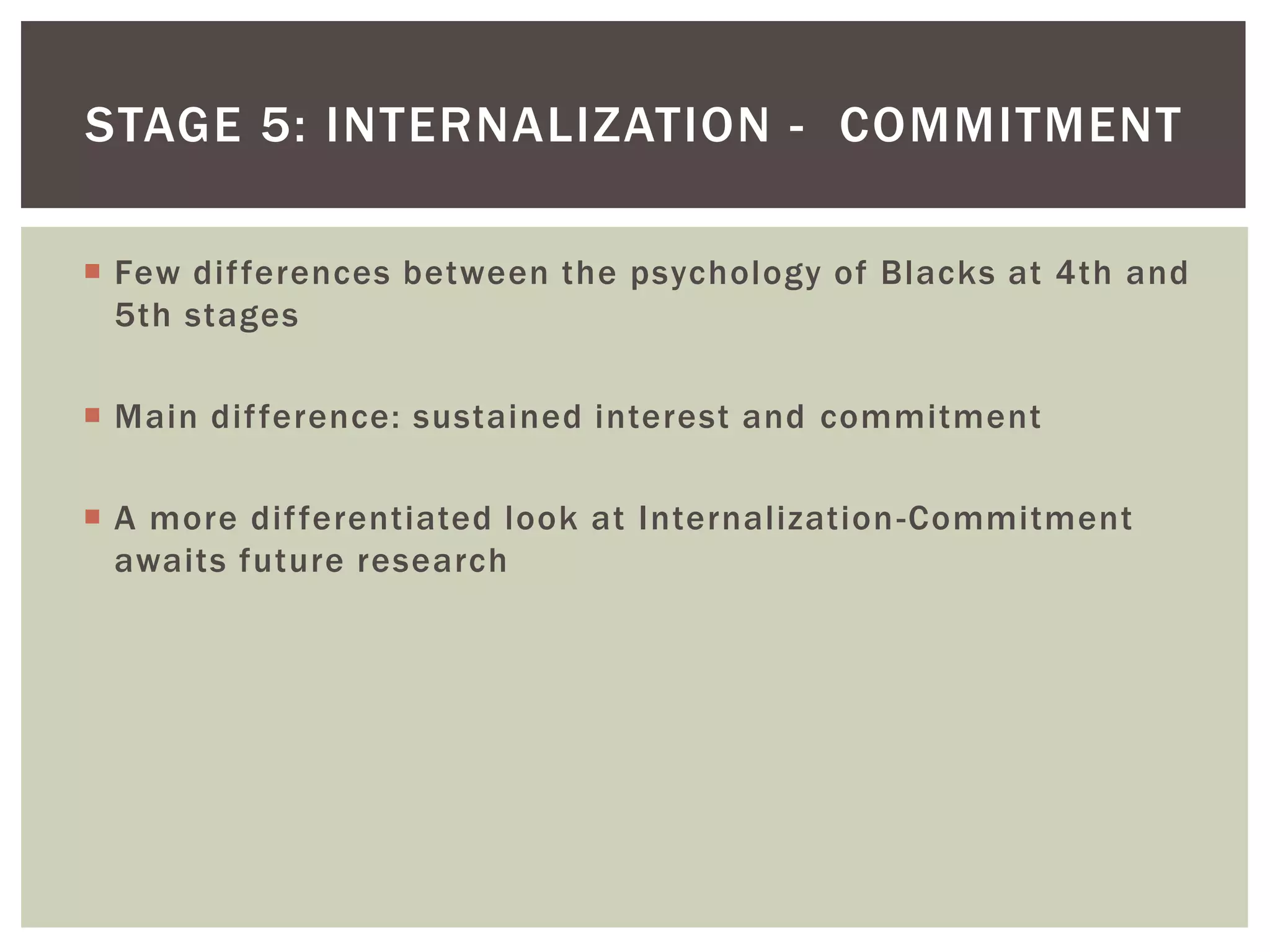
Few differences between the psychology of Blacks at 4th and 5th stagesMain difference: sustained interest and commitmentA more differentiated look at Internalization-Commitment awaits future researchStage 5: internalization -  commitment
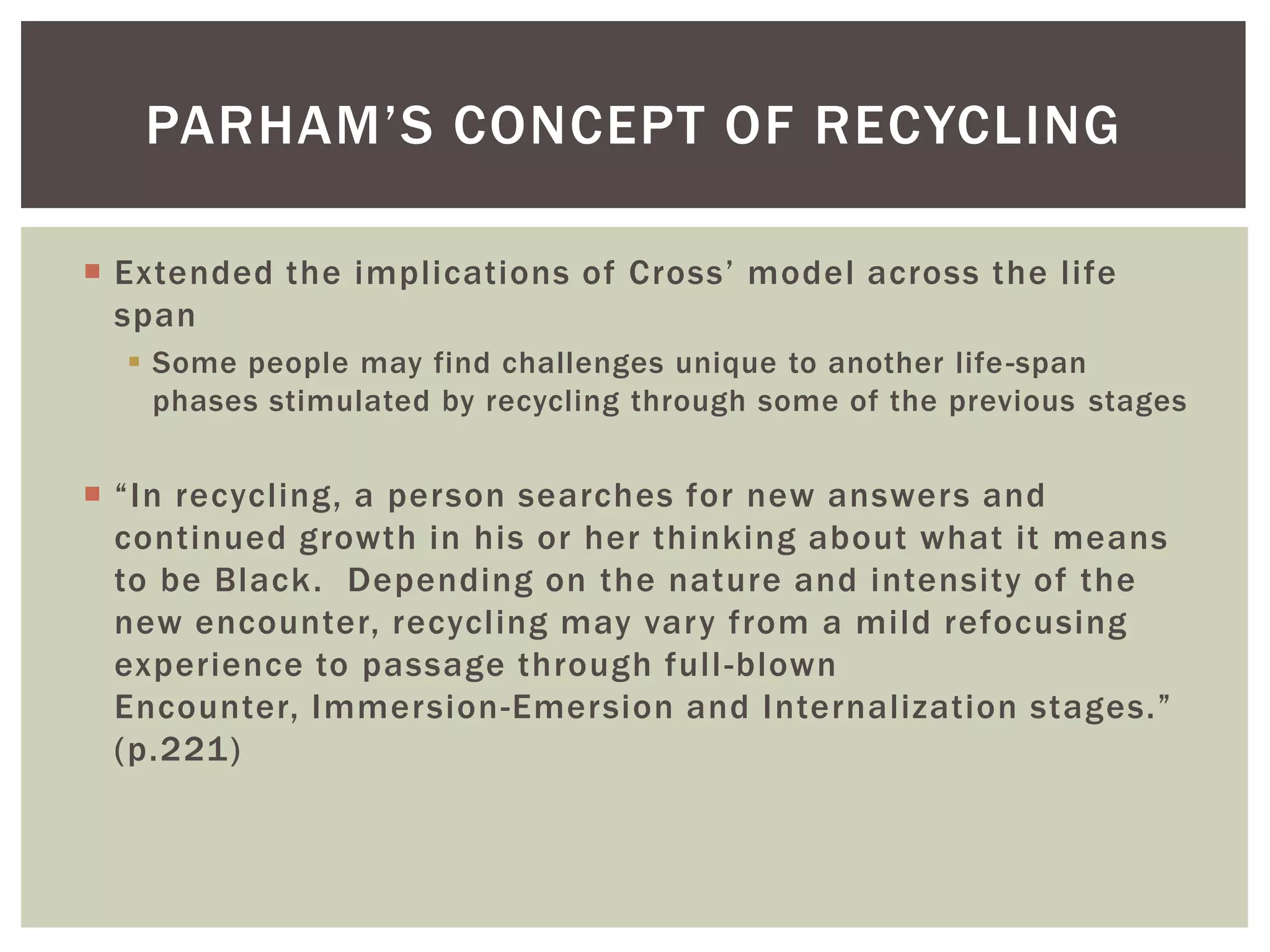
Extended the implications of Cross’ model across the life spanSome people may find challenges unique to another life-span phases stimulated by recycling through some of the previous stages“In recycling, a person searches for new answers and continued growth in his or her thinking about what it means to be Black.  Depending on the nature and intensity of the new encounter, recycling may vary from a mild refocusing experience to passage through full-blown Encounter, Immersion-Emersion and Internalization stages.” (p.221)Parham’s Concept of Recycling
Nigrescence needed to be coupled with the development of a comparative referentAfrocentric MovementAttempt to apply non-Western perspective to analysis of Black life in the United StatesToday, the original nigrescence cycle takes place within the context of the Afrocentric movementHowever, Cross suggests that they two paradigms should remain distinctNigrescence and Afrocentricity
Stage 1: Pre-EncounterStage 2: EncounterStage 3: Immersion-EmersionStage 4: InternalizationStage 5: Internalization-CommitmentWhich stage corresponds to your scenario?

Cross Presentation

  • 1.
    KRISTIAN AUSTINKIMBERLY HENNEJESSENGUYENJESSIE OSTROWBRITTANY TAITThe Psychology of nigrescence
  • 2.
    This stage focuseson the pre-existing identity to be changedThere are attitudes and characteristics that define this stage:AttitudesLow SalienceSocial StigmaAnti-BlackCharacteristicsMiseducationA Eurocentric Cultural PerspectiveSpotlight AnxietyAssimilation-IntegrationValue Structure and OrientationStage 1: pre encounter
  • 3.
    Low Salient AttitudesBeingBlack does not contribute to their lives in any meaningful way. For some, other aspects of their lives (religion, career, social status) hold more importance.Social Stigma AttitudesBeing Black is a stigma or problem. The experience is negative and centered on oppression.Anti-Black AttitudesBlack as a “negative reference group”Loathes other Black men and women, the community.Takes a “blame the victim” approach to race relations.Stage 1: pre encounter attitudes
  • 4.
    MiseducationProducts of aformal education system that is monoracial and monocultural (white and Western). They don’t realize the importance of Black history in American culture or history in general.Black anti-Black people have a negatively distorted view of Black history.Believe that Black people came from a strange, uncivilized land and that slavery was a civilizing experience for them.A Eurocentric Cultural PerspectiveDespite those that think bi-culturally, more emphasis and value is put on Western concepts and art.Black anti-Black men and women see Black art and concepts as “primitive.”Stage 1: pre encounter Characteristics
  • 5.
    Spotlight, or RaceImage, AnxietyAnxiety about being “too Black,” fulfilling stereotypes.Changes language and actions when around white people.Black anti-Black people are above anxiety because they believe the stereotypes are true. Enslaved in a body and community they hate.Assimilation-IntegrationAssimilate into white culture since other disadvantaged, ethnically white groups have.One-way change. White people simply have to accept, whereas Black people need to change their identities.Value Structure and OrientationPriority on organizations and causes that have low race salience.Stage 1: pre encounter Characteristics
  • 6.
    Requires established identityActsas defense to change in identity perceptionEncounter: must have “the effect of catching him or her ‘off guard’” (pg. XXX)Not encounter if it does not impact world viewStage 2: Encounter
  • 7.
    Can be asingle dramatic eventMore common to be a chain of eventsMust personalize event in order to have the impact of “Encounter”Reactions will vary, but many feel confusion, alarm and anxietyStage 2: Encounter
  • 8.
    In this periodof transition, a person begins to demolish their former identity while constructing a new identity. Person has made the decision to change, but still in process of transformationThey begin to reject aspects of their familiar identityIn becoming familiar with their new identity, they immerse themselves in idealistic visions of BlacknessWeusior “Black” anxietyOld identity is “bad” and new ideas are “good”Stage 3: Immersion-Emersion
  • 9.
    ImmersionIndividual immerses herselfin black cultureJoins new organizations and political parties focused on Black issuesDrops membership in Pre-encounter oriented groupsIndividuals in this stage zealously embrace Black culture as liberation from whitenessFocuses on black culture, including music, art, literature, and dress stylesMay turn to creative expressionPrimary communication mode for early converts is confrontation/bluntness Blacker-than-thou syndrome Individual becomes especially community-mindedStage 3: Immersion-Emersion
  • 10.
    EmersionAn emergence fromthe oversimplified and emotionally charged immersion experienceUnderstands that Blackness and Black identity are complexMay switch memberships to organizations considered more committed to BlacknessPrepares to internalize a new identityStage 3: Immersion-Emersion
  • 11.
    Negative Consequences ofTransitional StageRegressionFixation at Stage 3Dropping OutStage 3: Immersion-Emersion
  • 12.
    The new identityis internalizedReturn to steady state of personality and cognitive styleCore personality is re-establishedShift from how others see you to how you see yourselfConception of Blackness tends to become more open, expansive and sophisticatedPerson perceives themselves to be completely changedMore of an effect on group identityStage 3: INternalization
  • 13.
    Defense function becomesmore sophisticated and flexible. Involves:An awareness that racism is part of the American experienceAn anticipatory set – regardless of one’s station in American society they can be the target of racismWe-developed ego defenses that can be employed when confronted with racismA system blame and personal efficacy orientation helping person see that circumstances create racism, not the self2 extremesA person underestimates the importance of racismA person is overly sensitive, seeing racism where it doesn’t existStage 3: INternalization
  • 14.
    Changes frame ofreference… in one’s social network… in personal appearance… in what one reads or views on television… in historical and cultural perspectiveIdeologyNationalistsBiculturalBlackness & AmericannessMulticulturalStage 3: INternalization
  • 15.
    Few differences betweenthe psychology of Blacks at 4th and 5th stagesMain difference: sustained interest and commitmentA more differentiated look at Internalization-Commitment awaits future researchStage 5: internalization - commitment
  • 16.
    Extended the implicationsof Cross’ model across the life spanSome people may find challenges unique to another life-span phases stimulated by recycling through some of the previous stages“In recycling, a person searches for new answers and continued growth in his or her thinking about what it means to be Black.  Depending on the nature and intensity of the new encounter, recycling may vary from a mild refocusing experience to passage through full-blown Encounter, Immersion-Emersion and Internalization stages.” (p.221)Parham’s Concept of Recycling
  • 17.
    Nigrescence needed tobe coupled with the development of a comparative referentAfrocentric MovementAttempt to apply non-Western perspective to analysis of Black life in the United StatesToday, the original nigrescence cycle takes place within the context of the Afrocentric movementHowever, Cross suggests that they two paradigms should remain distinctNigrescence and Afrocentricity
  • 18.
    Stage 1: Pre-EncounterStage2: EncounterStage 3: Immersion-EmersionStage 4: InternalizationStage 5: Internalization-CommitmentWhich stage corresponds to your scenario?