Submitted by:
Vaibhav Agarwal…(37) Laxmi Narasimhan…..(27) Nitin Kumar....…….….(43)
Mayank Singhal….(38) Mohammad Junaid...(28) Naveen Reddy………..(65)
Ajay Veer………......(53)
 Cross-Functional communication can be referred as the
communication between different teams which have
different functional expertise working toward a common
goal.
 It may include people from finance, marketing, operations,
and human resources departments. Typically, it includes
employees from all levels of an organization.
 Communicating effectively is imperative to both professional
and personal success. A close-knit working environment that
emphasizes the importance of communication can positively
impact not only teams, but the individuals within those
teams, leading to a stronger workplace and greater
organizational effectiveness
Amity Business School
The task of achieving cross-functionality is difficult in
that each employee might not communicate the same
way, and the work environment can either help or hinder
productivity.
 To produce better results more quickly.
 To improve coordination and integration.
 To reduce the production cycle time in new product
development.
 To bring people together from different disciplines
which improves problem solving and decision making.
 To foster the spirit of cooperation.
Amity Business School
 We all work with people every day, whether it is within our
office space or on meetings with clients and members which
makes it vital to understand how to best engage with them.
 To understand that not every person we interact with on a
daily basis will respond to one type of communication. Each
and every member deserves a distinct relationship, and it is
our job to treat members in a way that is unique to their
preferred method of communication.
 There are several platforms where communication can take
place, and taking the time to figure out which is preferred is
crucial. Understanding what your colleagues or clients respond
to will ultimately help you master the goal of achieving cross-
functional communication.
Amity Business School
The problems of cross-functional interaction:
• Conflict between departments as a part of business model.
• Departments can understand business priorities in their own way.
• The "natural" conflicts (sales with marketing, finance with
purchases).
• Resistance to communicate with other departments.
• Attempt to avoid tasks responsibility, trying transfer this tasks to
other people.
• Cross-functional conflicts can be informal “long war with a smile on
faces”.
Amity Business School
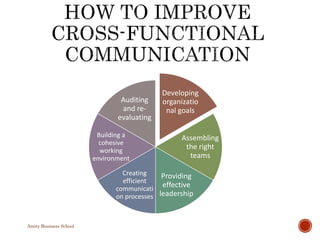
Developing
organizatio
nal goals
Assembling
the right
teams
Providing
effective
leadership
Creating
efficient
communicati
on processes
Building a
cohesive
working
environment
Auditing
and re-
evaluating
Amity Business School
1. Developing organizational goals
One way to get your teams collaborating more efficiently
is by giving them unified goals that they can work
towards. Setting and achieving goals together helps to
create more cohesive working relationships and makes
solving cross-functional issues much more efficient.
2. Assembling the right teams
It’s important to understand the critical skill sets
necessary to complete all tasks on time and accurately.
Having an outside opinion on the best candidates for a
cross-functional team can be extremely beneficial to have
and will keep your teams productive and accountable.
Amity Business School
3. Providing effective leadership
Consulting firms have a wealth of knowledge in their
field and have the tools and experience necessary to
become great team leaders for your organization.
4. Creating efficient communication processes
When working directly with team members, third-
party firms Enforce some standards that will help
ensure that teams are communicating regularly
enough to support the integrity of their projects.
Amity Business School
5. Building a cohesive working environment
when working towards achieving mutual company goals.
multiple departments are involved so they can ensure
that all parties receive equal level of accountability and
recognition when projects are launched successfully.
6. Auditing and re-evaluating
Third-party firms can actively monitor the effectiveness
of your company’s operations and interdepartmental
communication standards while making changes that
directly support the sustainability of your projects over
time.
Amity Business School
Cross functional communication

Cross functional communication

  • 1.
    Submitted by: Vaibhav Agarwal…(37)Laxmi Narasimhan…..(27) Nitin Kumar....…….….(43) Mayank Singhal….(38) Mohammad Junaid...(28) Naveen Reddy………..(65) Ajay Veer………......(53)
  • 2.
     Cross-Functional communicationcan be referred as the communication between different teams which have different functional expertise working toward a common goal.  It may include people from finance, marketing, operations, and human resources departments. Typically, it includes employees from all levels of an organization.  Communicating effectively is imperative to both professional and personal success. A close-knit working environment that emphasizes the importance of communication can positively impact not only teams, but the individuals within those teams, leading to a stronger workplace and greater organizational effectiveness Amity Business School
  • 3.
    The task ofachieving cross-functionality is difficult in that each employee might not communicate the same way, and the work environment can either help or hinder productivity.  To produce better results more quickly.  To improve coordination and integration.  To reduce the production cycle time in new product development.  To bring people together from different disciplines which improves problem solving and decision making.  To foster the spirit of cooperation. Amity Business School
  • 4.
     We allwork with people every day, whether it is within our office space or on meetings with clients and members which makes it vital to understand how to best engage with them.  To understand that not every person we interact with on a daily basis will respond to one type of communication. Each and every member deserves a distinct relationship, and it is our job to treat members in a way that is unique to their preferred method of communication.  There are several platforms where communication can take place, and taking the time to figure out which is preferred is crucial. Understanding what your colleagues or clients respond to will ultimately help you master the goal of achieving cross- functional communication. Amity Business School
  • 5.
    The problems ofcross-functional interaction: • Conflict between departments as a part of business model. • Departments can understand business priorities in their own way. • The "natural" conflicts (sales with marketing, finance with purchases). • Resistance to communicate with other departments. • Attempt to avoid tasks responsibility, trying transfer this tasks to other people. • Cross-functional conflicts can be informal “long war with a smile on faces”. Amity Business School
  • 6.
    Developing organizatio nal goals Assembling the right teams Providing effective leadership Creating efficient communicati onprocesses Building a cohesive working environment Auditing and re- evaluating Amity Business School
  • 7.
    1. Developing organizationalgoals One way to get your teams collaborating more efficiently is by giving them unified goals that they can work towards. Setting and achieving goals together helps to create more cohesive working relationships and makes solving cross-functional issues much more efficient. 2. Assembling the right teams It’s important to understand the critical skill sets necessary to complete all tasks on time and accurately. Having an outside opinion on the best candidates for a cross-functional team can be extremely beneficial to have and will keep your teams productive and accountable. Amity Business School
  • 8.
    3. Providing effectiveleadership Consulting firms have a wealth of knowledge in their field and have the tools and experience necessary to become great team leaders for your organization. 4. Creating efficient communication processes When working directly with team members, third- party firms Enforce some standards that will help ensure that teams are communicating regularly enough to support the integrity of their projects. Amity Business School
  • 9.
    5. Building acohesive working environment when working towards achieving mutual company goals. multiple departments are involved so they can ensure that all parties receive equal level of accountability and recognition when projects are launched successfully. 6. Auditing and re-evaluating Third-party firms can actively monitor the effectiveness of your company’s operations and interdepartmental communication standards while making changes that directly support the sustainability of your projects over time. Amity Business School

Editor's Notes

  • #4 The teams foster a spirit of cooperation that can make it easier to achieve customer satisfaction and corporate goals at the same time.