COMPARISON OF WATER USE AND CROP WATER USE EFFICIENCY OF MAIZE,
                SORGHUM, AND SOYBEAN IN NEBRASKA
                                                                                                      J.M. Rees*1, S. Irmak2, and D. Andersen3.
                                                                                                 1Extension Educator, University of Nebraska-Lincoln
                                                                              2Soil & Water Resources & Irrigation Engineer, UNL Dept. of Biological Systems Engineering
                                                                                   3Water Resources Specialist, Little Blue Natural Resources District, Davenport, NE


                                                                                                                                                                                                                               Figure 1. Seasonal Crop Water Use (ET) for Maize, Soybean,
ABSTRACT:                                                                         RESULTS/DISCUSSION:                                                                                                                          and Sorghum in 2009 and 2010 from emergence to
Water is a crucial resource for agricultural production. As the availability of   General soil water balance equation was used to quantify seasonal crop water use and water use efficiency:                                  physiological maturity
freshwater resources is decreasing in parts of Nebraska and the world,                ETc = (TSWi - TSWe) + rainfall – RO – DP                                                                                                                                                            26
newer hybrids and varieties have been developed for handling stresses like                                                                                                                                                                                                                24
                                                                                       where:
water-limited conditions. While the trend of losing rainfed sorghum acres to           ETc      = crop evapotranspiration (in)                                                                                                                                                            22
maize acres continues, data lack in terms of water use efficiency between              TSWi     = initial available soil water at the beginning of season (in)                                                                                                                            20
maize, sorghum, and soybean. Field studies were conducted in two rainfed               TSWe     = available soil water at the full maturity (in)                                                                                                                                                     14.5”              23.3”         14.0”               22.0”            13.7”          21.3”
                                                                                                                                                                                                                                                                                          18


                                                                                                                                                                                                                                                                  Crop water use (in)
fields in South Central Nebraska to determine crop water use efficiency of             RO       = Runoff (assumed zero)
                                                                                                                                                                                                                                                                                          16
these three crops over several years. Watermark granular matrix sensors                DP       = Deep percolation (assumed zero)
                                                                                                                                                                                                                                                                                          14
measured soil water status every 1 ft up to 4 ft for the entire growing season    Evapotranspiration of maize, soybean, and sorghum in 2009 was: 14.5”, 14.0”, and 13.7” respectively with                                                                                               12
and a general soil water balance equation was used to quantify seasonal            10.1” of rainfall during the growing season (Figures 1 and 2).                                                                                                                                         10
crop water use and water use efficiency. In 2009, the evapotranspiration          Evapotranspiration of maize, soybean, and sorghum in 2010 was: 23.3”, 22.0”, and 21.3” respectively with                                                                                                   8
(ET) of maize, soybean, and sorghum was 14.5, 14.0, and 13.7 inches and            16.4” of rainfall during the growing season (Figures 1 and 3).                                                                                                                                             6
in 2010, 23.3, 22.0, and 21.3 inches, respectively. By accounting the final
                                                                                  All crops both years followed the same trend with maize using more water than soybean and sorghum each                                                                                                     4
grain yields, the overall crop water use efficiency of maize was 6.7 bu/inch in                                                                                                                                                                                                               2
2009 and 4.3 bu/inch in 2010; for soybean it was 2.4 bu/inch in 2009 and 2.0       year (Figure 1).
                                                                                                                                                                                                                                                                                              0
bu/inch in 2010; and for sorghum it was 5.6 bu/inch in 2009 and 5.5 bu/inch       Crop Water Use Efficiency (CWUE) was determined by dividing the final yield/ET for each crop each year.                                                                                                        Maize 2009 Maize 2010              Soy 2009          Soy 2010        Sorg 2009       Sorg 2010
in 2010. Rainfed maize was most efficient in the drier year of 2009.               Sorghum had the most consistent CWUE between 2009 and 2010. All CWUE can be viewed in Table 2.
However, sorghum was the most consistent water use-efficient crop                 2009 was a dry summer in this area of Nebraska. All crops rooted down utilizing moisture out of the 4 th foot soil
between the two years of varying environmental conditions with rainfall            moisture profile removing 5” on average from the total moisture profile (Figure 2). Herbicide did not receive
received from crop emergence to physiological maturity of 10.1 inches in                                                                                                                                                       Table 2. ET, Yield, and Crop Water Use Efficiency of Maize,
                                                                                   rainfall for activation. Grass pressure and nitrogen deficiency may have contributed to low sorghum yield in 2009.                          Soybean, and Sorghum in 2009 and 2010.
2009 and 16.4 inches in 2010.
                                                                                  2010 was a very wet May and June followed by a dry summer and fall. Maize and soybean only depleted 2.5”
                                                                                   out of the total moisture profile while sorghum depleted 3.0” (Figure 3). Maize shut down early in August due to                                                                              Crop                       2009          2009         2009             2010         2010               2010
                                                                                   environmental stresses while sorghum was flowering during the one substantial rain received in August.                                                                                                                    Etc          Yield       CWUE               Etc         Yield             CWUE
                                                                                                                                                                                                                                                                                                             (in)         (bu)        (bu/in)            (in)       (bu/ac)            (bu/in)
 OBJECTIVE:
 Determine the crop water use efficiency of new maize,
 sorghum, and soybean hybrids and varieties.                                                                                                                                                                                                                                Maize                           14.5           97.5             6.7         23.3            101.2             4.3


                                                                                                                                                                                                                                                       Soybean                                               14            33.4             2.4         22.0            44.0              2.0

                                                                                          Table 1. Agronomic Practices for Each Field Site in 2009 and 2010.                                                                                     Sorghum                                                    13.7           77.4             5.6         21.3            118.0             5.5
                                                                                          Practice Performed                Lawrence, NE 2009                                   Lawrence, NE 2010
                                                                                          Planting Date and Rate            May 7 at 20,000 seeds/acre                          May 7 at 20,000 seeds/acre
                                                                                          Maize Hybrid                      Pioneer 33T57                                       Pioneer 33T57                                  Figure 2 (2009) and Figure 3 (2010) Total Soil Water Depletion
                                                                                          Planting Date and Rate            May 8 at 135,000 seeds/acre                         May 7 at 135,000 seeds/acre                    for Maize, Soybean, and Sorghum vs. Cumulative Rainfall.
                                                                                          Soybean Variety                   Pioneer 92M61                                       Pioneer 92M61
                                                                                          Planting Date and Rate            May 19 at 65,000 seeds/acre                         May 28 at 65,000 seeds/acre                                                                      12.0                                                                                                       12
                                                                                          Sorghum Variety                   Pioneer 85Y40                                       Pioneer 85Y40
                                                                                                                                                                                                                                                                                 11.0


                                                                                                                                                                                                                                   Total soil water in the top 4 ft (in)
                                                                                          Row Spacing and No. Rows 12 rows, 30” spacing                                         12 rows, 30” spacing
                                                                                                                                                                                                                                                                                 10.0                                                                                                       10
                                                                                          Previous Crop                     Sorghum                                             Sorghum                                                                                                             Rainfall (in.)
                                                                                                                                                                                                                                                                                        9.0


                                                                                                                                                                                                                                                                                                                                                                                                  Cumulative Rainfall (in.)
                                                                                          Tillage Practice                  No-till                                             No-till
                                                                                                                                                                                                                                                                                        8.0         Maize                                                                                   8
                                                                                          Fertilizer                        Dry blend 90-40-0 as per soil test for 100 bu/ac    100 lbs urea + Nserve as per soil test for                                                              7.0
                                                                                                                            sorghum                                             100 bu/ac sorghum                                                                                                   Soybean
                                                                                                                                                                                                                                                                                        6.0                                                                                                 6
                                                                                          Soil Moisture Equipment           May 22: Maize and Soybean                           May 18: Maize and Soybean                                                                                           Sorghum
 MATERIALS/METHODS:                                                                       Installation                      June 12: Sorghum                                    June 4: Sorghum                                                                                         5.0
                                                                                                                                                                                                                                                                                                    Cumulative
                                                                                                                                                                                                                                                                                        4.0                                                                                                 4
 Study was conducted via on-farm research. A farmer with                                 Herbicide                         *Pre-plant application of Dual II Magnum and        *Pre-plant Glyphosate burndown.                                                                                     Rainfall (in)
                                                                                                                             Glyphosate over entire plot.                       *Split Lumax application to sorghum pre-                                                                3.0
  rainfed fields was identified to cooperate with this study.                                                               *Glyphosate application to maize and soybean.        plant and at planting.                                                                                 2.0                                                                                                 2
  The field location changed each year. All agronomic                                                                       *Rescue treatment of Paramount and Atrazine for     *One post application of Glyphosate to maize                                                            1.0
  practices can be viewed in Table 1.                                                                                        grass control in sorghum.                           and soybean.
                                                                                                                                                                                                                                                                                        0.0                                                                                                 0
                                                                                                                            *2nd Glyphosate application to maize and soybean.                                                                                                                                                                Date
 A three crop randomized complete block design was                                       Full Maturity Date                Soybean: September 15          Maize: October 5     Soybean: August 30 Maize: September 12
                                                                                                                                                                                                                                                                                        21-May-09       15-Jun-09        10-Jul-09    4-Aug-09         29-Aug-09    23-Sep-09        18-Oct-09

  implemented for this study.                                                                                               Sorghum: October 6                                  Sorghum: October 4                                                          12.0                                                                                                                             18

 Watermark granular matrix sensors were installed after crop                                                                                                                                                                                                                                                                                                                                16
                                                                                                                                                                                                                                                            10.0
  emergence in each plot. These sensors measured soil
  water status every 1 ft up to 4 ft. Data was collected every                            CONCLUSIONS:                                                                                                                                                                                                                                                                                       14


                                                                                                                                                                                                                               Total soil water (in/4 ft)
                                                                                          Rainfed maize was the most water use efficient crop in the drier year of 2009,


                                                                                                                                                                                                                                                                                                                                                                                                                          Cumulative rainfall (in)
                                                                                                                                                                                                                                                                           8.0                                                                                                               12
  hour during the growing season for each crop plot.
 Each plot was checked once/week during the growing                                       most likely because of deep rooting depth. Maize roots failed to root down in                                                                                                   6.0                                                                     Rain (in)
                                                                                                                                                                                                                                                                                                                                                                                             10

  season to ensure all equipment was working. Field notes                                  2010 due to the wet spring which may have inhibited CWUE in 2010.                                                                                                                                                                                       Maize tot. water (in)                     8

  regarding weed/disease pressure and crop condition were                                 Sorghum was the most consistent water-use efficient crop from 2009-2010.                                                                                                        4.0                                                                     Soybean tot. water (in)                   6
                                                                                                                                                                                                                                                                                                                                                   Sorghum tot. water (in)
  taken.                                                                                  One more year of research will be conducted to make further conclusions and                                                                                                                                                                                                                       4
                                                                                                                                                                                                                                                                                                                                                   Cum. Rainfall (in)
 Data was collected and summarized at the end of the                                      solidify results.
                                                                                                                                                                                                                                                                           2.0
                                                                                                                                                                                                                                                                                                                                                                                             2
  growing season.
 Results were presented at winter meetings, field days, and                                                                                                                                                                                                               0.0
                                                                                                                                                                                                                                                                           22-May-10                11-Jun-10        1-Jul-10   21-Jul-10    10-Aug-10     30-Aug-10     19-Sep-10
                                                                                                                                                                                                                                                                                                                                                                                             0
                                                                                                                                                                                                                                                                                                                                                                                       9-Oct-10
                                                                                          This research was sponsored by a grant from the Nebraska Grain Sorghum Board. A special thanks to John
  http://cropwatch.unl.edu.                                                               Dolnicek, the cooperating farmer on this study.                                                                                                                                                                                                   Date

Crop waterusecomparisonposter

  • 1.
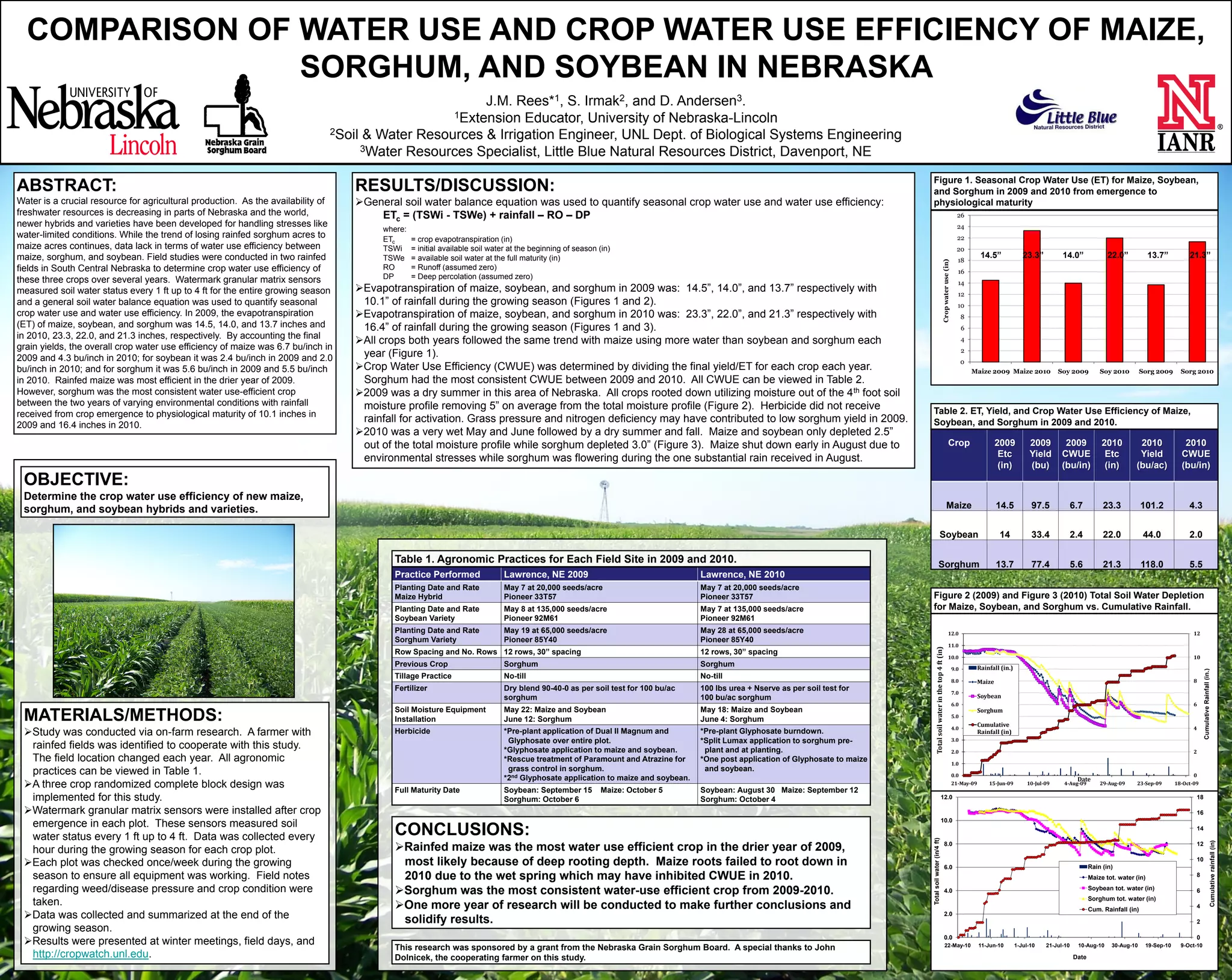
    COMPARISON OF WATERUSE AND CROP WATER USE EFFICIENCY OF MAIZE, SORGHUM, AND SOYBEAN IN NEBRASKA J.M. Rees*1, S. Irmak2, and D. Andersen3. 1Extension Educator, University of Nebraska-Lincoln 2Soil & Water Resources & Irrigation Engineer, UNL Dept. of Biological Systems Engineering 3Water Resources Specialist, Little Blue Natural Resources District, Davenport, NE Figure 1. Seasonal Crop Water Use (ET) for Maize, Soybean, ABSTRACT: RESULTS/DISCUSSION: and Sorghum in 2009 and 2010 from emergence to Water is a crucial resource for agricultural production. As the availability of General soil water balance equation was used to quantify seasonal crop water use and water use efficiency: physiological maturity freshwater resources is decreasing in parts of Nebraska and the world, ETc = (TSWi - TSWe) + rainfall – RO – DP 26 newer hybrids and varieties have been developed for handling stresses like 24 where: water-limited conditions. While the trend of losing rainfed sorghum acres to ETc = crop evapotranspiration (in) 22 maize acres continues, data lack in terms of water use efficiency between TSWi = initial available soil water at the beginning of season (in) 20 maize, sorghum, and soybean. Field studies were conducted in two rainfed TSWe = available soil water at the full maturity (in) 14.5” 23.3” 14.0” 22.0” 13.7” 21.3” 18 Crop water use (in) fields in South Central Nebraska to determine crop water use efficiency of RO = Runoff (assumed zero) 16 these three crops over several years. Watermark granular matrix sensors DP = Deep percolation (assumed zero) 14 measured soil water status every 1 ft up to 4 ft for the entire growing season Evapotranspiration of maize, soybean, and sorghum in 2009 was: 14.5”, 14.0”, and 13.7” respectively with 12 and a general soil water balance equation was used to quantify seasonal 10.1” of rainfall during the growing season (Figures 1 and 2). 10 crop water use and water use efficiency. In 2009, the evapotranspiration Evapotranspiration of maize, soybean, and sorghum in 2010 was: 23.3”, 22.0”, and 21.3” respectively with 8 (ET) of maize, soybean, and sorghum was 14.5, 14.0, and 13.7 inches and 16.4” of rainfall during the growing season (Figures 1 and 3). 6 in 2010, 23.3, 22.0, and 21.3 inches, respectively. By accounting the final All crops both years followed the same trend with maize using more water than soybean and sorghum each 4 grain yields, the overall crop water use efficiency of maize was 6.7 bu/inch in 2 2009 and 4.3 bu/inch in 2010; for soybean it was 2.4 bu/inch in 2009 and 2.0 year (Figure 1). 0 bu/inch in 2010; and for sorghum it was 5.6 bu/inch in 2009 and 5.5 bu/inch Crop Water Use Efficiency (CWUE) was determined by dividing the final yield/ET for each crop each year. Maize 2009 Maize 2010 Soy 2009 Soy 2010 Sorg 2009 Sorg 2010 in 2010. Rainfed maize was most efficient in the drier year of 2009. Sorghum had the most consistent CWUE between 2009 and 2010. All CWUE can be viewed in Table 2. However, sorghum was the most consistent water use-efficient crop 2009 was a dry summer in this area of Nebraska. All crops rooted down utilizing moisture out of the 4 th foot soil between the two years of varying environmental conditions with rainfall moisture profile removing 5” on average from the total moisture profile (Figure 2). Herbicide did not receive received from crop emergence to physiological maturity of 10.1 inches in Table 2. ET, Yield, and Crop Water Use Efficiency of Maize, rainfall for activation. Grass pressure and nitrogen deficiency may have contributed to low sorghum yield in 2009. Soybean, and Sorghum in 2009 and 2010. 2009 and 16.4 inches in 2010. 2010 was a very wet May and June followed by a dry summer and fall. Maize and soybean only depleted 2.5” out of the total moisture profile while sorghum depleted 3.0” (Figure 3). Maize shut down early in August due to Crop 2009 2009 2009 2010 2010 2010 environmental stresses while sorghum was flowering during the one substantial rain received in August. Etc Yield CWUE Etc Yield CWUE (in) (bu) (bu/in) (in) (bu/ac) (bu/in) OBJECTIVE: Determine the crop water use efficiency of new maize, sorghum, and soybean hybrids and varieties. Maize 14.5 97.5 6.7 23.3 101.2 4.3 Soybean 14 33.4 2.4 22.0 44.0 2.0 Table 1. Agronomic Practices for Each Field Site in 2009 and 2010. Sorghum 13.7 77.4 5.6 21.3 118.0 5.5 Practice Performed Lawrence, NE 2009 Lawrence, NE 2010 Planting Date and Rate May 7 at 20,000 seeds/acre May 7 at 20,000 seeds/acre Maize Hybrid Pioneer 33T57 Pioneer 33T57 Figure 2 (2009) and Figure 3 (2010) Total Soil Water Depletion Planting Date and Rate May 8 at 135,000 seeds/acre May 7 at 135,000 seeds/acre for Maize, Soybean, and Sorghum vs. Cumulative Rainfall. Soybean Variety Pioneer 92M61 Pioneer 92M61 Planting Date and Rate May 19 at 65,000 seeds/acre May 28 at 65,000 seeds/acre 12.0 12 Sorghum Variety Pioneer 85Y40 Pioneer 85Y40 11.0 Total soil water in the top 4 ft (in) Row Spacing and No. Rows 12 rows, 30” spacing 12 rows, 30” spacing 10.0 10 Previous Crop Sorghum Sorghum Rainfall (in.) 9.0 Cumulative Rainfall (in.) Tillage Practice No-till No-till 8.0 Maize 8 Fertilizer Dry blend 90-40-0 as per soil test for 100 bu/ac 100 lbs urea + Nserve as per soil test for 7.0 sorghum 100 bu/ac sorghum Soybean 6.0 6 Soil Moisture Equipment May 22: Maize and Soybean May 18: Maize and Soybean Sorghum MATERIALS/METHODS: Installation June 12: Sorghum June 4: Sorghum 5.0 Cumulative 4.0 4 Study was conducted via on-farm research. A farmer with Herbicide *Pre-plant application of Dual II Magnum and *Pre-plant Glyphosate burndown. Rainfall (in) Glyphosate over entire plot. *Split Lumax application to sorghum pre- 3.0 rainfed fields was identified to cooperate with this study. *Glyphosate application to maize and soybean. plant and at planting. 2.0 2 The field location changed each year. All agronomic *Rescue treatment of Paramount and Atrazine for *One post application of Glyphosate to maize 1.0 practices can be viewed in Table 1. grass control in sorghum. and soybean. 0.0 0 *2nd Glyphosate application to maize and soybean. Date A three crop randomized complete block design was Full Maturity Date Soybean: September 15 Maize: October 5 Soybean: August 30 Maize: September 12 21-May-09 15-Jun-09 10-Jul-09 4-Aug-09 29-Aug-09 23-Sep-09 18-Oct-09 implemented for this study. Sorghum: October 6 Sorghum: October 4 12.0 18 Watermark granular matrix sensors were installed after crop 16 10.0 emergence in each plot. These sensors measured soil water status every 1 ft up to 4 ft. Data was collected every CONCLUSIONS: 14 Total soil water (in/4 ft) Rainfed maize was the most water use efficient crop in the drier year of 2009, Cumulative rainfall (in) 8.0 12 hour during the growing season for each crop plot. Each plot was checked once/week during the growing most likely because of deep rooting depth. Maize roots failed to root down in 6.0 Rain (in) 10 season to ensure all equipment was working. Field notes 2010 due to the wet spring which may have inhibited CWUE in 2010. Maize tot. water (in) 8 regarding weed/disease pressure and crop condition were Sorghum was the most consistent water-use efficient crop from 2009-2010. 4.0 Soybean tot. water (in) 6 Sorghum tot. water (in) taken. One more year of research will be conducted to make further conclusions and 4 Cum. Rainfall (in) Data was collected and summarized at the end of the solidify results. 2.0 2 growing season. Results were presented at winter meetings, field days, and 0.0 22-May-10 11-Jun-10 1-Jul-10 21-Jul-10 10-Aug-10 30-Aug-10 19-Sep-10 0 9-Oct-10 This research was sponsored by a grant from the Nebraska Grain Sorghum Board. A special thanks to John http://cropwatch.unl.edu. Dolnicek, the cooperating farmer on this study. Date