ANALYZING CROP
SHIFT IN BELGAUM
USING MARKOV
CHAIN ANALYSIS.
SESHA SAI K
BAM-21-71, Agricultural Collage, Bapatla
Co authors:- Dr. K.N Sreenivasulu , Dr. V. Srinivas Rao
INTRODUCTION
•Agriculture is continued to play an important
role for poverty alleviation in India, even in the
era of economic liberalization and
globalization.
•More than 70 per cent of India’s population
lives in rural areas where the occupation is
agriculture.
•Indian agriculture is characterized by small
farm holdings. The average farm size is only
1.57 hectares.
•Crop diversification is intended to give a
wider choice in the production of a variety of
crops in a given area so as to expand
production related activities on various crops
and also to lessen risk.
• Crop diversification in India and also in Andhra
Pradesh is generally viewed as a shift from
traditionally grown, less remunerative crops to
more remunerative crops.
• The crop shift also takes place due to government
policies and thrust on some crops over a given
time, for example creation of the Technology
Mission on Oilseeds (TMO) to give thrust on
oilseeds production as a national need for the
country’s requirement for less dependency on
imports.
• Market infrastructure development and certain
other price related supports also induce crop shift
often low value to high value commercial crops.
Crop diversification was generally practiced in
rain fed lands to reduce the risk factor of crop
failures due to drought
•MATERIALS AND METHODS:
The Study was focused on Belgaum, Karnataka, India.
The secondary data was collected from 1995-2021 of
major crops.
•STATISTICAL PROCEDURE:
MARKOV CHAIN ANALYSIS.
•The Markov process was used to study the shifts in the
cropping pattern and thereby gain an understanding
about the dynamics of the changes. Markov chain
analysis was carried out for a period from 1995 to 2021.
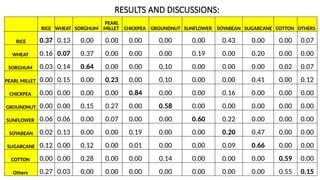
RESULTS AND DISCUSSIONS:
RICE WHEAT SORGHUM
PEARL
MILLET CHICKPEA GROUNDNUT SUNFLOWER SOYABEAN SUGARCANE COTTON OTHERS
RICE 0.37 0.13 0.00 0.00 0.00 0.00 0.00 0.43 0.00 0.00 0.07
WHEAT 0.16 0.07 0.37 0.00 0.00 0.00 0.19 0.00 0.20 0.00 0.00
SORGHUM 0.03 0.14 0.64 0.00 0.00 0.10 0.00 0.00 0.00 0.02 0.07
PEARL MILLET 0.00 0.15 0.00 0.23 0.00 0.10 0.00 0.00 0.41 0.00 0.12
CHICKPEA 0.00 0.00 0.00 0.00 0.84 0.00 0.00 0.16 0.00 0.00 0.00
GROUNDNUT 0.00 0.00 0.15 0.27 0.00 0.58 0.00 0.00 0.00 0.00 0.00
SUNFLOWER 0.06 0.06 0.00 0.07 0.00 0.00 0.60 0.22 0.00 0.00 0.00
SOYABEAN 0.02 0.13 0.00 0.00 0.19 0.00 0.00 0.20 0.47 0.00 0.00
SUGARCANE 0.12 0.00 0.12 0.00 0.01 0.00 0.00 0.09 0.66 0.00 0.00
COTTON 0.00 0.00 0.28 0.00 0.00 0.14 0.00 0.00 0.00 0.59 0.00
Others 0.27 0.03 0.00 0.00 0.00 0.00 0.00 0.00 0.00 0.55 0.15
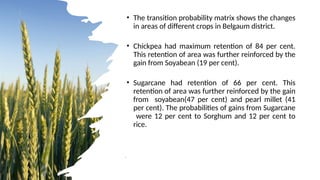
• The transition probability matrix shows the changes
in areas of different crops in Belgaum district.
• Chickpea had maximum retention of 84 per cent.
This retention of area was further reinforced by the
gain from Soyabean (19 per cent).
• Sugarcane had retention of 66 per cent. This
retention of area was further reinforced by the gain
from soyabean(47 per cent) and pearl millet (41
per cent). The probabilities of gains from Sugarcane
were 12 per cent to Sorghum and 12 per cent to
rice.
•
• Sorghum had retention of 64 per cent. This
retention of area was further reinforced by the gain
from cotton(28 per cent) and sugarcane (12 per
cent). The probabilities of gains from sorghum
were 14 per cent to wheat and 7 per cent to others.
(Finger millet, pigeon pea, sesamum, rapeseed,
mustard, safflower, castor, linseed and onion)
• Groundnut had retention of 58 per cent. This
retention of area was further reinforced by the gain
of 14 per cent from cotton and 10 per cent from
sorghum and pearl millet. The probability of gain
from Groundnut were 27 per cent to pearl millet
and 14 per cent to Sorghum.
• Cotton had retention of 59 per cent. This retention
of area was further reinforced by the gain from
others 55 per cent.
Conclusions:
• The chickpea had a maximum retention area of 84 per cent and gained 19
per cent area from soyabean.
• Sugarcane which is important commercial crop had a retained area of 66
per cent and gained 41 per cent area from pearl millet and 47 per cent
area from soyabean
• Rice had a retained only 37 per cent of its area and lost 43 per cent area
to soyabean.
• Maximum retention was observed in groundnut and sugarcane and also
sugarcane, soyabean and cotton are the emerging crops of Belgaum.
THANK YOU

Analyzing Crop Shift in Belgaum using Markov Chain Analysis..pptx

  • 1.
    ANALYZING CROP SHIFT INBELGAUM USING MARKOV CHAIN ANALYSIS. SESHA SAI K BAM-21-71, Agricultural Collage, Bapatla Co authors:- Dr. K.N Sreenivasulu , Dr. V. Srinivas Rao
  • 2.
    INTRODUCTION •Agriculture is continuedto play an important role for poverty alleviation in India, even in the era of economic liberalization and globalization. •More than 70 per cent of India’s population lives in rural areas where the occupation is agriculture. •Indian agriculture is characterized by small farm holdings. The average farm size is only 1.57 hectares. •Crop diversification is intended to give a wider choice in the production of a variety of crops in a given area so as to expand production related activities on various crops and also to lessen risk.
  • 3.
    • Crop diversificationin India and also in Andhra Pradesh is generally viewed as a shift from traditionally grown, less remunerative crops to more remunerative crops. • The crop shift also takes place due to government policies and thrust on some crops over a given time, for example creation of the Technology Mission on Oilseeds (TMO) to give thrust on oilseeds production as a national need for the country’s requirement for less dependency on imports. • Market infrastructure development and certain other price related supports also induce crop shift often low value to high value commercial crops. Crop diversification was generally practiced in rain fed lands to reduce the risk factor of crop failures due to drought
  • 4.
    •MATERIALS AND METHODS: TheStudy was focused on Belgaum, Karnataka, India. The secondary data was collected from 1995-2021 of major crops. •STATISTICAL PROCEDURE: MARKOV CHAIN ANALYSIS. •The Markov process was used to study the shifts in the cropping pattern and thereby gain an understanding about the dynamics of the changes. Markov chain analysis was carried out for a period from 1995 to 2021.
  • 5.
    RESULTS AND DISCUSSIONS: RICEWHEAT SORGHUM PEARL MILLET CHICKPEA GROUNDNUT SUNFLOWER SOYABEAN SUGARCANE COTTON OTHERS RICE 0.37 0.13 0.00 0.00 0.00 0.00 0.00 0.43 0.00 0.00 0.07 WHEAT 0.16 0.07 0.37 0.00 0.00 0.00 0.19 0.00 0.20 0.00 0.00 SORGHUM 0.03 0.14 0.64 0.00 0.00 0.10 0.00 0.00 0.00 0.02 0.07 PEARL MILLET 0.00 0.15 0.00 0.23 0.00 0.10 0.00 0.00 0.41 0.00 0.12 CHICKPEA 0.00 0.00 0.00 0.00 0.84 0.00 0.00 0.16 0.00 0.00 0.00 GROUNDNUT 0.00 0.00 0.15 0.27 0.00 0.58 0.00 0.00 0.00 0.00 0.00 SUNFLOWER 0.06 0.06 0.00 0.07 0.00 0.00 0.60 0.22 0.00 0.00 0.00 SOYABEAN 0.02 0.13 0.00 0.00 0.19 0.00 0.00 0.20 0.47 0.00 0.00 SUGARCANE 0.12 0.00 0.12 0.00 0.01 0.00 0.00 0.09 0.66 0.00 0.00 COTTON 0.00 0.00 0.28 0.00 0.00 0.14 0.00 0.00 0.00 0.59 0.00 Others 0.27 0.03 0.00 0.00 0.00 0.00 0.00 0.00 0.00 0.55 0.15
  • 6.
    • The transitionprobability matrix shows the changes in areas of different crops in Belgaum district. • Chickpea had maximum retention of 84 per cent. This retention of area was further reinforced by the gain from Soyabean (19 per cent). • Sugarcane had retention of 66 per cent. This retention of area was further reinforced by the gain from soyabean(47 per cent) and pearl millet (41 per cent). The probabilities of gains from Sugarcane were 12 per cent to Sorghum and 12 per cent to rice. •
  • 7.
    • Sorghum hadretention of 64 per cent. This retention of area was further reinforced by the gain from cotton(28 per cent) and sugarcane (12 per cent). The probabilities of gains from sorghum were 14 per cent to wheat and 7 per cent to others. (Finger millet, pigeon pea, sesamum, rapeseed, mustard, safflower, castor, linseed and onion) • Groundnut had retention of 58 per cent. This retention of area was further reinforced by the gain of 14 per cent from cotton and 10 per cent from sorghum and pearl millet. The probability of gain from Groundnut were 27 per cent to pearl millet and 14 per cent to Sorghum. • Cotton had retention of 59 per cent. This retention of area was further reinforced by the gain from others 55 per cent.
  • 8.
    Conclusions: • The chickpeahad a maximum retention area of 84 per cent and gained 19 per cent area from soyabean. • Sugarcane which is important commercial crop had a retained area of 66 per cent and gained 41 per cent area from pearl millet and 47 per cent area from soyabean • Rice had a retained only 37 per cent of its area and lost 43 per cent area to soyabean. • Maximum retention was observed in groundnut and sugarcane and also sugarcane, soyabean and cotton are the emerging crops of Belgaum.
  • 9.