Application of Advanced Machine Learning
Methods for Crop Image Classification
G. Amrutha Lakshmi
BAM/22-075
M.Sc. (Ag) Statistics
CONTENTS
• Basic terms
• Description of the dataset
• ResNet Architecture
• ResNet + K-Nearest Neighbor
• ResNet + Support Vector Machine
• ResNet + Neural Network
• ResNet + Decision Tree
• ResNet + Random Forest
• ResNet + Naive Bayes Classifier
• Roboflow
• Yolo v5
Basic terms
• Machine Learning: Machine learning is a subset of artificial intelligence (AI)
that involves algorithms and data that automatically analyze and make decisions
by itself without human intervention.
• Image classification: Image classification is the task of assigning a label to an
image from a predefined set of categories.
• Performance metrics
• Accuracy: TP/ [TP+FP+FN+FP]
• Precision: TP/ [TP+FP]
• Recall: TP/ [TP+FN]
• F1 score: 2 x [precision x recall] / [precision + recall]
• ROC AUC: Measures the ability of the model to distinguish between classes
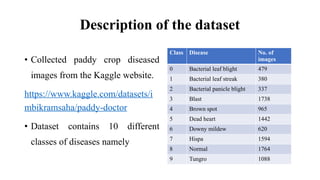
Description of the dataset
• Collected paddy crop diseased
images from the Kaggle website.
https://www.kaggle.com/datasets/i
mbikramsaha/paddy-doctor
• Dataset contains 10 different
classes of diseases namely
Class Disease No. of
images
0 Bacterial leaf blight 479
1 Bacterial leaf streak 380
2 Bacterial panicle blight 337
3 Blast 1738
4 Brown spot 965
5 Dead heart 1442
6 Downy mildew 620
7 Hispa 1594
8 Normal 1764
9 Tungro 1088
ResNet Architecture
• ResNet, short for Residual Network, is a deep convolutional neural network
architecture.
• It enables the training of models with hundreds or even thousands of layers,
leading to significant improvements in performance.
• Feature extraction using ResNet-50 involves utilizing the pre-trained ResNet-50
model to extract high-level features from input images.
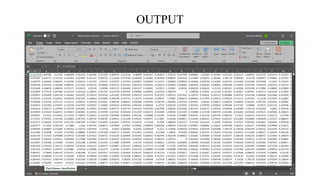
OUTPUT
ResNet + K-Nearest Neighbor
• kNN, also known as a lazy or instance-based learning method is a simple and
popular supervised ML method.
• The theory behind kNN is that the algorithm finds k samples based on the distance
values that are nearest to the new test samples. The label of each test sample is
determined by the majority of votes of its k nearest neighbors.
• Hence, k is the main hyperparameter in this classifier and needs to be tuned as it
directly affects the model’s performance.
• Now, combining ResNet with a K-Nearest Neighbors (KNN) classifier forms a
powerful hybrid approach for tasks such as image classification. In this setup,
ResNet is used for feature extraction. Once the features are extracted using
ResNet, they can be fed into a KNN classifier for the actual classification task.
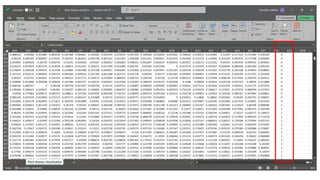
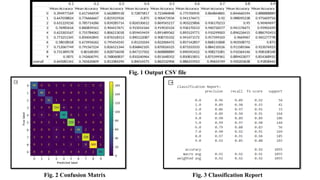
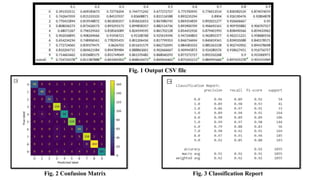
Fig. 1 Output CSV file
Fig. 2 Confusion Matrix Fig. 3 Classification Report
0.1 0.2 0.3 0.4 0.5 0.6 0.7 0.8 0.9
Mean Accuracy Mean Accuracy Mean Accuracy Mean Accuracy Mean Accuracy Mean Accuracy Mean Accuracy Mean Accuracy Mean Accuracy
0 0.394977169 0.617346939 0.662889518 0.72875817 0.723484848 0.775700935 0.864864865 0.844660194 0.888888889
1 0.647058824 0.776666667 0.825925926 0.875 0.900473934 0.941176471 0.92 0.988095238 0.975609756
2 0.631229236 0.785714286 0.839285714 0.826530612 0.869565217 0.903225806 0.936170213 0.95 0.96969697
3 0.76985616 0.860839161 0.904417671 0.915014164 0.919010124 0.936170213 0.940726577 0.941176471 0.93902439
4 0.623303167 0.755784062 0.806213018 0.859459459 0.891489362 0.893129771 0.910299003 0.896226415 0.886792453
5 0.773251345 0.850042845 0.876318313 0.890122087 0.908735332 0.941471572 0.957399103 0.9669967 0.965277778
6 0.58018018 0.673956262 0.795454545 0.81233244 0.822006472 0.857142857 0.868131868 0.903508772 0.875
7 0.712067749 0.791567224 0.826521344 0.836842105 0.870026525 0.873333333 0.884210526 0.911585366 0.923076923
8 0.731389578 0.80168185 0.828756058 0.847157502 0.868888889 0.890392422 0.908273381 0.910364146 0.908108108
9 0.5875 0.742606791 0.768060837 0.810240964 0.851648352 0.850815851 0.875399361 0.889423077 0.854368932
overall 0.645081341 0.765620609 0.813384294 0.84014575 0.862532906 0.886255923 0.90654749 0.920203638 0.91858442
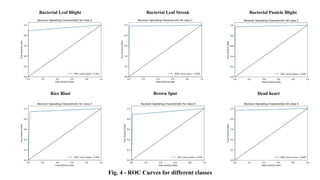
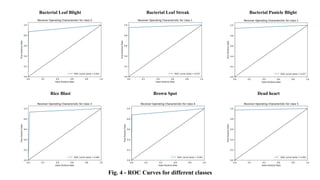
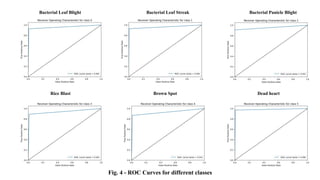
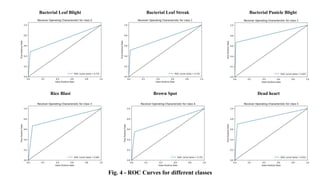
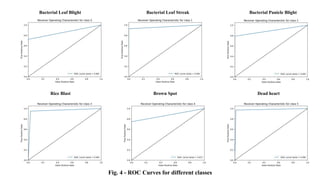
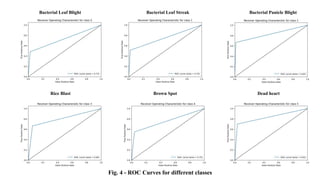
Bacterial Leaf Blight Bacterial Leaf Streak Bacterial Panicle Blight
Rice Blast Brown Spot Dead heart
Fig. 4 - ROC Curves for different classes
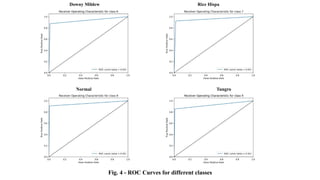
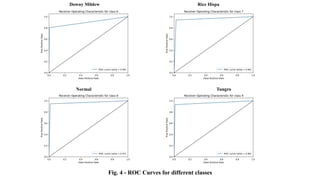
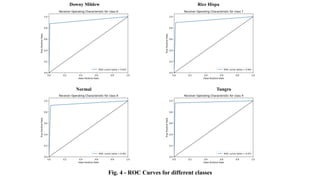
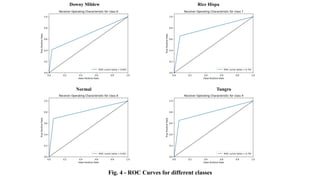
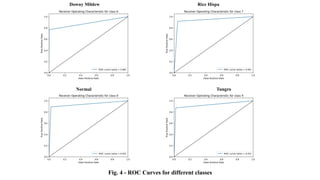
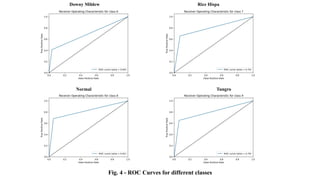
Downy Mildew Rice Hispa
Normal Tungro
Fig. 4 - ROC Curves for different classes
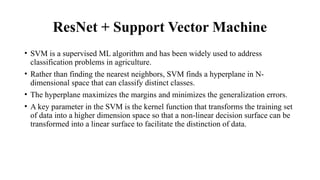
ResNet + Support Vector Machine
• SVM is a supervised ML algorithm and has been widely used to address
classification problems in agriculture.
• Rather than finding the nearest neighbors, SVM finds a hyperplane in N-
dimensional space that can classify distinct classes.
• The hyperplane maximizes the margins and minimizes the generalization errors.
• A key parameter in the SVM is the kernel function that transforms the training set
of data into a higher dimension space so that a non-linear decision surface can be
transformed into a linear surface to facilitate the distinction of data.
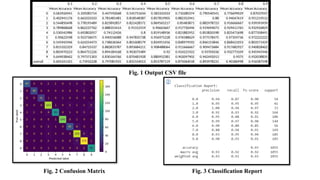
Fig. 1 Output CSV file
Fig. 2 Confusion Matrix Fig. 3 Classification Report
0.1 0.2 0.3 0.4 0.5 0.6 0.7 0.8 0.9
Mean Accuracy Mean Accuracy Mean Accuracy Mean Accuracy Mean Accuracy Mean Accuracy Mean Accuracy Mean Accuracy Mean Accuracy
0 0.063926941 0.339285714 0.447592068 0.545751634 0.583333333 0.710280374 0.790540541 0.776699029 0.87037037
1 0.402941176 0.663333333 0.781481481 0.818548387 0.857819905 0.882352941 0.88 0.94047619 0.951219512
2 0.544850498 0.778195489 0.825892857 0.821428571 0.869565217 0.85483871 0.882978723 0.916666667 0.939393939
3 0.789868668 0.862237762 0.888353414 0.91312559 0.90663667 0.917730496 0.919694073 0.929411765 0.932926829
4 0.530542986 0.692802057 0.74112426 0.8 0.819148936 0.821882952 0.853820598 0.825471698 0.877358491
5 0.90622598 0.923736075 0.940556088 0.947835738 0.956975228 0.976588629 0.977578475 0.97359736 0.972222222
6 0.545945946 0.624254473 0.738636364 0.801608579 0.834951456 0.848979592 0.846153846 0.868421053 0.803571429
7 0.815102329 0.84725537 0.882833787 0.893684211 0.908488064 0.911666667 0.909473684 0.917682927 0.940828402
8 0.803970223 0.864751226 0.894184168 0.903075489 0.92 0.924221922 0.93705036 0.932773109 0.945945946
9 0.649038462 0.797371303 0.830164766 0.870481928 0.880952381 0.902097902 0.942492013 0.9375 0.932038835
overall 0.605241321 0.73932228 0.797081925 0.831554013 0.853787119 0.875064018 0.893978231 0.90186998 0.916587598
Bacterial Leaf Blight Bacterial Leaf Streak Bacterial Panicle Blight
Rice Blast Brown Spot Dead heart
Fig. 4 - ROC Curves for different classes
Downy Mildew Rice Hispa
Normal Tungro
Fig. 4 - ROC Curves for different classes
ResNet + Neural Network
•A neural network classifier is a fundamental component of modern machine learning and artificial
intelligence systems, particularly in the field of supervised learning.
•Its computational models are inspired by the structure and functioning of biological neurons in the
human brain.
•The architecture of a neural network classifier typically consists of multiple interconnected layers
of neurons. These layers can be broadly categorized into three types: input layer, hidden layers and
output layer.
•At its core, a neural network classifier is designed to recognize patterns and make predictions
from input data.
•It learns to map input features to corresponding output labels through a process known as training.
•During training, the neural network adjusts its internal parameters (weights and biases) based on
the input-output pairs provided in a labeled dataset, to minimize the difference between its predictions
and the true labels.
Fig. 1 Output CSV file
Fig. 2 Confusion Matrix Fig. 3 Classification Report
0.1 0.2 0.3 0.4 0.5 0.6 0.7 0.8 0.9
0 0.391552511 0.609183673 0.72776204 0.744771242 0.677272727 0.775700935 0.776013514 0.830582524 0.874074074
1 0.742647059 0.815333333 0.84537037 0.83608871 0.831516588 0.893235294 0.8904 0.926190476 0.92804878
2 0.770431894 0.819548872 0.861830357 0.856632653 0.867080745 0.869354839 0.892021277 0.926666667 0.95
3 0.808036273 0.873426573 0.893293173 0.899858357 0.882114736 0.893900709 0.906692161 0.909705882 0.906707317
4 0.68071267 0.796529563 0.818565089 0.824594595 0.861702128 0.854452926 0.879401993 0.858490566 0.859433962
5 0.902036895 0.908269066 0.91936721 0.92108768 0.925619296 0.947240803 0.962892377 0.962211221 0.958680556
6 0.654234234 0.748906561 0.778295455 0.801206434 0.817799353 0.846734694 0.840659341 0.839035088 0.840178571
7 0.772724065 0.839379475 0.8626703 0.851631579 0.862732095 0.884583333 0.885263158 0.902743902 0.894378698
8 0.810204715 0.869621584 0.894789984 0.888863001 0.902666667 0.909945873 0.924280576 0.918627451 0.916756757
9 0.714663462 0.833680175 0.831749049 0.861370482 0.868040293 0.877272727 0.892332268 0.9 0.923300971
overall 0.724724378 0.811387888 0.843369303 0.848610473 0.849654463 0.875242213 0.884995666 0.897425378 0.905155969
Bacterial Leaf Blight Bacterial Leaf Streak Bacterial Panicle Blight
Rice Blast Brown Spot Dead heart
Fig. 4 - ROC Curves for different classes
Downy Mildew Rice Hispa
Normal Tungro
Fig. 4 - ROC Curves for different classes
ResNet + Decision Tree
• A decision tree is a powerful and popular tool used in various fields, including machine
learning, statistics, and data mining, to make decisions based on input data.
• It is a flowchart-like structure where each internal node represents a "test" on an attribute
(feature), each branch represents the outcome of the test, and each leaf node represents a
class label or a decision.
• The process of creating a decision tree involves selecting the best attribute at each node to
split the data into subsets that are as homogeneous as possible in terms of the target
variable (e.g., class labels).
• This process is typically guided by measures such as information gain, Gini impurity, or
entropy, which quantify the effectiveness of each attribute in splitting the data.
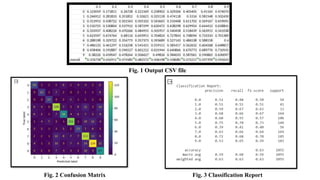
Fig. 1 Output CSV file
Fig. 2 Confusion Matrix Fig. 3 Classification Report
0.1 0.2 0.3 0.4 0.5 0.6 0.7 0.8 0.9
0 0.123059 0.171811 0.26728 0.221569 0.258902 0.329206 0.405405 0.41165 0.474074
1 0.246912 0.281833 0.351852 0.32621 0.325118 0.474118 0.5316 0.581548 0.502439
2 0.313953 0.438722 0.501563 0.505102 0.563665 0.533468 0.611702 0.569167 0.659091
3 0.510725 0.530804 0.537912 0.587299 0.620472 0.638298 0.629924 0.644412 0.658841
4 0.333937 0.408226 0.470266 0.484955 0.505957 0.540458 0.518439 0.563915 0.541038
5 0.623597 0.674764 0.68116 0.693951 0.704824 0.727843 0.748094 0.733333 0.701389
6 0.288198 0.329722 0.354773 0.357373 0.393689 0.527143 0.486538 0.588158 0.4
7 0.486133 0.461297 0.516258 0.541421 0.559151 0.585417 0.562632 0.604268 0.648817
8 0.458406 0.592887 0.596527 0.601212 0.631944 0.640866 0.670773 0.689776 0.710541
9 0.38226 0.439047 0.478264 0.506627 0.49826 0.584033 0.587061 0.590865 0.630097
overall 0.376718 0.432911 0.475585 0.482572 0.506198 0.558085 0.575217 0.597709 0.592633
Bacterial Leaf Blight Bacterial Leaf Streak Bacterial Panicle Blight
Rice Blast Brown Spot Dead heart
Fig. 4 - ROC Curves for different classes
Downy Mildew Rice Hispa
Normal Tungro
Fig. 4 - ROC Curves for different classes
ResNet + Random Forest
• Random Forest is a powerful and versatile ensemble learning method that is
widely used for both classification and regression tasks in machine learning.
• It is an extension of decision tree algorithms and operates by constructing a
multitude of decision trees during training and outputting the mode (for
classification) or mean prediction (for regression) of the individual trees.
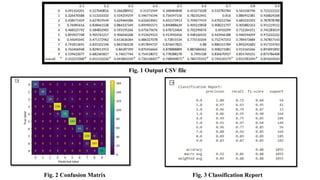
Fig. 1 Output CSV file
Fig. 2 Confusion Matrix Fig. 3 Classification Report
0.1 0.2 0.3 0.4 0.5 0.6 0.7 0.8 0.9
0 0.091324201 0.227040816 0.266288952 0.31372549 0.348484848 0.453271028 0.533783784 0.563106796 0.722222222
1 0.326470588 0.513333333 0.559259259 0.596774194 0.734597156 0.782352941 0.816 0.880952381 0.926829268
2 0.428571429 0.627819549 0.629464286 0.632653061 0.652173913 0.709677419 0.670212766 0.683333333 0.787878788
3 0.76985616 0.838461538 0.884337349 0.899905571 0.890888639 0.909219858 0.908221797 0.905882353 0.951219512
4 0.468325792 0.584832905 0.593195266 0.675675676 0.678723404 0.702290076 0.6910299 0.712264151 0.745283019
5 0.893927748 0.905741217 0.906040268 0.913429523 0.913950456 0.948160535 0.943946188 0.940594059 0.972222222
6 0.45045045 0.471172962 0.613636364 0.686327078 0.72815534 0.775510204 0.752747253 0.789473684 0.767857143
7 0.791813691 0.835322196 0.863760218 0.857894737 0.876657825 0.88 0.886315789 0.893292683 0.917159763
8 0.762406948 0.829011913 0.86187399 0.870456664 0.878888889 0.887686062 0.908273381 0.913165266 0.891891892
9 0.539423077 0.682365827 0.74017744 0.754518072 0.778388278 0.7995338 0.830670927 0.855769231 0.873786408
overall 0.552257008 0.651510226 0.691803339 0.720136007 0.748090875 0.784770192 0.794120179 0.813783394 0.855635024
Bacterial Leaf Blight Bacterial Leaf Streak Bacterial Panicle Blight
Rice Blast Brown Spot Dead heart
Fig. 4 - ROC Curves for different classes
Downy Mildew Rice Hispa
Normal Tungro
Fig. 4 - ROC Curves for different classes
ResNet + Naive Bayes Classifier
•Naive Bayes classifier is a simple yet powerful probabilistic model commonly used in
machine learning for classification tasks, including image classification.
•The "naive" assumption underlying the model is that the features are conditionally
independent given the class label, meaning that the presence or absence of one feature does not
affect the presence or absence of another feature.
•In image classification, the Naive Bayes classifier can be applied by considering a set of
predefined features extracted from the image as independent variables. It calculates the probability
of each class given the extracted features using Bayes' theorem. The class with the highest
probability is then assigned as the predicted label for the image.
•Despite its simplicity and the naive assumption of feature independence, the Naive Bayes
classifier can yield surprisingly accurate results in image classification tasks.
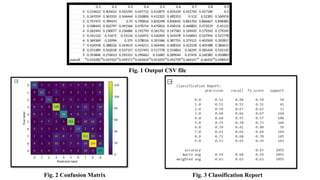
Fig. 1 Output CSV file
Fig. 2 Confusion Matrix Fig. 3 Classification Report
0.1 0.2 0.3 0.4 0.5 0.6 0.7 0.8 0.9
0 0.214612 0.405612 0.410765 0.447712 0.412879 0.425234 0.452703 0.427184 0.5
1 0.347059 0.363333 0.344444 0.350806 0.412322 0.482353 0.512 0.52381 0.560976
2 0.757475 0.789474 0.75 0.790816 0.832298 0.830645 0.861702 0.866667 0.848485
3 0.508443 0.502797 0.491566 0.478754 0.475816 0.458156 0.460803 0.473529 0.45122
4 0.262443 0.230077 0.236686 0.192793 0.161702 0.147583 0.169435 0.179245 0.179245
5 0.541122 0.51671 0.53116 0.524972 0.520209 0.543478 0.544843 0.537954 0.527778
6 0.369369 0.33996 0.375 0.378016 0.391586 0.387755 0.379121 0.403509 0.392857
7 0.426958 0.388226 0.419619 0.444211 0.469496 0.408333 0.423158 0.405488 0.384615
8 0.551489 0.562018 0.537157 0.527493 0.517778 0.554804 0.56295 0.585434 0.535135
9 0.353846 0.276013 0.295311 0.290663 0.31685 0.289044 0.27476 0.240385 0.203883
overall 0.433282 0.437422 0.439171 0.442624 0.451093 0.452739 0.464147 0.46432 0.458419
Bacterial Leaf Blight Bacterial Leaf Streak Bacterial Panicle Blight
Rice Blast Brown Spot Dead heart
Fig. 4 - ROC Curves for different classes
Downy Mildew Rice Hispa
Normal Tungro
Fig. 4 - ROC Curves for different classes
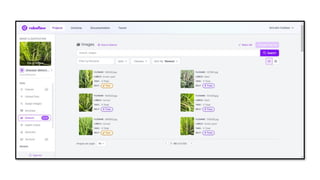
Roboflow
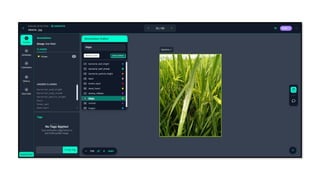
•Roboflow is a comprehensive platform designed to streamline and automate
the process of labeling images, a crucial step in developing machine learning
models, particularly for computer vision tasks.
•Image labeling involves annotating images with bounding boxes, polygons,
key points, or other markers to identify and delineate objects or regions of interest
within the images. These annotations serve as ground truth labels for training
machine learning models to recognize and understand visual content accurately.
•Overall, Roboflow simplifies and accelerates the image labeling process
through its intuitive interface and a suite of powerful tools. It accelerates the
development and deployment of machine learning models for a wide range of
applications in computer vision.
Yolo v5
• YOLO (You Only Look Once) v5 is a state-of-the-art deep learning architecture
primarily designed for object detection tasks, but it can also be adapted for image
classification.
• By modifying the output layer of the model to predict class probabilities for a
given set of classes instead of bounding boxes, YOLO v5 can serve as a powerful
image classifier.
• This adaptation enables YOLO v5 to leverage its efficient architecture and robust
feature extraction capabilities for accurate image classification tasks. With its
efficient architecture and robust feature extraction capabilities, YOLO v5 offers
high accuracy and speed in image classification tasks across various domains.
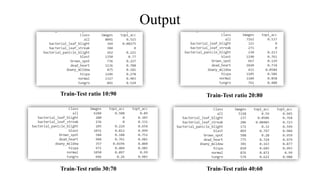
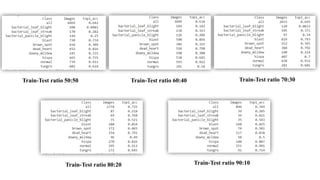
Output
Train-Test ratio 10:90 Train-Test ratio 20:80
Train-Test ratio 30:70 Train-Test ratio 40:60
Train-Test ratio 50:50 Train-Test ratio 60:40 Train-Test ratio 70:30
Train-Test ratio 80:20 Train-Test ratio 90:10
Thank you…

Application of Advanced Machine Learning Methods for Crop Image Classification .pptx

  • 1.
    Application of AdvancedMachine Learning Methods for Crop Image Classification G. Amrutha Lakshmi BAM/22-075 M.Sc. (Ag) Statistics
  • 2.
    CONTENTS • Basic terms •Description of the dataset • ResNet Architecture • ResNet + K-Nearest Neighbor • ResNet + Support Vector Machine • ResNet + Neural Network • ResNet + Decision Tree • ResNet + Random Forest • ResNet + Naive Bayes Classifier • Roboflow • Yolo v5
  • 3.
    Basic terms • MachineLearning: Machine learning is a subset of artificial intelligence (AI) that involves algorithms and data that automatically analyze and make decisions by itself without human intervention. • Image classification: Image classification is the task of assigning a label to an image from a predefined set of categories. • Performance metrics • Accuracy: TP/ [TP+FP+FN+FP] • Precision: TP/ [TP+FP] • Recall: TP/ [TP+FN] • F1 score: 2 x [precision x recall] / [precision + recall] • ROC AUC: Measures the ability of the model to distinguish between classes
  • 4.
    Description of thedataset • Collected paddy crop diseased images from the Kaggle website. https://www.kaggle.com/datasets/i mbikramsaha/paddy-doctor • Dataset contains 10 different classes of diseases namely Class Disease No. of images 0 Bacterial leaf blight 479 1 Bacterial leaf streak 380 2 Bacterial panicle blight 337 3 Blast 1738 4 Brown spot 965 5 Dead heart 1442 6 Downy mildew 620 7 Hispa 1594 8 Normal 1764 9 Tungro 1088
  • 5.
    ResNet Architecture • ResNet,short for Residual Network, is a deep convolutional neural network architecture. • It enables the training of models with hundreds or even thousands of layers, leading to significant improvements in performance. • Feature extraction using ResNet-50 involves utilizing the pre-trained ResNet-50 model to extract high-level features from input images.
  • 6.
  • 8.
    ResNet + K-NearestNeighbor • kNN, also known as a lazy or instance-based learning method is a simple and popular supervised ML method. • The theory behind kNN is that the algorithm finds k samples based on the distance values that are nearest to the new test samples. The label of each test sample is determined by the majority of votes of its k nearest neighbors. • Hence, k is the main hyperparameter in this classifier and needs to be tuned as it directly affects the model’s performance. • Now, combining ResNet with a K-Nearest Neighbors (KNN) classifier forms a powerful hybrid approach for tasks such as image classification. In this setup, ResNet is used for feature extraction. Once the features are extracted using ResNet, they can be fed into a KNN classifier for the actual classification task.
  • 9.
    Fig. 1 OutputCSV file Fig. 2 Confusion Matrix Fig. 3 Classification Report 0.1 0.2 0.3 0.4 0.5 0.6 0.7 0.8 0.9 Mean Accuracy Mean Accuracy Mean Accuracy Mean Accuracy Mean Accuracy Mean Accuracy Mean Accuracy Mean Accuracy Mean Accuracy 0 0.394977169 0.617346939 0.662889518 0.72875817 0.723484848 0.775700935 0.864864865 0.844660194 0.888888889 1 0.647058824 0.776666667 0.825925926 0.875 0.900473934 0.941176471 0.92 0.988095238 0.975609756 2 0.631229236 0.785714286 0.839285714 0.826530612 0.869565217 0.903225806 0.936170213 0.95 0.96969697 3 0.76985616 0.860839161 0.904417671 0.915014164 0.919010124 0.936170213 0.940726577 0.941176471 0.93902439 4 0.623303167 0.755784062 0.806213018 0.859459459 0.891489362 0.893129771 0.910299003 0.896226415 0.886792453 5 0.773251345 0.850042845 0.876318313 0.890122087 0.908735332 0.941471572 0.957399103 0.9669967 0.965277778 6 0.58018018 0.673956262 0.795454545 0.81233244 0.822006472 0.857142857 0.868131868 0.903508772 0.875 7 0.712067749 0.791567224 0.826521344 0.836842105 0.870026525 0.873333333 0.884210526 0.911585366 0.923076923 8 0.731389578 0.80168185 0.828756058 0.847157502 0.868888889 0.890392422 0.908273381 0.910364146 0.908108108 9 0.5875 0.742606791 0.768060837 0.810240964 0.851648352 0.850815851 0.875399361 0.889423077 0.854368932 overall 0.645081341 0.765620609 0.813384294 0.84014575 0.862532906 0.886255923 0.90654749 0.920203638 0.91858442
  • 10.
    Bacterial Leaf BlightBacterial Leaf Streak Bacterial Panicle Blight Rice Blast Brown Spot Dead heart Fig. 4 - ROC Curves for different classes
  • 11.
    Downy Mildew RiceHispa Normal Tungro Fig. 4 - ROC Curves for different classes
  • 12.
    ResNet + SupportVector Machine • SVM is a supervised ML algorithm and has been widely used to address classification problems in agriculture. • Rather than finding the nearest neighbors, SVM finds a hyperplane in N- dimensional space that can classify distinct classes. • The hyperplane maximizes the margins and minimizes the generalization errors. • A key parameter in the SVM is the kernel function that transforms the training set of data into a higher dimension space so that a non-linear decision surface can be transformed into a linear surface to facilitate the distinction of data.
  • 13.
    Fig. 1 OutputCSV file Fig. 2 Confusion Matrix Fig. 3 Classification Report 0.1 0.2 0.3 0.4 0.5 0.6 0.7 0.8 0.9 Mean Accuracy Mean Accuracy Mean Accuracy Mean Accuracy Mean Accuracy Mean Accuracy Mean Accuracy Mean Accuracy Mean Accuracy 0 0.063926941 0.339285714 0.447592068 0.545751634 0.583333333 0.710280374 0.790540541 0.776699029 0.87037037 1 0.402941176 0.663333333 0.781481481 0.818548387 0.857819905 0.882352941 0.88 0.94047619 0.951219512 2 0.544850498 0.778195489 0.825892857 0.821428571 0.869565217 0.85483871 0.882978723 0.916666667 0.939393939 3 0.789868668 0.862237762 0.888353414 0.91312559 0.90663667 0.917730496 0.919694073 0.929411765 0.932926829 4 0.530542986 0.692802057 0.74112426 0.8 0.819148936 0.821882952 0.853820598 0.825471698 0.877358491 5 0.90622598 0.923736075 0.940556088 0.947835738 0.956975228 0.976588629 0.977578475 0.97359736 0.972222222 6 0.545945946 0.624254473 0.738636364 0.801608579 0.834951456 0.848979592 0.846153846 0.868421053 0.803571429 7 0.815102329 0.84725537 0.882833787 0.893684211 0.908488064 0.911666667 0.909473684 0.917682927 0.940828402 8 0.803970223 0.864751226 0.894184168 0.903075489 0.92 0.924221922 0.93705036 0.932773109 0.945945946 9 0.649038462 0.797371303 0.830164766 0.870481928 0.880952381 0.902097902 0.942492013 0.9375 0.932038835 overall 0.605241321 0.73932228 0.797081925 0.831554013 0.853787119 0.875064018 0.893978231 0.90186998 0.916587598
  • 14.
    Bacterial Leaf BlightBacterial Leaf Streak Bacterial Panicle Blight Rice Blast Brown Spot Dead heart Fig. 4 - ROC Curves for different classes
  • 15.
    Downy Mildew RiceHispa Normal Tungro Fig. 4 - ROC Curves for different classes
  • 16.
    ResNet + NeuralNetwork •A neural network classifier is a fundamental component of modern machine learning and artificial intelligence systems, particularly in the field of supervised learning. •Its computational models are inspired by the structure and functioning of biological neurons in the human brain. •The architecture of a neural network classifier typically consists of multiple interconnected layers of neurons. These layers can be broadly categorized into three types: input layer, hidden layers and output layer. •At its core, a neural network classifier is designed to recognize patterns and make predictions from input data. •It learns to map input features to corresponding output labels through a process known as training. •During training, the neural network adjusts its internal parameters (weights and biases) based on the input-output pairs provided in a labeled dataset, to minimize the difference between its predictions and the true labels.
  • 17.
    Fig. 1 OutputCSV file Fig. 2 Confusion Matrix Fig. 3 Classification Report 0.1 0.2 0.3 0.4 0.5 0.6 0.7 0.8 0.9 0 0.391552511 0.609183673 0.72776204 0.744771242 0.677272727 0.775700935 0.776013514 0.830582524 0.874074074 1 0.742647059 0.815333333 0.84537037 0.83608871 0.831516588 0.893235294 0.8904 0.926190476 0.92804878 2 0.770431894 0.819548872 0.861830357 0.856632653 0.867080745 0.869354839 0.892021277 0.926666667 0.95 3 0.808036273 0.873426573 0.893293173 0.899858357 0.882114736 0.893900709 0.906692161 0.909705882 0.906707317 4 0.68071267 0.796529563 0.818565089 0.824594595 0.861702128 0.854452926 0.879401993 0.858490566 0.859433962 5 0.902036895 0.908269066 0.91936721 0.92108768 0.925619296 0.947240803 0.962892377 0.962211221 0.958680556 6 0.654234234 0.748906561 0.778295455 0.801206434 0.817799353 0.846734694 0.840659341 0.839035088 0.840178571 7 0.772724065 0.839379475 0.8626703 0.851631579 0.862732095 0.884583333 0.885263158 0.902743902 0.894378698 8 0.810204715 0.869621584 0.894789984 0.888863001 0.902666667 0.909945873 0.924280576 0.918627451 0.916756757 9 0.714663462 0.833680175 0.831749049 0.861370482 0.868040293 0.877272727 0.892332268 0.9 0.923300971 overall 0.724724378 0.811387888 0.843369303 0.848610473 0.849654463 0.875242213 0.884995666 0.897425378 0.905155969
  • 18.
    Bacterial Leaf BlightBacterial Leaf Streak Bacterial Panicle Blight Rice Blast Brown Spot Dead heart Fig. 4 - ROC Curves for different classes
  • 19.
    Downy Mildew RiceHispa Normal Tungro Fig. 4 - ROC Curves for different classes
  • 20.
    ResNet + DecisionTree • A decision tree is a powerful and popular tool used in various fields, including machine learning, statistics, and data mining, to make decisions based on input data. • It is a flowchart-like structure where each internal node represents a "test" on an attribute (feature), each branch represents the outcome of the test, and each leaf node represents a class label or a decision. • The process of creating a decision tree involves selecting the best attribute at each node to split the data into subsets that are as homogeneous as possible in terms of the target variable (e.g., class labels). • This process is typically guided by measures such as information gain, Gini impurity, or entropy, which quantify the effectiveness of each attribute in splitting the data.
  • 21.
    Fig. 1 OutputCSV file Fig. 2 Confusion Matrix Fig. 3 Classification Report 0.1 0.2 0.3 0.4 0.5 0.6 0.7 0.8 0.9 0 0.123059 0.171811 0.26728 0.221569 0.258902 0.329206 0.405405 0.41165 0.474074 1 0.246912 0.281833 0.351852 0.32621 0.325118 0.474118 0.5316 0.581548 0.502439 2 0.313953 0.438722 0.501563 0.505102 0.563665 0.533468 0.611702 0.569167 0.659091 3 0.510725 0.530804 0.537912 0.587299 0.620472 0.638298 0.629924 0.644412 0.658841 4 0.333937 0.408226 0.470266 0.484955 0.505957 0.540458 0.518439 0.563915 0.541038 5 0.623597 0.674764 0.68116 0.693951 0.704824 0.727843 0.748094 0.733333 0.701389 6 0.288198 0.329722 0.354773 0.357373 0.393689 0.527143 0.486538 0.588158 0.4 7 0.486133 0.461297 0.516258 0.541421 0.559151 0.585417 0.562632 0.604268 0.648817 8 0.458406 0.592887 0.596527 0.601212 0.631944 0.640866 0.670773 0.689776 0.710541 9 0.38226 0.439047 0.478264 0.506627 0.49826 0.584033 0.587061 0.590865 0.630097 overall 0.376718 0.432911 0.475585 0.482572 0.506198 0.558085 0.575217 0.597709 0.592633
  • 22.
    Bacterial Leaf BlightBacterial Leaf Streak Bacterial Panicle Blight Rice Blast Brown Spot Dead heart Fig. 4 - ROC Curves for different classes
  • 23.
    Downy Mildew RiceHispa Normal Tungro Fig. 4 - ROC Curves for different classes
  • 24.
    ResNet + RandomForest • Random Forest is a powerful and versatile ensemble learning method that is widely used for both classification and regression tasks in machine learning. • It is an extension of decision tree algorithms and operates by constructing a multitude of decision trees during training and outputting the mode (for classification) or mean prediction (for regression) of the individual trees.
  • 25.
    Fig. 1 OutputCSV file Fig. 2 Confusion Matrix Fig. 3 Classification Report 0.1 0.2 0.3 0.4 0.5 0.6 0.7 0.8 0.9 0 0.091324201 0.227040816 0.266288952 0.31372549 0.348484848 0.453271028 0.533783784 0.563106796 0.722222222 1 0.326470588 0.513333333 0.559259259 0.596774194 0.734597156 0.782352941 0.816 0.880952381 0.926829268 2 0.428571429 0.627819549 0.629464286 0.632653061 0.652173913 0.709677419 0.670212766 0.683333333 0.787878788 3 0.76985616 0.838461538 0.884337349 0.899905571 0.890888639 0.909219858 0.908221797 0.905882353 0.951219512 4 0.468325792 0.584832905 0.593195266 0.675675676 0.678723404 0.702290076 0.6910299 0.712264151 0.745283019 5 0.893927748 0.905741217 0.906040268 0.913429523 0.913950456 0.948160535 0.943946188 0.940594059 0.972222222 6 0.45045045 0.471172962 0.613636364 0.686327078 0.72815534 0.775510204 0.752747253 0.789473684 0.767857143 7 0.791813691 0.835322196 0.863760218 0.857894737 0.876657825 0.88 0.886315789 0.893292683 0.917159763 8 0.762406948 0.829011913 0.86187399 0.870456664 0.878888889 0.887686062 0.908273381 0.913165266 0.891891892 9 0.539423077 0.682365827 0.74017744 0.754518072 0.778388278 0.7995338 0.830670927 0.855769231 0.873786408 overall 0.552257008 0.651510226 0.691803339 0.720136007 0.748090875 0.784770192 0.794120179 0.813783394 0.855635024
  • 26.
    Bacterial Leaf BlightBacterial Leaf Streak Bacterial Panicle Blight Rice Blast Brown Spot Dead heart Fig. 4 - ROC Curves for different classes
  • 27.
    Downy Mildew RiceHispa Normal Tungro Fig. 4 - ROC Curves for different classes
  • 28.
    ResNet + NaiveBayes Classifier •Naive Bayes classifier is a simple yet powerful probabilistic model commonly used in machine learning for classification tasks, including image classification. •The "naive" assumption underlying the model is that the features are conditionally independent given the class label, meaning that the presence or absence of one feature does not affect the presence or absence of another feature. •In image classification, the Naive Bayes classifier can be applied by considering a set of predefined features extracted from the image as independent variables. It calculates the probability of each class given the extracted features using Bayes' theorem. The class with the highest probability is then assigned as the predicted label for the image. •Despite its simplicity and the naive assumption of feature independence, the Naive Bayes classifier can yield surprisingly accurate results in image classification tasks.
  • 29.
    Fig. 1 OutputCSV file Fig. 2 Confusion Matrix Fig. 3 Classification Report 0.1 0.2 0.3 0.4 0.5 0.6 0.7 0.8 0.9 0 0.214612 0.405612 0.410765 0.447712 0.412879 0.425234 0.452703 0.427184 0.5 1 0.347059 0.363333 0.344444 0.350806 0.412322 0.482353 0.512 0.52381 0.560976 2 0.757475 0.789474 0.75 0.790816 0.832298 0.830645 0.861702 0.866667 0.848485 3 0.508443 0.502797 0.491566 0.478754 0.475816 0.458156 0.460803 0.473529 0.45122 4 0.262443 0.230077 0.236686 0.192793 0.161702 0.147583 0.169435 0.179245 0.179245 5 0.541122 0.51671 0.53116 0.524972 0.520209 0.543478 0.544843 0.537954 0.527778 6 0.369369 0.33996 0.375 0.378016 0.391586 0.387755 0.379121 0.403509 0.392857 7 0.426958 0.388226 0.419619 0.444211 0.469496 0.408333 0.423158 0.405488 0.384615 8 0.551489 0.562018 0.537157 0.527493 0.517778 0.554804 0.56295 0.585434 0.535135 9 0.353846 0.276013 0.295311 0.290663 0.31685 0.289044 0.27476 0.240385 0.203883 overall 0.433282 0.437422 0.439171 0.442624 0.451093 0.452739 0.464147 0.46432 0.458419
  • 30.
    Bacterial Leaf BlightBacterial Leaf Streak Bacterial Panicle Blight Rice Blast Brown Spot Dead heart Fig. 4 - ROC Curves for different classes
  • 31.
    Downy Mildew RiceHispa Normal Tungro Fig. 4 - ROC Curves for different classes
  • 32.
    Roboflow •Roboflow is acomprehensive platform designed to streamline and automate the process of labeling images, a crucial step in developing machine learning models, particularly for computer vision tasks. •Image labeling involves annotating images with bounding boxes, polygons, key points, or other markers to identify and delineate objects or regions of interest within the images. These annotations serve as ground truth labels for training machine learning models to recognize and understand visual content accurately. •Overall, Roboflow simplifies and accelerates the image labeling process through its intuitive interface and a suite of powerful tools. It accelerates the development and deployment of machine learning models for a wide range of applications in computer vision.
  • 37.
    Yolo v5 • YOLO(You Only Look Once) v5 is a state-of-the-art deep learning architecture primarily designed for object detection tasks, but it can also be adapted for image classification. • By modifying the output layer of the model to predict class probabilities for a given set of classes instead of bounding boxes, YOLO v5 can serve as a powerful image classifier. • This adaptation enables YOLO v5 to leverage its efficient architecture and robust feature extraction capabilities for accurate image classification tasks. With its efficient architecture and robust feature extraction capabilities, YOLO v5 offers high accuracy and speed in image classification tasks across various domains.
  • 38.
    Output Train-Test ratio 10:90Train-Test ratio 20:80 Train-Test ratio 30:70 Train-Test ratio 40:60
  • 39.
    Train-Test ratio 50:50Train-Test ratio 60:40 Train-Test ratio 70:30 Train-Test ratio 80:20 Train-Test ratio 90:10
  • 40.